Utagawa TOYOKUNI II (TOYOSHIGE) (1777-1835)


Click here to view image full size.

Meisho hakkei: Enoshima seiran “Eight Celebrated Views: Clearing Weather at Enoshima” in the oblong title cartouche and written below it: Koyurugi no iso Morokoshi ga hara “Koyurugi Strand and Morokoshi Plain.” Shows a view of the famous island from Shichiri Beach and Mount Fuji in the distance. The “Eight Views” theme originates from 11th century China and the scenery of the Xiao and Xiang Rivers made famous by the scholar-painter Song Di. Here Toyokuni sets the views in Kanagawa. Published by Iseya Rihei (Kinjudo) c early 1830s. There are two editions of this set: one with regular block script in title cartouche (as here), the other with cursive script. It is unclear which is the earliest. Cursive script is extremely difficult to read now but in 1830 it was no problem. Comparison between editions on some other designs in the set show them to be almost identical, consequently it seems that the two states are almost contemporaneous and which is earlier is a moot point.

Fine impression and colour with colour in title cartouche well retained. Fine condition. Signed Toyokuni hitsu.
Status: Available

Price:  £4,200


    Tags: , , ,


    Utagawa TOYOKUNI II (TOYOSHIGE) (1777-1835)


    Click here to view image full size.

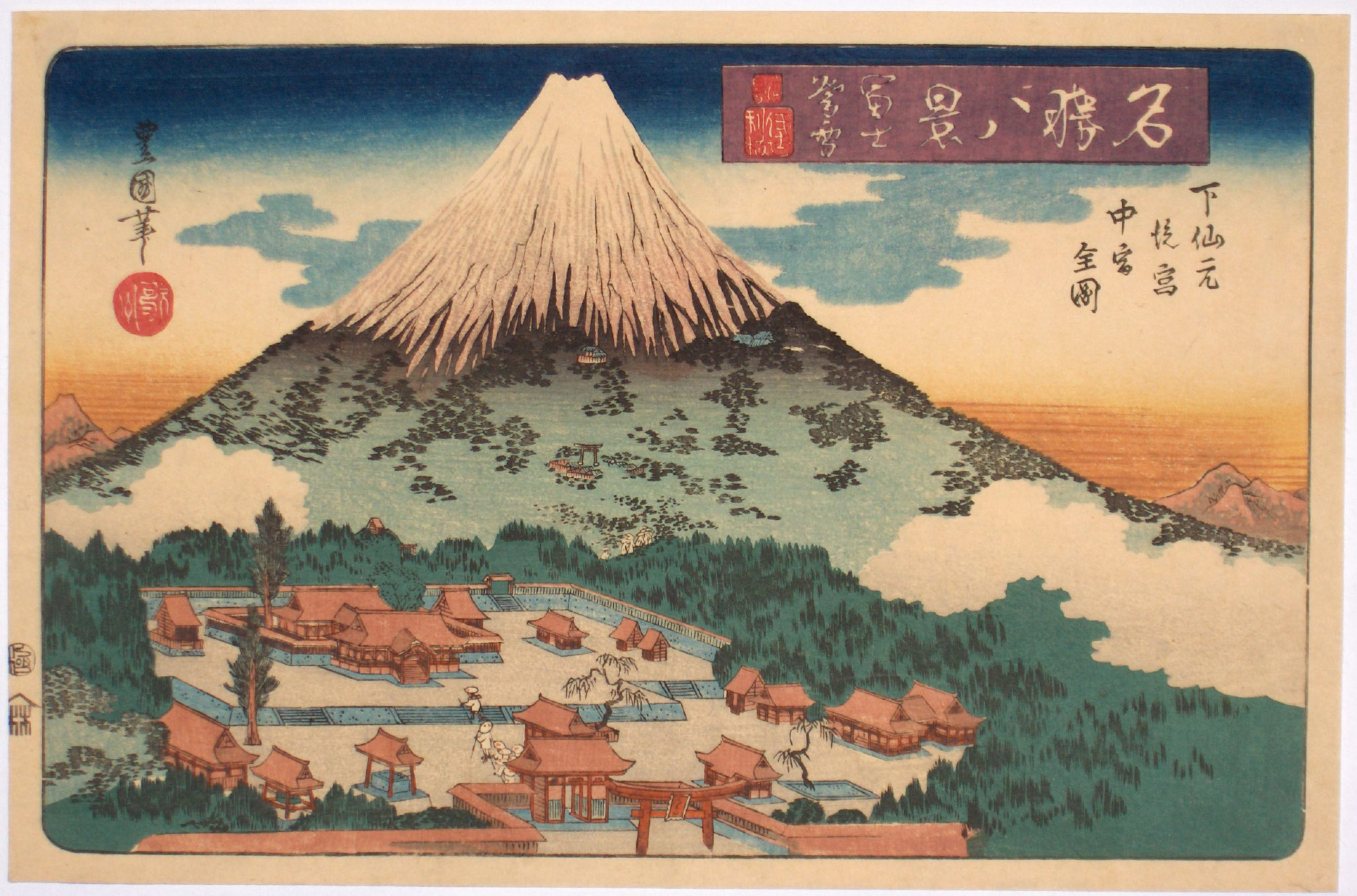
    Meisho hakkei: Fuji bosetsu, “Eight Celebrated Views: Evening Snow on Mount Fuji” in the oblong title cartouche and written below it: Shimo Sengen atomiya nakamiya zenzu, “Complete View of the Inner and Middle Shrines at Shimo Sengen.” A majestic Fuji towers over the shrines. The “Eight Views” theme originates from 11th century China and the scenery of the Xiao and Xiang Rivers made famous by the scholar-painter Song Di. Here Toyokuni sets the views in Kanagawa. Published by Iseya Rihei (Kinjudo) c early 1830s. There are two editions of this set: one with regular block script in title cartouche, the other with cursive script (as here). It is unclear which is the earliest. Cursive script is extremely difficult to read now but in 1830 it was no problem. Comparison between editions on some other designs in the set show them to be almost identical, consequently it seems that the two states are almost contemporaneous and which is earlier is a moot point.

    Fine impression and colour with colour in title cartouche well retained. Fine condition. Signed Toyokuni hitsu.
    Status: Available

    Price:  £6,800


      Tags: , , ,


      Utagawa TOYOKUNI II (TOYOSHIGE) (1777-1835)


      Click here to view image full size.

      Meisho hakkei: Miho rakugan “Eight Celebrated Views: Returning Geese at Miho” in the oblong title cartouche and written below it: Suruga Kiyomidera Yoshiwara enkei, “Distant View of Yoshiwara Station and Kiyomi Temple in Suruga Province.” A blind-printed Mount Fuji is seen on the horizon. The “Eight Views” theme originates from 11th century China and the scenery of the Xiao and Xiang Rivers made famous by the scholar-painter Song Di. Here Toyokuni sets the views in Kanagawa. Published by Iseya Rihei (Kinjudo) c early 1830s. There are two editions of this set: one with regular block script in title cartouche, the other with cursive script (as here). It is unclear which is the earliest. Cursive script is extremely difficult to read now but in 1830 it was no problem. Comparison between editions on some other designs in the set show them to be almost identical, consequently it seems that the two states are almost contemporaneous and which is earlier is a moot point.

      Fine impression and colour with colour in title cartouche well retained. Fine condition. Signed Toyokuni hitsu.
      Status: Available

      Price: £5,500


        Tags: , , ,


        Utagawa Toyokuni II (1777-1835)


        Click here to view image full size.

        An aizuri-e (blue print) showing the courtesan Utagawa of Tamaya admiring a bowl of carnations. From a set Bijin awase published by Shimizu, c. late 1820s. These blue prints using the imported bero, Berlin blue (what we called Prussian blue), became popular during the 1820s to 1840s as the cost came down.


        Fine impression and colour. Trimmed slightly, otherwise very good condition. Signed Toyokuni ga.


        Status: Available

        Price:  £2,200


          Tags: , ,


          Utagawa TOYOKUNI II (TOYOSHIGE) (1777-1835)


           Click here to view image full size.

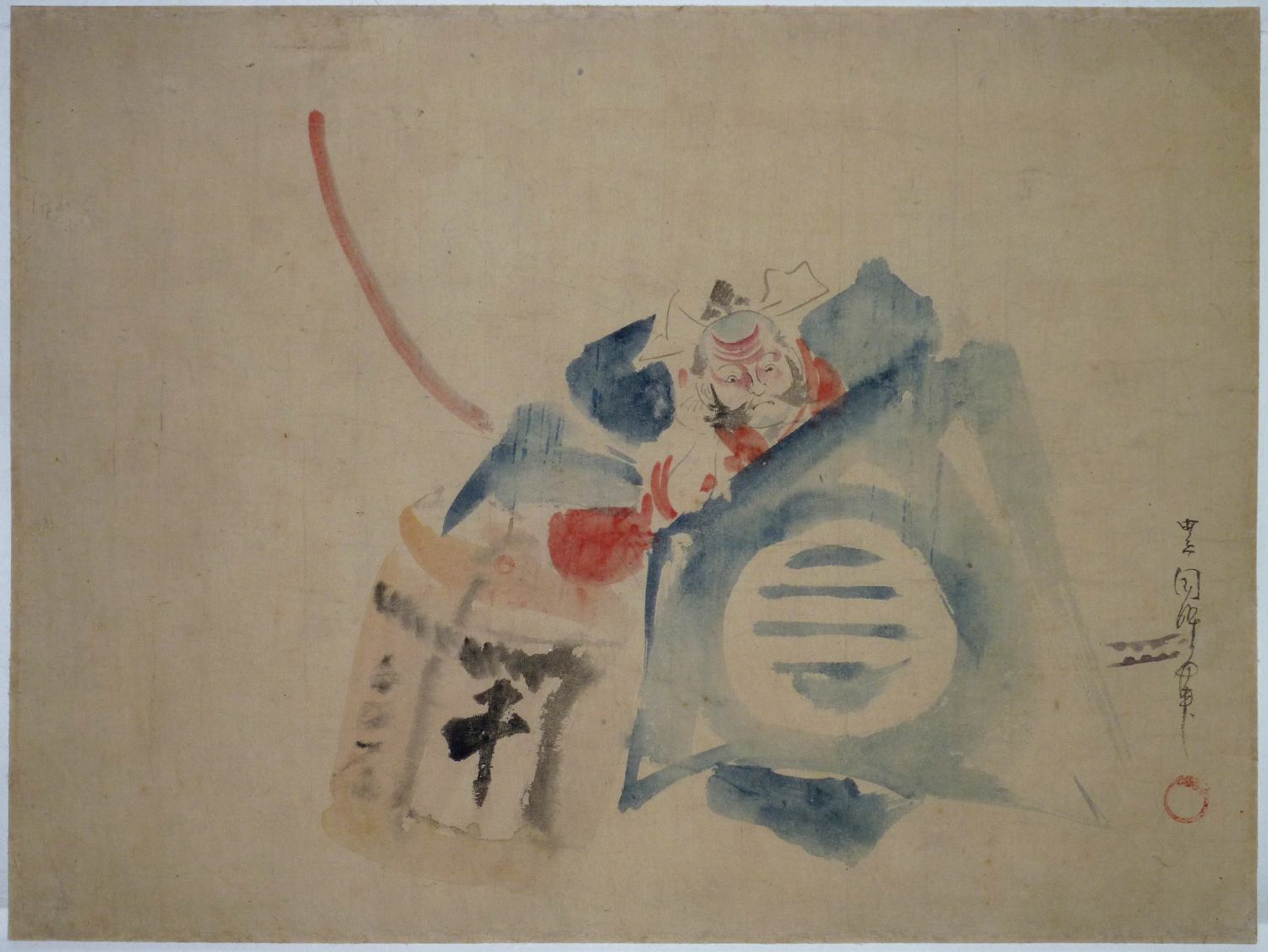
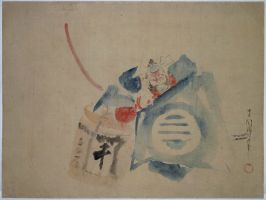
          An original painting on paper, unmounted, showing Asahina Saburo (Wada no Saburo Yoshihide), a famous warrior of the early Kamakura period (1185-1333). Image size 11.5 x 15.5 in; 29.2 x 39.5 cms. Signed Toyokuni suichu hitsu, “Toyokuni painted while being drunk.”


          Status: Sold


            Tags: , ,


            Utagawa TOYOKUNI II (TOYOSHIGE) (1777-1835)


            Click here to view image full size.

            Returning Geese at Miho: Kiyomizu Temple of Suruga Province with a Distant View of Yoshiwara from Meisho hakkei, “Eight Views of Famous Places.” A popular theme in Japanese art originating in China and the landscape of the Xiaoxiang region where the Xiao and Xiang rivers converge. Published c 1833-4 by Kinjudo.


            Fine impression, colour and condition. The pigment in the title cartouche intact, which is usually faded. Signed Toyokuni hitsu.


            Status: Sold


              Tags: , , ,


              Utagawa TOYOKUNI II (TOYOSHIGE) (1777-1835)


              Click here to view image full size.

              Meisho hakkei: Oyama yau, “Eight Celebrated Views: Night Rain at Oyama” in the oblong title cartouche and written below it: Juzan Fudo yori chojo no zu, “View of the Peak from Fudo.” Shows Mount Oyama in heavy rain with the Oyama-dera Temple dedicated to the Buddhist deity Fudo Myoo. Mount Fuji is seen in the distance. The “Eight Views” theme originates from 11th century China and the scenery of the Xiao and Xiang Rivers made famous by the scholar-painter Song Di. Here Toyokuni sets the views in Kanagawa. Published by Iseya Rihei (Kinjudo) c early 1830s. There are two editions of this set: one with regular block script in title cartouche, the other with cursive script (as here). Is in unclear which is the earliest. Cursive script is extremely difficult to read now but in 1830 it was no problem; certainly, with this design, the cursive script edition has superior gradation. However, comparison between editions on some other designs in the set show them to be almost identical, consequently it seems that the two states are almost contemporaneous and which is earlier is a moot point. One of the great 19th century landscapes.Fine impression. Fine colour with the title cartouche still retaining some purple which is famous for fading to a puce colour. Slight centre fold, otherwise very good condition. Signed Toyokuni hitsu.

              Status: Sold


                Tags: , , ,


                Utagawa TOYOKUNI II (TOYOSHIGE) (1777-1835)


                Click here to view image full size.

                Meisho hakkei: Kamakura bansho, “Eight Celebrated Views: Evening Bell at Kamakura” in the oblong title cartouche and written below it: Tsurugaoka yori Boshu yama no kei, “View of the Mountains of Awa Province from Tsurugaoka.” Shows the Tsurugaoka Hachimangu Shrine. The “Eight Views” theme originates from 11th century China and the scenery of the Xiao and Xiang Rivers made famous by the scholar-painter Song Di. Here Toyokuni sets the views in Kanagawa. Published by Iseya Rihei (Kinjudo) c early 1830s. There are two editions of this set: one with regular block script in title cartouche, the other with cursive script (as here). Is in unclear which is the earliest. Cursive script is extremely difficult to read now but in 1830 it was no problem. Comparison between editions on some other designs in the set show them to be almost identical, consequently it seems that the two states are almost contemporaneous and which is earlier is a moot point.Fine impression and colour with colour in title cartouche perfectly retained. Fine condition. Signed Toyokuni hitsu.

                Status: Sold


                  Tags: , , ,


                  Utagawa TOYOKUNI II (TOYOSHIGE) (1777-1835)


                   Click here to view image full size.

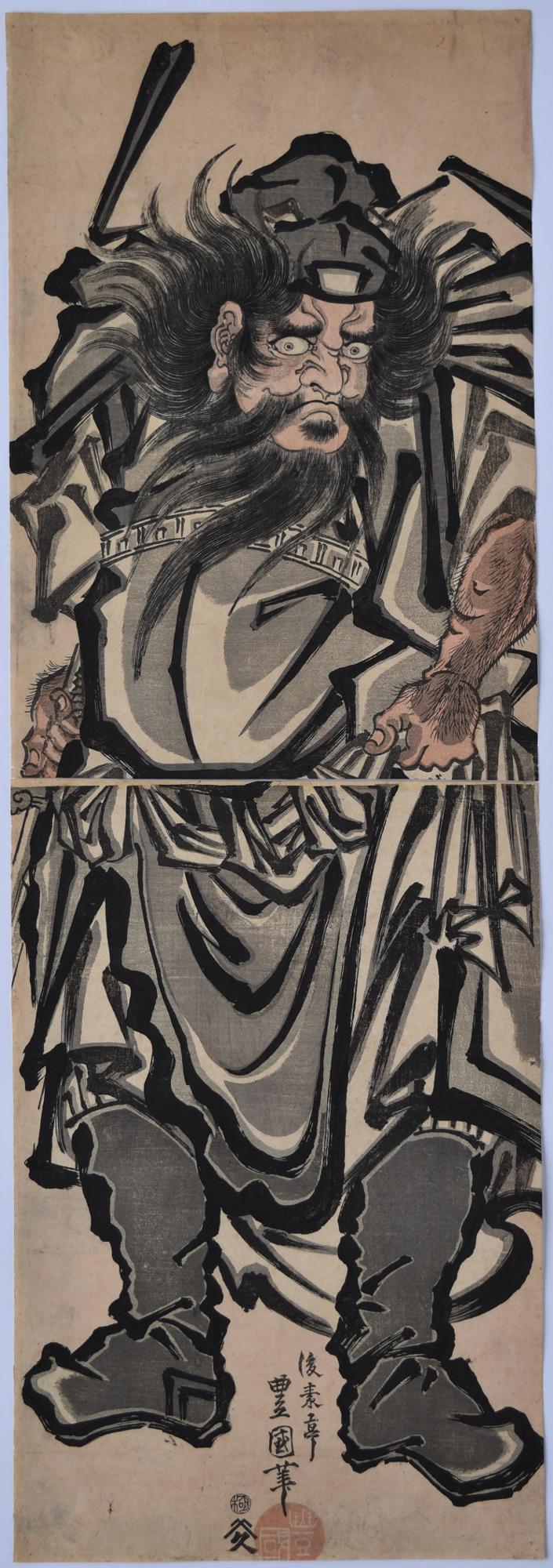
                  A vertical diptych of Shoki, the Demon Queller. The character originates from China being a deity from China’s Taoist pantheon. He is always shown with his scholar’s hat, large robe and boots, and usually carrying a sword with which he attacks oni. Images of Shoki were hung outside houses to ward off evil during the Boys’ Day Festival on May 5th. Published by Yamamoto Kyubei, c 1820. Prints by Toyoshige are often misattributed to Toyokuni I and vice versa because late Toyokuni I signatures and those of Toyoshige are similar. Rare.


                  Very good impression and colour. Some edge soil, otherwise very good condition. Signed Gosotei Toyokuni hitsu.


                  Status: Sold


                    Tags: , , ,


                    Utagawa TOYOKUNI II (1777-1835)


                    Click here to view image full size.

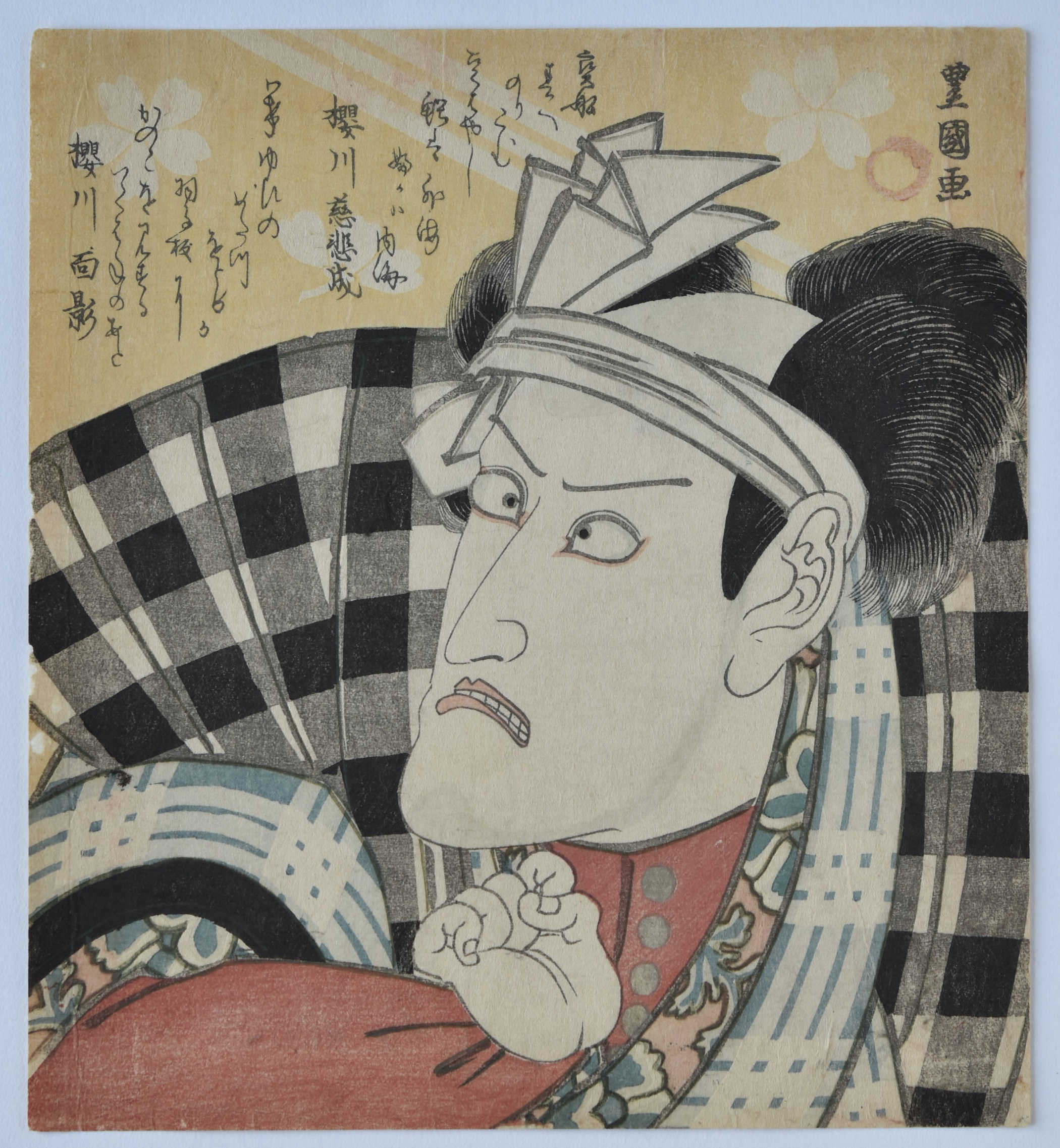
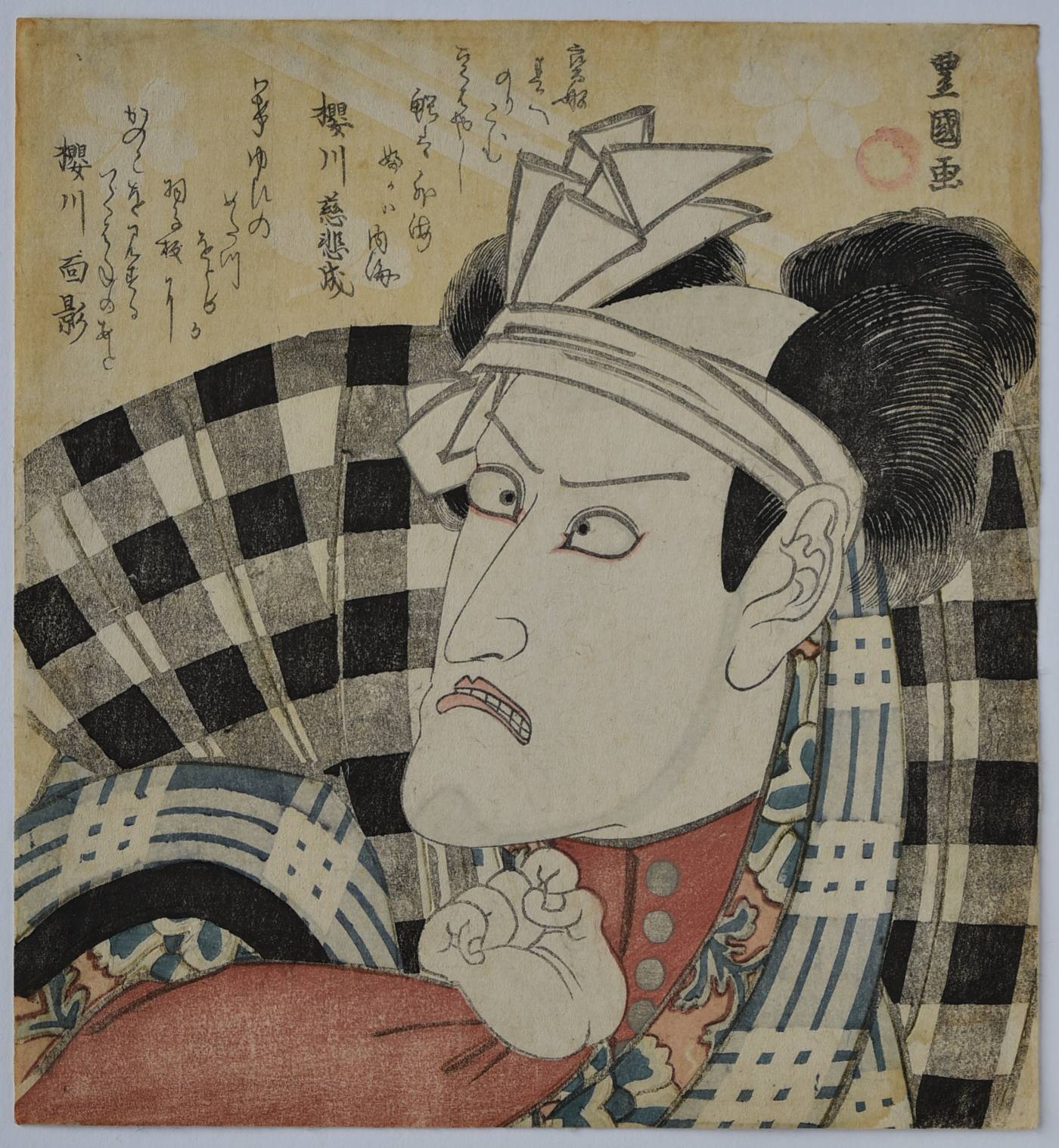
                    A surimono showing a bust portrait of the actor Ichikawa Danjuro VII as Kanawa no Goro, a retainer of Kamatari no Fujiwara, disguised as the fisherman Fukashichi from the Mikasayama Goten scene at the palace on Mount Mikasa in Act 4 of Imoseyama onna teikino. Three poems by Shoshokyo Otokado, Sakuragawa Jihinari and Sakuragawa Omokage. Issued c. mid 1820s. Rare.


                    Fine impression. Very good colour and condition. Signed Toyokuni ga.


                    Status: Sold

                      Tags: , ,


                      Utagawa TOYOKUNI II (1777-1835)


                       Click here to view image full size.

                      A surimono showing a bust portrait of the actor Ichikawa Danjuro VII as Kanawa no Goro, a retainer of Kamatari no Fujiwara, disguised as the fisherman Fukashichi from the Mikasayama Goten scene in Act 4 of Imoseyama onna teikino. Three poems by Shoshokyo Otokado, Sakuragawa Jihinari, and Sakuragawa Omokage. Issued c mid-1820s. Provenance: originally purchased from me in 1977 (see my catalogue 20, 1977, no. 38). Unidentified collector’s seal au verso. Rare.


                      Very good impression, colour and condition. Signed Toyokuni ga.


                      Status: Sold


                        Tags: , ,


                        Utagawa TOYOKUNI II (TOYOSHIGE ) ( 1777-1835 )


                         Click here to view image full size.

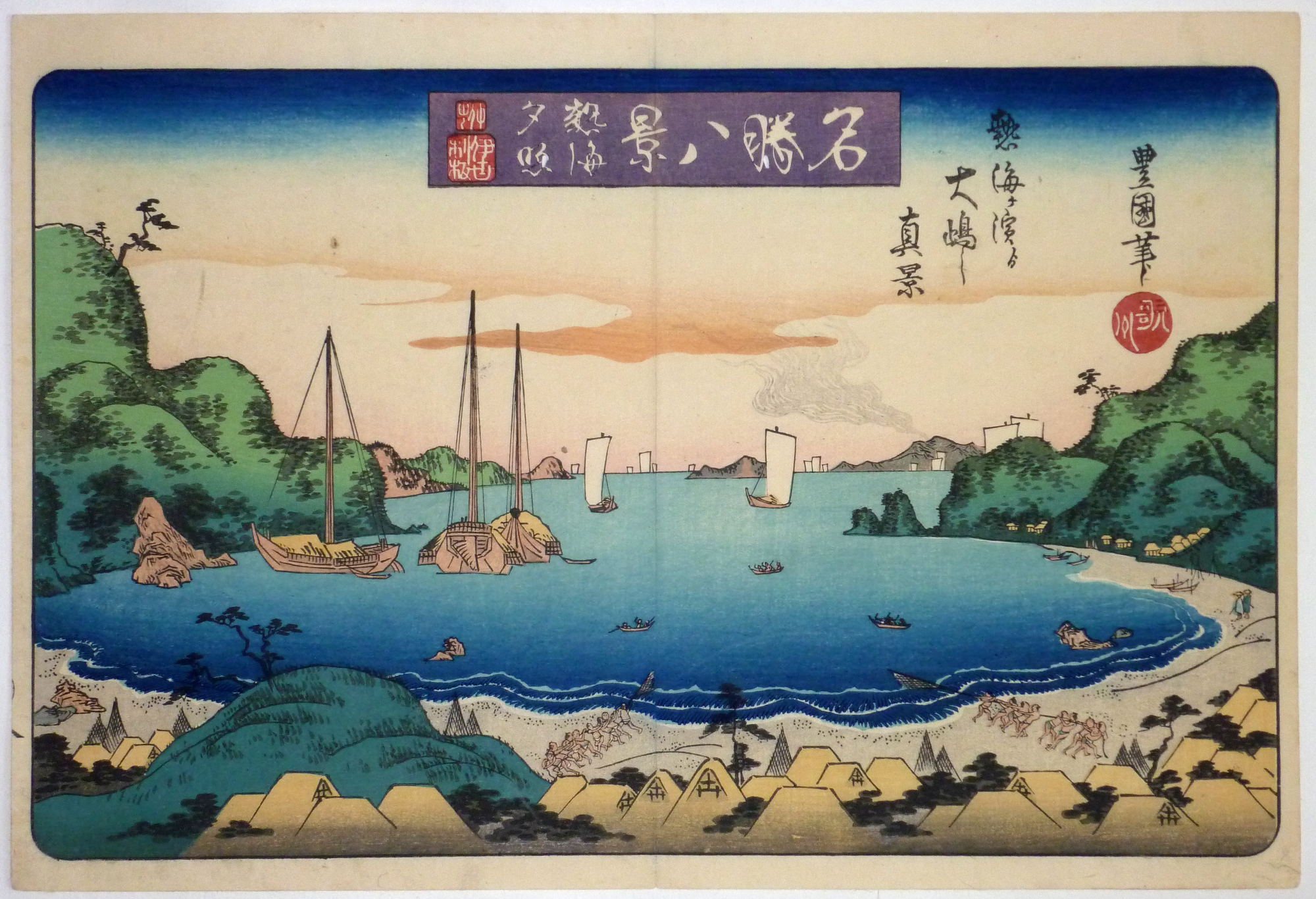
                        Evening Glow ( Sunset ) at Atami, Shizuoka Prefecture. From a set Meisho hakkei, “Eight Views of Famous Places” ( based on the Eight Views of Omi theme ). Published 1830s by Iseri. The town is famous for the Onsen hot springs and the area is known for its past volcanic activity. Across Sagami Bay can be seen smoke coming from the volcanic island of Oshima ( the epicentre of the great Kanto earthquake of 1923 ).

                        Fine impression and colour.There are two states of this set: one with square and one with cursive script ( as here ) in the oblong cartouche at top. It is unclear which is the earliest. This purple cartouche is often faded out to a puce colour. Slight centre fold otherwise very good condition. Signed Toyokuni hitsu.

                        Status: Sold

                          Tags: , , ,


                          Utagawa TOYOKUNI II (TOYOSHIGE) (1777-1835)


                           Click here to view image full size.

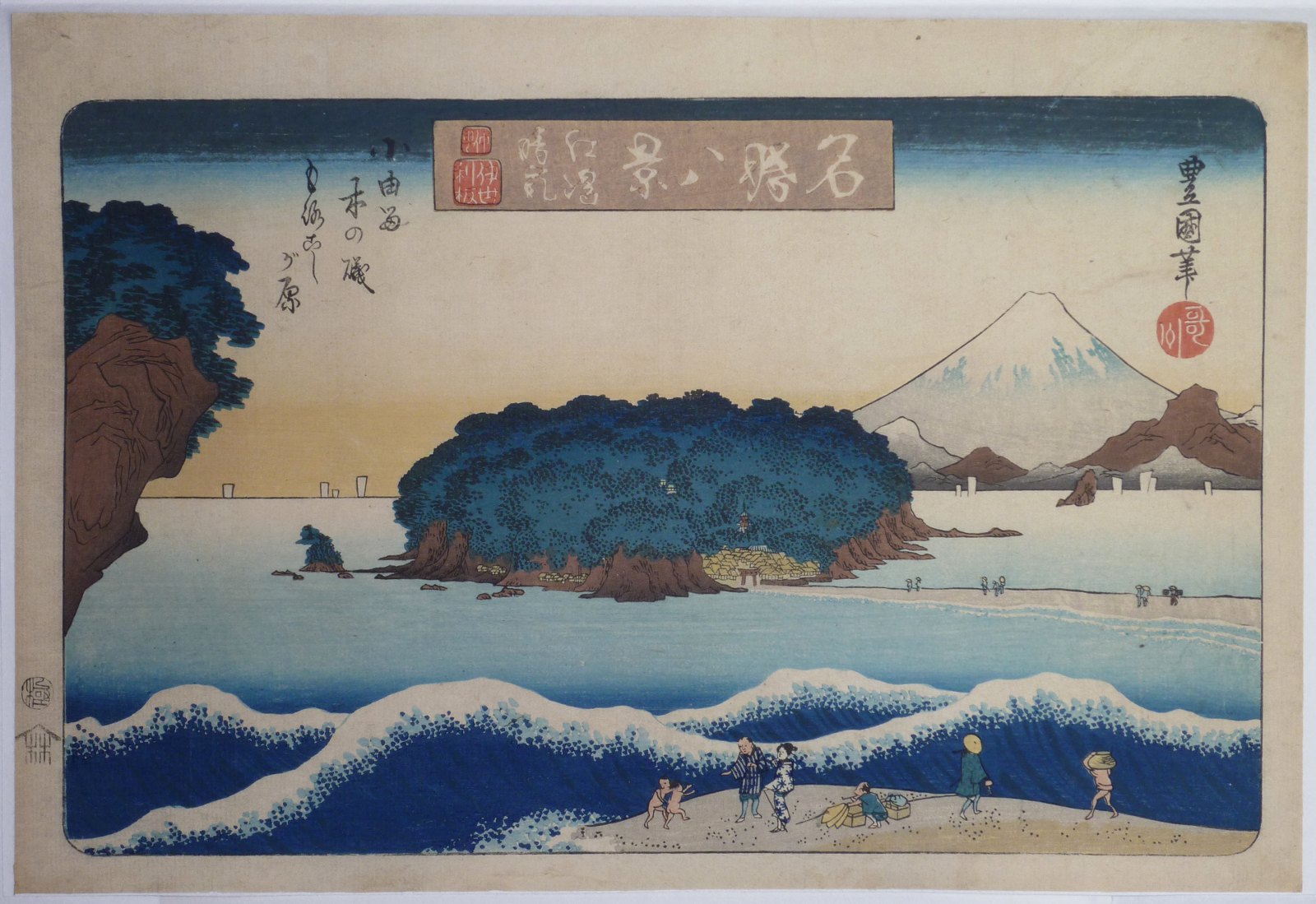
                          Clearing weather over the Enoshima Island from a Meisho hakkei, “Eight Views of Famous Places” ( based on the Eight Views of Omi theme ) set published 1830s by Iseri. A view of the island from Shichiri Beach in Sagami Province. The island was dedicated to Benten ( one of the seven gods of good luck ).

                          Fine impression. There are two states of this set: one with square and one with cursive script ( as here ) in the oblong cartouche at top. It is unclear which is the earliest. Fine impression. Small expert restoration to two upper corners, otherwise fine colour and condition. Signed Toyokuni hitsu.

                          Status: Sold

                            Tags: , , ,


                            Utagawa TOYOKUNI II (1777-1835)


                             Click here to view image full size.

                            Fuji bosetsu, Evening Snow on Fuji from a set of Eight Famous Views published by Iseya Rihei, c. 1833-4. Fuji towers over a religious compound. Toyokuni, like Kuniyoshi, Kunisada, Gakutei and Hokkei, while not known as a landscapes artist, produced a few fine examples, as here. Rare.

                            Very fine impression and colour. Fine condition. The first edition: It’s not generally known that there are two editions with the title recut. Also, the purple colour in the title label invariably fades to a puce colour. Signed Toyokuni hitsu.

                            Status: Sold

                              Tags: , ,


                              Utagawa TOYOKUNI II (1777-1835)


                               Click here to view image full size.

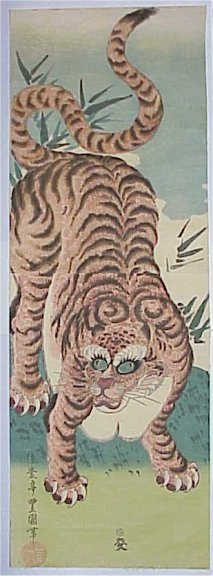
                              A vertical diptych showing a tiger. A striking design published by Yamamotoya Heikichi c1820s.

                              Fine early impression with gauffrage. Fine colour. Slight creasing and small edge repair, but otherwise very good, Full size. Signed Gosotei Toyokuni hitsu.

                              Status: Sold

                                Tags: , ,


                                Utagawa TOYOKUNI II (1777-1835)


                                 Click here to view image full size.

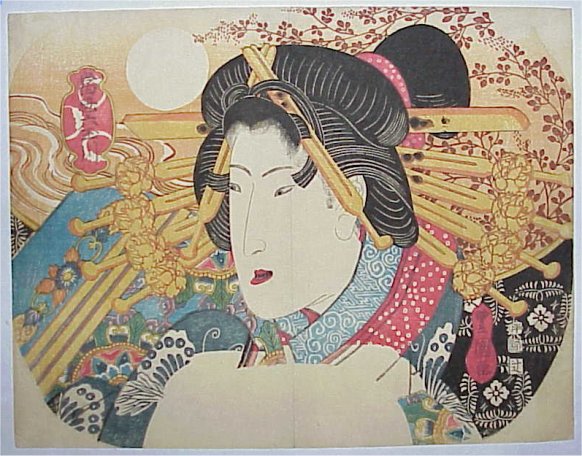
                                A bust portrait of a beauty in the form of a fan from a series of the Six Tama Rivers, this being the Ide (or Hagi) no Tamagawa in Yamashiro. Published by Tsujiokaya Bunsuke with date seal 1823.

                                Very fine impression and colour. Very faint centrefold. Signed Toyokuni ga.

                                Status: Sold

                                  Tags: , ,


                                  Utagawa TOYOKUNI II ( TOYOSHIGE ) (1777-1835)


                                  Click here to view image full size.

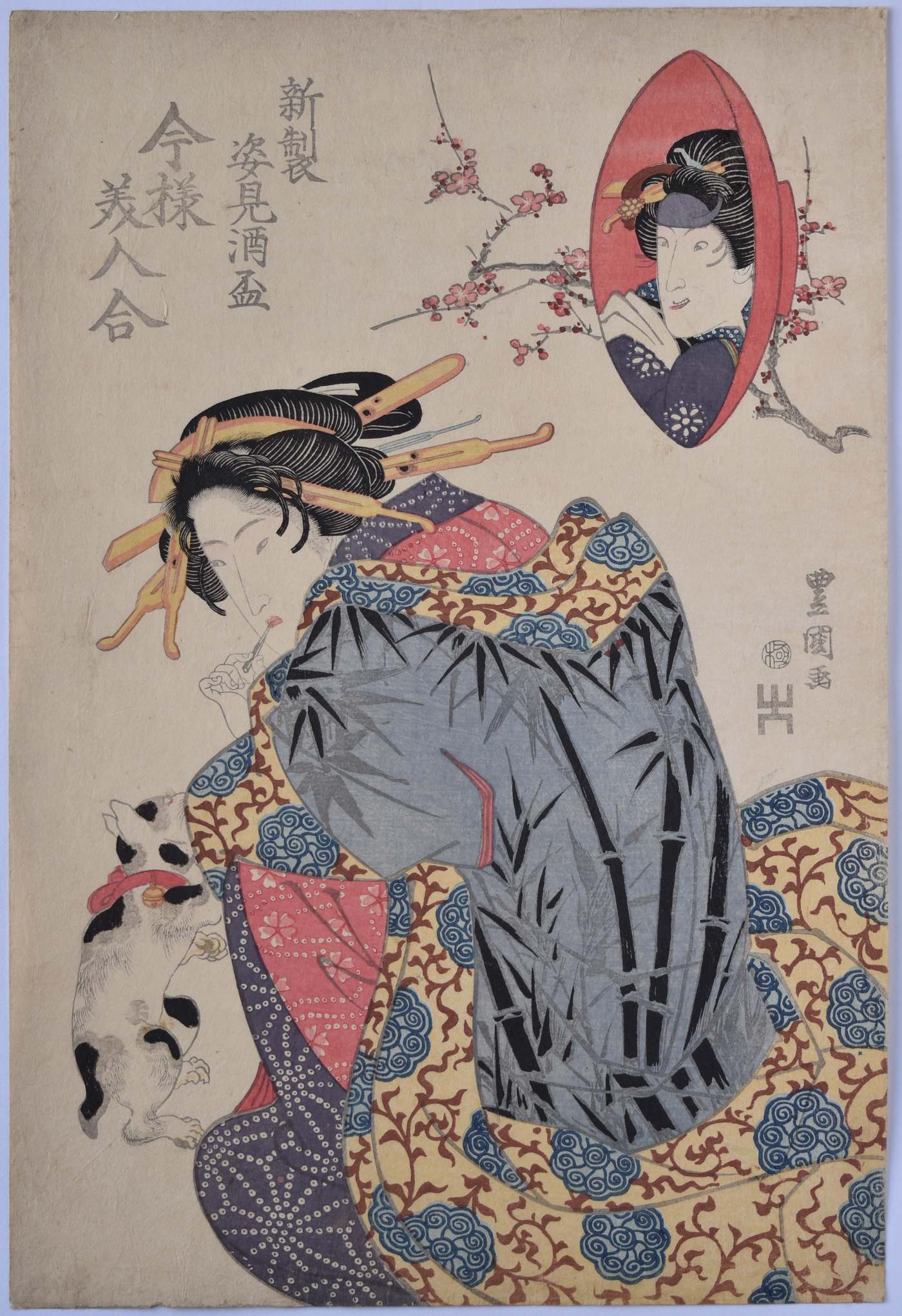
                                  A courtesan with a toothpick and playing with a cat compared to the actor Iwai Hanshiro V ( inset in a sake cup top right ). From a series Imayo bijin awase, shinsei sugatami sakazuki, “A Comparison of Modern Beauties – A New Mirror of Sake Cups.” Published by Imariya Ushizo, c 1820-24.


                                  Very good impression, colour and condition. Extensive mica added to the coat of the courtesan. Signed Toyokuni ga.


                                  Status: Sold

                                    Tags: , , ,


                                    Utagawa TOYOKUNI II (1777-1835)


                                    Click here to view image full size.

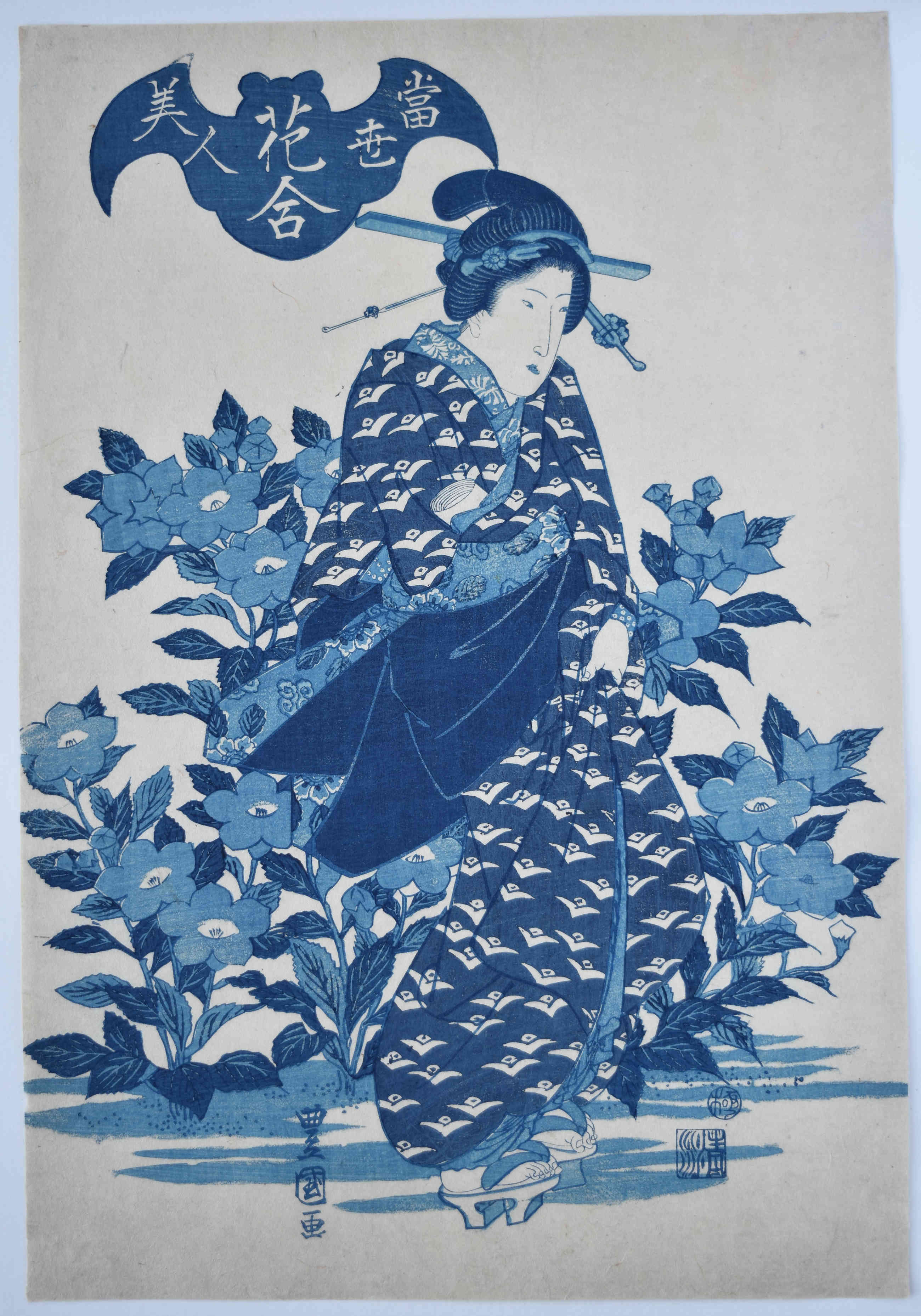
                                    An aizuri (blue) print from a set Tosei bijin hana-awase, “Beauties of the Latest Fashion Compared to the Beauty of Flowers.” In this case kikyo flowers – the Chinese bellflower. Aizuri prints were the outcome of avoiding intermittent edicts promulgated by the bakufu prohibiting the number of blocks that could be used. The aim being to curb excesses, raise moral standards and encourage thrift. Published by Shimizo, c. late 1820s. Three other prints from set are in the Brooklyn Museum of Art, 76.151.13; 14; 15.


                                    Fine impression, colour and condition. Signed Toyokuni ga.


                                    Status: Sold

                                      Tags: , ,


                                      Utagawa TOYOKUNI II (1777-1835)


                                       Click here to view image full size.

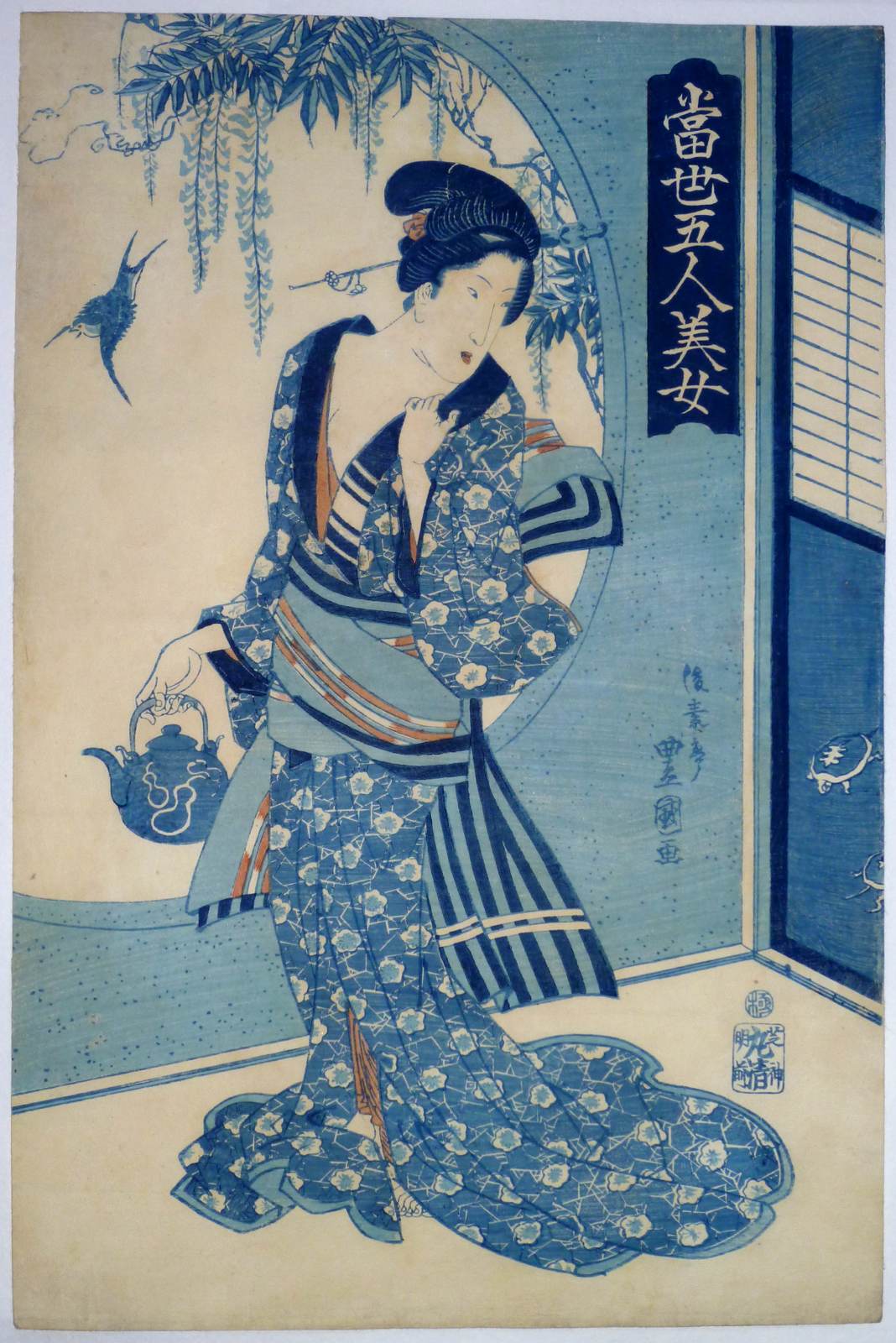
                                      A beauty standing beside a circular window with wisteria and a swallow, both symbols of spring. From an aizuri-e set Tosei gonin bijo, “Fine Modern Beauties.” Published by Maruya Seijiro, c 1830-5.


                                      Very good impression, colour and condition. Signed Gosotei Toyokuni ga.


                                      Status: Sold


                                        Tags: , ,


                                        Toyokuni – painted while drunk

                                        In the current update is a painting signed “Toyokuni painted while being drunk.” This is not an isolated example: Certain artists – such as Kyosai – often signed works in this way and indeed may have benefited from a degree of inebriation to prompt inspiration. Artists often collaborated on works, especially of the Shijo school, and one can imagine the conviviality of such a cohors amicorum with food and wine being passed around. It’s difficult to think of a western comparison to this. Hand scrolls, because of their horizontal length and short height, were very suitable for joint efforts of like-minded artists or literati.
                                         

                                        utagawa-toyokuni-ii-1777-1835-paintings-99


                                        The example in this update is spontaneous – even slapdash – due to the artist’s intoxication, but this adds a charm and veracity to the subject. It also makes authentication easier, certainly of Ukiyoe subjects, as forgers tended to concentrate on copying the detailed, more sober and meticulous subjects, as these were the most highly valued.


                                        Japanese paintings are an undervalued area of collecting. It’s possible, as here, to buy an important Hiroshige painting for the price many of his prints fetch. And one is purchasing an unique item.


                                          Artists

                                          ( A to Z )

                                          Kyogado ASHIKUNI ( Fl. c. 1807 – 1818 )
                                          Gigado ASHIYUKI ( Fl. c. 1814 – 1833 )

                                          Ki BAITEI ( 1734 – 1810 )
                                          Takizawa BAKIN ( 1767 – 1848 )
                                          Ono BAKUFU ( 1888 – 1976 )
                                          Georges BIGOT ( 1860 – 1927 )
                                          Kawamura BUMPO ( 1779 – 1821 )
                                          Ippitsusai BUNCHO ( Fl. c. 1765 – 1792 )

                                          Toyohara CHIKANOBU ( 1838 – 1912 )
                                          Kishi CHIKUDO ( 1826 – 1897 )
                                          Tsubaki CHINZAN ( 1801 – 1854 )
                                          Eishosai CHOKI ( Fl. c. 1756 – 1808 ). See also SHIKO

                                          Rekisentei EIRI ( Fl. c. 1790 – 1800 )
                                          Keisai EISEN ( 1790 – 1848 )
                                          Hosoda EISHI ( 1756 – 1829 )
                                          Hosoda EISHO ( Fl. c. 1780 – 1800 )
                                          Ichirakutei EISUI ( Fl. c. 1790 – 1823 )
                                          Kikugawa EIZAN ( 1787 – 1867 )

                                          Hirano HAKUHO ( 1879 – 1957 )

                                          Elizabeth KEITH ( 1887 – 1956 )
                                          Imao KEINEN ( 1845 – 1924 )

                                          Yashima GAKUTEI ( 1786 – 1868 )
                                          Ogata GEKKO ( 1859 – 1920 )
                                          Adachi GINKO ( Fl. c. 1847 – 1897 )
                                          Matsumura GOSHUN ( 1752 – 1811 )
                                          GYOSAI. See Kawanabe KYOSAI

                                          Hirano HAKUHO ( 1879 – 1957 )
                                          Suzuki HARUNOBU ( 1724 – 1770 )
                                          Kawase HASUI ( 1883 – 1957 )
                                          Kitagawa HIDEMARO ( Fl. c. early 19th century )
                                          Kinoshita HIRONOBU ( Fl. c. 1851 – 1870 )
                                          Gosotei HIROSADA ( Fl. c. 1847 – 1863 )
                                          Ichiryusai HIROSHIGE ( 1797 – 1858 )
                                          Ichiryusai HIROSHIGE II ( 1826 – 1869 )
                                          Ando HIROSHIGE III ( 1843 – 1894 )
                                          Nakamura HOCHU ( Fl. c. late 18th to early 19th century )
                                          Sakai HOITSU ( 1761 – 1828 )
                                          Totoya HOKKEI ( 1780 – 1850 )
                                          Teisai HOKUBA ( 1771 – 1844 )
                                          Shunkosai HOKUEI (Active 1824-1837)
                                          Katsushika HOKUGA ( Fl. c. 1830 )
                                          Shotei HOKUJU ( Fl. c. 1789 – 1818 )
                                          Katsushika HOKUSAI ( 1760 – 1849 ). Also used numerous other names such as: SORI, SHUNRO, SHINSAI
                                          Shokosai HOKUSHU ( Fl. c. 1808 – 1832 )

                                          KEISAI. See Kitao MASAYOSHI
                                          Suzuki KIITSU ( 1796 – 1858 )
                                          Kitagawa KIKUMARO ( Fl. c. ? – 1830 ). See TSUKIMARO
                                          Kobayashi KIYOCHIKA ( 1847 – 1915 )
                                          Torii KIYOHIRO ( Fl. c. 1737 – 1771 )
                                          Torii KIYOMASA ( Fl. c. 1700 – 1722 )
                                          KIYOMINE. See Torii KIYOMITSU II
                                          Torii KIYOMITSU ( 1735 – 1785 )
                                          Torii KIYOMITSU II ( 1787 – 1868 ). See KIYOMINE
                                          Torii KIYONAGA ( 1752 – 1815 )
                                          Torii KIYONOBU ( 1664 – 1729 )
                                          Torii KIYONOBU II ( 1706 – 1763 )
                                          Torii KIYOTSUNE ( Fl. c. 1757 – 1779 )
                                          Isoda KORYUSAI ( Fl. c. 1767 – 1788 )
                                          Ohara KOSON ( 1877 – 1945 ). See SHOSON
                                          Torii KOTONDO ( 1900 – 1976 )
                                          Toyohara KUNICHIKA ( 1835 – 1900 )
                                          Utagawa KUNIHIRO ( Fl. c. 1815 – 1843 )
                                          Ichiunsai KUNIHISA ( 1832 – 1891 )
                                          Utagawa KUNINAO ( 1793 – 1854 )
                                          Utagawa KUNISADA ( 1786 – 1865 )
                                          Utagawa KUNISADA II ( 1823 – 1880 )
                                          Utagawa KUNISATO ( ? – 1858 )
                                          Utagawa KUNITERU ( 1808 – 1876 )
                                          KUNITERU. See Utagawa SADASHIGE
                                          Utagawa KUNITERU II ( 1829 – 1874 )
                                          Utagawa KUNIYASU ( 1794 – 1832 )
                                          Ichiyusai KUNIYOSHI ( 1797 – 1861 )
                                          Santo KYODEN. See Kitao MASANOBU
                                          Kawanabe KYOSAI ( 1831 – 1889 ). See GYOSAI

                                          Okumura MASANOBU ( 1686 – 1764 )
                                          KitaoMASANOBU ( 1761 – 1816 ). See Santo KYODEN
                                          Kitao MASAYOSHI ( 1764 – 1824 ). See KEISAI
                                          Oishi MATORA ( 1794 – 1833 )
                                          Hishikawa MORONOBU ( Fl. c. 1618 – 1694 )

                                          Nishimura NANTEI ( 1775 – 1834 )
                                          Utagawa NOBUKATSU ( Fl. c. 1830 – 1844 )
                                          Watanabe NOBUKAZU ( Fl. c. late 19th century )

                                          Hishikawa RYUKOKU ( Fl. c. 1808 – 1816 )
                                          Jokei RYUKOSAI ( Fl. 1772 – 1816 )

                                          Gokitei SADAFUSA ( Fl. c. 1825 – 1850 )
                                          Hasegawa SADAHARU ( Fl. c. 1830 – 1844 )
                                          Gokotei SADAKAGE ( Fl. c. 1818 – 1844 )
                                          Utagawa SADAHIDE ( 1807 – 1873 )
                                          Hasegawa SADANOBU ( 1809 – 1879 )
                                          Utagawa SADASHIGE ( Fl. c. mid 19th century ). See KUNITERU
                                          Gofutei SADATORA ( Fl. c. 1825 )
                                          Yamaguchi SHIGEHARU ( 1803 – 1853 )
                                          Kitao SHIGEMASA ( 1739 – 1820 )
                                          Nishimura SHIGENAGA ( 1697 ? – 1756 )
                                          Nishimura SHIGENOBU ( Fl. c. 1724 – 1735 )
                                          SHIKO. See Eishosai CHOKI
                                          Ryuryukyo SHINSAI ( 1764 – 1820 )
                                          Ito SHINSUI ( 1898 – 1972 )
                                          Kojima SHOGETSU ( Fl. c. 1880 – 1890 )
                                          SHOSON. See Ohara KOSON
                                          Takahashi SHOTEI ( 1871 – 1945 )
                                          Yamamoto SHOUN ( 1870 – 1965 )
                                          Yamakawa SHUHO ( 1898 – 1944 )
                                          Katsukawa SHUNCHO ( Fl. c. 1780 – 1795 )
                                          Takehara SHUNCHOSAI ( Fl. c. 1772 – 1801 )
                                          Katsukawa SHUN’EI ( 1762 – 1819 )
                                          Katsukawa SHUNKO ( 1743 – 1812 )
                                          Hishikawa SHUNKYO ( Fl. c. early 19th century )
                                          Kubo SHUNMAN ( 1757 – 1820 )
                                          Katsukawa SHUNSEN ( Fl. c. 1762 – 1830 )
                                          Natori SHUNSEN ( 1886 – 1960 )
                                          Gatoken SHUNSHI ( Fl. c. 1820 – 1828 )
                                          Katsukawa SHUNSHO ( 1726 – 1792 )
                                          Katsukawa SHUNTEI ( 1770 – 1820 )
                                          Katsukawa SHUNZAN ( Fl. c. 1782 – 1798 )
                                          Yamaguchi SOKEN ( 1759 – 1834 )

                                          Ikeno TAIGA ( 1723 – 1776 )
                                          Katsukawa TERUSHIGE ( Fl. c. 1715 – 1725 )
                                          Mori TETSUZAN (1775-1841)
                                          Migita TOSHIHIDE ( 1863 – 1925 )
                                          Mizuno TOSHIKATA ( 1866 – 1908 )
                                          Okumura TOSHINOBU ( Fl. c. 1717 – 1750 )
                                          Utagawa TOYOHARU ( 1735 – 1814 )
                                          Utagawa TOYOHIRO ( 1773 – 1828 )
                                          Utagawa TOYOKUNI ( 1769 – 1825 )
                                          Utagawa TOYOKUNI II ( 1777 – 1835 ). See TOYOSHIGE
                                          Yamamura TOYONARI ( 1885 – 1942 )
                                          Ishikawa TOYONOBU ( 1711 – 1785 )
                                          TOYOSHIGE. See Utagawa TOYOKUNI II
                                          TSUKIMARO. See Kitagawa KIKUMARO
                                          Kitano TSUNETOMI ( 1880 – 1947 )

                                          Toyokawa UMEKUNI ( Fl. c. 1816 – 1826 )
                                          Kitagawa UTAMARO ( 1753 – 1806 )
                                          Kitagawa UTAMARO II ( ? – 1831 )

                                          Inoue YASUJI ( 1864 – 1889 )
                                          Hiroshi YOSHIDA ( 1876 – 1950 )
                                          Ipposai YOSHIFUJI ( 1828 – 1887 )
                                          Utagawa YOSHIIKU ( 1833 – 1904 )
                                          Utagawa YOSHIKATA ( Fl. c. 1841 – 1864 )
                                          Utagawa YOSHIKAZU ( Fl. c. 1850 – 1870 )
                                          Toyokawa YOSHIKUNI ( Fl. c. 1803 – 1840 )
                                          Utagawa YOSHIMUNE ( 1817 – 1880 )
                                          Ichiyosai YOSHITAKI ( 1841 – 1899 )
                                          Utagawa YOSHITORA ( Fl. c. 1850 – 1880 )
                                          Taiso YOSHITOSHI ( 1839 – 1892 )
                                          Utagawa YOSHITSURU ( Fl. c. 1840 – 1850 )
                                          Ichieisai YOSHITSUYA ( 1822 – 1866 )
                                          Mori YOSHIYUKI ( 1835 – 1879 )

                                          Shibata ZESHIN ( 1807 – 1891 )