/category/new-acquisitions/
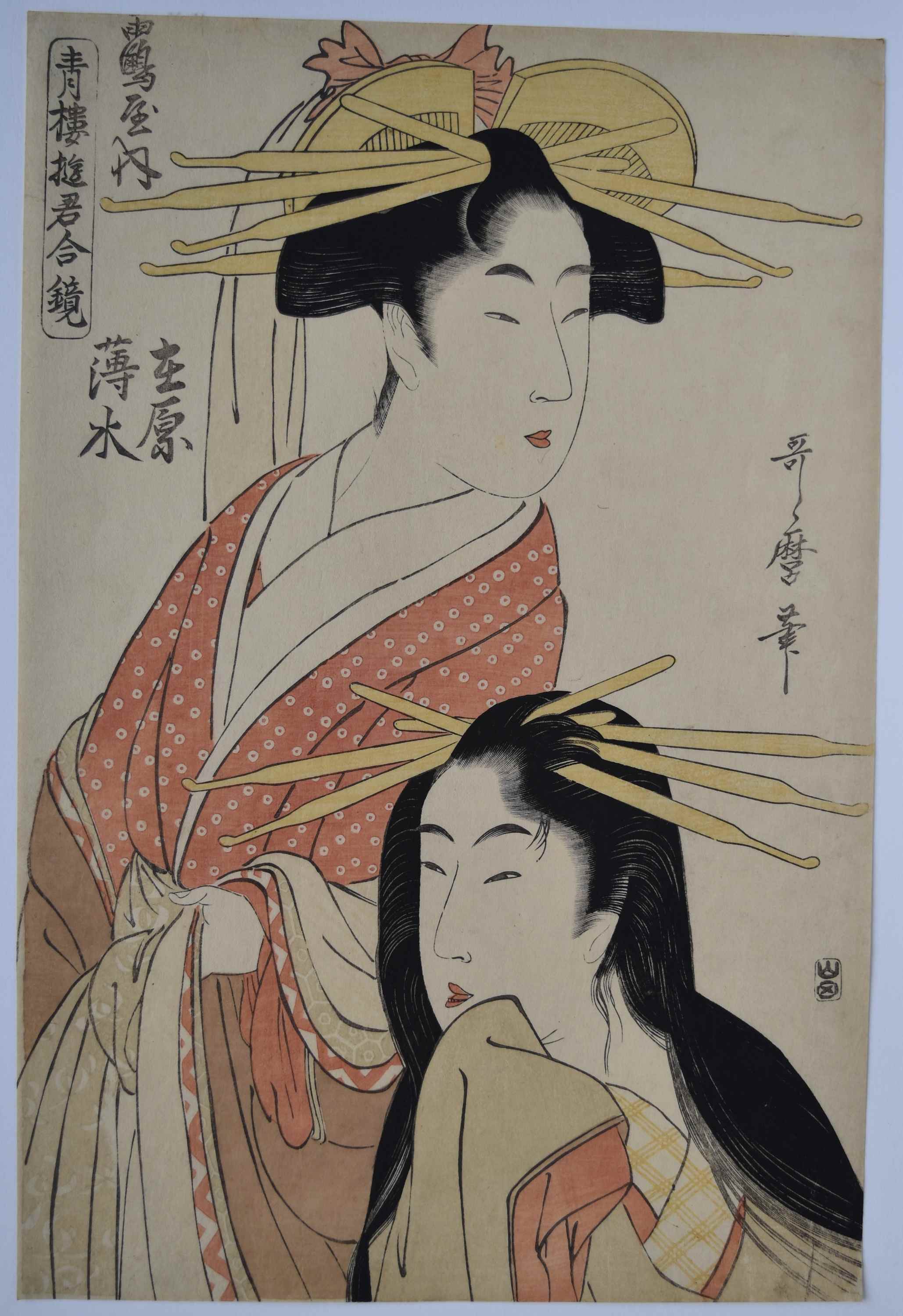
Kitagawa UTAMARO (1754-1806)
Click here to view image full size.
A double-bust portrait of the famous courtesans Ariwara (bottom) and Usumizu of the Tsuruya House in the Yoshiwara, Edo. From a set Seiro yukun awase kagami, “Mirror of Courtesans of the Green Houses.” Published by Yamada, c 1797.
Fine impression. Very good colour. Very slight trimming, otherwise very good condition. Signed Utamaro hitsu.
Status: Available
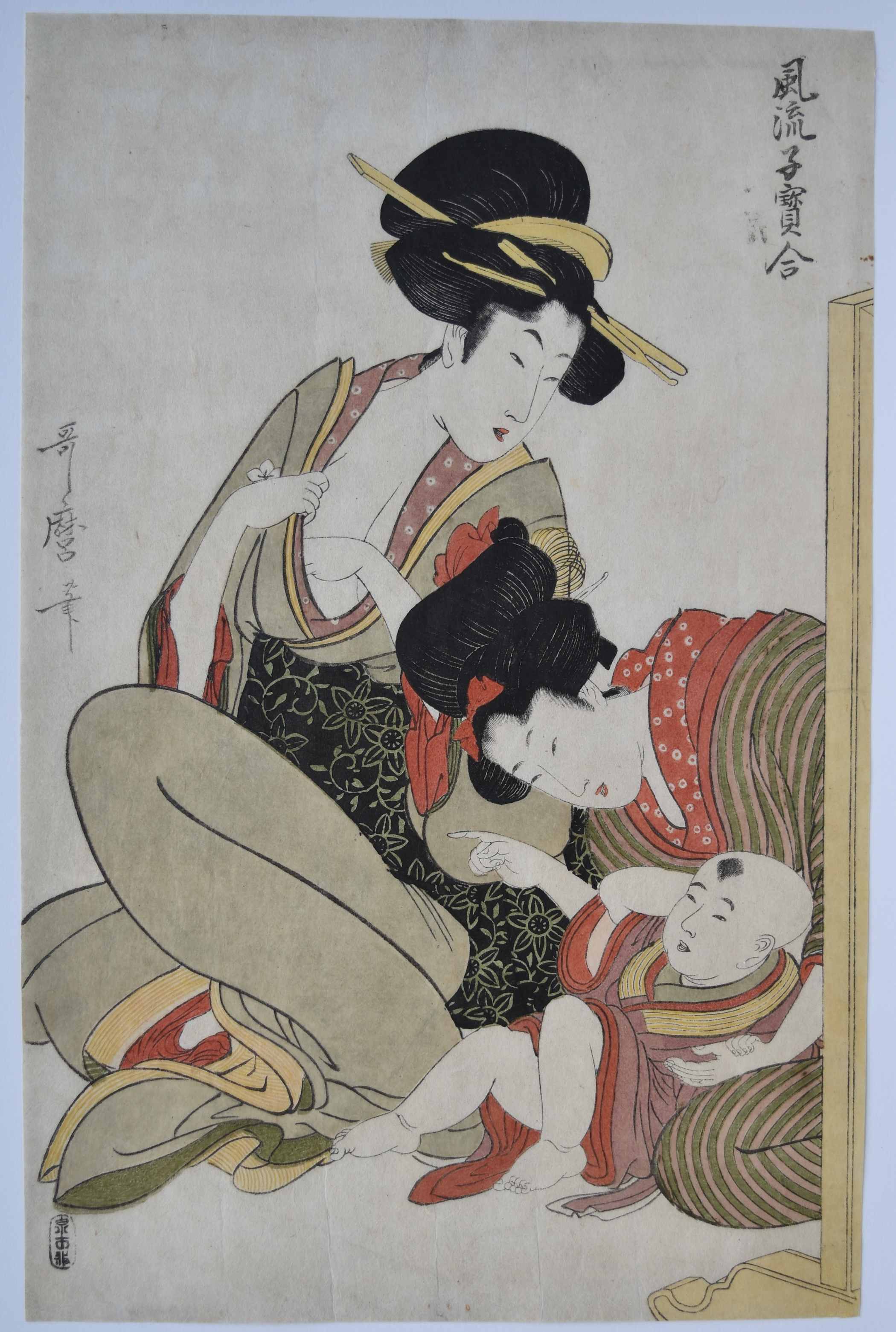
Kitagawa UTAMARO (1754-1806)
Click here to view image full size.
A design from a set of six prints Furyu ko-dakara awase, “Elegant Comparisons of Little Treasures.” About to breastfeed (chichi). Published by Izumiya Ichibei, c 1802.
Fine impression. Extremely well preserved colour. Very good condition. Signed Utamaro hitsu.
Status: Available
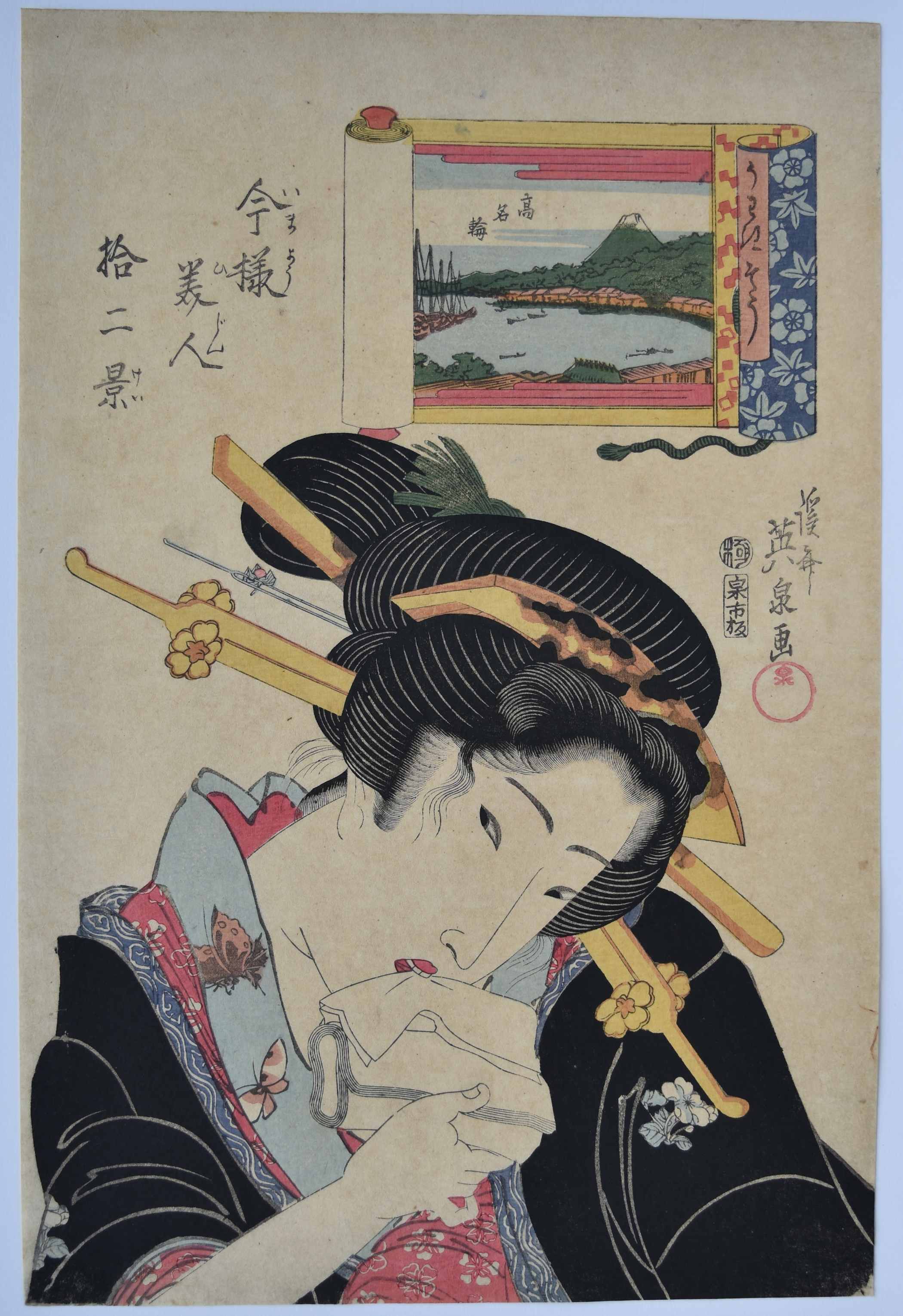
Ikeda EISEN (1790-1848)
Click here to view image full size.
A beauty, Ureshi so, “The Contented Type” from a set Imayo bijin junikei, “Twelve Views of Modern Beauties.” Above on a handscroll is a view of Fuji from Takanawa. She bites onto a tissue which has erotic connotations. Published c 1822-25 by Izumiya Ichibei.
Fine impression and colour. Very good condition. Signed Keisai Eisen ga.
Status: Available
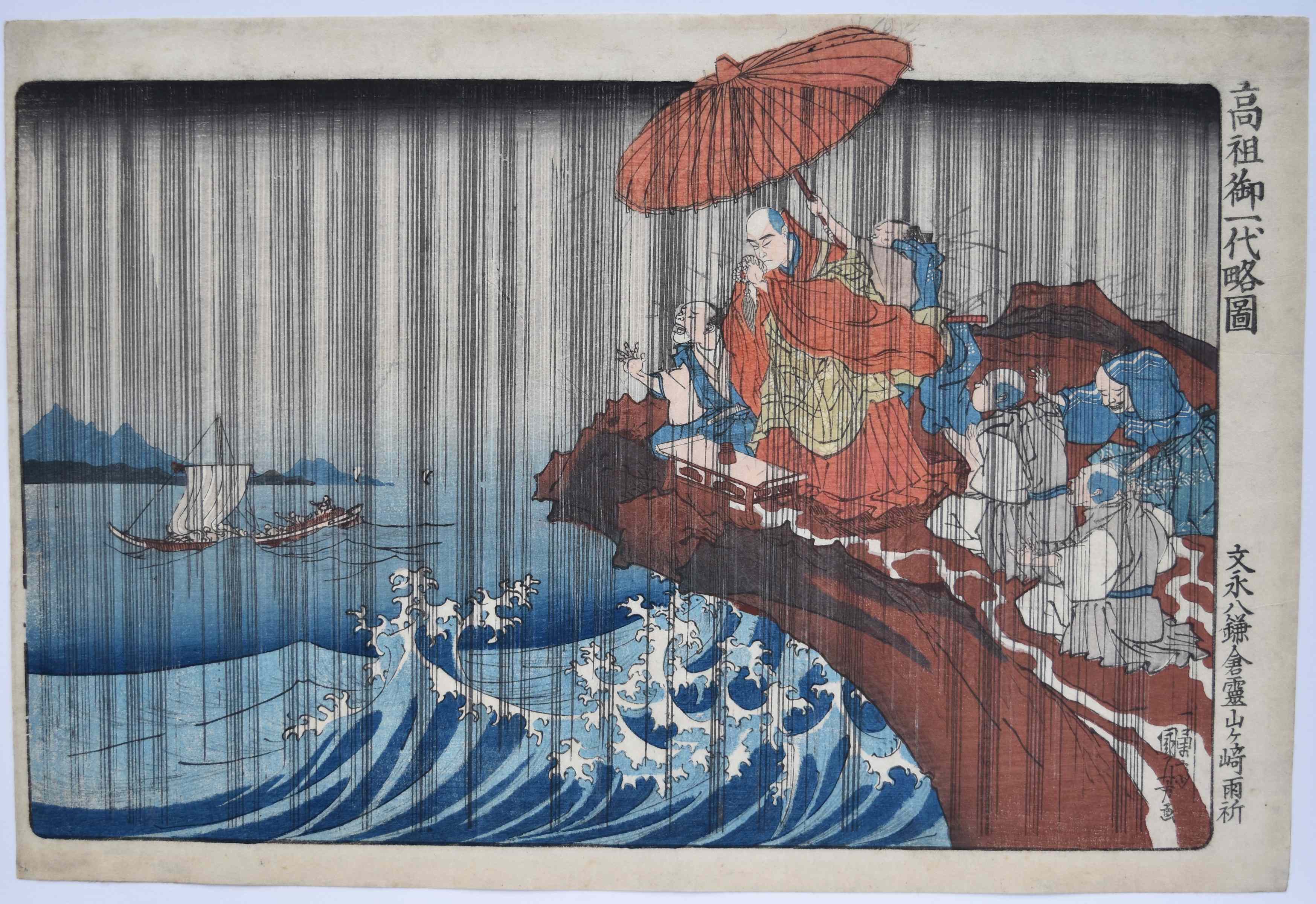
Utagawa KUNIYOSHI (1797-1861)
Click here to view image full size.
The priest Nichiren standing on the rocky promontory at Reizan in Kamakura and having his prayers for rain answered. The event occurred in 1271. His disciples surround him and protect him from the deluge with a large umbrella. Bunei hachi Kamakura Reizan-ga-saki uki. The second best design from Koso [Nichiren] goichidai ryakuza, “Illustrated Abridged Biography of the Founder.” Nichiren (1222-1282) was the founder of the Buddhist Nichiren sect (Nichiren shu – Kuniyoshi being a follower) and indeed the set of ten prints may have been commissioned to mark the 550th anniversary of his death. Published by Iseya Rihei, c 1831.
Fine impression, colour and condition. Ample room on top border for the umbrella which protrudes beyond the border and is often trimmed off, as is the information on right border. Signed Ichiyusai Kuniyoshi ga.
Status: Available
Tsukioka SETTEI (1710-1786)
Click here to view image full size.
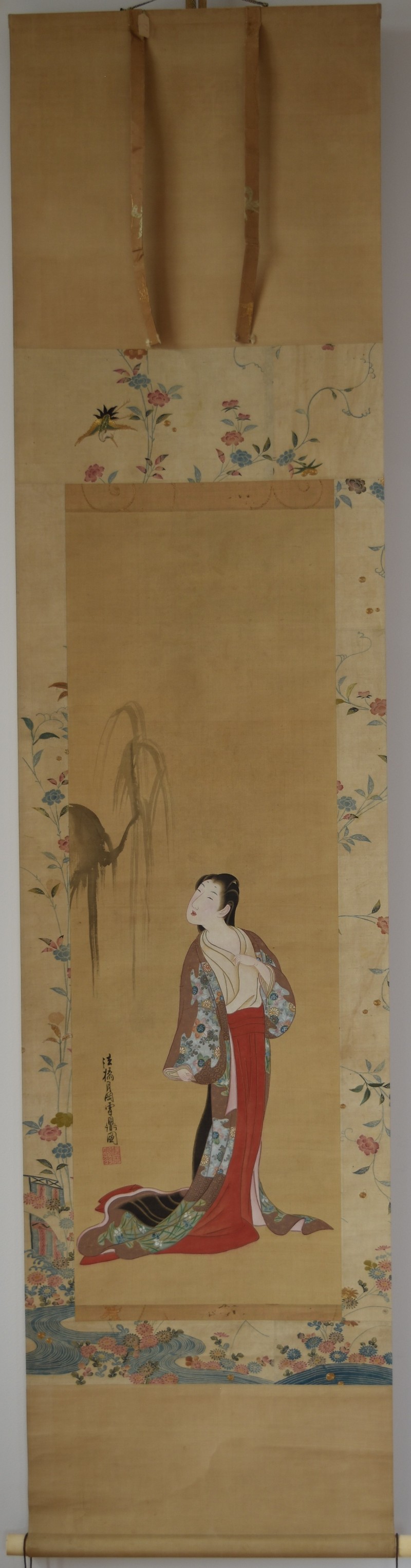
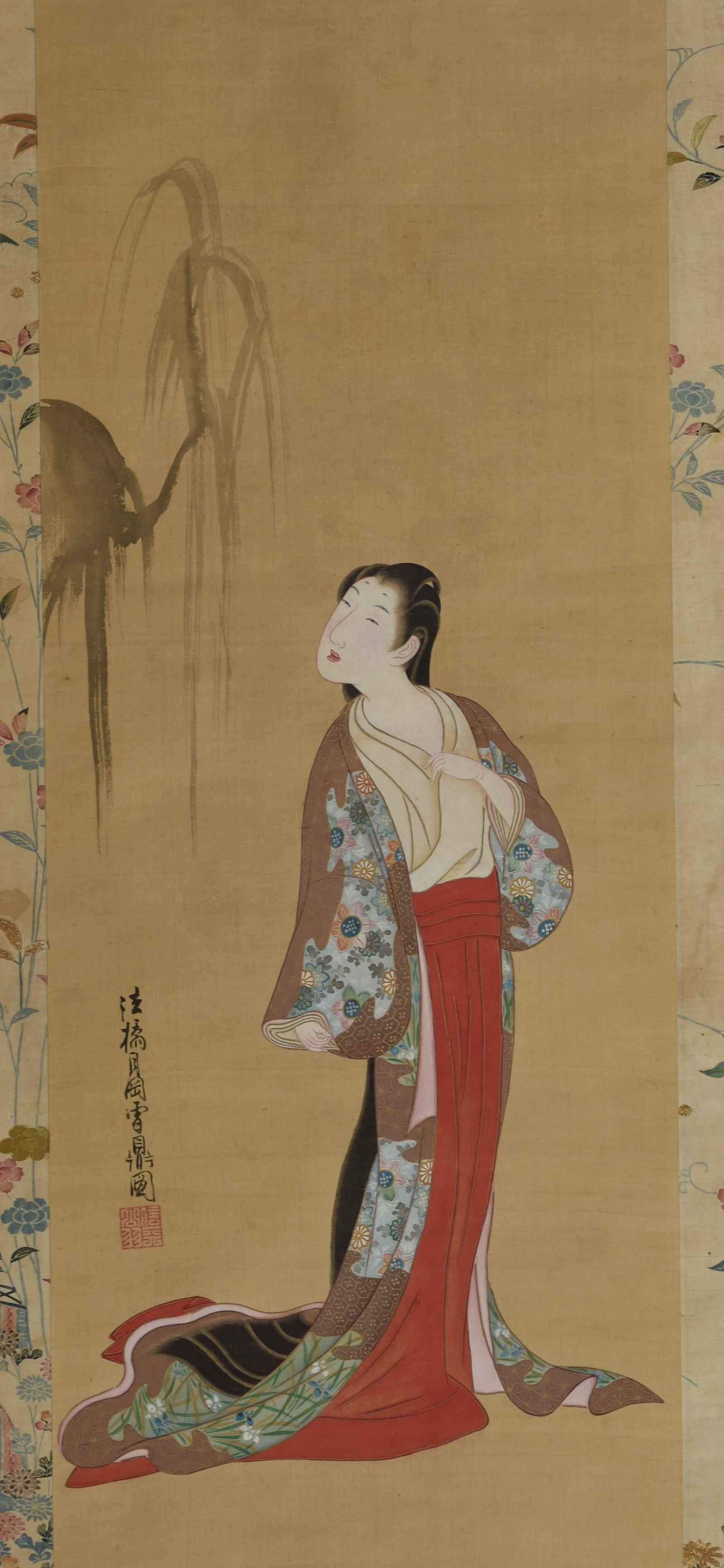
An original painting, sumi and full colour on silk, 38 x 12.5 in; 96 x 32 cms. Settei produced many illustrated books but after around 1765 turned towards painting beauties, courtesans and geishas. They are of the utmost refinement – the faces and limbs often delineated in red and their costumes embellished with gold. Settei is also known for his elegant shunga. A beauty looks towards a weeping willow. Painted c 1770. In good condition with an elaborately stencilled and embroidered mount. Details picked out in gold.
Signed Hokkyo Tsukioka Settei dzu and sealed o’Shinten.
Status: Available
Click here to view image full size.
Matsumura KEIBUN (1779-1843)
Click here to view image full size.
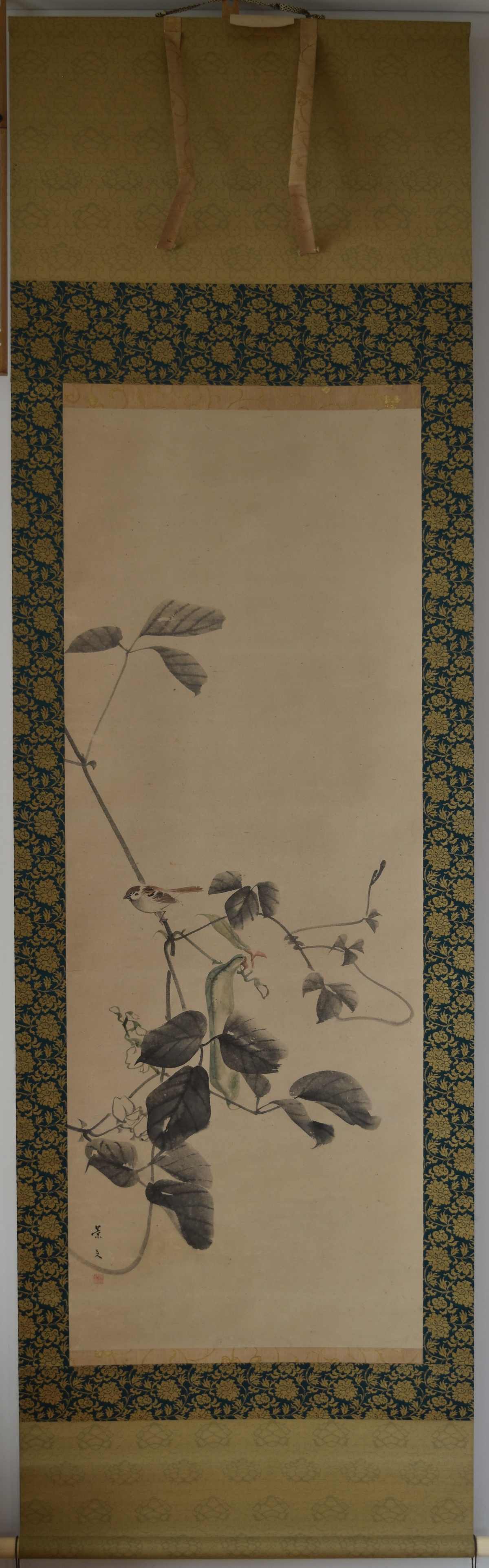
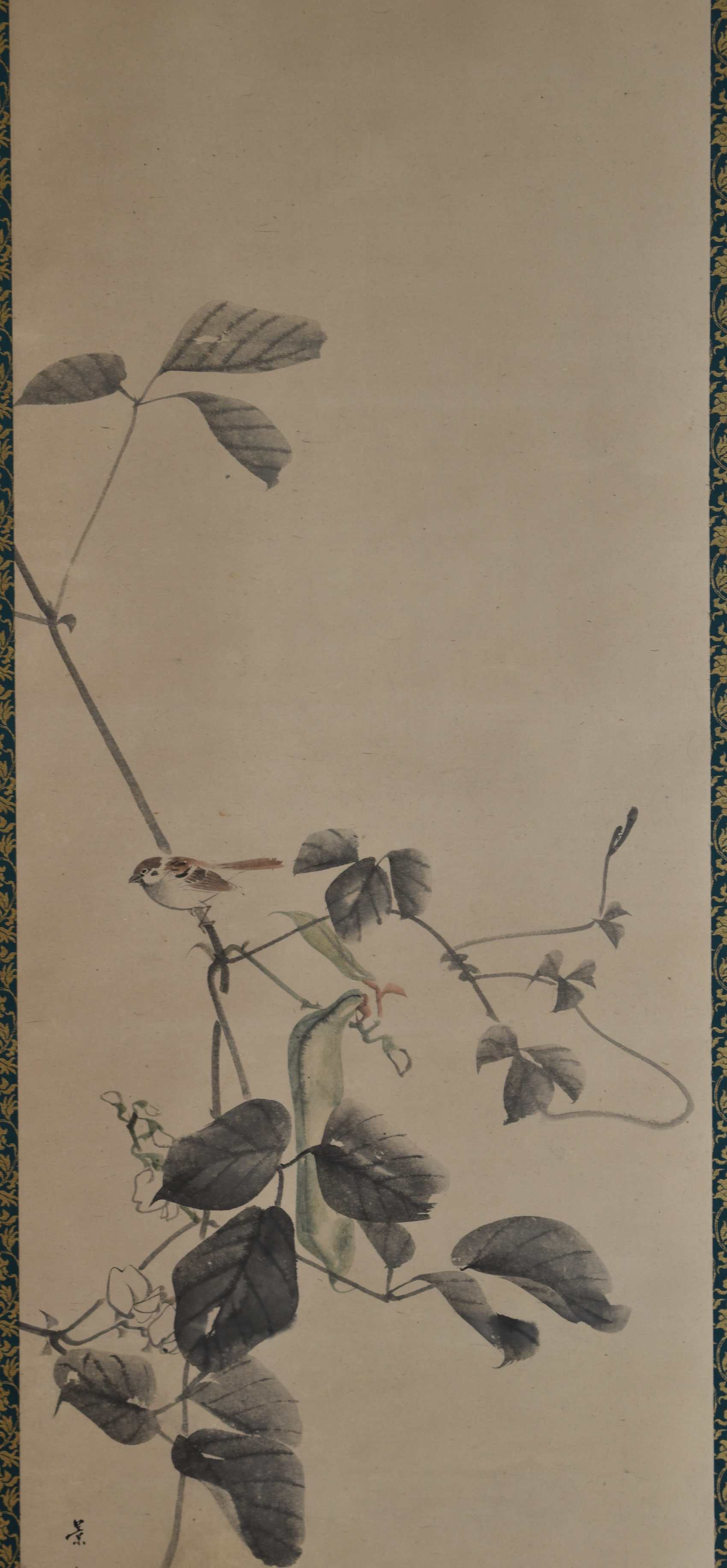
An original painting, sumi and very light colour on paper, 52.5 x 20 in; 133.5 x 51 cms. Keibun studied with his older half-brother Matsumura Goshun as well as Maruyama Okyo. At his best, the equal of Goshun. Noted for his kachoga, as here, showing a bird on a flowering branch and a gourd vine.
In good condition. Signed and sealed Keibun.
Status: Available
Click here to view image full size.
Kubo SHUNMAN (1757-1820)
Click here to view image full size.
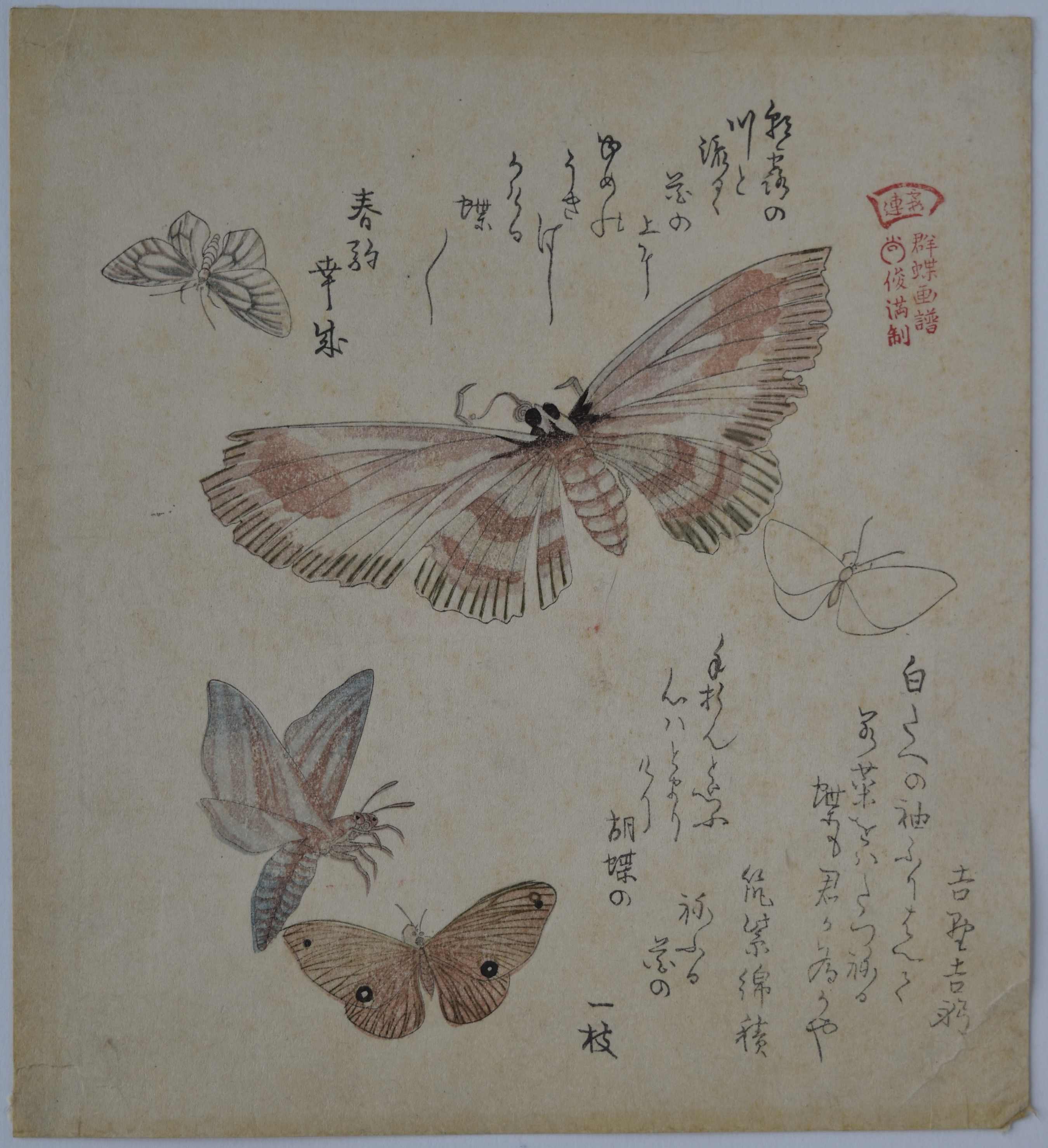
One of a series of surimono with title: Guncho gafu, “ Pictorial Record of a Swarm of Butterflies.” (In fact butterflies and moths.) Shunman is recognised as possibly the greatest designer of surimono and the prints from this set are amongst the most beautifully printed in this field. His family were printers and this would explain their particular excellence. In fact it is possible that Shunman engraved and printed himself which would account for his seal on other artists’ surimono. Issued c 1810s by the Kasumi-ren poetry club. (Their seal above the signature, top right, Kasumi-ren guncho gafu.) There are copies of the prints from this set which can be very misleading. Two other genuine impressions are in Harvard, 1933.4.1375 and the Met, JP2356.
Very fine impression. Fine colour. Slight discolouration and crinkling at the corners, otherwise good condition. Signed Sho Shunman sei.
Status: Available
Hishikawa MORONOBU (?-1694)
Click here to view image full size.
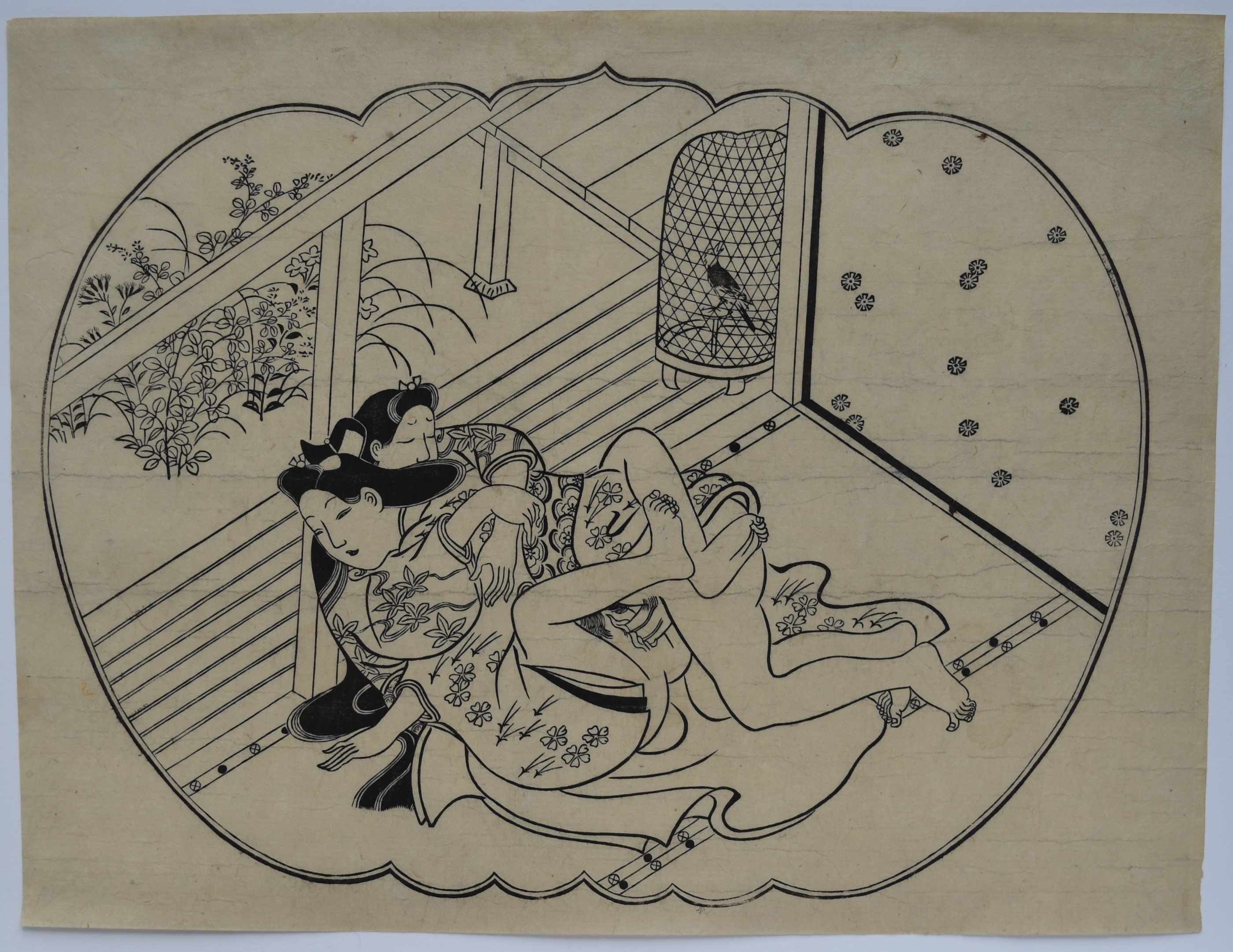
A large sumizuri-e from a shunga set of twelve published c 1680s. In each case the couples are enclosed in a Chinese-style fan border. A couple in flagrante delicto beside an engawa with a bird cage. Moronobu was possibly the single most influential artist and pioneered the ukiyo-e school. A painter, printer and illustrator.
Very good impression. Minor marks, otherwise good condition.
Status: Available
Hishikawa MORONOBU (?-1694)
Click here to view image full size.
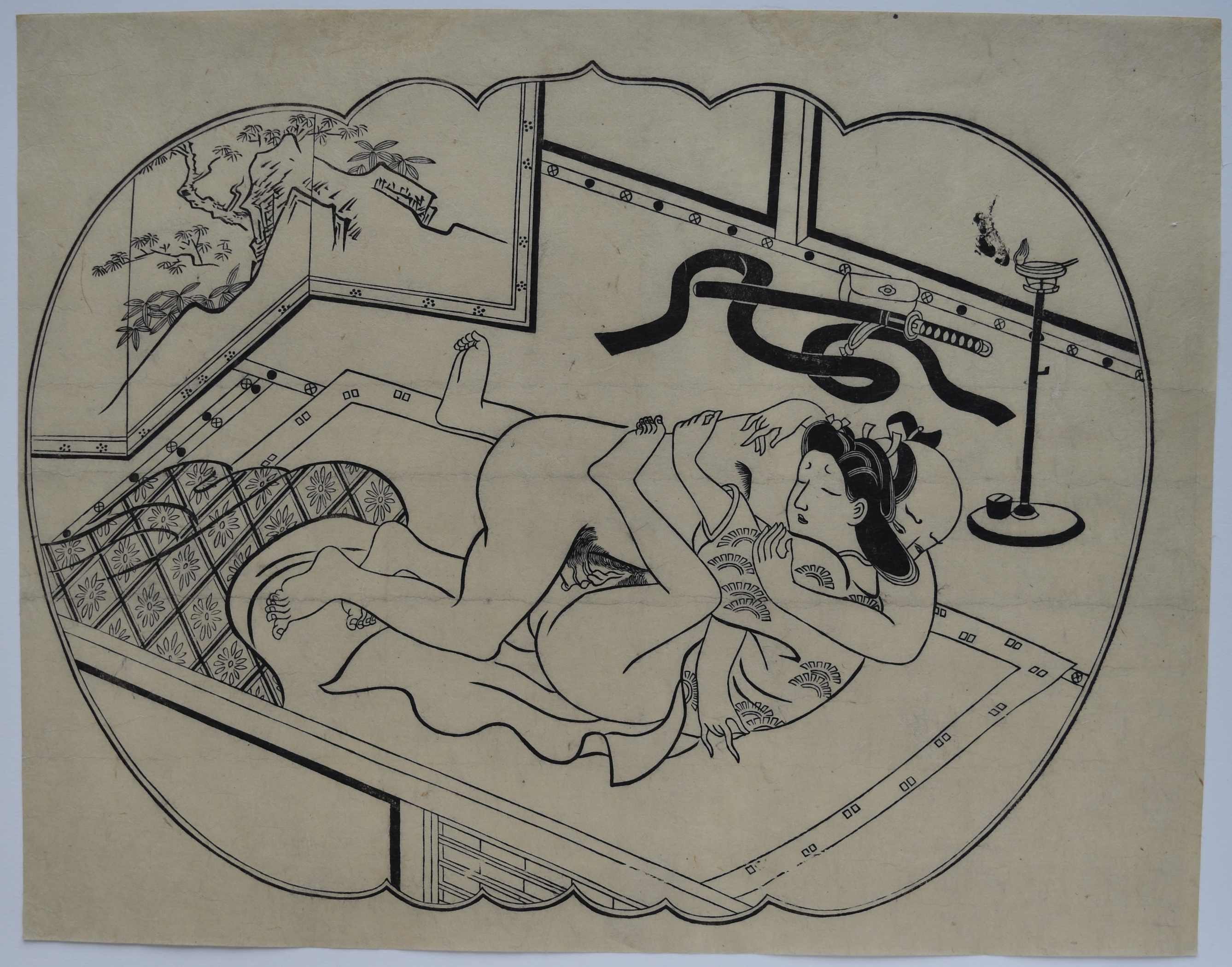
A large sumizuri-e from a shunga set of twelve published c 1680s. In each case the couples are enclosed in a Chinese-style fan border. A couple in flagrante delicto. Moronobu was possibly the single most influential artist and pioneered the ukiyo-e school. A painter, printer and illustrator.
Very good impression. Minor marks, otherwise good condition.
Status: Available
Hishikawa MORONOBU (?-1694)
Click here to view image full size.
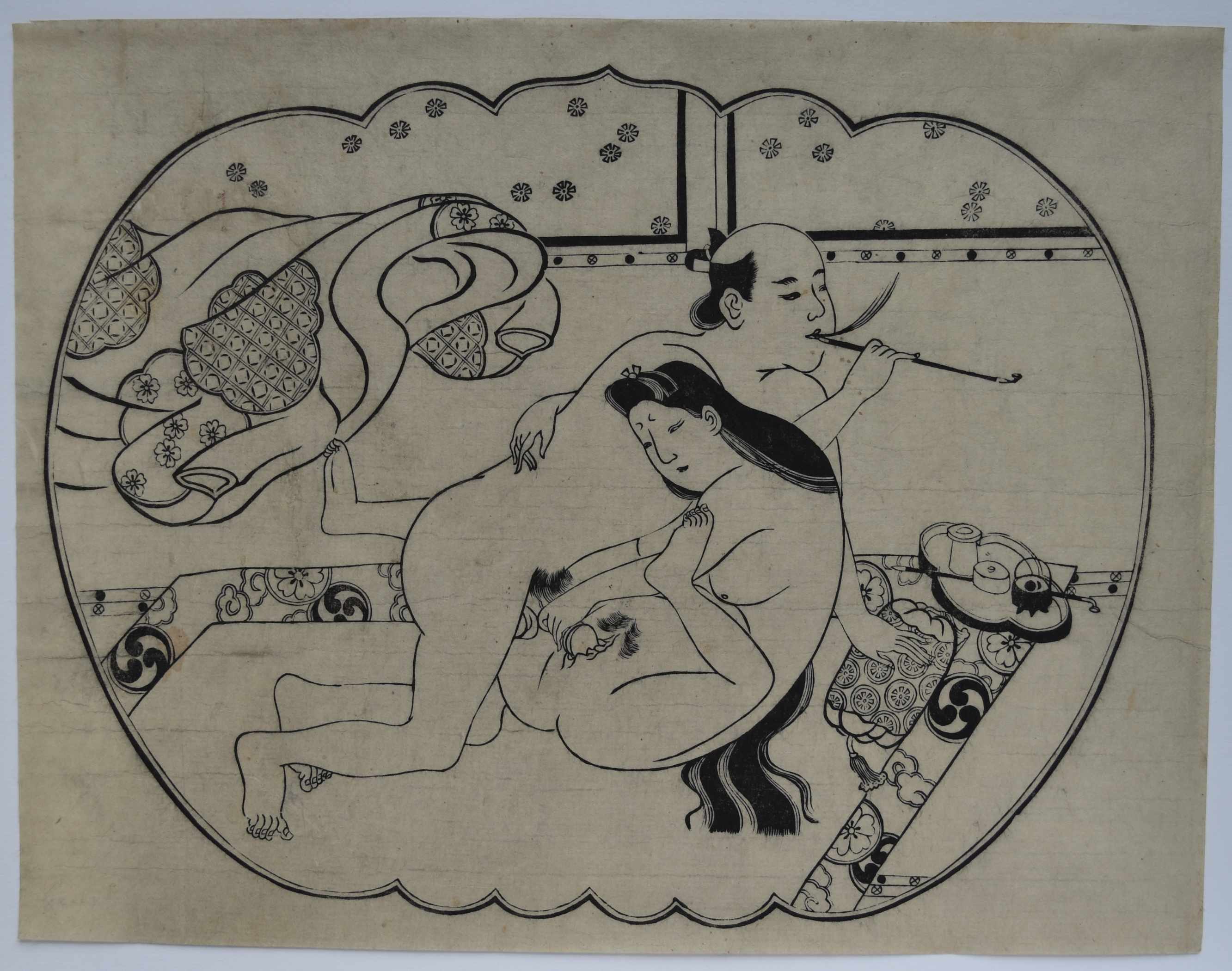
A large sumizuri-e from a shunga set of twelve published c 1680s. In each case the couples are enclosed in a Chinese-style fan border. A couple in flagrante delicto. Moronobu was possibly the single most influential artist and pioneered the ukiyo-e school. A painter, printer and illustrator.
Very good impression. Minor marks, otherwise good condition.
Status: Available
Hishikawa MORONOBU (?-1694)
Click here to view image full size.
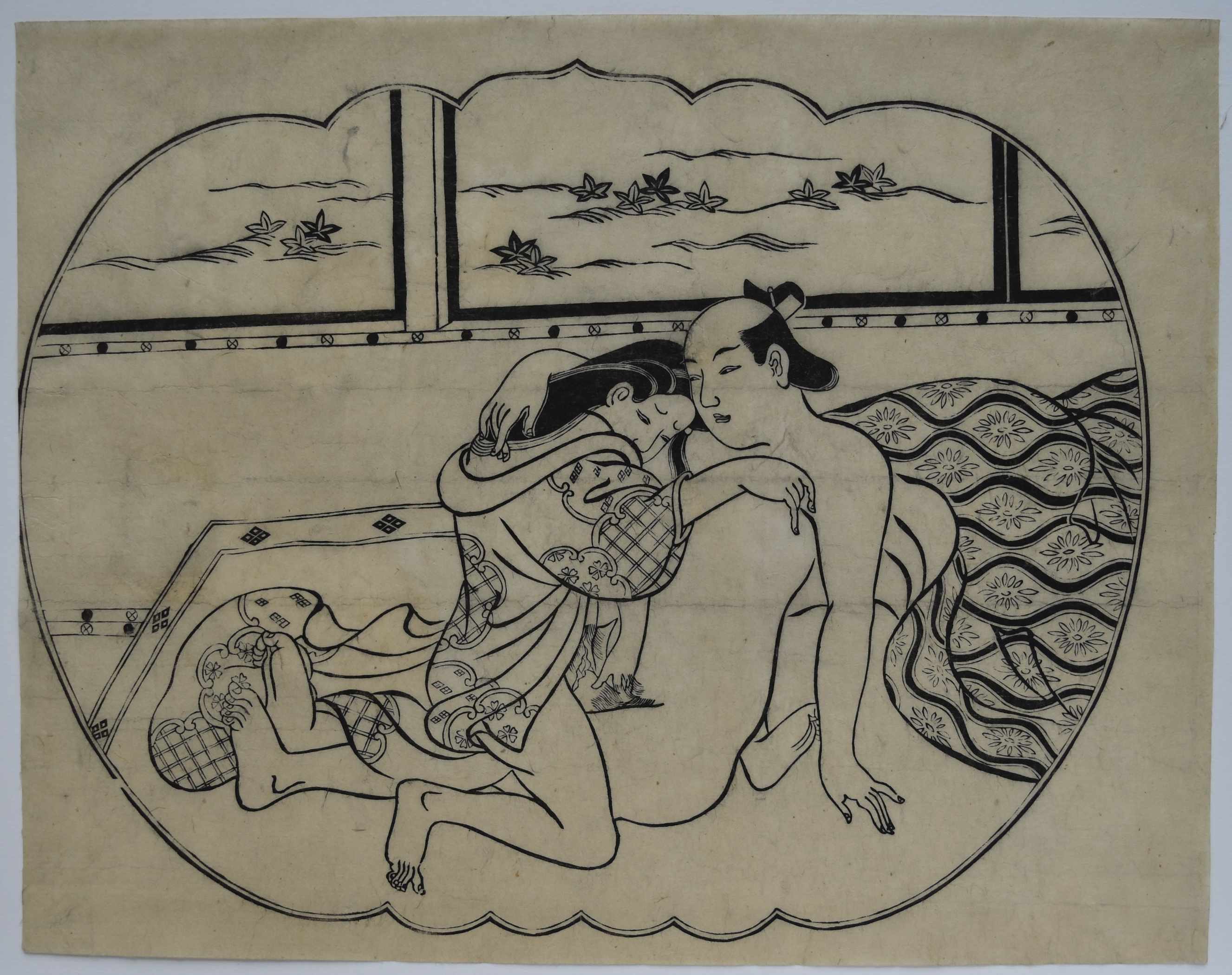
A large sumizuri-e from a shunga set of twelve published c 1680s. In each case the couples are enclosed in a Chinese-style fan border. A couple in flagrante delicto. Moronobu was possibly the single most influential artist and pioneered the ukiyo-e school. A painter, printer and illustrator.
Very good impression. Minor marks, otherwise good condition.
Status: Available
Hishikawa MORONOBU (?-1694)
Click here to view image full size.
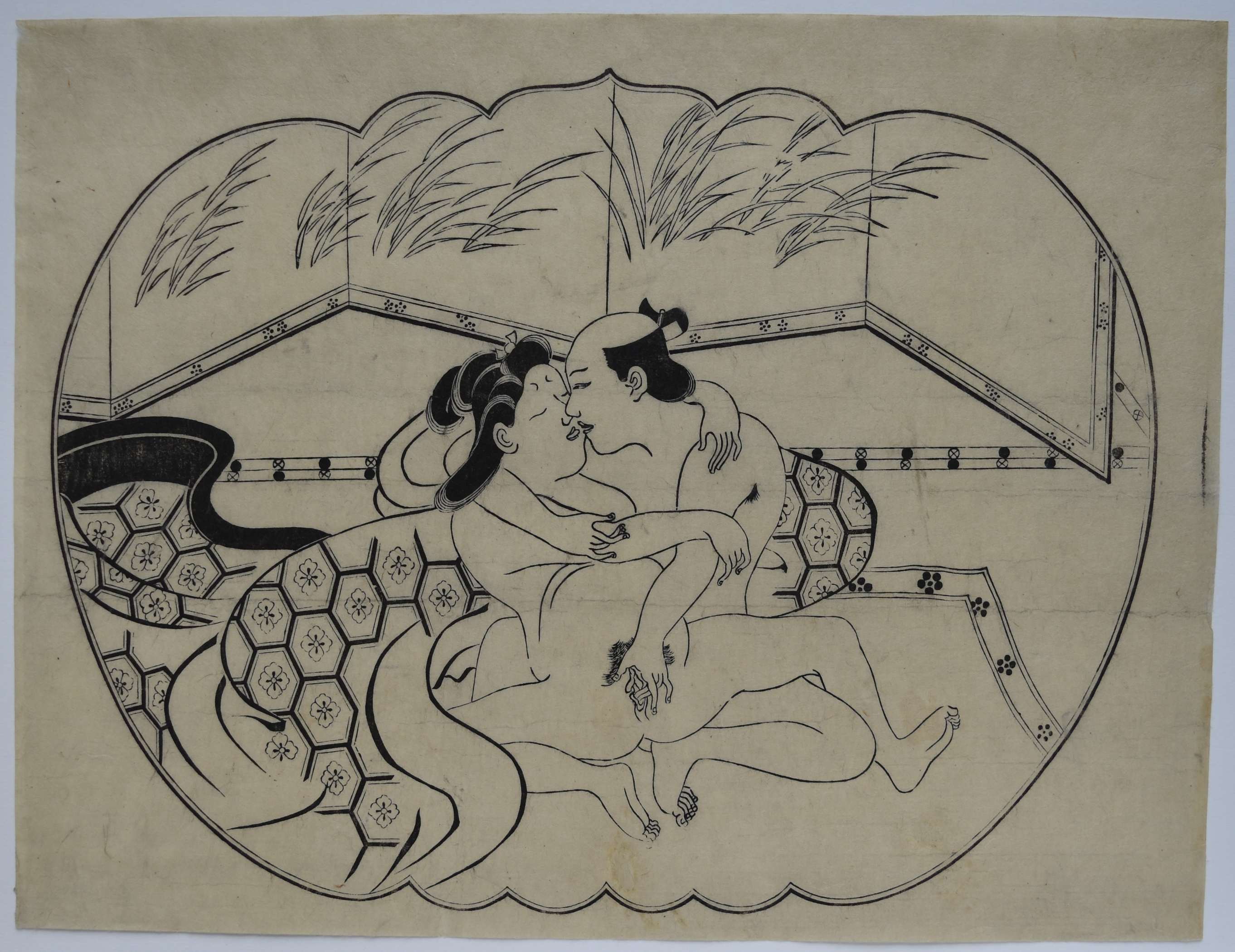
A large sumizuri-e from a shunga set of twelve published c 1680s. In each case the couples are enclosed in a Chinese-style fan border. A couple in flagrante delicto. Moronobu was possibly the single most influential artist and pioneered the ukiyo-e school. A painter, printer and illustrator.
Very good impression. Minor marks, otherwise good condition.
Status: Available
Utagawa HIROSHIGE II (1826-1869)
Click here to view image full size.
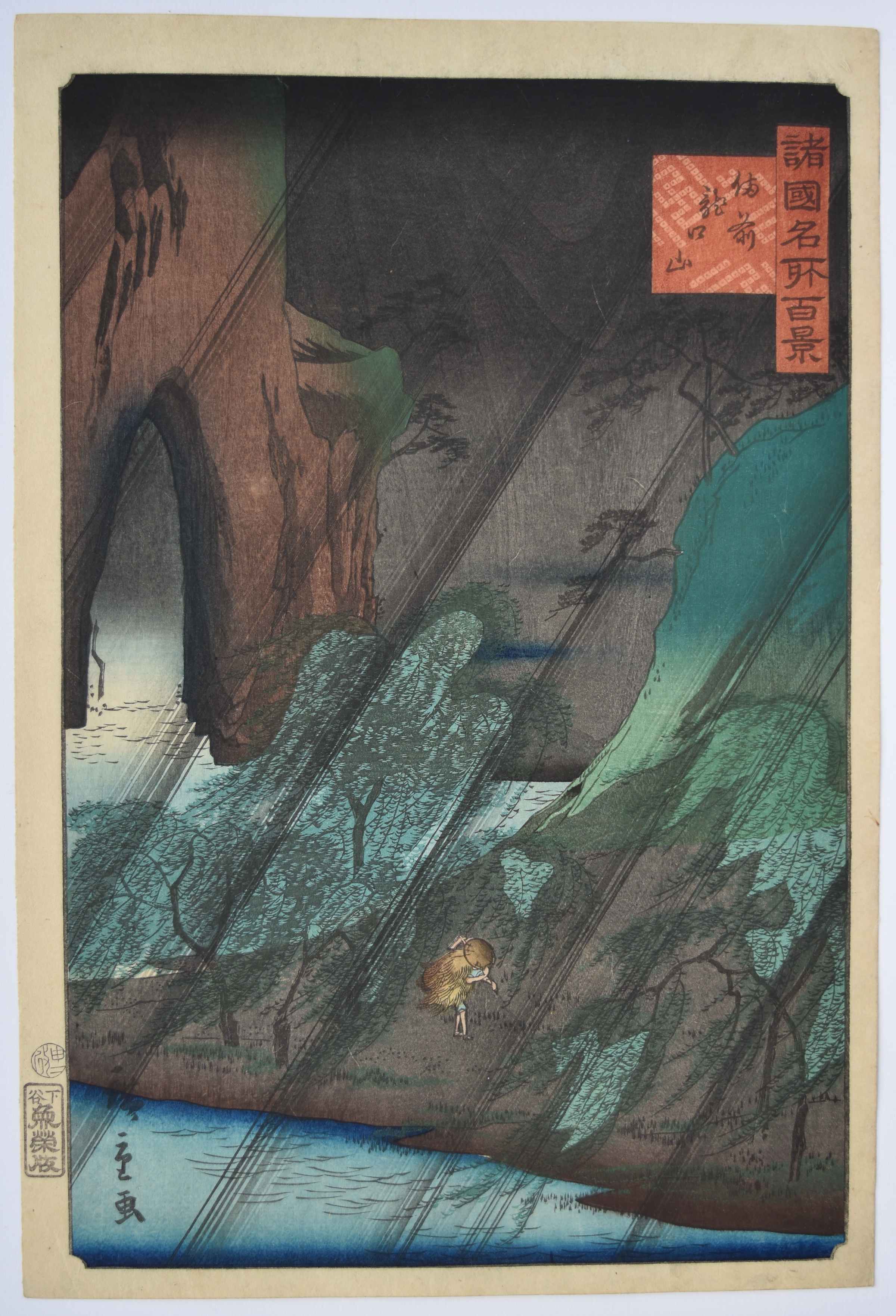
The Dragon’s Maw Mountain, Bizen Province, Bizen tatsu-no-kuchiyama from Shokoku meisho hyakkei, “Hundred Views of Famous Places in the Provinces.” An uncompleted set of 81 prints published by Uoya Eikichi between 1859-1861 (this being 1861). Shows a lone figure battling a heavy rainstorm in a steep-sided canyon.
Superb impression of the first edition. Fine colour and condition. Signed Hiroshige ga.
Status: Available
Utagawa HIROSHIGE II (1826-1869)
Click here to view image full size.
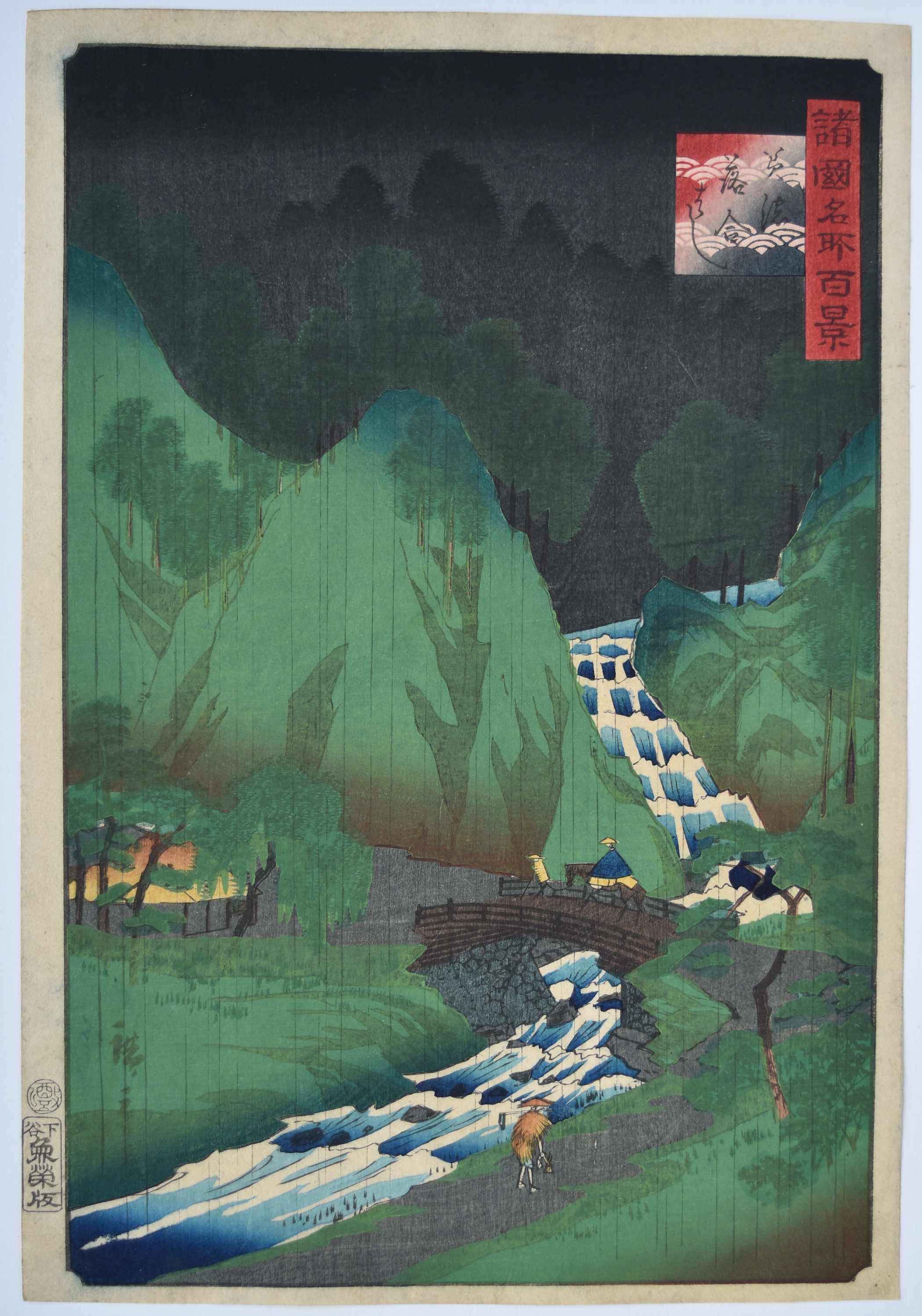
Mino Ochiai-bashi. Mino (Noshu) Province from Shokoku meisho hyakkei, “Hundred Views of Famous Places in the Provinces.” An uncompleted set of 81 prints published by Uoya Eikichi between 1859-1861 (this being 1861). An evening rain scene with figures making their way across the torrential Chitose River, famous for its fishing.
Superb impression of the first edition. Fine colour and condition. Signed Hiroshige ga.
Status: Available
Utagawa KUNISADA (1786-1864)
Click here to view image full size.
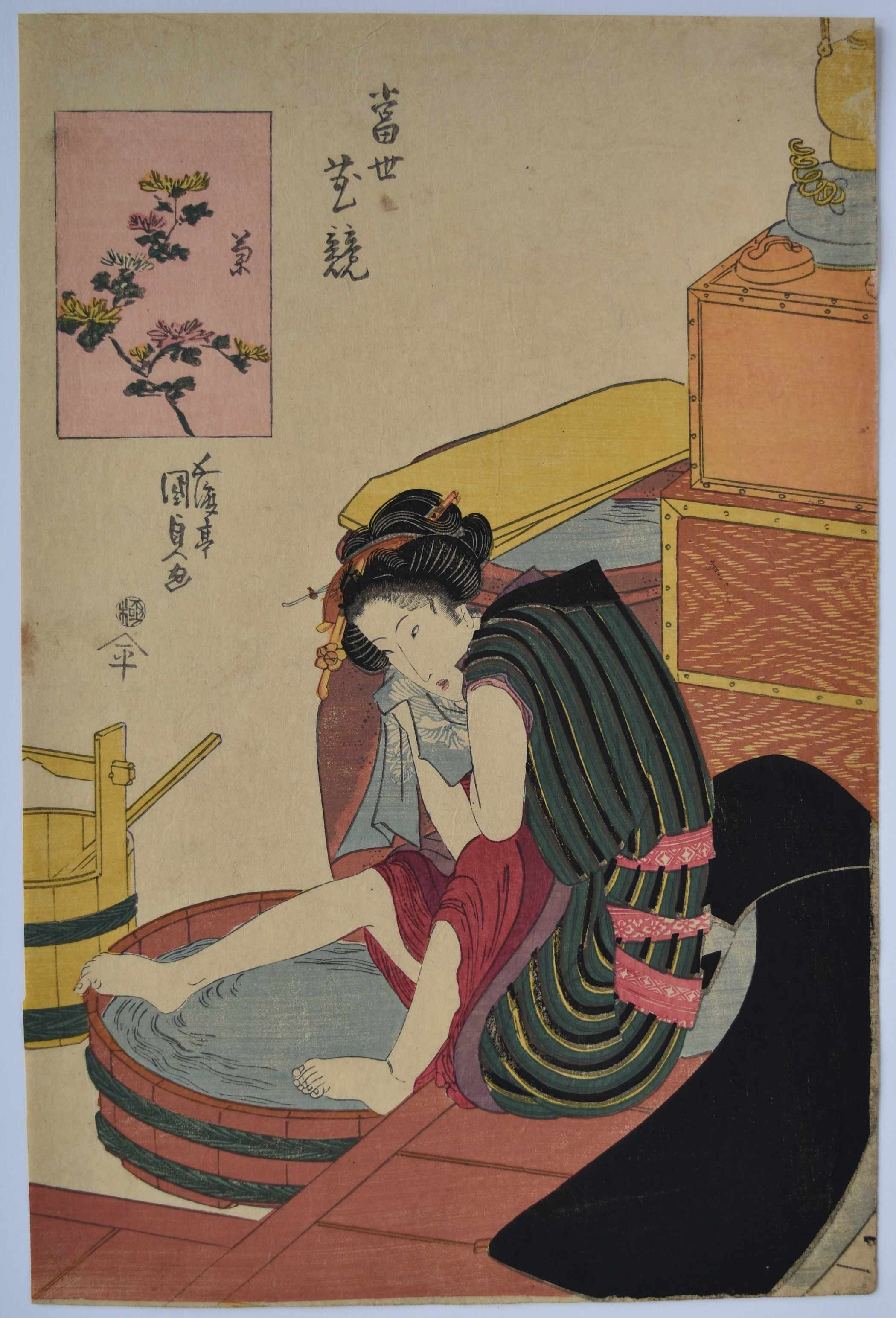
A beauty washing in a large tub of water. Kiku,”Chrysanthemum” from a set Tosei hana kurabe, “Contest of Modern Flowers.”Beauties compared to flowers. Published by Omiya Heihachi, c 1820. This appears to be the earliest state with the beauty’s undergarment printed red which is lacking in other impressions.
Very good impression. Fine colour. Very good condition. Signed Gototei Kunisada ga.
Status: Available
Utagawa KUNISADA (1786-1864)
Click here to view image full size.
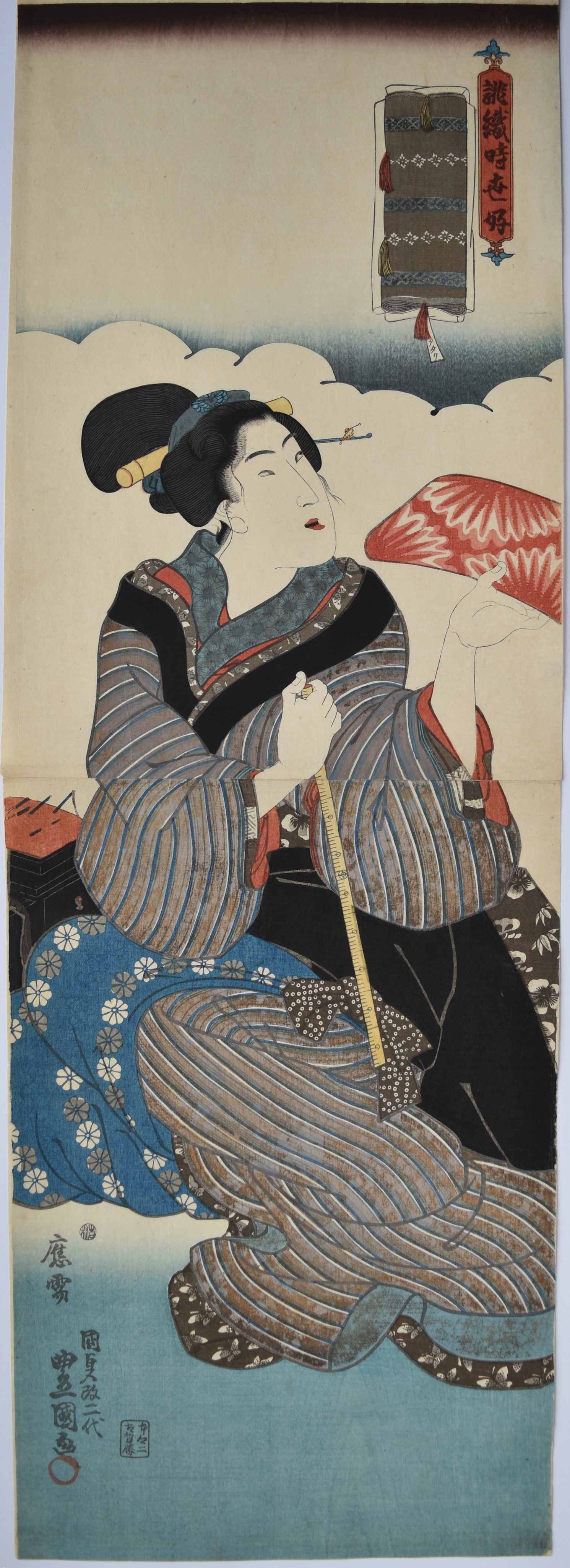
A vertical double oban showing a woman holding a ruler and offering a small bolt of cloth with the other hand. From a set Atsurae ori jisei konomi, “Fabrics to Order in Current Taste.” Published by Yamashiroya Jinbei, c 1843-7. A rare design from a rare set, and even rarer to find in this condition as most examples have been mounted and consequently damaged from being hung.
Very fine impression. Fine colour and condition. Signed Oju Kunisada aratame Nidai Toyokuni ga.
Status: Available
Tsukioka YOSHITOSHI (1839-1892)
Click here to view image full size.
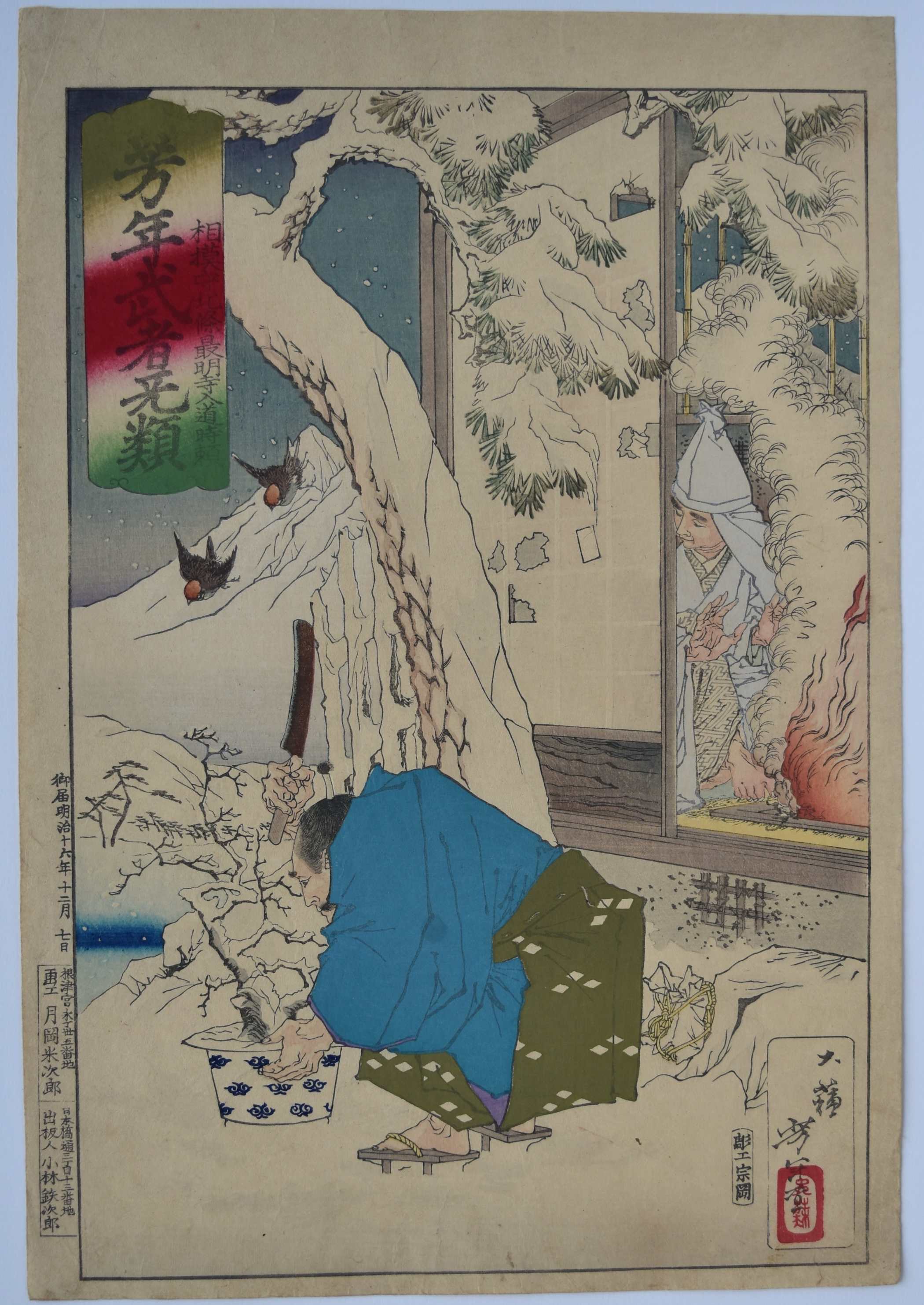
Shows Sano Genzaemon Tsuneyo in his snowy garden about to cut his precious bonsai to provide kindling to cook a meal for an unexpected visitor. The guest, disguised as a monk, was in fact the retired regent Hojo Tokiyori (1226-1263) on an intelligence mission. He is shown peering through the shoji. From a set Yoshitoshi musha burui, “Yoshitoshi’s Courageous Warriors” published by Kobayashi Tetsujiro, 1883. This is the first edition with the heavily variegated cartouche. Some first editions from the set also have red seals in the left margin and some also have the panels below coloured.
Very good impression, colour and condition. Signed Taiso Yoshitoshi ga.
Status: Available
Utagawa KUNITORA (Active c 1819-1840)
Click here to view image full size.
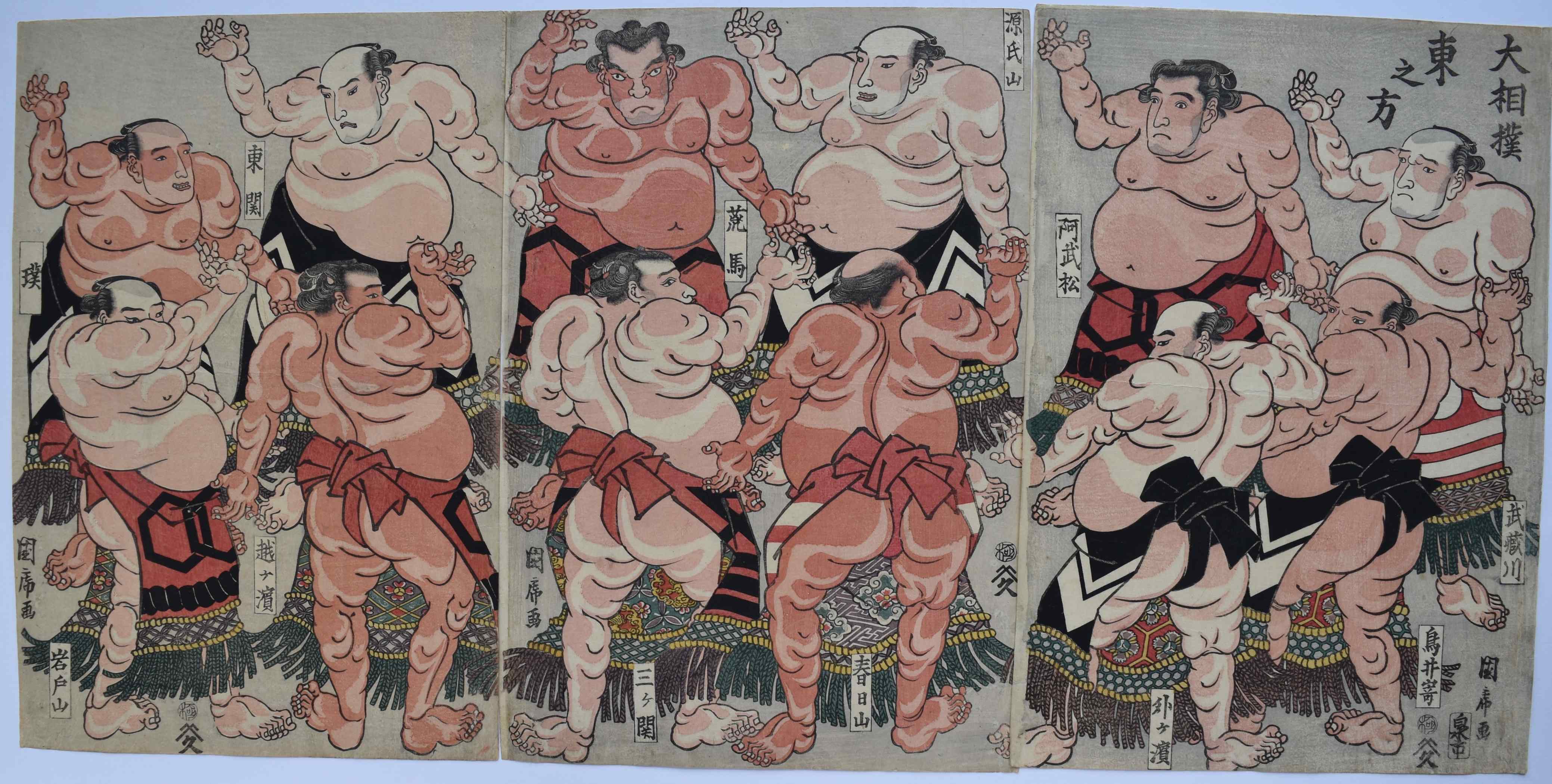
A triptych showing the famous sumo wrestlers from the Higashikata (East) camp. The opposite side being the Nishikata (West) camp. On the centre panel at the top are the famous wrestlers Arauma Daigoro (left) and Genjiyama Tsunagoro (right). Published by Eikyudo c late 1820s. Rare.
Fine impression and colour. Very good condition. Signed Kunitora ga.
Status: Available
Utagawa YOSHIIKU (1833-1904)
Click here to view image full size.
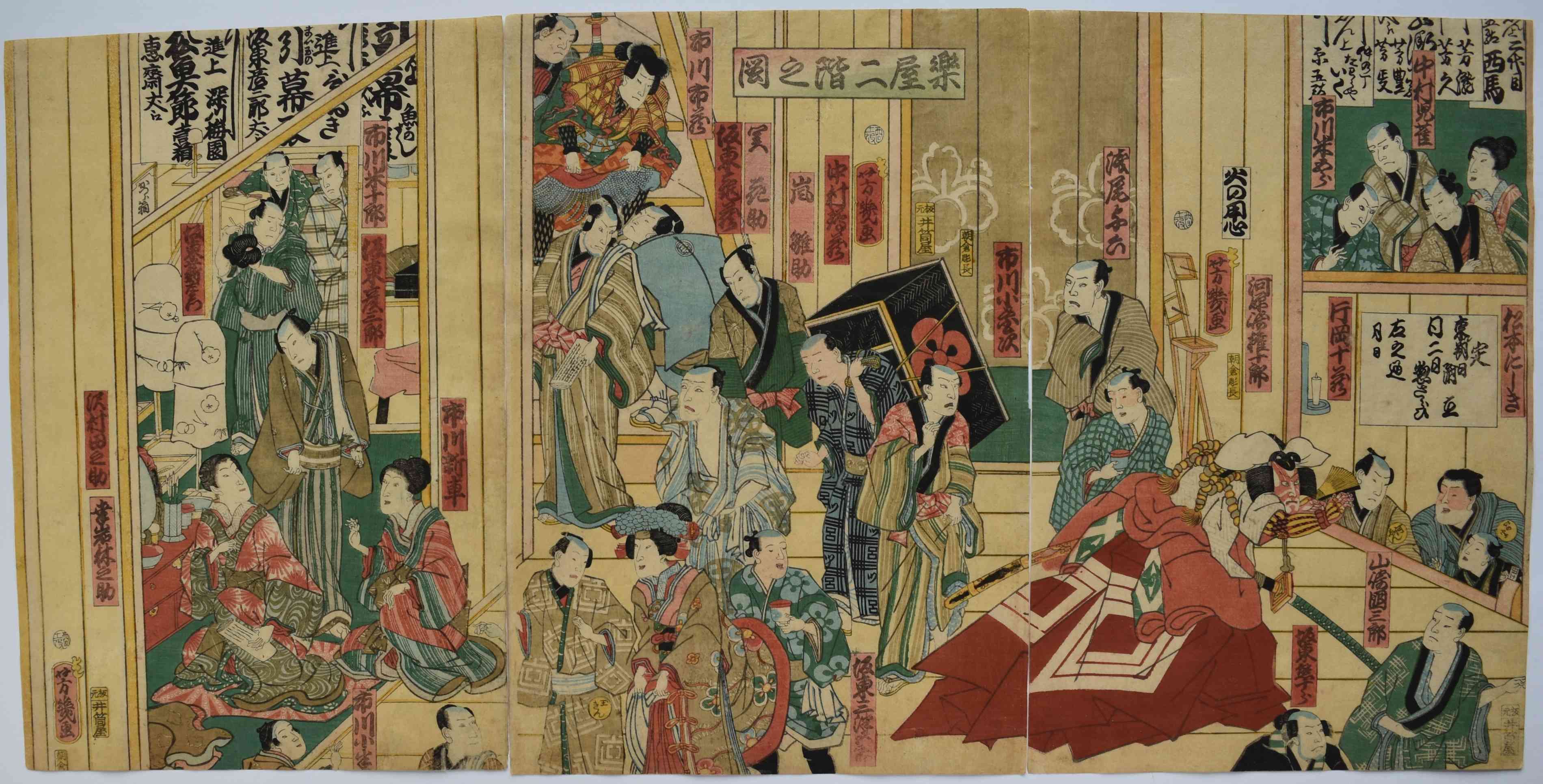
A fascinating triptych showing the backstage activities on the second floor of a kabuki theatre, Gakuya ni-kai no zu. Twenty-one actors are shown, mostly in their street clothes, together with assistants. However, on the right sheet can be seen an actor in full Shibaraku costume while the centre sheet has Ichikawa Ichizo III descending the stairs. Below is the actor Bando Mitsugoro VI in an onnagata role. On the left sheet can be seen another actor in an onnagata role applying his makeup. This is the bottom half of a hexaptych. Published by Izutsuya Shokichi, c 1861. This design is loosely based on the bottom half of a hexaptych designed by Kunisada in 1856. Rare.
Very good impression and colour. Minor defects, otherwise very good condition. Signed Yoshiiku ga.
Status: Available
Toyohara KUNICHIKA (1835-1900)
Click here to view image full size.
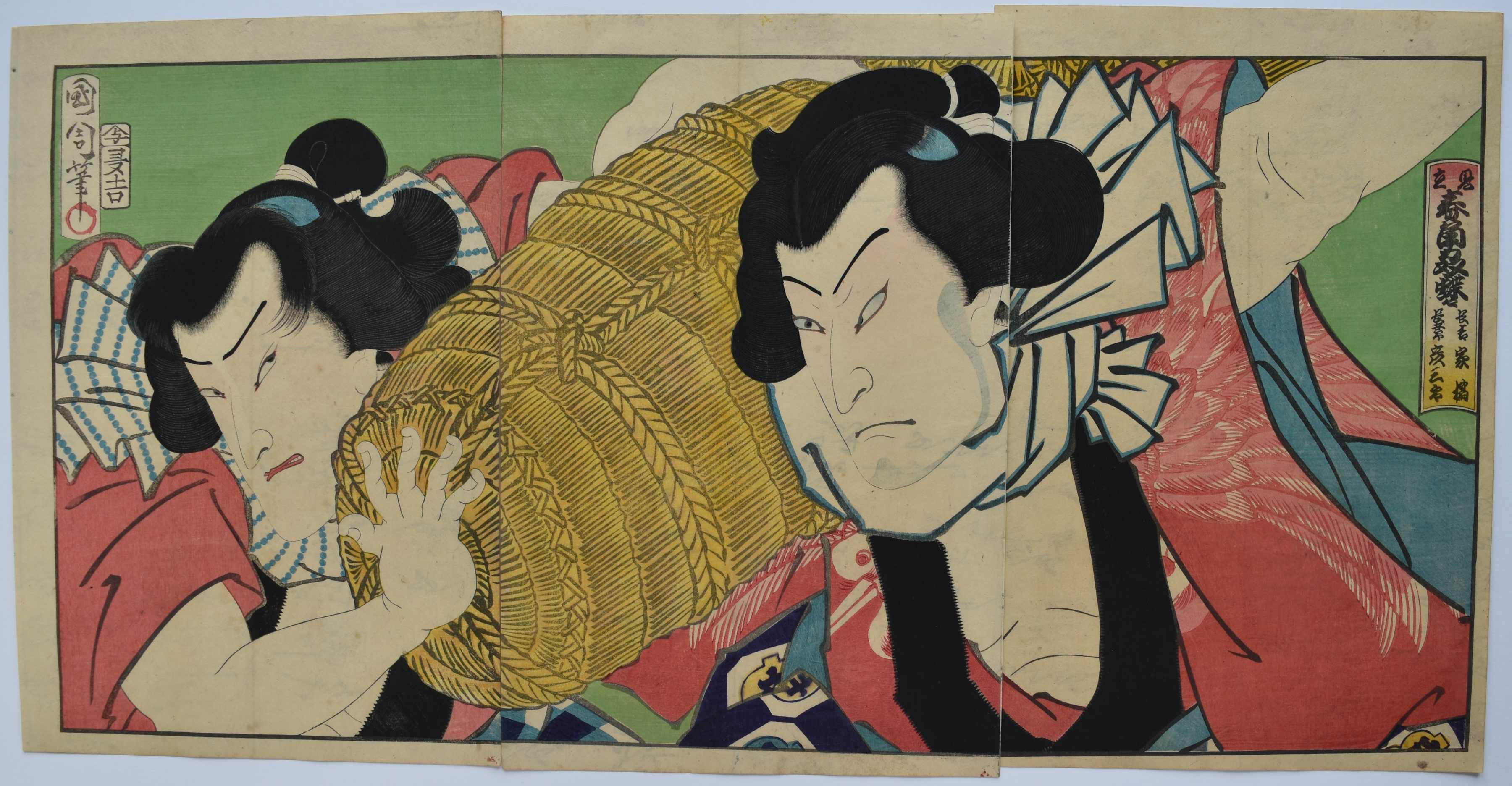
A triptych with the title Mitate haruzumo futatsu chocho, “An Imaginary Spring Sumo Match with two Butterflies.” A parody of the famous Sumoba, “Sumo Scene” in the pay Futatsu chocho kuruwa nikki, “A Diary of two Butterflies in the Pleasure Quarters.” Shows the actors Ichimura Kakitsu IV (left) as the wrestler Chokichi and Bando Hikosaburo V (right) as his rival Chogoro. The names of both wrestlers begin with “Cho” and two of them together makes “Chocho” which also means “butterfly.” Published by Otaya Takichi, 1866.
Very good impression and colour. Backed, otherwise very good condition. Signed Kunichika ga.
Status: Available
Utagawa TOYOKUNI (1769-1825)
Click here to view image full size.
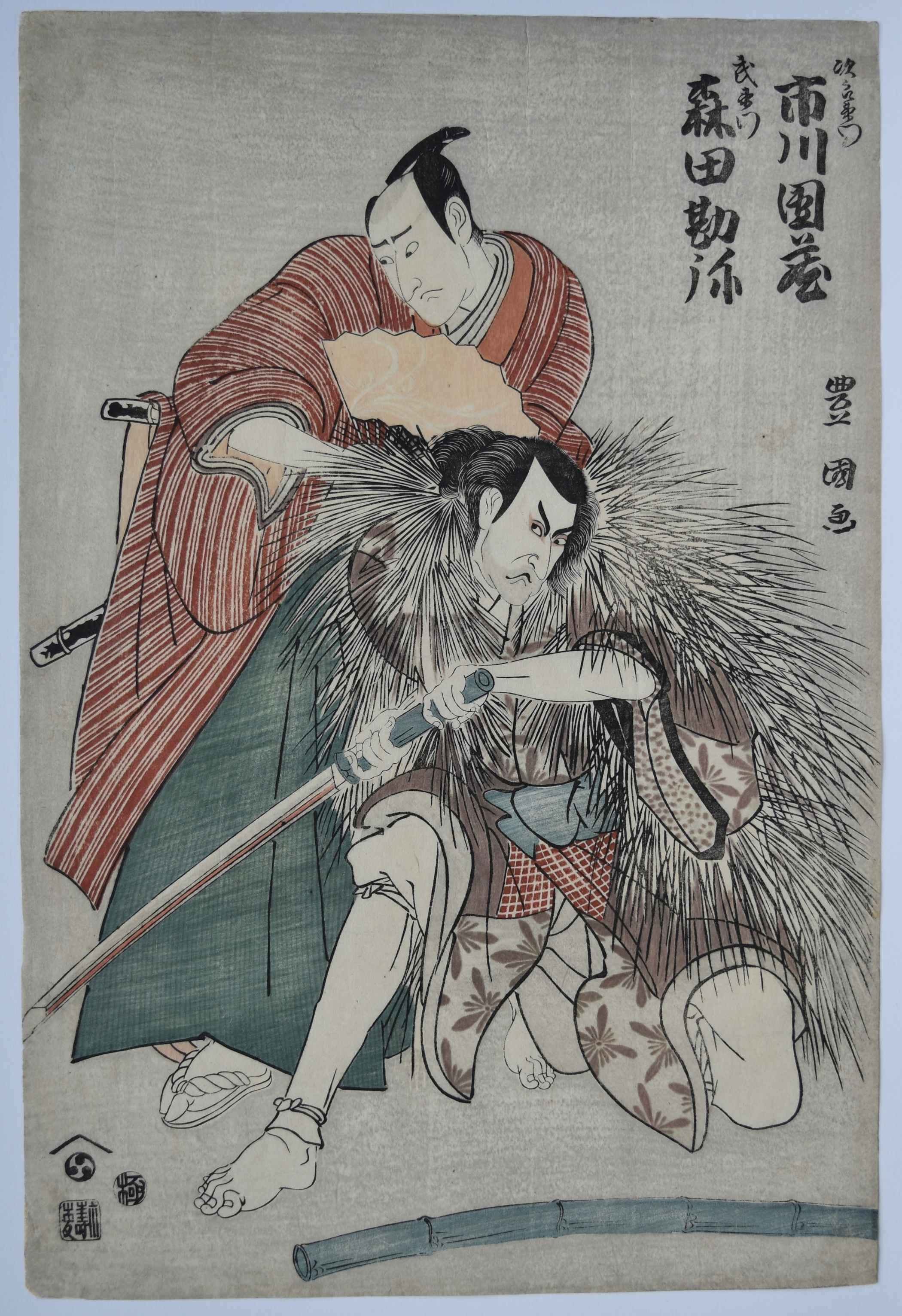
Shows Ichikawa Danzo IV as Shundo Jiroemon disguised as a beggar and Morita Kan’ya VIII as Takaichi Buemon in the Daianji Zutsumi scene from the play Katakiuchi tsuzure no nishiki, “The Vendetta in Patched-Brocade.” A fine grey-ground print published by Eijudo, 1798. Ichikawa Danzo IV had one of the great Kabuki faces. See the 1799 Toyokuni bust of Danzo as Keyamura Rokusuke in the drama Hikosan Gongen Chikai no Sukedachi.
Fine impression. Very good colour and condition. Signed Toyokuni ga.
Status: Sold