/category/flora-and-fauna/
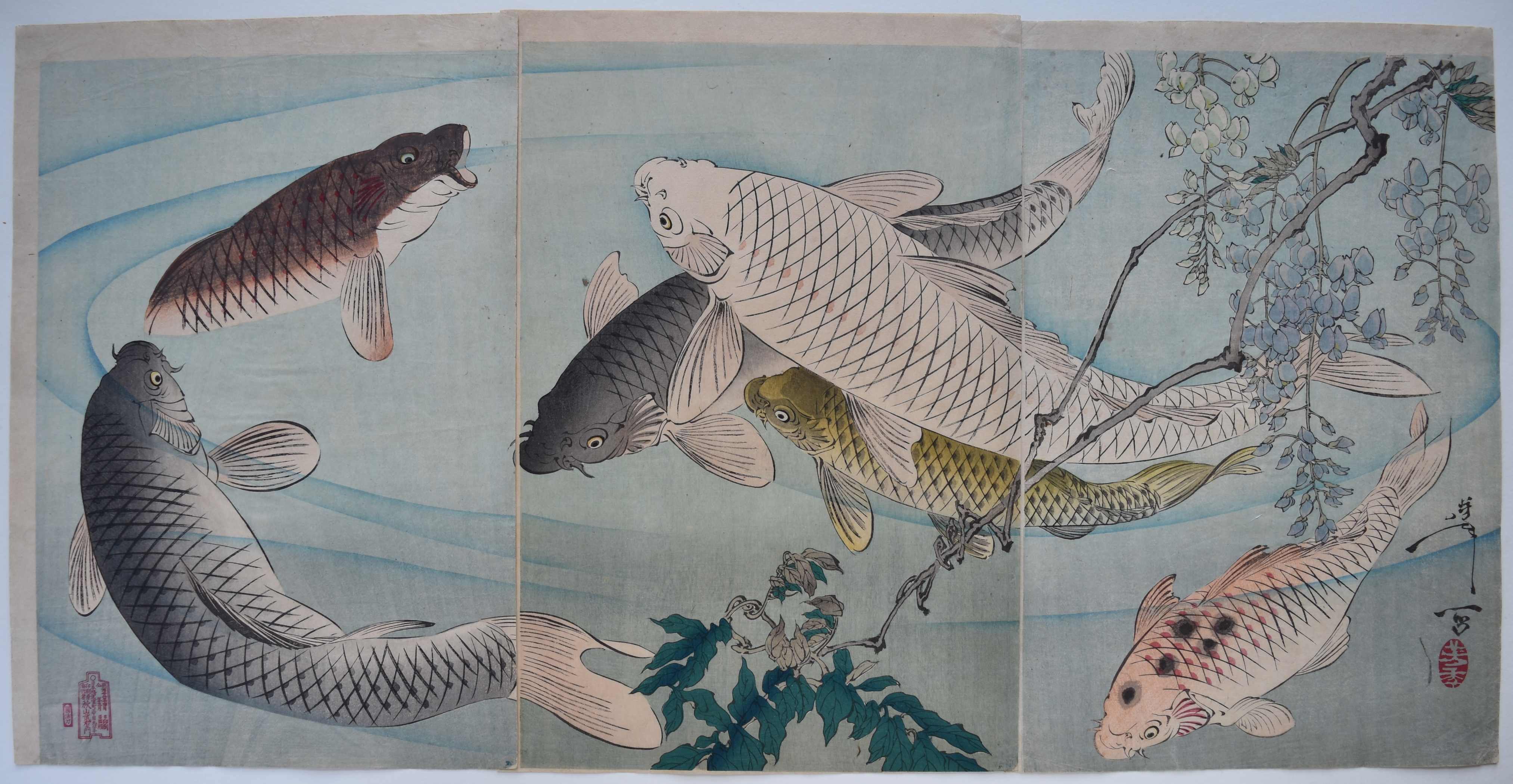
Tsukioka YOSHITOSHI (1839-1892)
Click here to view image full size.
A triptych showing carp swimming beneath wisteria. A rare and extremely unusual subject in Yoshitoshi’s canon of work. Koi are symbols of love and friendship in Japan. The breeding of ornamental carp began in the 1820s. The outside world was unaware of the advances in breeding colour variations until an annual exposition in Tokyo in 1914. Published by Akiyama Buemon, 1889. There is an original drawing, most likely for this triptych, elsewhere on this site. A much sought after design.
Very fine impression. Fine colour. Completely untrimmed with the extra margins around. Fine condition. Signed Yoshitoshi ga.
Status: Available
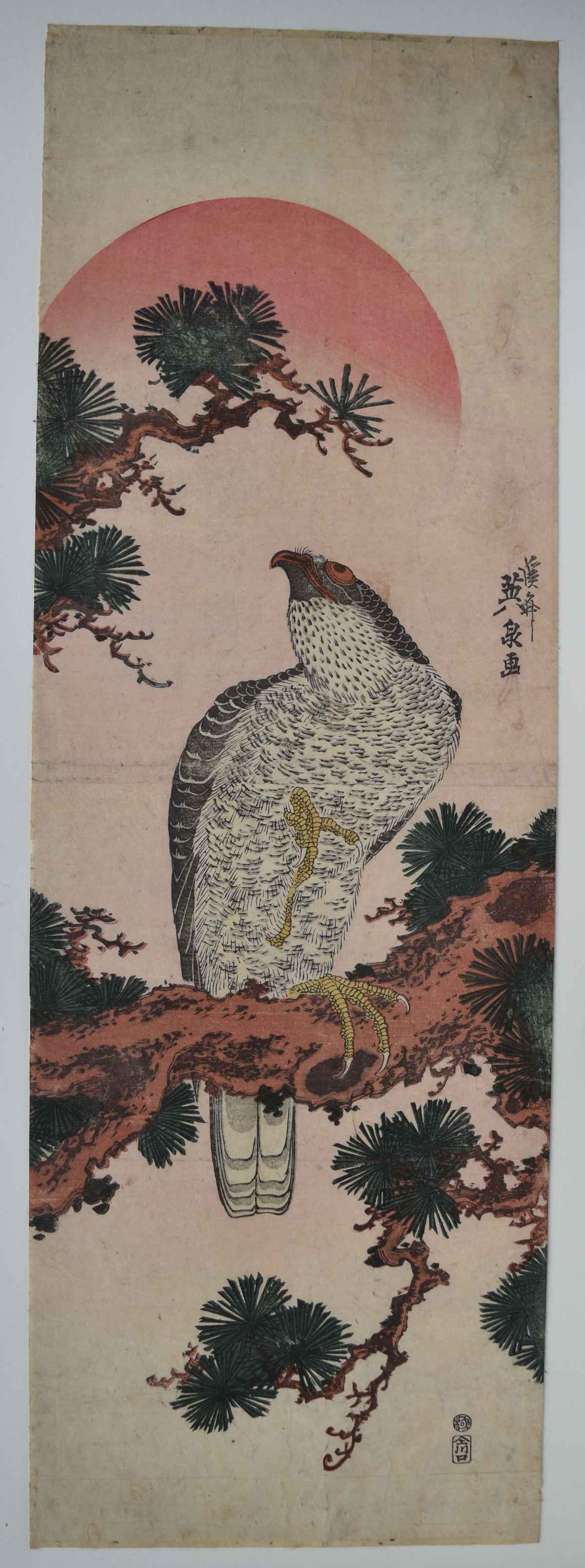
Keisai EISEN (1790-1848)
Click here to view image full size.
A vertical double oban showing a falcon on a pine branch with a large red sun above. This was a very popular subject and many artists produced versions in different formats. However, I cannot, at the moment, locate another impression of this design. Published by Kawaguchiya Uhei, c 1830s. Extremely rare.
Fine impression and colour. Slight soil and several expertly repaired wormholes, but otherwise very good condition. Signed Keisai Eisen ga.
Status: Available
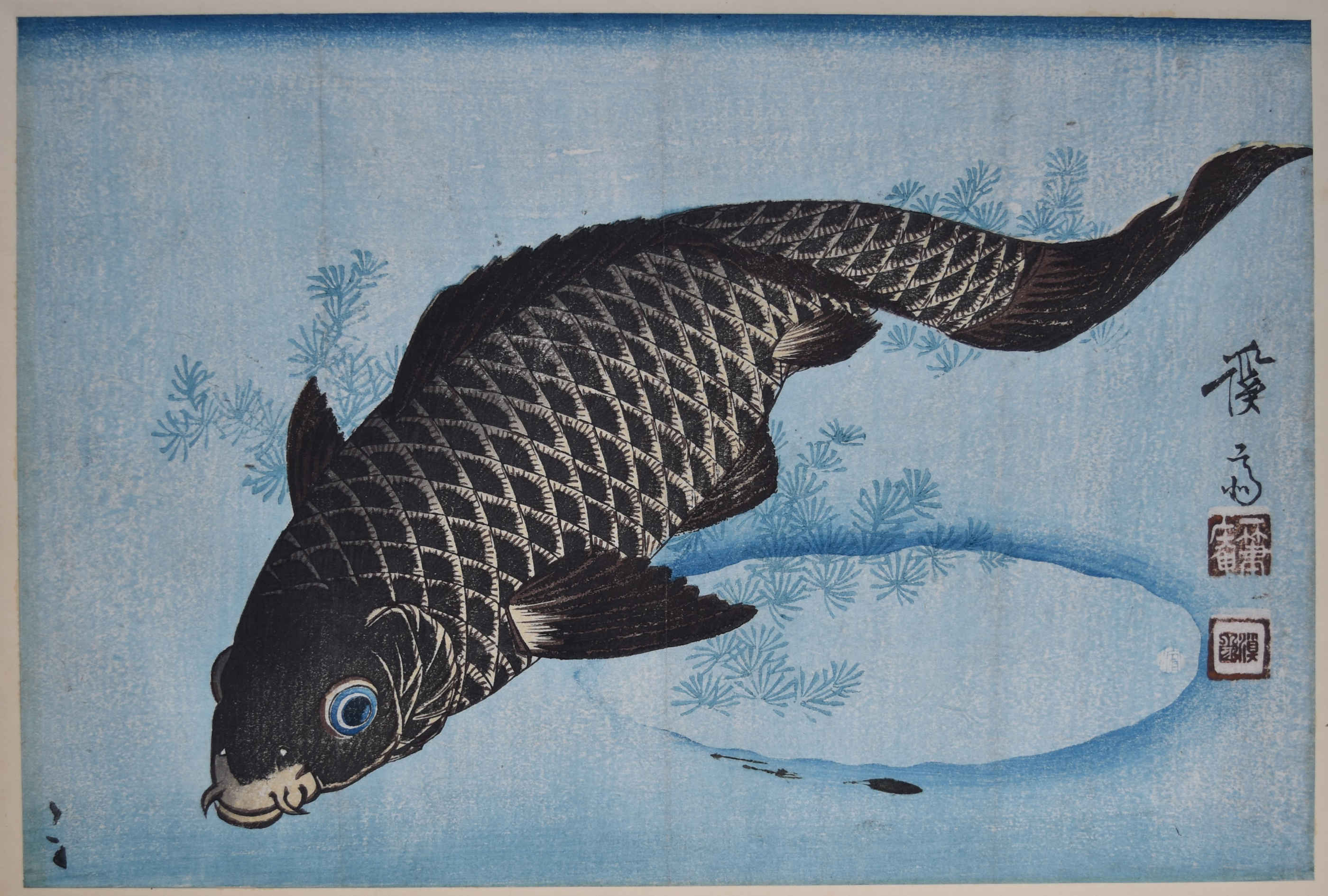
Keisai EISEN (1790-1848)
Click here to view image full size.
A carp swimming among water-weed. The moon’s reflection in the blue water. There are various editions of this design: without the moon’s reflection; with and without the censor seal; with and without publisher’s seal; with and without currents in the water. Published by Ezakiya, c. 1843-6. Rare.
Fine impression and colour. Faint vertical folds and two areas of sumi, otherwise very good condition. Signed Keisai with seals Ippitsuan and Keisai.
Status: Available
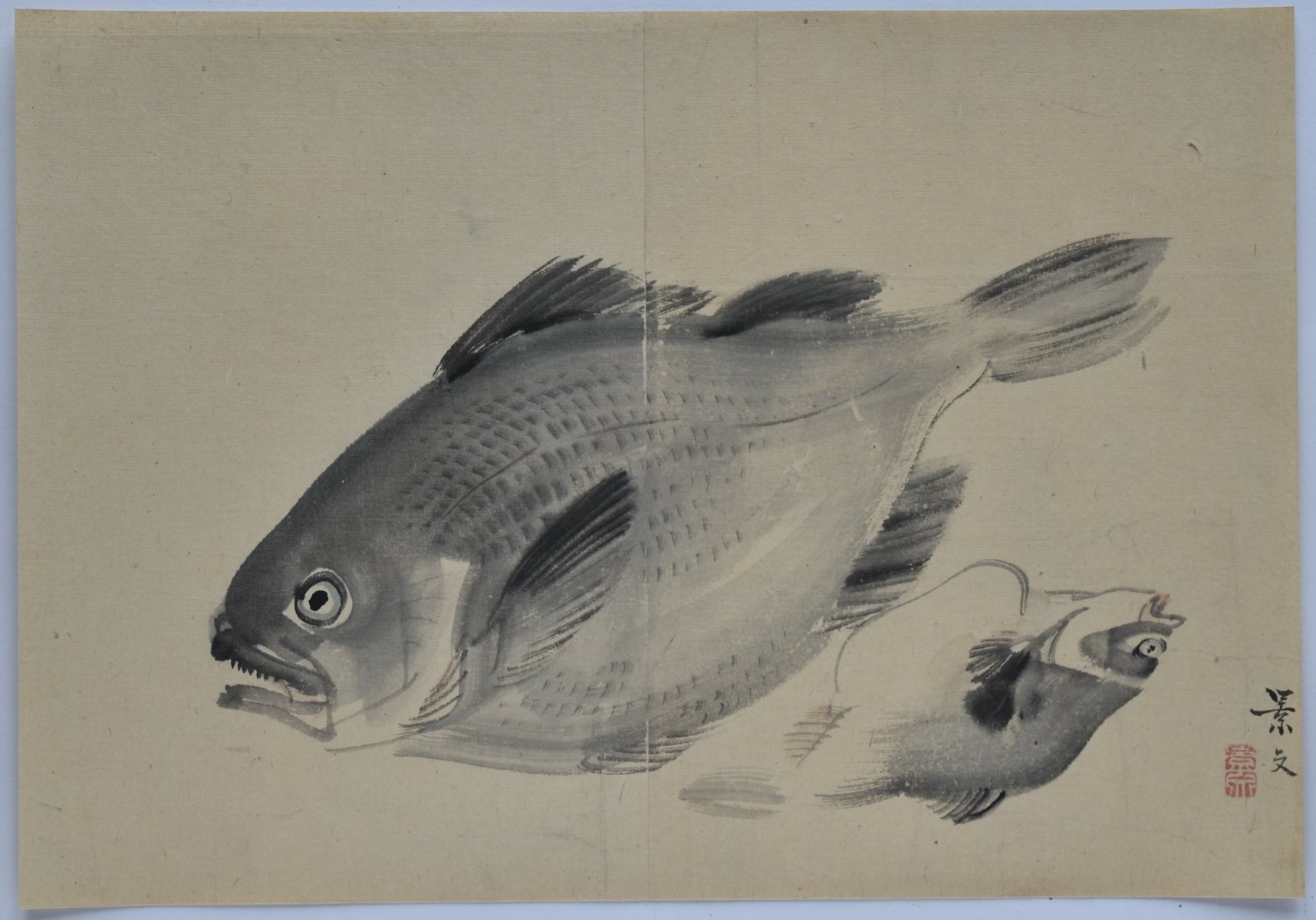
Matsumura KEIBUN (1779-1843)
Click here to view image full size.
A shijo brush drawing of a seabream and a lumpfish (?). One of Kyoto’s leading artists. Noted for his painting from nature. He studied with his older brother Matsumura Goshun as well as Maruyama Okyo. Sumi and light colour on paper, 10 x 14.75 in; 25.4 x 37.4 cms.
In good condition. Signed and sealed Keibun.
Status: Available
Matsumura KEIBUN (1779-1843)
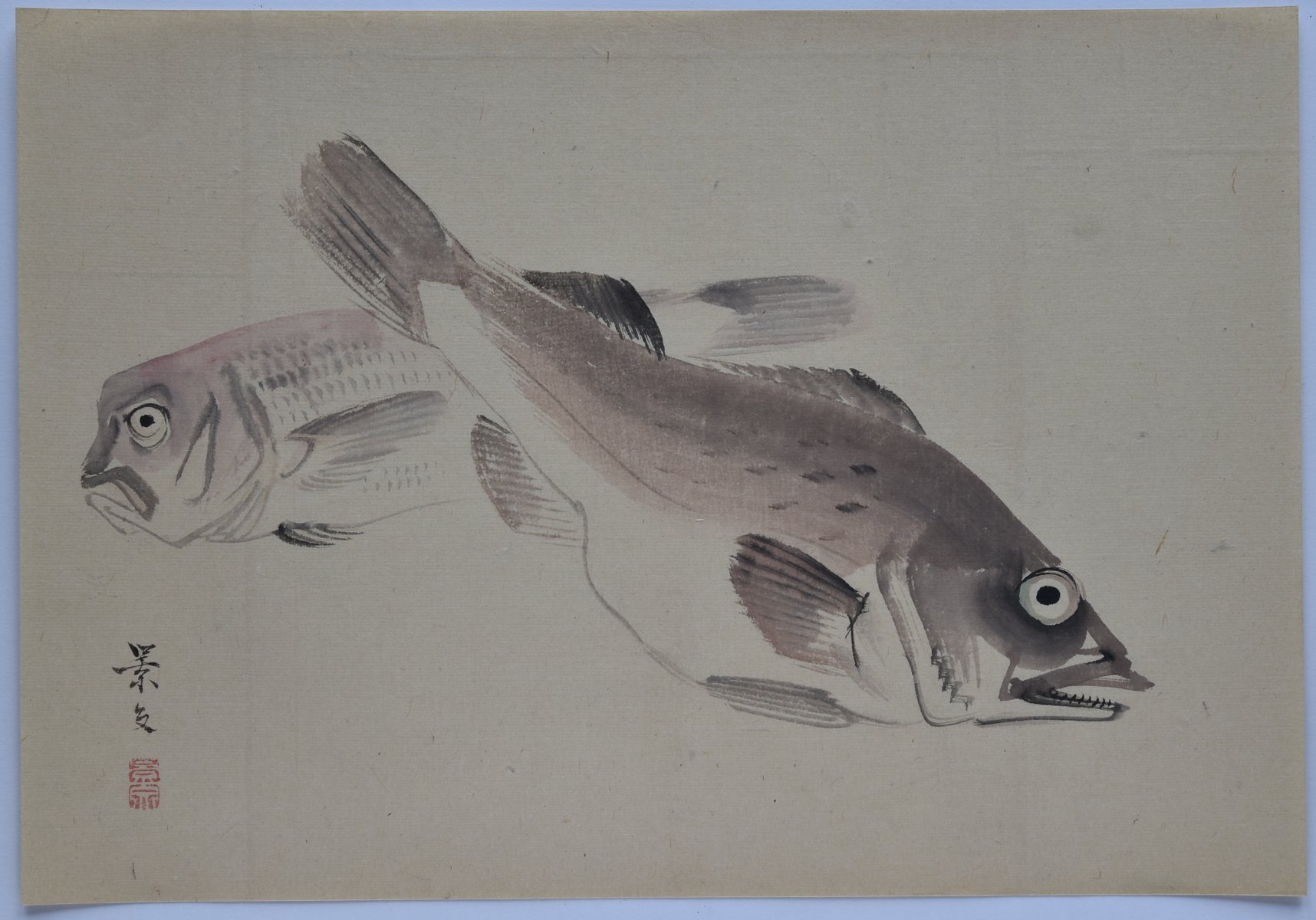
Click here to view image full size.
A shijo brush drawing of a white horsehead and an acropomatidae (?). One of Kyoto’s leading artists. Noted for his painting from nature. He studied with his older brother Matsumura Goshun as well as Maruyama Okyo. Sumi and light colour on paper, 10.5 x 15 in; 26.7 x 38.1 cms.
In good condition. Signed and sealed Keibun.
Status: Available
Matsumura KEIBUN (1779-1843)
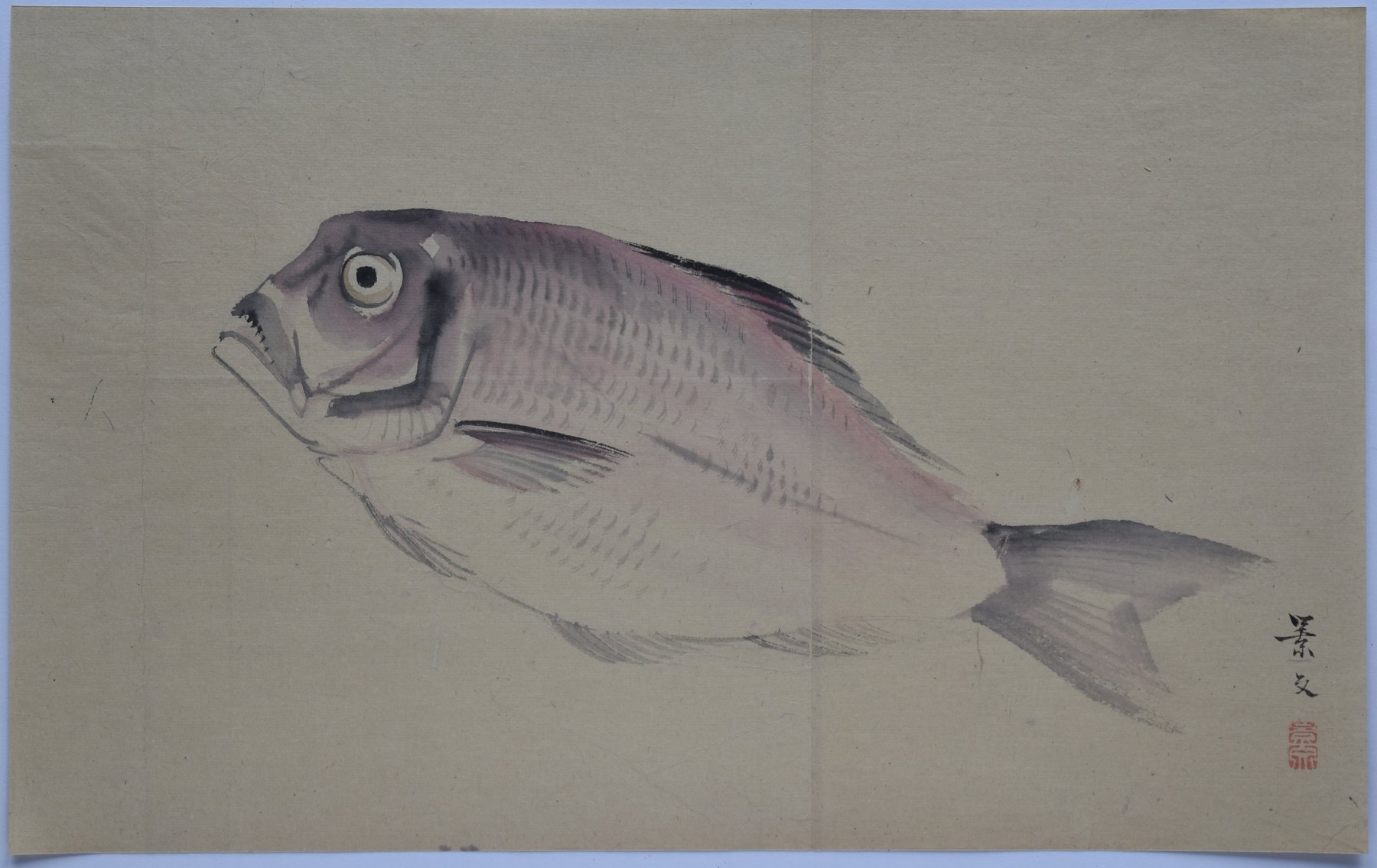
Click here to view image full size.
A shijo brush drawing of a red seabream. One of Kyoto’s leading artists. Noted for his paintings from nature. He studied with his older brother Matsumura Goshun as well as Maruyama Okyo. Sumi and light colour on paper, 10.5 x 17 in; 26.7 x 43.2 cms.
In good condition. Signed and sealed Keibun.
Status: Available
Matsumura KEIBUN (1779-1843)
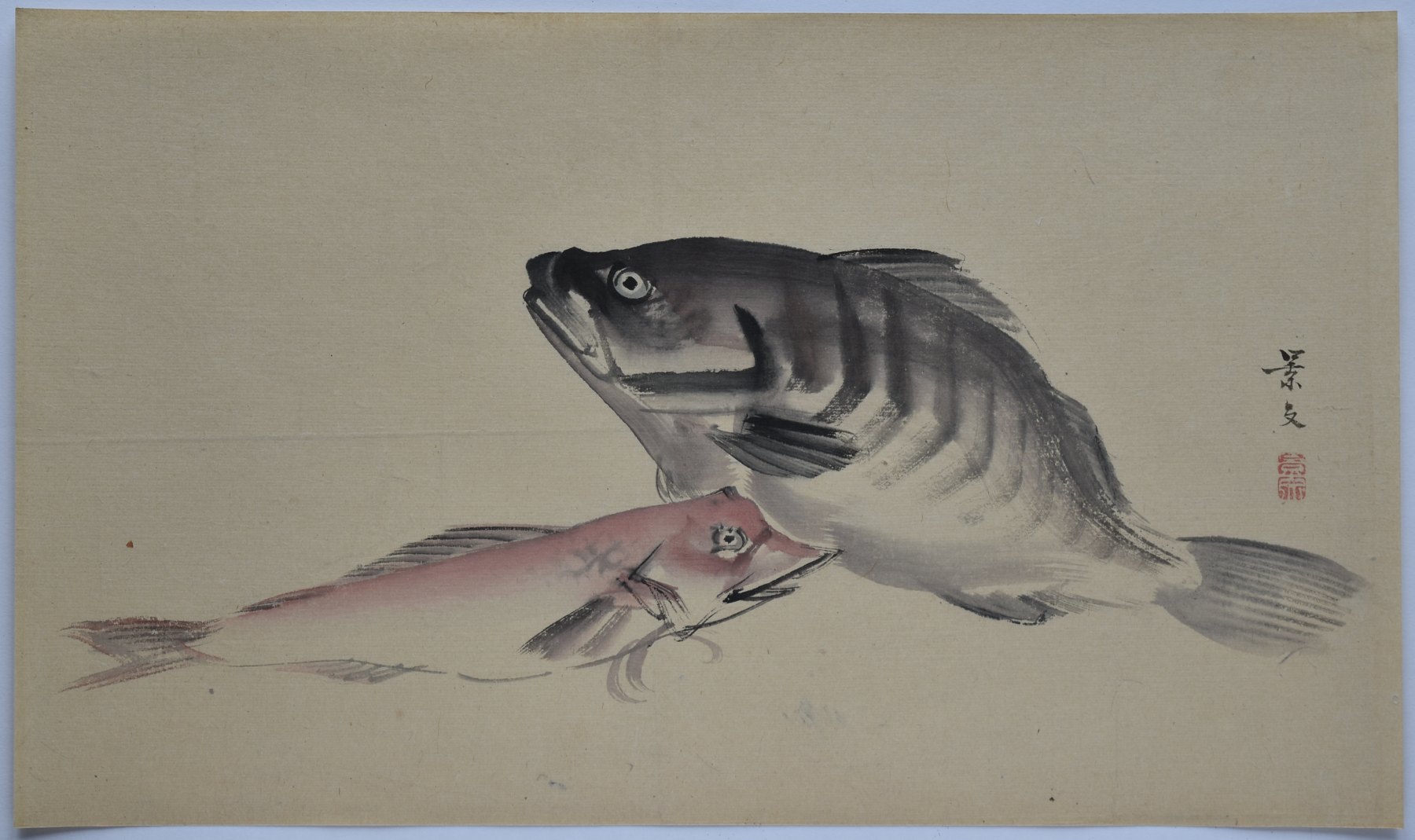
Click here to view image full size.
A shijo brush drawing of a gurnard and a snapper (?). One of Kyoto’s leading artists. Noted for his painting from nature. He studied with his older brother Matsumura Goshun as well as Maruyama Okyo. Sumi and light colour on paper, 10.5 x 17.75 in; 26.7 x 45.1 cms.
In good condition. Signed and sealed Keibun.
Status: Available
Tsukioka SETTEI (1710-1786)
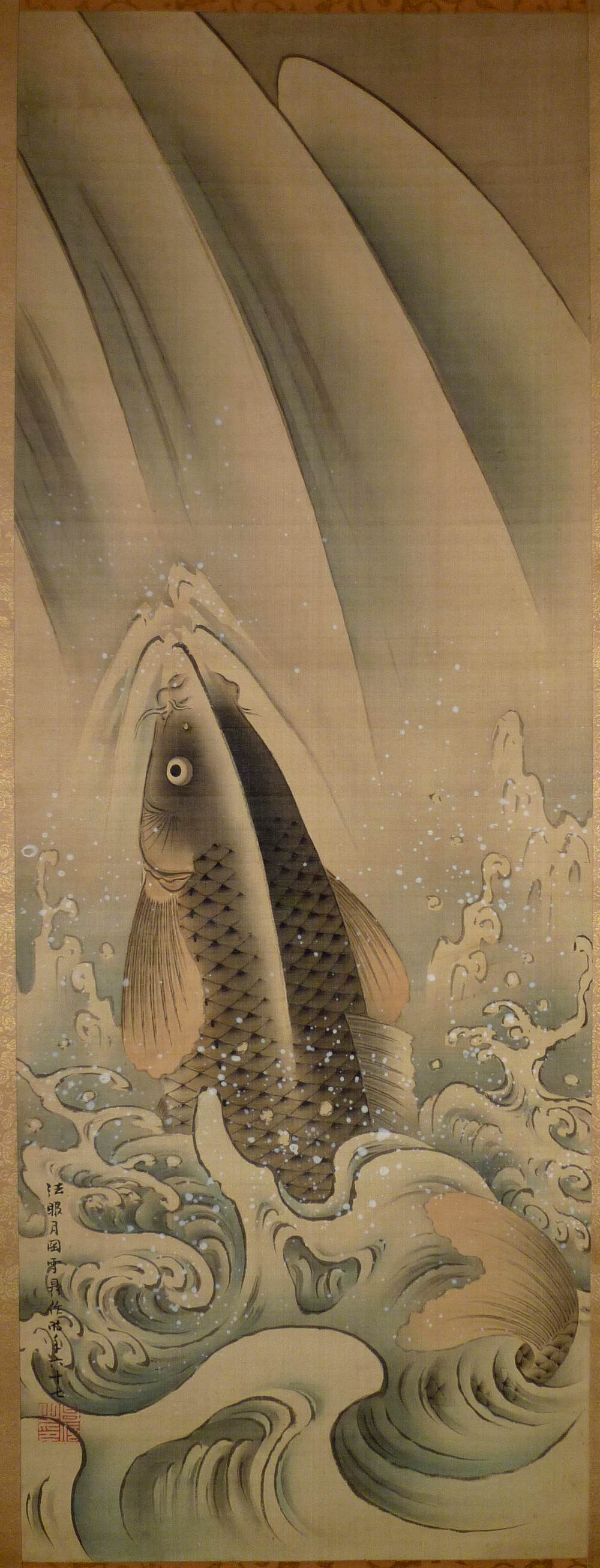
Click here to view image full size.
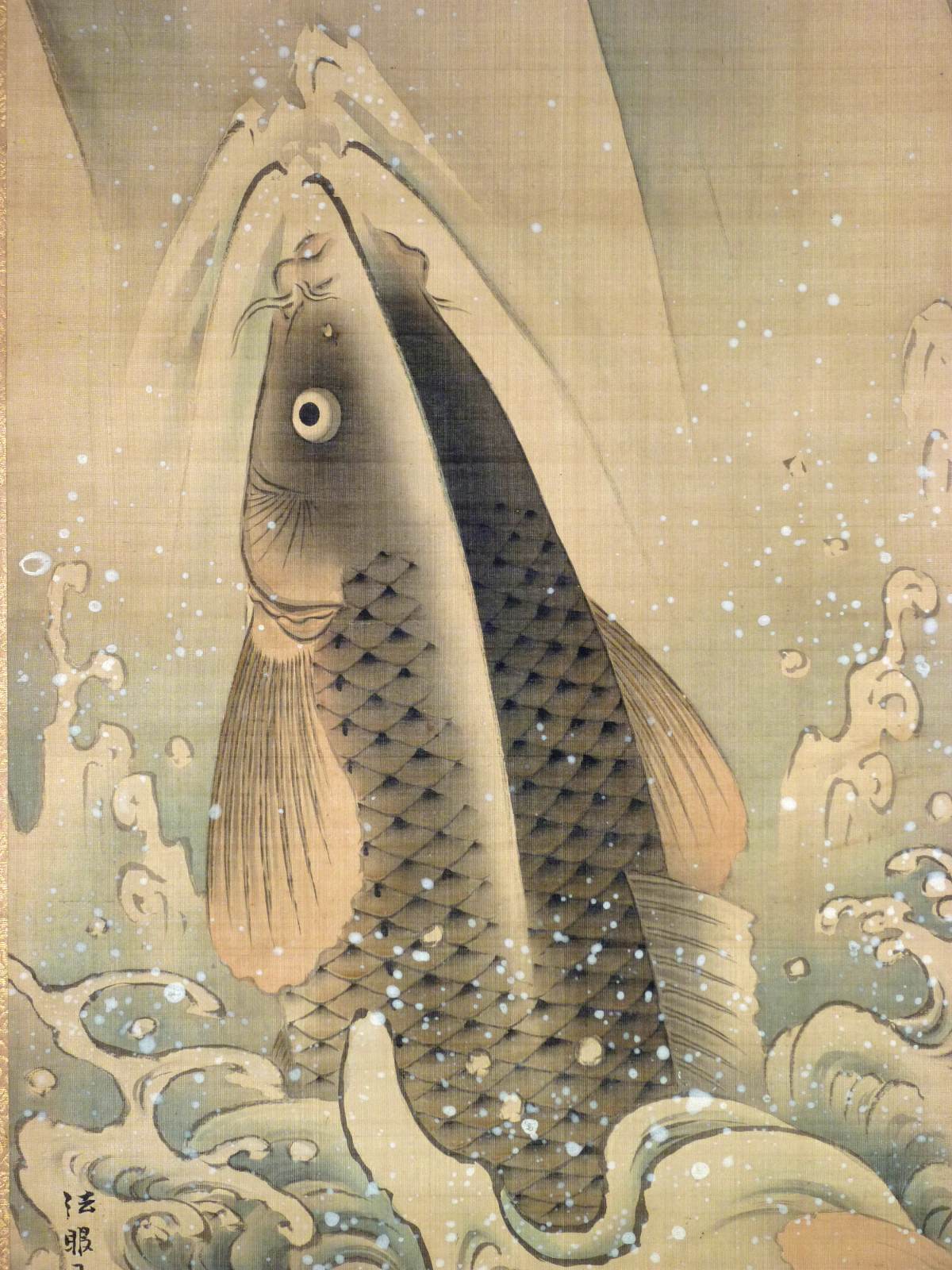
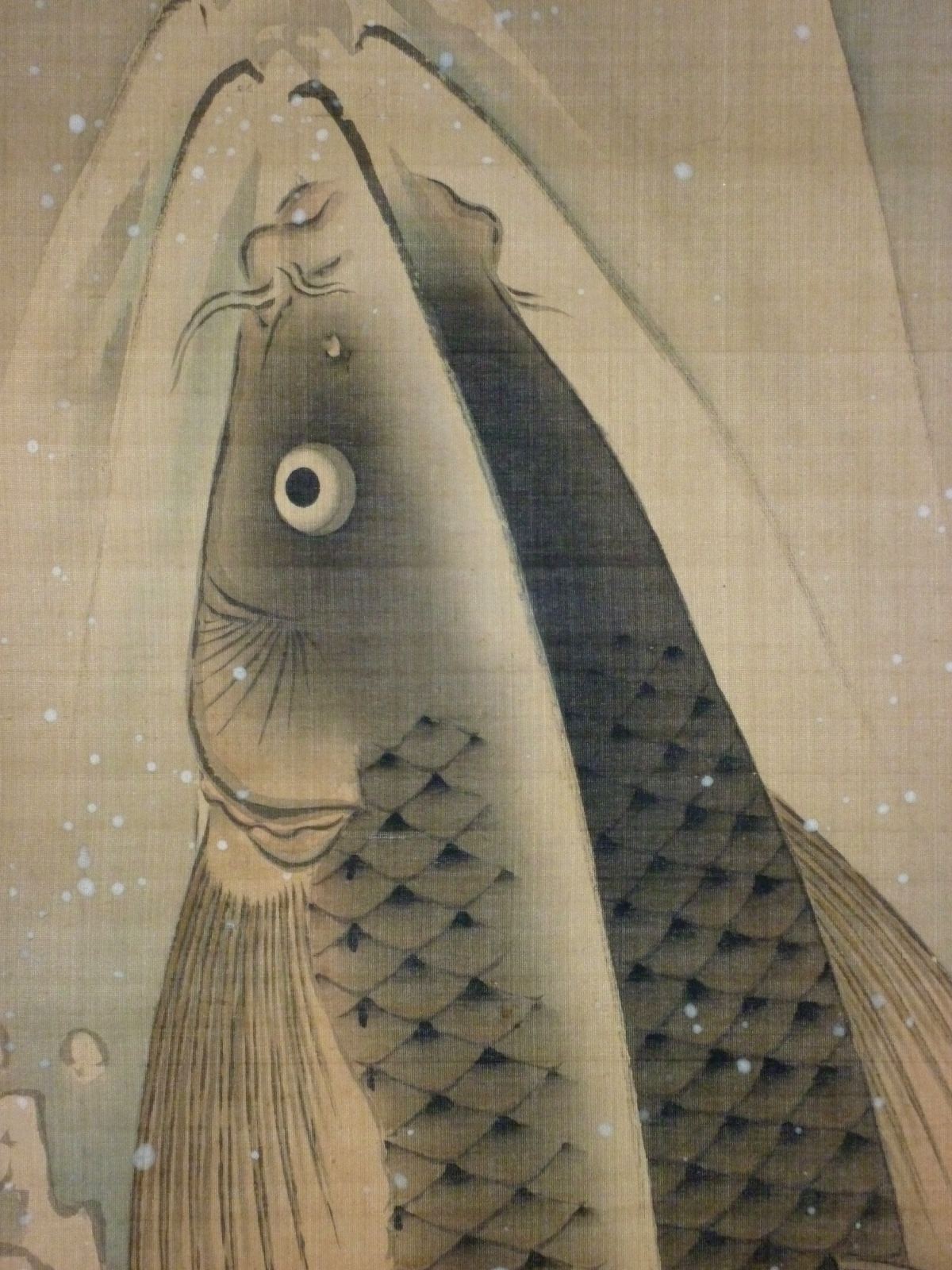
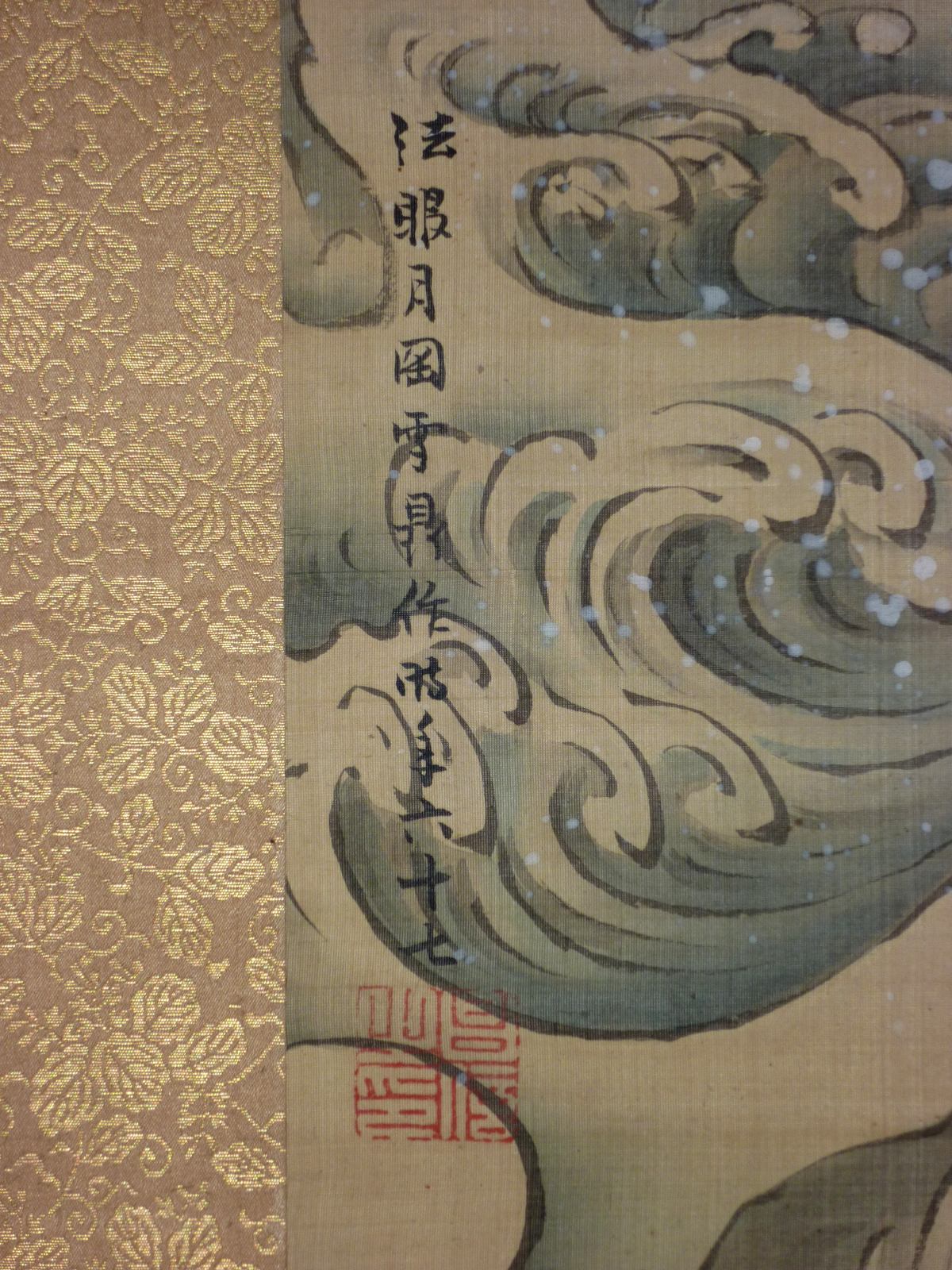
An original painting, sumi and light blue on silk. Image size 38.75 x 14.25 in; 98.4 x 36.2 cms. Shows a carp leaping a waterfall. This was a favourite subject for Japanese artists being a symbol of achievement against adversity. Carp were bred for their colour in Japan and, interestingly, Koi that are returned to the wild revert back to their grey colour. They are known to live for up to a hundred years or more. Settei produced many illustrated books but after around 1765 turned to painting beauties, courtesans and geishas. They are of the utmost refinement – the faces and limbs picked out in red, their costumes with areas of gold, and invariably have the wide lantern-locks (toro-bin) hairstyle. Signed Hogen Tsukioka Sessai jinen rokuju-nana (painted aged sixty-seven, hence 1777). Seal Masanobu no in. In good condition with splashed gofun.
Status: Available
Ohara HOSON (Aka SHOSON, KOSON) (1877-1945)
Click here to view image full size.
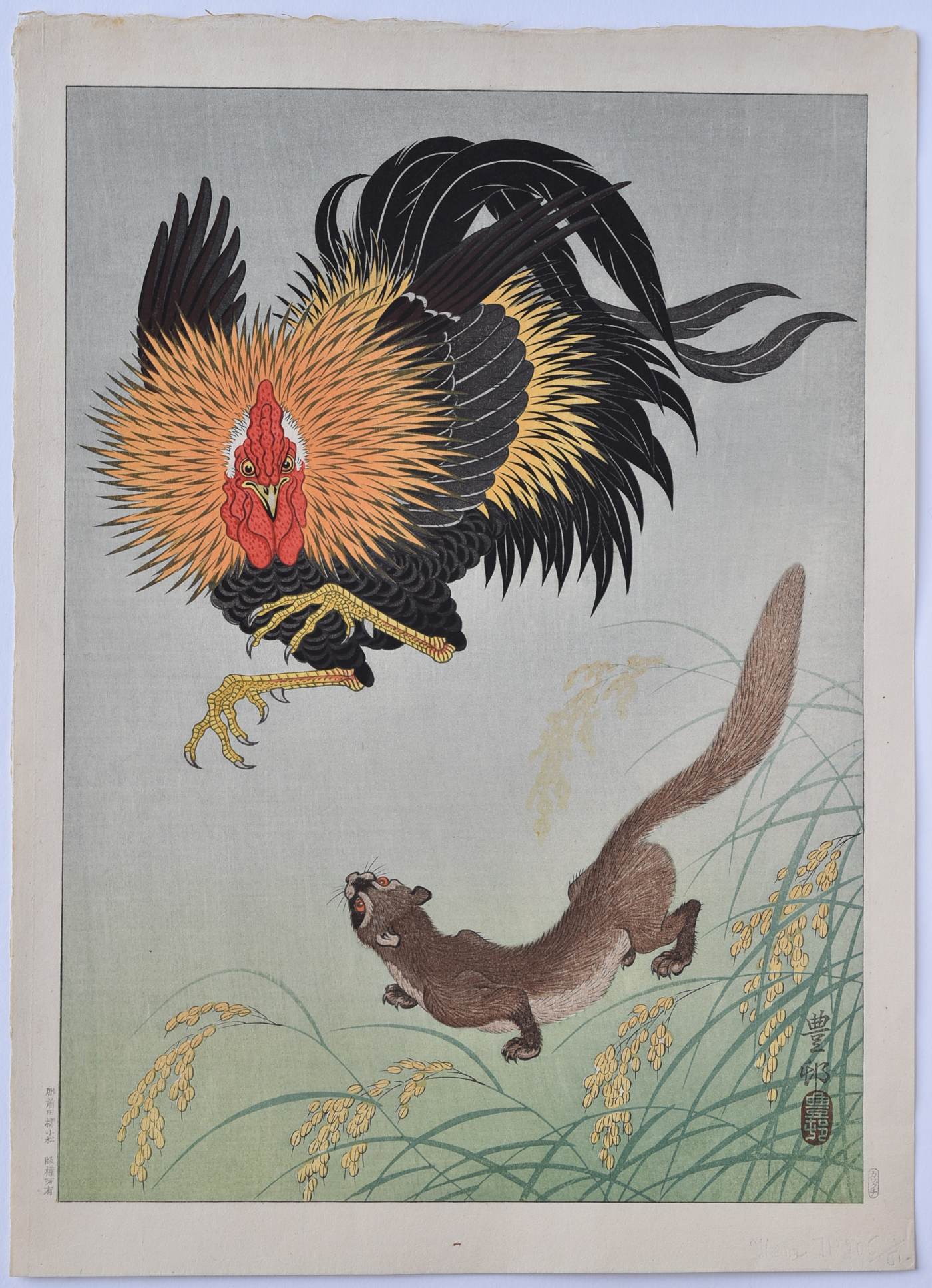
A rooster and weasel. Published by Kawaguchi, c. 1930. The first and only edition. Ex Robert O. Muller collection. Rare.
Very fine impression, colour and condition. Signed Hoson. Copyright seal in lower right margin; seal of printer, Komatsu, and carver, Maeda, in lower left margin.
Status: Sold
Utgawa HIROSHIGE (1797-1858)
Click here to view image full size.
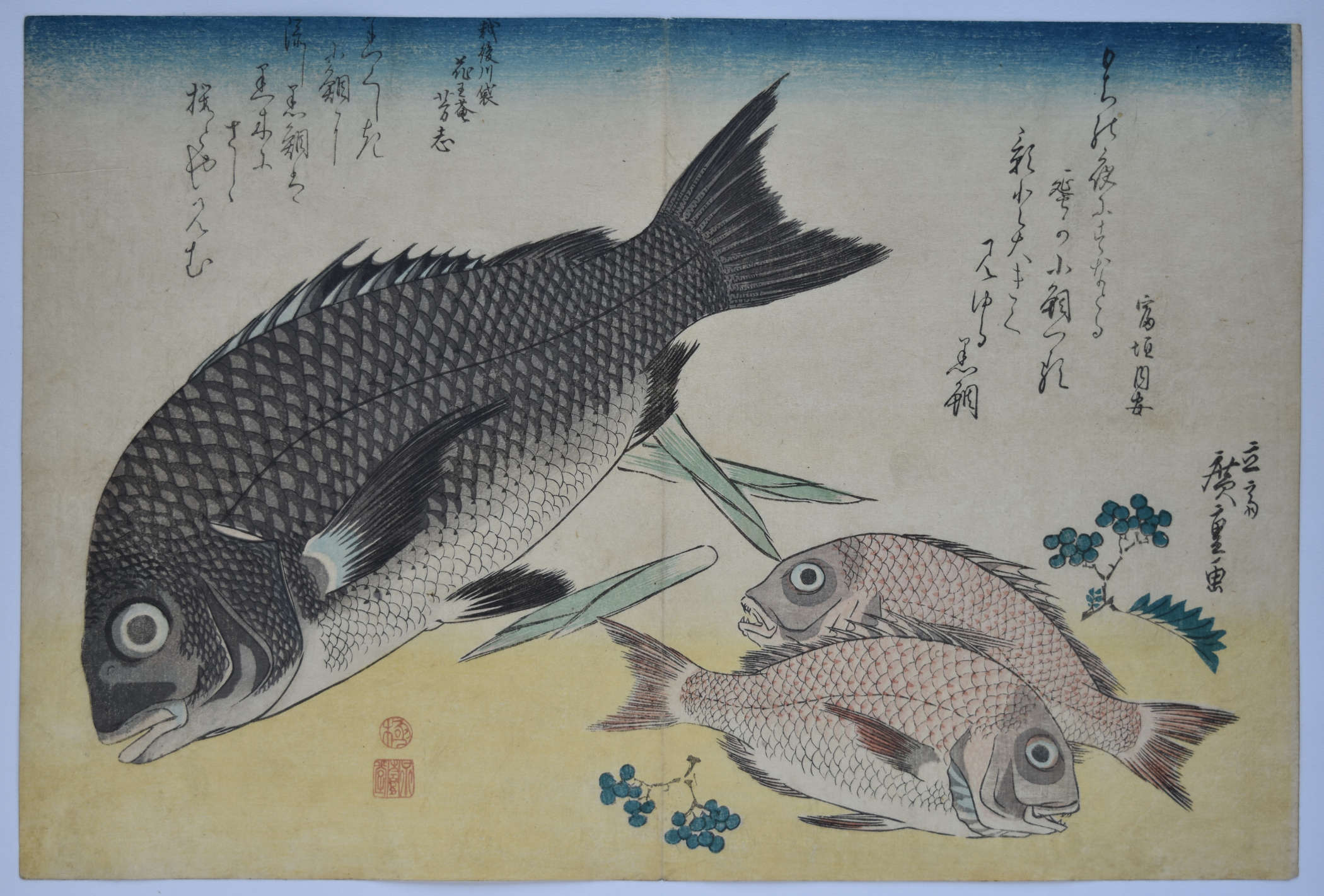
Kurodai, black sea bream (Acantho pagus schlegeli) and akadai, red bream (Pagus tumifrons) together with bamboo shoots and Japanese pepper. Poems by Tomigaki Uchiyasu and Kaoan Hoshi. From the first series of ten plus one prints published by Eijudo, c. 1832-34. The set was issued privately for a poetry group (probably the Shingyoku Circle) with judges’ names and extra poems. These prints are of the utmost rarity as probably only enough for the Circle were printed and they seldom come onto the market.
Fine, early impression before the grey block defect on the tail of the black sea bream. Fine colour. Slight centre fold (as usual), otherwise very good condition. Full size. Kruml 10b (Andon 49). Signed Ichiyusai Hiroshige.
Status: Sold
Utagawa HIROSHIGE (1797-1858)
Click here to view image full size.
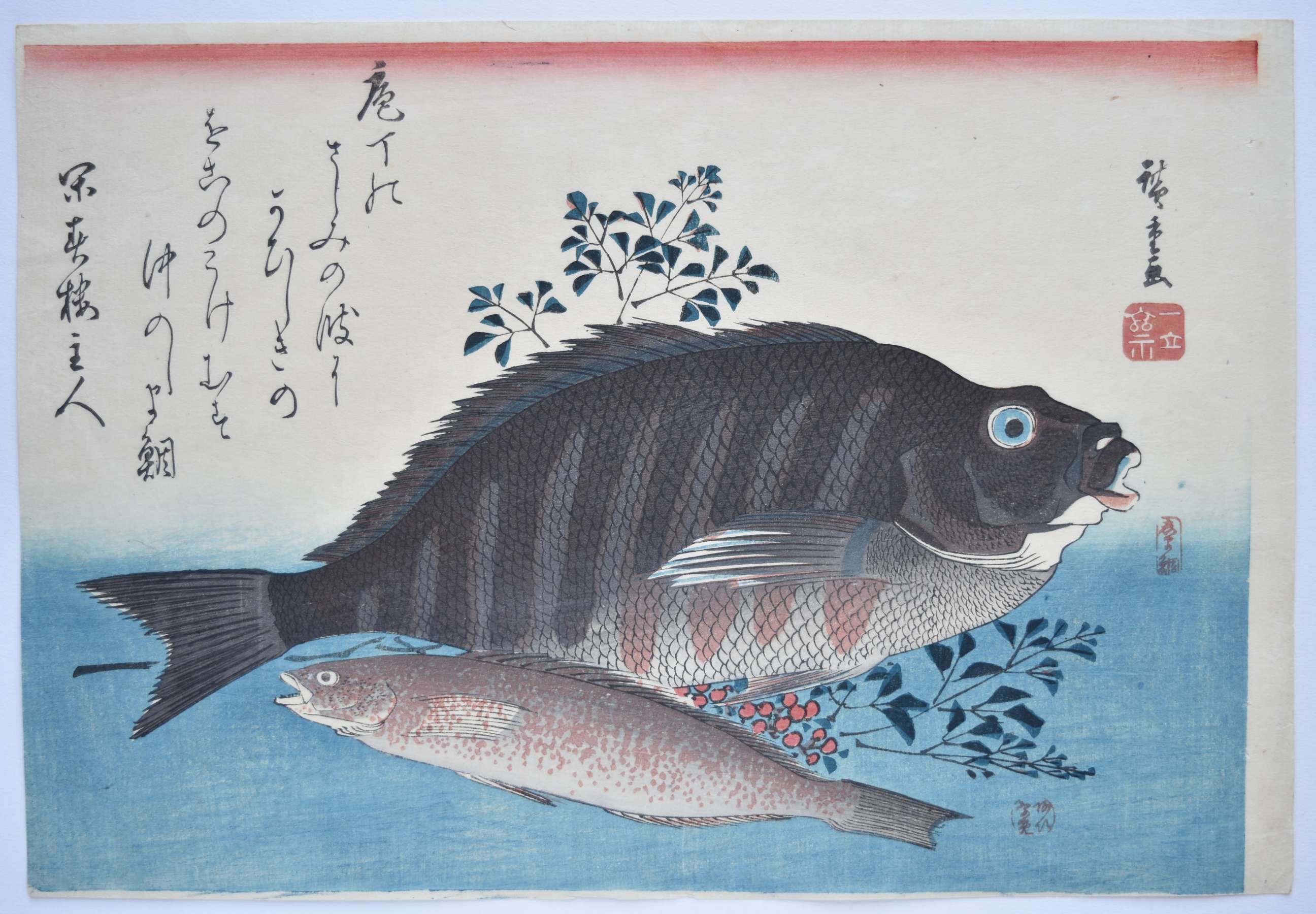
Shimadai, grouper (probably Chilodactylus zonatus) and ainame, greenling (Hexagrammus otakii) together with red-berried nanten. Poem by Kanshunro Nushibito. Probably the first edition (Kruml 18a). From the second series of fish published by Yamasho c. 1840-42.
Fine impression, colour and condition. Signed Hiroshige ga.
Status: Sold
Utagawa HIROSHIGE (1797-1858)
Click here to view image full size.
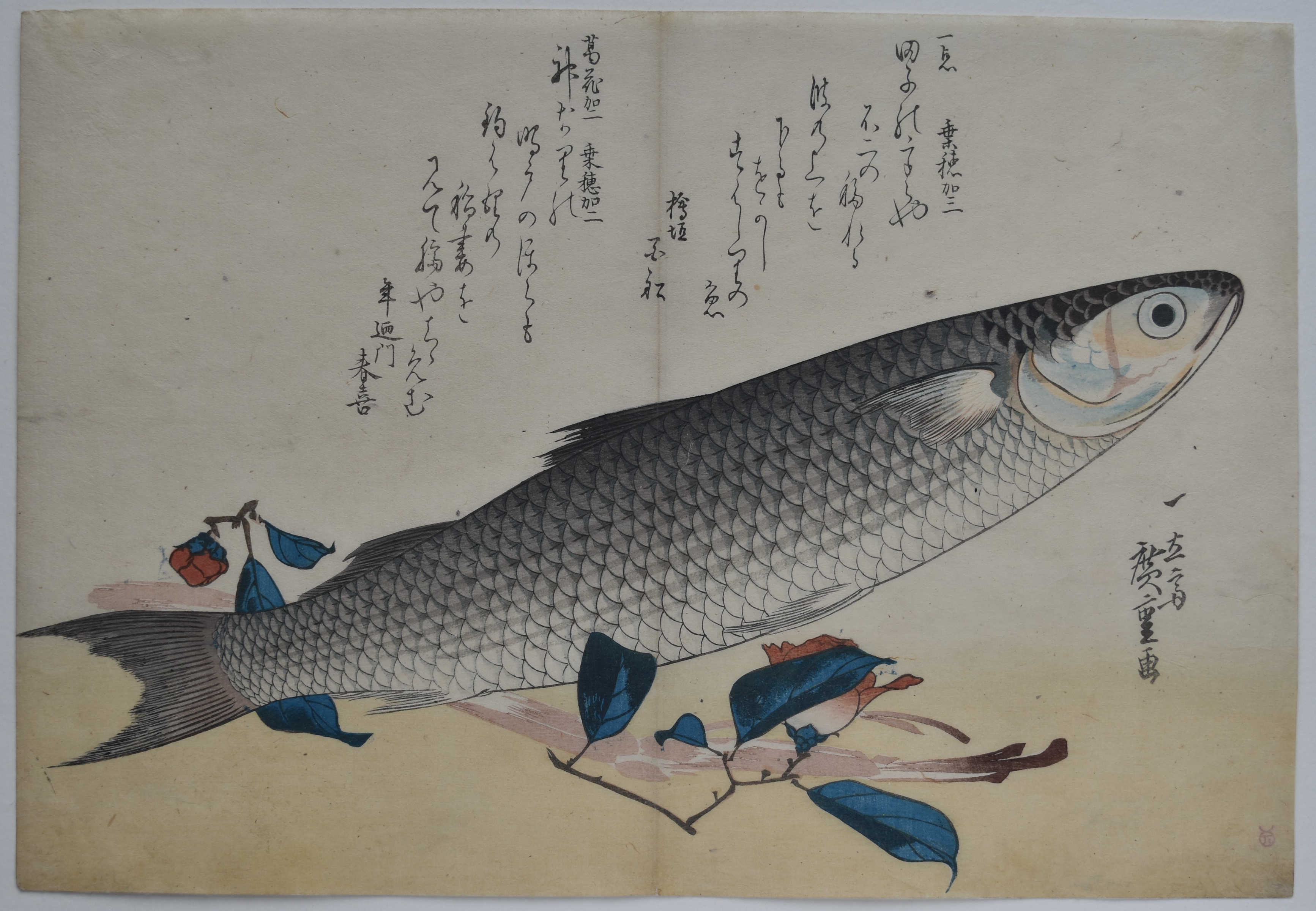
The extremely rare first, private printing of Bora, the grey mullet (Mugil cephalus) with camellia and Japanese asparagusado. From a set of 10 prints in folding album form, privately commissioned for a poetry club, c 1832-34. Poems by Higaki Kunifune and Toshinoto Haruki. The judges’ names next to the poems. These were removed on the commercial editions. Rare because of the obvious reason that the numbers printed were directly related to the relatively small memberships of poetry groups.
Fine impression and colour of the earliest printing without kiwame seal and publisher’s seal. With judges’ names and without gradation at top. Centre fold (as always), otherwise very good condition. Signed Ichiyusai Hiroshige ga. Unknown collector’s seal au verso.
Status: Sold
Utagawa HIROSHIGE (1797-1858)
Click here to view image full size.
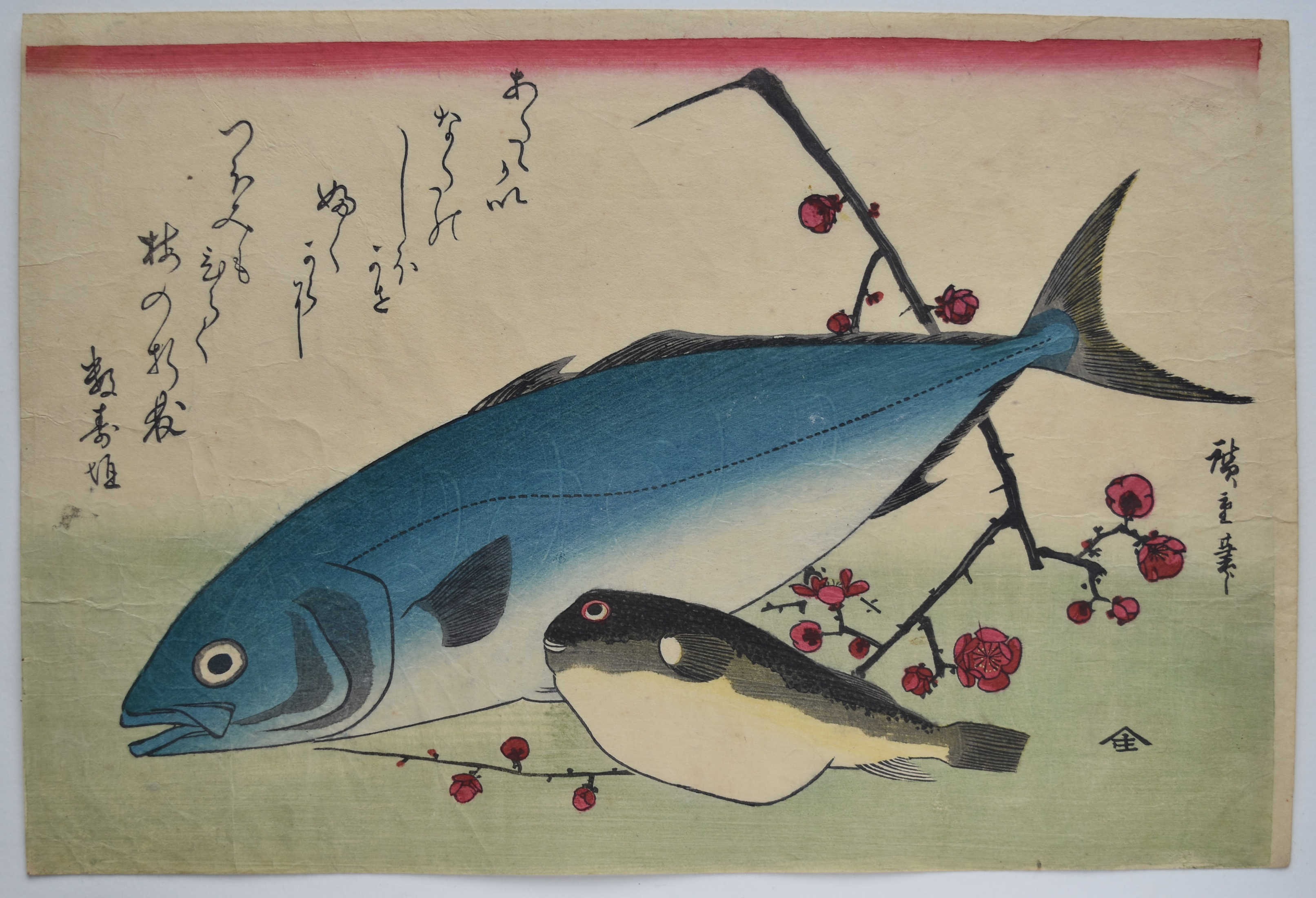
Inada, yellowtail or amberjack (Seriola quinqueradiata) and fugu, blowfish or puffer (Fugu pardalis). Together with plum blossom. Poem by Suzugaki. From the second set of 9 prints published by Yamasho, c 1840-42. (Some designs on the reprints have the publisher’s mark Marujin.)
Extremely early impression before the block defect below the fugu’s tail is evident. Fine colour with extensive mica on the inada. Some slight creasing, otherwise very good condition. Full size. Signed Hiroshige ga.
Status: Sold
Utagawa HIROSHIGE (1797-1858)
Click here to view image full size.
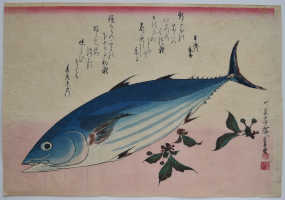
Katsuo, bonito (Kasuwonus pelamis). Also called ocean bonito, strip-bellied bonito and striped tuna. Together with three sprigs of cherry (sakura). Poems by Toshinoto Haruki and Toshihiro Machikado. From the first commercial edition of the first series published by Eijudo, c 1832-34.
Early impression with the kiwame and publisher’s seal sharp. Fine colour. Some slight creasing, otherwise very good condition. Full size. Signed Ichiyusai Hiroshige ga.
Status: Sold
Utagawa HIROSHIGE (1797-1858)
Click here to view image full size.
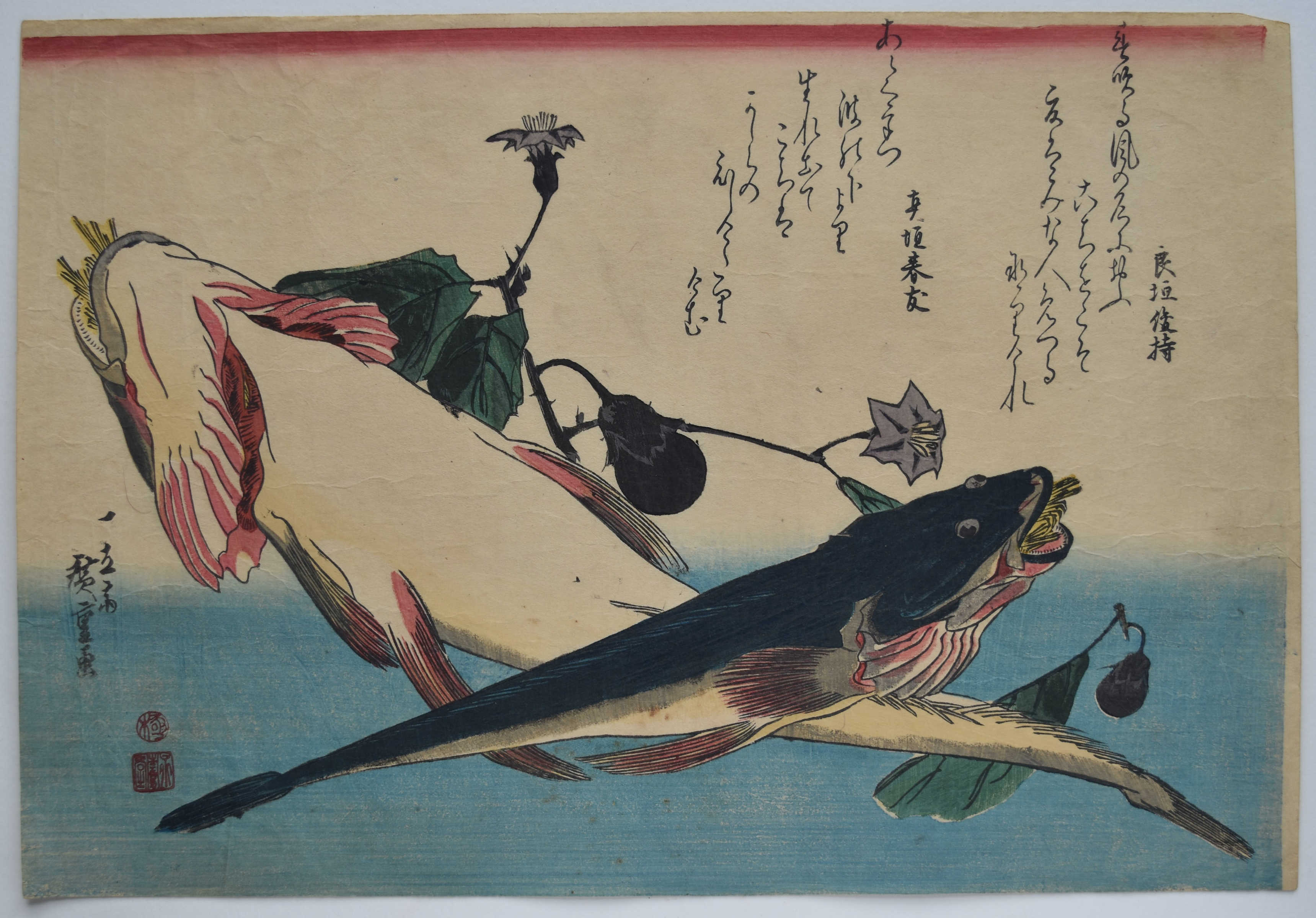
Kochi, bartail flatheads (Platycephalus indictus). Together with a flowering egg-plant, nasu. Poems by Yoshigaki Toshimochi and Magaki Harutomo. From the first commercial edition of the first series published by Eijudo, c 1832-34.
Early impression with the kiwame and publisher’s seal sharp. Fine colour. Some slight creasing, otherwise very good condition. Full size. Signed Ichiyusai Hiroshige ga.
Status: Sold
Utagawa HIROSHIGE (1797-1858)
Click here to view image full size.
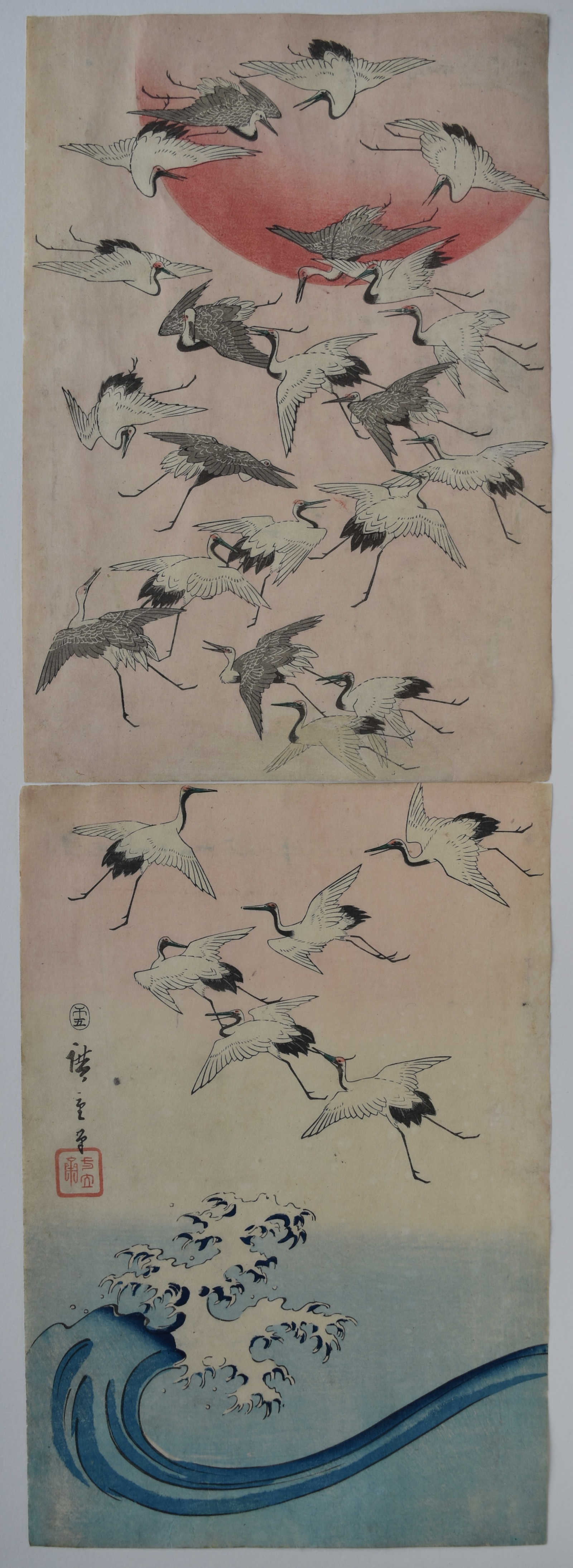
A vertical diptych showing a multitude of cranes flying up from a cresting wave to a large red sun. In fact this diptych was used by an Edo publisher as end sheets to albums – usually sets of Hiroshige landscapes. Rare: Invariably it is impossible to match the two sheets as the bottom design is always graded blue at the top. Another matching impression is illustrated pl. 143 in Four Hundred Ukiyoe Woodblock Prints From The Museum Of Art, Rhode Island School Of Design, Abby Aldrich Rockefeller Collection Of Japanese Prints, 1990. Another impression is known with a large red seal at a slight angle bottom right. (This may be the first state but rather spoils the design.) Published 5/1858.
Fine impression and colour. Small expertly repaired binding holes, otherwise very good condition. Signed Hiroshige hitsu with Ichiryusai seal.
Status: Sold
Utagawa HIROSHIGE (1797-1858)
Click here to view image full size.
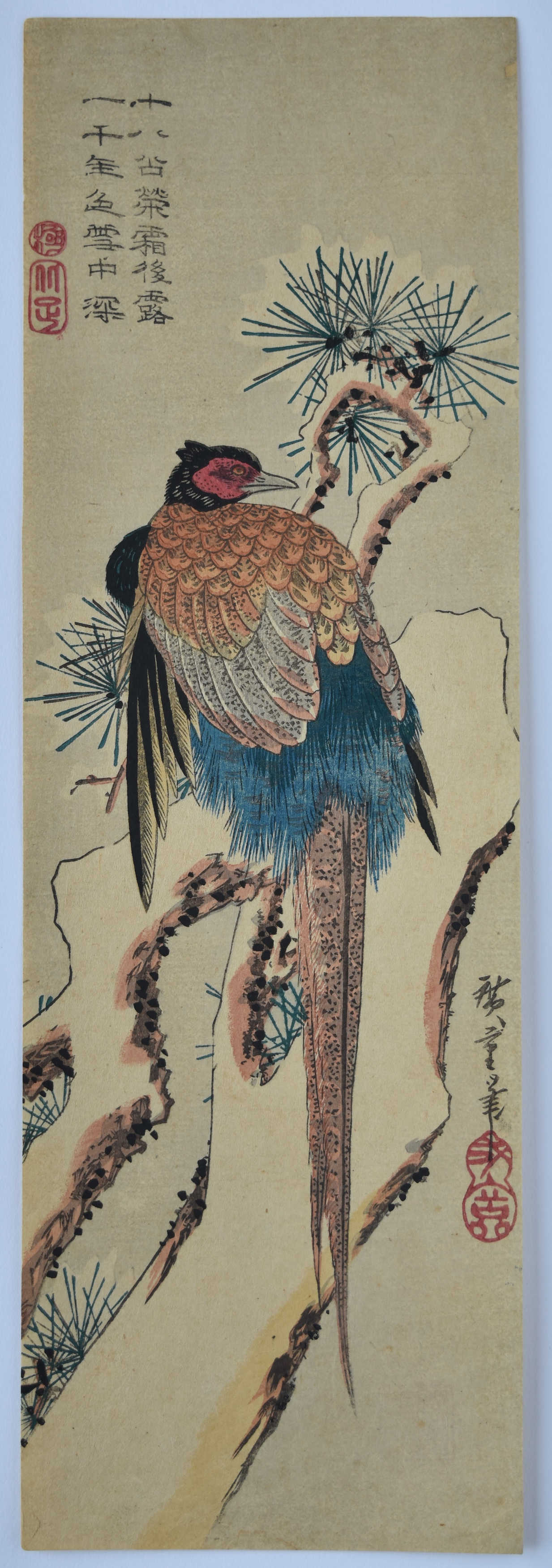
A pheasant on a snow-covered pine. Published by Kawaguchi Shozo, c. 1830s (seal top left).
Fine impression and colour. Minimal trimming, otherwise very good condition. Signed Hiroshige hitsu.
Status: Sold
Utagawa KUNIYOSHI (1797-1861)
Click here to view image full size.
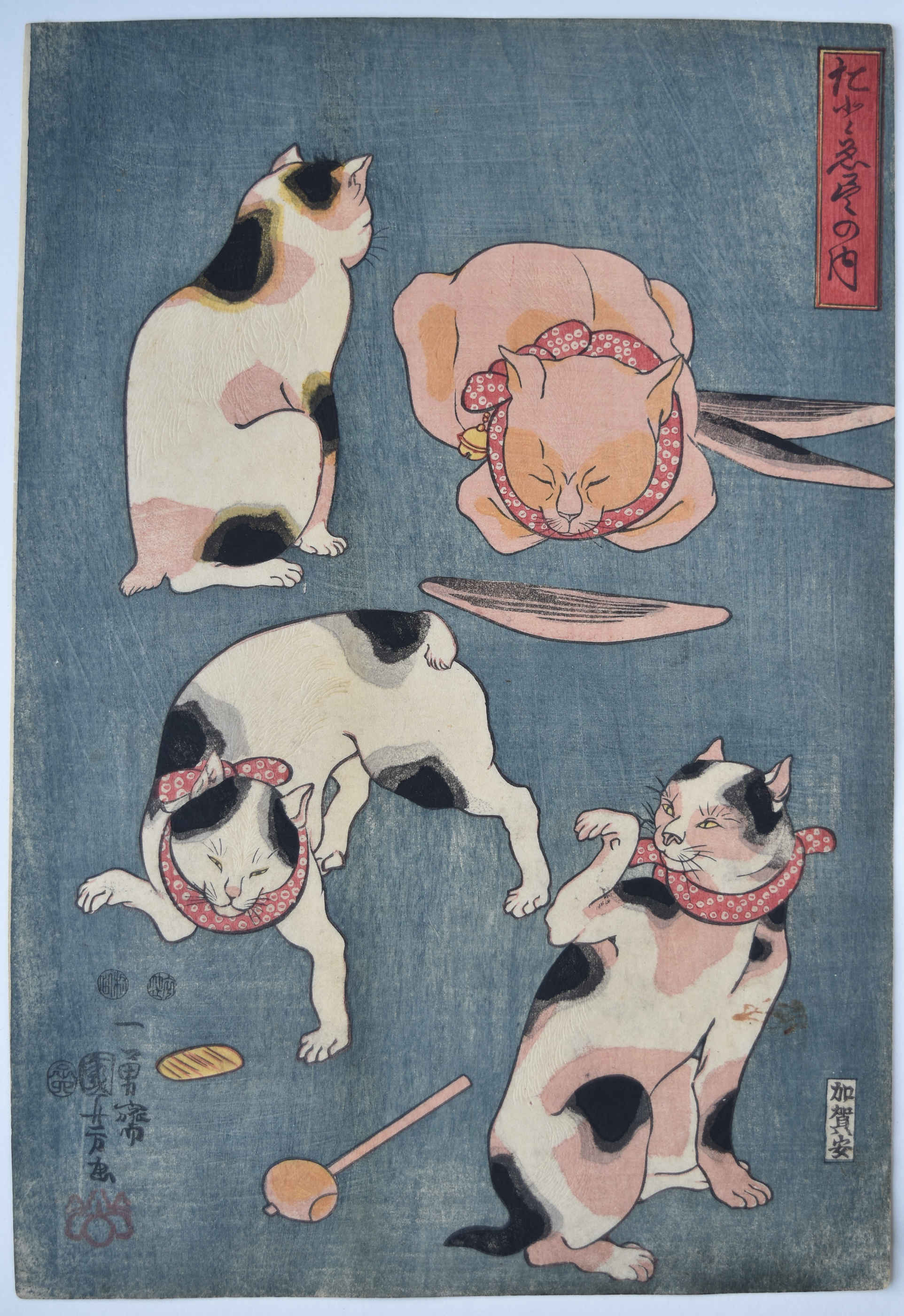
Four cats, the first sheet of a triptych Tatoe zukushi no uchi, “Proverbs Illustrated by Cats.” Examples being: “Bonito to a cat,” “Coin to a cat,” “Not even a cat would eat it.” Published 1852 by Kagaya Yasubei. Bob-tailed and calico cats were common in the Edo period. It is well known that Kuniyoshi was a cat-lover and Yoshimune, one of his pupils, relates how they were allowed to run around his studio and when a cat died he would have it sent to a nearby temple. He also had a Buddhist altar erected in his home for his deceased cats. Another pupil of Kuniyoshi’s was Kyosai and he depicts the chaotic studio with cats and other artists milling around in his illustrated book Kyosai kadan, part II, vol. 3, of 1887. Of the utmost rarity: I have not catalogued another sheet from this triptych in 50 years.
Very fine impression and colour. One minor blemish, otherwise very fine condition. Signed Ichiyusai Kuniyoshi ga. (All the cats have blind-printing on their coats which is not apparent on the illustrated examples of this print. Possibly due to the reproductive process.)
Status: Sold
Utagawa HIROSHIGE (1797-1858)
Click here to view image full size.
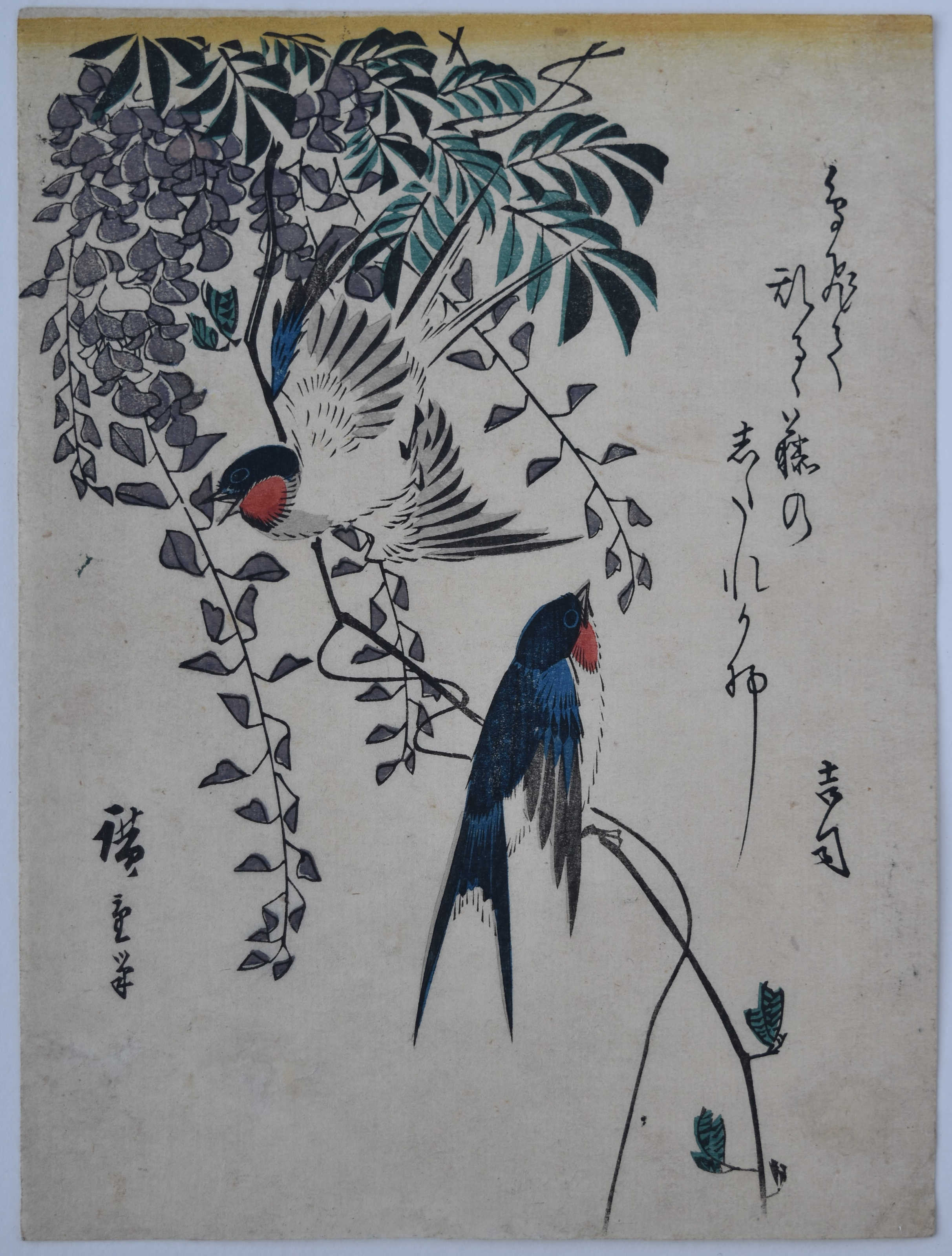
A chuban print showing two house swallows and wisteria. Although Hiroshige is recognised as one of the pre-eminent landscape artists, many of his most beautiful designs are in the uchiwa-e format and kachoga.
Fine impression and colour. Several expertly repaired wormholes, otherwise very good condition. Signed Hiroshige hitsu.
Status: Sold
Utagawa HIROSHIGE (1797-1858)
Click here to view image full size.
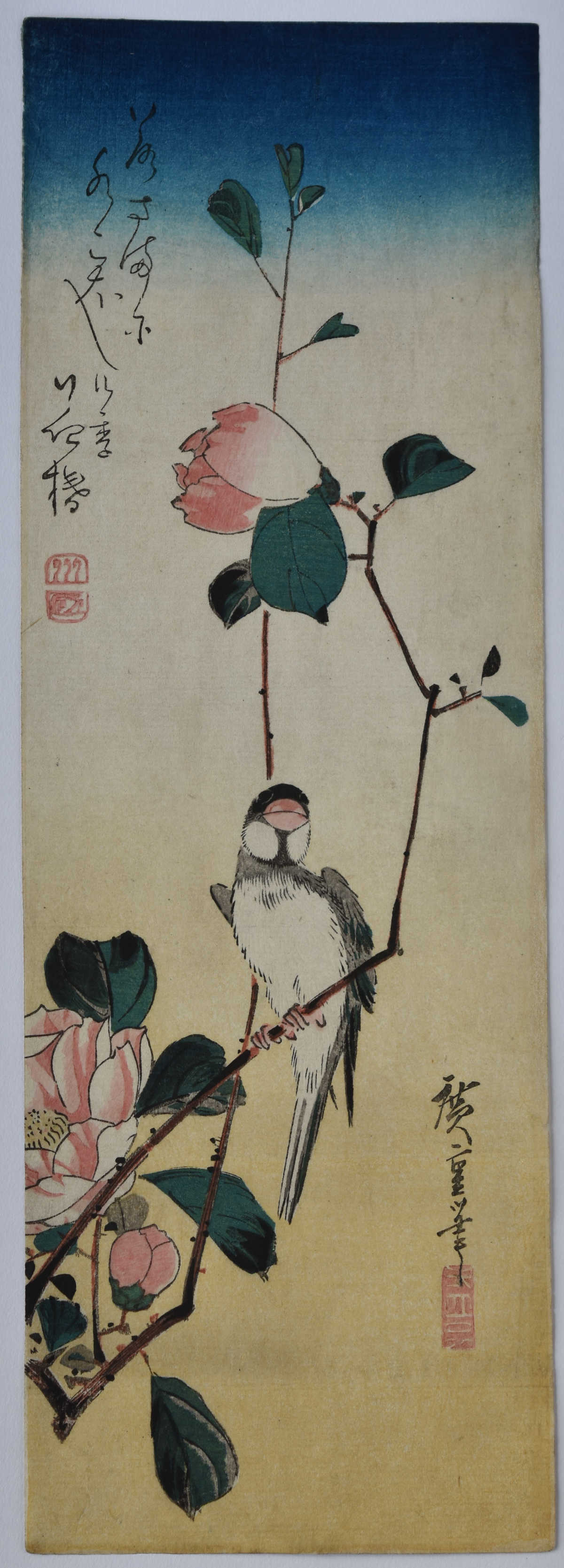
A medium tanzaku showing a Java sparrow on a magnolia branch. Published by Kawasho (Kawaguchi Shozo) c early 1830s. Another example of this design has an overall light pink ground rather than the light yellow graded up, as here. Another impression is illustrated in Kikuchi , A Treasury of Japanese Wood Block Prints Ukiyo-e, NY, 1968, no. 1477.
Fine impression with blind-printing on the bird’s breast. Very good colour. Minimal soil at bottom, otherwise very good condition. Signed Hiroshige hitsu with Ichiryusai seal.
Status: Sold
Utagawa HIROSHIGE (1797-1858)
Click here to view image full size.
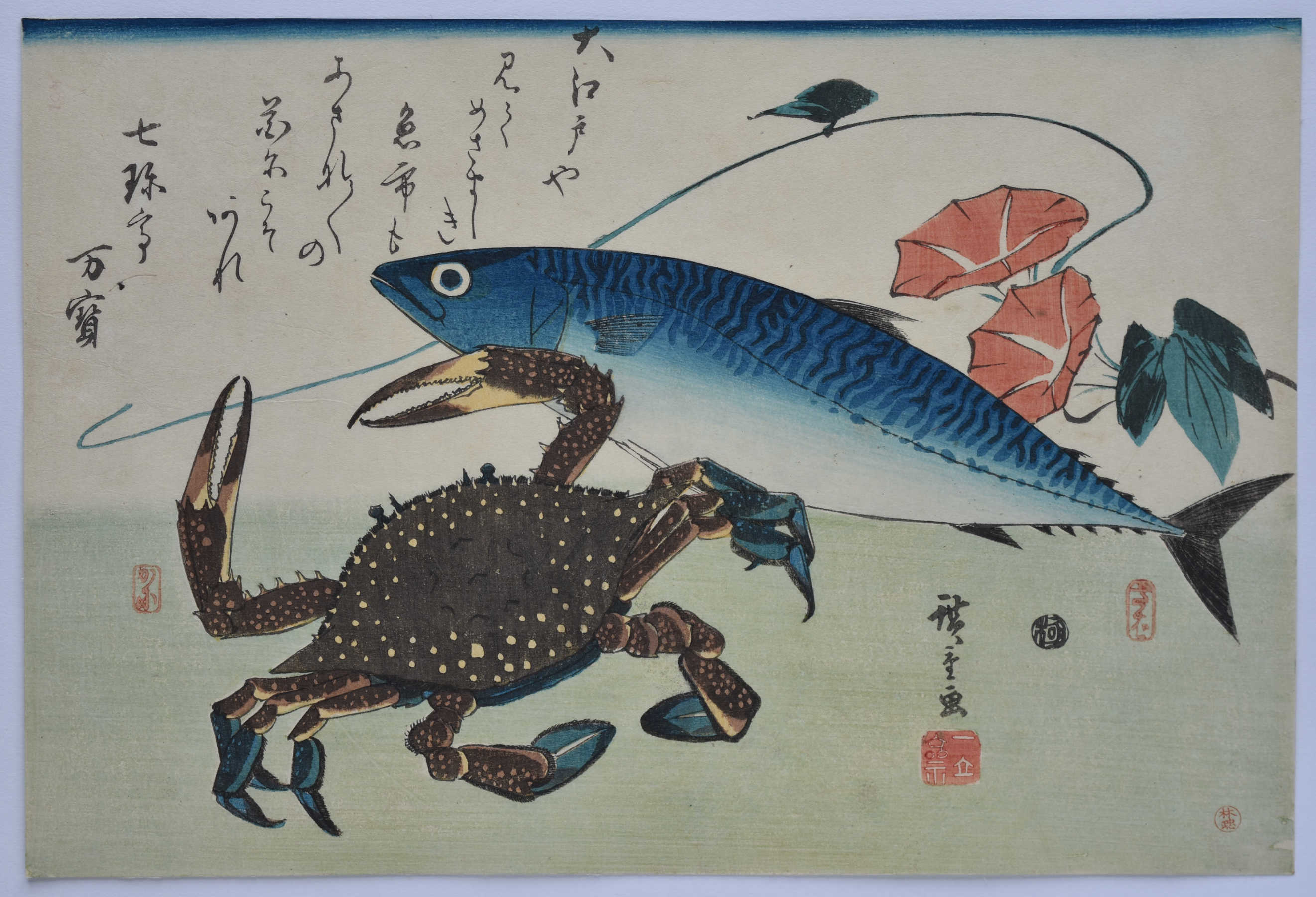
Kami, crab (Charybois) and saba, mackerel (Scomber Japonicus) together with two flowers of morning glory. Poem by Shichichintei. This is the first edition (Kruml 19a). From the second series of fish published by Yamasho c. 1840-42. Collector’s seal Hayashi bottom right corner.
Fine impression, colour and condition. Signed Hiroshige ga.
Status: Sold
http://www.japaneseprints-london.com/wp-login.php
Utagawa KUNIYOSHI (1797-1861)
Click here to view image full size.
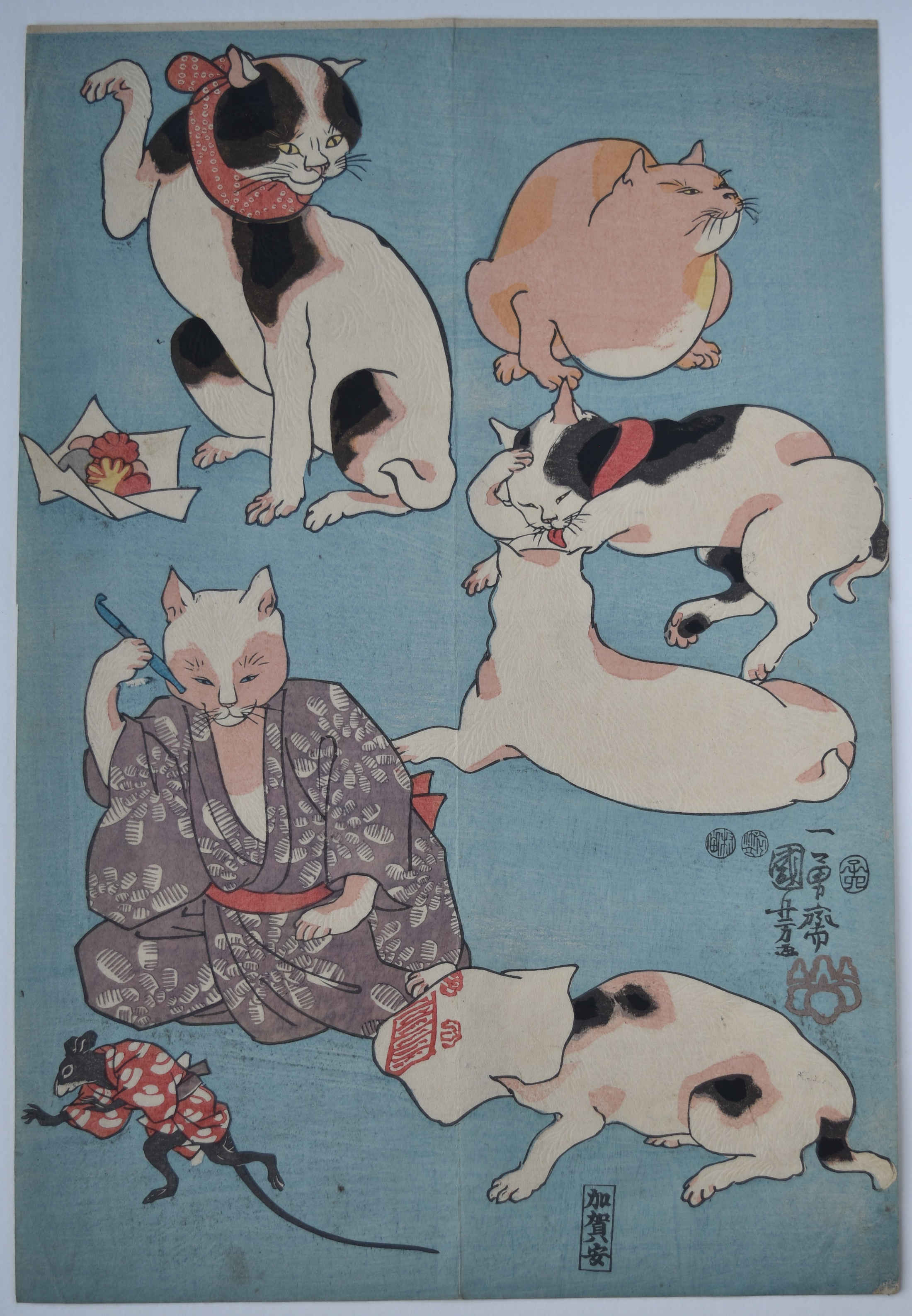
Six cats, the last sheet of a triptych Tatoe zukushi no uchi, “Proverbs Illustrated by Cats.” Examples being: “Bonito to a cat,” “Coin to a cat,” “Not even a cat would eat it.” Published 1852 by Kagaya Yasubei. Bob-tailed and calico cats were common in the Edo period. It is well known that Kuniyoshi was a cat lover and Yoshimune, one of his pupils, relates how they were allowed to run around his studio and when a cat died he would have it sent to a nearby temple. He also had a Buddhist altar erected in his home for his deceased cats. Another pupil of Kuniyoshi’s was Kyosai and he depicts the chaotic studio with cats and other artists milling around in his illustrated book Kyosai kadan, part II, vol. 3, of 1887. Of the utmost rarity: I had not catalogued another sheet from the triptych until the last year.
Superb impression with extensive blind-printing on the cat’s coats. Fine colour. Slight centre fold and light backing, otherwise very good condition. Signed Ichiyusai Kuniyoshi ga.
Status: Sold
Utagawa HIROSHIGE (1797-1858)
Click here to view image full size.
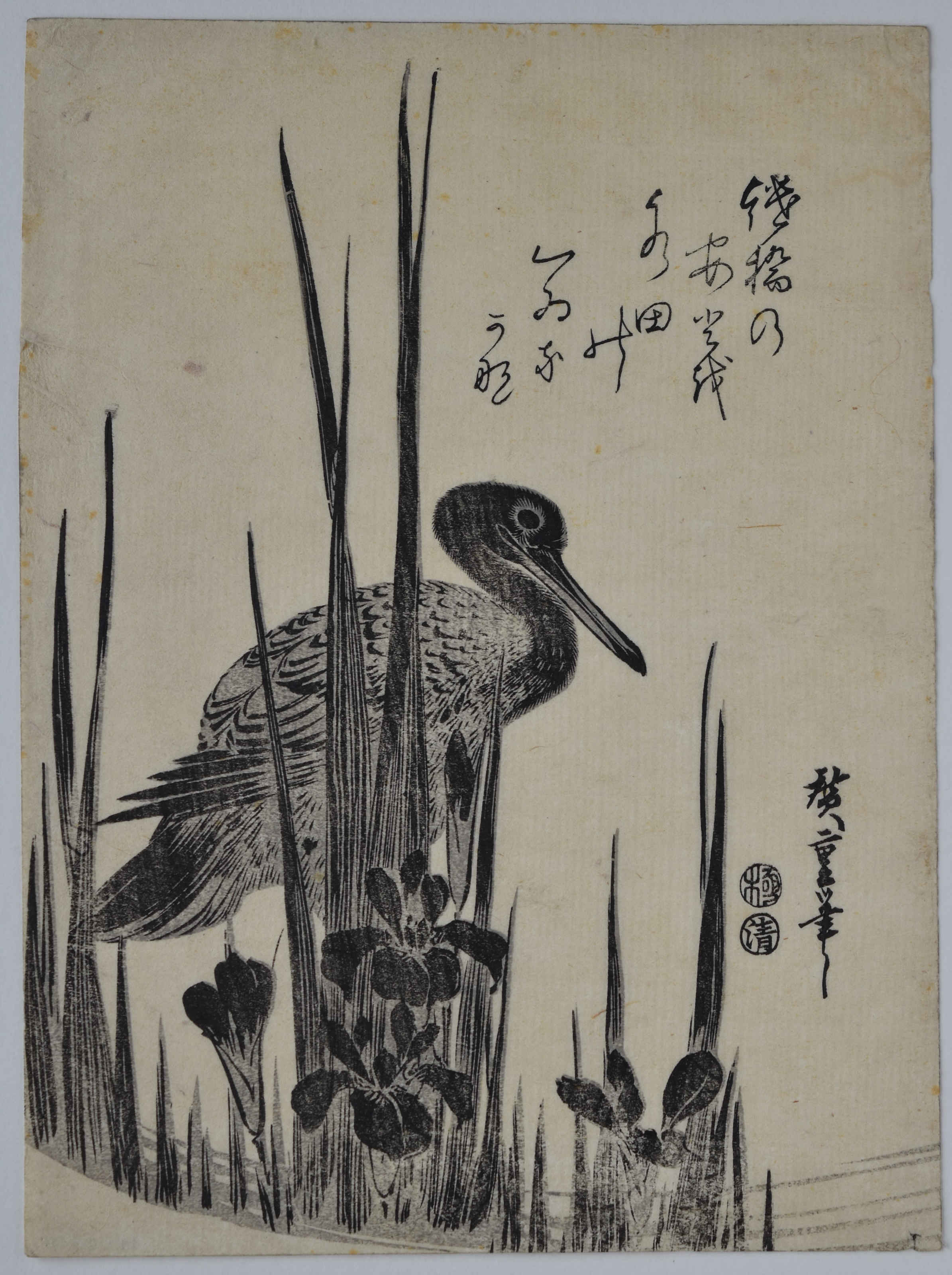
A half-block print showing a Japanese cormorant (?) and iris. Printed only in grades of sumi. In fact, this and the other half is illustrated in: Four Hundred Ukiyoe Woodblock Prints From The Museum Of Art, Rhode Island School Of Design, 1990, no. 166, p. 72 which shows fish and hydrangea on the other side. This is an aizuri print. The quality of impression here leads me to believe this might be a proof impression. Published by Shimizuya Naojiro, c early 1840s.
Fine impression, colour and codition. Signed Hiroshige hitsu.
Status: Sold
Utagawa HIROSHIGE (1797-1858)
Click here to view image full size.
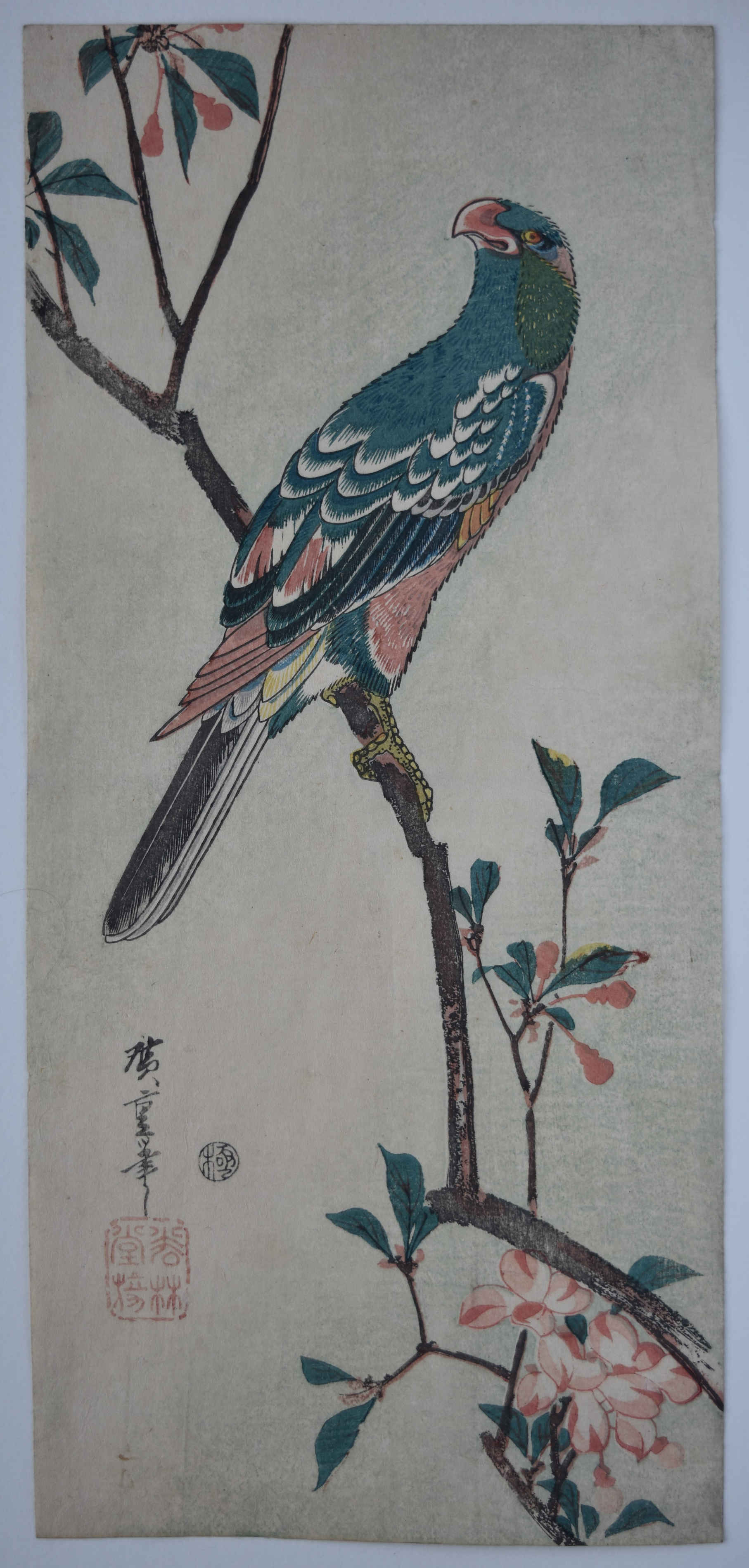
A large panel showing a parrot on a flowering crab apple branch. This is the very rare first edition published by Jakurindo (Wakasaya Yoichi). It was reissued by Kikakudo (Sanoya Kihei). Published c. early 1830s. Hiroshige is rightly regarded as the leading landscape artist. However, many of his finest designs are in the fan (uchiwa-e) and bird and flower (kacho-e) genres. They are not so well known because of their often great rarity.
Fine impression. Very good colour. Slight trimming, otherwise very good condition. Signed Hiroshige hitsu.
Status: Sold
Takahashi SHOTEI (HIROAKI) (1871-1945)
Click here to view image full size.
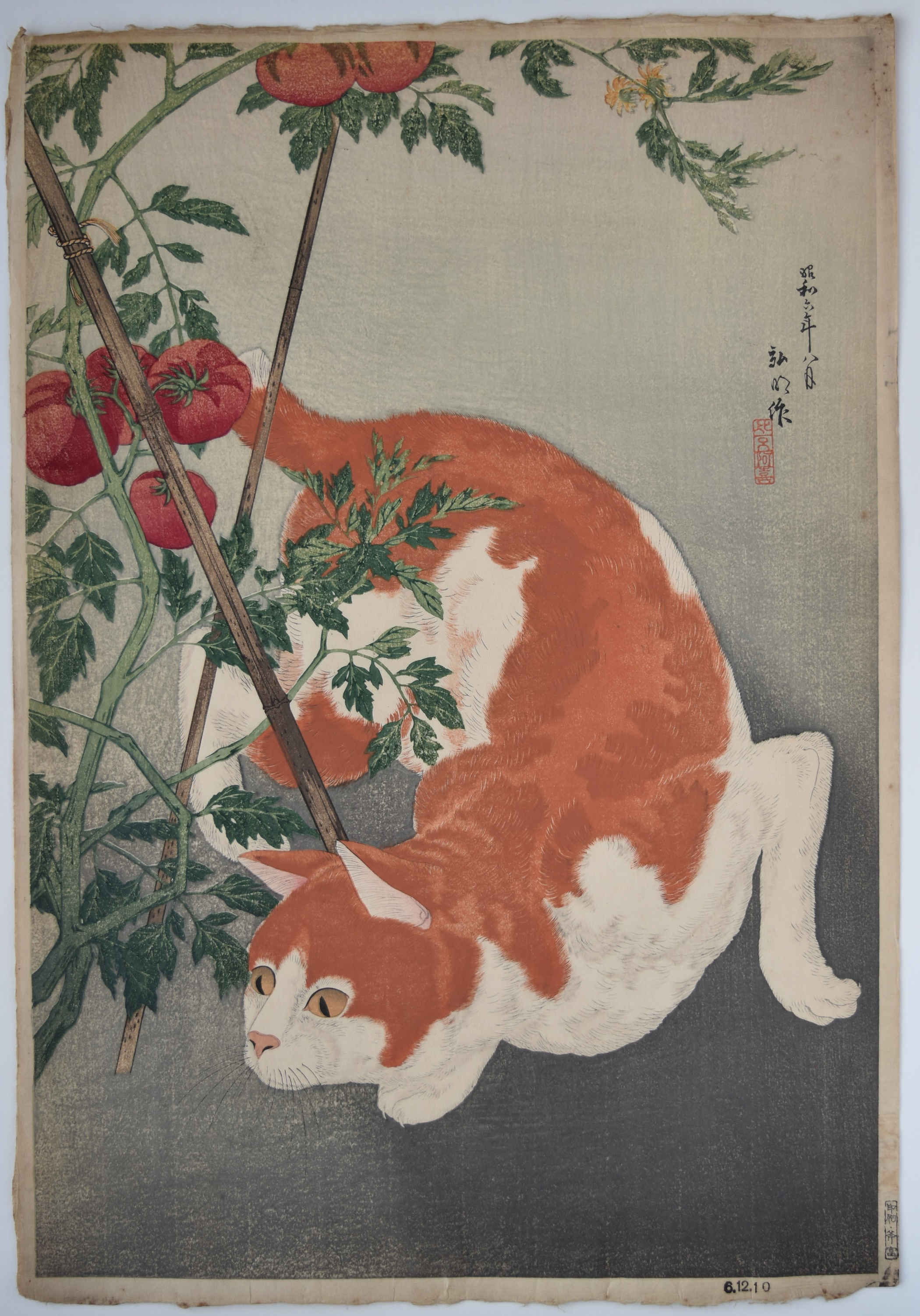
A large design (20 x 13.75 in; 51 x 35 cms) on thick hosho showing a ginger cat and tomato plant. Two versions are known of this design: As here and with the cat having a black and white coat. An edition of only 100 prints was published by Fusui Gabo, 1931. This is an extremely rare proof print with the printer’s seal hand-stamped bottom right Ono Tomisaburo. At the bottom are the numerals: 6.12.10 standing for Showa 6, 12th month, 10th day (1931). Interestingly, the published edition of prints employs baren-suji – the pattern of baren marks left in the background, not evident on this proof. Shotei (he changed his name in 1921) must have been fond of cats as he designed a number of other prints but this is by far and away the best.
Very fine impression with extensive blind printing on the cat’s coat. Fine colour. Slight discolouration in margin at top left and right, otherwise very good condition. Signed Showa 6, 8th month, Hiroaki saku with Hiroaki seal.
Status: Sold
Ichiryusai HIROSHIGE (1797-1858)
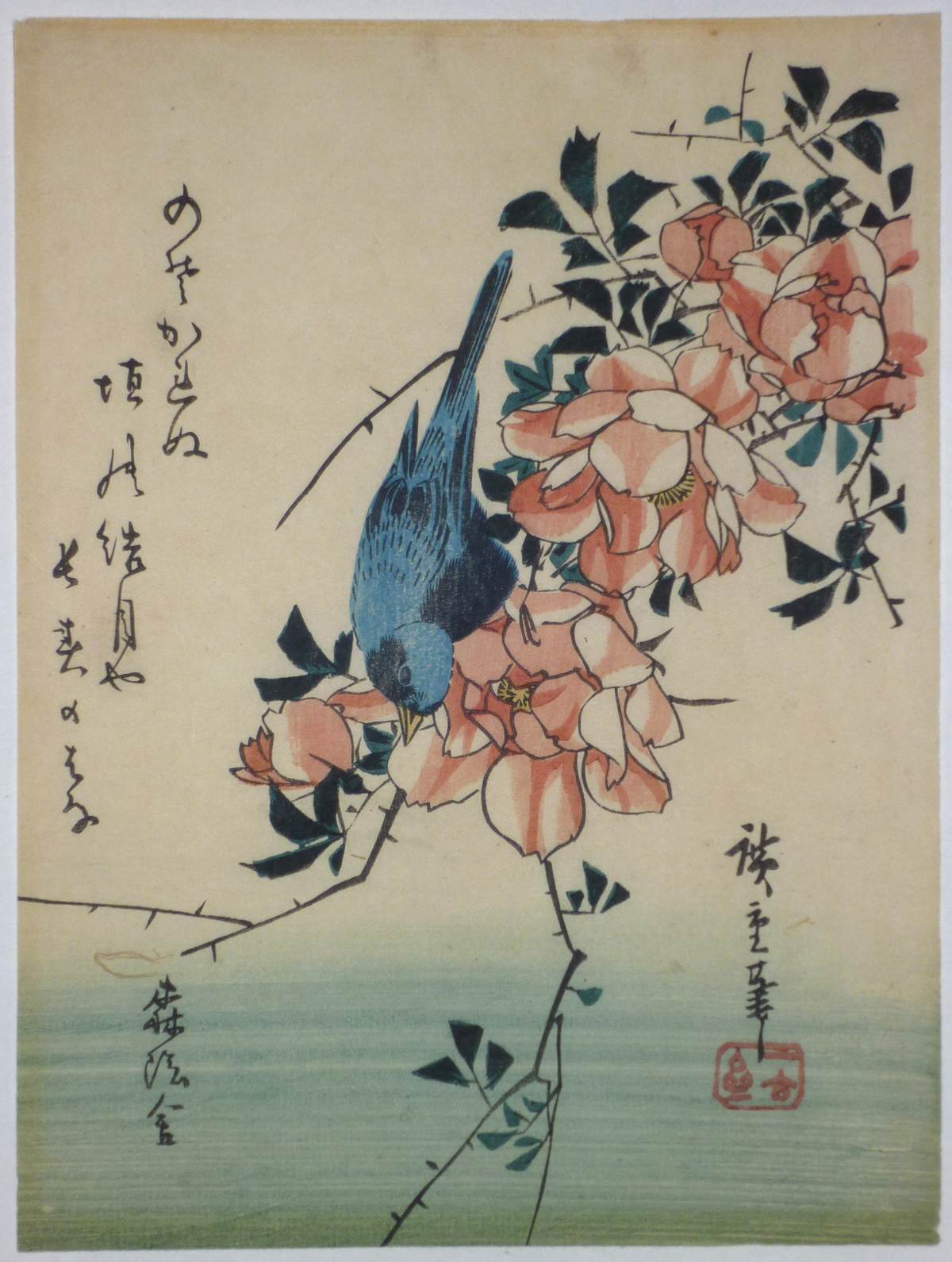
Click here to view image full size.
Ichiryusai HIROSHIGE (1797-1858)
A bluebird and a branch of wild rose. A chuban print published c 1835-9. A very similar design with the same poem is in the Museum of Fine Arts, Boston, acquisition number 21.9729 and also a chutanzaku design, acquisition number 21.7997. Rare.
Fine impression. Very good colour. Minor marks, otherwise very good condition. Signed Ichiryusai Hiroshige hitsu with Ichiryusai seal.
Status: Sold
Ichiryusai HIROSHIGE (1797-1858)
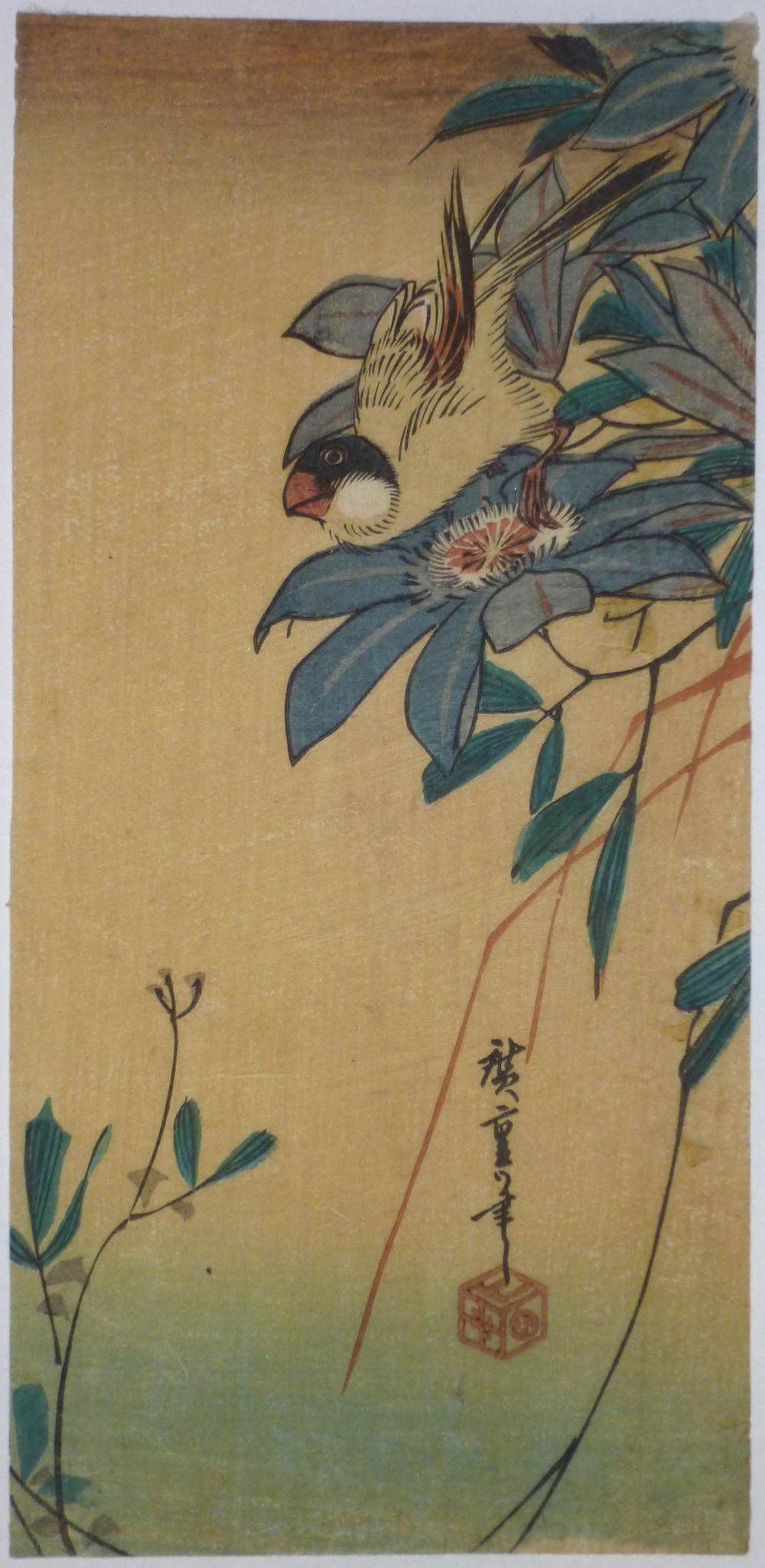
Click here to view image full size.
A Java sparrow on a clematis vine. A sanchogake format (three designs printed on a horizontal sheet and intended to be separated). Published c 1835-9. This is the first edition with the cube-shaped red Hiroshige seal. Two later impressions are in the Museum of Fine Arts, Boston, acquisition numbers 21.9590 and 65.1671. Rare.
Fine impression and colour. Minor marks, otherwise very good condition. Signed Hiroshige hitsu.
Status: Sold
Utagawa HIROSHIGE (1797-1858)
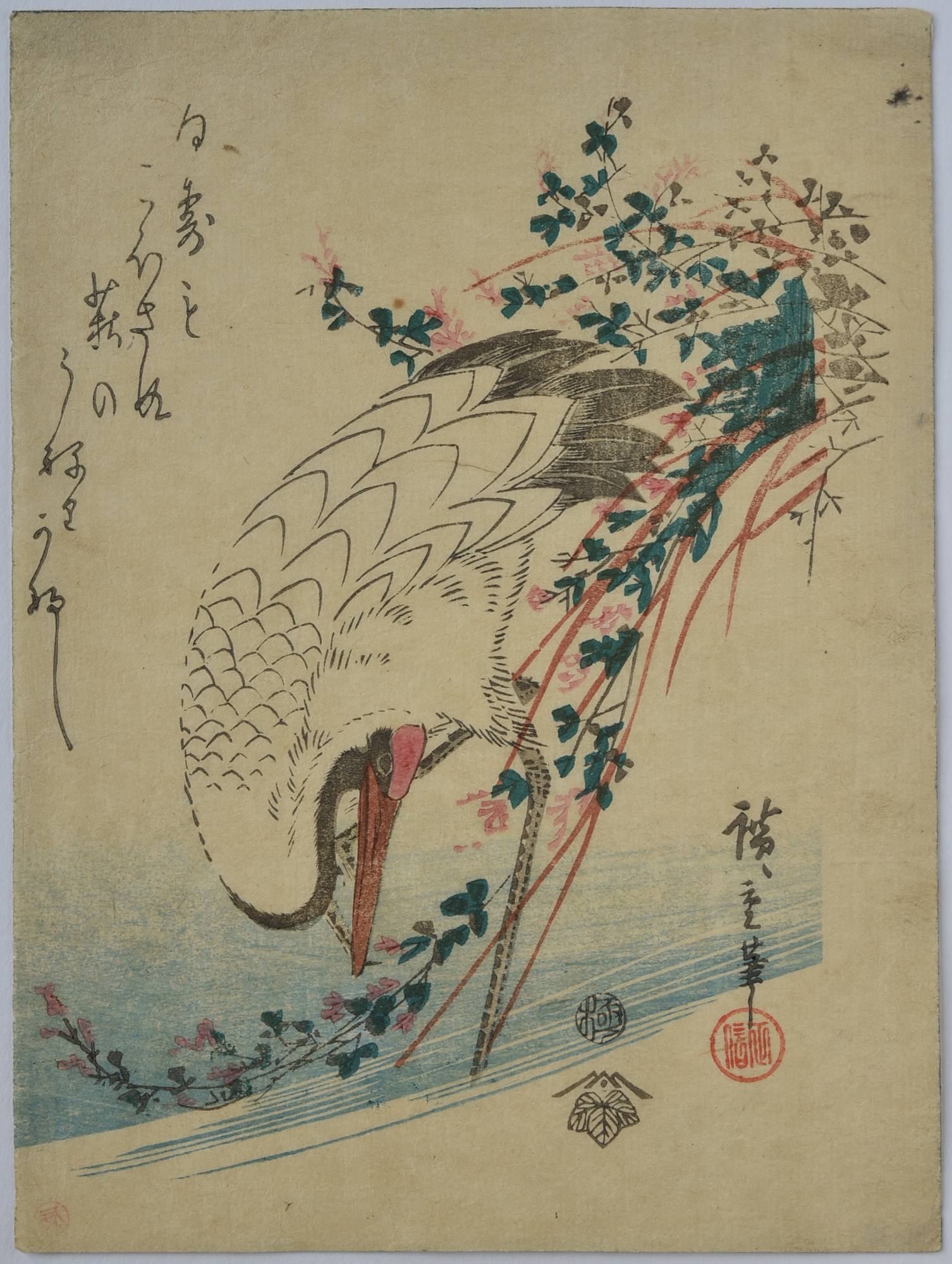
Click here to view image full size.
A half-block, 8.75 x 6.5 in; 22.5 x 16.5 cms, print showing a Japanese crane standing in water with a flowering plant (a variety of Berberis ?). Published c. late 1840s by Tsutaya Kichizo. Unidentified collector’s seal au verso.
Very good impression, colour and condition. Signed Hiroshige hitsu.
Status: Sold
Utagawa HIROSHIGE (1797-1858)
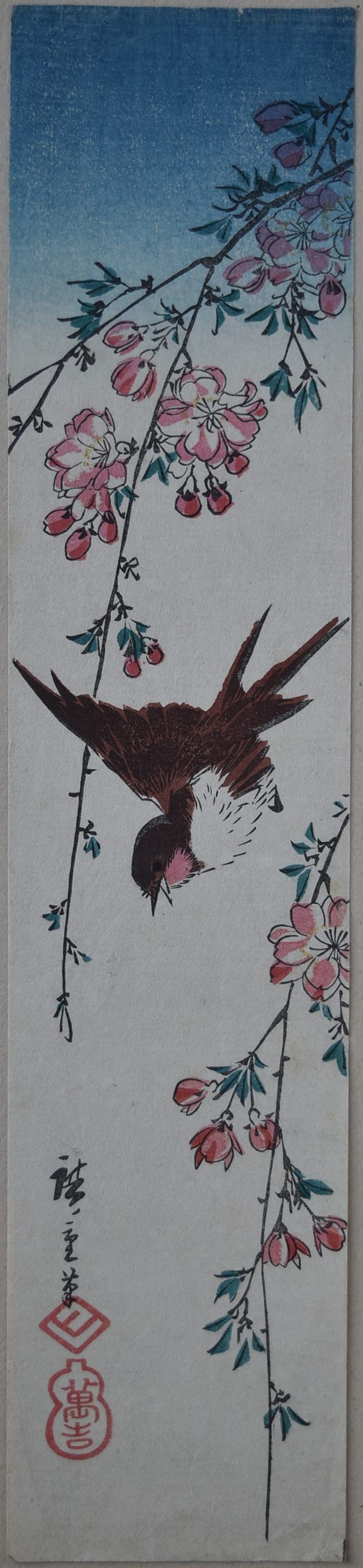
Click here to view image full size.
A third-of-a-block (ko-tanzaku) print, 13.5 x 3 in; 34 x 7.25 cms, showing a sparrow and cherry blossom. Published c. mid 1840s. Unidentified publisher’s seal. These narrow panels are often poorly printed, but not in this case.
Very fine impression: beautiful gradation. Fine colour and condition. Signed Hiroshige hitsu.
Status: Sold
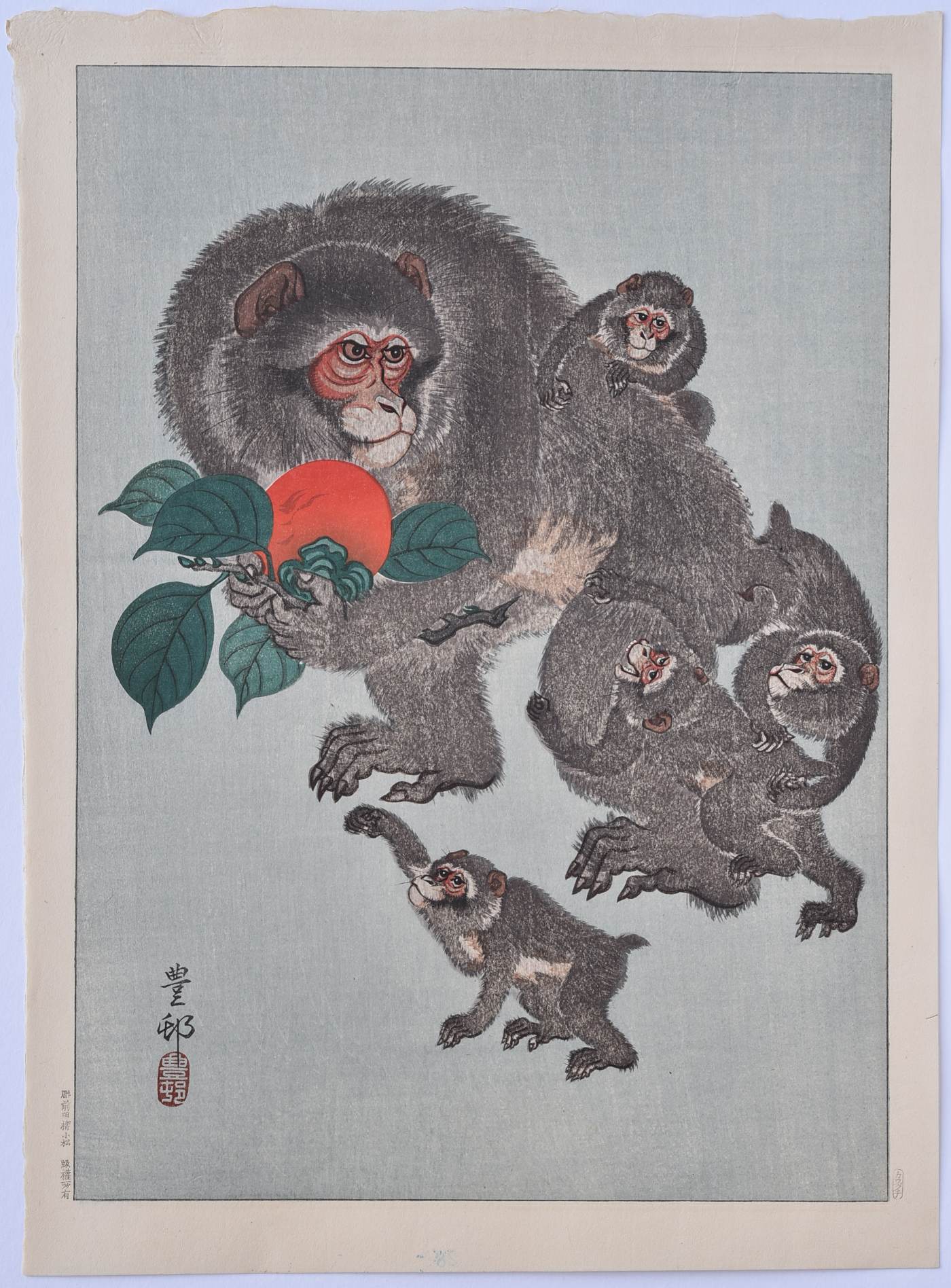
Ohara HOSON (Aka SHOSON, KOSON) (1877-1945)
Click here to view image full size.
A mother monkey holding a persimmon and four playful babies. Published by Kawaguchi, c. 1930. The first and only edition. Ex Robert O. Muller collection. Rare.
Very fine impression, colour and condition. Signed Hoson. Copyright seal in lower right margin; seal of printer, Komatsu, and carver, Maeda, in lower left margin. Kawaguchi catalogue number “28” on reverse.
Status: Sold
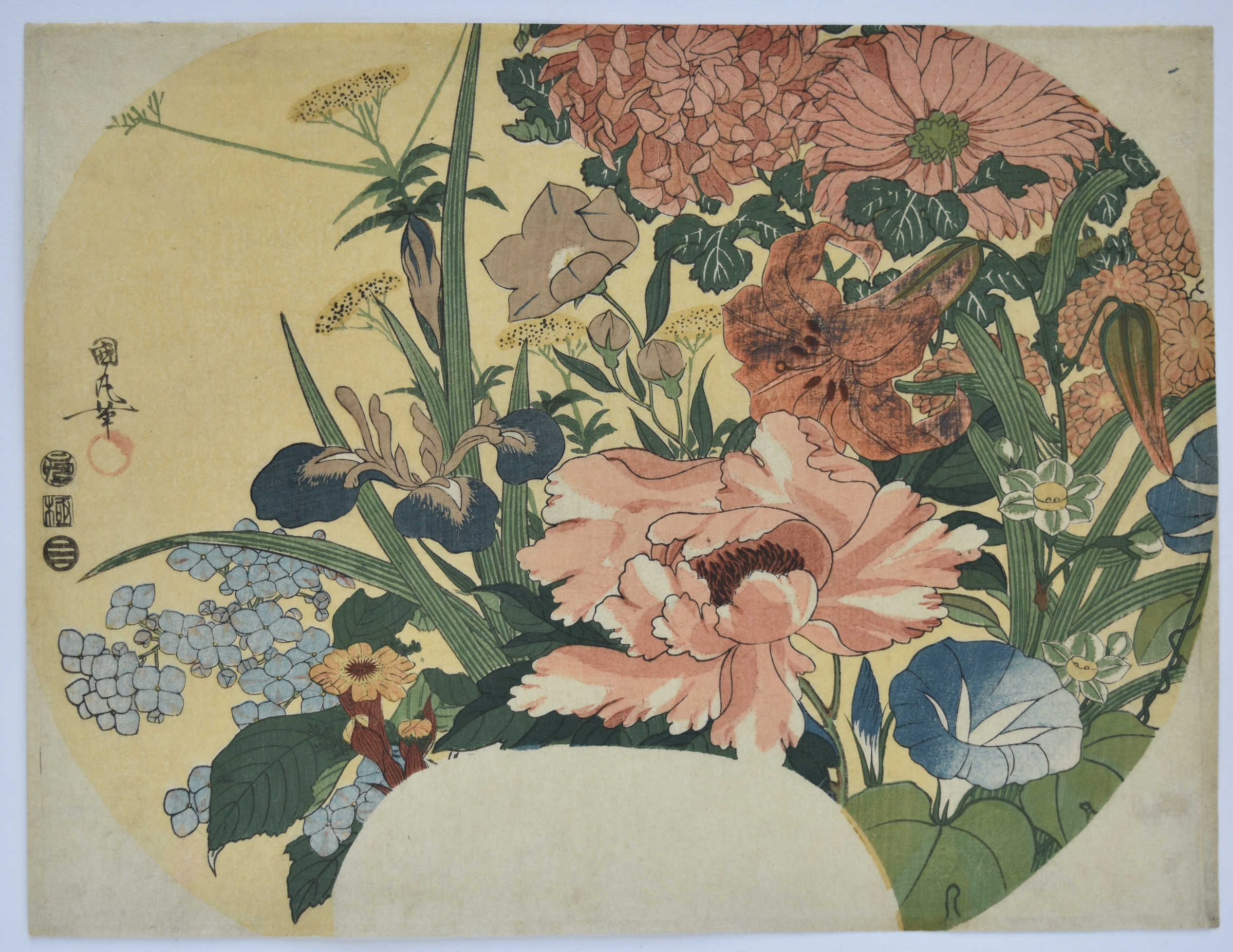
Utagawa KUNIMARU (1794-1829)
Click here to view image full size.
An uchiwa-e (fan print) showing summer flowers : hydrangea, peony, iris, chrysanthemum, morning glory, etc against a yellow ground. Of the utmost rarity: possibly the only recorded example. Published by Ibaya Senzaburo with date seal Bunsei 10 (1827). Ex Werner Schindler collection, seal au verso, and illustrated in Masterpieces of ukiyo-e prints from the Schindler collection, Kondo/Suzuki, Tokyo, 1985, pl. 165, p. 140.
Fine impression; very good colour and condition. Signed Kunimaru hitsu.
Status: Sold
Utagawa HIROSHIGE (1797-1858)
Click here to view image full size.
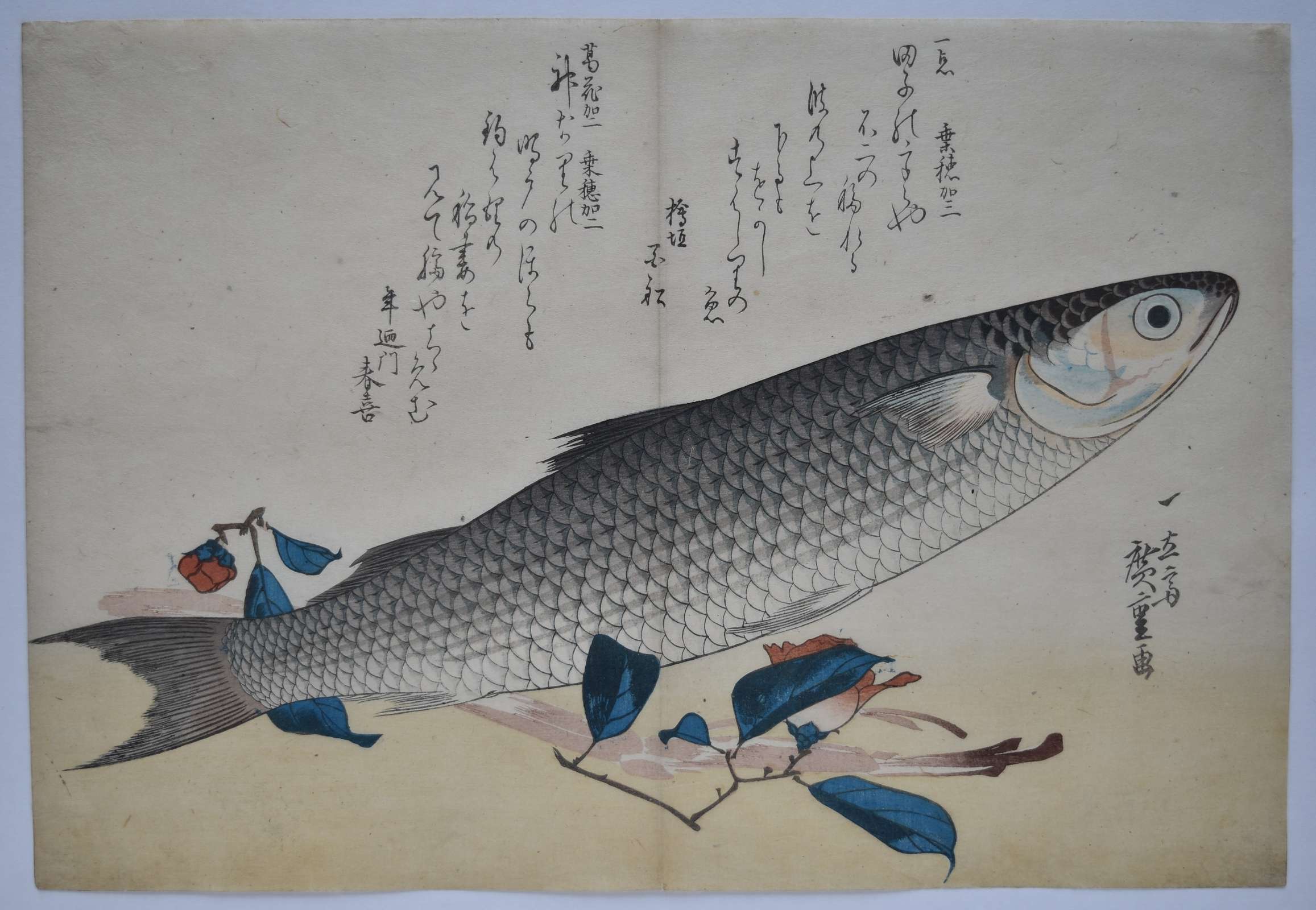
A bora, grey mullet (Mugil cephalus), together with camellia and Japanese asparagusudo. This impression is from the extremely rare first private edition for a poetry club with the judges’ names beside the kyoka poems by Higaki Kunifune and Toshinoto Haruki. From a set of ten prints published – most likely – by Eijudo around 1832-34. These prints were subsequently issued commercially by Eijudo with his seal and a kiwame seal (both missing here on the private printing) and with the judges’ names removed. Who the poetry group was is not known, but they must have been affluent and influential. Of the sixteen poets on the prints, four were certainly members of the Shingyoku Circle, which was affiliated to the Yomogawa. This was the group that commissioned, amongst others, Hokusai’s Horse and Shell series of surimono. There appear to be three other impressions known from the private edition: Sebastian Izzard, Hiroshige, The Ukiyo-e Society of America Inc., 1983, no. 5; Ukiyo-e art, no. 18, Memeorial exhibition of Hiroshige, The Japan Ukiyo-e Society, 1968 (C) no. 4; and Juzo Suzuki, Utagawa Hiroshige, Nihon Keizai Shinbun, 1970, no. 593. Provenance: Ex Stoclet collection.
Very fine impression. Fine colour. Centre fold (as usual as they were issued in folding album form), otherwise fine condition. Signed Ichiryusai Hiroshige ga.
Status: Sold
Ichiryusai HIROSHIGE (1797-1858)
Click here to view image full size.
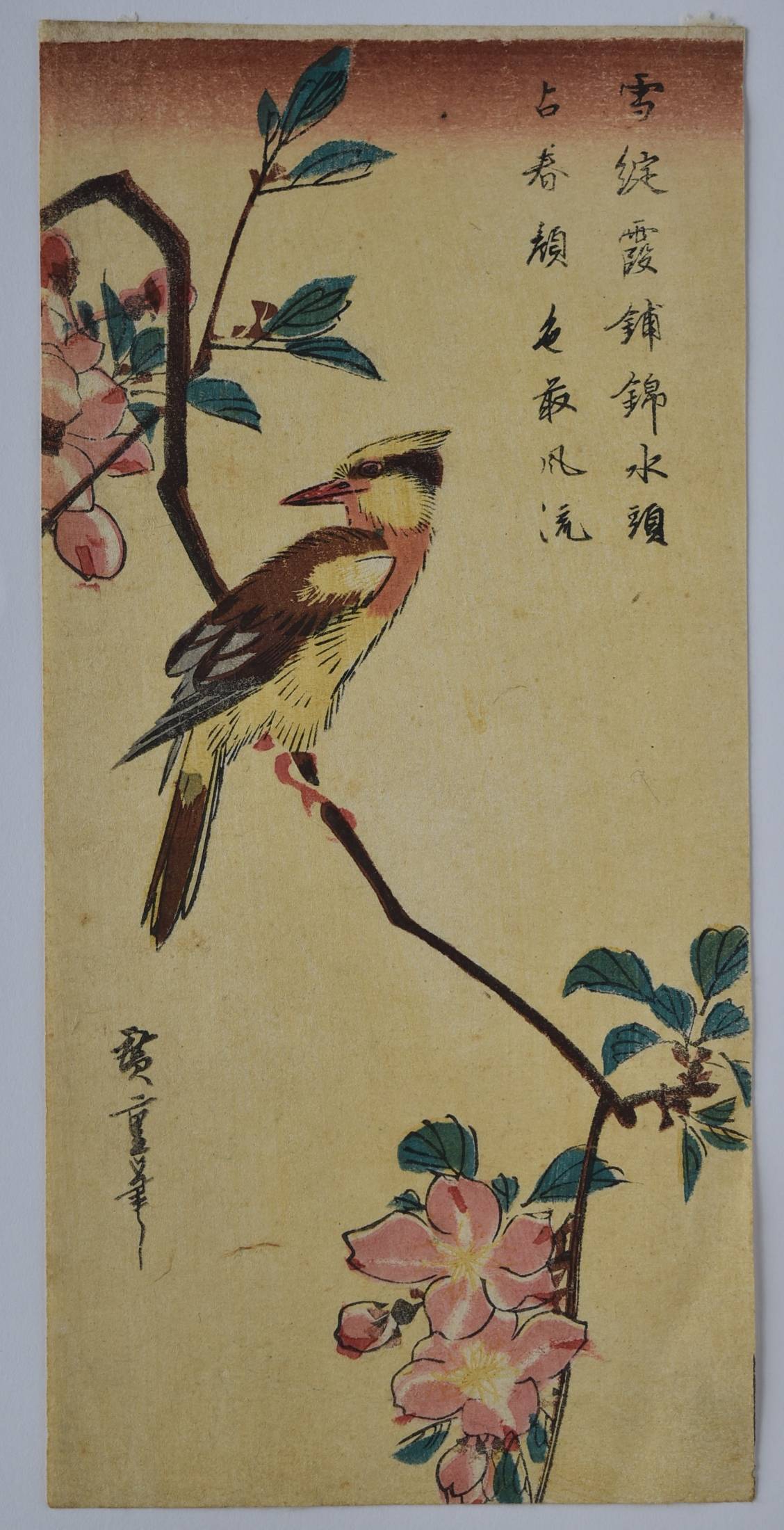
A one third block (10 x 4.75 in; 25.3 x 12.1 cms) panel showing an oriole – probably a black-naped oriole – on a branch of a flowering apple tree. Published c. early 1830s.
Good impression. Very good colour and condition. Signed Hiroshige hitsu.
Status: Sold
Ichiryusai HIROSHIGE (1797-1858)
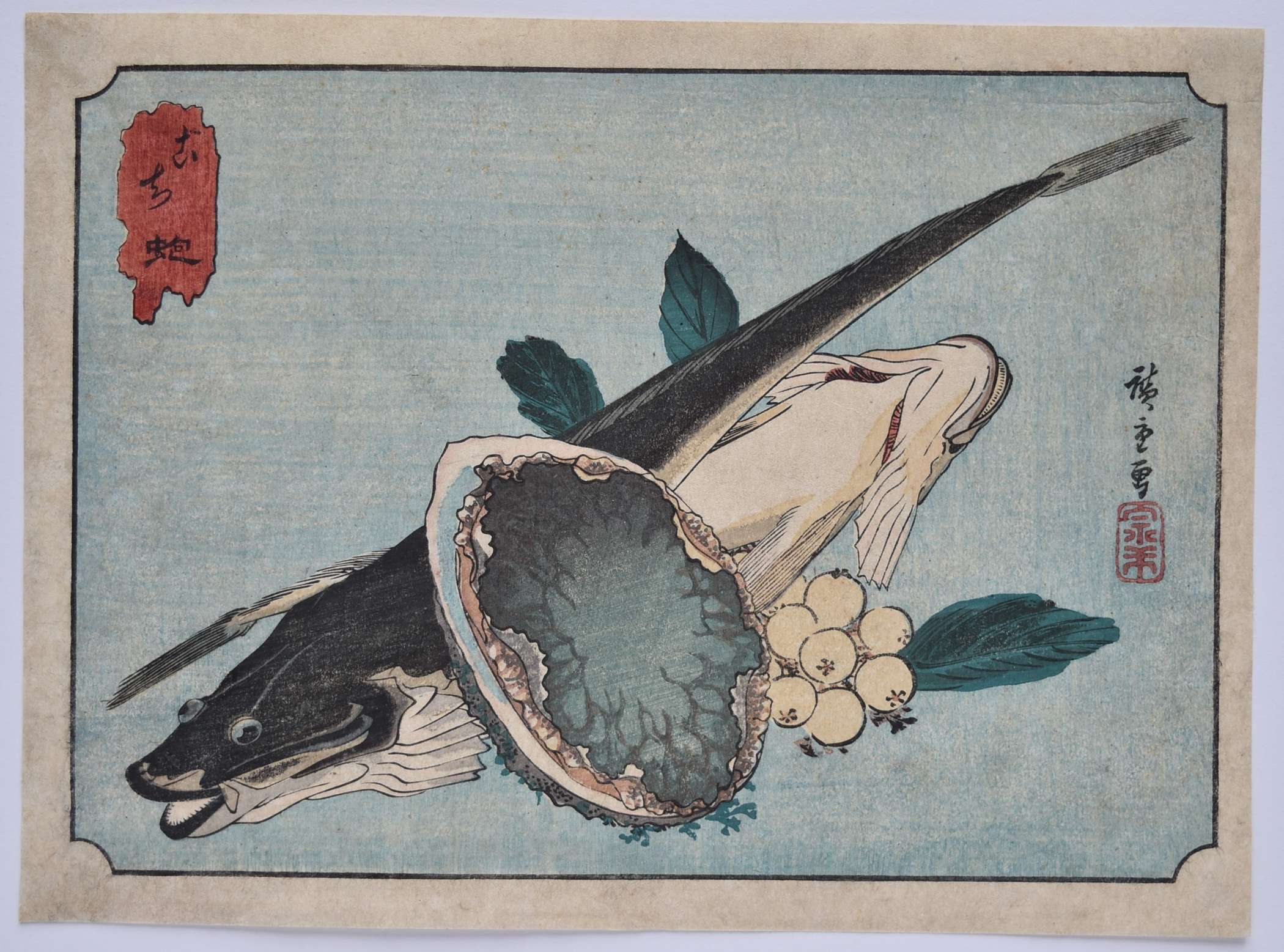
Click here to view image full size.
An extremely rare aiban print showing two kochi , bartail flatheads, (Platycephalus indicus) and an abalone, sea-ear, (Haliotus tuberculate). From a set of eight prints of various fish published c. late 1830s. Another impression is illustrated in Japanese Prints IV – Hiroshige and the Utagawa School, Rijksmuseum Amsterdam, 1984, no. 45, p. 35.
Fine impression and colour. Slight soil, otherwise very good condition. Signed Hiroshige
Status: Sold
Utagawa HIROSHIGE (1797-1858)
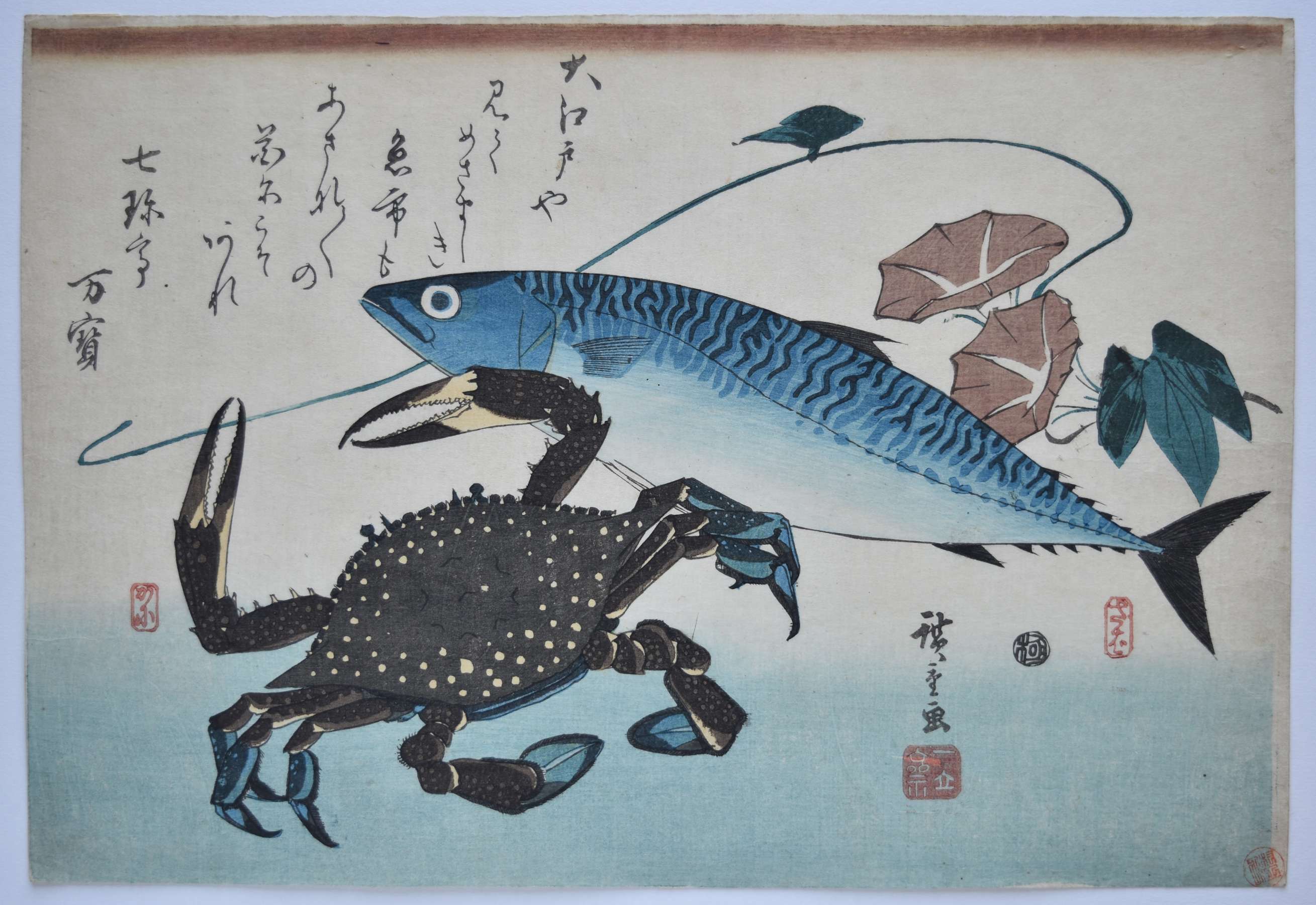
Click here to view image full size.
Kami, crab (Charybois) and saba, mackerel (Scomber Japonicus) together with two flowers of morning glory. Poem by Shichichintei. This is the first edition (Kruml 19a). From the second series of fish published by Yamasho c. 1840-42. Unidentified collector’s seal bottom right corner.
Fine impression, colour and condition. Signed Hiroshige ga.
Status: Sold
Ichiryusai HIROSHIGE (1797-1858)
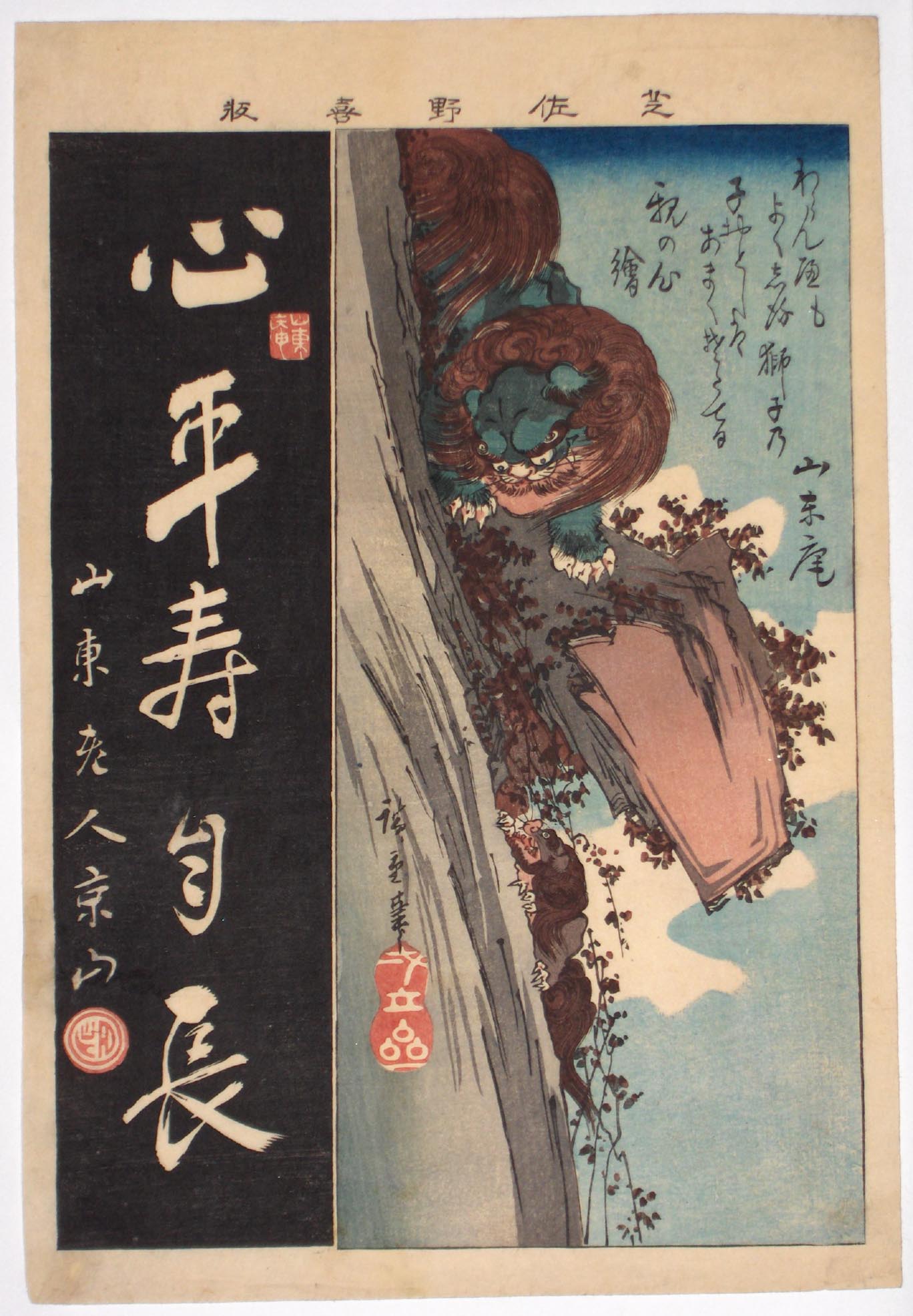
Click here to view image full size.
A shishi cub being taught to scale a vertical cliff. ( Shishi: ‘Chinese Lion’ [ Ch.: Shi-tzu ]. ) it was said that the shishi cast its young from a high rock to test whether it could scale the rock face in which case it became the perfect beast. Published by Sanoki, c 1839-40. Extremely rare: one other impression illustrated in The Art of Hiroshige, Tsuneo Tamba, no.410.
Fine impression and colour. Small areas of expert restoration. Signed Hiroshige ga.
Status: Sold
Ichiryusai HIROSHIGE (1797-1858)
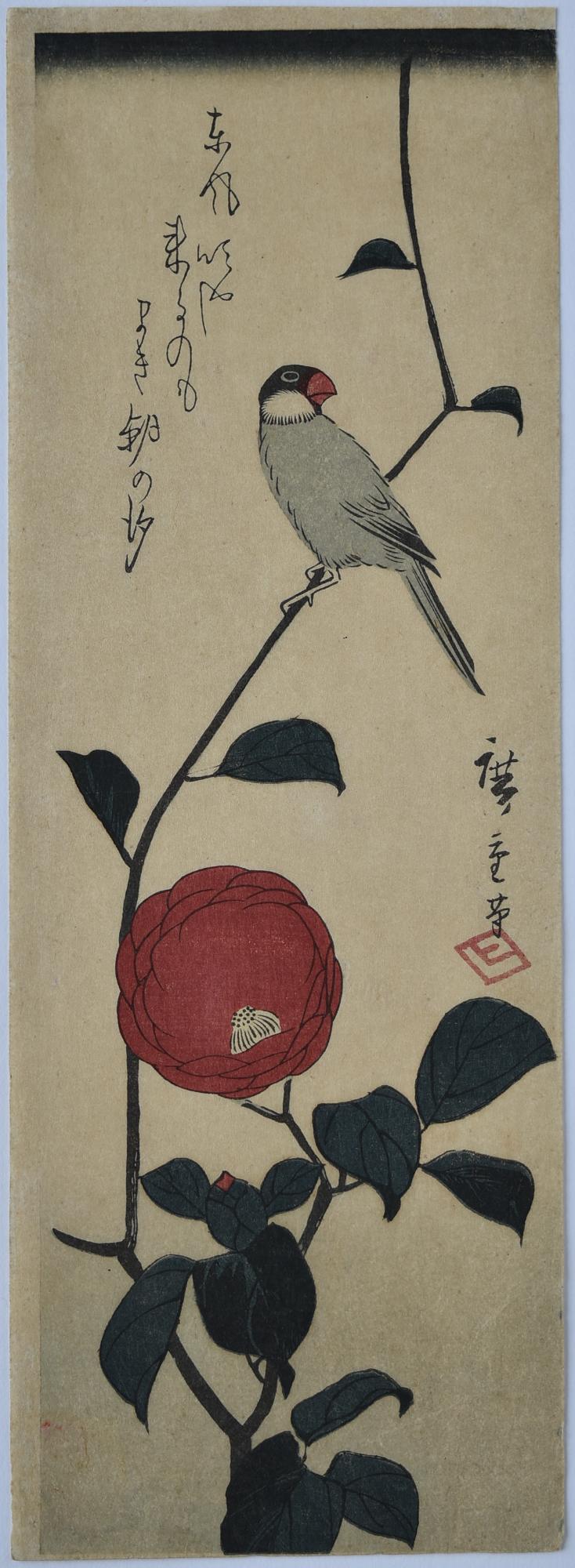
Click here to view image full size.
A tanzaku showing a Japanese finch sitting on a camellia branch. Unidentified collector’s seal au verso.
Very fine impression. Fine colour and condition. Signed Hiroshige hitsu.
Status: Sold
Ichiryusai HIROSHIGE (1797-1858)
Click here to view image full size.
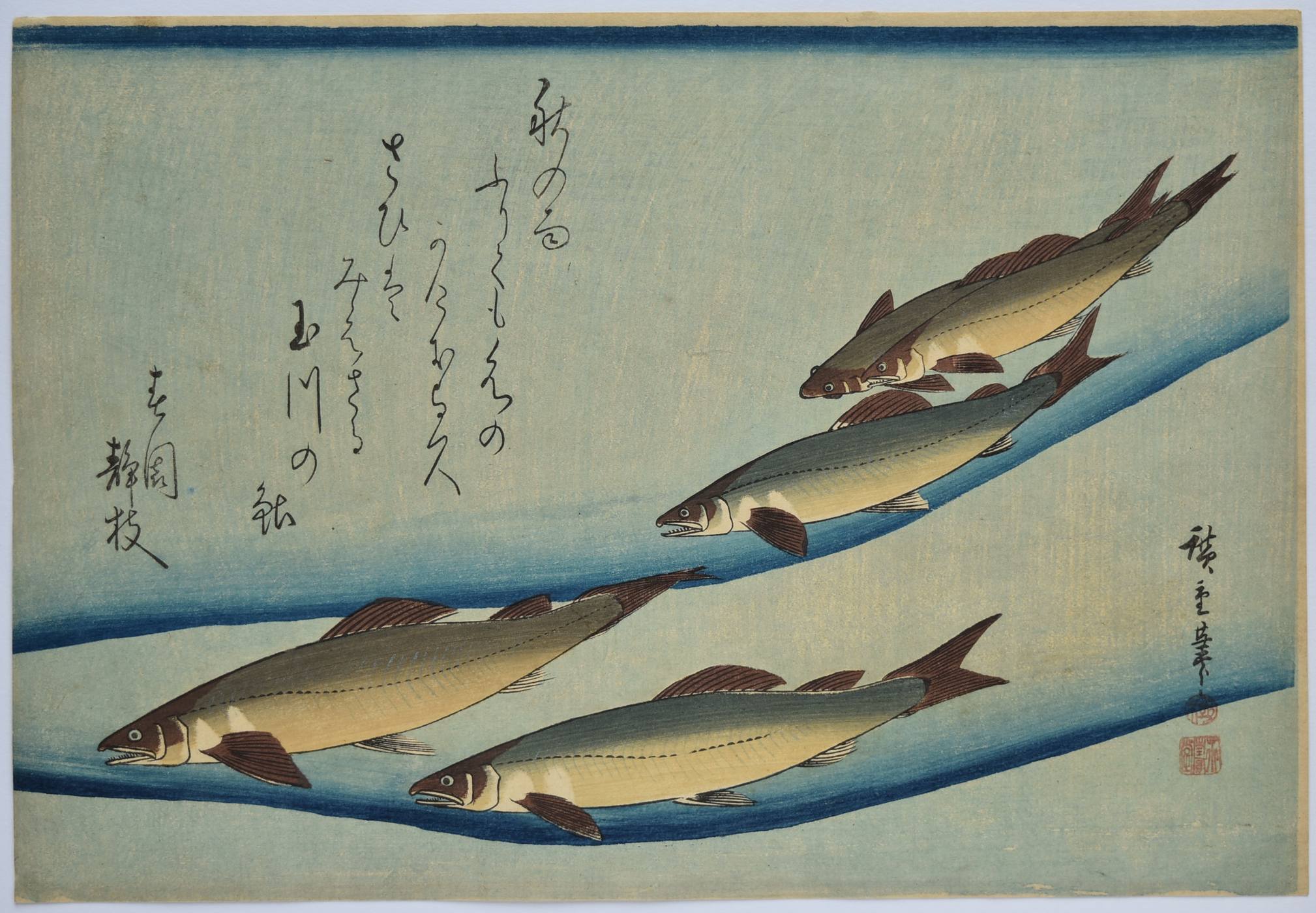
Ai or ayu, river trout, Plecoglossus altivelis. Poem by Haruzono Shizuo. From the first set of fish prints published by Eijudo, c 1832-4. This first series was issued privately for a poetry group ( probably the Shingyoku Circle ) with judges’ names and extra poems. These prints are of the utmost rarity as probably only enough for the Circle were printed and they never come onto the market. Due to their popularity this first series was published commercially and a second set was commissioned. The most sought after print in the series and probably the first to be designed.
Very good impression, colour and condition. Full size with with no centre fold. Signed Hiroshige hitsu.
Status: Sold
Ichiryusai HIROSHIGE (1797-1858)
Click here to view image full size.
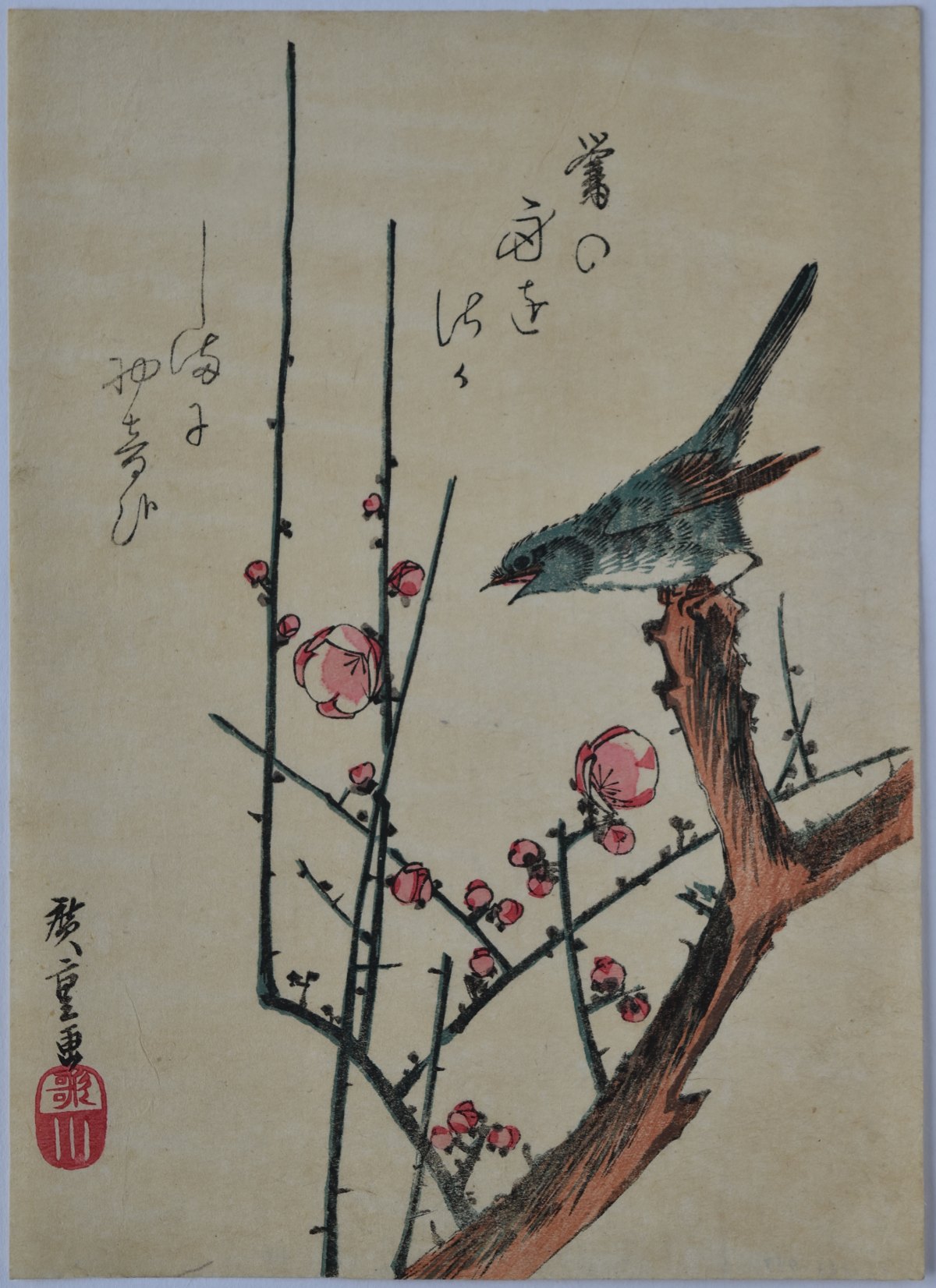
A half- block print showing a small bird (possibly a bush warbler) and plum blossom. . Published by Kawasho (Kawaguchi Shozo) c. mid 1830s. Half-blocks were printed two-to-a-sheet and divided, either vertically or horizontally.
Very good impression, colour and condition. Signed Hiroshige ga with Utagawa seal.
Status: Sold
Ichiryusai HIROSHIGE (1797-1858)
Click here to view image full size.
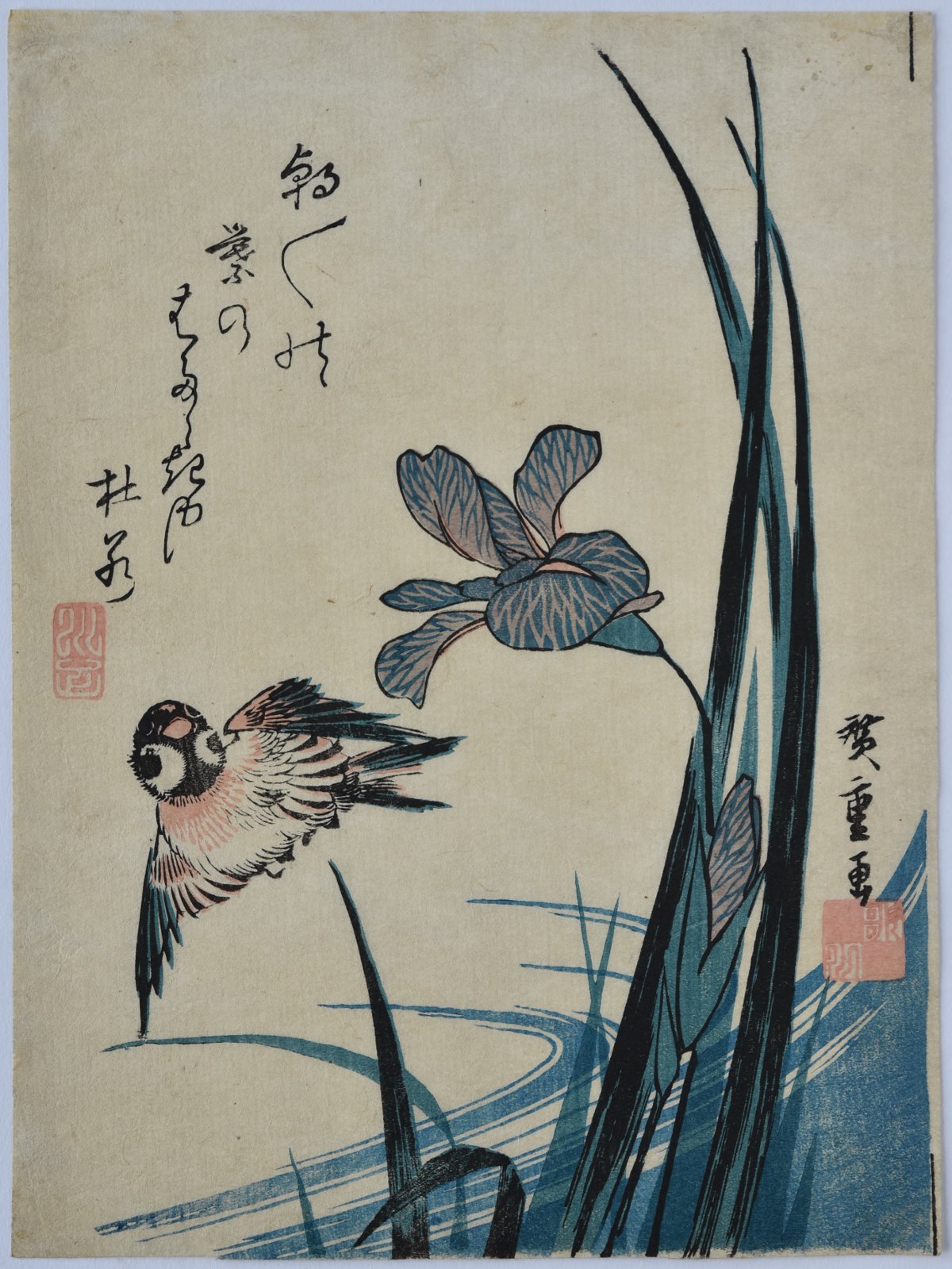
A half-block print showing a sparrow and iris. Published by Kawasho (Kawaguchi Shozo) c. mid 1830s. Half-blocks were printed two-to-a-sheet and divided, either vertically or horizontally.
Very good impression, colour and condition. Signed Hiroshige ga with Utagawa seal.
Status: Sold