/category/beauties/
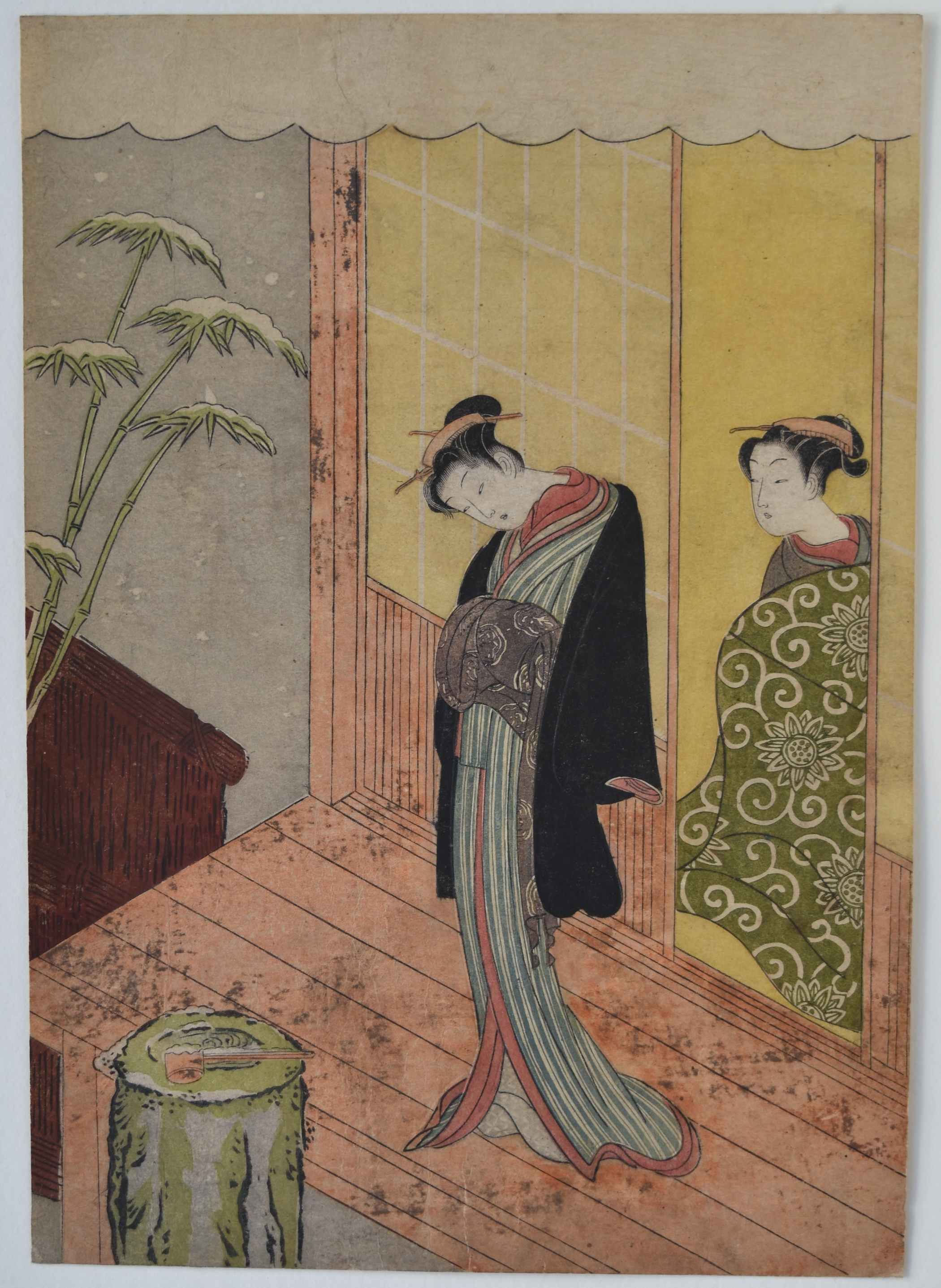
Attributed to Suzuki HARUSHIGE (Shiba KOKAN 1747-1818)
Click here to view image full size.
A winter scene with a young courtesan on an engawa gazing at an upturned ladle resting in a water basin formed from a hollow tree trunk. Behind her a young beauty peers out through the shoji. The scene calls to mind the Bell of Damnation (Muken no kane) act in the play Hiragana Seisuiki where Umegae strikes the water basin with a ladle to produce gold coins. Harushige was the ukiyo-e go of Shiba Kokan, the first artist to try copper plate engraving and who studied oil painting and etching from books he saw in Nagasaki. For a time a pupil of Harunobu whose style his prints resemble. Extremely rare: I cannot, at the moment, locate another impression. Published c early 1770s.
Fine impression. Extremely good colour, the orange pigment partly oxidised. Possibly slightly trimmed left and bottom, otherwise very good condition.
Status: Available
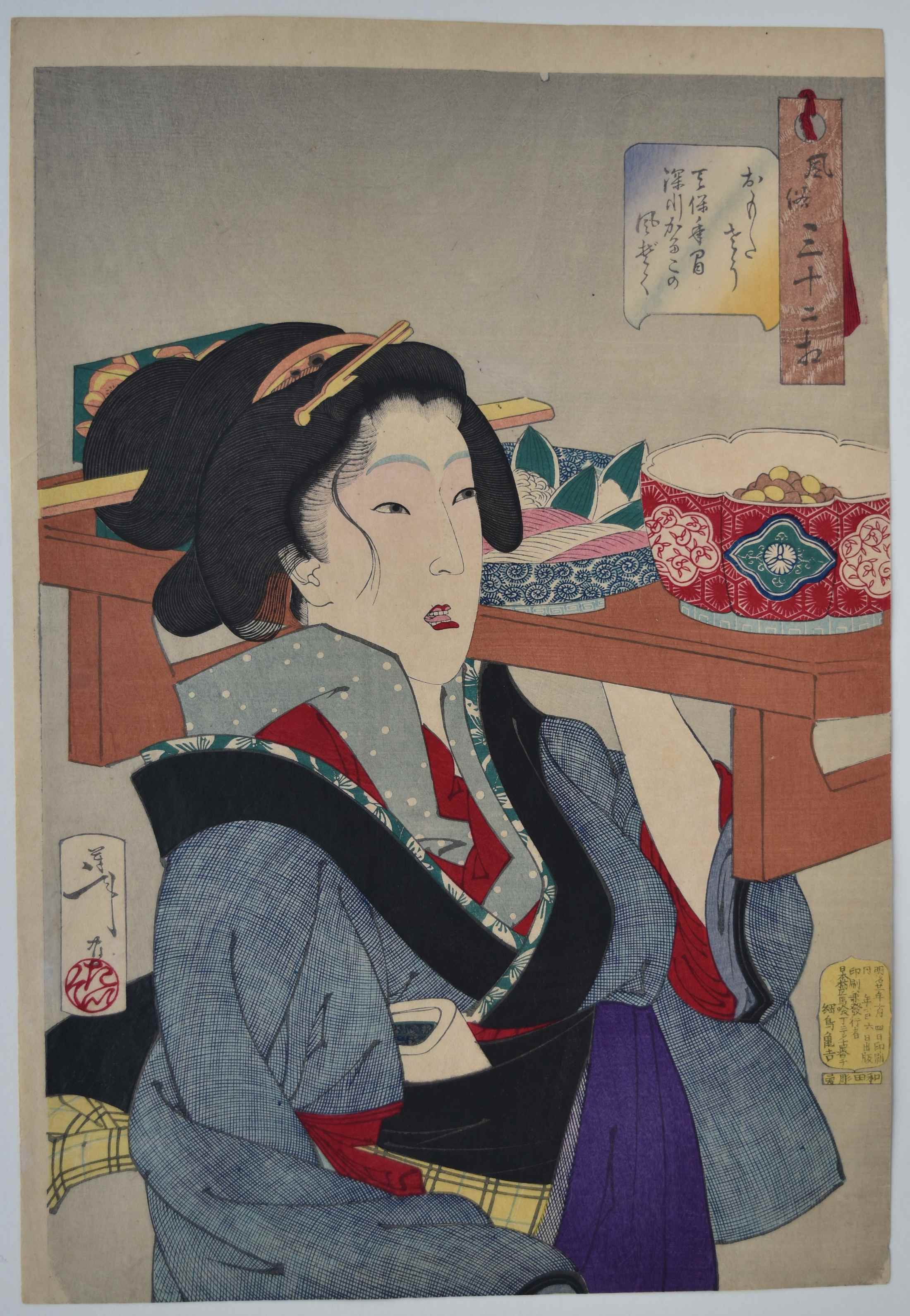
Tsukioka YOSHITOSHI (1839-1892)
Click here to view image full size.
Omota-so: Tempo nenkan Fukagawa karuko no fuzoku, “Looking Weighed-Down: The Appearance of a Waitress at Fukagawa in the Tempo Era [1830-1844].” Shows the waitress carrying a portable wooden table with food to a geisha party from a set Thirty-two Aspects of Women published by Tsunashima Kamekichi, 1888. The set depicts women of different backgrounds and occupations from the Kansei era through to the Meiji era with punning allusions to their situation or mood.
Very fine impression of the true first edition. Fine colour and condition. Signed Yoshitoshi ga.
Status: Available
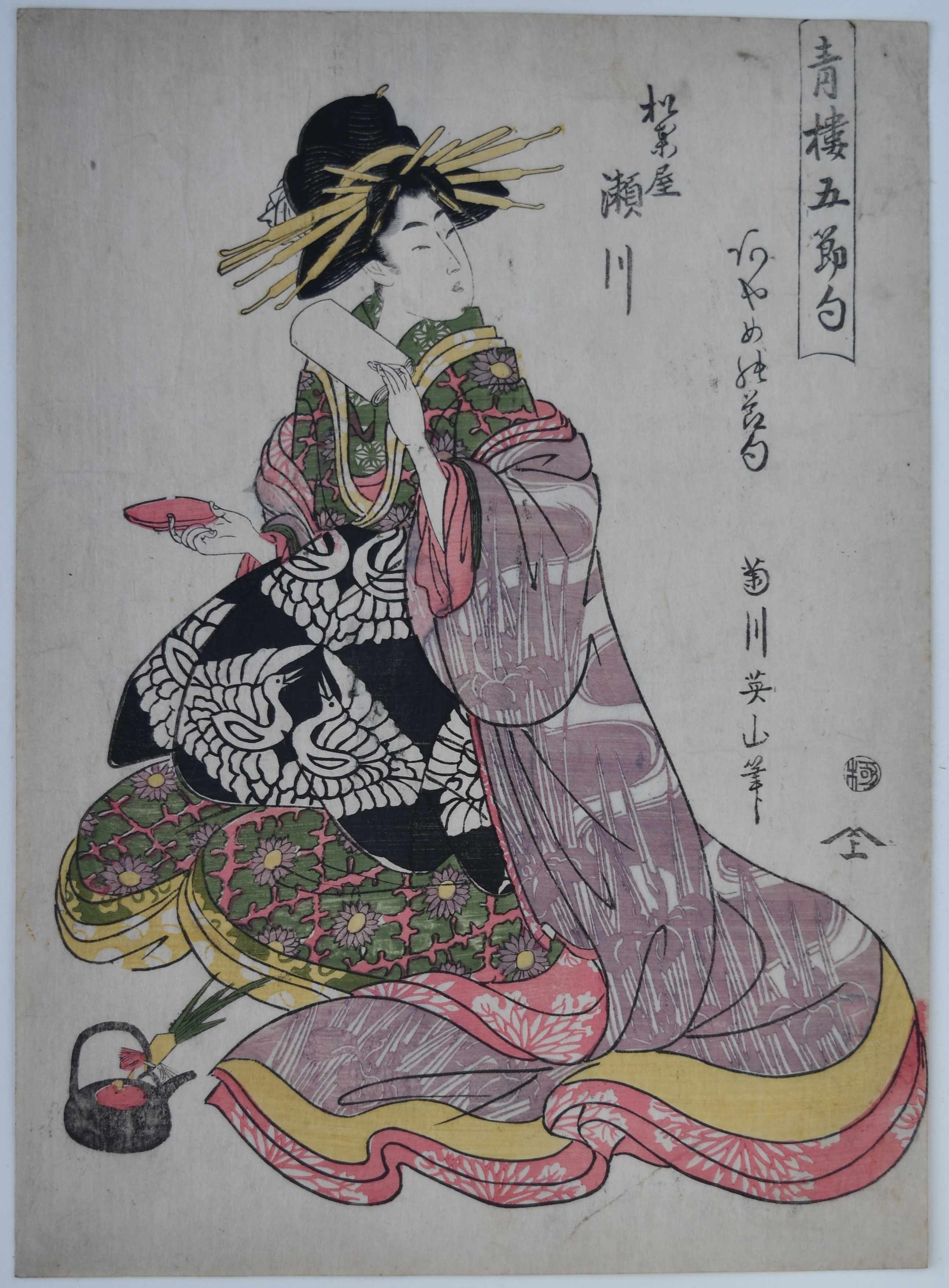
Kikugawa EIZAN (1787-1867)
Click here to view image full size.
An aiban print showing the courtesan Segawa of the Matsubaya drinking ayamezake (a sake soaked with iris root) from a set Seiro gosekku, “Beauties of the Yoshiwara Compared to the Five Festivals.” In this case the Boys’ Festival held on the 5th May. Published by Iseya Soemon, c 1810.
Fine impression, very good colour and condition. Signed Kikugawa Eizan fude.
Status: Available
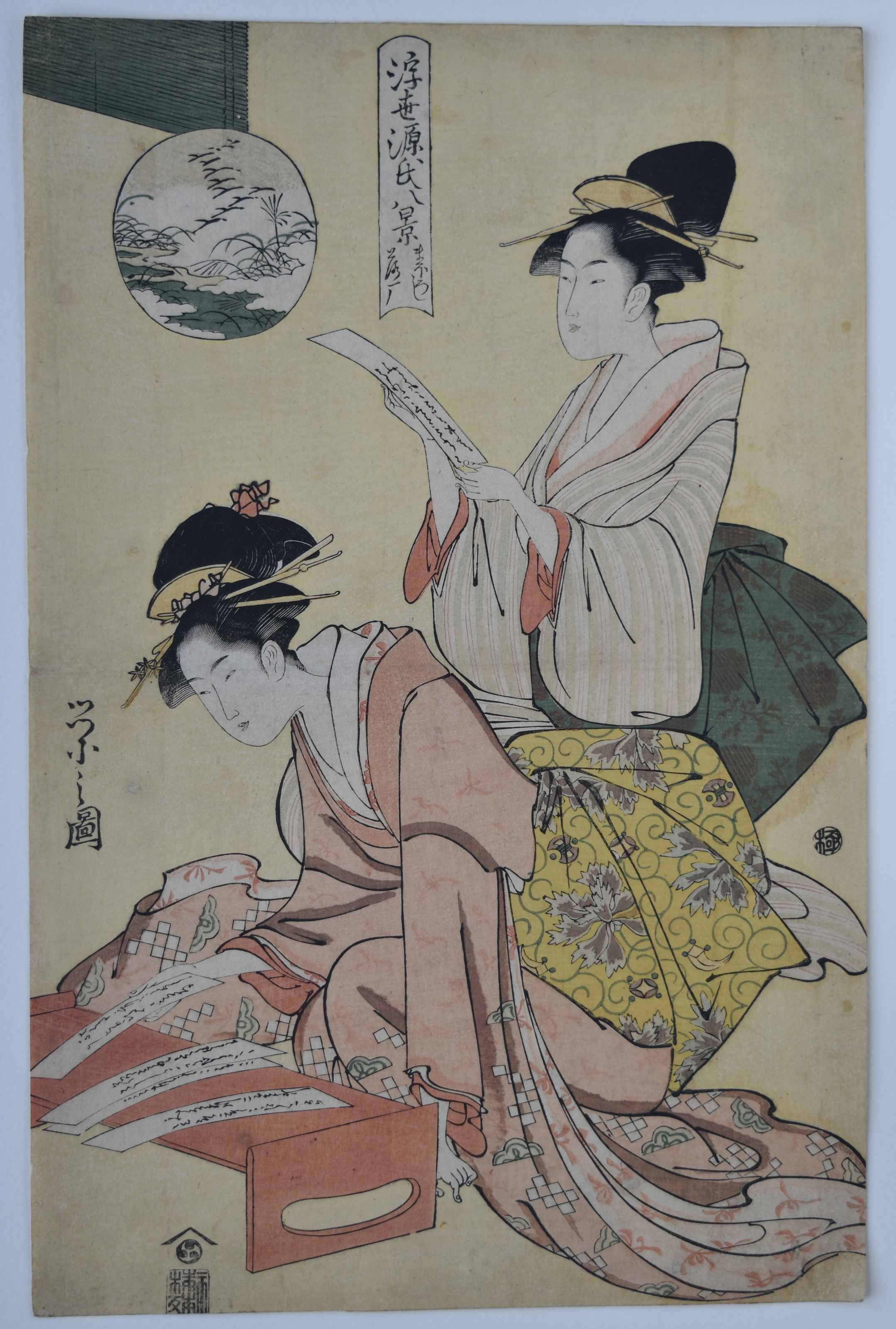
Hosoda EISHI (1756-1829)
Click here to view image full size.
Two beauties examining tanzaku poetry cards from a set Ukiyo Genji hakkei, “Eight Views of Genji in the Floating World.” The designs stand alone but also form diptychs. This series compares scenes from the famous Tale of Genji novel written by the Lady Murasaki in the early 11th century with the Eight Views of Omi [Lake Biwa]. In the present case, Maboroshi rakugan (viz Katata rakugan, “Descending Geese at Katata”) is compared to chapter 41, Spirit Summoner, of the Tale of Genji where a poem composed by the Akashi Lady is in response to the grieving Genji’s poem after the nocturnal encounter with Murasaki which refers to the wild goose (aka Genji) having flown away. Published by Eijudo c 1797-99. Another impression is in the B.M., reg. no. 1931, 0427,0.8 and an impression is illustrated in Klaus J. Brandt, Hosoda Eishi, 1977, 119, no. 301. Provenance: Sold Sothebys, New York, 28/10/1980, lot 866.
Fine impression. Very good colour with yellow ground. Slight centre fold and very slight trimming, otherwise very good condition. Signed Eishi zu.
Status: Available
Tsukioka YOSHITOSHI (1839-1892)
Click here to view image full size.
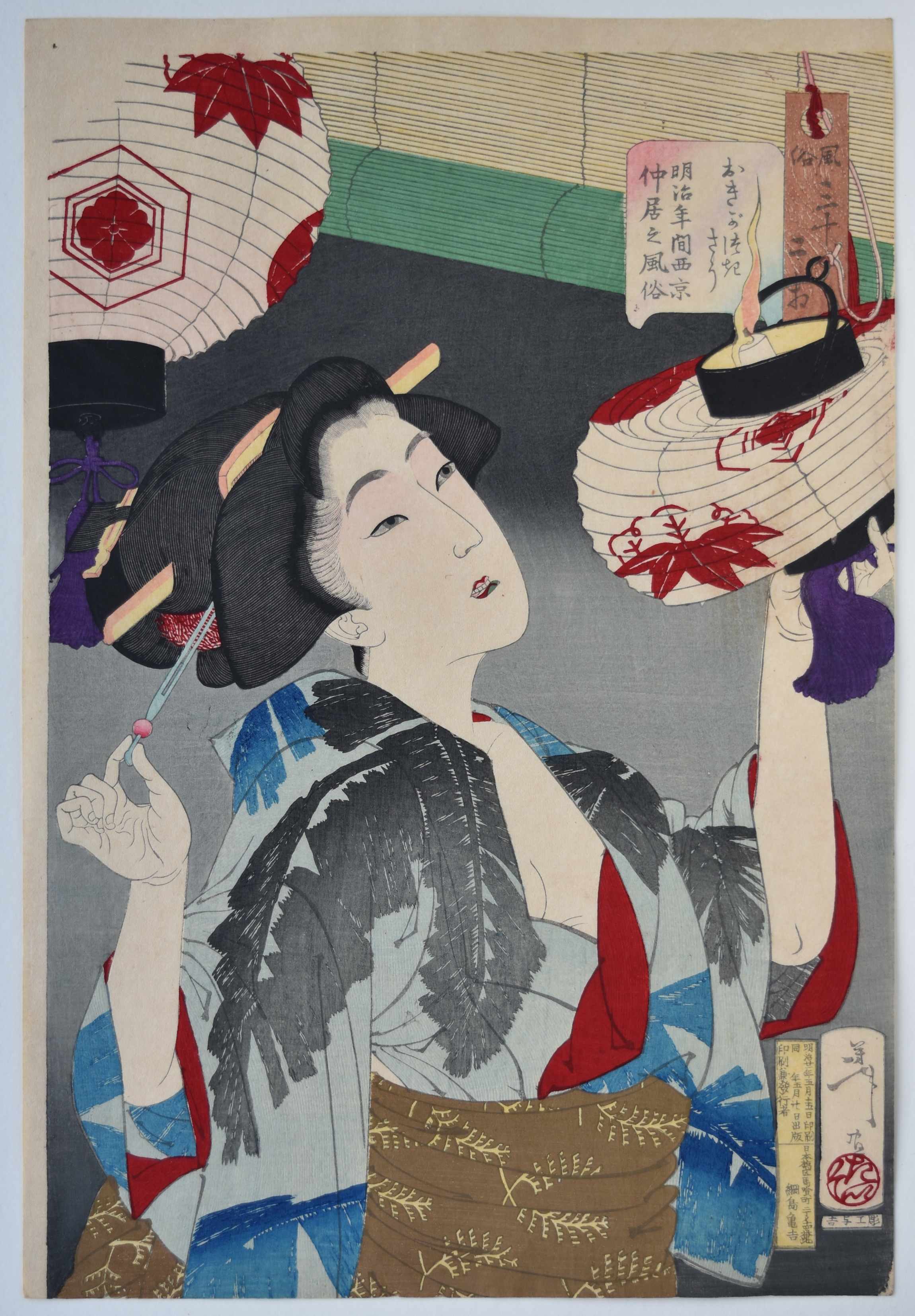
Okigatsuki-so: Meiji nenken saikyo nakai no fuzoku, “Looking Capable: The Appearance of a Kyoto Waitress in the Meiji Era [1867-1912].” Shows the waitress of a Kyoto geisha house whose job was to act as a go-between for customer and geisha. From a set Thirty-two Aspects of Women published by Tsunashima Kamekichi, 1888. The set depicts women of different backgrounds and occupations from the Kansei era through to the Meiji era with punning allusions to their situation or mood.
Very fine impression of the true first edition. Fine colour and condition. Signed Yoshitoshi ga.
Status: Available
Kikugawa EIZAN (1787-1867)
Click here to view image full size.
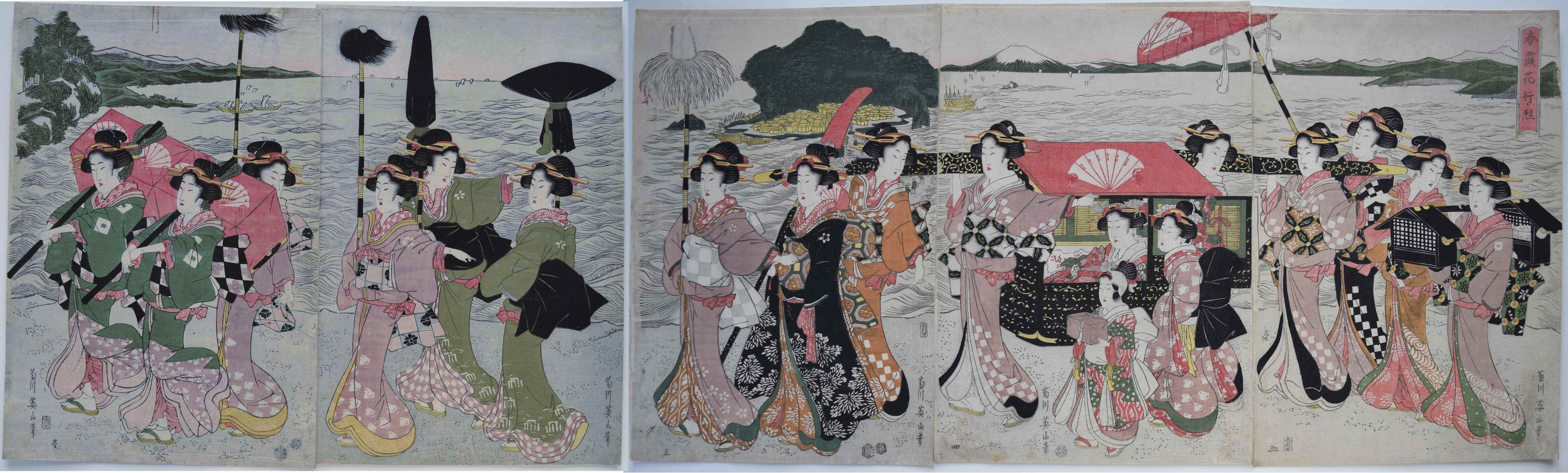
An early complete 5-sheet (pentaptych) design being a mitate-e of a daimyo’s procession along Kugenuma beach with Enoshima island and Mt. Fuji in the background. Harugasumi hana iki retsu, “Journey in the Spring Mist.” The regional feudal lords (daimyo) were required every alternative year to travel to the capital of Edo. This was a deliberately costly affair and secured their loyalty as they had to leave their families in Edo. In this design young women replace the daimyo’s retinue. Published by Kawaguchiya Uhei, 1811-14. Its rare to find 5 or 6-sheet prints complete.
Fine impression and colour. Light album backing, otherwise very good condition. Signed Kikugawa Eizan hitsu.
Status: Available
Suzuki HARUNOBU (1724-1770)
Click here to view image full size.
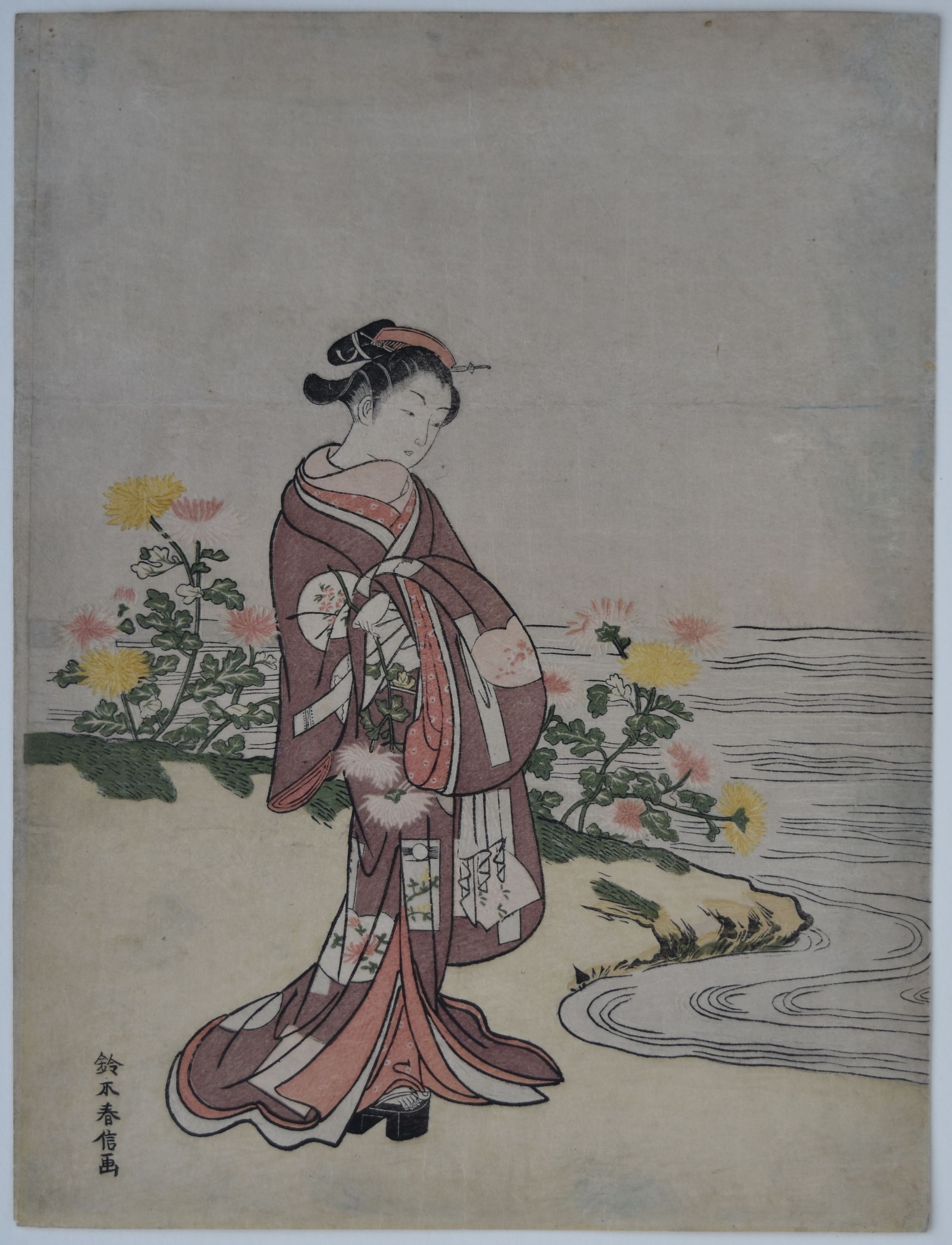
A beauty standing beside a stream where wild chrysanthemums grow. A mitate-e (parody) of Kikujido, the Chrysanthemum Boy, who was the favourite of the Chinese Emperor Mu (c. 950 B.C.). However, because of court jealousy, he was banished but had his exile eased by the Emperor who gifted him the ability to read sacred Buddhist texts. He became an immortal, spending his days surrounded by chrysanthemums and inscribing words of peace on the flowers’ petals. This is the second state: The first (private edition) is a calendar print with a signature (of an amateur) Kinga Ko and seal and has the year and its cyclical signs for 1766. These Harunobu calendar prints, printed in small numbers, were commissioned by wealthy individuals between c. 1764 and 1766 and so popular that they were published commercially. Rare.
Very good impression and colour Very minor edge soil, otherwise very good condition. Signed Suzuki Harunobu ga.
Status: Available
Utagawa KUNISADA (1786-1865)
Click here to view image full size.
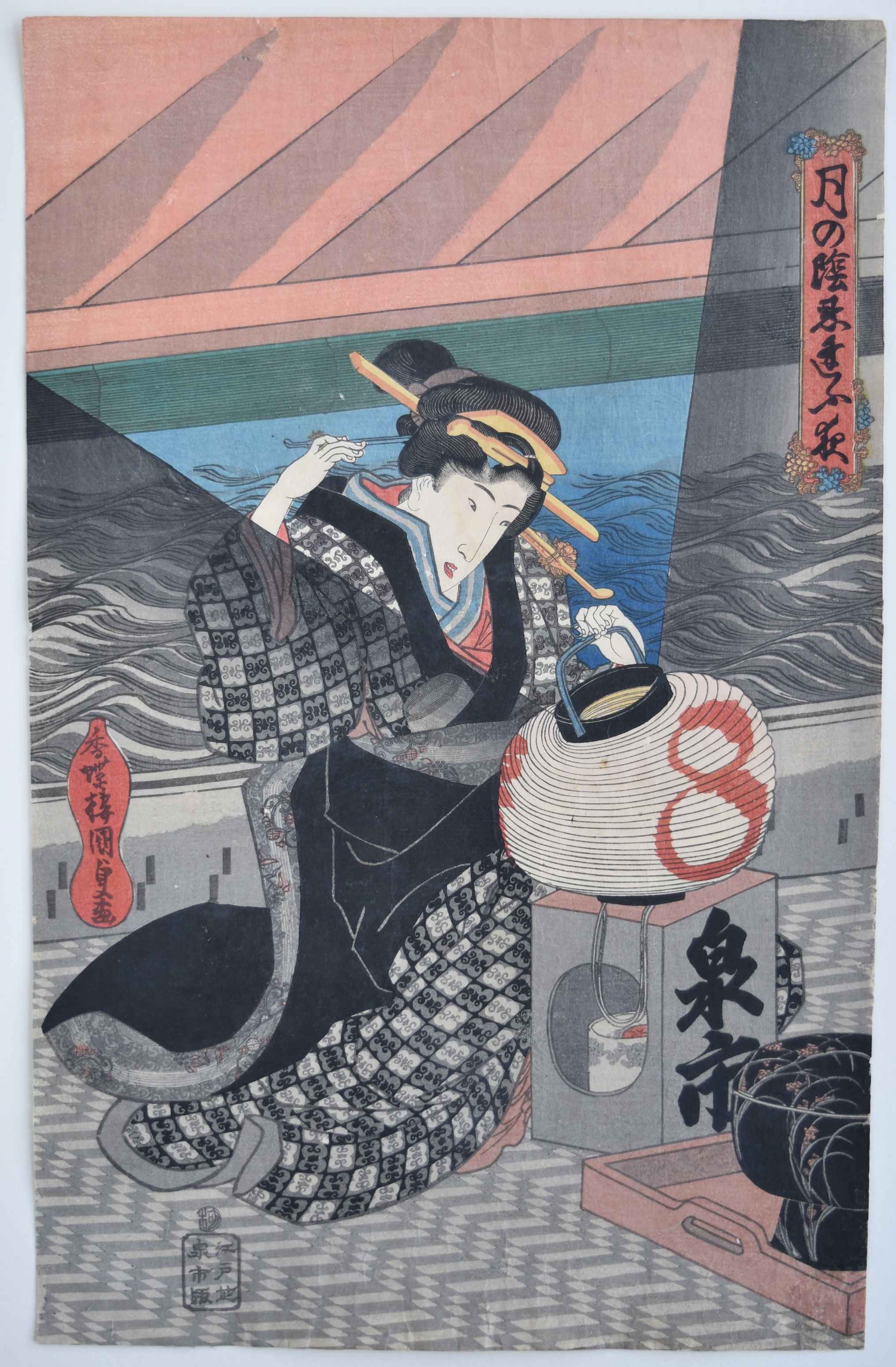
A geisha partly illuminated by a lantern on a boat from a set Tsuki no kage shinobiau yo, “Secret Meetings by Moonlight.” Published jointly by Izumiya ichibei (as here) and Yamamoto Kyubei, c. 1836-38.
Very good impression and colour. Minor creasing, otherwise very good condition. Signed Kochoro Kunisada ga.
Status: Available
Tsukioka YOSHITOSHI (1839-1892)
Click here to view image full size.
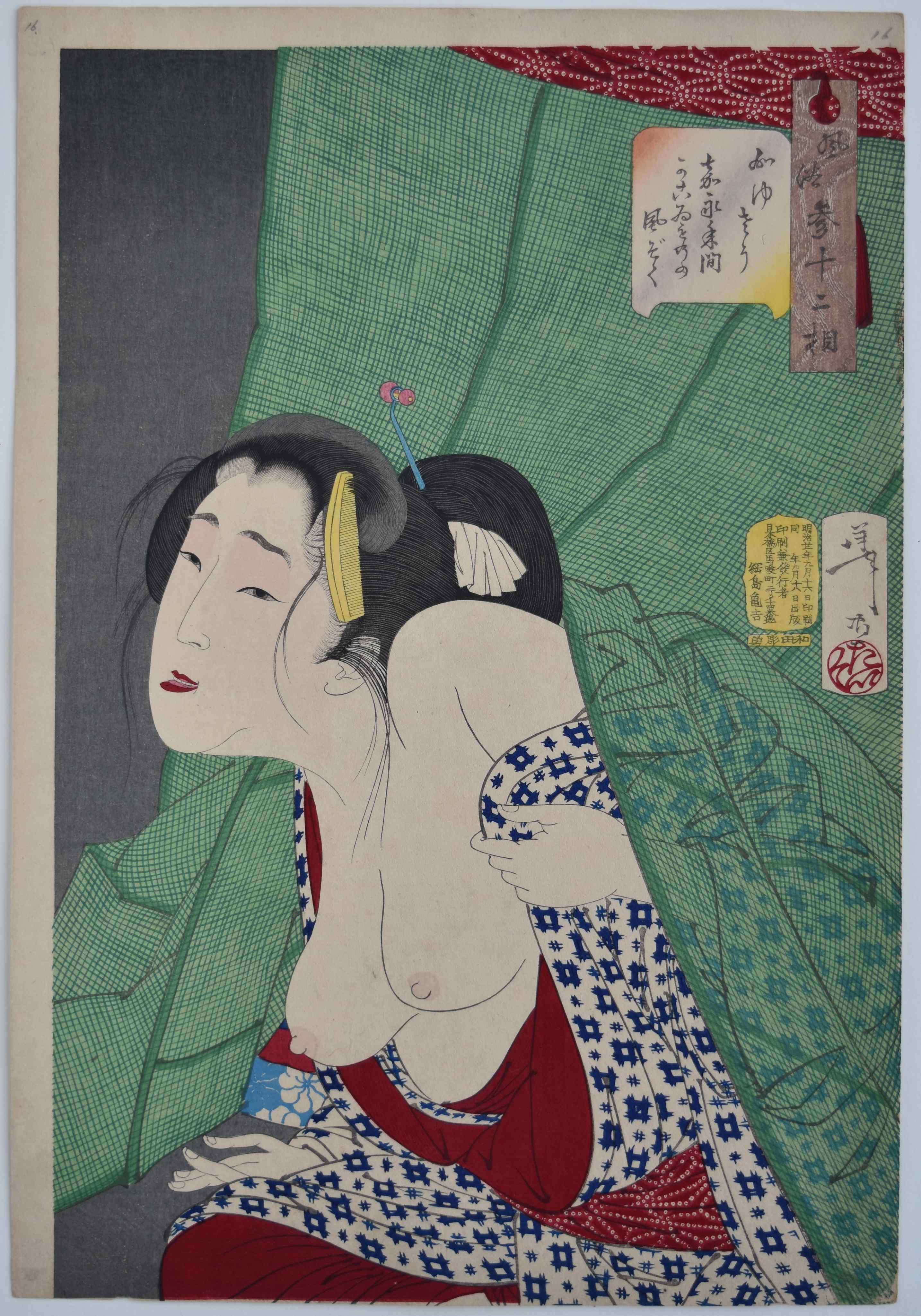
Looking Itchy: the appearance of a kept woman of the Kaei era [1848-1854]. Shows a beauty emerging from a mosquito net that has apparently not been entirely successful. From a set Thirty-two Aspects of Women published by Tsunashima Kamekichi, 1888. The set depicts women of different backgrounds and occupations from the Kansei era through to the Meiji era with punning allusions to their situation or mood.
Very fine impression with strong blind-printing on the fall. Fine colour and condition. Full size. Signed Hiroshige ga.
Status: Available
Utagawa KUNIYASU (1794-1832)
Click here to view image full size.
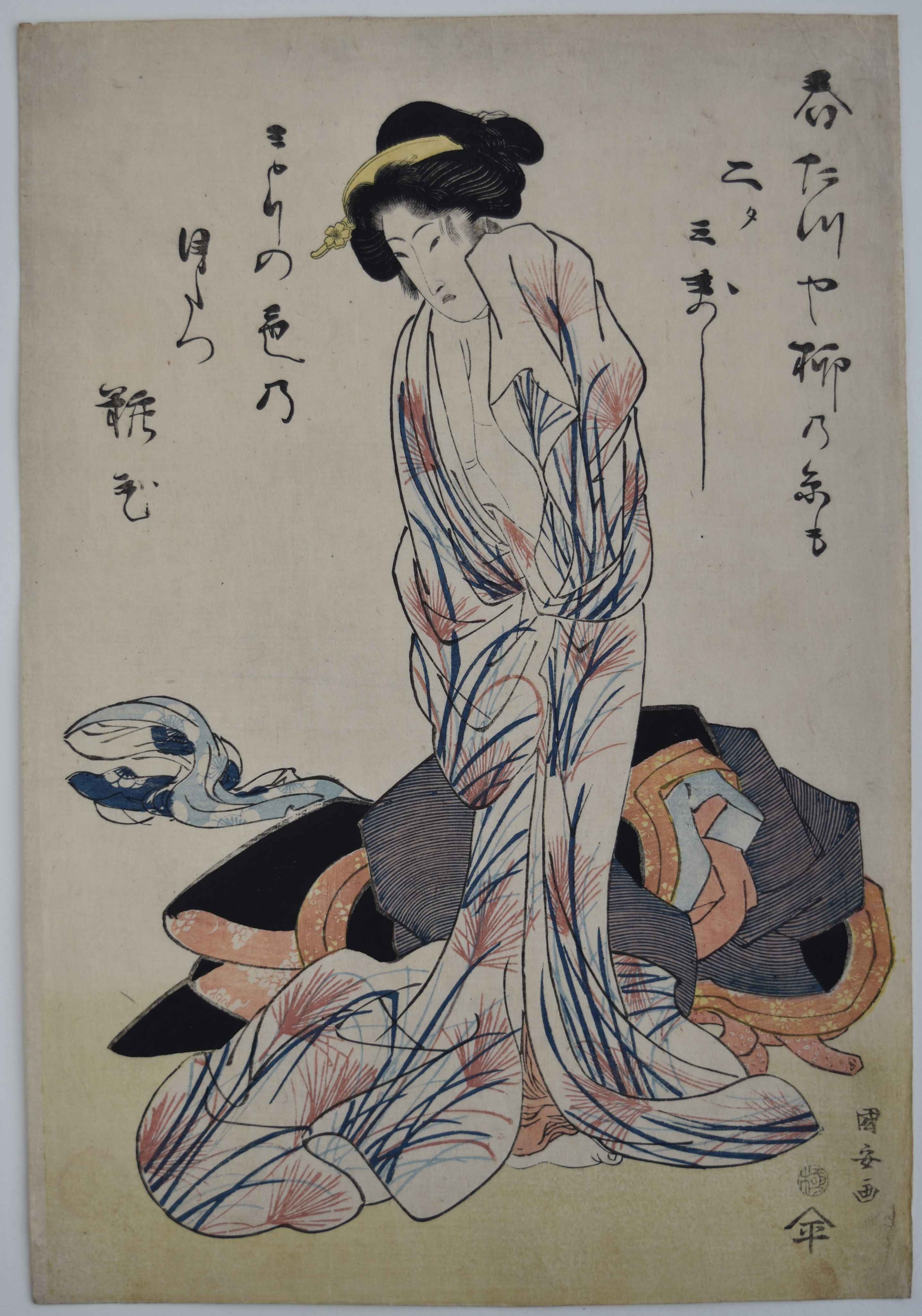
Shows a beauty after a bath. The poem above compares her to the young green shoots of the willow tree in spring. Published by Omiya Heihachi, c. 1820.
Very good impression, colour and condition. Signed Kuniyasu ga.
Status: Available
Isoda KORYUSAI (1735-1790)
Click here to view image full size.
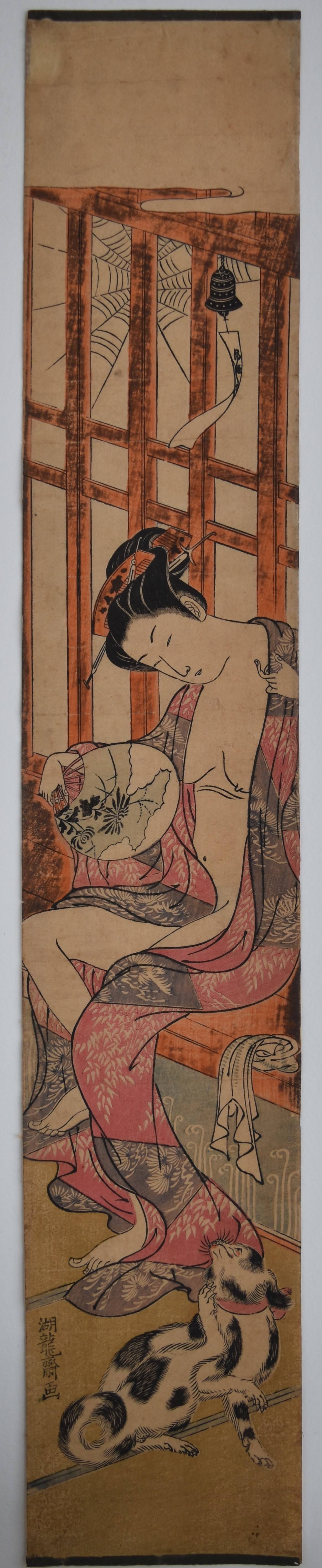
A pillar print, hashira-e, of a beauty after a bath cooling herself with a fan. A cat looks up adoringly from below. Above her is a temple bell wind chime, often hung in the summer. Masanobu laid claim to have invented the pillar print format. Roger Keyes has suggested that, because many large format prints from the 1740s were printed using two blocks of wood, there was a tendency for the blocks to separate during use, giving rise to the hashira-e shape. Probably the most interesting format in that the restrictions often led to creative compositions. And figures sometimes partially exit or enter from the side, giving weight to the theory of separating blocks of wood. Certainly, these prints were hung on pillars in houses, and because of this they often come browned, faded or damaged. Koryusai was the artist par excellence when it comes to pillar prints. Rare.
Very good impression and colour. Slight toning, but in very good condition for such a print. Signed Koryusai ga.
Status: Available
Utagawa KUNISADA (1786-1865)
Click here to view image full size.
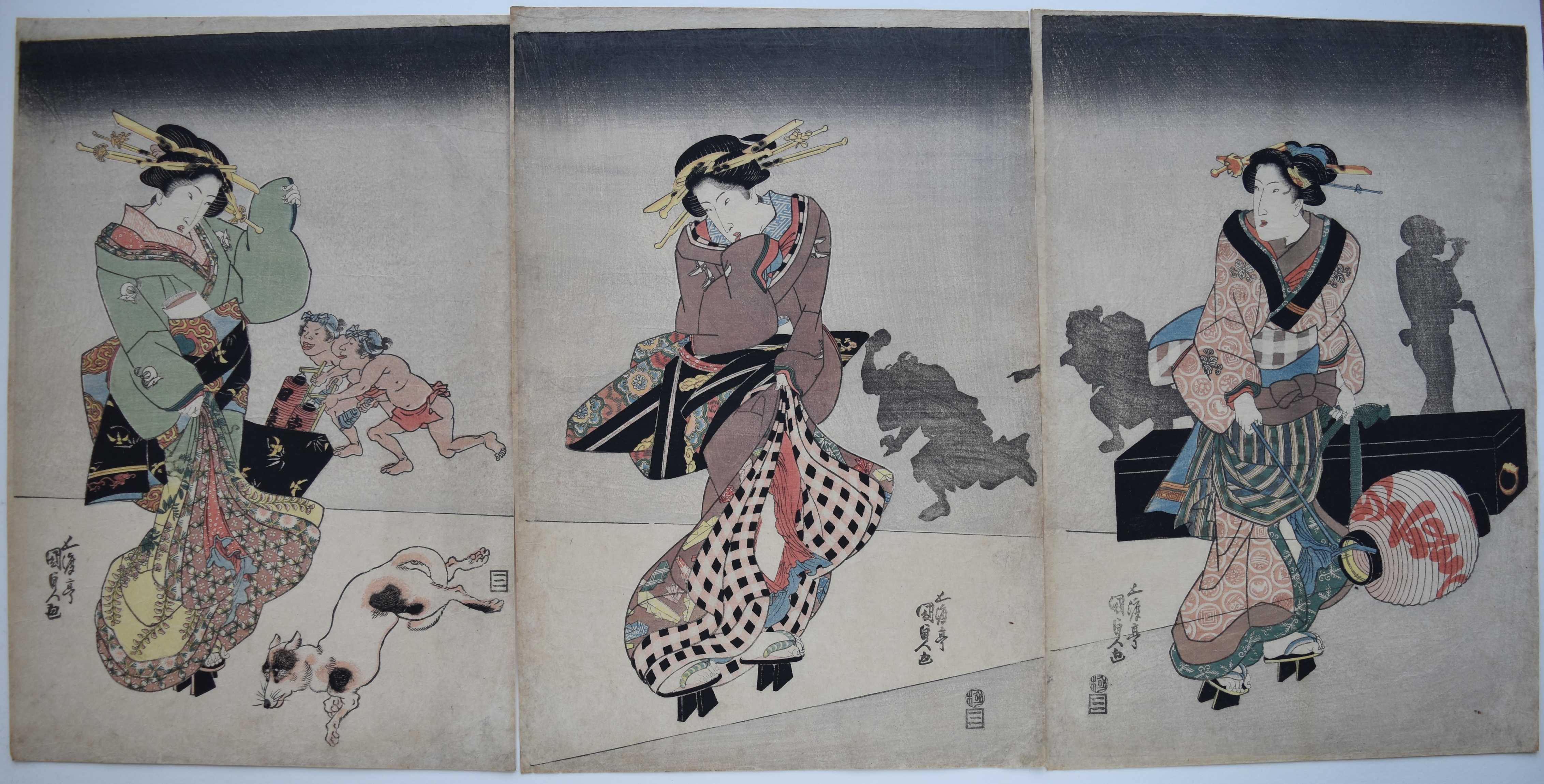
An untitled triptych showing two beauties and a maidservant lighting their way with a lantern and carrying a shamisen box. The beam of light from the lantern illuminates the foreground figures and a leaping dog but leaves the background figures in silhouette. Published by Mikawaya Seimon, c. mid 1820s. A fine design.
Fine impression and colour. Imperceptible fold, otherwise very good condition. Signed Gototei Kunisada ga.
Status: Available
Keisai EISEN (1790-1848)
Click here to view image full size.
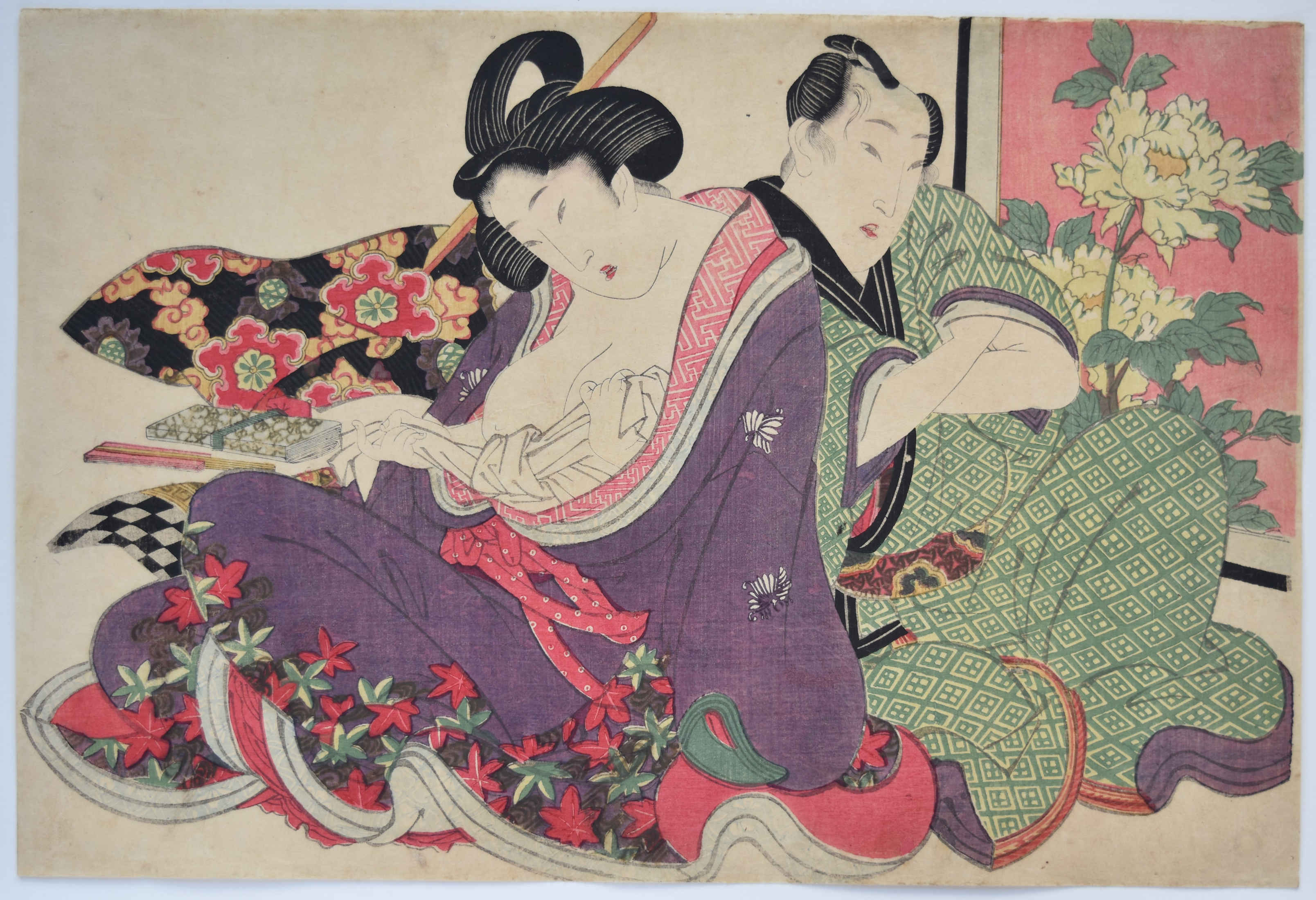
An amorous couple beside a screen decorated with a large chrysanthemum. From a set of twelve prints Keisei higo, “Secret Words of a Courtesan” published c 1822-25. Although coming under the heading of shunga, each print is an abuna-e design, without any graphic detail. Shows a courtesan with her client. She turns to tie the iwata-sash which indicates she is pregnant.
Fine impression. Very fine colour. Fine condition.
Status: Available
Tsukioka YOSHITOSHI (1839-1892)
Click here to view image full size.
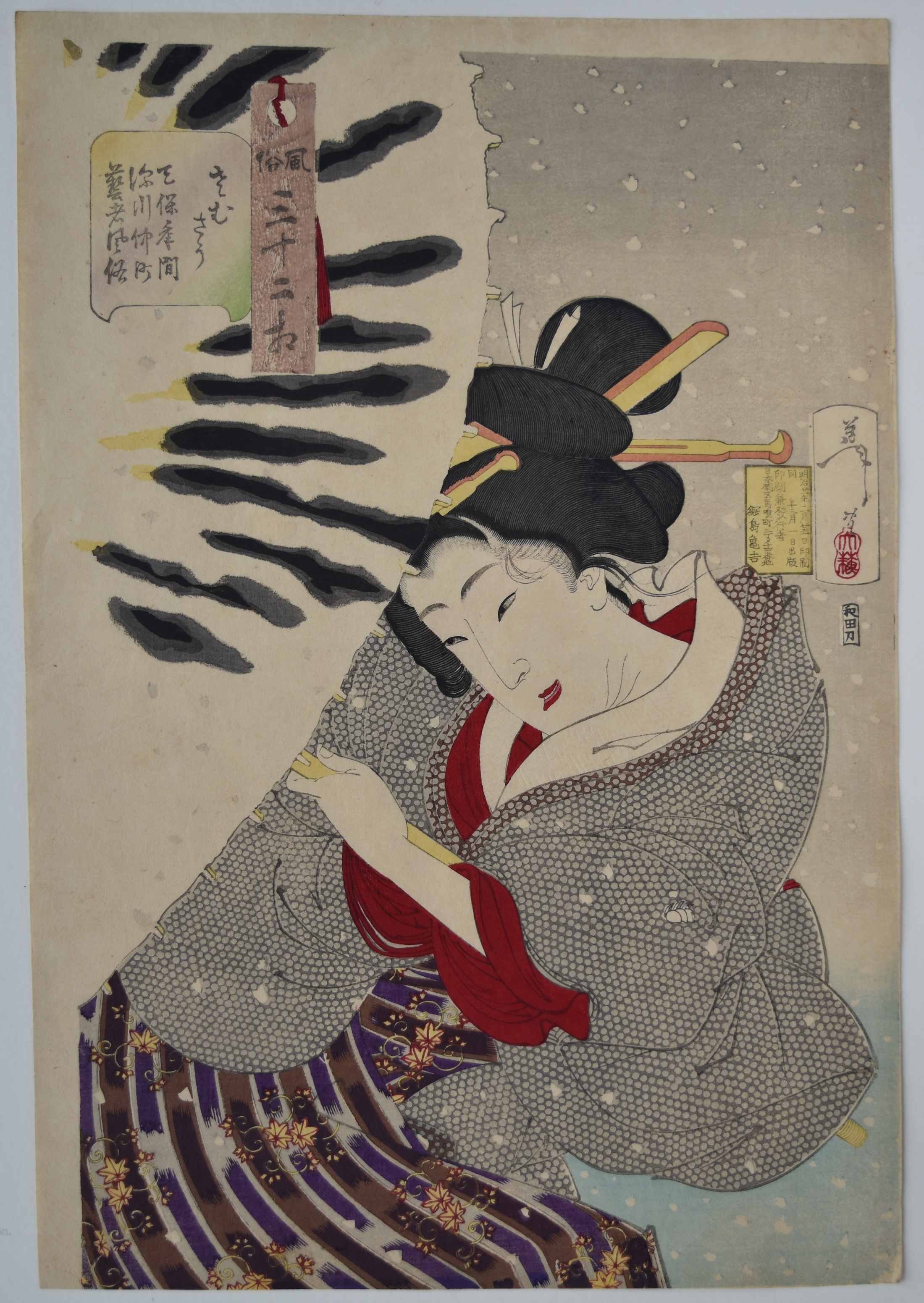
Samu-so: Tempo nenkan Fukagawa Nakamachi geisha fuzoku, “Looking Frozen: The Appearance of a Fukagawa Nakamachi Geisha in the Tempo Era [1830-1844].” Shows a beauty caught in a snowstorm, her umbrella laden with snow from a set Thirty-two Aspects of Women published by Tsunashima Kamekichi, 1888. The set depicts women of different backgrounds and occupations from the Kansei era through to the Meiji era with punning allusions to their situation or mood.
Very fine impression of the true first edition. Fine colour and condition. Signed Yoshitoshi ga.
Status: Available
Ikeda EISEN (1790-1848)
Click here to view image full size.
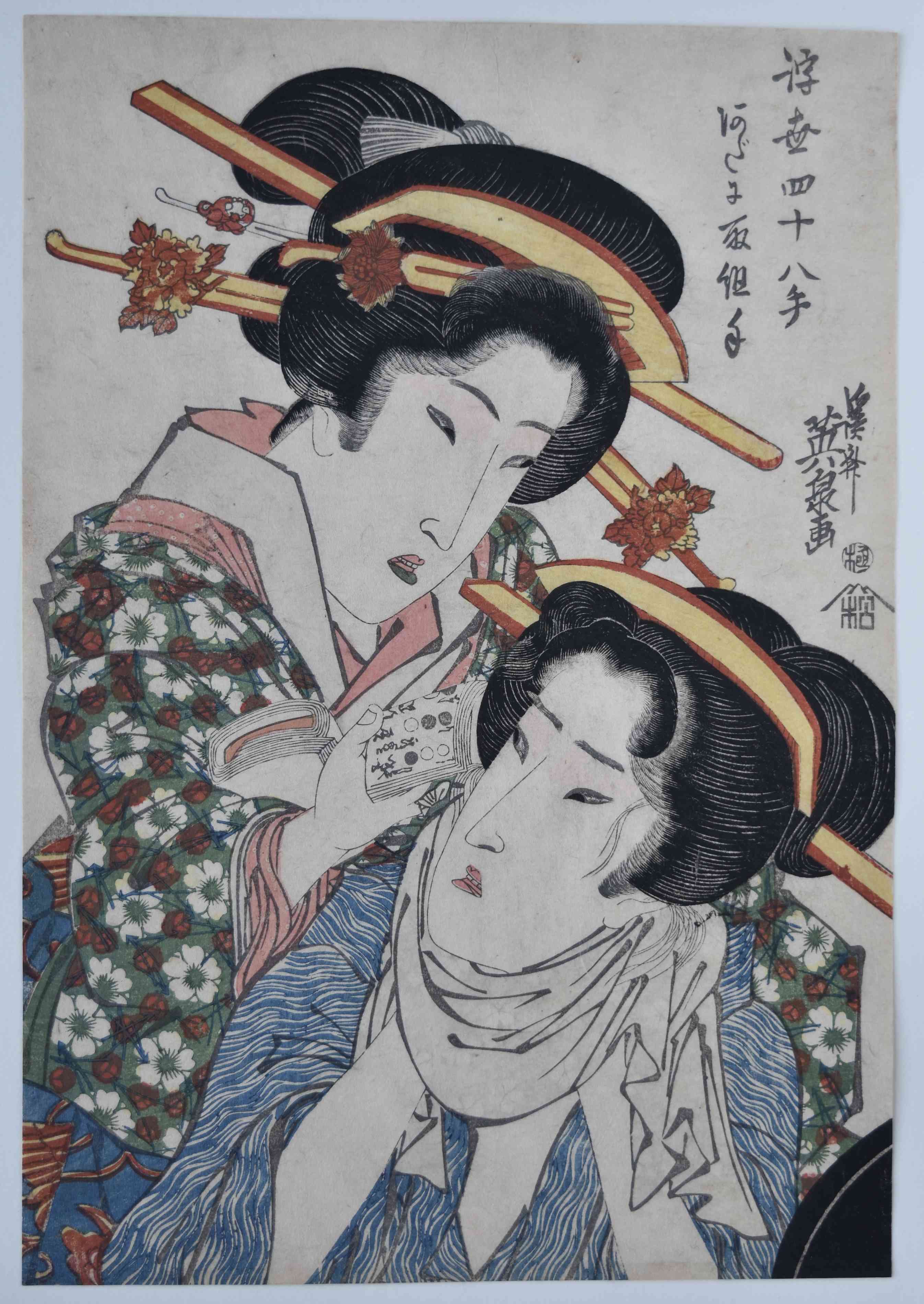
Two beauties in front of a mirror, Ada ni torikumite, “Grudge Match” from a set Ukiyo shiju hatte, “Forty-eight Habits of the Floating World.” This was a popular title for sets of prints – especially during the next thirty years. The sub-titles are quite obtuse, whereas in later series – for example Kuniyoshi’s set of c 1846 – the meanings are self-evident. A fine double okubi-e set published by Matsumura Tatsuemon, c 1821-22. Eisen was a prolific and repetitive artist but produced some fine landscapes and okubi-e sets. Rare.
Fine impression. Slight fading and minor soil, otherwise very good condition. Signed Keisai Eisen ga.
Status: Available
Torii KIYOHIRO (Active 1737-1776)
Torii KIYOHIRO
Click here to view image full size.
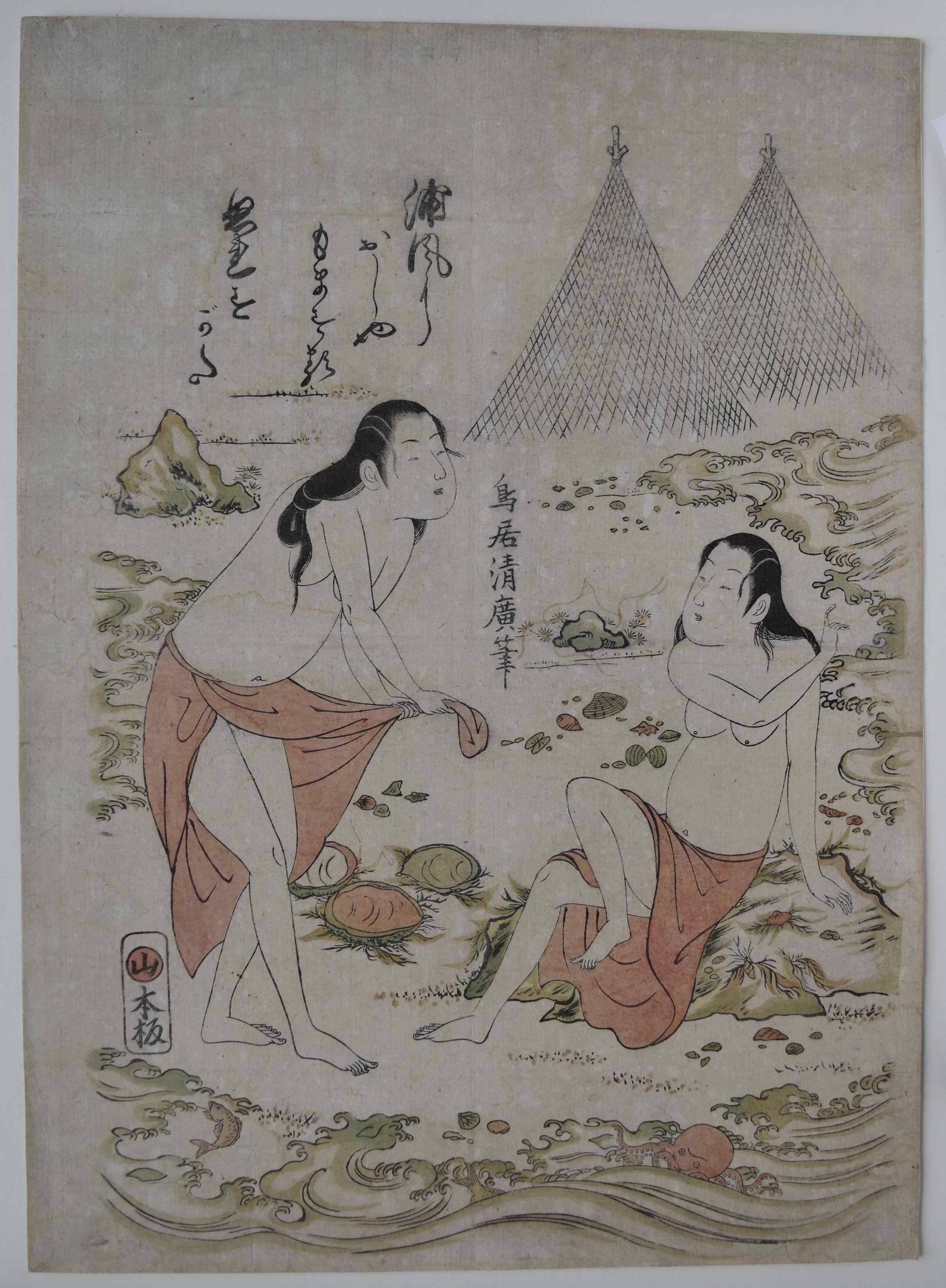
A large oban, 17.25 x 12.25 in; 44 x 35.2 cms, sumizuri-e with hand-applied colour. Shows two ama, abalone divers, on the seashore with nets in the background , abalone shells at their feet and an octopus in the waves below them. The poem above speaks of the salty sea breeze wafting across the shore. Published by Maruya Kuzaemon (Gyokeido) c late 1730s. Extremely rare: Another impression is in the Ritsumeikan University, https://www.dh-jac.net/db/nishikie/Z0164-003/portal/
Very good impression. Light soil, and lightly laid down. Faint fold marks, but generally good condition for its size and date. Signed Torii Kiyohiro hitsu.
Status: Available
Utagawa HIROSHIGE (1797-1858)
Click here to view image full size.
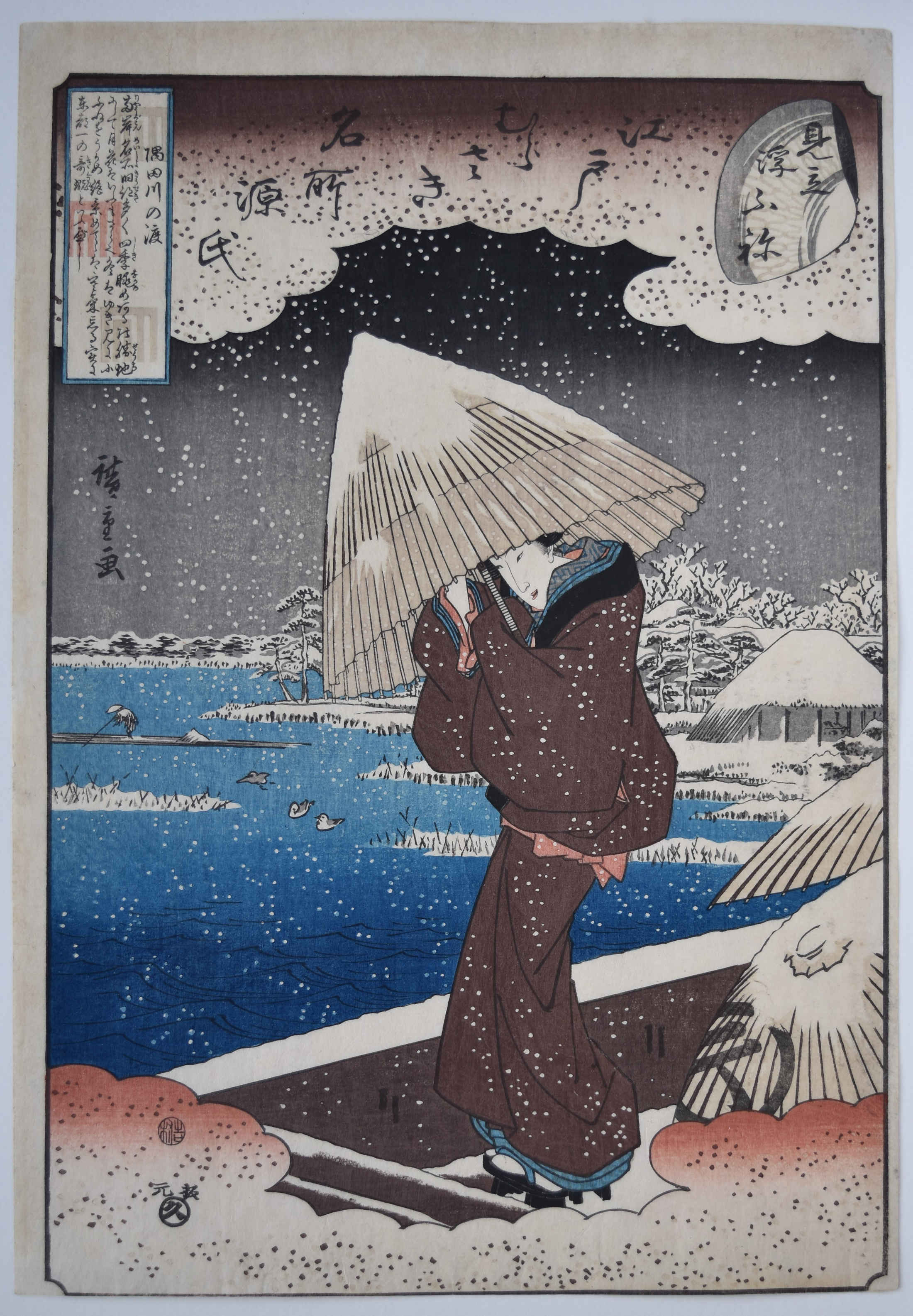
One of a set: Edo Murasaki meisho Genji, “Murasaki’s Genji in Famous Places of Edo.” Mitate Ukifune Sumidagawa no watashi, “A Parody of Ukifune Crossing the Sumida River.” Shows a beauty on a ferry crossing the Sumida River in heavy snow, representing Ukifune, one of the court ladies of the Genji Monogatari. Stylised clouds above and below copying the traditional kiri-gane gold found on Yamato-e scrolls. These Genji pictures were popular at this time to circumvent the reforms of 1842. Published by Kinseido (his seal also appearing on the umbrella bottom right). Rare.
Fine impression. Very good colour. Lower margin trimmed close, otherwise very good condition. Signed Hiroshige ga.
Status: Available
Tsukioka YOSHITOSHI (1839-1892)
Click here to view image full size.
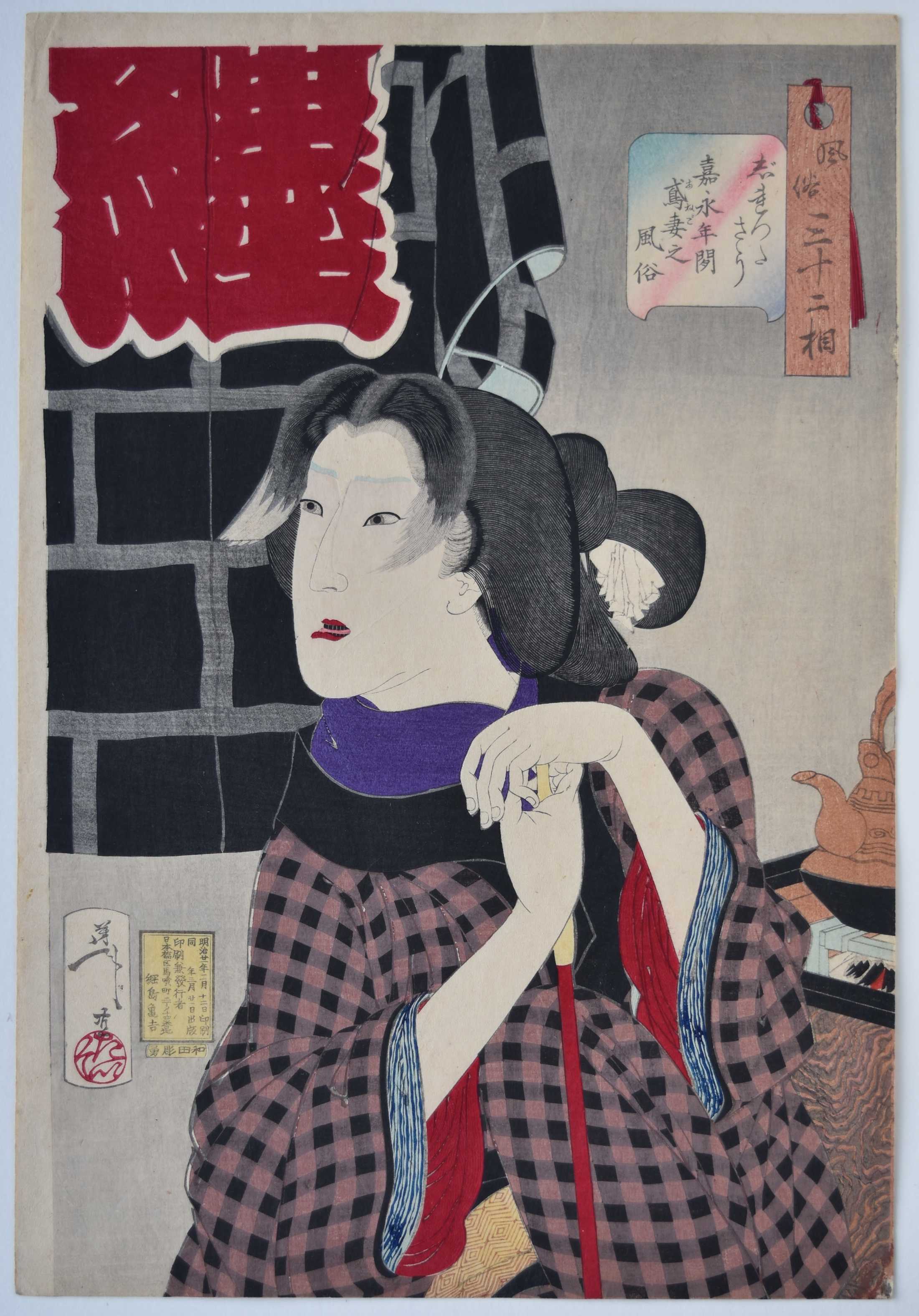
Jiki-tsuki-so: Kaei nenkan anego no fuzoku, “Looking as if Somebody is About to Arrive: The Appearance of a Fireman’s Wife in the Kaei Era [1848-1854].” A fireman’s wife waits for the return of the head of the household. From a set Thirty-two Aspects of Women published by Tsunashima Kamekichi, 1888. The set depicts women of different backgrounds and occupations from the Kansei era through to the Meiji era with punning allusions to their situation or mood.
Very fine impression of the true first edition. Fine colour and condition. Signed Yoshitoshi ga.
Status: Available
Isoda KORYUSAI (1735-1790)
Click here to view image full size.
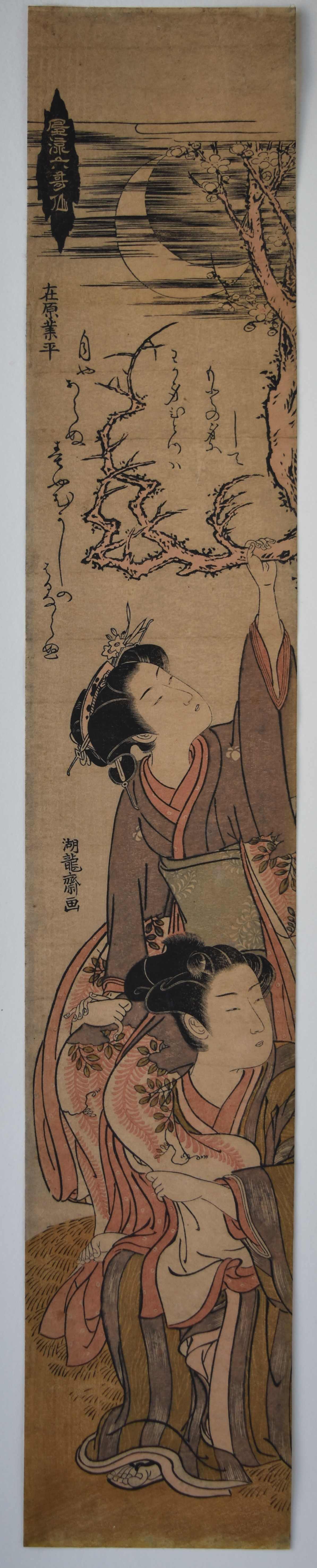
An hashira-e, “pillar print.” A night scene showing a beauty on the shoulders of her lover reaching up to a branch of plum blossom beneath a spring moon. From a set Furyu Rokkasen, “Fashionable Six Poetic Immortals,” this being a poem by Ariwara no Narihira (825-880) where the poet composes a poem inspired by a beauty he has seen. Koryusai was the master of this format. Pillar prints were introduced to hang, when mounted, on the pillars of a Japanese house. Consequently, they often come browned, creased or faded and finding good examples is difficult. Rare: Not in Pins.
Very good impression and colour. Slightly toned, otherwise very good condition. Signed Koryusai ga.
Status: Available
Katsukawa SHUNCHO(Fl. c 1780-1801
Click here to view image full size.
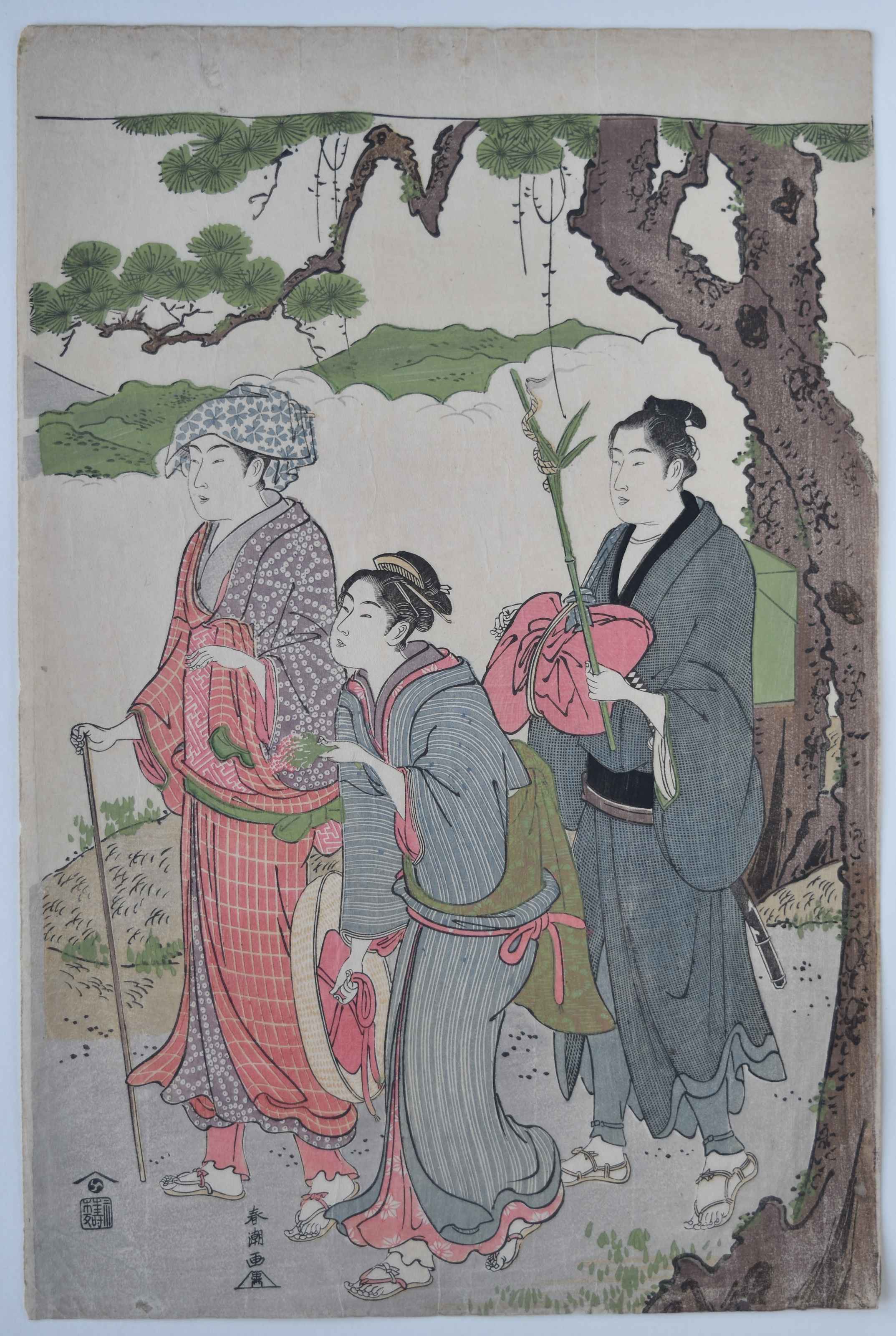
The first sheet of a triptych showing travellers on a mountain path – possibly the Tokaido Road. Published by Eijudo (Nishimuraya Yohachi), c 1790. Other impressions in the MFA Boston, acc. no. 21.5953 and the BM, 1910, 0212, 0.439. Little is known of Shuncho’s life. He was a pupil of Shunsho and heavily influenced by Kiyonaga. Probably the greatest exponent of the triptych format and a master of the pillar print format.
Fine impression. Extremely good colour. Fine condition. Signed Shuncho ga.
Status: Available
Kitagawa UTAMARO (1753-1806)
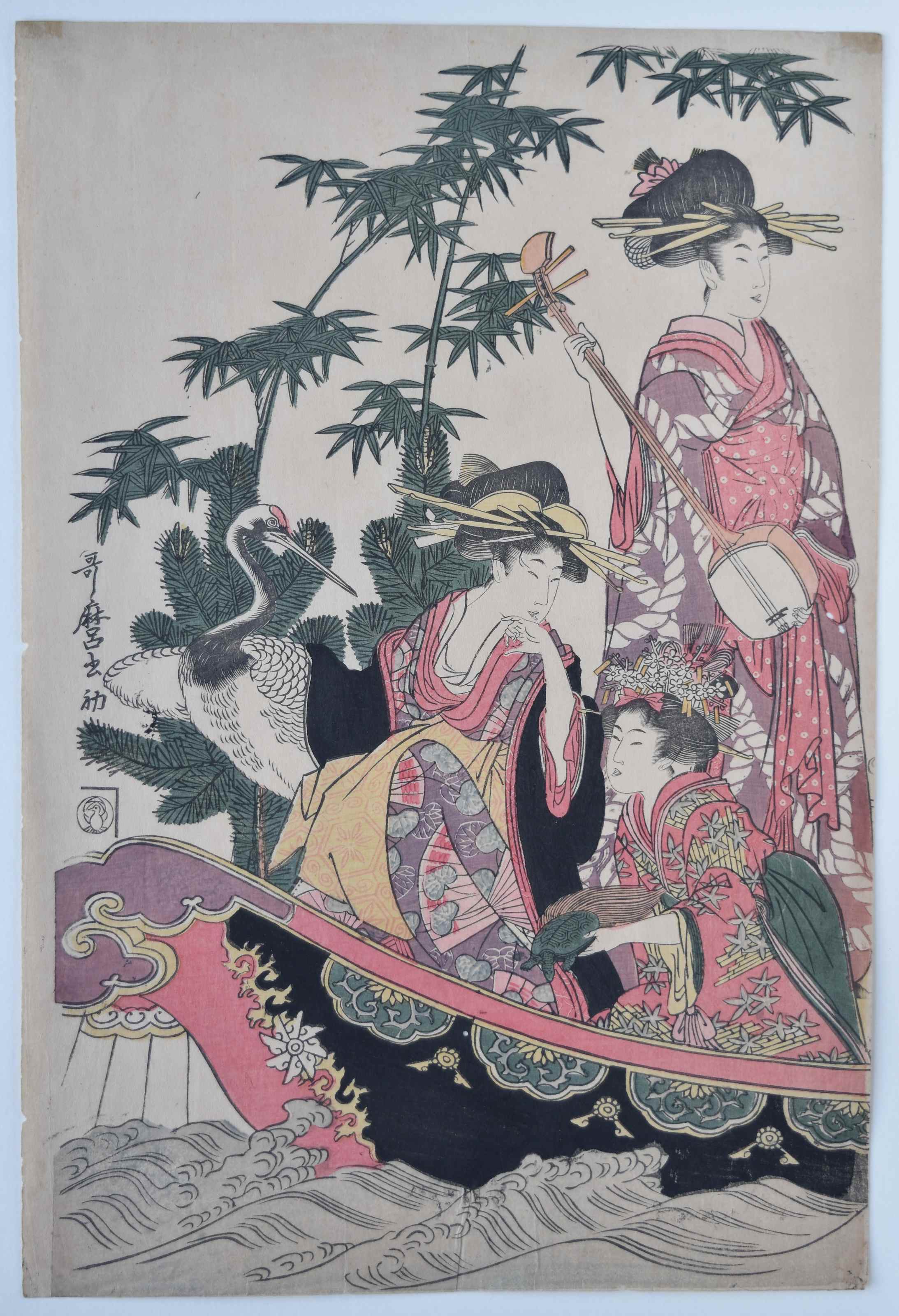
Click here to view image full size.
Presumably the last sheet of a triptych (I cannot locate the complete design at the moment). Shows three geisha representing three of the Seven Lucky Gods: Benzaiten, Fukurokuji, Ebisu. The other sheets would show the other four. They are depicted on the Takarabune, ” Treasure Ship” which has been constructed on a stage with artificial water. Probably an event that occurred during the first three days of the New Year.. Published by Tsuruya Kinsuke, c 1802.
Fine impression. Extremely good colour. Fine condition. Signed Utamaro ga.
Status: Available
Kitagawa UTAMARO II (Fl. c 1807-1830s)
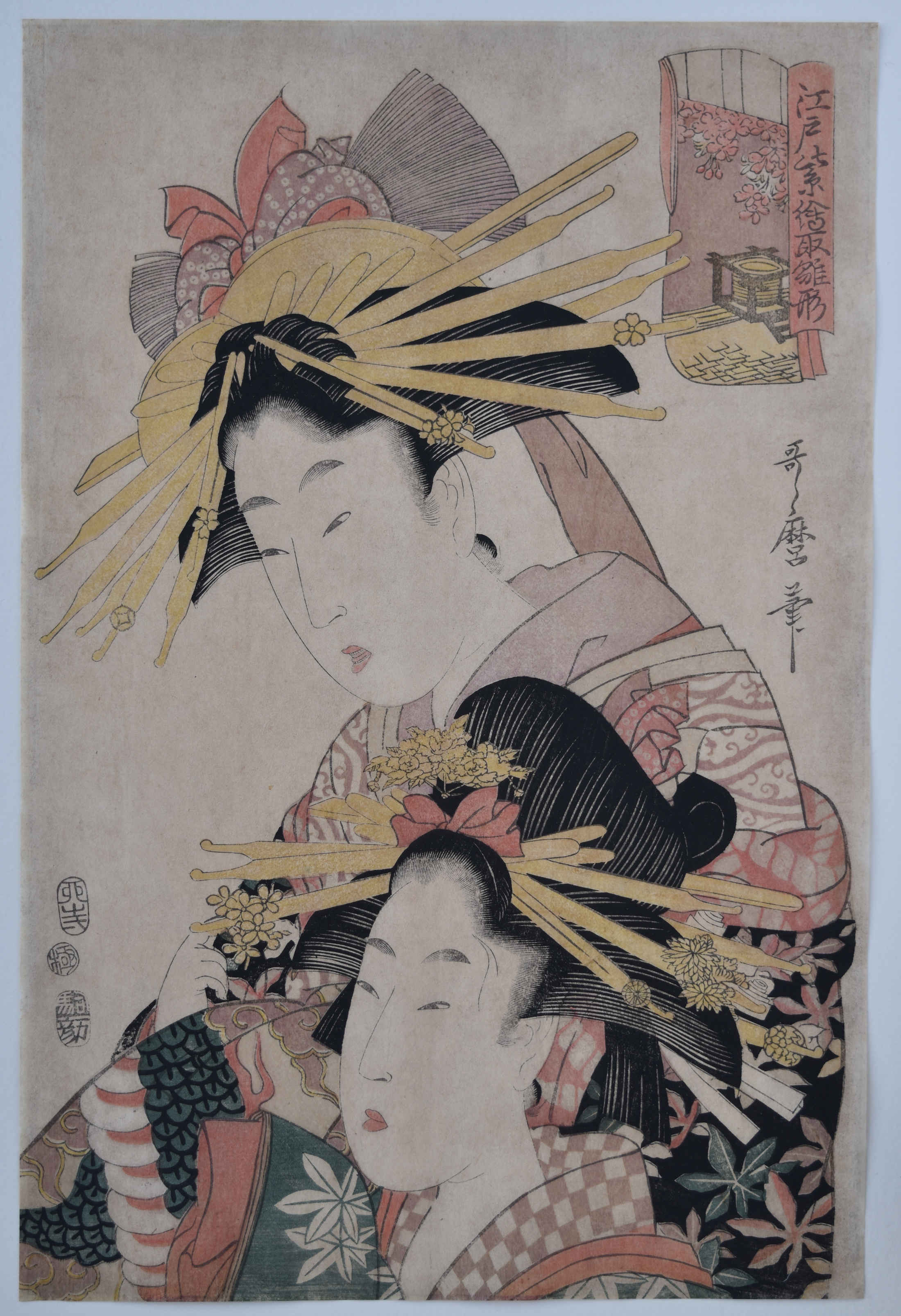
Click here to view image full size.
A courtesan and her Shinzo from a set Edo murasaki edoru hinagata, “Models Designed in the Purple of Edo.” A bluish purple as opposed to the more reddish purple from Kyoto. A pigment that had been extremely expensive and reserved for the elite few, but became cheaper and more accessible during the Edo period, fuelled by leading actors – such as Danjuro – wearing an Edo murasaki headband. Published 11/1807. Publisher unread.
Very good impression, colour and condition. Signed Utamaro hitsu.
Status: Available
Utagawa KUNISADA (1786-1865)
Click here to view image full size.
A courtesan biting on a tissue about to write a love letter from the set Ukiyoe jinsei tengankyo, “Types of the Floating World Seen Through a Physiognomist’s Glass.” The glass top right. These professionals who purported to look at people’s features and give counsel based on their countenance were called Ninsomi or simply Somi. This set of ten prints showing different female personalities have their characteristics written up above. Utamaro produced two fine sets based on this theme in 1792-4 and c 1802: Fuji ninso jupon and Bijin gomenso. The clenching of the tissue is always an indication of arousal. Published c 1830 by Moriya Jihei (Kinshindo).
Fine impression with blind-printing. Fine colour. Small repaired binding holes and very slight trimming, otherwise very good condition. Signed Gototei Kunisada ga.
Status: Available
Suzuki HARUTSUGI (HARUJI) (Active 1760-1770)
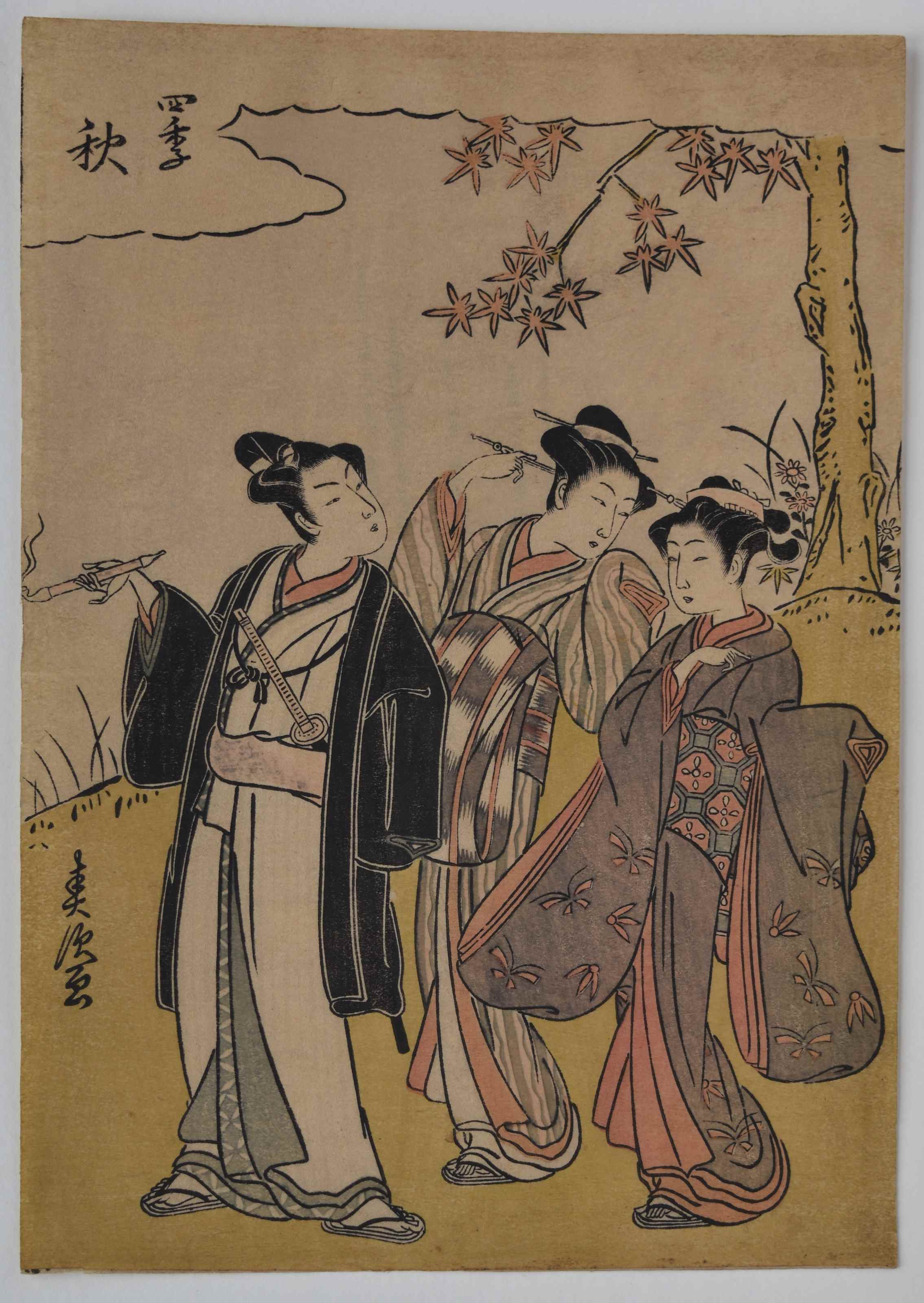
Click here to view image full size.
A large koban print, 8.75 x 6 in; 22.25 x 15.25 cms, showing a samurai with two attendants. Aki, “Autumn” from a set of the four seasons, Shiki. A rare artist and most likely a follower of Harunobu. Produced a number of pillar prints. Provenance: Ex Javal, sold 3/3/1926, lot 50.
Very good impression, colour and condition. Signed Harutsugi ga.
Status: Available
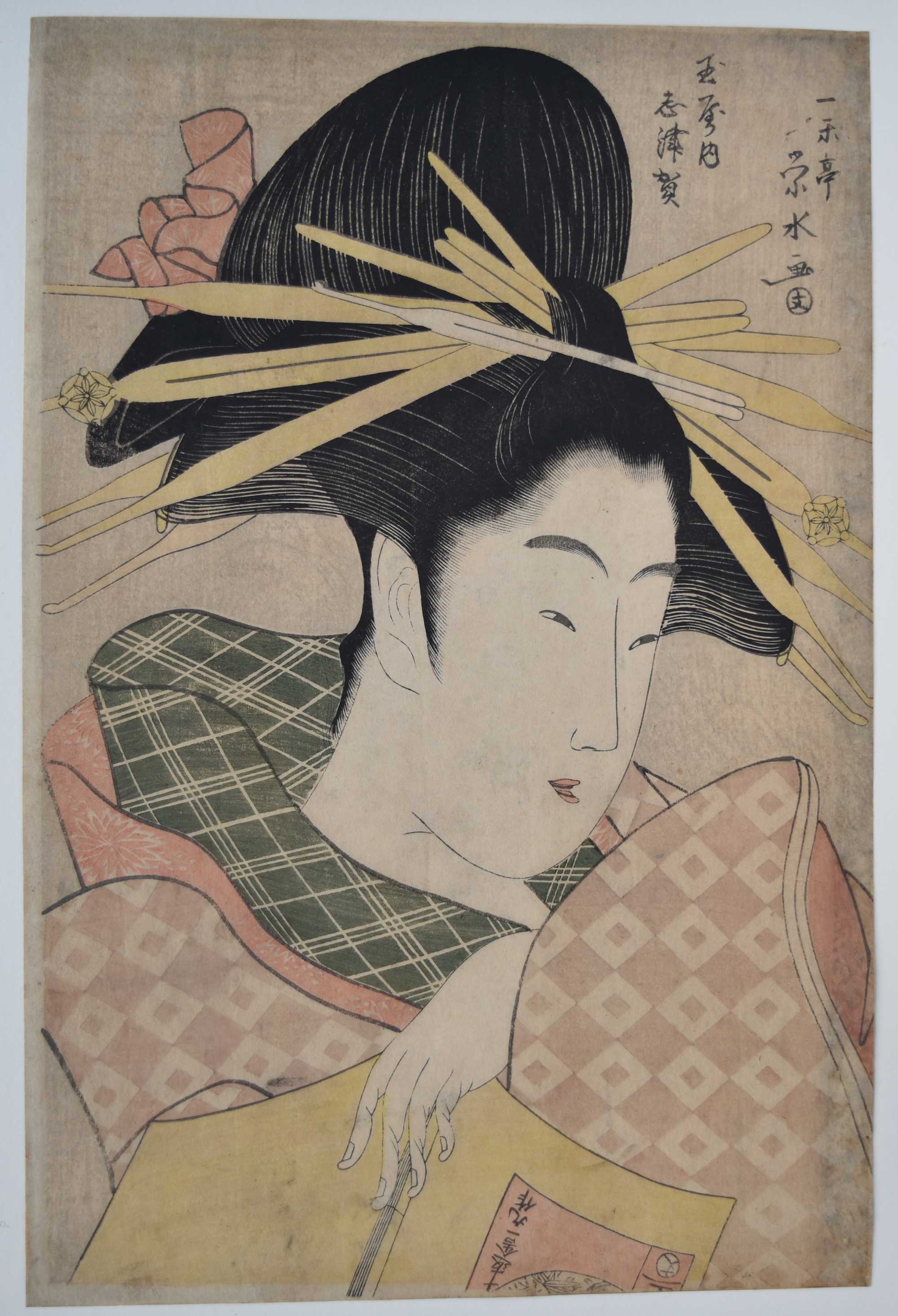
Ichirakutei EISUI (Active 1790-1823)
Click here to view image full size.
A fine okubi-e (“large head”) portrait of the courtesan Shizuka of the Tama-ya House. Eisui, like the other main pupils of Eishi, produced some of the finest bust-portraits in Ukiyo-e. Published by Maruya Bunemon c late 1790’s. Other impressions illustrated in Klaus J. Brandt, Hosoda Eishi, page 72, 524, no. C35, catalogued p. 231, and the Library of Congress, FP2-JPD, no. 1912. Extremely Rare.
Very good impression. Good colour. Slight soil, otherwise good condition. Full sze. Signed Ichirakutei Eisui ga.
Status: Available
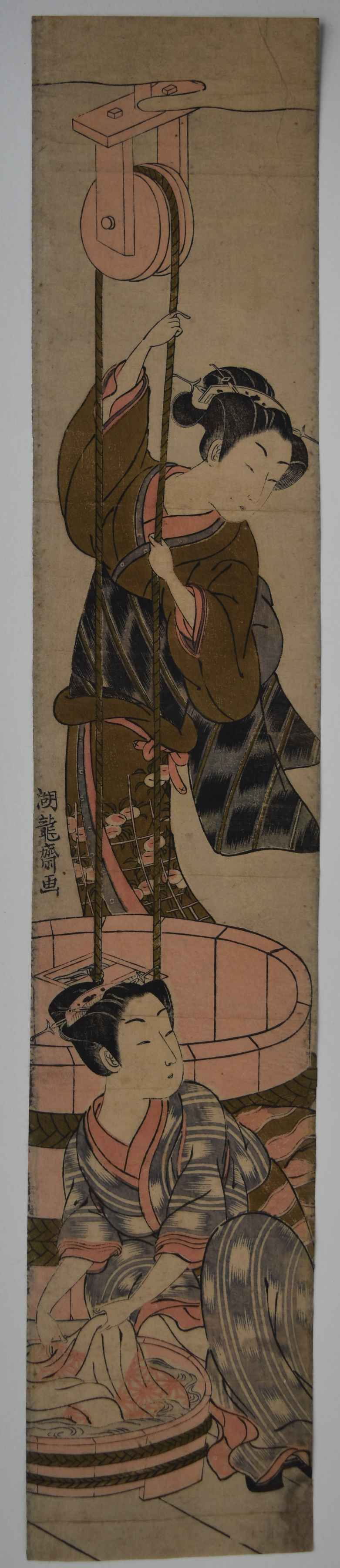
Isoda KORYUSAI (1735-1790)
Click here to view image full size.
A hashira-e, “pillar print” showing two women washing clothes at a well. Koryusai cleverly uses the ropes of the pulley to emphasize the narrow format. Koryusai was the master of this sort of print. Pillar prints were introduced to hang, when mounted, on the pillars of a Japanese house. Consequently, they often come browned, creased or faded and finding good examples is difficult. Rare: Other examples in MFA Boston, acc. no. 21.8379 (ex Metzgar sale 1/12/1921); TNM, catalogue 1, (1960), no. 742; and illustrated in Pins, The Japanese Pillar Print, 1982, no. 396.
Very good impression. Good colour. Slight toning and small repair bottom right corner, but otherwise a nice example. Signed Koryusai ga.
Status: Available
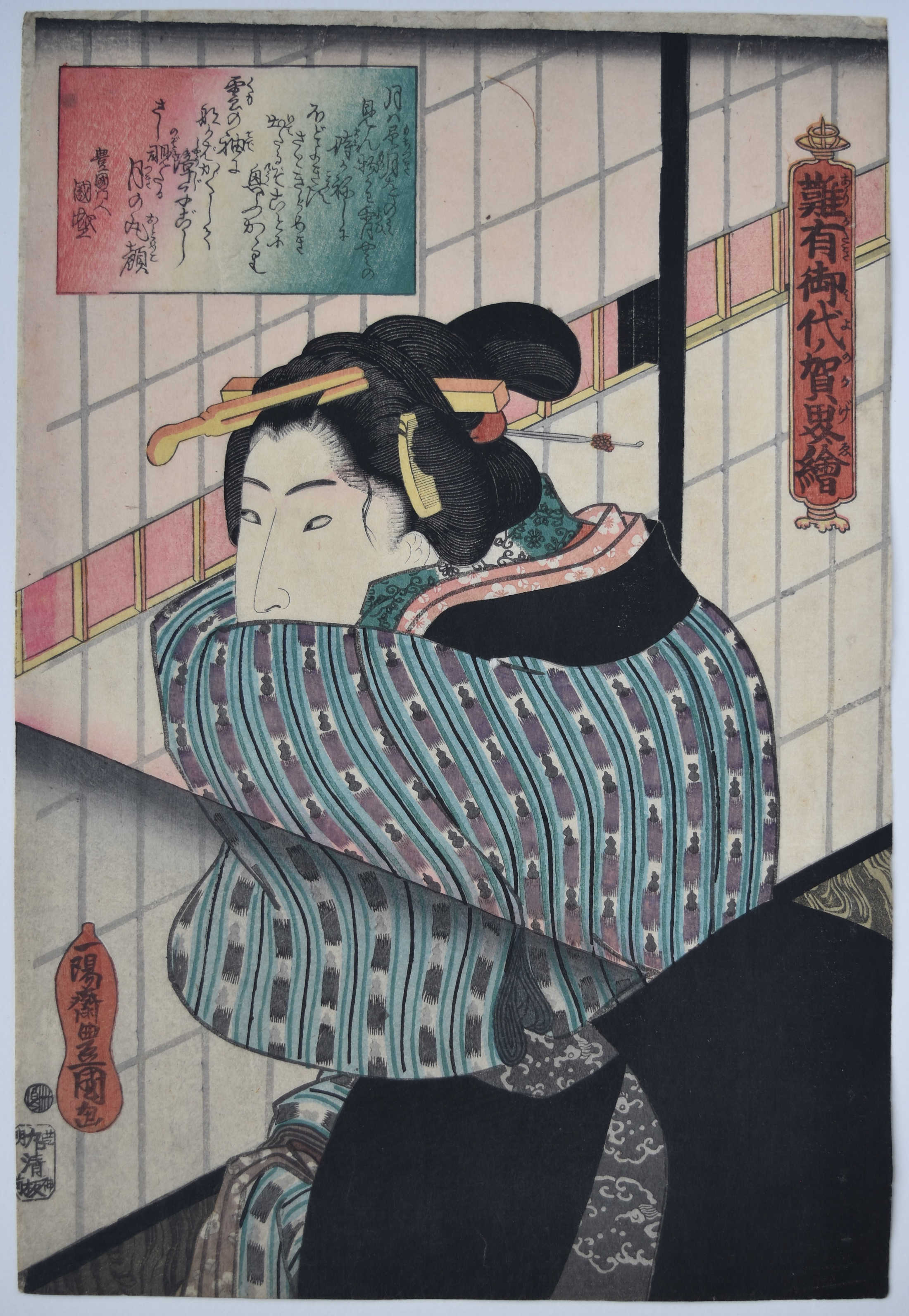
Utagawa KUNISADA (1786-1864)
Click here to view image full size.
A woman peering through a gap in a shoji from a set Arigataki miyo no kage e “Shadow Pictures for Our Blessed Times.” Published by Maruya Seijiro c. 1845-6 and is based on strong light sources shining on beauties. This chiaroscuro technique was pioneered by Shumman and used by Utamaro and Toyokuni I.
Fine impression, colour and condition. Signed Ichiyosai Toyokuni ga.
Status: Available
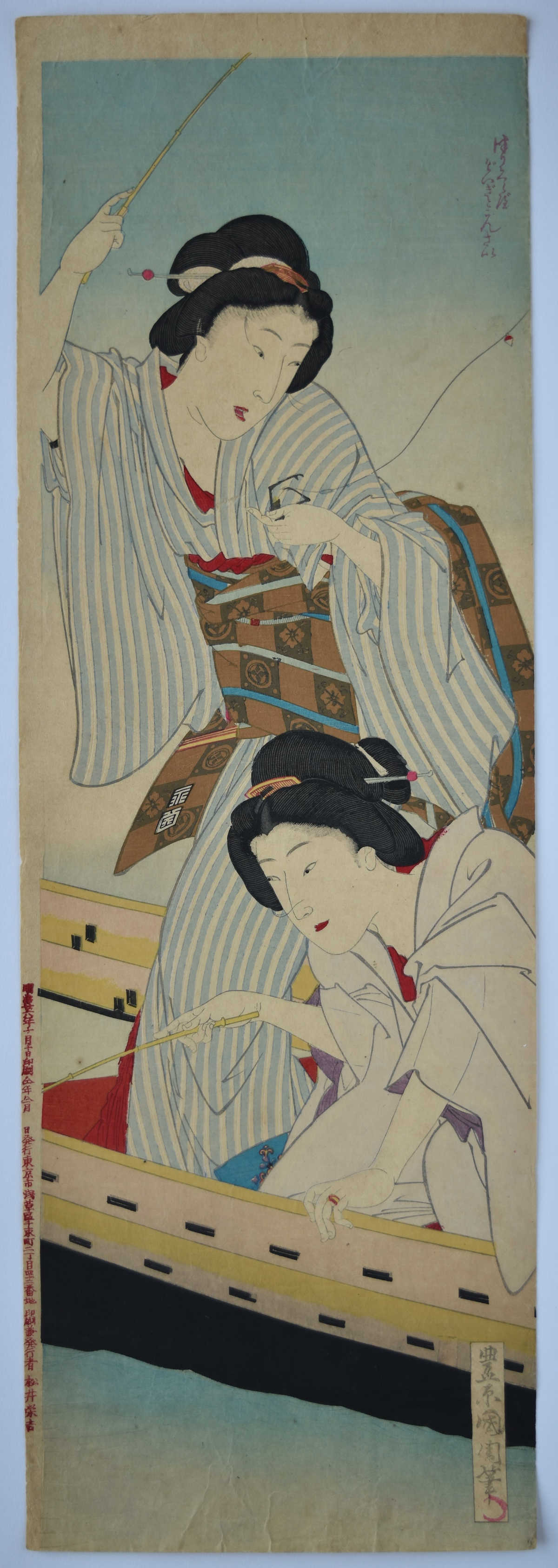
Toyohara KUNICHIKA (1835-1900)
Click here to view image full size.
A cho-oban (20 x 6.75 inches) print showing beauties fishing. The top figure has caught a crayfish. Each design interprets a haiku poem in red, top right. A set of 6 prints published by Matsui Eikichi, 1893. Rare.
Fine impression and colour. Slight creasing, otherwise fine condition. Signed Toyohara Kunichika hitsu.
Status: Available
Utagawa KUNISADA II (1823-1880)
Click here to view image full size.
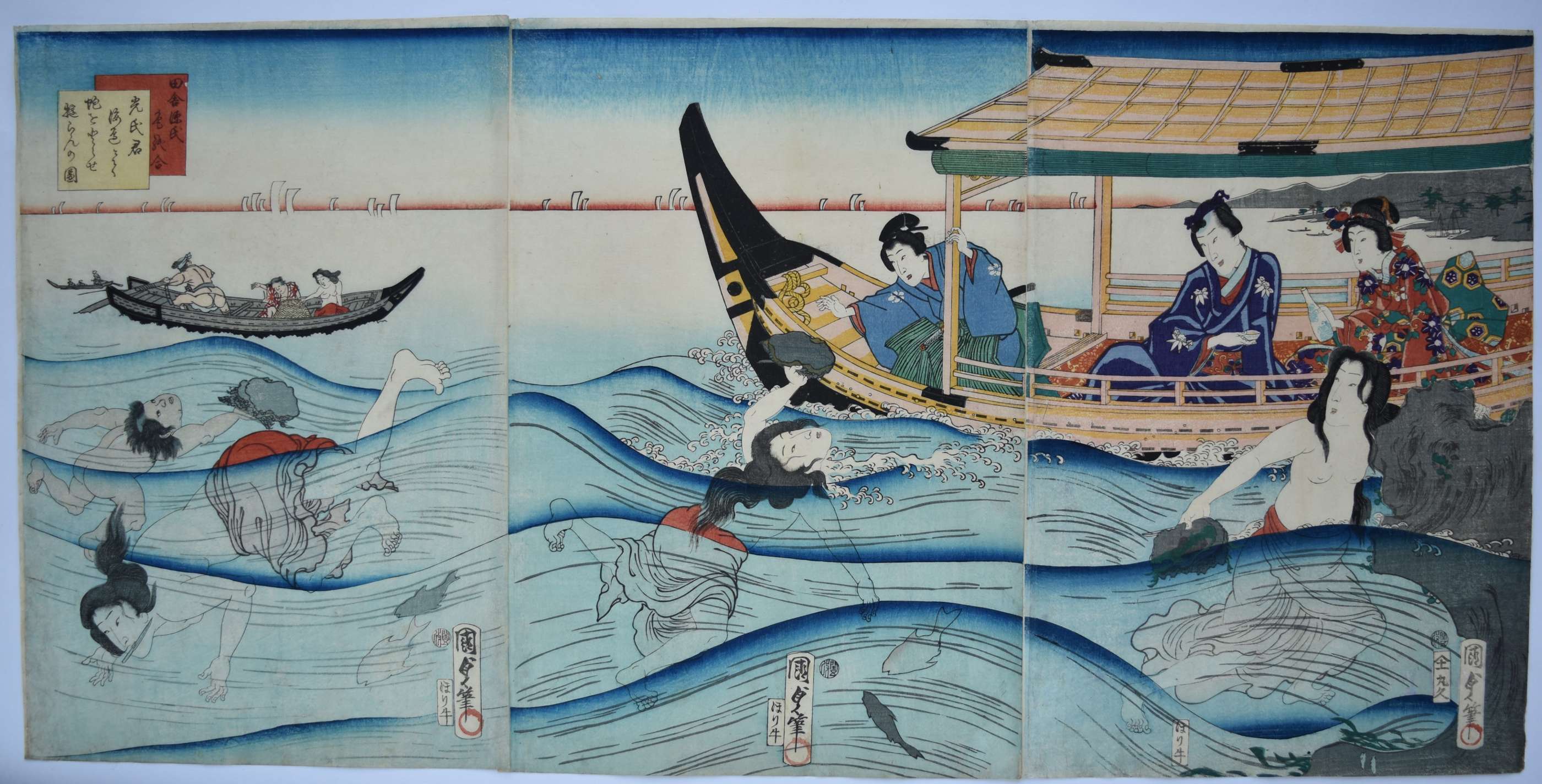
A triptych showing Prince Genji in a boat with attendant page and a lady watching female awabi (abalone) divers called ama. These women were a great curiosity for the public and seen as rather risqué characters. Prince Genji was the protagonist of Murasaki Shikibu’s Heian-era novel The Tale of Genji. He was the second son of the emperor, and relegated to civilian life. Published 1865 by Maruya Kyushiro.
Very good impression and colour. Slight edge soil, otherwise very good condition. Signed Kunisada hitsu.
Status: Available
Katsukawa SHUNCHO (Fl. c. 1780-1795)
Click here to view image full size.
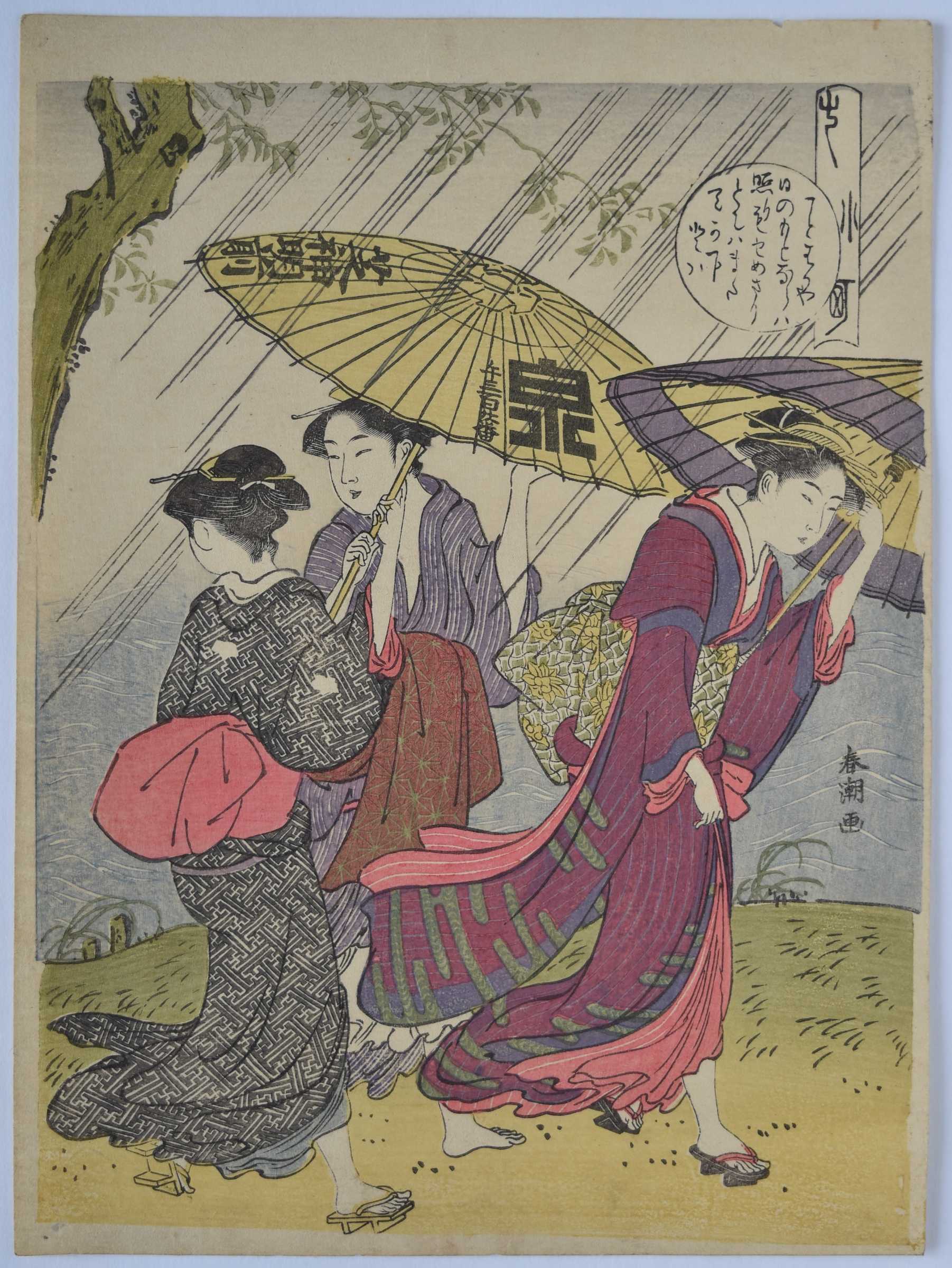
A chuban print showing a group of beauties caught in a downpour on the banks of a river. The centre figure has an umbrella with the publisher’s name Izumi [ya Ichibei] and address Shiba Jinmeimae which was in front of Shiba Daijingu Shrine. One of a set Nana Komachi, “The Seven Komachi,” being episodes in the life of the famous waka poetess Ono no Komachi (c. 825-c. 900). Little is known of Shuncho’s life except that he was a pupil of Katsukawa Shunsho and was then heavily influenced by Kiyonaga. He produced some particularly fine triptychs and pillar prints. Published c. early 1790s.
Superb impression, colour and condition: As the day it was printed. Signed Shuncho ga.
Status: Sold
Utgawa HIROSHIGE (1797-1858)
Click here to view image full size.
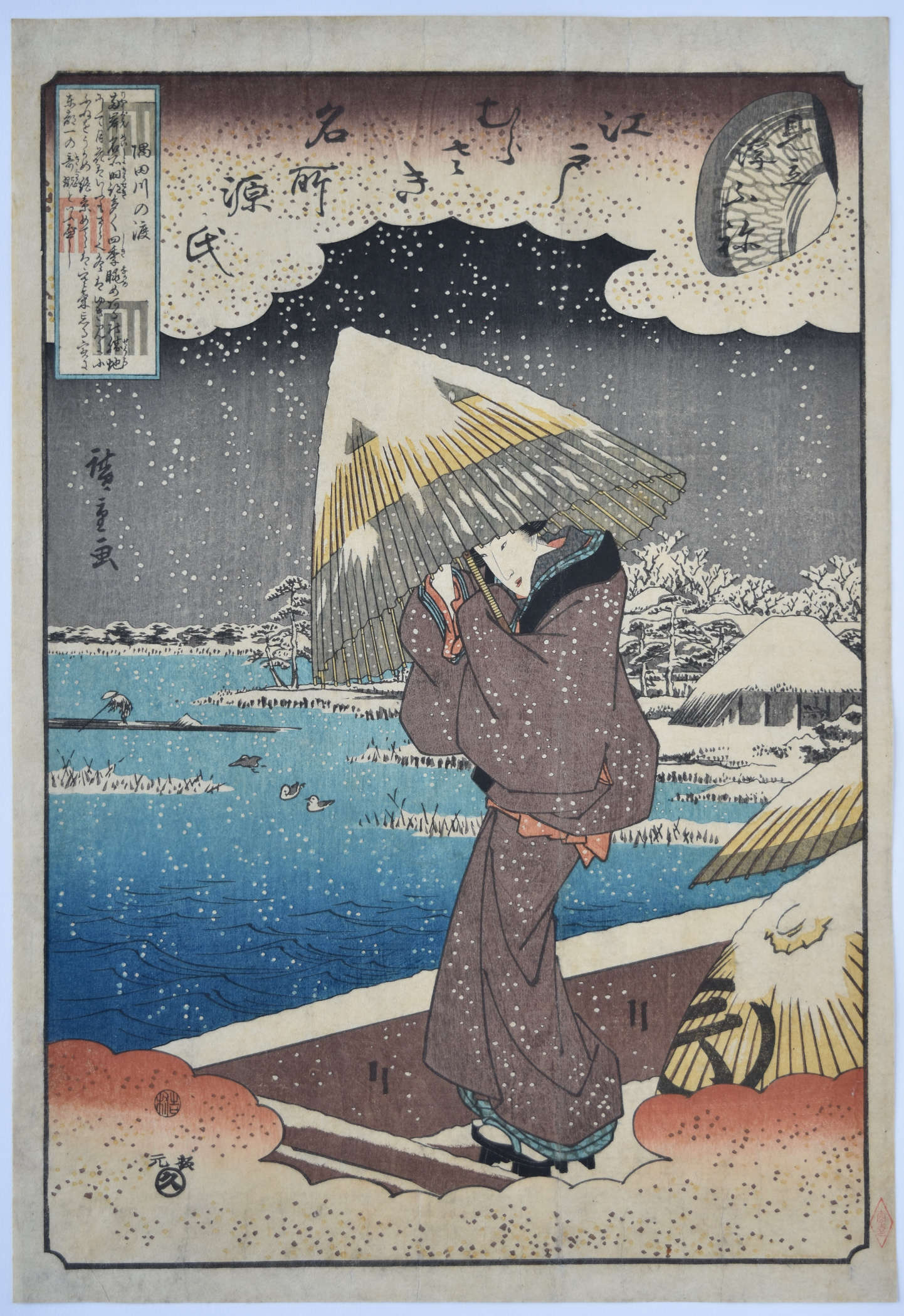
One of a set: Edo Murasaki meisho Genji, “Murasaki’s Genji in Famous Places of Edo.” Mitate Ukifune Sumidagawa no watashi, “A Parody of Ukifune Crossing the Sumida River.” Shows a beauty on a ferry crossing the Sumida River in heavy snow, representing Ukifune, one of the court ladies of the Genji Monogatari. Stylised clouds above and below copying the traditional kiri-gane gold found on Yamato-e scrolls. These Genji pictures were popular at this time to circumvent the reforms of 1842. Published by Kinseido (his seal also appearing on the umbrella bottom right). A rare set.
Fine impression. Very good colour. Minor soil, otherwise very good condition. Signed Hiroshige ga.
Status: Sold
Attributed to Nishikawa SUKENOBU (1671-1750)
Click here to view image full size.
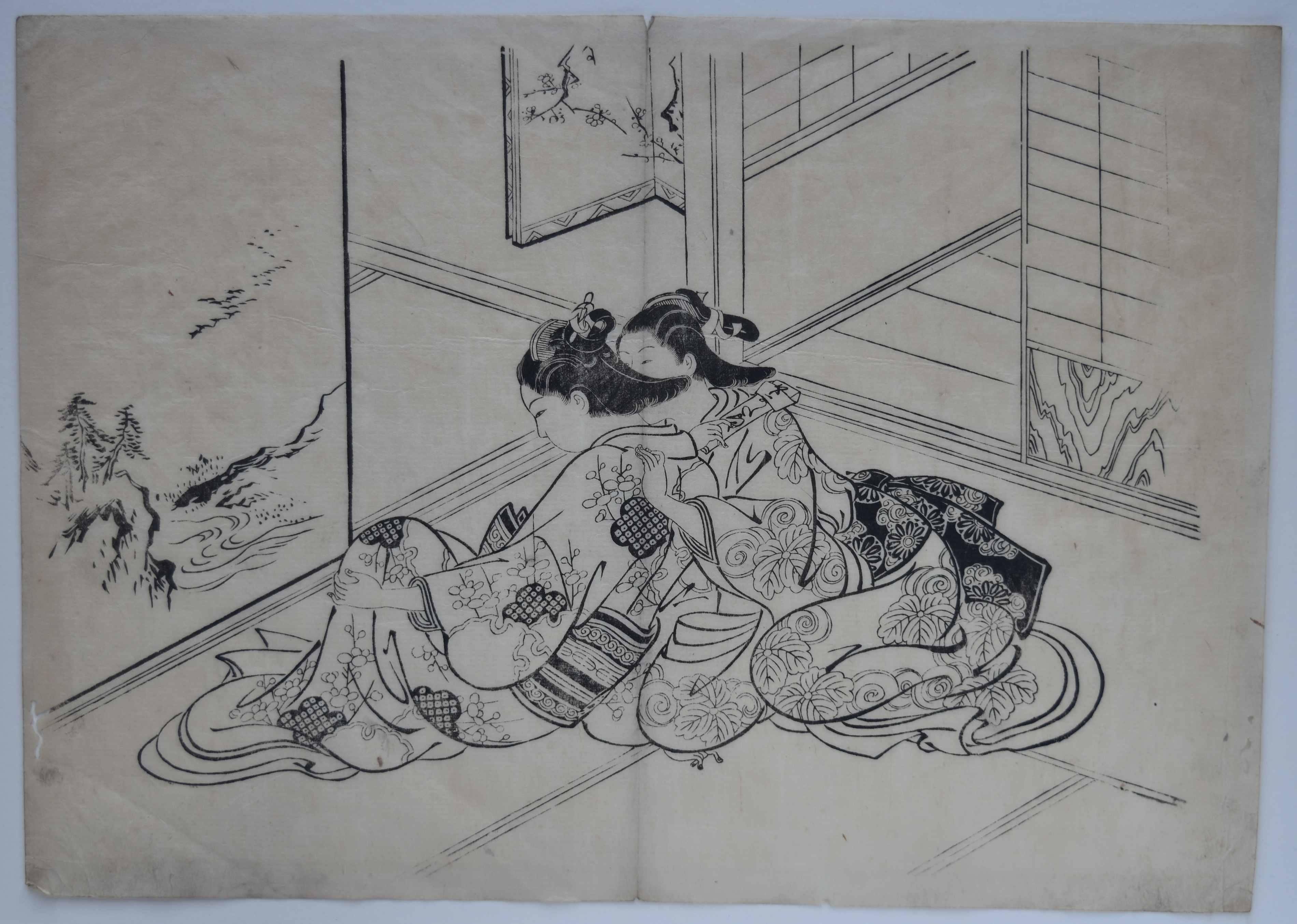
A sumizuri-e print, probably from a set of 12 issued in album form, showing two courtesans, one holding a love letter which she is either delivering or collecting. Its difficult to intuit what is happening. Sukenobu was unusual in spending his working life in Kyoto.
Very good impression. Centre fold (as usual) and small wormage on left and right border.
Status: Sold
Suzuki HARUNOBU (1724-1770)
Click here to view image full size.
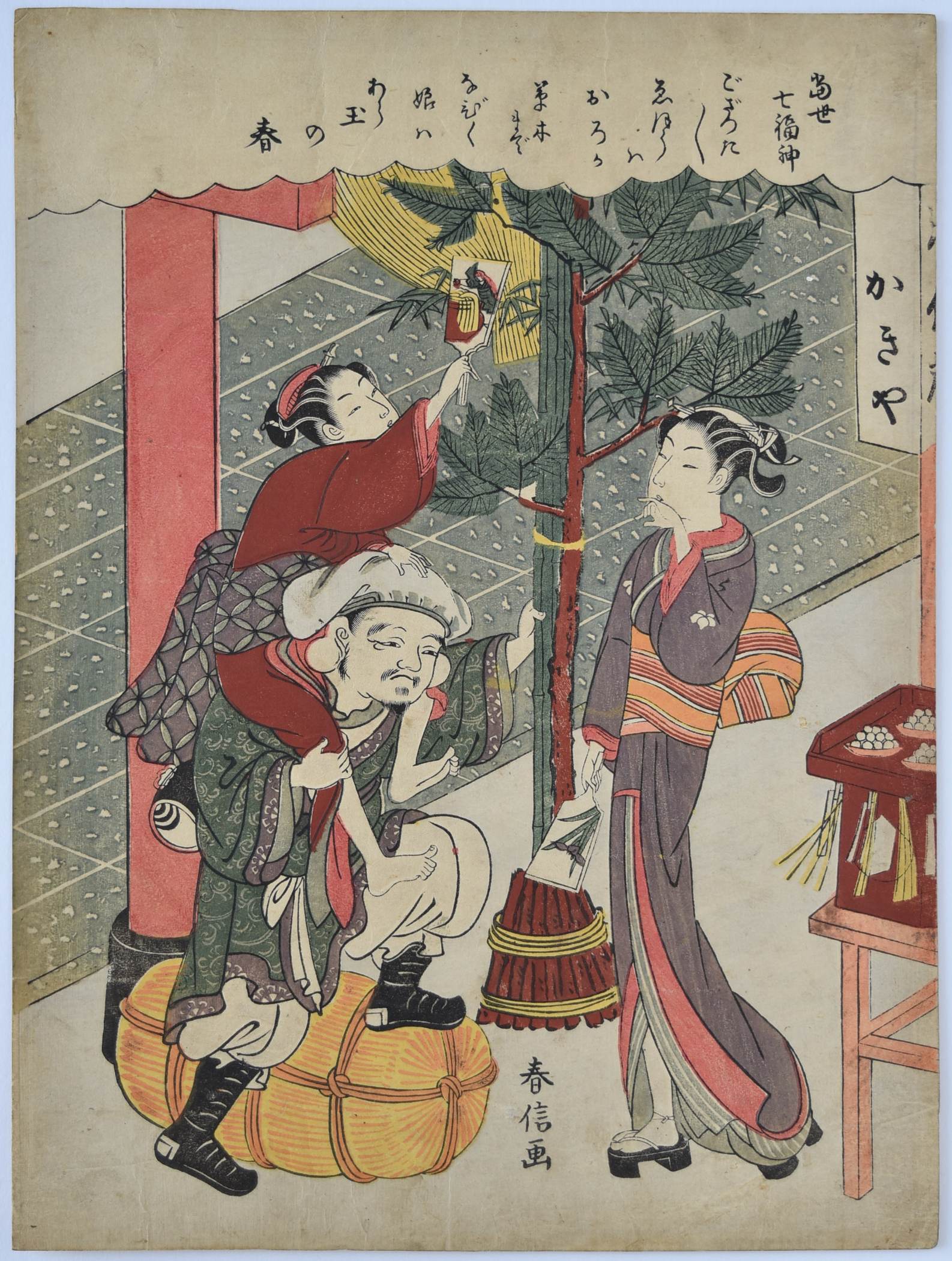
A fine chuban from a series parodying the Seven Gods of Good Fortune, this being Daikoku, the god of wealth, seen here attempting to stand on one of his straw bales of rice. The famous waitress Kasamori O-sen (1751-1827) stands holding a battledore on New Year’s Day while her companion balances on Daikoku’s shoulders attempting to retrieve the shuttlecock caught in the kado-matsu decorations using her own battledore. The lantern on the right reads Kagi-ya, which was a tea-house located by the Kasamori Inari Shrine in Yanaka, north of Edo, which was owned by O-sen’s father and where she was the waitress. Considered to be one of “The Three Beauties” of her time. (Given the date of the print, she must have been around 18 when shown here.) The Torii gate is seen on the left. The poem above speaks of a New Year’s fresh gem [O-Sen] and how the trees and grasses bend to her. Published c. 1769.
Fine impression: As with many Harunobu, the lines are in relief because of the thick hosho. Exceptional colour: Even the vegetable blue used for the paving stones leading to the temple have not turned except at the extreme left and right. This was a colour used frequently by Harunobu to depict water but is almost always faded to a puce colour. Minimal soil, otherwise a fine example from this period. Signed Harunobu ga.
Status: Sold
Kitagawa UTAMARO (1753-1806)
Click here to view image full size.
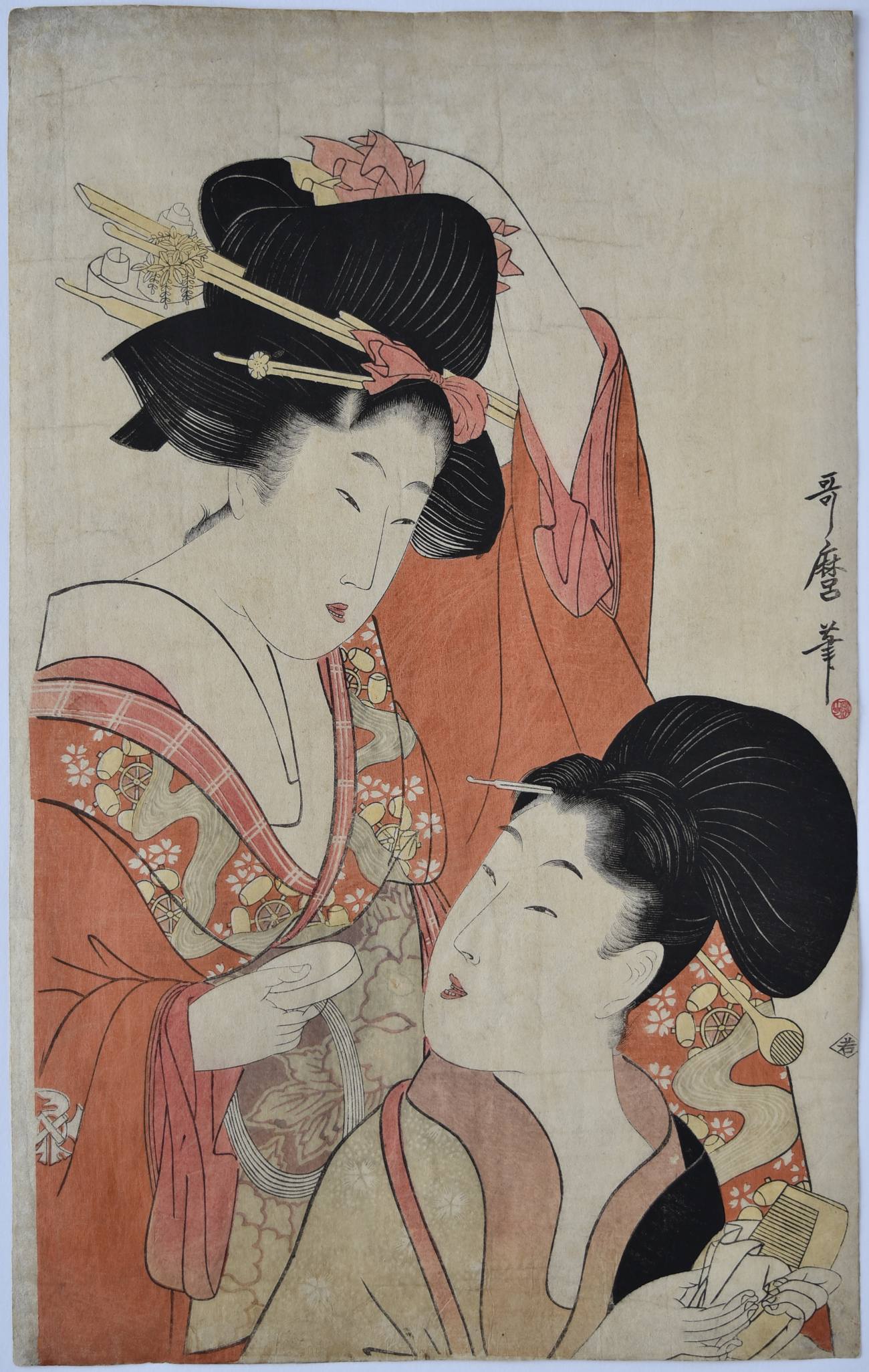
A beauty being aided by her assistant to dress her hair. Published by Wakasaya Yoichi, c 1803-4.
Fine impression. Very well retained colour. Minor marks and soil, but otherwise very good condition. On thick hosho. Signed Utamaro fude.
Status: Sold
Utagawa KUNIYOSHI (1797-1861)
Click here to view image full size.
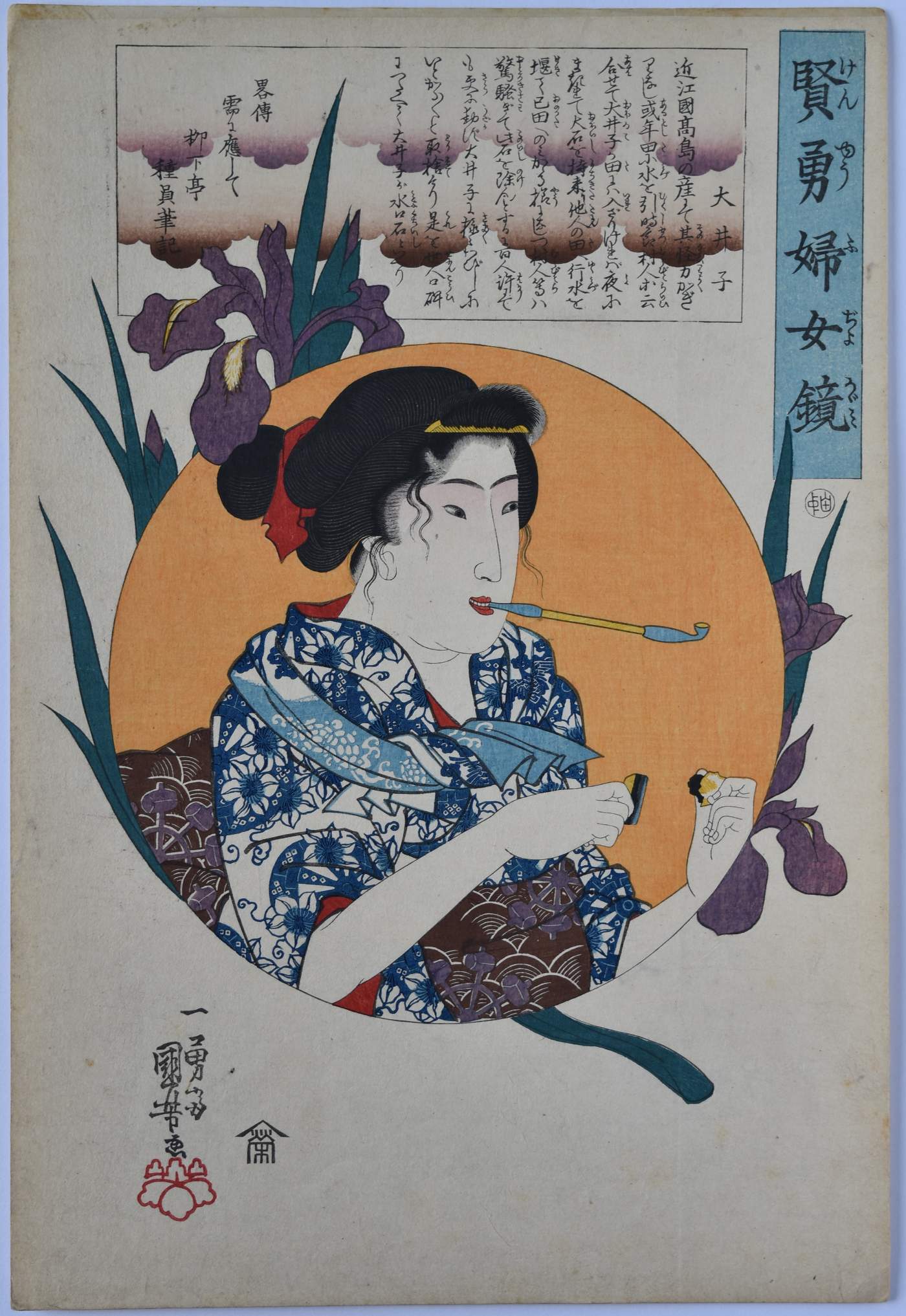
Oishi from a set Kenyu fujo kagami, “A Mirror of Wise and Courageous Women.” She evidently was famous for having used her strength to deliver irrigation water into her own fields. Published c 1843-45 by Takahashiya.
Very fine impression. Fine colour. Light album backing, otherwise fine condition. Signed Ichiyusai Kuniyoshi ga.
Status: Sold
Utagawa KUNIYOSHI (1797-1861)
Click here to view image full size.
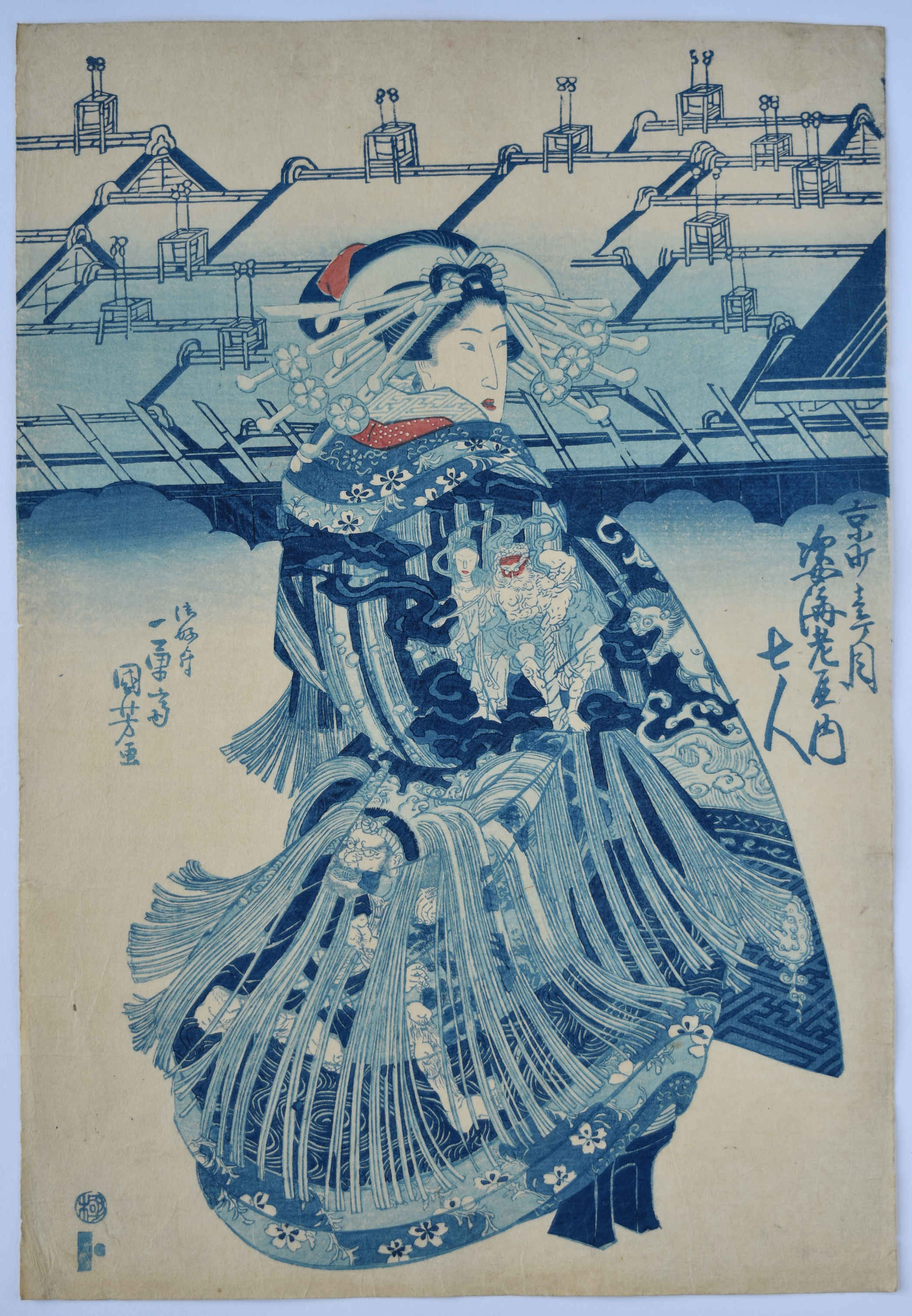
An aizuri-e print showing the courtesan Nanahito of the Sugata-ebi house, 1 chome, Kyomachi, parading in front of rooftops. Published by Yamaguchiya Tobei, c. 1835-40. In fact, the left sheet of a triptych. Apparently, no known copy of the complete triptych is known, only this design and the first sheet. Nanahito was a popular courtesan also appearing on prints by Kunisada and Eisen.
Very fine impression, colour and condition. Signed “Restraining tears”, Ichiyusai Kuniyoshi ga.
Status: Sold
Keisai EISEN (1790-1848)
Click here to view image full size.
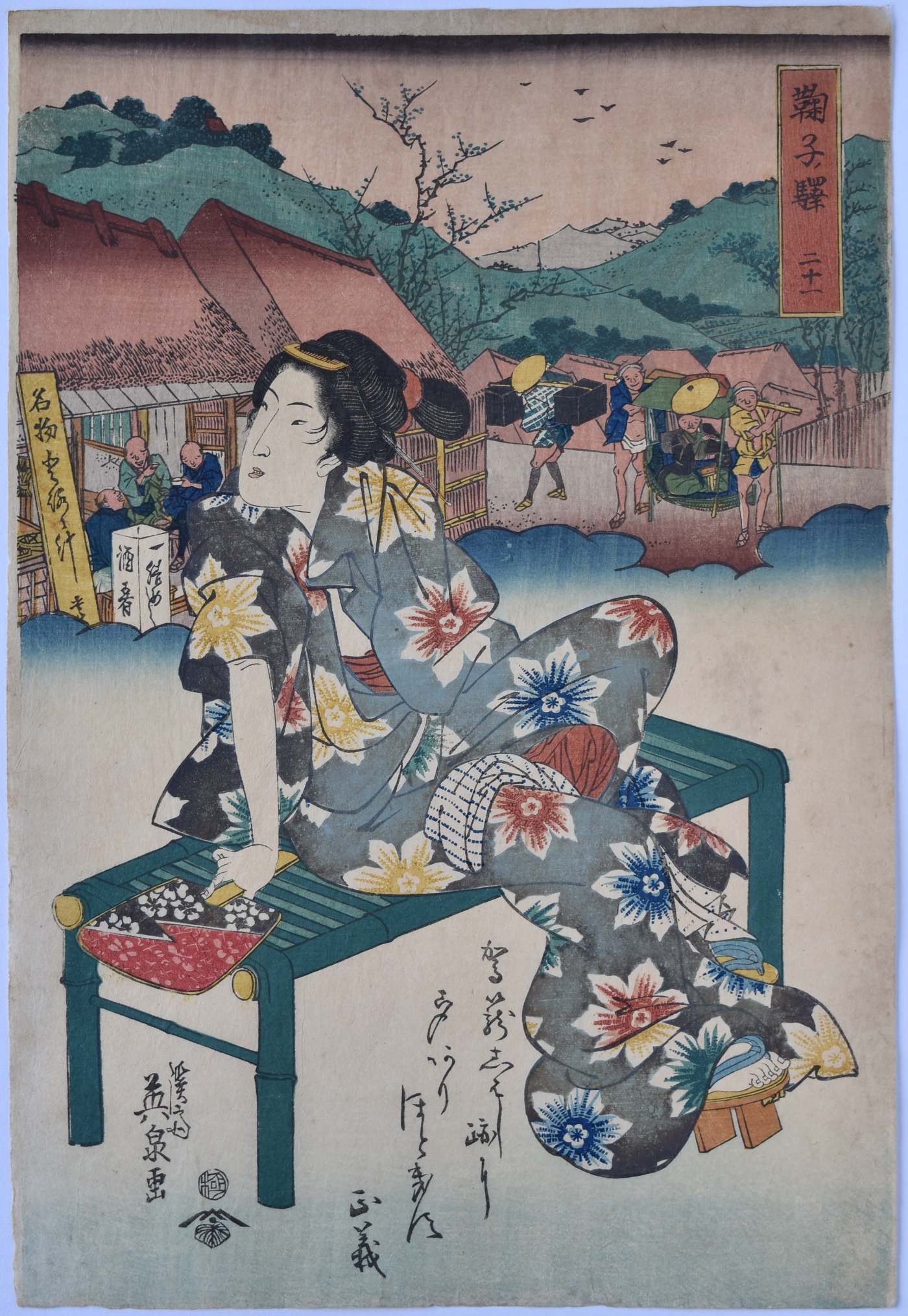
Mariko, Station 21, from the Bijin Tokaido which compares beauties to the Fifty-three Stations of the Tokaido. This Station was famous for tororojiru, a dish of yams and white bean paste. An inn behind is advertising this meal.The set was published by Tsutaya, c early 1830s but only 40 designs are known as the government considered them a little risqué. The set was reissued without the Station numbers and censor seal for 1846.
Fine impression and colour. Nice oxidation. Very good condition. Full size. Signed Keisai Eisen ga.
Status: Sold
Keisai EISEN (1790-1848)
Click here to view image full size.
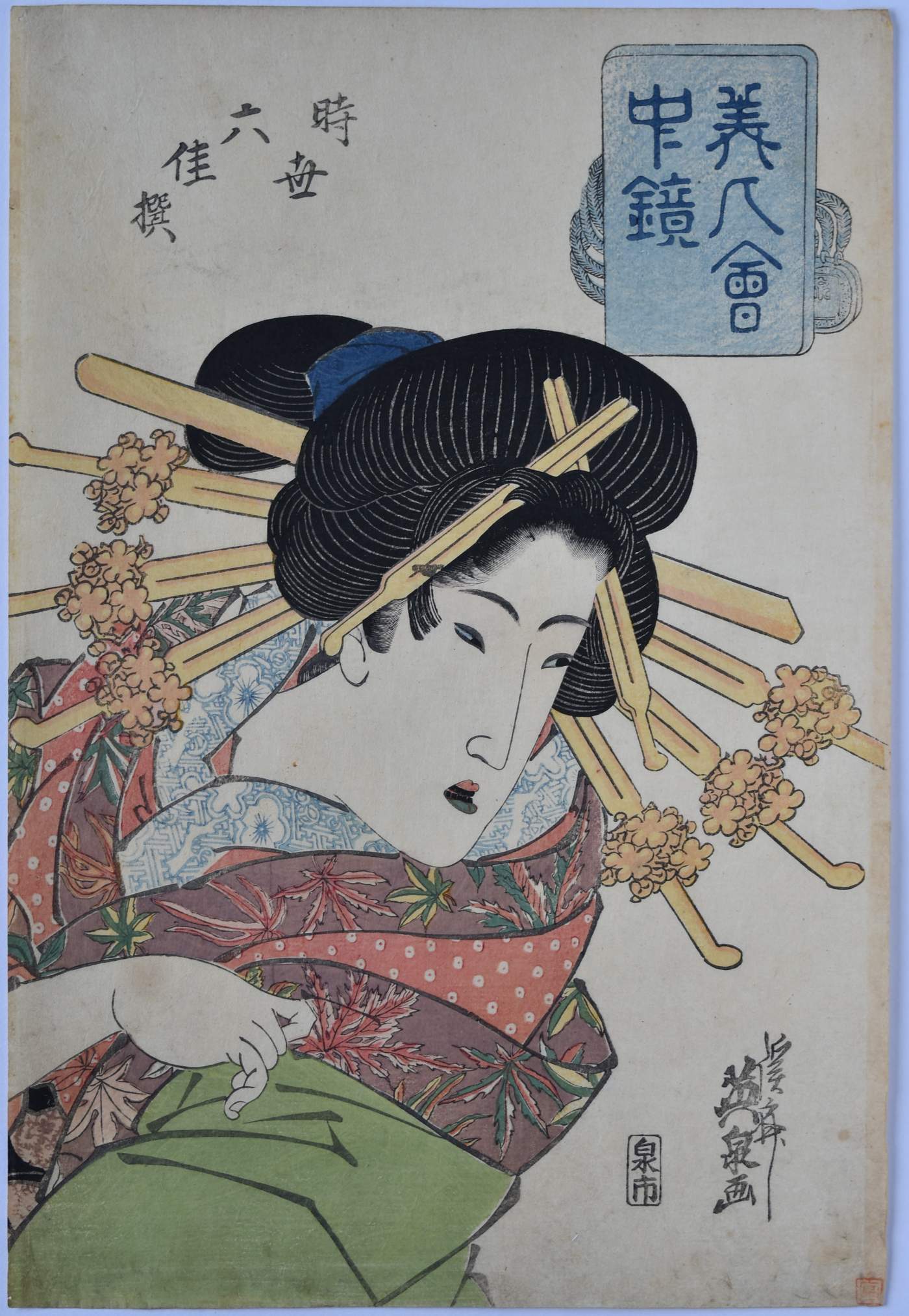
A high-ranking courtesan ( oiran ) looking over her shoulder. From a set of six prints: Bijin kaichu kagami – Jisei rokkassen: Ariwara no Narihira, “ A Pocket Mirror of Beauties – Six Immortal Poets of the Era: Ariwara no Narihira.” The set compares the beauties to the six “immortal” waka poets of the 9th/10th centuries. The maple leaves on the oiran’s collar identify the subject as compared to the poet Ariwara no Narihira ( 825-880 A.D. ). The set published by Senichi, c 1826-28.
Fine early impression. Fine colour. Very slight soil and trimming bottom right, otherwise fine condition. Signed Keisai Eisen ga.
Status: Sold
Utagawa KUNIYOSHI (1797-1861)
Click here to view image full size.
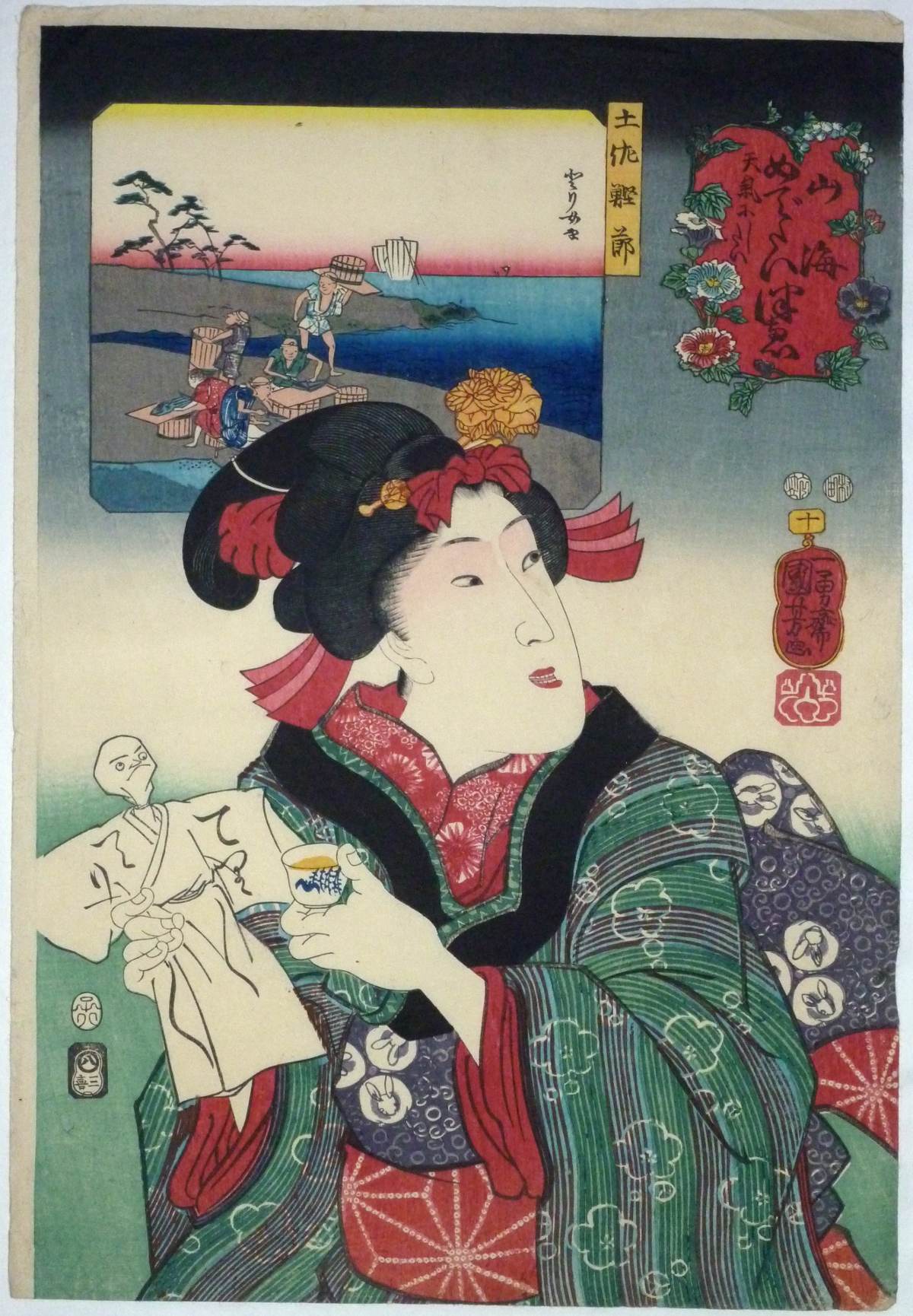
A beauty in sumptuous clothing from a fine set of seventy numbered prints with title: Sankai medetai zu, “Excellences of Mountain and Sea.” The set compares busts of beautiful women with various products and occupations from the provinces of Japan. The inset view here shows dried bonito from Tosa Province, Tosa katsuobushi. The set published 1852 by Sano-ya Kihei.
Superb impression, very fine colour and condition. Signed Ichiyusai Kuniyoshi ga.
Status: Sold
Utagawa KUNIYOSHI (1797-1861)
Click here to view image full size.
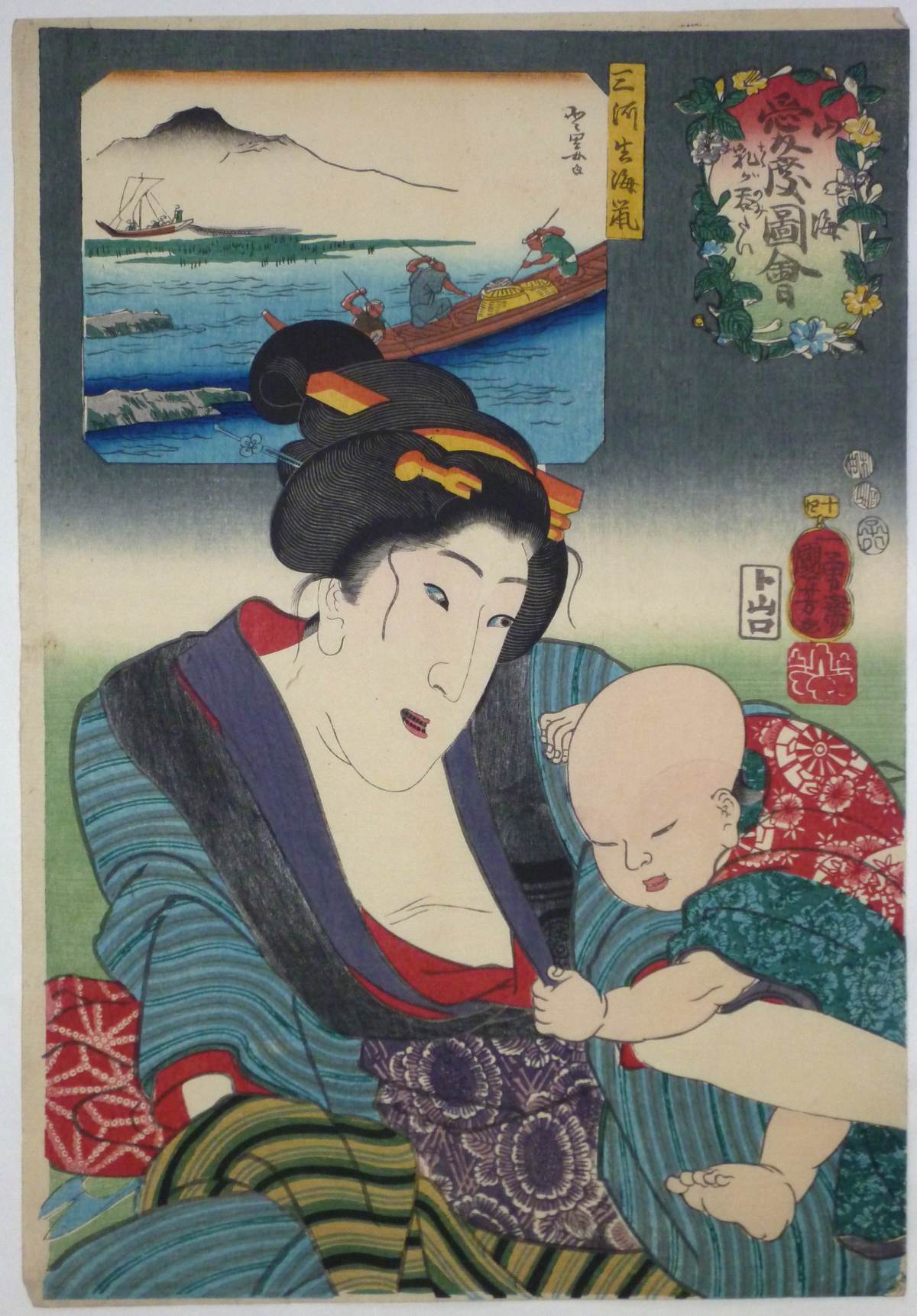
A beauty in sumptuous clothing from a fine set of seventy numbered prints with title: Sankai medetai zu, “Excellences of Mountain and Sea.” The set compares busts of beautiful women with various products and occupations from the provinces of Japan. The inset view here shows sea cucumber being collected in Mikawa Province, Mikawa-namako. The set published 1852 by Sano-ya Kihei.
Superb impression, very fine colour and condition. Signed Ichiyusai Kuniyoshi ga.
Status: Sold