Search Results for HOKUSHU

Shunchosai HOKUSHU (Active 1822-32)

Click here to view image full size. Onoe Kikugoro III as the ghost of Oiwa in Irohagana yotsuya kaidan, “Ghost Story of Yotsuya.” Performed at the Kado Theatre, 1 Probably the best known Japanese ghost story and has been made into a number of films. Tamiya Iemon, a masterless samurai, murders the wife he has disfigured who comes back to haunt him until he is driven mad and subsequently killed by Oiwa’s brother. Evidently, Kikugoro’s performance was something of a sensation at the time as he gave a bravura performance playing both the ghost of Oiwa and Koheiji who were nailed on opposite sides of a panel dropped into the river. There are at least five states of this print. The first appears to be that illustrated in Roger Keyes, The Theatrical World Of Osaka Prints, Philadelphia Museum Of Art, 1973, no. 34, p. 108 with the engraver and two printers and the writing printed in silver. The example offered here appears to be a second state without the engraver and printers’ seal but with the writing still printed in silver. Other impressions with different seals and lacking the first three lines of writing and the silver are known. See The Tsubouchi Memorial Theatre Museum of Waseda University catalogue, Kamigata Prints in the former period: part 1, nos. 279 and 280. Also BM impression 1962,0210,0.2 which may be the last state. Fine impression and colour with calligraphy in silver. Very good condition; full size. Signed Shunchosai Hokushu ga. Status: Sold
Shunkosai HOKUSHU (Fl. c 1808-1832)

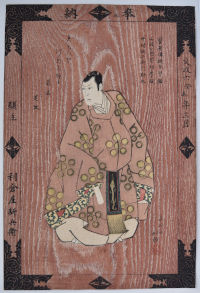
Click here to view image full size. The actor Nakamura Utaemon III as Kan Shojo in the play Sugawara denju tenarai kagami, “Mirror of Learning and Transmitting Sugawara’s Secrets of Calligraphy.” In fact based on stories relating to Sugawara Michizane (845 – 903, scholar, poet and politician). Government regulations prohibited the use of the names of real people in Kabuki. He is shown on a wood votive tablet. The play was performed at the Kado no Shibai Theatre, Osaka, 3 In fact, Utaemon is supposed to have sensationally played 7 roles in this play. Poem above by Shikan (Utaemon’s poetry name). Published by Toshikuraya Shinbei (inscribed bottom left).   Fine impression. This is a wonderful example of kimetsubushi printing whereby the grain of the wood is exposed with stiff brushes or pads to enable the grain to be printed. Very good colour and condition. Signed Shunkosai Hokushu ga.   Status: Sold  

Shunkosai HOKUSHU (Active 1809-1832)

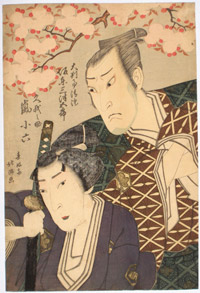
 Click here to view image full size. Bando Mitsugoro III as Daihanji Kiyozumi and Arashi Koroku IV as the son Koganosuke in the play Imoseyama Onna Teikin. In fact a diptych ( see Keyes, The Theatrical World of Osaka Prints, no. 16, p. 72-73 ). The child Koganosoke resolves on a suicide pact with Hinadori ( shown on the other sheet ) after Soga no Iruka orders the children to be sent to his court to insure the family’s loyalty. Published 1821 by Wataki. ( There are two states known: With and without publisher’s seal. Some embellishments are added and some removed on the two states.) Fine impression. Particularly well preserved colour. De-luxe impression. Gum and polishing on Koganosuke’s hair; blind printing on the blossom above. Some loss of brass. Signed Shunkosai Hokushu ga. Status: Sold

Shunkosai HOKUSHU (active 1810-1832)

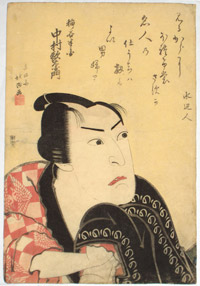
 Click here to view image full size. Yellow-ground bust portrait of Nakamura Utaemon III ( Inanoya Hanbei ). Published 3 Rare: Another chirimen ( creped ) version is illustrated in Kamigata Prints in the former period: part 1, Tsubouchi Memorial Theatre Museum of Waseda University, no. 129, p. 33 Very good impression and colour. Slight creases and soil. Signed Shunkosai Hokushu ga. Status: Sold

Artists

( A to Z ) Kyogado ASHIKUNI ( Fl. c. 1807 – 1818 ) Gigado ASHIYUKI ( Fl. c. 1814 – 1833 ) Ki BAITEI ( 1734 – 1810 ) Takizawa BAKIN ( 1767 – 1848 ) Ono BAKUFU ( 1888 – 1976 ) Georges BIGOT ( 1860 – 1927 ) Kawamura BUMPO ( 1779 – 1821 ) Ippitsusai BUNCHO ( Fl. c. 1765 – 1792 ) Toyohara CHIKANOBU ( 1838 – 1912 ) Kishi CHIKUDO ( 1826 – 1897 ) Tsubaki CHINZAN ( 1801 – 1854 ) Eishosai CHOKI ( Fl. c. 1756 – 1808 ). See also SHIKO Rekisentei EIRI ( Fl. c. 1790 – 1800 ) Keisai EISEN ( 1790 – 1848 ) Hosoda EISHI ( 1756 – 1829 ) Hosoda EISHO ( Fl. c. 1780 – 1800 ) Ichirakutei EISUI ( Fl. c. 1790 – 1823 ) Kikugawa EIZAN ( 1787 – 1867 ) Hirano HAKUHO ( 1879 – 1957 ) Elizabeth KEITH ( 1887 – 1956 ) Imao KEINEN ( 1845 – 1924 ) Yashima GAKUTEI ( 1786 – 1868 ) Ogata GEKKO ( 1859 – 1920 ) Adachi GINKO ( Fl. c. 1847 – 1897 ) Matsumura GOSHUN ( 1752 – 1811 ) GYOSAI. See Kawanabe KYOSAI Hirano HAKUHO ( 1879 – 1957 ) Suzuki HARUNOBU ( 1724 – 1770 ) Kawase HASUI ( 1883 – 1957 ) Kitagawa HIDEMARO ( Fl. c. early 19th century ) Kinoshita HIRONOBU ( Fl. c. 1851 – 1870 ) Gosotei HIROSADA ( Fl. c. 1847 – 1863 ) Ichiryusai HIROSHIGE ( 1797 – 1858 ) Ichiryusai HIROSHIGE II ( 1826 – 1869 ) Ando HIROSHIGE III ( 1843 – 1894 ) Nakamura HOCHU ( Fl. c. late 18th to early 19th century ) Sakai HOITSU ( 1761 – 1828 ) Totoya HOKKEI ( 1780 – 1850 )…