Utagawa KUNISADA II (1823-1880)
Click here to view image full size.
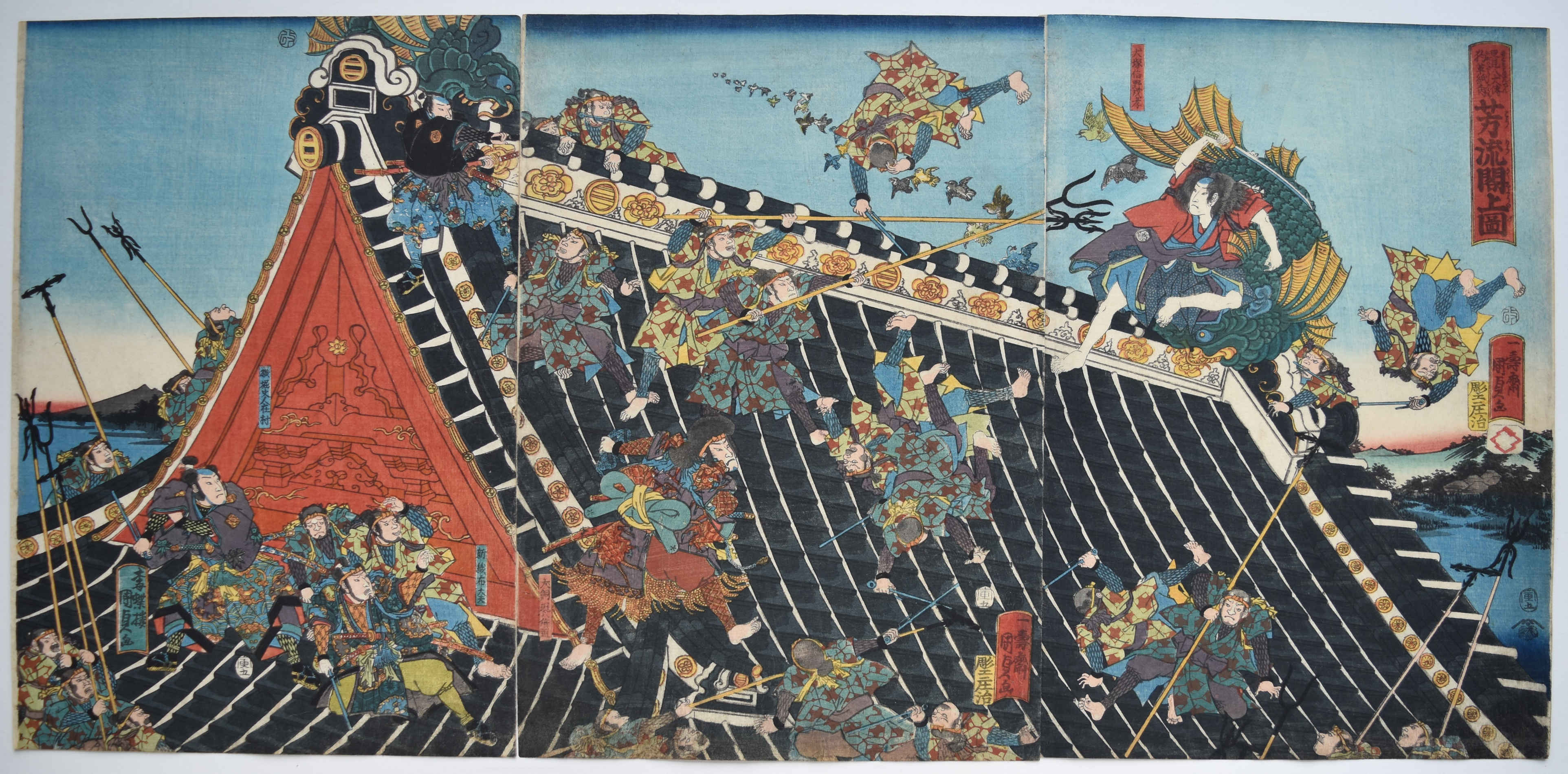
A triptych showing the fight on the roof of the Horyukaku Tower of Koga Castle beside the Tone River. A popular scene from the complex novel Nanso Satomi Hakkenden, “The Diary of Eight Dogs” by Takizawa Bakin (1767-1848). The macabre tale revolves around the eight offspring of a supernatural marriage between a princess and her father’s dog and their commitment to restore the fortunes of the samurai house of Satomi. Shows Inuzuka Shino Moritaka defending himself against the chief of police Inukai Kempachi Nobumichi. Published by Tsutaya Kichizo 1854.
Very good impression, colour and condition. Signed Ichijusai and Baichoro Kunisada ga.
Status: Available
Price: £2,300
Utagawa KUNIYOSHI (1797-1861)
Click here to view image full size.
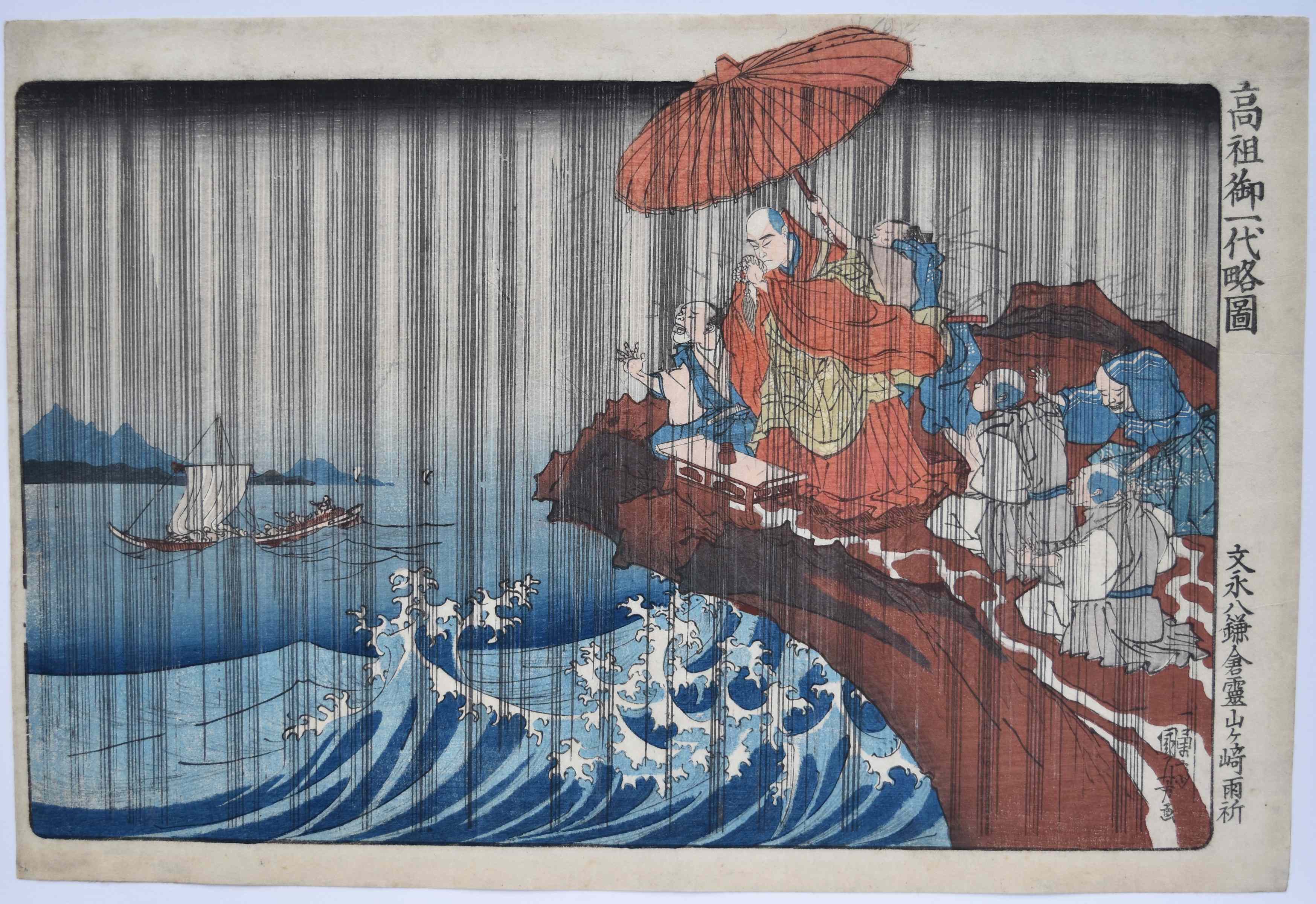
The priest Nichiren standing on the rocky promontory at Reizan in Kamakura and having his prayers for rain answered. The event occurred in 1271. His disciples surround him and protect him from the deluge with a large umbrella. Bunei hachi Kamakura Reizan-ga-saki uki. The second best design from Koso [Nichiren] goichidai ryakuza, “Illustrated Abridged Biography of the Founder.” Nichiren (1222-1282) was the founder of the Buddhist Nichiren sect (Nichiren shu – Kuniyoshi being a follower) and indeed the set of ten prints may have been commissioned to mark the 550th anniversary of his death. Published by Iseya Rihei, c 1831.
Fine impression, colour and condition. Ample room on top border for the umbrella which protrudes beyond the border and is often trimmed off, as is the information on right border. Signed Ichiyusai Kuniyoshi ga.
Status: Available
Price: £4,800
Utagawa HIROSHIGE (1797-1858)
Click here to view image full size.
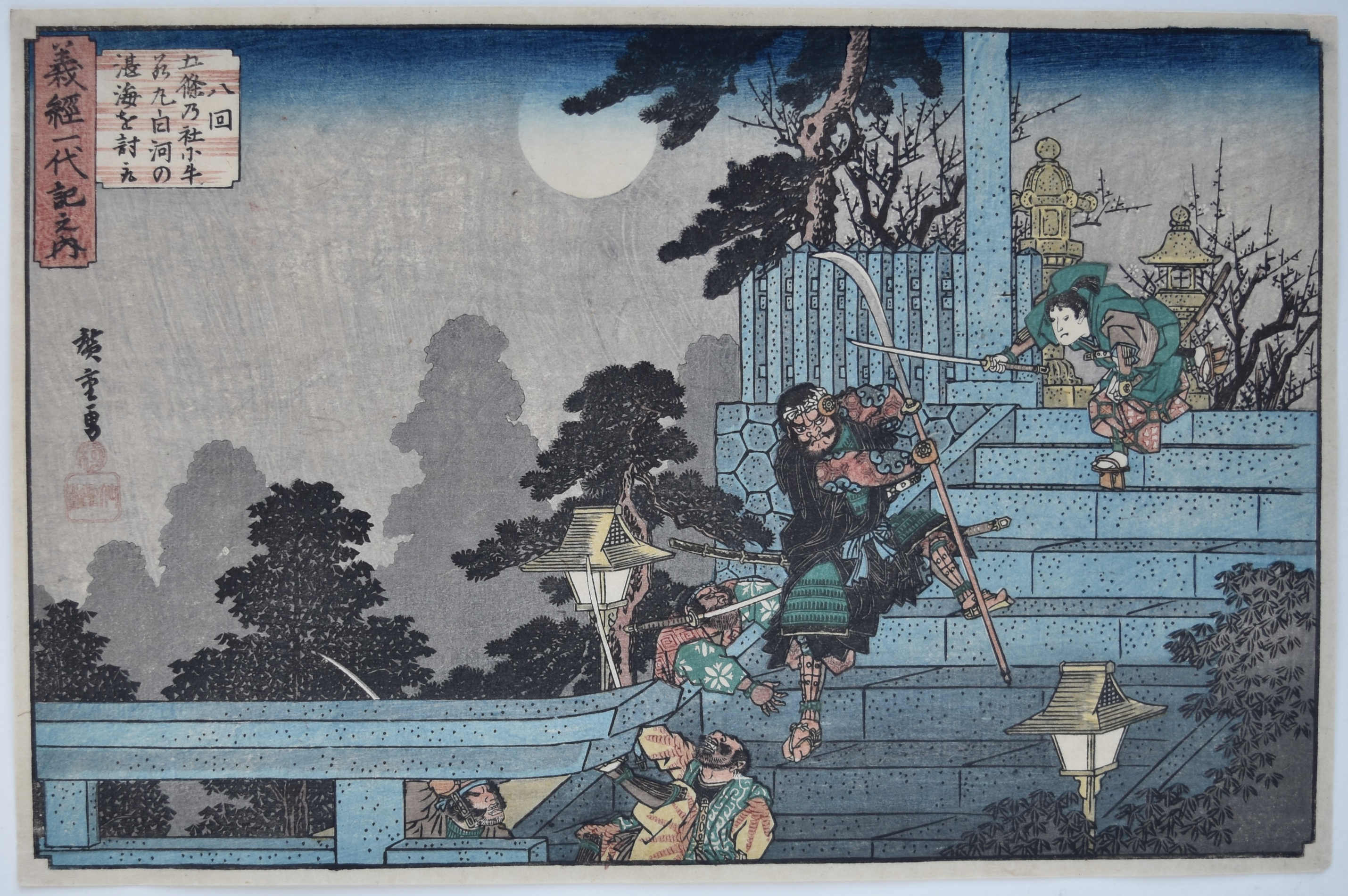
Ushiwakamaru (Yoshitsune) defeats the priest Tankai of Shirakawa at the Gojo Shrine under a full moon. Hachikai, Gojo no Yashiro ni Ushiwakamaru Shirakawa no Tankai o uchitori from the set Yoshitsune ichidaiki no uchi, “The Life of Yoshitsune.” Published by Tsuruya Kiemon (Senkakudo) 1832-34.
Fine impression and colour. Very good condition. Signed Hiroshige ga.
Status: Available
Price: £950
Tsukioka YOSHITOSHI (1839-1892)
Click here to view image full size.
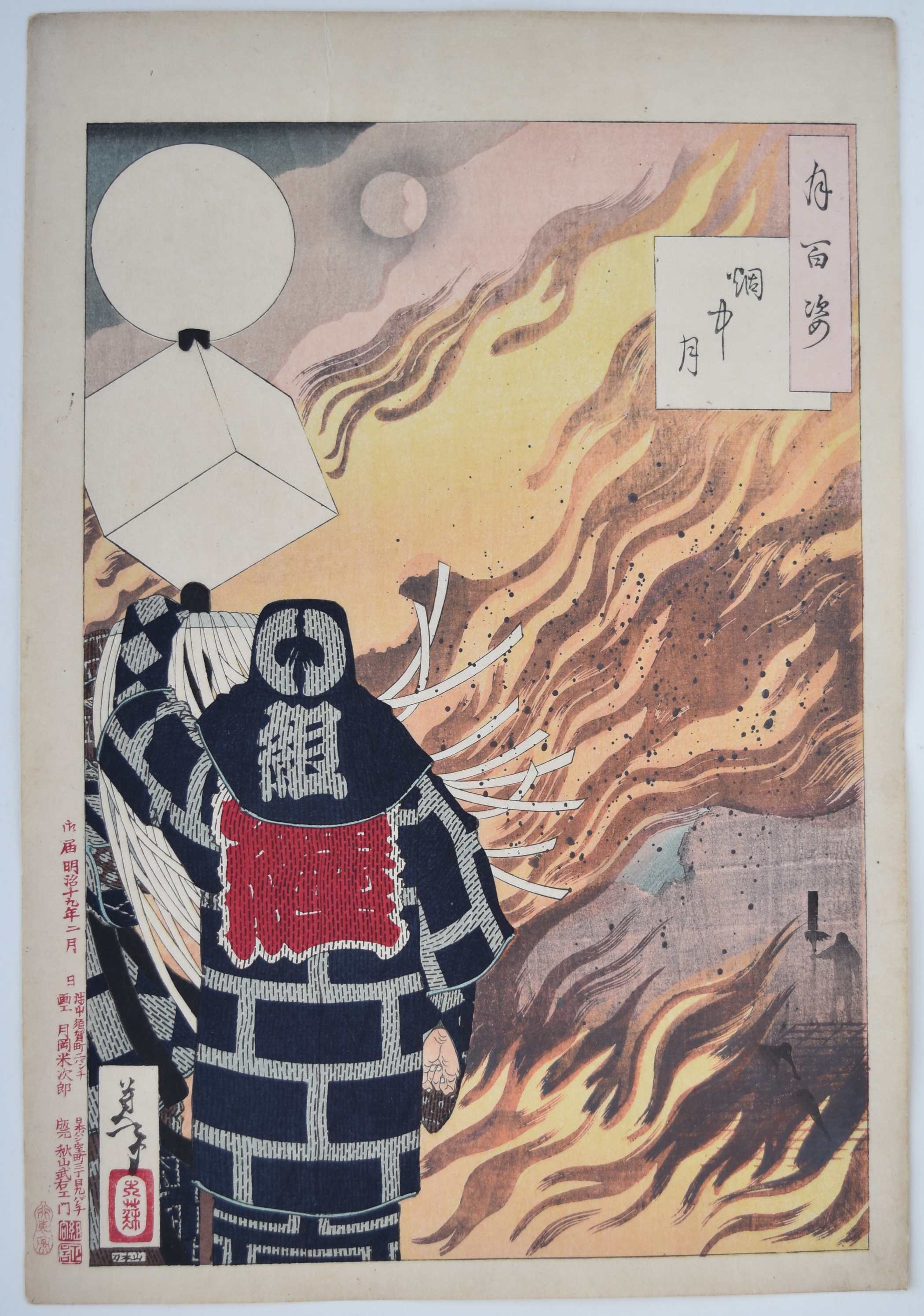
A silhouetted fireman faces a conflagration; in his left hand he holds a matori, a three-dimensional standard which identifies him and his location. Enchu no tsuki, “Moon and Smoke” from Tsuki hyakushi, “One Hundred Aspects of the Moon.” Published by Akiyama Buemon (Akiyama Seikichi) 1885-1892, this being 1886. The firemen’s heavily-quilted jackets were soaked in water to better enable them to withstand the heat. They were notorious for their rowdy behaviour and rivalrous nature leading to open hostility with other groups such as sumo wrestlers. Fires were a constant threat due to the building materials used, and firefighters were not above starting fires themselves in order to be the first on the scene (especially if they were in the construction business).
Fine impression, colour and condition. Signed Yoshitoshi. A gourd-shaped collector’s seal (unread) in the extreme left bottom which is found on other early impressions of this set.
Status: Available
Price: £2,400
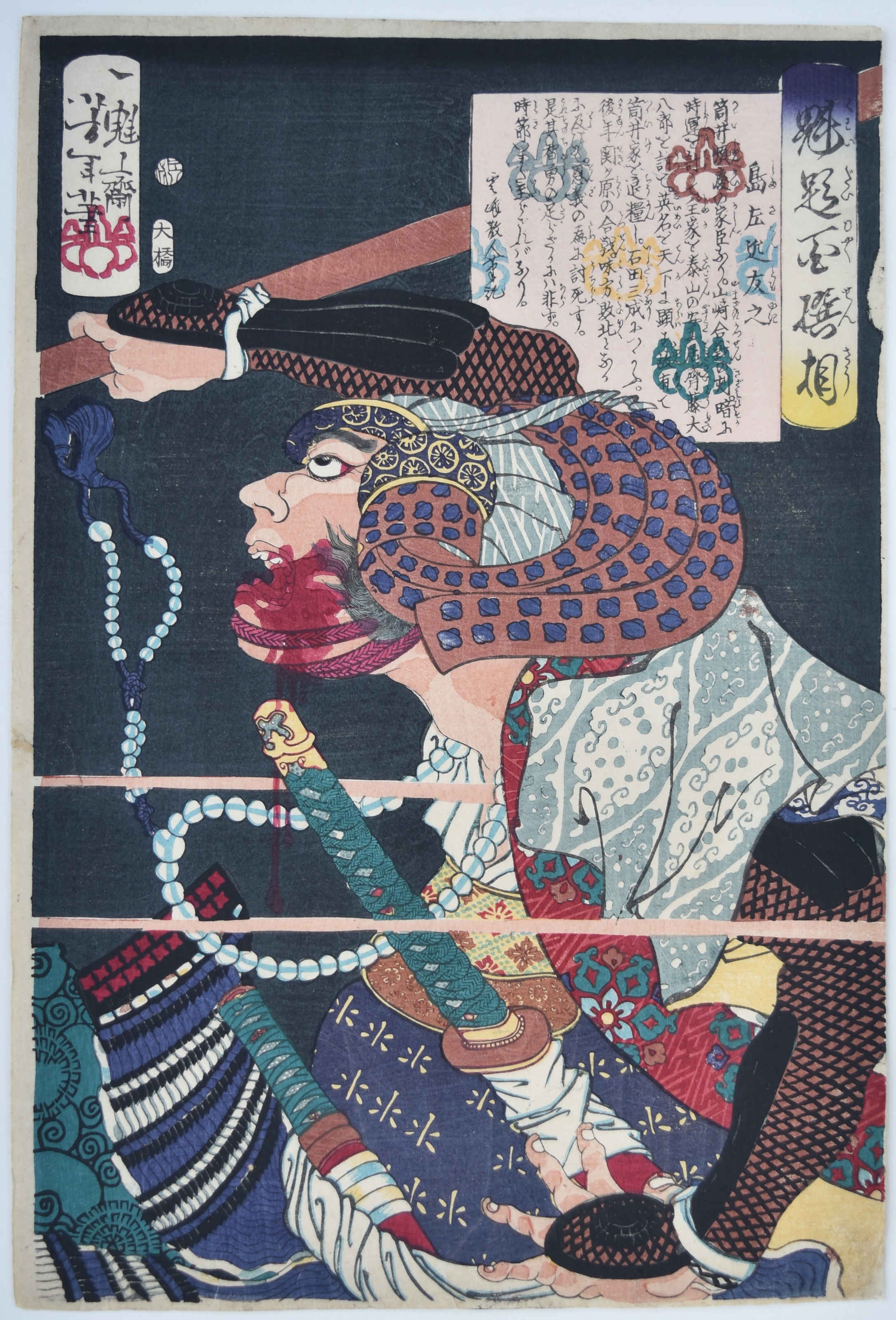
Tsukioka YOSHITOSHI (1839-1892)
Click here to view image full size.
Shows Shima Sakon Tomoyuki at the battle of Sekigahara, October 21, 1600. Shima was a commander of Ishida no Mitsunari’s forces against Tokugawa Ieyasu and was shot by riflemen (although his body was not found). He is shown being hit by a hail of bullets, his juzo (rosary) swinging in the air. From a set Kaidai hyaku senso “Yoshitoshi’s Selection of One Hundred Warriors.” Sixty-five prints published by Ohashiya Yashichi (Odawaraya Yashichi) between 1868 and 1869, this being 1868. The text in the square cartouche in this set refers to prominent warriors in the internecine wars of the 16th century, but in fact the subjects are Shogitai soldiers (those that held out against the Imperial forces and were massacred at Ueno, 4/7/1868). An excellent set.
Fine impression, colour and condition. Signed Ikkaisai Yoshitoshi hitsu.
Status: Available
Price: £1,800
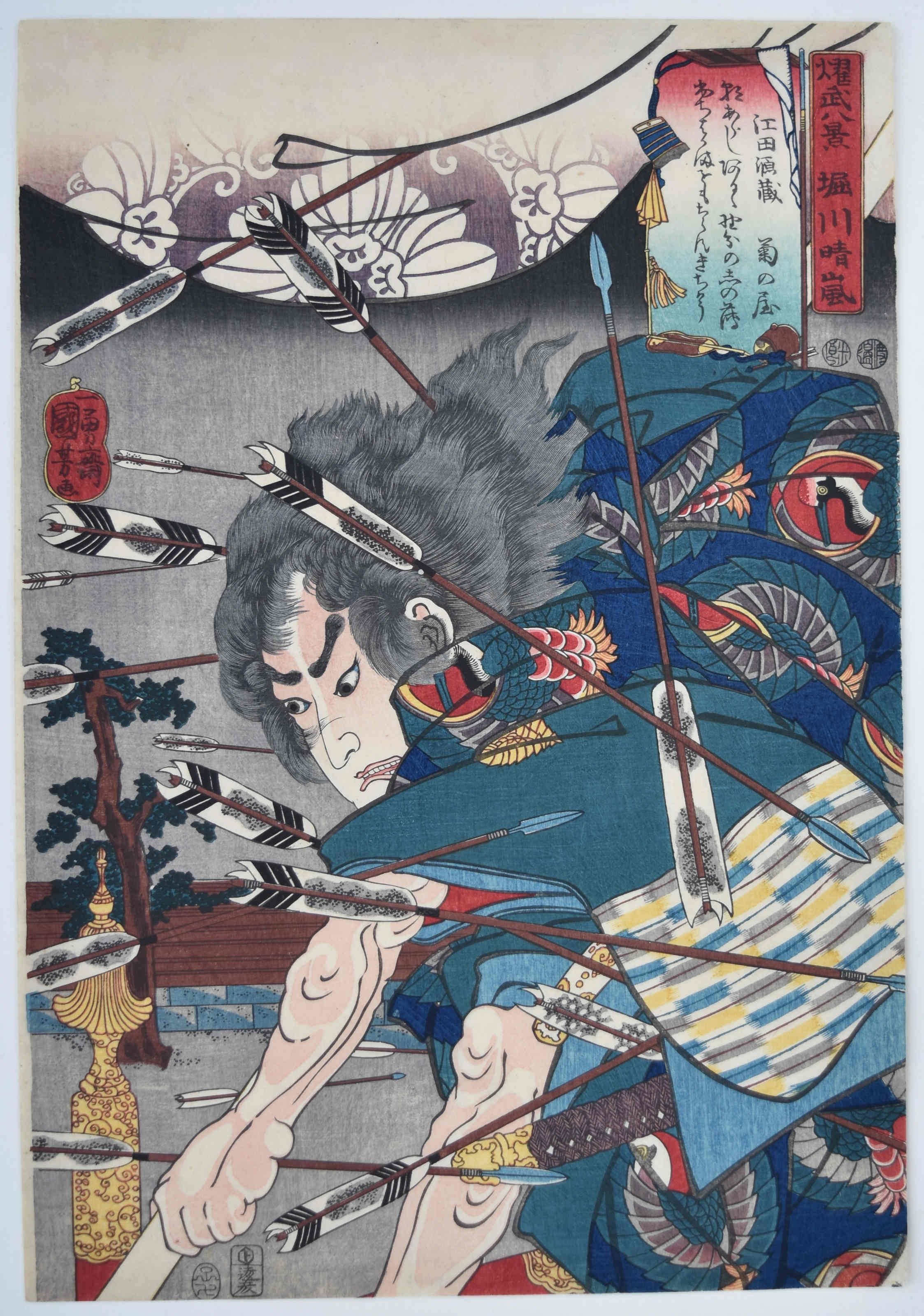
Utagawa KUNIYOSHI (1797-1861)
Click here to view image full size.
The warrior Eda Genzo Hirotsuna avoiding a hail of arrows during the defence of Minamoto Yoshitsuna’s palace at Horikawa, Kyoto in 1185. He was killed during the night attack. Horikawa seiran, “Clearing Weather at Horikawa” from the set Yobuhakkei, “Military Brilliance for the Eight Views.” Each of the eight prints has an association, either pictorially, thematically or by place with the famous Eight Views originating from China. Published by Enshuya Hikobei (Enhiko) 1852. Unidentified collector’s seal au verso.
Very fine impression, colour and condition. There are later states lacking the subtleties of the first printings. Signed Ichiyusai Kuniyoshi ga.
Status: Available
Price: £1,900
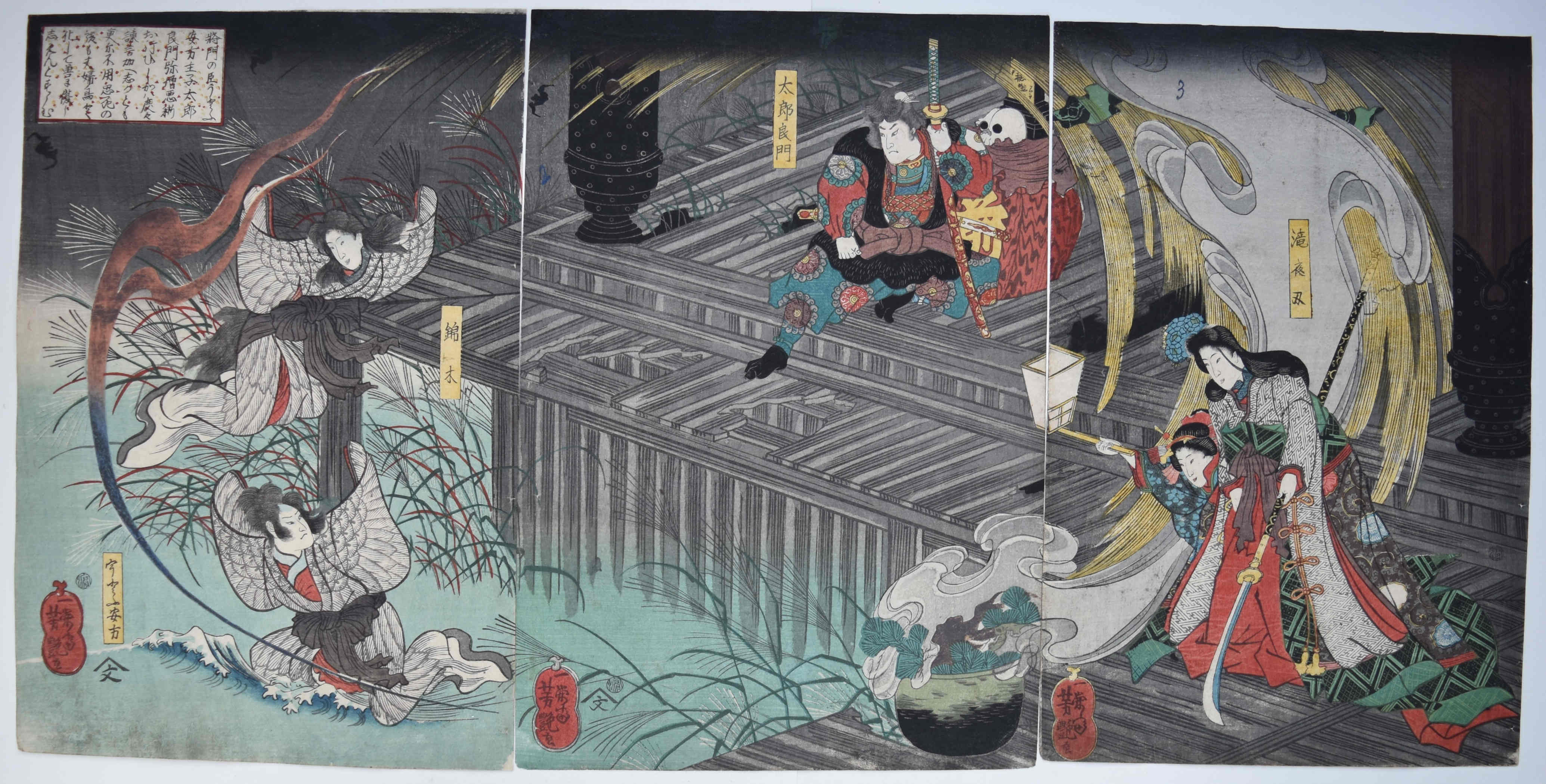
Utagawa YOSHITSUYA (1822-1866)
Click here to view image full size.
A triptych Uto Yasukata chugi den, “The Tale of Faithful Uto Yasukata.” Shows Shogun Taro Taira no Yoshikado (centre); Princess Takiyasha right); and Uto Yasukata and his wife (far left) turning into birds. Set in the ruins of Soma Palace. Takiyasha releases a ghost from a cauldron. A difficult triptych to interpret. (More information is available on the Lyon collection website: woodblockprints.org.) Published by Tsujiokaya Bunsuke (Tsujibun) 1852-53.
Fine impression and colour. Small edge binding holes on centre sheet, otherwise very good condition. Signed Ichieisai Yoshitsuya ga.
Status: Available
Price: £3,000
Utagawa YOSHIFUSA (Act. 1837-1860)

Click here to view image full size.
A triptych showing the vengeful spirit of Akugenta Yoshihira in a giant ball of fire sending a lightning bolt down on Nanba Jiro. Retaliation for having been defeated and beheaded during the Heiji rebellion. (There are other explanations for Yoshihira’s revenge, but this is the most common.) The revenge takes place at the Nunobiki Waterfall near Kobe. The scene watched by Taira no Kiyomori. Published by Omiya Kyujiro (Kinkyu) 1856.
Fine impression. Very good colour although extensive oxidation. Edge crease on centre panel, otherwise very good condition. Signed Ipposai Yoshifusa Ga.
Status: Available
Price: £3,800
Tsukioka YOSHITOSHI (1839-1892)
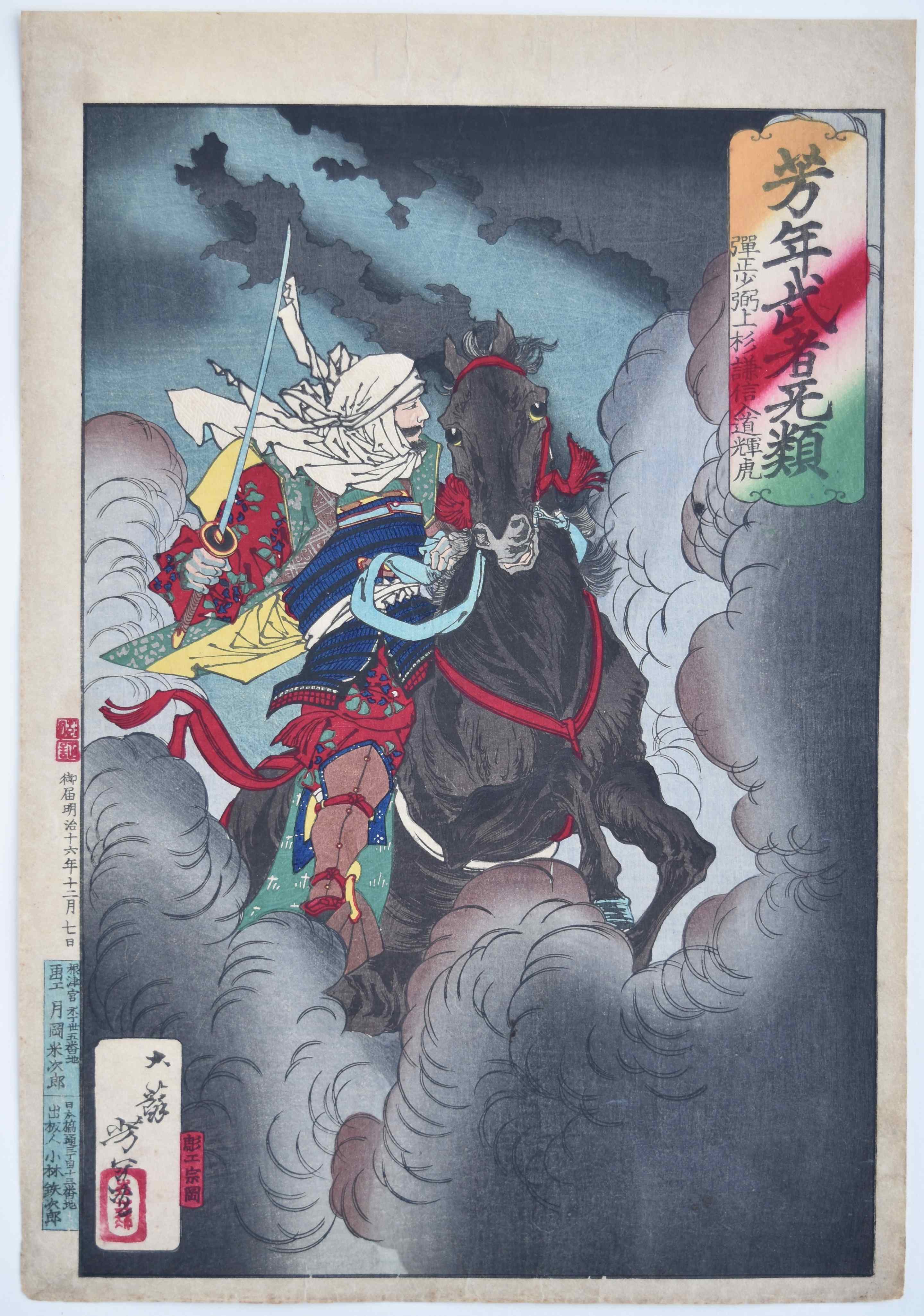
Uesugi Kenshin Nyudo Terutora. Shows Uesugi no Terutora (aka Kenshin) riding into battle through clouds of smoke against his long-standing adversary Takeda Shingen. From a set of 33 prints Yoshitoshi musha burui, “Yoshitoshi’s Courageous Warriors.” Published by Kobayashi Tetsujiro between 1883 and 1886, this being 1883. A fine design.
Very fine impression of the first edition. (Which should have a three-colour cartouche; two red seals and the publisher’s address in blue in the left margin.) It was reprinted by Tsunajima Kamekichi in 1886 and there are many late printings of the set. Fine colour and condition. Full size with extra paper at left. Signed Taiso Yoshitoshi ga.
Status: Available
Price: £1,400
Tsukioka YOSHITOSHI (1839-1892)
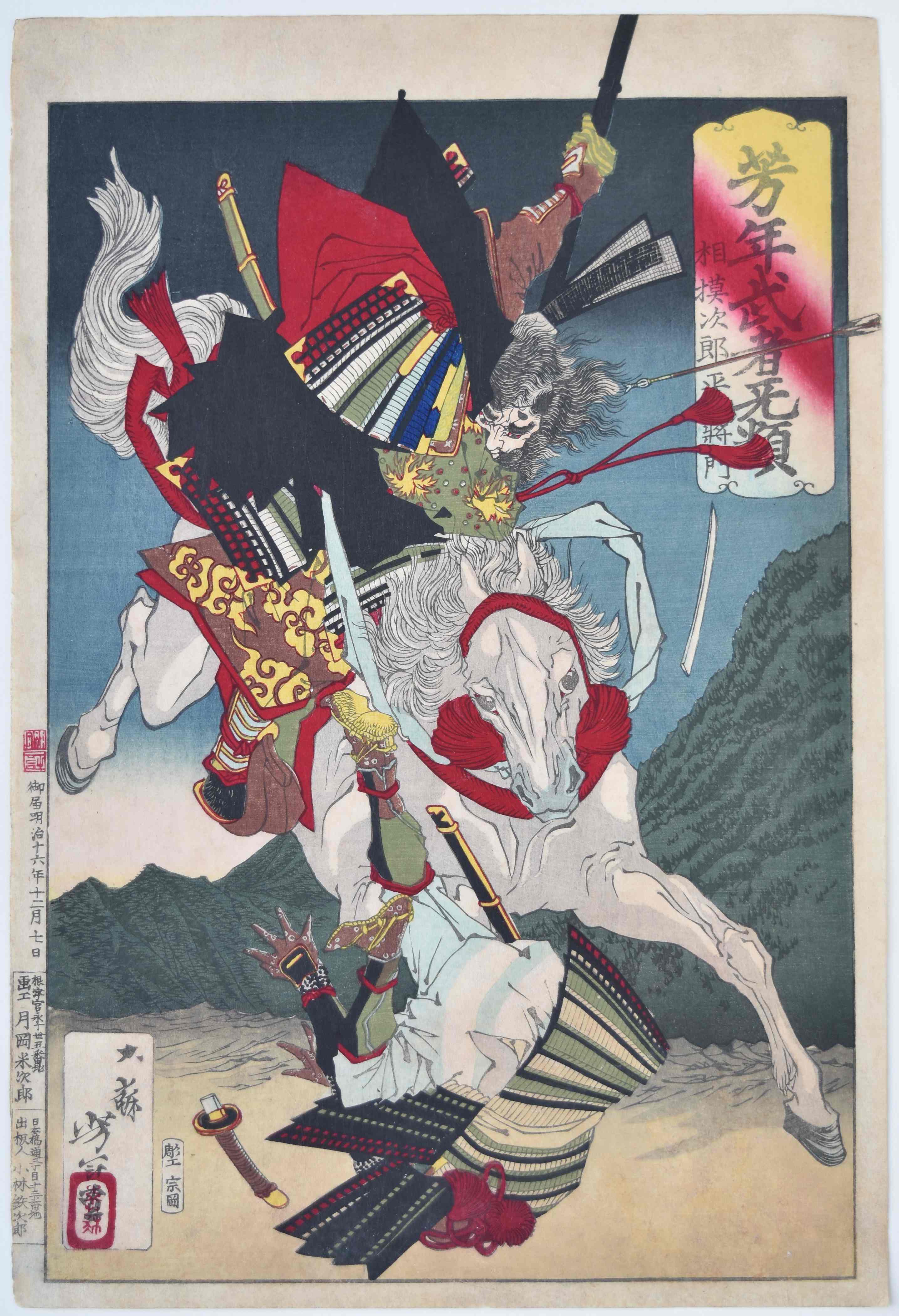
Click here to view image full size.
Shows Sagami Jiro Taira no Masakado on horseback attacking an opponent and having cut his sword in two. From a set Yoshitoshi musha burui, “Yoshitoshi’s Courageous Warriors.” Published by Kobayashi Tetsujiro, 1883.
Very fine impression: This is the first edition with three-colour cartouche and small red seals in left margin. There are late editions of this set. It was republished by Tsunajima Kamekichi in 1886. Fine colour. Slight soil bottom edge, otherwise very good condition. Signed Taiso Yoshitoshi ga.
Status: Available
Price: £1,400
Tsukioka YOSHITOSHI (1839-1892)
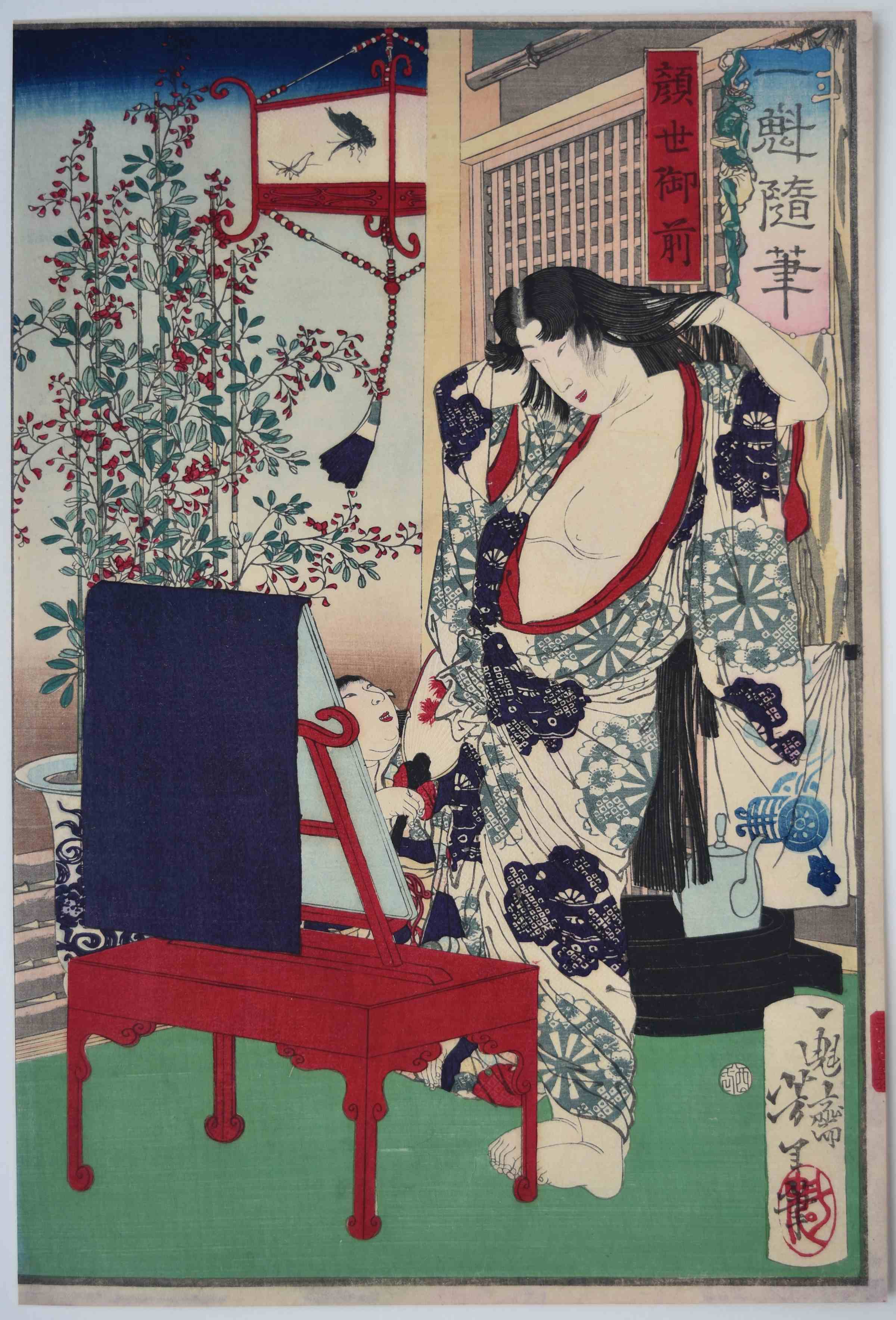
Click here to view image full size.
The great beauty Lady Kaoyo (Gozen) admires herself in a long morror. Lord Ko Moronao, the chief retainer of Shogun Ashikaga Takauji, hears of her beauty and connives to spy on her after her bath. He falls in love, but she is married to En’ya Hankan Takasada. The evil Moronao plots against En’ya although the outcome is that the family is put to death, including En’ya’s wife. The story forms the basis of the famous Chushingura tale. From the set Ikkai zuihitsu, “Essays by Yoshitoshi.” (Ikkai was an early name of Yoshitoshi’s.) A set of thirteen prints published by Masadaya Heikichi 1872/3. A fine set.
Extremely fine impression and colour from the first edition. Most designs from the set have red seals in the margin and red seals over the signature. These were removed on later editions. Trimmed on black border at left, otherwise fine condition. Signed Ikkaisai Yoshitoshi hitsu.
Status: Available
Price: £1,800
Utagawa KUNIYOSHI (1797-1861)
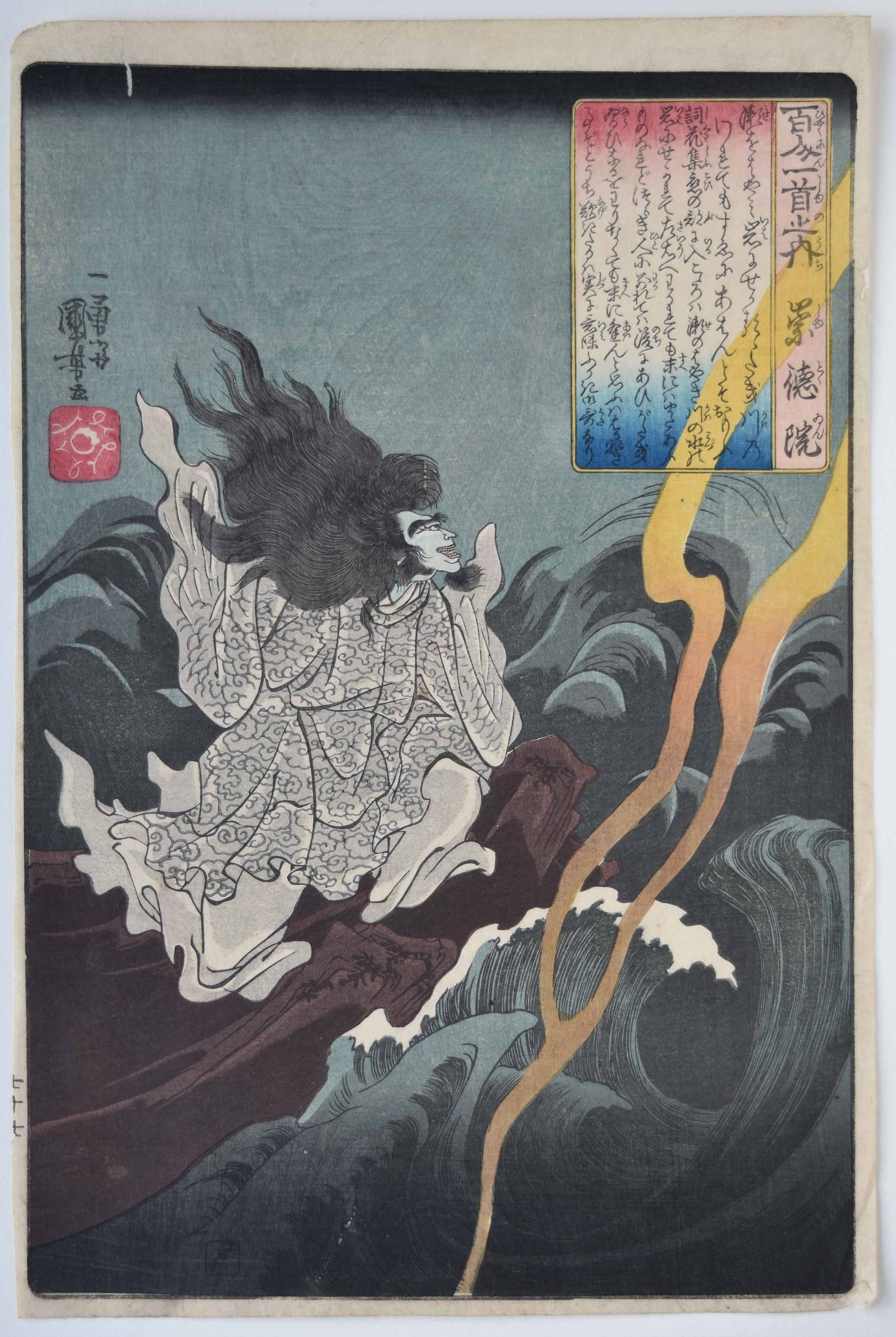
Click here to view image full size.
A poem by the celebrated poet Sutoku-in from the series Hyakunin isshu no uchi, “One Hundred Poems for One Hundred Poets” which was compiled in 1235 by Fujiwara Teiki (1162-1241). Shows the exiled Emperor Sutoku (1119-64) standing on a rocky outcrop above turbulent rapids. His wrath causes a thunderstorm with lightening. One of the very best designs from the set. Published by Ebisuya Shoshichi, Ebine, 1840-42. Only 58 of the 100 prints are known. Various translations of the poem exist, here is one:
Because the current is swift
Even though the rapids
Blocked by a boulder
Are divided, like them, in the end
We will surely meet, I know
Very fine impression. Fine colour. Very good condition. Signed Ichiyusai Kuniyoshi ga.
Status: Available
Price: £5,500
Tsukioka YOSHITOSHI (1839-1892)
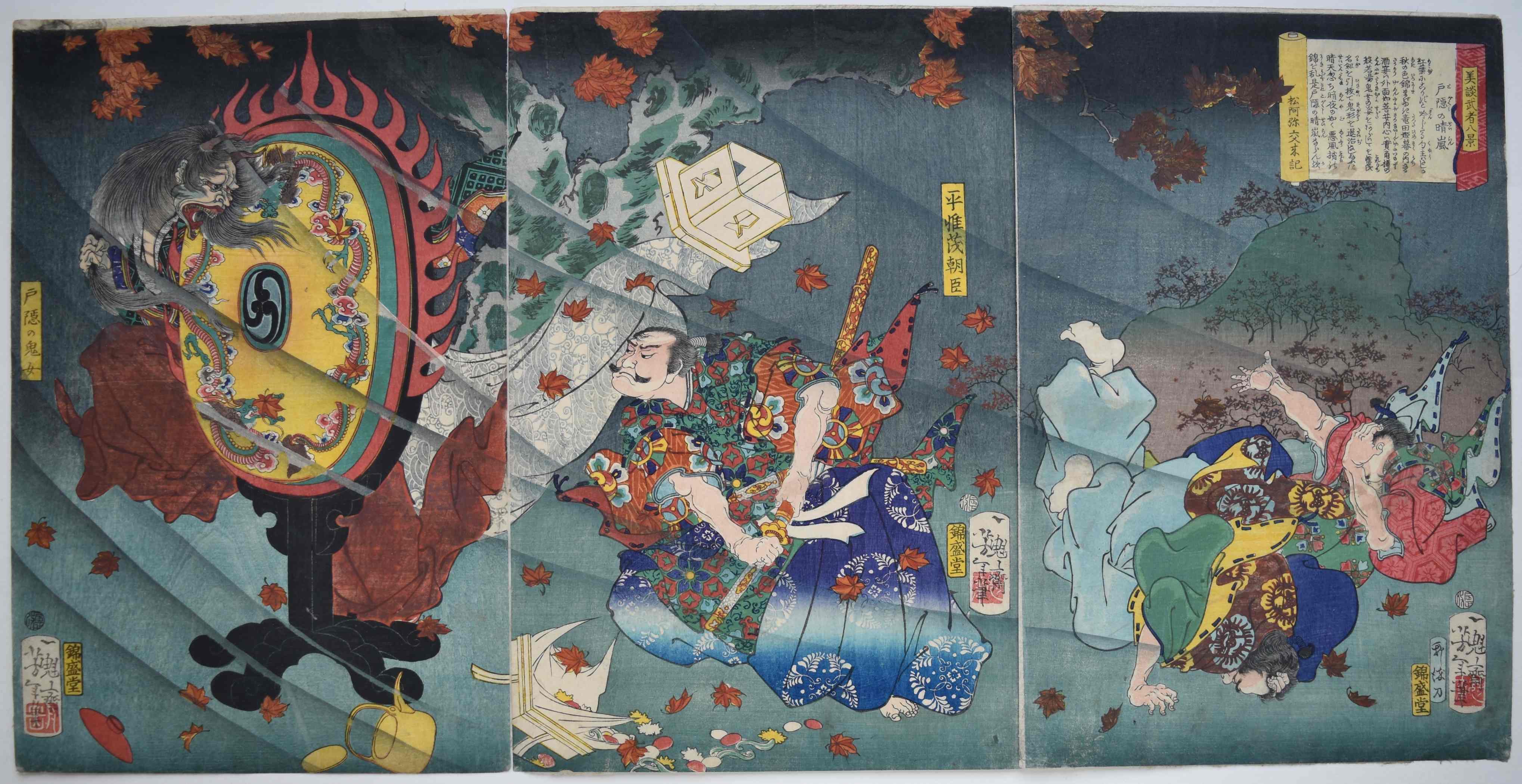
Click here to view image full size.
A triptych from a set Bidan musha hakkei, “Eight Views of Warriors’ Fine Tales.” This design Togakushi no seiran, “Clearing Weather of the Togakushi Mountains.” Princess Sarashina, who is actually a female oni called Momji, “Maple Leaves,” having transformed herself, is seen screaming from behind a giant drum and raising a high wind scattering maple leaves against Taira no Koremori Ason who draws his sword to kill her. Published by Sanoya Tomigoro, 1868.
Extremely fine impression of the earliest state. Fine colour. Slight marks on first sheet, otherwise very good condition. Signed Gekko Yoshitoshi hitsu.
Status: Available
Price: £4,800
Ichiyusai KUNIYOSHI (1797-1861)
Click here to view image full size.
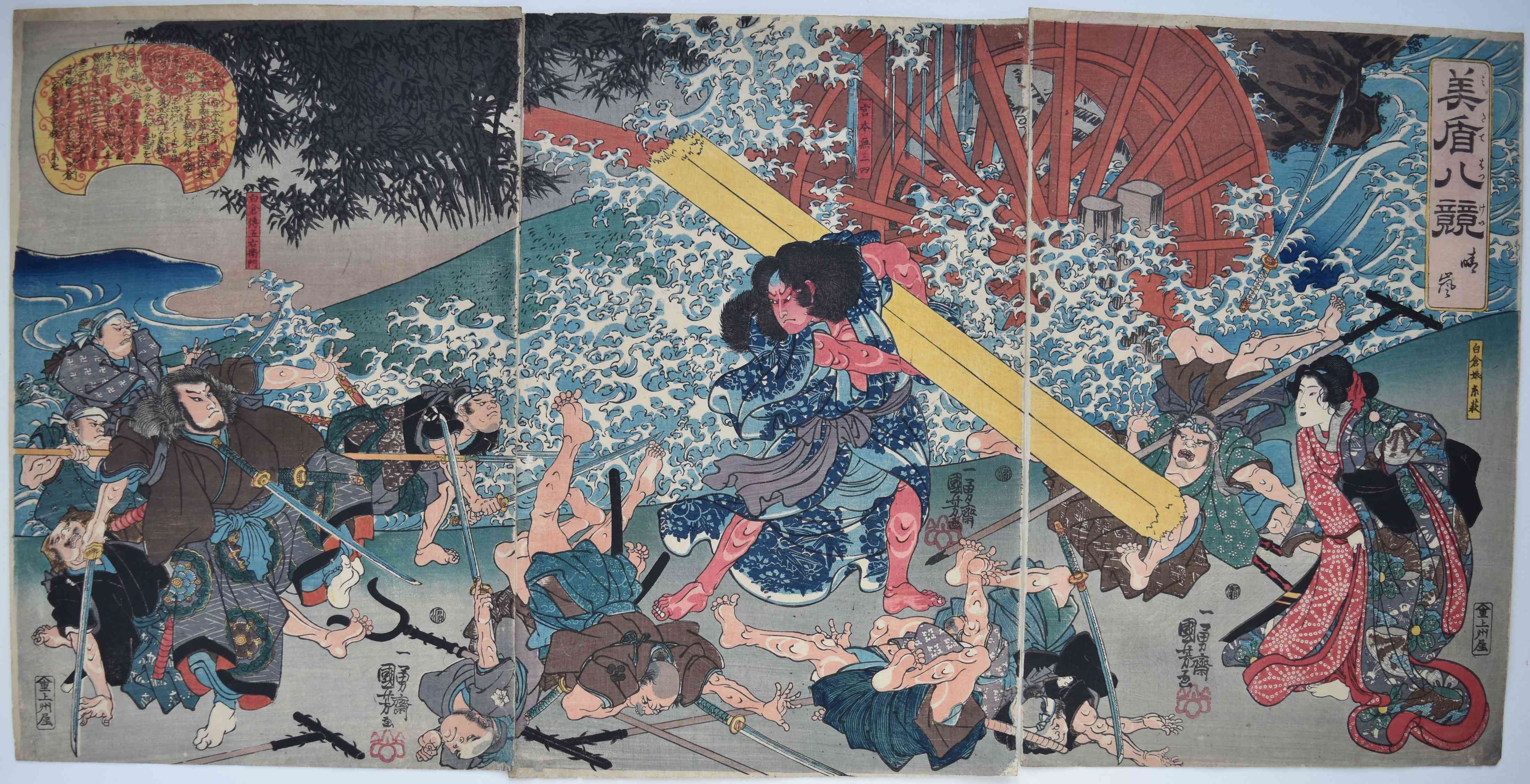
A triptych showing the legendary swordsman Miyamoto Musashi (centre) battling Shirakura Dengoemon (left) and his henchmen. The story usually relates how a jealous Dengoemon plots to kill Musashi by inebriating him and locking him in a bath house without his sword. However, Musashi, wielding a huge broken beam, slays Dengoemon and his followers aided by Dengoemon’s daughter Itohagi (right) who has fallen in love with Musashi. Kuniyoshi, however, depicts the event beside a mill-stream and a large waterwheel. Seiran, “Clearing Weather” from a set Mitate hakkei, “Selection for the Eight Views.” Published by Joshuya Juzo, 1846.
Very good impression, colour and condition. Signed Ichiyusai Kuniyoshi ga.
Status: Available
Price: £3,800
Tsukioka YOSHITOSHI (1839-1892)
Click here to view image full size.
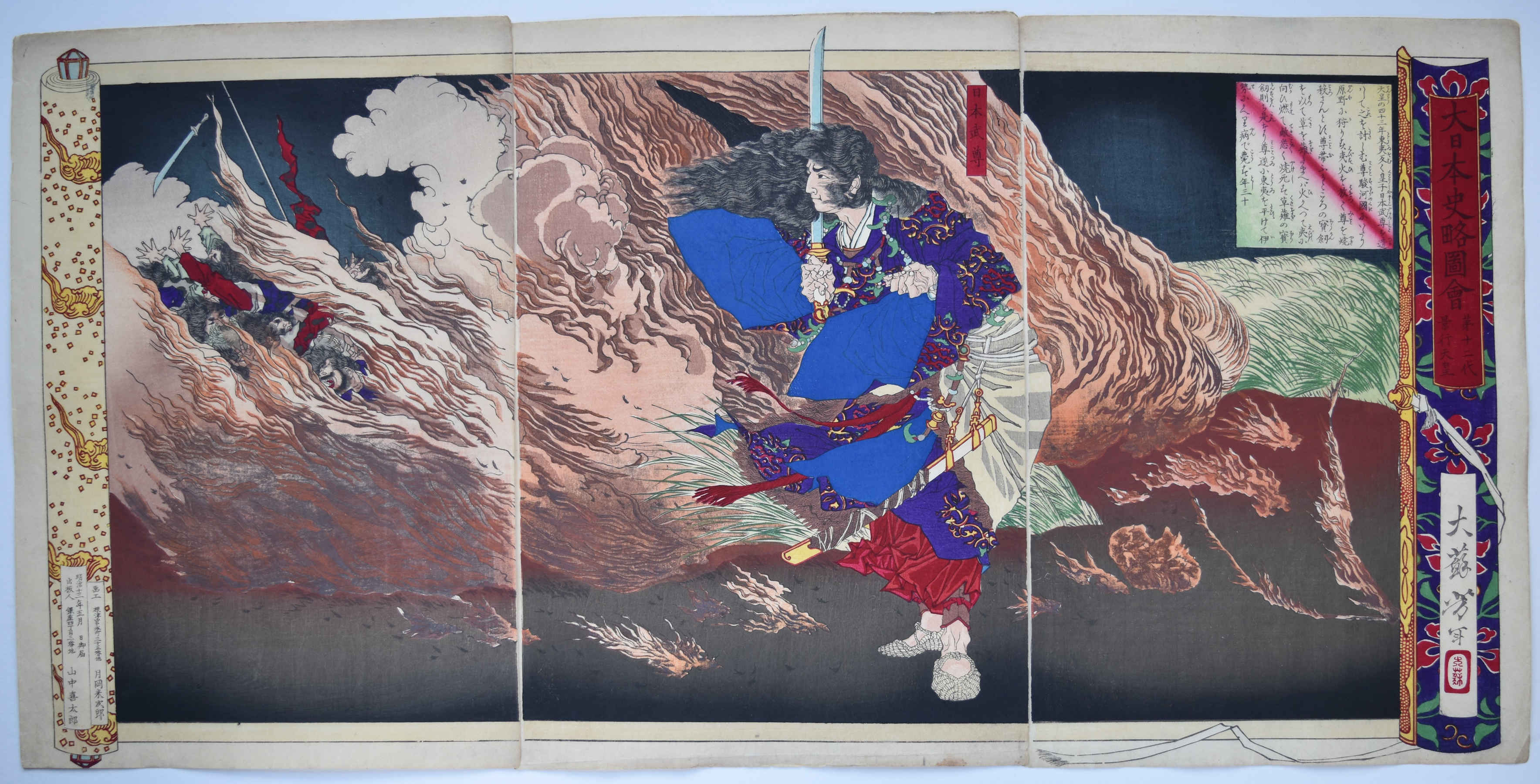
A triptych from a set of ten: Dai Nippon shiryaku zue, “Short Illustrated History of Great Japan.” Each print is in the form of an unrolled makimono. This design shows the third son of the twelfth century Emperor Keiko, Yamato Takeru no mikoto (Wo-usu). His father was constantly sending him on dangerous missions making him suspect that he wished his death. One such journey was to the Emishi in northeast Japan. On complaining about this to his high-priestess aunt, Yamatohime, she gave him the famous sword Ame no murakumo no hoken to aid him. On his arrival, the ruler of the Emishi lured him onto open grassland which he set on fire. Wo-usu used his sword to cut the grass, evade death, and start new fires to kill his enemy. Published by Kobayashi, 1880. A fine design.
Fine impression of first edition. Fine colour. Very slight crease bottom margin of centre sheet, otherwise fine condition. Signed Taiso Yoshitoshi.
Status: Available
Price: £2,800
Toyohara CHIKANOBU (1838-1912)
Click here to view image full size.
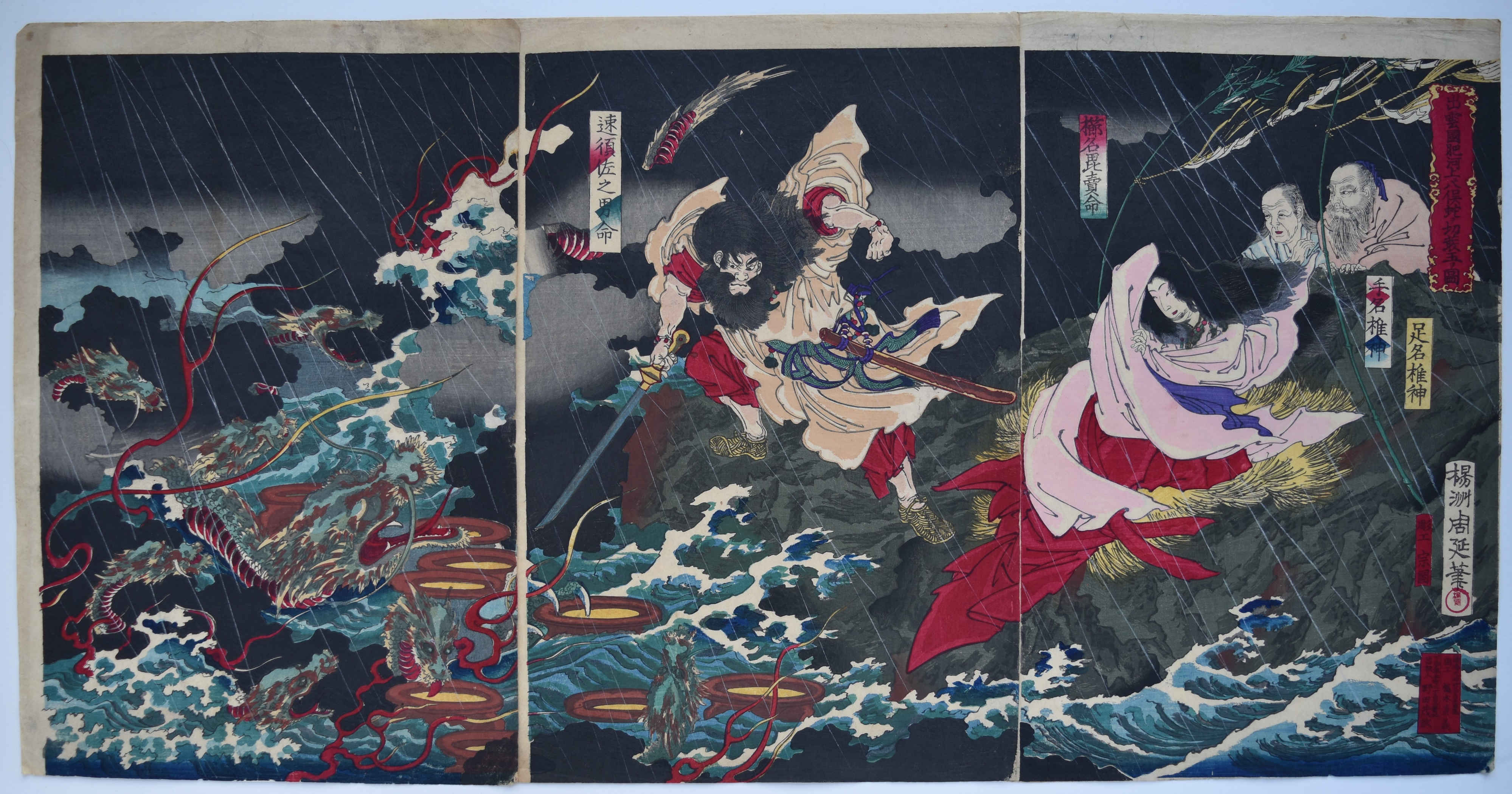
A triptych showing the Shinto Storm God Susanoo about to slay the eight-headed dragon, Yamata no Orochi, at the head of the Hi River in pouring rain. The dragon devoured virgins and had eaten the seven daughters of two earthly deities, seen top right. The eighth, Kushi-inada-hime, also on the right, is saved by Susanoo who encourages the dragon to drink eight-times brewed sake from eight vats which intoxicates it enough to be killed. Rare: Chikanobu is not known for this type of subject. Published c 1870s.
Fine impression, colour and condition. Mica applied to sky and the rain printed in silver. Full size. Signed Yoshu Chikanobu hitsu.
Status: Available
Price: £2,200
Utagawa KUNIYOSHI (1798-1861)
Click here to view image full size.
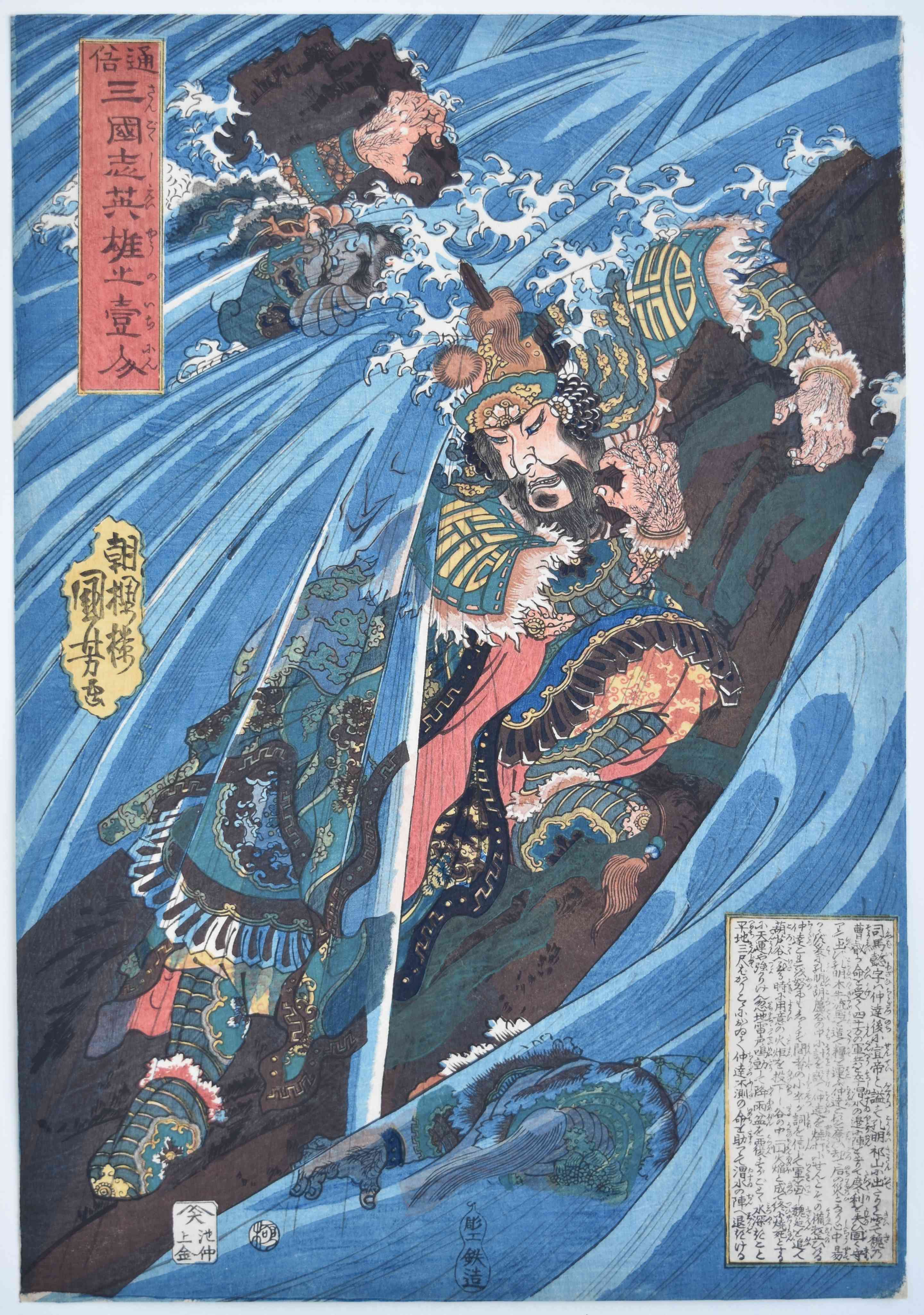
Cao Cao (Jap. Shuso) and Pang De (Jap. Hotoku) in the Han river during the battle with Guan Yu. From a set of Chinese warrior prints: Tsuzoku sangokushi eiyu no ichinin, “Heroes of the Popular History of the Three Kingdoms.” Published by Joshuya Kinzo, c. 1836. Robinson S10.8 (although only known as a key-block proof). Rare.
Superb impression. Very fine colour and condition. As the day it was printed. Signed Chooro Kuniyoshi ga.
Status: Available
Price: £3,800
Utagawa KUNIYOSHI (1797-1861)
Click here to view image full size.
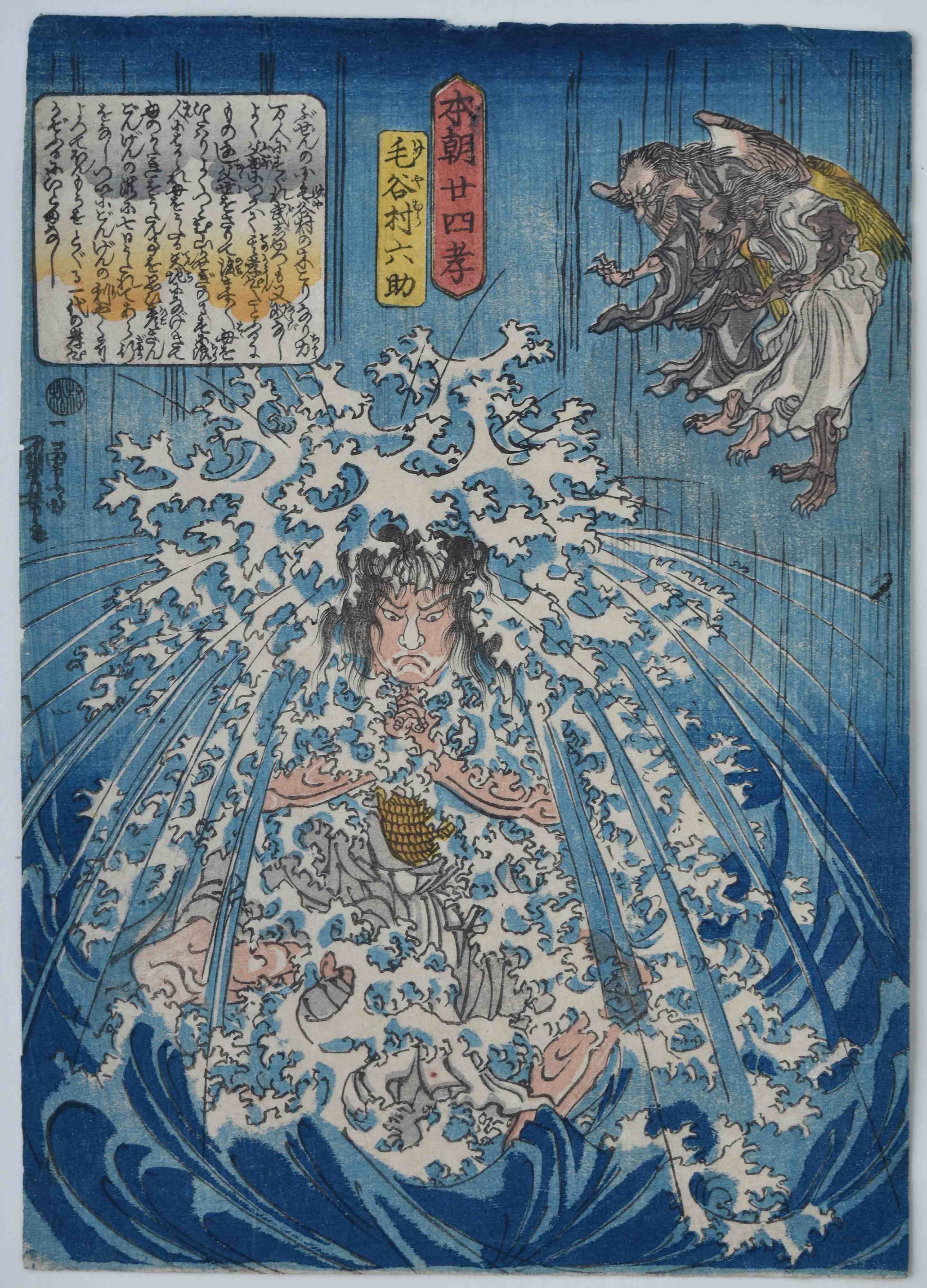
A fine chuban design showing Keyamura Rokusuke (aka Kida Magobee Muneharu), a famous farmer turned samurai and sumo wrestler of incredible strength, doing penance for seven days under the waterfall at Hikosan Gongen praying for his mother. Two Tengu watch from above. Waterfalls were one of the go-to-places to perform filial piety as they were considered to purify the soul in Shinto/Buddhist culture. From a set Honcho nijushiko, “Twenty-four Paragons of Filial Piety of our Country.” Published by Murataya Tetsu, 1843-6.
Fine impression and colour. Small nick out of top, otherwise very good condition. The signature Ichiyusai Kuniyoshi ga is on the extreme left edge and is often trimmed.
Status: Available
Price: £1,800
Utagawa YOSHITORA (1836-1887)
Click here to view image full size.
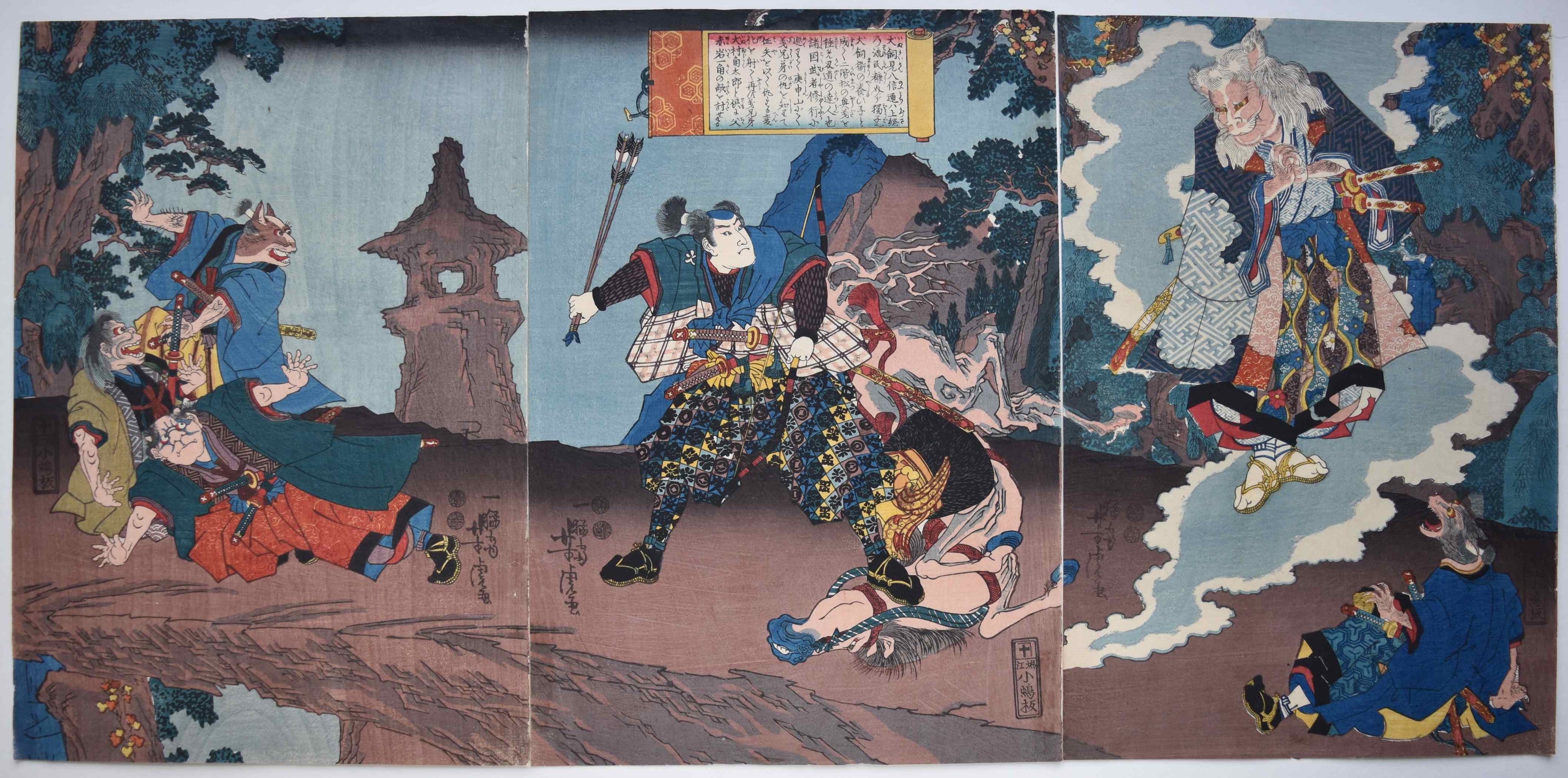
A triptych showing the warrior Inukai Genpachi (the famous character from the Hakkenden) confronting a cat monster which has emanated from a horse on Mount Koshin. Other cat monsters stare in amazement. Published by Kojimaya Jubei, 1850.
Very fine impression. Fine colour. Imperceptible small binding holes, otherwise fine condition. Signed Ichimosai Yoshitora ga.
Status: Available
Price: £3,800
Tsukioka YOSHITOSHI (1839-1892)
Click here to view image full size.
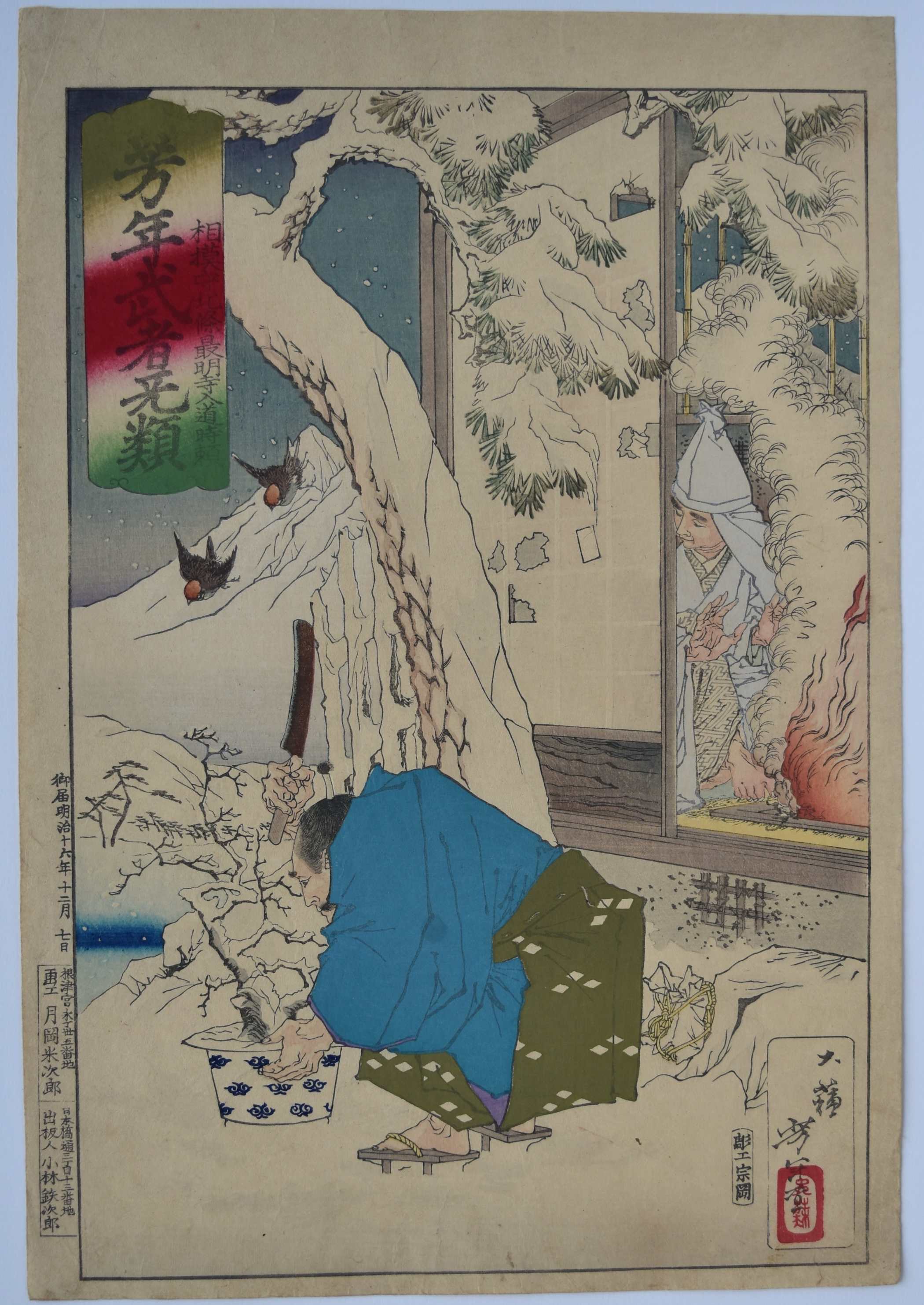
Shows Sano Genzaemon Tsuneyo in his snowy garden about to cut his precious bonsai to provide kindling to cook a meal for an unexpected visitor. The guest, disguised as a monk, was in fact the retired regent Hojo Tokiyori (1226-1263) on an intelligence mission. He is shown peering through the shoji. From a set Yoshitoshi musha burui, “Yoshitoshi’s Courageous Warriors” published by Kobayashi Tetsujiro, 1883. This is the first edition with the heavily variegated cartouche. Some first editions from the set also have red seals in the left margin and some also have the panels below coloured.
Very good impression, colour and condition. Signed Taiso Yoshitoshi ga.
Status: Available
Price: £800
Katsukawa SHUNSHO II (Active 1818-1830)
Click here to view image full size.
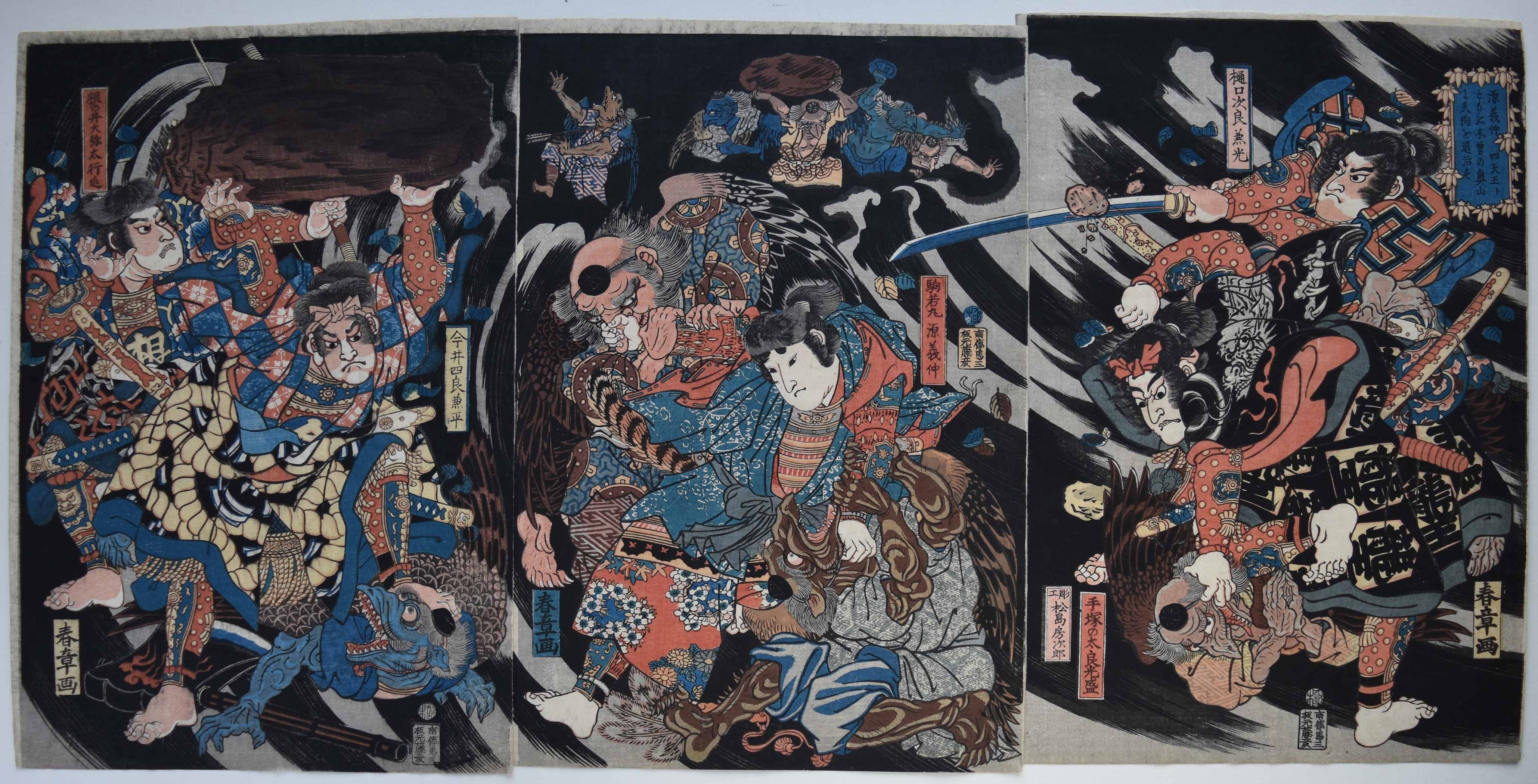
Minamoto no Yoshinaka Shitenno to tomoni Kiso no okuyama ni Tengu o taiji su, “Minamoto Yoshinaka and His Four Retainers Defeat the Tengu in the Deep Mountains of Kiso.” Minamoto no Yoshinaka is seen in the centre panel, Higuchi Kanemitsu on the right holding a sword and Imai Kanehiro on the left panel. Tengu are winged demons or spirits known for their fencing abilities, have long noses or bird-like beaks, and are associated with the ascetic practise of Shugendo and wear the garb of its followers, the Yamabushi. Published by Fujiokaya Hikotaro. Rare: Another impression is in MFA, Boston, accession number 11.21594-6.
Fine impression. Very good colour and condition. Signed Shunsho ga.
Status: Available
Price: £4,800
Utagawa YOSHIHARU (1828-1888)
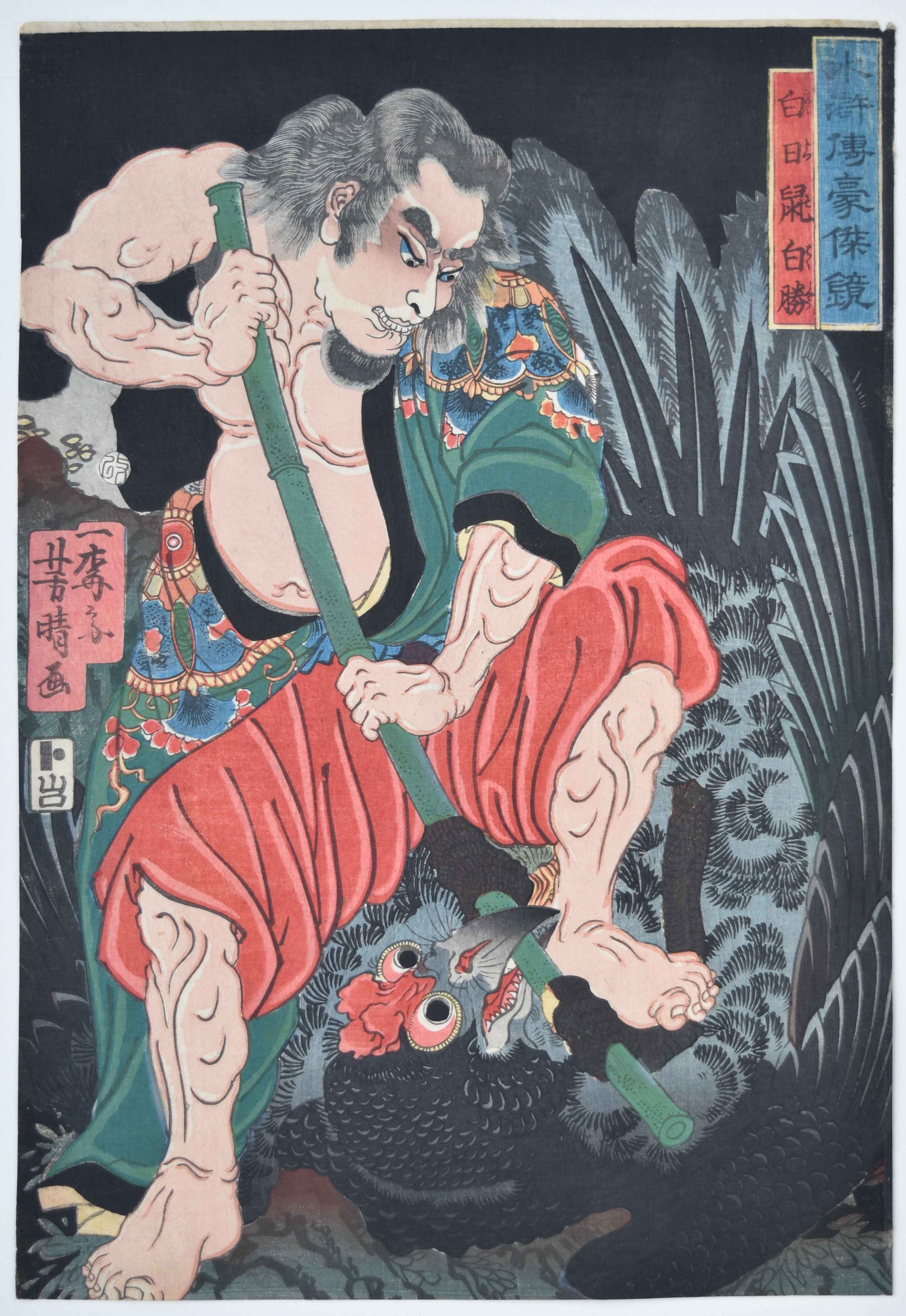
Click here to view image full size.
Shows Hakujisso Hakusho (Chin. Bai Sheng) subduing a giant bird with a bamboo pole. From a set Suikoden goketsu kagami, “Mirror of Heroes of the Suikoden” published by Yamaguchiya Tobei, 1856. This is the first edition with gradation on the bird’s beak and elsewhere and the signature cartouche printed in red. Later editions lack these refinements.
Very fine impression. Fine colour. Slightly trimmed, otherwise very good condition. Signed Ichibaisai Yoshiharu ga.
Status: Available
Price: £1,280
Taiso YOSHITOSHI (1839 – 1892)
Click here to view image full size.
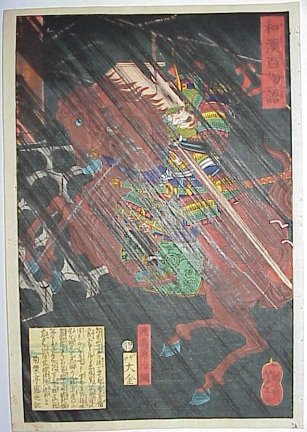
Watanabe no Tsuna on horseback in the rain. One of the finest designs from Wakan hyaku monogatari. Published by Daikin, 1865/2.
Fine impression and colour. Minor wormage otherwise very good condition. Signed Ikkaisai Yoshitoshi ga.
Status: Available
Taiso YOSHITOSHI (1839-1892)
Click here to view image full size.
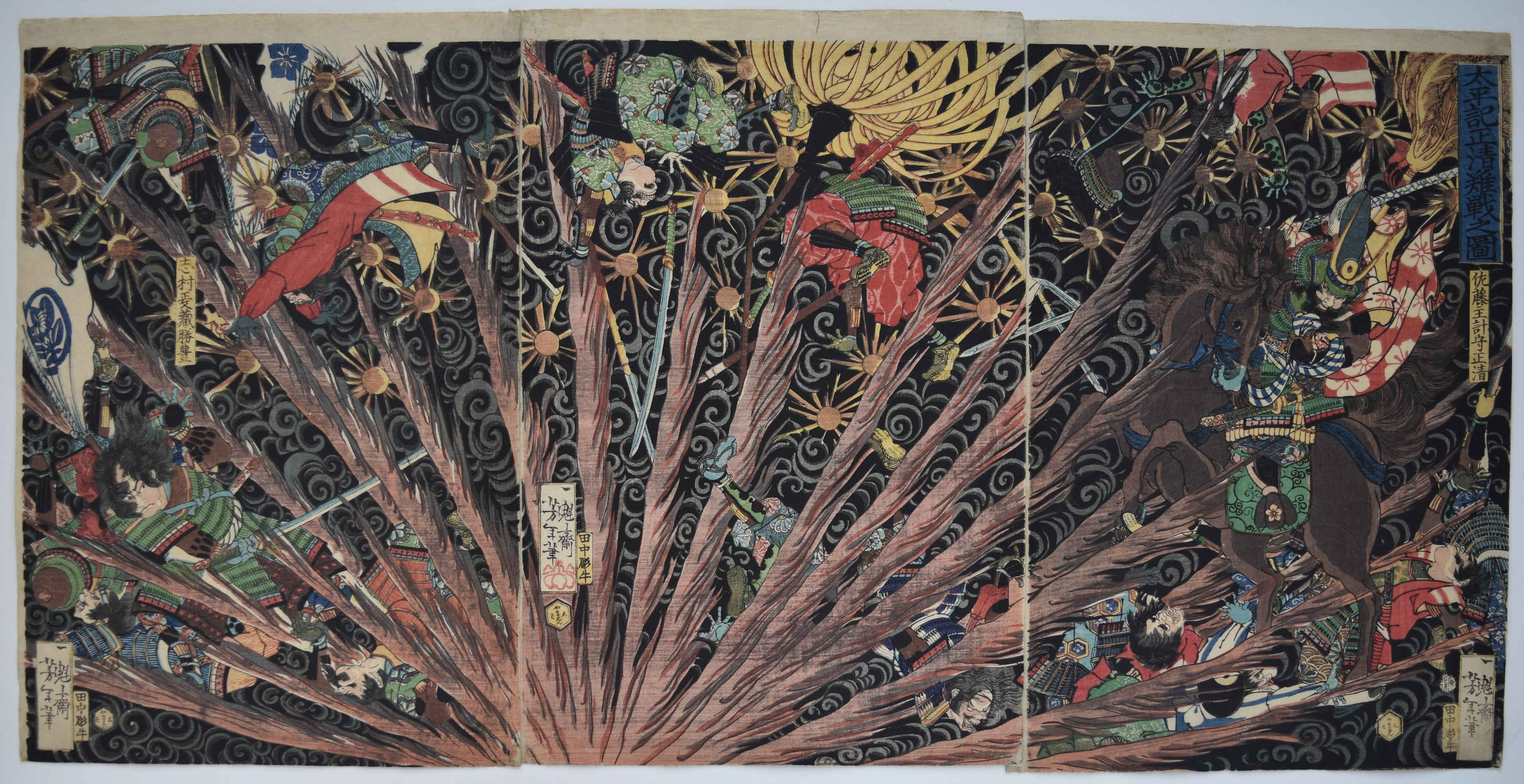
A triptych showing an exploding land-mine throwing bodies and horses into the ether. Taiheiki Masakiyo nansen no zu, “Masakiyo’s Difficult Battle from the Taiheiki.” Figures identified in the print are the 14th century warriors Sato Shukei no Kami Masakiyo and Shimura Masazo Katsutoyo, but by way of avoiding censorship, it is actually showing Kato Kiyomasa (1562-1611) and Kimura Matazo Shigekatsu. It may also be that the design alludes to the rogue samurai in Choshu Province during the summer of 1866. Published by Yamashiroya Jinbei, 1866. One of Yoshitoshi’s great designs. In fact, this is a reworking of a similar composition in a book early in his career, Ehon jitsugokyo dojikyo yoshu of 1853.
Fine impression and colour. Lovely oxidation of the orange pigment. Fine condition. Signed Ikkaisai Yoshitoshi hitsu.
Status: Available
Price: £9,800
Utagawa KUNIYOSHI (1797-1861)
Click here to view image full size.
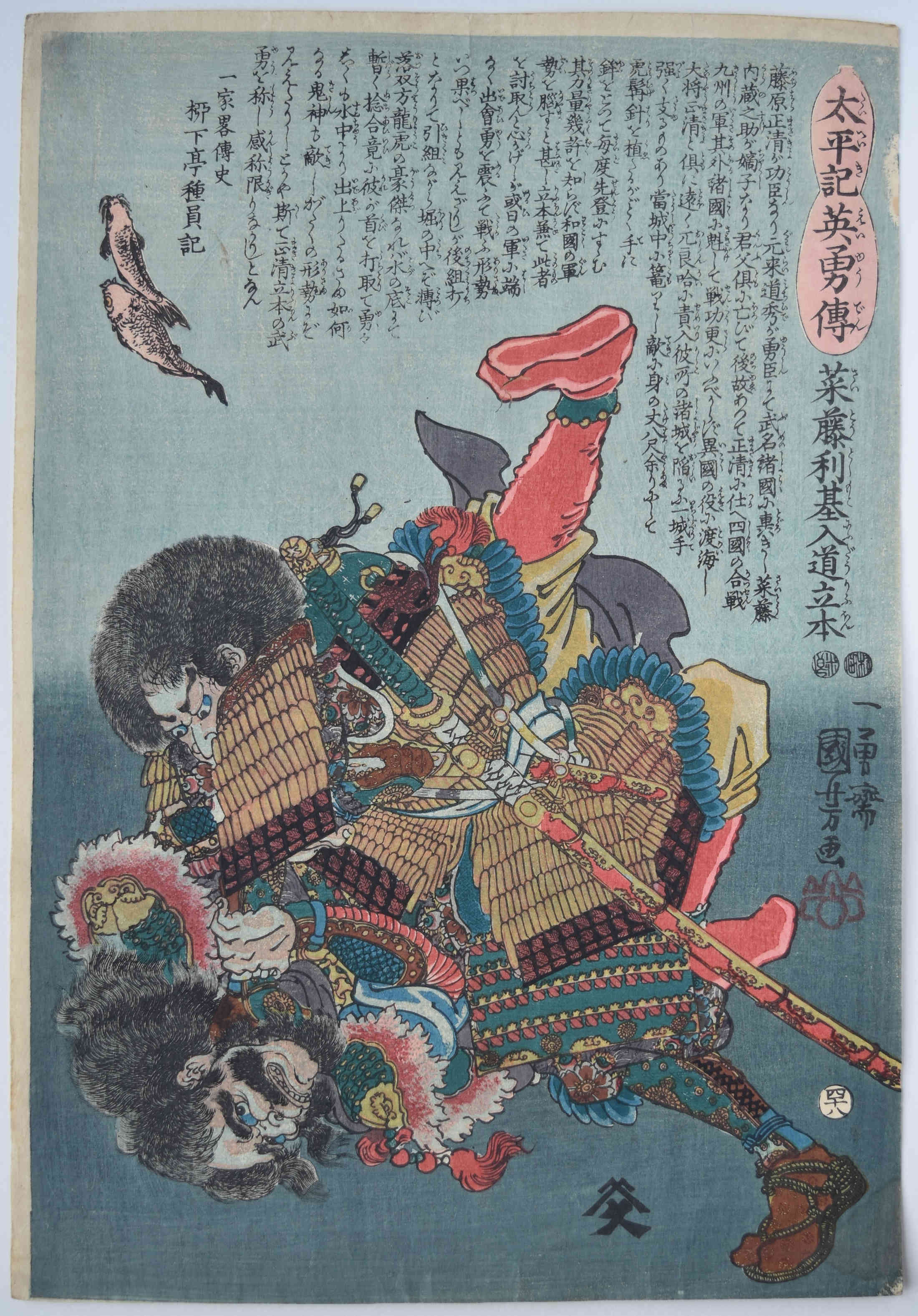
Saito Toshimoto nyudo Ryuhon in armour struggling with a Chinese brigand underwater. From the set Taiheiki yeiyuden, “Heroic Stories of the Taiheiki.” A history of the wars of the loyalist Nitta and Kusunoki families against the Ashikaga war-lords during the second quarter of the 14th century. But in fact the subject of this set of fifty prints is the civil war of the late 16th century. Censorship restrictions imposed in the 1840s prevented publishers from illustrating historical subjects from the Tensho era 1573-92 onwards, so the publishers circumvented this by slightly altering the names of the historical figures. Published 1848-9 by Yamamoto-ya Heikichi. Robinson S62.31. One of the best designs in the set.
Fine impression and colour. Very good condition. Signed Ichiyusai Kuniyoshi ga.
Status: Available
Price: £1,450
Utagawa KUNIYOSHI (1797-1861)
Click here to view image full size.
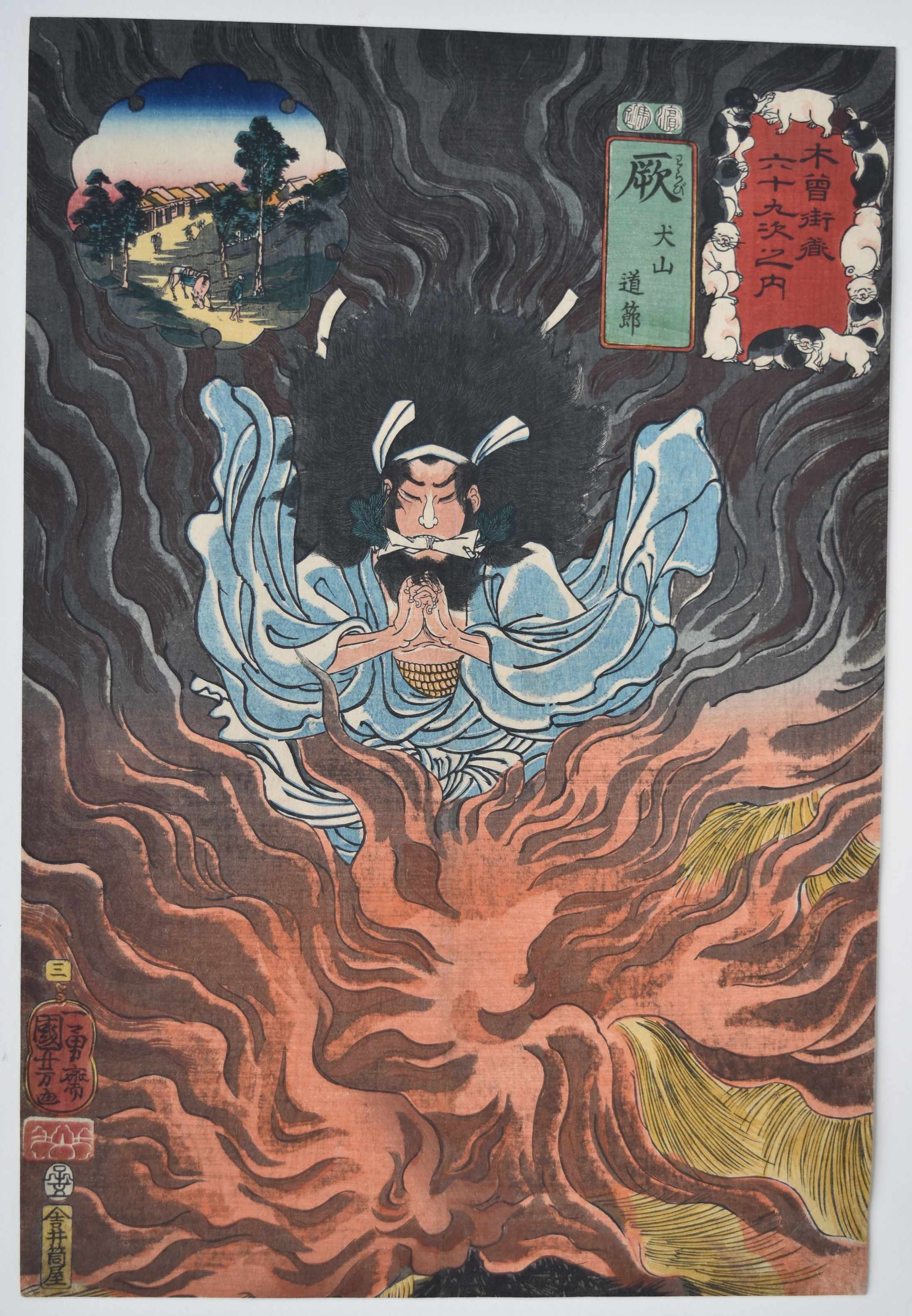
Inuyama Dosetsu, one of the eight dog heroes, enveloped in a conflagration. The heroes represent a Confucian ideal or Buddhist regulation and meet various adversaries in the epic Nanso satomi hakkenden, “Biography of the Eight Dogs” written by Takizawa Bakin between 1814 and 1842. Dosetsu is gifted with magic fire and is seen here with pine sprigs wrapped in paper clenched between his teeth. The subject represents Warabi Station (seen top left) from a set Kisokaido rokujuku tsugi, “Sixty-nine Stations along the Kisokaido.” In fact, a pun on the word warabi which can also mean “straw fire.” The bales can be seen bottom right. Published by Izutsuya Shokichi 1852. The best design from the set.
ga.
Fine impression and colour. Lightly backed and very slight vertical fold, otherwise very good condition. Signed Ichiyusai Kuniyoshi
Status: Available
Price: £1,400
Tsukioka YOSHITOSHI (1839-1892)
Click here to view image full size.
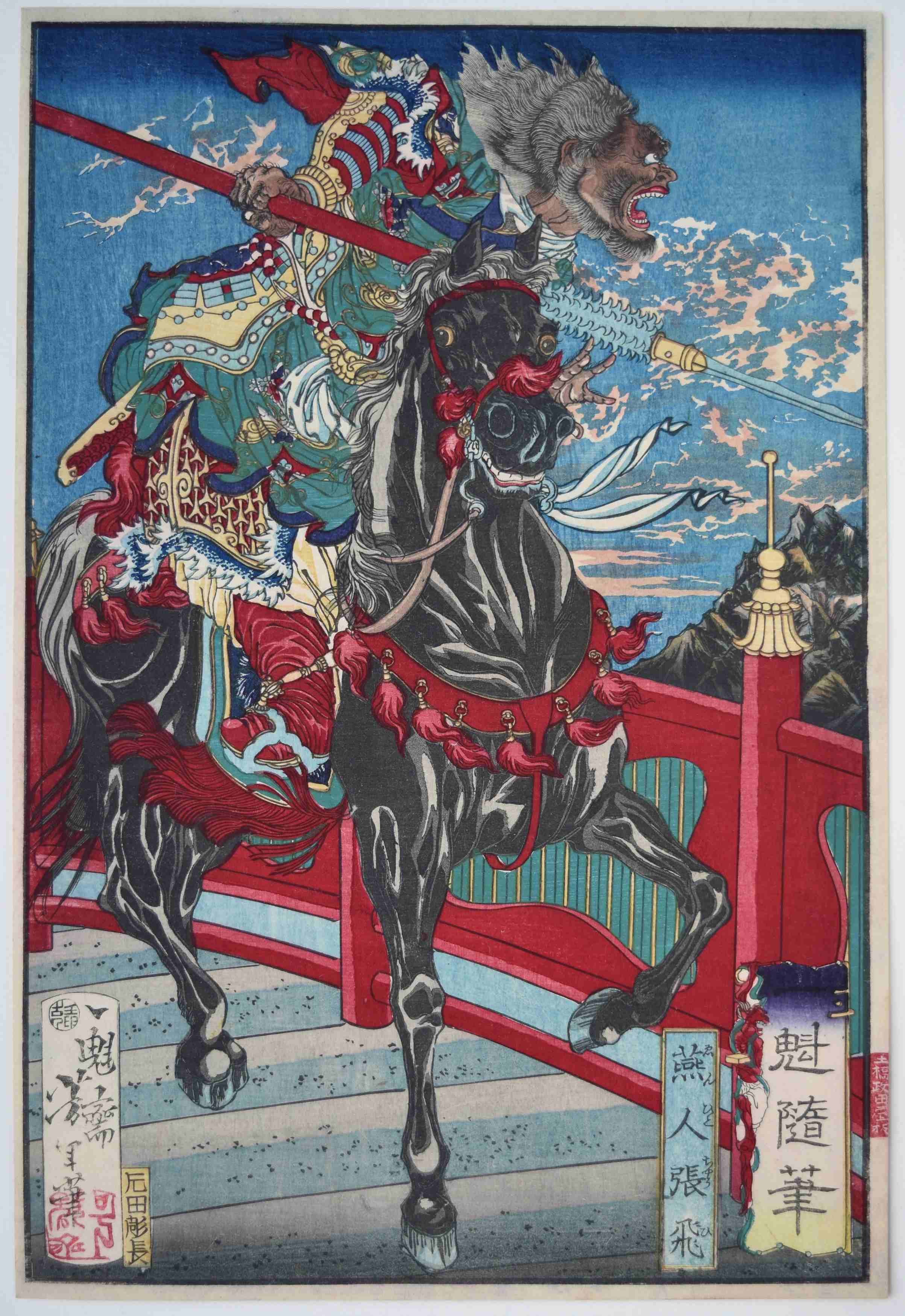
Shows the warrior Zhang Fei (Jap. Yokutoku) awaiting his rival Cao Cao on Changban bridge. Fei tricks his enemy into thinking he leads a vast army by dragging logs from a nearby forest causing a huge dust cloud. Cao Cao retreats. The story is from the Romance of the Three Kingdoms (Chi. Sanguo yanyi). From the set Ikkai zuihitsu, “Essays by Yoshitoshi.” (Ikkai was an early name of Yoshitoshi’s.) A set of thirteen prints published by Masadaya Heikichi 1872/3. A fine set.
Extremely fine impression and colour from the first edition. Fine burnishing on the horse. Most designs from the set have red seals in the margin and red seals over the signature. These were removed on later editions. Margins trimmed a little, otherwise fine condition. Signed Ikkaisai Yoshitoshi hitsu.
Status: Available
Price: £2,500
Tsukioka YOSHITOSHI (1839-1892)
Click here to view image full size.
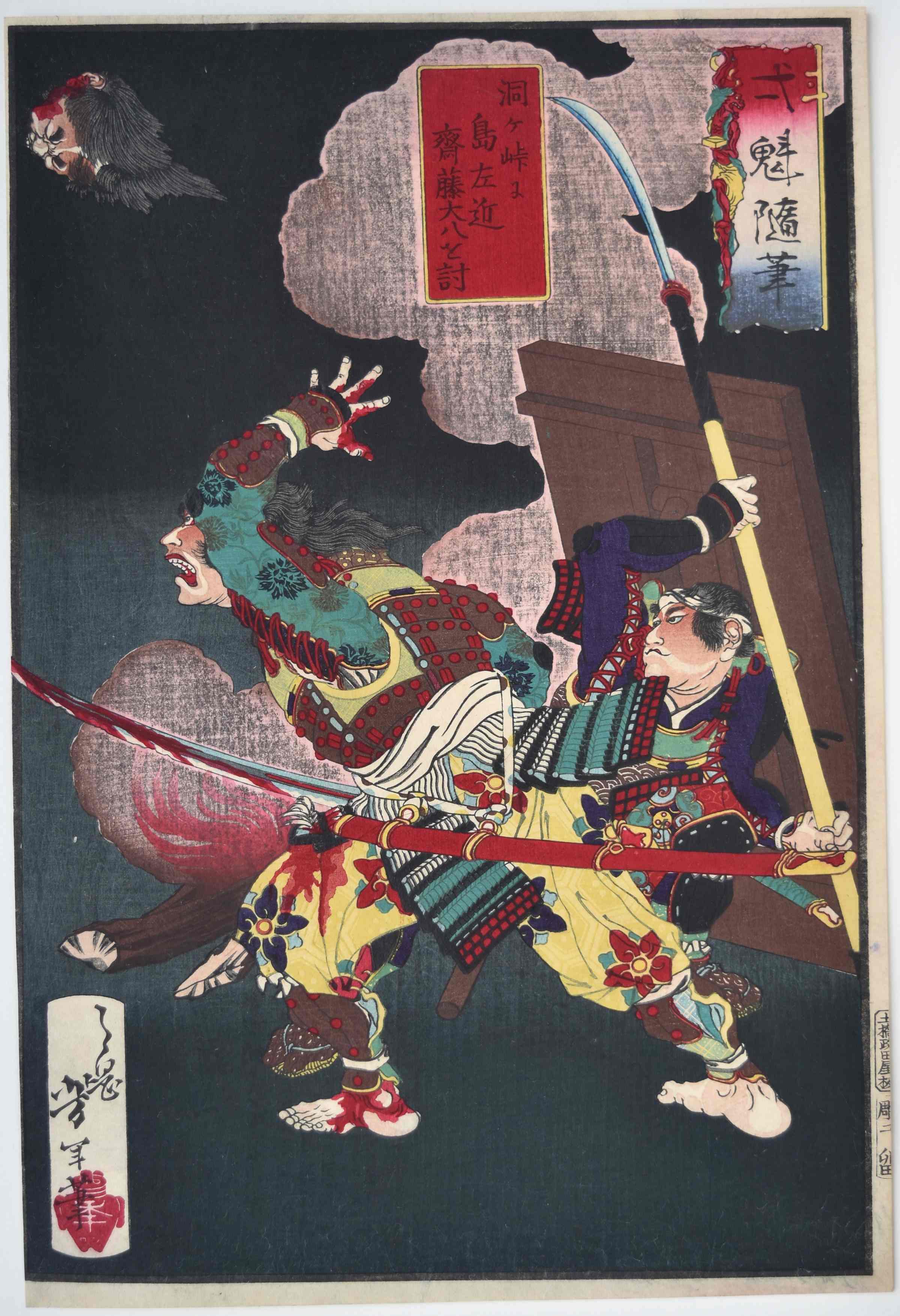
Shows the bloodied western army commander, Shima Sakon, having severed the head of Sato Daihachi, which flies through the air at Horagatoge Pass. Sakon lead an army of his Lord Ishida Mitsunari against the future Shogun Tokugawa Ieyasu at the battle of Sekigahara in 1600. From the set Ikkai zuihitsu, “Essays by Yoshitoshi.” (Ikkai was an early name of Yoshitoshi’s.) A set of thirteen prints published by Masadaya Heikichi 1872/3. A fine set.
Extremely fine impression and colour from the first edition. (There were no red seals on the first edition of this design.) Trimmed on black border at left, otherwise fine condition. Signed Ikkaisai Yoshitoshi hitsu.
Status: Available
Price: £1,500
Tsukioka YOSHITOSHI (1839-1892)
Click here to view image full size.
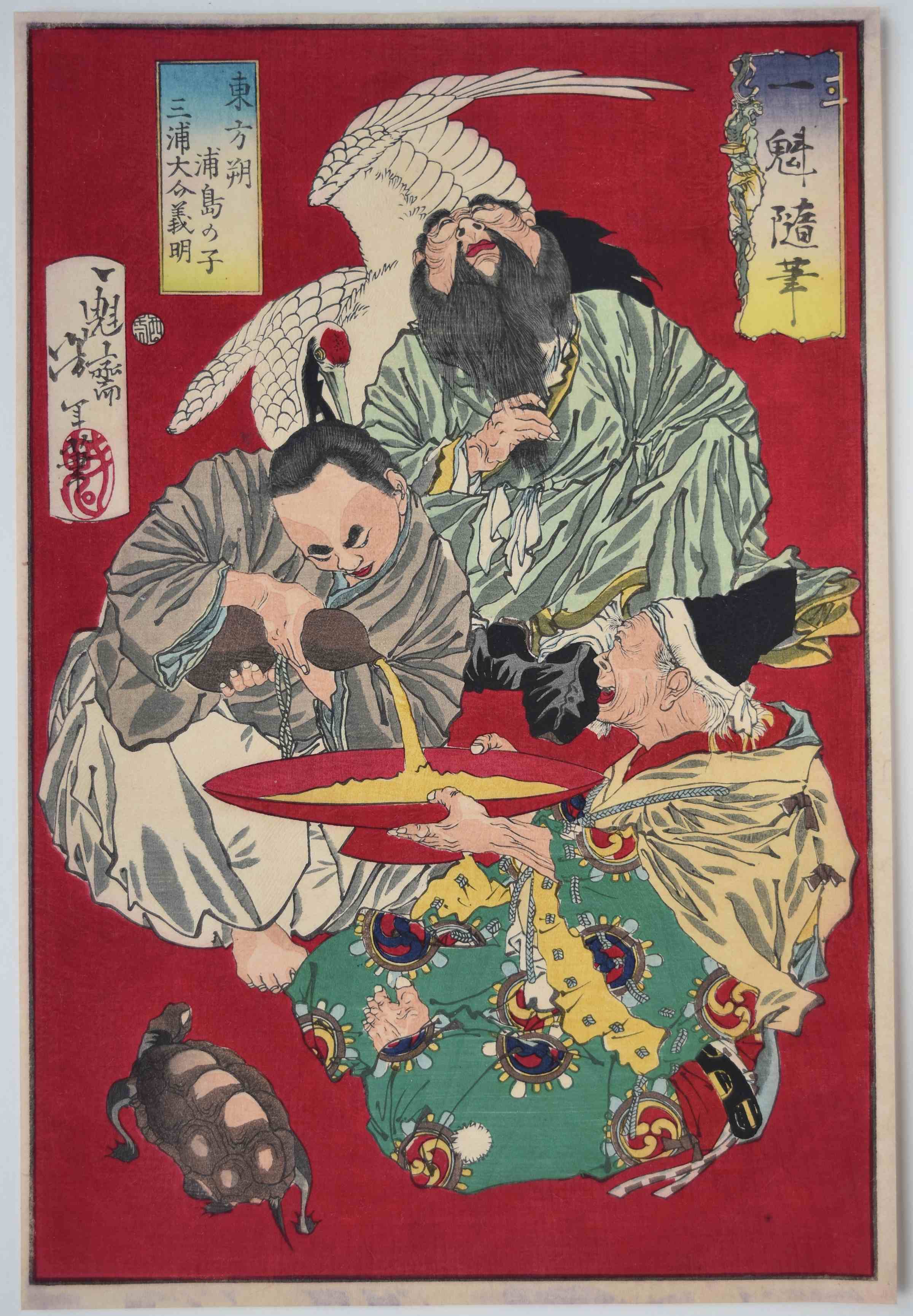
Shows Tobosaku (who stole the Peaches of Immortality), Miura Daisuke Yoshiaki (Lord of Kinugasa castle), and the son of Urashima Taro (who saved the sea turtle and was carried to the Dragon King’s Palace) drinking wine. From the set Ikkai zuihitsu, “Essays by Yoshitoshi.” (Ikkai was an early name of Yoshitoshi’s.) A set of thirteen prints published by Masadaya Heikichi 1872/3. A fine set.
Extremely fine impression and colour from the first edition. (No seals on the first edition.) Margins trimmed a little, otherwise fine condition. Signed Ikkaisai Yoshitoshi hitsu.
Status: Available
Price: £1,500
Utagawa KUNIYOSHI (1797-1861)
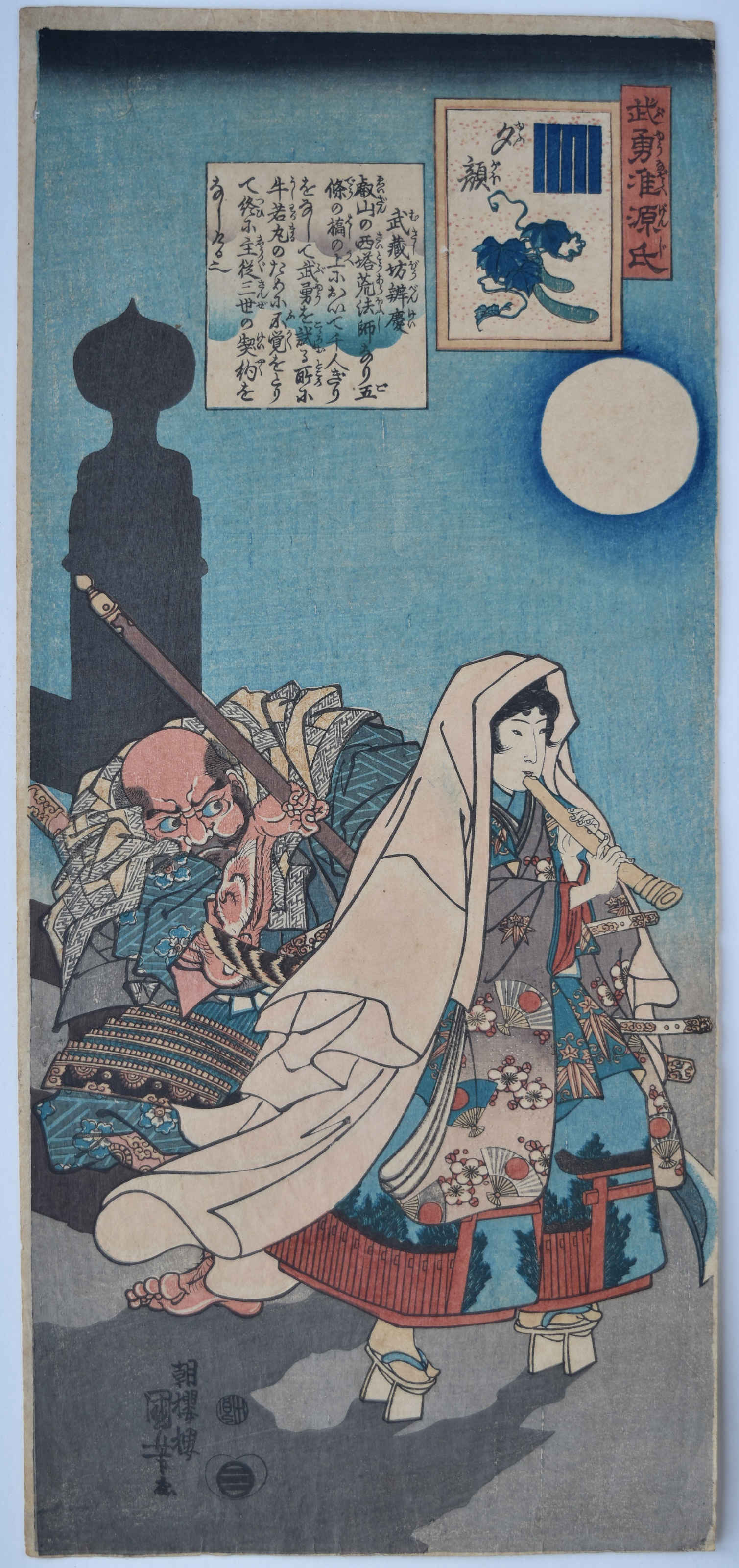
Click here to view image full size.
An o-tanzaku print, Yugao chapter from the fifty-four chapters of Genji, the Genji Monogatari. A tenth century romance written by Murasaki Shikibu. From a set Buyu nazoraye Genji, “Heroic Comparisons for the Chapters of Genji.” In this case showing Benkei creeping up on Ushiwaka on Gojo Bridge in Kyoto. The story relates how Benkei only needs one more blade to add to the 999 he has wrenched from samurai attempting to cross the bridge in order to fashion an invincible weapon. Benkei loses the fight and becomes Yoshitsune’s loyal retainer. Published by Ibaya Sensaburo, c. 1843.
Fine impression and colour. Very good condition. Signed Cho-o-ro Kuniyoshi ga.
Status: Available
Price: £2,500
Tsukioka YOSHITOSHI (1839-1892)
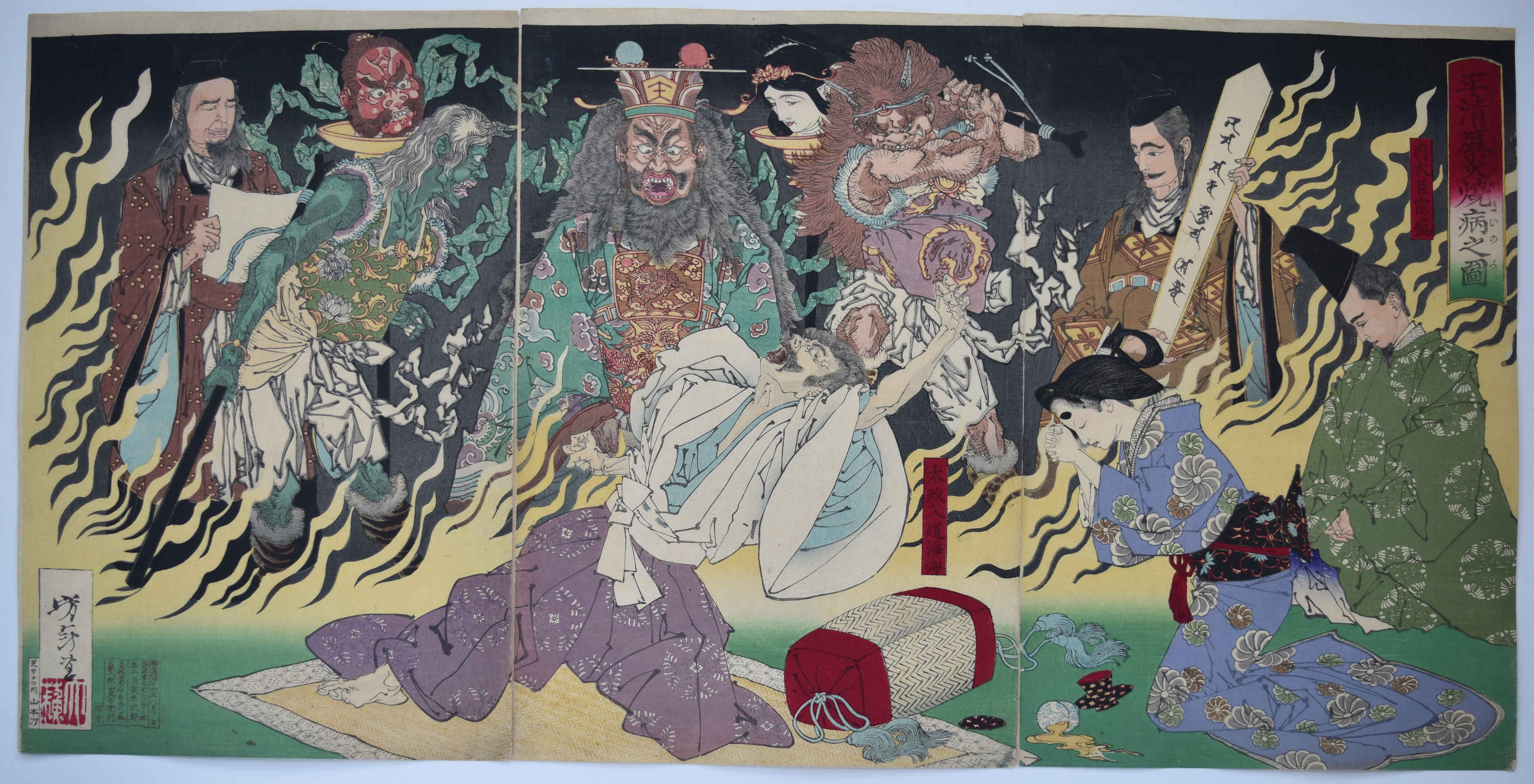
Click here to view image full size.
A triptych Taira Kiyomori hi no yamai no zu, “The Fever of Taira no Kiyomori.” Kiyomori’s wife, Niidono, dreams that the King of Hell, Ema, is coming for Kiyomori for his crime of burning the Rushana Buddha. His family gather around him and pray but to no avail. He dies on the 4/2/1181. Shows Niidono and her son beside a convulsed Kiyomori. Behind are visions of hell with Ema and figures who may have been Kiyomori’s victims. Published by Akiyama Buemon, 1883.
Fine impression, colour and condition. A lovely copy of this triptych. Signed Yoshitoshi ga.
Status: Available
Price: £3,900
Utagawa KUNIYOSHI (1797-1861)
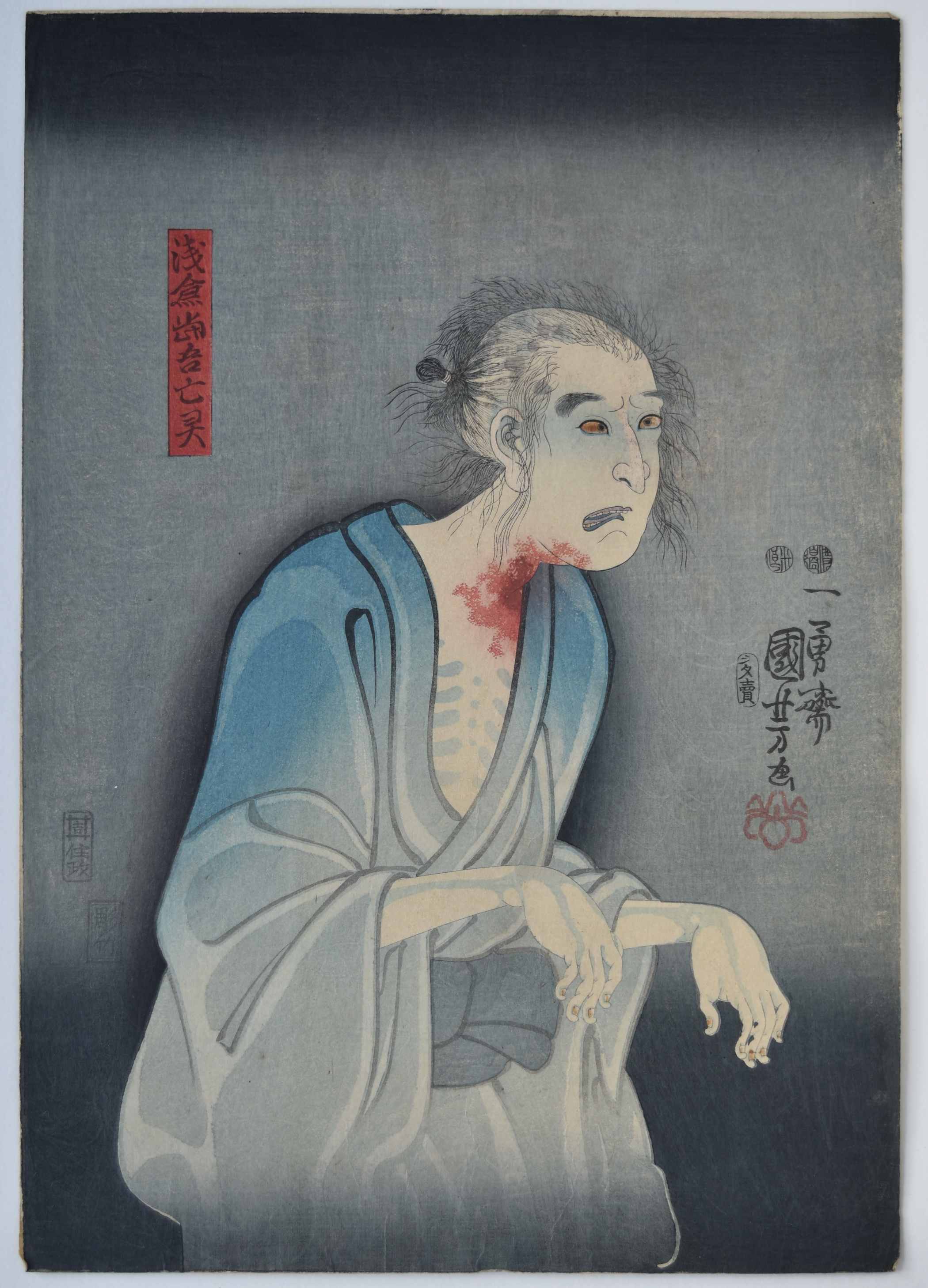
Click here to view image full size.
Ichikawa Kodanji IV as the ghost of Asakura Togo in the play Higashiyama Sakura zoshi, “The Story of Sakura of Higashiyama.” Based on historical events in 1653 with the characters’ names changed (Asakura Togo was actually Sakura Sogoro). The story tells of a village chief who was forced to witness the beheading of his sons before being crucified by the cruel samurai Lord Hotta Kozuki, after he had protested at the levy of unfair taxes. Sakura’s ghost returns to haunt Hotta’s castle. In fact the left sheet of a diptych. However, nearly always sold as a single sheet as the other side does not marry up, is undistinguished and was probably sold separately. Published by Sumiyoshi Masagoro, 1851. Beside the signature is the seal shita-uri, “low sale” meaning it was sold “under the counter” due to censorship laws prevalent at the time. This is the very rare first edition with the carver’s seal Hori Take, Yokokawa Takejiro, to the right of the publisher’s seal on the left. This was removed on later editions. One of the great ghost prints.
Fine impression, colour and condition with gum applied to the eyes (only found on the first edition).Signed Ichiyusai Kuniyoshi ga.
Status: Available
Price: £4,500
Utagawa KUNIYOSHI (1797-1861)
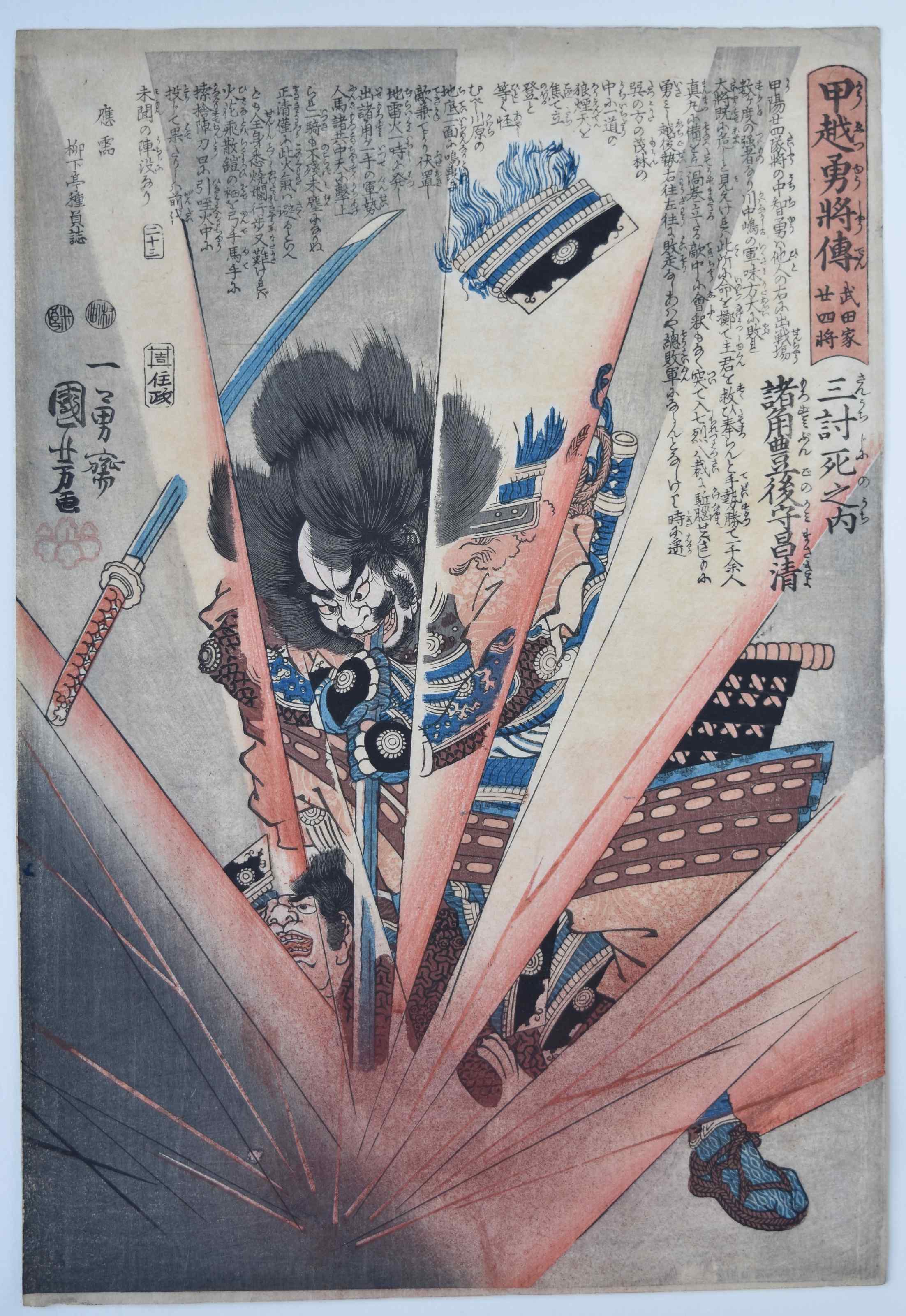
Click here to view image full size.
The general Morozumi Masakiyo, Lord of Bungo and a retainer of the Takeda Clan (Shingen of Kai Province) in a battle with the Uesugi Clan (Kenshin of Echigo Province), The wars taking place between 1553 and 1563. From a set Koetsu yusho den, “Stories of Courageous Generals of the Provinces of Echigo and Kai.” Masakiyo is shown committing suicide by inserting his sword into his mouth while being blown up by a land-mine. As with so much in Japan, the land-mine originated in China from early times. Published by Sumiyoshiya Masagoro, c 1848-9. One of the “three great deaths” of these wars.
Very good impression with extensive sprayed pigment around the exploding mine. Slight fading, otherwise very good condition. Signed Ichiyusai Kuniyoshi ga.
Status: Available
Price: £2,800
Utagawa KUNIYOSHI (1797-1861)
Click here to view image full size.
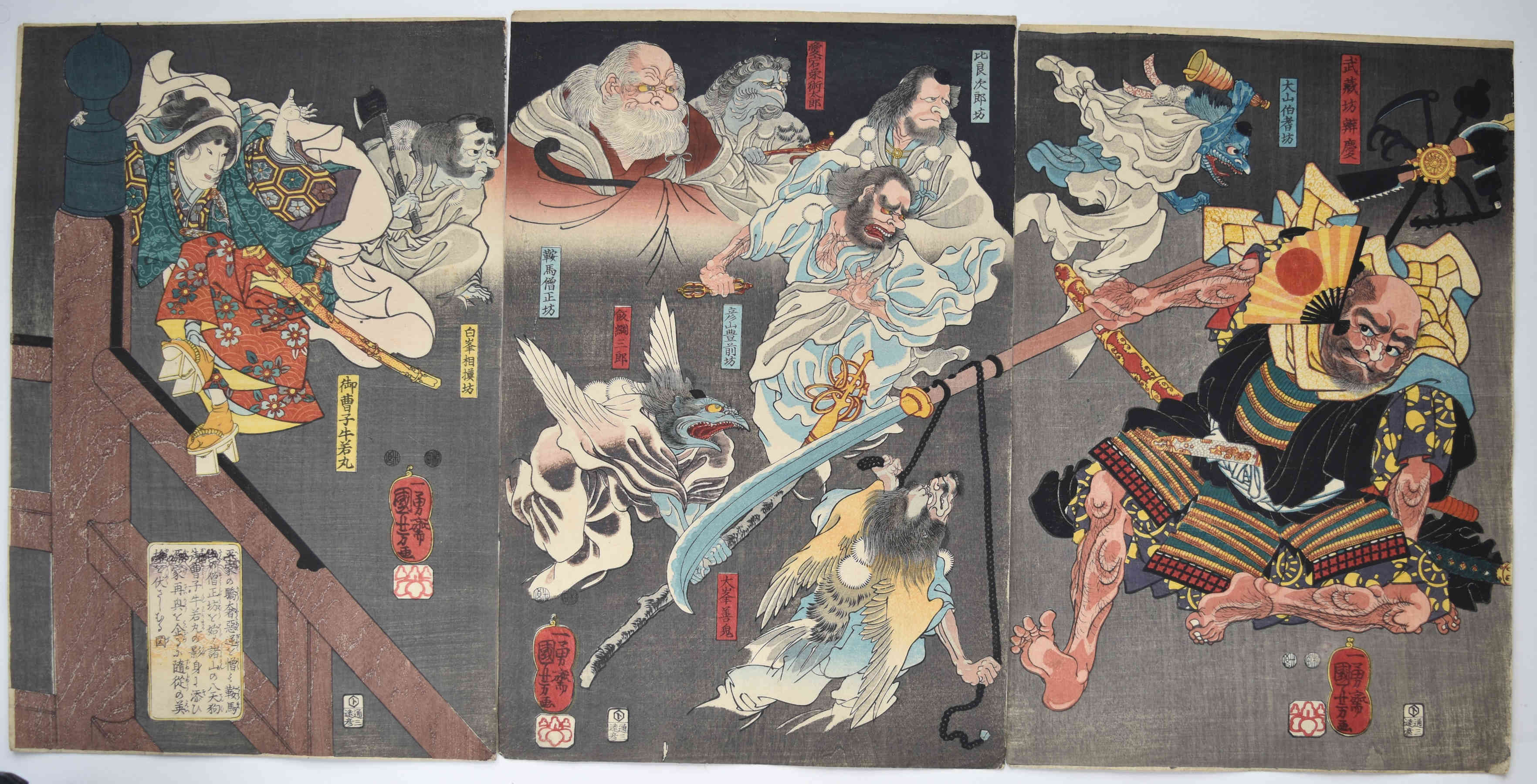
A triptych showing the famous battle on Gojo Bridge. The story relates how Benkei only needs one more blade to add to the 999 he has wrenched from samurai attempting to cross the bridge in order to fashion an invincible weapon. He meets Ushiwaka Maru (Minamoto no Yoshitsune’s childhood name) and challenges him to a fight on the bridge. Yoshitsune is aided by Sojobo, King of the Tengu (white-bearded in the centre) and other yamabushi tengu. Benkei loses the fight and becomes Yoshitsune’s loyal retainer. Published by Enshuya Hikobei, 1847-50. Robinson T194.
Fine impression, colour and condition. A lovely copy of this triptych. Signed Ichiyusai Kuniyoshi ga.
Status: Available
Price: £3,800
Tsukioka YOSHITOSHI (1839-1892)
Click here to view image full size.
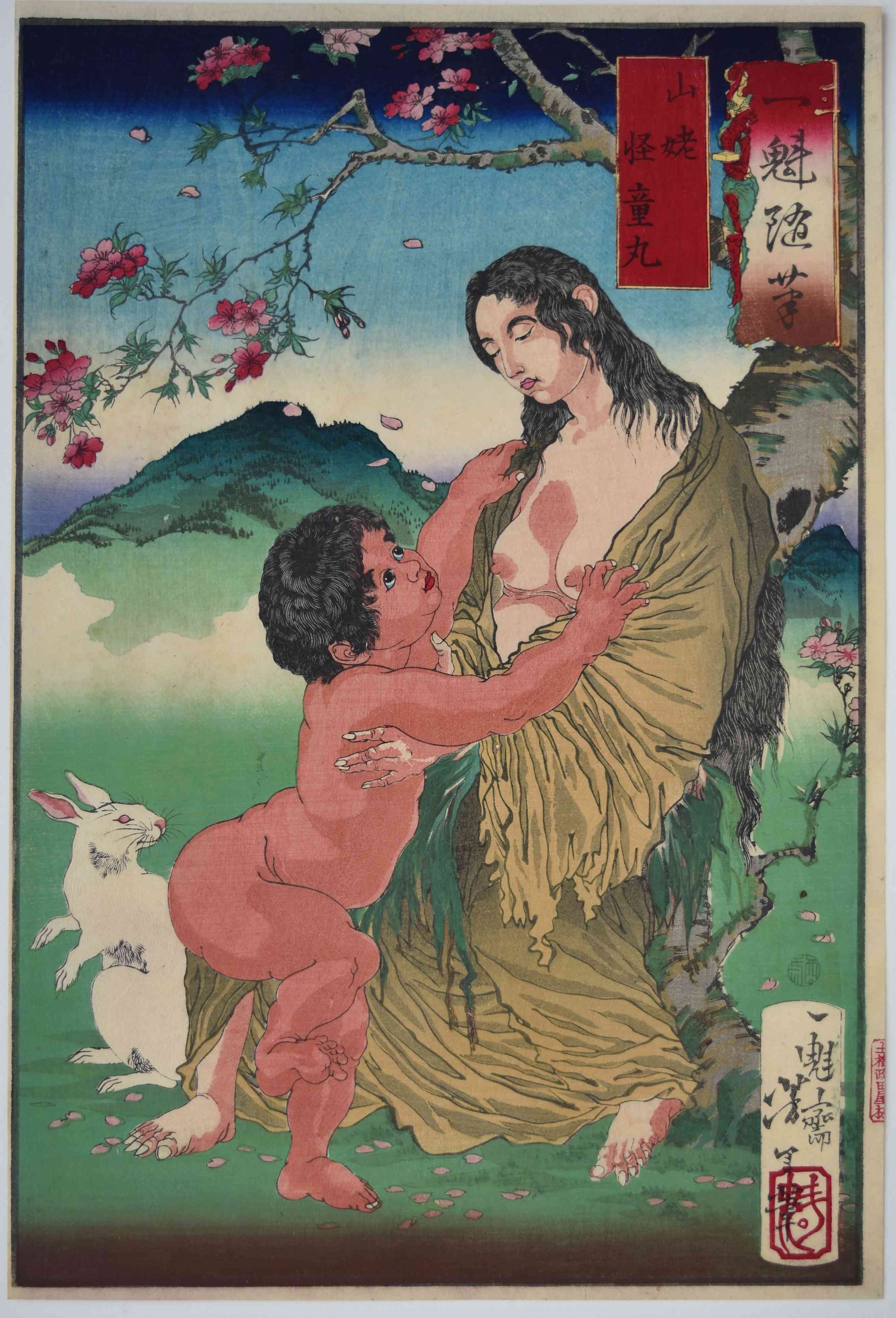
A fascinating print showing Kintoki (aka Kintaro and Sakata Kaidomaru) and yama-uba beneath a flowering cherry tree. Strong western elements are obvious in this design indicating a knowledge of (probably) Flemish Madonna and Child paintings or icons, Kintoki standing in for the child Jesus. Yama-uba is depicted as a bare-breasted benign mother figure, rather than the wizened witch which is how she is usually shown, having raised Kintoki on Mount Ashigara. From the set Ikkai zuihitsu, “Essays by Yoshitoshi.” (Ikkai was an early name of Yoshitoshi’s.) A set of thirteen prints published by Masadaya Heikichi 1872/3. A fine set.
Extremely fine impression and colour from the first edition with a brown Kintoki (rather than bright red) and the red seals in the margin and over signature. The white hare’s coat is blind-printed. Margins trimmed a little, otherwise fine condition. Signed Ikkaisai Yoshitoshi hitsu.
Status: Available
Price: £2,200
Kobayashi KIYOCHIKA (1847-1915)
Click here to view image full size.
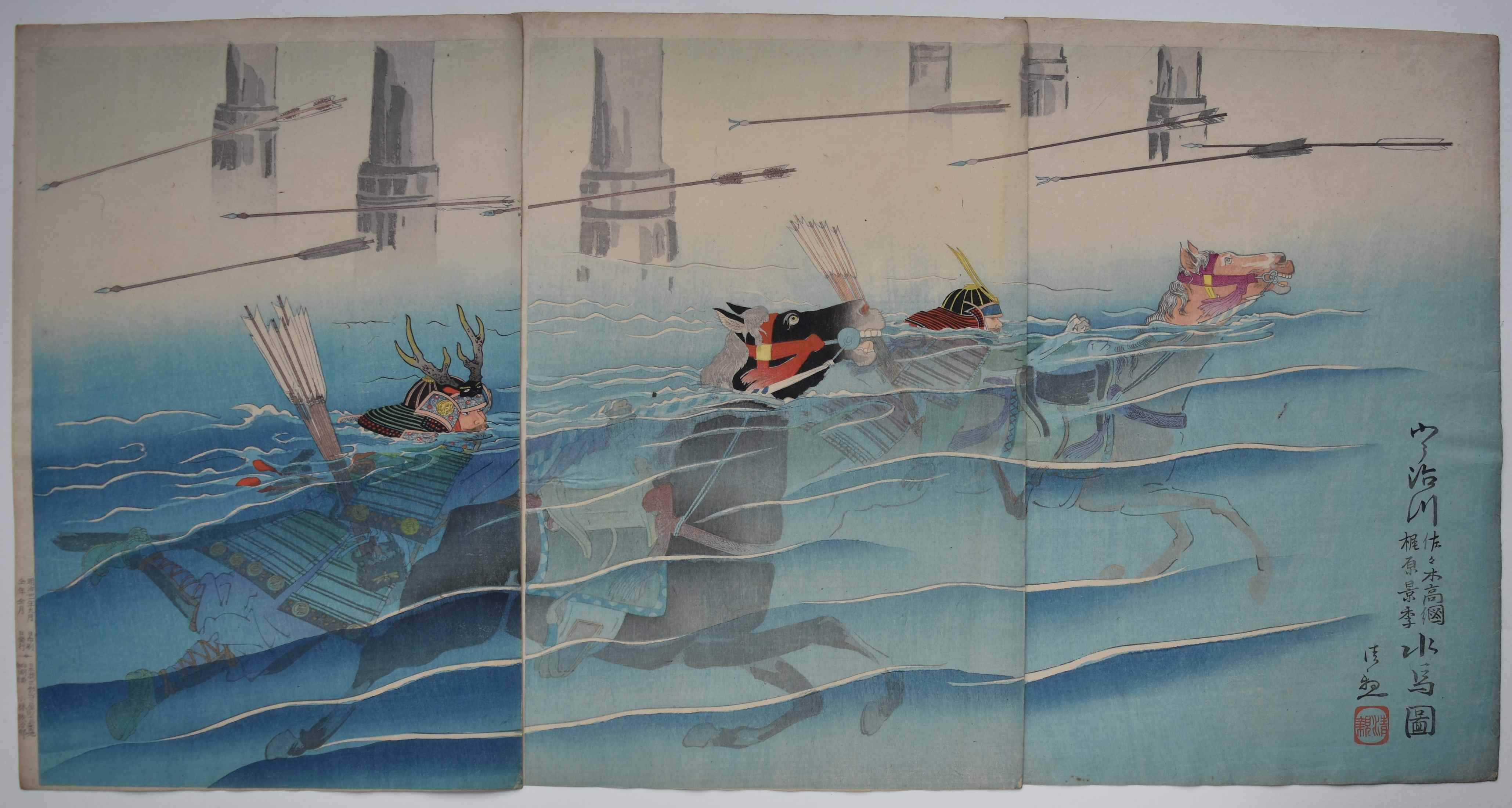
A triptych Ujigawa Kajiwara Kagesue, Sasaki Takatsuna, miju uma. Yoshitsune is informed that Kiso no Yoshinaka is entrenched behind the natural defence of the Uji river, then in full flood. Yoshitsune calls on Kajiwara Kagesue and Sayemon-no-jo Sasaki Shiro Takatsuna to make an attempt at fording the river. He gives them his best horses: Surusumi to Kagesue and Iketsuki to Takatsuna. They plunge into the river beside their horses with Takatsuna, dodging the hail of arrows, arriving first. One of Kiyochika’s best designs. Published 1899.
Fine impression, colour and condition. Untrimmed with margins intact. Signed Kiyochika.
Status: Available
Price: £2,500
Katsukawa SHUN’EI (1762-1819)
Click here to view image full size.
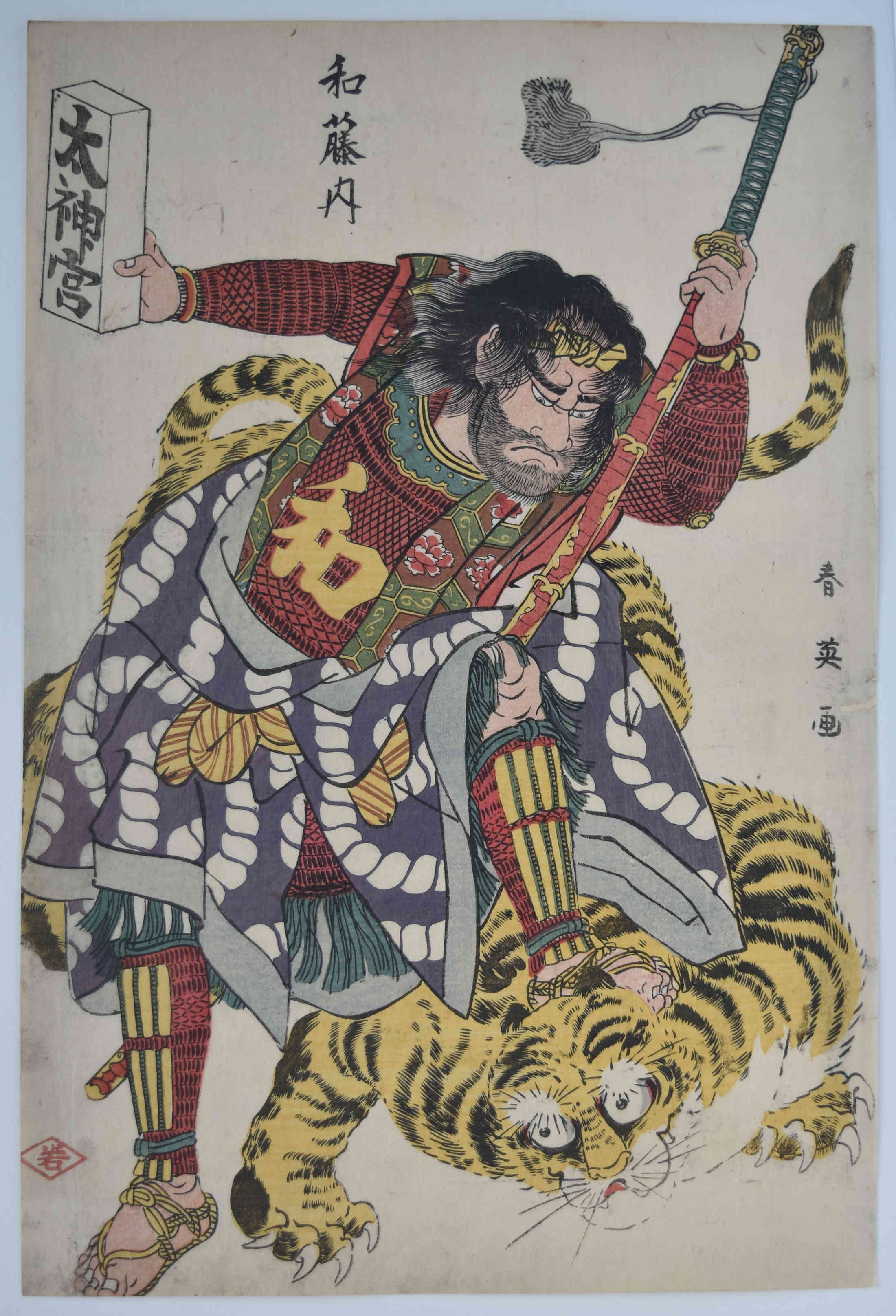
Shows the half-Chinese, half-Japanese hero Watonai overcomes a man-eating tiger in China by using a charm from the Ise Shrine. He holds a post with the characters reading Daijinga, “Grand Shrine” used in the inner and outer shrines at Ise. Published by Wakasaya Yoichi (Jakurindo), c 1810. Rare.
Fine impression and colour. One small backed edge wormhole, otherwise very good condition. Signed Shun’ei ga
Status: Available
Price: £3,200
Tsukioka YOSHITOSHI (1839-1892)
Click here to view image full size.
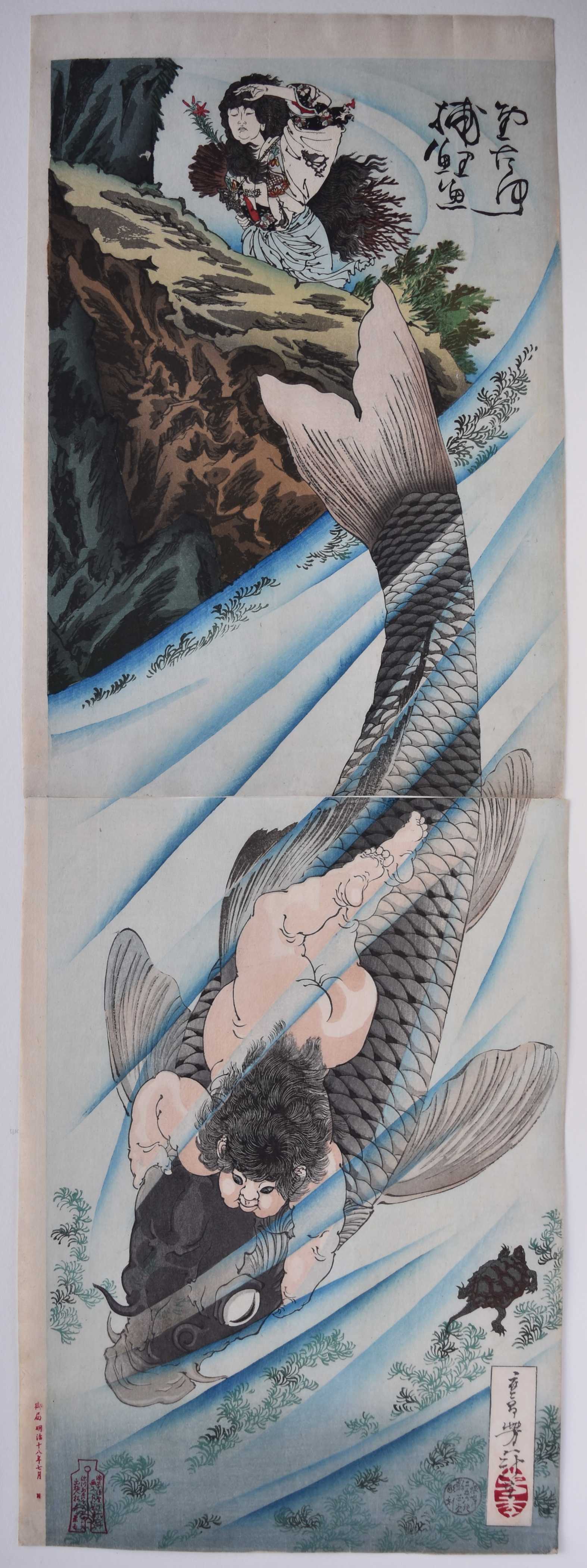
Kintaro rigyo o toru, “Kintaro Captures the Carp.” The “golden boy” of superhuman strength, a.k.a. Sakata no Kintoki and Kaidomaru, grapples with a giant carp which had been terrorizing the neighbourhood. There are conflicting stories about Kintaro’s origins but he is normally shown with his mother, Yama-uba, on Mount Ashigara where he developed a friendship with the mountain animals. The carp is associated with enormous strength and consequently needed great power to overcome it. From a set of fine vertical diptychs published by Matsui Eikichi, this design in 1885. It was republished by Hasegawa Tsunejiro in 1897. Arguably the best print from the set and one of Yoshitoshi’s finest designs.
Fine impression. Very good colour and condition. With full margins: This set often comes with the left margin, with the publication date, trimmed off. Signed Oju Yoshitoshi ga..
Status: Available
Price: £4,200
Tsukioka YOSHITOSHI (1839-1892)
Click here to view image full size.
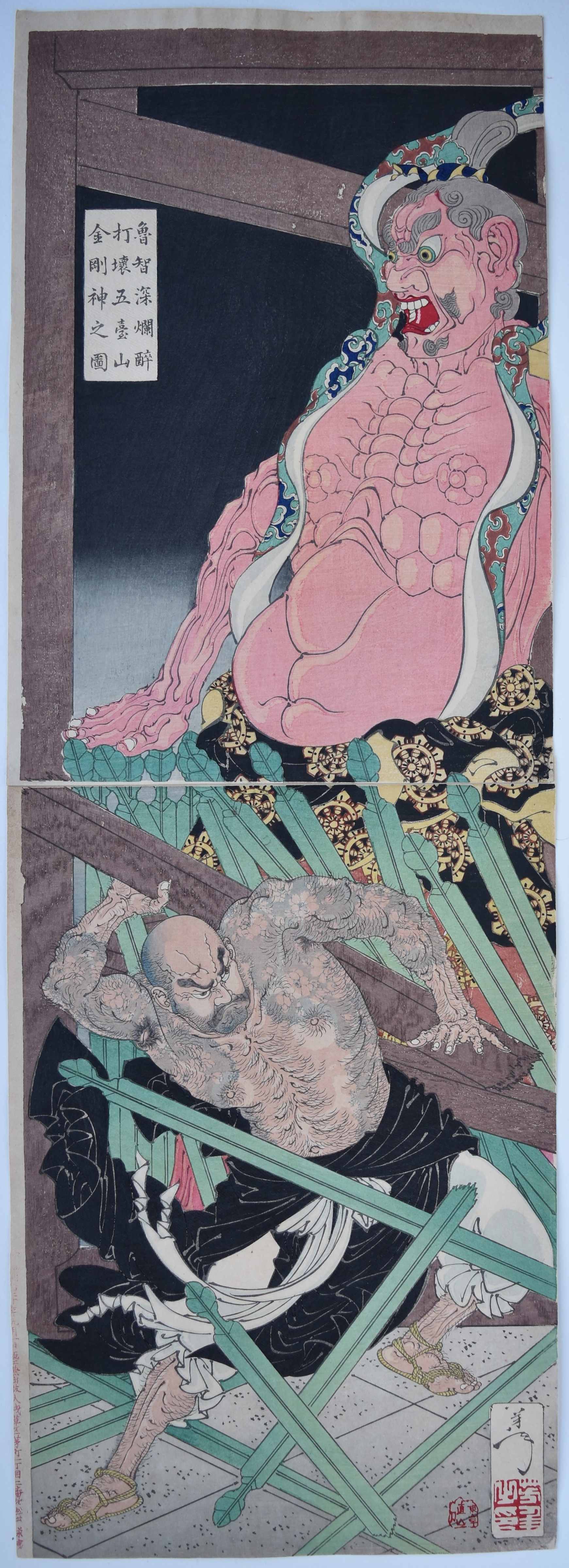
A vertical diptych showing Rochishin demolishing the temple gate on Mount Godai. There are conflicting versions of this event: Some suggest he gained entry to kill a gang of thieves. However, it seems that he was drunkenly staggering back to the temple after consuming a large quantity of wine and is barred entry by the monks. In a temper he demolishes the entrance and the large Buddhist guardian figure (Kongojin). The abbot dismisses him and sends him to a lesser temple. Rochishin ransui Godaisan Kongojin o uchikowasu no zu, “Picture of Rochishin in a Drunken Rage Demolishing a Guardian Statue (Kongojin) on Mount Godai.” Published by Matsui Eikichi, 1887. He figures in the Chinese classic Tales of the Water Margin, the Suikoden (jp. Suikoden) and is often referred to as the “Flower priest” because of his floral tattoos.
Very fine impression: This is the earliest state with a pigment used on the guardian’s torso that does not oxidise. (Exactly the same can be seen on the first editions of the Kinryusan Temple at Asakusa from Hiroshige’s 100 Views of Edo. Later printings use a different pigment on the huge lantern that oxidises badly.) It was also republished by Shimizuya Tsunejiro. Extensive burnishing. Fine colour. Very good condition. Signed Yoshitoshi.
Status: Available
Price: £4,800
Tsukioka YOSHITOSHI (1839-1892)
Click here to view image full size.
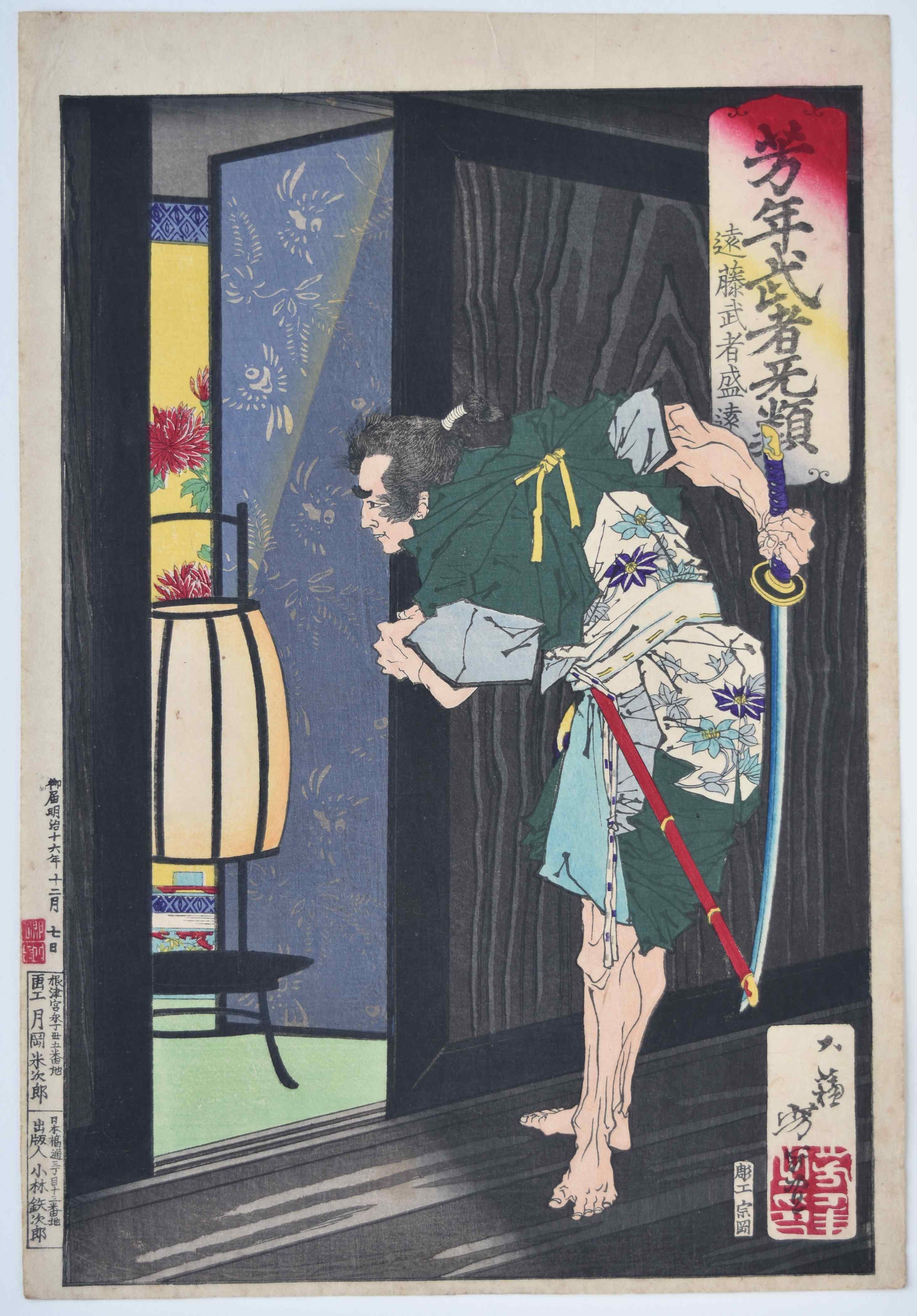
Shows Endo Morito about to murder Kesa Gozen’s husband in his bedroom. Morito became enamoured of Kesa Gozen although she was married to a palace guard. She eventually succumbs to his advances on the condition that he kills her husband. However, she takes the place of her husband in bed and is subsequently killed by him. Full of remorse Morito changes his name to Mongaku and does penance under the Nachi Falls. A famous scene much depicted in Japanese art. From a set Yoshitoshi musha burui, “Yoshitoshi’s Courageous Warriors.” Published by Kobayashi Tetsujiro, 1883.
Fine impression: This is the first edition with three-colour cartouche and small red seals in left margin. There are late editions of this set. It was republished by Tsunajima Kamekichi in 1886. Fine colour and condition. Signed Taiso Yoshitoshi ga.
Status: Available
Price: £680