Utagawa KUNIYOSHI (1797-1861)
Click here to view image full size.
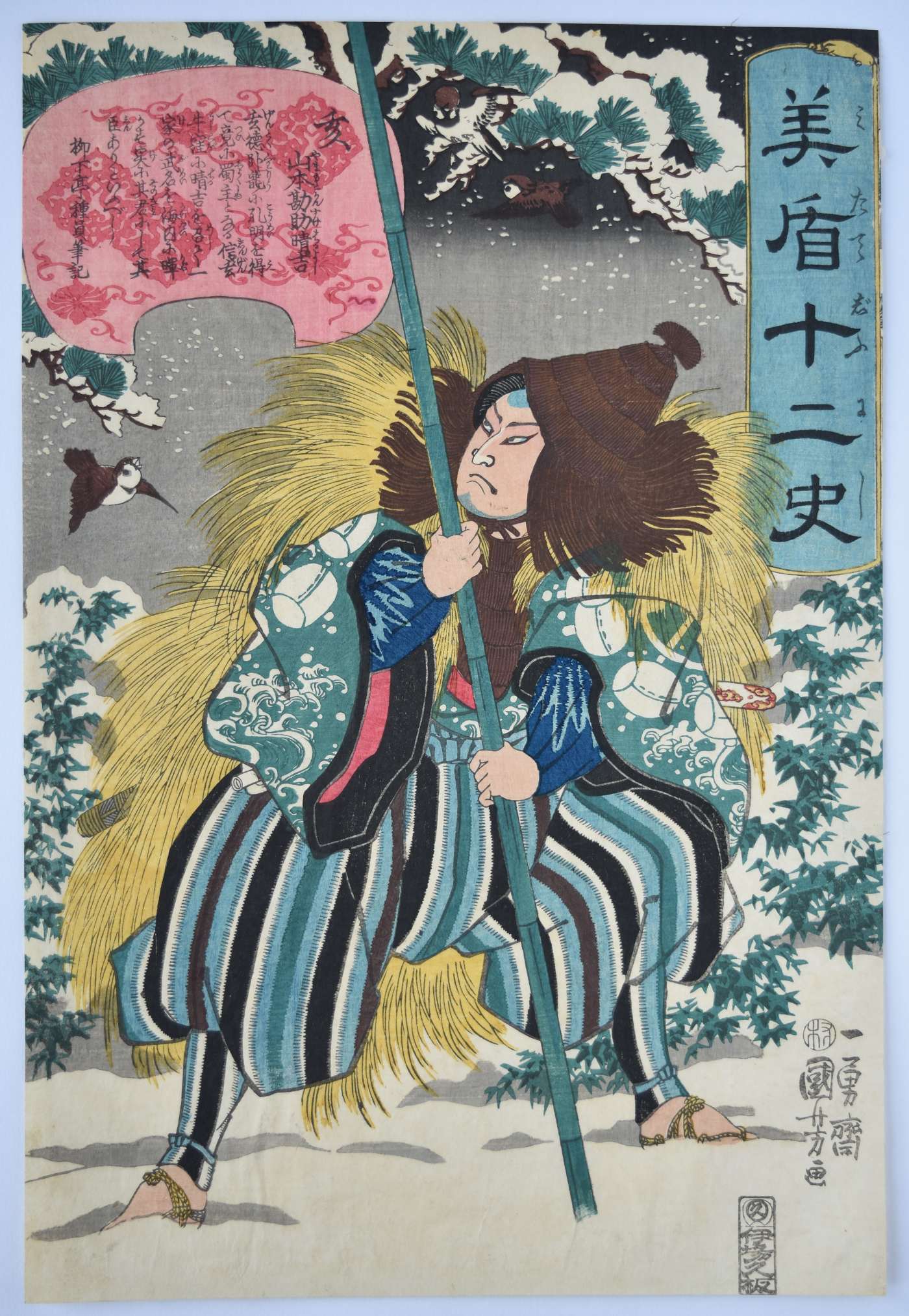
Yamamoto Kansuke striding through the snow. “Boar” from a set Mitate junishi, “Selection for the Twelve Signs.” Published by Ibaya Kyubei, c 1845. (Kansuke was famous for killing a giant boar in the snow.) Robinson S38.12.
Fine impression, colour and condition. Signed Ichiyusai Kuniyoshi ga.
Status: Sold
Utagawa KUNIYOSHI (1797-1861)
Click here to view image full size.
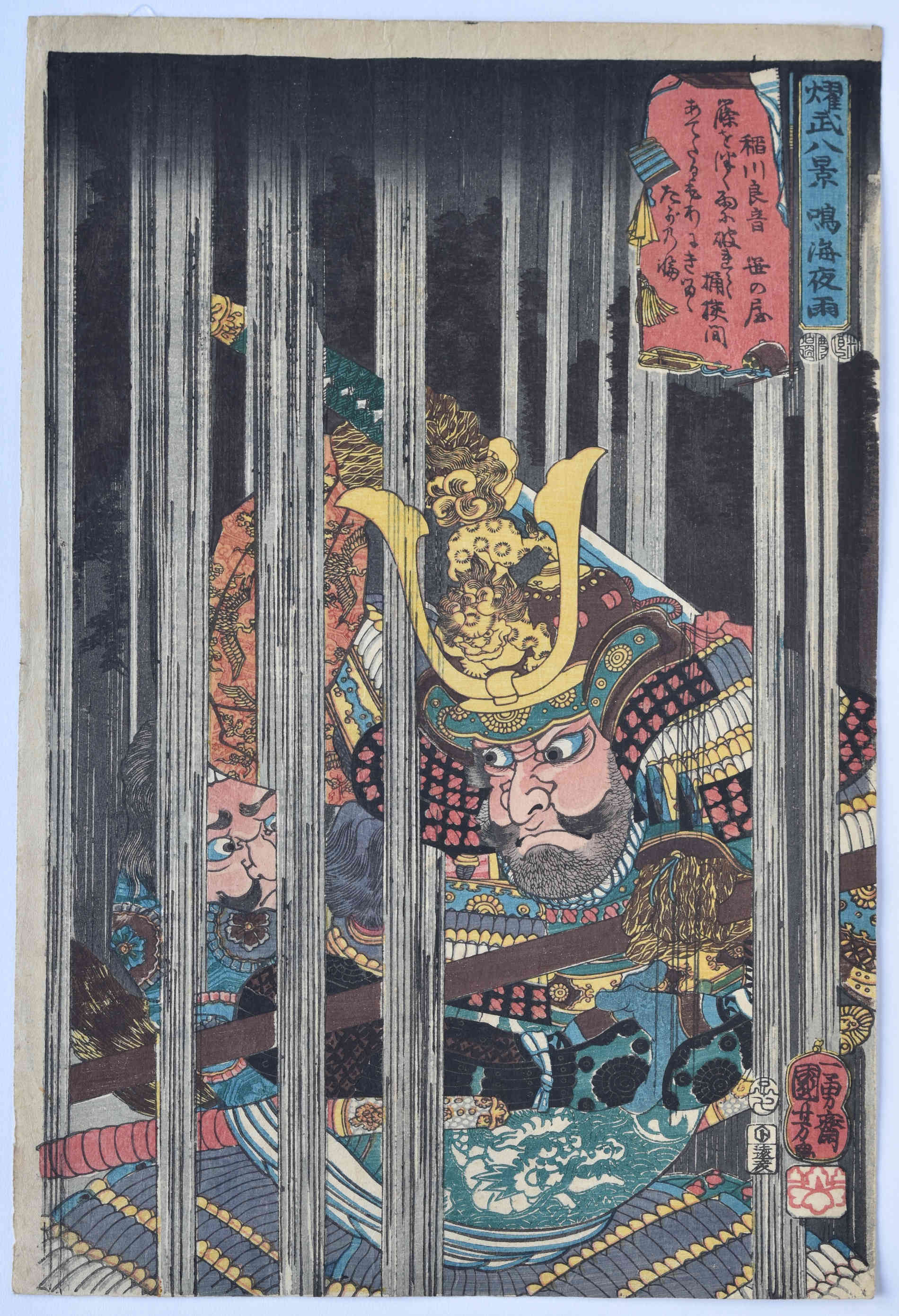
The death of the Daimyo Imagawa Yoshimoto (1519-60) by Oda Nobunaga during the battle of Okehazama which was fought at night during an intense downpour and was the culmination of the feud between the Imagawa and Oda clans. The battlefield is now a park and a national historical site. The best design from a set Yobu hakkei, “Military Brilliance of the Eight Views.” Each print relates to the famous Eight Views theme, in this case Narumi yau, “Night Rain at Narumi.” Published by Enshuya Hikobei, 1852.
Fine impression, colour and condition. Full size with extra paper left and top, which is unusual as these prints are normally trimmed from albums. Signed Ichiyusai Kuniyoshi ga.
Status: Sold
Tsukioka YOSHITOSHI (1839-1892)
Click here to view image full size.
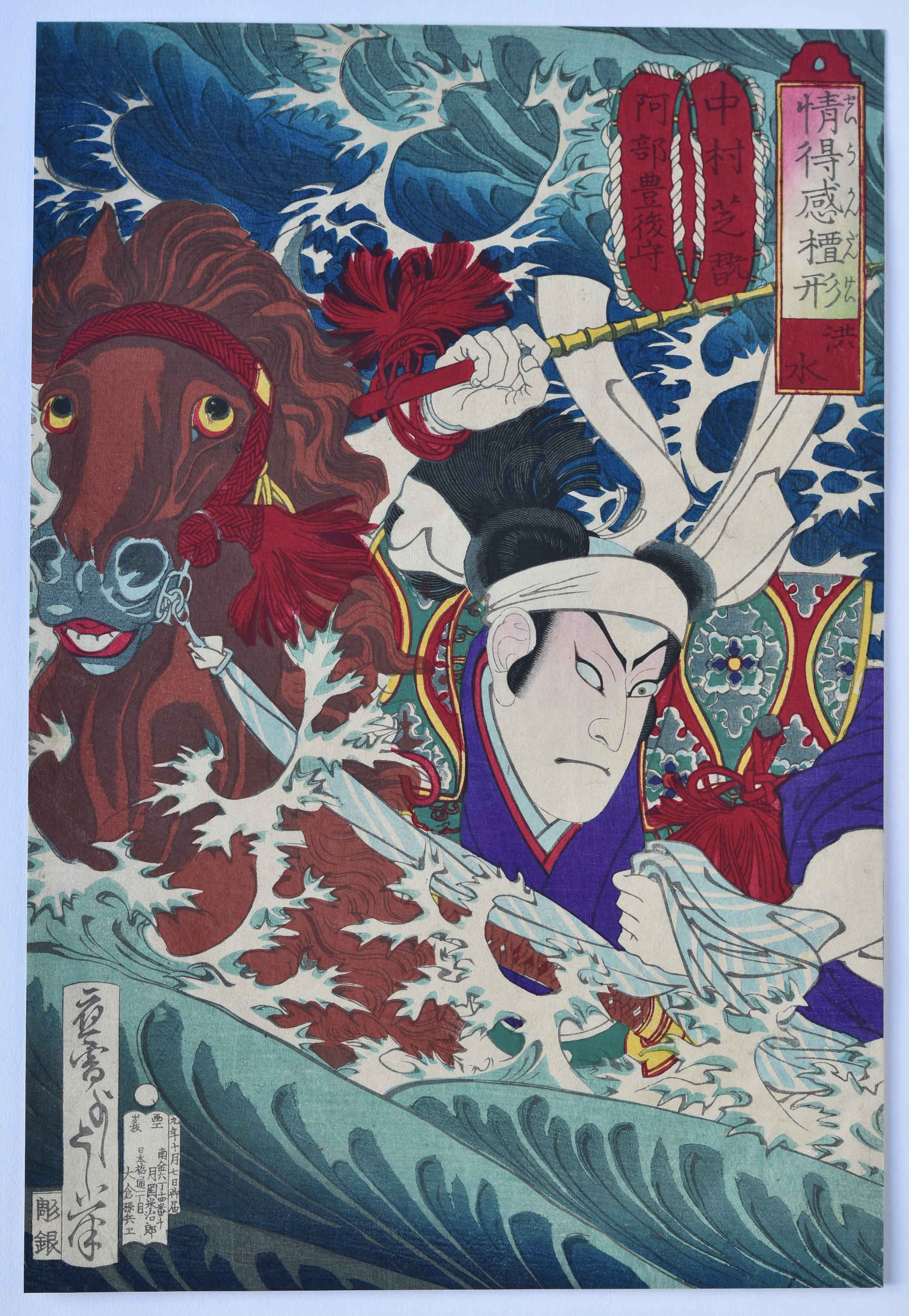
“Flood” from a series Seiu kandankei, “A Barometer of Emotions.” Shows Nakamura Shikan III as Abe Bungo no Kami riding his horse through waves. Published by Okura Magobei 1876-77 (this being 1876). A rare set with some striking designs comparing actors in theatrical roles with meteorological phenomena.
Fine impression and colour. Slight trimming, otherwise fine condition. Signed Oju Yoshitoshi hitsu.
Status: Sold
Utagawa KUNIYOSHI (1797-1861)
Click here to view image full size.
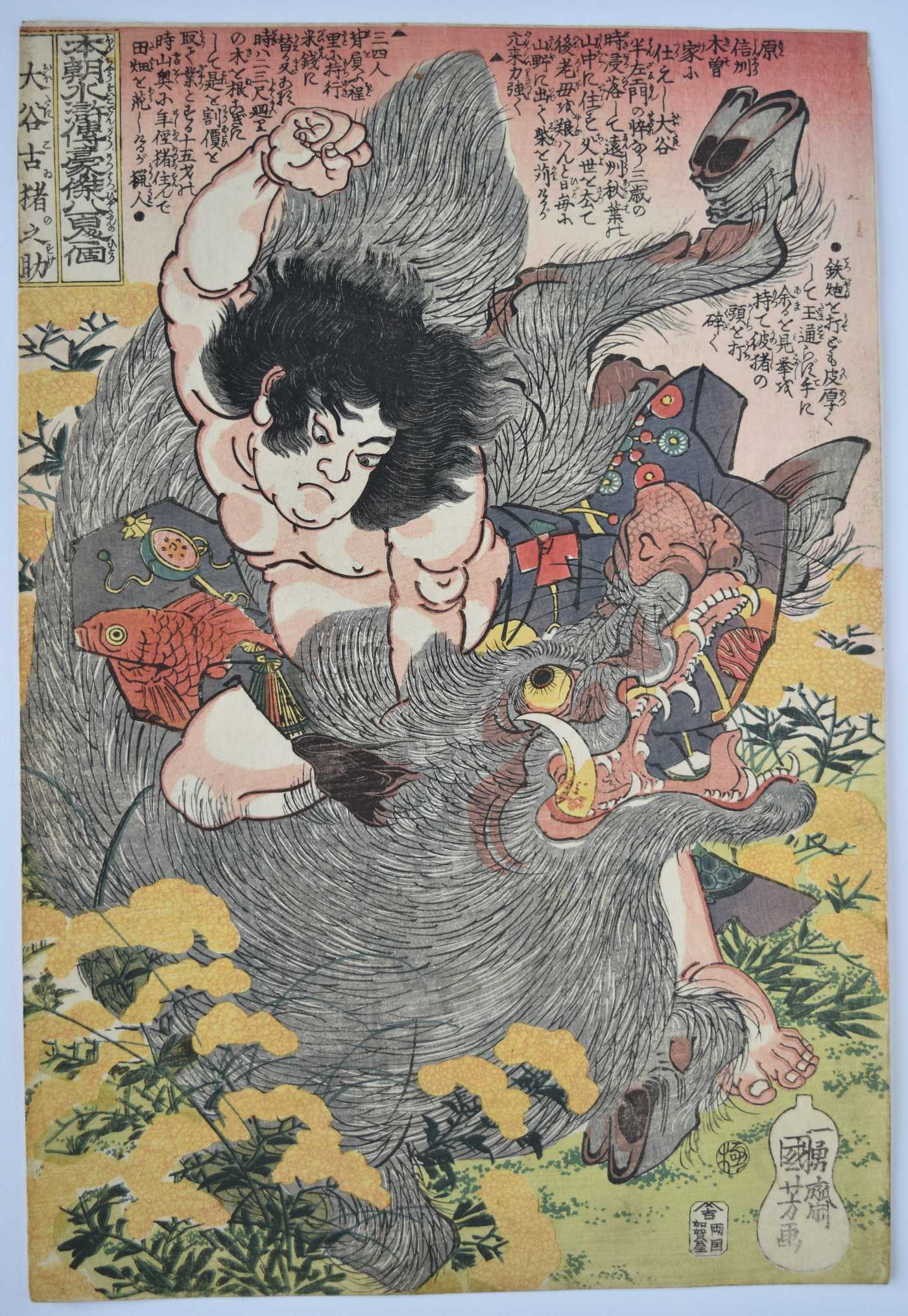
The fifteen year old Otani Furuinosuke killing a giant boar with his bare hands. From a set Honcho Suikoden goyu happyakunin no hitori, “One of the Eight Hundred Heroes of the Water Margin of Japan.” Published by Kagaya Kichiemon c 1831. This is the first edition: It was republished by Ibaya Sensaburo in 1845. Robinson S4a.14.
Fine impression and colour. Slight trimming at left, otherwise very good condition. Signed Ichiyusai Kuniyoshi ga.
Status: Sold
Utagawa KUNIYOSHI (1797-1861)
Click here to view image full size.
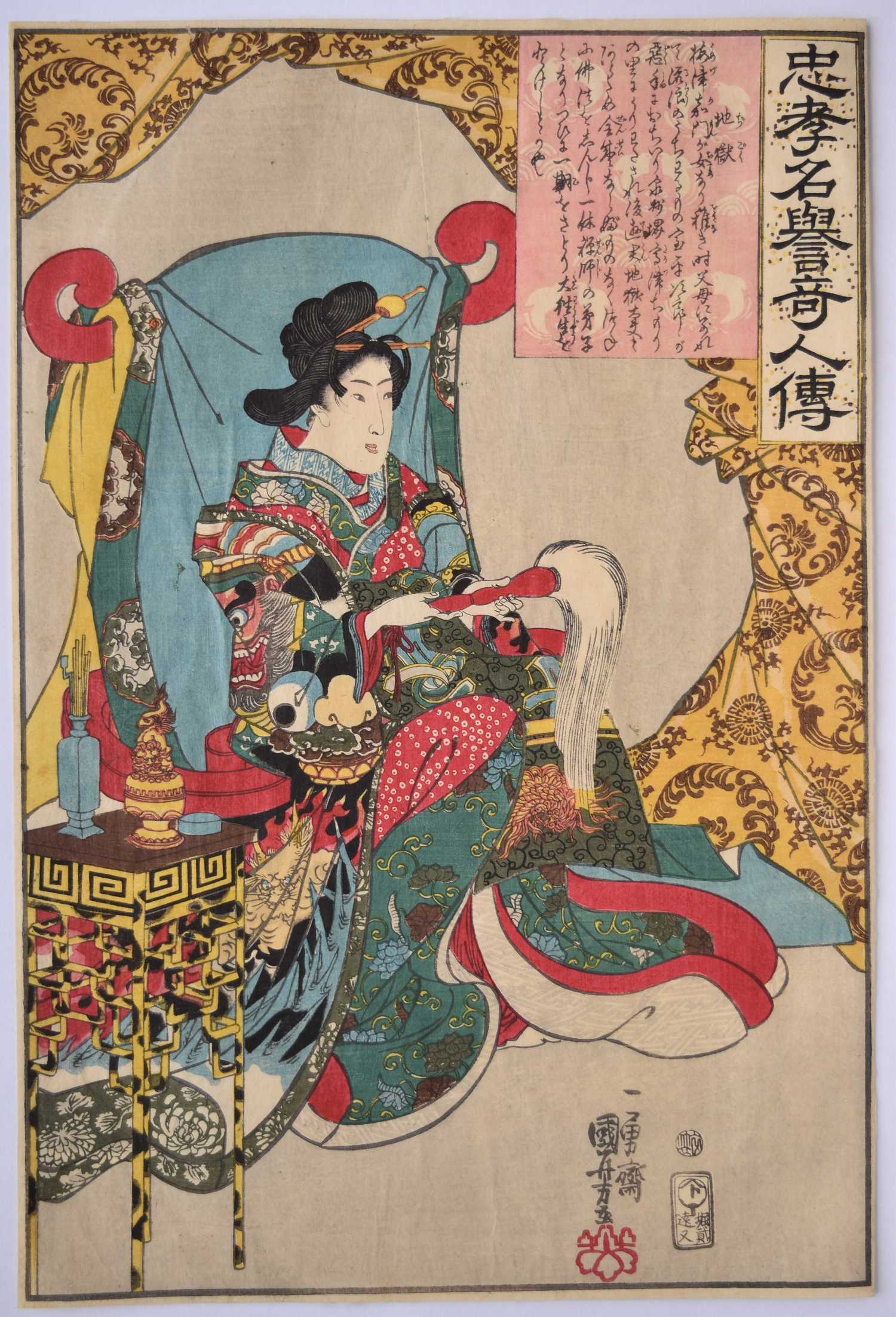
Jigoku Dayu, the “Hell Courtesan” from the set Chuko meiyo kijin den, “Stories of Remarkable Persons of Loyalty and High Reputation.” Published by Iseya Ichiemon or Enshuya Matabei (this design) 1845. Robinson S35.3. She was a courtesan who found enlightenment through the Buddhist monk Ikkyu. (The fly-whisk she holds denotes her enlightenment.) Sold to a brothel, she believed her misfortune was due to karma and is always depicted with robes depicting images of hell.
Very fine impression and colour. Very slight crinkling and trimmed close, otherwise fine condition. Signed Ichiyusai Kuniyoshi ga.
Status: Sold
Utagawa KUNISADA (1786-1865)
Click here to view image full size.
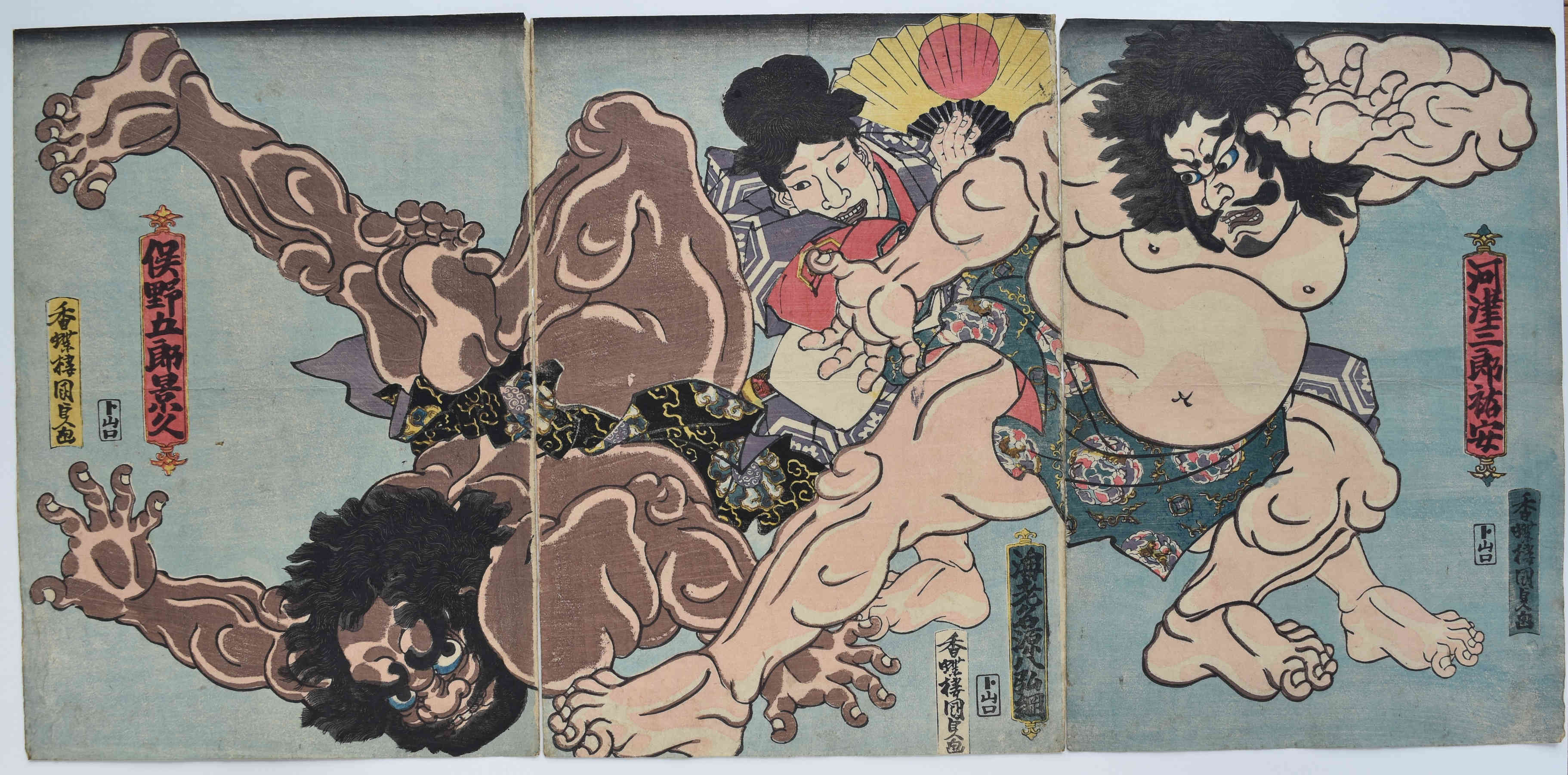
A triptych showing the great wrestling match between Matano Goro Kagehisa and Kawazu Saburo Sukeyasu. The match was refereed by Ebina Gempachi and occurred during a hunting expedition organised by the general Minamoto no Yoritomo in 1176 near Mt. Akazawa. Kawazu was the eventual victor after a rematch, throwing Matano by twisting his foot behind him – a throw still known as the kawazu in his honour. Kawazu was later found murdered – his death being avenged by his sons Juro and Goro. Published by Yamaguchiya Tobei, 1838-40. An earlier version was designed by Kunisada as well as there being an excellent example by Kuniyoshi.
Very good impression and colour. Minor creasing and wear, otherwise good condition. Signed Kochoro Kunisada ga.
Status: Sold
Utagawa KUNIYOSHI (1797-1861)
Click here to view image full size.
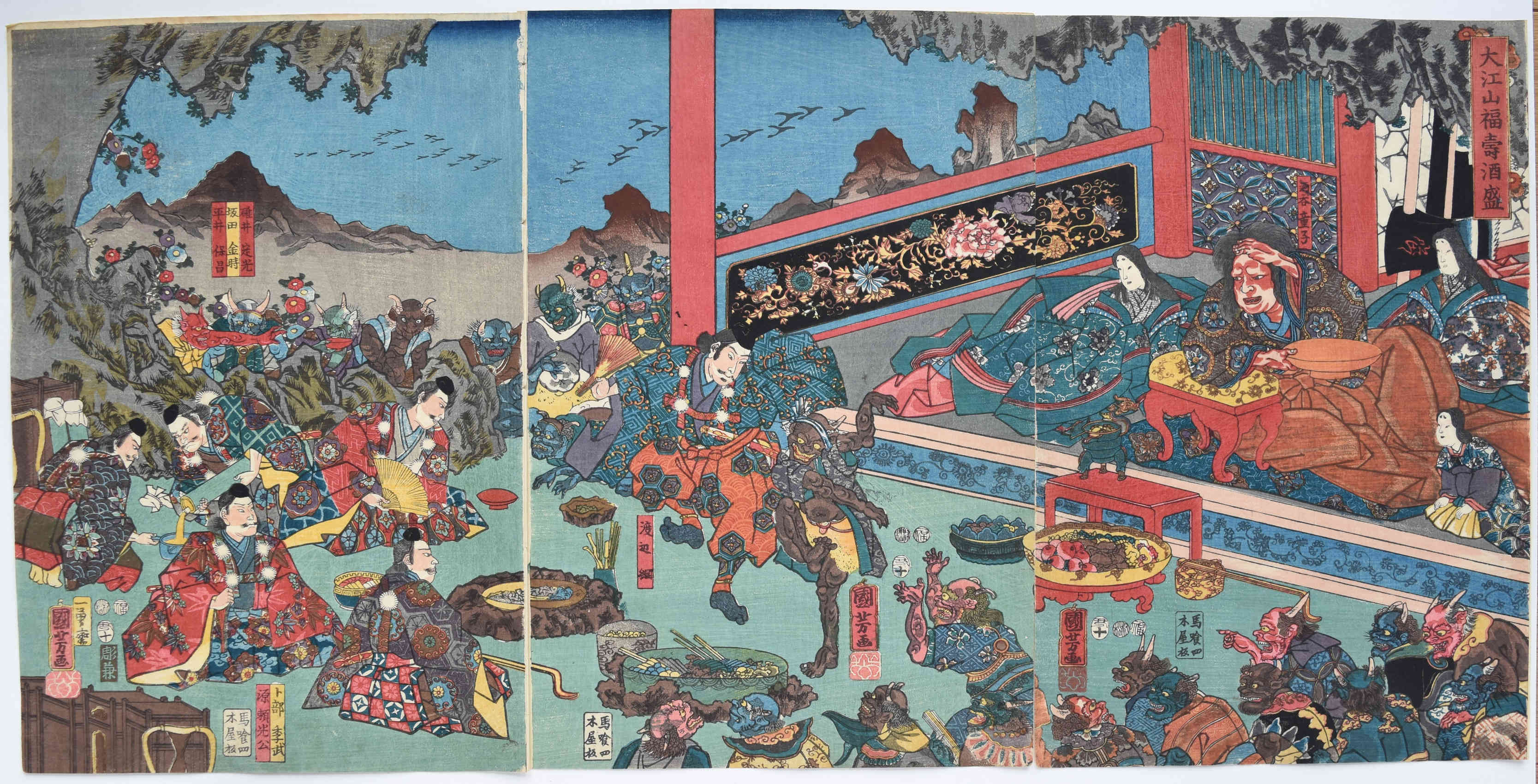
A triptych showing Shutendoji’s palace on Mount Oyeyama, Oyeyama fukujin shusei. Raiko (Minamoto no Yorimitsu) is charged by the Emperor Murakami with killing the evil Shutendoji who terrorizes the neighbourhood. He and his retainers infiltrate the castle and ply Shutendoji and his ogrish band with sake and dance for them. Eventually Shutendoji is so intoxicated he has to be carried to bed, whereupon Raiko and his followers attack and decapitate him. This is the episode most often depicted with the head flying through the air. Published by Kiya Sojiro, 1853.
Very good impression, colour and condition. Signed Ichiyusai Kuniyoshi ga.
Status: Sold
Tsukioka YOSHITOSHI (1812-1866)
Click here to view image full size.
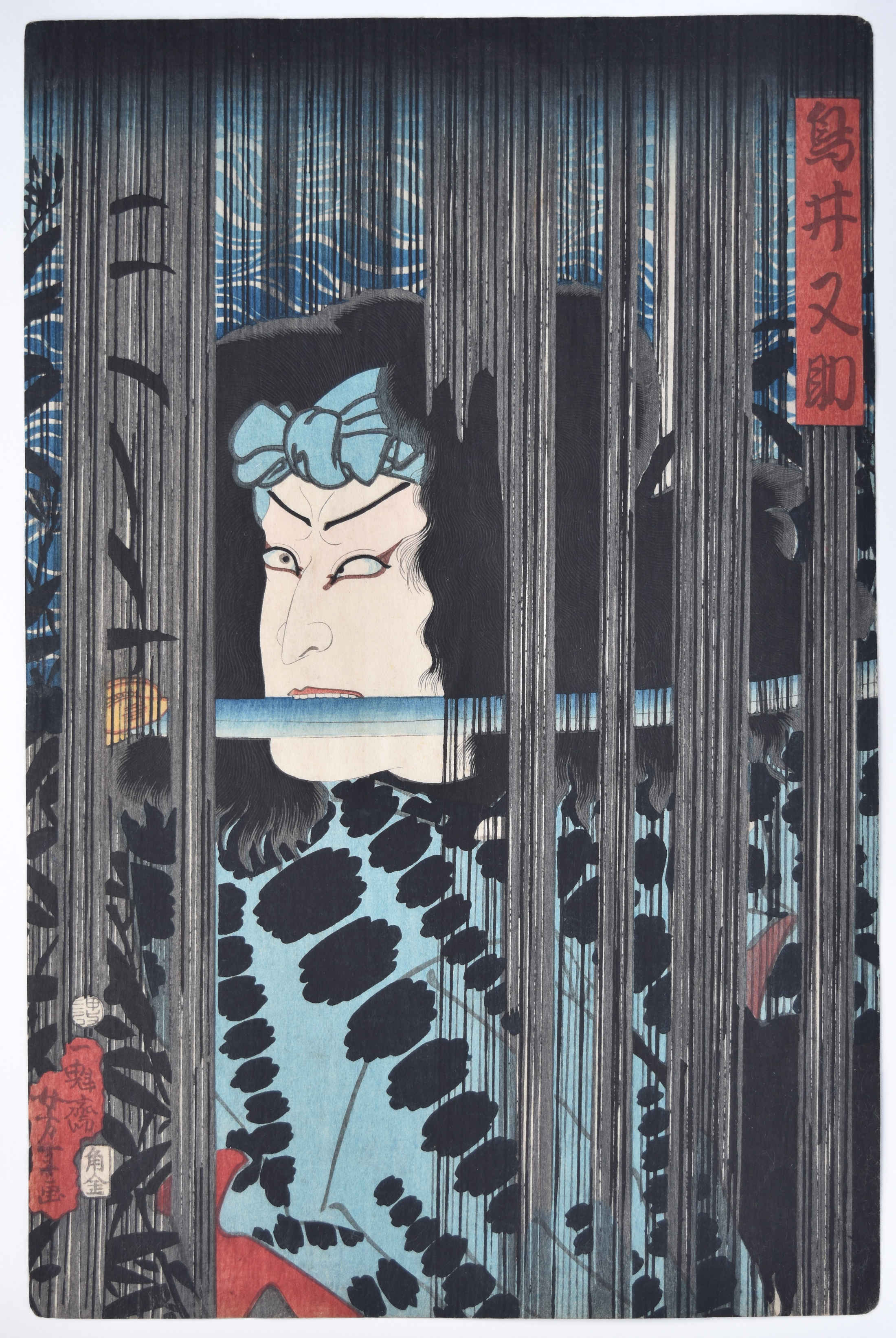
The actor Ichikawa Kodanji IV as Torii Matasuke clenching a sword between his teeth in pouring rain. From the play Kagamiyama gonichi no Iwafuji performed at the Ichimura Theatre, 3/1860. The plot centres around Lord Taga who is disloyal to his wife Lady Ume with Oryu. One of Taga’s retainers, Motome, advises him against his actions and is dismissed. Meanwhile Oryu and her husband plan to take over Taga’s domain so a plot is hatched to kill her. However, Motome’s faithful servant, Matasuke, murders Lady Ume by mistake. The design shows Matasuke just prior to his mistake. Published by Kaku-Kin (Kakumotoya Kinjiro), 1860.
Fine impression and colour. Some minute restored binding holes and very slight trimming on right, otherwise very good condition. Signed Ikkaisai Yoshitoshi ga.
Status: Sold
Utagawa YOSHIKAZU (Active c 1849-1867)
Click here to view image full size.
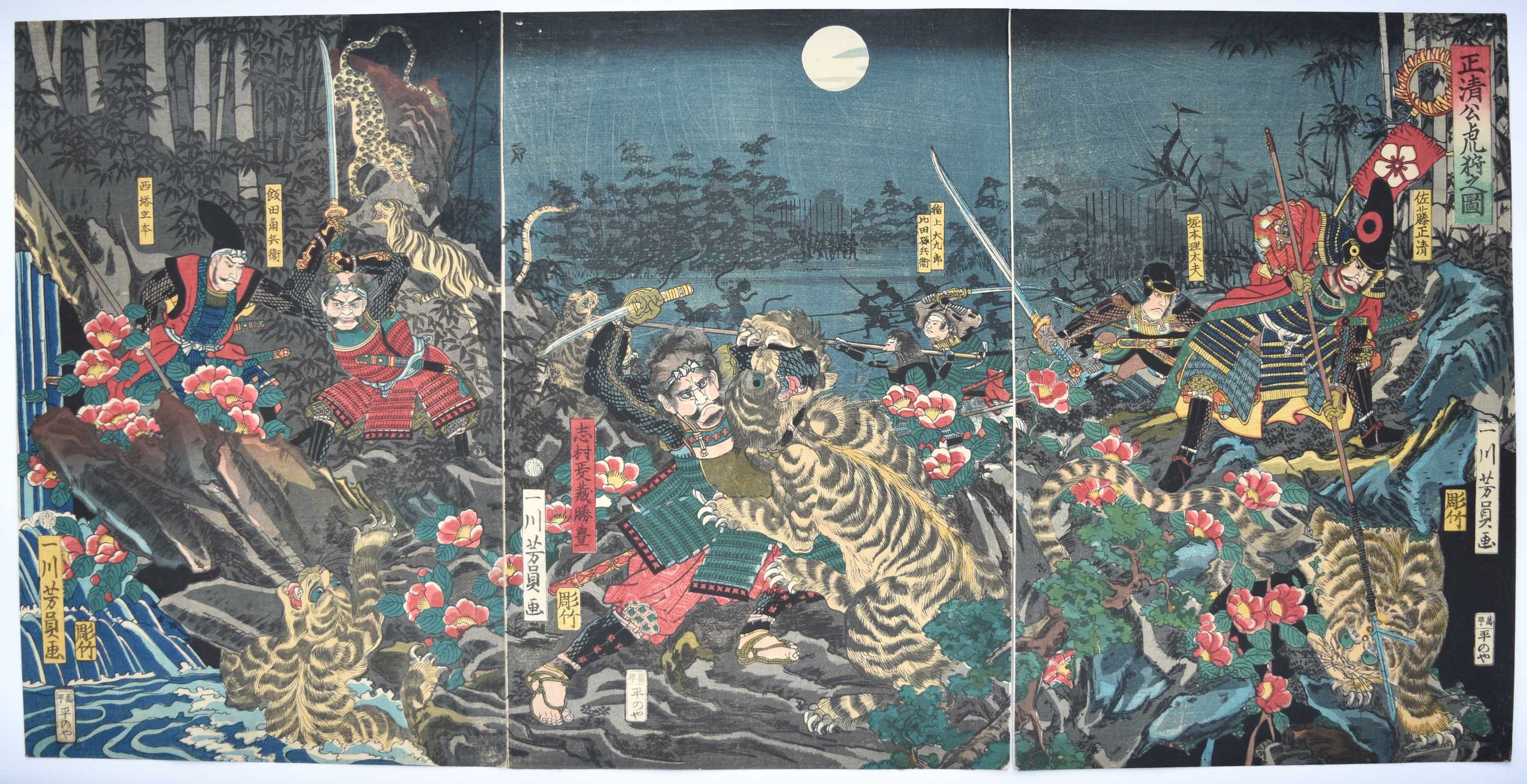
Kato Kiyomasa (aka Masakiyo, 1562-1611) hunting man-eating tigers with his cohorts in Korea. Masakiyo ko toragari no zu. Kiyomasa had two expeditions to Korea in 1592 and 1597. Published by Hiranoya Shinzo, 1861.
Fine impression, colour and condition. Signed Ichikawa Yoshikazu ga.
Status: Sold
Utagawa YOSHITSUYA (1822-1866)
Click here to view image full size.
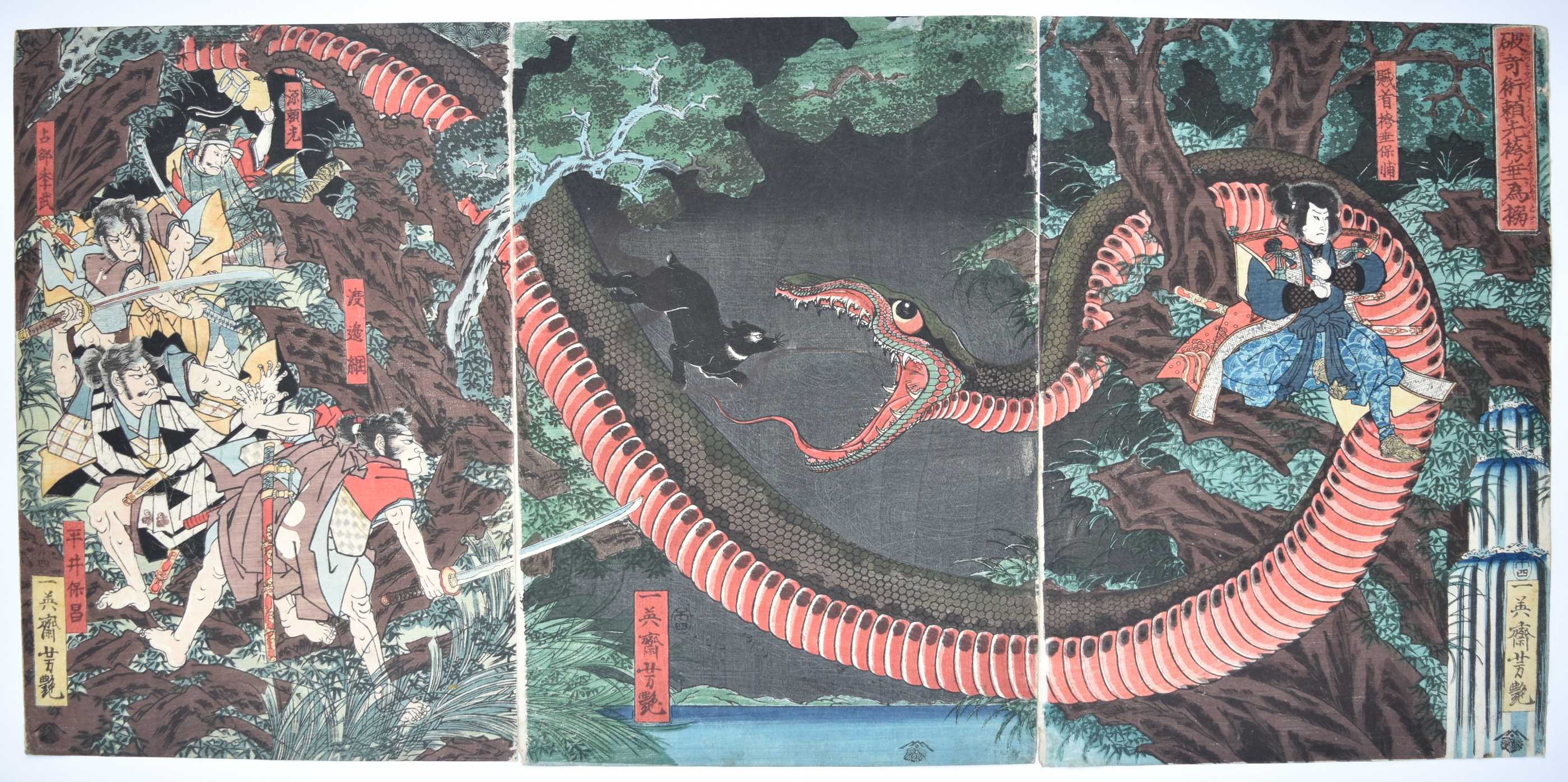
A triptych showing Minamoto no Yorimitsu (aka Raiko, 948-1021) trying to capture the notorious thief Hakamadare Yasusuke. Kijutsu Hakamadare o karamen to su. Yorimitsu is seen with his cohorts Urabe Suetake, Hirai Yasumasa, and Watanabe Tsuna. On the right Hakamadare attempts to evade capture by magically conjuring up a battle between a giant snake and a bear. Published 1858 by Tsutaya Kichizo.
Very good impression, colour and condition. Signed Ichieisai Yoshitsuya.
Status: Sold
Utagawa KUNISADA (1786-1865)
Click here to view image full size.
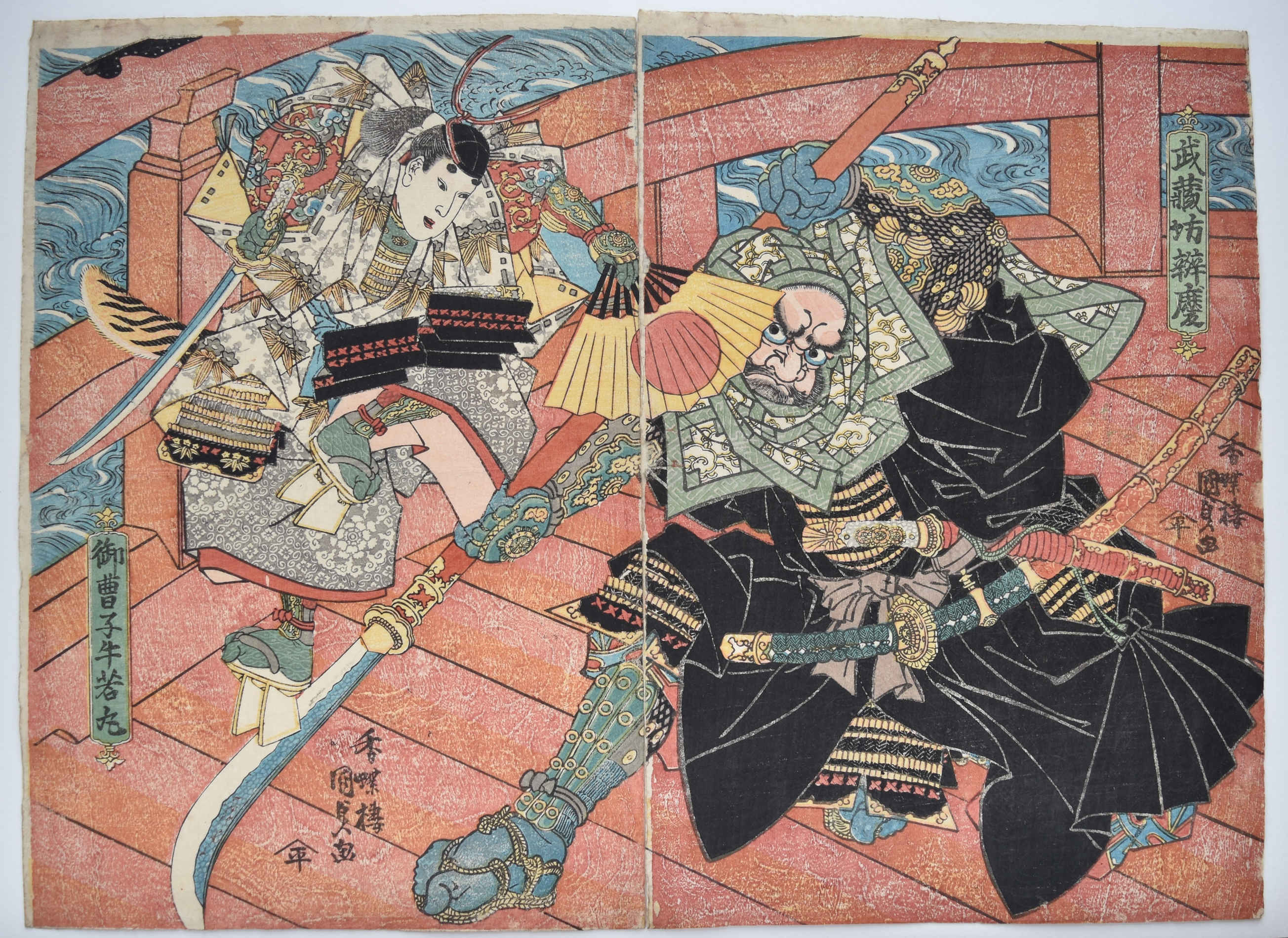
A diptych showing Musashi-bo Benkei, renowned for his herculean strength, battling with the young Onzoshi Ushiwaka Maru (Yoshitsune) on Gojo Bridge. The story relates how Benkei (1155-1189) wandered around Kyoto with the intention of relieving 1000 samurai of their swords. One night with one more sword to go he saw Yoshitsune playing a flute and wearing a golden sword at the Gojotenjin Shrine. They agreed to fight on Gojo Bridge in southern Kyoto. However, Yoshitsune was too agile for Benkei and had been educated in the secrets of fighting by the mountain tengu. Following Yoshitsune’s victory Benkei became Yoshitsune’s retainer. Published by Hei, c. early 1830s. (This publisher produced many of Kunisada’s prints in the early 1830s.) Very rare.
Fine impression, colour and condition. Signed Kochoro Kunisada ga.
Status: Available
Price: £3,500
Utagawa KUNIYOSHI (1797-1861)
Click here to view image full size.
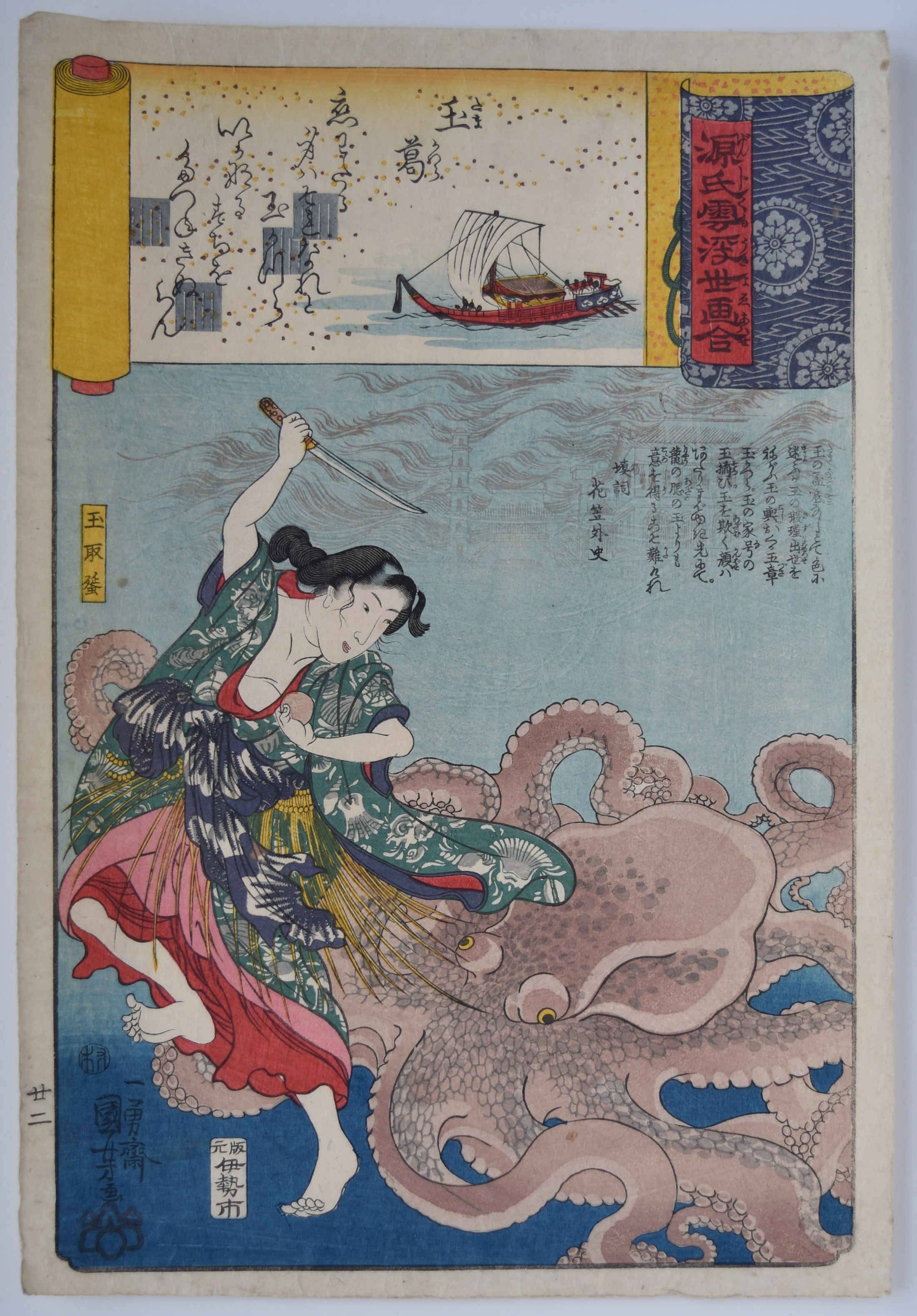
The best design from Genji kumo Ukiyoe awase, “Ukiyoe Comparisons of the Cloudy Chapters of Genji.” A set comparing famous warriors to the Chapters of the Genji Monogotari written by Lady Murasaki Shikibu (c 973-1025). This design is for Chapter 22, Tamakatzura. Shows the pearl diver, Tamatori-hime, who has reclaimed the precious pearl stolen by the Dragon King. She is pursued by a host of his aquatic retainers including a giant octopus before finally returning the jewel to her husband Fujiwara no Kamatari, albeit buried in her chest for safety and causing her death. A popular subject with Kuniyoshi who designed a number of other oban prints and triptychs on this subject. The Dragon King’s Palace can be seen beneath the waves in the background. Published by Iseya Ichibei, 1843-5.
Fine impression and colour. Slight crinckling in margins, otherwise very good condition. Signed Ichiyusai Kuniyoshi ga.
Status: Sold
Tsukioka YOSHITOSHI (1839-1892)

Click here to view image full size.
A design from the set Azuma no nishiki ukiyo kodan, “Tales of the Floating World on Eastern Brocade.” Kodan (traditional storytelling) raconteurs narrated Japanese folk stories, sometimes accompanying themselves with wooden blocks clapped together or a fan giving rhythm. The Kodan text is shown above. Having been popular from around 1700 (and known as Koshaku), these performances gained renewed popularity in the 1850s with the classic standards augmented by contemporary stories of heroes and villains. Shows Mukokizu Yosa stabbing Komori Yasu (Yasu the Bat); so-called because of the bat-like birthmark on his cheek. A gruesome scene with Yasu covered in blood. Various publishers from 1867-68, here Omiya Kyojiro, 11/1867.
Fine impression. Very good colour. Slight trimming, otherwise very good condtion. Signed Ikkaisai Yoshitoshi hitsu.
Status: Sold
Tsukioka YOSHITOSHI (1839-1892)

Click here to view image full size.
A design from the set Azuma no nishiki ukiyo kodan, “Tales of the Floating World on Eastern Brocade.” Kodan (traditional storytelling) raconteurs narrated Japanese folk stories, sometimes accompanying themselves with wooden blocks clapped together or a fan giving rhythm. The Kodan text is shown above. Having been popular from around 1700 (and known as Koshaku), these performances gained renewed popularity in the 1850s with the classic standards augmented by contemporary stories of heroes and villains. Shows Azekura Jushiro slashing Hinotama no Sangoro who is covered in blood. Various publishers from 1867-68, here Sanoya Tomigoro, 9/1867.
Fine impression. Very good colour. Slight trimming, otherwise very good condtion.
Status: Sold
Tsukioka YOSHITOSHI (1839-1892)

Click here to view image full size.
A design from the set Azuma no nishiki ukiyo kodan, “Tales of the Floating World on Eastern Brocade.” Kodan (traditional storytelling) raconteurs narrated Japanese folk stories, sometimes accompanying themselves with wooden blocks clapped together or a fan giving rhythm. The Kodan text is shown above. Having been popular from around 1700 (and known as Koshaku), these performances gained renewed popularity in the 1850s with the classic standards augmented by contemporary stories of heroes and villains. Shows Lady Masao from Osasahara surrounded by curling snakes who force her to reveal her true identity – the Fox Spirit. Various publishers from 1867-68, here Omiya Kyojiro, 11/1867.
Fine impression. Very good colour. Slight trimming, otherwise very good condtion. Signed Ikkaisai Yoshitoshi hitsu.
Status: Sold
Katsushika HOKUSAI (1760-1849)
Click here to view image full size.
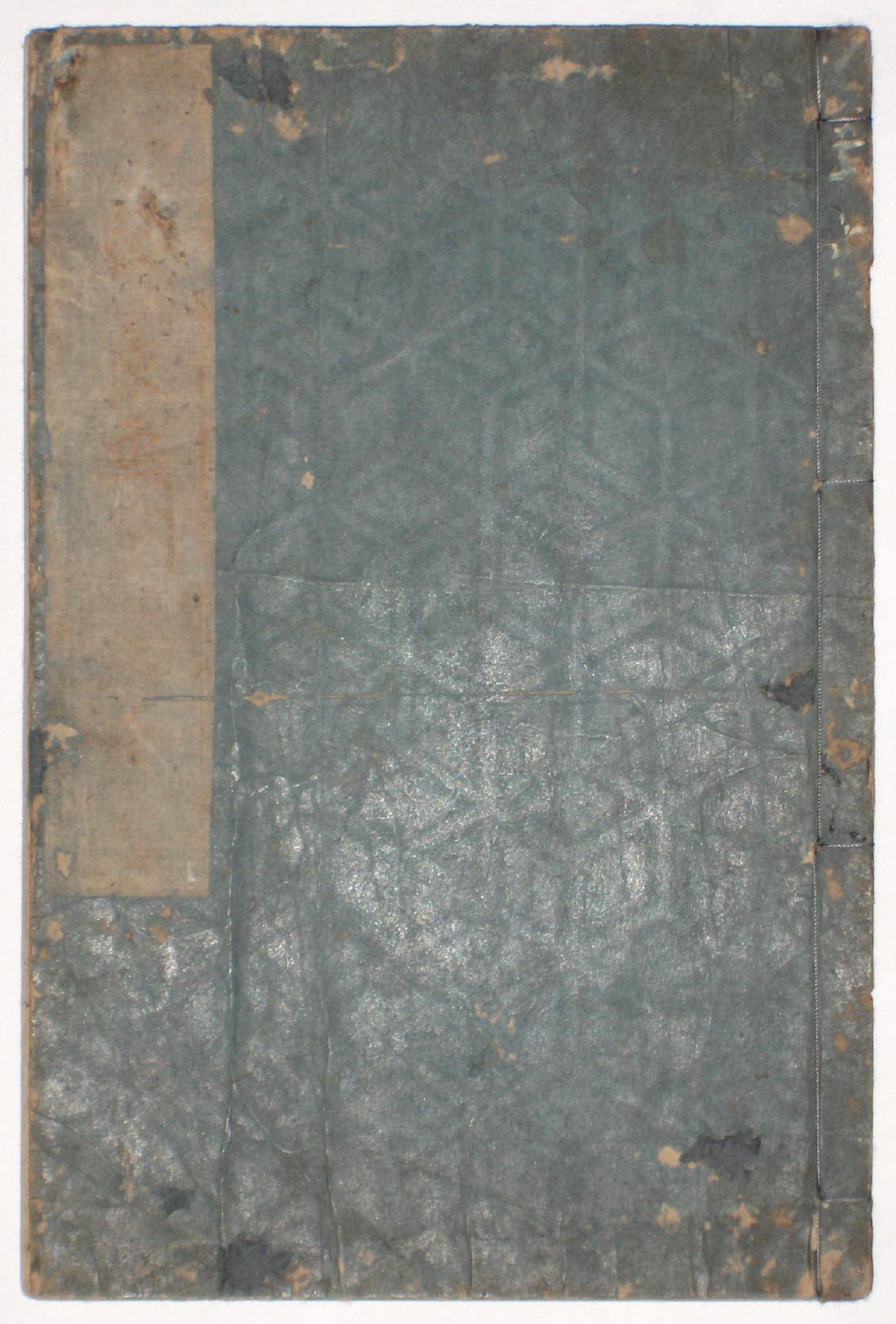
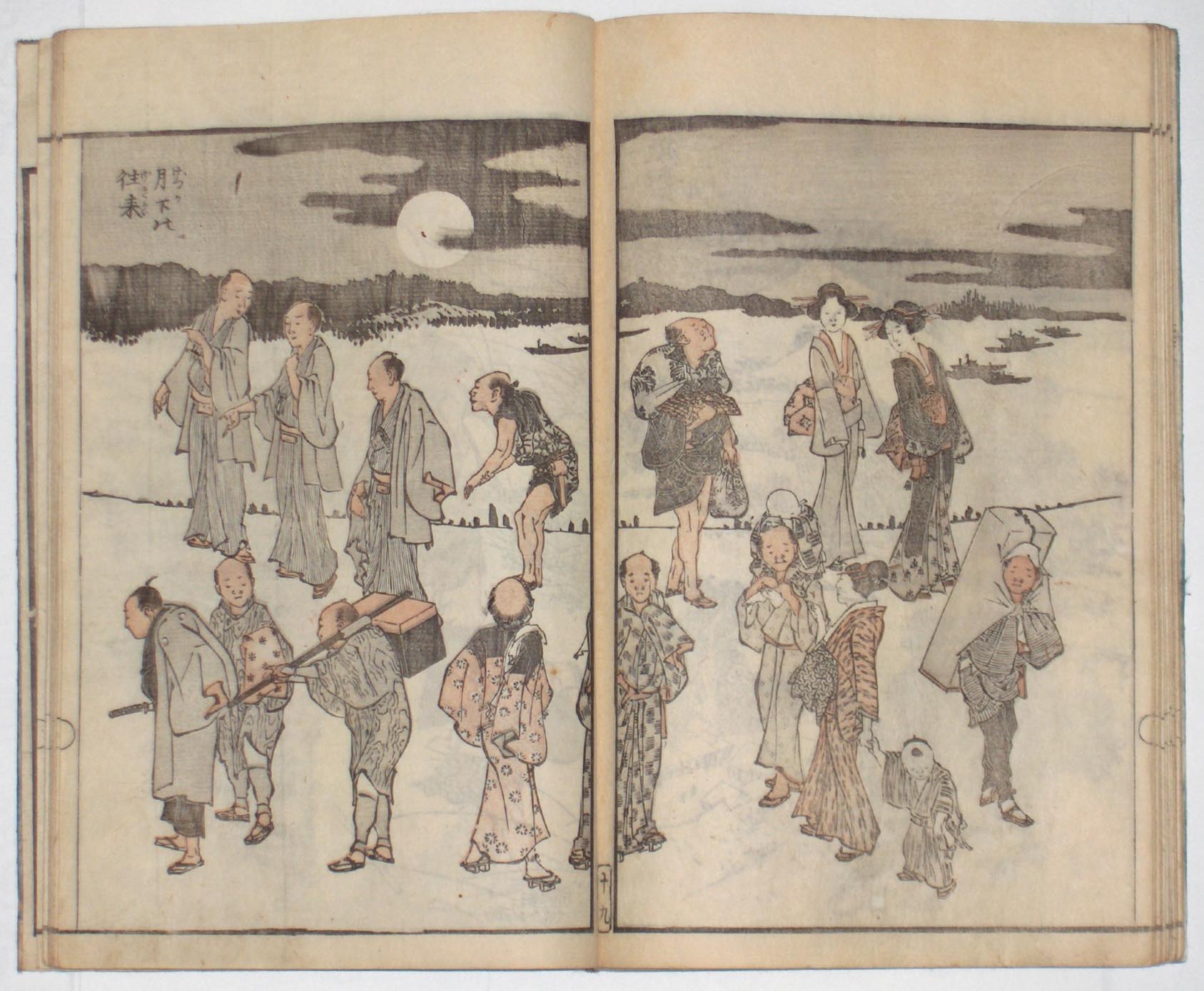
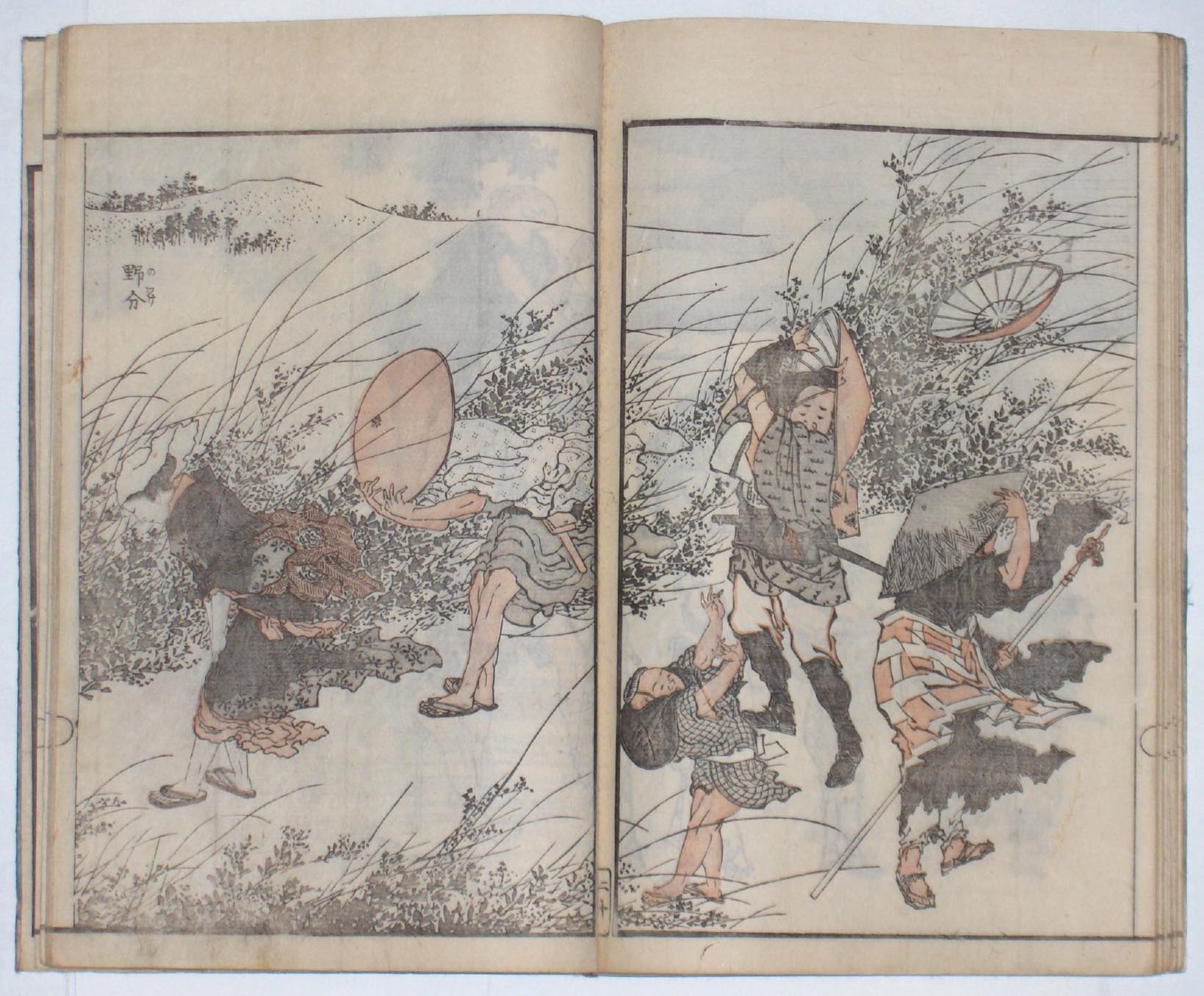
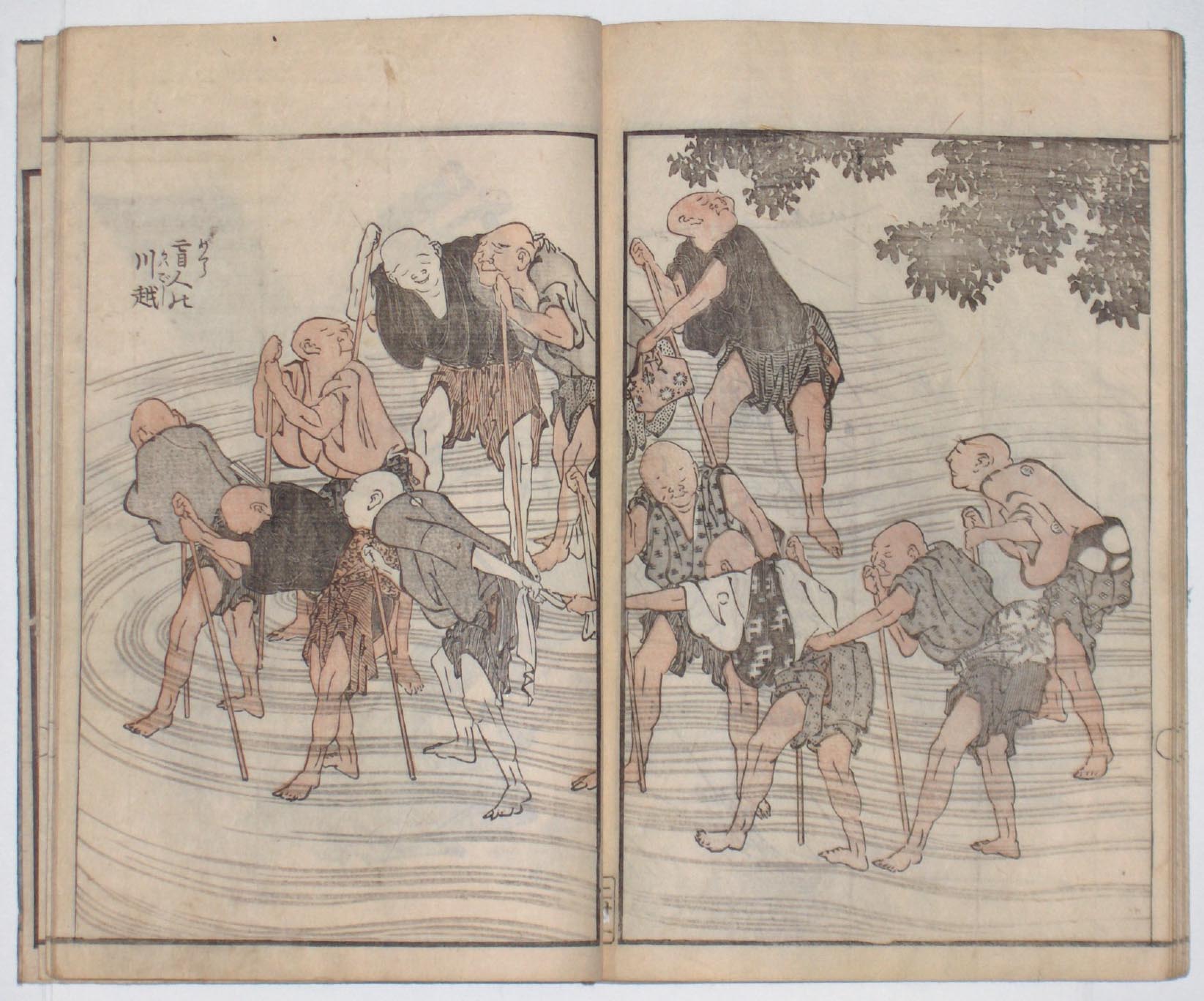
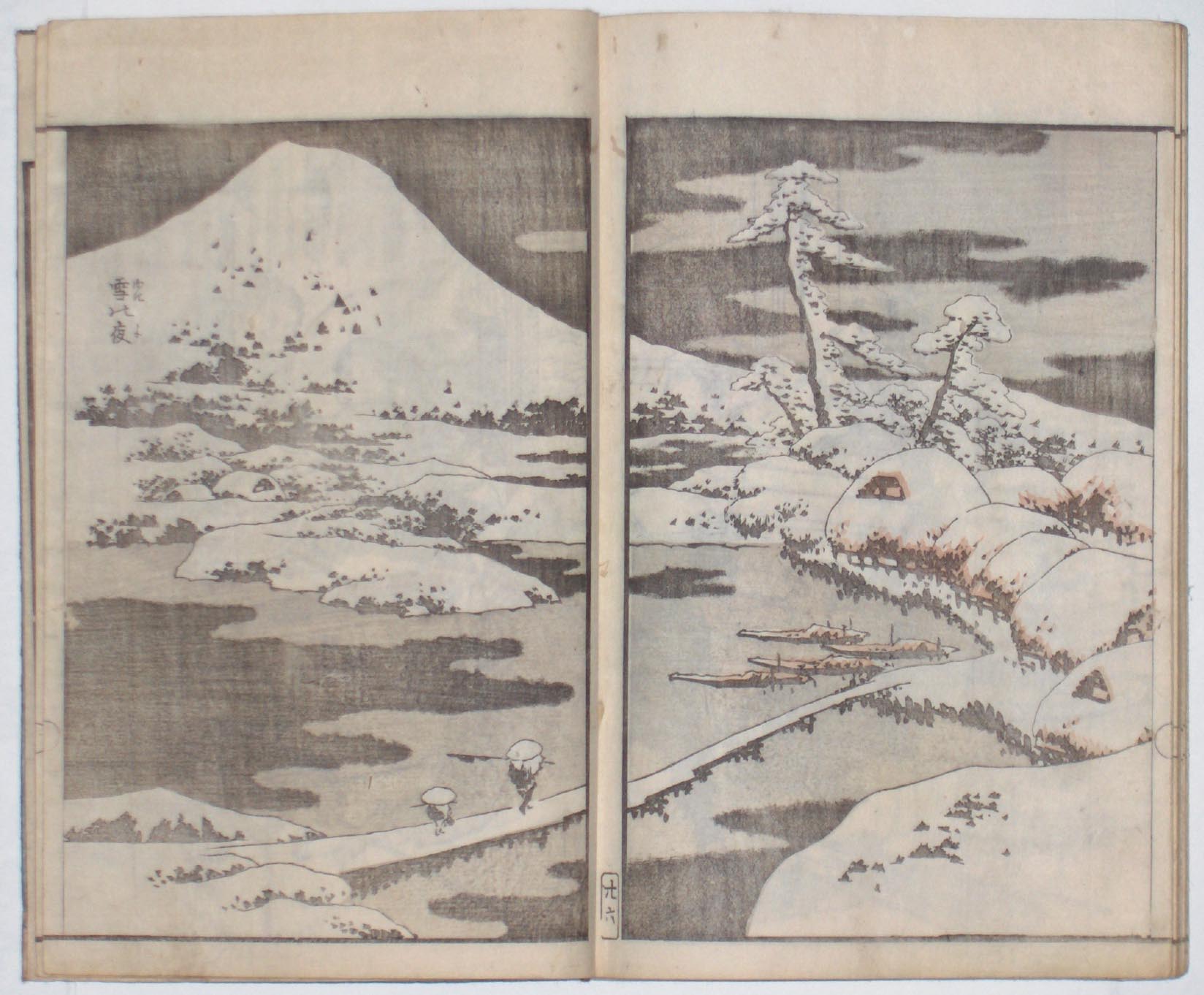
One volume complete: Hokusai soga, “Hokusai’s Free Sketches.” Two versions of this publication are known: Solely printed in sumi and ( as here ) sumi with gradated shading and a pink block. This version also with the colophon. Both are almost certainly contemporaneous. Contain’s some of Hokusai’s best known images and was considered by Jack Hillier to contain “the finest figure prints by Hokusai.” Published 1820 by Eirakuya, Nagoya; Surawaya Mohei and seven others in Edo.
Original light blue burnished covers. Original title slip. Some slight damage to covers, and thumbing on some pages, but overall a very nice copy with fine impressions.
Status: Sold
Ichiryusai HIROSHIGE (1797-1858)
Click here to view image full size.
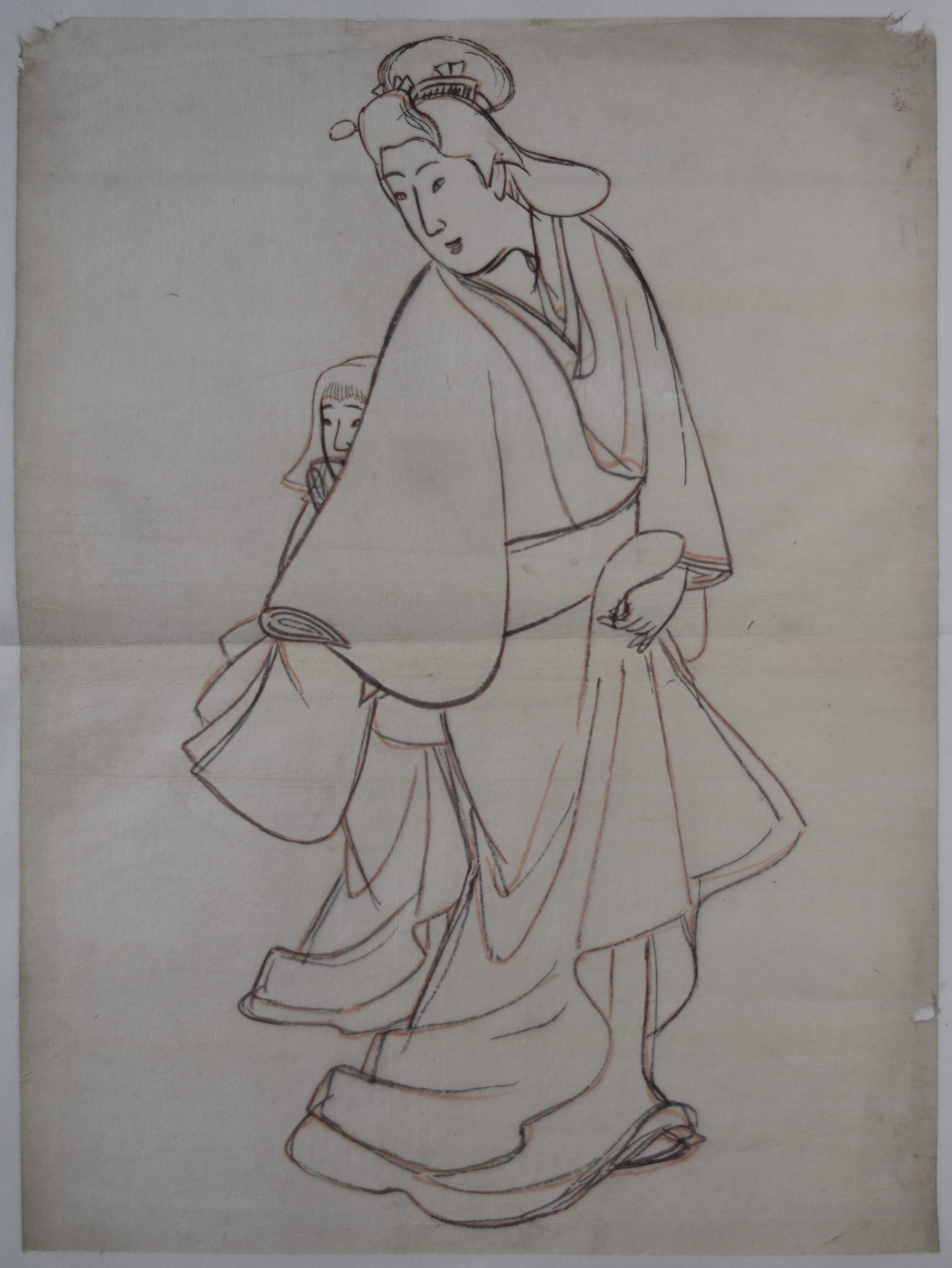
An original drawing showing a beauty with an acolyte. Sumi on thin paper. 14.5 x 10.5 in., 37 x 27.5 cms.
Status: Available
Price: £800
Ichiryusai HIROSHIGE (1797-1858)
Click here to view image full size.
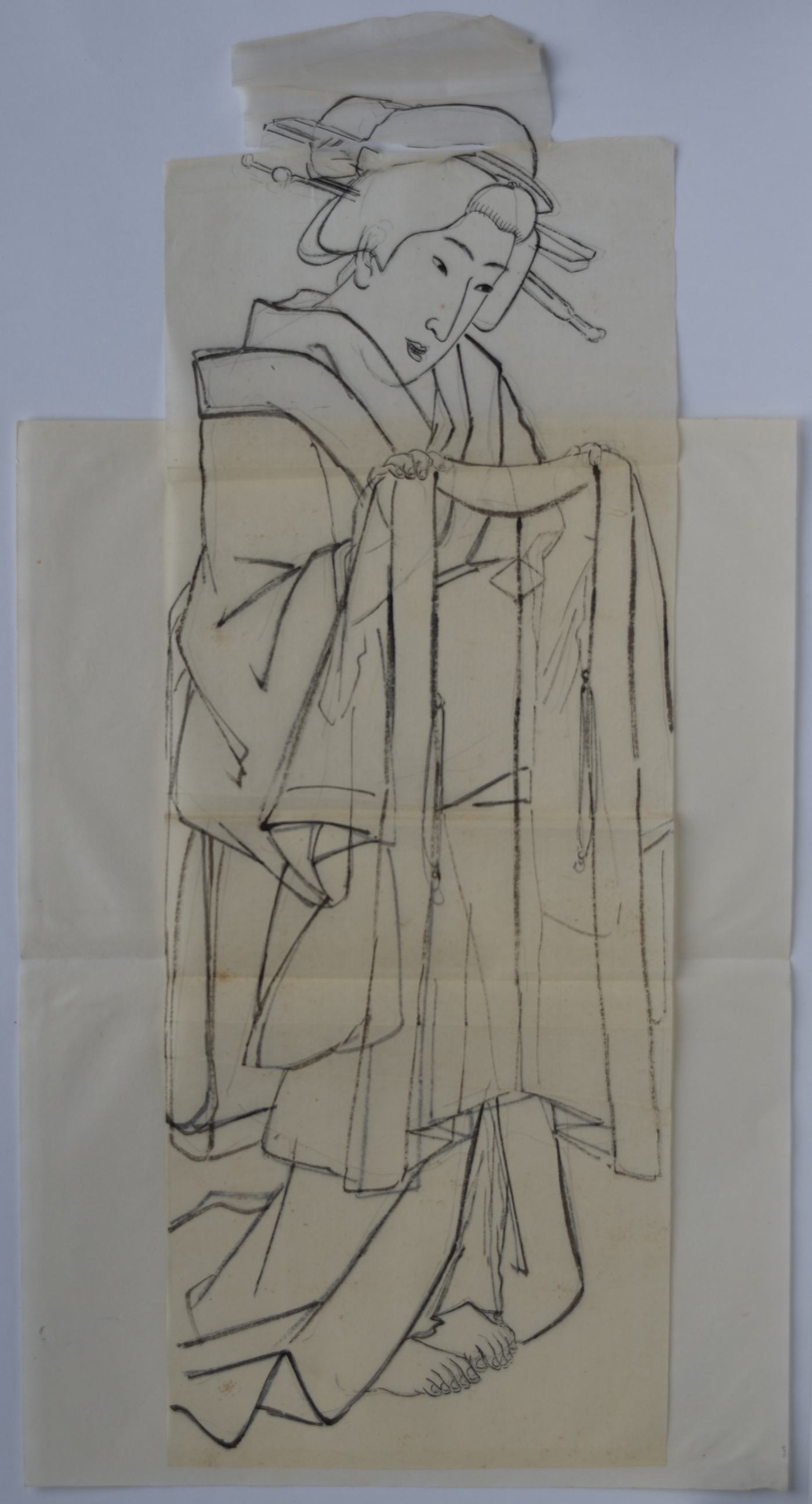
A large original drawing. Probably for a kakemono-e. Sumi on thin paper. 29.5 x 9.75 in., 73 x 24 cms.
Status: Available
Price: £800
Ichiryusai HIROSHIGE (1797-1858)
Click here to view image full size.
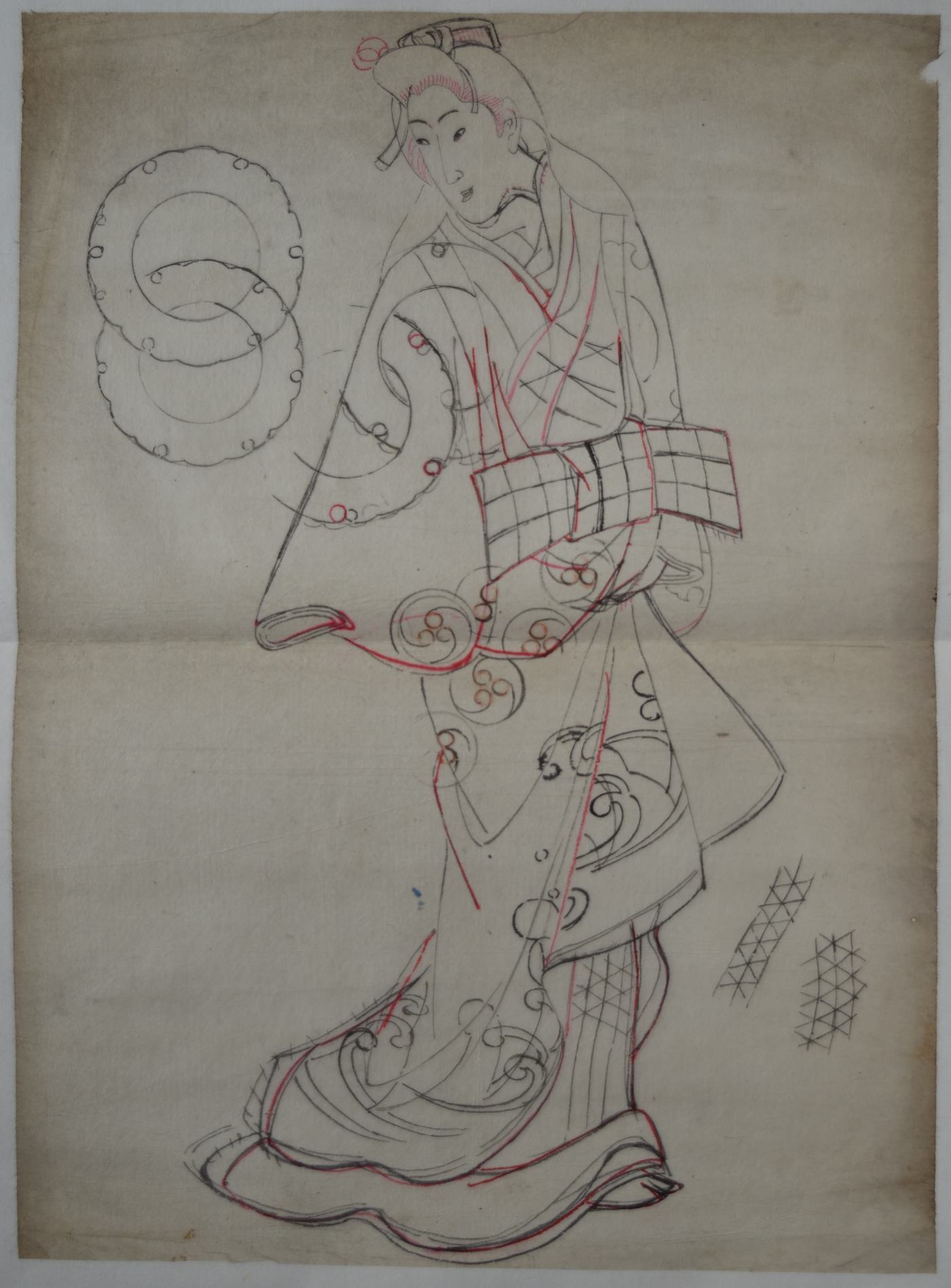
An original drawing showing a full length study of a woman with details of the pattern on her dress. Sumi and red under-drawing on thin paper. 14.75 x 10.75 in., 37.5 x 27.5 cms.
Status: Available
Price: £400
Ichiryusai HIROSHIGE (1797-1858)
Click here to view image full size.
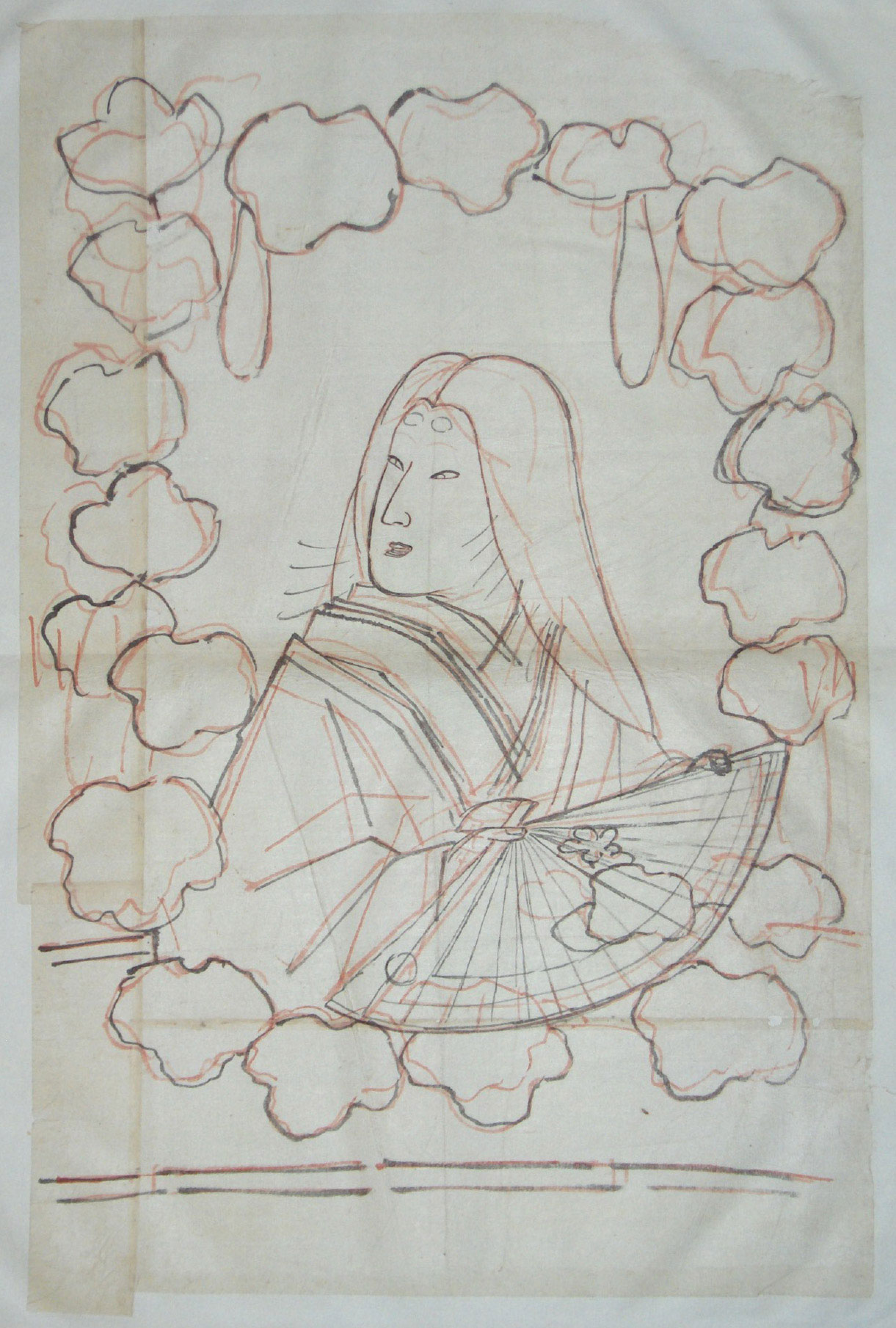
An original drawing showing a bust portrait of a Heian beauty holding a fan with a surrounding motif of gourds and leaves. Sumi and red under drawing on thin paper. 18.5 x 12 in., 47 x 31 cms.
Status: Available
Price: £1,200
Ichiryusai HIROSHIGE (1797-1858)
Click here to view image full size.
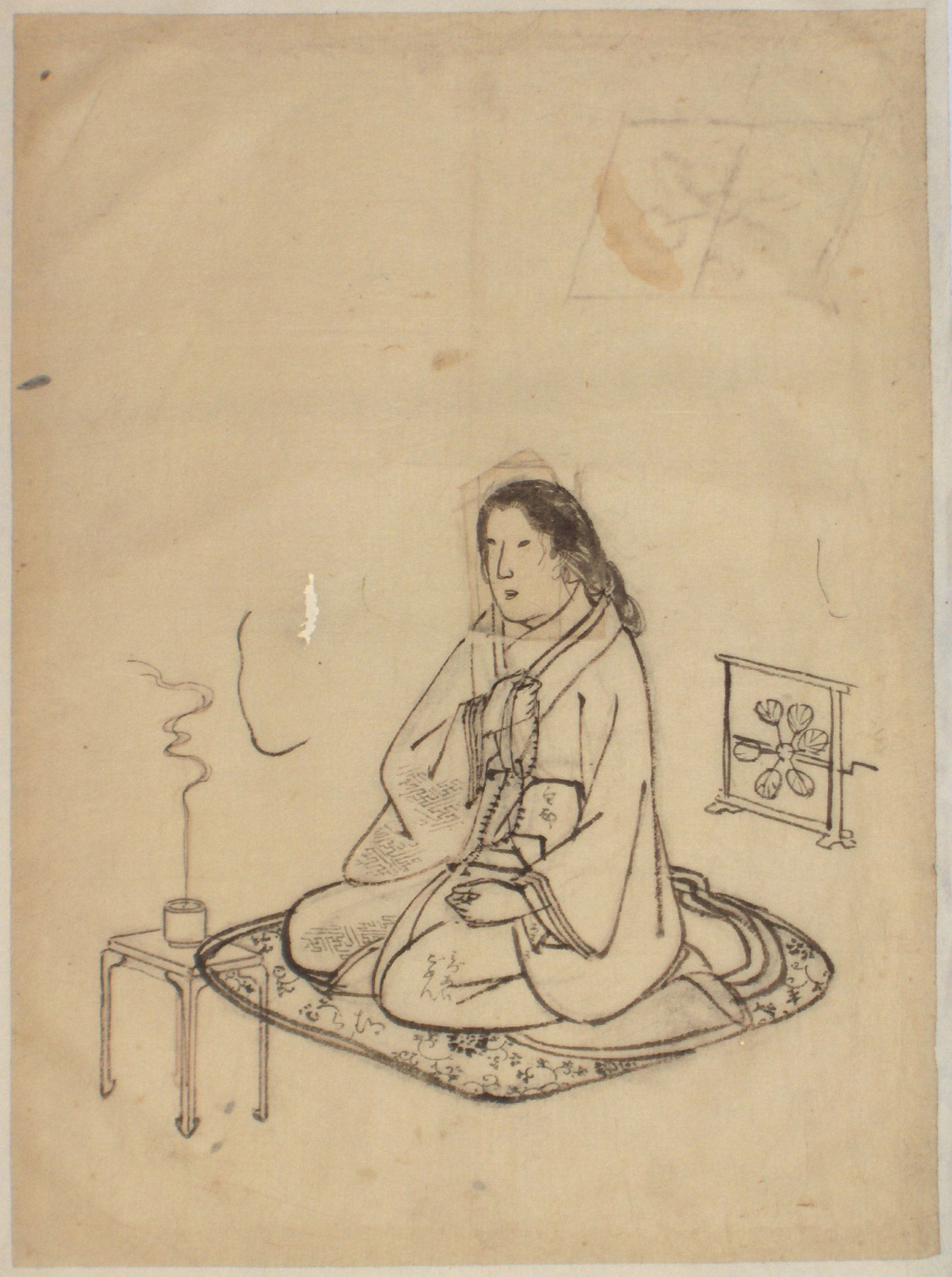
An original drawing showing a study of a seated woman holding a rosary in front of an incense burner. Sumi and pentimenti on thin paper. 13 x 9.5 in., 33 x 24.5 cms.
Status: Available
Price: £1,200
Toyohara KUNICHIKA (1835-1900)
Click here to view image full size.
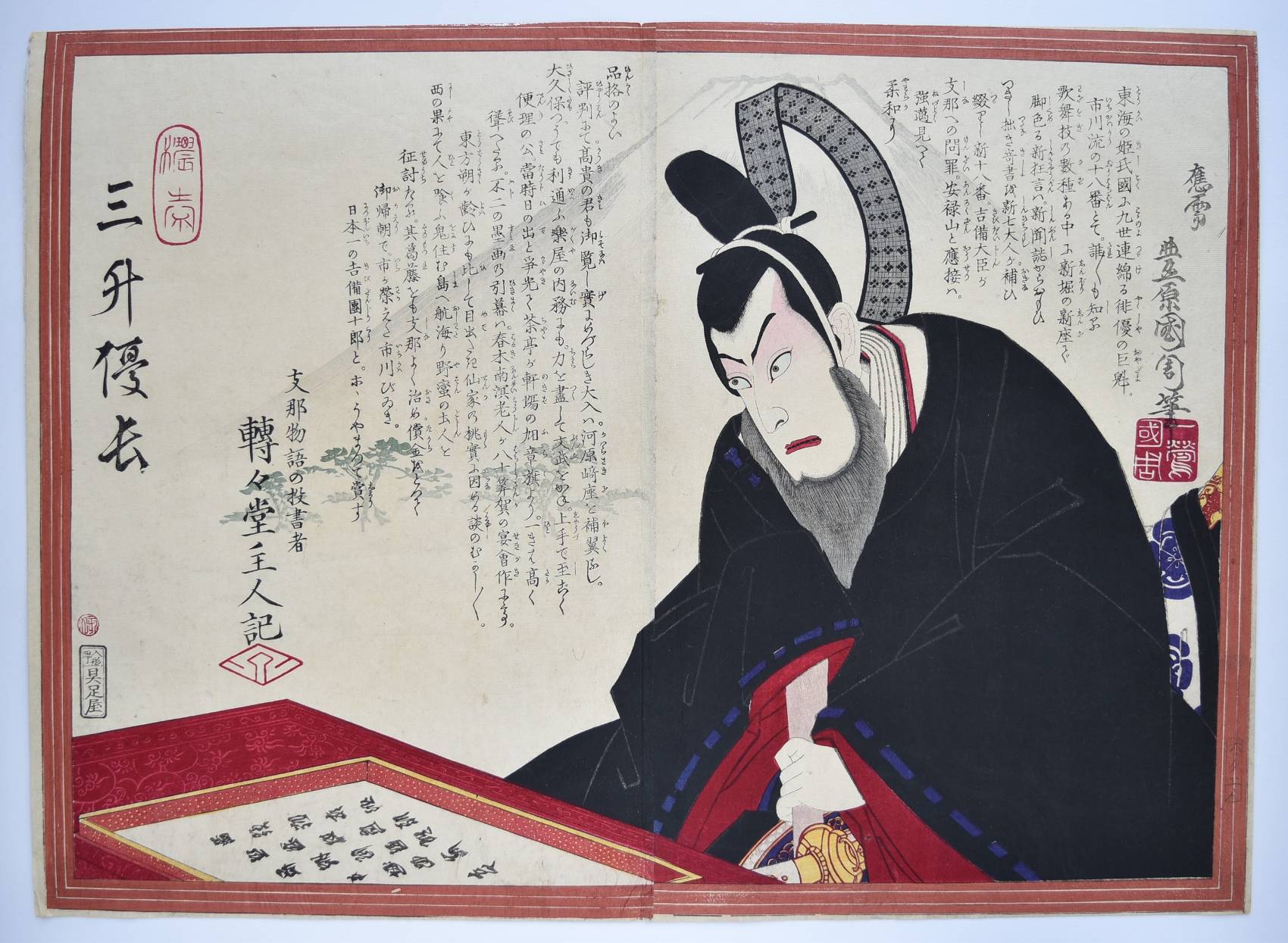
A dai-oban print showing the actor Ichikawa Danjuro IX as Minister Kibi in the play Kibi Daijin Shina monogatari, “Minister Kibi, Tale of China.” The play centres on the historical minister Kibi no Makibi who joined a mission to the Tang Court in China in 716. He is supposed to have brought back to Japan the game of go, embroidery, and the secrets of the Chinese almanac. Published by Gusokuya Kahai, 1875.
Fine impression with gauffrage and extensive burnishing to Kibi’s black garment. Fine colour. Light album backing, otherwise fine condition, untrimmed. Signed Oju Toyohara Kunichika hitsu.
Status: Sold
Torii KIYONOBU II (Fl. c 1720s-1760)
Click here to view image full size.
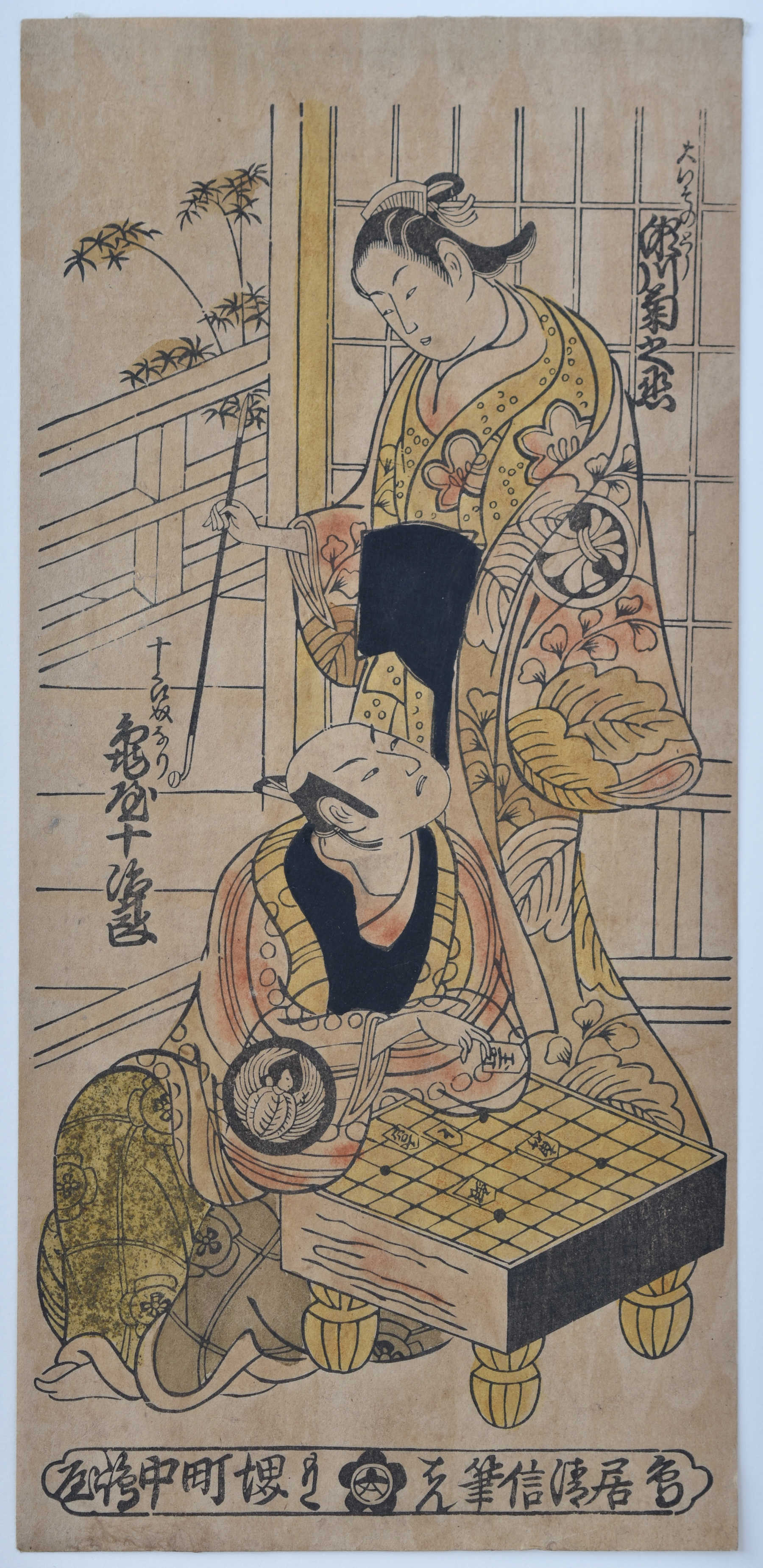
An early print showing the actor Segawa Kikunojo as Oiso no Tora looking down at Kameya Jujiro as Soga no Juro Sukenari who is leaning on a shogi board (Japanese chess). The play Hatsu hikage maizuru Soga was performed at the Nakamura-za Theatre, 1/1737. Published by Nakajima Izaemon. Ex collection Dr E.F. (1978). Rare.
Fine impression. Urushi beni-e with hand-applied colour: tan, yellow, light beni, gold powder and lacquered sumi over an embossed pattern. Toned with some fading of colour. Signs of mounting au verso. Signed Torii Kiyonobu hitsu.
Status: Sold
Torii KIYONOBU II (Fl. c 1720s-1760)
Click here to view image full size.
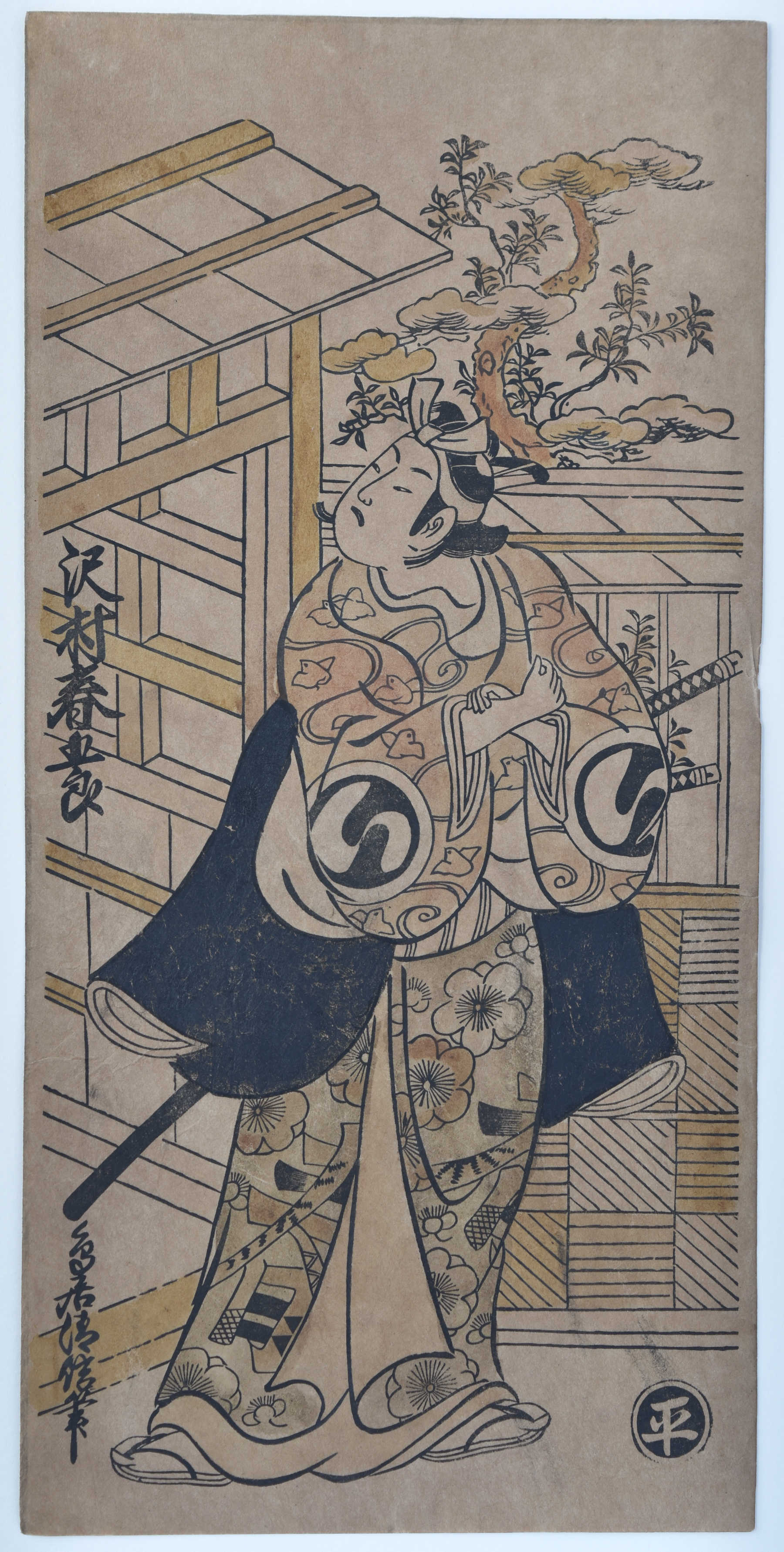
An early print showing the actor Sawamura Harugoro as Soga no Goro. Another impression is in MFA, Boston, acc. no. 21.5656. Published by Hiranoya Kohachi c early 1740s. Ex collection Dr E.F. (1969). Rare.
Very good impression. Urushi beni-e with signs of hand-colouring (faded) and lacquered sumi. Paper toned and signs of mounting au verso. Signed Torii Kiyonobu hitsu.
Status: Sold
Katsukawa SHUN’EI
Click here to view image full size.
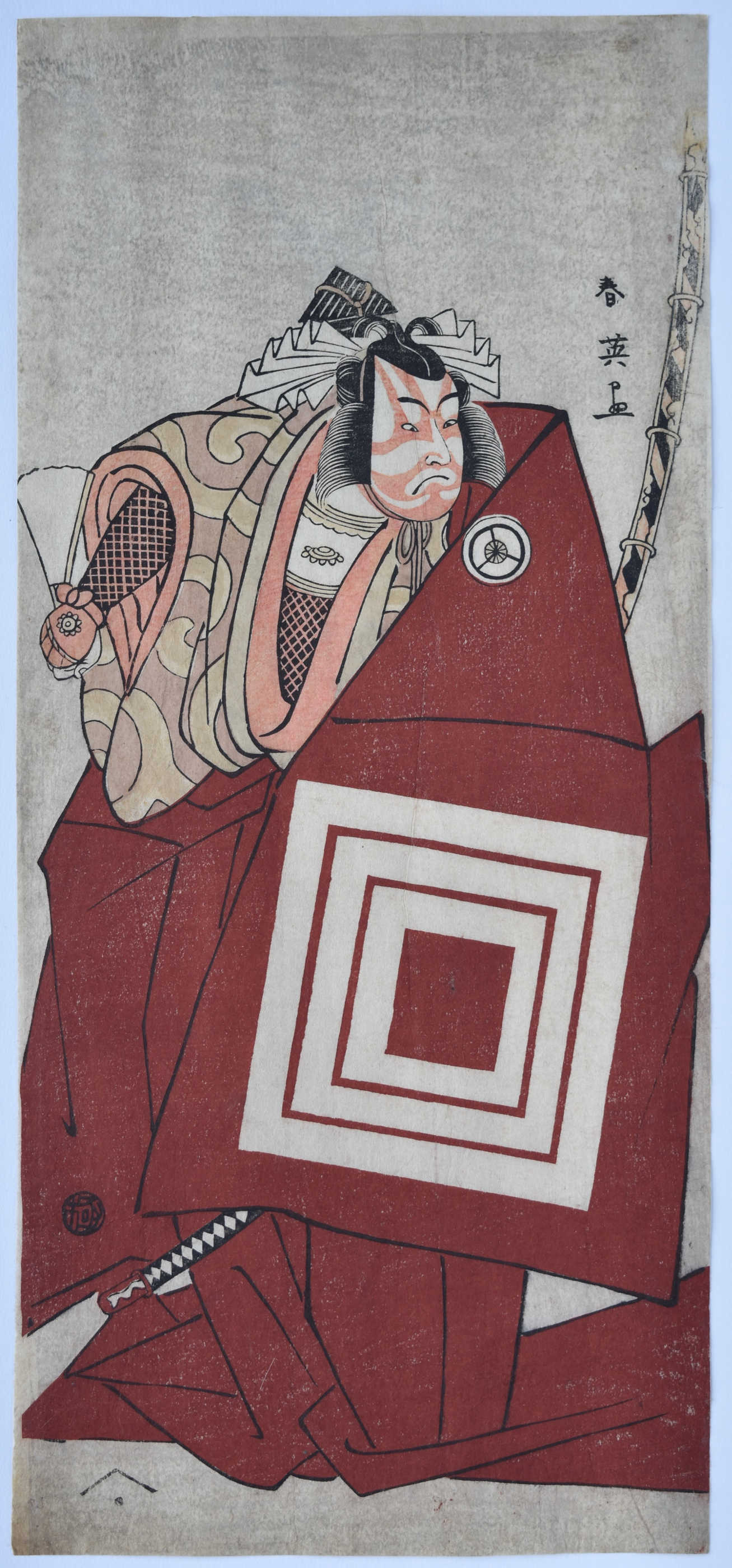
An hosoban showing Iwai Hanshiro IV in a “Shibaraku” role, probably as Akita Jonosuke Yoshikage from the play Mieiko nori no hachi no ki performed at the Kawarazaki Theatre in the 11th month, 1791. The highly stylised and dramatic Shibaraku costume gave rise to some of the best ukiyo-e designs. Originally staged by Ichikawa Danjuro I in 1697, it quickly gained popularity and was included in the kaomise celebrations at Edo theatres. Published by Harimaya Shinshichi. Ex Beres collection, sold Paris 2002, lot 39.
Fine impression, very good colour and condition. Beres seal au verso. Signed Shun’ei ga.
Status: Sold
Utagawa TOYOKUNI I (1769-1825)
Click here to view image full size.
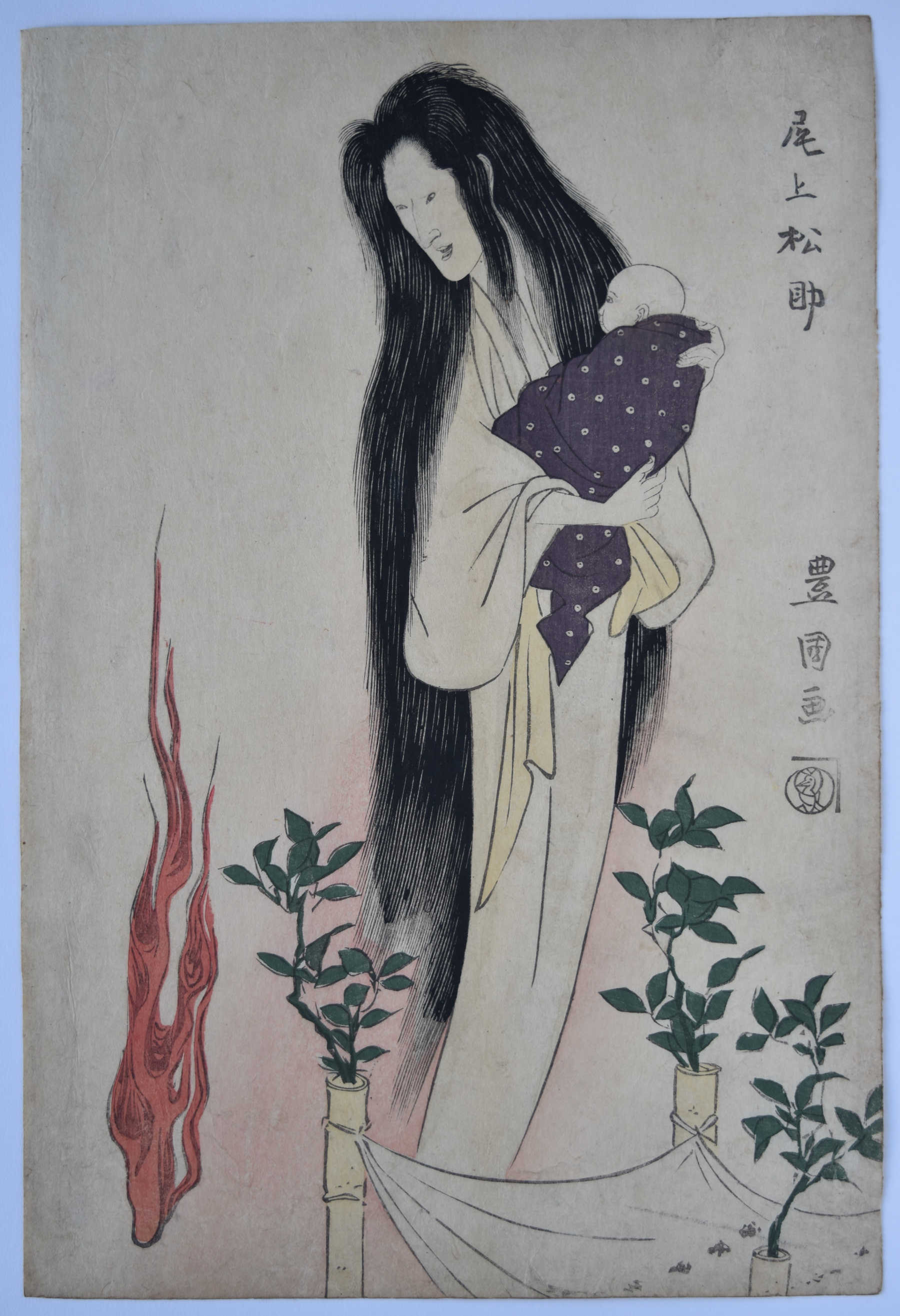
The actor Onoe Matsusuke I as the ghost of the wife of Kohada Koheiji in the play Eiri otogi zoshi performed at the Ichimura-za Theatre, 7/1808. In fact, Matsusuke played both the wife and Kohada Koheiji. One of the best plots in Kabuki: Kohada Koheiji was a third-rate kabuki actor who couldn’t find work. His drama teacher, taking pity on him, bribed a director to give him work. On seeing him, the director immediately saw his potential as a yurei (ghost) because of his appearance – white skin, dark, sunken eyes and long hair. And at this he became extremely successful. However, his wife Osoka, was embarrassed by him and took a lover. Together, they planned to kill him which they did by drowning him in a swamp. This gave him his greatest yurei role and he came back to haunt them to death. Published by Tsuruya Kinsuke, 1808.
Very good impression and colour. Minor creasing, otherwise very good condition. Signed Toyokuni ga.
Status: Sold
Utagawa KUNIYOSHI (1797-1861)
Click here to view image full size.
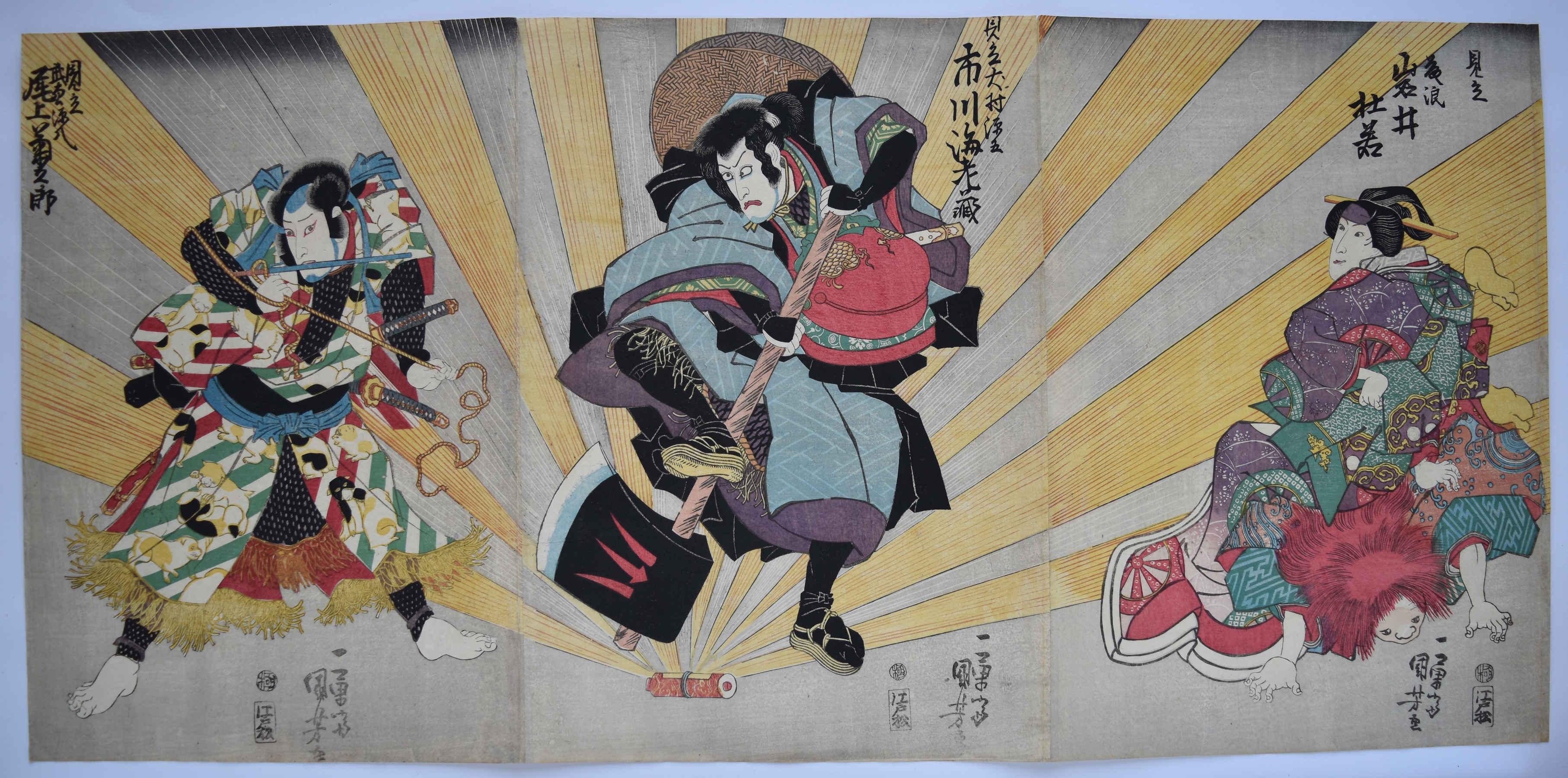
A mitate (imaginary) triptych showing, from left to right: Onoe Kikugoro III as Takehara Genpachi; Ichikawa Ebizo V as Omura Gengo; Iwai Tojaku as Fujinami. The actors surrounding a handscroll that is emitting strong bands of light. Published by Edoya Matsugoro, c. late 1830s.
Fine impression and colour. Album backing and joined sheets, otherwise fine condition. Signed Ichiyusai Kuniyoshi ga.
Status: Sold
Utagawa KUNISADA (1786-1865)
Click here to view image full size.
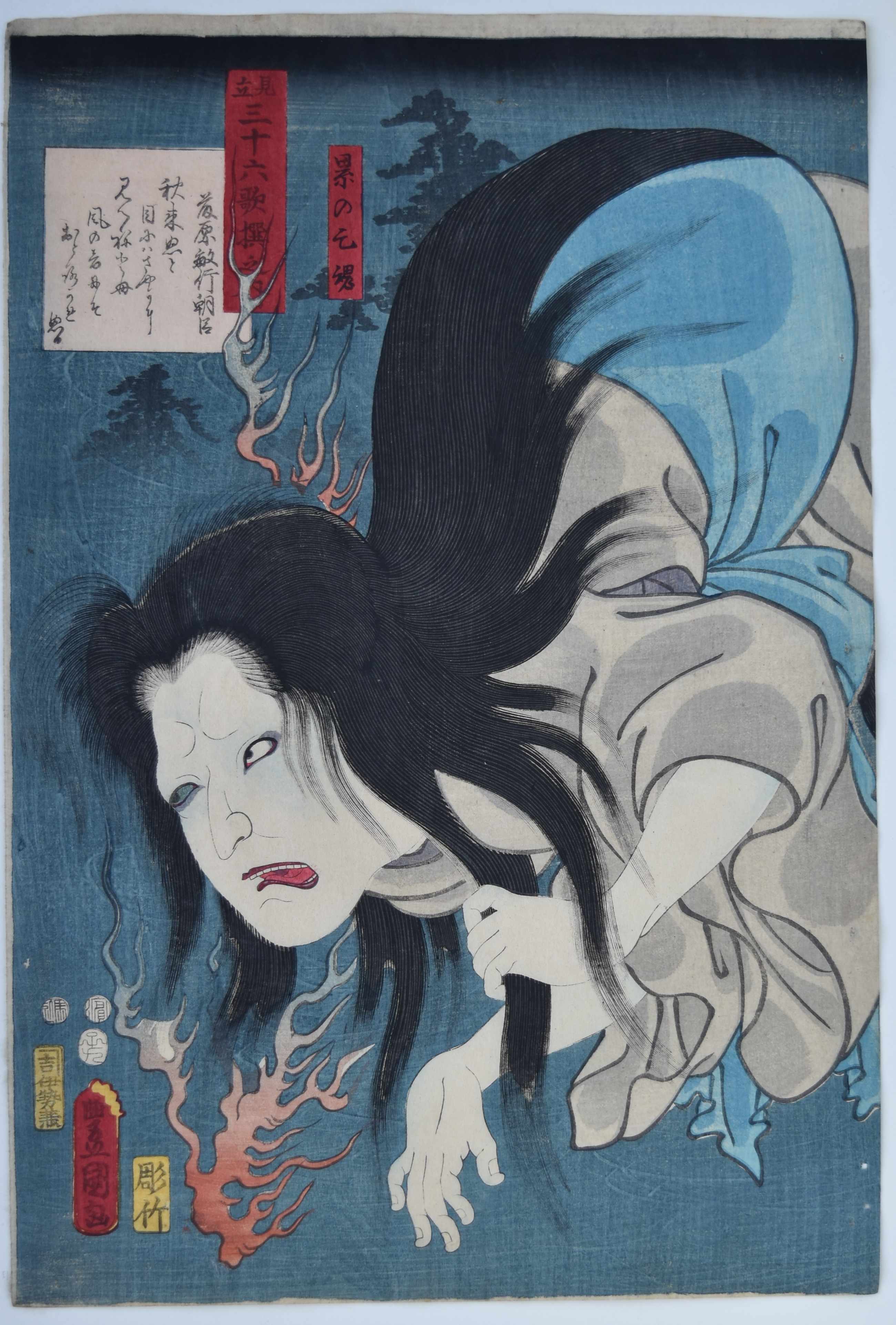
The actor Ichikawa Kodanji IV as the ghost of Kasane from a set Mitate sanjurokkasen no uchi, “An Imaginary Thirty-six Poets.” A famous early compilation; in this case the image is inspired by a poem of Fujiwara no Toshiyuki Ason. Shows Kasane’s vengeful ghost appearing to her husband who had murdered her. Published by Iseya Kanekichi, 1852.
Very fine early impression showing overall strong woodgrain and glue applied to the ghost’s right eye. Fine colour. Very small binding holes, otherwise very good condition. Signed Toyokuni ga.
Status: Sold
Utagawa YOSHITORA (Active c. 1850-1880)
Click here to view image full size.
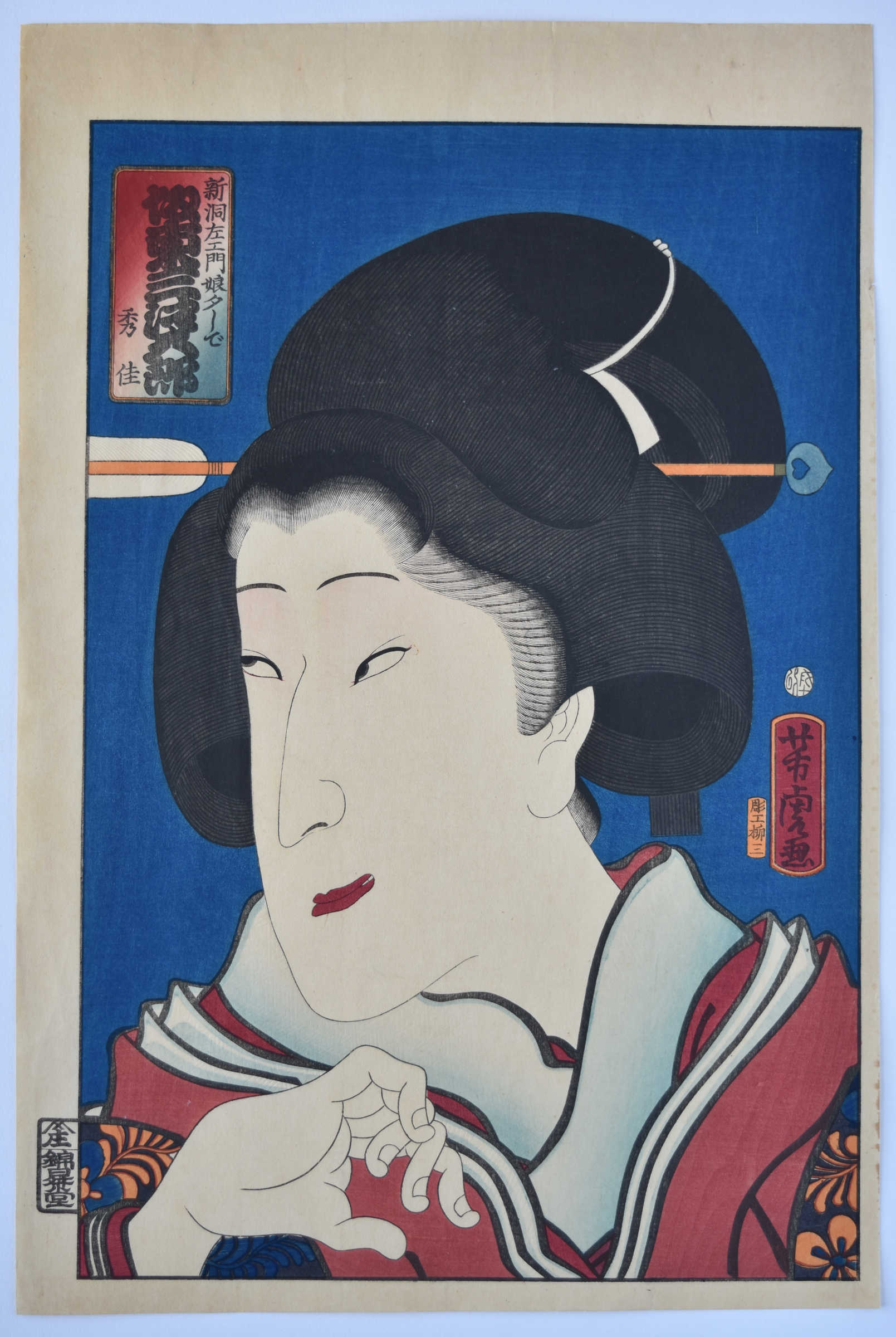
The actor Bando Mitsuguro V as Yushide, a daughter of Shindo Saemon from the play Karukaya doshin tsukushi no iezuto. From an untitled set of prints designed in conjunction with Kunisada. It was intended to represent the culmination of Kunisada’s career using only the finest materials, engravers and printers. Published by Kinshodo between 1860-1864. 150 designs were envisioned but only 72 were published, with 12 being by Yoshitora who joined the project in 1862. The plot concerns the machinations of rival Daimyo to possess a rare gem stone. Yushide is caught up in the shenanigans, the outcome being that she stabs herself in the throat with the white arrow she wears as a hair pin.
Superb impression. Fine colour and condition. Signed Yoshitora ga.
Status: Sold
Attributed to Toyoharu KUNICHIKA (1835-1900)
Click here to view image full size.
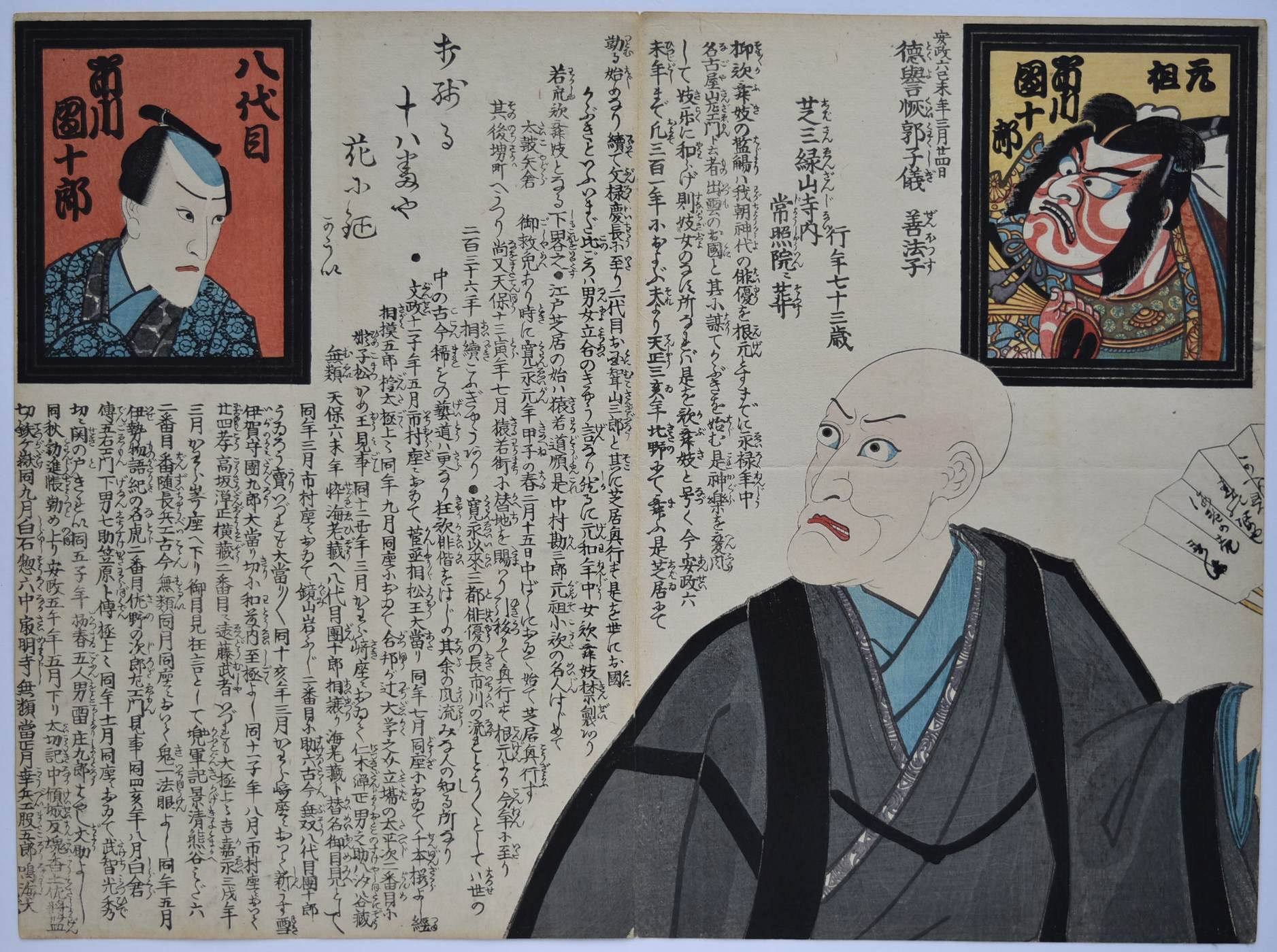
An oban diptych shini-e (memorial portrait) of the famous kabuki actor Ichikawa Danjuro VII (1791-1859). Upper right is the date of his burial, Ansei 6 (1859), 3rd month, 24th day. A long inscription at left on his life. The image top right shows his great-great-great grandfather, the first Ichikawa Danjuro (1660-1704). The other image, top left, shows Danjuro VIII (1823-1854), his son, who predeceased him by 4 years. See Waseda University Theatre Museum, acc. Nos. 114-0330 and 114-0332 (attributed to Kunichika).
Fine impression and colour. Light album backing, otherwise fine condition.
Status: Sold
Utagawa KUNISADA II (1823-1880)
Click here to view image full size.
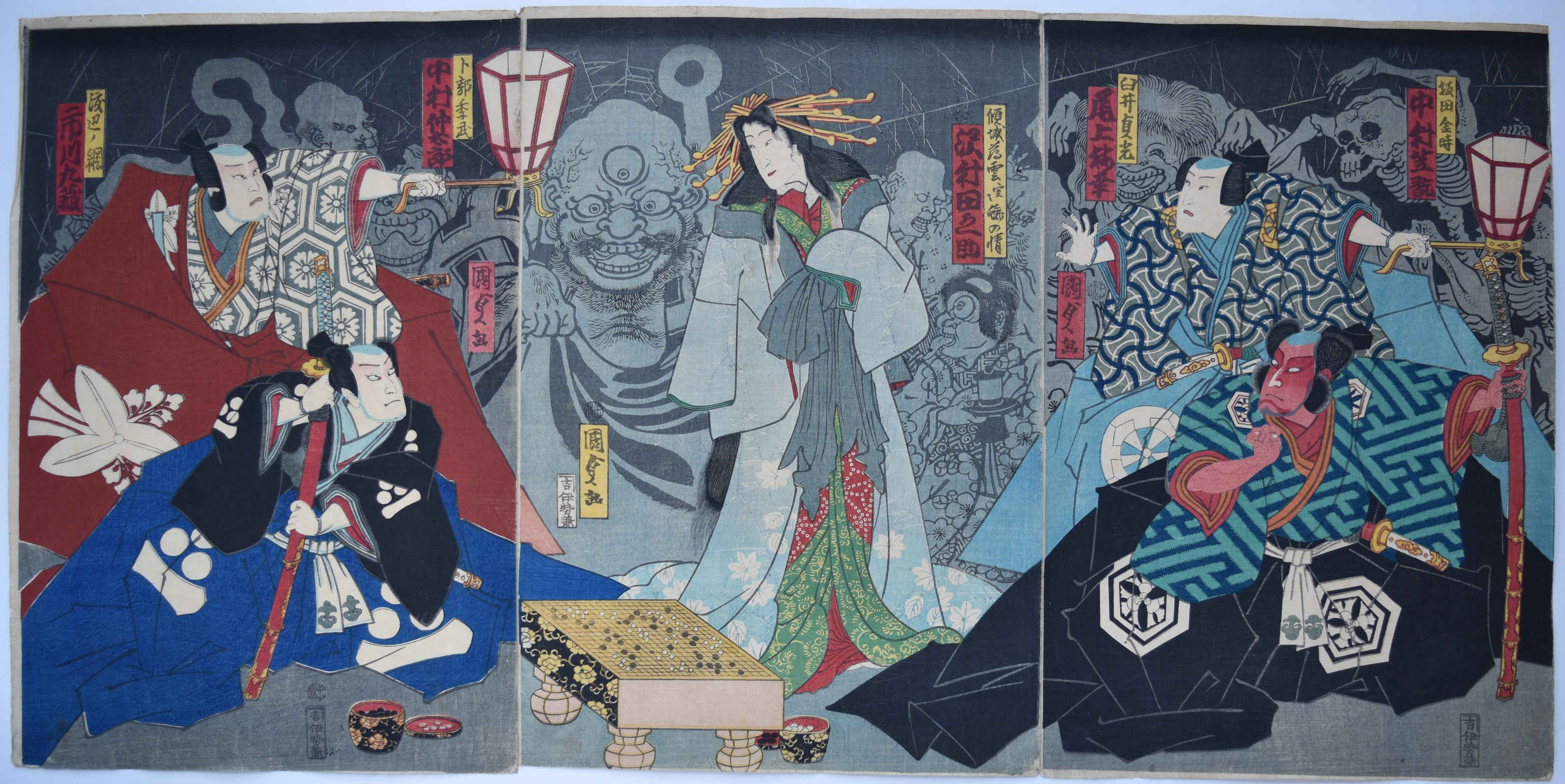
A triptych showing the actors Nakamura Shikan IV as Sakata Kintoki and Onoe Baiko V as Usui Sadamitsu – both henchmen of Watanabe no Tsuna (Raiko) – on the right; Sawamura Tanosuke III as the courtesan Usugumo (actually the spirit of a spider), centre, and Nakamura Chutaro as Urabe Hidetake – another henchman of Raiko – and Ichikawa Kuzo III as Watanabe no Tsuna on the left. Goblins and skeletons abound in the background. From the play Kubei yoi no itosuji performed at the Morita-za Theatre, 1864. Published by Iseya Kanekichi.
Very good impression, colour and condition. Signed Kunisada ga.
Status: Sold
KATSUKAWA SCHOOL
Click here to view image full size.
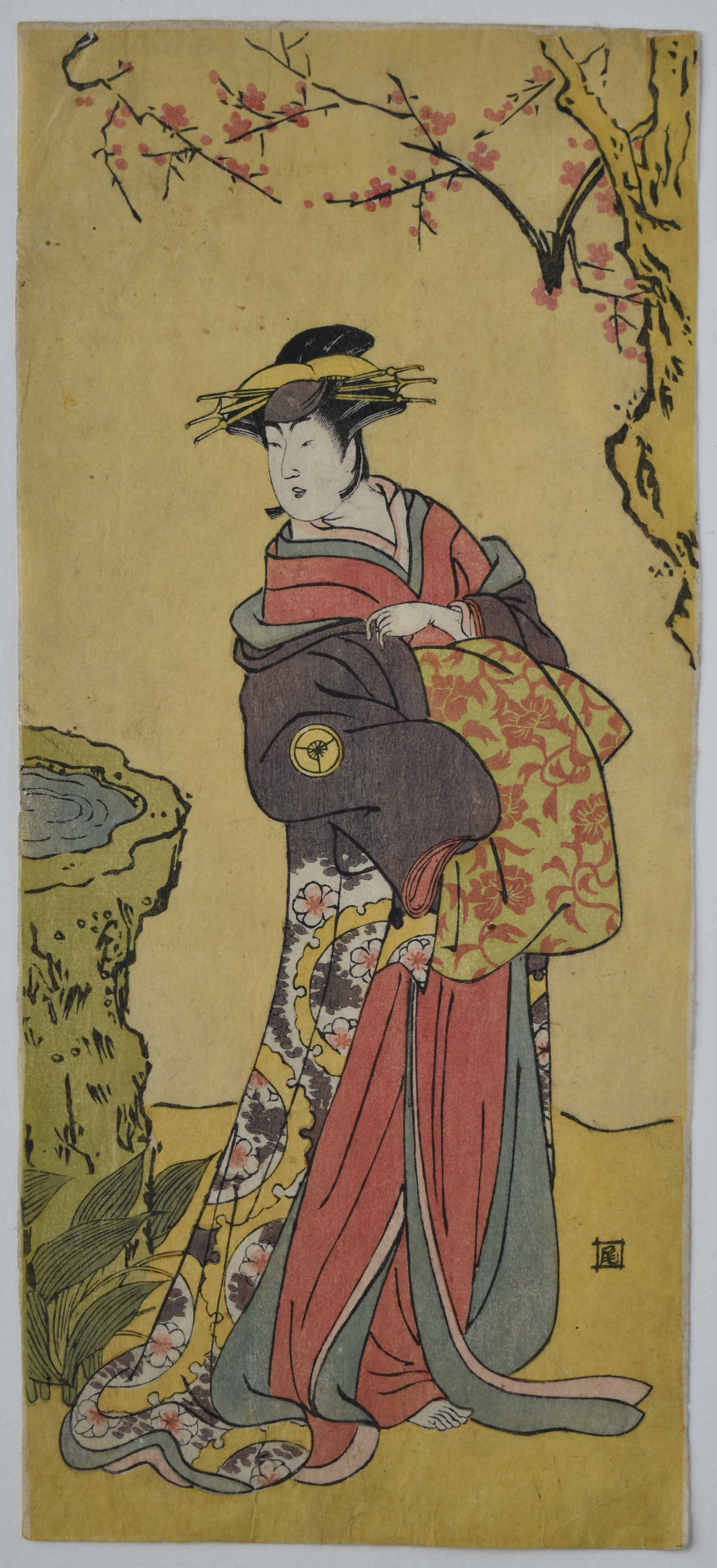
The actor Iwai Hanshiro IV probably in a new year Soga play. Unidentified publisher, published c late 1780s.
Fine impression. Exceptional colour. Fine condition.
Status: Sold
Torii KIYOMASU II (Fl. c 1720s -1760)
Click here to view image full size.
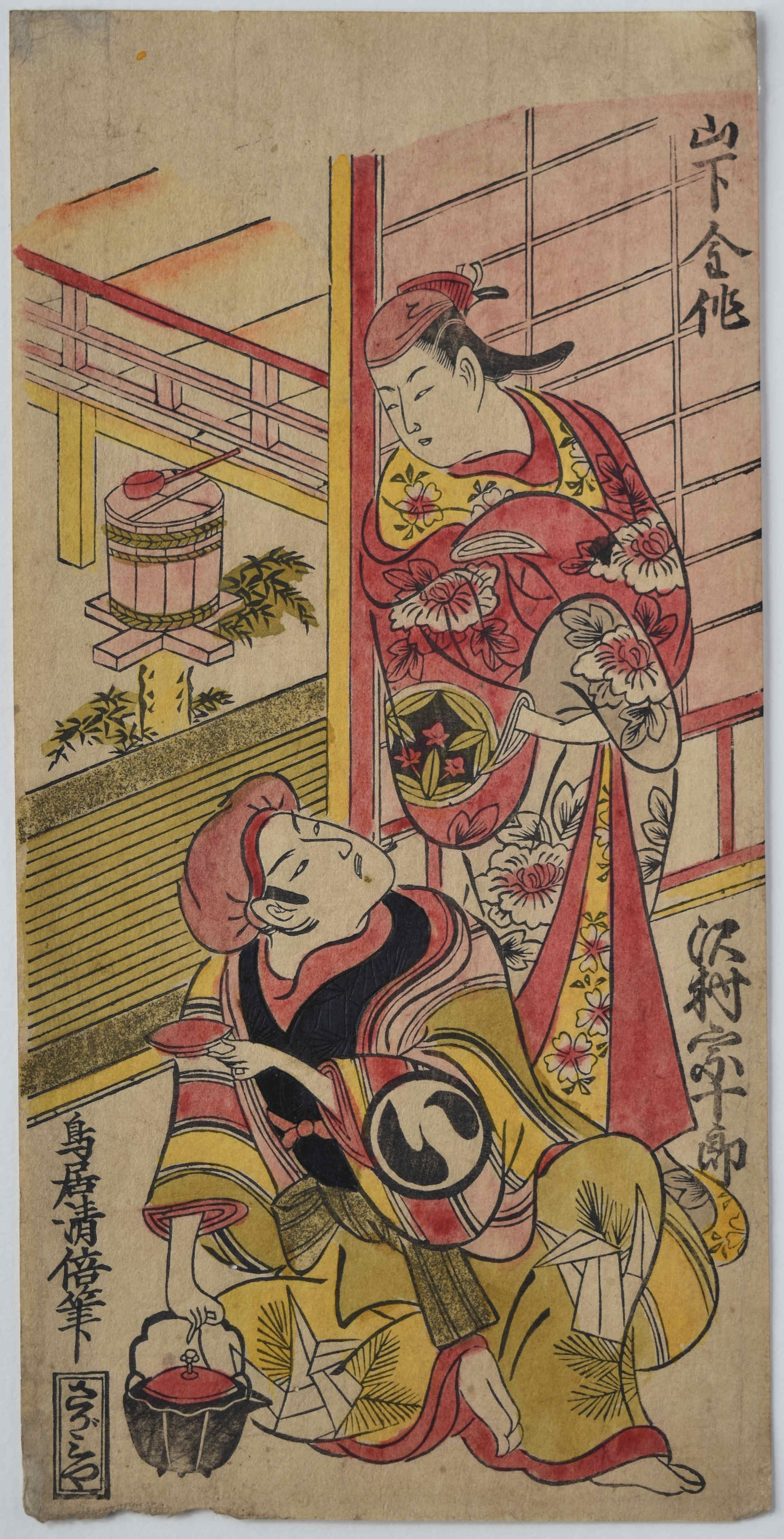
An exceptional Primitive showing the onnagata actor Yamashita Kinsaku I looking down at the actor Sawamura Sojuro I who is holding a kettle and teacup. Published by Sagami-ya Yohei c late 1720s.
Very good impression. Urushi beni-e with hand-applied colour: Tan, yellow, light and dark beni and green. Lacquered sumi over an embossed pattern and gold powder. Minor soil and small nick out of bottom edge, otherwise very good condition. Signed Torii Kiyomasu hitsu.
Status: Sold
Torii KIYOTOMI (FL. c 1720 -1740)
Click here to view image full size.
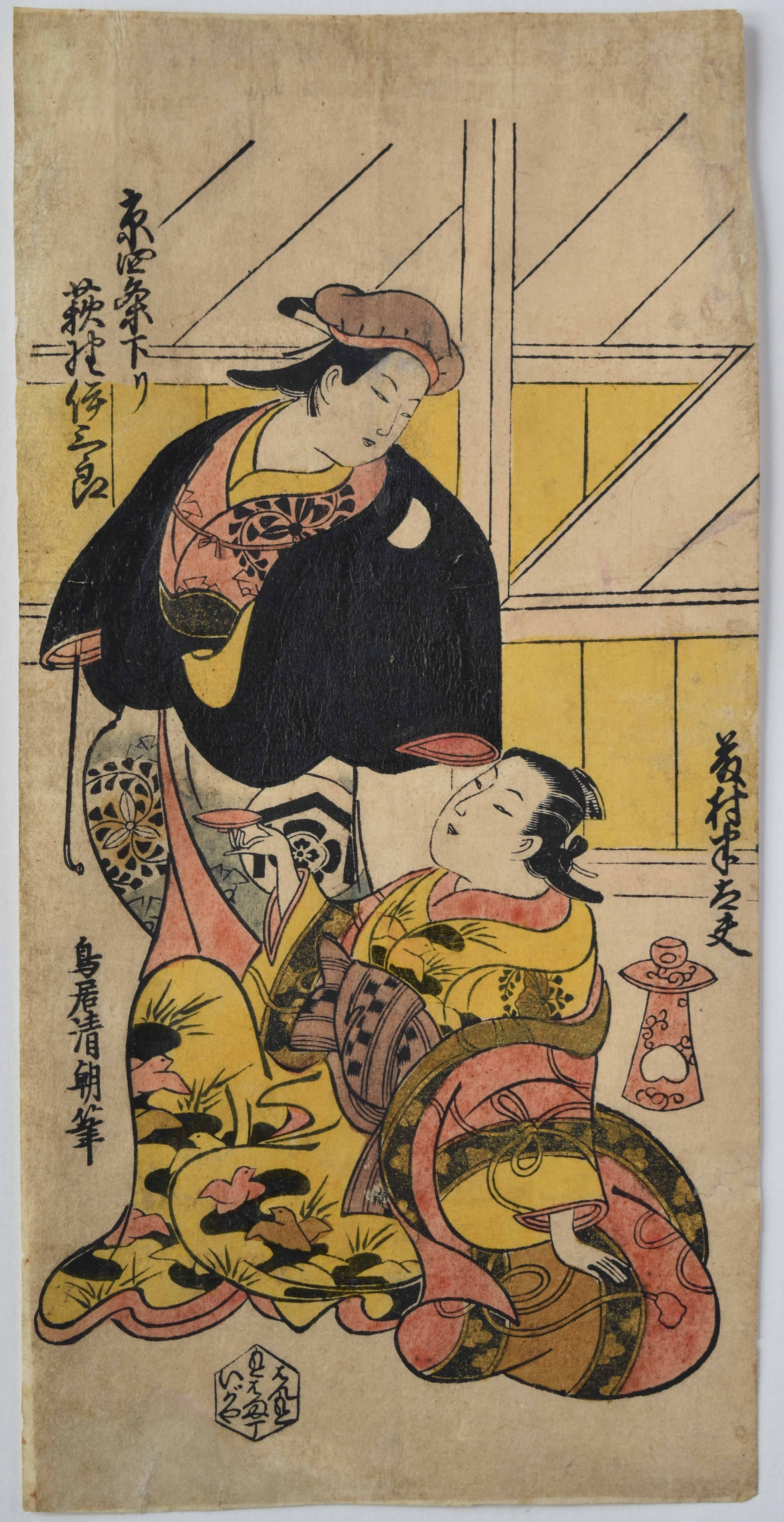
The actor Ogino Isaburo I looking down on the onnagata actor Fujimura Handayu II. An inscription above Ogino Isaburo states: Kyo Shijo kudari, “Coming from Shijo (Fourth Street) from the Capital.” Indicating the actor was on tour in Edo. Kyoto was considered the capital at that time and the Kabuki theatre was located on Fourth Street in Kyoto. Published by Igaya Kan’emon (Bunkido) c mid 1720s.
Very good impression. Urushi beni-e with hand-applied colour: Tan, yellow, light and dark beni and blue. Lacquered sumi over an embossed pattern and gold powder. Some soil and expertly repaired wormage, otherwise very good condition. Signed Torii Kiyotomi hitsu.
Status: Sold
Tamura SADANOBU (Fl. c 1720s-1730s)
Click here to view image full size.
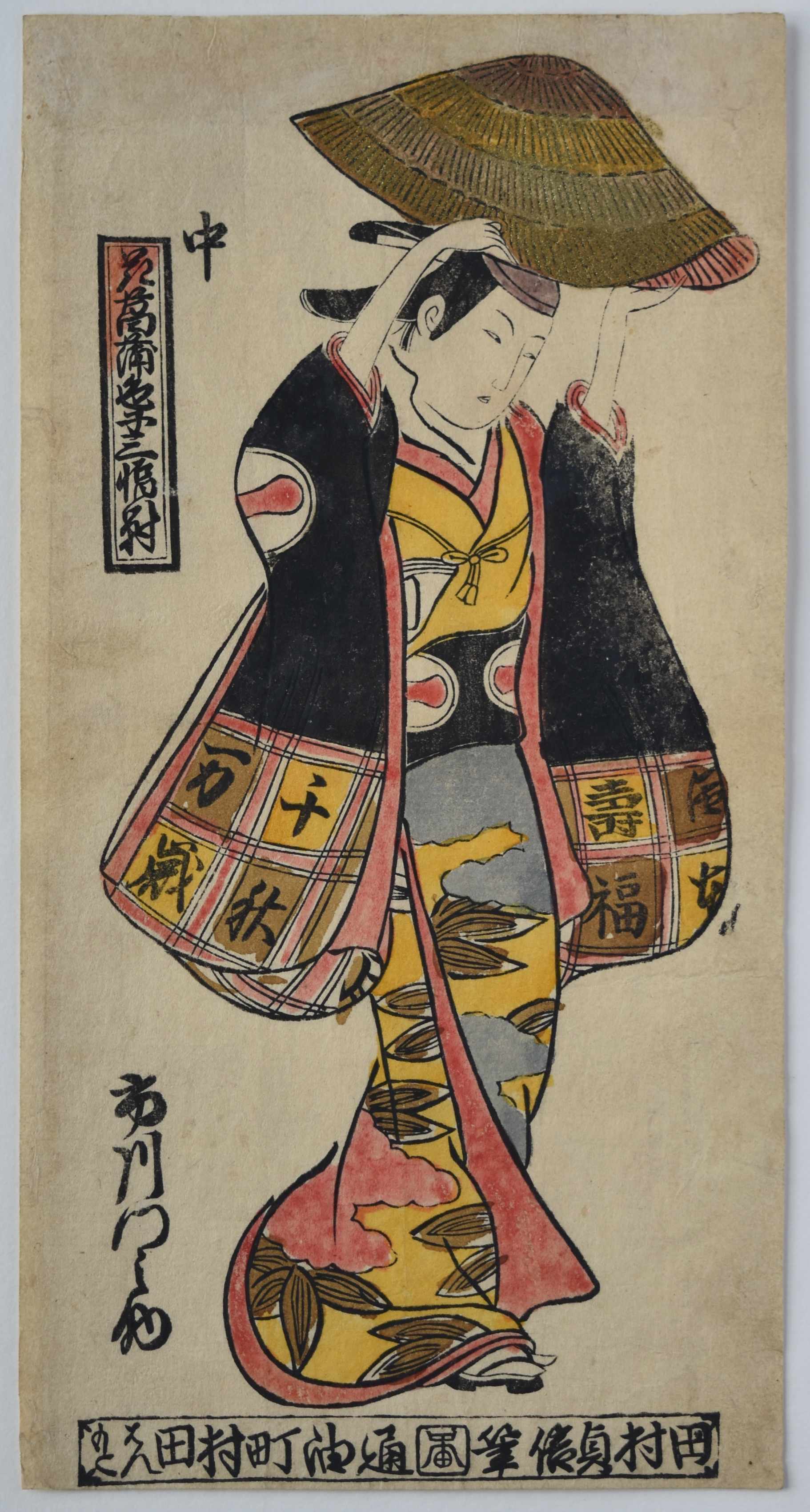
The An artist who seems to have specialised in triptychs. Shows the actor Ichikawa Monnosuke I shielding his head with a large sedge hat (kasa). The middle sheet (naka) of a triptych with title: Hana shobu irotagai sannpukutsui, “A Triptych of Irises in Alternating Colours.”(Possibly following the colours irises come in: Blue, purple, white.) On the sleeves are the auspicious characters denoting long life. Published by Murataya Jirobe (Eiyudo), c mid 1720s.
Very good impression. Urushi beni-e with hand-applied colour: tan, blue and beni. Lacquered sumi over an embossed pattern and gold powder. Slight loss of the sumi, otherwise very good condition. Signed Tamura Sadanobu hitsu.
Status: Sold
Torii KIYOMASU II (Fl. c 1720s -1760)
Click here to view image full size.
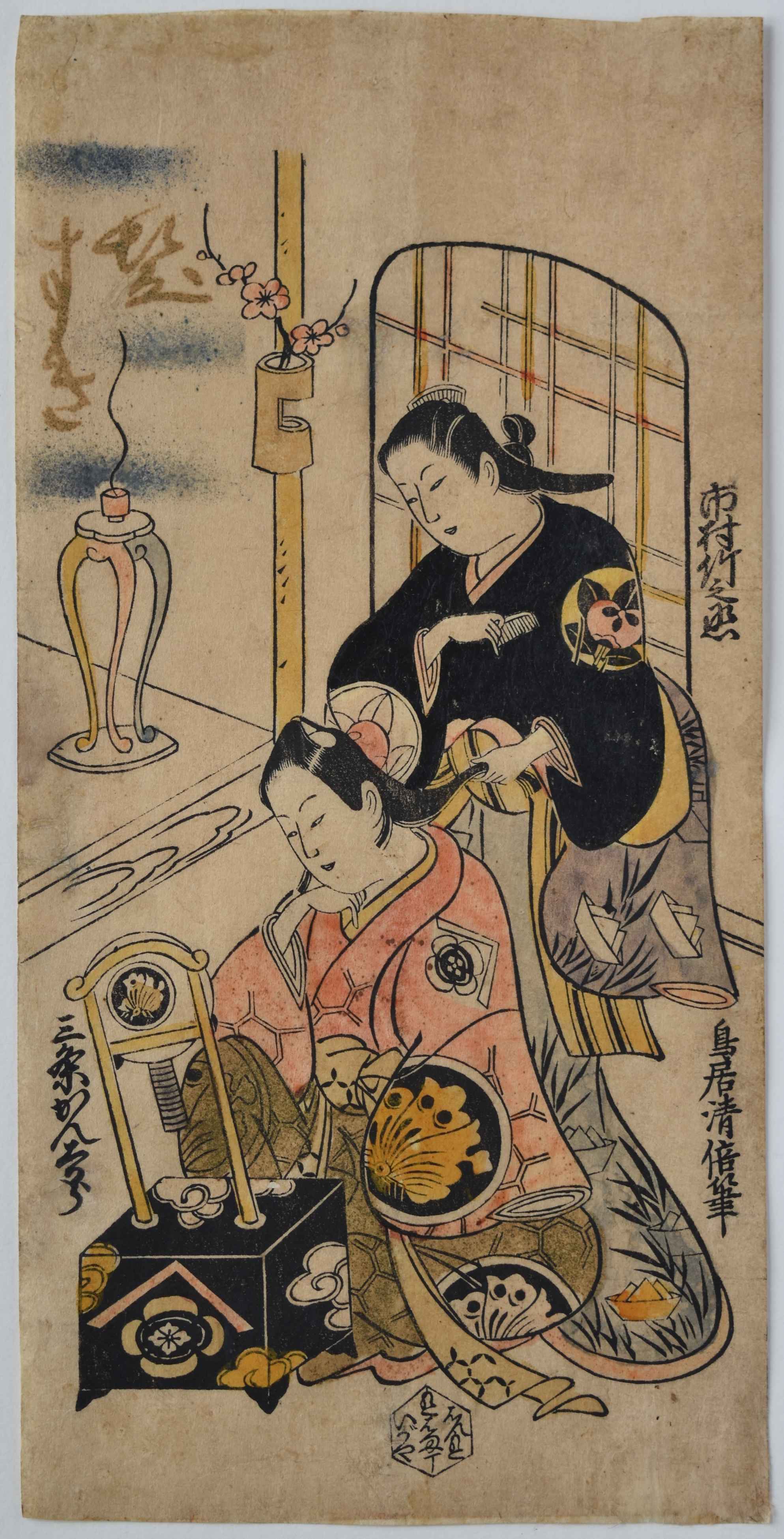
The onnagata actor Ichimura Takenojo IV standing and combing the hair of a fashionable young man played by Sanjo Kantaro II. Above, left, is the title printed in gold: Kamisuke, “Hair-combing.” These romantic scenes show the tenderness and love between a man and a woman. There is another version of this scene with the same actors by Okumura Toshinobu. Published by Igaya Kan’emon (Bunkido) c early 1730s.
Very good impression. Urushi beni-e with hand-applied colour: Lilac, beni and yellow. Lacquered sumi over an embossed pattern and gold powder with sprayed blue bands around title. Light soil and small expertly repaired wormhole, otherwise very good condition. Signed Torii Kiyomasu hitsu.
Status: Sold
Torii KIYOMASU II (Fl. c 1720s -1760)
Click here to view image full size.
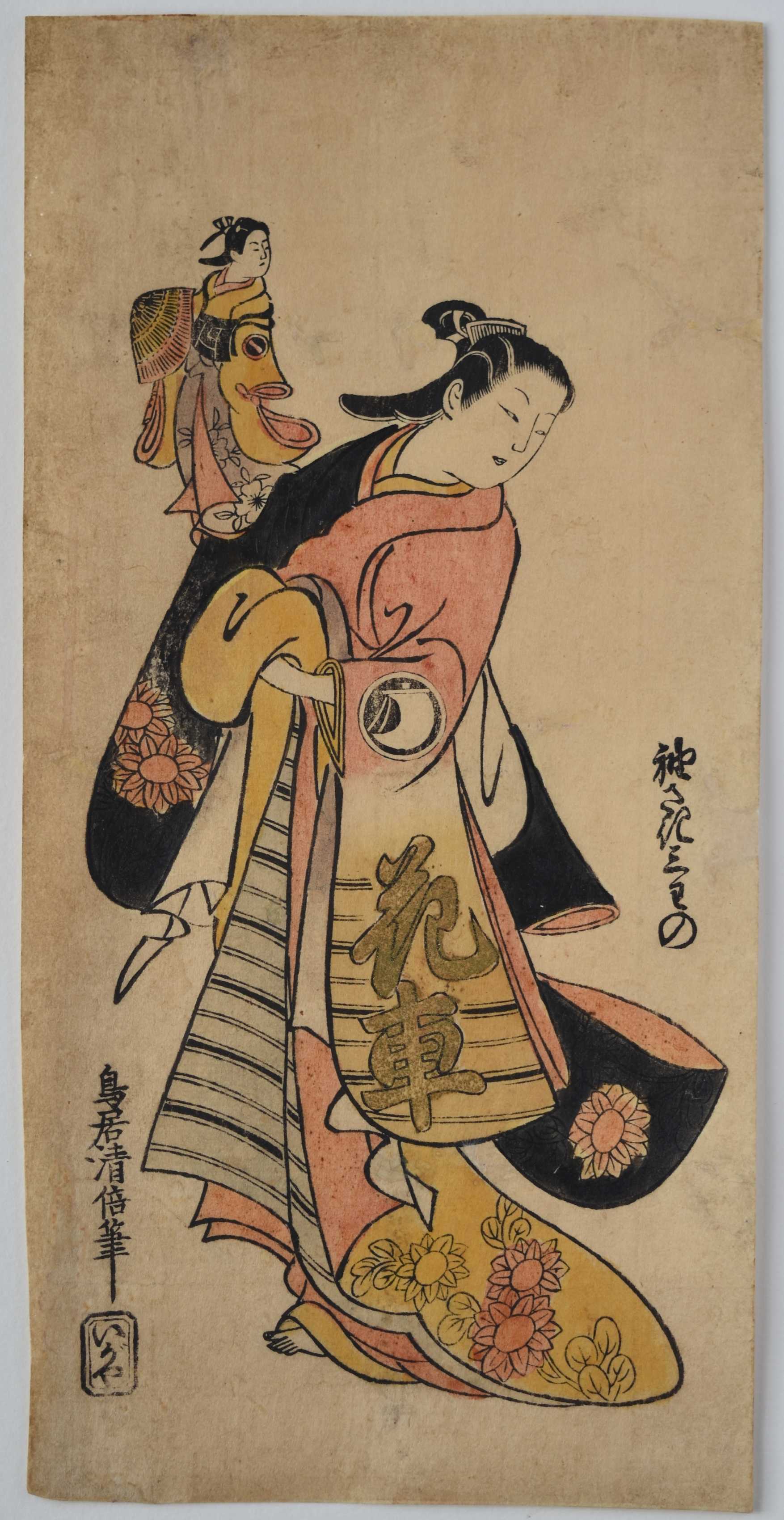
Shows the actor Sodesaki Miwano I as a proprietress of a house of assignation (kasha). He holds a puppet of the actor Ichikawa Monnosuke I dressed as a fashionable young man visiting the pleasure quarter holding a sedge hat to hide his face. Published by Igaya Kan’emon (Bunkido) c late 1720s.
Very good impression. Urushi beni-e with hand-applied colour: beni, yellow, lilac and pale green. Lacquered sumi over an embossed pattern and gold powder. Light soil and expertly repaired wormage, otherwise very good condition. Signed Torii Kiyomasu hitsu.
Status: Sold
Torii KIYOMASU II (Fl. c 1720s -1760)
Click here to view image full size.
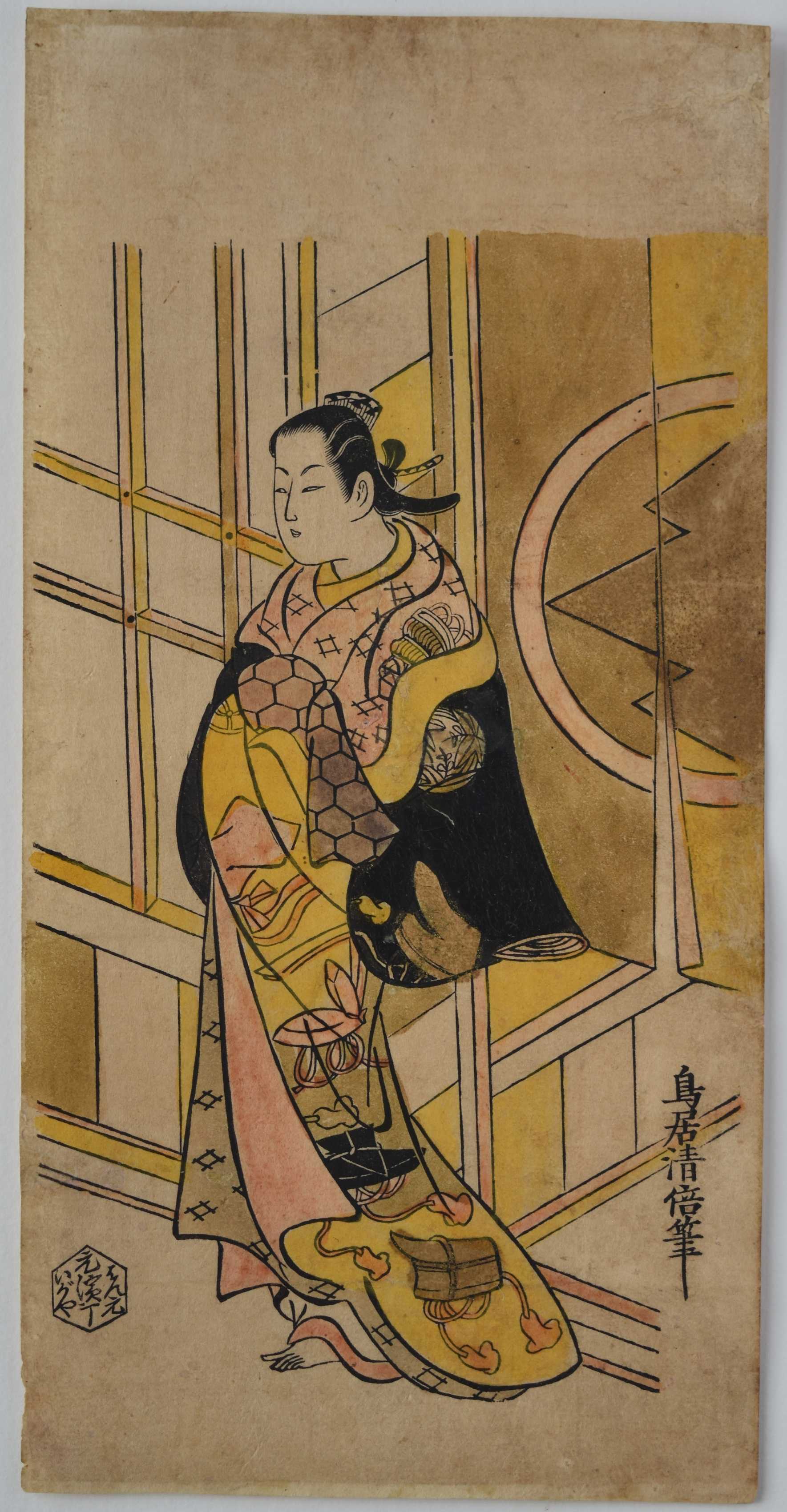
Shows a high-class courtesan emerging from a tea-house with slashed curtains. Possibly one sheet of a triptych. Published by Igaya Kan’emon (Bunkido) c mid 1720s.
Very good impression. Urushi beni-e with hand-applied colour: tan, light beni, light green and yellow. Lacquered sumi and gold powder (mostly lost). Light soil and expertly repaired wormage, otherwise good condition. Signed Torii Kiyomasu hitsu.
Status: Sold
Okumura TOSHINOBU (Fl. c 1717-1750)
Click here to view image full size.
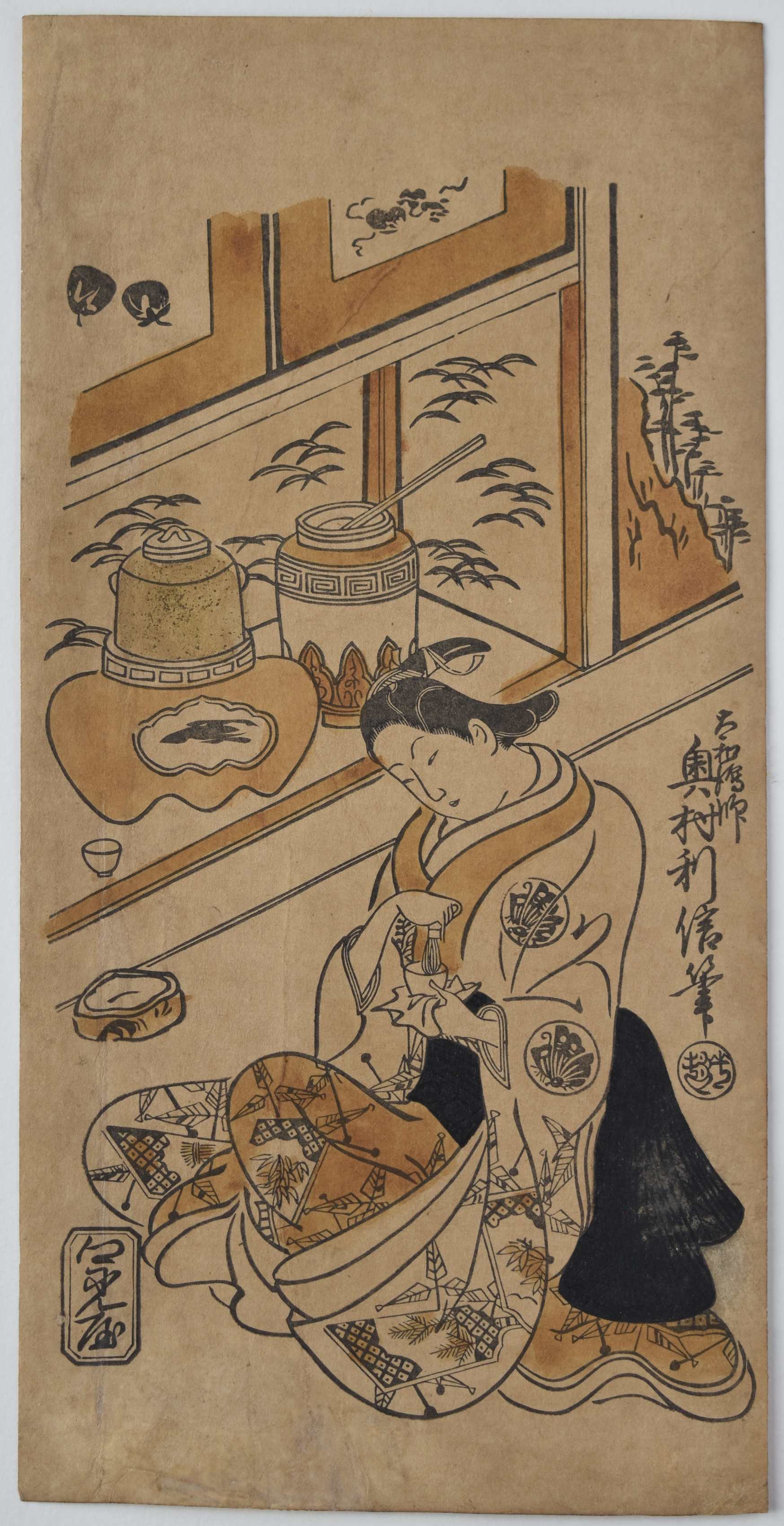
Shows a beauty whisking tea in front of an alcove. Published by Emiya Kichiemon c late 1720s.
Very good impression. Urushi with hand-applied tan colour. Lacquered sumi over an embossed pattern. Browned and some thinned areas, otherwise good condition. Signed Yamato gashi Okumura Toshinobu hitsu.
Status: Sold
Tsukioka YOSHITOSHI (1839-1892)
Click here to view image full size.
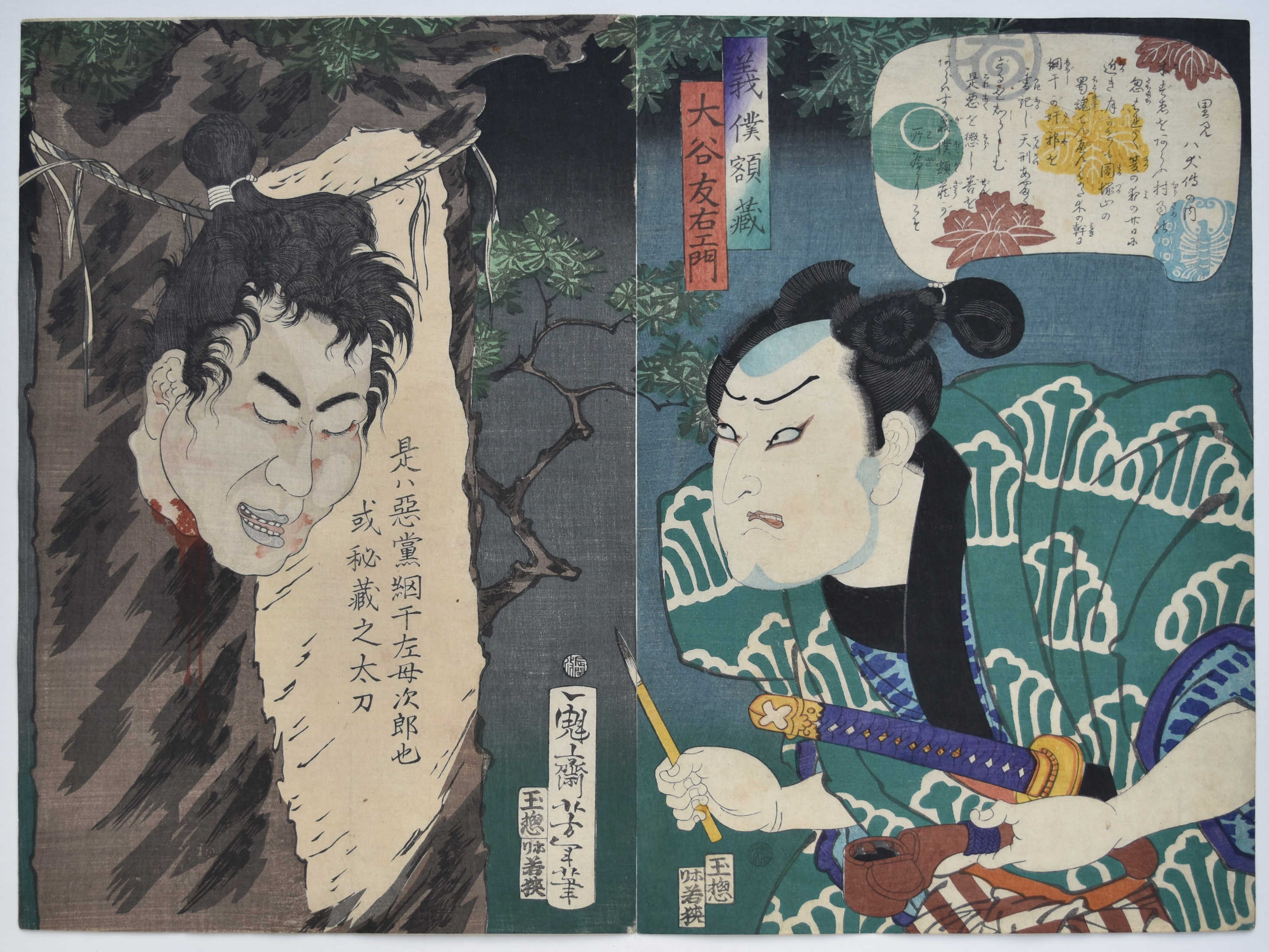
A diptych showing the actor Otani Tomoemon V as the loyal servant Gakuzo (aka Inukawa Sosuke Yoshito, one of the eight Dog half-brothers), brush in hand, having just hung the decapitated head of the evil Aboshi on a tree and written beside it: Kore ha akuto Aboshi Samojiro nari. Aruiwa hizo tachi, “This is the villain Aboshi Samojiro… He [stole] a treasured sword [Murasame – the treasured sword of the Ashikaga family].” Shows a scene from an episode in Part III, volume 5 of the Satomi Hakkenden no uchi, “Tales of the Eight Dogs of the Satomi Clan.” The macabre tale, written by Kyokutei Bakin (1767-1848) in 98 chapters and 106 booklets, revolves around the eight offspring of a supernatural marriage between a princess and her father’s dog and their commitment to restore the fortunes of the samurai house of Satomi. Published by Tamaya Sosuke 1868. Very rare: Keyes in his dissertation on Yoshitoshi lists just the right sheet from an oban series, presumably the print in the Philadelphia Museum of Art, ART568220, and another impression of just the right sheet is owned by Tateyama City in Chiba Prefecture.
Very good impression, colour and condition. Signed Kaisai Yoshitoshi hitsu. (Keyes attributes this print to Yoshitoshi as he hadn’t seen the left sheet.)
Status: Sold