Utagawa KUNIYOSHI (1797-1861)
Click here to view image full size.
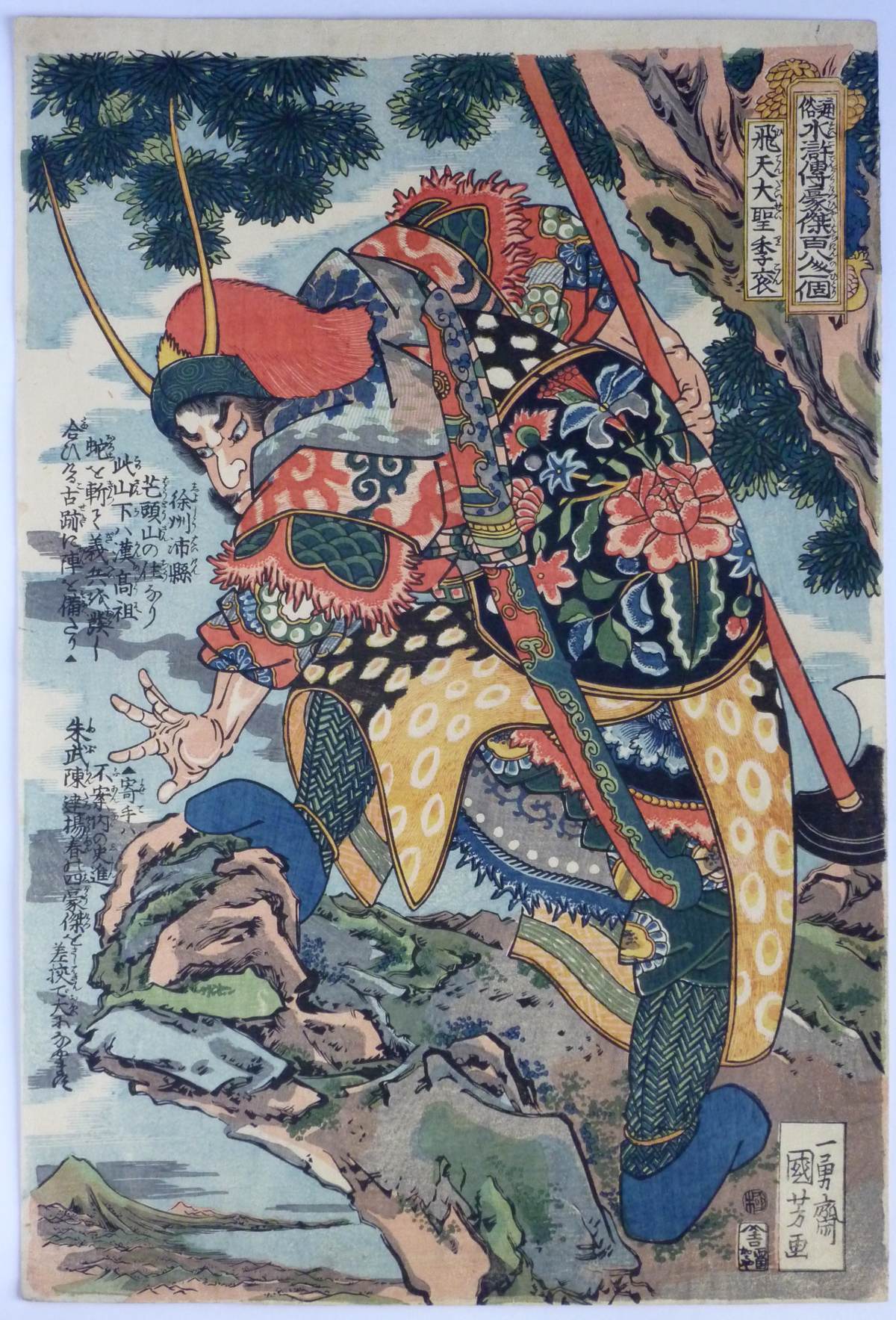
The warrior Hitentaisei Rikon in armour, holding a long-handled axe and scanning the horizon from a craggy outcrop. From the set Tsuzoku Suikoden goketsu hyaku-hachi-nin no hitori, “The Hundred and Eight Heroes of the Popular Suikoden, One by One.” Published by Kagaya Kichiyemon, 1827-30. Robinson S2. 21.
Extremely fine impression and colour. Fine condition. Full size (unusual as this set are overlarge obans and often trimmed). Signed Ichiyusai Kuniyoshi ga.
Status: Sold
Utagawa KUNIYOSHI (1797-1861)
Click here to view image full size.
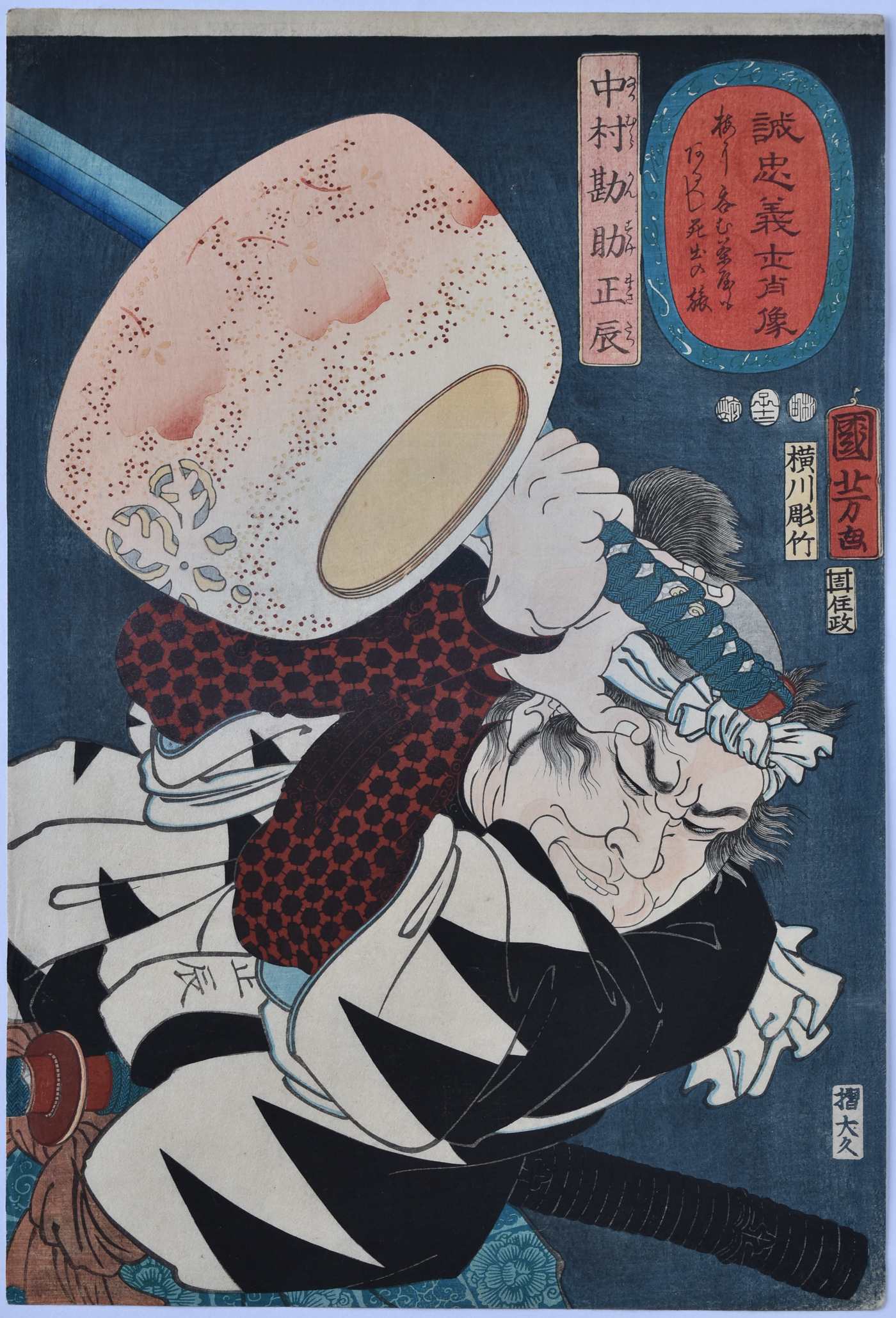
The ronin Nakamura Kansuke Masatatsu dodging a brazier of hot ash. The best design from a fine set of twelve half length portraits of the forty-seven ronin: Seicho gishi shozo, “Portraits of Faithful Samurai of True Loyalty.” The depictions borrow strongly from western portraiture including imitation western script in the green border of the title cartouche. It is not necessary to repeat the story here as it is the best known Japanese tale. Published by Sumiyoshiya Masagoro, 12/1852.
Fine impression, colour and condition. Full size. The printing on this set is exceptional with details such as the sword blades and title cartouches burnished. Signed Kuniyoshi ga.
Status: Sold
Ichiryusai HIROSHIGE (1797-1858)
Click here to view image full size.
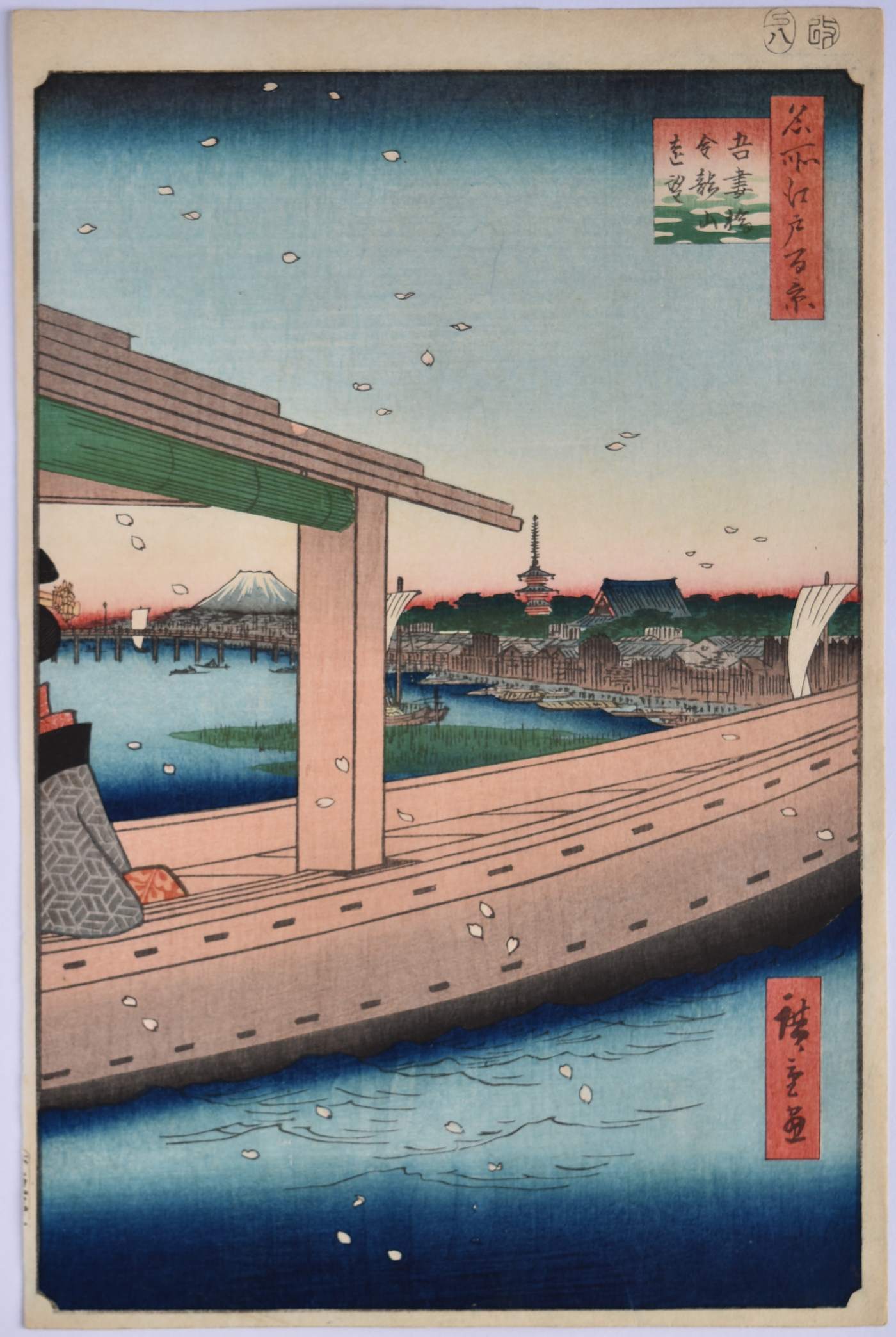
Azumabashi Kinryuzan enbo, “Distant View of Kinryuzan Temple from Azuma Bridge” from Meisho Edo hyakkei, the “One Hundred Views of Edo.” The set published between 1856 and 1858 (this being 1857) by Uoya Eikichi. A spring day with cherry blossom floating down over a boat drifting on the Sumida River. A geisha is partly glimpsed sitting in the boat. In the distance is Mt Fuji, the bridge and temple. See my blog.
Superb impression from the first edition. Fine colour. Fine condition. Signed Hiroshige ga.
Status: Sold
Taiso YOSHITOSHI (1839-1892)
Click here to view image full size.
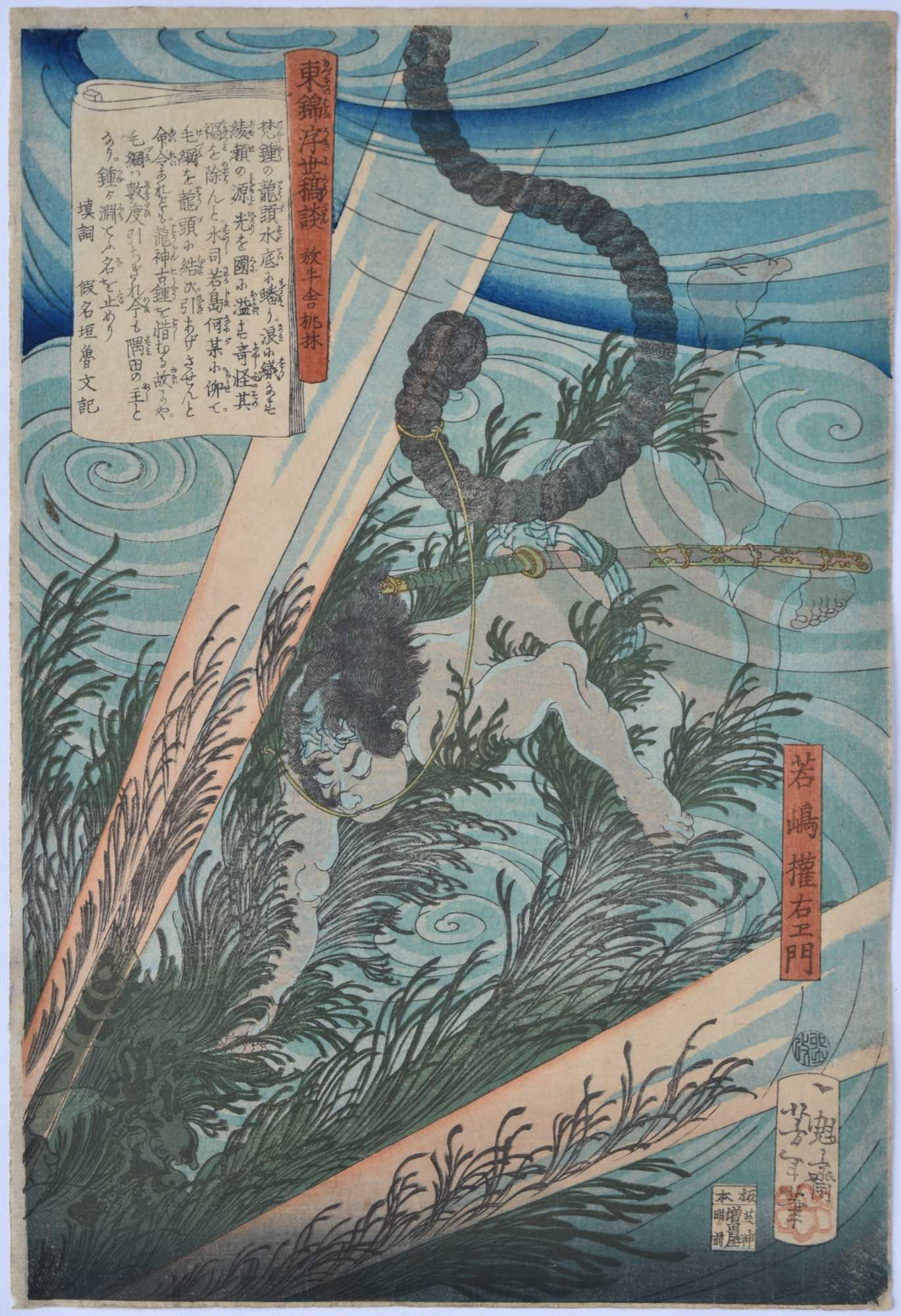
Wakashima Gonemon swimming underwater with a large rope attempting to retrieve the ancient dragon-headed bell of the Dragon God. The beams of light indicate its location. In the event, the rope broke and the bell is supposedly still in situ at the bottom of the Sumida river. The best design from Azuma no nishiki ukiyo kodan, “Tales of the Floating World on Eastern Brocade.” The stories retold by Kanagaki Robun (text at top). Published by Masudaya, 11/1867.
Very good impression, colour and condition. Full size. Signed Ikkaisai Yoshitoshi hitsu.
Status: Sold
Utagawa Toyokuni I (1769-1825)
Click here to view image full size.
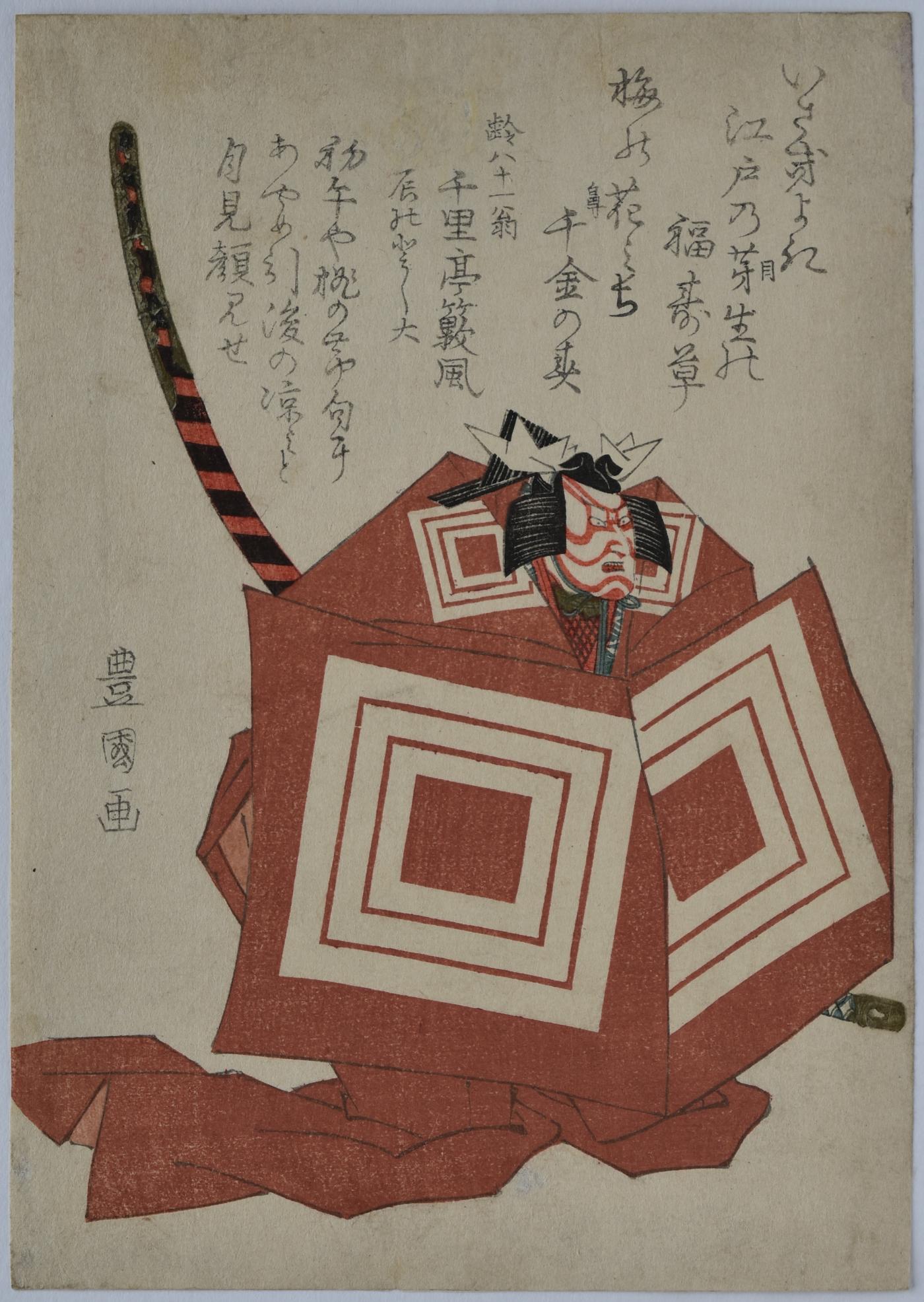
A pupil of Toyoharu, he is best known for his fine actor prints at the end of the 18th century. He had many pupils. A koban surimono showing Ichikawa Danjuro VII in Shibaraku with the voluminous costume and chikara gami “strength papers” sticking up at the back of his wig. Issued for the New Year 1810 (confirmed by the characters hatsu-ushi [“the first year of the ox”] in the first line of the left-hand poem). Interestingly, Danjuro did perform Shibaraku in the play Misao no hana toba koizuka at the Ichimura-za theatre just a couple of months before (11th month, 1809). The role name being Kaneomaru.
Very good impression and colour. Minor toning, otherwise very good condition. Signed Toyokuni ga.
Status: Sold
Utagawa KUNIYOSHI (1797-1861)
Click here to view image full size.
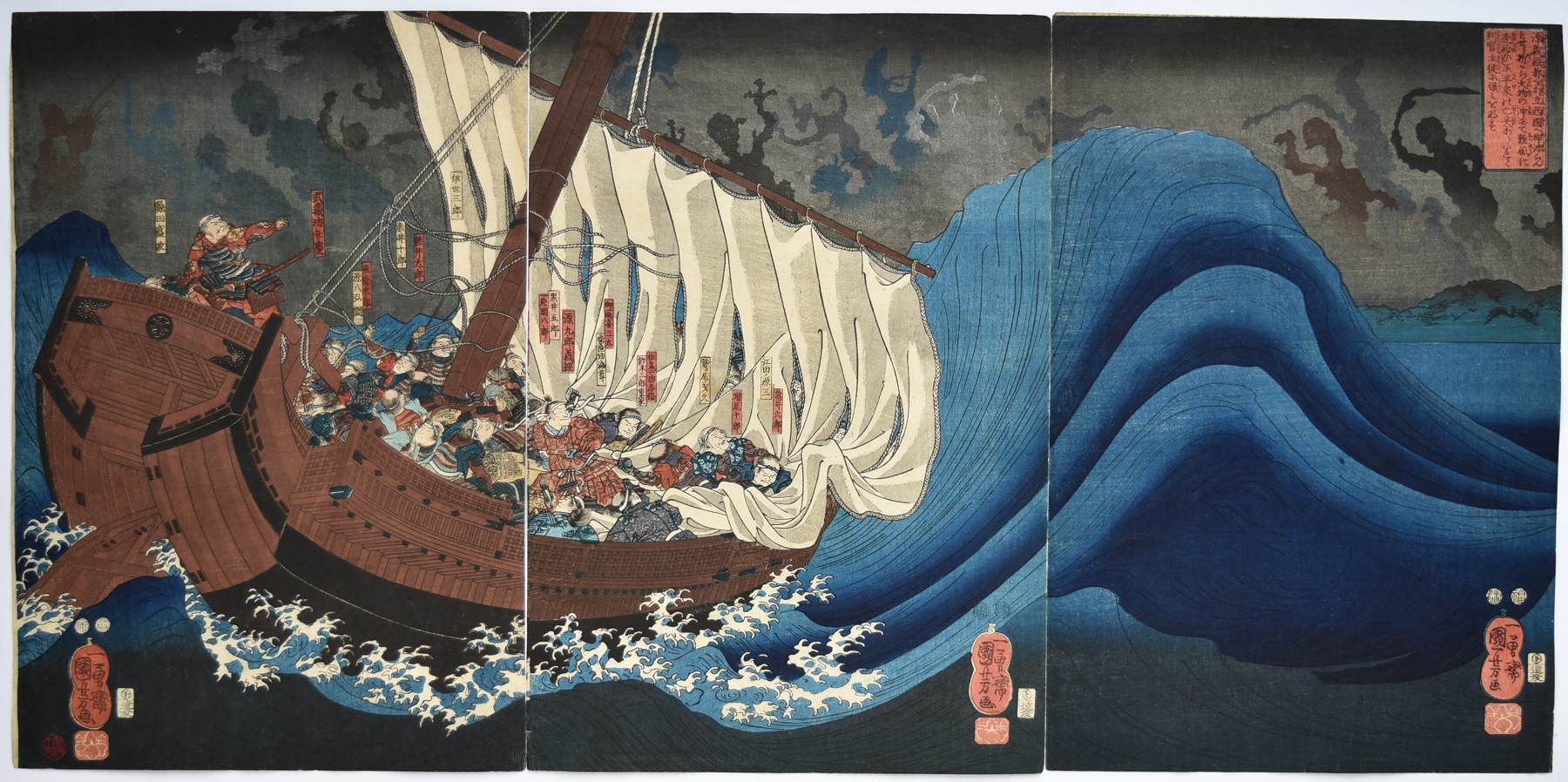
A famous triptych: The ghosts of the Taira warriors attacking Yoshitsune’s ship in Daimotsu bay. Shows Minamoto no Yoshitsune (1159-89) aboard his ship Tsukimaru sailing along the coast of Settsu Province at Daimotsu. It was here that the Minamoto and Taira clans clashed and many Taira warriors perished. It is the ghosts of these that rise from the waves to attack Yoshitsune. His men struggle to lower the sail while Yoshitsune’s loyal retainer, Benkei, rubs his prayer beads and offers prayers to the gods of the sea and to Kannon, the Bodhisattva of mercy and the storm abates. Published 1849-51 by Enshuya Hikobei.
A very nice example of this rare print: A number of states exist, the earliest having white lines in the waves lower right. The main differences are with the ghosts. The horns and eyes are removed but the printing and gradation of these varies as well. This impression has the lines but the eyes and horns removed so seems to be an intermediate state between first and second editions. There is no great variation in impression between these states. Very good impression and colour. Slightly trimmed. otherwise very good condition. Signed Ichiyusai Kuniyoshi ga.
Status: Sold
Tsukioka YOSHITOSHI (1839-1892)
Click here to view image full size.
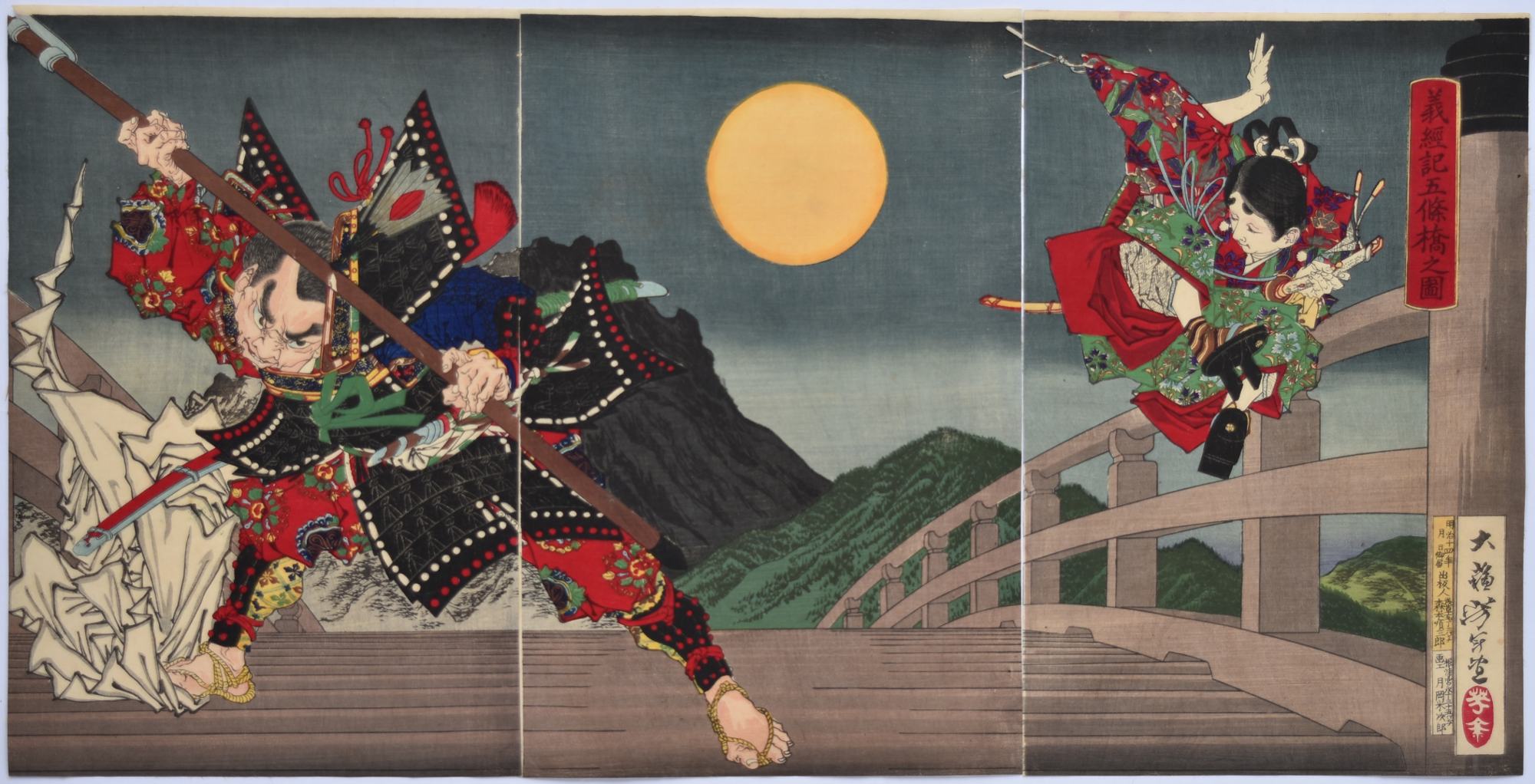
One of Yoshitoshi’s finest designs: Gikeiki Gojobashi no zu. The fight between Ushiwaka and Benkei on Gojo Bridge, Kyoto. The story relates how Benkei only needs one more blade to add to the 999 he has wrenched from samurai attempting to cross the bridge in order to fashion an invincible weapon. Benkei loses the fight and becomes Yoshitsune’s loyal retainer. Published 1881 by Morimoto Junzaburo.
Fine impression and colour. Very slight trimming, otherwise fine condition. Signed Taiso Yoshitoshi ga.
Status: Sold
Utagawa KUNIYOSHI (1797-1861)
Click here to view image full size.
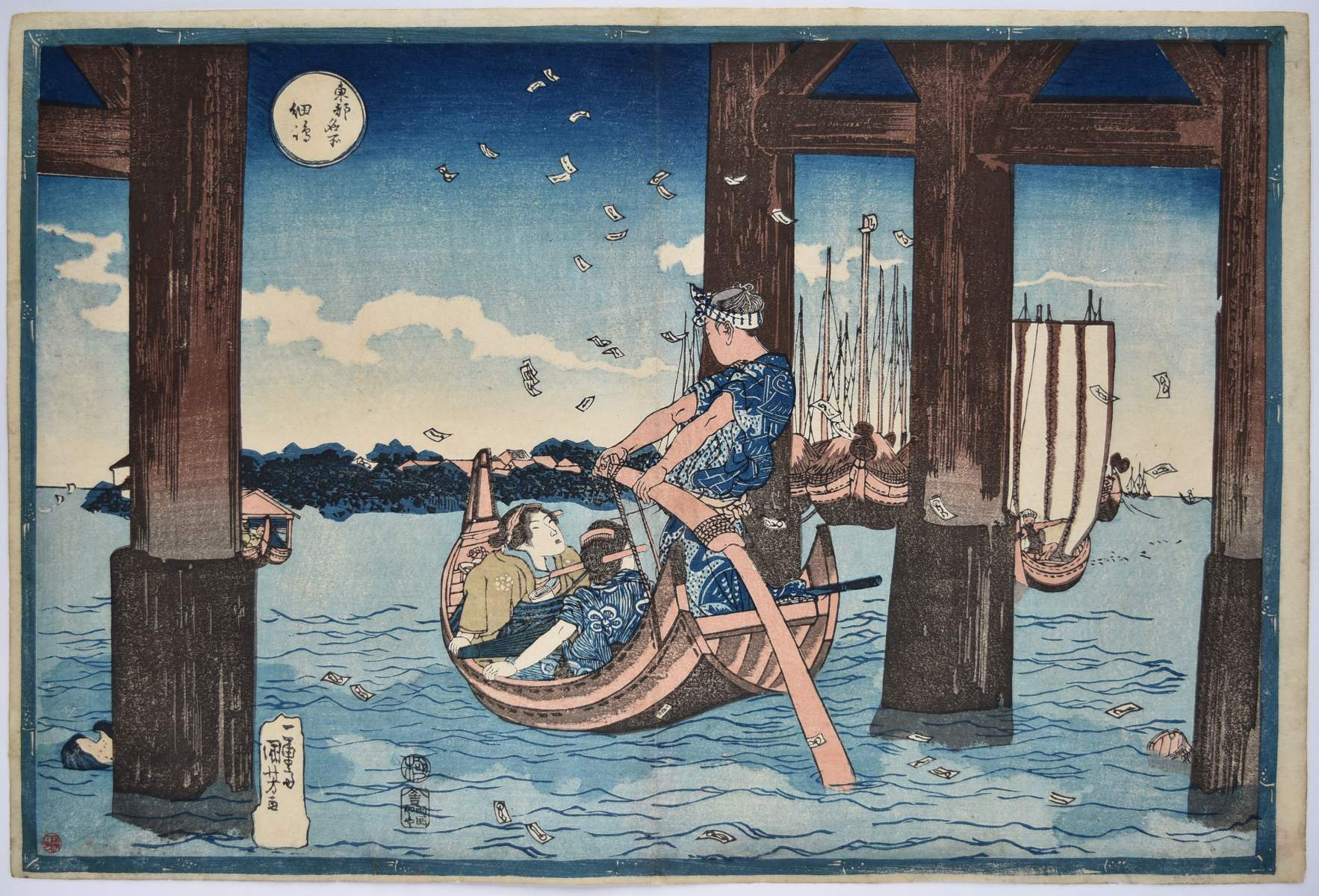
Tsukudajima from the series Toto meisho, “Famous Places in Edo.” Shows two women and a boatman being rowed beneath Eitai bridge. In the distance is Tsukudajima Island. It was here that large vessels would anchor at the mouth of the Sumida river to transfer their cargos to smaller boats. Devotional prayer slips float down during the Bon Odori festival, 13-15 July, commemorating those that have drowned in the river. A set of ten prints with western influences published by Kagaya Kichiemon, c 1832-3. Ex Kessler collection. Rare.
Very good impression: Early states have a grey tone on the bottom of the bridge supports (as here). A late edition has recut clouds. Slight fading and centre fold, otherwise good condition. The green border intact (so often trimmed off). Signed Ichiyusai Kuniyshi ga.
Status: Sold
Yanagawa SHIGENOBU II (active c 1820s-1850s)
Click here to view image full size.
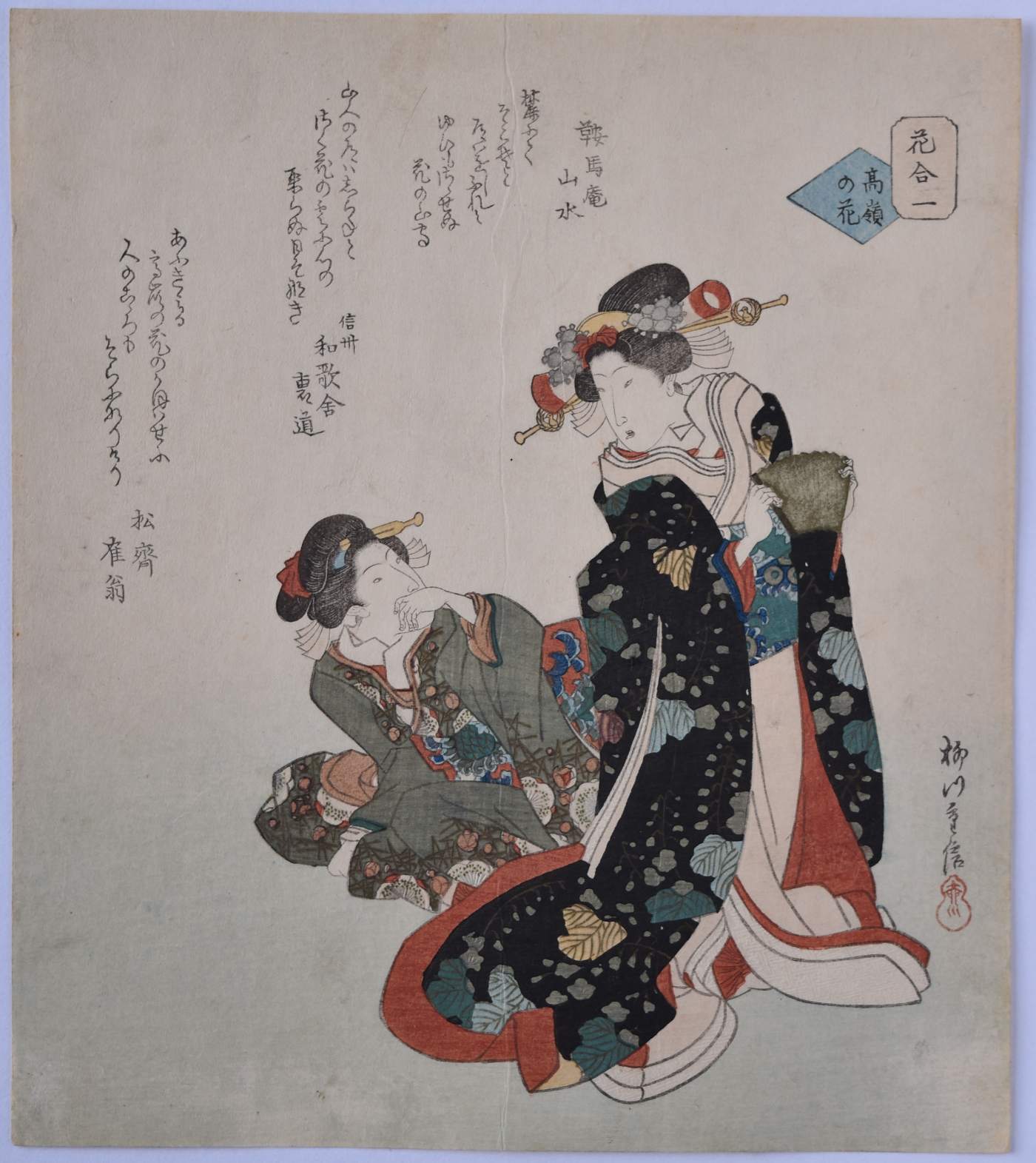
Number one from a surimono series Hana-awase, “A Flower Competition.” Sub-title Takane no hana, “Flowers of the Peak.” A princess turns to her attendant. Published c early 1830s.
Fine impression with touches of gold and silver. Fine colour and condition. Signed Yanagawa Shigenobu.
Status: Sold
Tsukioka YOSHITOSHI (1839-1892)
Click here to view image full size.
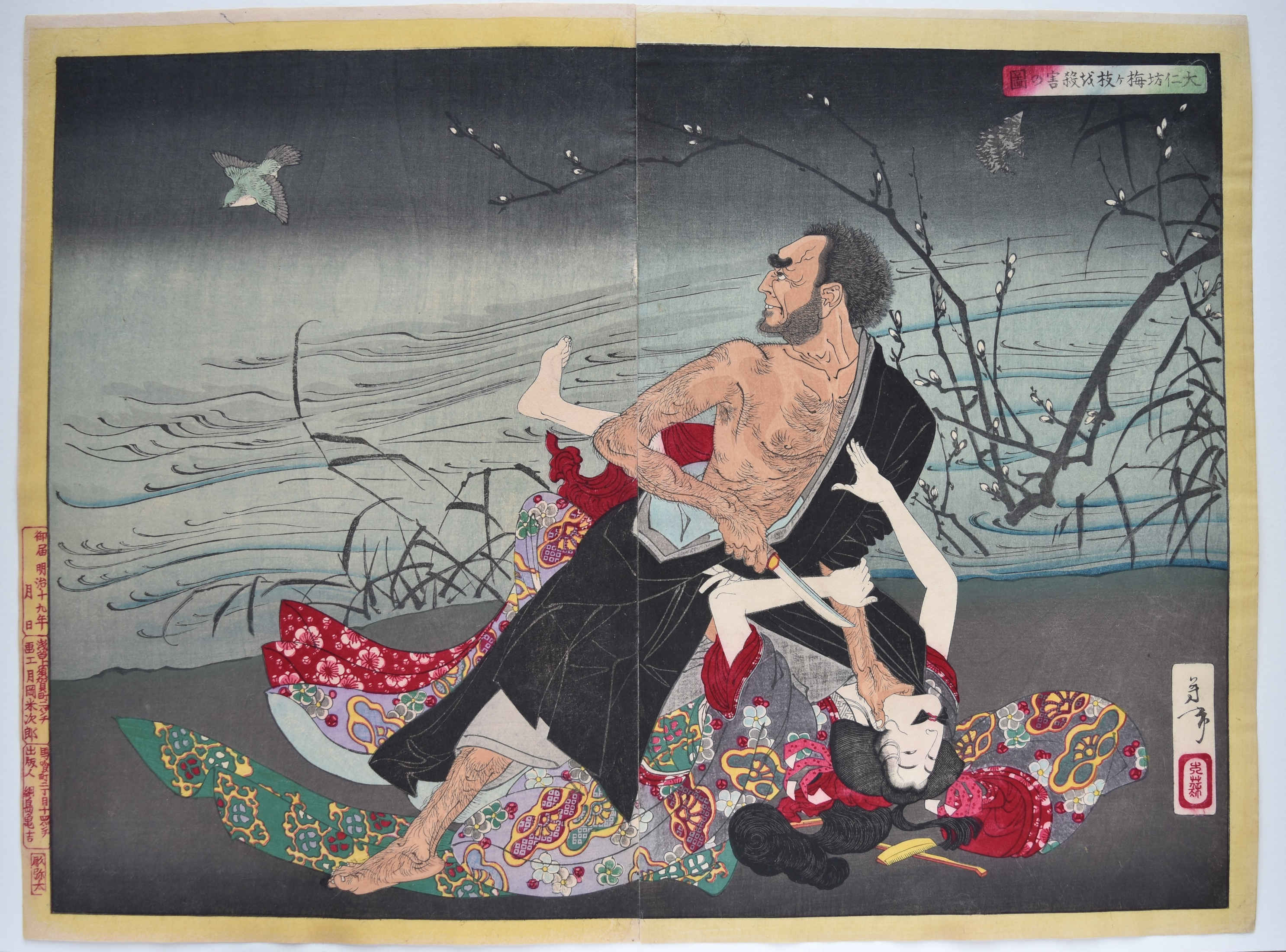
A diptych showing the Buddhist priest Dainin about to kill the girl Umegae. Daininbo Umegae o satsugai no zu, “Picture of the Priest Dainin Killing the Girl Umegae.” From a set of prints Shinsen azuma nishiki-e, “New Selection of Eastern Brocade Pictures.” The priest momentarily looks up at a passing cuckoo. The set published by Tsunashima Kamekichi between 1885 and 1889, this being 1886.
Very fine impression of the first edition. Fine colour and condition. Signed Yoshitoshi.
Status: Sold
Utagawa KUNIYOSHI (1797-1861)
Click here to view image full size.
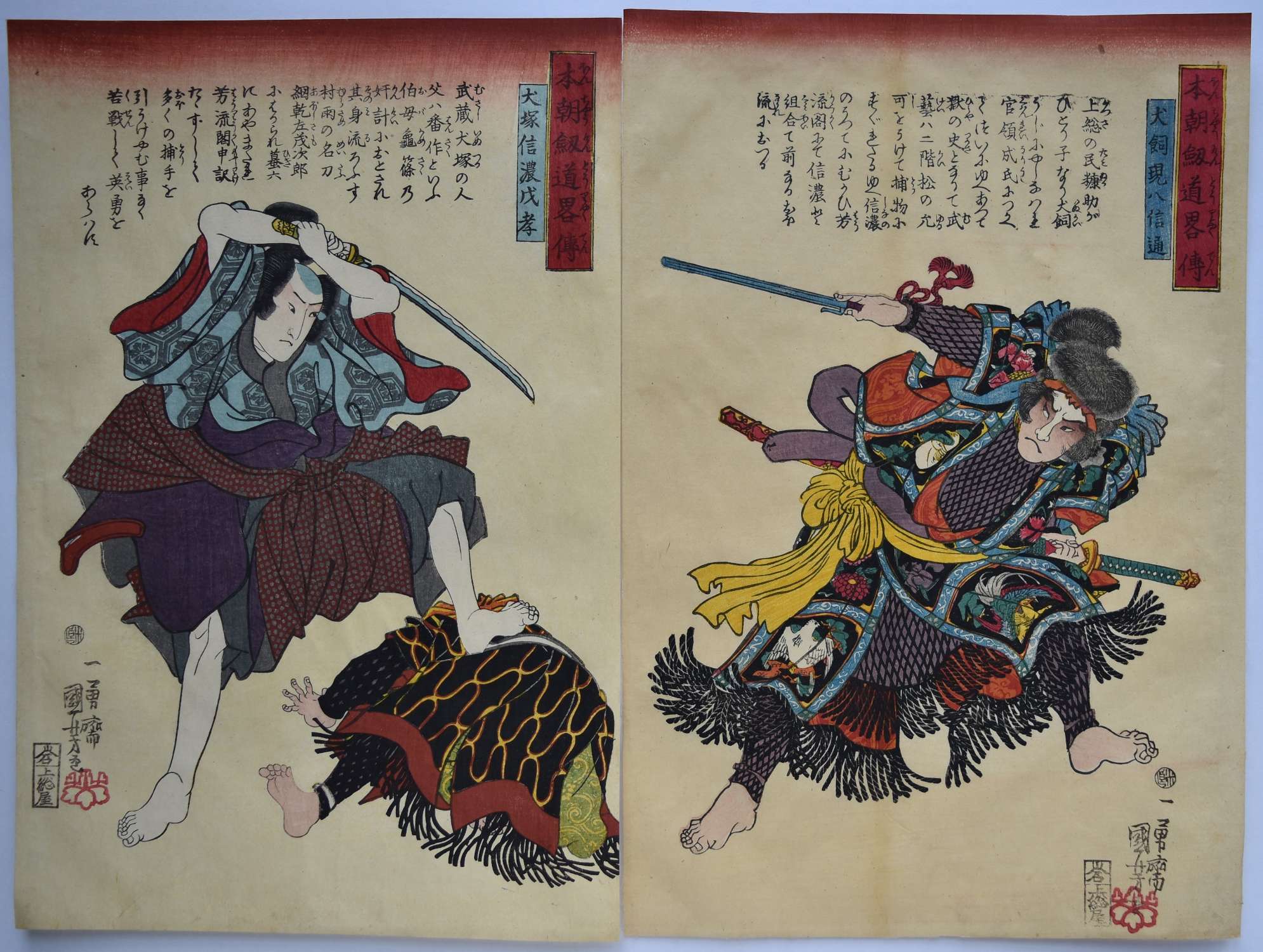
A complete diptych showing Inukai Kempachi wielding an iron truncheon against Inudzuka Shino who stands, sword drawn, with one foot on a fallen follower of Kempachi during the fight on the Horyukaku roof of Koga Castle. A well-known episode from Kyokutei Bakin’s famous book, Nanso Satomi hakkenden, “The Chronicles of the Eight Dog Heroes of the Satomi Clan of Nanso.” From a set of prints Kendo ryaku den “Abridged Stories of Our Country’s Swordsmamship.” Published by Kadzusa-ya Iwazo, c. 1845-6. Robinson S37.6.5. The complete diptych is rare.
Very fine impression, colour and condition. Signed Ichiyusai Kuniyoshi ga.
Status: Sold
Okumura MASANOBU (1686-1764)

Click here to view image full size.
An hashira-e showing Shoki, the Chinese demon queller, Chung Kwei, about to plunge a sword into an oni. Another pillar print showing Shoki from the same period is illustrated in The Clarence Buckingham Collection of Japanese Prints, The Primitives, Helen C. Gunsaulus, AIC, 1955, no. 103, p. 166. Published c. 1745. Rare.
Very good impression. A sumi-e, printed in sumi with washes of sumi applied by hand. Slight toning, otherwise very good condition.Pillar prints are often toned because they were hung and, of course, this is especially true of the earlier examples, as here. Signed Hogetsudo
Tanchosai Okumura Bunkaku Masanobu Baio ga with seal Tanchosai.
Status: Sold
Kochoro KUNISADA (1786-1865)
Click here to view image full size.
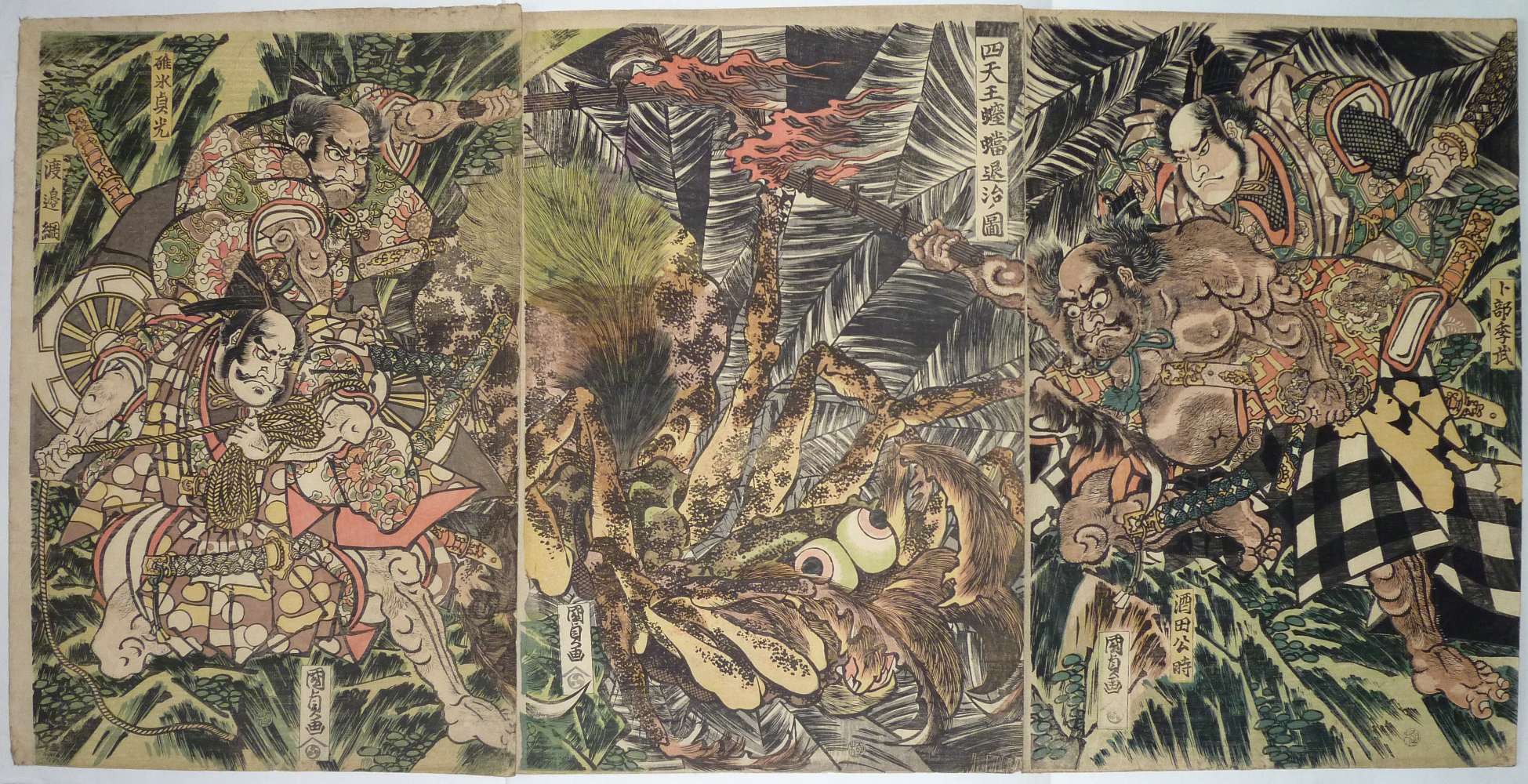
An exceptionally rare triptych showing Minamoto no Yorimitsu (Raiko) and his loyal retainers, from left to right: Watanabe no Tsuna, Usui no Sadamitsu, Sakata no Kintoki and Urabe no Suetake killing the giant “Earth Spider.” Numerous versions exist of this story but basically Raiko and his followers have to tackle various horrendous apparitions in a cave within the hill Kagura ga oka near Kyoto, eventually to be faced by a beautiful woman who envelops Raiko in cobwebs. He slays her and her body turns into the spider, the head being twenty-five feet long and eyes shining like the sun and moon. He cuts off the beast’s head and the carcase reveals the many bodies devoured by it. An extremely early Kunisada print published by Nishimuraya Yohachi, c 1815. I have not seen this design before or located another impression.
Very good impression, colour and condition. Full size with extra paper around. Signed Kunisada ga.
Status: Sold
Mori SOSEN (1747-1821)
Click here to view image full size.
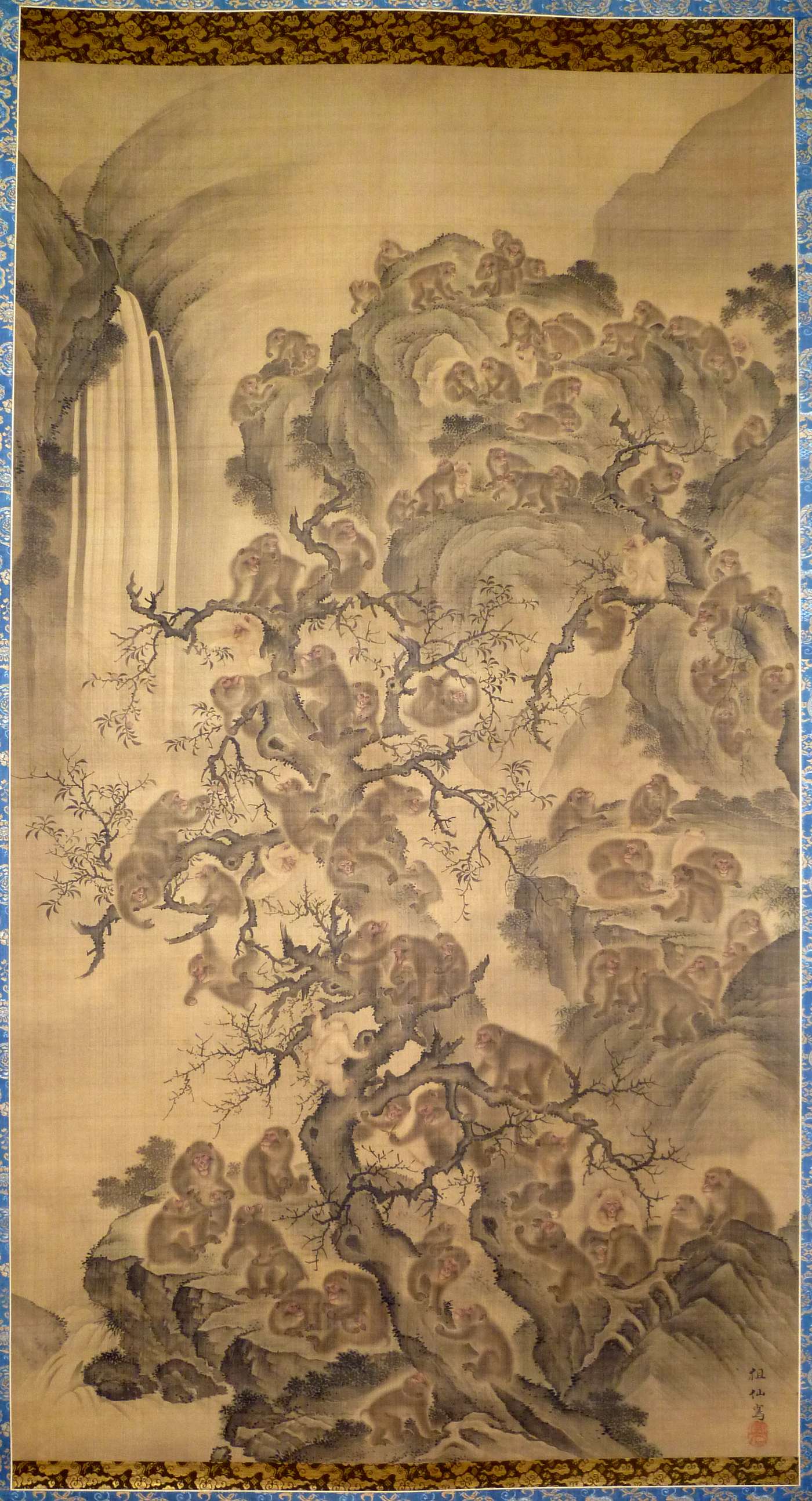
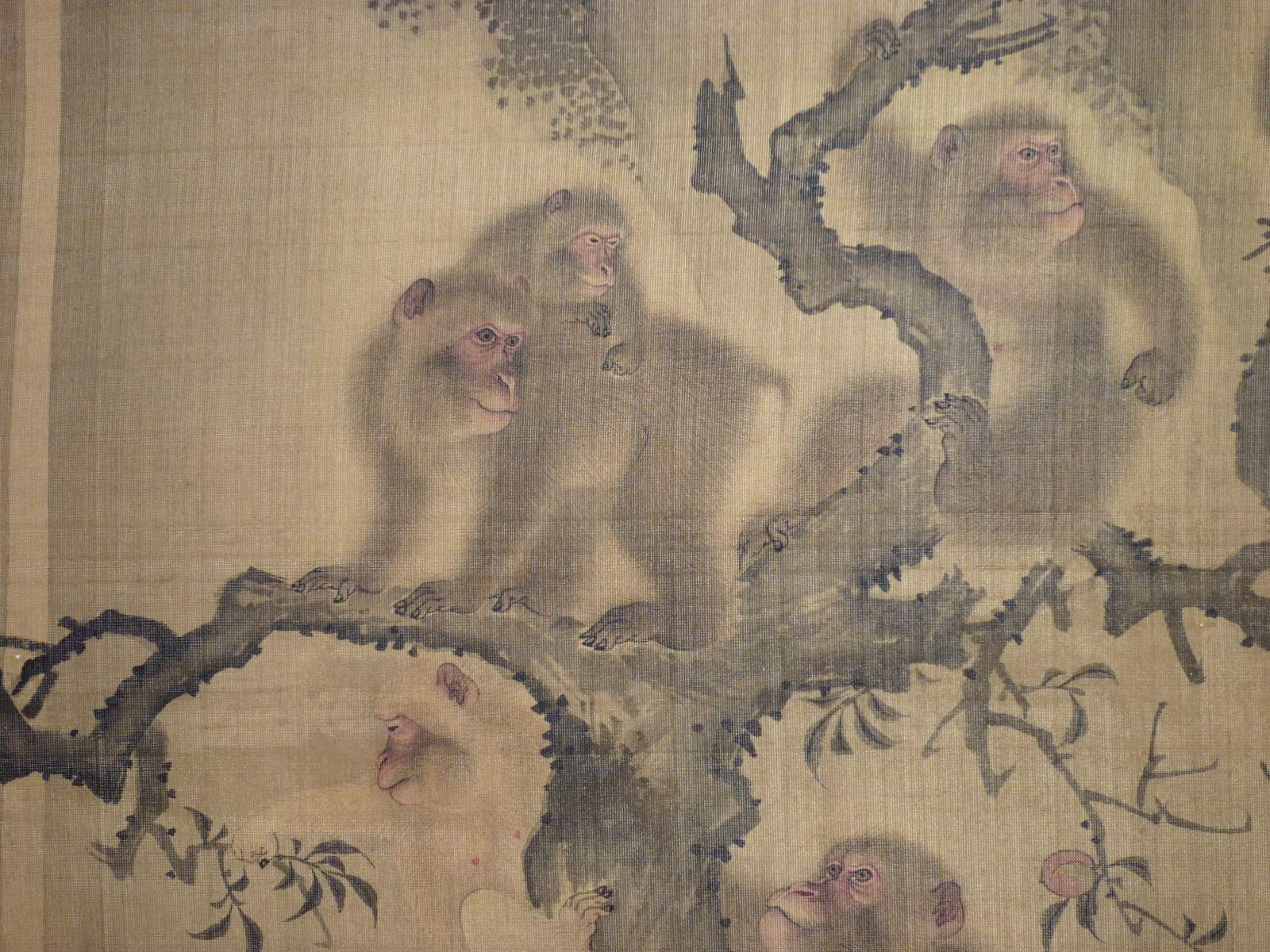
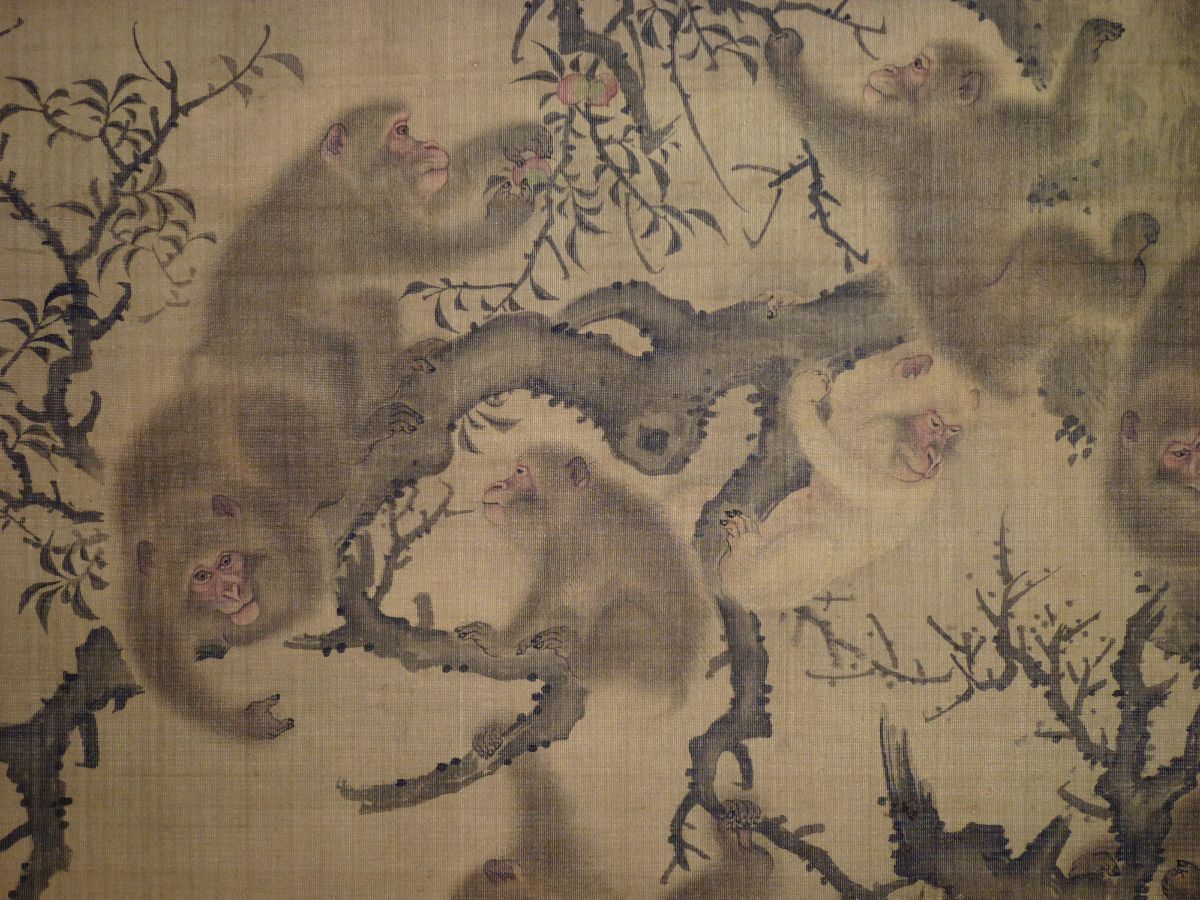
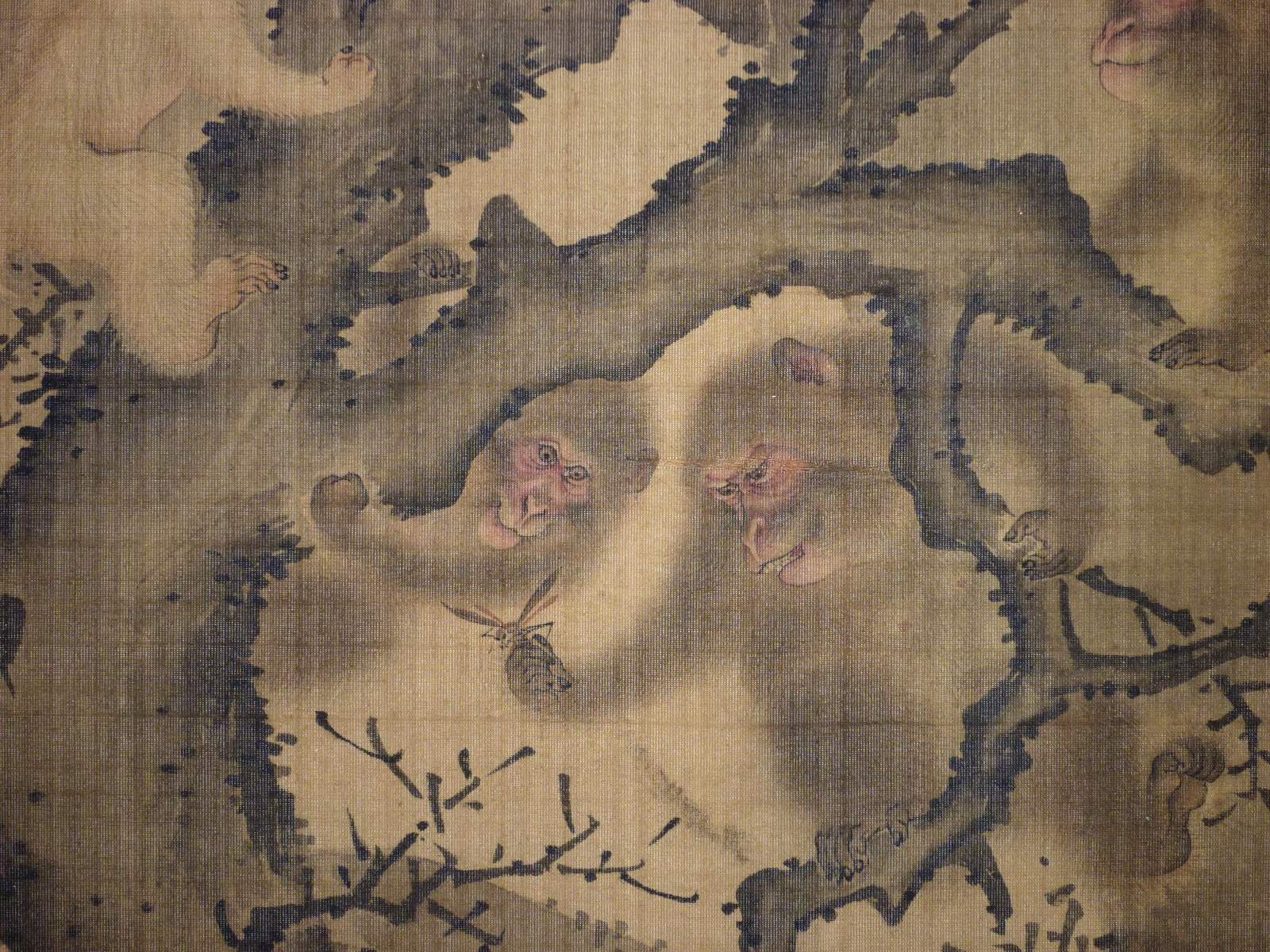
A large original painting of one hundred monkeys. Sumi and light red on silk. Image size 57.5 x 32.25 in; 146 x 82 cms. The monkeys – some being white – are painted with great finesse and are shown perched on and scrambling over a large peach tree. Others are seated on rocky ledges around the tree in a mountainous landscape with a waterfall top left. Sosen is considered the best painter of monkeys in Japan, although he also depicted other animals. He is supposed to have lived for a while in the woods to better observe the monkeys. There are many copies of his work. Sosen produced several other one hundred monkey paintings and they are his masterpieces.
In very good condition. Signed Sosen utsusu with seal Morizo. A superb painting and extremely rare.
Status: Sold
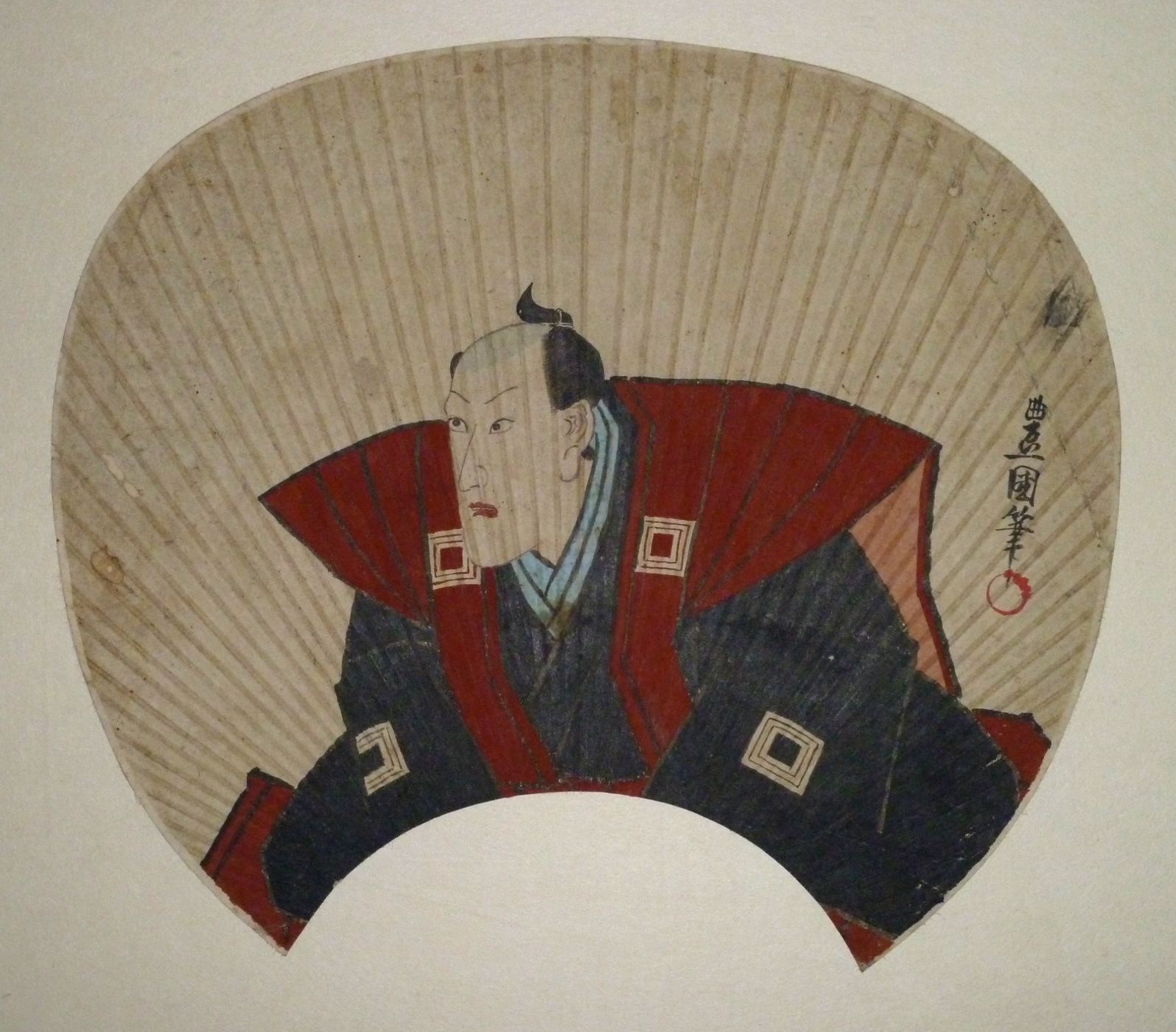
Kochoro KUNISADA (1786-1865)
Click here to view image full size.
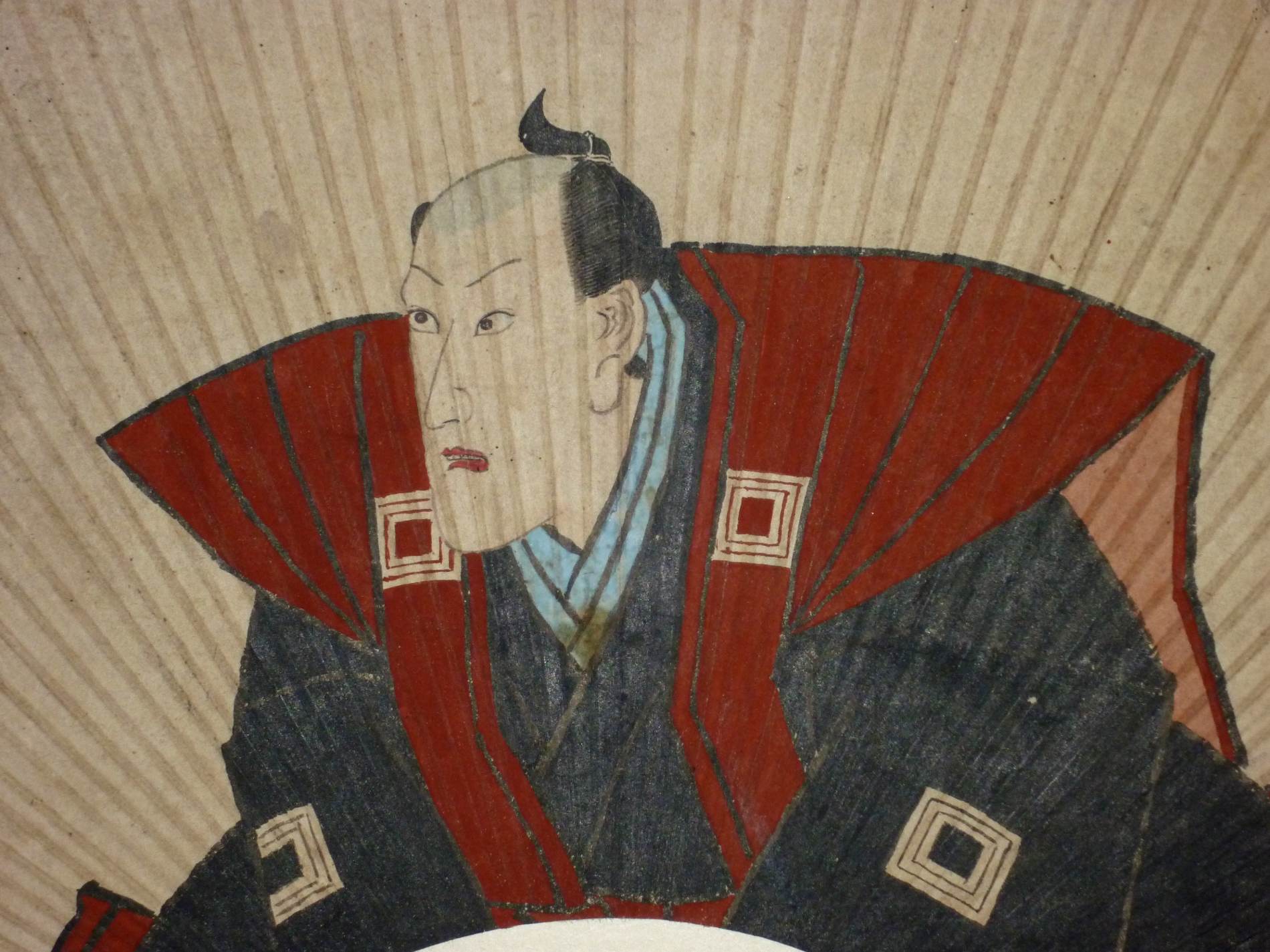
An original painted fan showing the actor Danjuro VIII. The fan has been used and dismounted from the frame and laid onto Japanese paper, hence the rib marks. Signed Toyokuni fude with red toshidama seal. Painted c 1858. Sold “as is.” Extremely rare.
Status: Sold
Click here to view image full size.
Ichiryusai HIROSHIGE (1797-1858)

Click here to view image full size.
A distant view of Mount Daisen [ Oyama ] in Hoki Province. One of the best designs from Rokuju yoshu meisho zue, “Famous Places in the Sixty-Odd Provinces.” The set published by Koshimuraya Heisuke between 7/1853 and 3/1856 ( this being 12/1853 ). White rain ( printed with gofun ) falls on groups of peasants planting rice. A lovely design, the edges of the paddy fields zig-zagging into the distance. This is the rare first edition with blue and yellow diagonal bands on the sub-cartouche.
Fine impression with strong woodgrain showing. The second state of the first edition has the rain printed black (not using gofun as here).Very good colour and condition. Signed Hiroshige ga.
Status: Sold
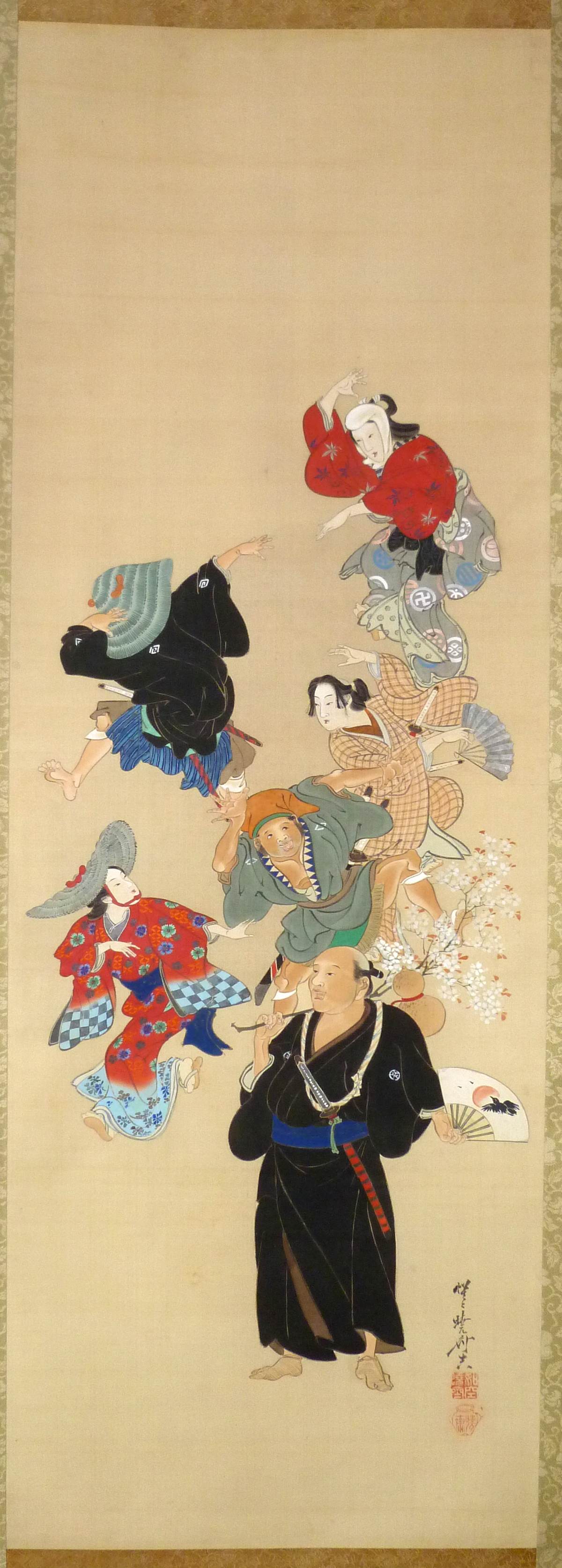
Kawanabe KYOSAI (1831-1889)
Click here to view image full size.
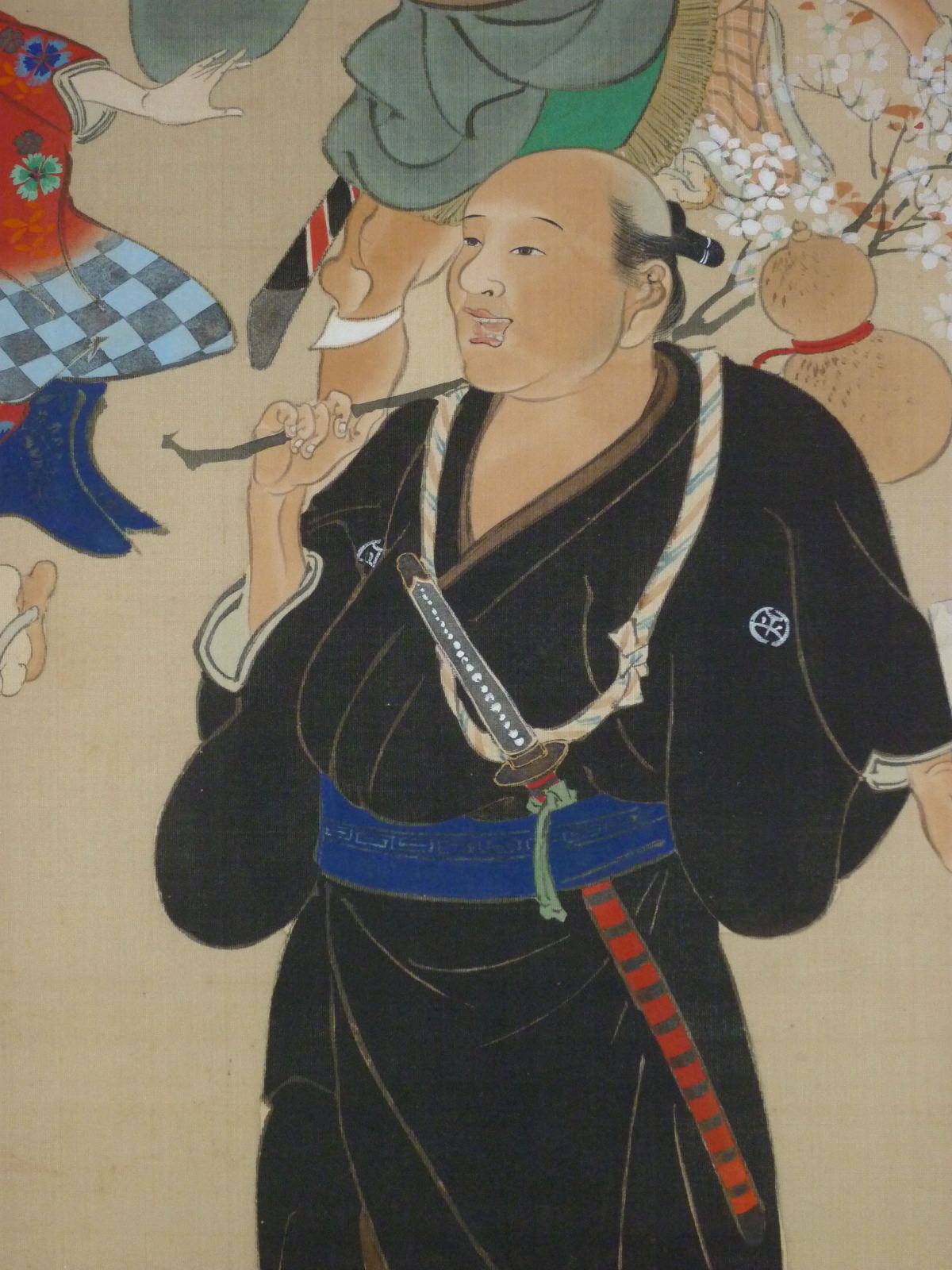
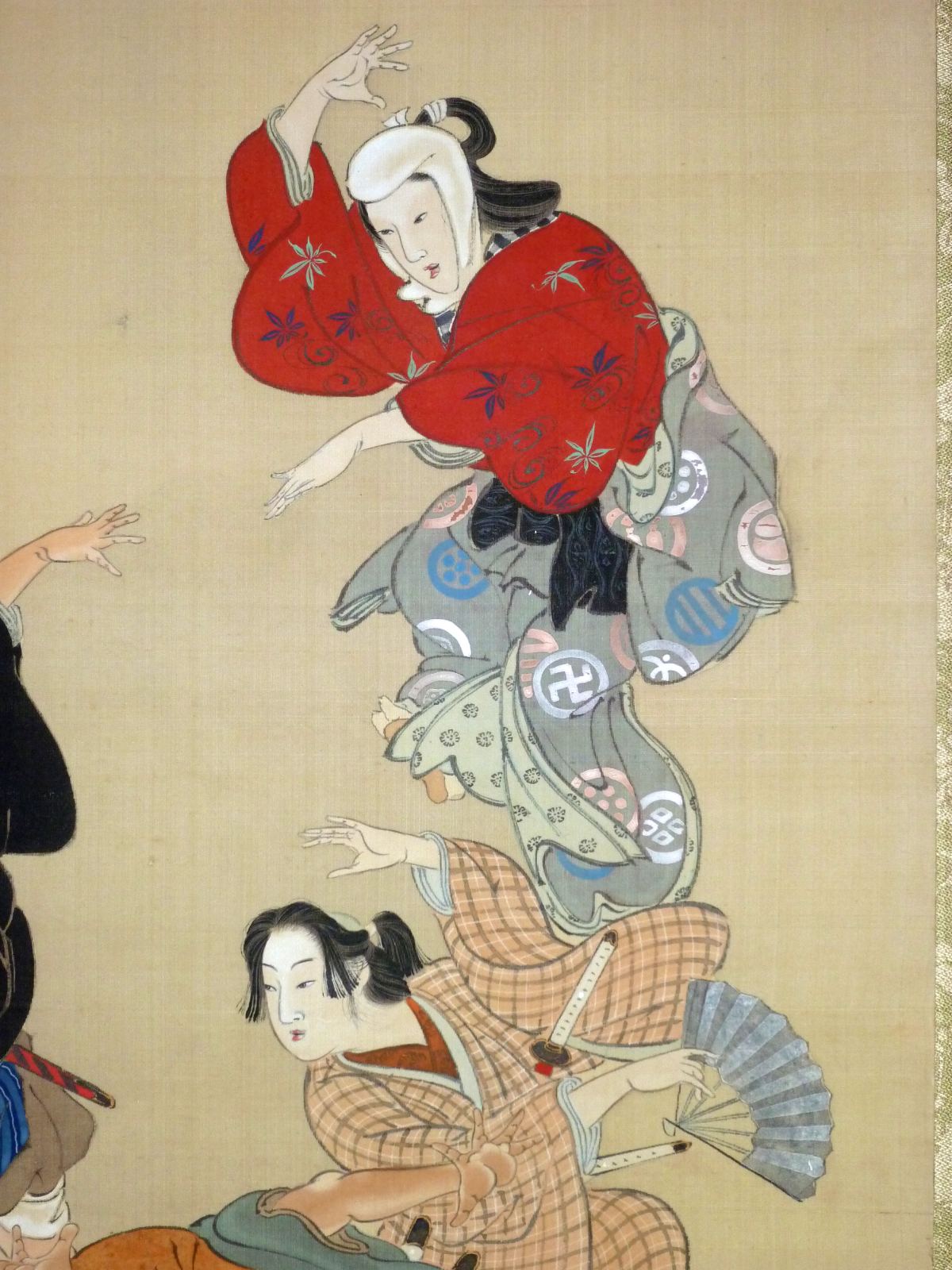
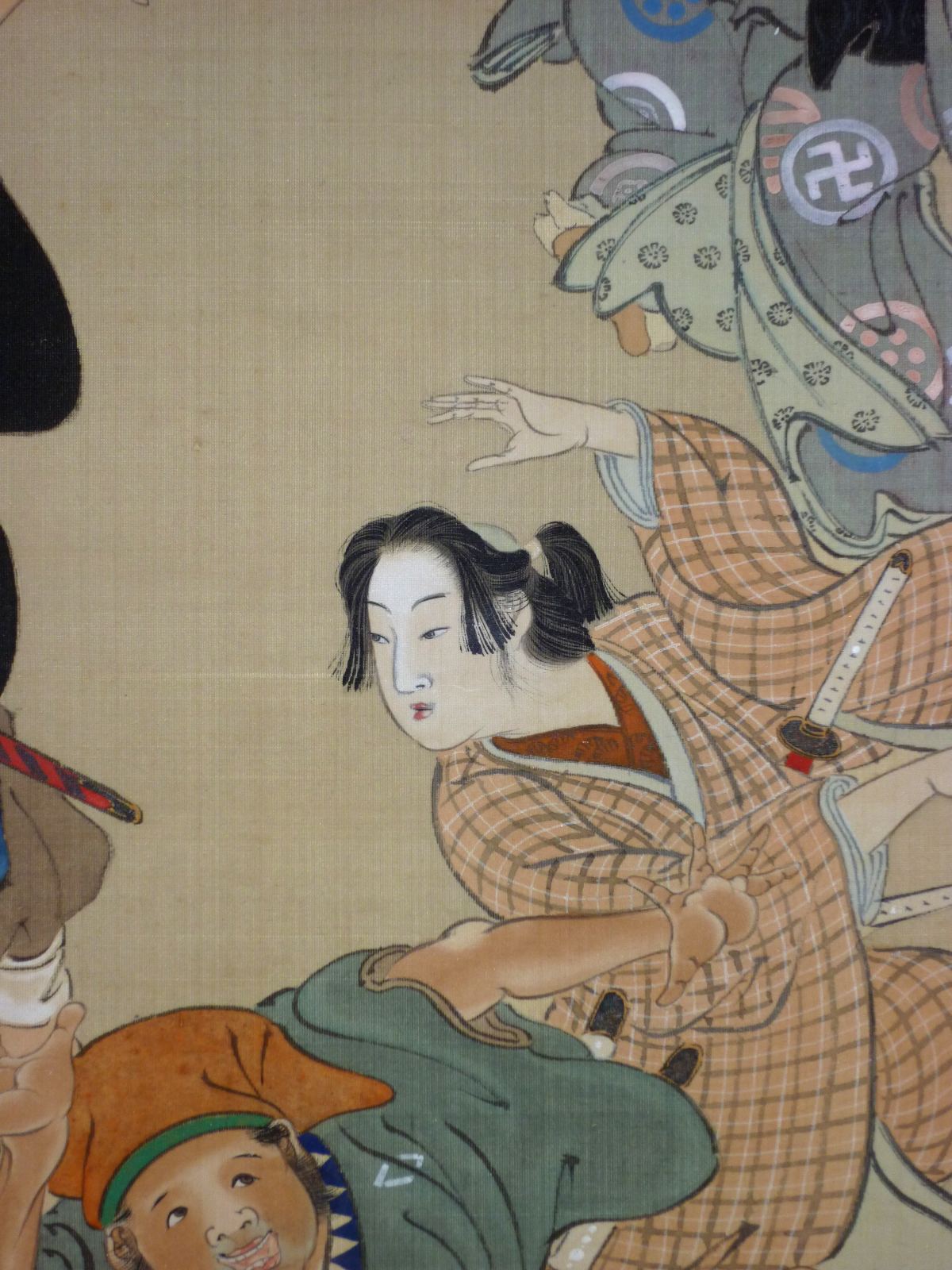
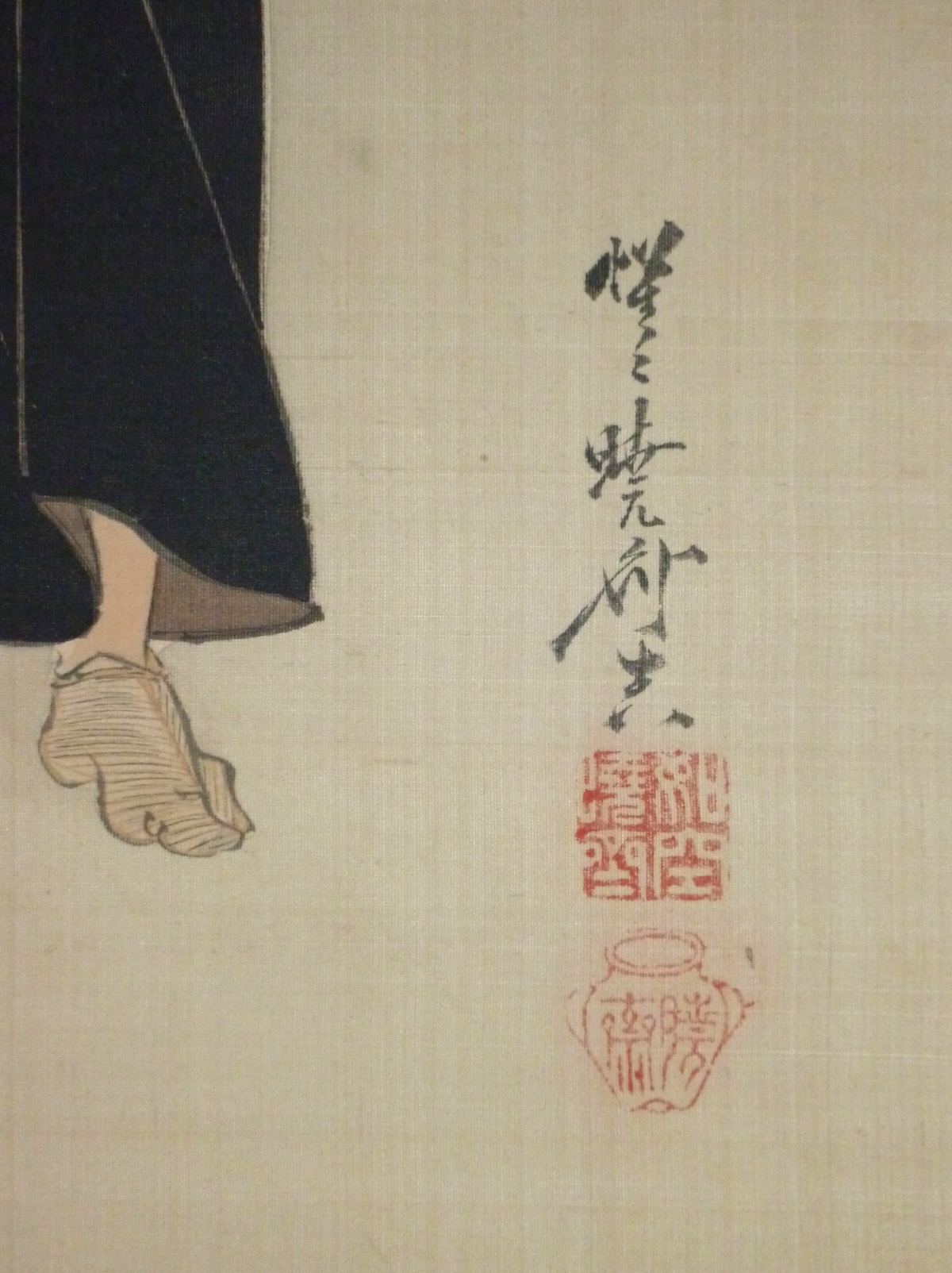
A fine painting showing Oishi Yoshio (Kuranosuke) with his fellow servants cavorting in a Bon-Odori dance behind him. The famous Chushingura story relates how Yoshio, the principle retainer and counsellor of Asano Takumi no Kami (Yenya), and his colleagues became ronin to avenge the death of their insulted master by eventually decapitating Kotsuke no Suke (Moronao). Kyosai shows Yoshio trying to mislead anyone who thinks they are planning such a revenge by holding a party. Full colour on silk. Image size 46 x 16 in; 116.8 x 40.7 cms. Exceptional condition. Signed Seisei Kyosai ga with seals Joku Kyosai and Kyosai. The former seal is on the fine painting showing Ushiwaka-maru playing the flute for Princess Joruri which is in the Kumamoto Prefectural Museum of Art and dated to c 1888.
Status: Sold
Click here to view image full size.
Click here to view image full size.
Click here to view image full size.
here to view image full size.
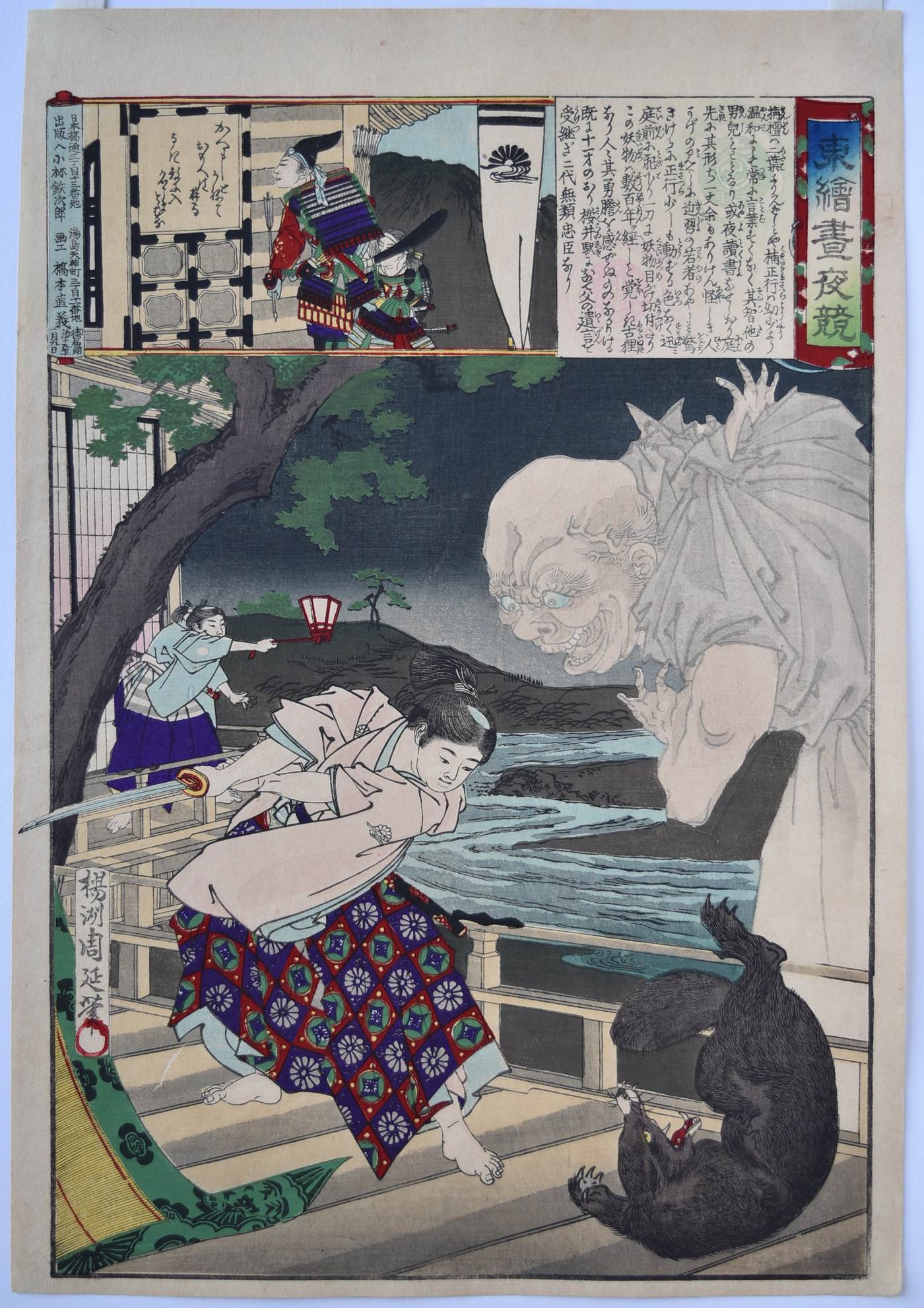
Toyohara CHIKANOBU (1838-1912)
Click here to view image full size.
Kusunoki Masatsura killing the magical tanuki from a set of 50 prints Azuma nishiki chuya kurabe, “Edo Embroidery Pictures.” The set published by Kobayashi Tetsujiro, 1886.
Fine impression, colour and condition. Signed Yoshu Chikanobu hitsu.
Status: Sold
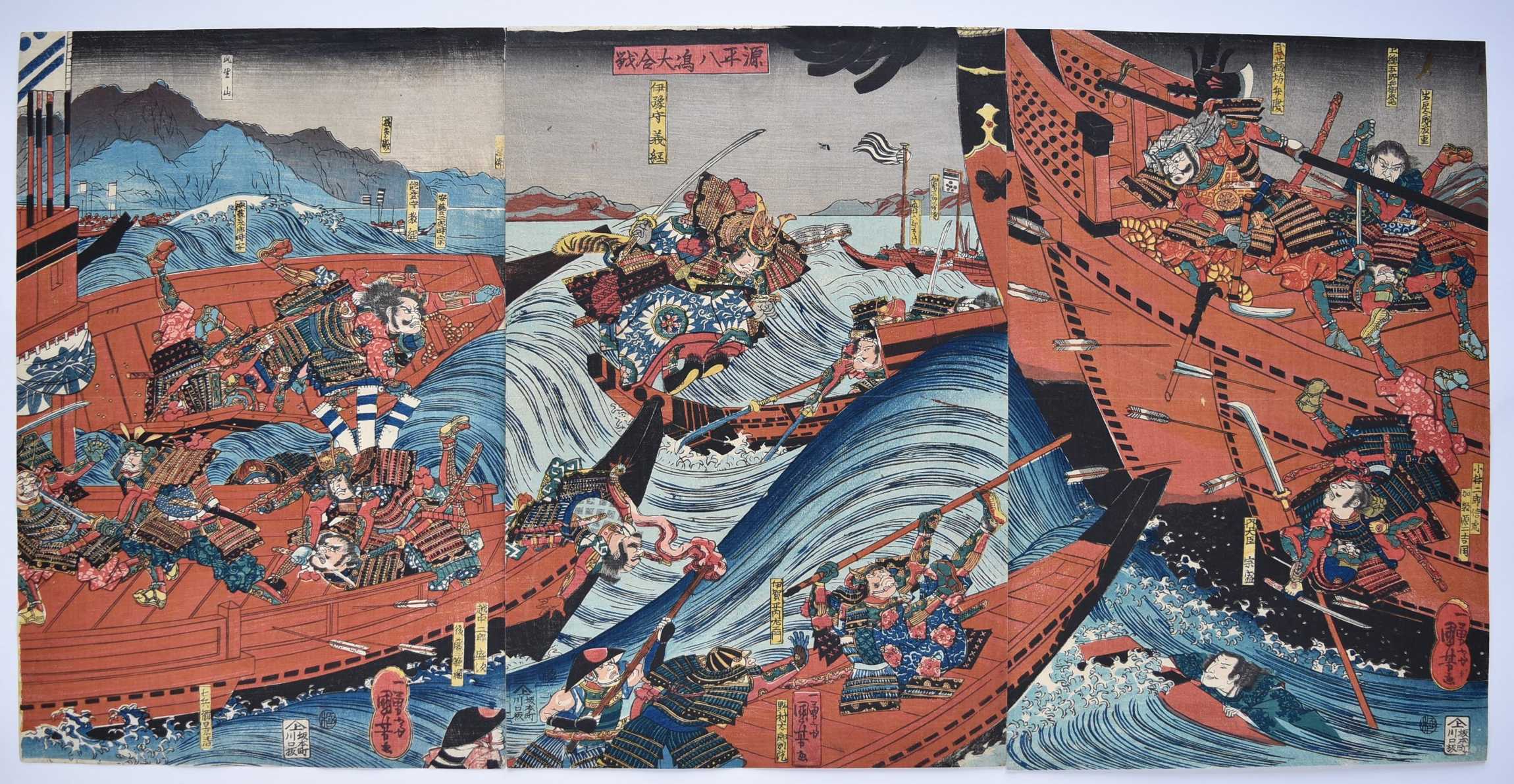
Utagawa KUNIYOSHI (1797-1861)
Click here to view image full size.
Gempei Yashima o-kassen, the great battle of Yashima in 1184. Shows Yoshitsune’s famous “eight-boat leap” (centre), Noritsune (left), and Benkei on the large boat (right). Published by Kawaguchiya Uhei, c. 1839-41.
Very good impression and colour. Edge repair top left sheet, otherwise very good condition. Signed Ichiyusai Kuniyoshi ga.
Status: Sold
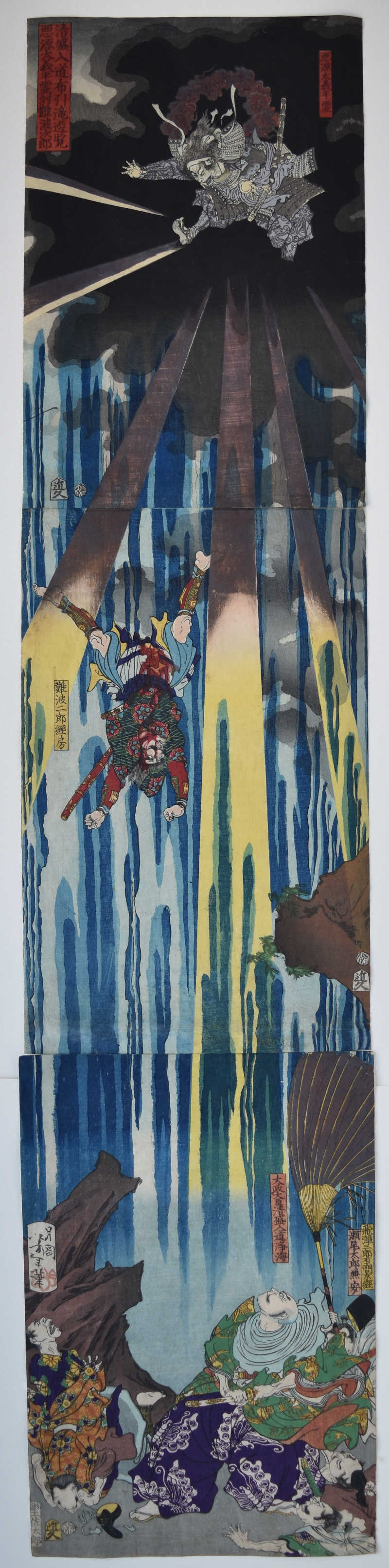
Tsukioka YOSHITOSHI (1839-1892)
Click here to view image full size.
A vertical triptych showing Taira no Kiyomori (1118-1181) watching Akugenta Yoshihira (“Wicked Genta of Kamakura”) (1140-1160) become the Thunder God and strike Namba no Jiro (1141-1160) down with a thunderbolt. An exceptional design of a subject that produced some excellent interpretations by Kuniyoshi and his pupils. Kiyomori nyudo Nunobiki no taki yuran Akugenta Yoshihira no rei Namba Jiro o utsu. The story originates from the Heiji Monogatari and relates how Minamoto no Yoshihira was defeated in the Heiji Rebellion of 1160 and decapitated by Namba no Saburo Tsunefusa, a retainer of Taira no Kiyomori. He pledges to return and kill Namba with a thunderbolt which he succeeds in doing in 1168 at the Nunobiki Waterfall. There is an alternative version of events that gives the decapitation and subsequent revenge killing as all taking place at the Nunobiki Waterfall. Published by Kinkyo (Omiya Kyujiro) in 1868. Of the utmost rarity: There might have been impressions circulating privately, but I have never seen an example for sale since I started dealing: Perhaps few impressions were printed, but the vertical triptych format is not conducive to it surviving intact. Another impression is in the MET, acc. no. 2007.49.307a-c. Possibly Yoshitoshi’s masterpiece.
Fine impression and colour. Some slight trimming. Oxidation and minor horizontal crease at bottom of centre sheet evident au verso, but otherwise in very good condition. Signed Tsukioka Yoshitoshi hitsu.
Status: Sold
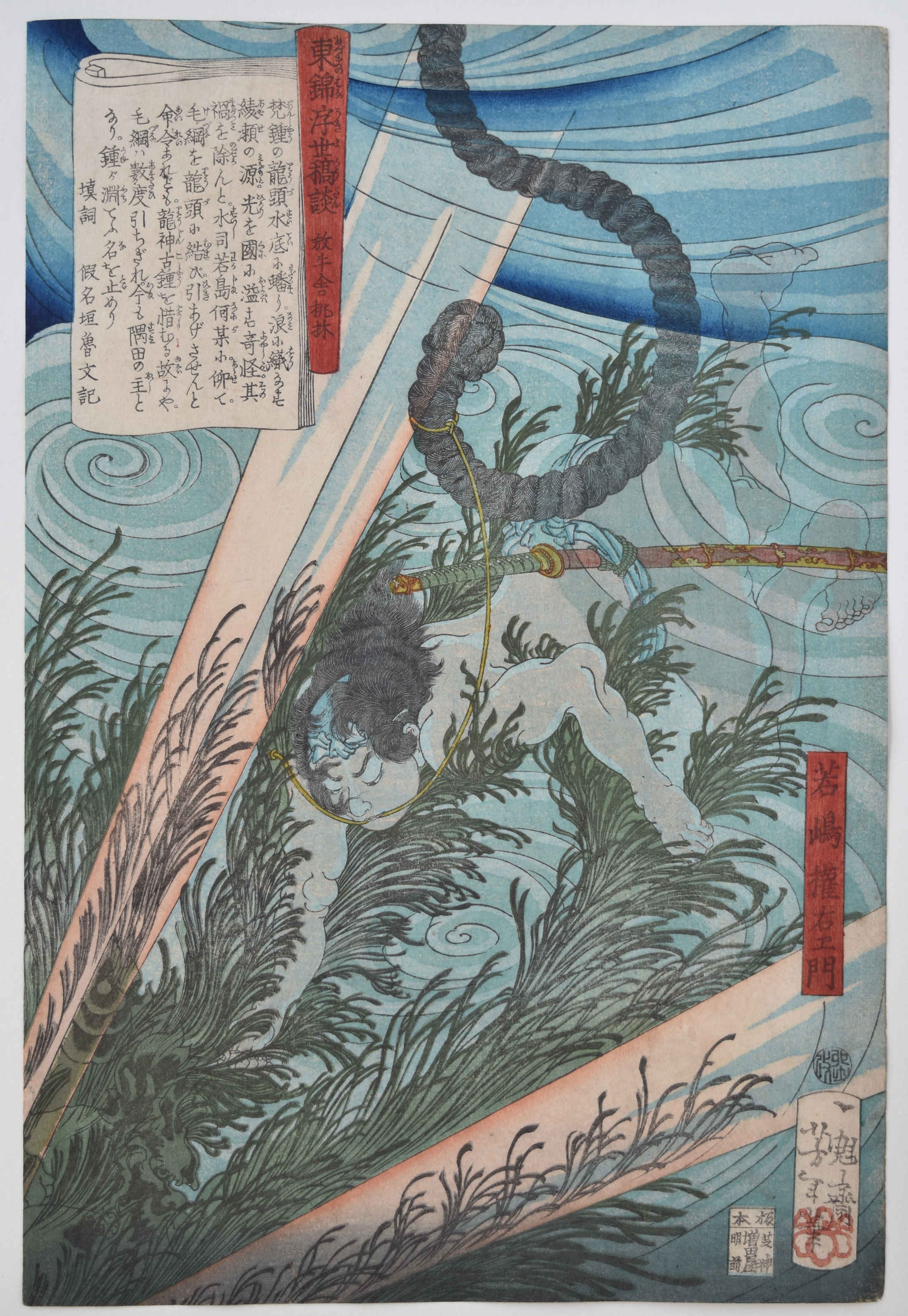
Tsukioka YOSHITOSHI (1839-1892)
Click here to view image full size.
Shows Wakashima Gonemon diving into a whirlpool in an attempt to fasten a rope to the old dragon-headed temple bell and haul it up from the bed of the Sumida River. The story relates how the Dragon King thwarted his attempt by cutting the rope. From a set Azuma nishiki Ukiyo Kodan, “Rough Tales of the Floating World Told on Eastern Brocades.” Kodan (traditional storytelling) raconteurs narrated Japanese folk stories, sometimes accompanying themselves with wooden blocks clapped together or a fan giving rhythm. Having been popular from around 1700 (and known as Koshaku), these performances gained renewed popularity in the 1850s with the classic standards augmented by contemporary stories of heroes and vigilantes. Here, the storyteller Hogyusha Torin, narrates a story by Kanagaki Robun, the text seen in the open book top left. The best design from the set. Published by seven different publishers (here: Masudaya Ginjiro) between 1867-1868 (here: 1867).
Fine impression, colour and condition. Signed Ikkaisai Yoshitoshi hitsu.
Status: Sold
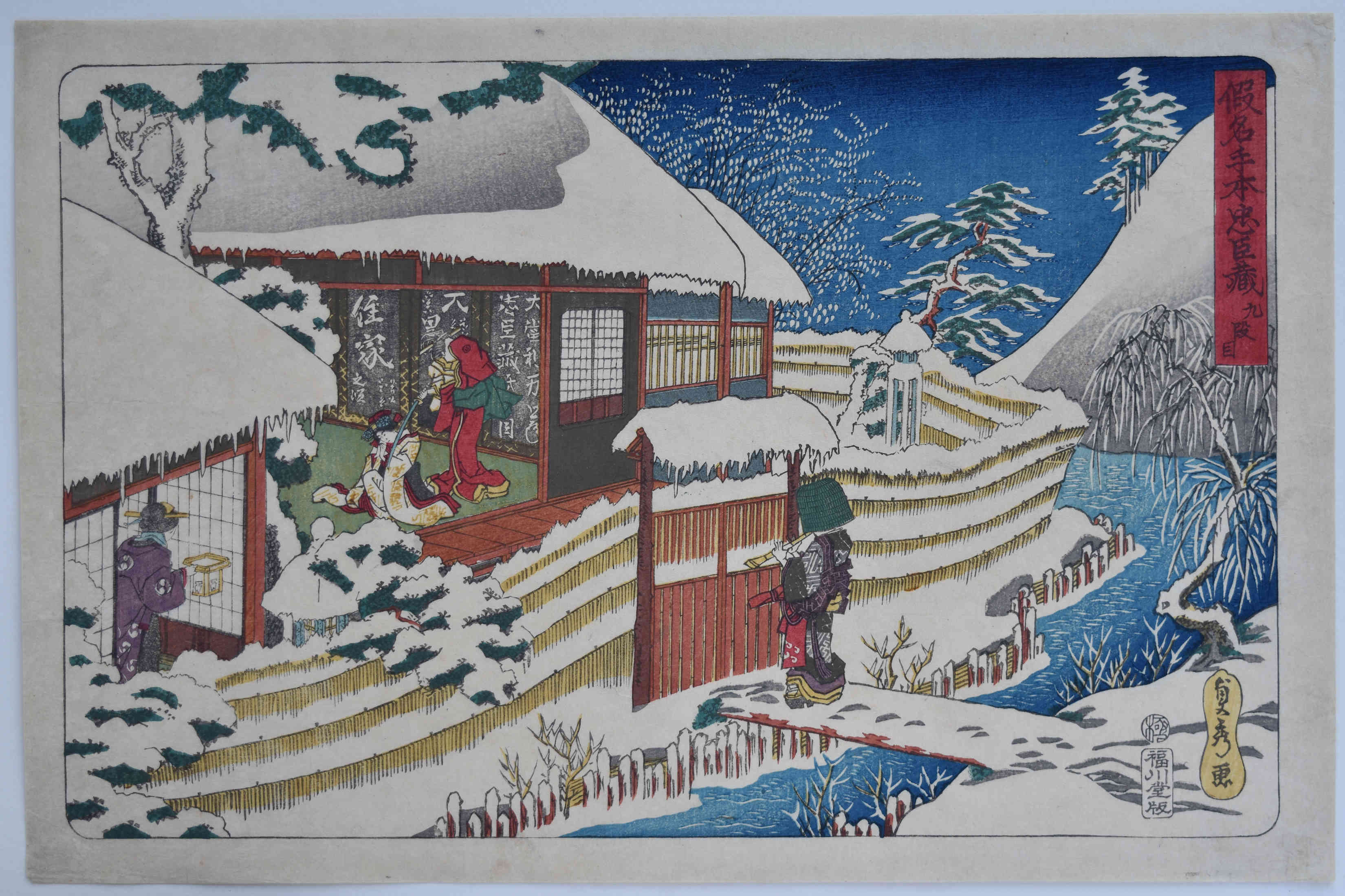
Utagawa SADAHIDE (1807-1873)
Click here to view image full size.
A snow scene: Act IX of the famous revenge drama, Kanadehon Chushingura, “The Treasury of Loyal Retainers.” Actually based on events of 1701-3. Shows Honzo appearing at Yuranosuke’s villa at Yamashina disguised as a komuso (a Japanese mendicant monk of the Fuke school of Zen Buddhism). Published by Kawaguchi-ya Uhei, c early 1840s.
Superb impression. Very fine colour and condition. Signed Sadahide ga.
Status: Sold
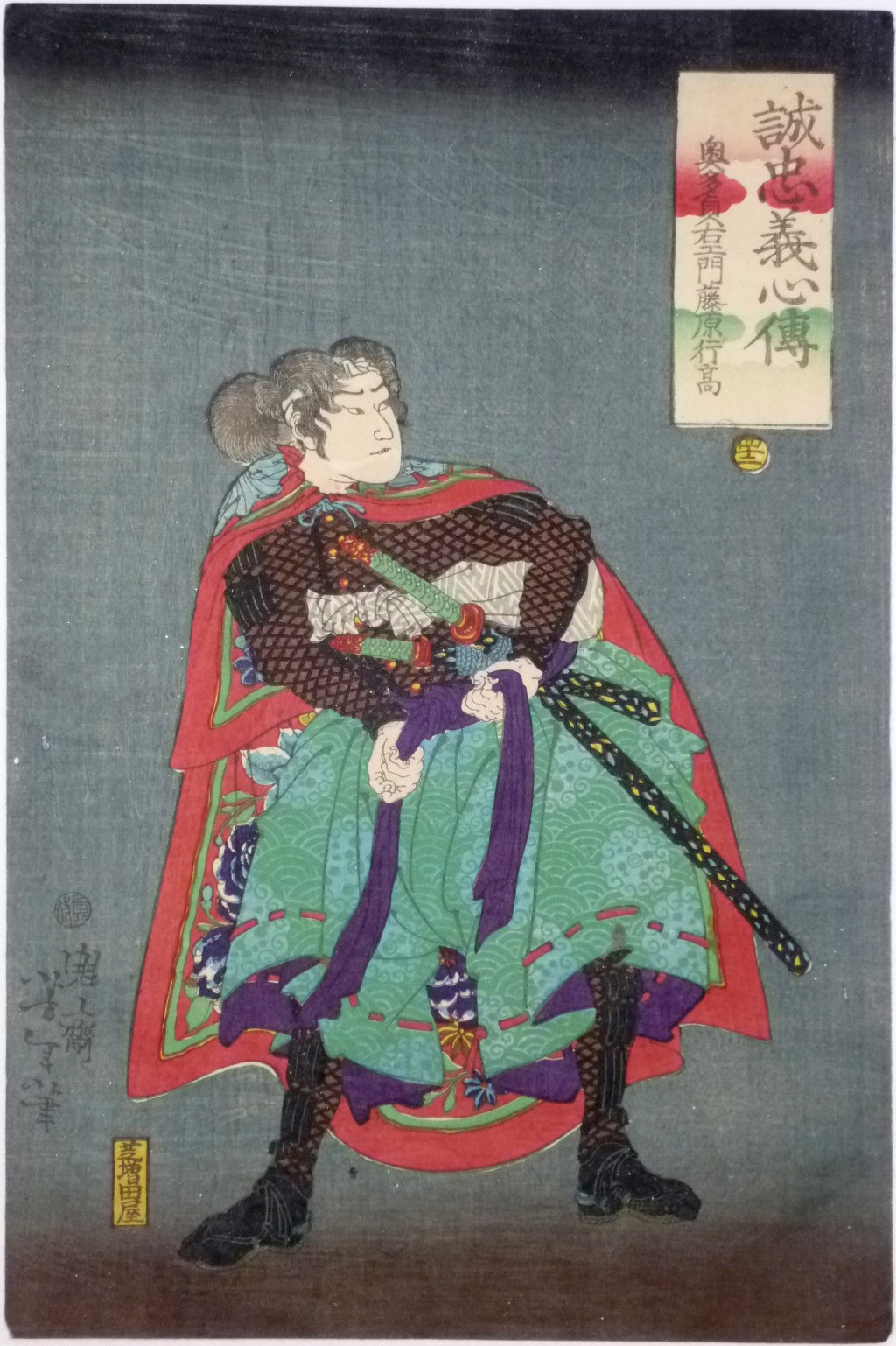
Tsukioka YOSHITOSHI (1839-1892)
Click here to view image full size.
The ronin Okuda Sadaemon Fujiwara Yukitaka ( number 42 ) from Seichu gishinden, “Tales of True Loyalty.” From a rare uncompleted set of the 47 Ronin published 6/1868 by Masudaya. Thirteen designs extant. It has been suggested that the set was completed but that the others are not known based on the fact that two of the prints are numbered 3 and 46. An error as artists did not commence and progress from number 1. Artists chose at random which numbers from a set to start with. Well known examples being Hiroshige’s Tokaido and Kisokaido.
Very good impression and colour. Light album backing. Signed Ikkaisai Yoshitoshi hitsu.
Status: Sold
Utagawa KUNIYOSHI (1797-1861)
Click here to view image full size.
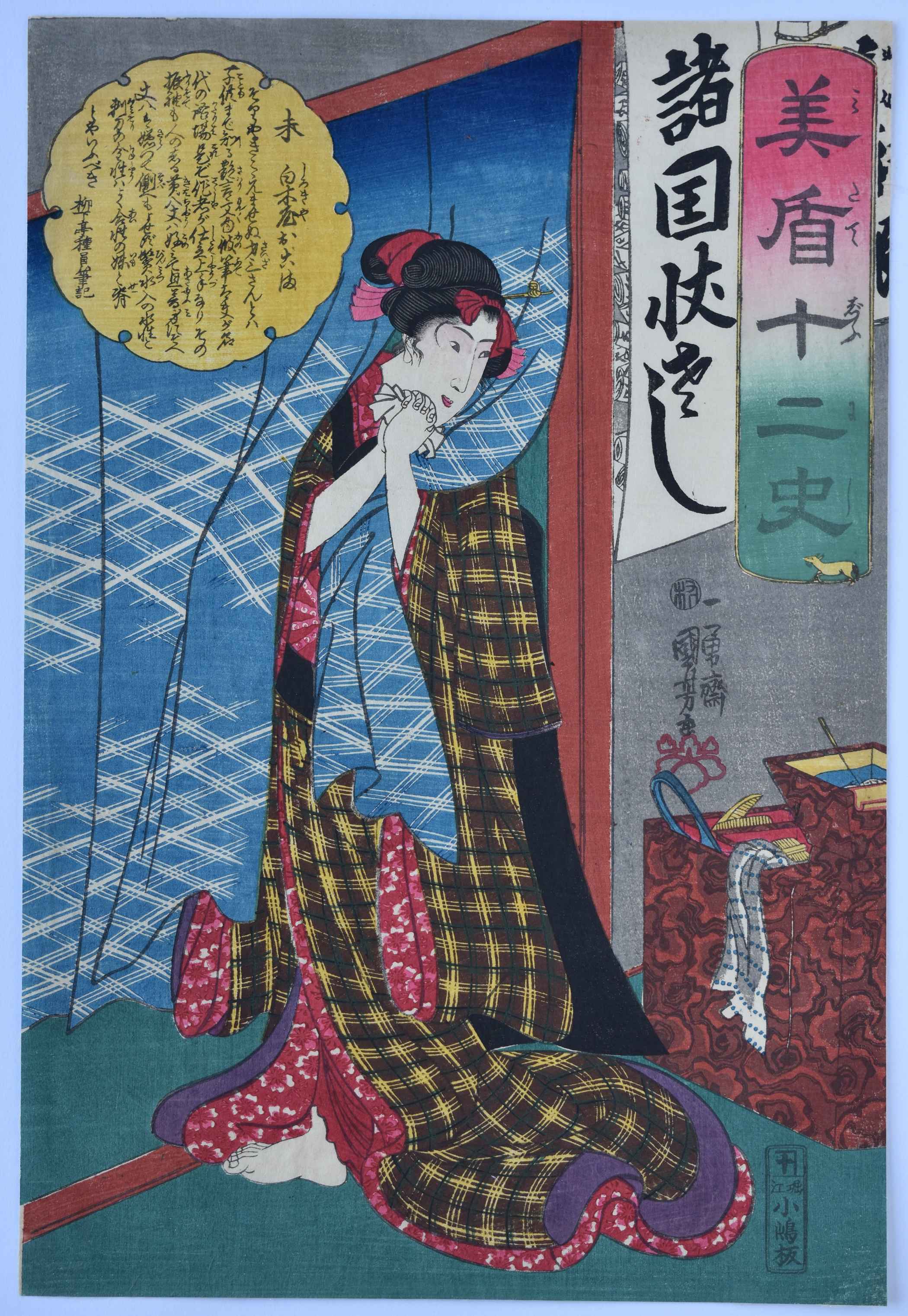
“Goat” from a set Mitate junishi, “Selection for the Twelve Signs.” Shows the beauty Okoma looking through a curtain. Briefly the story relates how she is to be married off to a rich man by her mother but Okoma is in love with another man called Chushichi. A visiting barber cuts Chushichi’s hair and concocts a scheme with him to have her kidnaped and for Chushichi to rescue her. Published by Kojima c 1845. Robinson S38.8.
Fine impression, colour and condition. Signed Ichiyusai Kuniyoshi ga.
Status: Sold
Utagawa KUNIYOSHI (1797-1861)
Click here to view image full size.
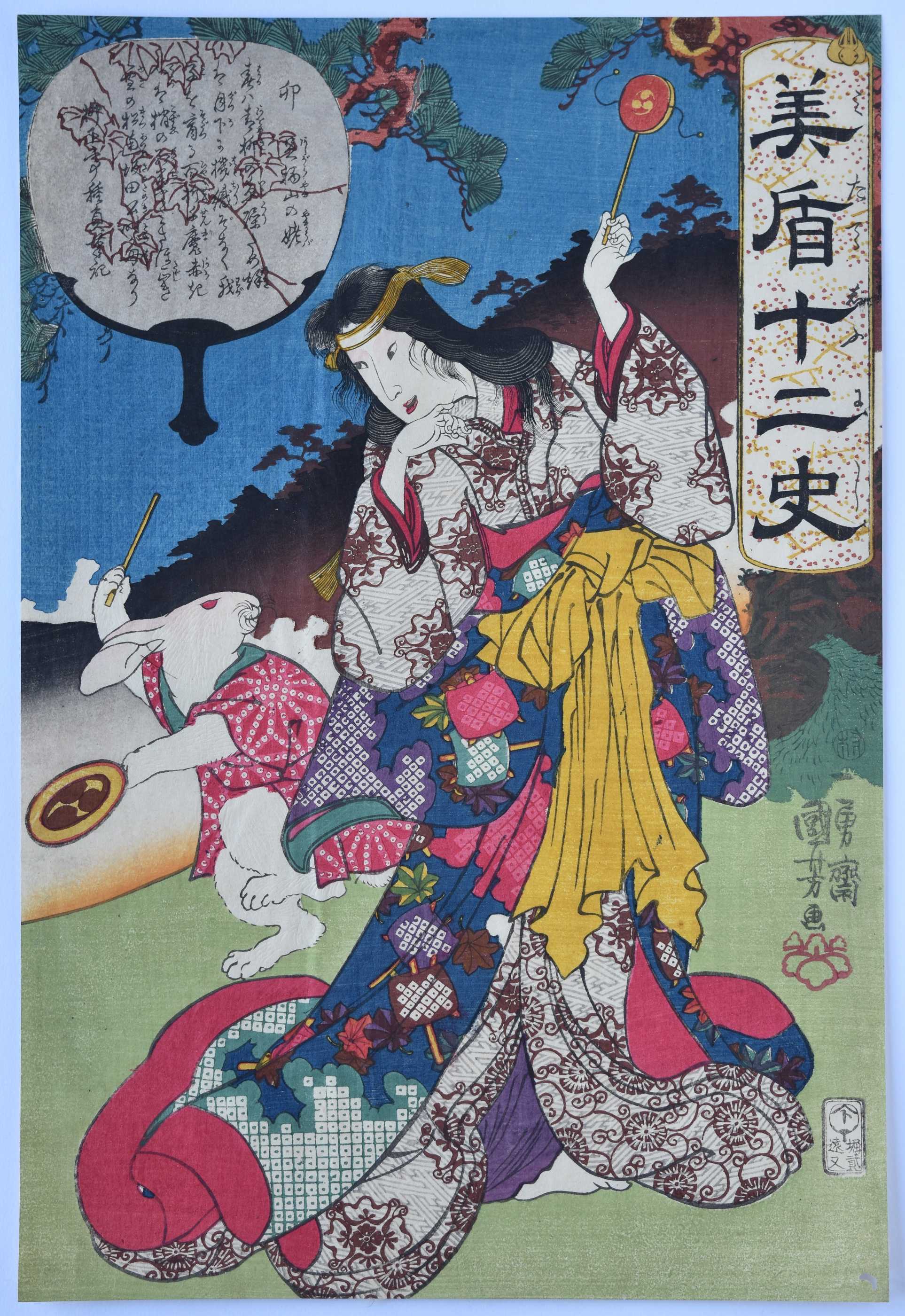
“Hare” from a set Mitate junishi, “Selection for the Twelve Signs.” Shows Yama-uba with a rattle and a dancing white hare on Mount Ashigora. She is famous for bringing up Kintaro who played with the mountain animals. Published by Yenshuya Matabei, c 1845. Robinson S38.4.
Fine impression, colour and condition. Signed Ichiyusai Kuniyoshi ga.
Status: Sold
Utagawa YOSHIIKU (1833-1904)
Click here to view image full size.
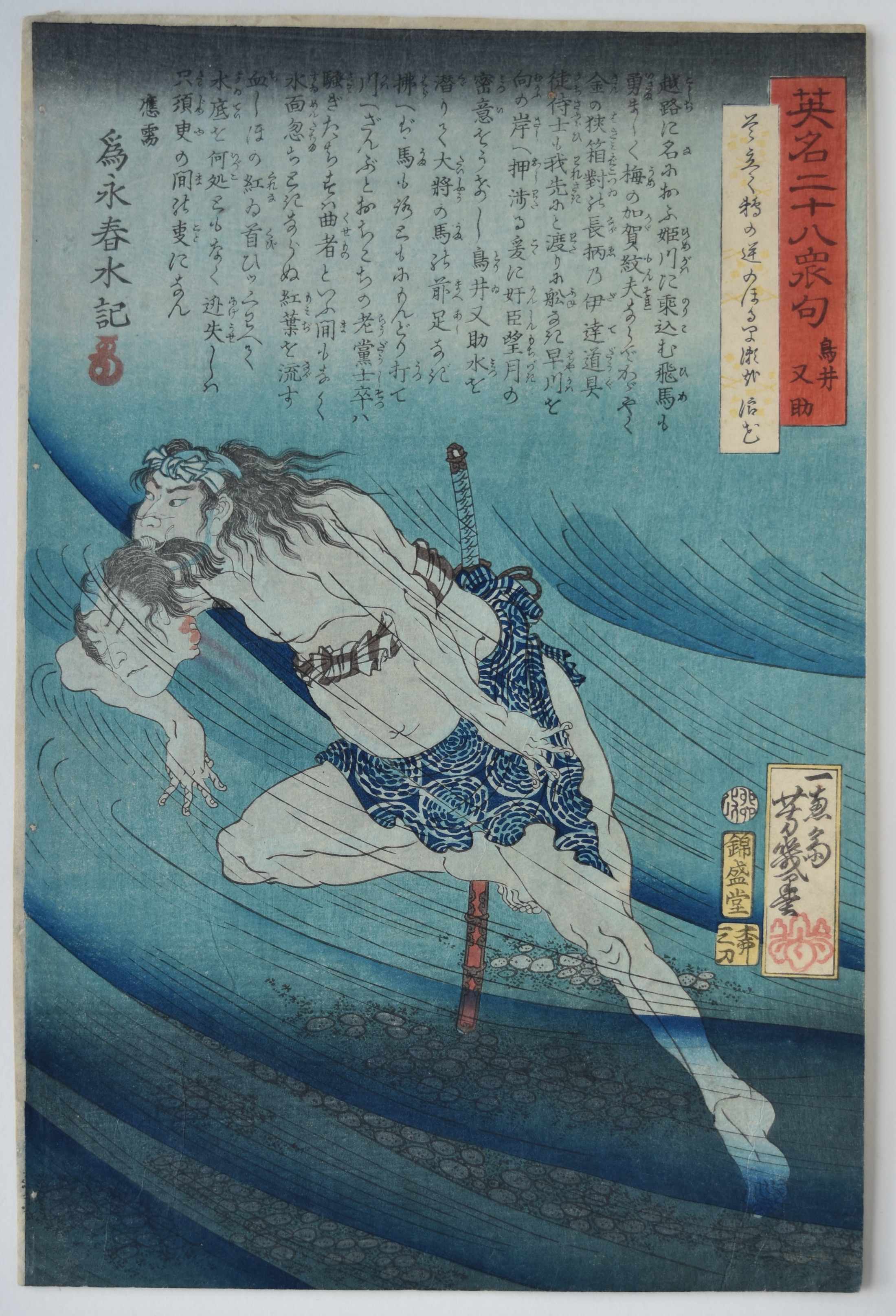
The warrior Torii Matasuke from a set Eimei nijuhasshuku, “Twenty Eight Famous Murders with Verse.” The set jointly designed by Yoshitoshi and Yoshiiku and depicts legendary and historical characters engaged in violent crimes. Matasuke is seen swimming in the Hime River gripping the topknot of a severed head between his teeth. Published by Kinseido, 1867.
Fine impression and colour. Lightly backed, otherwise very good condition. Signed Ikkeisai Yoshiiku ga.
Status: Sold
Utagawa KUNIYOSHI (1797-1861)
Click here to view image full size.
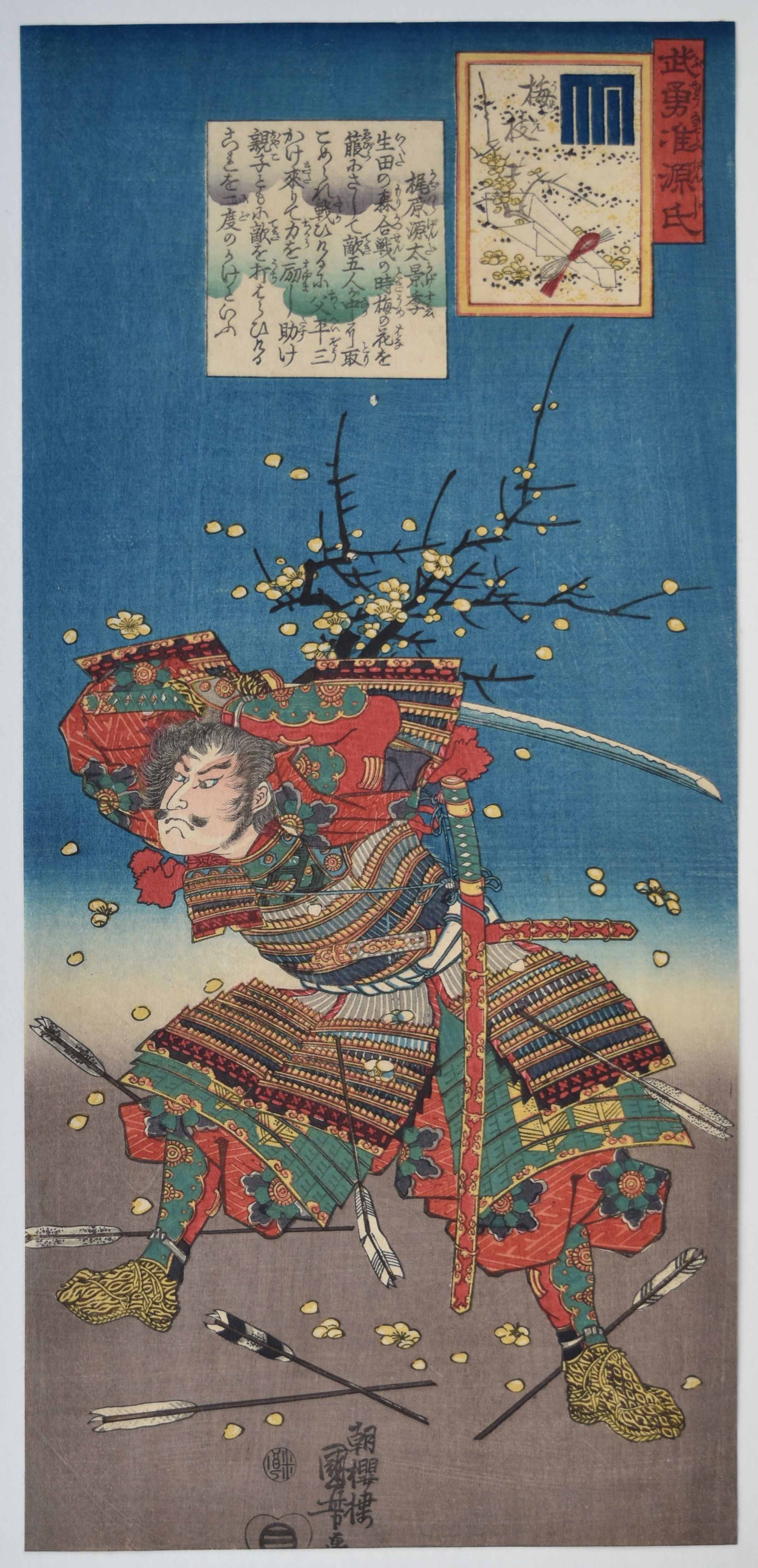
Chapter 32: Umegaye, “Plum brach” from an o-tanzaku set: Buyu nazorae Genji, “Heroic Comparisons for the Chapters of Genji.” Shows the Minamoto samurai Kajiwara Genda Kagesuye (1162-1200) fighting at Ikura-no-mori during the Genpai wars between the Taira and Minomoto clans. He has a plum branch stuck in his utsubo “quiver” in honour of his love Umegaye. The branch makes him an easy target for his enemies but he fights on regardless. Published by Ibaya Sensaburo, c 1843.
Very fine impression. Fine colour. Slightly trimmed at bottom, otherwise fine condition. Signed Cho-o-ro Kuniyoshi ga.
Status: Sold
Utagawa KUNIYOSHI (1797-1861)
Click here to view image full size.
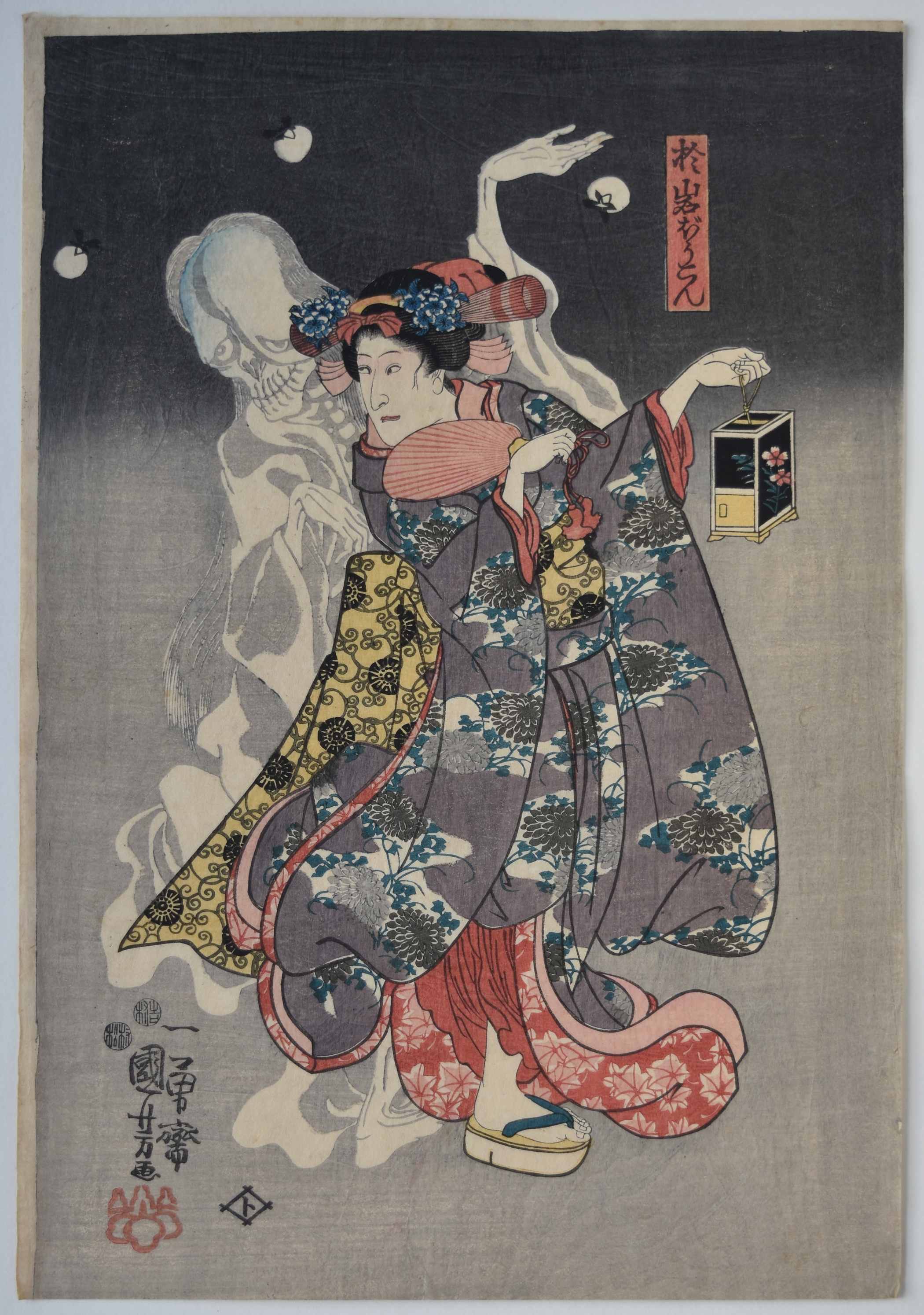
Oiwa and her ghost: Yondaime Ichikawa Kodanji IV no Oiwa bokon, “The Spirit of Oiwa Performed by Ichikawa Kodanji IV.” Probably in the play Atari mimasu yotsuya no kikigaki, performed at the Kawarasaki Theatre, 1848. The popular story has many versions, the gist being that Oiwa’s husband, Kamiya Lemon, falls in love with Oume, the daughter of a rich neighbour. Oume’s family poison Oiwa so that Lemon can marry the daughter. The poison hideously disfigures Oiwa who comes back to haunt Lemon. Published by Ebiya Rinnosuke, 1848.
Fine impression, colour and condition. Signed Ichiyusai Kuniyoshi ga.
Status: Sold
Utagawa KUNIYOSHI (1797-1861)
Click here to view image full size.
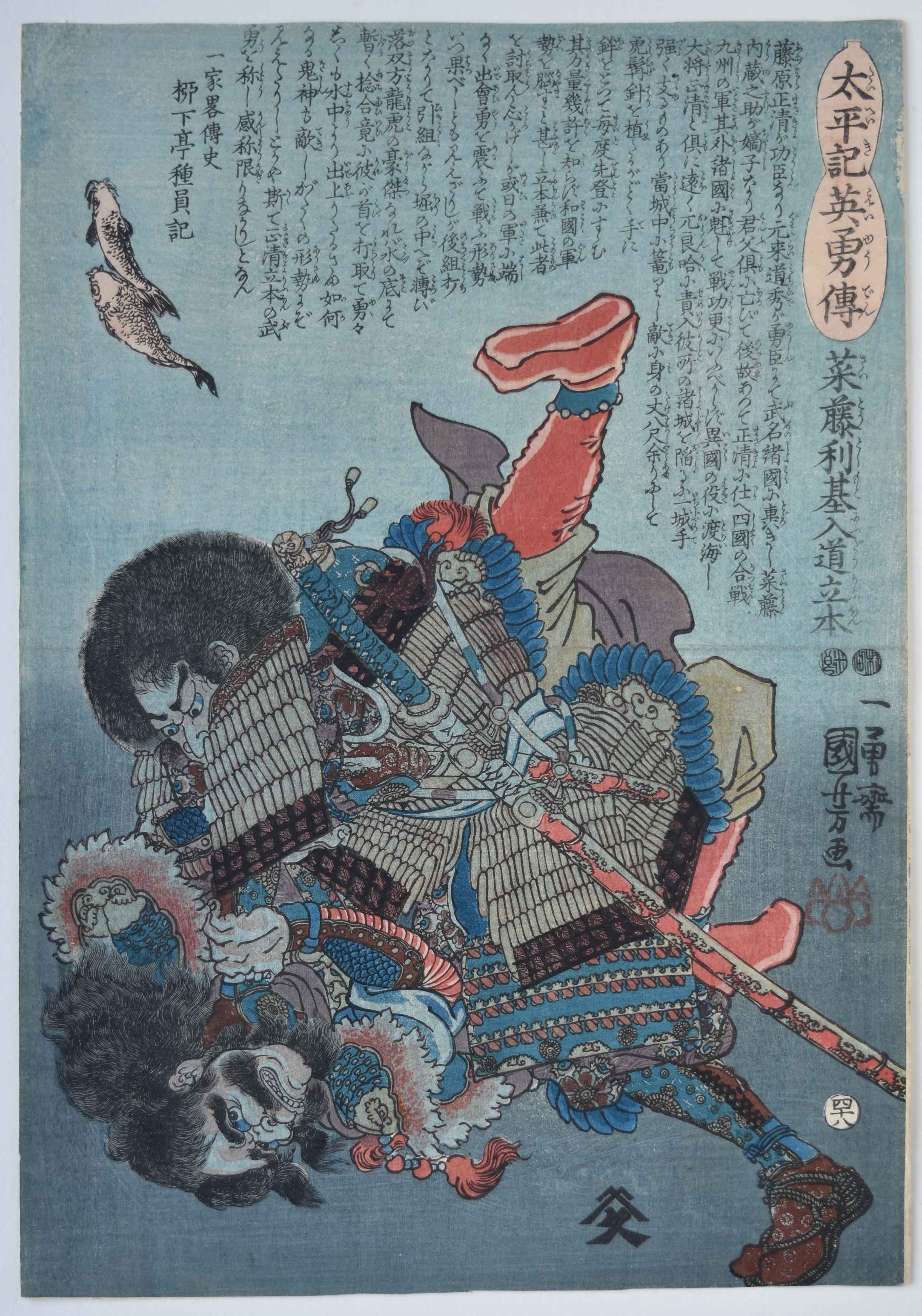
Saito Toshimoto nyudo Ryuhon (actually Saito Toshimitsu nyudo Ryuhon) in armour struggling with a Chinese brigand underwater. From the set Taiheiki yeiyuden, “Heroic Stories of the Taiheiki.” A history of the wars of the loyalist Nitta and Kusunoki families against the Ashikaga war-lords during the second quarter of the 14th century. But in fact the subject of this set of fifty prints (this numbered 48) is the civil war of the late 16th century. Censorship restrictions imposed in the 1840s prevented publishers from illustrating historical subjects from the Tensho era 1573-92 onwards, so the publishers circumvented this by slightly altering the names of the historical figures. Published 1848-9 by Yamamoto-ya Heikichi. There are a number of different states of this design, the preferable one, as here, has a light blue printed over the whole image to better depict the water. One of the best designs from the set.
Fine impression and colour. Slight centre fold and slight trimming at bottom. Light album backing. Signed Ichiyusai Kuniyoshi ga.
Status: Sold
Utagawa KUNIYOSHI (1797-1861)
Click here to view image full size.
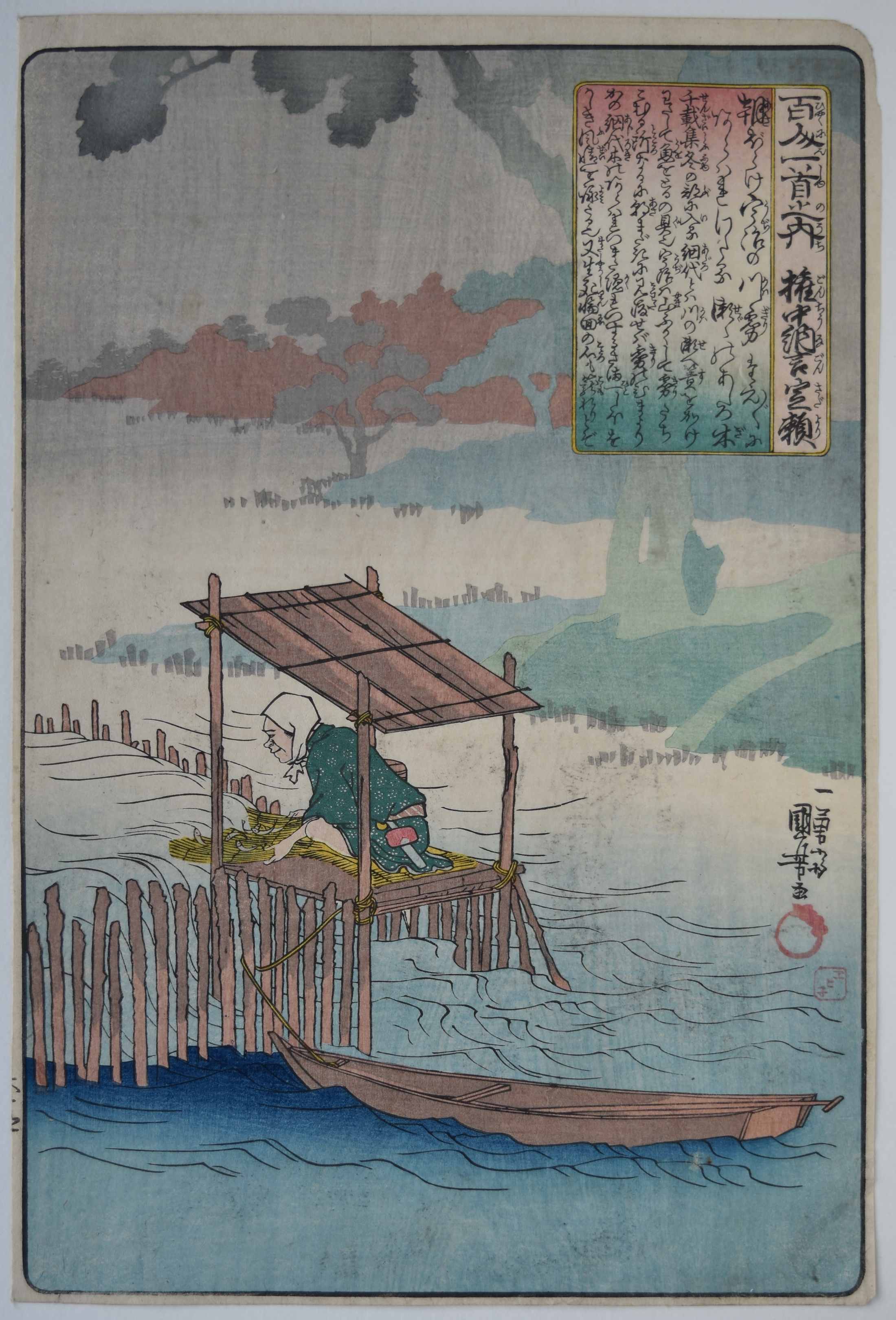
A poem by the celebrated poet Gonchunagon Sadayori from the series Hyakunin isshu no uchi, “One Hundred Poems for One Hundred Poets” which was compiled in 1235 by Fujiwara Teiki (1162-1241). Shows a fisherman catching fish in a fish trap. One of the best designs from the set with fine chiaroscuro printing of the background. Published by Ebisuya Shoshichi, Ebine, 1840-42. Only 58 of the 100 prints are known. Various translations of the poem exist, here is one:
In the early dawn
When the mists on Uji River
Slowly lift and clear
From the shallows to the deep
The stakes of fishing nets appear
Very fine impression. Fine colour. Slight nibbling of top right margin, otherwise very good condition. Signed Ichiyusai Kuniyoshi ga.
Status: Sold
Katsukawa SHUNTEI (1770-1820)
Click here to view image full size.
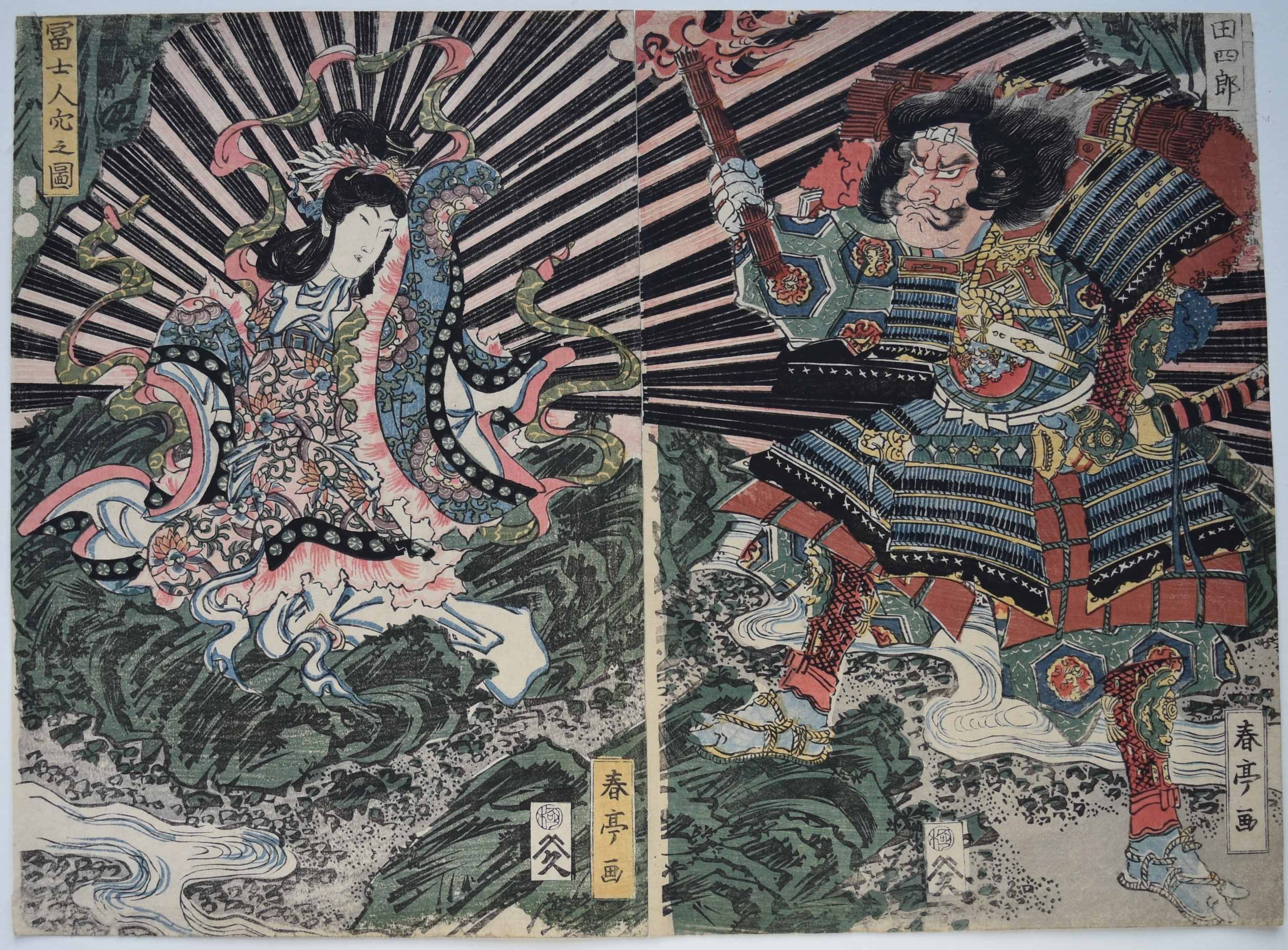
A diptych showing the warrior Nitta no Shiro Tadatsune (1167-1203) in the Hitoana Cave in Mt. Fuji brandishing a firebrand to illuminate the Sengen Bodhisattva, the Deity of Mount Fuji. He is sent on this mission by the Shogun Yoriie and discovers a pitch black cavern filled with bats and snakes. The Deity guides him through the Six Realms of Hell. Published by Yamamotoya Heikichi, c 1810s.
Very good impression, colour and condition. Signed Shuntei ga.
Status: Sold
Tsukioka YOSHITOSHI (1839-1892)
Click here to view image full size.
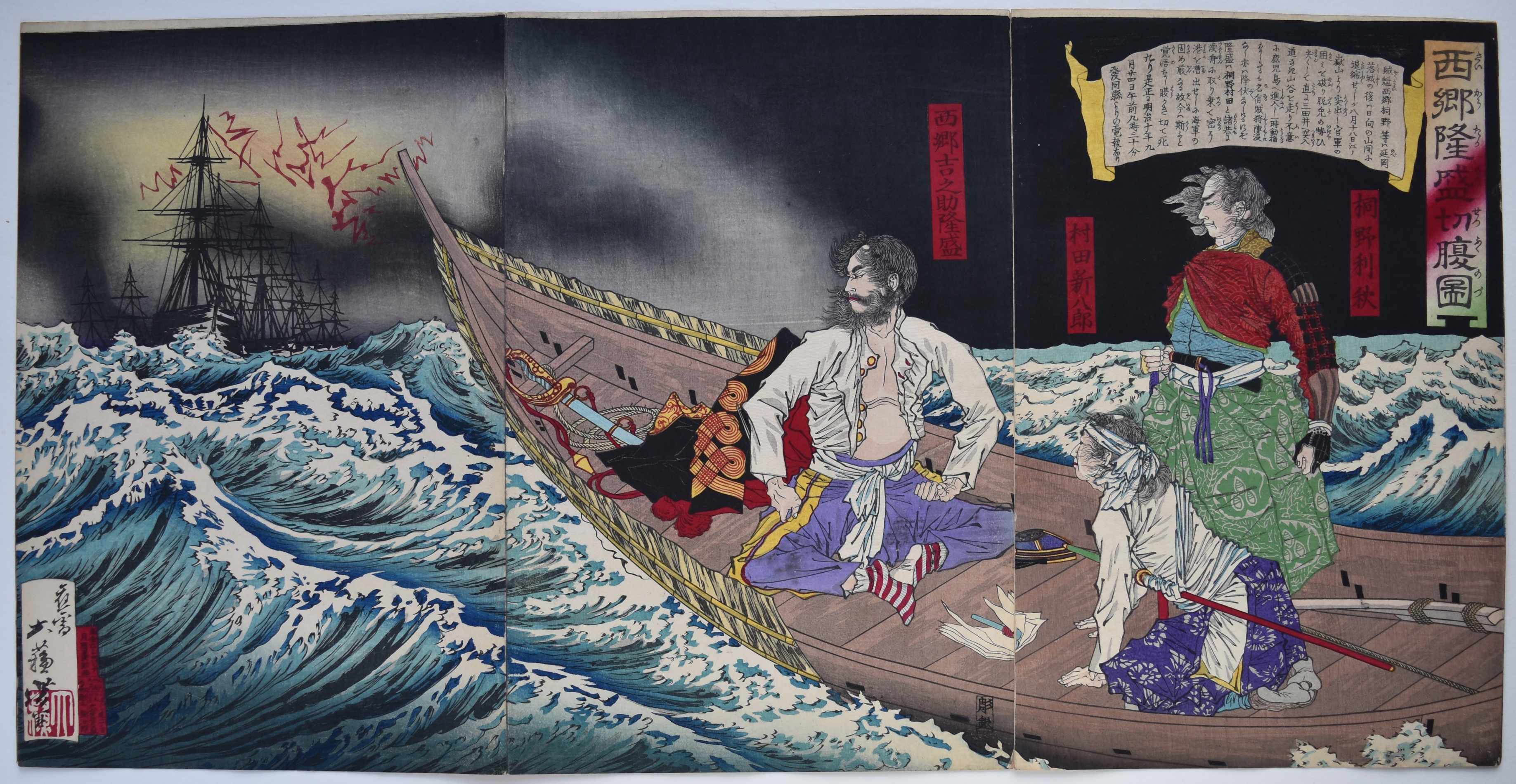
A triptych showing Saigo Takamori about to commit seppuku in a boat. Next to him are Murata Shinhachito and Kirino Yoshiaki. Saigo Takamori seppuku no zu. The “last true samurai,” he was instrumental in overthrowing the Tokugawa Shogunate. However, he had a falling out with the new Meiji government and returned to his native Satsuma in 1877 and led the so-called Satsuma Rebellion. This failed after seven months and the three in the boat were the last survivors of the rebellion. Published by Okura Magohei, 1877.
Very fine impression. Fine colour. Original album backing, otherwise good condition. Signed Oju Taiso Yoshitoshi.
Status: Sold
Utagawa YOSHITORA (Active c 1850-1880)
Click here to view image full size.
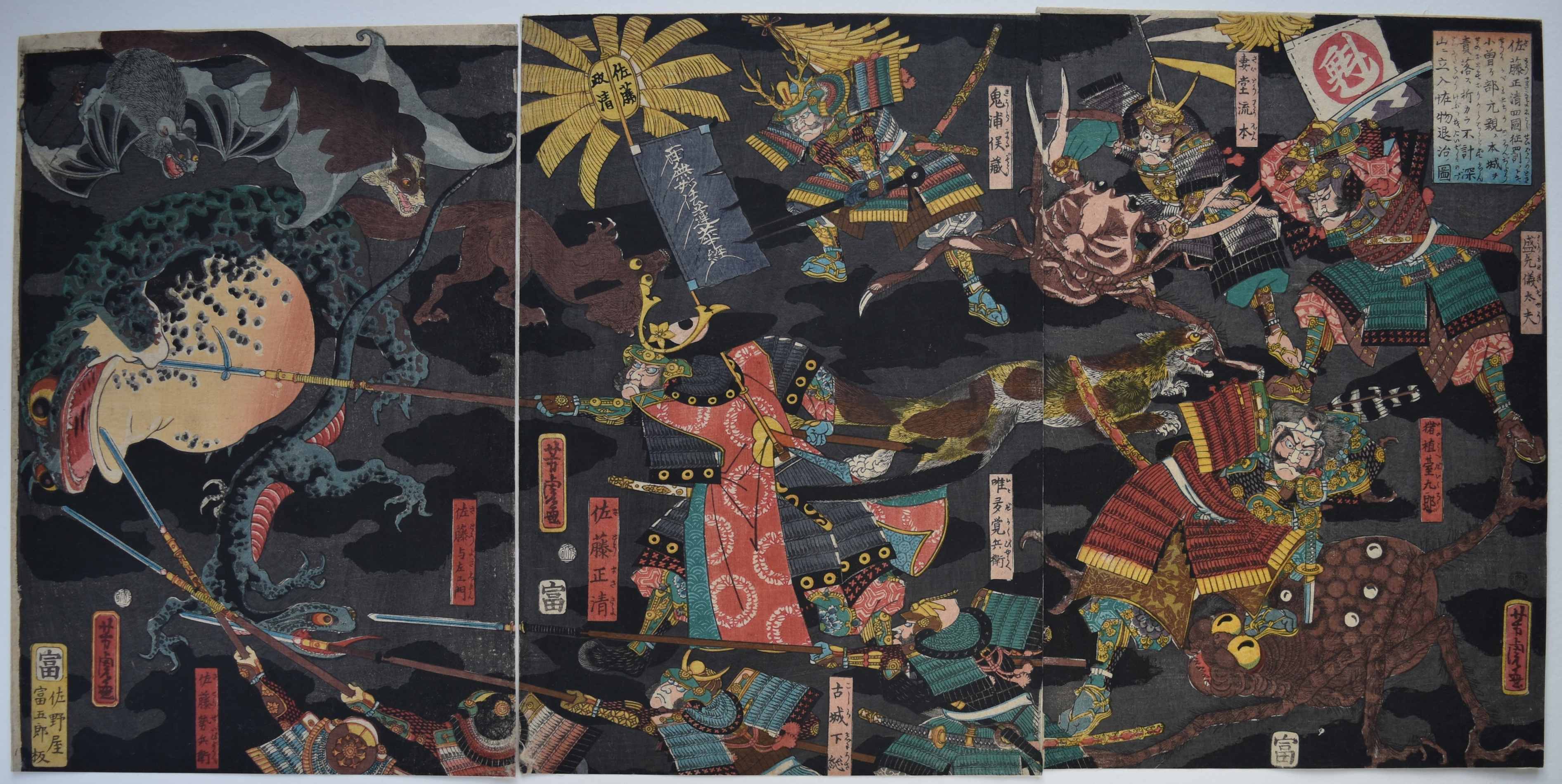
A triptych showing Sato Masakiyo, having invaded Shikoku and overthrowing the castle of Shosokabe Motochika, entered deep into the mountains where he battles an army of huge toads, lizards, bats, spiders, cats and dogs. Sato Masakiyo Shikoku seibatsu no toki Shosokabe Motochika no honjo o semeotosu ori kara hakarazu shinzan ni tachiiri kebutsu taiji no zu. Published by Kinseido, 1862.
Very good impression and colour. Album backing, otherwise good condition. Signed Yoshitora ga.
Status: Sold
Tsukioka YOSHITOSHI (1839-1892)
Click here to view image full size.
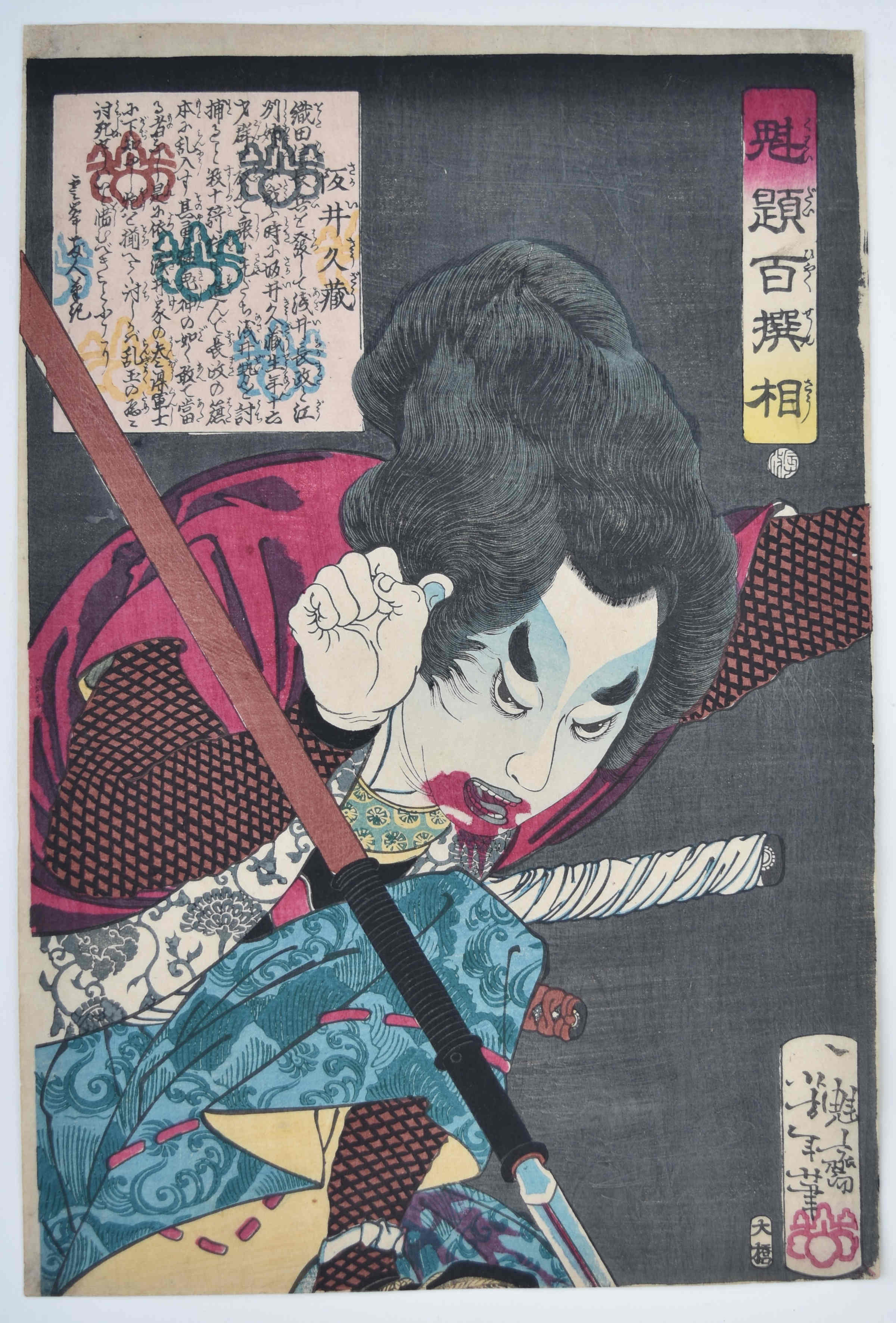
The boy warrior Sakai Kuzo hurling a te-yari spear from a set Kaidai hyaku senso “Yoshitoshi’s Selection of One Hundred Warriors.” Sixty-five prints published by Ohashiya Yashichi (Odawaraya Yashichi) between 1868 and 1869, this being 1868. The text in the square cartouche in this set refers to prominent warriors in the internecine wars of the 16th century, but in fact the subjects are Shogitai soldiers (those that held out against the Imperial forces and were massacred at Ueno, 4/7/1868). An excellent set.
Fine impression, colour and condition. Signed Ikkaisai Yoshitoshi hitsu.
Status: Sold
Tsukioka YOSHITOSHI (1839-1892)
Click here to view image full size.
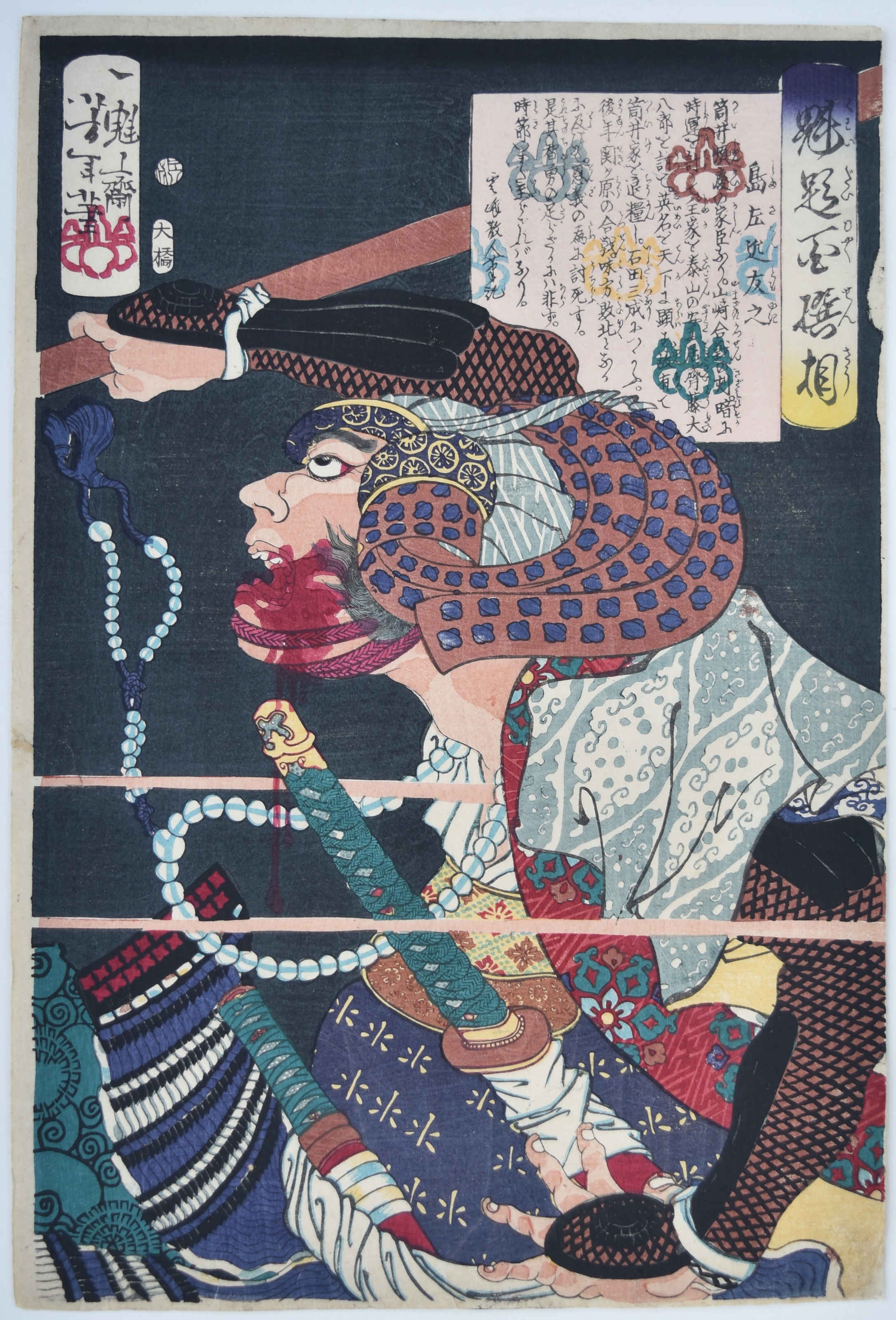
Shows Shima Sakon Tomoyuki at the battle of Sekigahara, October 21, 1600. Shima was a commander of Ishida no Mitsunari’s forces against Tokugawa Ieyasu and was shot by riflemen (although his body was not found). He is shown being hit by a hail of bullets, his juzo (rosary) swinging in the air. From a set Kaidai hyaku senso “Yoshitoshi’s Selection of One Hundred Warriors.” Sixty-five prints published by Ohashiya Yashichi (Odawaraya Yashichi) between 1868 and 1869, this being 1868. The text in the square cartouche in this set refers to prominent warriors in the internecine wars of the 16th century, but in fact the subjects are Shogitai soldiers (those that held out against the Imperial forces and were massacred at Ueno, 4/7/1868). An excellent set.
Fine impression, colour and condition. Signed Ikkaisai Yoshitoshi hitsu.
Status: Sold
Taiso YOSHITOSHI (1839-1892)
Click here to view image full size.
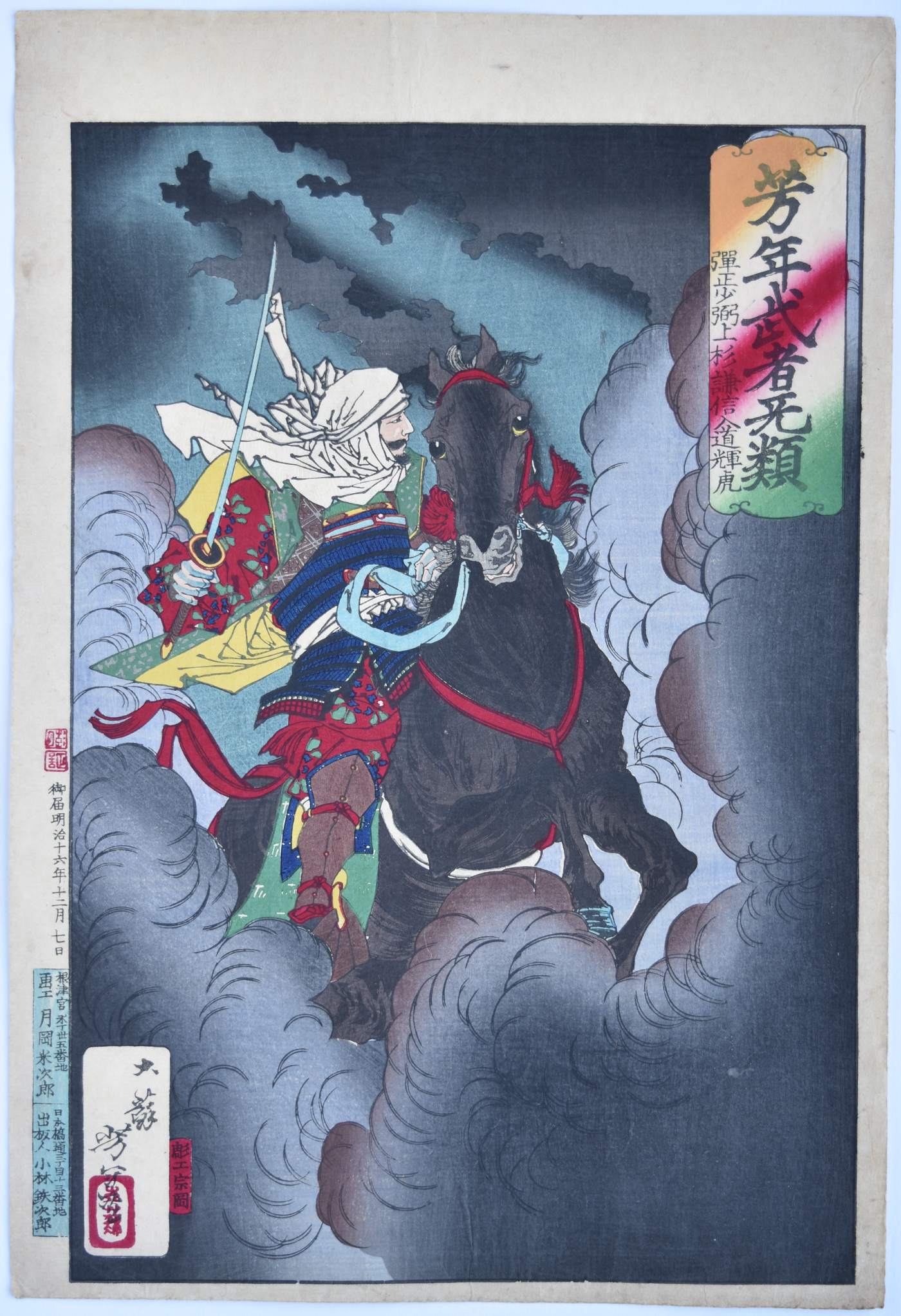
Uesugi Kenshin Nyudo Terutora riding into battle. From the fine set Yoshitoshi mushaburui, “Yoshitoshi’s Courageous Warriors.” Published by Kobayashi, 1883-1886 (this being 1883).
Fine impression and colour. Light toning, otherwise fine condition. This is the first edition. There are a number of later states and the set was republished by Tsunajima in 1886.
Status: Sold
Ogata GEKKO (1859-1920)
Click here to view image full size.
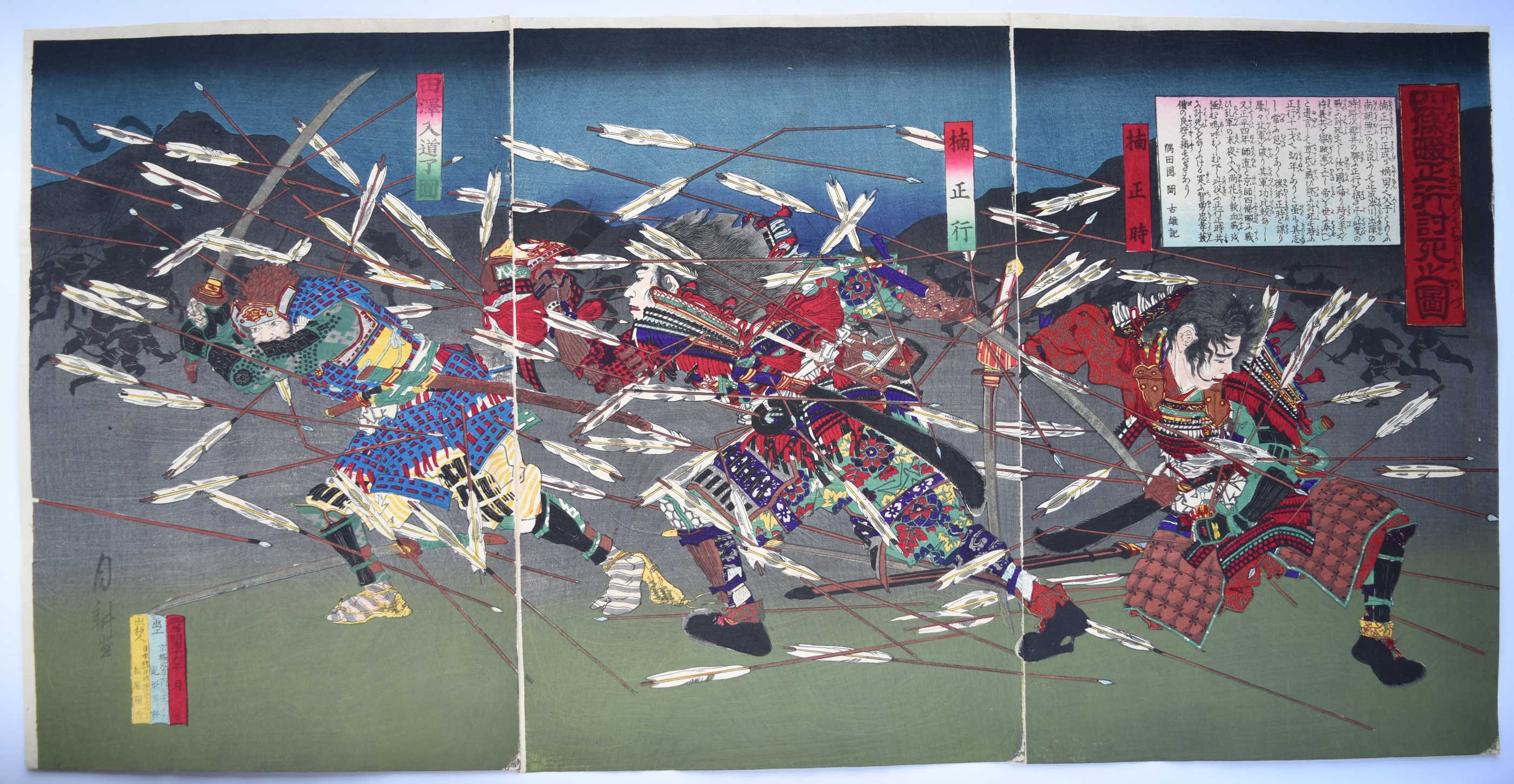
A triptych showing the last stand of the Kusunoki Clan at the Battle of Shijonawate in 1348. The event took place during the Nanbokucho wars when the Kusunoki Masatsura forces of the Southern Imperial Court were attacked at Yoshino by the Northern forces led by Ko no Moroyasu. Masatsura fought valiantly against a hail of arrows, eventually succumbing and committing suicide. . Published 1883 by Matsuo Danzo (who only appears to have survived one year). There is an earlier triptych version of this by Gekko in 1878. A later and far inferior reprint was published in 1901.
Superb impression, colour and condition with extensive burnishing. Signed Gekko ga.
Status: Sold
Utagawa KUNIYOSHI (1797-1861)
Click here to view image full size.
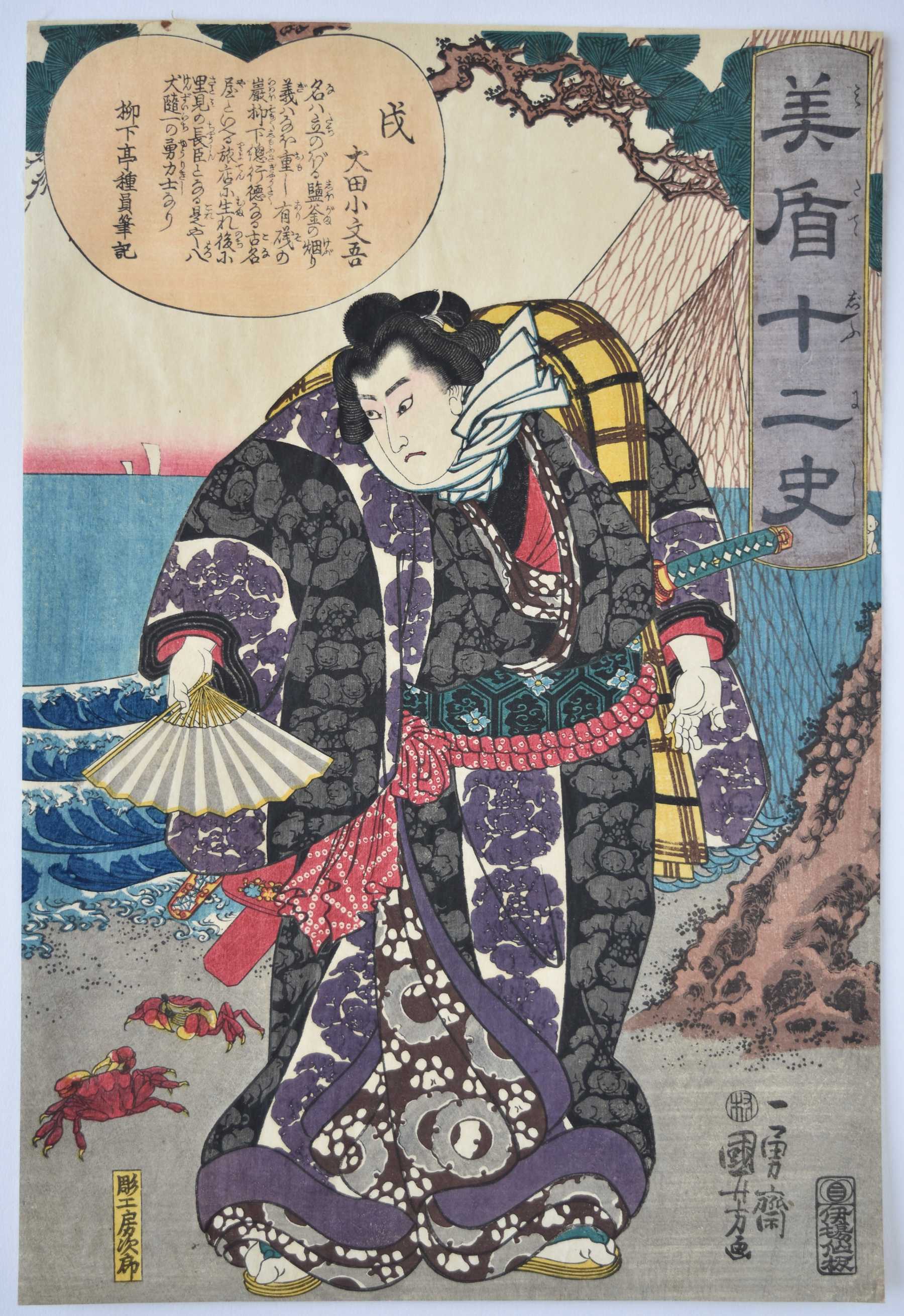
A print from the set Mitate junishi, “Selection for the Twelve Signs [of the Zodiac].” This being Dog. Shows the wrestler Inuda (Inu, “Dog”) Kobungo umpiring a match between two crabs. Published c. 1845 by Iba-ya Sensaburo. Robinson S38.11.
Fine impression and colour. Very slight trimming, otherwise fine condition. Signed Ichiyusai Kuniyoshi ga.
Status: Sold
Utagawa KUNIYOSHI (1798-1861)
Click here to view image full size.
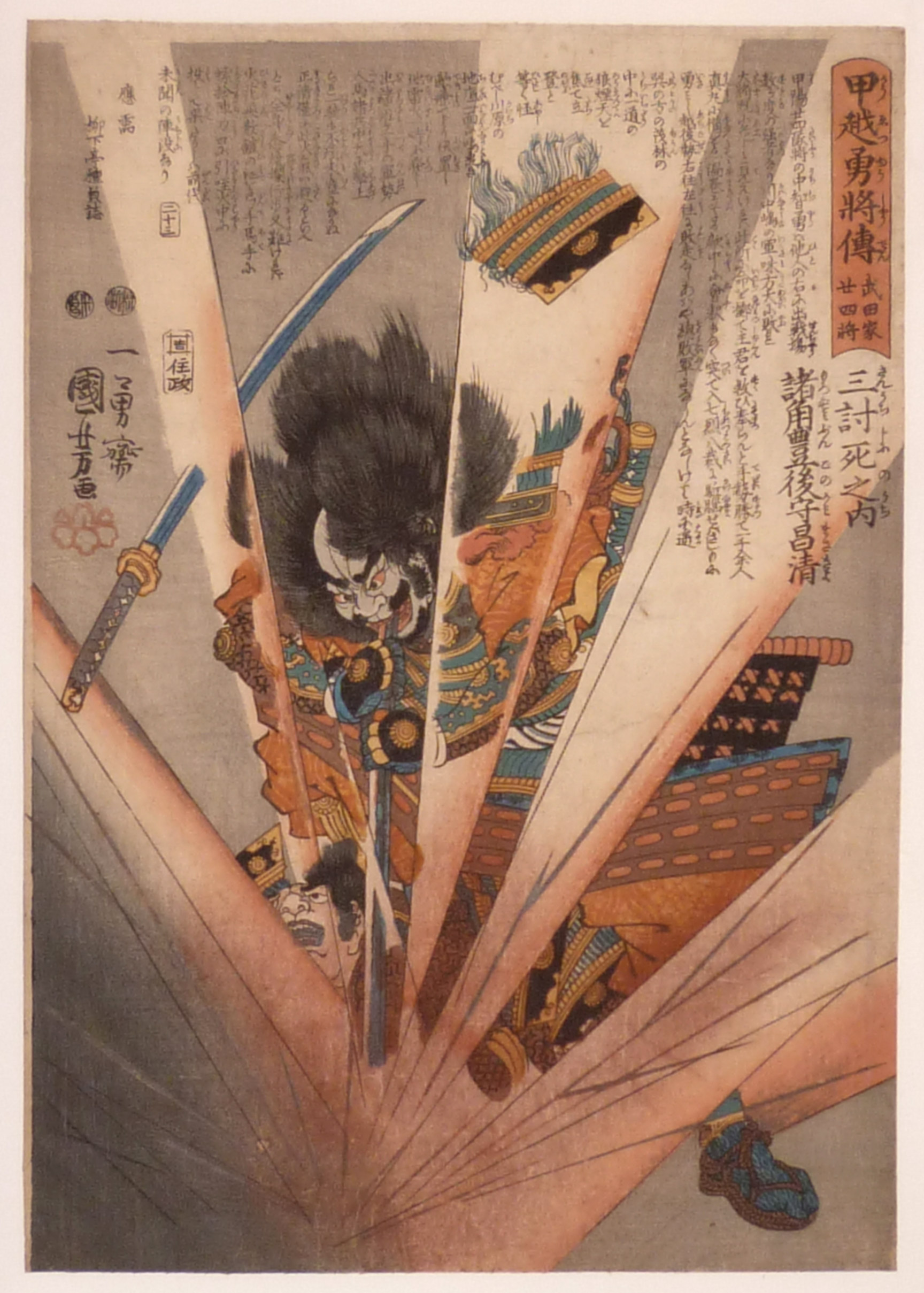
Morozumi Masakiyo, Lord of Bungo, and retainer of the Takeda being blown up by a cannonball or landmine whilst committing suicide with his sword. The best design from a set Koetsu yusho den, “Biographies of Brave Generals from the Provinces of Kai and Echigo.” The series shows heroic acts during battles that took place between the troops of Takeda Shungen of Kai Province and Kenshin Tora of Echigo Province during 1553-1564 at Kawanakajima. Published by Sumiyoshiya Masagoro, c 1849. Illustrated in colour, Robinson, Kuniyoshi The Warrior-Prints, Phaidon, 1982, pl. 20, S63.9 and elsewhere. One of Kuniyoshi’s finest oban designs.
Very good impression. Some oxidation, otherwise very good colour and condition. Signed Ichiyusai Kuniyoshi ga.
Status: Sold
Tamagawa SHUNSUI (Active 1772-1781)

Click here to view image full size.
A hashira-e, “pillar print” by a rare artist, a pupil of Choshun who went on to teach Katsukawa Shunsho. Produced a few chuban, hosoban, and pillar prints. Shows the Minamoto (Genji) warrior Kumagai Naozane ,above, attacking the Taira (Heike) warrior Taira no Atsumori, below, at the battle of Ichi-no-Tani in 1184 during the Genpei war. Pillar prints were introduced to hang, when mounted, on the pillars of a Japanese house. Consequently, they often come browned, creased or faded and finding good examples is difficult. Rare: Another impression is in MFA, Boston, acc. no. 28.500.
Very good impression and colour. Light toning but otherwise very good condition. Signed Tamagawa Shunsui ga.
Status: Sold