Taiso YOSHITOSHI (1839-1892)

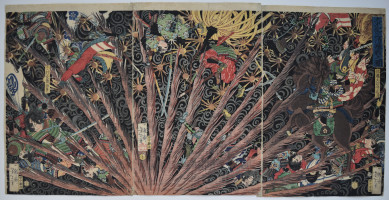
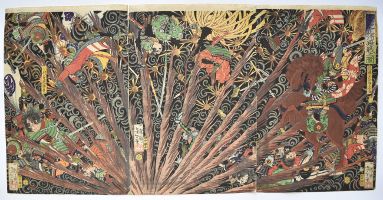
Click here to view image full size. A triptych showing an exploding land-mine throwing bodies and horses into the ether. Taiheiki Masakiyo nansen no zu, “Masakiyo’s Difficult Battle from the Taiheiki.” Figures identified in the print are the 14th century warriors Sato Shukei no Kami Masakiyo and Shimura Masazo Katsutoyo, but by way of avoiding censorship, it is actually showing Kato Kiyomasa (1562-1611) and Kimura Matazo Shigekatsu. It may also be that the design alludes to the rogue samurai in Choshu Province during the summer of 1866. Published by Yamashiroya Jinbei, 1866. One of Yoshitoshi’s great designs. In fact, this is a reworking of a similar composition in a book early in his career, Ehon jitsugokyo dojikyo yoshu of 1853.   Fine impression and colour. Lovely oxidation of the orange pigment. Fine condition. Signed Ikkaisai Yoshitoshi hitsu.   Status: Available Price:  £9,800  

Taiso YOSHITOSHI (1839-1892)

Click here to view image full size. Minamoto no Ushiwakamura battling with Kumasaka Chohan. From the fine set Yoshitoshi mushaburui, “Yoshitoshi’s Courageous Warriors.” Published by Kobayashi, 1883-1886 (this being 1883).     Fine impression and colour. Light toning, otherwise fine condition. This is the first edition. There are a number of later states and the set was republished by Tsunajima in 1886.     Status: Sold    

Taiso YOSHITOSHI (1839-1892)

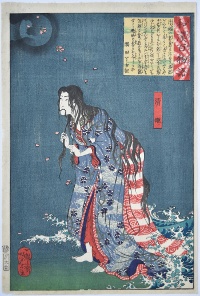
 Click here to view image full size. Shows Kiyohime (Princess Kiyo) who fell passionately in love with the monk Anchin and endeavoured to pursue him across a swollen river to his monastery. Unable to cross she transforms herself into a serpent-like creature to enable her to reach the other side. One of a set of 26 prints with title: Wakan hyaku monogatari, “One Hundred Tales of China and Japan.” Published by Daikokuya Kinnosuke, 1865.   Very good impression, colour and condition. Signed Ikkaisai Yoshitoshi ga.   Status: Sold  

Taiso YOSHITOSHI (1839-1892)

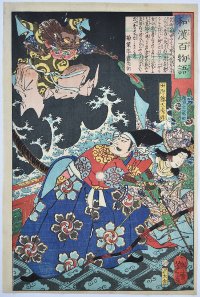
 Click here to view image full size. Shows the samurai Tawara Toda (“Lord of the Ricebag”) Hidesato slaying the monstrous centipede Mukade on the request of the Dragon King. Elated the king presents him with a bottomless bag of rice. Behind Hidesato is the centipede’s arch-enemy Otohime. One of a set of 26 prints with title: Wakan hyaku monogatari, “One Hundred Tales of China and Japan.” Published by Daikokuya Kinnosuke, 1865.   Fine impression with variegated cartouche and mica. Fine colour and condition. Signed Ikkaisai Yoshitoshi ga.   Status: Sold  

Taiso YOSHITOSHI (1839-1892)

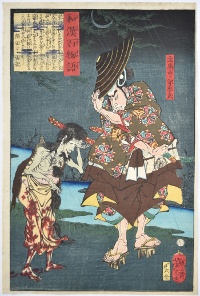
 Click here to view image full size. Shows Suma Urabe Suetake, one of the retainers of Minamoto Yorimitsu, meeting the apparition of the woman Ubume, who is to place a baby boy in his arms. One of a set of 26 prints with title: Wakan hyaku monogatari, “One Hundred Tales of China and Japan.” Published by Daikokuya Kinnosuke, 1865.   Very good impression, colour and condition. Signed Ikkaisai Yoshitoshi ga.   Status: Sold  

Taiso YOSHITOSHI (1839-1892)

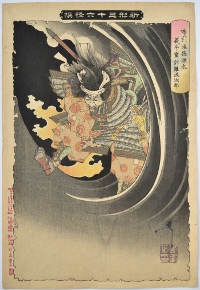
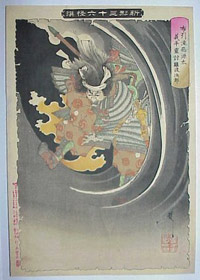
 Click here to view image full size. The ghost of the wicked Genta Yoshihira attacking his executioner Nanba Jiro at the Nunobiki waterfall from Shinkei sanjurokkaisen, “New Forms of Thirty-six Ghosts.”The set published by Sasaki Toyokichi, 1889-1892 (this being 1889). One of the two best designs from the set.   Very fine first edition. Fine colour and condition. Signed Yoshitoshi.   Status: Sold  

Taiso YOSHITOSHI (1839-1892)

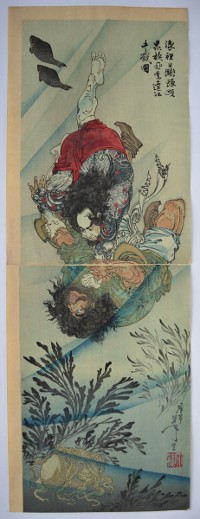
 Click here to view image full size. A vertical oban diptych showing the renowned swimmer and fishmonger Rorihakucho Chojun grappling underwater with the famous (but non-swimmer) warrior Kokusenpu (“Black Whirlwind”) Riki. The result of Chojun challenging Riki to a fight after his gang attempt to rob some fishermen. They eventually become friends. Rorihakucho Chojun Kokusenpu Riki ochude tatakau zu. Published by Matsui Eikichi early 1887. This is the first edition without publisher or date. It was then issued with this information and then re-published by Hasegawa Tsunejiro in September 1887. This is most likely a proof impression with extra large margin on the left. The finest impression I have seen of this design.   Superb impression, colour and condition. Signed Oju Yoshitoshi ga.   Status: Sold  

Taiso YOSHITOSHI (1839-1892)

 Click here to view image full size. A triptych showing an exploding land-mine throwing bodies and horses into the ether. Taiheiki Masakiyo nansen no zu, “Masakiyo’s Difficult Battle from the Taiheiki.” Figures identified in the print are the 14th century warriors Sato Shukei no Kami Masakiyo and Shimura Masazo Katsutoyo, but by way of avoiding censorship, it is actually showing Kato Kiyomasa (1562-1611) and Kimura Matazo Shigekatsu. It may also be that the design alludes to the rogue samurai in Choshu Province during the summer of 1866. Published by Yamashiroya Jinbei, 1866. One of Yoshitoshi’s great designs. An unidentified collector’s seal at the bottom right of each sheet. In fact, this is a reworking of a similar composition in a book early in his career, Ehon jitsugokyo dojikyo yoshu of 1853.   Fine impression and colour. Lovely oxidation of the orange pigment. Fine condition. Signed Ikkaisai Yoshitoshi hitsu.   Status: Sold  

Taiso YOSHITOSHI (1839-1892)

 Click here to view image full size. Sagaminokami Hojo Takatoki warding off a group of tengu with his fan. From the fine set Yoshitoshi mushaburui, “Yoshitoshi’s Courageous Warriors.” Published by Kobayashi, 1883-1886 (this being 1883).   Fine impression and colour. Light toning, otherwise fine condition. This is the first edition. There are a number of later states and the set was republished by Tsunajima in 1886.   Status: Sold  

Taiso YOSHITOSHI (1839-1892)

 Click here to view image full size. Sano Genzaemon cutting his potted trees to warn Hojo Tokiyori. From the fine set Yoshitoshi mushaburui, “Yoshitoshi’s Courageous Warriors.” Published by Kobayashi, 1883-1886 (this being 1883).   Fine impression and colour. Light toning, otherwise fine condition. This is the first edition. There are a number of later states and the set was republished by Tsunajima in 1886.   Status: Sold  

Taiso YOSHITOSHI (1839-1892)

 Click here to view image full size. Danjo Matsunaga Hisahide preparing to commit suicide. From the fine set Yoshitoshi mushaburui, “Yoshitoshi’s Courageous Warriors.” Published by Kobayashi, 1883-1886 (this being 1883).   Fine impression and colour. Light toning, otherwise fine condition. This is the first edition. There are a number of later states and the set was republished by Tsunajima in 1886.   Status: Sold  

Taiso YOSHITOSHI (1839-1892)

 Click here to view image full size. Kuro Hangan Yoshitsune and Notonokami Noritsune fighting on a ship’s prow. From the fine set Yoshitoshi mushaburui, “Yoshitoshi’s Courageous Warriors.” Published by Kobayashi, 1883-1886 (this being 1886).   Fine impression and colour. Light toning, otherwise fine condition. Early edition. There are a number of later states and the set was republished by Tsunajima in 1886.   Status: Sold  

Taiso YOSHITOSHI (1839-1892)

Click here to view image full size. A design from a set Azuma nishiki ukiyo kodan, “Rough Tales of the Floating World.” Various publishers between 1867 -1868, here Omi-Kyu in 1868. The prints interpret stories told by various well known storytellers, in this case Momokawa Enkoku. Shows the Monkey King (Son Goku) being catapulted into the air by the force of the large palm fan of Princess Iron Fan. (The fan was capable of creating strong winds and putting out fires.) She was a Rasetsunyo, a female protector of Buddhism. A comparatively rare set.     Very good impression, colour and condition. Signed Ikkaisai Yoshitoshi hitsu.     Status: Sold    

Taiso YOSHITOSHI (1839-1892)

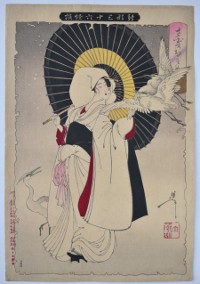
Click here to view image full size. Shows the famous Heron Maiden. There are different versions of this story but the most common tells how a young man finds an injured heron. He nurses it back to health and releases it. Some time later a beautiful young woman appears in his village. He falls in love and they marry. She makes fine brocade which they sell, but she does not allow him to see her making it. Tempted he secretly views her only to discover she is the heron. This is the end of their marriage and the heron flies away. From a set Shingata sanjurokkaisen, “New Forms of Thirty-six Ghosts,” sub-title: Sagi musume. The set published by Sasaki between 1889- 1892 (this being 1889). This is the first edition.     Very fine impression, colour and condition. Signed Yoshitoshi.     Status: Sold    

Taiso YOSHITOSHI (1839-1892)

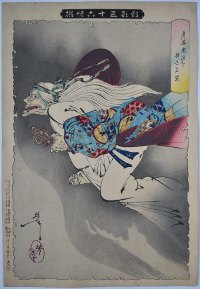
 Click here to view image full size. Roba kiwan o mochisaru from Shingata sanjurokkaisen, “New Forms of Thirty-Six Ghosts.” The set of thirty-six prints published by Sasaki Toyokichi 1889-1892 (this being 1889). Shows the demon Ibaraki escaping with her severed arm. She had haunted the Rashomon Gate near the Toji Temple in Kyoto. Watanabe no Tsuna is commanded to kill her but only succeeds in cutting an arm off. Knowing she will return he locks it in a box. Subsequently his elderly aunt visits him and asks to see it, whereupon she reverts to her demonic self and seizes the limb. In another version she haunts the Modori bridge, Ichijo, in Kyoto.   Very fine impression of the first edition with burnishing. Fine colour. Very slight crease, otherwise fine condition. Signed Yoshitoshi.   Status: Sold  

Taiso YOSHITOSHI (1839-1892)

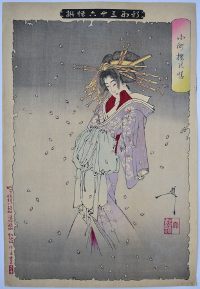
 Click here to view image full size. Komachizakura no sei from Shingata sanjurokkaisen, “New Forms of Thirty-Six Ghosts.” The set of thirty-six prints published by Sasaki Toyokichi 1889-1892 (this being 1889). The story relates how Lord Kuronushi is on his way to attempt the overthrow of the Emperor. To make his journey auspicious he stops to build a shrine using an ancient cherry tree. The spirit of the cherry tree appears in the form of Kurozume – a courtesan with magical powers. She extracts the details of the plot and punishes him.   Very fine impression of the first edition with burnishing. Fine colour. Very slight crease, otherwise fine condition. Signed Yoshitoshi.   Status: Sold  

Taiso YOSHITOSHI (1839-1892)

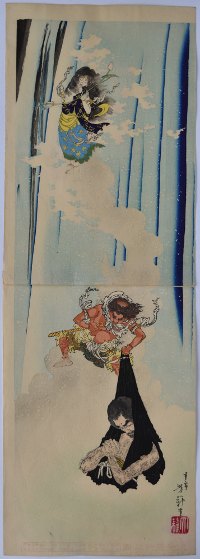
 Click here to view image full size. A vertical diptych: Mongaku shonin aragyo no zu. One of a series of 16 vertical diptychs published in the 1880s. Shows the priest Mongaku atoning for his sins in the icy waters of the Nachi waterfall but being saved just in time by Seitaka doji, one of the two main boy servants of the Buddhist guardian deity Fudo-myoo (shown above). Published by Matsui Eikichi, 1885.   Very fine impression. Fine colour. The first edition with the title printed in red at the bottom. On thick deluxe hosho. Slight bleeding of the red seal, otherwise fine condition with the extra paper at left and top. Signed Oju Yoshitoshi ga.   Status: Sold  

Taiso YOSHITOSHI (1839-1892)

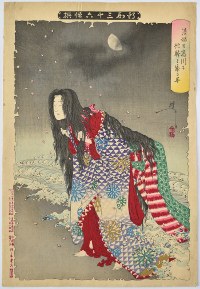
 Click here to view image full size. Kiyohime assumes a serpent form at Hidaka river as she continues her pursuit of the monk Anchin. From the set Shinkei sanjurokkaisen, “New Forms of Thirty-Six Ghosts.” The set published by Sasaki Toyokichi, 1889 and 1890.   Extremely fine impression of the first edition with three-colour cartouche. Fine colour and condition. Signed Yoshitoshi.   Status: Sold  

Taiso YOSHITOSHI (1839-1892)

 Click here to view image full size. A design showing Hojo Tokiyori in a snowy landscape from the set Dai Nippon meisho kagami, “Mirror of Famous Commanders of Great Japan.” He was Regent during the Kamakura period (1185-1333) but withdrew to the temple of Saimyoji and subsequently travelled around the country incognito to familiarize himself with the conditions of the populace. Published by Funazu Chujiro, 1878.   Fine impression with extensive burnishing. Fine colour. Light backing, otherwise very good condition. Signed Oju Yoshitoshi hitsu.   Status: Sold  

Taiso YOSHITOSHI (1839-1892)

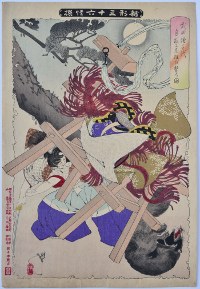
 Click here to view image full size. Takeda Katsuchiyo in his boyhood killing an old badger which had transformed itself into a wooden saddle-horse. From the set Shinkei sanjurokkaisen, “New Forms of Thirty-Six Ghosts.” The set published by Sasaki Toyokichi, 1889 and 1890.   Very fine impression of the first edition with three-colour cartouche. Fine colour. Very good condition. Signed Yoshitoshi.   Status: Sold  

Taiso YOSHITOSHI (1839-1892)

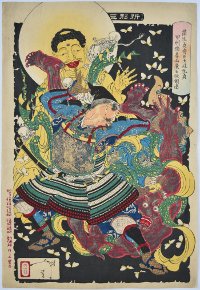
 Click here to view image full size. Toki Motosada, the retainer of Gamo Sadahide, throwing a red temple guardian to the ground and vanquishing the ghosts on Mount Inohana. From the set Shinkei sanjurokkaisen, “New Forms of Thirty-Six Ghosts.” The set published by Sasaki Toyokichi, 1889 – 1892 (this being 1890). This seems to be the same subject Yoshitoshi used for his set Wakan hyaku monogatari but the names are altered.   Very fine first edition, fine colour and condition. Signed Yoshitoshi.   Status: Sold  

Taiso YOSHITOSHI (1839-1892)

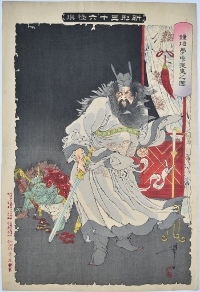
Click here to view image full size. Shoki appearing in the Chinese emperor Ming Huang’s dream and cleansing him of a fever demon. From the set Shinkei sanjurokkaisen, “New Forms of Thirty-Six Ghosts.” The set published by Sasaki Toyokichi, 1889 – 1892 (this being 1890).     Very fine first edition, fine colour and condition. Signed Yoshitoshi.     Status: Sold    

Taiso YOSHITOSHI (1839-1892)

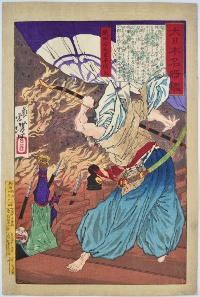
 Click here to view image full size. The famous daimyo Oda Nobunaga throwing an assailant over a terrace while the Honnoji Temple burns behind him. Nobunaga’s branch of the Oda clan held control of central Japan but he was eventually killed by his treacherous vassal Akechi Mitsuhide at this temple in 1582. From a set Dai Nippon meisho kagami, “Mirror of Famous Commanders of Great Japan.” The series of 51 prints published by Kumagai and Funazu Chujiro, c. 1876 – 82. The design here by the latter in 1878.   Fine impression, colour and condition. Signed Oju Yoshitoshi hitsu.   Status: Sold  

Taiso YOSHITOSHI (1839-1892)

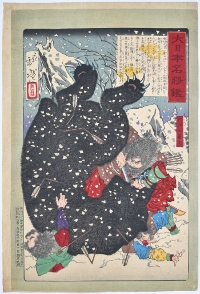
 Click here to view image full size. Abe no Hirafu (c. 575 – 674), a governor of Koshi Province, is famous for quelling the indigenous people of northern Japan – the Ainu. He is shown here killing a giant bear in the snow (of either northern Japan or Korea). From a set Dai Nippon meisho kagami, “Mirror of Famous Commanders of Great Japan.” The series of 51 prints published by Kumagai and Funazu Chujiro, c. 1876 – 82. The design here by the latter in 1880.   Fine impression, colour and condition. Signed Oju Yoshitoshi hitsu.   Status: Sold  

Taiso YOSHITOSHI (1839-1892)

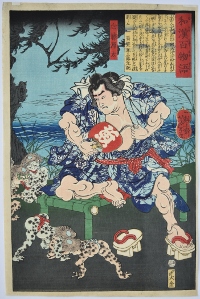
 Click here to view image full size. The famous wrestler Shirafuji Genta watching kappa (amphibious half humanoid, half turtle creatures). One of a set of 26 prints with title Wakan hyaku monogatari, “One Hundred Tales of China and Japan.” Published by Daikokuya Kinnosuke, 1865.   Fine impression, colour and condition. Signed Ikkaisai Yoshitoshi ga.   Status: Sold  

Taiso YOSHITOSHI (1839-1892)

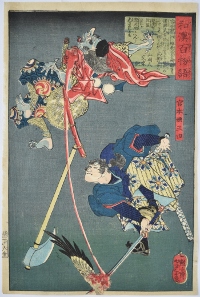
 Click here to view image full size. The famous swordsman Miyamoto Musashi cutting the arm off a tengu. He was taught the short sword technique from his father but then became expert with the long sword, eventually inventing the two-sword style, with the long sword in the right hand, the short in the left. One of a set of 26 prints with title Wakan hyaku monogatari, “One Hundred Tales of China and Japan.” Published by Daikokuya Kinnosuke, 1865.   Fine impression. Fine colour and condition. Signed Ikkaisai Yoshitoshi ga.   Status: Sold  

Taiso YOSHITOSHI (1839-1892)

 Click here to view image full size. Lord Mashiba Tairyo Hisayoshi defying the thunderstorm on Mount Kobo conjured up by Kobo Daishi. A retribution for ignoring the vow of silence on the mountain. One of a set of 26 prints with title Wakan hyaku monogatari, “One Hundred Tales of China and Japan.” Published by Daikokuya Kinnosuke, 1865.   Fine impression with burnishing and mica. Fine colour. Trimmed close on the right, otherwise very good condition. Signed Ikkaisai Yoshitoshi ga.   Status: Sold  

Taiso YOSHITOSHI (1839-1892)

 Click here to view image full size. Toki Daishiro, the retainer of Gamo Ujisato, vanquishing the demons in the temple on Mt. Inohana by grappling with the temple guardian. One of a set of 26 prints with title Wakan hyaku monogatari, “One Hundred Tales of China and Japan.” Published by Daikokuya Kinnosuke, 1865. This appears to be the same subject Yoshitoshi used in his set Shinkei sanjurokkaisen but with altered names.   Fine impression, colour and condition. Signed Ikkaisai Yoshitoshi ga.   Status: Sold