Kikukawa EIZAN (1787-1867)

Click here to view image full size.
An original painting by Eizan, sumi and full colour on silk, 37 x 13 in; 94 x 33 cms. Eizan was the leading exponent of bijinga in the early 1800s. He founded the Kikukawa School with Eisen his best known pupil. He was left-handed which was somewhat unusual. Shows a standing geisha, her shamisen case at her feet. This musical instrument was frequently associated with the world of courtesans.
Very minor marks, otherwise very good condition. Signed Kikukawa Eizan with seals Kikukawa Toshinobu.
Status: Available
Price: £12,000

Click here to view image full size.
Matsumura GOSHUN (1752-1811)

Click here to view image full size.
An original painting, sumi and light colour on silk, 49 x 22 in; 124.5 x 56 cms. Shows a mountainous landscape in snow with figures on a narrow footpath between overhanging cliffs. Goshun was a highly influential artist, known for his geniality and mastery, not only of painting, but of poetry and calligraphy. A pupil of Yosa Buson and then much influenced by Okyo. Founded the Shijo School (named after the street on which he lived in Kyoto). His mature style dates from around 1795.
A large and excellent example of his work in very good condition. Signed Goshun utsusu with seal Goshun.
Status: Available
Price: £6,800

Click here to view image full size.
Maekawa SENPAN (1888-1960); Okamoto IPPEI (1886-1948); Kondo KOICHIRO (1884-1962) et al
Click here to view image full size.
A set of two handscrolls in original paulownia storage box, 30 feet x 10 in; 914.4 x 25.4 cms. Sumi and full colour on paper by 18 artists of the Tokyo Manga Association, produced in 1921: 27 paintings in scroll 1; 28 paintings in scroll 2. The scrolls are a modern manga rendering of the Tokaido Road in homage to Hiroshige, the artists following and interpreting the same route that Hiroshige walked. Satirical and comedic showing the modernisation of Japan at a time manga was gaining popularity due to publications like the Jiji Manga newspaper supplement, previously known as the Ponchi, “Punch.” 150 sets were produced (although some sources give as many as 250-300 being made). No two sets are exactly the same ; indeed, some artists changed their designs substantially. Tokaido gojusan-tsugi Manga emaki, “Manga Handscrolls of the Fifty-three Stations of the Tokaido Highway.” Inside lid inscription: Tokaido emaki, dojin juhachi mei hitsu, “Tokaido handscrolls, painted by eighteen members.” Tokyo Chuo Bijutsukai dated Taisho 10 (1921).
A fascinating historical document. Some slight separation in the scrolls, but otherwise in very good condition. Various signatures and seals.
Status: Available
Price: £2,200
Eishosai CHOKI (Active c. 1781-1813)

Click here to view image full size.
A yellow ground aiban showing the high-ranking courtesan Hinazuru of the Chojiya House with her two kamuro Tsuruji and Tsuruno. Little is known of his life: Probably a pupil, together with Utamaro, of the artist Toriyama Sekien. His output was limited, leaving a small corpus of work, but some acknowledged masterpieces. Signed with two go: Choki, in the style of Kiyonaga, and Shiko in the style of Utamaro. Published by Murataya Jirobei (Eiyudo) c. 1795.
Fine impression. Very good colour. Centre fold only evident au verso, otherwise very good condition. Signed Choki ga.
Status: Available
Price: £3,800
Utagawa HIROSHIGE (1797-1858)

Click here to view image full size.
Station Ishiyakushi from Tokaido gojusan-tsugi no uchi, “Fifty-three Stations of the Tokaido.” This seminal work was possible because Hiroshige was asked to accompany an official procession along the Tokaido Road from Edo to Kyoto in 1832, and he made numerous sketches to document the journey. An evening scene in late autumn showing the village with the Ishiyakushi-ji (temple) on the left. This housed a stone image of Yakushi Nyurai, the Buddha of medicine. Pilgrims came in the hope of being healed, but they seldom stayed preferring to move on to Shono, the next station, which was only 3 km away. Because of the sets popularity, it was reprinted many times and there are a plethora of late impressions. Early printings are hard to find. Published by Hoeido (Takenouchi Magohachi) and Tsuruya Kiemon (Senkakudo) 1833-34.
Fine, early impression. Beautiful blue bokashi on the distant Suzuka Mountains: Late impressions often have crude wiping of this block. Fine colur and condition. Signed Hiroshige ga.
Status: Available
Price: £5,800
Utagawa HIROSHIGE (1797-1858)

Click here to view image full size.
Ushiwakamaru (Yoshitsune) defeats the priest Tankai of Shirakawa at the Gojo Shrine under a full moon. Hachikai, Gojo no Yashiro ni Ushiwakamaru Shirakawa no Tankai o uchitori from the set Yoshitsune ichidaiki no uchi, “The Life of Yoshitsune.” Published by Tsuruya Kiemon (Senkakudo) 1832-34.
Fine impression and colour. Very good condition. Signed Hiroshige ga.
Status: Available
Price: £950
Katsukawa SHUNSHO (1726-1792)

Click here to view image full size.
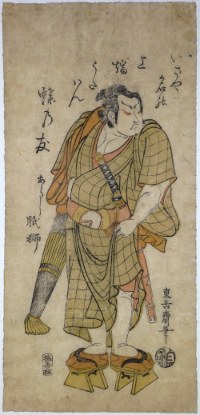
Two sumo wrestlers from the East Side: Kurateyama Yadayu (right) and Izumigawa Rin’emon (left) from a fine set of double portraits: 5 from the West Side, 6 from the East Side. No publisher’s seal but probably published by Toyoshimaya Bunjiemon (Bunkindo) c. mid 1780s.
Fine impression. Very good colour and condition. Signed Shunsho ga.
Status: Available
Price: £6,800
Utagawa HIROSHIGE (1797-1858)

Click here to view image full size.
The Yoro Waterfall. Mino, Yoro no taki, “Mino [Province], Yoro Waterfall” from Rokujuyoshu meisho zue, “Famous Views of the Sixty-odd Provinces.” The 32 meters fall cascades down from Mount Tado. Legend has it that the water had rejuvenating properties with the Empress Gensho (A.D. 683-748) having visited and likening the taste to that of sake. A cider, Yoro Sanroku, is produced here. Published by Koshimuraya Heisuke (Kohei), 1853-56, this being 1853. Numerous states exist of this design with colour variations and differences in gradation. Primarily the colouring of the fall changes: Some impressions have the waterfall completely blue, which obscures the blind-printing, while others, as here, have edge gradation only.
Very good impression with blind-printing on the waterfall. Fine colour. Very good condition. Signed Hiroshige ga.
Status: Available
Price: £4,800
Utagawa HIROSHIGE (1797-1858)

Click here to view image full size.
Station Numazu from a set Tokaido gojusan tsugi, “The Fifty-three Stations of the Tokaido Road,” aka the Reisho Tokaido from the clerical script used in the title, or the Marusei Tokaido after the publisher Maruya Seijiro (Marusei) who published the set 1847-52. An impressive view of Mount Fuji seen from the plains of Suruga. The village of Numazu is seen on the right amongst the trees.
Very fine impression. Fine colour and condition. Signed Hiroshige ga.
Status: Available
Price: £1,500
Utagawa HIROSHIGE (1797-1858)

Click here to view image full size.
Station Hara from a set Tokaido gojusan tsugi, “The Fifty-three Stations of the Tokaido Road,” aka the Reisho Tokaido from the clerical script used in the title, or the Marusei Tokaido after the publisher Maruya Seijiro (Marusei) who published the set 1847-52. A huge Mount Fuji towers over the landscape emphasized by the diminutive travellers in the foreground.
Very fine impression. Fine colour and condition. Signed Hiroshige ga.
Status: Available
Price: £1,900
Utagawa HIROSHIGE (1797-1858)

Click here to view image full size.
Station Okitsu from a set Tokaido gojusan tsugi, “The Fifty-three Stations of the Tokaido Road,” aka the Reisho Tokaido from the clerical script used in the title, or the Marusei Tokaido after the publisher Maruya Seijiro (Marusei) who published the set 1847-52. The Kiyomi Barrier and Seiken Temple near Okitsu.
Very fine impression. Fine colour and condition. Signed Hiroshige ga.
Status: Available
Price: £1,800
Utagawa HIROSHIGE (1797-1858)

Click here to view image full size.
Station Fuchu from a set Tokaido gojusan tsugi, “The Fifty-three Stations of the Tokaido Road,” aka the Reisho Tokaido from the clerical script used in the title, or the Marusei Tokaido after the publisher Maruya Seijiro (Marusei) who published the set 1847-52. A night scene with travellers arriving at an inn. This was the largest post town on the Tokaido and served as the castle town for Sumpu Castle, the seat of the Tokugawa clan.
Very fine impression. Fine colour and condition. Signed Hiroshige ga.
Status: Available
Price: £2,000
Utagawa HIROSHIGE (1797-1858)

Click here to view image full size.
Station Ejiri from a set Tokaido gojusan tsugi, “The Fifty-three Stations of the Tokaido Road,” aka the Reisho Tokaido from the clerical script used in the title, or the Marusei Tokaido after the publisher Maruya Seijiro (Marusei) who published the set 1847-52. Located on the west side of Suruga Bay, close to the famous beauty spot of Miho no Matsubara.
Very fine impression. Fine colour and condition. Signed Hiroshige ga.
Status: Available
Price: £1,500
Utagawa HIROSHIGE (1797-1858)

Click here to view image full size.
Station Kanbara from a set Tokaido gojusan tsugi, “The Fifty-three Stations of the Tokaido Road,” aka the Reisho Tokaido from the clerical script used in the title, or the Marusei Tokaido after the publisher Maruya Seijiro (Marusei) who published the set 1847-52. Kanbara, Fujikawa funawatashi, “Kanbara, Ferryboat on the Fuji River.”
Very fine impression. Fine colour and condition. Signed Hiroshige ga.
Status: Available
Price: £1,800
Tsukioka YOSHITOSHI (1839-1892)

Click here to view image full size.
A silhouetted fireman faces a conflagration; in his left hand he holds a matori, a three-dimensional standard which identifies him and his location. Enchu no tsuki, “Moon and Smoke” from Tsuki hyakushi, “One Hundred Aspects of the Moon.” Published by Akiyama Buemon (Akiyama Seikichi) 1885-1892, this being 1886. The firemen’s heavily-quilted jackets were soaked in water to better enable them to withstand the heat. They were notorious for their rowdy behaviour and rivalrous nature leading to open hostility with other groups such as sumo wrestlers. Fires were a constant threat due to the building materials used, and firefighters were not above starting fires themselves in order to be the first on the scene (especially if they were in the construction business).
Fine impression, colour and condition. Signed Yoshitoshi. A gourd-shaped collector’s seal (unread) in the extreme left bottom which is found on other early impressions of this set.
Status: Available
Price: £2,400
Tsukioka YOSHITOSHI (1839-1892)

Click here to view image full size.
Shows Shima Sakon Tomoyuki at the battle of Sekigahara, October 21, 1600. Shima was a commander of Ishida no Mitsunari’s forces against Tokugawa Ieyasu and was shot by riflemen (although his body was not found). He is shown being hit by a hail of bullets, his juzo (rosary) swinging in the air. From a set Kaidai hyaku senso “Yoshitoshi’s Selection of One Hundred Warriors.” Sixty-five prints published by Ohashiya Yashichi (Odawaraya Yashichi) between 1868 and 1869, this being 1868. The text in the square cartouche in this set refers to prominent warriors in the internecine wars of the 16th century, but in fact the subjects are Shogitai soldiers (those that held out against the Imperial forces and were massacred at Ueno, 4/7/1868). An excellent set.
Fine impression, colour and condition. Signed Ikkaisai Yoshitoshi hitsu.
Status: Available
Price: £1,800
Utagawa KUNISADA (1786-1864)

Click here to view image full size.
The actor Ichikawa Ebizo V (Ichikawa Danjuro VII) in a Shibaraku scene as the warrior Usui Arataro Sadamitsu (Taira no Tadamichi) adopting the cross-eyed mie expression to show great emotion. From an untitled set of large-head portraits of actors, past and present, published by Ebisuya Shoshichi (Kinshodo) between 1860 and 1865, this being 1860. Kunisada, in his old age, planned this set to have 150 designs but only 72 were completed (with the help of Utagawa Yoshitora). Only the best materials and most experienced engravers and printers were employed, the cost being mitigated by the Mitani copper and iron merchant family.
Fine impression with heavy burnishing on the hair. Very slight fading, otherwise very good colour. Very good condition. Signed Toyokuni ga.
Status: Available
Price: £5,800
Utagawa KUNIYOSHI (1797-1861)

Click here to view image full size.
The warrior Eda Genzo Hirotsuna avoiding a hail of arrows during the defence of Minamoto Yoshitsuna’s palace at Horikawa, Kyoto in 1185. He was killed during the night attack. Horikawa seiran, “Clearing Weather at Horikawa” from the set Yobuhakkei, “Military Brilliance for the Eight Views.” Each of the eight prints has an association, either pictorially, thematically or by place with the famous Eight Views originating from China. Published by Enshuya Hikobei (Enhiko) 1852. Unidentified collector’s seal au verso.
Very fine impression, colour and condition. There are later states lacking the subtleties of the first printings. Signed Ichiyusai Kuniyoshi ga.
Status: Available
Price: £1,900
Keisai EISEN (1790-1848)

Click here to view image full size.
Jakko Nunobiki no taki, “The Hanging Cloth Waterfall at Jakko Shrine.” So-called because it falls in seven-tiers. The shrine is seen below the fall. From a set of five prints: It was probably intended to be a set of three prints but another two were added, possibly with the intention of going on to emulate Hokusai’s waterfall set. Nikkosan meisho no uchi, “Celebrated Views in the Nikko Mountains.” Published by Yamamotoya Heikichi (Eikyudo) c. 1843-47. In contrast to Hokusai’s set, Eisen’s have a more muscular appearance. See: The Japanese Print: A New Approach, J. Hillier, Bell & Son, 1960, Chapter XVI, where Jack Hillier discusses Eisen and his landscapes and considers this set “… is perhaps the crowning achievement of his career as a designer of landscape prints.”
Fine impression. (Late impressions are not known of this set, probably due to not having the popularity of Hokusai’s set.) Slight fading, otherwise very good colour. Very good condition. Signed Keisai Eisen utsusu.
Status: Available
Price: £6,800
Keisai EISEN (1790-1848)

Click here to view image full size.
The Kirifuri waterfall, Kirifuri no taki, santaki no sono ikkei, “The Falling Mist Waterfall, View of One of the Three Falls.” From a set Nikkosan meisho no uchi, “Celebrated Views in the Nikko Mountains.” A group of travellers admire the fall from below. From a set of five prints: It was probably intended to be a set of three prints but another two were added, possibly with the intention of going on to emulate Hokusai’s waterfall set. Published by Yamamotoya Heikichi (Eikyudo) c. 1843-47. In contrast to Hokusai’s set, Eisen’s have a more muscular appearance. See: The Japanese Print: A New Approach, J. Hillier, Bell & Son, 1960, Chapter XVI, where Jack Hillier discusses Eisen and his landscapes and considers this set “… is perhaps the crowning achievement of his career as a designer of landscape prints.”
Fine impression. (Late impressions are not known of this set, probably due to not having the popularity of Hokusai’s set.) Very good colour and condition. Signed Keisai Eisen utsusu.
Status: Available
Price: £9,000
Keisai EISEN (1790-1848)

Click here to view image full size.
Kegon no taki, santaki no sono ikkei, “ The Kegon Waterfall, View of One of the Three Falls.” From a set Nikkosan meisho no uchi, “Celebrated Views in the Nikko Mountains.” Three travellers rather precariously perched on a ledge looking down at the fall. From a set of five prints: It was probably intended to be a set of three prints but another two were added, possibly with the intention of going on to emulate Hokusai’s waterfall set. Published by Yamamotoya Heikichi (Eikyudo) c. 1843-47. In contrast to Hokusai’s set, Eisen’s have a more muscular appearance. See: The Japanese Print: A New Approach, J. Hillier, Bell & Son, 1960, Chapter XVI, where Jack Hillier discusses Eisen and his landscapes and considers this set “… is perhaps the crowning achievement of his career as a designer of landscape prints.”
Fine impression. (Late impressions are not known of this set, probably due to not having the popularity of Hokusai’s set.) Fine impression. Very good colour. Slight edge soil, otherwise very good condition. Signed Keisai Eisen utsusu.
Status: Available
Price: £7,200
Kitagawa UTAMARO (1753-1806)

Click here to view image full size.
A pillar print showing the courtesan Ariwara and her young attendant Arishige (below), both of the Tsuruya House. Utamaro’s output of hashira-e was not as great as some other artists, and they are especially difficult to find in good condition because of often being hung on pillars and in alcoves where they were subject to fading and toning. Another trimmed and somewhat faded impression is in the B.M. 1907, 0531, 0. 474. Published by Matsuyasu , c. 1803.
Fine impression. An area of slight fading of purple at centre, otherwise extremely well retained colour. Very good condition. Signed Utamaro hitsu.
Status: Available
Price: £8,000
Tsukioka YOSHITOSHI (1839-1892)

Click here to view image full size.
A triptych showing horse racing in Tokyo. Tokyo Shokonsha [the original name of the Yasukuni Shrine] naigaijin keiba no zu, “Horse Racing for Foreigners and Japanese in Shokonsha Tokyo.” From Tokyo kaika kyoga meisho, “Comic Pictures of Civilised Tokyo.” Published by Maruya Jinpachi (Marujin) 1871. The first Western-style horse racing was established by – mainly British – residents in the form of the Yokohama Race Club in 1862.
Fine impression: Later states lack the wood-pattern background on the title panel. Fine colour and condition. Signed Oju Keisai Yoshitoshi.
Status: Available
Price: £2,200
Utagawa YOSHITSUYA (1822-1866)

Click here to view image full size.
A triptych Uto Yasukata chugi den, “The Tale of Faithful Uto Yasukata.” Shows Shogun Taro Taira no Yoshikado (centre); Princess Takiyasha right); and Uto Yasukata and his wife (far left) turning into birds. Set in the ruins of Soma Palace. Takiyasha releases a ghost from a cauldron. A difficult triptych to interpret. (More information is available on the Lyon collection website: woodblockprints.org.) Published by Tsujiokaya Bunsuke (Tsujibun) 1852-53.
Fine impression and colour. Small edge binding holes on centre sheet, otherwise very good condition. Signed Ichieisai Yoshitsuya ga.
Status: Available
Price: £3,000
Utagawa YOSHIFUSA (Act. 1837-1860)

Click here to view image full size.
A triptych showing the vengeful spirit of Akugenta Yoshihira in a giant ball of fire sending a lightning bolt down on Nanba Jiro. Retaliation for having been defeated and beheaded during the Heiji rebellion. (There are other explanations for Yoshihira’s revenge, but this is the most common.) The revenge takes place at the Nunobiki Waterfall near Kobe. The scene watched by Taira no Kiyomori. Published by Omiya Kyujiro (Kinkyu) 1856.
Fine impression. Very good colour although extensive oxidation. Edge crease on centre panel, otherwise very good condition. Signed Ipposai Yoshifusa Ga.
Status: Available
Price: £3,800
Utagawa KUNIYOSHI (1797-1861)

Click here to view image full size.
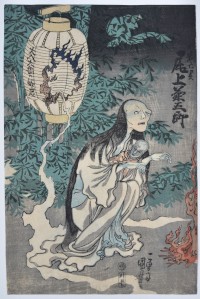
The actor Onoye Kikugoro III as the ghost of Oiwa from a production of Yotsuya kaidan at the Morita Theatre, 1836. Probably the most famous Japanese ghost story. It was adapted by the playwright Tsuruya Nanboku IV for his friend Kikugoro in 1825. The left panel of a diptych (the right panel being boring and usually ignored). A scene on Snake Mountain showing Oiwa, disfigured by poison, emerging from a burning lantern to haunt her husband, Tamiya Lemon, who had murdered her father. Published by Kawaguchi-ya Chozo, 1836.
Very good impression, colour and condition. Signed Ichiyusai Kuniyoshi ga.
Status: Available
Price: £1,350
Tsukioka YOSHITOSHI (1839-1892)

Click here to view image full size.
Looking Itchy: the appearance of a kept woman of the Kaei era [1848-1854]. Shows a beauty emerging from a mosquito net that has apparently not been entirely successful. From a set Thirty-two Aspects of Women published by Tsunashima Kamekichi, 1888. The set depicts women of different backgrounds and occupations from the Kansei era through to the Meiji era with punning allusions to their situation or mood.
Very fine impression with strong blind-printing on the fall. Fine colour and condition. Full size. Signed Hiroshige ga.
Status: Available
Price: £2,800
Utagawa KUNIYOSHI (1797-1861)

Click here to view image full size.
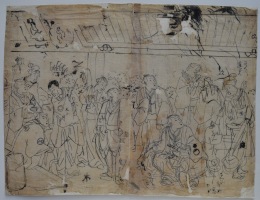
A large original drawing, sumi on thin paper, 15 x 20 in; 38 x 51 cms. Shows a large group of actors in front of a theatre. Most likely two sheets for an intended triptych. There appears to be the publisher’s seal Kiya Sojuro brushed-in at the bottom who was active c 1851-1904. Provenance: Ex collection Dr. Julius Kurth (1870-1949), an eminent scholar who wrote extensively on Japanese and Chinese art. Sold “as is” with all imperfections.
Status: Available
Price: £1,400
Nagasawa ROSETSU (1754-1799)

Click here to view image full size.
An original fan painting, sumi on treated paper, 17 x 6.25 in; 43 x 16 cms. Shows two needlefish (family Belonidae).Rosetsu is considered one of the most important artists of the late Edo period but little is known of his short life – he died at forty-five, apart from the fact that he studied and was one of the top disciples of Maruyama Okyo. He is labelled an “eccentric” painter as he defies easy classification. His brushwork is a tour de force and he is known for his expressive depictions of animals. Signed Rosetsu with his Gyo (fish) seal. Framed and glazed with the fan mounted onto Japanese paper. Good condition, apart from the obvious fan folds.
Status: Available
ANONYMOUS (Late 18th century)
Click here to view image full size.
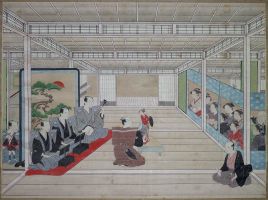
An Uki-e, “floating picture” painting showing an interior with a puppet performance taking place. A puppeteer manipulates a female puppet in the centre, behind him two gidayu narrators and a shamisen player. A male puppet is being held behind a screen. Ladies behind a screen at right enjoy the drama. In fact, a male individual at the back seems overcome by emotion with a hanky to his face. The architecture is represented using one-point perspective, a style which made its way to Japan in the 1740’s from the West via China. (Interestingly the artist has got the perspective wrong on the screen at right.) This genre of painting – invariably unsigned – always shows interior or semi-interior views with banquets or, as here, puppet performances. Full colour on paper, 17 x 23 in; 43.2 x 58.5 cms. Minor marks, although good condition for this kind of painting.
Status: Available
Price: £1,900

Click here to view image full size.
Ichiryusai HIROSHIGE (1797-1858)
Click here to view image full size.
An uncut fan print with title Shinkiro no zu which has a double meaning of being the Yoshiwara in the deep sea and also a chimera or mirage. The scene enclosed in a (dreaming ?) bivalve shows visitors in a watery Yoshiwara, all with fish heads. Of the utmost rarity: This appears to be the only impression known. There are also what appear to be keying marks on three sides that have not been removed. Published by Shinagawaya Kyusuke with censor seal for 1845.
Very fine impression. Fine colour and condition. Signed Hiroshige giga hitsu.
Status: Sold
Katsushika HOKUSAI (1760-1849)

Click here to view image full size.
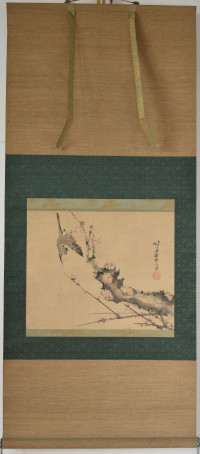
An original painting, light colour on paper, 13 x 16.5 in; 33 x 42 cms. Shows a sparrow flying over a flowering plum tree. Light soil and creasing, but in generally good condition. Signed Hokusai suichu hitsu, “Hokusai painted while drunk.” Sealed Katsushika. (One of his better-known seals. He used different versions of it throughout his career.)
Status: Sold

Click here to view image full size.
Ichiyusai HIROSHIGE II (1826-1869)

Click here to view image full size.
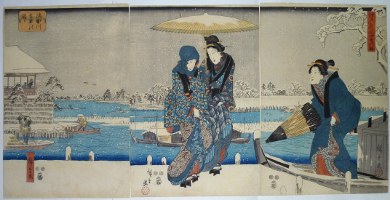
Suo Iwakuni Kintaibashi, “The Bridge of the Brocade Sash at Iwakuni in Suo Province.” From an uncompleted set: Shokoku meisho hyakkei, “One Hundred Views of the Provinces.” Published by Uoei between 1859 – 1861 (this being 1859). Shows the beautiful five-arch bridge spanning the Nishiki-gawa under heavy snow. The village of Nishikimi in the foreground. The bridge was built in 1673 using massive stone pilings because earlier bridges had been swept away. It was destroyed in 1950 due to a typhoon but rebuilt in 1953. The best print from the set and probably Hiroshige IIs finest design.
Fine impression of the first edition with mica applied. Fine colour. Minor edge discolouration, otherwise very good condition. Later editions lack the variegated cartouche and the colour-banded publisher’s seal in left margin. Signed Hiroshige ga.
Status: Sold
Utagawa HIROSHIGE (1797-1858)

Click here to view image full size.
Musashi, Sumidagawa, yuki no ashita, “Musashi [Province], Sumida River, Morning after Snow.” From a set of 69 prints [Dai Nihon] Rokujuyoshi meisho zue, “Famous Places in the Sixty-odd Provinces [of Japan]” published by b Koshimuraya Heisuke between 1853 and 1856, this being 1853.
Very fine impression and colour. Light album backing, otherwise fine condition. Signed Hiroshige ga.
Status: Sold
Ichiryusai HIROSHIGE (1797-1858)
Click here to view image full size.
An extremely rare chu-tanzaku, Fuyu Sumidagawa no yuki, “Winter Snow on the Sumida River.” From a set Shiki Edo meisho, “Famous Places in Edo in the Four Seasons.” A lone figure in straw cape and large hat poles a log raft down the Sumida river in heavy snow. Published by Kawasho c. 1834. There are a number of states of this design known: As here (probably the earliest) with publisher’s seal and kiwame seal; with kiwame only; and without either. There are also extremely deceiving copies of this print. Provenance: Ex Le Veel collection, sold by Ader Picard Tajan, Paris, 2nd sale, 24/10/1980, lot 114, p. 50.
Very good impression, colour and condition. Signed Hiroshige ga.
Status: Sold
Tsukioka YOSHITOSHI (1839-1892)

Click here to view image full size.
The warrior Jingu Samanosuke Masanaga holding a sword and wearing a mino (straw cape) in heavy rain. From a set Kaidai hyaku, “Yoshitoshi’s Selection of One Hundred Warriors.” Sixty-five prints published by Ohashiya Yashichi between 1868 and 1869, this being 1869. The text in the square cartouches in this set refer to prominent warriors in the internecine wars of the 16th century but in fact the subjects are Shogitai soldiers. (Those that held out against the imperial forces and were massacred at Ueno, 4/7/1868.) An excellent set.
Fine impression and colour. The rain printed in silver. Fine condition. Signed Ikkaisai Yoshitoshi htsu.
Status: Sold
Utagawa KUNIYOSHI (1797-1861)
Click here to view image full size.
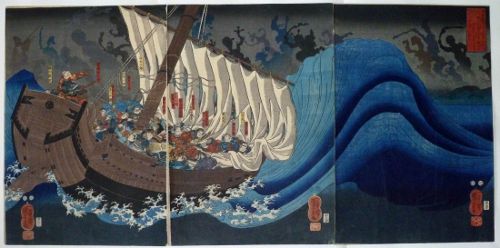
A triptych showing the ghosts of the Taira (Heike) warriors attempting to sink Yoshitsune’s ship off the coast of Settsu on his way to Shikoku. This is one of Kuniyoshi’s great designs – amongst the three or four best triptychs and is illustrated in numerous publications. The scene is the outcome of a great battle at Dan-no-ura where the Minamoto (Genji) clans clashed and defeated the Taira clans a few years earlier. The spirits of the drowned warriors rose up to seek revenge only to be pacified by Benkei reciting exorcisms with his rosary. Published 1849-52 by Enshuya Hikobei. Robinson T242. Rare.
Very good impression and colour although slightly mismatched blue on the first and second sheets. Very good condition. Full size. There appear to be three states of this design: The main difference being in the shape of the ghosts and lines in the waves only on the first state. In this (the second state) the ghosts lack some of the features that are on the first and a large spirit appears above the wave over the ship on the centre panel. The third state has further differences in the ghosts and lacks this figure. Also, the colour of the boat gets greyer. Signed Ichiyusai Kuniyoshi ga.
Status: Sold
Yurakusai NAGAHIDE (c 1799-1848)

Click here to view image full size.
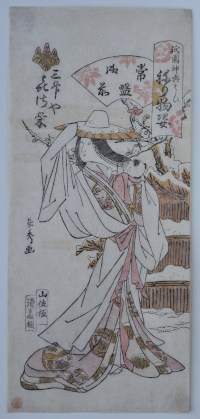
An hosoban kappazuri (coloured by stencils) print from a set: Gion mikoshi arai nerimono sugata, “Gion Festival Costume Parade.” The set was jointly designed by: Goshichi, Seikoku (Charakusai) and Toyokuni, as well as Nagahide, although he appears to have been responsible for many in the set. A large group is in the MFA, Boston, with another impression of this design being acc. no 11.26554. Published by Yamashiroya Sahei (Yamasa) c 1818. Shows a courtesan, Kisae of Mimasuya, parading in the Gion Matsuri Festival, held in the geisha quarter of Kyoto in July, dressed as Tokiwa Gozen, the mother of Minamoto no Yoshitsune. She is usually depicted fleeing through the snow during the Heiji rebellion cradling her son to her chest. Seal bottom left Kato [Shozo] who was an art dealer/collector in Oxford Street, London and sold prints to the BM in the 1920s.
Very good impression with extensive undamaged mica. Very good colour. Signs of mounting au verso, otherwise very good condition. Signed Nagahide ga.
Status: Sold
Katsushika HOKUSAI (1760-1849)

Click here to view image full size.
An original drawing, sumi on thin paper, 14.5 x 10.5 in; 37 x 27 cms, laid onto Japanese card. Shows a standing warrior with his sword drawn: A common subject in Hokusai’s oeuvre.
In very good condition.
Status: Sold
Utagawa KUNIYOSHI (1797-1861)
Click here to view image full size.
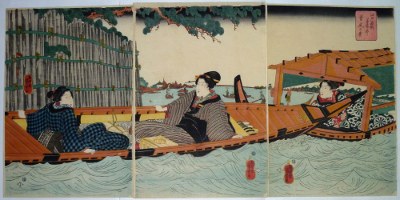
A complete triptych showing beauties in boats on the Sumida River. Shubi no matsu, “Successful-deal Pine Tree” from a set Edo meisho somoku-zukushi, “Notable Sights Famous for Grass and Trees in Edo.” This famous pine was blown down during the An’ei era (1772-1780); its successor died during the Ansei era (1854-1859); the third died at the end of the Meiji era (c 1910). There is also the Hiroshige view of this subject from the 100 Views of Edo. Published by Ebiya Rinnosuke (Kaijudo), 1845.
Very good impression. Fine colour and condition. Full size. Another state has darker water and variegated cartouche. Signed Cho-o-ro Kuniyoshi ga.
Status: Sold