Search Results for YOSHITOSHI 1839

Taiso YOSHITOSHI (1839-1892)

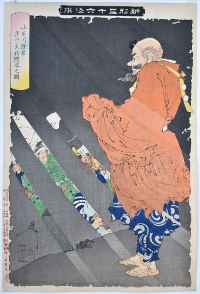
Click here to view image full size. Kobayakawa Takakage debating with the tengu on mount Hiko from Shinkei sanjurokkaisen, “New Forms of Thirty-six Ghosts.”The set published by Sasaki Toyokichi, 1889-1892 (this being 1892).    Very fine first edition. Fine colour and condition. Signed Yoshitoshi.    Status: Sold

Tsukioka YOSHITOSHI (1839-1892)

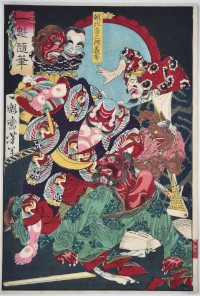
Click here to view image full size. Shows Asahina Saburo Yoshihide, the fabled warrior of superhuman strength, subjugating the King of Hell, Ema-o. He forces him to indicate the path to Heaven. This episode is from the kabuki play Asahina. From the set Ikkai zuihitsu, “Essays by Yoshitoshi.” (Ikkai was an early name of Yoshitoshi’s.) A set of thirteen prints published by Masadaya Heikichi 1872 A fine set.   Extremely fine impression and colour from the first edition. Most designs from the set have red seals in the margin and red seals over the signature. These were removed on later editions. Margins trimmed a little, otherwise fine condition. Signed Ikkaisai Yoshitoshi hitsu.   Status: Sold  

Tsukioka YOSHITOSHI (1839-1892)

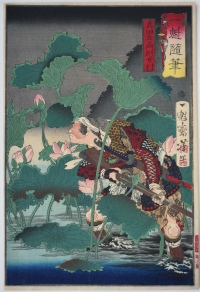
Click here to view image full size. Shows the famed warrior Sanada Saemon-no-jo Yukimura (in fact Nobushige) crouching down amongst giant lotus plants, holding a rifle, in order to ambush Tokugawa Ieyasu during the siege of Osaka castle. Initially, Yukimura was a follower of Ieyasu but was betrayed by having his land seized and so switched sides. He won many battles in which his army was outnumbered. From the set Ikkai zuihitsu, “Essays by Yoshitoshi.” (Ikkai was an early name of Yoshitoshi’s.) A set of thirteen prints published by Masadaya Heikichi 1872 A fine set.   Extremely fine impression and colour from the first edition. Most designs from the set have red seals in the margin and red seals over the signature. These were removed on later editions. Margins trimmed a little, otherwise fine condition. Signed Ikkaisai Yoshitoshi hitsu.   Status: Sold  

Tsukioka YOSHITOSHI (1839-1892)

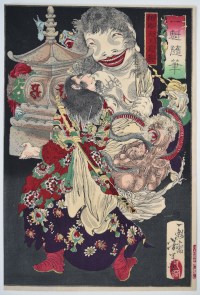
Click here to view image full size. Shows Chao Gai (Jap. Takuto Tenno Chogai), the Heavenly King and Suikoden hero, lifting a stone pagoda which releases a Pandora’s box of gruesome spirits: An enormous white figure with a face on its abdomen, various oni and a brown spirit, its chest holding a twisting snake. From the set Ikkai zuihitsu, “Essays by Yoshitoshi.” (Ikkai was an early name of Yoshitoshi’s.) A set of thirteen prints published by Masadaya Heikichi 1872 A fine set.   Extremely fine impression and colour from the first edition. Most designs from the set have red seals in the margin and red seals over the signature. These were removed on later editions. Trimmed on black border at left, otherwise fine condition. Signed Ikkaisai Yoshitoshi hitsu.   Status: Sold  

Tsukioka YOSHITOSHI (1839-1892)

Click here to view image full size. “Flood” from a series Seiu kandankei, “A Barometer of Emotions.” Shows Nakamura Shikan III as Abe Bungo no Kami riding his horse through waves. Published by Okura Magobei 1876-77 (this being 1876). A rare set with some striking designs comparing actors in theatrical roles with meteorological phenomena. Fine impression and colour. Slight trimming, otherwise fine condition. Signed Oju Yoshitoshi hitsu.     Status: Sold

Tsukioka YOSHITOSHI (1839-1892)

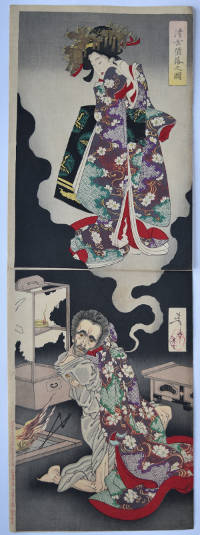
Click here to view image full size. A vertical diptych Seigen daraku no zu showing the priest Seigen of the Kiyomizudera Temple in Kyoto and the beautiful Sakura-hime (Princess Sakura). Several versions of the story exist. In one, Sakura-hime is Seigen’s long-deceased lover reincarnated as a young priest called Shiragiku. In another, Shiragiku is the dead lover reborn as Sakura-hime. The main thrust of the tale is that Seigen’s lust gets the better of him resulting in his removal from the temple. It was the basis of the play Sakura Hime azuma bunsho premiered 3 This is the rare first state of the first edition published by Matsui Eikichi, 1889. It was republished by Hasegawa Tsunejiro in 1889 with the publisher and date in left border and on most impressions a seal at top left reading “Reproduction not allowed.”     Very fine impression with hand-applied colour to the eyes, teeth and nails with gum overlay to eyes on Seigen. Fine colour. Minor edge wear to right, otherwise fine condition. Ample room for joining. Signed Yoshitoshi.     Status: Sold

Tsukioka YOSHITOSHI (1839-1892)

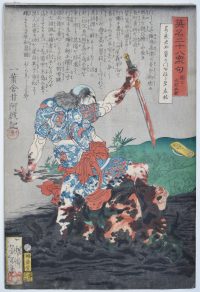
Click here to view image full size. A heavily tattooed fishmonger, Danshichi Kurobei, slaughtering his father-in-law, Mikawaya Giheiji, in a swamp. From a set Eimei nijuhasshuku, “Twenty-eight Famous Murders with Verse.” A series produced with Yoshiiku, each designing 14 prints. Published by Kinseido between 1866 and 1869, this being 1866. The story relates how Kurobei is instrumental in the release of the mistress of Lord Tamashimas’s son who was kidnapped by Giheiji. Outraged because he had previously supported Kurobei’s wife and child while he was in prison, he demands payment. The fight ensues. Very good impression and colour. Light album backing, otherwise good condition. Signed Ikkaisai Yoshitoshi hitsu. Status: Sold

Tsukioka YOSHITOSHI (1839-1892)

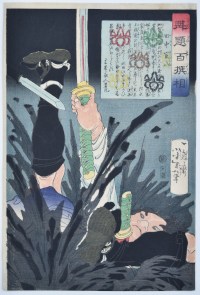
Click here to view image full size. Tanaka Kanhachi falling backwards into a sea of mud from a set Kaidai hyaku, “Yoshitoshi’s Selection of One Hundred Warriors.” Sixty-five prints published by Ohashiya Yashichi between 1868 and 1869, this being 1869. The text in the square cartouches in this set refer to prominent warriors in the internecine wars of the 16th century but in fact the subjects are Shogitai soldiers. (Those that held out against the imperial forces and were massacred at Ueno, 4) A wonderful design from this excellent set. Fine impression, colour and condition. Signed Ikkaisai Yoshitoshi htsu. Status: Sold

Tsukioka YOSHITOSHI (1839-1892)

Click here to view image full size. The boy warrior Sakai Kuzo hurling a te-yari spear from a set Kaidai hyaku, “Yoshitoshi’s Selection of One Hundred Warriors.” Sixty-five prints published by Ohashiya Yashichi between 1868 and 1869, this being 1868. The text in the square cartouches in this set refer to prominent warriors in the internecine wars of the 16th century but in fact the subjects are Shogitai soldiers. (Those that held out against the imperial forces and were massacred at Ueno, 4) A wonderful design from this excellent set. Fine impression, colour and condition. Signed Ikkaisai Yoshitoshi htsu. Status: Sold

Tsukioka YOSHITOSHI (1839-1892)

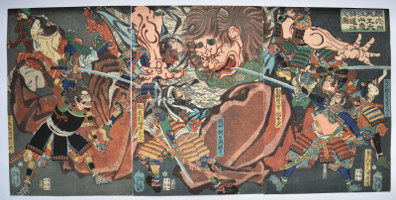
A triptych showing Raiko and his four companions conquering the demon of Oe Mountain. Raiko shitenno Oeyama kijin taiji. The story relates how the demon (Shuten-doji) kidnappes young girls and keeps them captive in his lair on Mt. Oe near Kyoto. The great warrior Minamoto no Yorimitsu (Raiko) and four retainers seek out the demon. They inebriate him and cut off his head. However, the beast’s head still takes a bite at Raiko who avoids death by wearing the additional helmets of his followers. Published by Kiya, 1864. An early and very fine design. Fine impression and colour with lovely partial oxidation. Slight trimming, otherwise very good condition. Signed Ikkaisai Yoshitoshi ga. Status: Sold

New Tsukioka YOSHITOSHI (1839-1892)

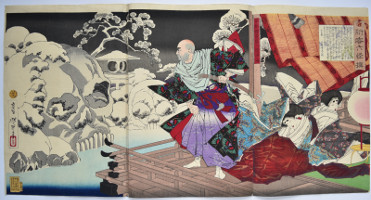
Click here to view image full size. A triptych , Shinyo rokkaisen, “Six New Monsters” showing Taira no Kiyomori (1118-1181) and his lover on the engawa of the palace confronted by a multitude of snow covered skulls and skeletons in the garden. Towards the end of his life, Kiyomori, the head of the Taira Clan, was obsessed with and hallucinated that his vanquished enemies – on his quest for power and authority – had come back for retribution. Published by Funazu, 1882.     Very fine impression. Fine colour. Sheets attached, otherwise fine condition. Signed Oju Yoshitoshi ga.     Status: Sold

Tsukioka YOSHITOSHI (1839-1892)

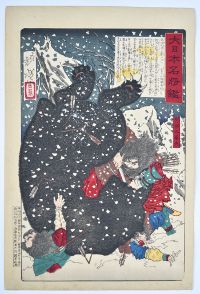
Click here to view image full size. Abe no Hirafu fighting a giant bear in the snow from a set of 51 prints Dai Nippon meisho kagami, “A Mirror of Famous Commanders of Great Japan.” The set was published by Ebisuya Shoshichi (the first 11 prints) and Funazu Chujiro between 1878-1882. Hirafu was a general for the Empress Saimei. On his return from a mission to the Emishi in northeastern Japan, where he signed a peace agreement , he presented the Empress with two live bears and seventy bear hides. Published by Funazu Chujiro in 1880.     Fine, early impression with splashed gofun (only on the earliest states). Fine colour. Light album backing, otherwise fine condition. Signed Oju Yoshitoshi hitsu.     Status: Sold    

Tsukioka YOSHITOSHI (1839-1892)

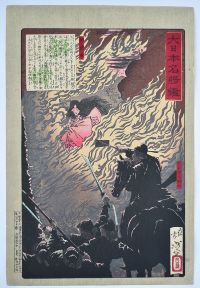
Click here to view image full size. Yatsunada attacking Saohime’s brother’s castle from a set of 51 prints Dai Nippon meisho kagami, “A Mirror of Famous Commanders of Great Japan.” The set was published by Ebisuya Shoshichi (the first 11 prints) and Funazu Chujiro between 1878-1882. Saohime had conspired with her elder brother Saohikoto to murder the emperor but she abandoned their plan at the last moment. She is seen escaping the conflagration. Published by Funazu Chujiro in 1880.     Fine, early impression. Fine colour. Light album backing, otherwise fine condition. Signed Oju Yoshitoshi hitsu.     Status: Sold    

Tsukioka YOSHITOSHI (1839-1892)

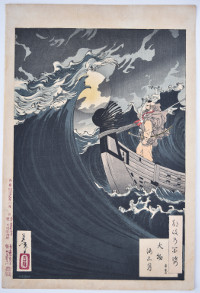
Click here to view image full size. The best design from the set Tsuki hyakushi, the “Hundred Phases of the Moon.” The set published between 1885 and 1892 (this being 1886) by Akiyama Buemon. Benkei against a full moon. In 1185 Yoshitsune, attacked by his half-brother Minamoto no Yoritomo, was forced to flee to northern Japan by ship. Sailing along the Inland Sea off the coast of Harima Province not far from Kyoto, the ship was struck by a storm in Daimotsu Bay caused by the vengeful ghosts of the Taira warriors Yoshitsune and his men had slain. Benkei pacified the spirits in the prow of the boat by holding up his string of prayer beads.     Fine impression. (A good guide to the quality of impression is to look at the outline of Benkei’s face: This fine line started to break down early on. The set was popular and many editions were printed and many late impressions exist. Great care was taken with the cutting of the blocks on this set and only early impressions do them justice. There should be subtle gradation in the sky and the title cartouche has hardly any colour.) Fine colour and condition. An impression that has not been in an album. Full margins. Signed Yoshitoshi.     Status: Sold

Tsukioka YOSHITOSHI (1839-1892)

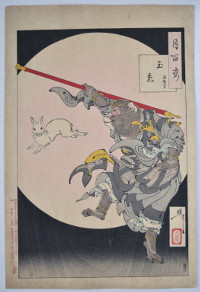
Click here to view image full size. The Monkey King: One of the best designs from the set Tsuki hyakushi, the “Hundred Phases of the Moon.” The set published between 1885 and 1892 (this being 1886) by Akiyama Buemon. Based on the Chinese fable, the Monkey King achieved immortality by stealing peaches from the Garden of Immortal Peaches. He is seen with his fighting stave and the Jade Hare that lived on the moon and was constantly pounding herbs for immortals.     Fine impression from a very early edition. The set was popular and many editions were printed and many late impressions exist. . Great care was taken with the cutting of the blocks on this set and only early impressions do them justice. Fine colour and condition. An impression that has not been in an album. Full margins. Signed Yoshitoshi.     Status: Sold

Tsukioka YOSHITOSHI (1839-1892)

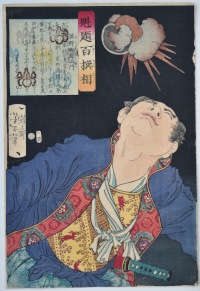
Click here to view image full size. The samurai Shigeno Yozaemon looking up at an exploding houroku-hiya “hand grenade.” (As with so much in Japan, the grenade originated in China from early times.) From a set Kaidai hyaku, “Yoshitoshi’s Selection of One Hundred Warriors.” Sixty-five prints published by Ohashiya Yashichi between 1868 and 1869, this being 1869. The text in the square cartouches in this set refer to prominent warriors in the internecine wars of the 16th century but in fact the subjects are Shogitai soldiers. (Those that held out against the imperial forces and were massacred at Ueno, 4) An excellent set.   Fine impression, colour and condition. Signed Ikkaisai Yoshitoshi htsu.   Status: Sold  

Tsukioka YOSHITOSHI (1839-1892)

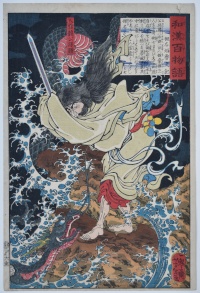
Click here to view image full size. Shows Kon Sosho (Chin. Gongsun Sheng), a famous character from the Chinese popular novel Tales of the Water Margin (Jap. Suikoden). A Taoist sorcerer known as “Dragon in the Clouds” he was able to conjure up wind and rain, as here, where he is seen standing on a rocky promontory summoning up the Storm Dragon from the sea. From the set Wakan hyaku monogatari, “One Hundred Ghost Stories of China and Japan,” published by Daikin, 1865.   Fine impression and colour. Small backed wormhole in top right corner and has original album backing, otherwise very good condition. Signed Ikkaisai Yoshitoshi ga.   Status: Sold  

Tsukioka YOSHITOSHI (1839-1892)

Click here to view image full size. A design from the set Azuma no nishiki ukiyo kodan, “Tales of the Floating World on Eastern Brocade.” Kodan (traditional storytelling) raconteurs narrated Japanese folk stories, sometimes accompanying themselves with wooden blocks clapped together or a fan giving rhythm. The Kodan text is shown above. Having been popular from around 1700 (and known as Koshaku), these performances gained renewed popularity in the 1850s with the classic standards augmented by contemporary stories of heroes and villains. Here, the wounded and blood-smeared chief of the Edo otokodate, Banzuin Chobei, is seen drinking water in a bathhouse where he is treacherously murdered by Mizuno Jurozaemon. Various publishers from 1867-68, here Sekiguchi Gyokumeido, 10 Fine impression. Very good colour. Slight trimming, otherwise very good condtion. Signed Ikkaisai Yoshitoshi hitsu. Status: Sold
Tsukioka YOSHITOSHI (1839-1892)

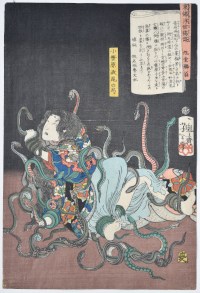
Click here to view image full size. A design from the set Azuma no nishiki ukiyo kodan, “Tales of the Floating World on Eastern Brocade.” Kodan (traditional storytelling) raconteurs narrated Japanese folk stories, sometimes accompanying themselves with wooden blocks clapped together or a fan giving rhythm. The Kodan text is shown above. Having been popular from around 1700 (and known as Koshaku), these performances gained renewed popularity in the 1850s with the classic standards augmented by contemporary stories of heroes and villains. Shows Lady Masao from Osasahara surrounded by curling snakes who force her to reveal her true identity – the Fox Spirit. Various publishers from 1867-68, here Omiya Kyojiro, 11     Fine impression. Very good colour. Slight trimming, otherwise very good condtion. Signed Ikkaisai Yoshitoshi hitsu.     Status: Sold
Taiso YOSHITOSHI (1839-1892)

Click here to view image full size. Shows Abe no Hirafu, a governor of Koshi, killing a giant bear in heavy snow. From a set: Dai Nippon meisho kagami, “Mirror of Famous Leaders of Great Japan.” Published by Funazu Chujiro, 1880.     Fine impression, colour and condition. Signed Oju Yoshitoshi hitsu.     Status: Sold    

Tsukioka YOSHITOSHI (1839-1892)

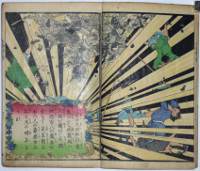
 Click here to view image full size. One volume Shuzo suiko meimei den, Shohen, “ Portraits of the Characters in the Suikoden, First Series.” Original embossed orange covers with yellow title slip. Inside front cover title and signature within a western-style surround. Preface 6 pp. including two double-page colour illustrations, last sheet dated Keio 3 ( 1867 ). And 18 numbered pages with 36 illustrations of Suikoden warriors on yellow grounds. Inside back cover advertisements. Published by Odawaraya Yashichi, Edo. In extremely good condition. Superb engraving ( by Egawa Ichigoro ). Presumably a response to the copper plate books and prints being circulated at the time. There is a two volume variant of this book printed in just sumi and blue. However, judging from the impressions in this one volume version with woodgrain showing and blind printing, this must be a very early printing.   Status: Sold    Click here to view image full size.  Click here to view image full size.  Click here to view image full size. here to view image full size. here to view image full size. here to view image full size.

Tsukioka YOSHITOSHI (1839-1892)

 Click here to view image full size. An original painting showing what is probably the most famous encounter in Japanese mythology: The scene is evening on Gojo Bridge in Kyoto where the twenty year old Benkei ambushes samurai to steal their swords. He is shown approaching the flute-playing Yoshitsune. A fight ensues which Yoshitsune wins due to his leaping ability taught to him by the mountain tengu. Yoshitsune pardons Benkei and they become loyal friends. This painting, in shades of sumi, beautifully evokes the crepuscular gloom. On silk, 7 x 9.5 in; 17.75 x 24.1 cms. Painted c late 1870s. Signed Yoshitoshi with Taiso seal. Status: Sold  Click here to view image full size.  Click here to view image full size.

Taiso YOSHITOSHI (1839-1892)

 Click here to view image full size. A complete set of six chuban prints (two-to-a-sheet) of Neko nezumi kassen, “The War of Cats and Mice.” Shows 1) Cats frightened by a toy dog. Below: A cat setting a mousetrap. 2) Cats tempted by a delicious smell. Below: Mice eating while a cat sleeps. 3) A cat with its head in a bag. Below: Mice attacked by cats. Of the utmost rarity: One other complete set in the Museum of Fine Arts, Boston (accession numbers 11.37779, 11.37780, 11.37781). An extremely early work published when Yoshitoshi was 20 and his first set. Published 1859 by Enshuya Hikobei. Provenance: Purchased from me in the early 1990s.   Superb impressions. Very fine colour. Album backing, otherwise fine condition. The best examples extant. Signed Ikkaisai Yoshitoshi gihitsu and Yoshitoshi giga.   Status: Sold    Click here to view image full size.  Click here to view image full size.

Tsukioka YOSHITOSHI ( 1839-1892 )

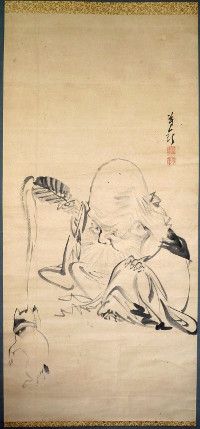
 Click here to view image full size. An original painting showing Fukurokugu – the God of Happiness, Wealth and Longevity and one of the Seven Gods of Good Luck, Shichi-fuku-ji, teasing a cat with the tassle on his fan.  The Seven Gods theme  comes from China, and possibly India as well, apart from Ebisu. Sumi on paper. Light creasing and rubbing at top otherwise good condition. Image size  47.75 x 22.5 in; 121.5 x 57 cms. Painted c 1880s. Signed Yoshitoshi with seals Taiso Yoshitoshi. Status: Sold  Click here to view image full size.  Click here to view image full size.  Click here to view image full size.

Tsukioka YOSHITOSHI (1839-1892 )

 Click here to view image full size. Taira no Masakado ( 901-940 ) from an extremely rare and early set: Honcho hyaku yuden, “One Hundred Warriors of Japan.” Masakado was an interloper who attempted to set up a rival court at Ishii in Shimosa to that of Regent Tadahira in Kyoto. He was subsequently killed by Hidesato on the orders of the Regent. Masakado was guarded by a number of ghostly doubles who impersonated him making killing him difficult. These ghostly doppelgangers are seen here in the background. Published 1862 by Enshu-ya Hikobei although it is not known how many prints there are in the set and Keys  ( Courage and Silence, Yoshitoshi, 1982 ) only knew of the set from the Netto list. Very fine impression. Fine colour and condition. Signed Ikkaisai Yoshitoshi hitsu. Status: Sold
Tsukioka YOSHITOSHI ( 1839-1892 )

 Click here to view image full size. Arguably Yoshitoshi’s masterpiece in the triptych format. Shows Mongaku ( Endo Morito, c.1120-1200 ) subjecting himself to three year’s penance as a Buddhist monk beneath the waterfall of Mount Nachi in Kii Province. Morito inflicted this punishment on himself because he had inadvertently cut off the head of Kesa Gozen, the wife of the palace guard Watanabe Wataru, with whom he was in love. Published 1859 ( centre sheet ) and 1860 ( outside panels ) by Kadokin. Extremely rare: Another impression in the Baur collection, Geneve, Switzerland. Fine impression, very good colour. Minor soil bottom left corners of last two sheets, otherwise very good condition. Extensive splashed gofun. Signed Ikkaisai Yoshitoshi hitsu. Status: Sold

Tsukioka YOSHITOSHI (1839-1892)

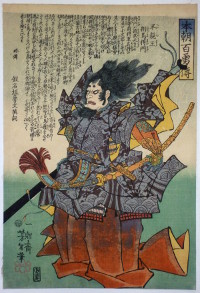
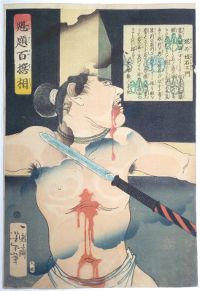
 Click here to view image full size. Shows the crucifiction of Torii Tsuneemon Katsutaka. The finest design from Kaidai hyaku senso, “Yoshitoshi’s Selection of One Hundred Warriors.” The set depicts warriors from the sixteenth century although based on Yoshitoshi’s record of the battle of Ueno in 1868. Torii Tsuneemon was a retainer of Okudaira Sadamasa and a member of the Nagashino Castle garrison when it came under siege by Takeda Katsuyori in 1575. He bravely volunteered to sneak through enemy lines to get help. However, he was captured on his return and ordered to shout to his compatriots that no help was coming. Instead he shouted encouragement and was crucified. Published by Ohashi, 1868. Fine impression with mica and gum applied to spear. Fine colour. Slight soil at bottom, otherwise very good condition. Signed Ikkaisai Yoshitoshi ga. Status: Sold
Tsukioka YOSHITOSHI (1839-1892)

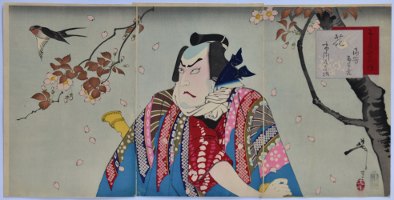
 Click here to view image full size. Flowers from a set of three triptychs showing half-length portraits of actors based on the Snow, Moon, Flowers theme. Shows the actor Ichikawa Sadanji as Gosho no Gorozo, the main character in the play Soga moyo tateshi no goshozome, “The Story of Gorozo, the Chivalrous Commoner.” A complex story which ends with Gorozo killing his old master’s lover, the courtesan Oshu. Published by Akiyama Buemon, 1890.   Fine impression, colour and condition. Signed Yoshitoshi.   Status: Sold  

Tsukioka YOSHITOSHI (1839-1892)

Click here to view image full size. A triptych showing from left to right the actors: Seki Sanjuro III as Nippon Daemon (above) and Ichimura Uzaemon XIII as Benten Kozo Kikunosuke. Centre: Nakamura Shikan IV as Nango Rikimaru. Right: Iwai Kumesaburo III as Akaboshi Juzaburo (above) and Kawarasaki Gonjuro I as Tadanobu Rihei. The group of five dandy-thieves in Aoto zoshi hana no nishiki-e or Shiranami gonin otoko. A famous play written by Kawatake Mokuami, this being the first performance at the Ichimura-za Theatre in 3 Published 3/1862 by Seibundo (Gifuya Seishichi). An extremely rare and early work: Not listed in Keyes.     Fine impression and colour. Slightly trimmed around, otherwise very good condition. Signed Ikkaisai Yoshitoshi ga.     Status: Sold    
Tsukioka YOSHITOSHI (1839-1892)

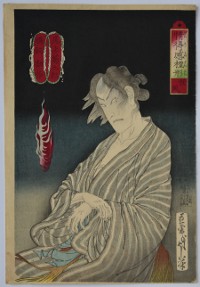
Click here to view image full size. Strange Wind from a set of actor prints Seiu kandankei, “A Barometer of Emotions.” A fine set published by Okura Magobei 1876-7. Shows Onoe Kikugoro V as the ghost of the cormorant fisherman Kansaku. He had poached fish from the sacred waters of the Isawa River and was caught and executed. His restless spirit caused Nichiren to pray for him and pacify the ghost. It was the subject of a famous play: Nichiren shonin minori no umi. Kikugoro was a personal friend of Yoshitoshi. One of Yoshitoshi’s best actor prints.     Fine impression, colour and condition. Signed (in kana) Oju Yoshitoshi hitsu.     Status: Sold