Utagawa KUNIYOSHI (1798-1861)
Click here to view image full size.
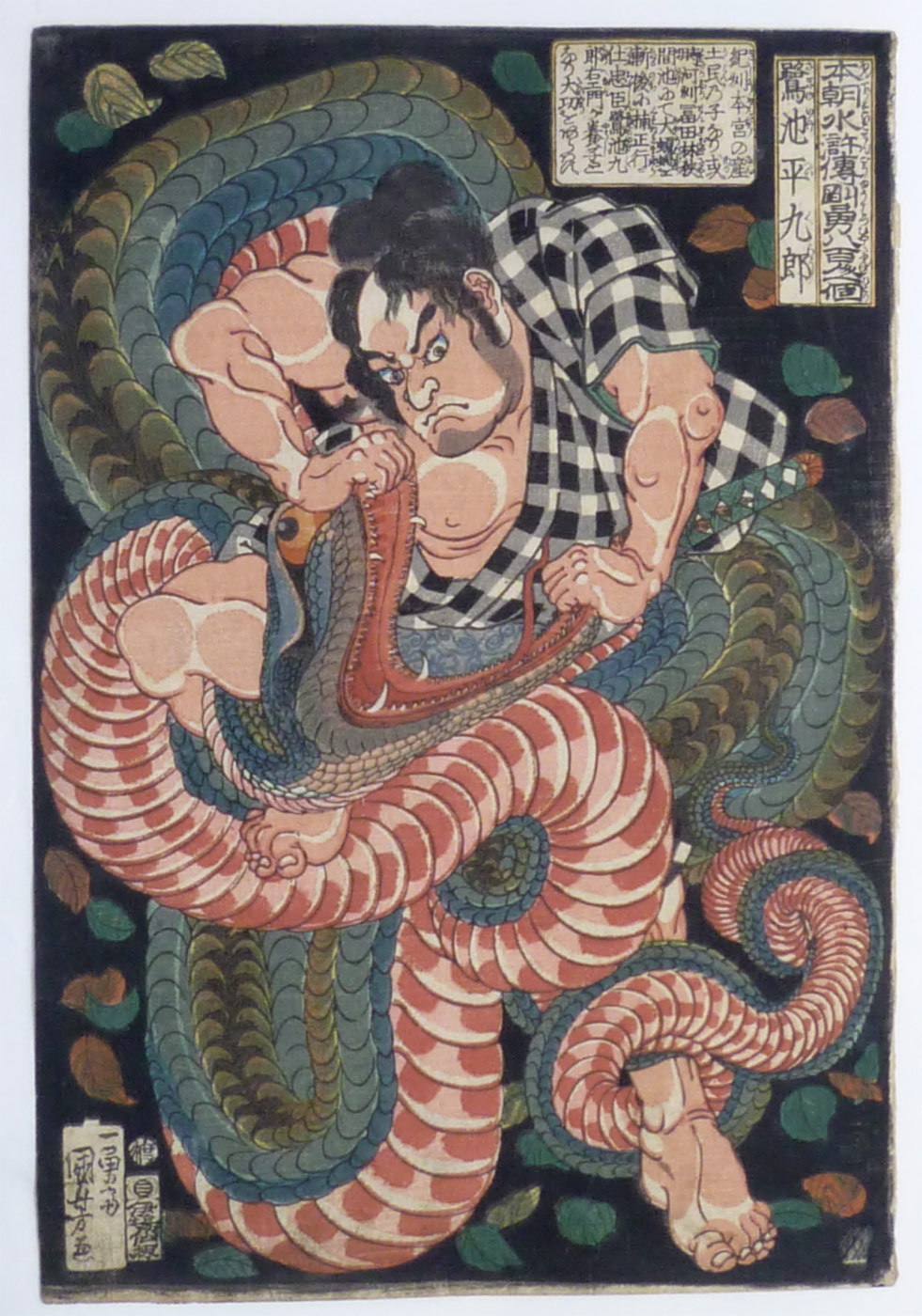
Saginoike Heikuro from Honcho Suikoden goyu happyaku-nin no hitori, “Eight Hundred Heroes of our Country’s Suikoden, One by One.” Shows the brigand wrestling with a huge serpent at the Lake of Sayama ( or Hazama ) at Tondabayashi in the Province of Kawachi. Published by Ibaya Sensaburo, c 1845. Robinson S4b.4. Fine design.
Very good impression and colour. Full size. Slightly soiled bottom left, otherwise very good condition. Signed Ichiyusai Kuniyoshi ga.
Status: Sold
Utagawa KUNIYOSHI (1798-1861)
Click here to view image full size.
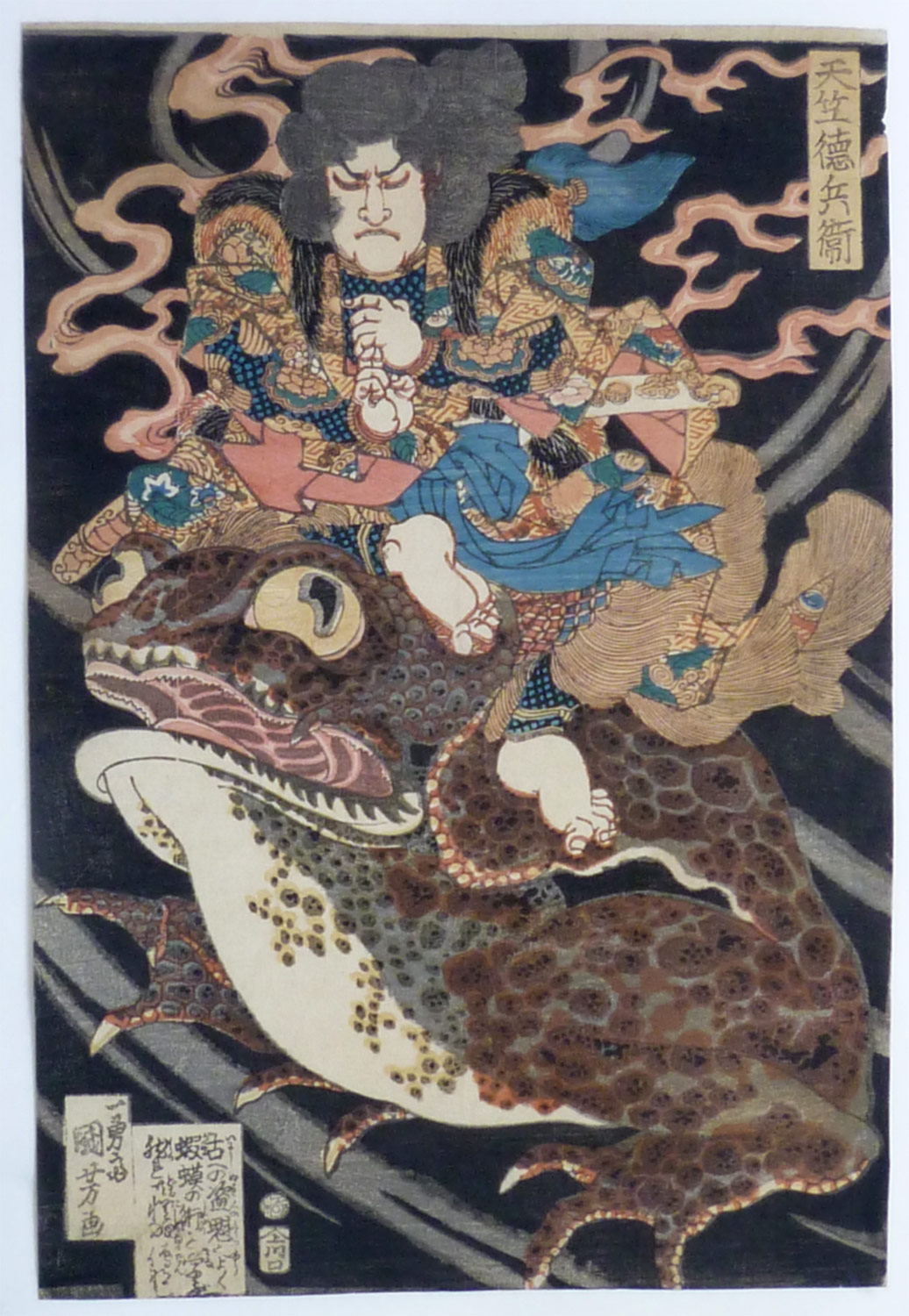
Tenjiku Tokubei ( 1619-1686 ) from an untitled series of warrior prints published by Kawaguchi Uhei, 1826-27. Tokubei was celebrated for his travels to India, Macao and Siam, and subsequently wrote about his exploits. He is usually represented surrounded by frogs and making magic with his fingers ( as here – Gama Yojutsu ) which enabled him to change into a frog. He is shown astride an enormous frog in a thunderstorm. Fine design.
Very good impression and colour. Slightly trimmed at bottom, otherwise very good condition. Signed Ichiyusai Kuniyoshi ga.
Status: Sold
Kochoro KUNISADA (1786-1865)
Click here to view image full size.
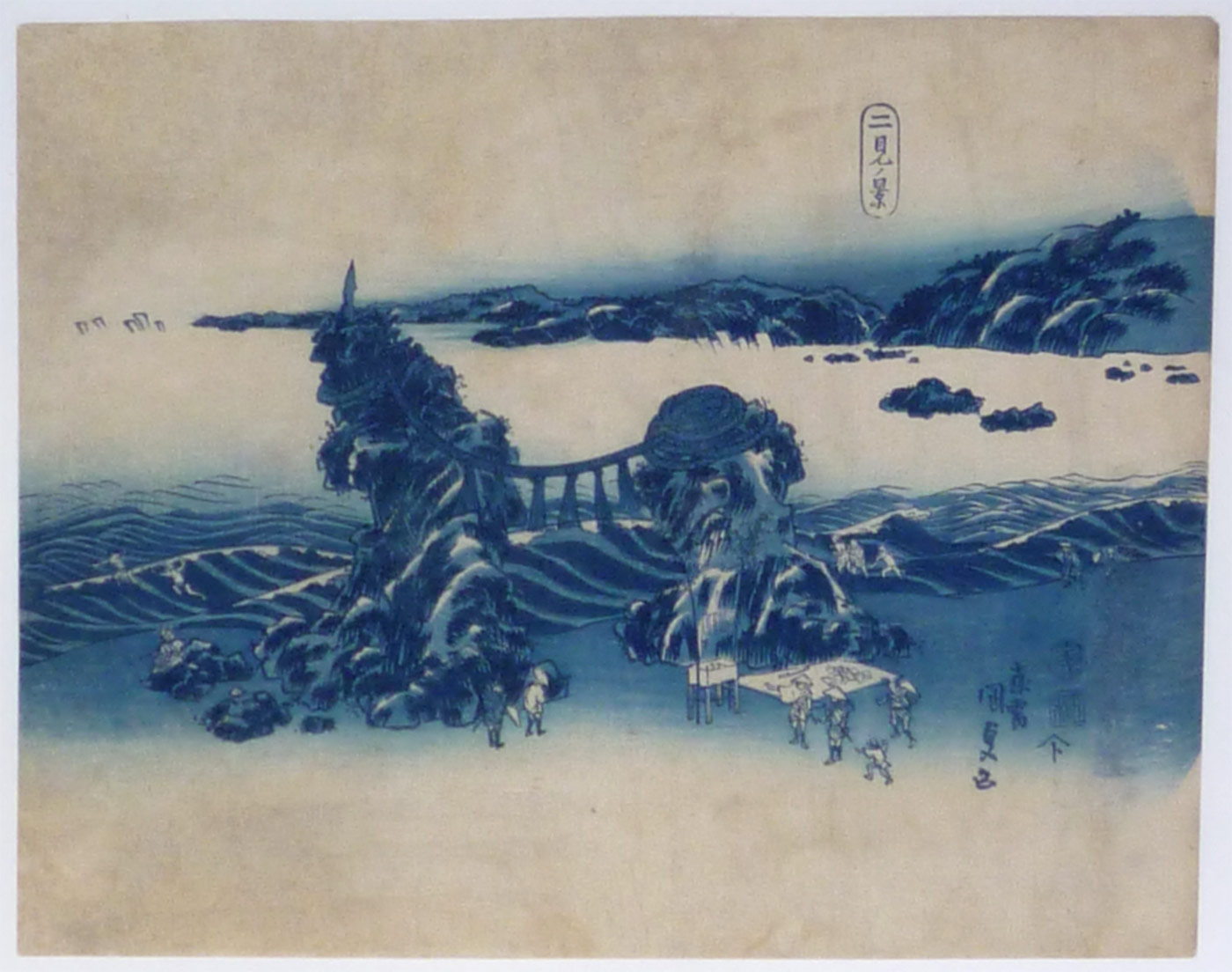
An aizurie fan print of the Husband and Wife rocks, Futami beach, Ise Province. A favourite beauty spot and a Shinto site showing the tasselled rope hanging between the two formations. From a series of extremely rare aizurie fan prints published 5/1830 by Daikokuya. Indeed, this may be the only known impression of this design.
Very good impression and colour. Restored and laid onto stable Japanese paper.
Signed Oju Kunisada ga ( “By special request” ).
Status: Sold
Keisai EISEN (1790-1848)
Click here to view image full size.
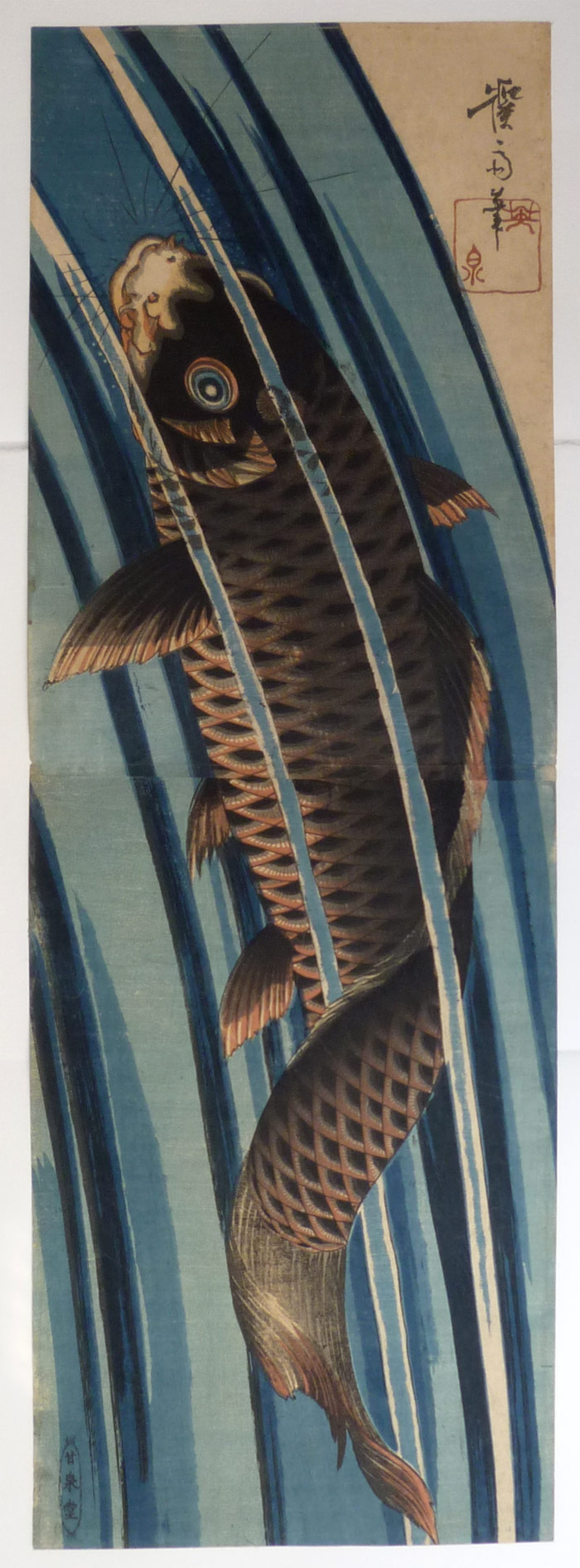
A vertical diptych of a carp leaping a waterfall. Published by Kansendo, c 1830 – 44. Illustrated Keisai Eisen: Artist of the Floating World, Chiba City Museum of Art, 2012, p. 240, pl. 313.
Very good impression, colour and condition. This was a popular design and later impressions are common. Signed Keisai hitsu with large red artist’s seal Eisen.
Status: Sold
Katsushika HOKUGA (Fl. c 1820s to 1830)
Click here to view image full size.
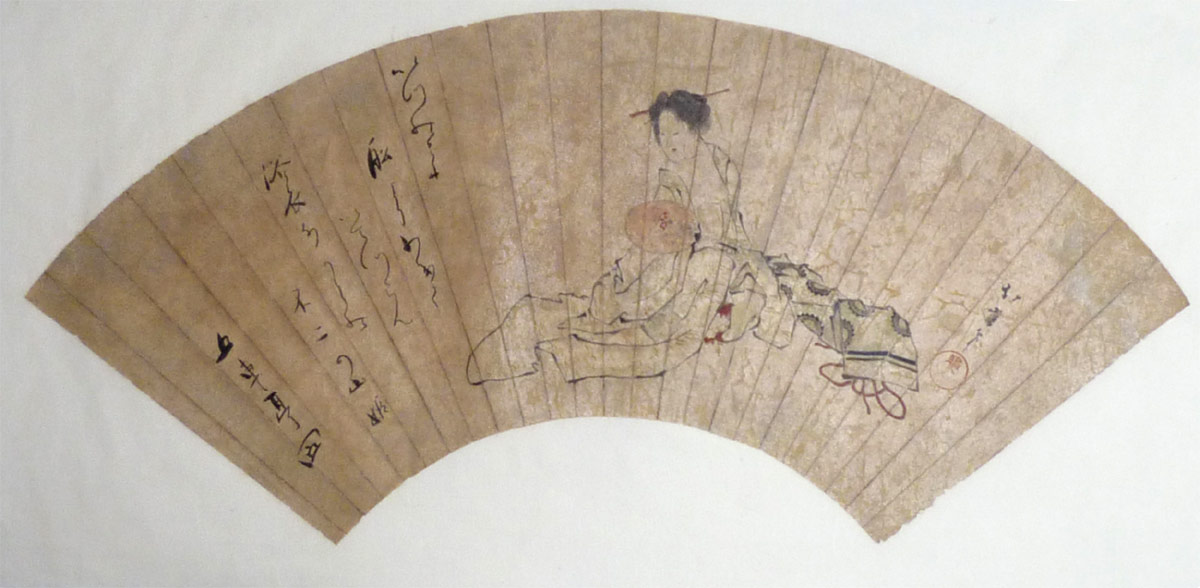
An original fan painting showing a seated beauty holding a fan. Full colour on mica- covered paper. 6.5 x 18.5 in; 16.5 x 47 cms. Hokuga was a pupil of Hokusai and produced paintings and surimono. Good condition. Laid onto Japanese paper. Signed Hokuga hitsu.
Status: Sold
Katsukawa SHUNCHO (Fl. c 1780-1801)
Click here to view image full size.
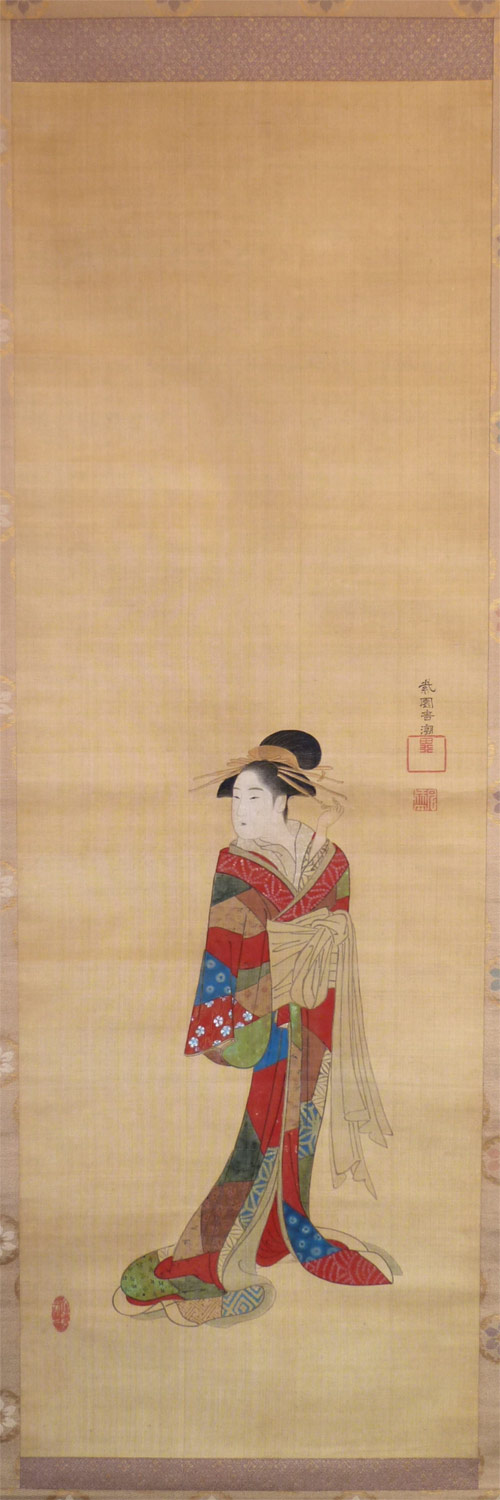
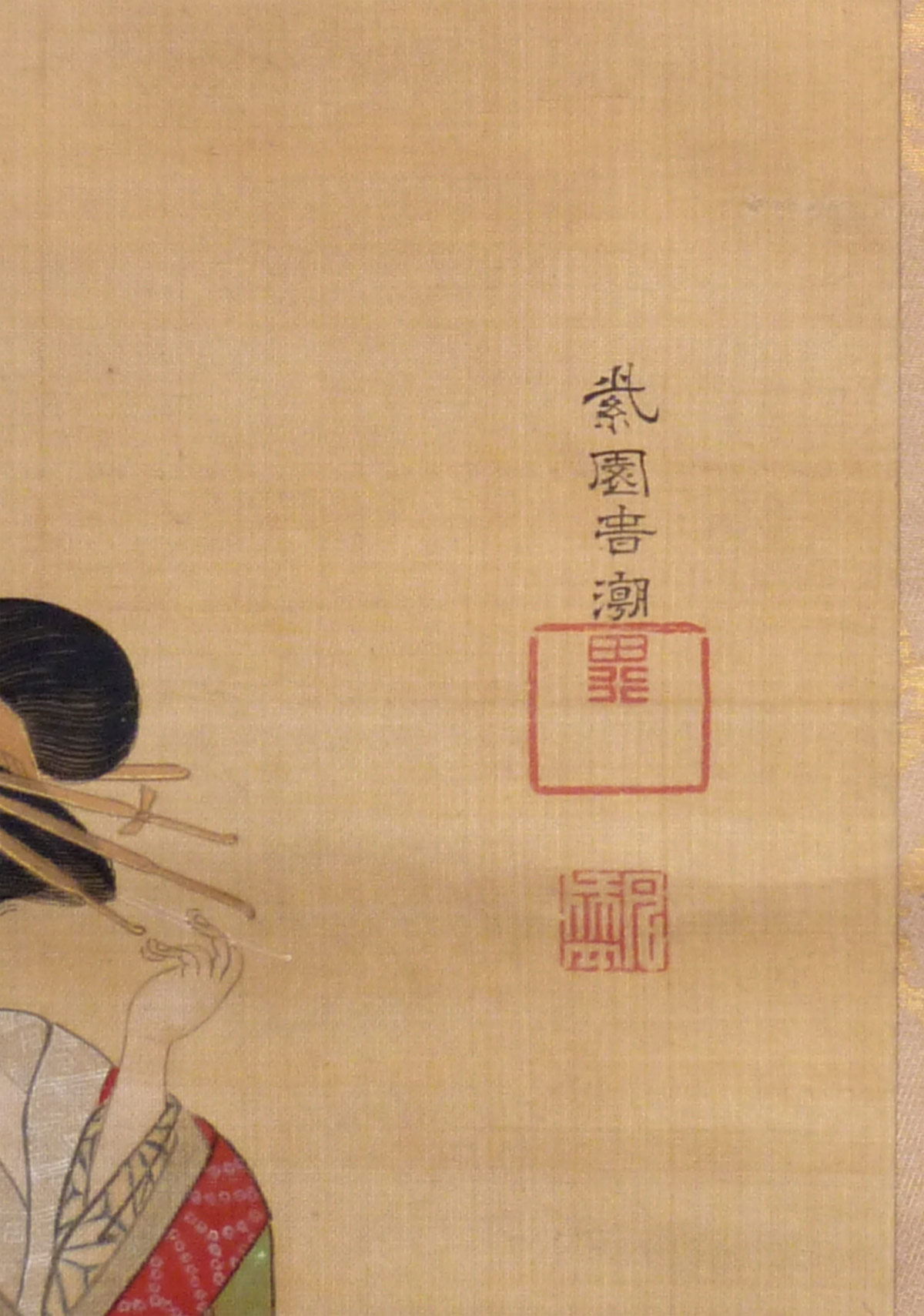
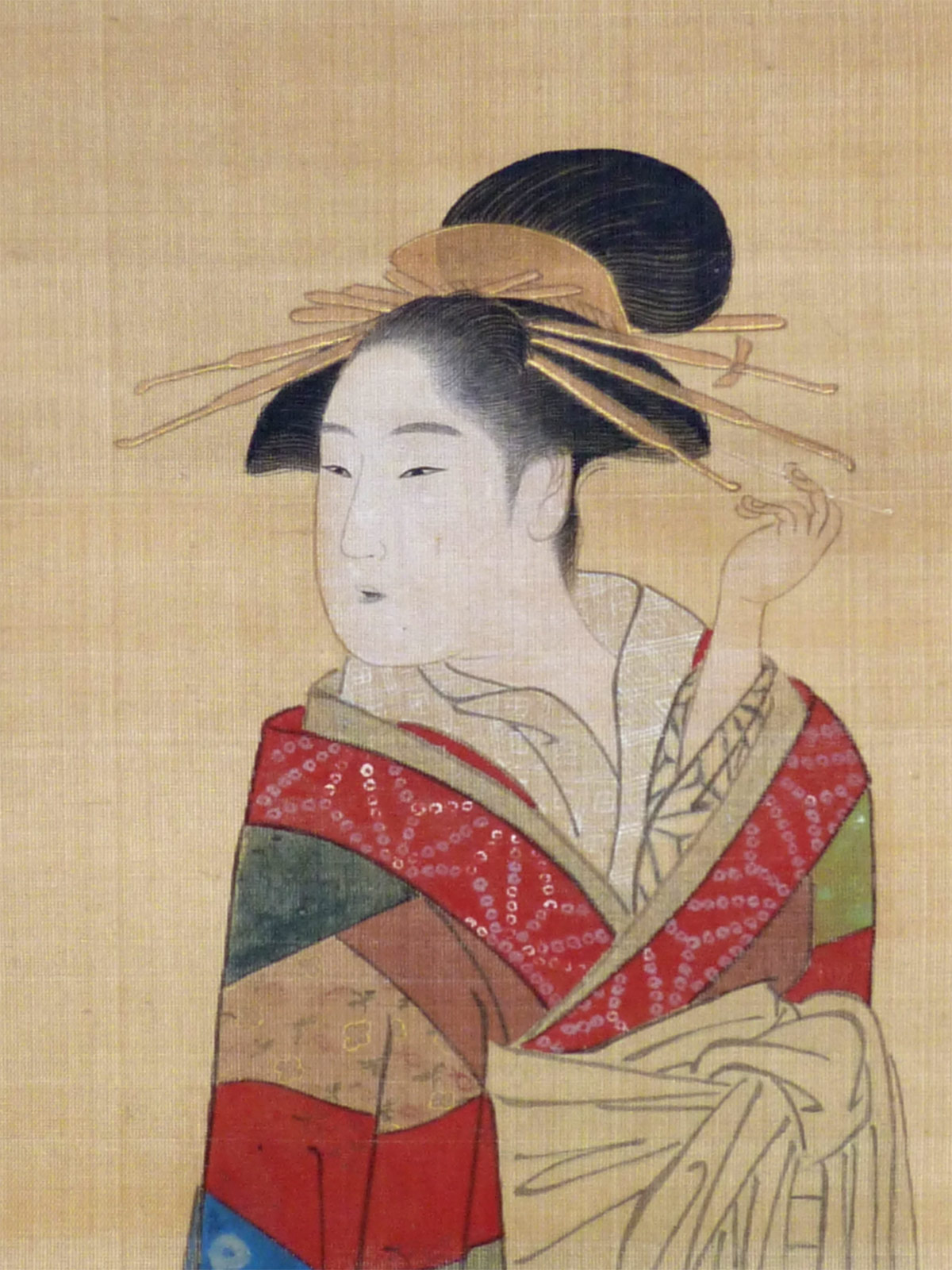
An original painting showing a standing beauty inserting a hairpin. An important print artist who produced many fine diptychs and triptychs. Paintings by him are rare. Studied under Shunsho, then Kiyonaga and Shumman. Full colour on silk, 30.75 x 10.5 in; 78 x 26.5 cms. Signed Shien Shuncho with unread seals.
Status: Sold
Utagawa KUNISADA (1786-1865)
Click here to view image full size.
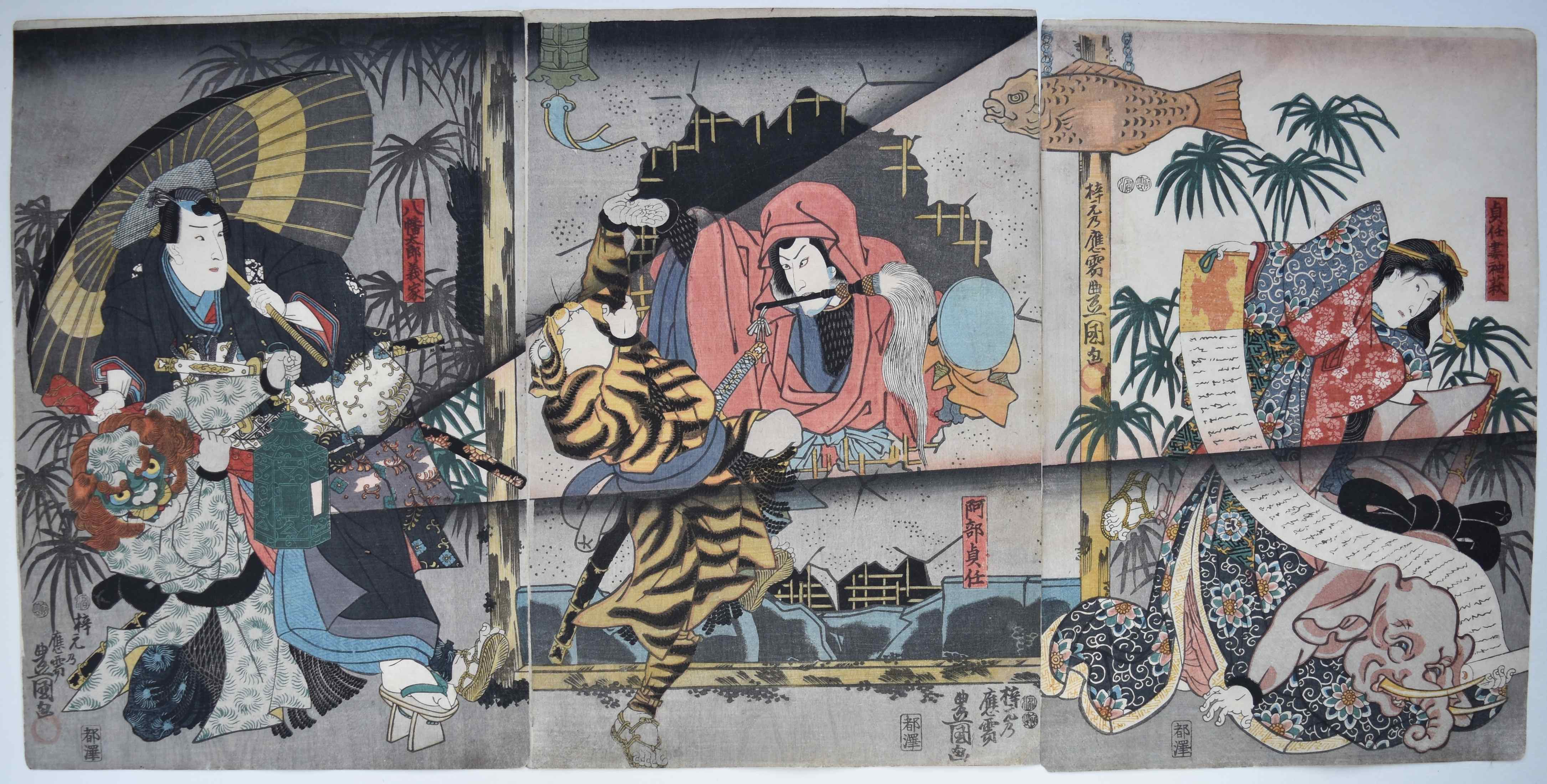
A triptych of a probably imaginary performance showing the actor Ichimura Uzaemon XII as Hachiman Taro Yoshiie (far left) with an actor dressed as a lion who shines a strong beam from a lantern across the other two sheets; the centre one showing the actor Ichikawa Danjuro III as Abe Sadato with an actor dressed as a lion, and the right sheet showing the actor Bando Shuka I as Sadato’s wife Sodehagi with an actor dressed as an elephant. Published by Miyakozawa 1847-52.
Very good impression, colour and condition. Signed Hanmoto no oujyu Toyokuni ga, “By the request of the publisher, painted by Toyokuni.”
Status: Sold
Utagawa KUNISADA (1786-1865)
Click here to view image full size.
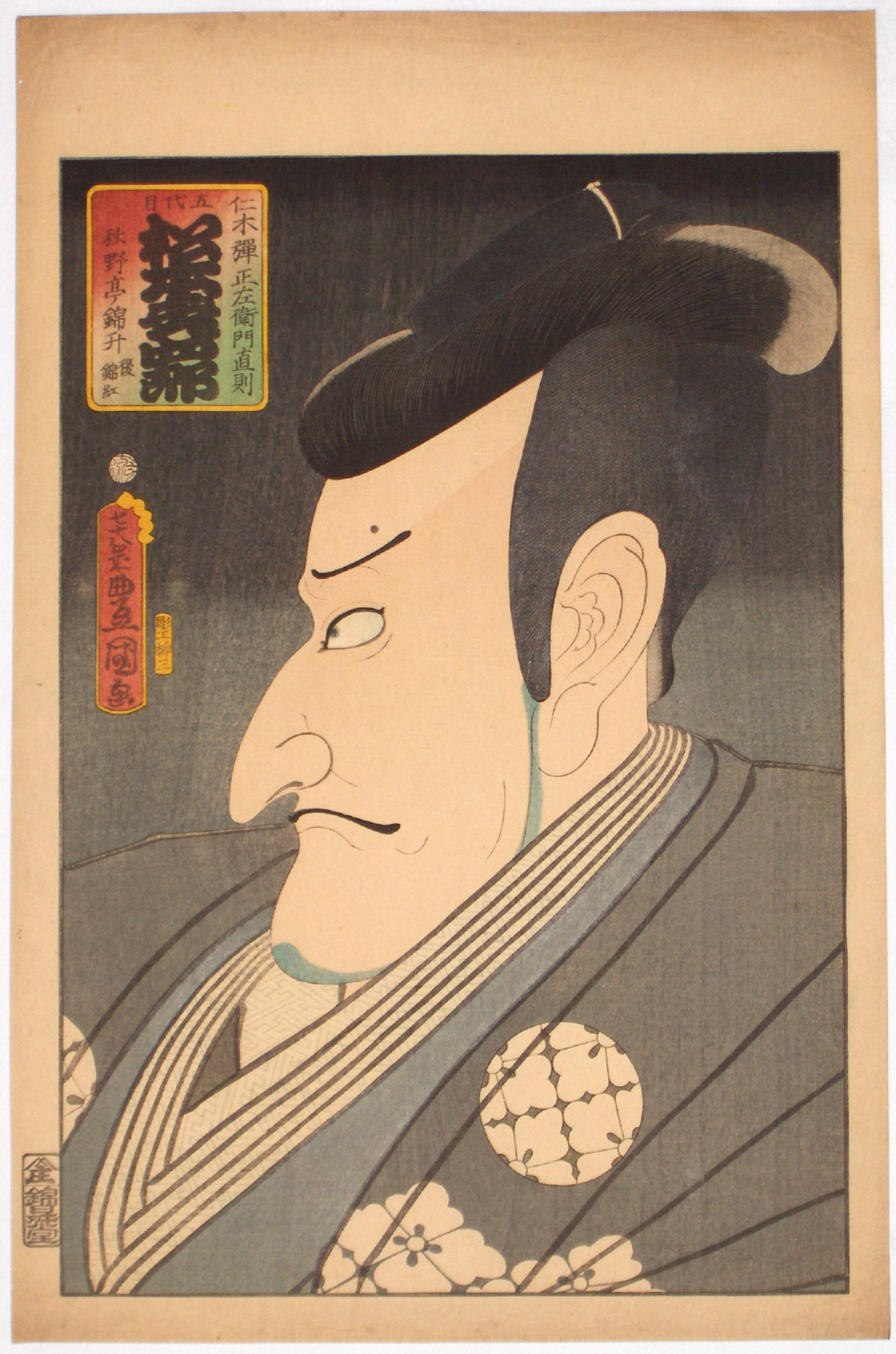
Matsumoto Koshiro V as the evil retainer Nikki Danjo who plots to overthrow his lord in the play Meiboku sendai hagi, “Precious Incense and the Bush Clover of Sendai.” From the last great actor set which was planned as a monument to his career and only used the most expensive materials. An untitled set with seventy-two prints completed on his death. ( One hundred and fifty were intended and some are in fact by Yoshitora. ) This is one of the best designs from the set showing a fine profile of an actor who was nicknamed Hanataka Koshiro, “Big-nosed Koshiro.” He made this role very much his own and to this day many actors still wear a mole on their foreheads in his honour. Published 1863 by Kinshodo.
Very fine impression. Fine colour with extensive burnishing to the hair. On thick hosho and with the extra large margins of the first issues before being bound into albums. Slight soil at edge of margins, top and bottom, otherwise very good condition. Signed Nanajuhassai ( “At the age of seventy-eight” ) Toyokuni ga.
Status: Sold
Tsukioka YOSHITOSHI (1839-1892)
Click here to view image full size.
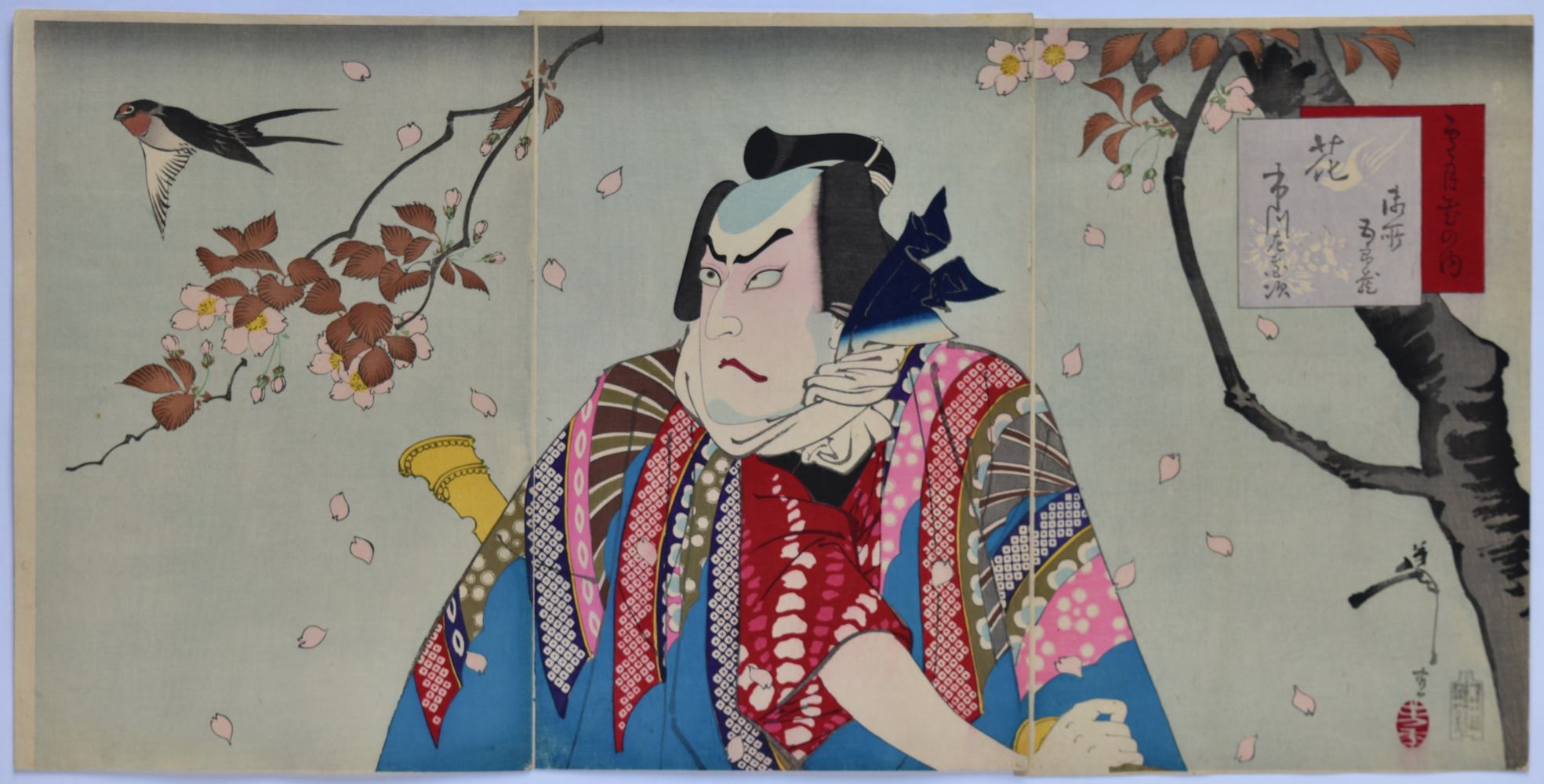
Flowers from a set of three triptychs showing half-length portraits of actors based on the Snow, Moon, Flowers theme. Shows the actor Ichikawa Sadanji as Gosho no Gorozo, the main character in the play Soga moyo tateshi no goshozome, “The Story of Gorozo, the Chivalrous Commoner.” A complex story which ends with Gorozo killing his old master’s lover, the courtesan Oshu. Published by Akiyama Buemon, 1890.
Fine impression, colour and condition. Signed Yoshitoshi.
Status: Sold
Katsukawa SHUNSHO (1726-1792)
Click here to view image full size.
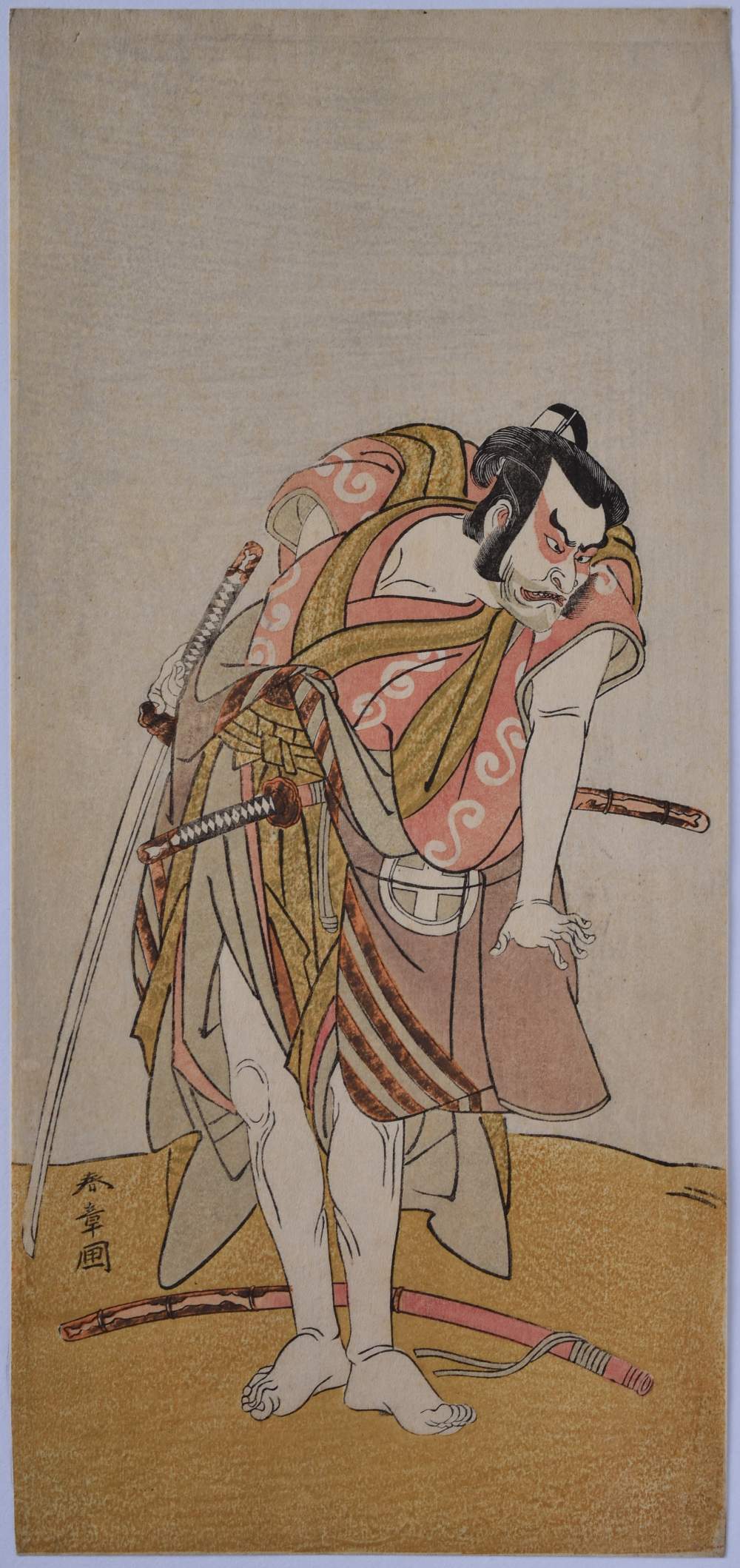
A hosoban of the actor Otani Hiroji III in the role of a samurai, one sword drawn with the scabbard lying at his feet. Published c 1776.
Fine impression. Very good colour. Fine condition. Signed Shunsho ga.
Status: Sold
Toyohara KUNICHIKA (1835-1900)
Click here to view image full size.
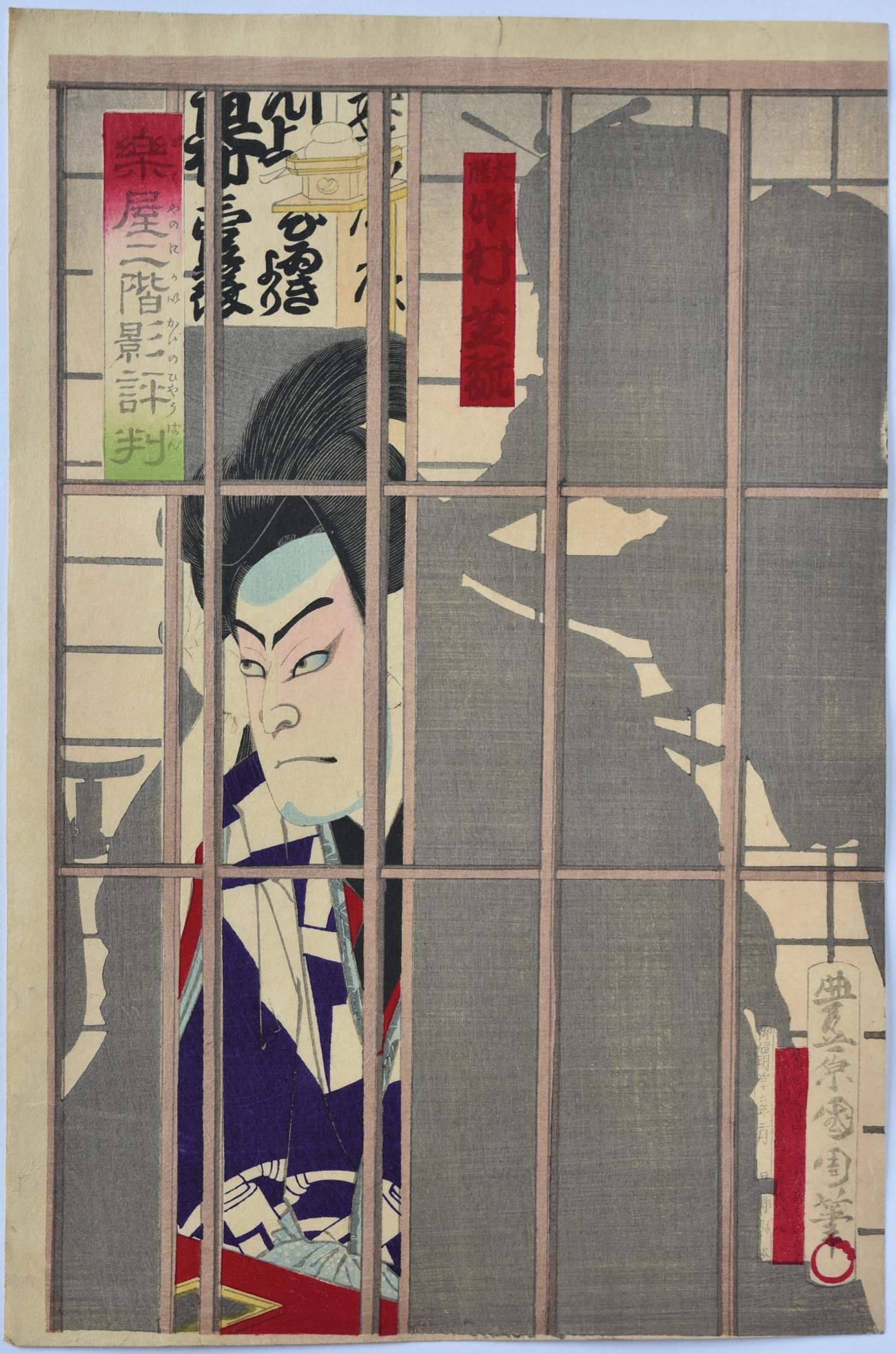
The actor Nakamura Shikan IV as Daizen from a fine set of prints showing actors glimpsed through their dressing room sliding doors, prior to going on stage. Their figures partly silhouetted as are their assistants, here aiding the actor with his headpiece. From a set Gakuya nikai kage no hyoban, “Popularity of the Upstairs Dressing Room.” The set published by Takagawa Fusajiro, 1883.
Fine impression, colour and condition. Full size. Signed Toyohara Kunichika hitsu.
Status: Sold
Toyohara KUNICHIKA (1835-1900)
Click here to view image full size.
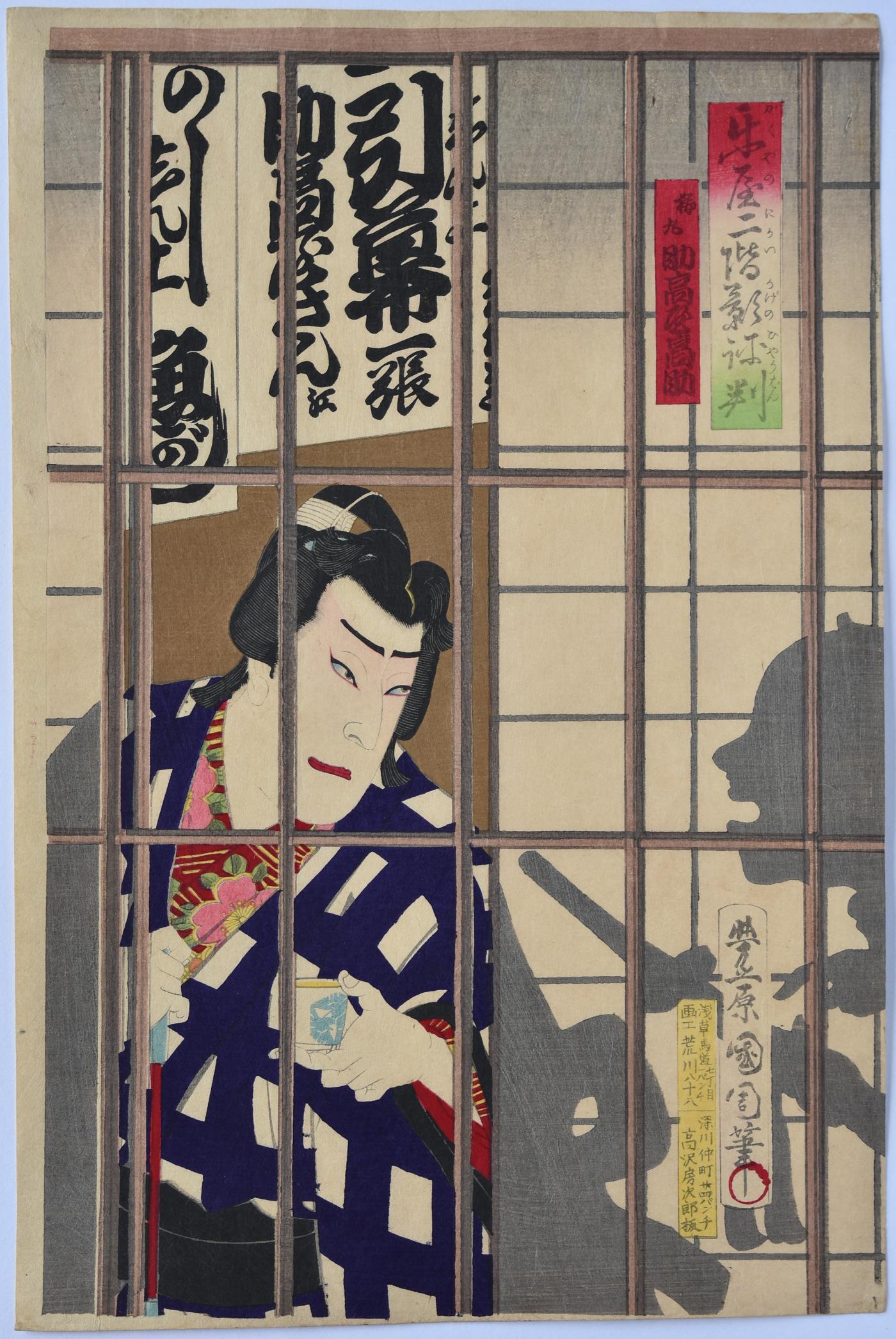
The actor Suketakaya Takasuke IV as Sakuramaru from a fine set of prints showing actors glimpsed through their dressing room sliding doors, prior to going on stage. Their figures partly silhouetted as are their assistants, here aiding the actor with his sword. From a set Gakuya nikai kage no hyoban, “Popularity of the Upstairs Dressing Room.” The set published by Takagawa Fusajiro, 1883.
Fine impression, colour and condition. Full size. Signed Toyohara Kunichika hitsu.
Status: Sold
Toyohara KUNICHIKA (1835-1900)
Click here to view image full size.
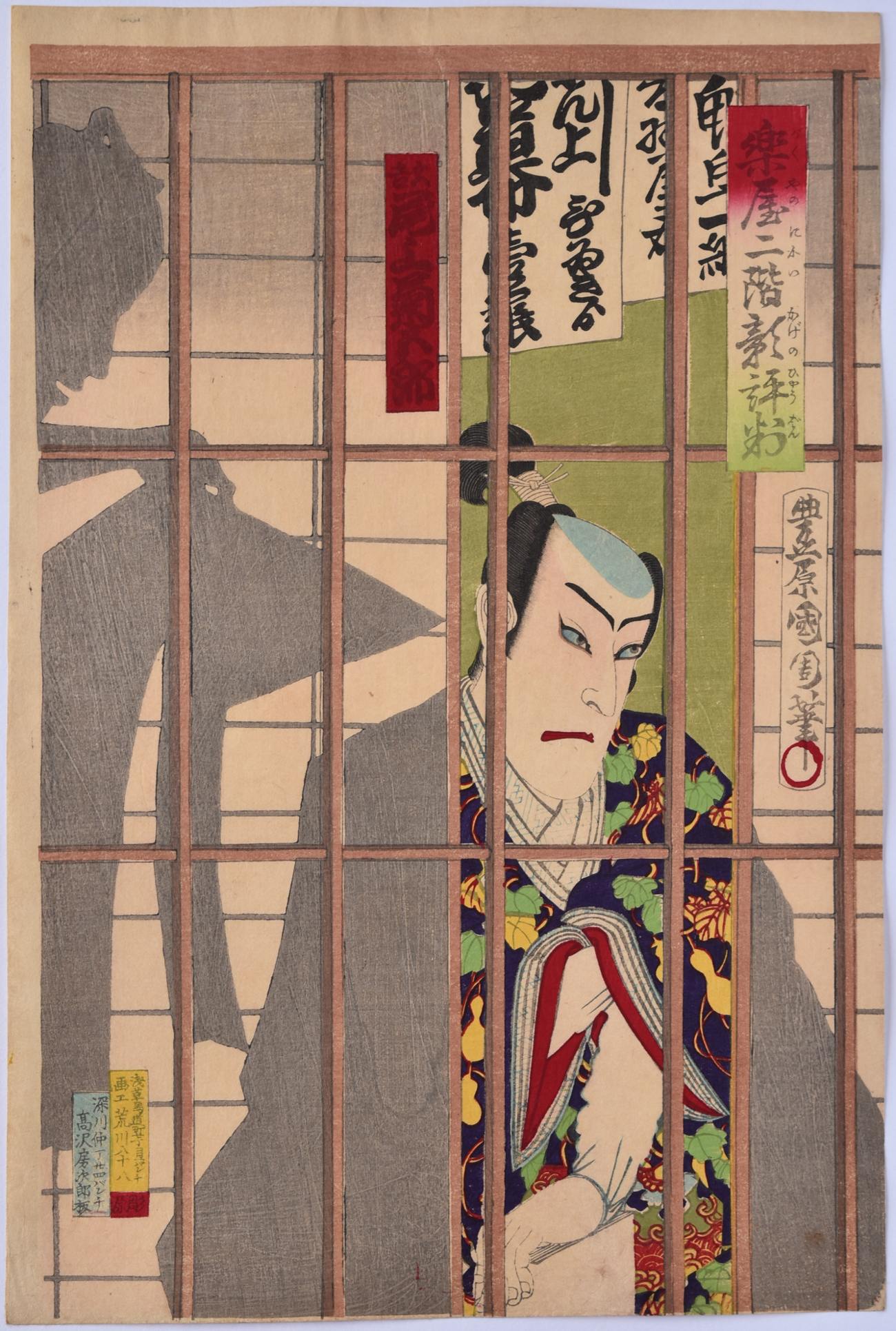
The actor Onoe Kikugoro V as Hisayoshi from a fine set of prints showing actors glimpsed through their dressing room sliding doors, prior to going on stage. Their figures partly silhouetted as are their assistants, here aiding the actor with his costume. From a set Gakuya nikai kage no hyoban, “Popularity of the Upstairs Dressing Room.” The set published by Takagawa Fusajiro, 1883.
Fine impression, colour and condition. Full size. Signed Toyohara Kunichika hitsu.
Status: Sold
Toyohara KUNICHIKA (1835-1900)
Click here to view image full size.
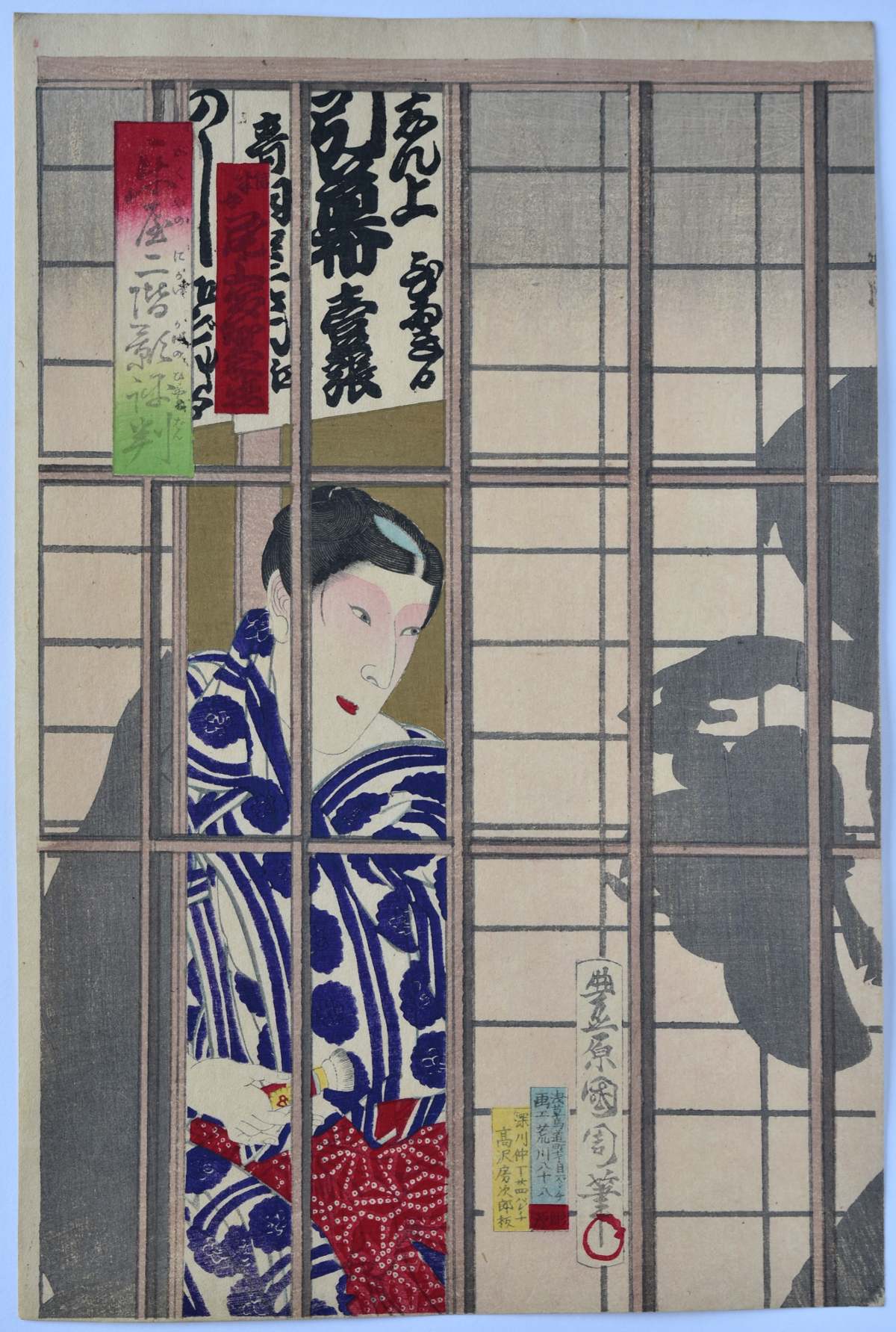
The actor Onoe Taganojo II from a fine set of prints showing actors glimpsed through their dressing room sliding doors, prior to going on stage. Their figures partly silhouetted as are their assistants, here aiding the actor with his headpiece. From a set Gakuya nikai kage no hyoban, “Popularity of the Upstairs Dressing Room.” The set published by Takagawa Fusajiro, 1883.
Fine impression, colour and condition. Full size. Signed Toyohara Kunichika hitsu.
Status: Sold
Katsukawa SHUNSHO (1729-1792)
Click here to view image full size.
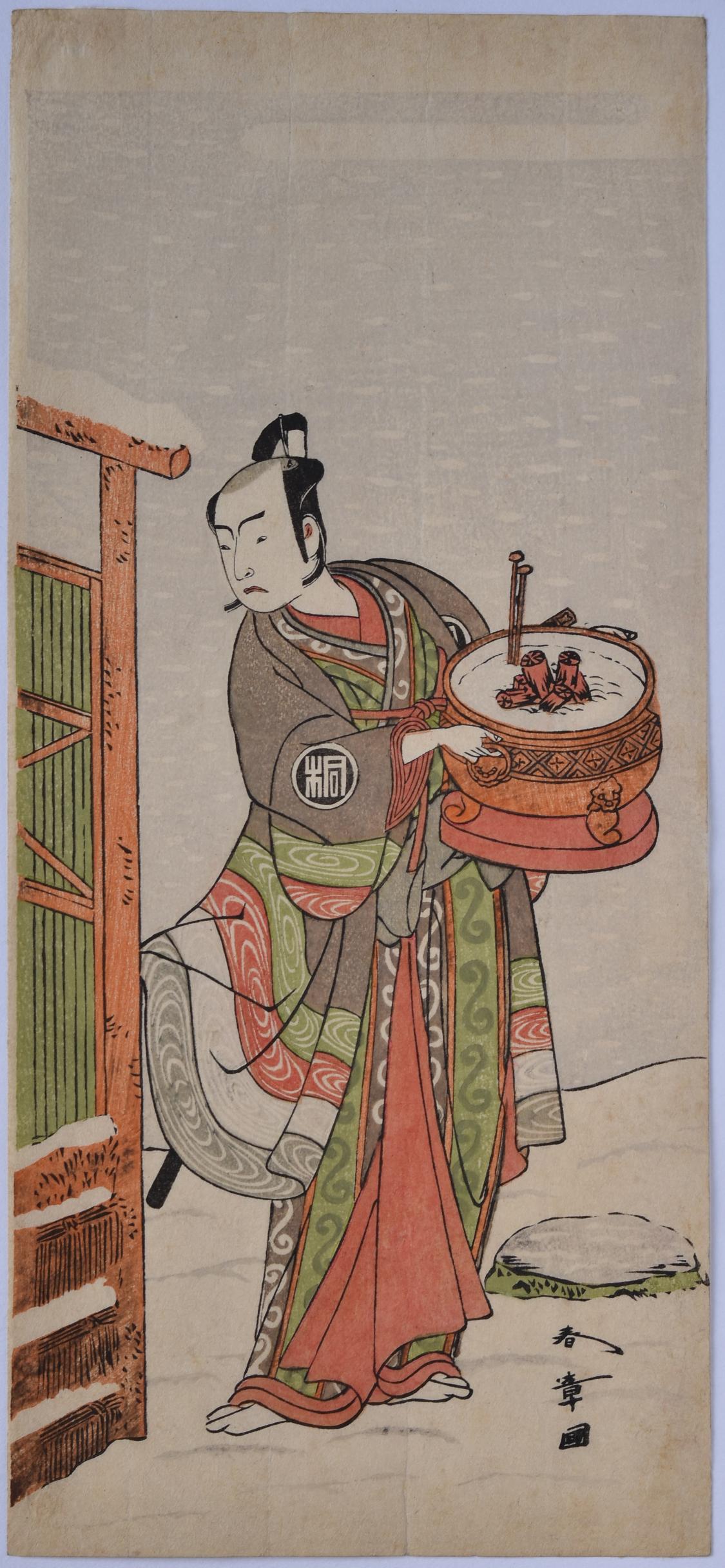
A hosoban showing the actor Arashi Sangoro II in the role of Ito Kuro disguised as Banta in the play Izu-goyomi shibai no ganjitsu performed at the Morita Theatre, 11/1772. He holds a brazier aloft and stands in deep snow.
Fine impression. Pristine colour. Small thinned area at top, otherwise fine condition. Full size. Signed Shunsho ga.
Status: Sold
Utagawa KUNISADA (1786-1864)
Click here to view image full size.
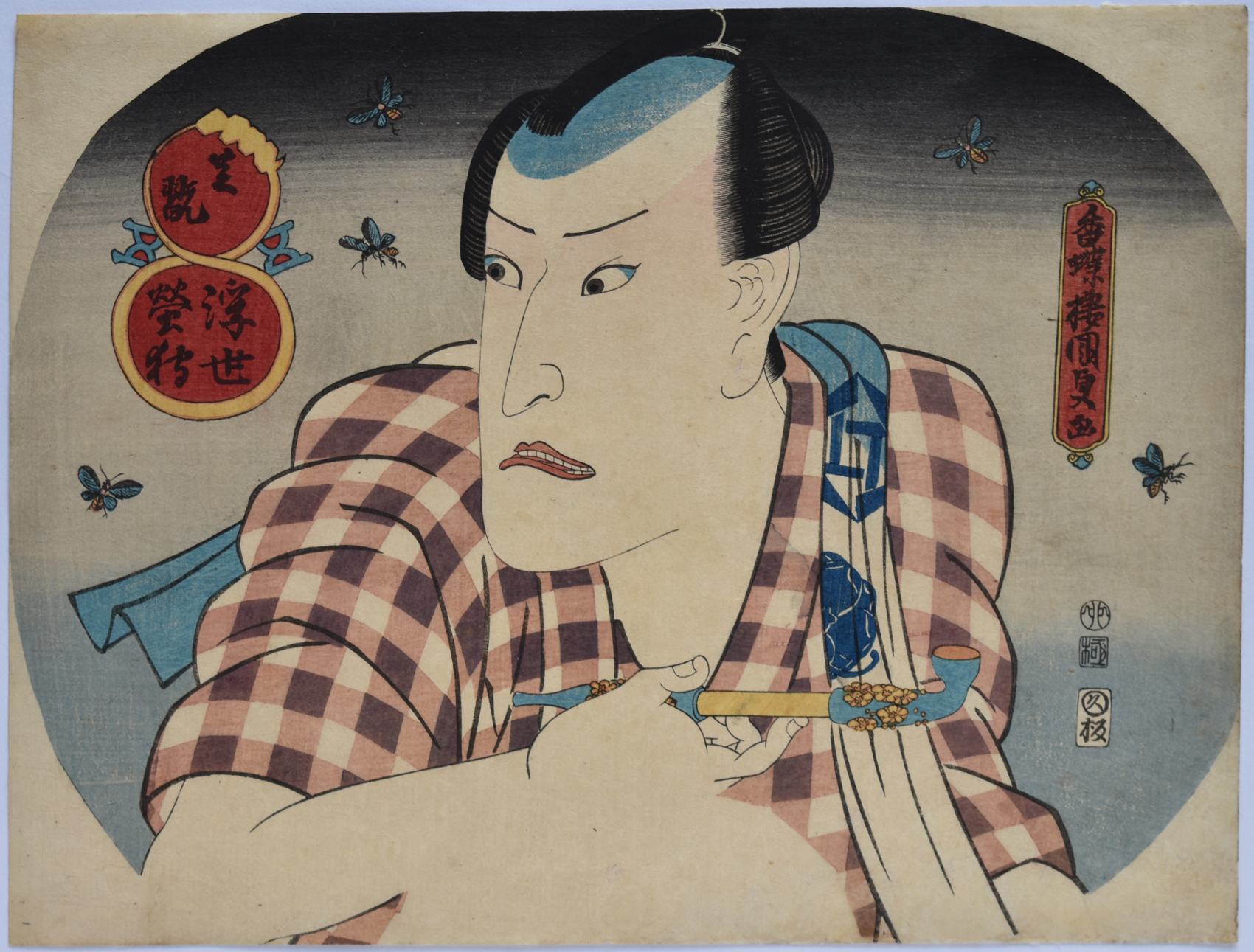
An untrimmed aiban fan print showing the actor Nakamura Shikan II on an outing to view the summer fireflies. Ukiyo hotarugari, “Firefly Viewing in the Floating World.” Published by Ibaya Kyubei, 1831.
Fine impression, colour and condition. Signed Kochoro Kunisada ga.
Status: Sold
Ippitsusai BUNCHO (Fl. c 1755-1790)
Click here to view image full size.
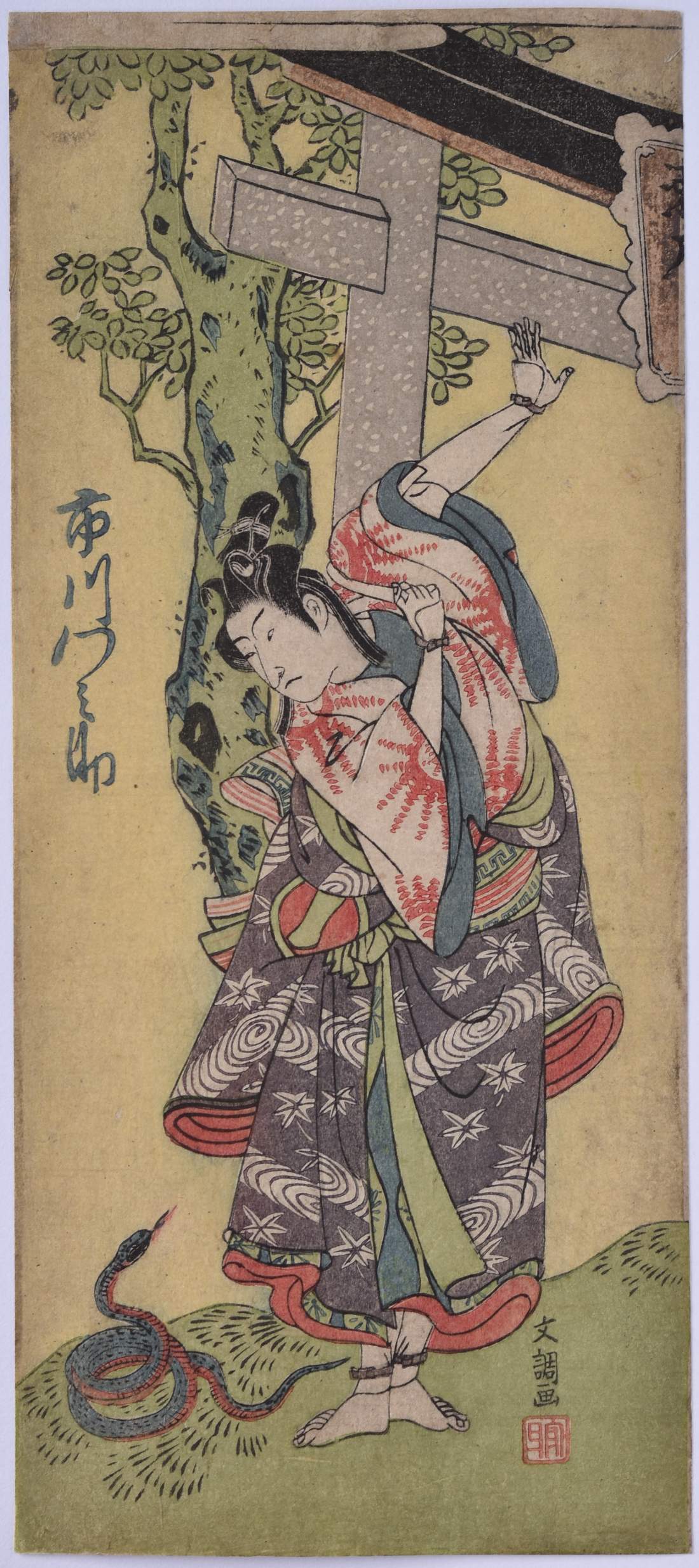
A hosoban showing the actor Ichikawa Monnosuke II standing before a torii and looking down at a snake. Not listed in the Riccar Art Museum Exhibition Of Ukiyo-e By Ippitsusai Buncho, 1978. Published c 1769.
Very good impression. Extremely well preserved colour. Probably slightly trimmed on right and slight soil, otherwise very good condition. Signed Buncho ga.
Status: Sold
Utagawa TOYOKUNI (1769-1825)
Click here to view image full size.
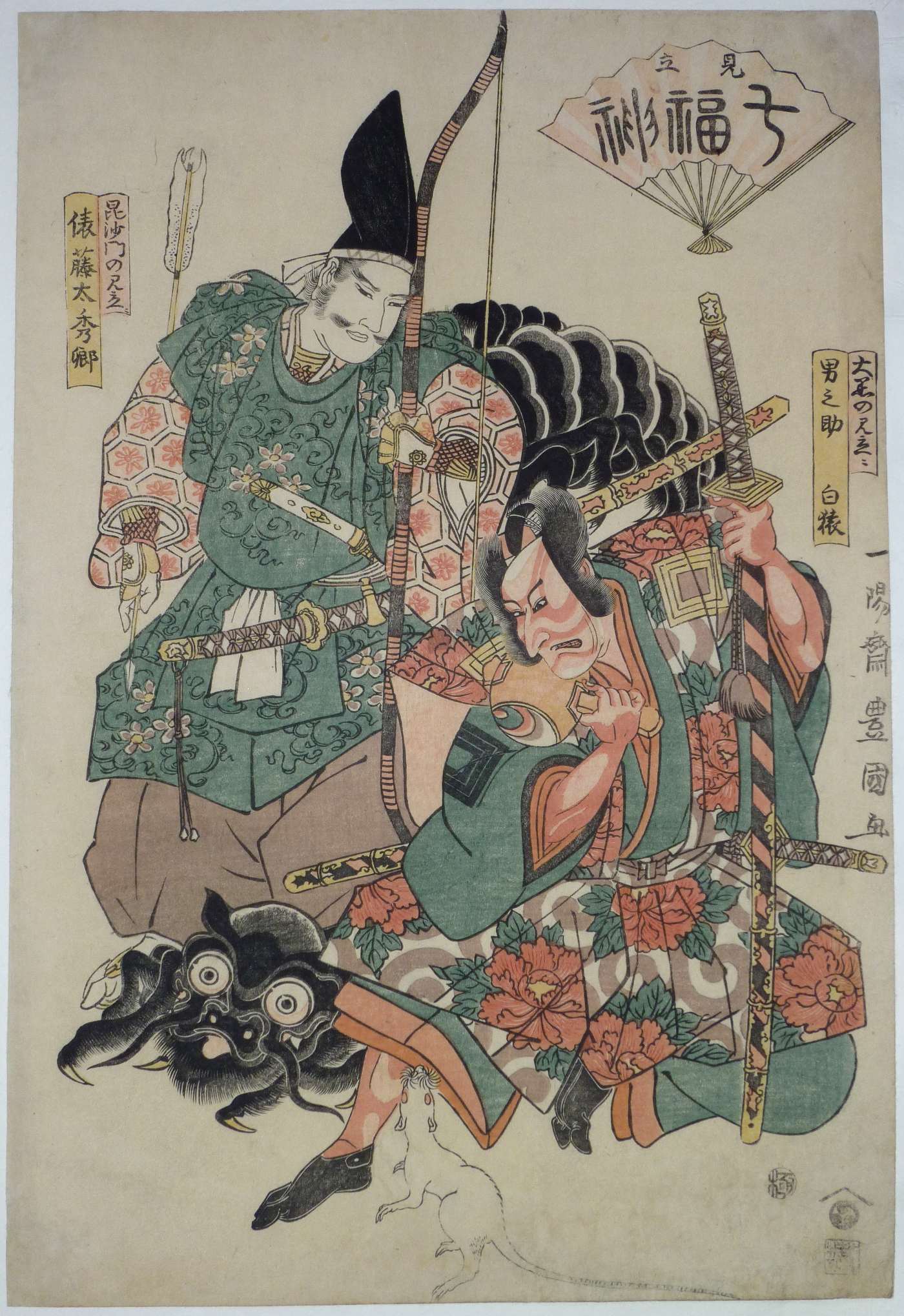
A print from the series Mitate Kofukujin, “ A Parody of Children’s Gods.” Featured are two of the seven gods of good fortune compared to famous heroes. Top left: Bishamonten no mitate, Tawara Toda Hidesato (Tawara Toda Hidesato defeating the giant centipede, compared to the god Bishamon). Bottom right: Daikoku no mitate, Otokonosuke, Hakuen (Ichikawa Hakuen I in the role of Arajishi Otokonosuke, compared to the god Daikoku). Hakuen (formerly Danjuro V) had already retired by this date so this does not depict an actual performance. However, the hero Otokonosuke is famous from the play Meiboku Sendai Hagi. Published 1804 by Nishimuraya Yohachi.
Very good impression and color. Small corner repair and slight edge soil, otherwise good condition. Signed Ichiyosai Toyokuni ga.
Status: Sold
Toyohara KUNICHIKA (1835-1900)
Click here to view image full size.
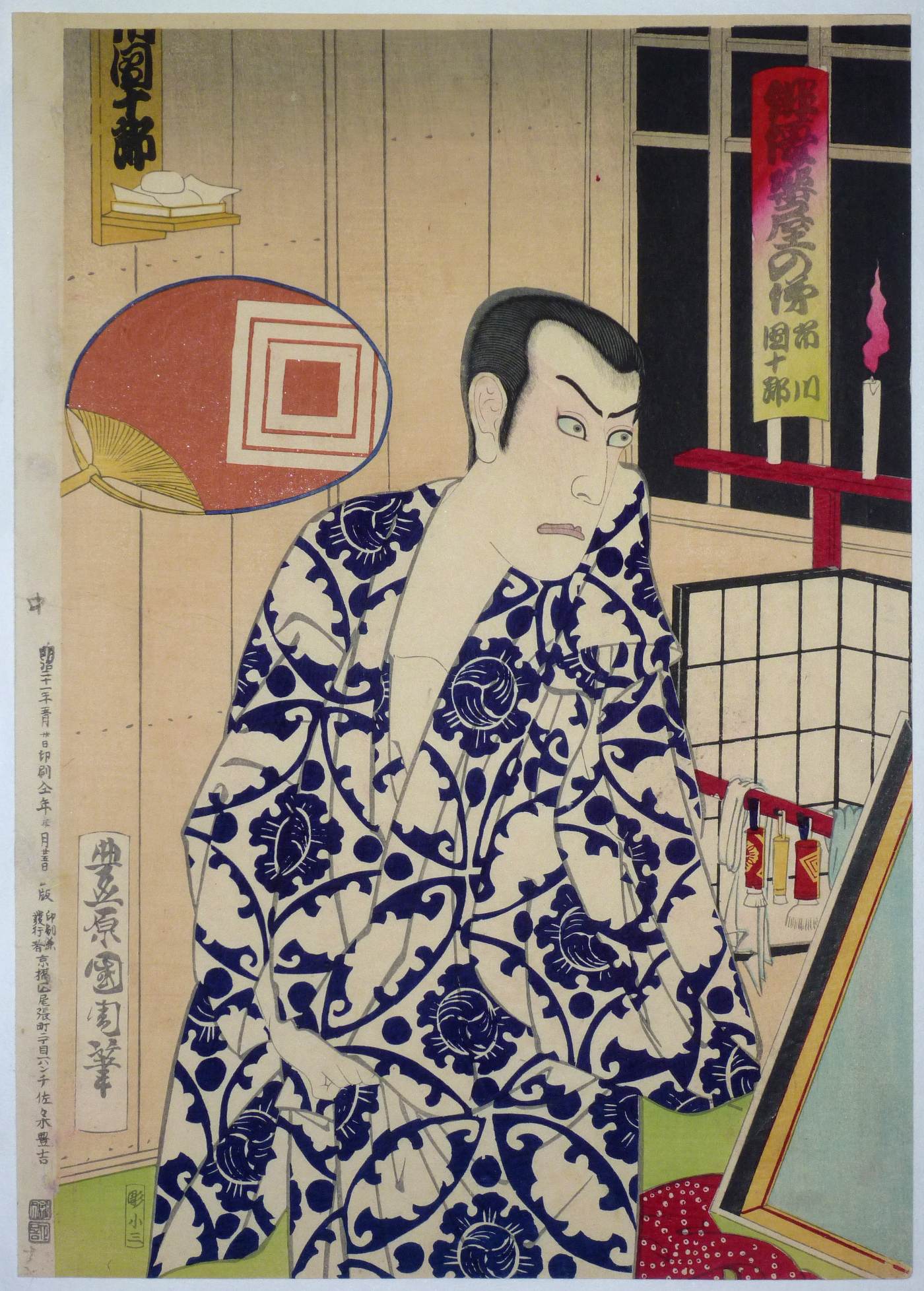
A fine set of prints showing actors preparing backstage for their performances. Haiyu gakuya no omokage, “Images of Actors in the Green Rooms.” Here Ichikawa Danjuro IX is shown in dressing gown being fanned by an attendant (off picture). Published 1888 by Sasaki Toyokichi.
Fine impression, colour and condition. Signed Toyohara Kunichika hitsu.
Status: Sold
Toyohara KUNICHIKA (1835-1900)
Click here to view image full size.
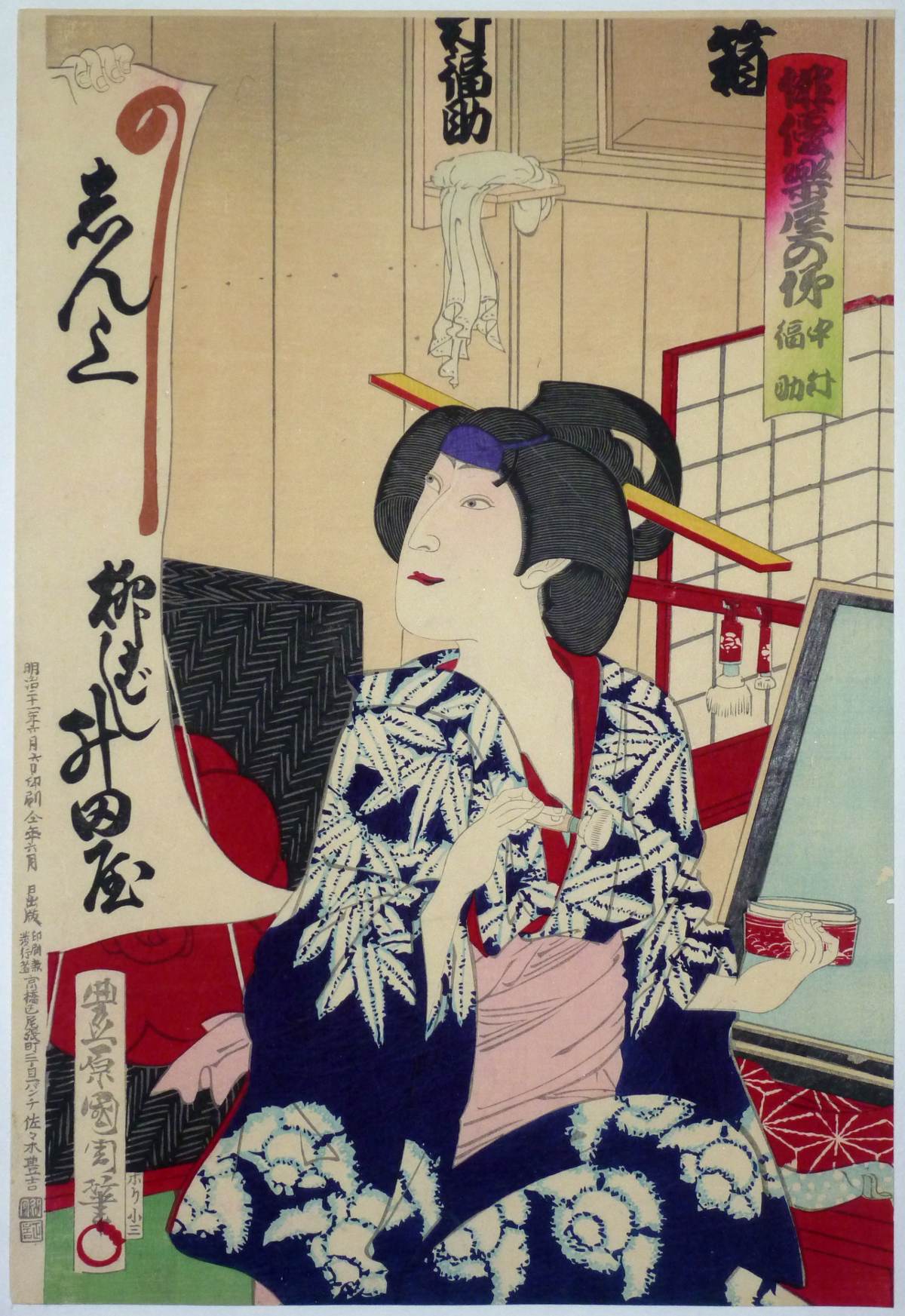
A fine set of prints showing actors preparing backstage for their performances. Haiyu gakuya no omokage , “Images of Actors in the Green Rooms.” Here Nakamura Fukusuke IV is shown preparing to put on makeup while an attendant (off picture) holds up what is presumably a supporter’s banner. Published 1888 by Sasaki Toyokichi.
Fine impression, colour and condition. Signed Toyohara Kunichika hitsu.
Status: Sold
Anonymous
Click here to view image full size.
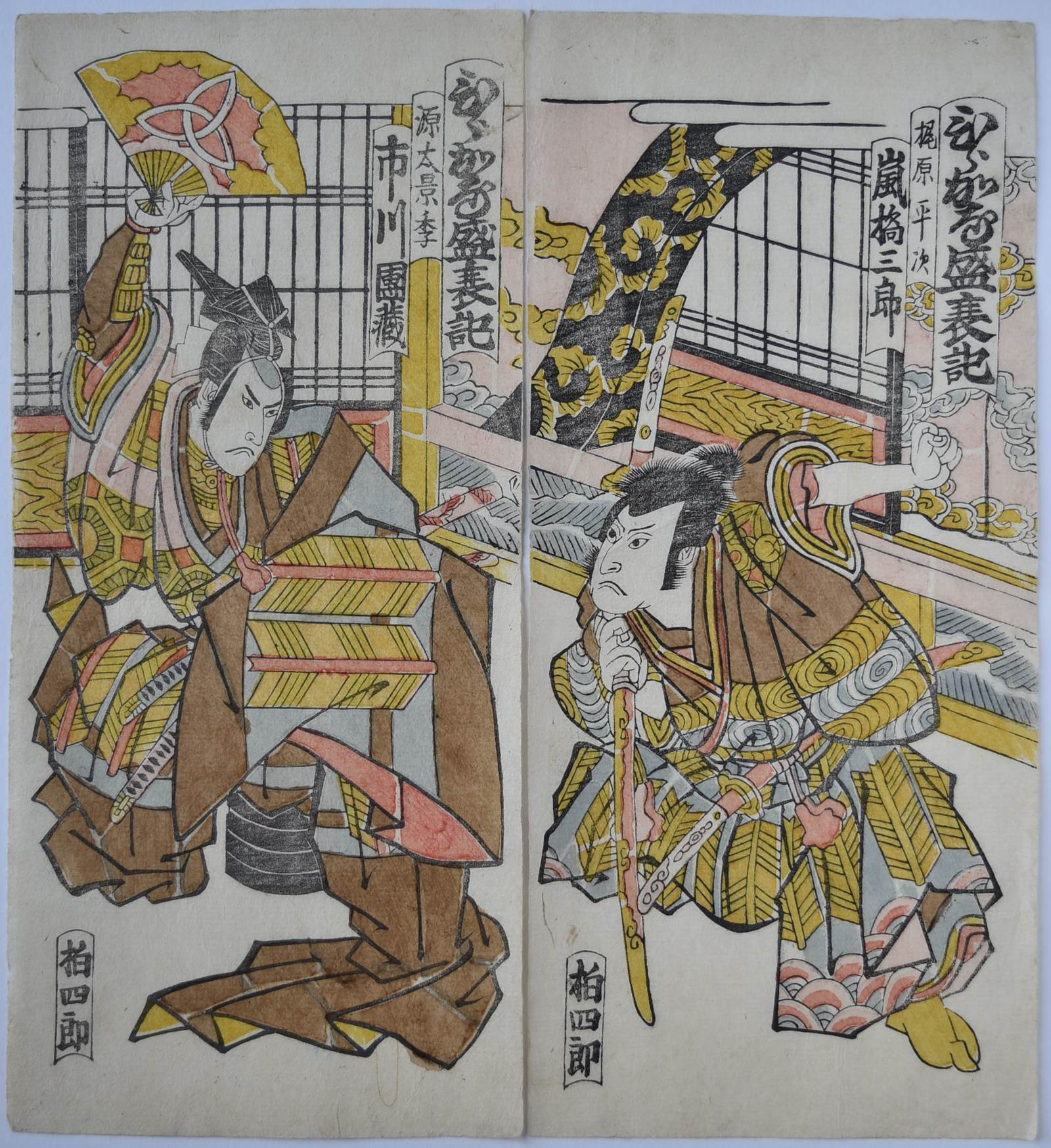
An early Osaka kappazuri-e hosoban diptych (printed with woodblock outline and stencilled colours) showing, on the left sheet, Ichikawa Danzo V in the role of Genta Kagesue, and on the right sheet Arashi Kitsusaburo II in the role of Kajiwara Heiji Kagetaka in the “Genta Kando” act of Hirakana seisuiki, performed at the Kitagawa no Shibai, Osaka, 7/1827. Unidentified publisher’s seal. Complete diptychs are very rare.
Fine impression: Beautifully printed for a kappazuri print. Fine colour and condition.
Status: Sold
Toyohara KUNICHIKA (1835-1900)
Click here to view image full size.
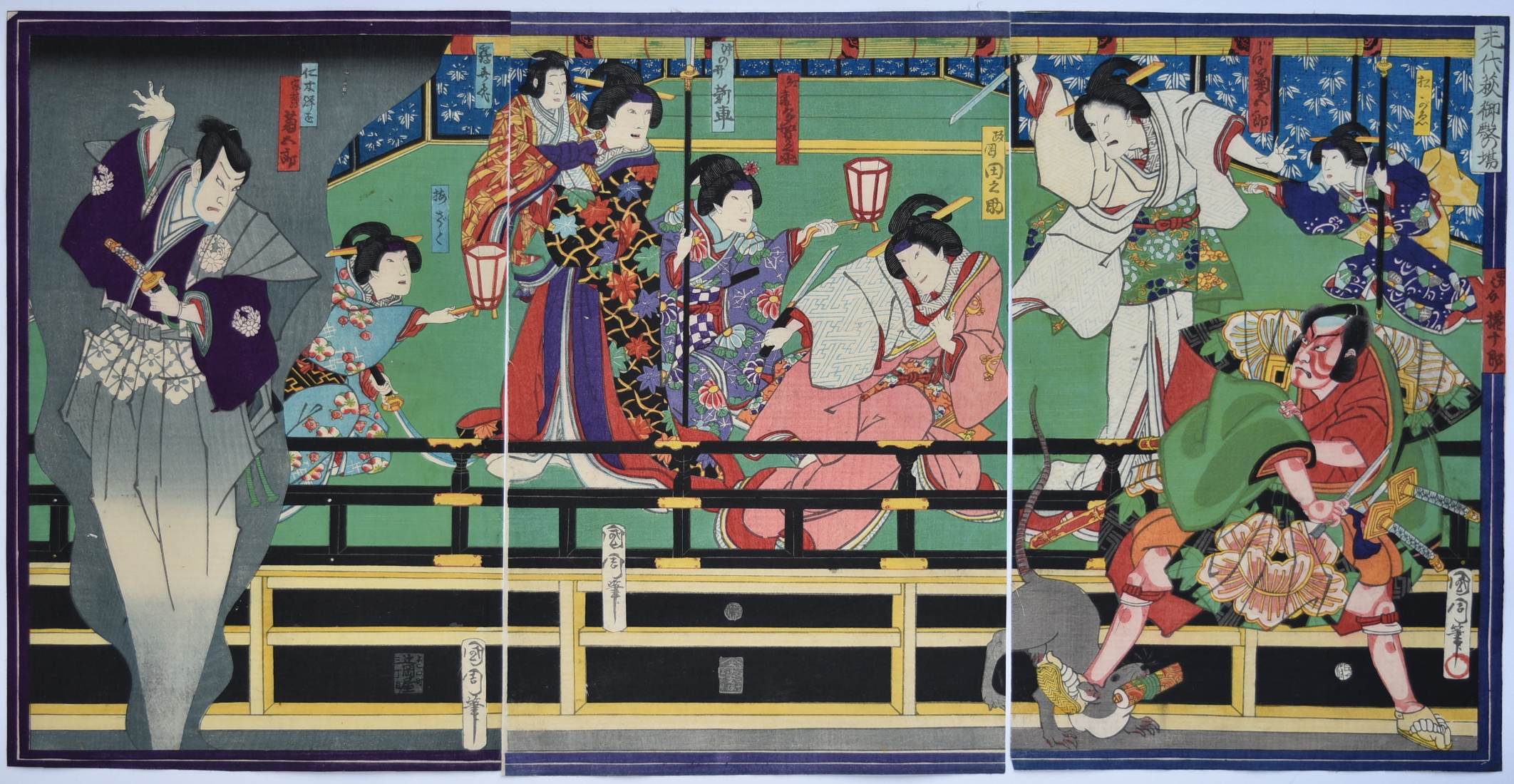
A triptych of the famous scene from Meiboku Sendai hagi “The Disputed Succession” showing Kawarasaki Gonjuro I as Arajishi Otokonosuke and Onoe Kikugoro V as Yoshio. The rat with the scroll of conspirators is attacked, escapes, and reappears through a trapdoor in its true guise as the evil Nikki Danjo. Published by Tsujiokaya Bunsuke, 1869.
Fine impression, colour and condition. Signed Kunichika hitsu.
Status: Sold
Utagawa KUNISADA (1786-1865)
Click here to view image full size.
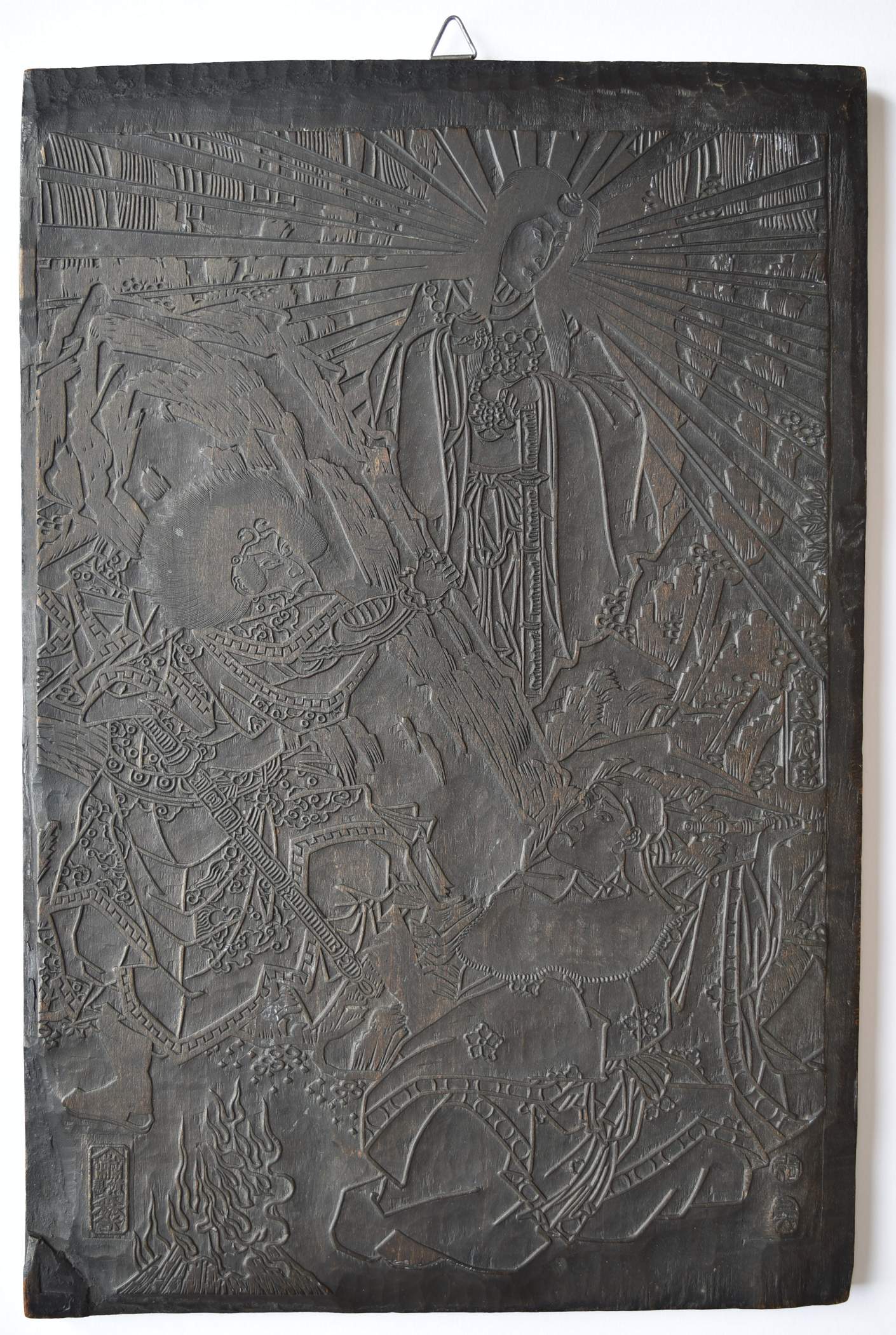
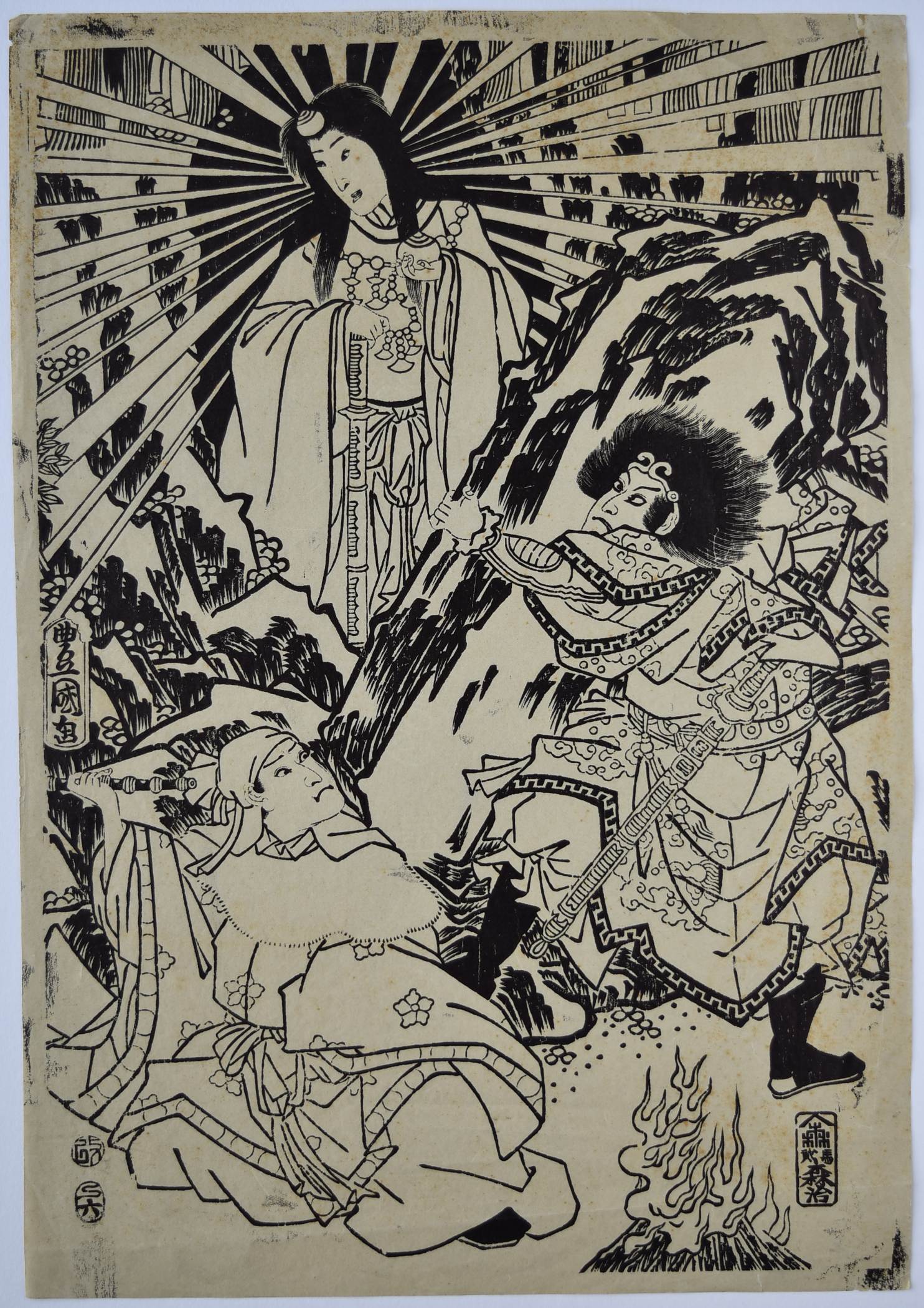
An original woodblock for printing the centre sheet of a triptych showing Ame no Tajikarao pulling the giant stone away from the Ama-no-Iwato cave where Amaterasu (the Sun Goddess) had ensconced herself thereby depriving the world of light. The block cut by the publisher Moriya Jihei, 6/1857. The block in very good condition. On the reverse side is the yellow block. Sold with a modern pull from the block. Signed Toyokuni ga.
Status: Sold
Click here to view image full size.
Ippitsusai BUNCHO (Fl. c. 1765-1792)
Click here to view image full size.
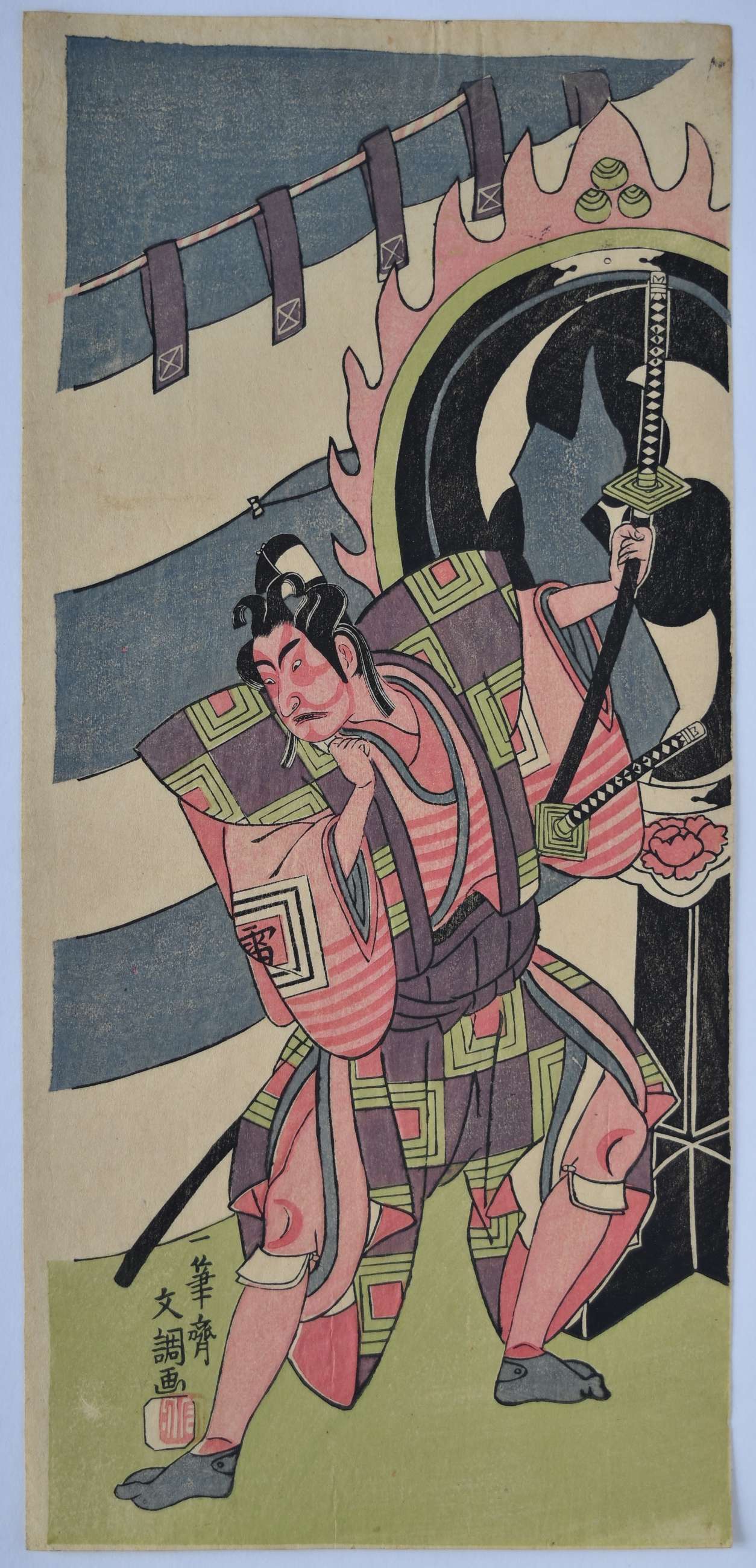
A hosoban showing the actor Ichikawa Raizo II as Kanesashi Goro Katsuhide in the play Kawaranu hanasakae hachi no ki, “The Ever-Blooming Potted Tree.” Performed at the Nakamura-za Theatre in 11/1769. Extremely rare: Another impression is illustrated in an Exhibition of Ukiyo-e by Ippitsusai Buncho, Riccar Art Museum, 1978, no. 40. Their example is annotated on the top left: Meiwa 6 nen, kaomise, Kanesashi Goro, Ichikawa Raizo. The kaomise production was always in the 11th month and was quite literally the “face showing” of actors for the coming season. There are a considerable number of hosobans annotated in the same hand around this time – obviously by an avid theatre goer. Buncho was the pre-eminent designer of hosobans in the second half of the 18th century. He subsequently became a samurai. He was also a painter and, together with Shunsho, produced the fine three volume book Ehon butai ogi of stage actors in 1770.
Superb impression, colour and condition: As the day it was printed. Signed Ippitsusai Buncho ga with seal Mori uji (offset as on the Riccar impression).
Status: Sold
Utagawa TOYOKUNI (1769-1825)
Click here to view image full size.
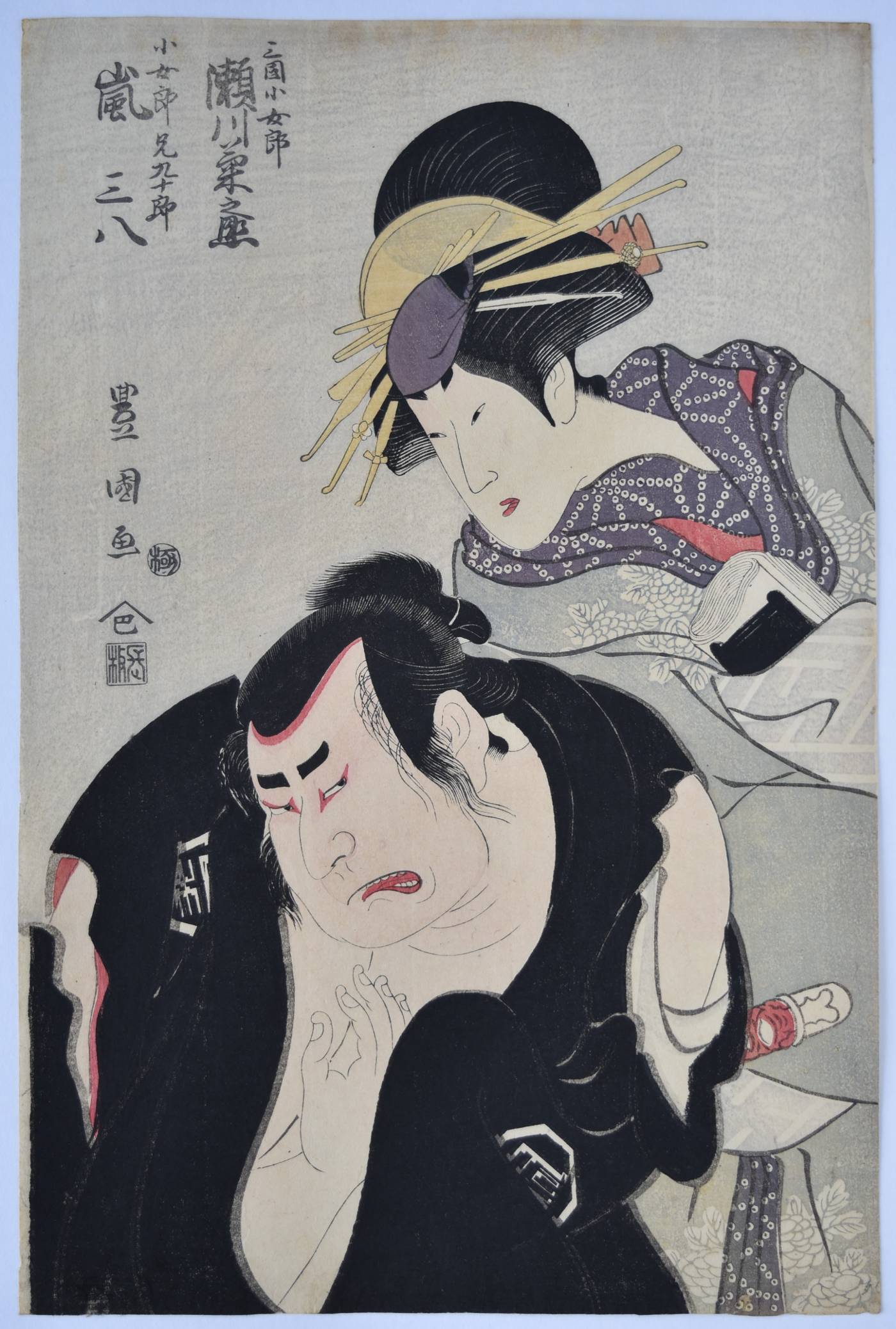
Segawa Kikunojo III as the courtesan Kojoro of the Mikuni House (Mikuni Kojoro) and Arashi Sanpachi I as her elder brother Kujuro (Kojoro ani Kujuro) in the play Tomigaoka koi no yamabiraki by Namiki Gohei performed at the Kin-za in the 1st month of 1798. The design shows the evil cormorant fisherman Ugai Kujuro attempting to extract money from his younger sister whom he had previously sold into prostitution. He is eventually murdered by the hero Shimbei who is in love with Kojoro. Published by Nishimuraya Yohachi. Rare: A faded example in B.M. (1906, 1220, 0.391). And another faded impression in the Museum of Fine Arts, Boston, acc. No. 11.13701. One of the great Toyokuni double bust portraits.
Fine impression and colour. Very slight trimming at bottom, otherwise fine condition. Signed Toyokuni ga.
Status: Sold
Toyohara KUNICHIKA (1835-1900)
Click here to view image full size.
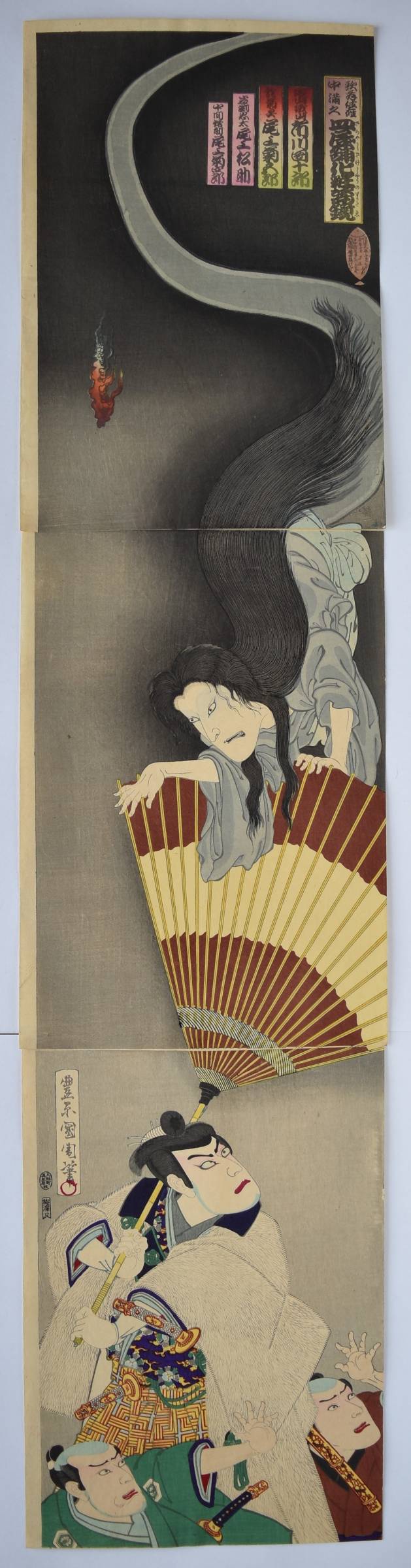
A vertical oban triptych showing Onoe Kikugoro V as Okiku’s ghost, above, and Ichikawa Danjuro IX as Asayama Tessan from the play Sarayashiki kesho no sugatami, “Mansion of Plates” performed at the Kabuki-za 1892. A famous ghost story with different versions. The gist is that Okiku was a maid at the mansion of the samurai Aoyama Tessan. He attempts to seduce her without luck and as an act of revenge hides one of ten valuable Dutch plates, claiming that she has stolen one. In remorse, she drowns herself in a neighbour’s well. Her ghost appears every night, sobbing and groaning, eventually causing Aoyama to go insane. Published by Fukuda Kumajiro, 1892.
Superb impression, colour and condition. Signed Toyohara Kunichika hitsu.
Status: Sold
Yurakusai NAGAHIDE (c 1799-1848)
Click here to view image full size.
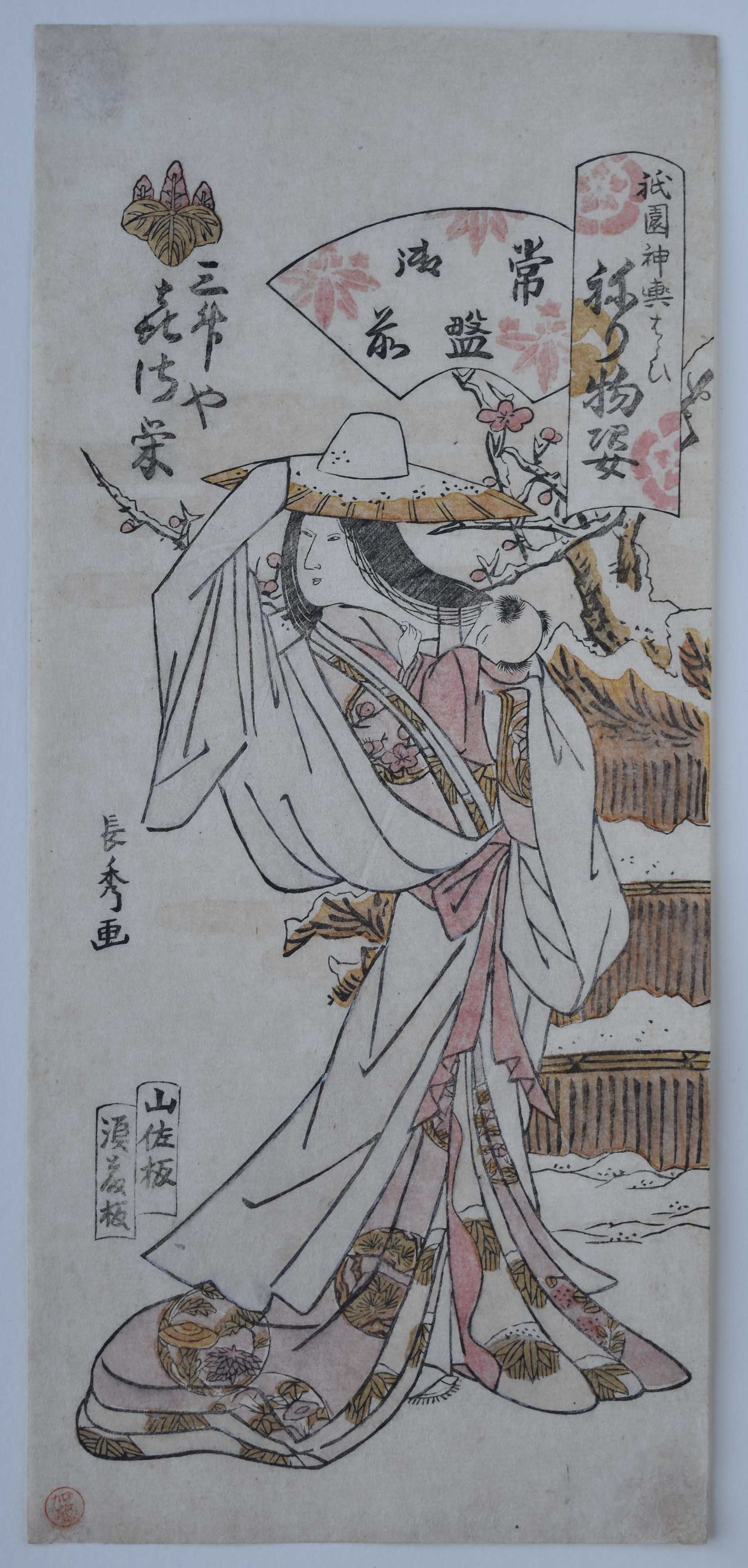
An hosoban kappazuri (coloured by stencils) print from a set: Gion mikoshi arai nerimono sugata, “Gion Festival Costume Parade.” The set was jointly designed by: Goshichi, Seikoku (Charakusai) and Toyokuni, as well as Nagahide, although he appears to have been responsible for many in the set. A large group is in the MFA, Boston, with another impression of this design being acc. no 11.26554. Published by Yamashiroya Sahei (Yamasa) c 1818. Shows a courtesan, Kisae of Mimasuya, parading in the Gion Matsuri Festival, held in the geisha quarter of Kyoto in July, dressed as Tokiwa Gozen, the mother of Minamoto no Yoshitsune. She is usually depicted fleeing through the snow during the Heiji rebellion cradling her son to her chest. Seal bottom left Kato [Shozo] who was an art dealer/collector in Oxford Street, London and sold prints to the BM in the 1920s.
Very good impression with extensive undamaged mica. Very good colour. Signs of mounting au verso, otherwise very good condition. Signed Nagahide ga.
Status: Sold
Katsukawa SHUNSHO (1726-1792)
Click here to view image full size.
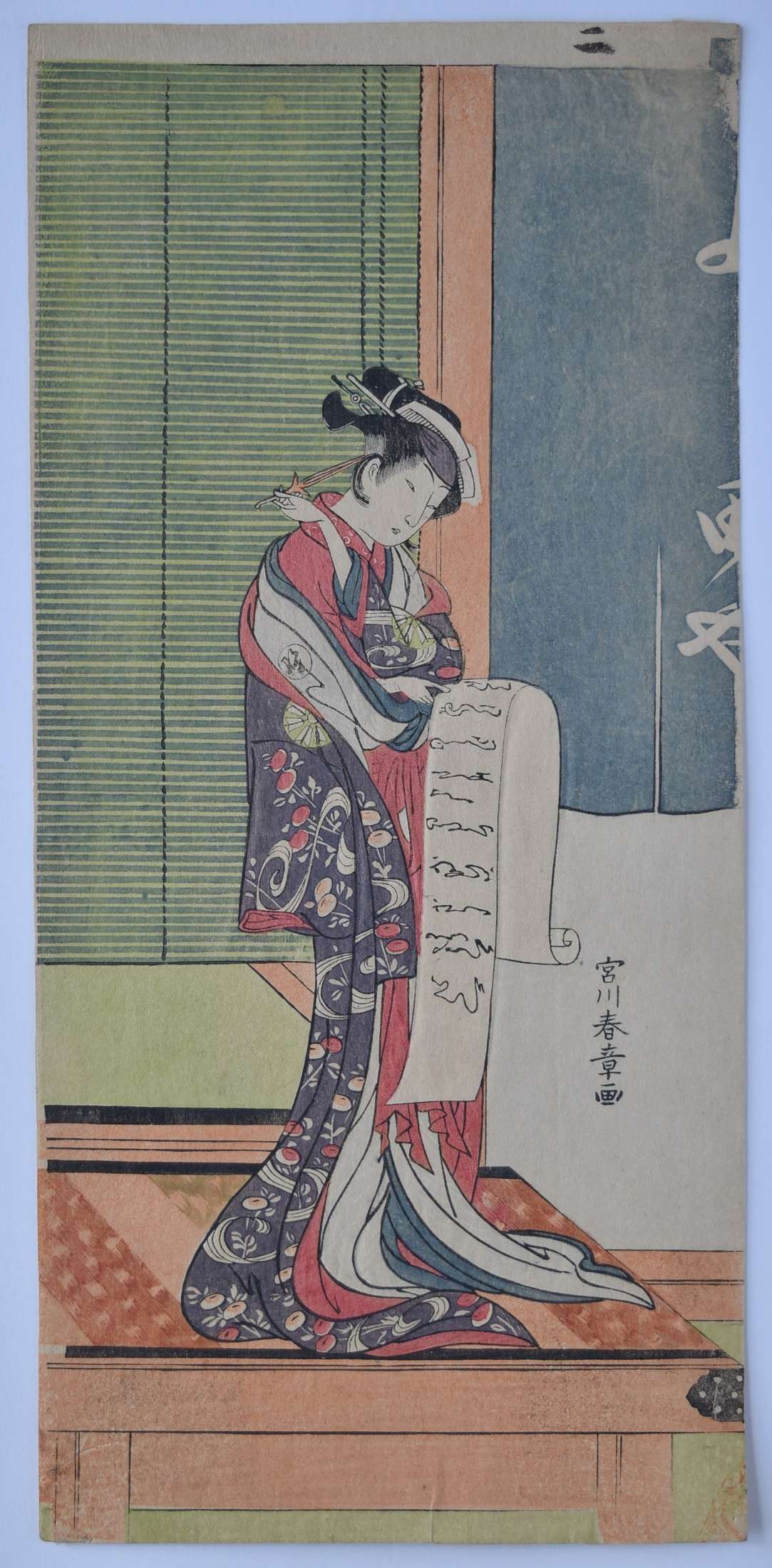
An exceptional hosoban showing the actor Nakamura Tomijuro I in the role of a courtesan. Published c. 1771 and the influence of Harunobu can be seen. Probably the centre panel of a triptych.
Superb impression on thick hosho with the outlines of the figure in relief, similar to the best Harunobu prints of a few years earlier. Very fine unfaded colour. Fine condition. Signed Miyagawa Shunsho. (A signature I have not seen before: He did study under Miyagawa Shunsui early on.)
Status: Sold
Rantokusai SHUNDO (Active c.1770-1790)
Click here to view image full size.
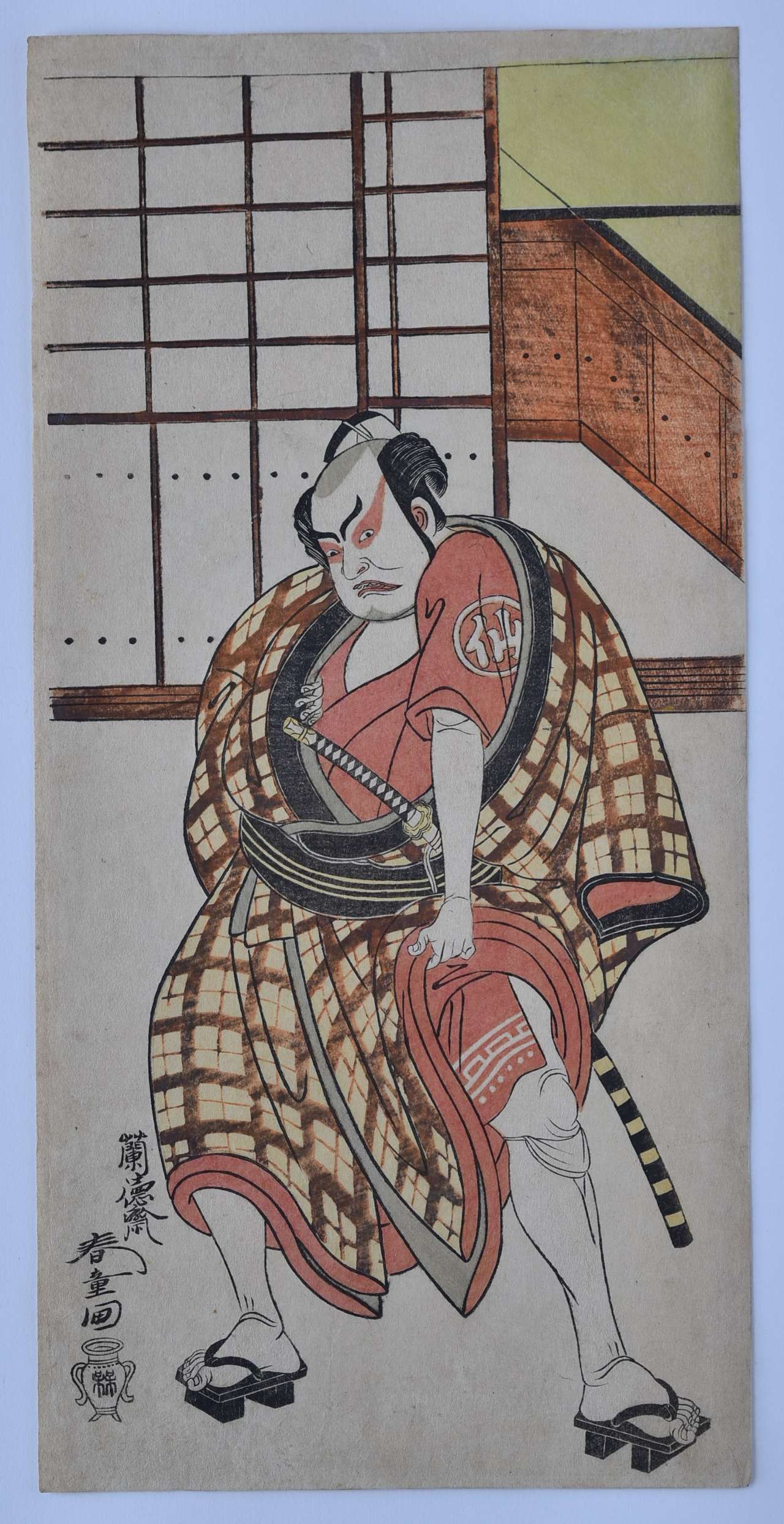
A hosoban showing the actor Nakamura Sukegoro II as Sasano Sangobei (an otokodate – chivalrous commoner) in part two of the play Iro moyo aoyagi Soga, “Green Willow Soga of Erotic Design.” Performed at the Nakamura Theater 2/1775. Shundo was an early pupil of Shunsho’s and this fine design is comparable to the best that Shunsho produced. The left sheet of a diptych. The complete (faded) design is illustrated in The Actor’s Image, Clark & Ueda, A.I.C., 1994, no. 135, p. 358/9. Rare.
Fine impression. Fine, totally unfaded colour. Fine condition. Signed Rantokusai Shundo ga with Hayashi in jar-shaped seal.
Status: Sold
Toyohara KUNICHIKA (1835-1900)
Click here to view image full size.
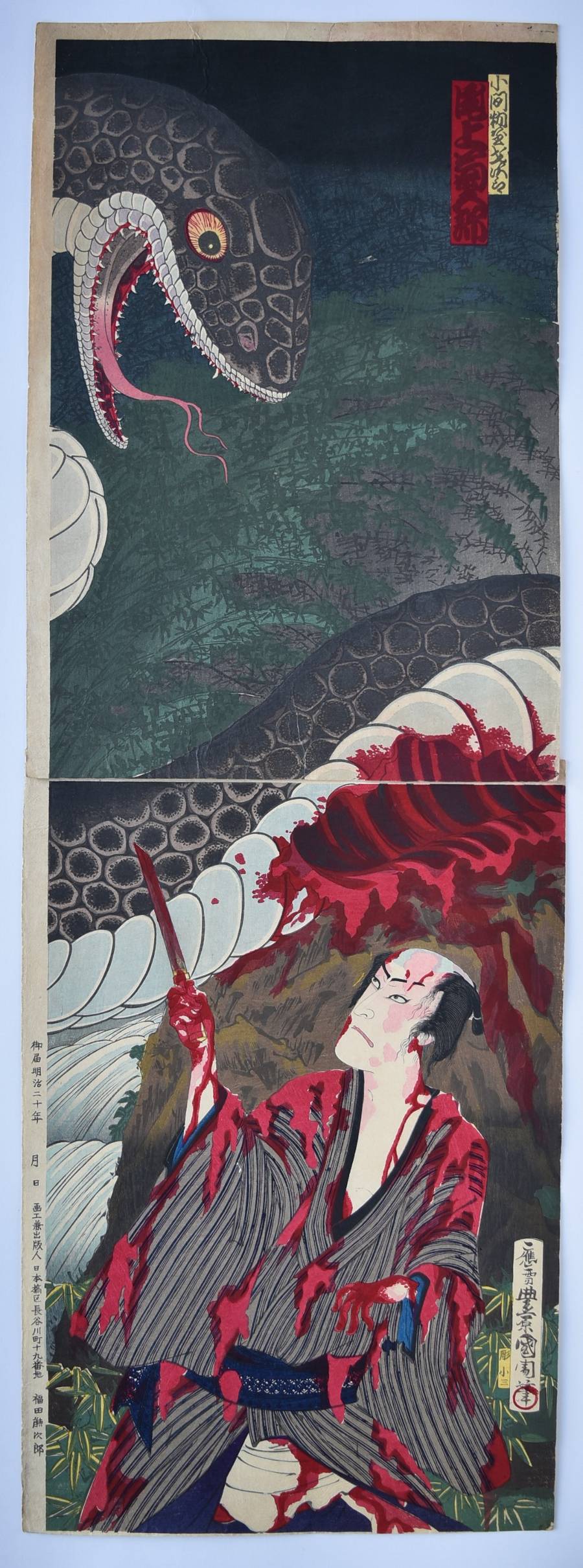
A vertical diptych showing the actor Onoe Kikugoro V in the role of Komamonoya Saijiro, “Saijiro of the haberdashery store,” fighting a giant serpent in the play Inaba Kozo ame no yobanashi performed at the Nakamura-za theatre in 11/1887. Published by Fukuda Kumajiro, 1887. Evidently the actor was swallowed whole during this scene ! An extremely rare print.
Fine impression and colour. Extensive mica on the serpent’s head and body. Fine condition with the publication details intact on the left margin. Ample room for joining the two sheets. Signed Oju Toyohara Kunichika hitsu.
Status: Sold
Utagawa TOYOKUNI (1769-1825)
Click here to view image full size.
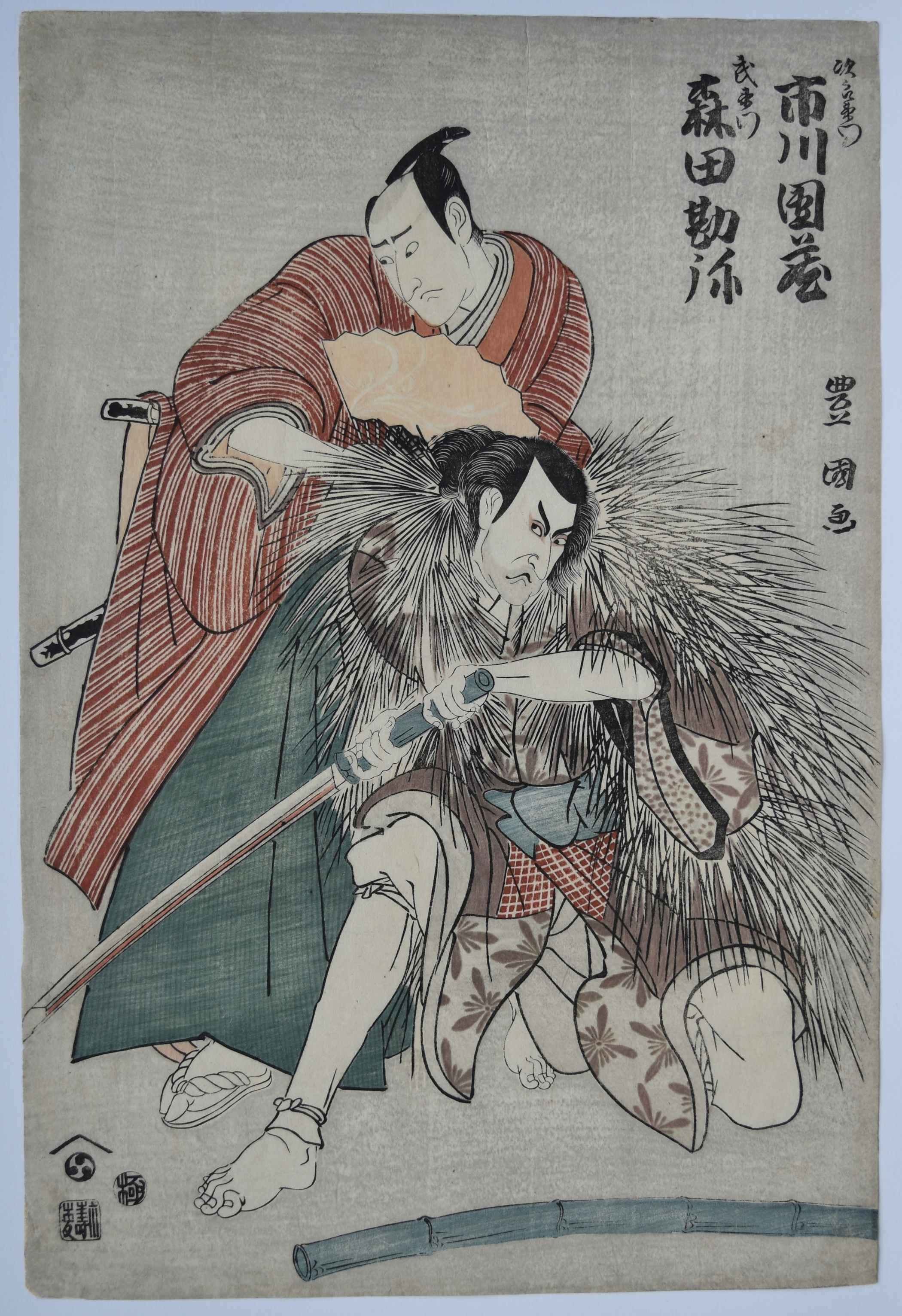
Shows Ichikawa Danzo IV as Shundo Jiroemon disguised as a beggar and Morita Kan’ya VIII as Takaichi Buemon in the Daianji Zutsumi scene from the play Katakiuchi tsuzure no nishiki, “The Vendetta in Patched-Brocade.” A fine grey-ground print published by Eijudo, 1798. Ichikawa Danzo IV had one of the great Kabuki faces. See the 1799 Toyokuni bust of Danzo as Keyamura Rokusuke in the drama Hikosan Gongen Chikai no Sukedachi.
Fine impression. Very good colour and condition. Signed Toyokuni ga.
Status: Sold
Toyohara KUNICHIKA (1835-1900)
Click here to view image full size.
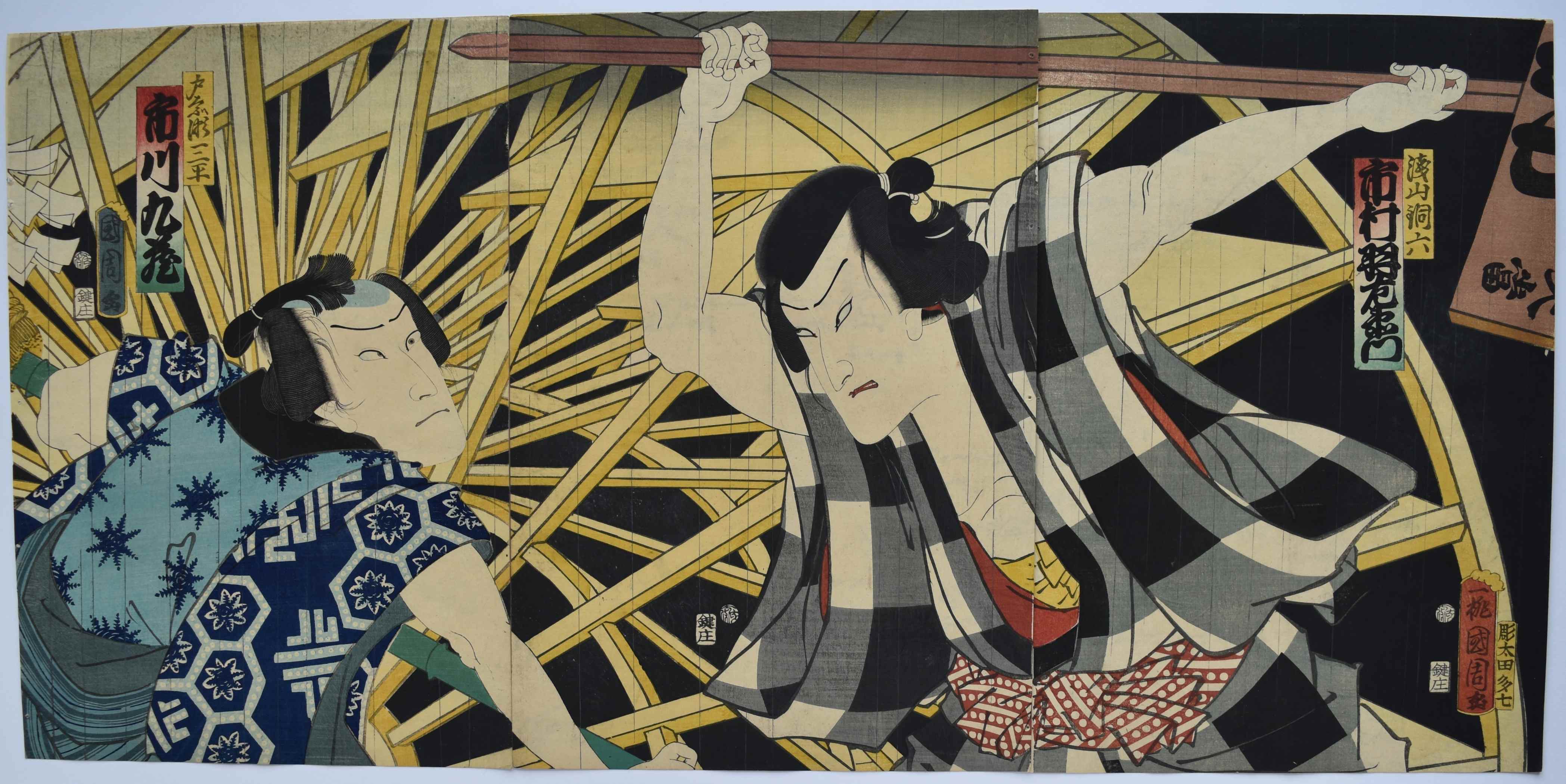
In heavy rain before a giant waterwheel are two actors: On the right Ichimura Uzaemon XIII as the commoner Doroku confronting Ichikawa Kuzo III as Sanpei from the play Sarayashiki kesho no sugatami, “The Mansion of Plates and the Cursed Makeup Mirror.” Published by Kagiya Shobei, 1863.
Very good impression and colour. Backed, otherwise very good condition. Signed Kunichika ga.
Status: Sold
Toyohara KUNICHIKA (1835-1900); Utagawa KUNISADA (1786-1864); Utagawa KUNISADA II (1823-1880); Kawanabe KYOSAI (1831-1889)
Click here to view image full size.
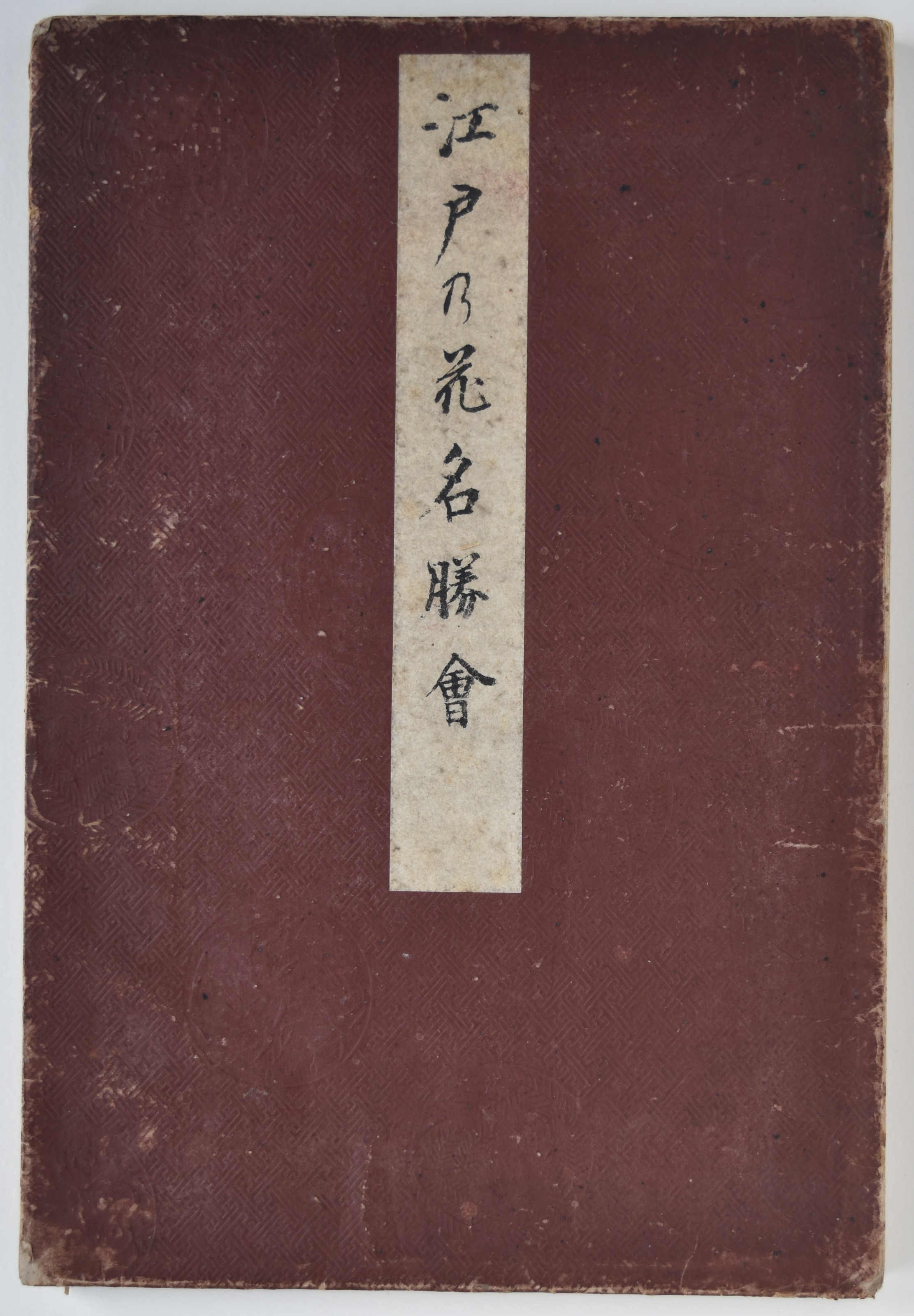
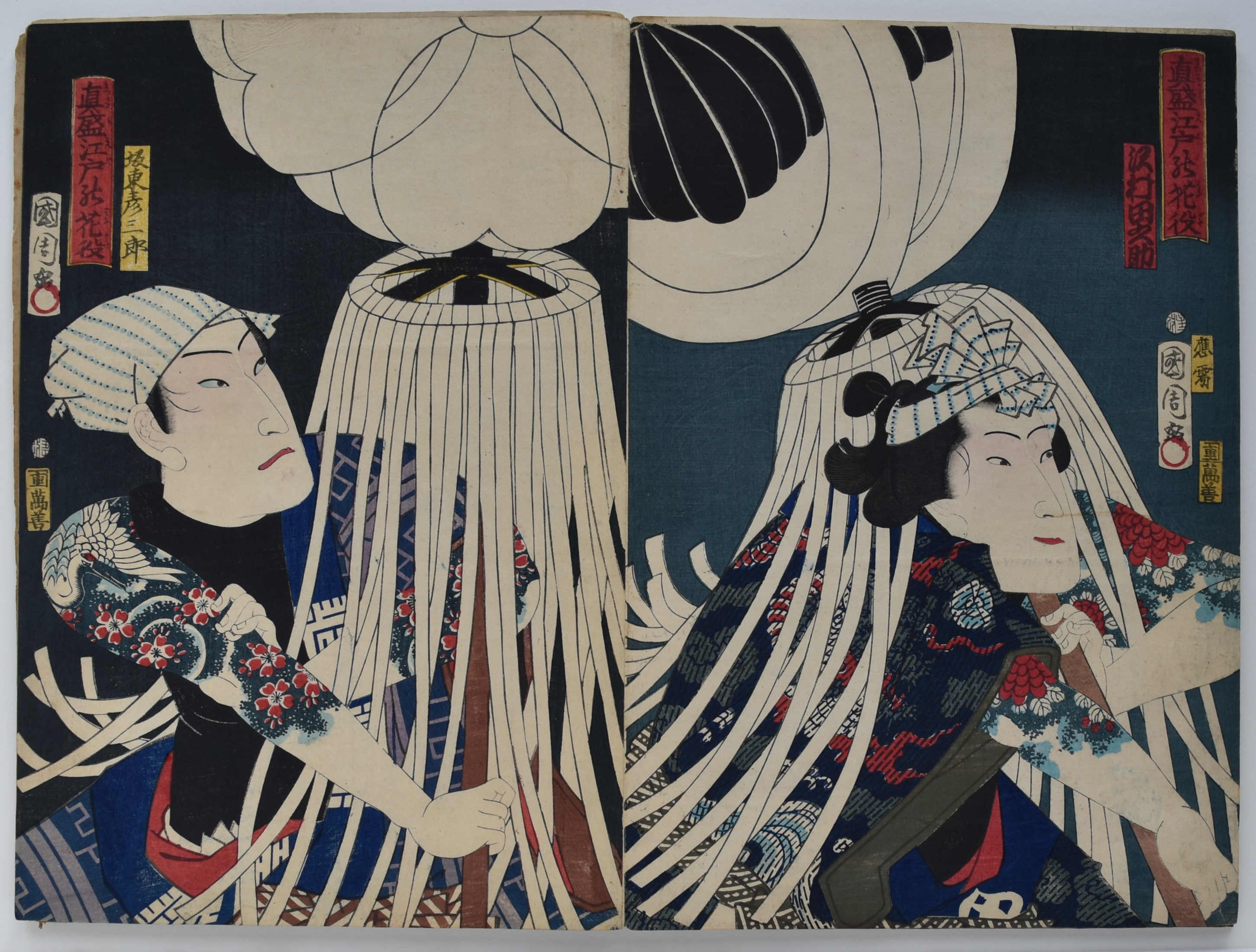
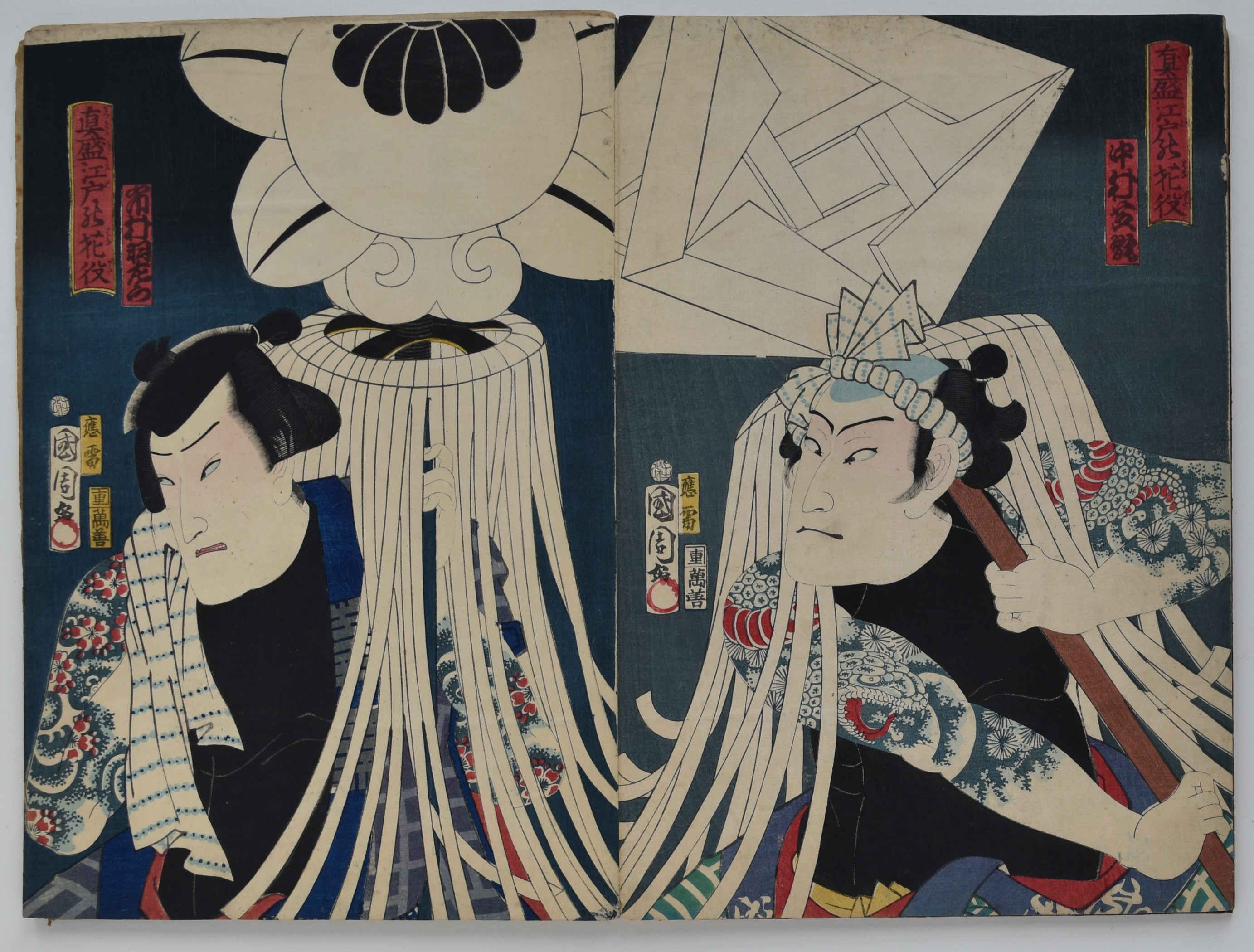
A concertina orihon consisting of 64 prints by the above artists. Various date seals to the early 1860s, the latest being 1865, which is presumably when the album was assembled. (Although the album is dated 1864.) Includes the excellent Kunichika 7-sheet tattooed firemen set: Sakari Edo no hanagata. Fine impressions and colour. Minor creasing and partial separation, otherwise very good condition. Untrimmed. The prints lightly adhered along the left edge only. Albums of prints were produced in great numbers and their contents vary: Some are of complete sets, while others cover a specific subject such as wrestler prints or are collections of a specific artist; but many are anything but homogeneous, even having incomplete diptychs, triptychs, etc and are not necessarily contemporaneous.
Status: Sold

Toyohara KUNICHIKA (1835-1900); Utagawa KUNISADA (1786-1864); Utagawa KUNISADA II (1823-1880)

Click here to view image full size.
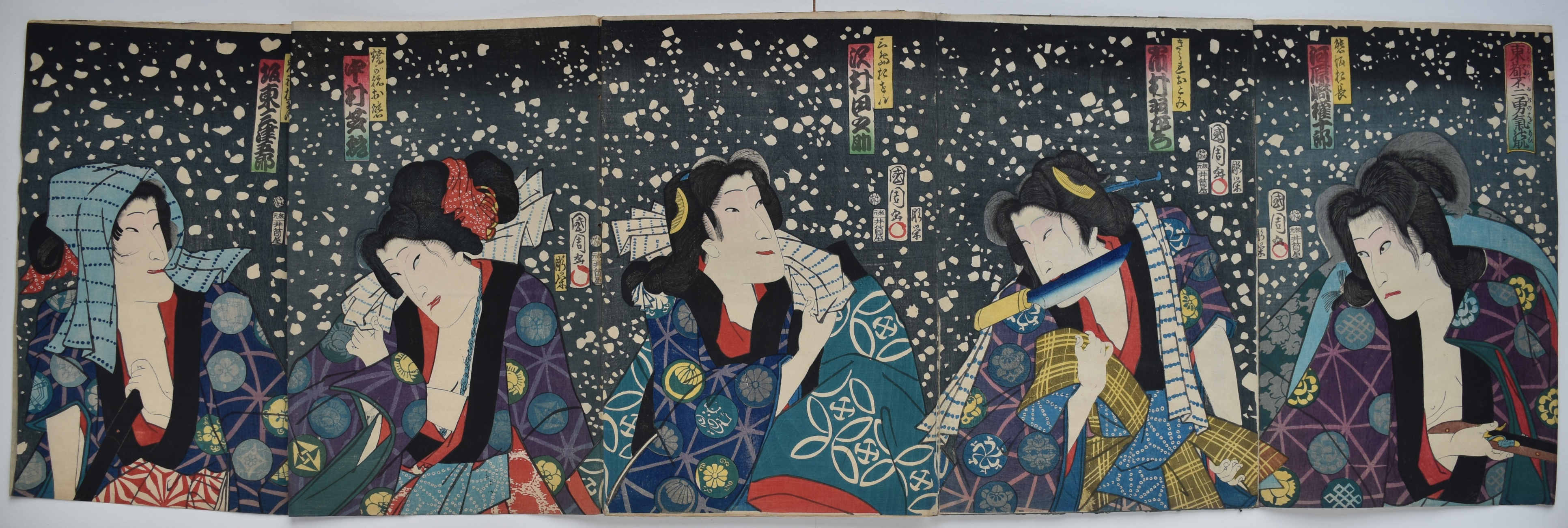
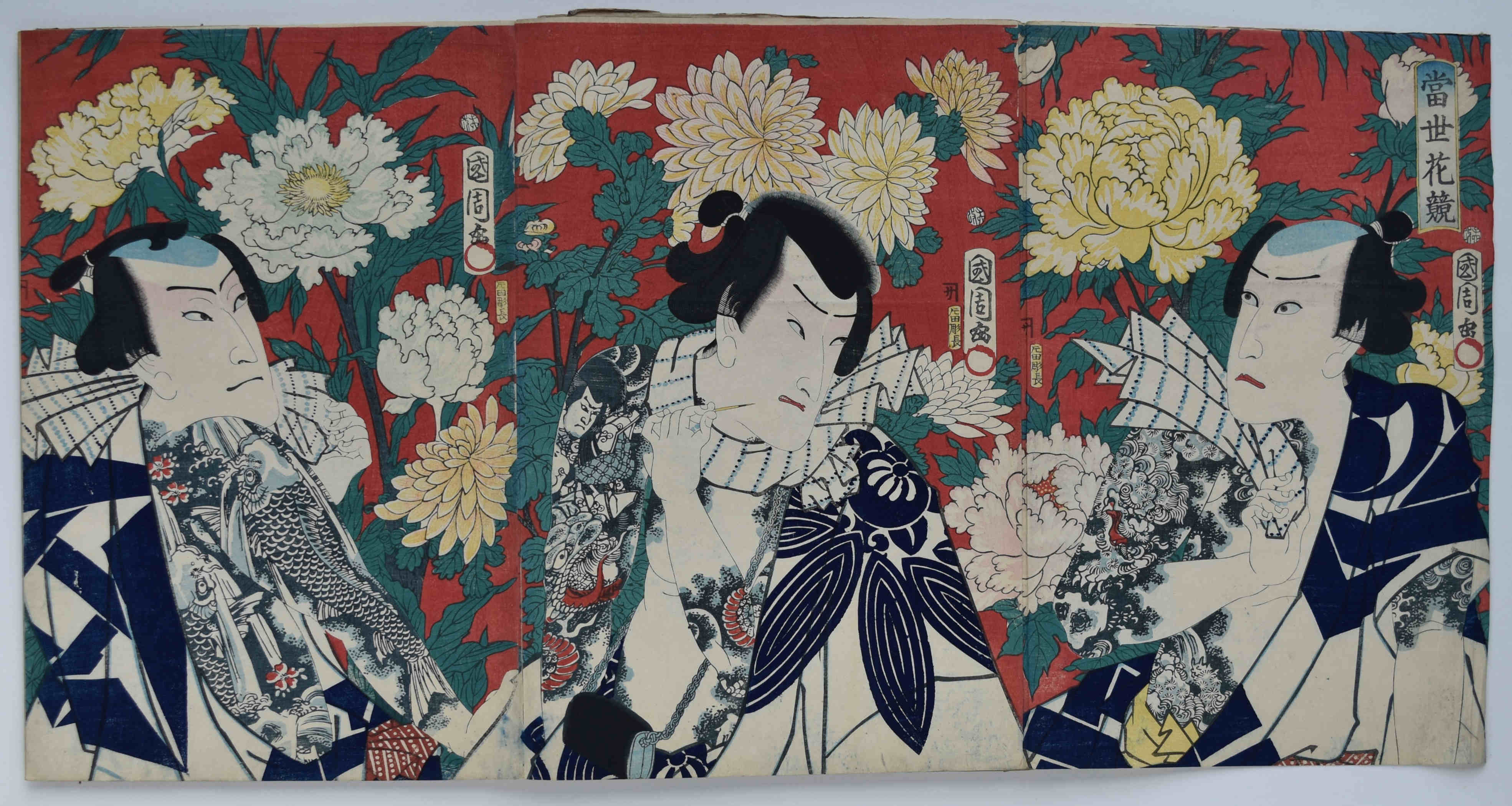
A concertina orihon consisting of 52 prints by the above artists. Various date seals to the early 1860s, the latest being 1865, which is presumably when the album was assembled. Includes the excellent Kunichika 5-sheet: Toto Fuji yuki no hada-ai. Fine impressions and colour. Some edge creasing and partial separation, otherwise very good condition. Untrimmed. The prints lightly adhered along the left edge only. Albums of prints were produced in great numbers and their contents vary: Some are of complete sets, while others cover a specific subject such as wrestler prints or are collections of a specific artist; but many are anything but homogeneous, even having incomplete diptychs, triptychs, etc and are not necessarily contemporaneous.
Status: Sold
Anonymous (c 1770s)

Click here to view image full size.
An uki-e, “perspective print” of a Kabuki theatre: Shinpan uki-e san shibai Kabuki kyogen no zu, “ Newly Published Uki-e Picture of Kabuki Plays from the Three Theatres.” The three theatres were: Nakamura-za, Ichimura-za, Morita-za. The actors have difficult to discern mon but appear to be: Nakamura Denkuro II, Ogawa Zengoro II, Arashi Sangoro II, Segawa Kikujiro III. Published by Iwatoya Genpachi who worked c 1758-82 and published uki-e prints by Utagawa Toyoharu, c 1770s. Toyoharu designed prints, probably based on European engravings which were viewed in stereoscopes. But he was not the first to use Western one-point perspective: Okumura Masanobu produced interiors using the method although Toyoharu introduced exteriors.
Very good impression, colour and condition. Unsigned.
Status: Sold
Utagawa YOSHITSUYA (1822-1866)


A set of 8 prints showing actors as firefighters: Edo no hana yoru no nigiwai, “Flowers of Edo, Excitement at Night.” It’s generally catalogued as having 8 designs, however the MFA Boston has a design not shown here: acc. no. 11.37798, so it seems there are 9 or 10 in complete set. It looks like there was originally a triptych published with the title showing the actors Ichikawa Kodanji IV (left), Kawarazaki Gonjuro I (centre), Nakamura Shikan IV (right) and then extra sheets were added which can be assembled as desired. Each sheet with hand-splashed gofun (oxidised) in the sky to resemble flying embers or sparks from the fires. Firemen were notorious for their rowdy behaviour and rivalrous nature leading to open hostility with other groups such as sumo wrestlers. Fires were a constant threat due to the building materials used, and firefighters were not above starting fires themselves in order to be the first on the scene (especially if they were in the construction business). Published by Ebiya Rinnosuke, 1860. Exceptional printing and designs on the thick, quilted cotton-soaked firefighters’ jackets (hikeshi-banten).
Fine impressions and colour. Minor marks, otherwise fine condition. Signed Icheisai Yoshitsuya ga on each sheet.
Status: Sold
Utagawa KUNISADA (1786-1865)
Click here to view image full size.
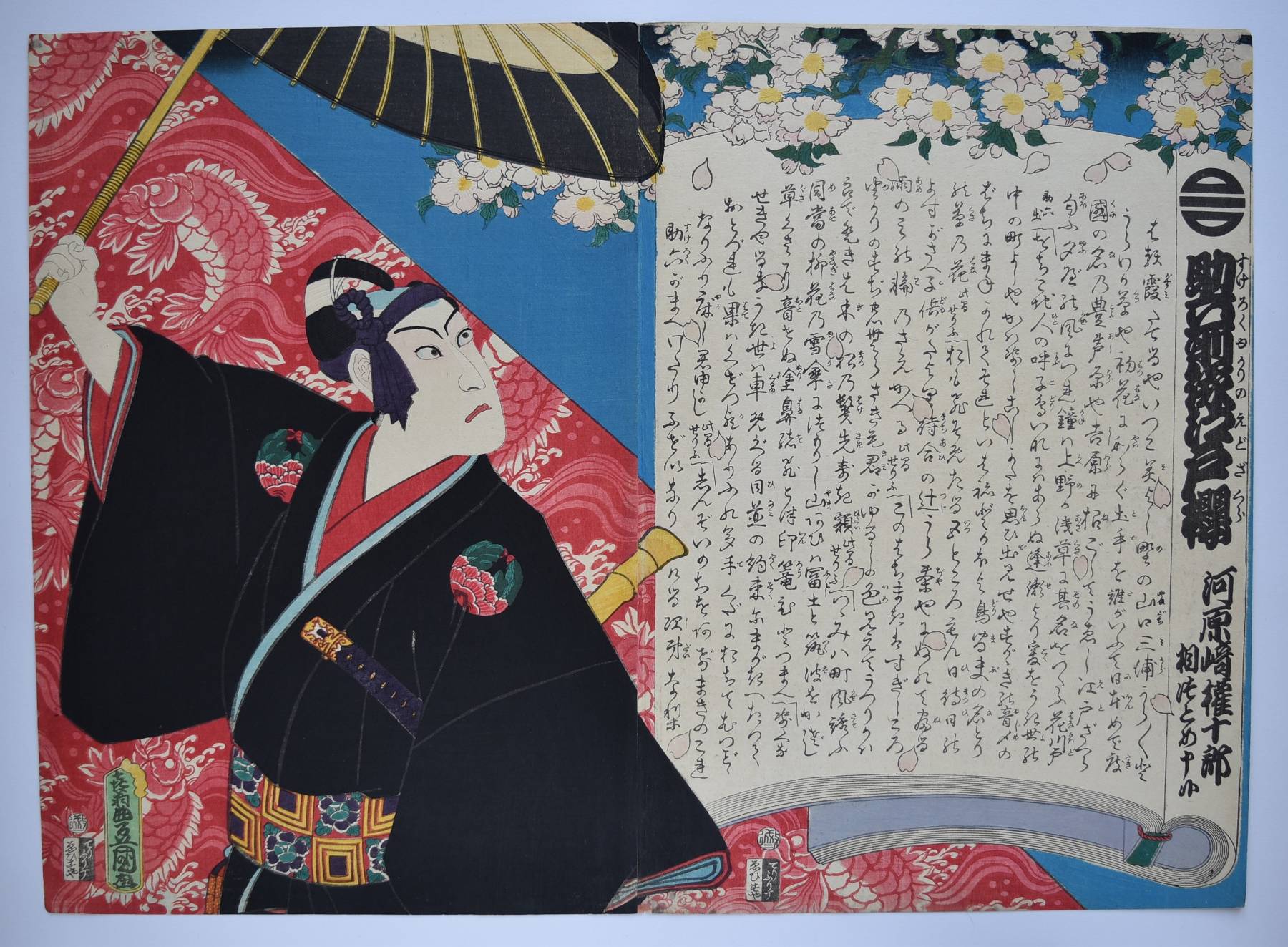
A dai-oban print showing the actor Kawarazaki Gonjuro I (Ichikawa Danjuro IX) in the role of Hanakawado no Sukeroku, an otokodate (chivalrous commoner) in the play Sukeroku yukari no Edo zakura, “Sukeroku, the Flower of Edo.” This play was performed at the Ichimura Theatre, Edo in 3/1862 and this print was published by Ebisuya Shoshichi the previous month to advertise the play. The storyline is based after the exploits of Soga no Goro and was one of the Kabuki juhachiban compiled by Ichikawa Danjuro VII for the family repertoire.
Fine impression with burnishing on the costume. Fine colour. Light album backing, otherwise fine condition. Untrimmed. Signed Ki-o Toyokuni ga.
Status: Sold
Torii KIYOMASU II (Fl. c 1720s-1760)
Click here to view image full size.
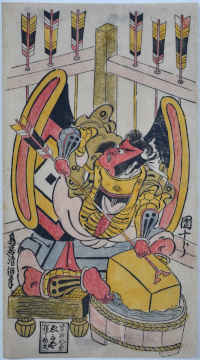
An outstanding primitive showing the actor Ichikawa Danjuro II as Soga no Goro in a scene from Yanone, “The Arrow Sharpener.” One of the most popular of the Soga Brothers vendetta plays that was later designated one of the Eight Great Kabuki Plays. The role first performed as part of Suehiro eho Soga, “A Fan of the Auspicious Direction for the Soga Brothers” at the Nakamura Theatre, Edo, 1/1729. The forerunner for all the subsequent versions of this scene. This performance was supposed to have been inspired by the New Year’s arrow sharpening ceremony conducted by the official arrow sharpener of the Tokugawa Shogunate in the early Edo period. Shows Danjuro grinding a huge double-headed arrow on a large whetstone. Published by Emiya Kichiemon. Extremely rare: Possibly unrecorded. Ex collection Dr E.F. (1976).
Fine impression. Urushi beni-e with hand-applied colour: tan, blue, yellow, light and dark beni and gold powder. Minor small wormhole, otherwise in exceptional condition for a print of this period. Signed Torii Kiyomasu fude.
Status: Sold
Attrib. to Torii KIYONOBU II (Fl. c 1720s-1760)
Click here to view image full size.
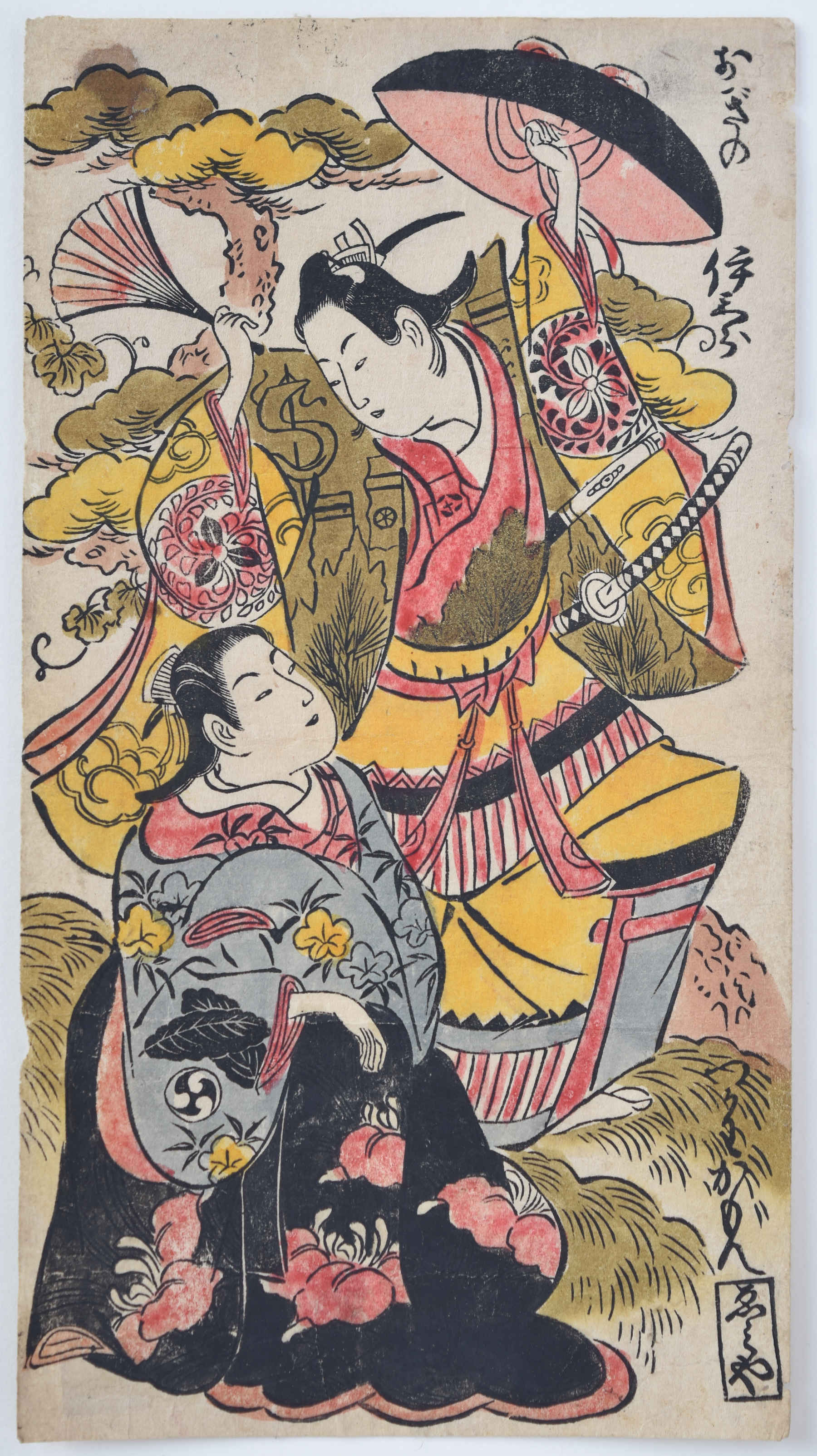
A fine primitive showing the actors Ogino Isaburo (above) and the onnagata actor Tsugawa Kamon below. Published c late 1720s by Emiya Kichiemon. Ex collection Dr E.F. (1970). Rare.
Fine impression. Urushi beni-e with hand-applied colour: tan, blue, yellow, light and dark beni, lacquered sumi over an embossed pattern and gold powder. Minor imperfections, but otherwise in exceptional condition for a print of this period.
Status: Sold
Torii KIYOMASU II (Fl. c 1720s-1760)
Click here to view image full size.
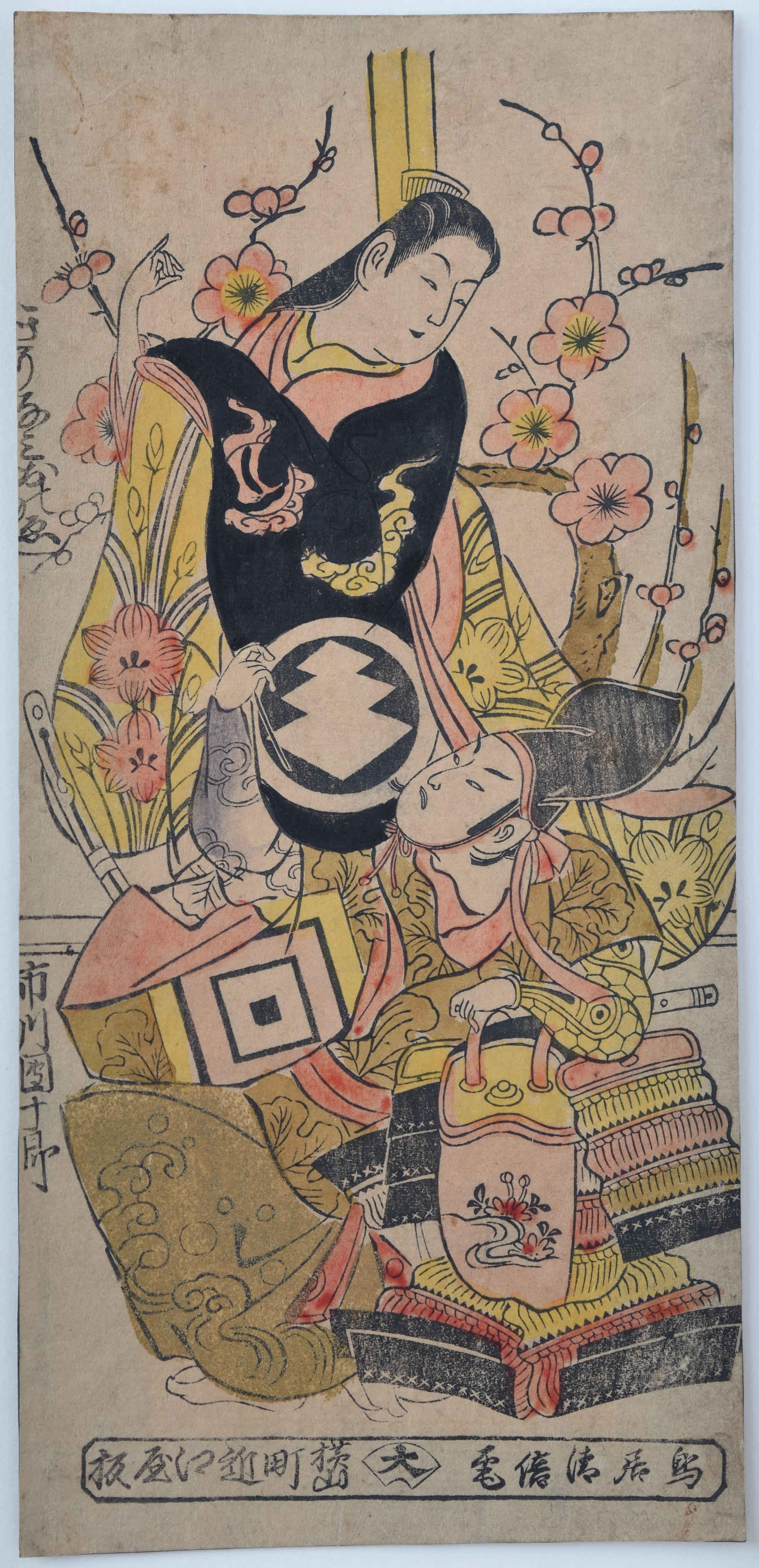
An early print showing the onnagata actor Kirinami Onoe (above) and Ichikawa Danjuro II, possibly in the play Yatsumune Taiheiki performed at the Nakamuraza Theatre, 11/1727. If it is this performance, then it’s the first time a trap-door was used. Published by Omiya Kuhei. Ex collection Dr E.F. (1966). Rare.
Fine impression. Urushi beni-e with hand-applied colour: tan, lilac, yellow, light and dark beni, lacquered sumi over an embossed pattern and gold powder. Album backing and slight toning, otherwise very good condition. Signed Kiyomasu hitsu.
Status: Sold