/category/archive/page/5/
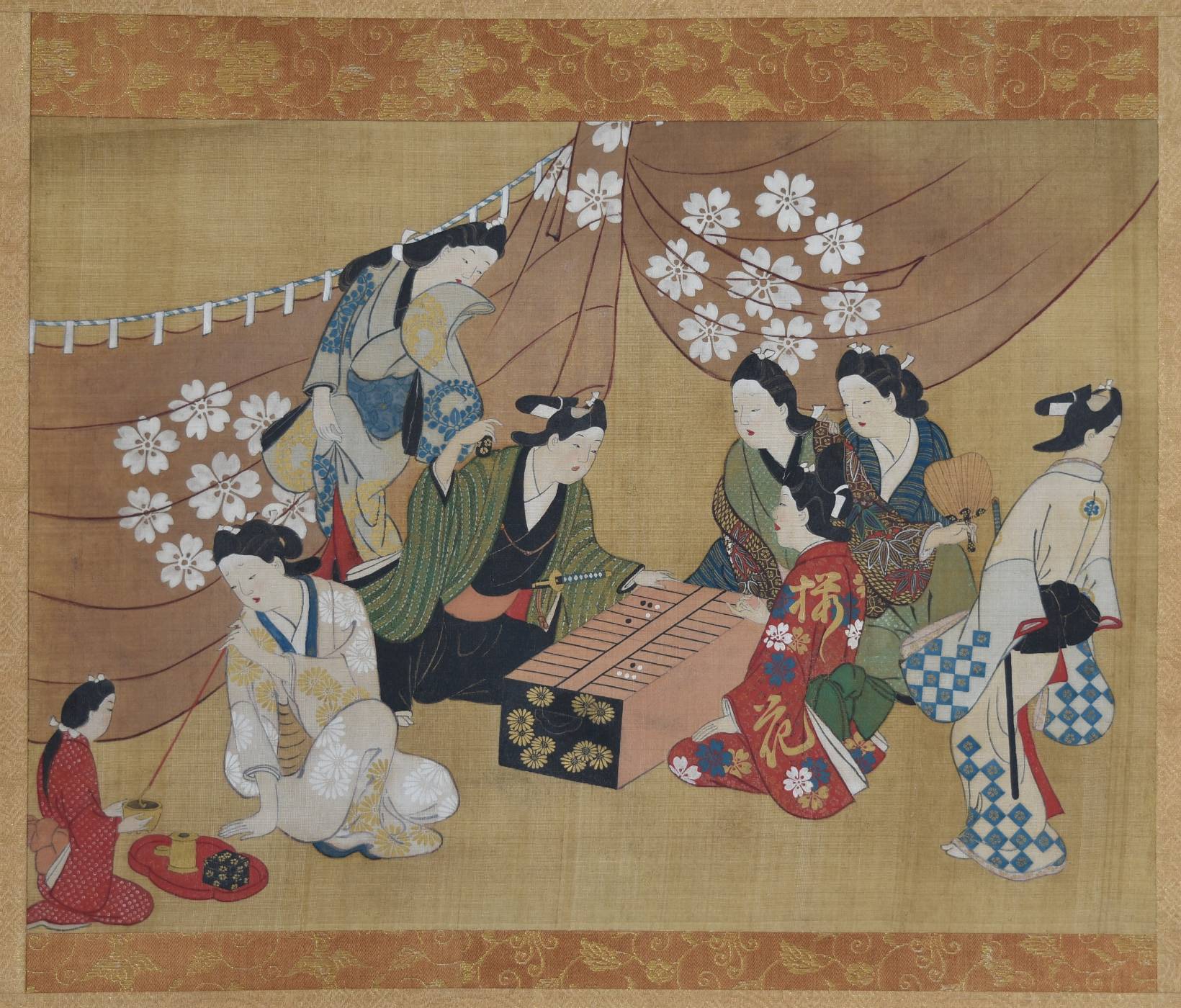
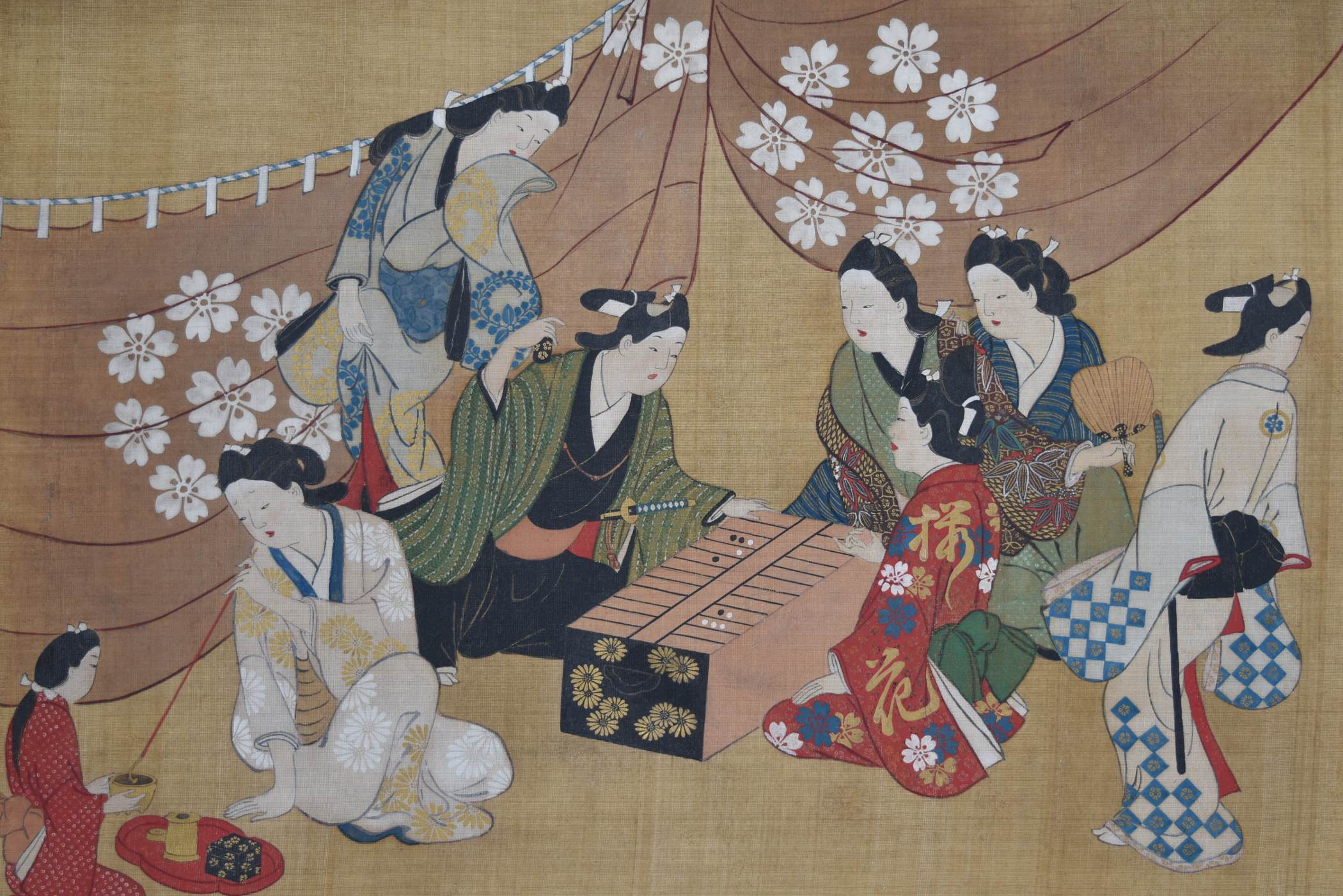
Hishikawa MOROSHIGE (Fl. 1684-1704)

Click here to view image full size.
An original painting showing a go game being watched by beautifully attired ladies. Moroshige was the senior pupil of Hishikawa Moronobu, and, it is said, was the father of Furuyama Moromasa. Sumi and full colour with extensive gold on silk; 10.75 x 15 in; 27.5 x 38 cms. Newly remounted with futomaki and box. Provenance: Ex William Sturgis Bigelow collection. He was one of the first Americans to live in Japan and much of his extensive collection went to the Museum of Fine Arts, Boston. His original seal has been affixed to the side of the box.
Painted c. 1700. In very good condition. Rare: A fine painting and nice subject.
Status: Sold

Nagasawa ROSETSU (1754-1799)
Click here to view image full size.
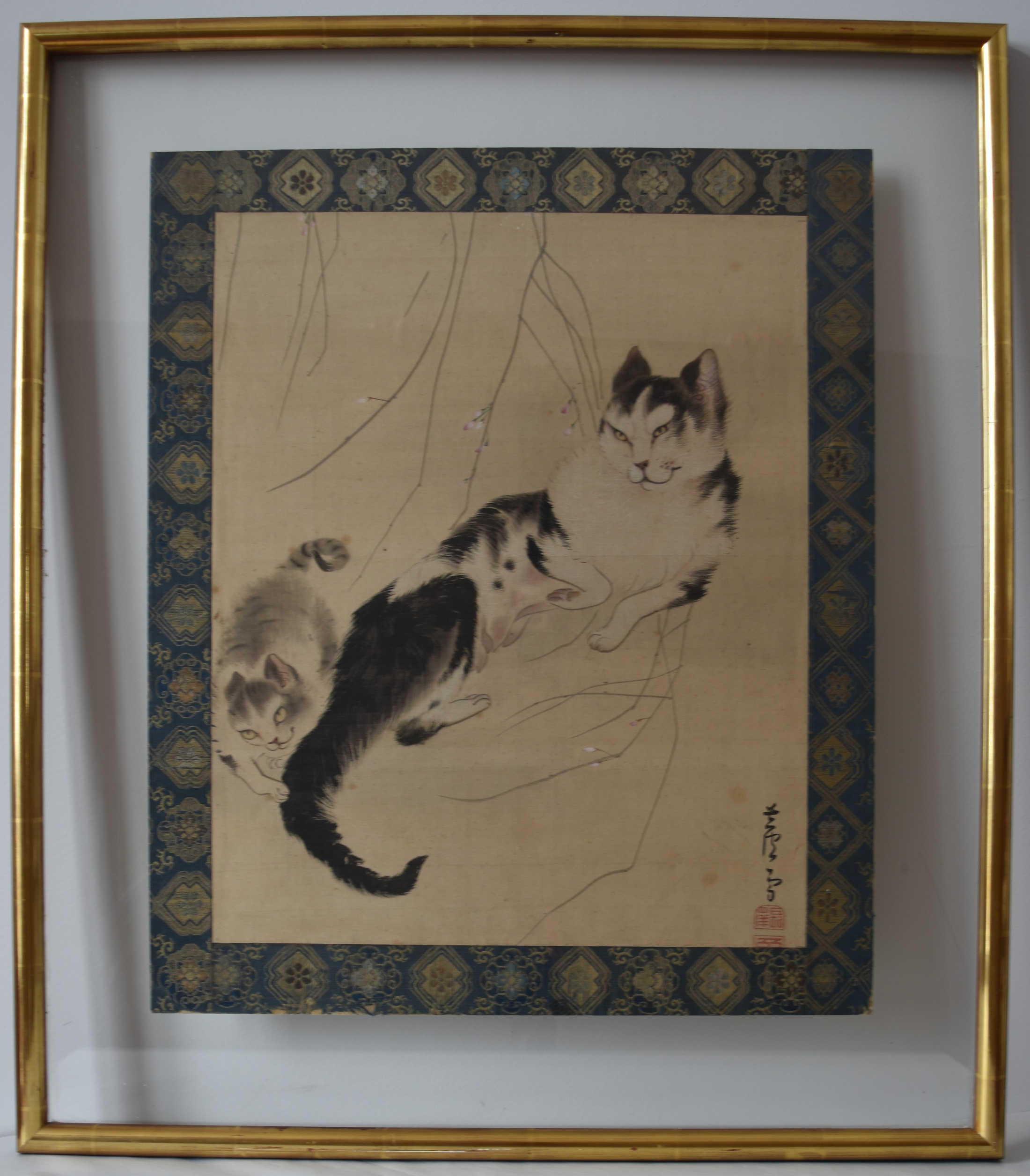
An original painting, sumi and light colour on silk, image size 17.5 x 14.25 in; 44.5 x 36 cms. Little is known of Rosetsu’s life: He was a lay student of Zen and a minor samurai. He became a pupil of Maruyama Okyo – the pre-eminent painter in Kyoto – at the age of 25. It is now generally agreed that he surpassed his teacher after some years. There are anecdotes – not verified – regarding his death, his break-up with Okyo and his drinking. Initially strongly influenced by Okyo, but then free of his style, he became highly skilled not only at more formal, finished paintings, but also at quick, spontaneous renditions. Often eccentric and not easily categorized, he was extensively faked in the Meiji period. Shows a reclining female cat who has obviously had a number of litters and a playful kitten.
A background of cherry blossom. The rendition of the furry tail and the character imbued in the face is impressive. Signed Rosetsu in sosho script of his late period (c 1795-1799) with seals Nagasawa (upper) and Gyo ‘Fish’ (lower). Unmounted and slightly cut into lower seal. Framed and glazed.
Status: Sold
Kubo SHUNMAN (1757-1820)
Click here to view image full size.
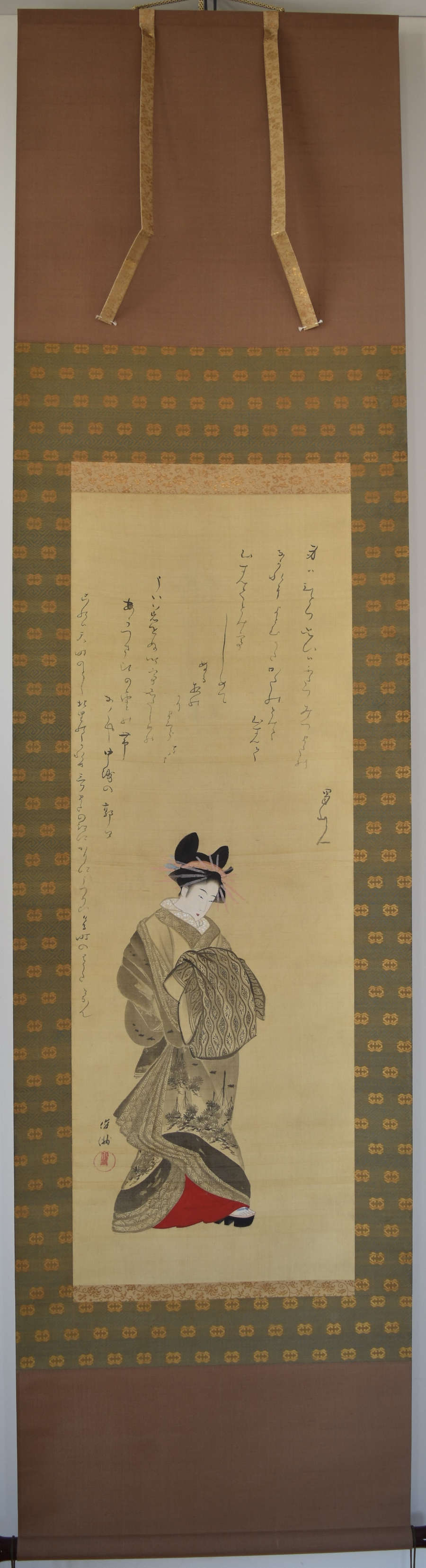
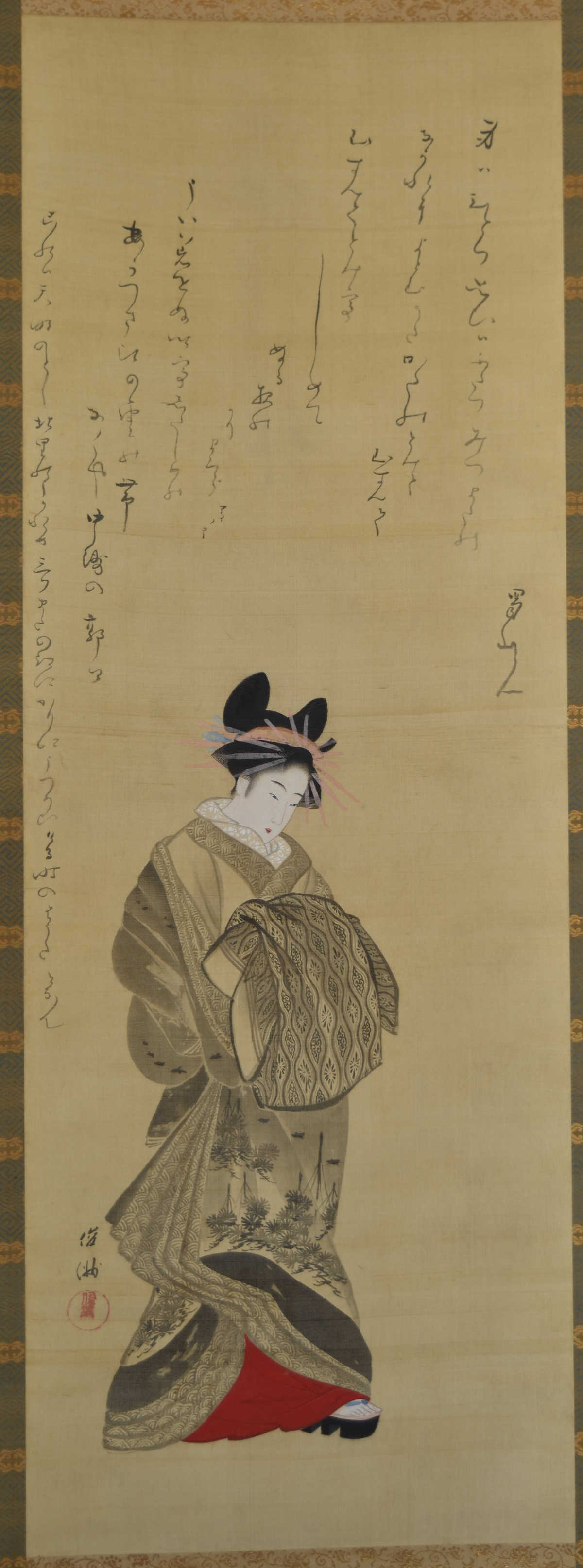
An original painting, sumi and colour on silk, 37 x 13 in; 94 x 33 cms. Shows a parading courtesan wearing a kimono of subdued colouring, being painted in sumi hues. She provocatively raises the hem of her monochromatic dress to reveal a bright red under-garment. Shunman, a man of great sophistication, designed only a few prints before concentrating on surimono and printing and issuing some of the finest in this format. (See The Japanese Print: A New Approach, J. Hillier, pp. 102-104 where he says “Probably no artist except Choki has achieved so high a reputation on such a small number of prints.”) He also excelled at painting, book illustration and light verse. Above is a poem by Ota Nampo (Shokuzanjin), a famous poet and fiction writer (1749-1823), as well as an occasional painter. In very good condition, signed and sealed Shunman.
Status: Sold
Click here to view image full size.
Utagawa HIROSHIGE (1797-1858)
Click here to view image full size.
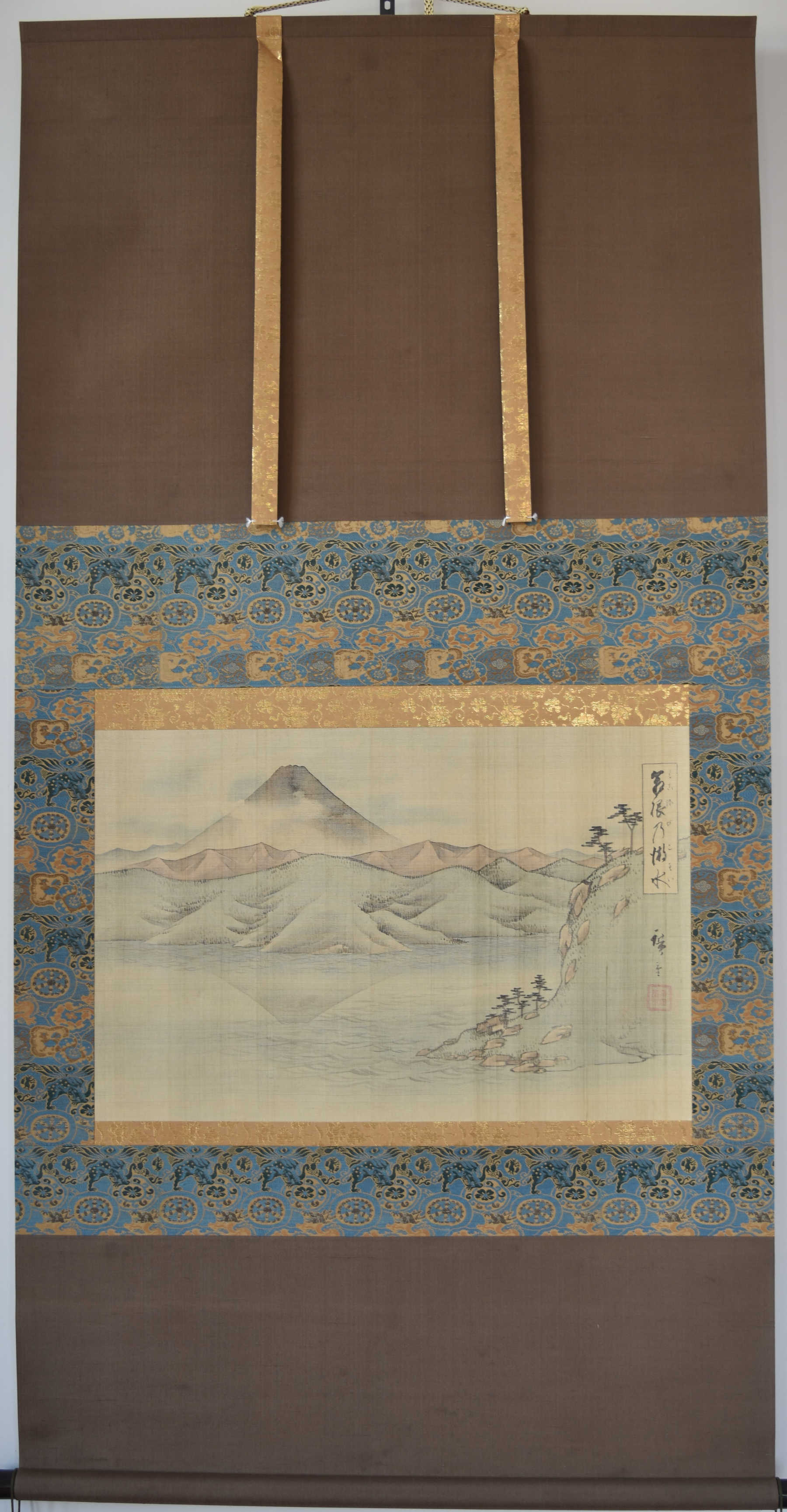
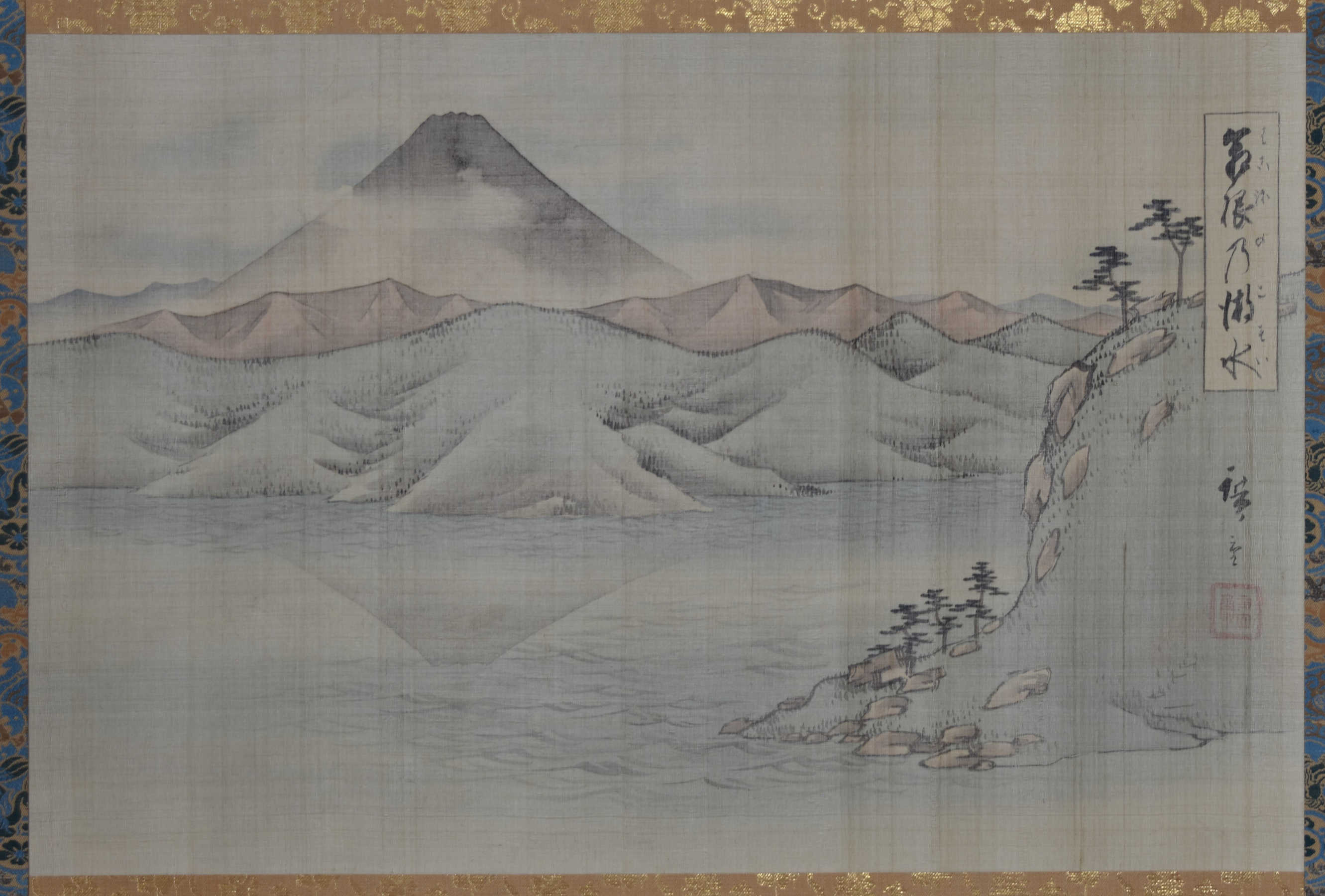
An original painting, sumi and light colour on silk, 14.5 x 22 in; 36.8 x 55.9 cms. Labelled on the right Hakone no kosui, “The Lake of Hakone.” Shows the reflection of Fuji in Lake Kawaguchi with the Misaka mountain range. A similar view could be seen from Lake Ashi. Hokusai produced a version for for the Thirty-six Views of Fuji set and this area was the subject of a number of Hiroshige prints. Signed Hiroshige with Ichiryusai seal. In very good condition.
Status: Sold
Click here to view image full size.
Yashima GAKUTEI (1786-1868)
Click here to view image full size.
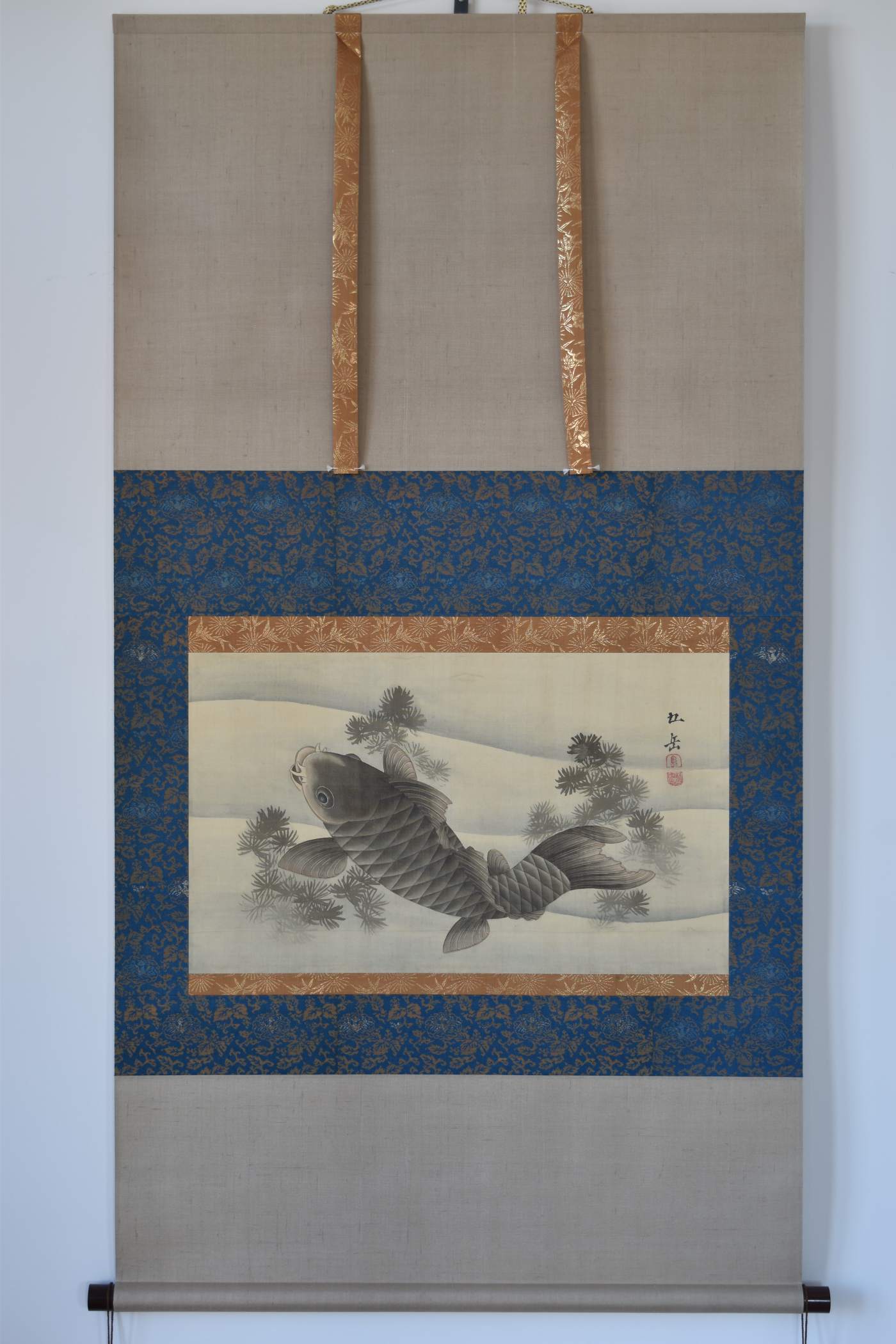
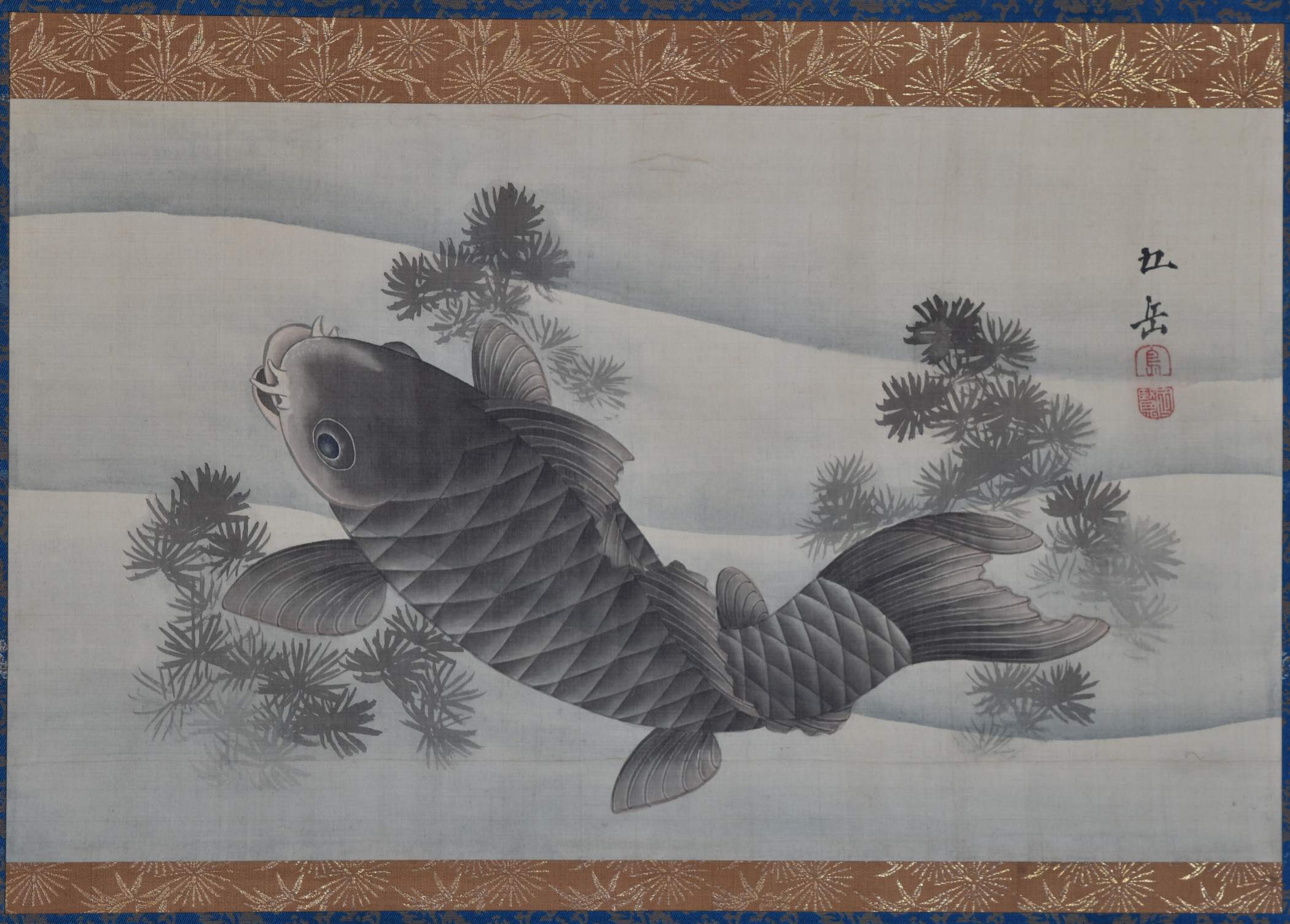
An original painting, sumi and light blue on silk, 13 x 22 in; 33 x 55.9 cms. Shows a carp swimming amongst weeds. Gakutei is best known for his fine surimono (and in fact designed a surimono of this subject). Painted in Bunsei era (1818-1830). In fine condition apart from a minimal crease. Recently remounted.
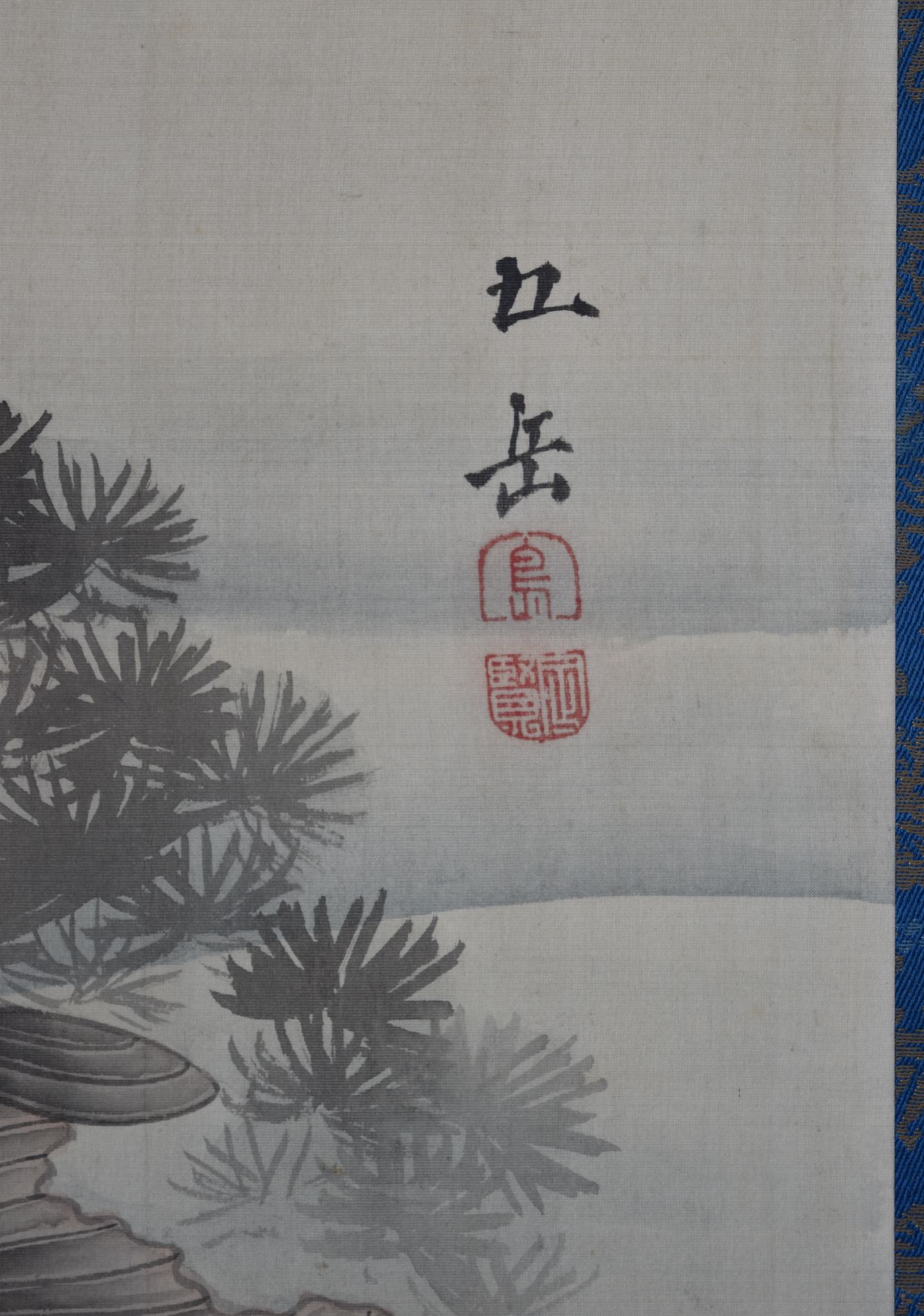
Signed Gogaku with seals Yashima and Sadaoka. A beautiful painting.
Status: Sold
Uegaki HORYU (Fl. c 1716-1736)
Click here to view image full size.
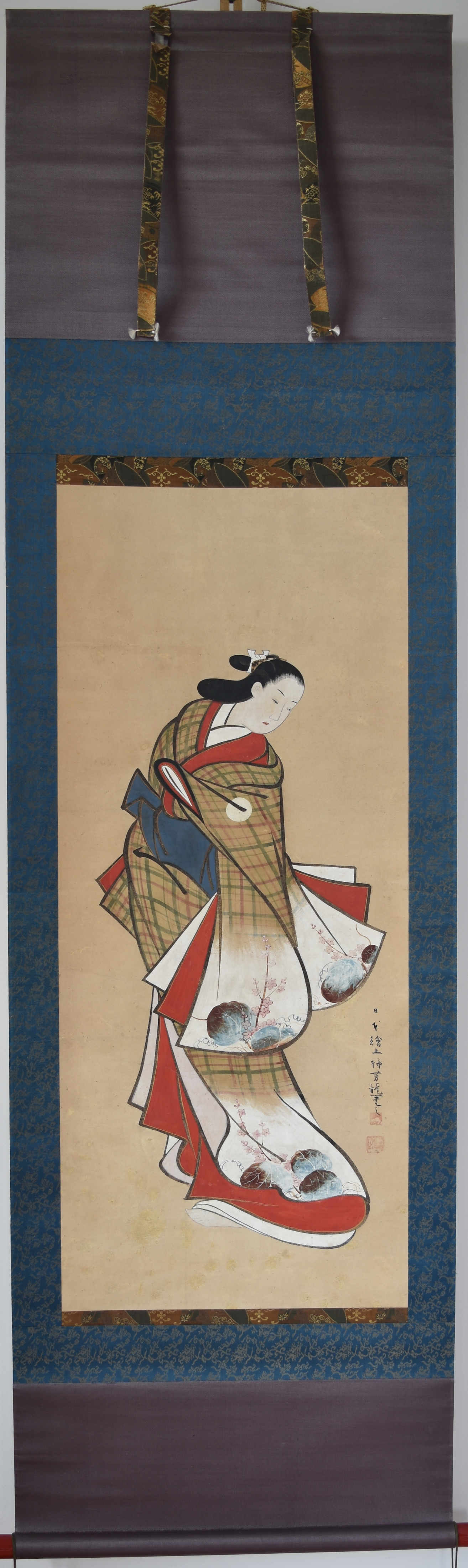
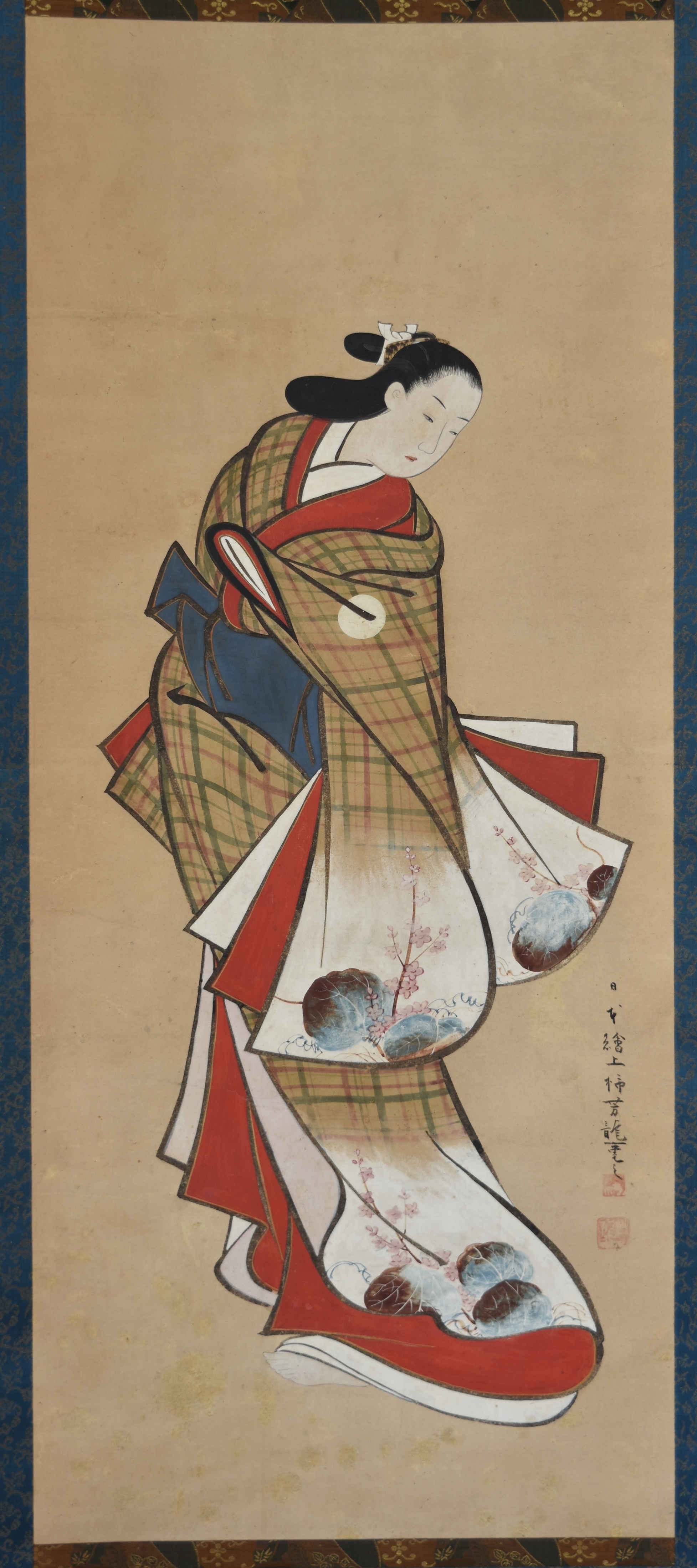
An original painting, full colour on paper, 36.5 x 15.5 in; 92.75 x 39.4 cms. Shows a full-length courtesan. It appears there are at least four other Horyu paintings known: Two in the Tokyo National Museum: C0041812 and C0041813; one in the Cleveland Museum of Art; and another in the MFA, Boston, Acc. no. 11.7482. Horyu worked in parallel (and in competition) with the Kaigetsudo atelier. Signed Nihon-e Uegaki Horyu kore o gasu with one Horyu seal; the other unread. The lid of the box is inscribed: Kaigetsudo-ha Uegaki Horyu-hitsu tayu tachi sugata, “A standing figure of a top courtesan brushed by Uegaki Horyu of the Kaigetsudo school.” And on the inside of the lid: Showa hinoto’u uzuki gekan, “Late April of the Fire Rabbit Year [Showa 62/1987].” Appraised by Kimura Suetsuke (a dealer and Ukiyo-e expert).
Areas of restoration at bottom and one or two other small areas, but otherwise in very good condition for a painting of this period.
Status: Sold


Watanabe SEITEI (1852-1918)
Click here to view image full size.
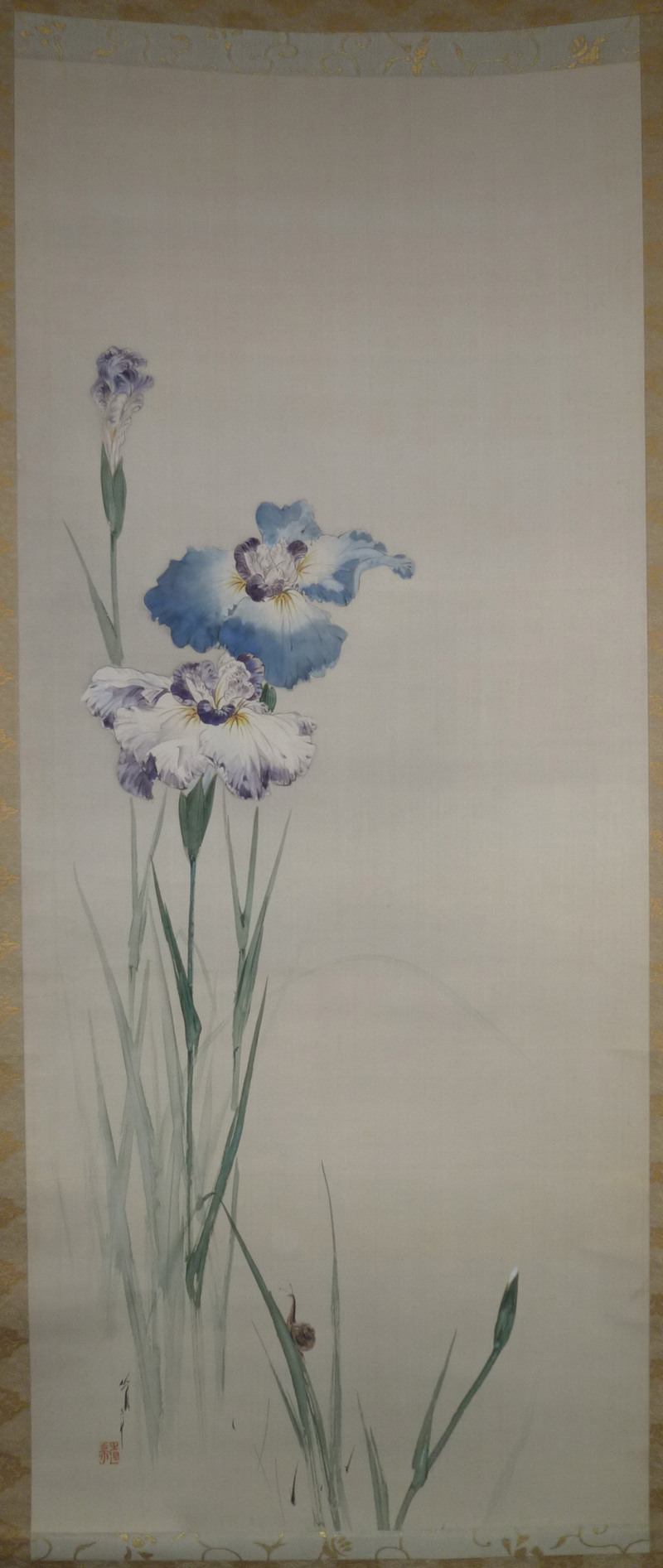
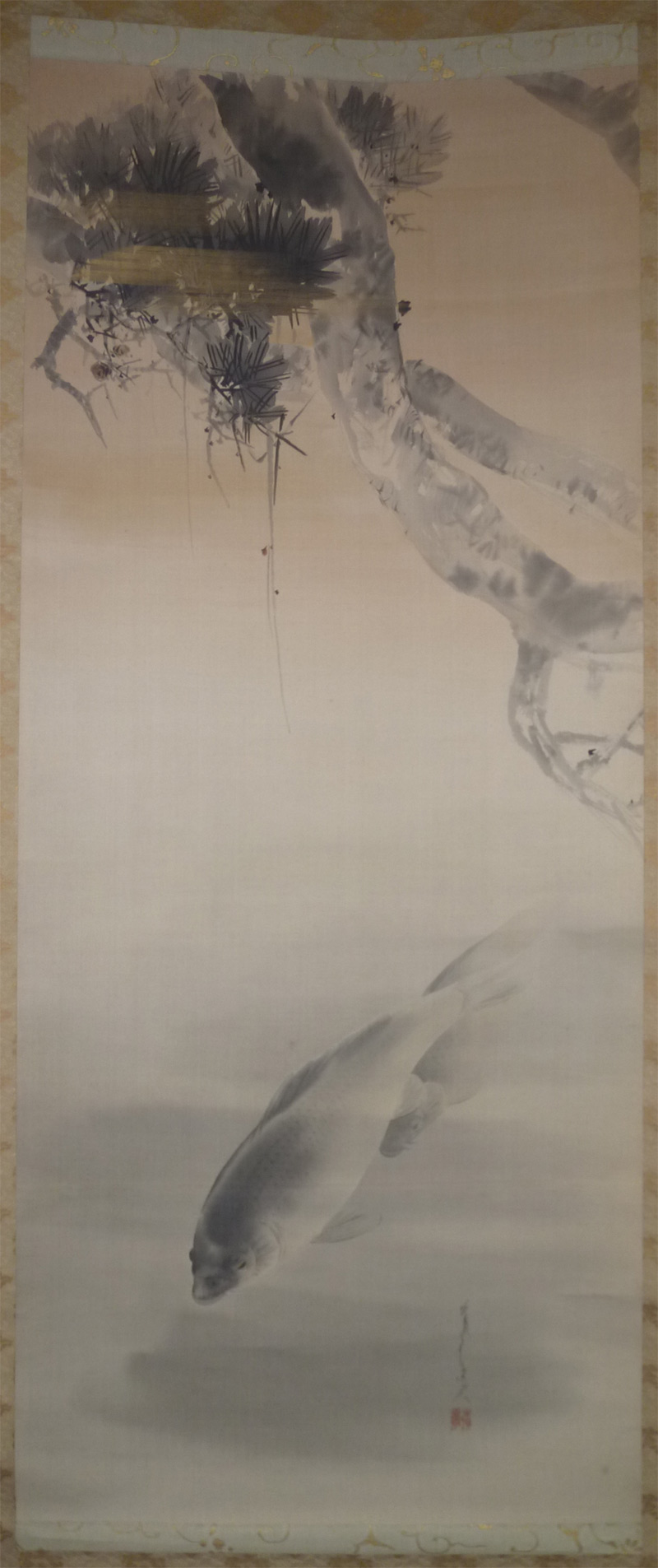
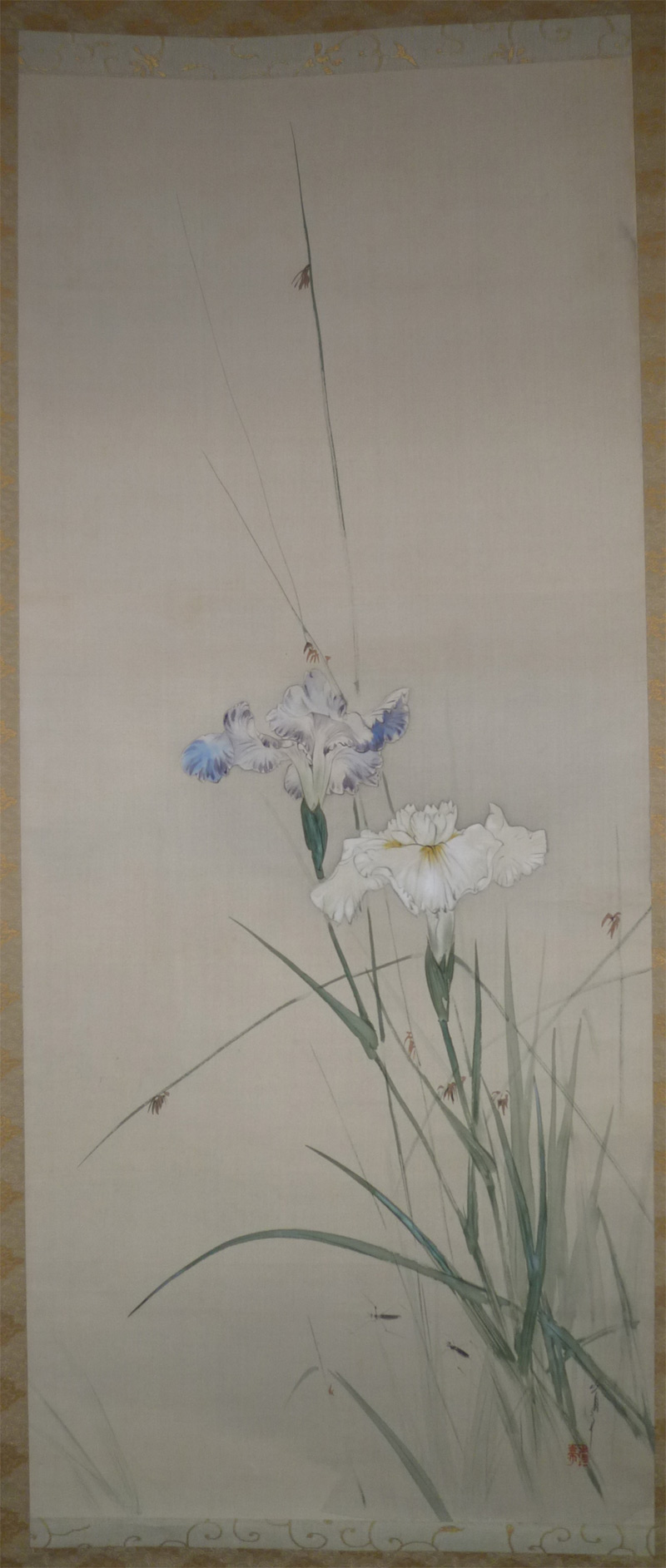
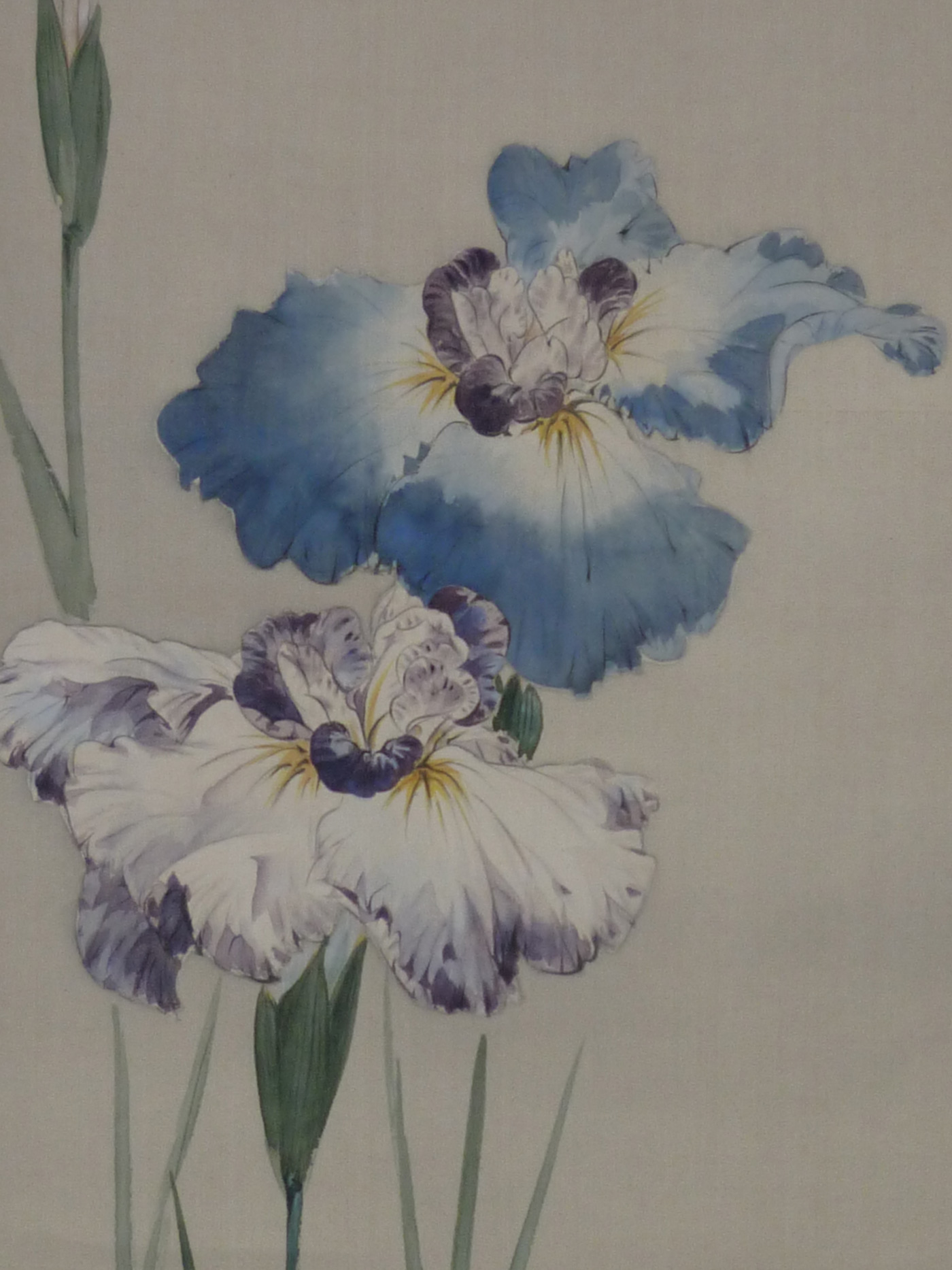
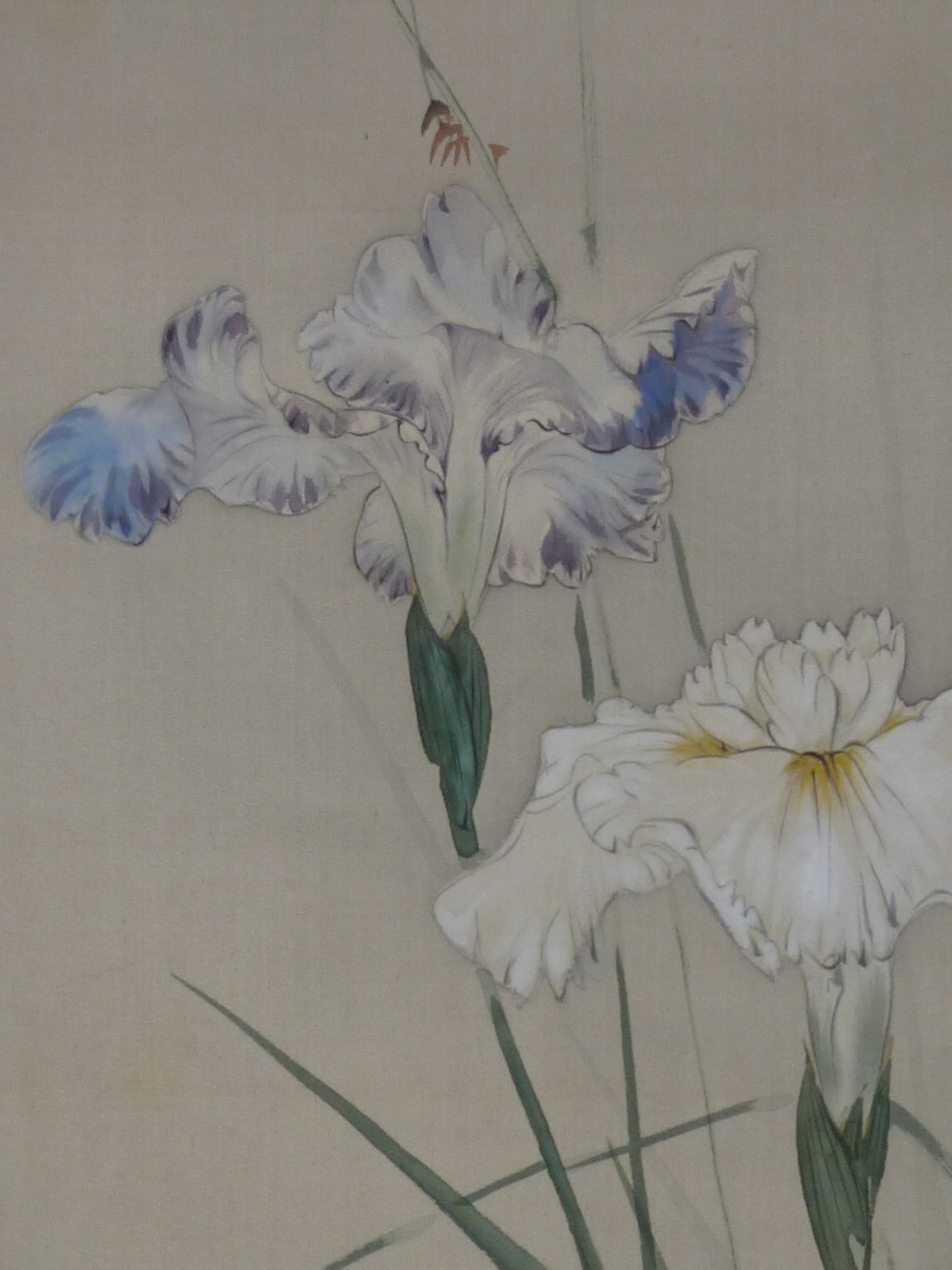
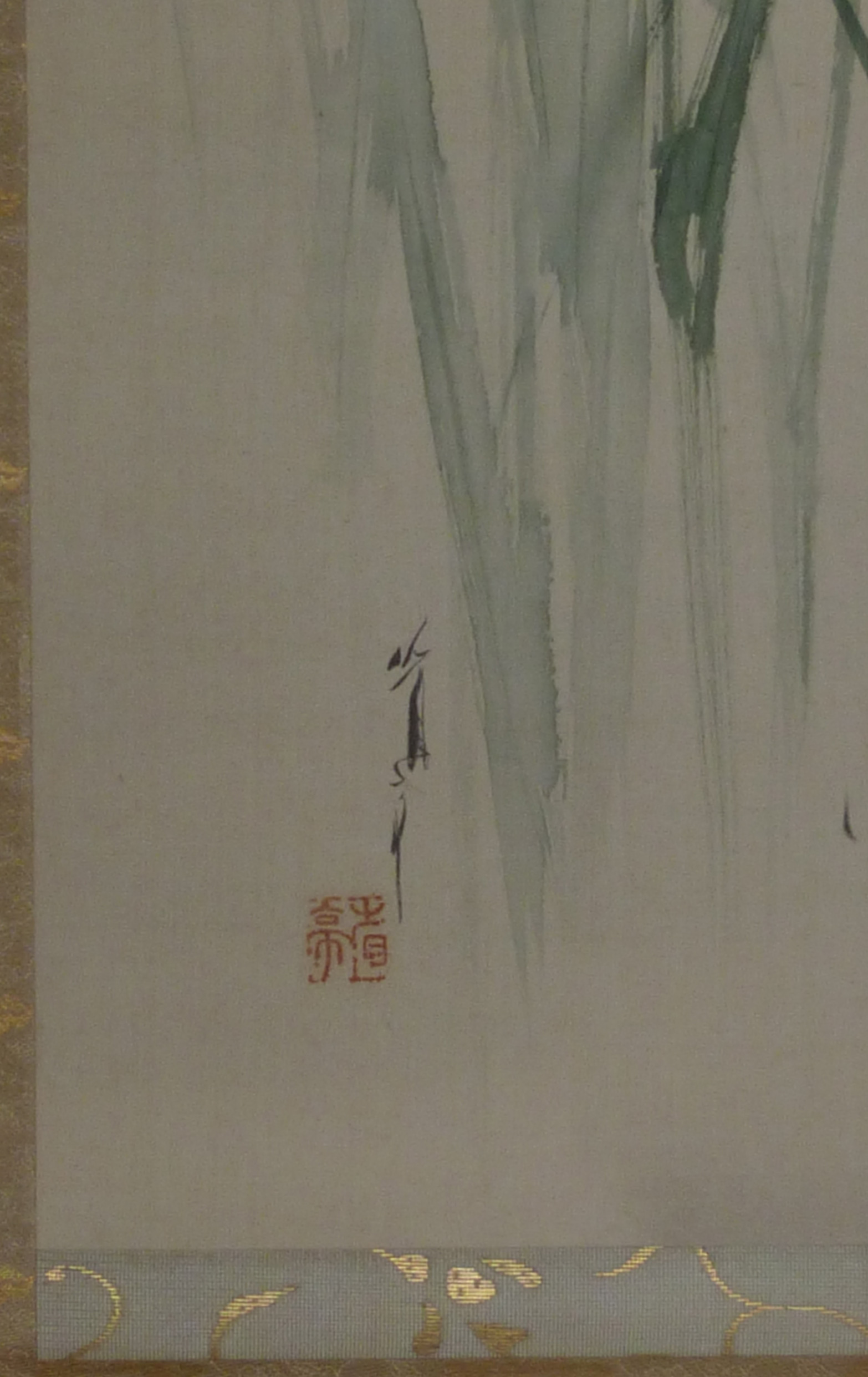
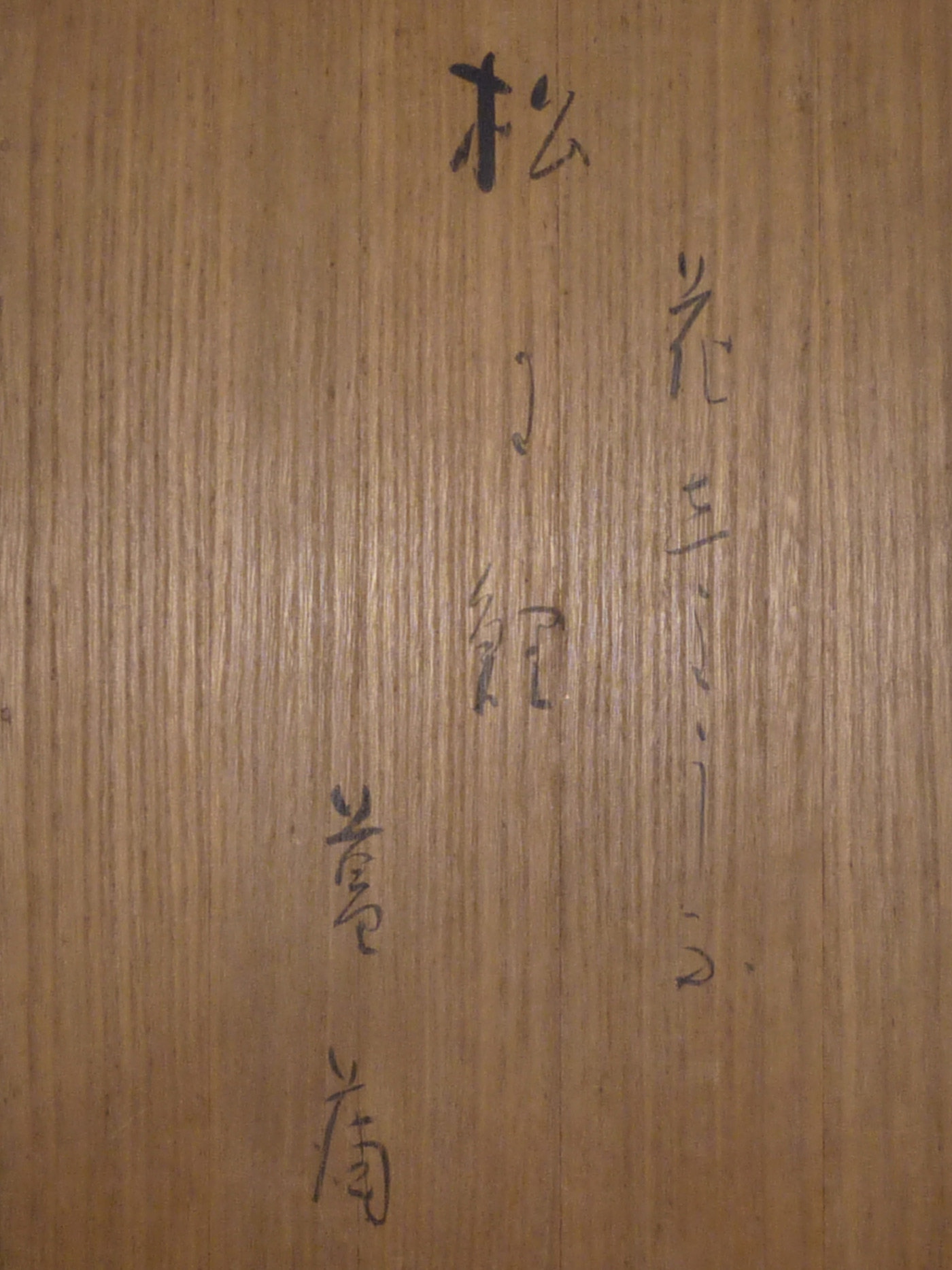
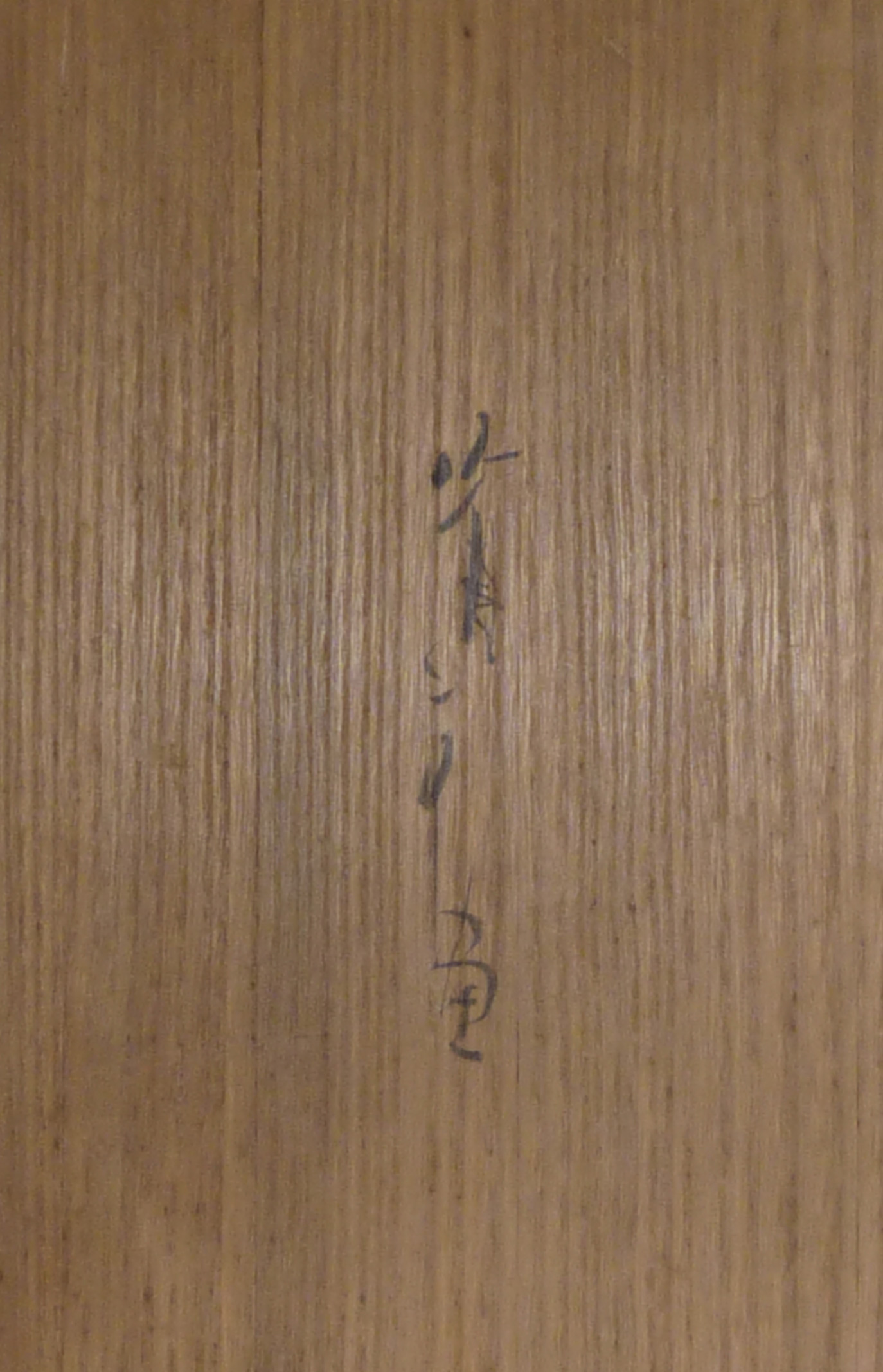
Seitei ( Shotei ) specialised in kachoga; was famous in this area, and regarded as the leading exponent. Technically brilliant. A complete set of three paintings showing, right, Hana shobu, “ Iris Flower; centre, Matsu ni koi, “Pine Tree and Carp”; and left, Shobu, “Iris.” Each painting in full colour on silk, image size 47.5 x 20 inches; 120.75 x 51 cms. Signed Seitei. Fine condition. With original double box, signed and sealed.
Status: Sold
Ichiryusai HIROSHIGE (1797-1858)
Click here to view image full size.
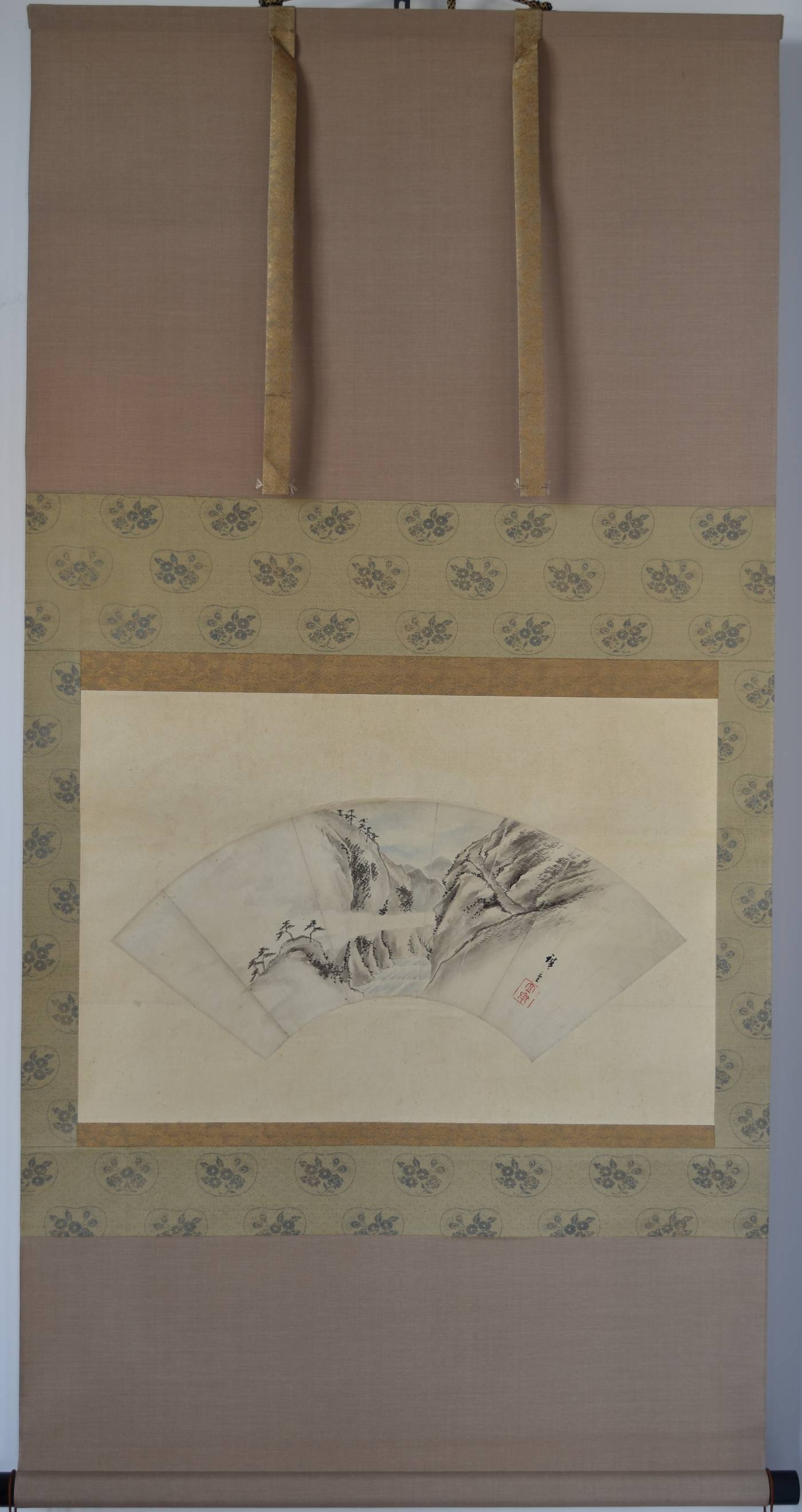
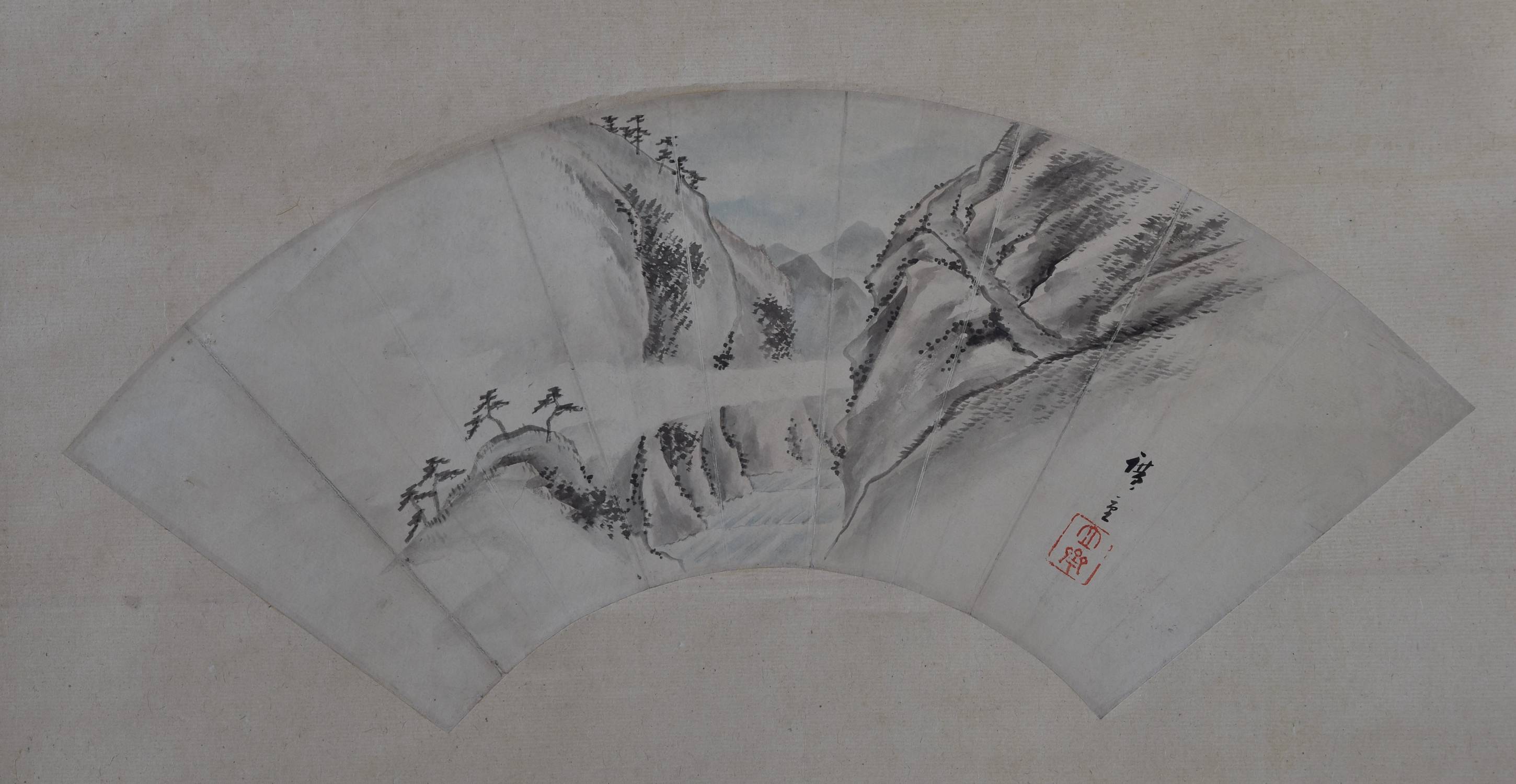
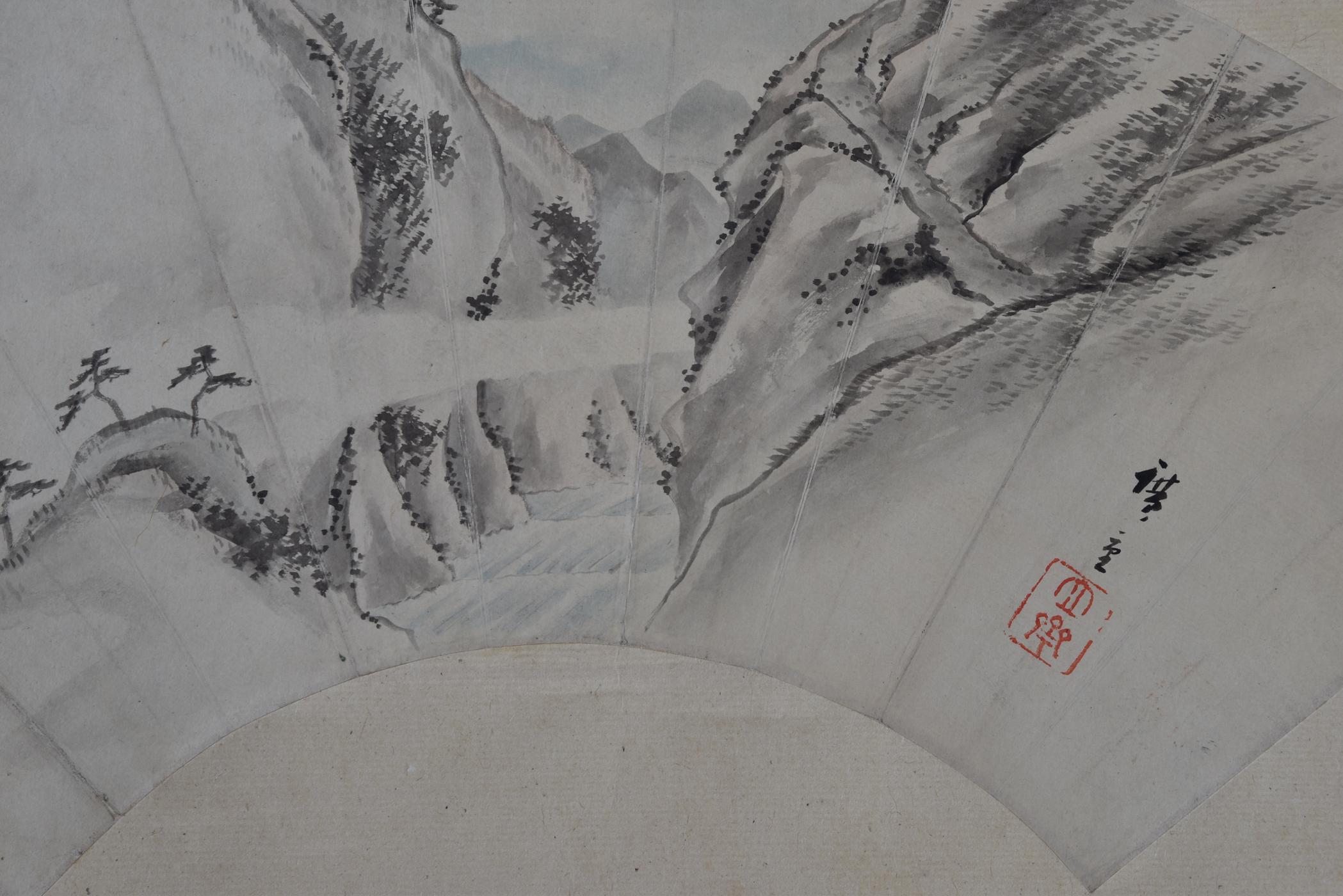
An original fan painting mounted as a scroll. Shows a gorge with the fast flowing Nagatoro River in Musashi Province. (An area in western Saitama Prefecture northwest of Tokyo.) Sumi and light blue on paper, 7 x 20.5 in; 17.75 x 52 cms. Comes with a certificate from Aoki Shinzaburo (who had a large collection of Hiroshige drawings and paintings). In good condition. Signed Hiroshige with Ryusai seal.
Status: Sold
Click here to view image full size.
Click here to view image full size.
Kikukawa EIZAN (1787-1867)
Click here to view image full size.
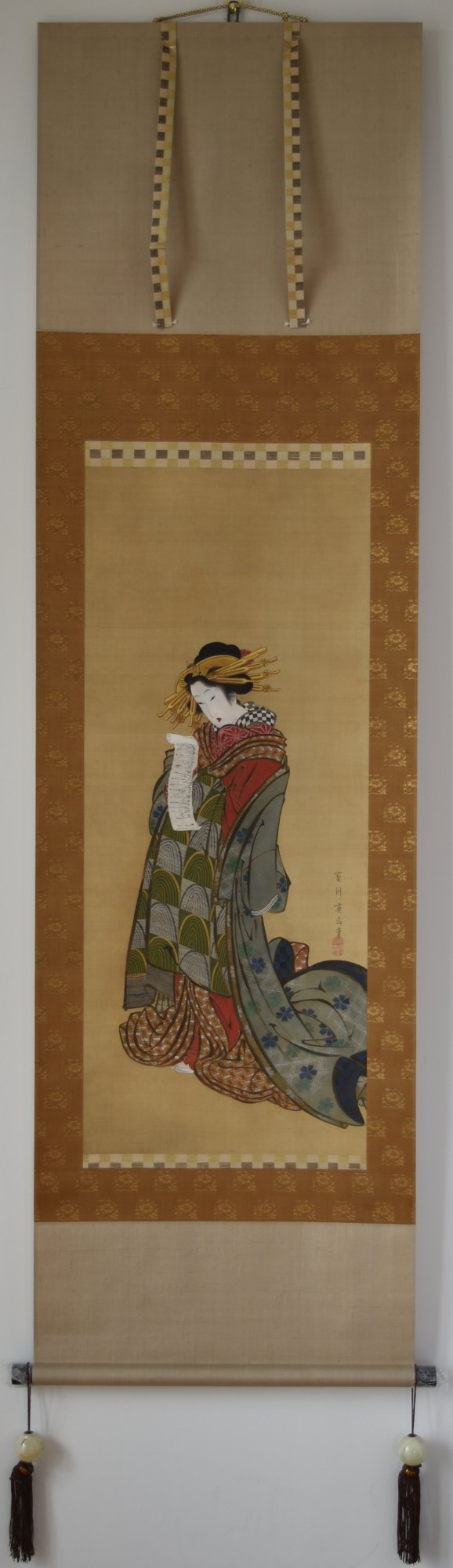
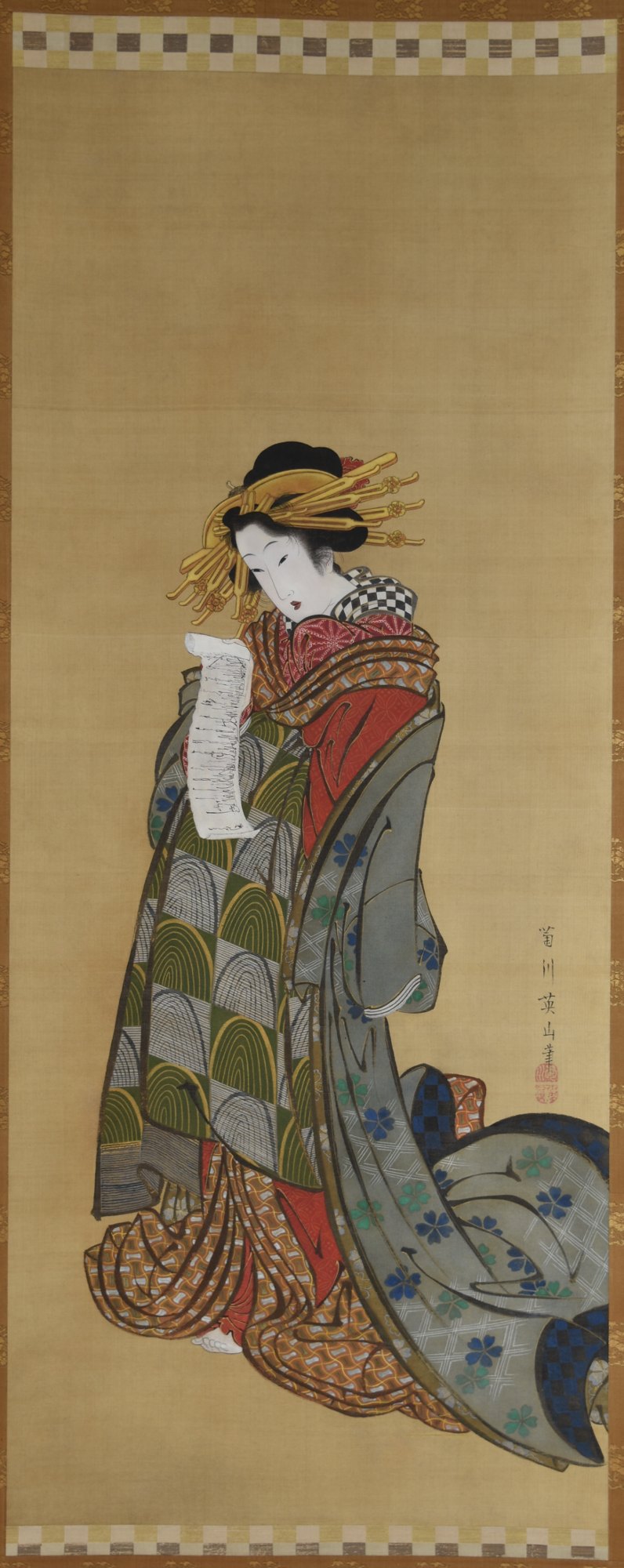
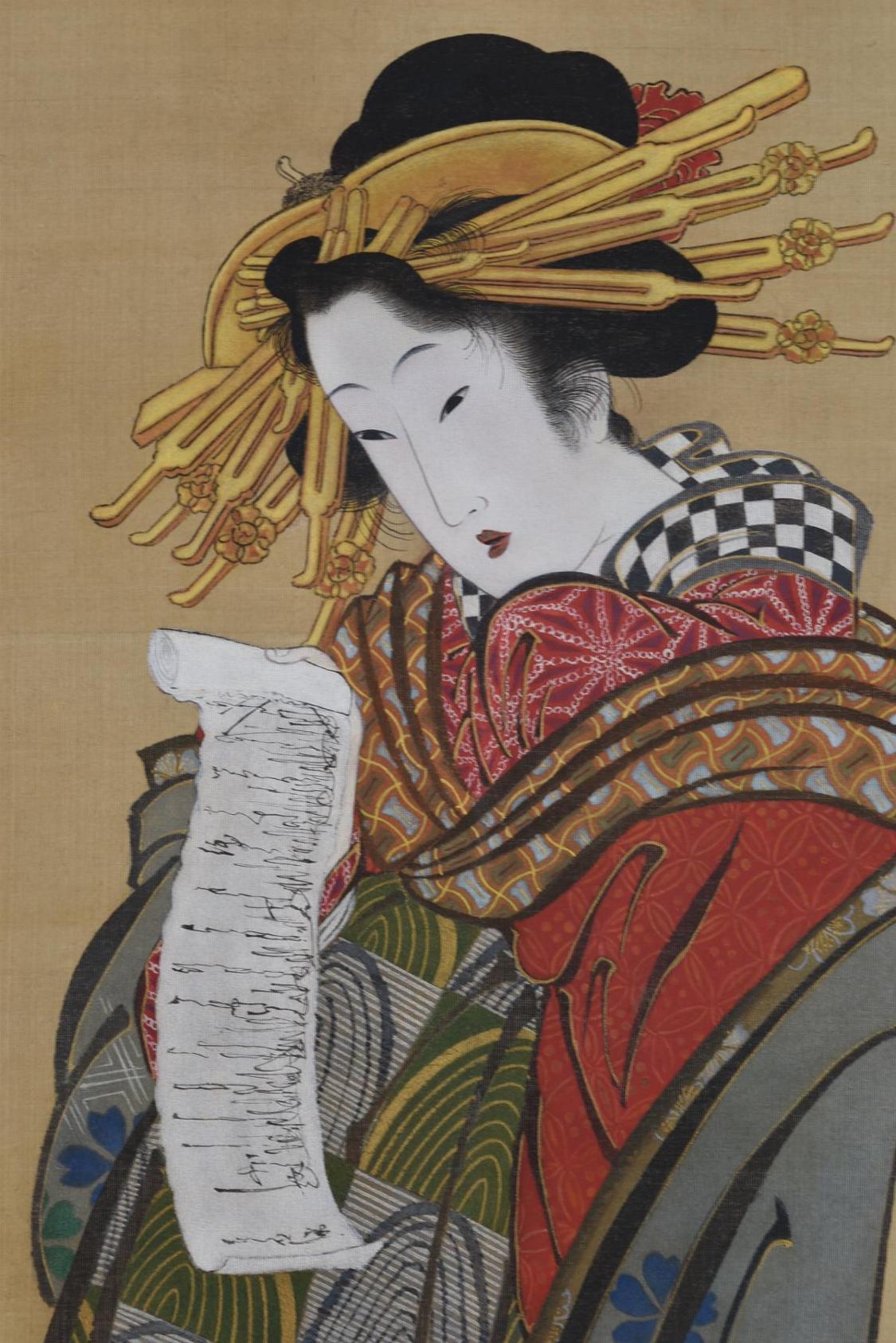
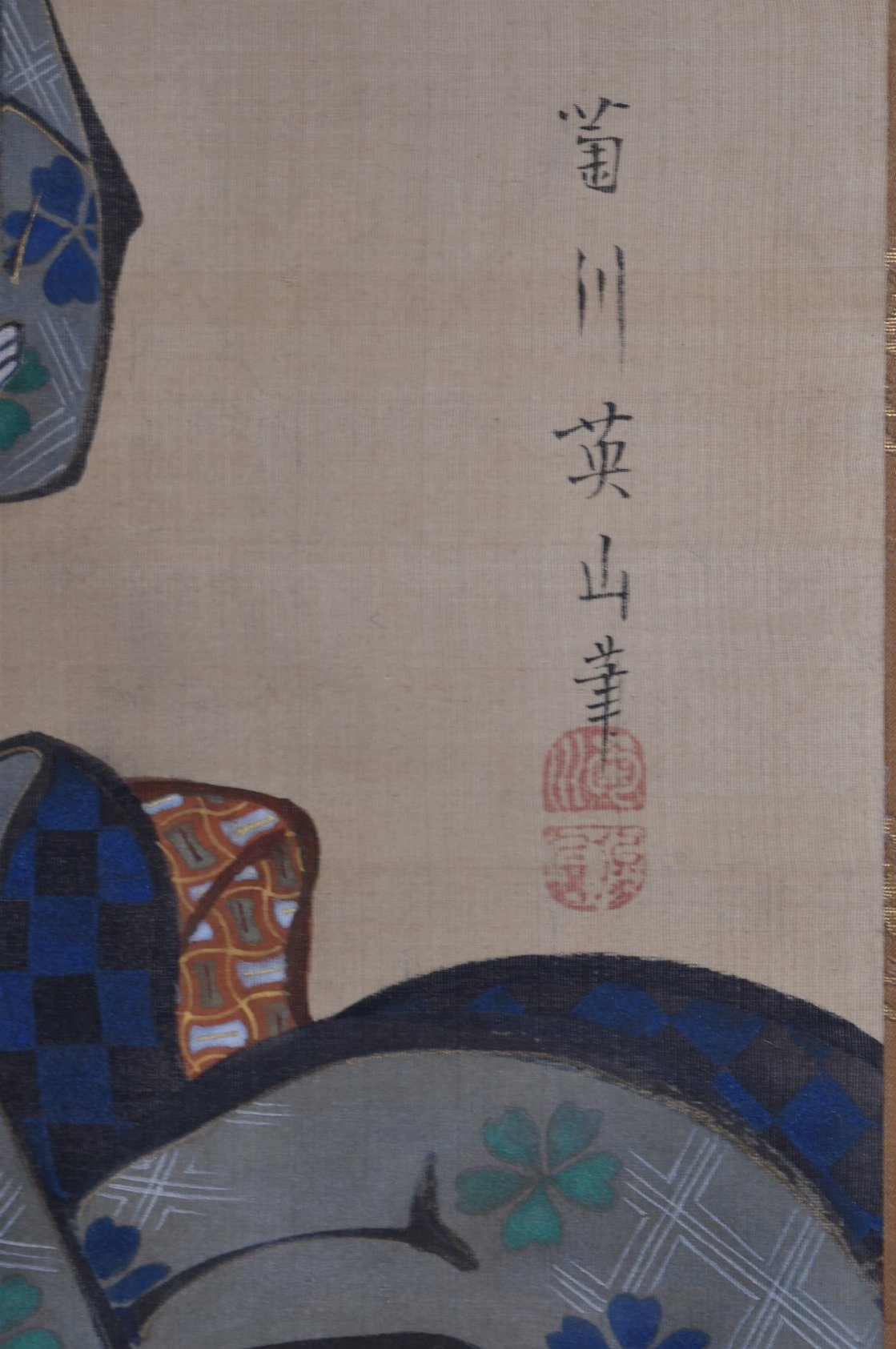
An original painting by Eizan who was the leading exponent of bijinga in the early 1800s producing many fine oban, triptych and shunga designs. He founded the Kikukawa School. Surprisingly, given his output of prints, his paintings are rare. This beautiful example, full colour on silk, 35 x 14.5 in; 88.9 x 36.8 cms, shows a courtesan reading a letter. Her sumptuous clothes are restrained in pattern and colour before the excesses of later years and other artists. Another example, not as fine as offered here, is in the Tokyo National Museum and is illustrated in their catalogue Ukiyo-e Painting Exhibition, 1993, no. 72, p. 64. The British Museum has a very slight painting of a beauty by Eizan illustrated in Ukiyo-e Paintings in the British Museum, Timothy Clark, Smithsonian Institution, 1992, no. 148, p. 195. One other fine example is illustrated in Masterpieces of ukiyo-e paintings from the Weston collection, various authors, 2015, no. 106, p. 161. Painted c. 1815-25. Signed Kikukawa Eizan hitsu with seals Kikukawa and Toshinobu. In very good condition having been recently remounted.
Status: Sold
Teisai HOKUBA (1771-1844)
Click here to view image full size.
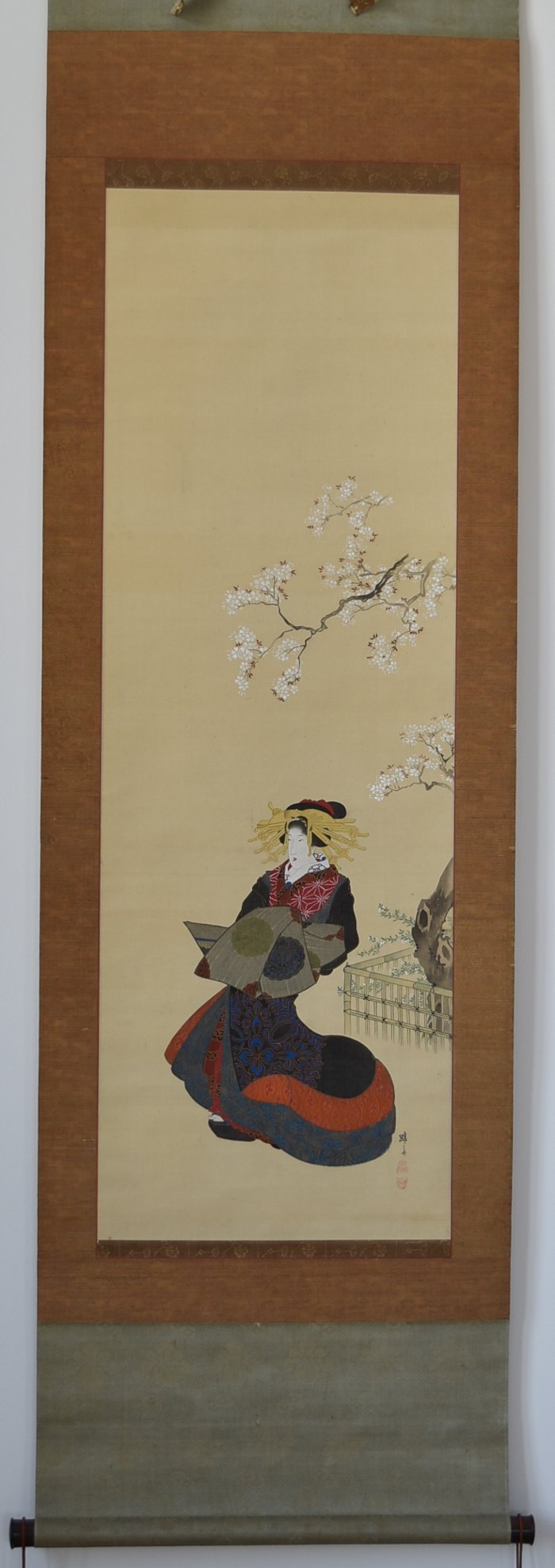
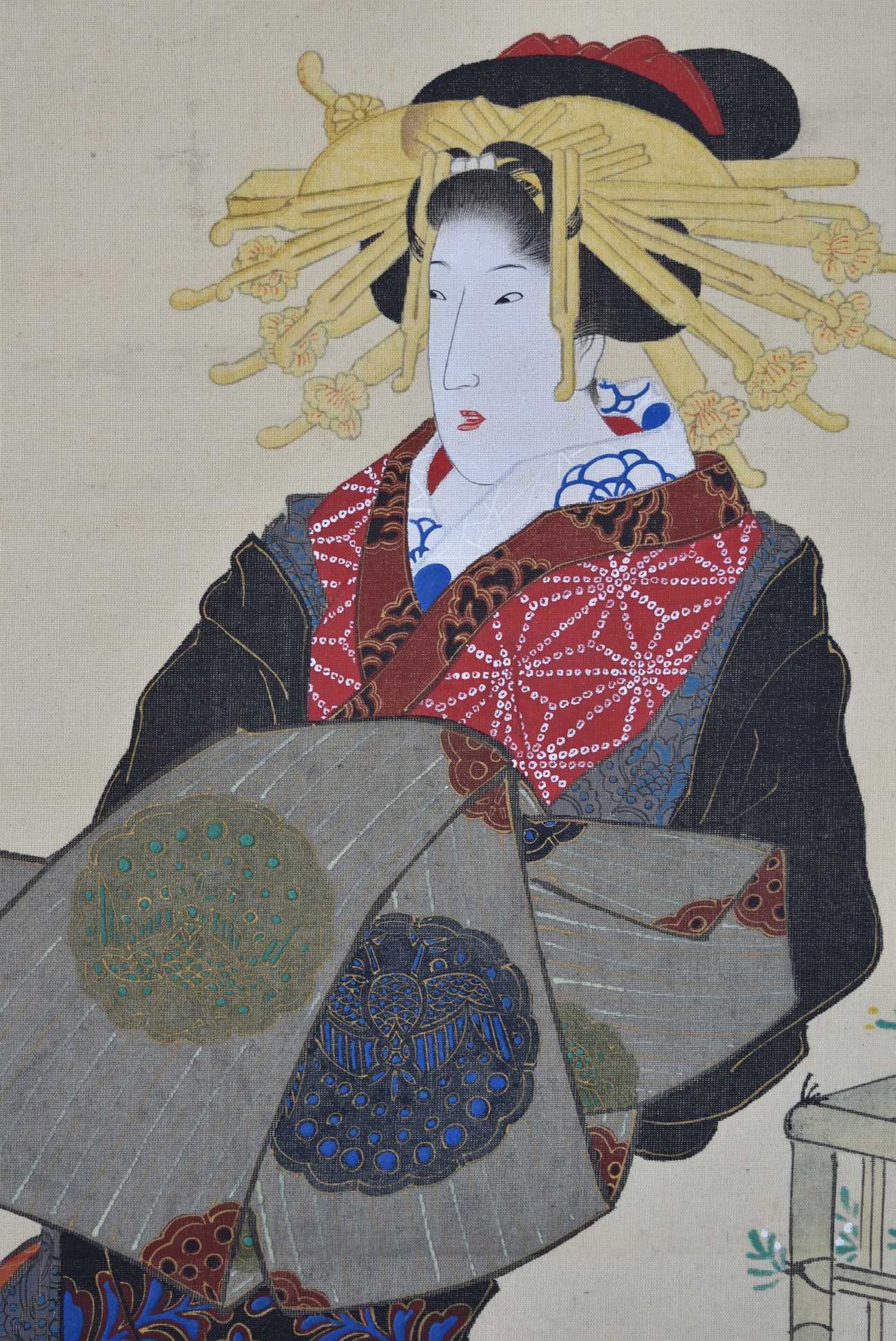
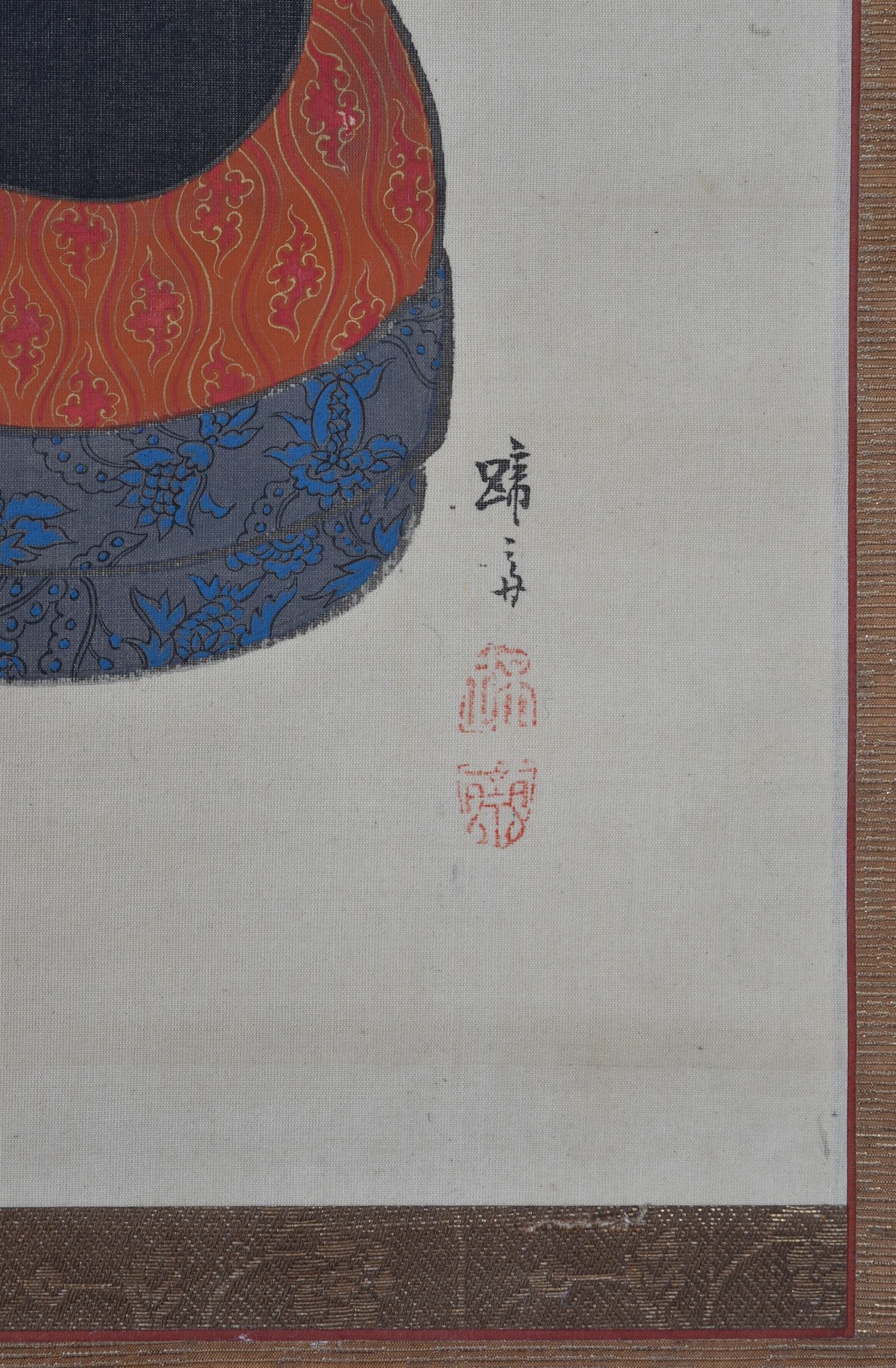
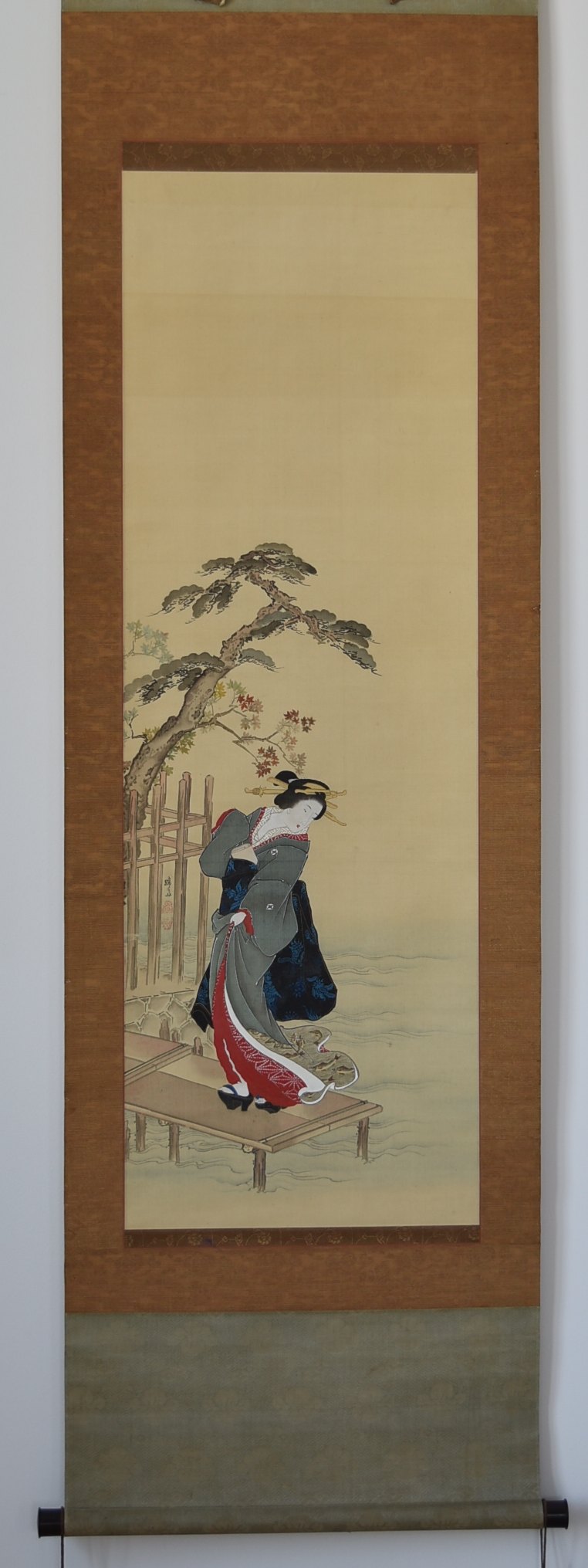
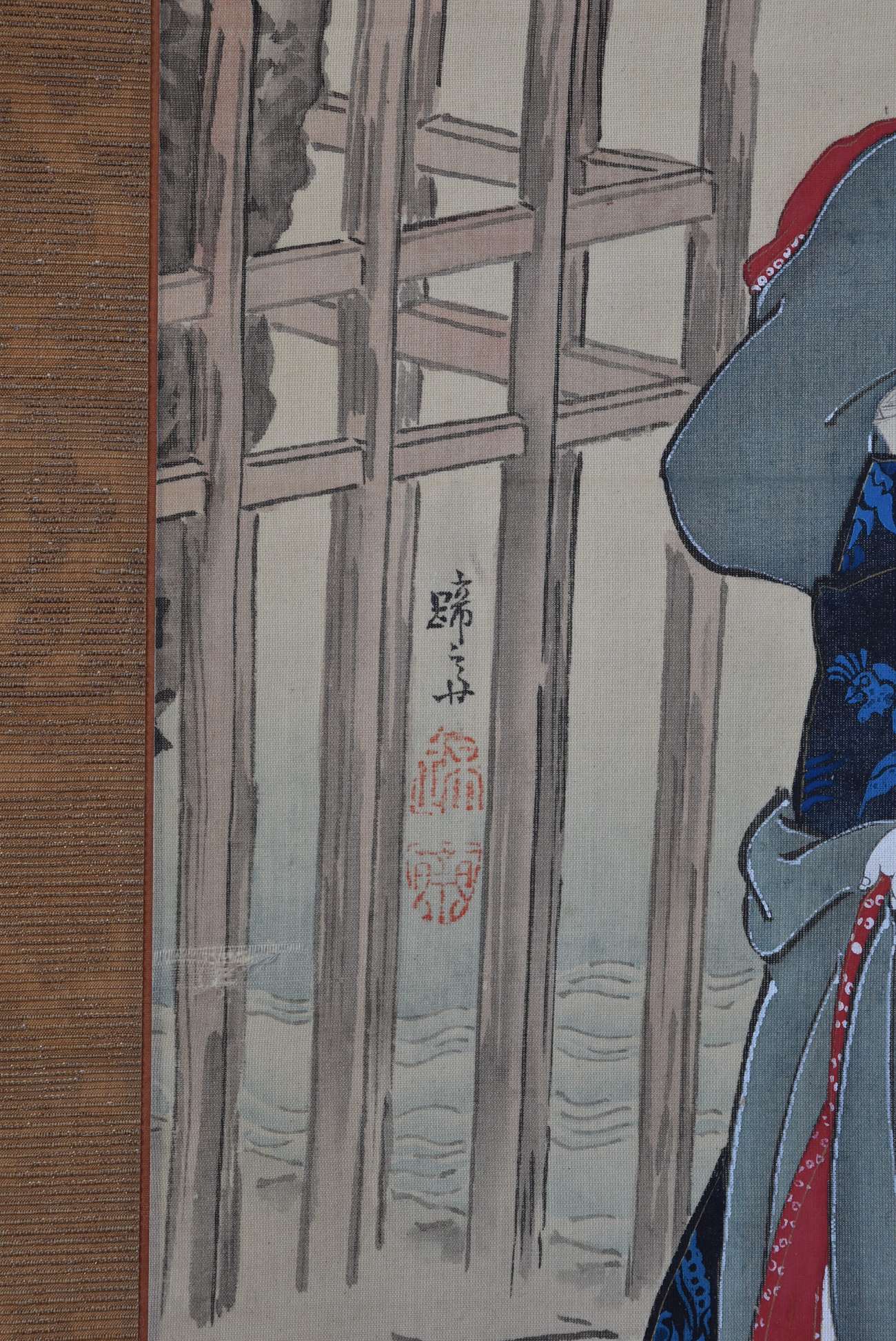
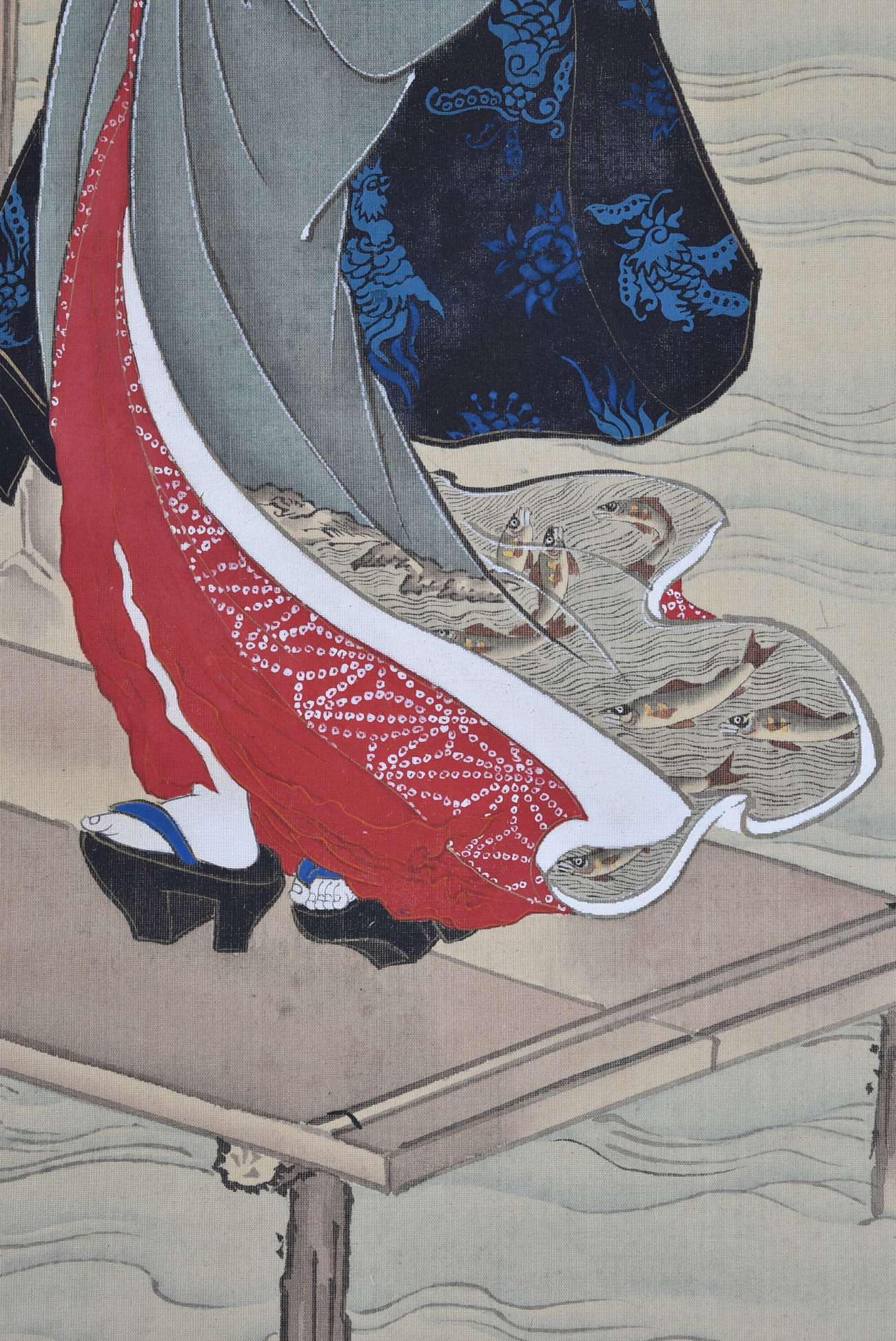
One of the outstanding pupils of Hokusai, his paintings rated next below the master’s, and also one of the earliest, together with Hokkei and Shinsai. Designed some fine surimono, also kyoka books. But best known for his highly accomplished kakemono of bijin, often set against well known places in Edo. This pair of paintings shows, right, a beauty beneath a cherry tree, Sakura; and, left, a beauty on a small jetty beneath a maple tree, Momiji. Beautifully presented with old mounts and box. Full colour on silk. Image sizes 39.75 x 13.5 in; 101 x 34.5 cms. In extremely good condition with beautiful details on the costumes of the two bijin. Each painting signed Teisai with seals Tei Sai. Probably c 1830’s when his finest work is considered to have been made.
Status: Sold
Click here to view image full size.
Ichiryusai HIROSHIGE (1797-1858)
Click here to view image full size.
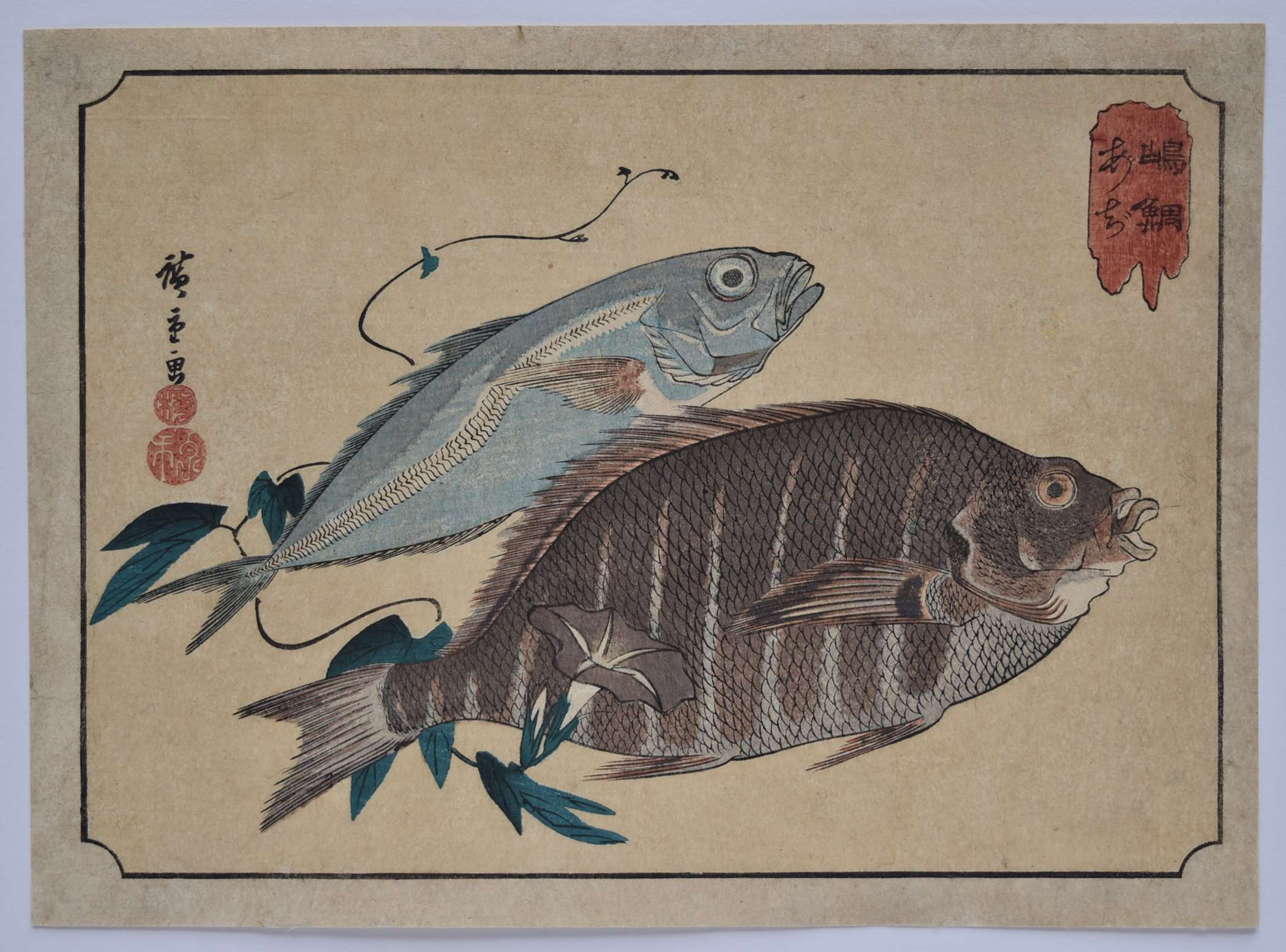
An extremely rare aiban print showing a shimadai, grouper, (probably Chilodactylus zonatus) and an aji, horse-mackerel, (Caranx trachurus). From a set of eight prints of various fish published c. late 1830s.
Fine impression and colour. Slight soil, otherwise very good condition. Signed Hiroshige ga.
Status: Sold
Kitao MASAYOSHI (1764-1824)
Click here to view image full size.
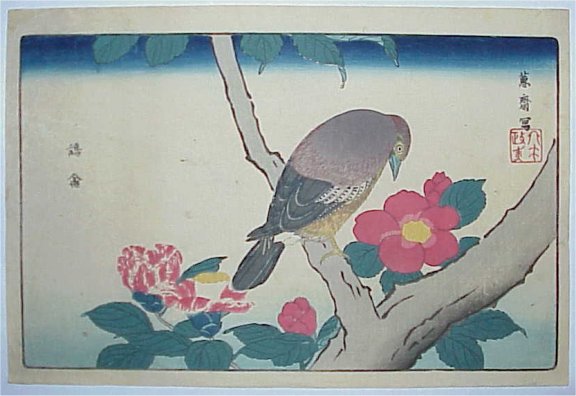
A falcon and camellia. One design from the album: Kaihaku raikin zui, A Compendium of Pictures of Birds Imported from Overseas. The first edition published by Gungyokudo Matsumoto Zembei, 2/1789. Copies of the first two editions are excessively rare and it was then reissued with the plates signed Keisai (as here). However this print does not appear to be from an album and judging from the quality of printing must be from the first printing with signature and when some prints were issued separately. Designs that appear on the market from this publication are invariably on thin paper and poor impressions.
Fine impression with beautiful gradation and blind printing. On thick deluxe hosho Fine colour. Very minor soil, otherwise fine condition. Signed Keisai Utsusu.
Status: Sold
Ichiryusai HIROSHIGE (1797-1858)
Click here to view image full size.
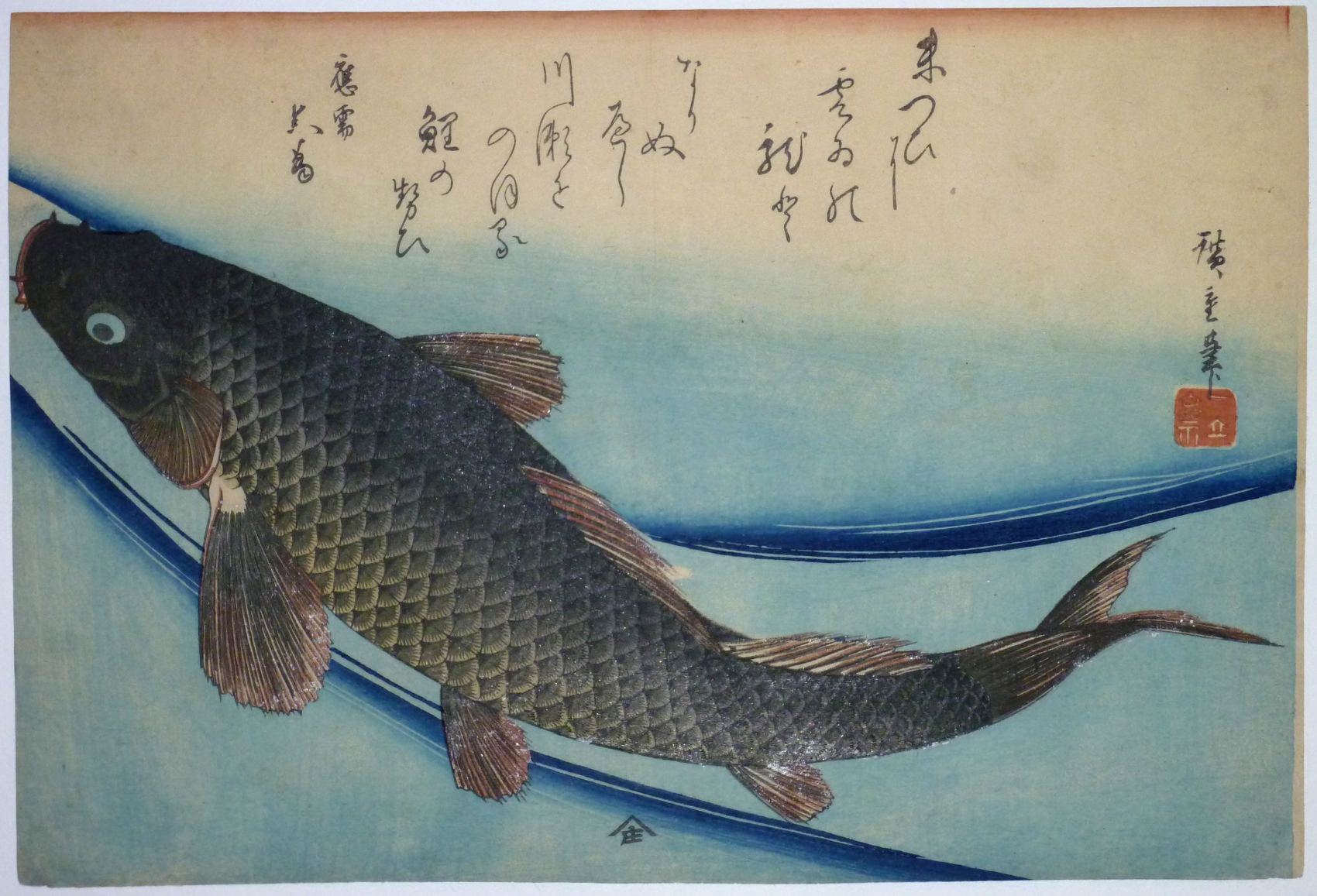
Koi, carp (Cyprinus carpio) from the second series of ten fish prints published by Yamasho, c 1840-42. The first series was issued privately for a poetry group ( probably the Shingyoku Circle ) with judges’ names and extra poems. Poem above by Makuzu. These prints are of the utmost rarity as probably only enough for the Circle were printed and they never come onto the market. Due to their popularity this first series was published commercially and a second set was commissioned. The best design from the second set. Other examples: Vignier and Inada, Vol. VI, pl. LXIX, no. 265 and Tamba, no. 424.
Very good impression. Early state: See Andon 49, Hiroshige: A shoal of red herrings, number 12. This is Kruml c with the b Ichiryusai seal. Fine colour. Slight trimming left and top, otherwise very good condition. Signed Hiroshige hitsu.
Status: Sold
Katsushika HOKUSAI (1760-1849)
Click here to view image full size.
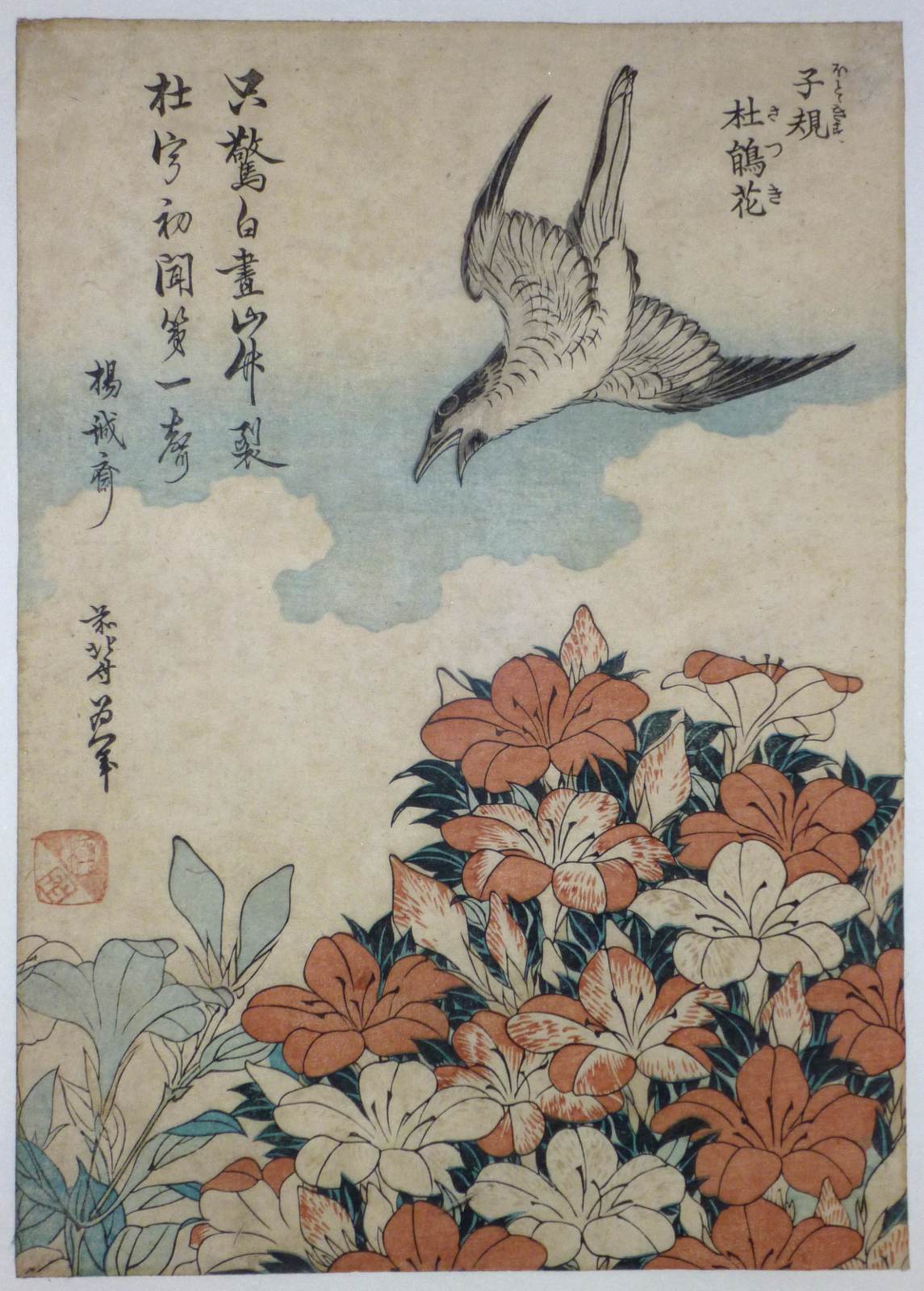
Cuckoo and azaleas from the so-called Small Flower series of ten chuban prints published c 1832. Amongst the most sought after of Hokusai’s prints. The first edition was published by and has the seal Eijudo. A later edition (as here) has combined manji and kiwame seal ( and some are printed on thin Chinese-style paper ), and there are also impressions extant without any seals which probably constitute a third state. All impressions are rare and the first state excessively so. Indeed, these prints are considered even rarer than the larger bird and flower set Hokusai designed c 1833. The printing and colour on this set comes close to surimono quality. Each print has a Chinese poem written in hiragana.
Fine impression. Slight fading, otherwise very good condition. Signed Zen Hokusai Iitsu hitsu.
Status: Sold
Utagawa HIROSHIGE (1797-1858)
Click here to view image full size.
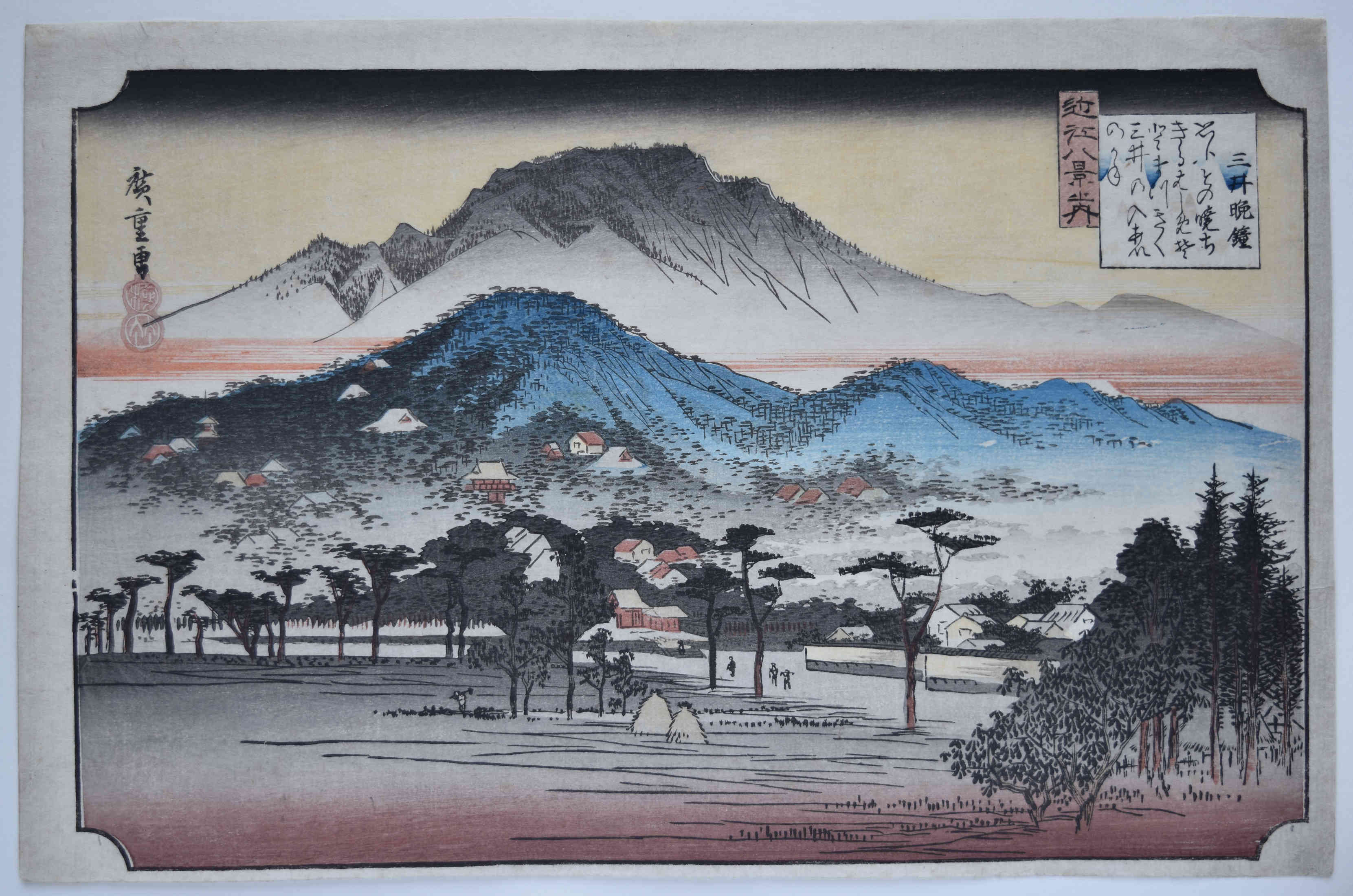
Mii no bansho, “Evening Bell at Miidera Temple” from a set Omi hakkei no uchi, “Eight Views in Omi [Province].” Shows the temple hidden amongst hills on the southern side of Lake Biwa. Miidera is the common name for the Onjoji, a temple of the Tendai sect founded in 858. Published by Hoeido and Eikyudo in c. 1834-5. The “Eight Views” theme was derived (as so much else in Japanese art) from China and based on the Eight Views of Xiaoxiang paintings of the 11th century. The subject was transposed to Omi and then taken up by such artists as Harunobu, and later Hiroshige. It was often playfully alluded to in sets of eight prints in mitate-e style.
Very good impression, colour and condition, Signed Hiroshige ga.
Status: Sold
Utagawa HIROSHIGE (1797-1858)
Click here to view image full size.
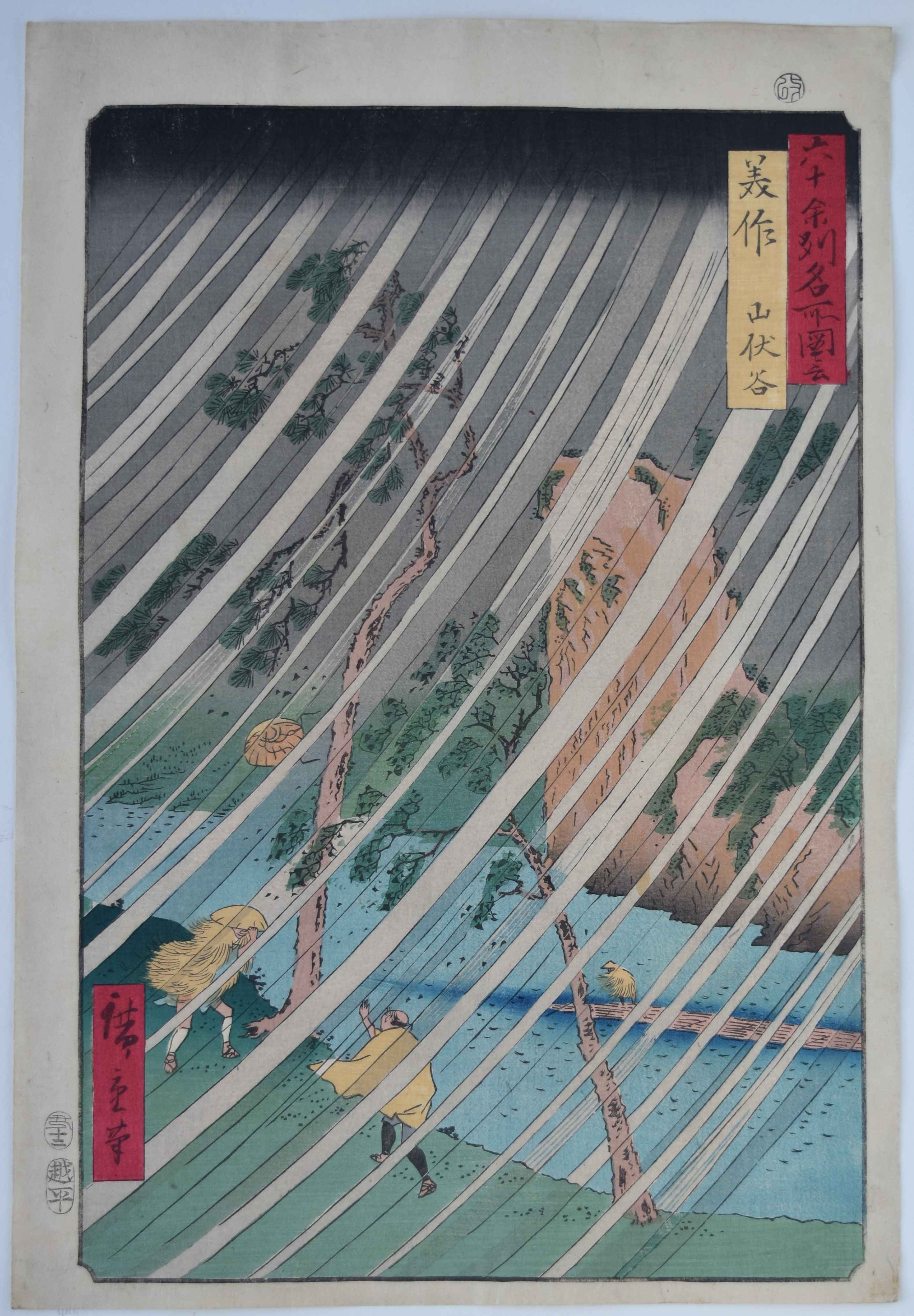
Mimasaka, Yamabushidani, “Mimasaka [Province], Yamabushi Valley.”A high wind and rain in the valley with a man on a raft on the Yoshi River. Other figures in the foreground, one having lost his hat. From a set of 69 prints [Dai Nihon] Rokujuyoshi meisho zue, “Famous Places in the Sixty-odd Provinces [of Japan]” published by Koshimuraya Heisuke between 1853 and 1856, this being 1853.
Fine, early impression. Fine colour and condition with large margins. Signed Hiroshige ga.
Status: Sold
Utagawa HIROSHIGE (1797-1858)
Click here to view image full size.
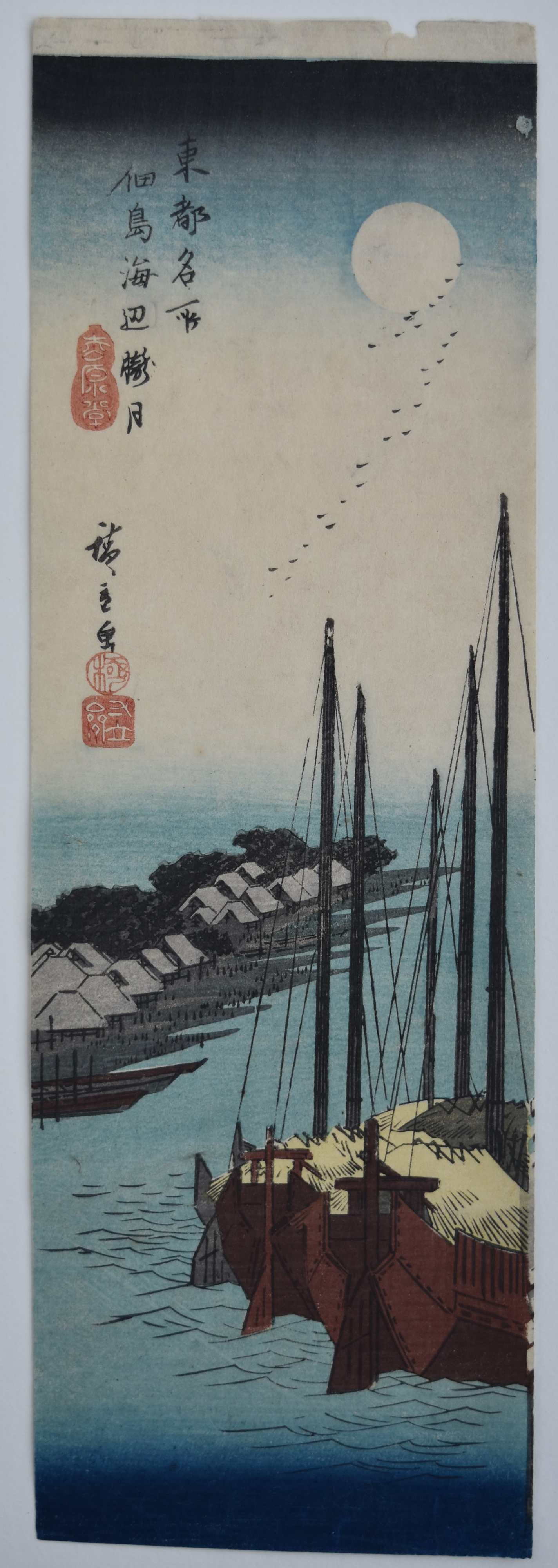
Spring moon at the shore of Tsukudajima . One of a set of chu-tanzaku prints published by Shogendo, c. 1837. Tsukudajima was one of two islands at the mouth of the Sumida River. Originally a sanbar, it was reclaimed with earth and rocks and given its name by the first Tokugawa Shogun, Ieyasu, who invited thirty-three fishermen to live there in 1613 in order to provide fish for the rapidly expanding city of Edo. The fishermen came from Tsukudama near Osaka and it was they who became the proprietors of what would become the Tsukiji fish market. It must have been popular during the late Edo period as a place to visit and view the boats from teahouses on the shore because there are many prints depicting the area, especially under a full moon.
Fine impression, colour and condition. Signed Hiroshige ga. n.
Status: Sold
Utagawa HIROSHIGE (1797-1858)
Click here to view image full size.
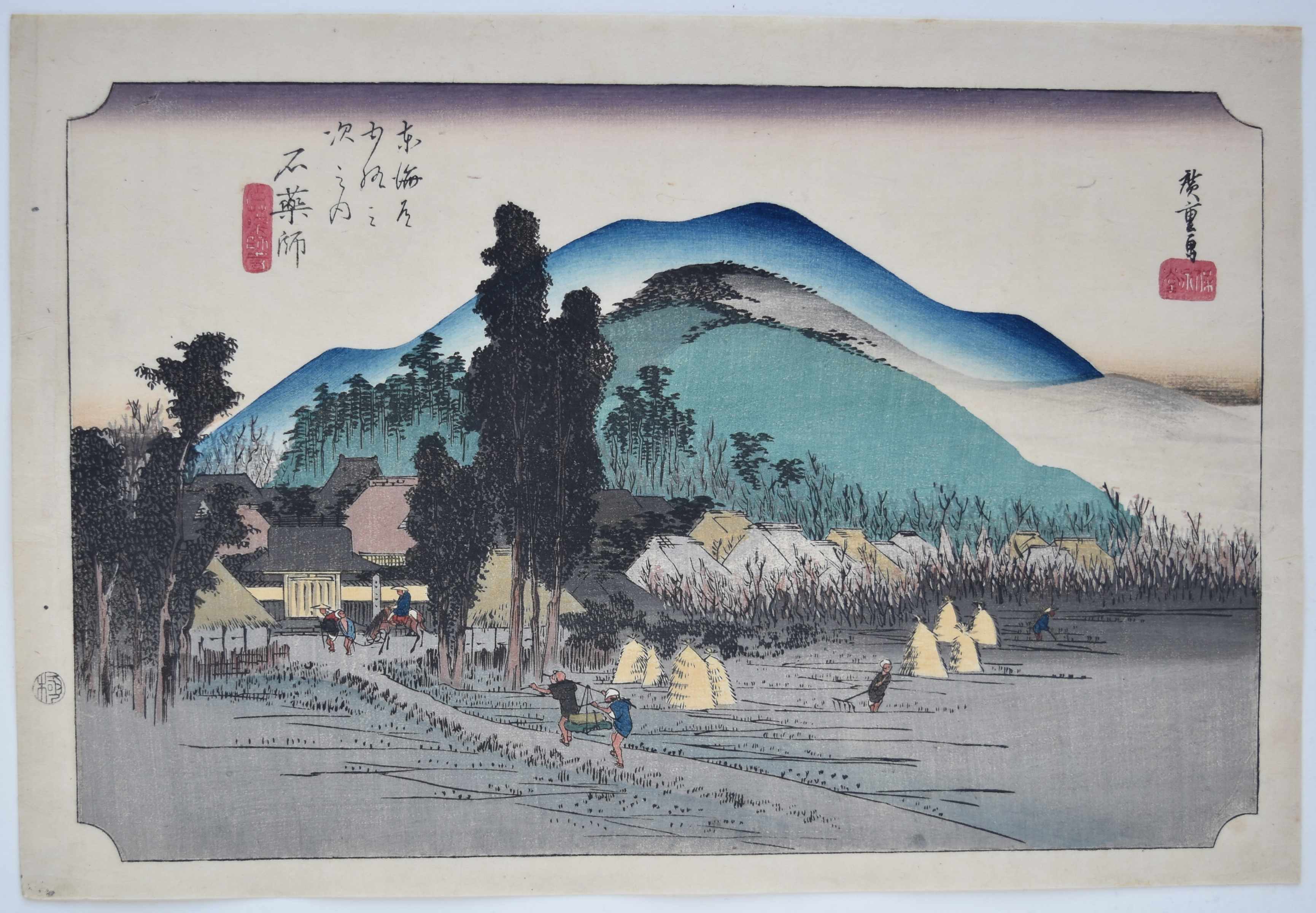
Station Ishiyakushi from Tokaido gojusan-tsugi no uchi, “Fifty-three Stations of the Tokaido.” This seminal work was possible because Hiroshige was asked to accompany an official procession along the Tokaido Road from Edo to Kyoto in 1832, and he made numerous sketches to document the journey. An evening scene in late autumn showing the village with the Ishiyakushi-ji (temple) on the left. This housed a stone image of Yakushi Nyurai, the Buddha of medicine. Pilgrims came in the hope of being healed, but they seldom stayed preferring to move on to Shono, the next station, which was only 3 km away. Because of the sets popularity, it was reprinted many times and there are a plethora of late impressions. Early printings are hard to find. Published by Hoeido (Takenouchi Magohachi) and Tsuruya Kiemon (Senkakudo) 1833-34.
Fine, early impression. Beautiful blue bokashi on the distant Suzuka Mountains: Late impressions often have crude wiping of this block. Fine colur and condition. Signed Hiroshige ga.
Status: Sold
Utagawa HIROSHIGE (1797-1858)
Click here to view image full size.
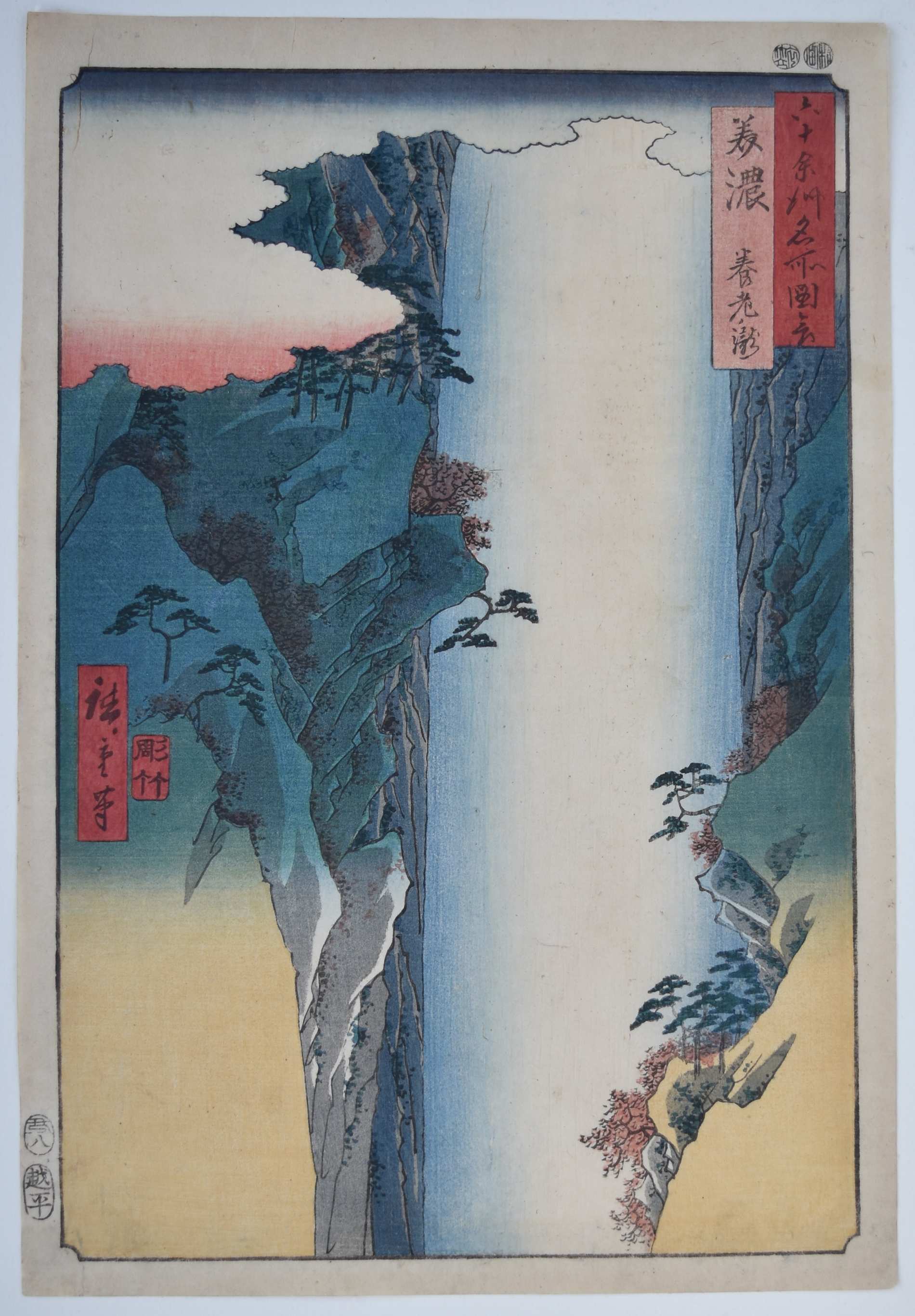
The Yoro Waterfall. Mino, Yoro no taki, “Mino [Province], Yoro Waterfall” from Rokujuyoshu meisho zue, “Famous Views of the Sixty-odd Provinces.” The 32 meters fall cascades down from Mount Tado. Legend has it that the water had rejuvenating properties with the Empress Gensho (A.D. 683-748) having visited and likening the taste to that of sake. A cider, Yoro Sanroku, is produced here. Published by Koshimuraya Heisuke (Kohei), 1853-56, this being 1853. Numerous states exist of this design with colour variations and differences in gradation. Primarily the colouring of the fall changes: Some impressions have the waterfall completely blue, which obscures the blind-printing, while others, as here, have edge gradation only.
Very good impression with blind-printing on the waterfall. Fine colour. Very good condition. Signed Hiroshige ga.
Status: Sold
Utagawa KUNIYOSHI (1797-1861)
Click here to view image full size.
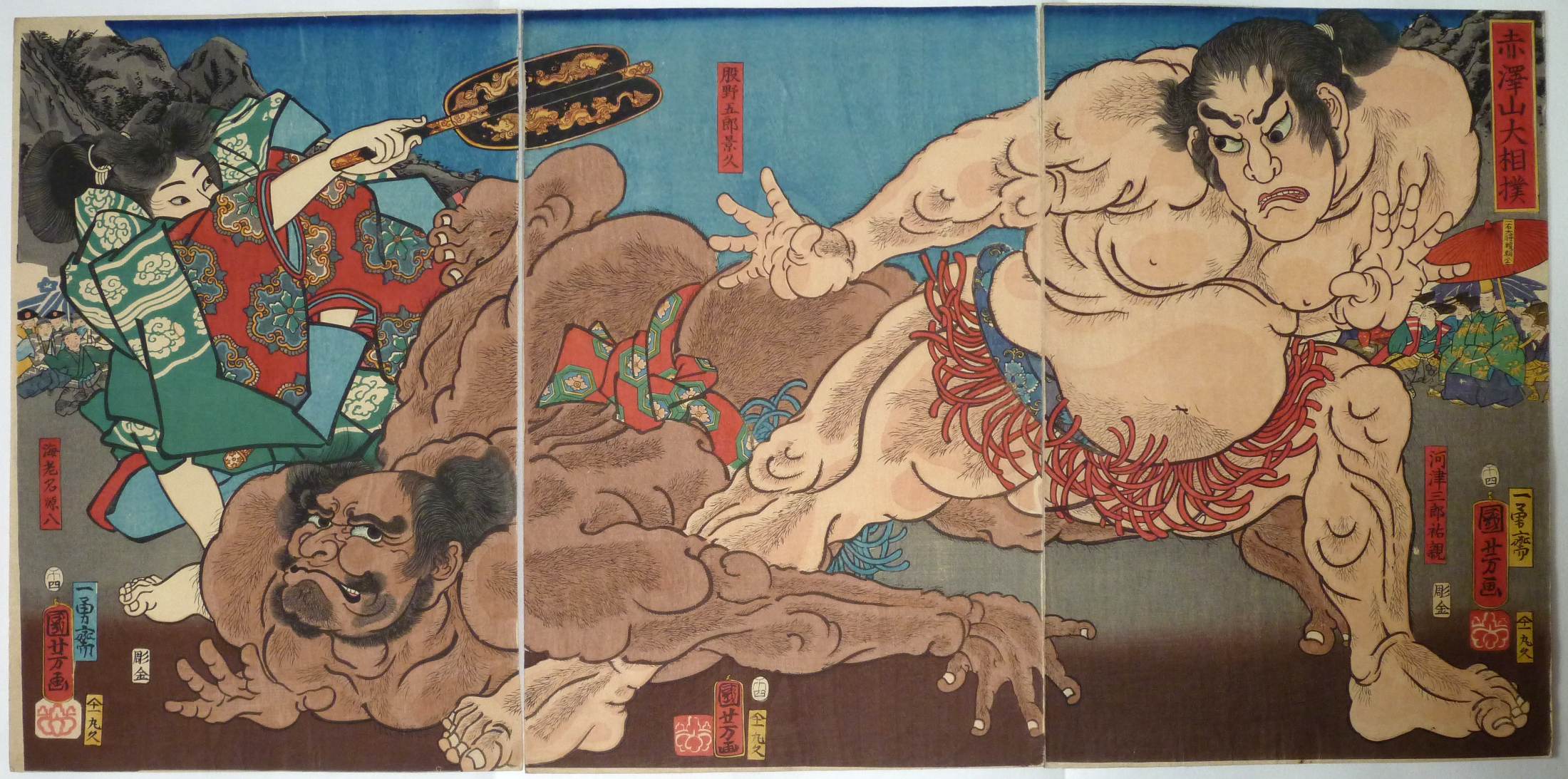
A triptych Akazawa-yama o-sumo showing the most famous sumo match in Japanese history between Kawazu Saburo Sukeyasu and Matano Goro Kagehisa at Akazawa mountain. Also famous as Kawazu used a new sumo hold wrapping a foot around his opponent’s leg and encircling the neck with one arm, a manoeuvre that became known as the Kawazu hold. The event took place in 1176 before Shogun Minamoto Yoritomo where Kawazu defeats the popular bully Matano. Subsequently Kawazu was murdered, quite unrelated to the bout. His sons swear revenge and their story becomes the Soga monogatari. Kawazu is shown here throwing Matano to the ground, the referee to the left. Published 1858 by Maruya Kyushiro. Robinson T353. Provenance: Purchased from me in 1994.
Superb impression and colour. One small thinned area, otherwise very fine condition. Probably the finest impression extant of this famous design. Signed Kuniyoshi ga and Ichiyusai Kuniyoshi ga.
Status: Sold
Utagawa KUNIYOSHI (1797-1861)
Click here to view image full size.
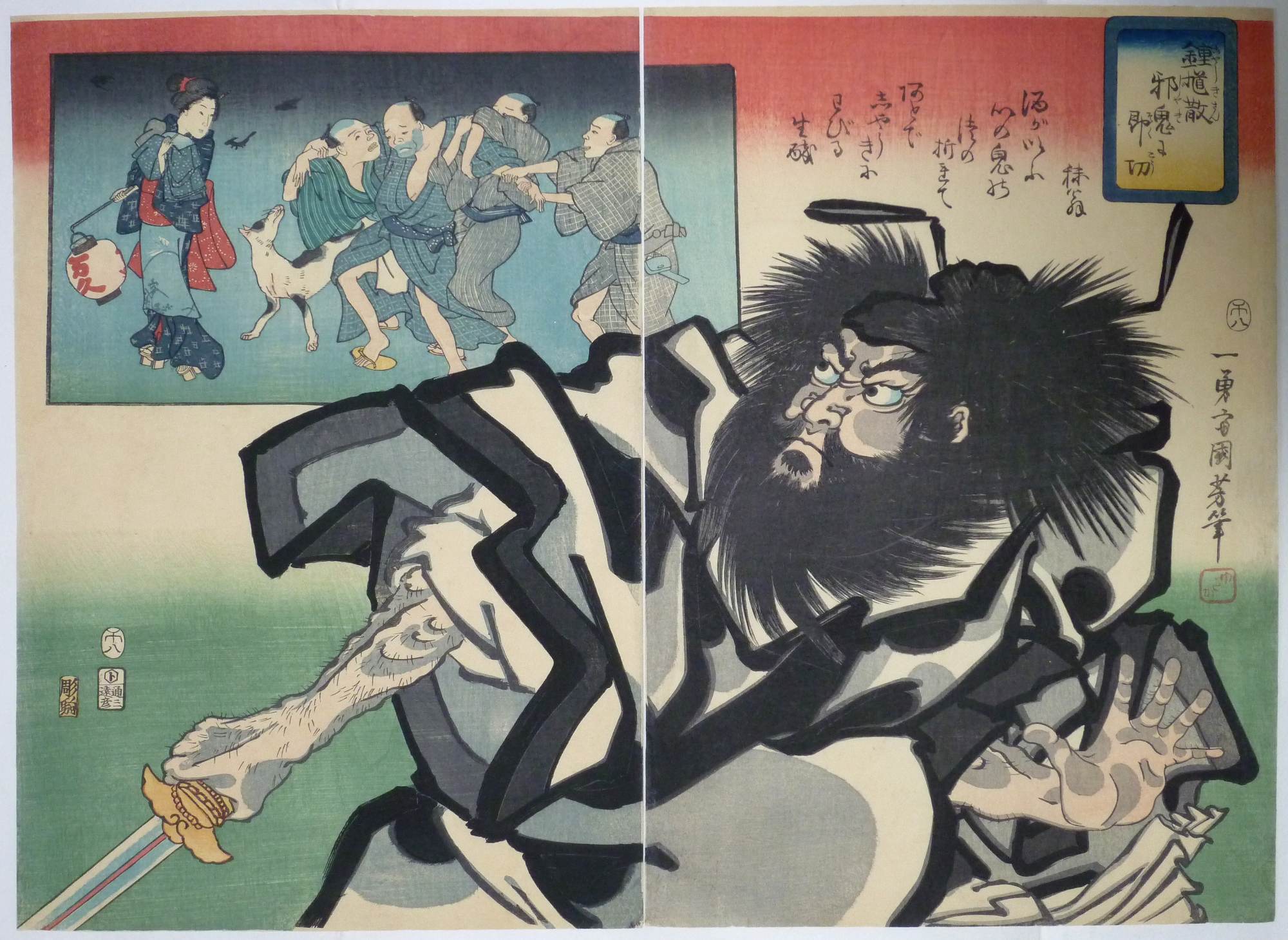
An extremely rare diptych, Shoki-san jaki ni sokko, “Shoki-San, Quick-Acting Medicine to Remove Evil Spirits.” Images of Shoki were used to ward off evil spirits and illness, especially during the Boys’ Festival. Published 1858 by Enshuya Hikobei. Provenance: Purchased from me in 1994.
Extremely fine impression. Fine colour and condition. Signed Ichiyusai Kuniyoshi fude with Yutaka seal.
Status: Sold
Utagawa KUNIYOSHI (1797-1861)
Click here to view image full size.
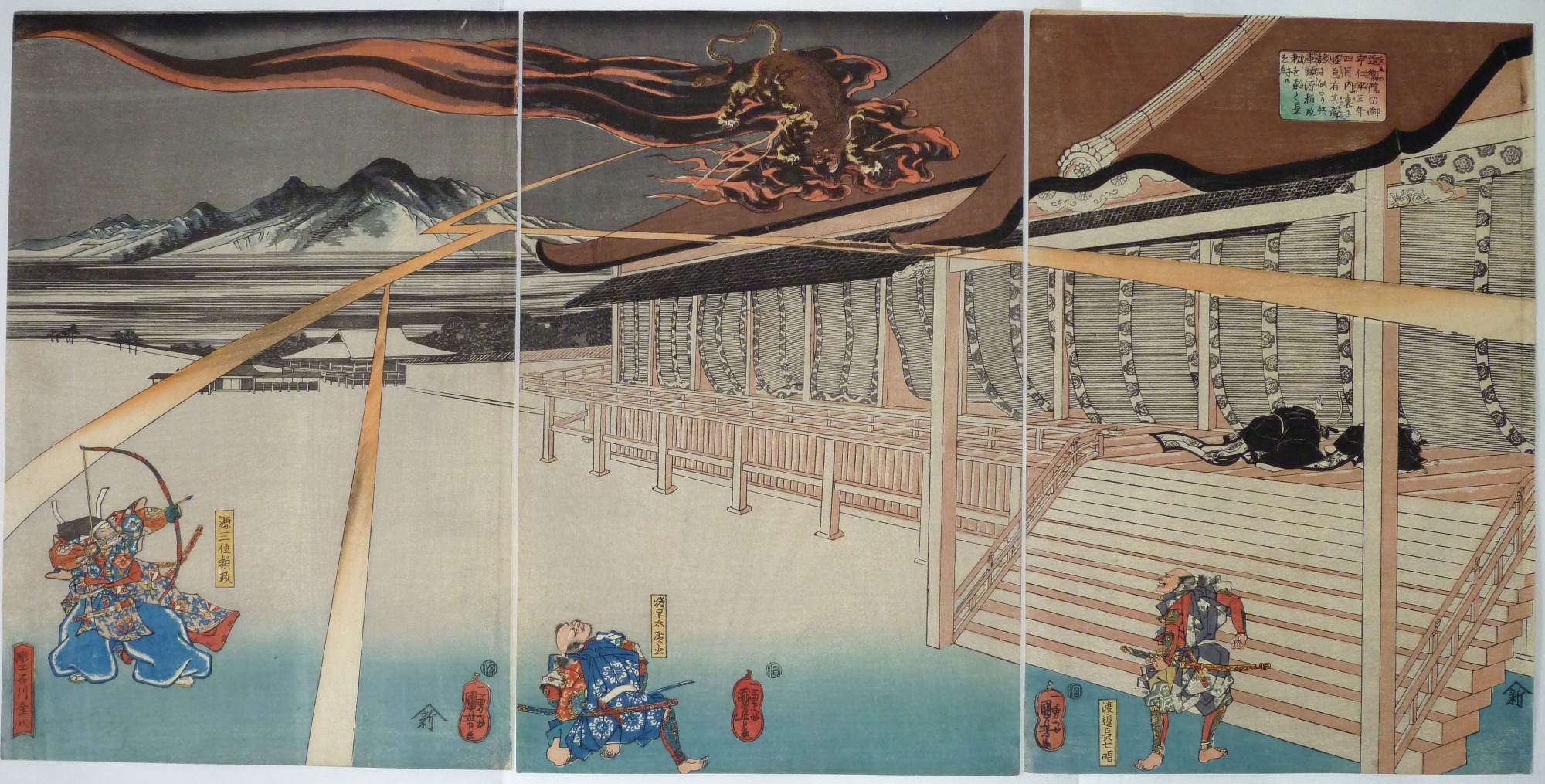
A triptych showing the famous archer Minamoto no Yorimasa preparing to shoot the monster Nue on the roof of the Shishinden Palace. The story relates how in 1153 the sixteen year old Emperor Konoe was having difficulty sleeping due to the shrieks and scratchings emanating from the palace roof. Guards informed him that a black cloud descended there every night. Yorimasa was called upon to investigate and he brought down the beast – a composite creature, part monkey, badger, tiger, dragon and snake which was duly despatched by his retainer Hironao no Hayata (Tadazumi no Hayata). Subsequently Konoe sleeps soundly and rewards Yorimasa with a fine sword and a court beauty Yorimasa loves. An exceptional design published 1842-3 by Yamashiroya Shinroku. Robinson T112. Provenance: Purchased from me in 1994.
Fine impression, colour and condition. Signed Ichiyusai Kuniyoshi ga.
Status: Sold
Utagawa KUNIYOSHI (1797-1861)
Click here to view image full size.
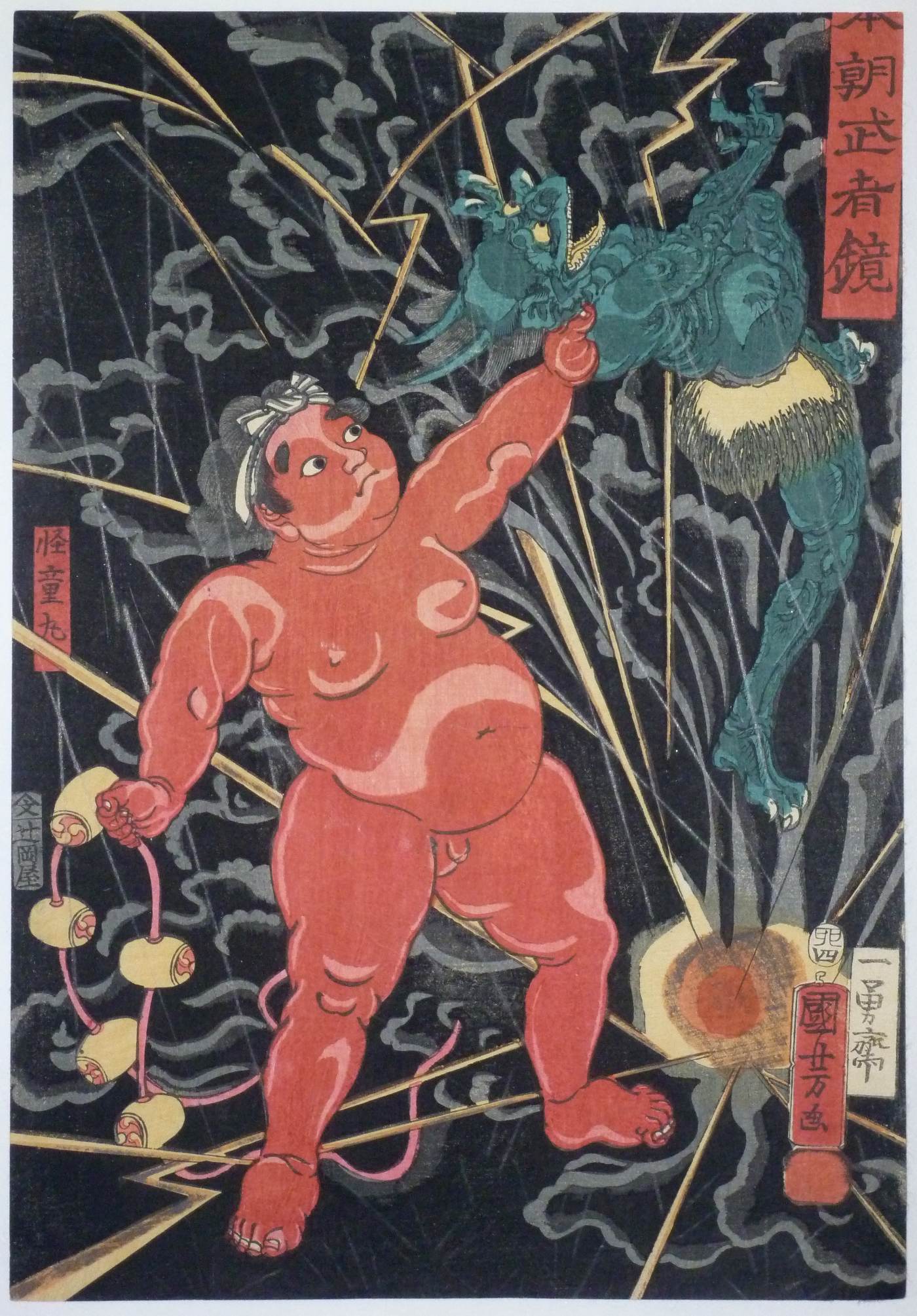
Kwaido Maru (Kintoki) seizes Raijin, the Thunder God, with one hand while holding his thunder drums with the other. A thunderbolt falls to earth causing flashes of lightning. A fine and rare set: Honcho musha kagami, “Mirror of Warriors of our Country.” The set published by Tsujioka-ya Bunsuke, 1855. Robinson S87.6.
Fine impression. Slightly trimmed, otherwise very good condition. Signed Ichiyusai Kuniyoshi ga.
Status: Sold
Ichiryusai HIROSHIGE (1797-1858)
Click here to view image full size.
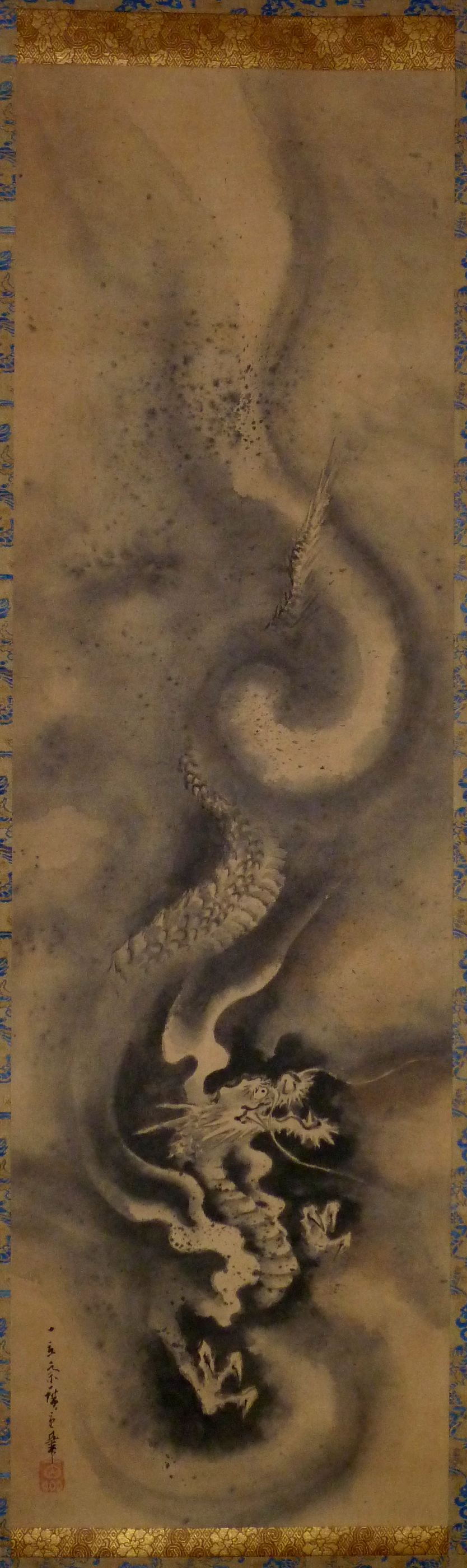
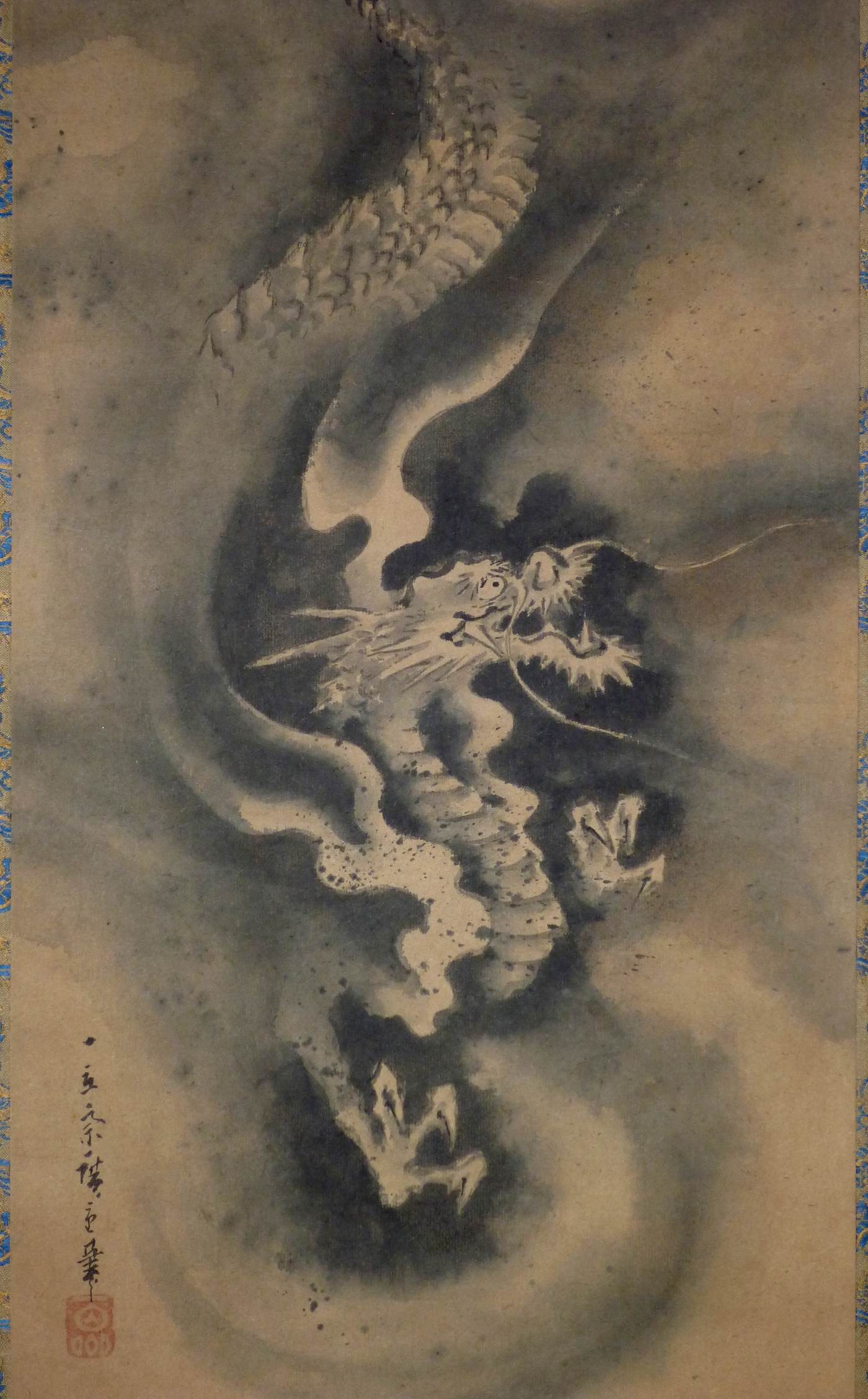
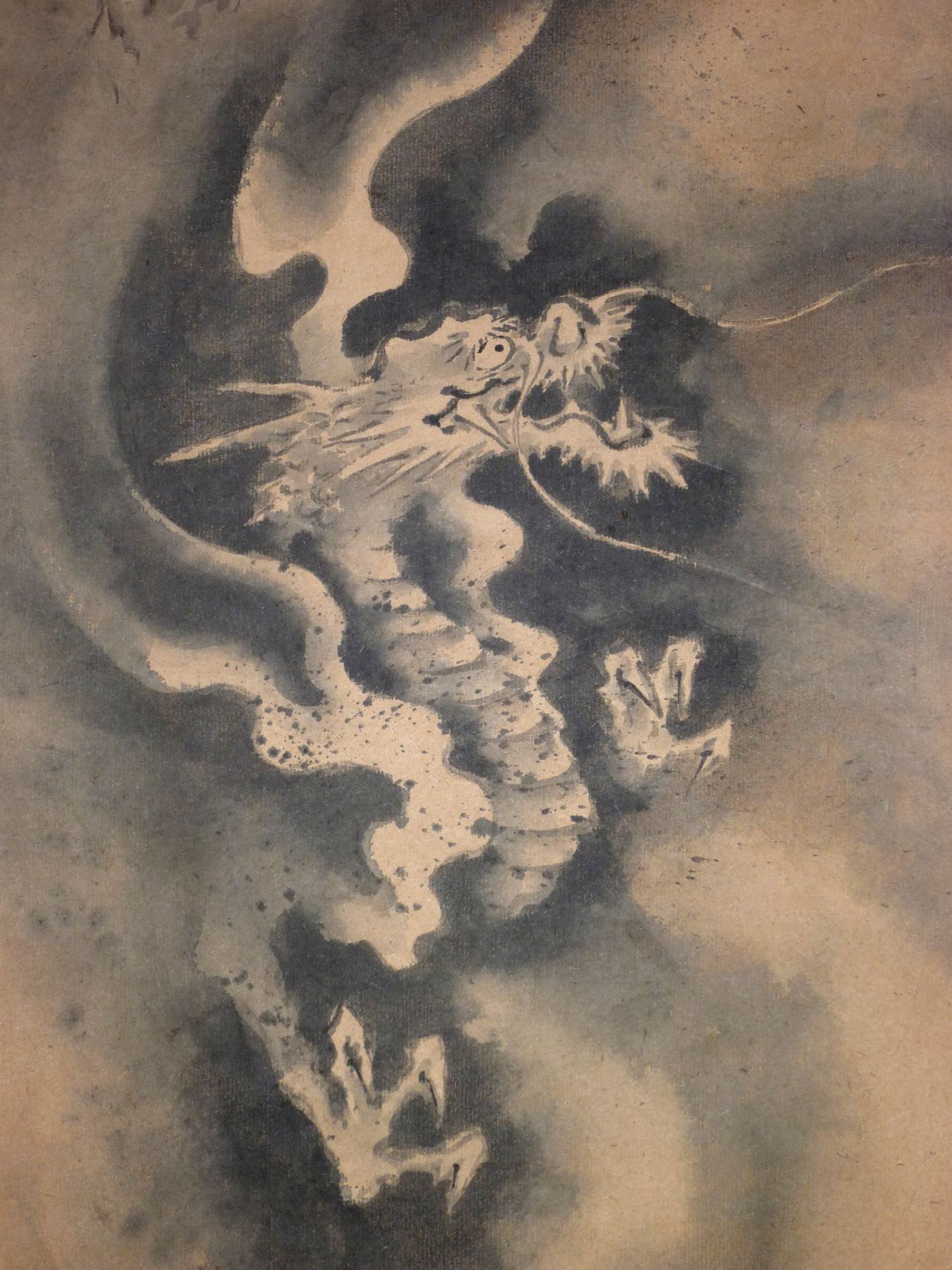
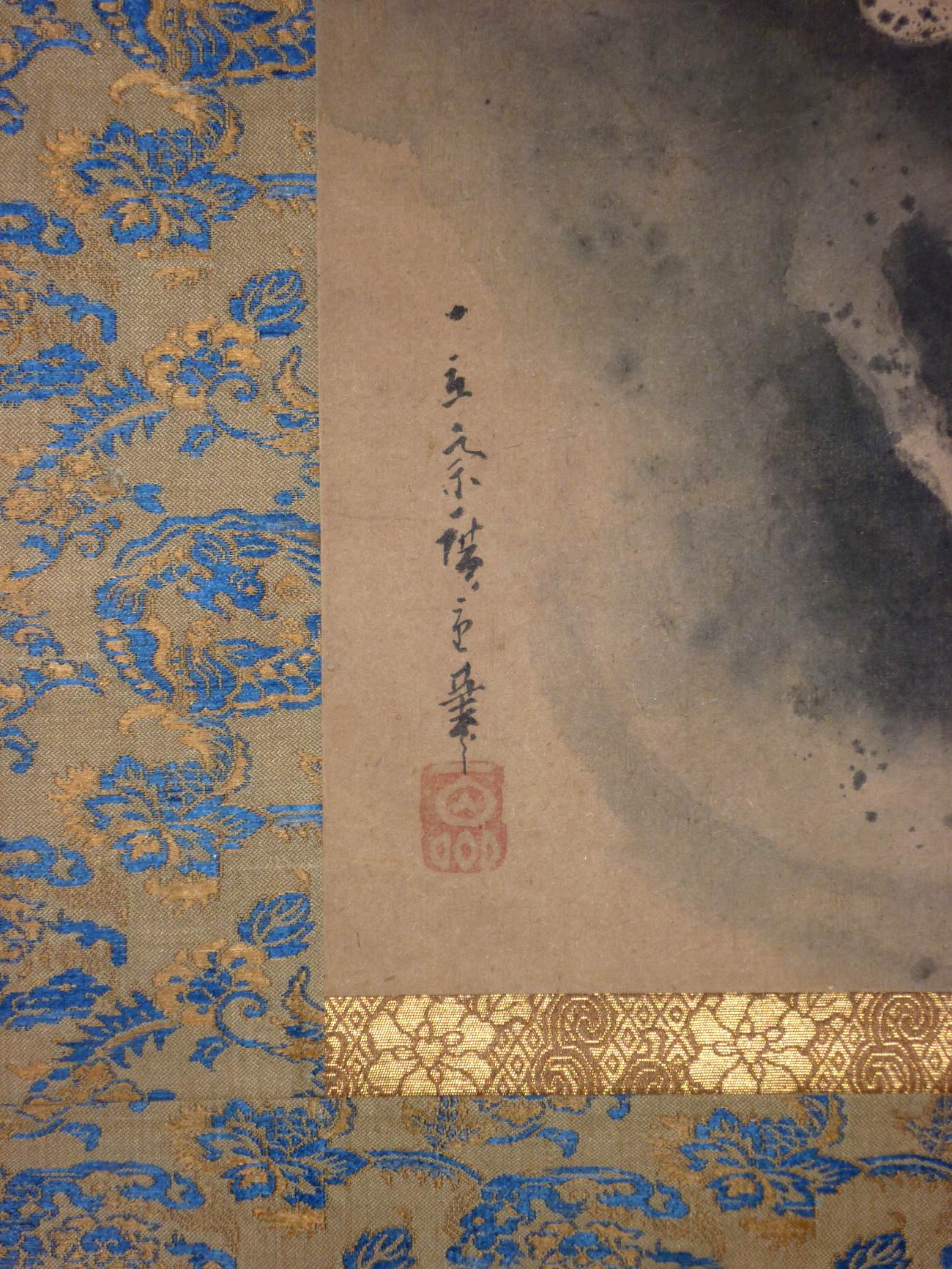
A newly discovered painting of a three-clawed Kano-style dragon amongst clouds. Although a subject popular with Japanese artists (and especially Chinese artists where the subject derives from), this appears to be the only such painting by Hiroshige extant. He did, however, produce two prints of the subject – a surimono and a large panel, both of around the same date. The signature indicates a date after 1840 and it was most likely painted for the Dragon Year 1844. Blue and brown ink on paper with extensive splashed ink. Image size 34.5 x 10.5 in; 87.7 x 26.7 cm. The mount uses a ryu-mon (dragon pattern) motif to match the subject. Very good condition. Signed Ichiryusai Hiroshige hitsu with Ichiryusai seal.
Status: Sold
Utagawa KUNIYOSHI (1797-1861)
Click here to view image full size.
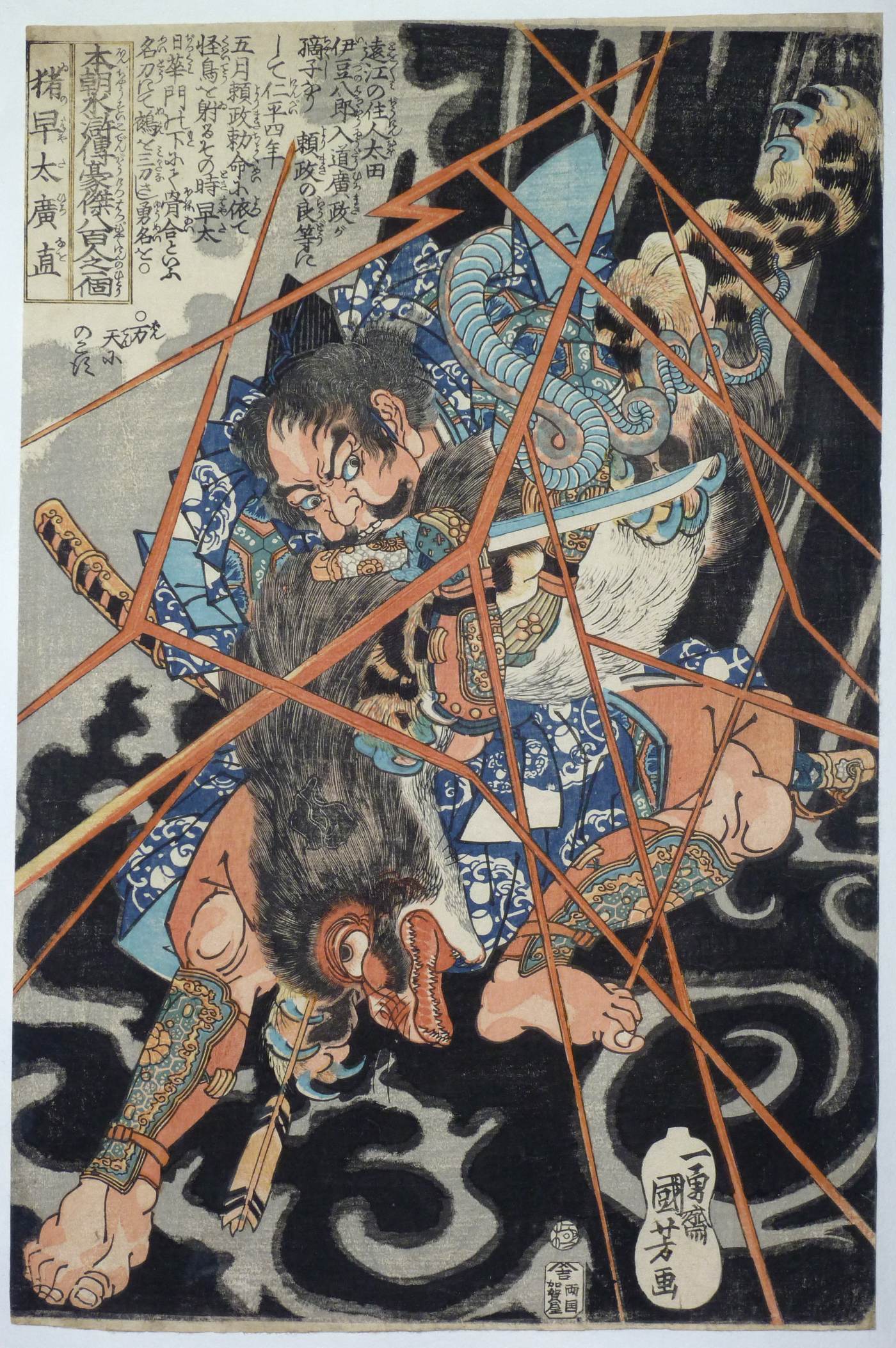
Hironao no Hayata (Tadazumi no Hayata), Yorimasa’s retainer (see the triptych by Kuniyoshi of the same subject on this update), grappling with the composite beast Nue on the roof of the Shishinden Palace. Forked lightning bounces around him. One of the best designs from Honcho Suikoden goyu happyaku-nin no hitori, “Eight Hundred Heroes of our Country’s Suikoden, One by One.” Published by Kagaya Kichiemon, 1830-31.
Very good impression and colour. Slight trimming, otherwise very good condition. Signed Ichiyusai Kuniyoshi ga.
Status: Sold
Isoda KORYUSAI (FL c 1764-1788)
Click here to view image full size.
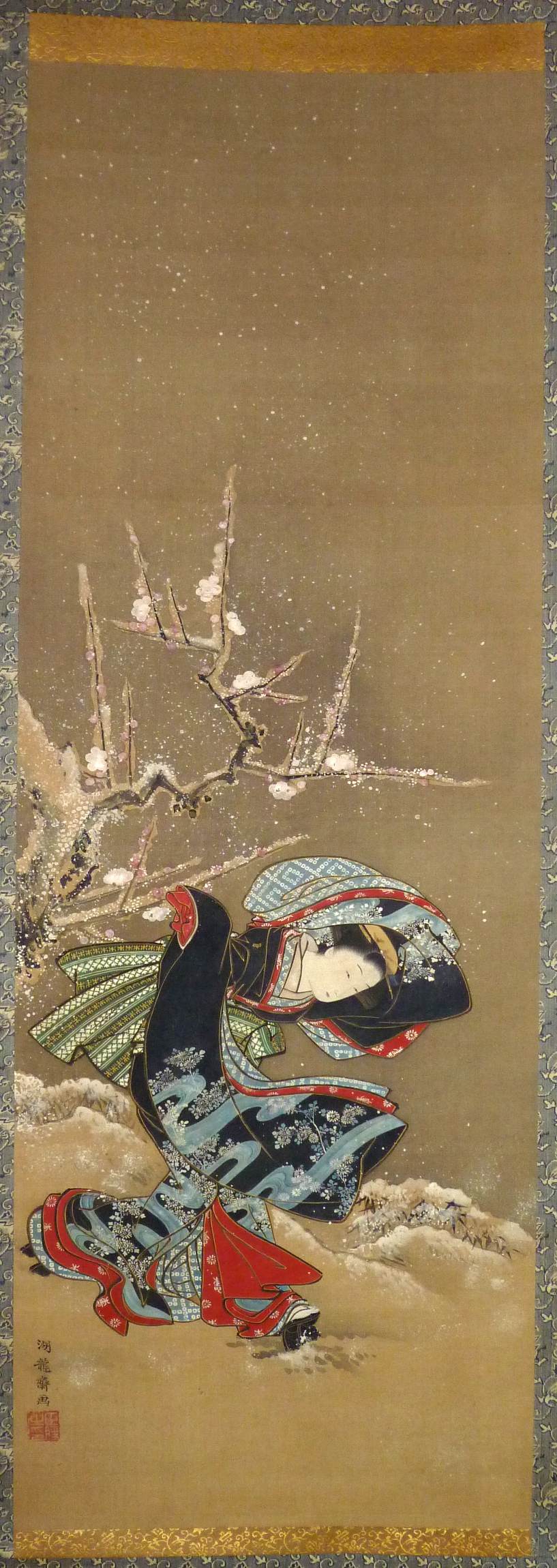
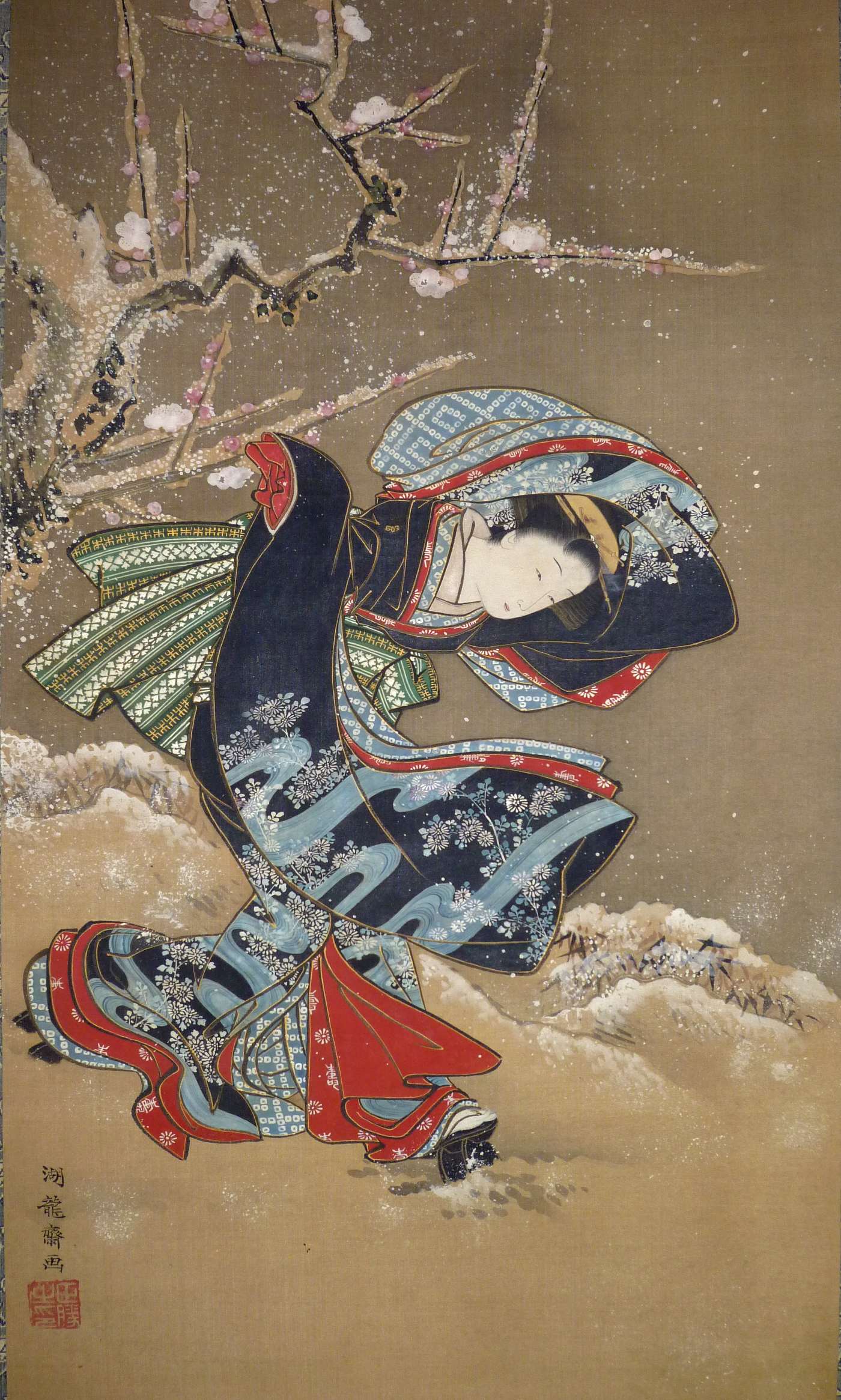
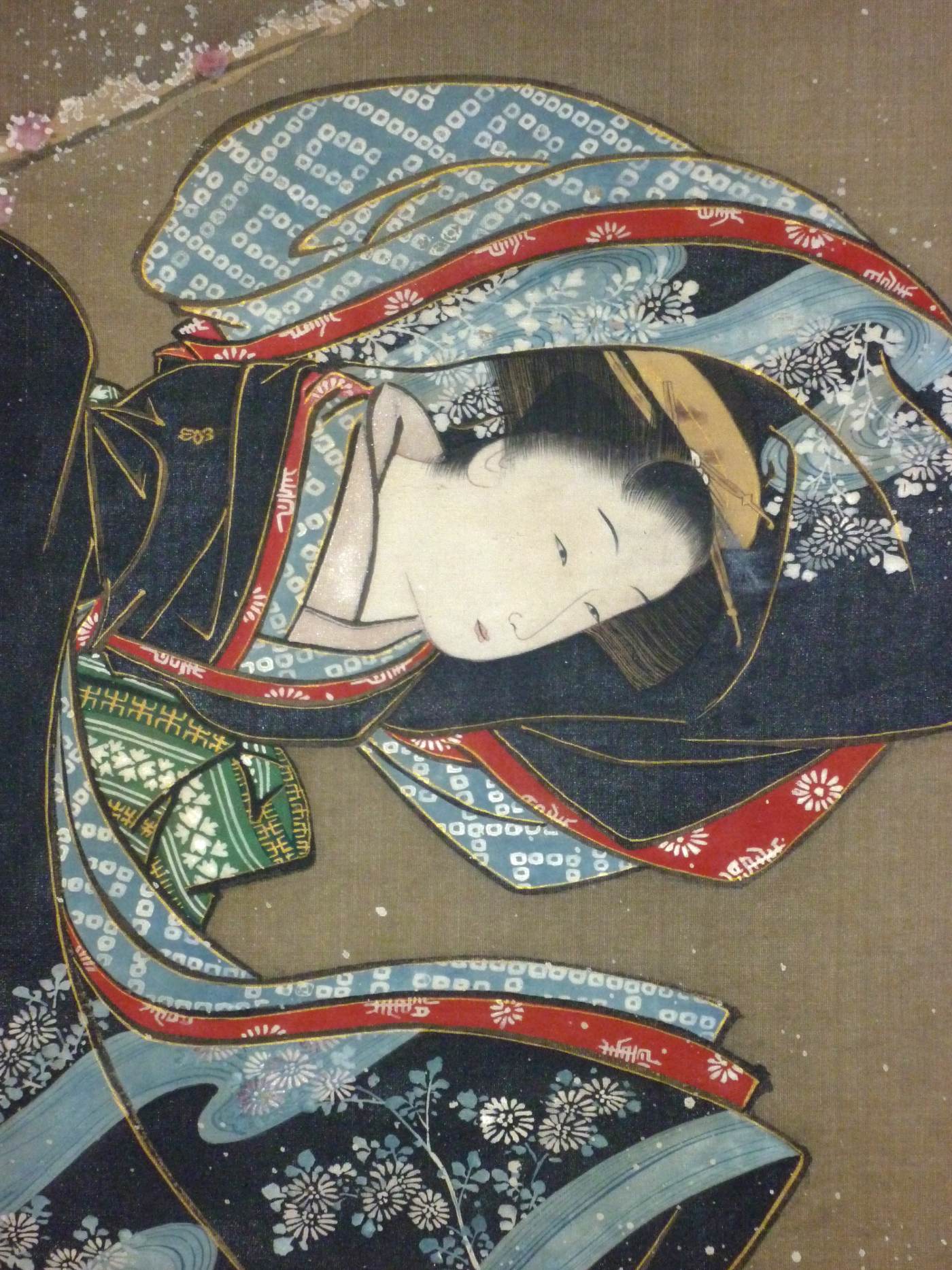
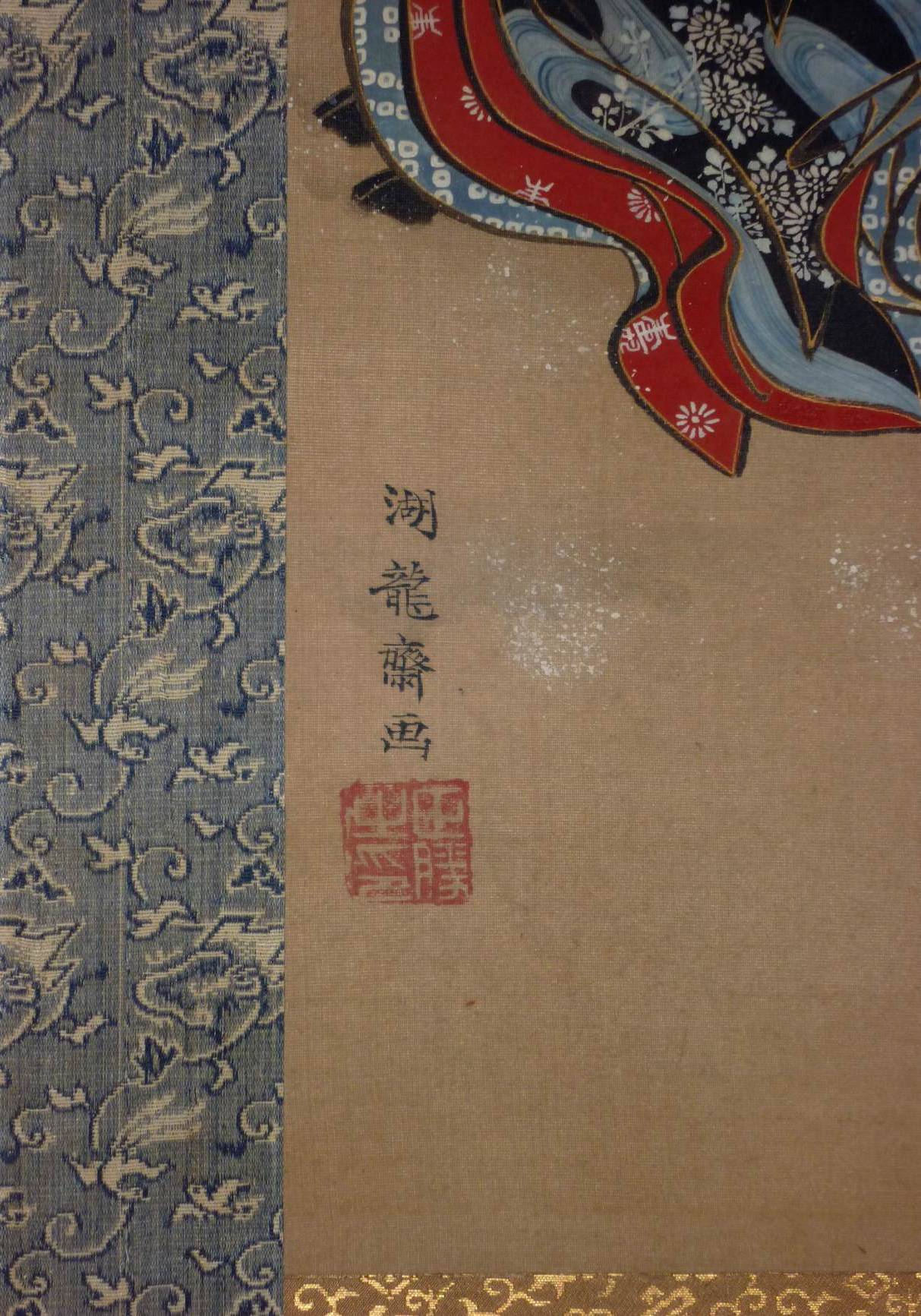
A superb original painting, full colour on silk, showing a beauty running in a late snowfall. Cherry blossom above. A leading artist of his time who produced some of the best bijin and kacho prints of the 1770s before concentrating on painting. Image size 40.25 x 14.25 in; 102.5 x 36 cm. Good condition. Painted c 1778. Signed Koryusai ga with seal Masakatsu, no in.
Status: Sold
Utagawa HIROSHIGE (1797-1858)
Click here to view image full size.
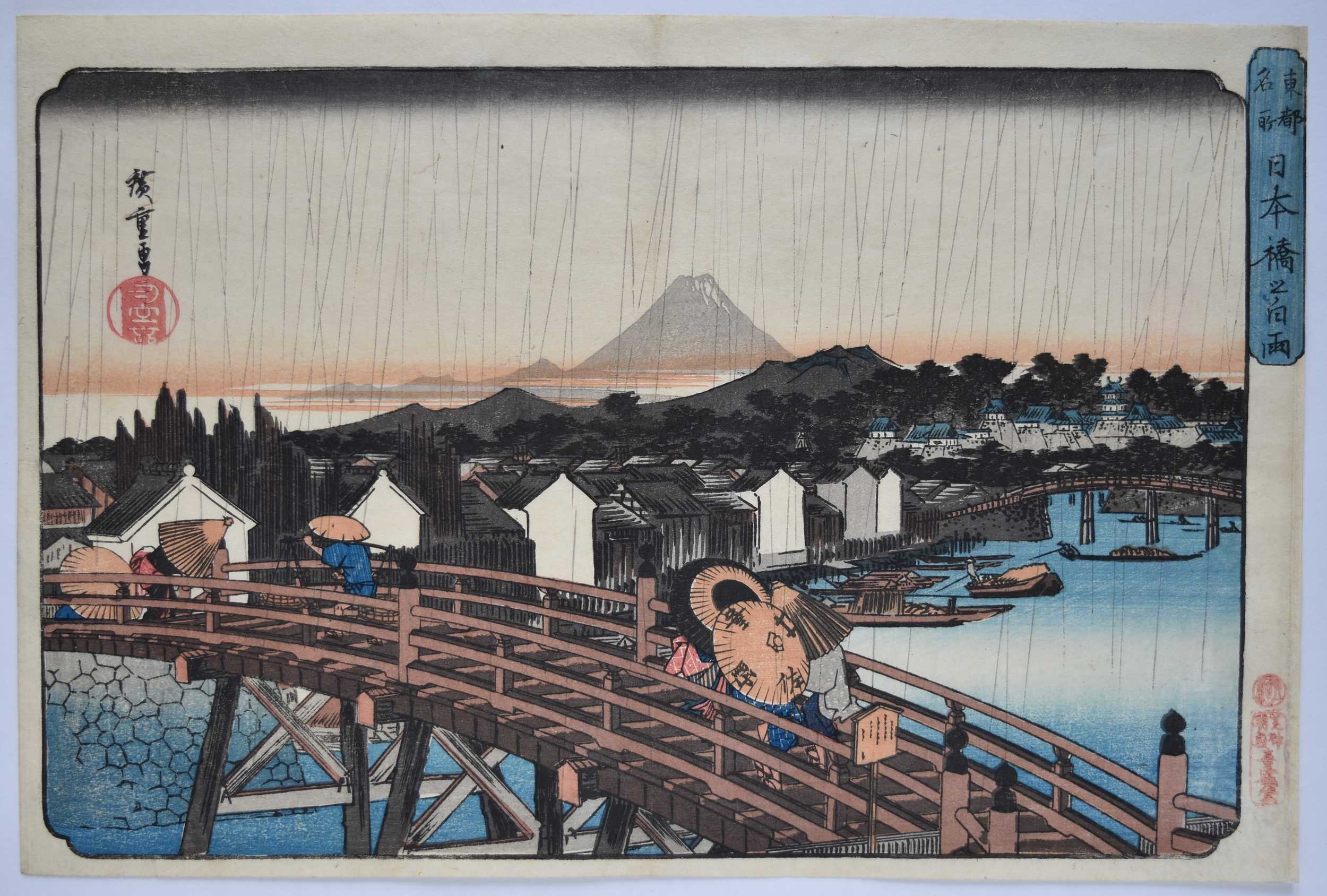
Nihonbashi no hakuu, “Light Rain on Nihon Bridge.” From a Toto meisho set of 21 designs published between c. 1832 and 1839 by Kikakudo. The set was subsequently enlarged. Shows figures crossing Nihonbashi in rain, one figure carries an umbrella with the publisher’s name. Warehouses in the background and a distant view of Fuji. A beautiful print and very difficult to find in early impression: The title cartouche had a plug inserted beside the bottom three characters of the title on the left. This damage seems to have occurred when the block was cut and over time the spigot gradually slipped out leaving an unprinted area (which is sometimes painted in). In the earliest impressions the plug is hardly visible (as here). Also, the publisher’s seal at the bottom right should be in red, later editions having it in black. There was also an early variant edition with a yellow sky.
Fine impression and colour. Imperceptible centre fold, also near the right edge, otherwise very good condition. Signed Hiroshige ga.
Status: Sold
Utagawa HIROSHIGE (1797-1858)
Click here to view image full size.
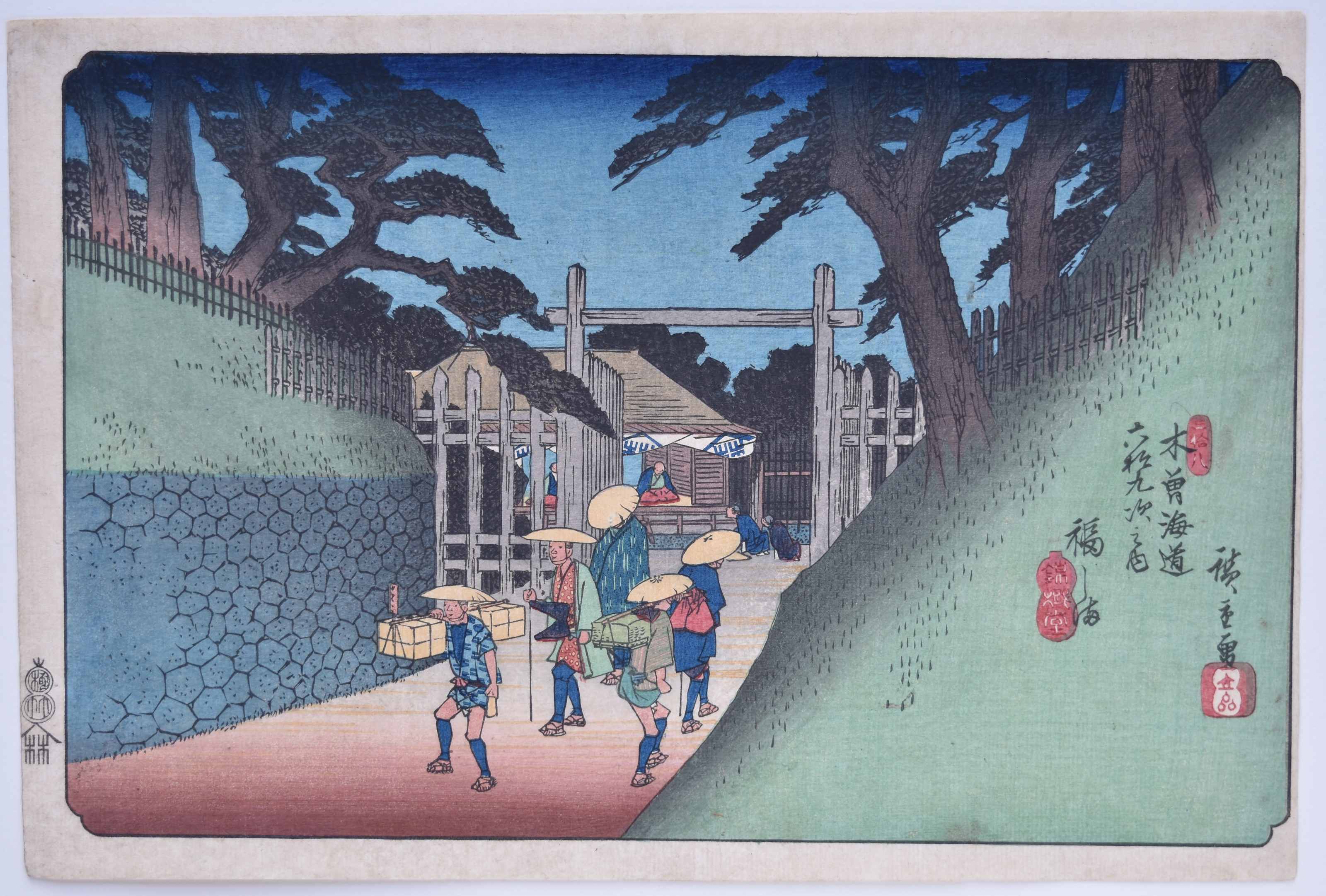
Station Fukushima from Kisokaido rokujukyutsugi no uchi, “Sixty-nine Stations of the Kisokaido.” The set of seventy prints was started by Eisen and published by Hoeido in 1835, but in 1837 Hiroshige took over and completed the series with the publisher Iseya Rihei (Kinjudo). Fukushima was one of the four most important checkpoints in the country and travellers had to have their documents inspected and approved before they could continue.
Superb impression. Very fine colour. Fine condition. Signed Hiroshige ga.
Status: Sold
Utagawa HIROSHIGE (1797-1858)
Click here to view image full size.
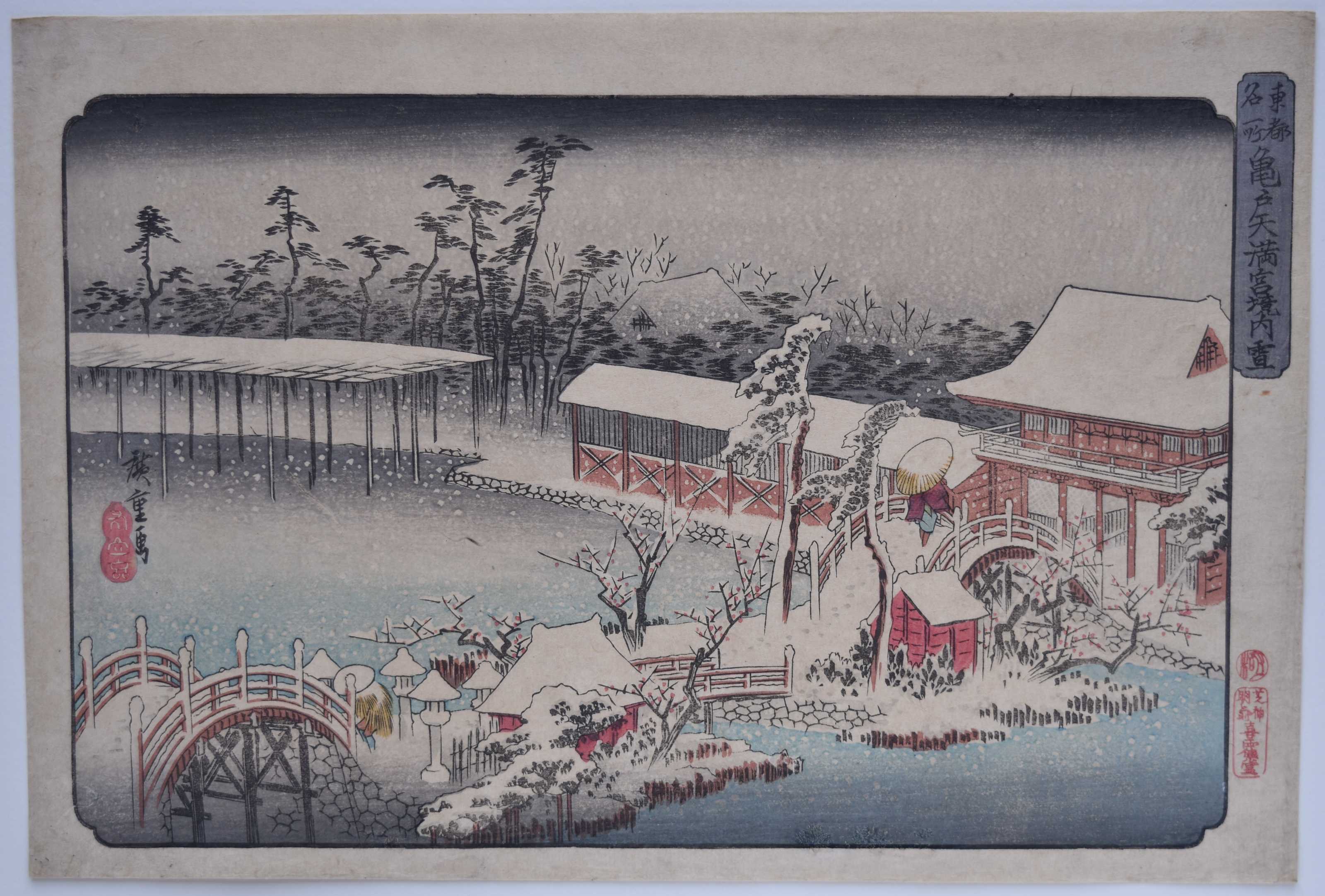
Kameido Tenmangu keidai no yuki, “The Compound of the Tenman Shrine at Kameido in Snow.” From a set of twenty-one prints Toto meisho, “Famous Views in the Eastern Capital” published by Sanoya Kihei, c 1834-5. The series was extended to fifty-five in c 1839-42. One of the most famous places in Edo. Known for its pergola, two drum bridges, koi ponds and the wisteria which flowered in the fifth month. The main shrine is dedicated to the memory of Sugawara no Michizane (Tenjin), the father of Japanese learning and built in 1662. The design comes in various states: Late editions have a black sky and the red publisher’s seal on right margin is replaced with an abbreviated Sanoki seal in black. Even later editions show a slipping plug becoming evident on the edge of the water, centre left.
Fine, very early impression with the double-printing on the cloak of the figure on the bridge. Fine colour and condition. Signed Hiroshige ga.
Status: Sold
Utagawa HIROSHIGE (1797-1858)
Click here to view image full size.
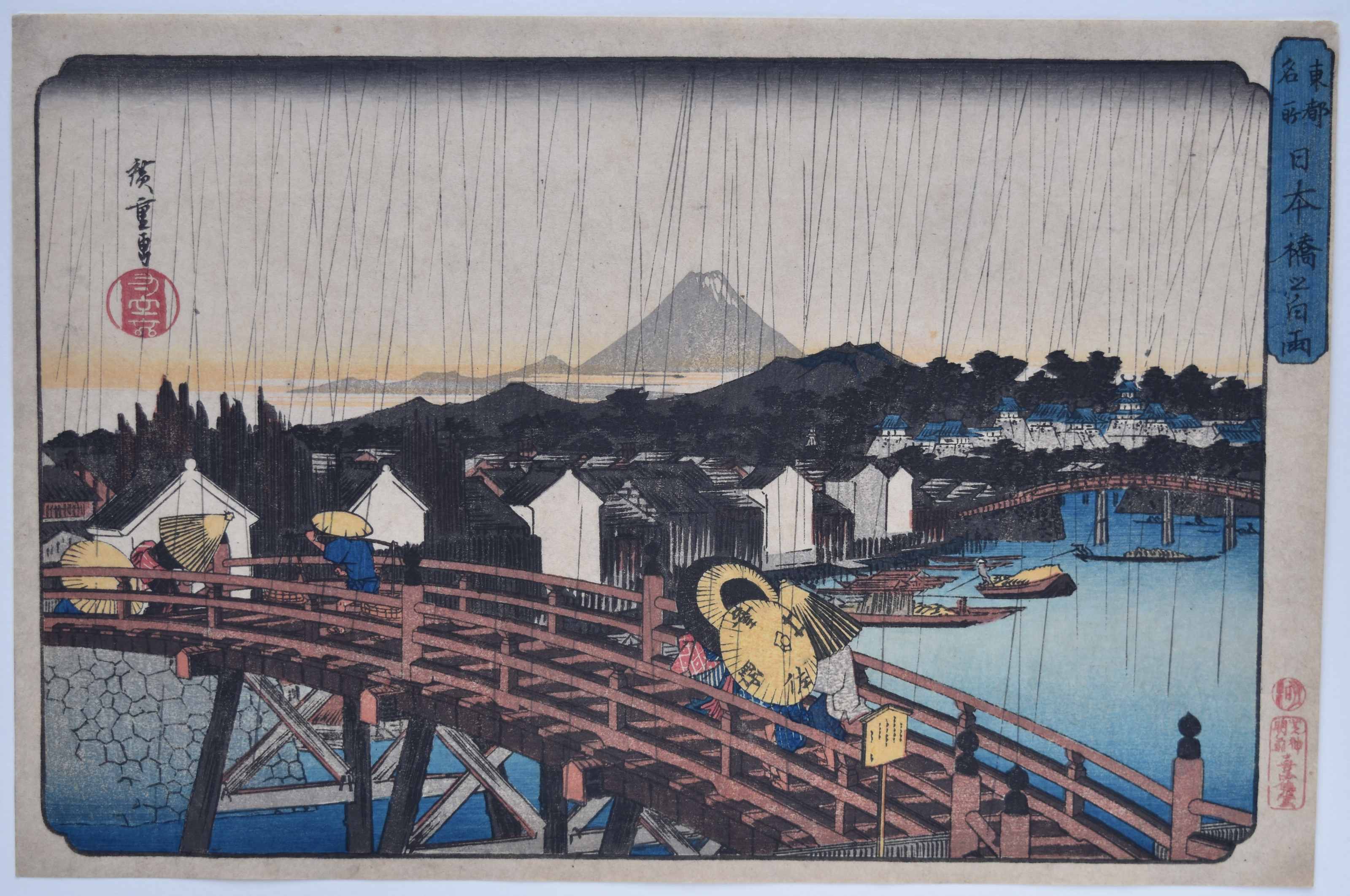
Nihonbashi no hakuu, “Light Rain on Nihon Bridge.” From a set of twenty-one prints Toto meisho, “Famous Views in the Eastern Capital” published by Sanoya Kihei, c 1834-5. The series was extended to fifty-five in c 1839-42. Shows figures crossing Nihonbashi in rain, one figure carries an umbrella with the publisher’s name. Warehouses in the background and a distant view of Fuji. A beautiful print and difficult to find in early state: The title cartouche had a plug inserted beside the bottom three characters of the title. This damage seems to have occurred when the block was cut and over time the spigot gradually slipped out leaving an unprinted area (which is sometimes painted in). In the earliest impressions the plug is not visible, as here. Also, the publisher’s seal at the bottom right should be red, later editions having it in black.
Fine, very early impression with a pale yellow sky. Fine colour and condition. Signed Hiroshige ga.
Status: Sold
Utagawa HIROSHIGE (1797-1858)
Click here to view image full size.
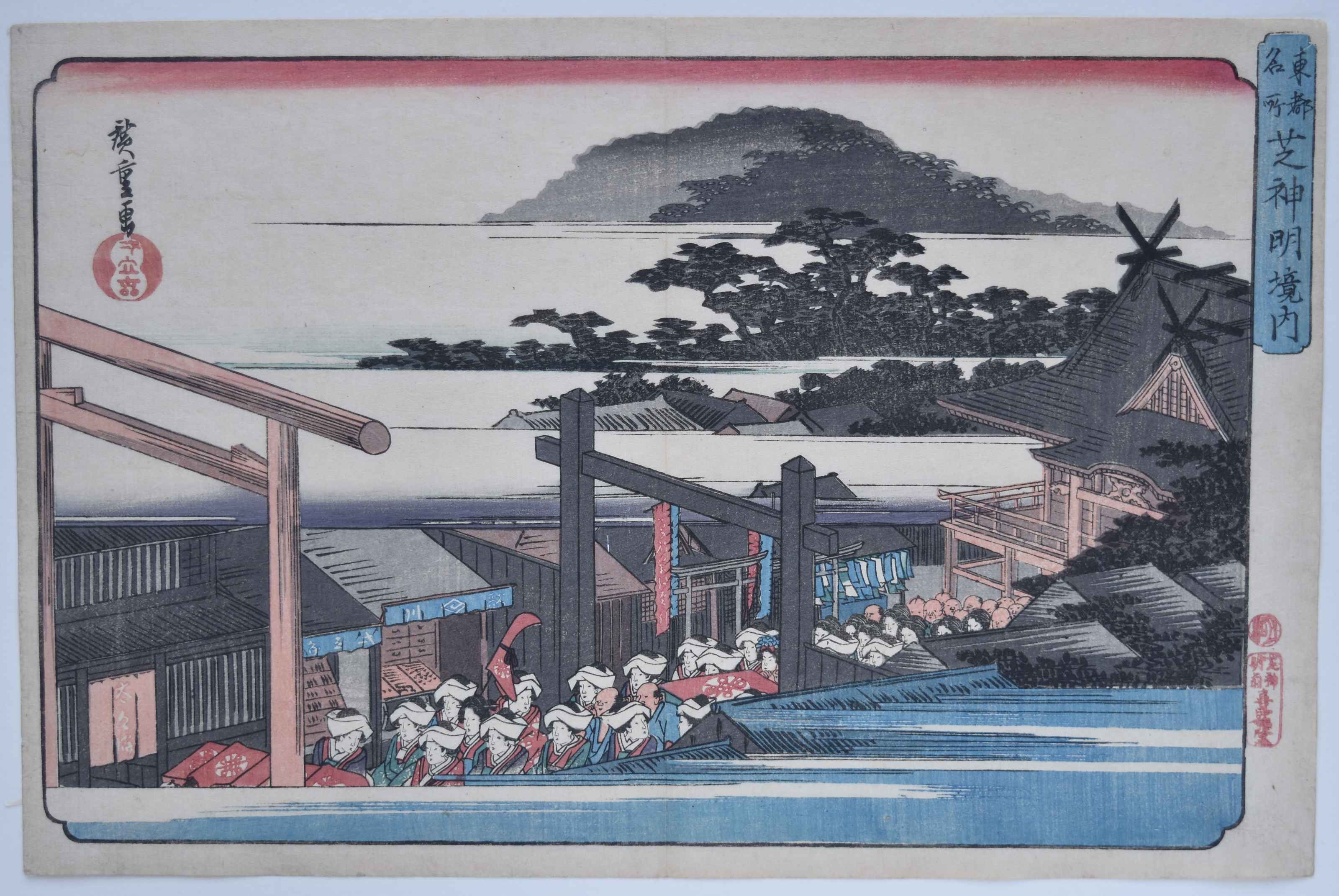
A procession at the Shiba Shinmei keidai, “Precincts [of the] Shiba Shinmei [Shrine].” The shrine with the distinctive chigi protruding roof beams can be seen on the right. A popular area with the Zozoji Temple, tea stalls and where the Shoga Matsuri Festival was held. From a set of twenty-one prints Toto meisho, “Famous Views in the Eastern Capital” published by Sanoya Kihei, c 1834-5. The series was extended to fifty-five in c 1839-42.
Fine, very early impression. The publisher’s seal at the bottom right should be red, later editions having it in black. Fine colour. Slight centre fold, otherwise very good condition. Signed Hiroshige ga.
Status: Sold
Ichiryusai HIROSHIGE (1797-1858)
Click here to view image full size.
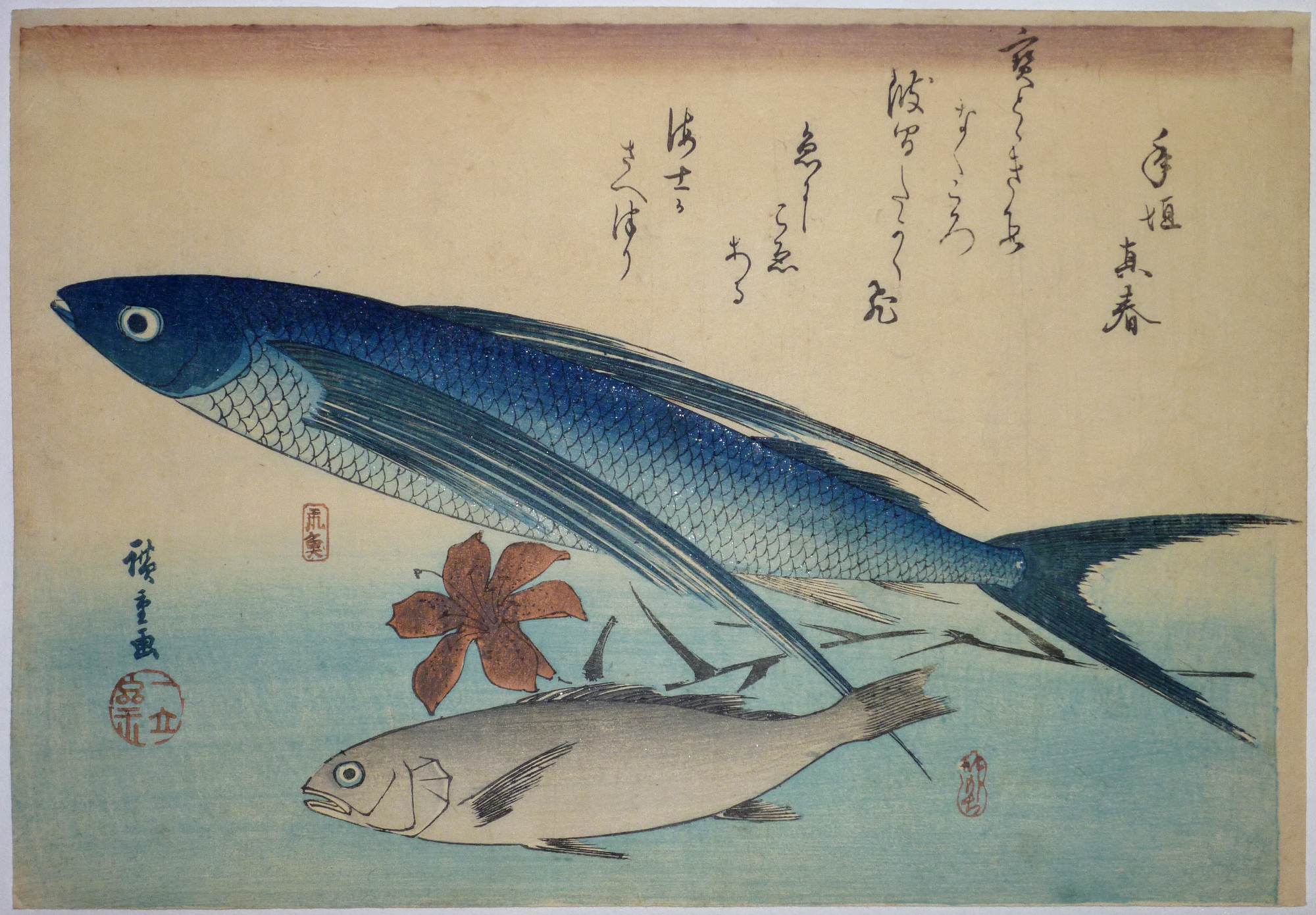
Tobiuo, flying fish (probably Prognichthys) and ishimochi also called guchi or shiroguchi, white croaker, (probably Argyrosomus argenatus). Together with a single lily. Poem by Toshigaki Maharu. From the second series of ten fish prints published by Yamasho, c1840-42.The first series was issued privately for a poetry group ( probably the Shingyoku Circle ) with judges’ names and extra poems. These prints are of the utmost rarity as probably only enough for the Circle were printed and they never come onto the market. Due to their popularity this first series was published commercially and a second set was commissioned.
Fine, early impression with mica on the flying fish. Fine colour and condition. Full size and no centre fold. Signed Hiroshige ga in blue (which I have never seen).
Status: Sold
Utagawa TOYOKUNI II (TOYOSHIGE) (1777-1835)
Click here to view image full size.
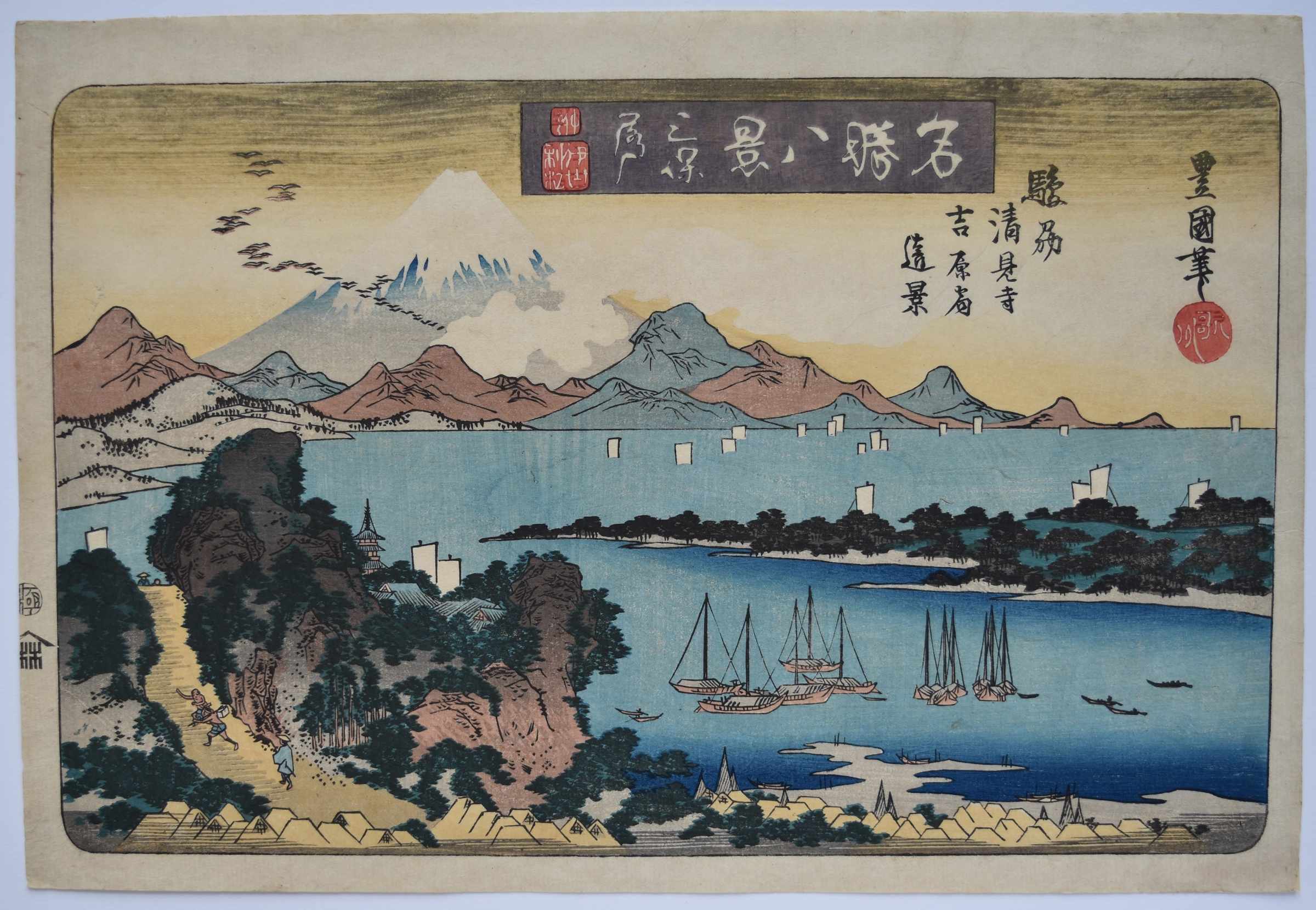
Returning Geese at Miho: Kiyomizu Temple of Suruga Province with a Distant View of Yoshiwara from Meisho hakkei, “Eight Views of Famous Places.” A popular theme in Japanese art originating in China and the landscape of the Xiaoxiang region where the Xiao and Xiang rivers converge. Published c 1833-4 by Kinjudo.
Fine impression, colour and condition. The pigment in the title cartouche intact, which is usually faded. Signed Toyokuni hitsu.
Status: Sold
Ichiryusai HIROSHIGE (1797-1858)
Click here to view image full size.
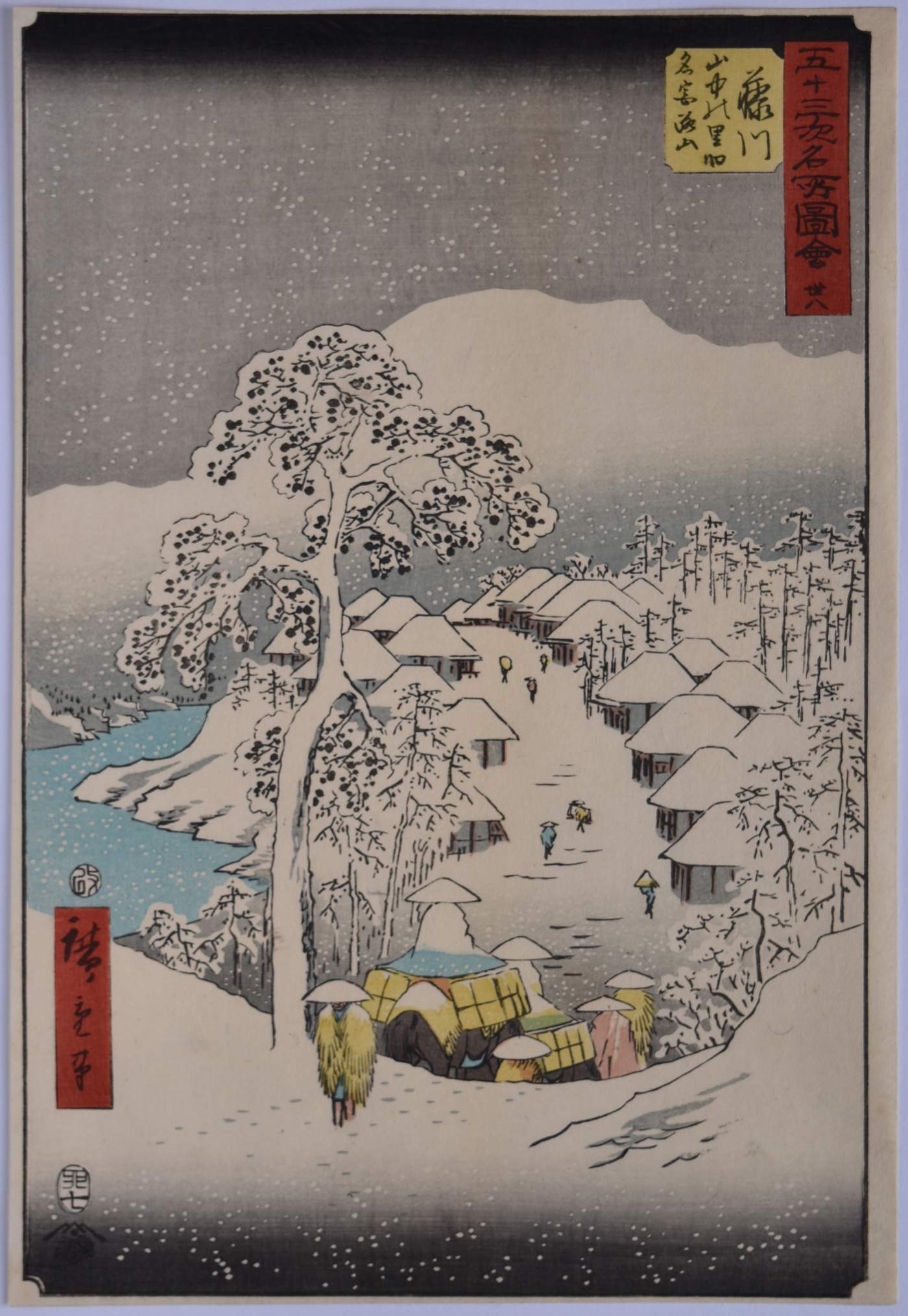
Fujikawa from the so-called “Upright Tokaido.” One of the two snow scenes from the set. Shows travelers coming and going at the edge of the village. Published by Tsutaya, Hare 7, 1855.
Very good impression with wood-grain evident in the sky. Very good colour. Trimmed close, otherwise very good condition. Signed Hiroshige ga.
Status: Sold
Katsushika HOKUSAI (1760-1849)
Click here to view image full size.
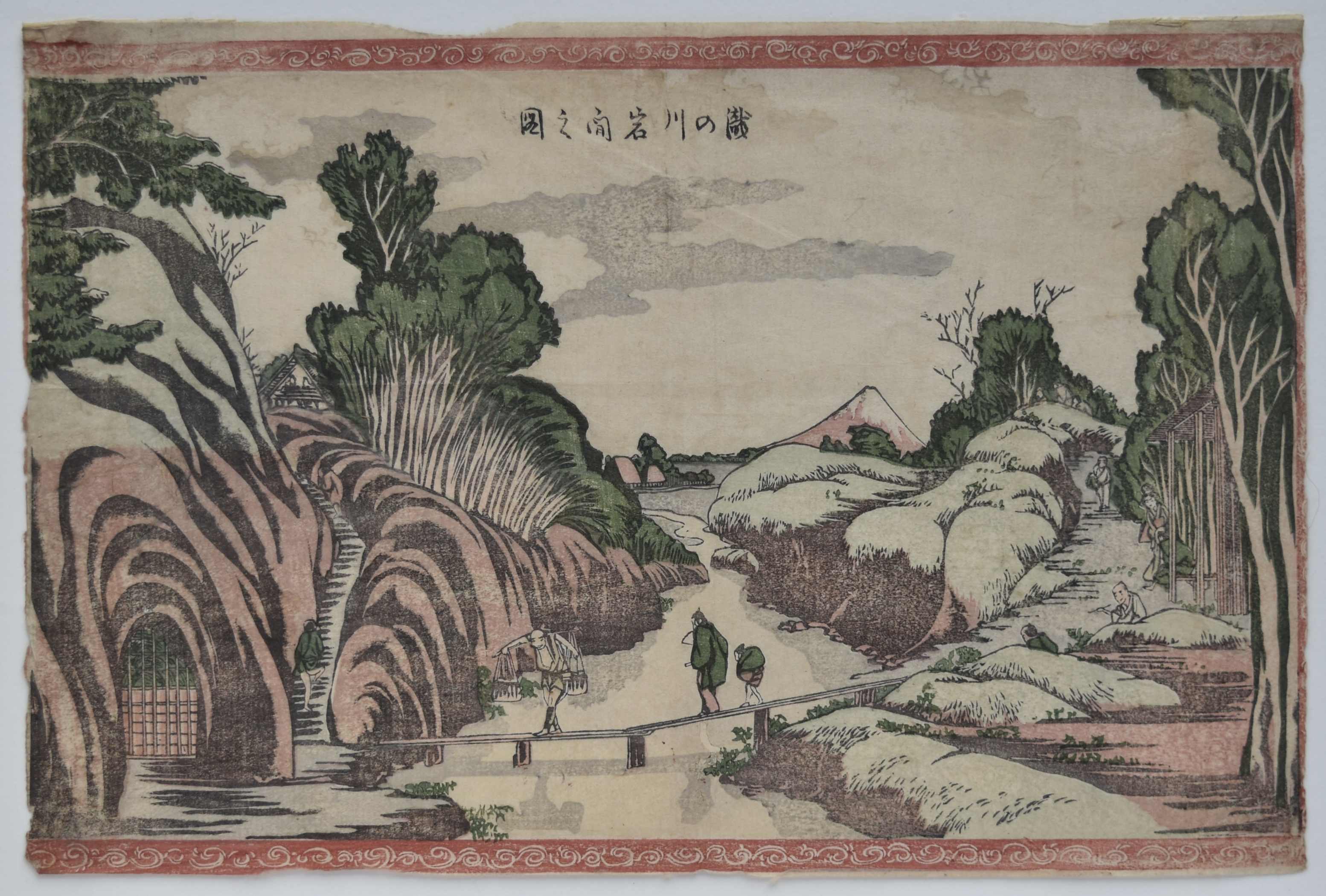
Early in his career Hokusai designed a number of occidental prints in various formats. The design offered here is from an aiban set of 5 prints published c 1800:
1) Haneda Benten no zu, “Benten Shrine at Haneda.”
2) Kanagawa oki Hommoku no zu, “View of Hommaku off the Coast of Kanagawa.”
3) Nihon-zutsumi yori Tanaka mo miru no zu, “View of the Fields Seen from Nihon Embankment.”
4) Azumabashi yori Sumida mo miru no zu, “View of the Sumida River from Azuma Bridge.”
5) And this print: Takinogawa Iwama no zu, “View of the Cave of Takinogawa.”
Shows travellers crossing a plank bridge and climbing a path up beside the cave seen far left with a metal grill. Of the utmost rarity: Another impression is illustrated in The Western-Style Colour-Prints in Japan, Usaburo Toyama, Daiichi-Shobo, 1936, pl. 101, p. 151. From the collection of Toyosaku Saito. This and possibly another impression in Japan are the only other impressions known.
Fine impression and colour. The decorative border left and right trimmed. Some edge damage left, top and bottom. One crease and minor soil; but generally good condition. Unsigned.
Status: Sold
Utagawa HIROSHIGE (1797-1858)

Click here to view image full size.
Shoheibashi Seido Kandagawa, “Seido Shrine and Kanda River seen from Shohei Bridge” from Meisho Edo hyakkei, “One Hundred Famous Views of Edo.” Summer rain over the Kanda River with the Confucian temple on the hill to the right which was founded in the 17th century. The set was published by Uoya Eikichi between 1856 and 1858, this being 1857. There are many late editions of this set. Unidentified collector’s seal au verso. This is the rare first edition.
Fine impression of the first edition. Fine colour. Slight toning and two pinholes in left margin, otherwise fine condition. Full margins. Signed Hiroshige ga.
Status: Sold
Utagawa HIROSHIGE (1797-1858)
Click here to view image full size.
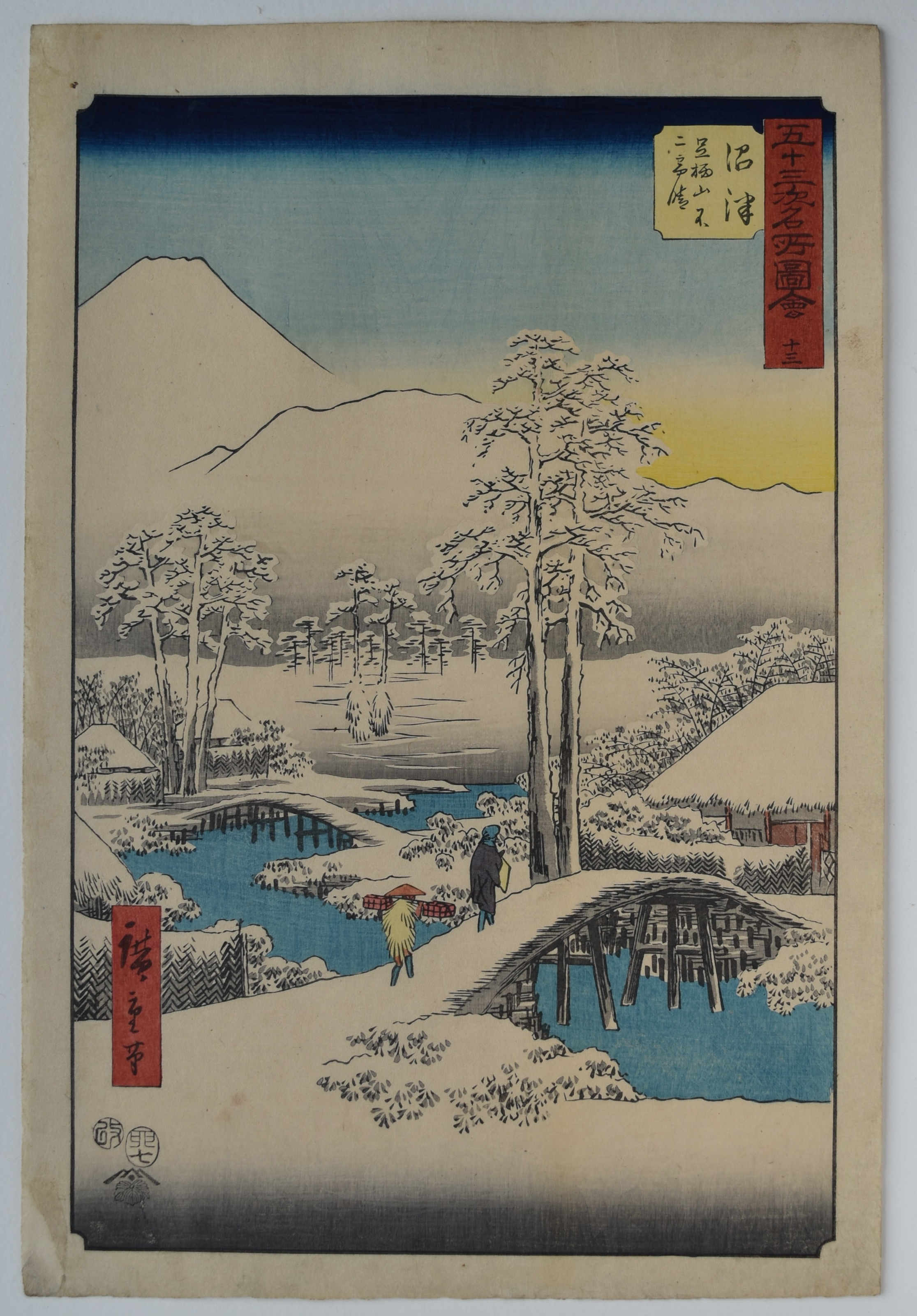
Numazu Ashigarayama Fuji no yukibare, “Numazu: Mount Fuji and Mount Ashigara after Snow” from Gojusan tsugi meisho zue, “Famous Places on the Fifty-three Stations.” The so-called “Upright Tokaido.” Shows two travellers crossing a trestle bridge over the Kise River before entering Numazu village seen on the left. Mount Fuji in the distance. Published by Kichizo (Koeido Tsutaya), 1855. There are many late editions of this set with the skies on the two snow scenes printed black. A fine snow design.
Fine, early impression. Fine colour. Small thinned area bottom left margin and one pinhole, otherwise fine condition. Full margins. Signed Hiroshige ga.
Status: Sold
Utagawa HIROSHIGE (1797-1858)
Click here to view image full size.
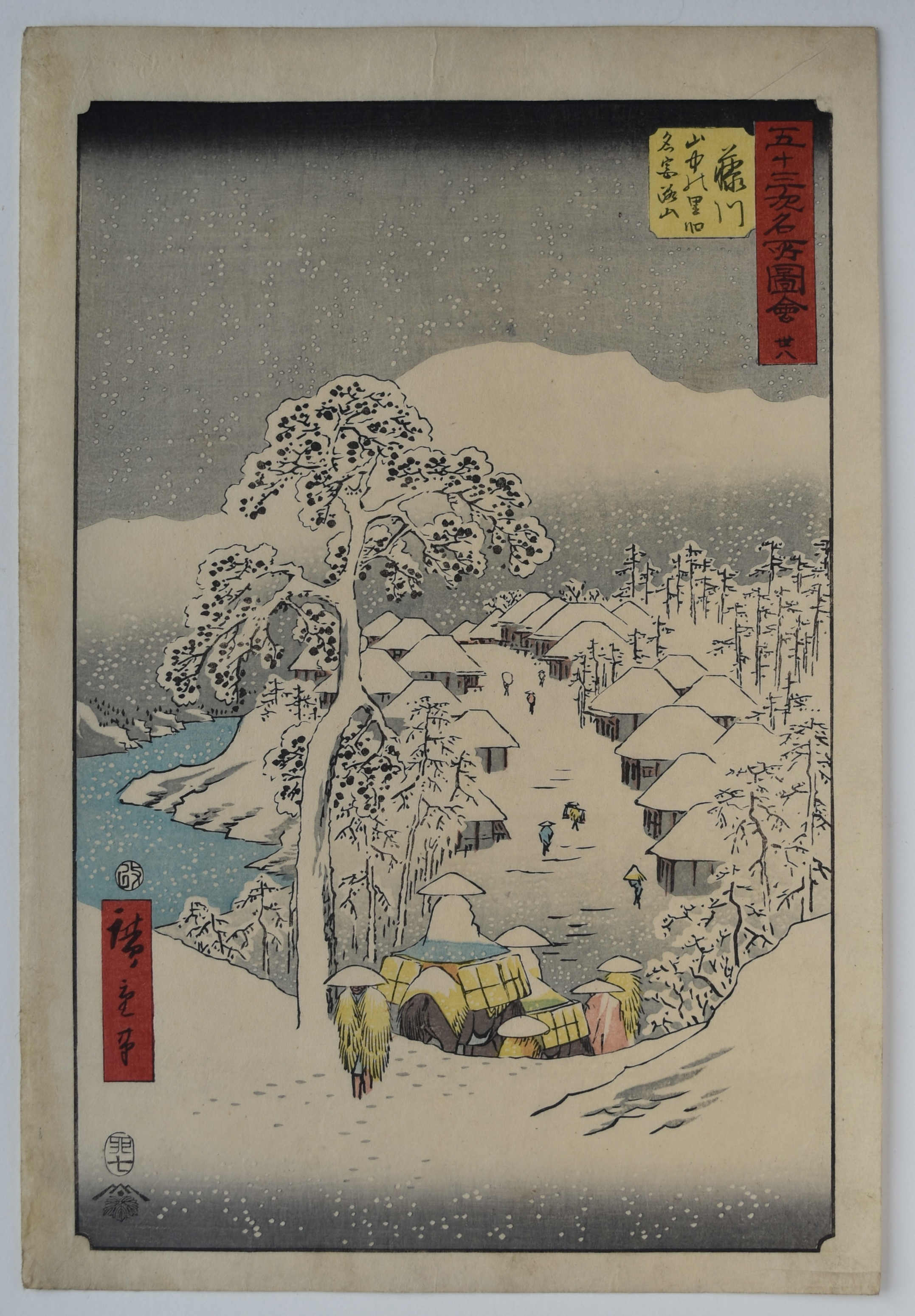
Fujikawa sanchu no sato kyumei Miyakoyama Fujikawa, “Fujikawa: Mountain Village, Formerly called Mount Miyako” from Gojusan tsugi meisho zue, “Famous Places on the Fifty-three Stations.” The so-called “Upright Tokaido.” Shows travellers in heavy snow entering Fujikawa village down a steep slope. Published by Kichizo (Koeido Tsutaya), 1855. There are many late editions of this set with the skies on the two snow scenes printed black. A fine snow design.
Fine, early impression. Fine colour and condition. Full margins. Signed Hiroshige ga.
Status: Sold
Utagawa HIROSHIGE II (1826-1869)
Click here to view image full size.
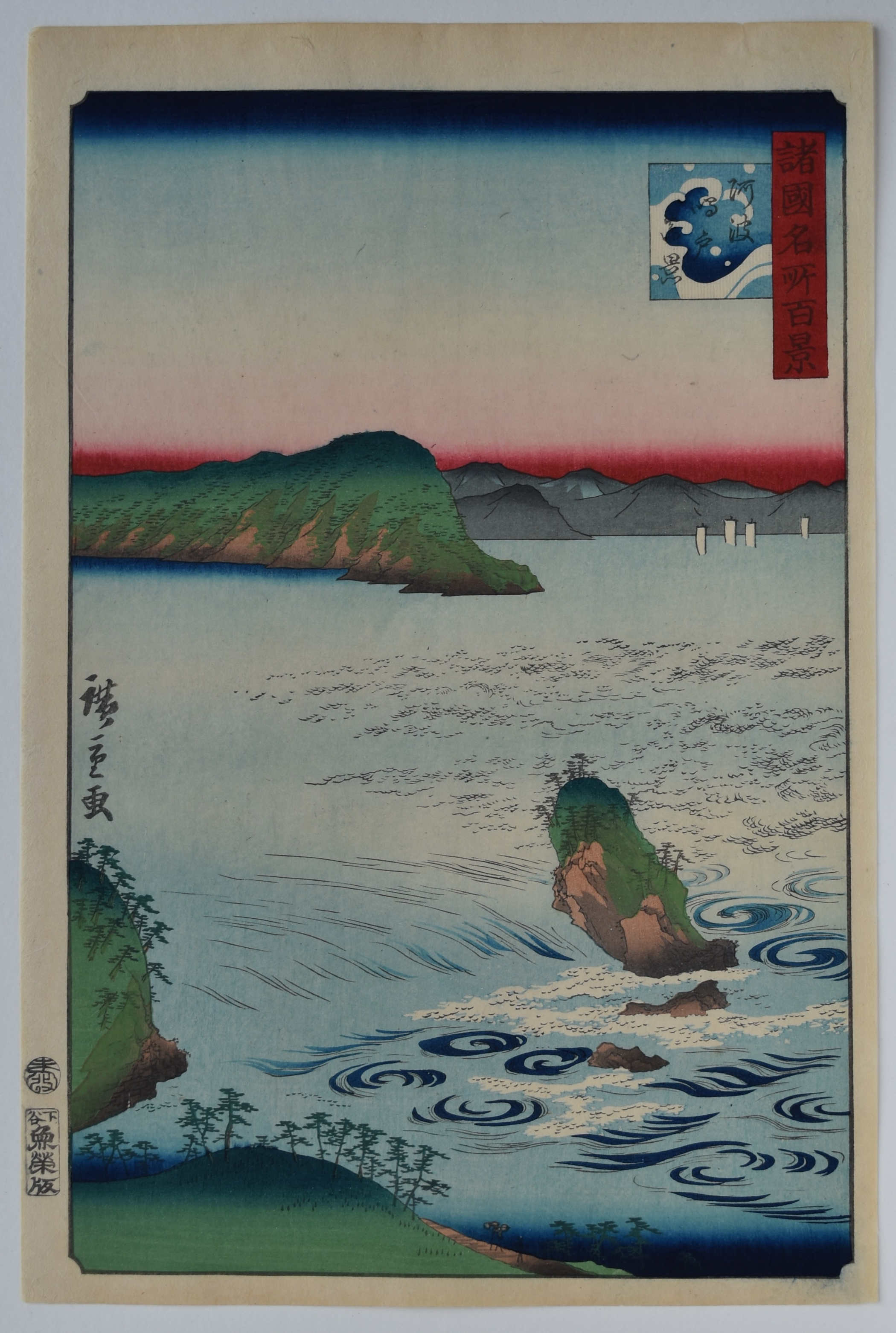
Awa Naruto shinkei, “True View of Whirlpool at Naruto, Awa Province” from Shokoku meisho hyakkei, “One Hundred Views of Famous Places in the Provinces.” Shows the powerful natural tidal eddies in the Naruto Strait between Naruto and Awaji Island. The 1.3 kilometre wide strait connects the Seto Inland Sea and the Pacific Ocean. Published by Uoya Eikichi between 1859 and 1861, this being 1859.
Fine impression of the first edition with gradation in square title box and extensive mica applied. Fine colour and condition. Full margins. Signed Hiroshige ga.
Status: Sold
Utagawa KUNIYOSHI (1797-1861)

Click here to view image full size.
Stations Totsuka, Fujisawa and Hiratsuka seen from Hodogaya from Tokaido gojusan eki (shishuku meisho), “Famous Views of the Fifty-three Stations on the Tokaido (four at a time).” In fact, there are between three and six on each sheet. An undistinguished set because of the necessity of compressing three or more stations into each design, apart from sailing boats between Maisaka and Arai, and this daring composition showing a group of boisterous pilgrims lower left. Hodogaya was a common stop for travellers starting on religious journeys. Published by Tsuruya Kiemon (Tsuruki) and Tsutaya Kichizo (Tsutakichi), c 1835. This is the first edition with light shading at top.
Fine impression, colour and condition. Signed Ichiyusai Kuniyoshi shuka zu, “Drawn together by Ichiyusai Kuniyoshi.”
Status: Sold