Utagawa HIROSHIGE (1797-1858)
Click here to view image full size.
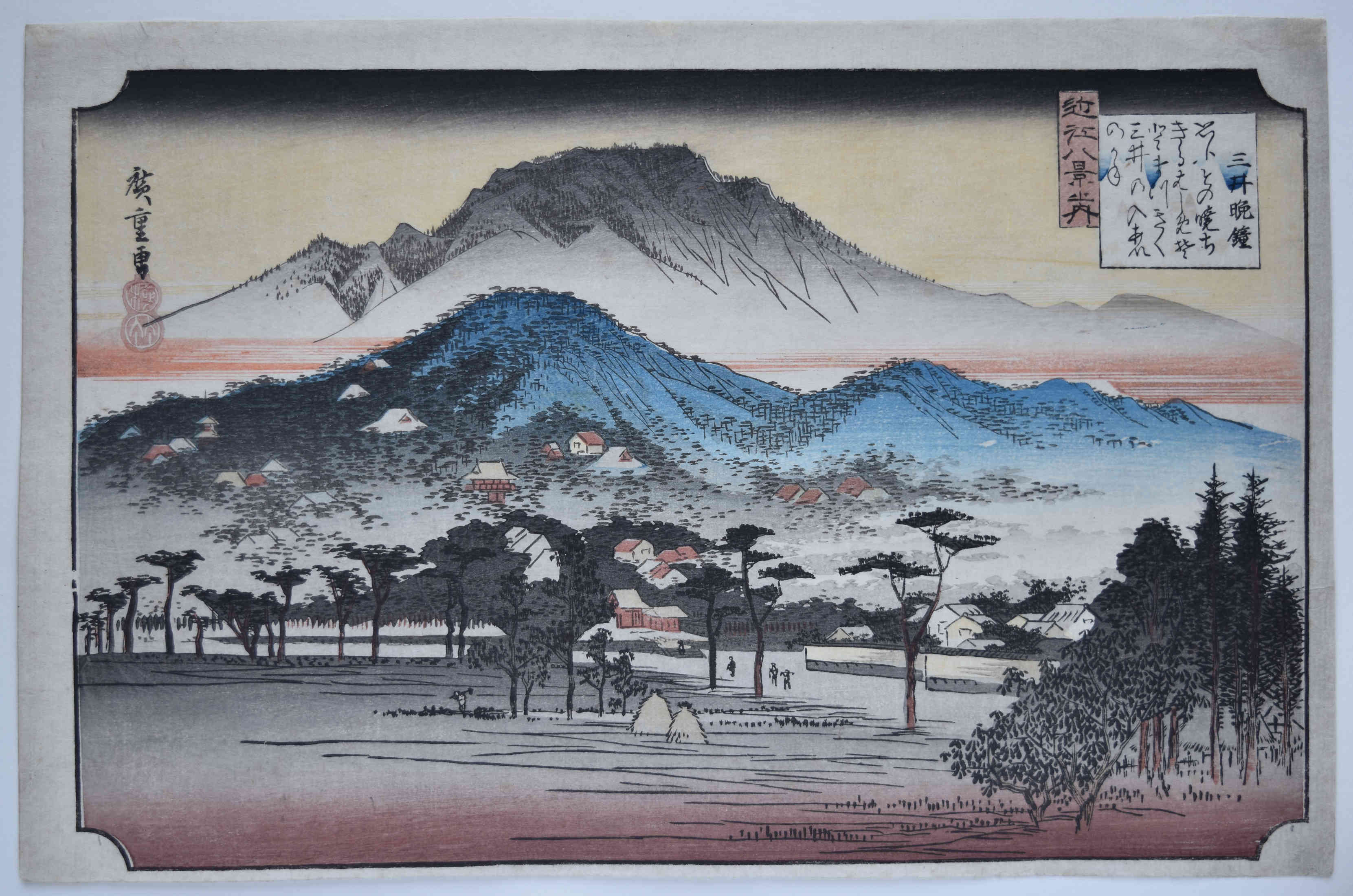
Mii no bansho, “Evening Bell at Miidera Temple” from a set Omi hakkei no uchi, “Eight Views in Omi [Province].” Shows the temple hidden amongst hills on the southern side of Lake Biwa. Miidera is the common name for the Onjoji, a temple of the Tendai sect founded in 858. Published by Hoeido and Eikyudo in c. 1834-5. The “Eight Views” theme was derived (as so much else in Japanese art) from China and based on the Eight Views of Xiaoxiang paintings of the 11th century. The subject was transposed to Omi and then taken up by such artists as Harunobu, and later Hiroshige. It was often playfully alluded to in sets of eight prints in mitate-e style.
Very good impression, colour and condition, Signed Hiroshige ga.
Status: Sold
Utagawa HIROSHIGE (1797-1858)
Click here to view image full size.
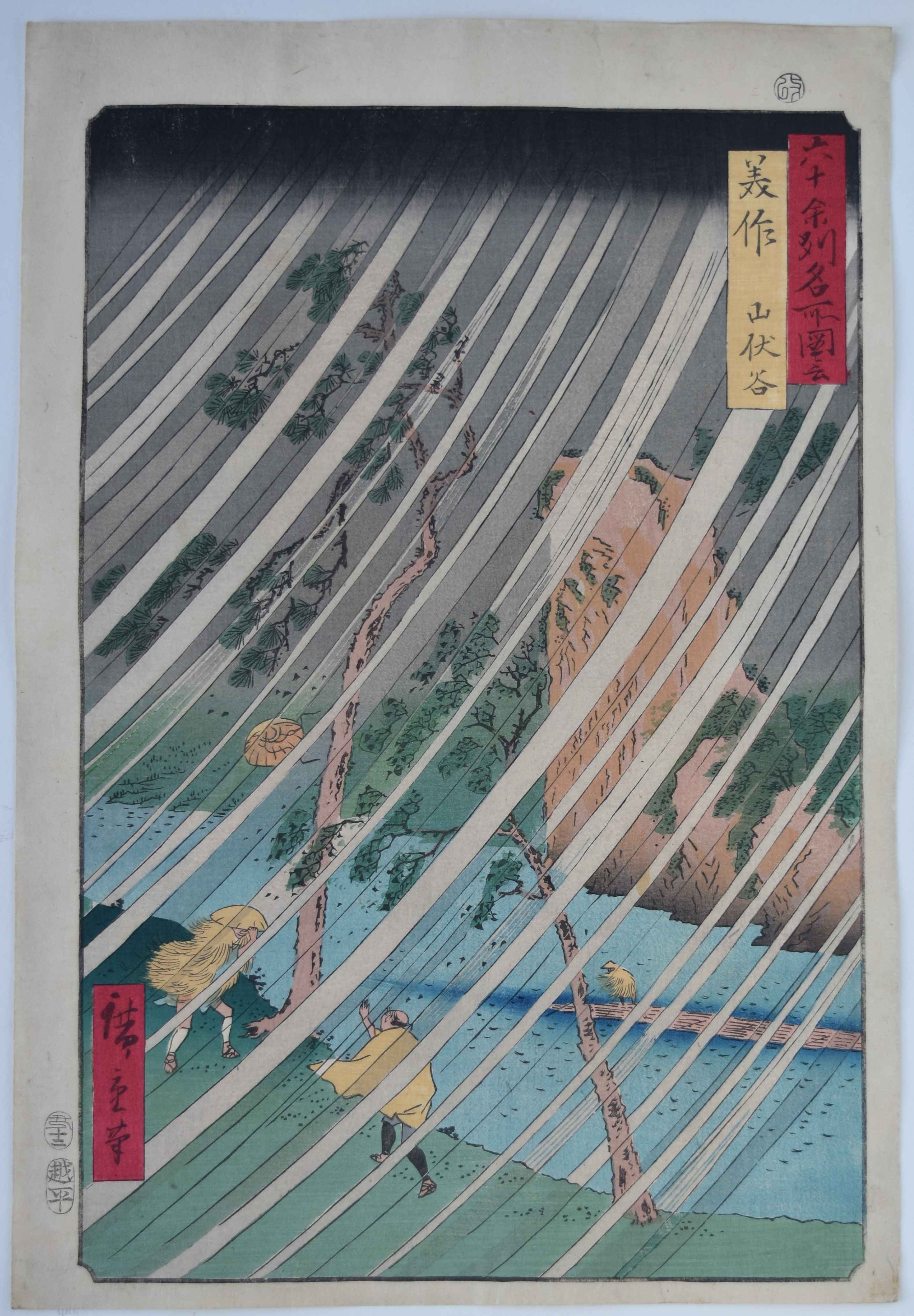
Mimasaka, Yamabushidani, “Mimasaka [Province], Yamabushi Valley.”A high wind and rain in the valley with a man on a raft on the Yoshi River. Other figures in the foreground, one having lost his hat. From a set of 69 prints [Dai Nihon] Rokujuyoshi meisho zue, “Famous Places in the Sixty-odd Provinces [of Japan]” published by Koshimuraya Heisuke between 1853 and 1856, this being 1853.
Fine, early impression. Fine colour and condition with large margins. Signed Hiroshige ga.
Status: Sold
Utagawa HIROSHIGE (1797-1858)
Click here to view image full size.
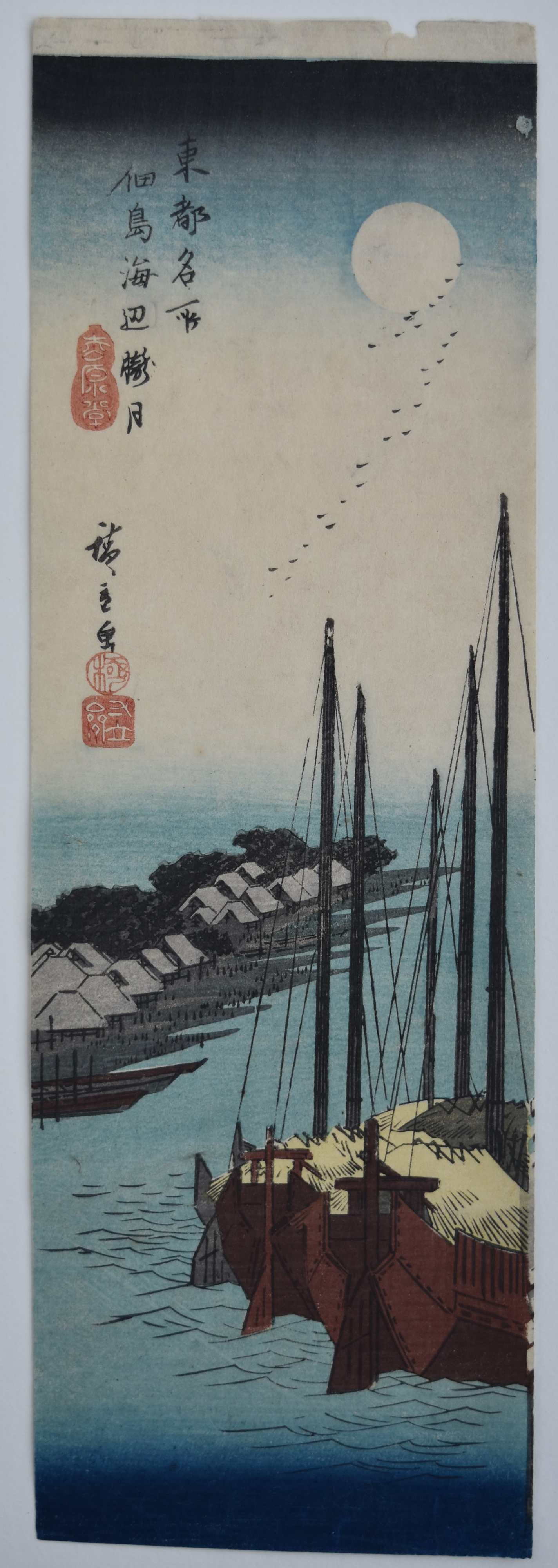
Spring moon at the shore of Tsukudajima . One of a set of chu-tanzaku prints published by Shogendo, c. 1837. Tsukudajima was one of two islands at the mouth of the Sumida River. Originally a sanbar, it was reclaimed with earth and rocks and given its name by the first Tokugawa Shogun, Ieyasu, who invited thirty-three fishermen to live there in 1613 in order to provide fish for the rapidly expanding city of Edo. The fishermen came from Tsukudama near Osaka and it was they who became the proprietors of what would become the Tsukiji fish market. It must have been popular during the late Edo period as a place to visit and view the boats from teahouses on the shore because there are many prints depicting the area, especially under a full moon.
Fine impression, colour and condition. Signed Hiroshige ga. n.
Status: Sold
Utagawa HIROSHIGE (1797-1858)
Click here to view image full size.
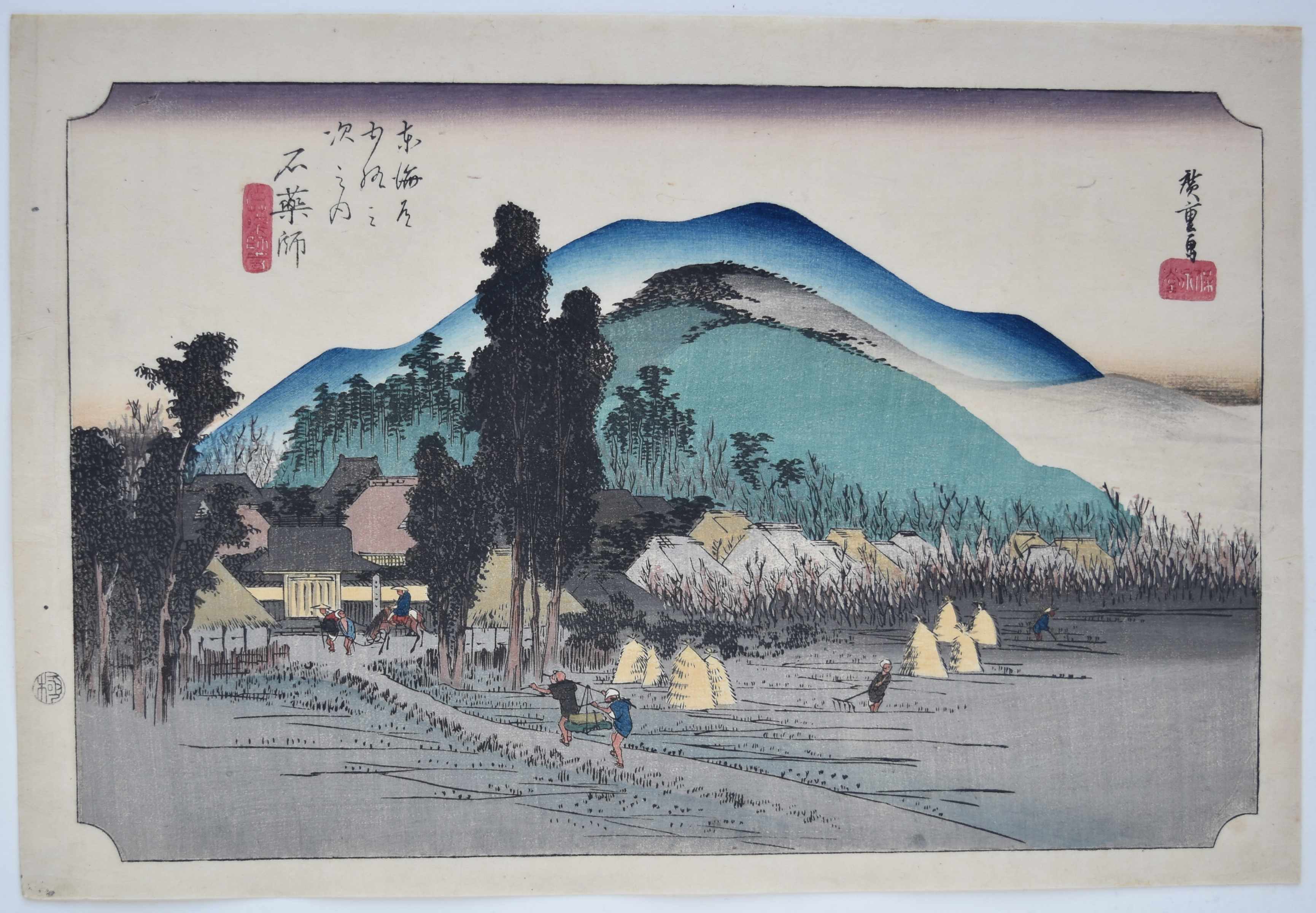
Station Ishiyakushi from Tokaido gojusan-tsugi no uchi, “Fifty-three Stations of the Tokaido.” This seminal work was possible because Hiroshige was asked to accompany an official procession along the Tokaido Road from Edo to Kyoto in 1832, and he made numerous sketches to document the journey. An evening scene in late autumn showing the village with the Ishiyakushi-ji (temple) on the left. This housed a stone image of Yakushi Nyurai, the Buddha of medicine. Pilgrims came in the hope of being healed, but they seldom stayed preferring to move on to Shono, the next station, which was only 3 km away. Because of the sets popularity, it was reprinted many times and there are a plethora of late impressions. Early printings are hard to find. Published by Hoeido (Takenouchi Magohachi) and Tsuruya Kiemon (Senkakudo) 1833-34.
Fine, early impression. Beautiful blue bokashi on the distant Suzuka Mountains: Late impressions often have crude wiping of this block. Fine colur and condition. Signed Hiroshige ga.
Status: Sold
Utagawa HIROSHIGE (1797-1858)
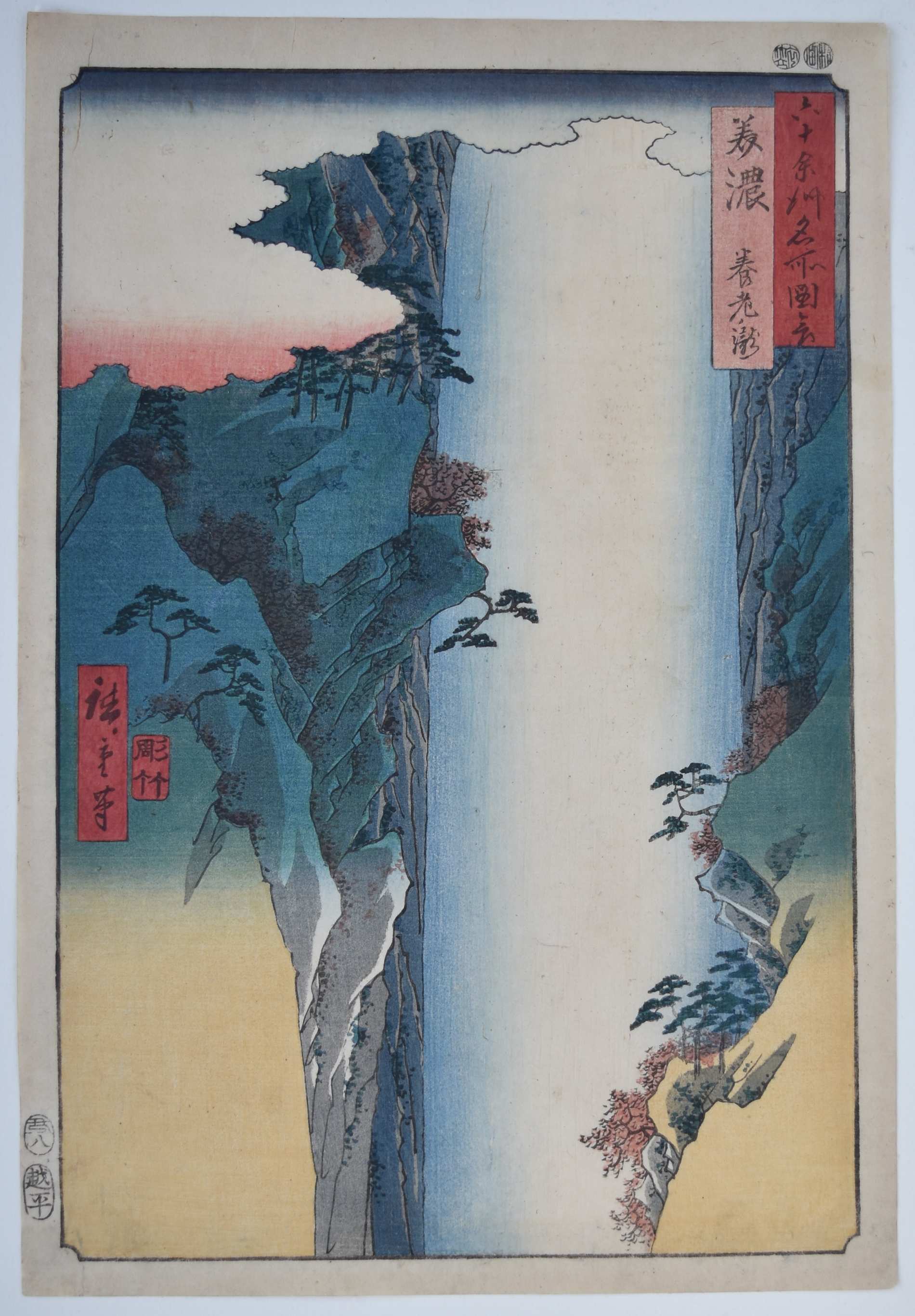
Click here to view image full size.
The Yoro Waterfall. Mino, Yoro no taki, “Mino [Province], Yoro Waterfall” from Rokujuyoshu meisho zue, “Famous Views of the Sixty-odd Provinces.” The 32 meters fall cascades down from Mount Tado. Legend has it that the water had rejuvenating properties with the Empress Gensho (A.D. 683-748) having visited and likening the taste to that of sake. A cider, Yoro Sanroku, is produced here. Published by Koshimuraya Heisuke (Kohei), 1853-56, this being 1853. Numerous states exist of this design with colour variations and differences in gradation. Primarily the colouring of the fall changes: Some impressions have the waterfall completely blue, which obscures the blind-printing, while others, as here, have edge gradation only.
Very good impression with blind-printing on the waterfall. Fine colour. Very good condition. Signed Hiroshige ga.
Status: Sold
Utagawa KUNIYOSHI (1797-1861)
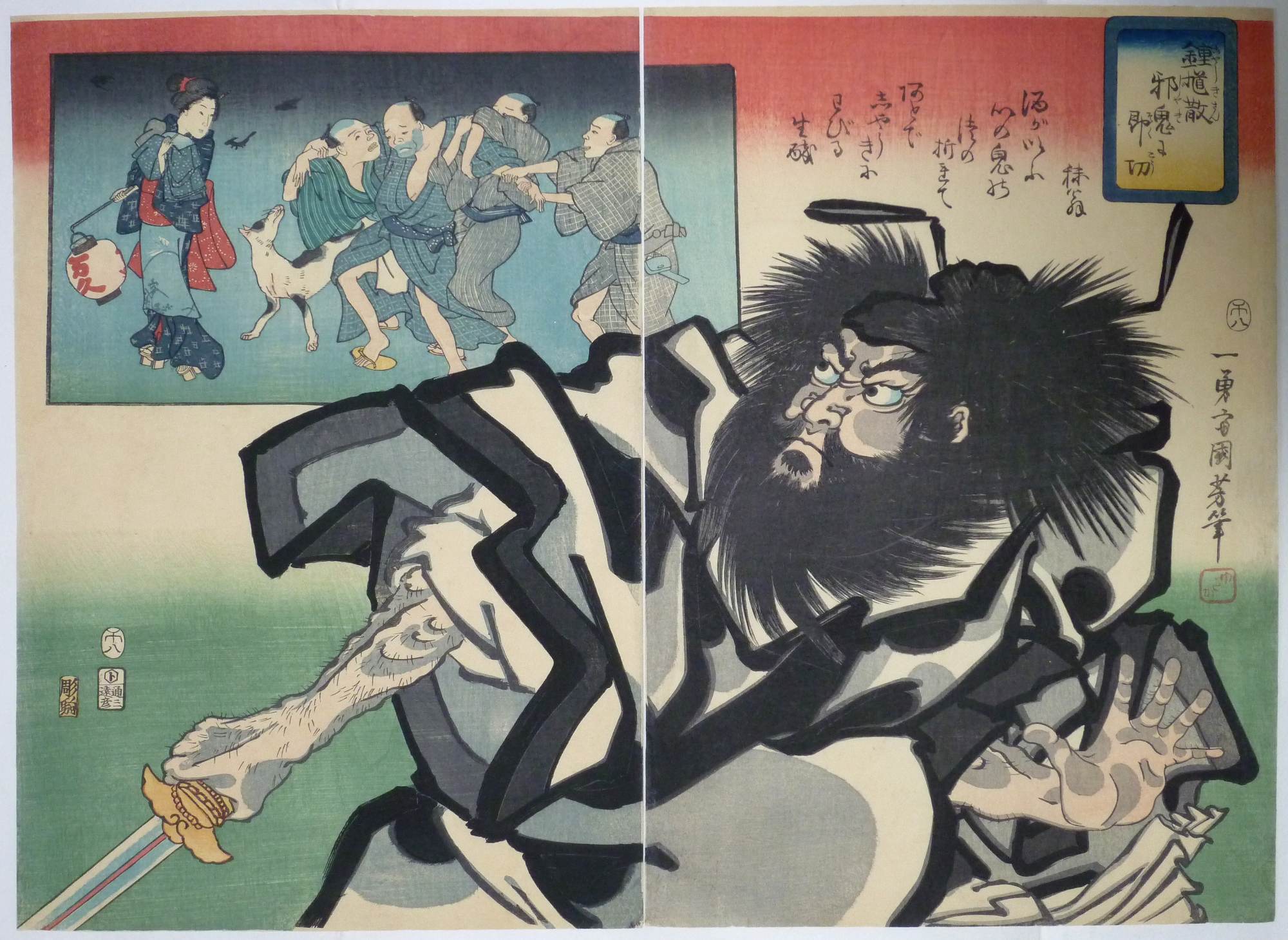
Click here to view image full size.
An extremely rare diptych, Shoki-san jaki ni sokko, “Shoki-San, Quick-Acting Medicine to Remove Evil Spirits.” Images of Shoki were used to ward off evil spirits and illness, especially during the Boys’ Festival. Published 1858 by Enshuya Hikobei. Provenance: Purchased from me in 1994.
Extremely fine impression. Fine colour and condition. Signed Ichiyusai Kuniyoshi fude with Yutaka seal.
Status: Sold
Utagawa KUNIYOSHI (1797-1861)
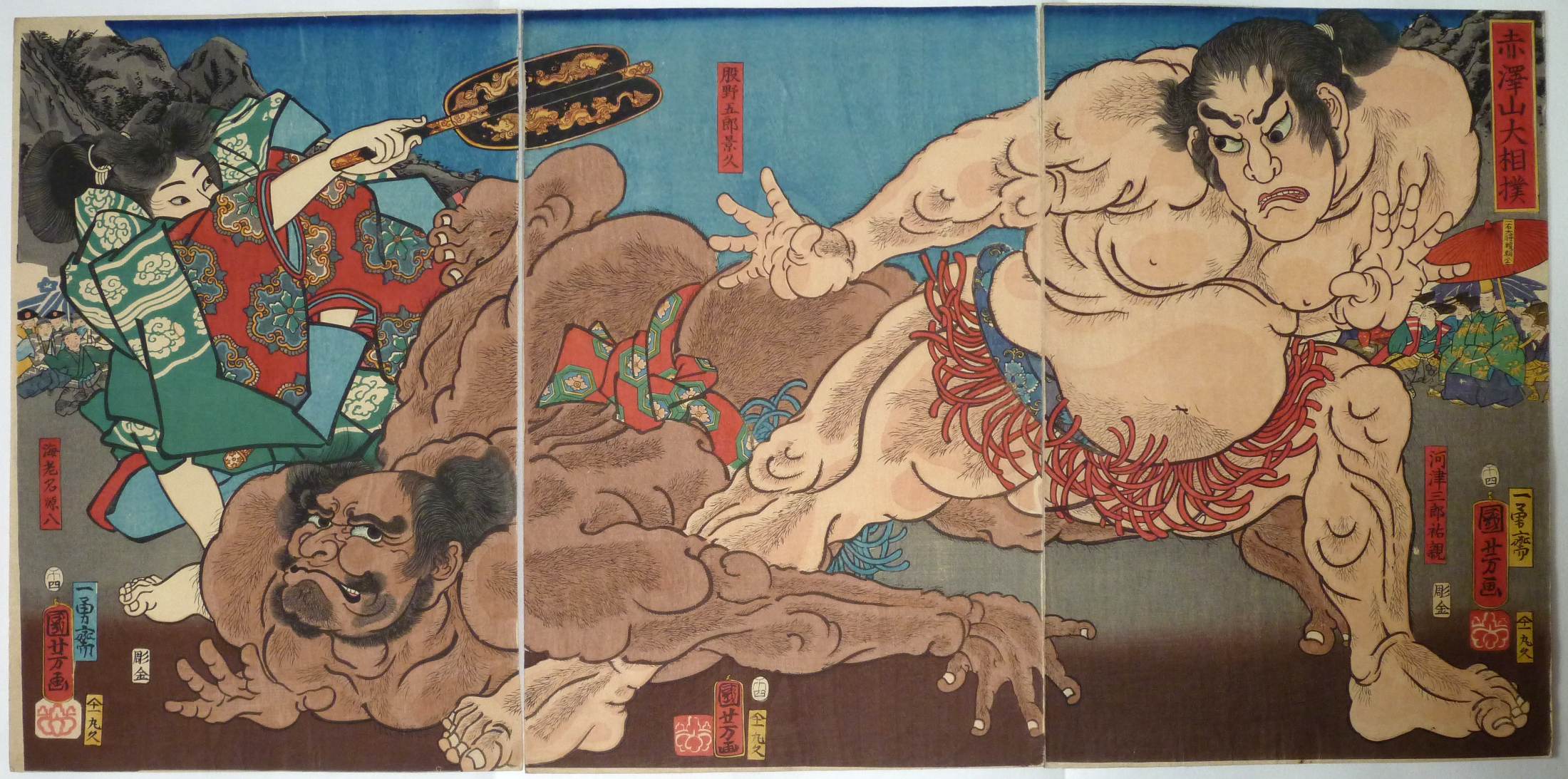
Click here to view image full size.
A triptych Akazawa-yama o-sumo showing the most famous sumo match in Japanese history between Kawazu Saburo Sukeyasu and Matano Goro Kagehisa at Akazawa mountain. Also famous as Kawazu used a new sumo hold wrapping a foot around his opponent’s leg and encircling the neck with one arm, a manoeuvre that became known as the Kawazu hold. The event took place in 1176 before Shogun Minamoto Yoritomo where Kawazu defeats the popular bully Matano. Subsequently Kawazu was murdered, quite unrelated to the bout. His sons swear revenge and their story becomes the Soga monogatari. Kawazu is shown here throwing Matano to the ground, the referee to the left. Published 1858 by Maruya Kyushiro. Robinson T353. Provenance: Purchased from me in 1994.
Superb impression and colour. One small thinned area, otherwise very fine condition. Probably the finest impression extant of this famous design. Signed Kuniyoshi ga and Ichiyusai Kuniyoshi ga.
Status: Sold
Utagawa KUNIYOSHI (1797-1861)
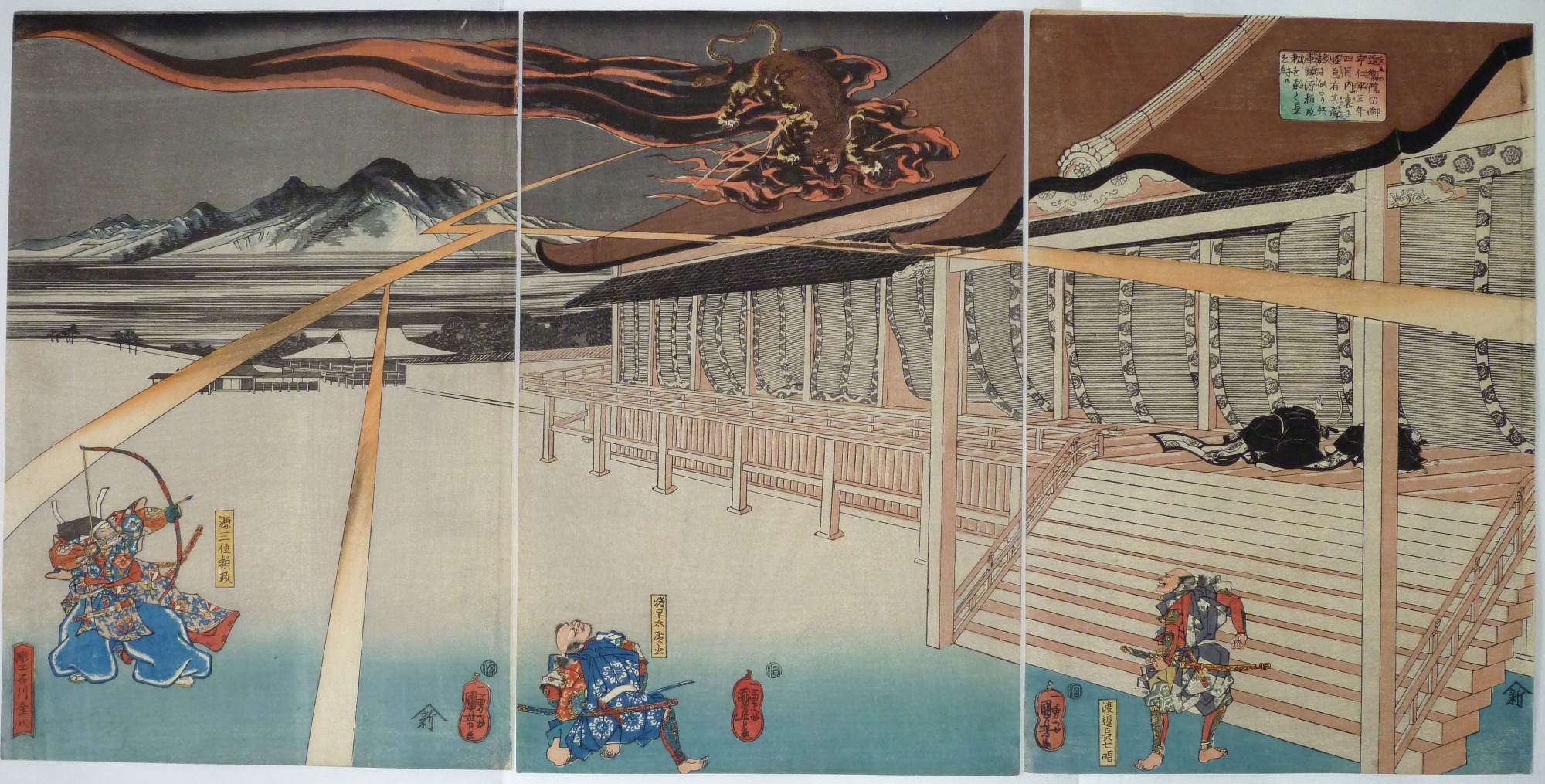
Click here to view image full size.
A triptych showing the famous archer Minamoto no Yorimasa preparing to shoot the monster Nue on the roof of the Shishinden Palace. The story relates how in 1153 the sixteen year old Emperor Konoe was having difficulty sleeping due to the shrieks and scratchings emanating from the palace roof. Guards informed him that a black cloud descended there every night. Yorimasa was called upon to investigate and he brought down the beast – a composite creature, part monkey, badger, tiger, dragon and snake which was duly despatched by his retainer Hironao no Hayata (Tadazumi no Hayata). Subsequently Konoe sleeps soundly and rewards Yorimasa with a fine sword and a court beauty Yorimasa loves. An exceptional design published 1842-3 by Yamashiroya Shinroku. Robinson T112. Provenance: Purchased from me in 1994.
Fine impression, colour and condition. Signed Ichiyusai Kuniyoshi ga.
Status: Sold
Utagawa KUNIYOSHI (1797-1861)
Click here to view image full size.
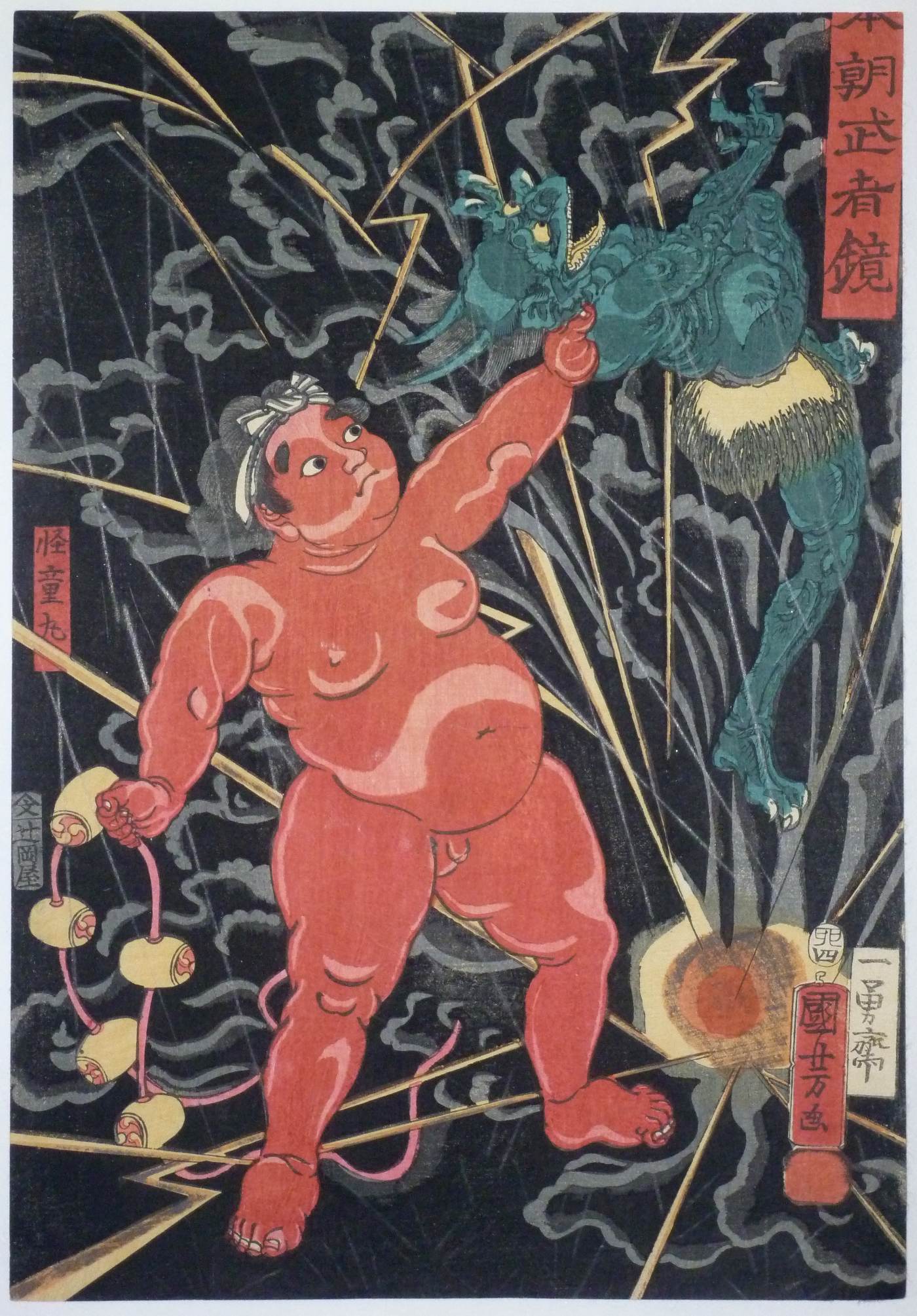
Kwaido Maru (Kintoki) seizes Raijin, the Thunder God, with one hand while holding his thunder drums with the other. A thunderbolt falls to earth causing flashes of lightning. A fine and rare set: Honcho musha kagami, “Mirror of Warriors of our Country.” The set published by Tsujioka-ya Bunsuke, 1855. Robinson S87.6.
Fine impression. Slightly trimmed, otherwise very good condition. Signed Ichiyusai Kuniyoshi ga.
Status: Sold
Ichiryusai HIROSHIGE (1797-1858)
Click here to view image full size.
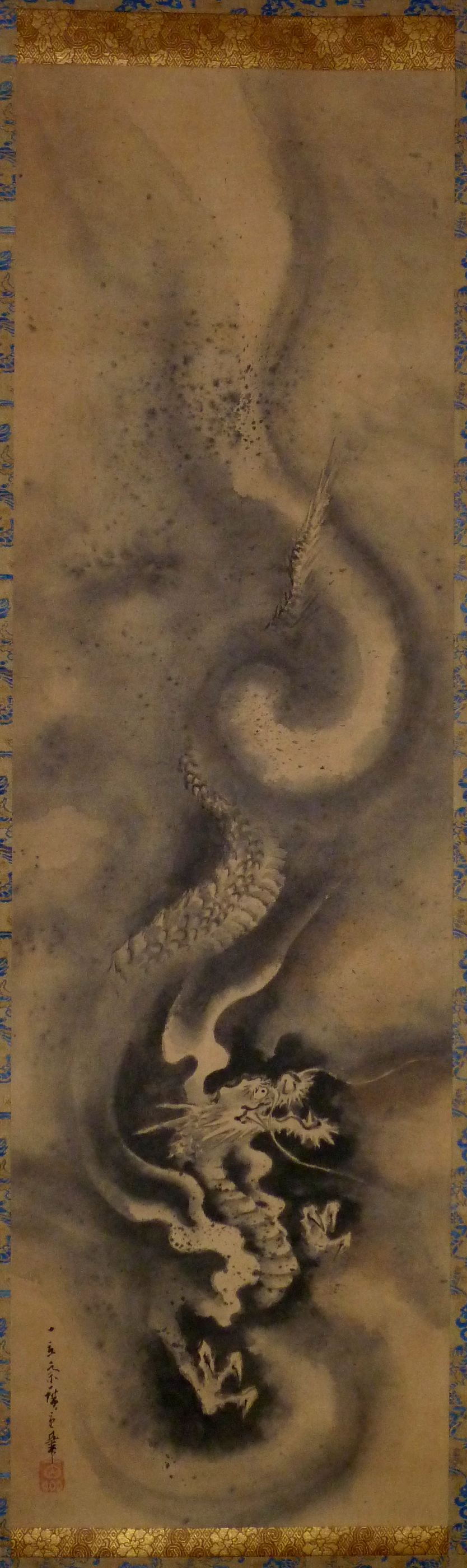
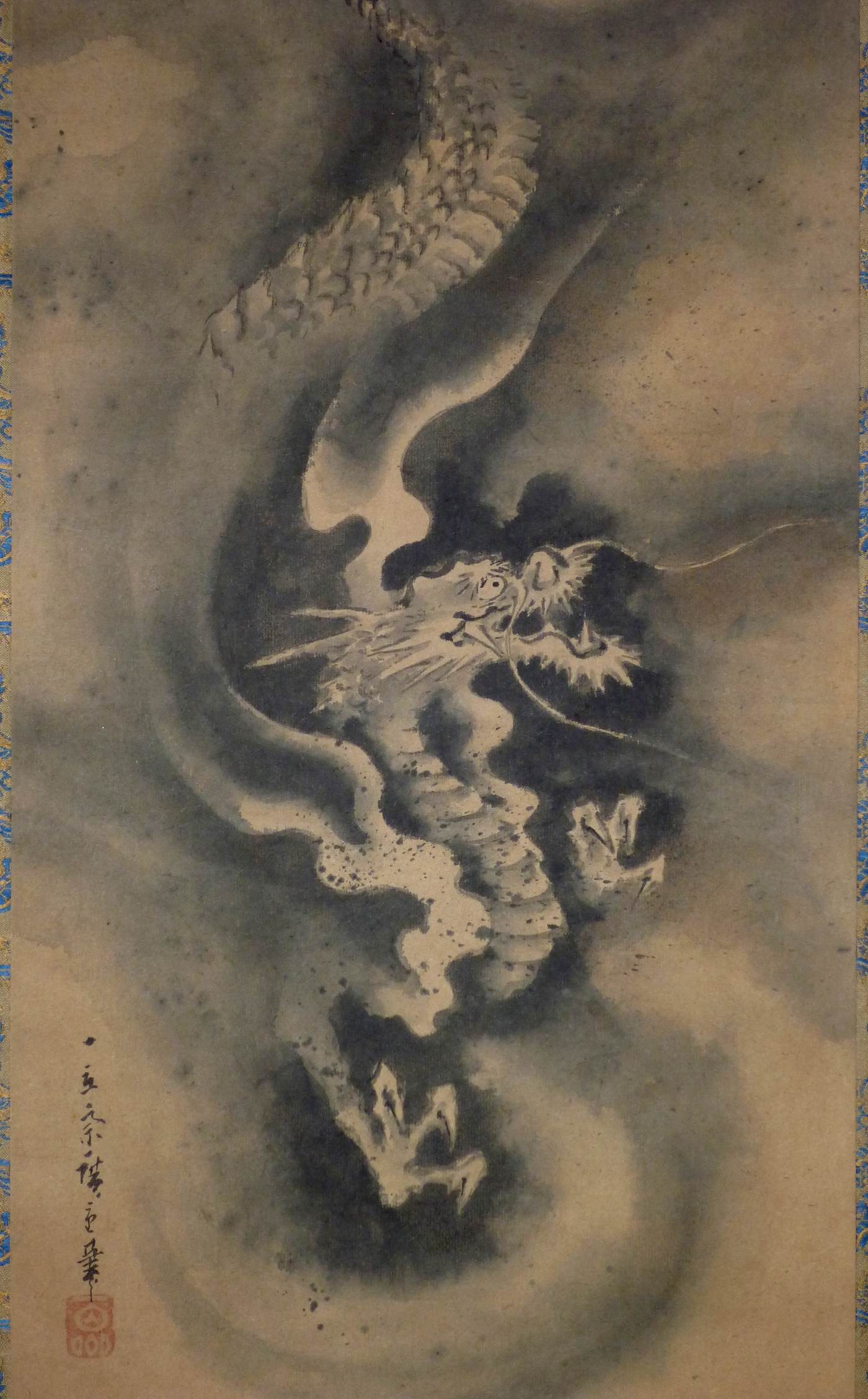
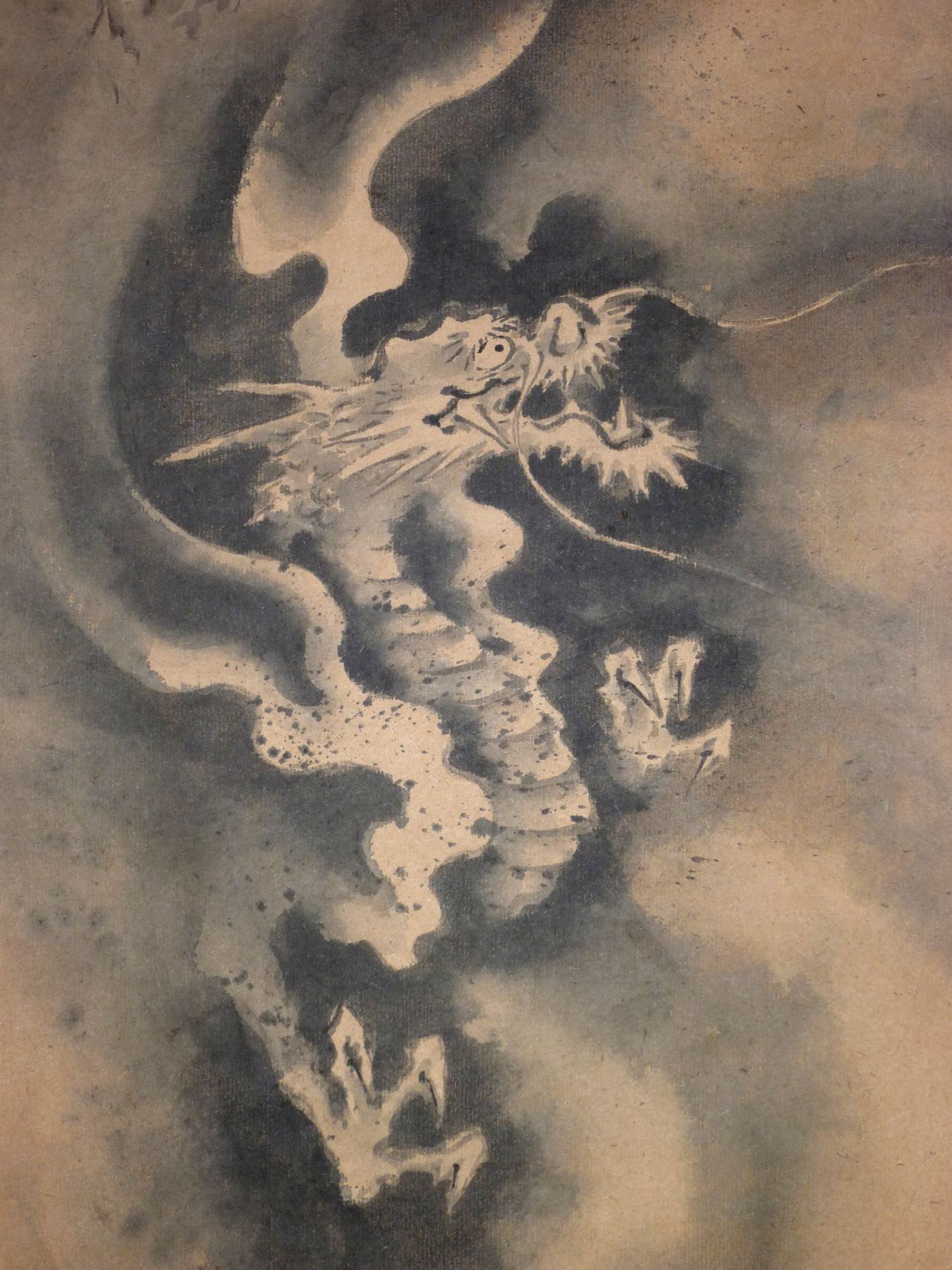
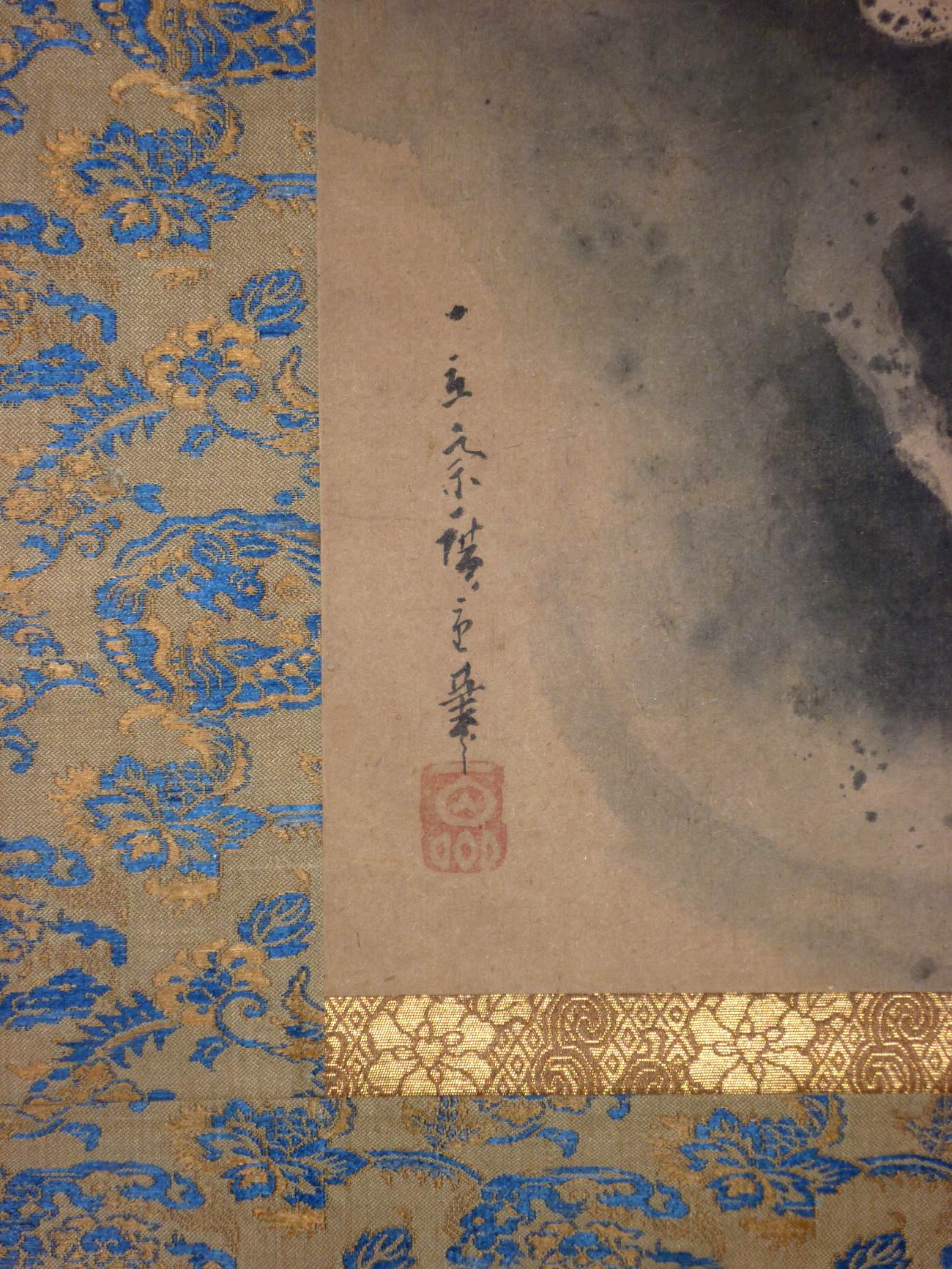
A newly discovered painting of a three-clawed Kano-style dragon amongst clouds. Although a subject popular with Japanese artists (and especially Chinese artists where the subject derives from), this appears to be the only such painting by Hiroshige extant. He did, however, produce two prints of the subject – a surimono and a large panel, both of around the same date. The signature indicates a date after 1840 and it was most likely painted for the Dragon Year 1844. Blue and brown ink on paper with extensive splashed ink. Image size 34.5 x 10.5 in; 87.7 x 26.7 cm. The mount uses a ryu-mon (dragon pattern) motif to match the subject. Very good condition. Signed Ichiryusai Hiroshige hitsu with Ichiryusai seal.
Status: Sold
Utagawa KUNIYOSHI (1797-1861)
Click here to view image full size.
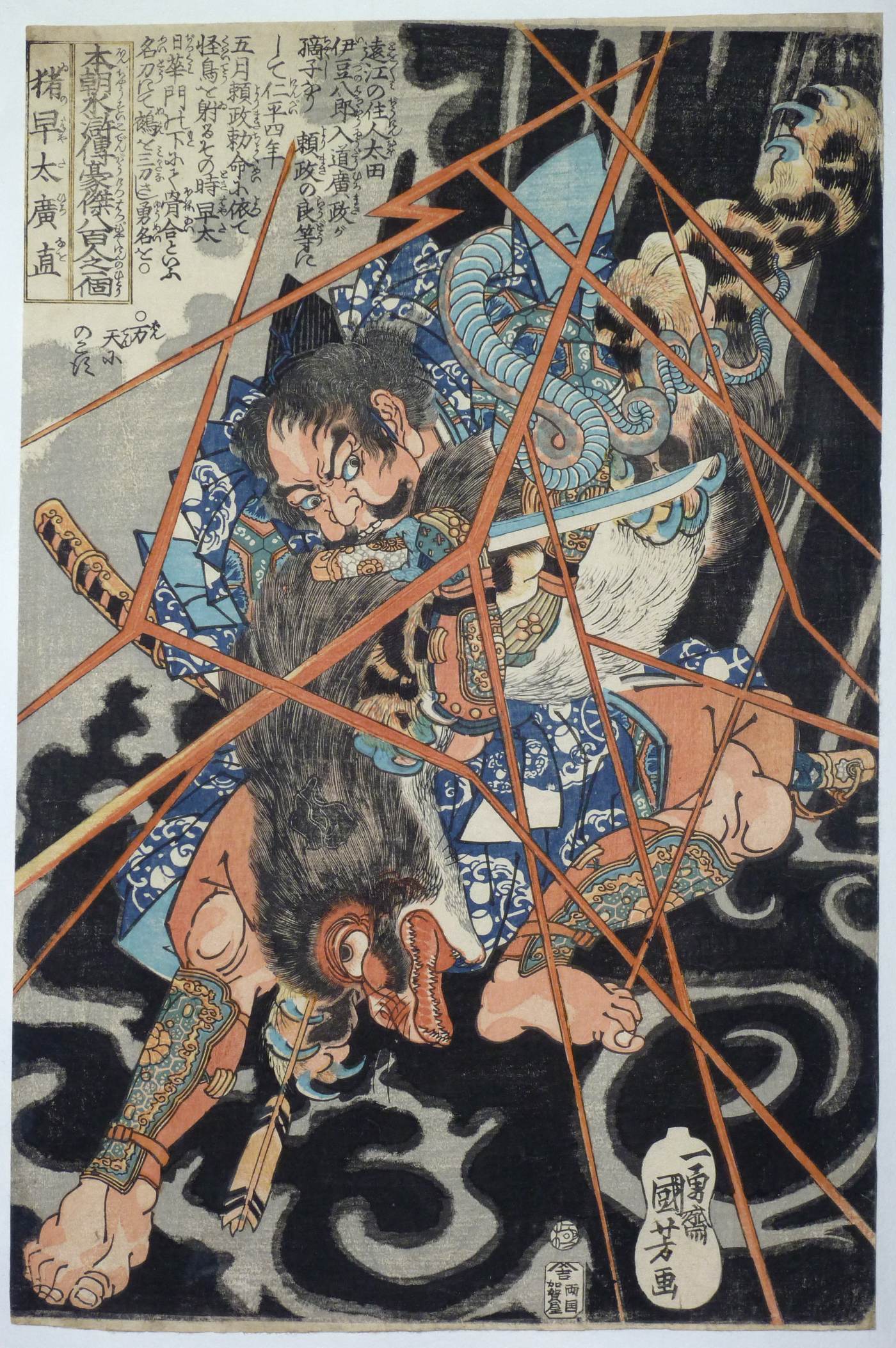
Hironao no Hayata (Tadazumi no Hayata), Yorimasa’s retainer (see the triptych by Kuniyoshi of the same subject on this update), grappling with the composite beast Nue on the roof of the Shishinden Palace. Forked lightning bounces around him. One of the best designs from Honcho Suikoden goyu happyaku-nin no hitori, “Eight Hundred Heroes of our Country’s Suikoden, One by One.” Published by Kagaya Kichiemon, 1830-31.
Very good impression and colour. Slight trimming, otherwise very good condition. Signed Ichiyusai Kuniyoshi ga.
Status: Sold
Isoda KORYUSAI (FL c 1764-1788)
Click here to view image full size.
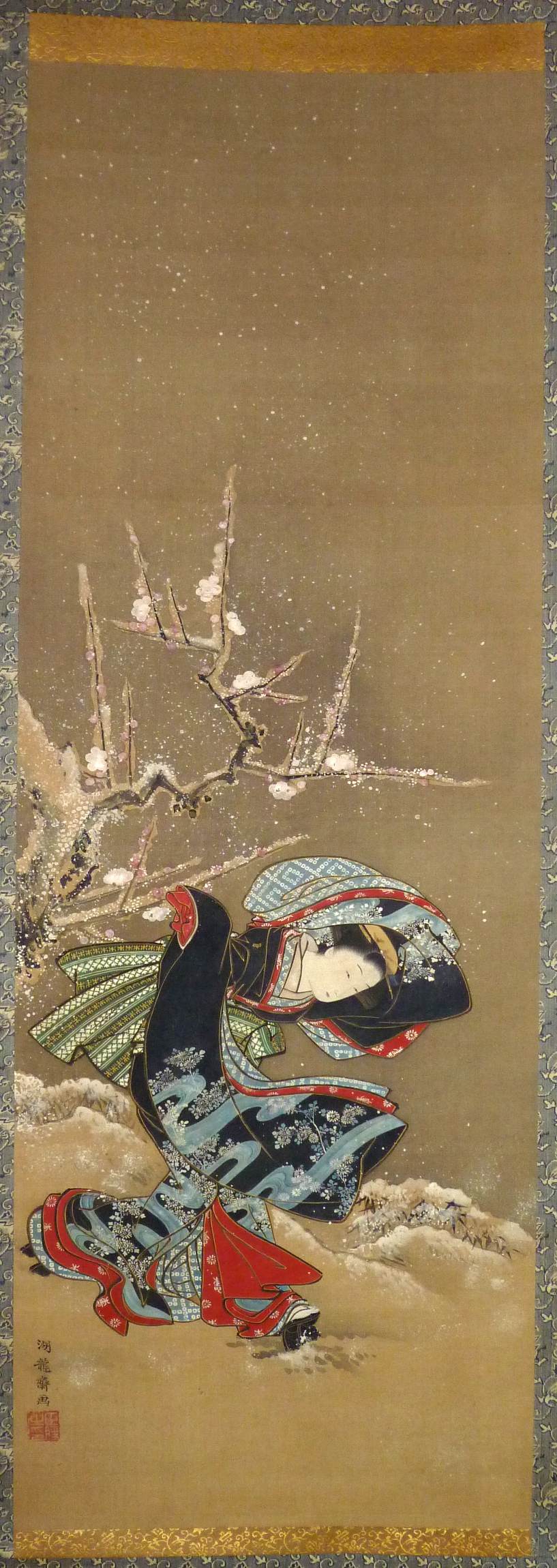
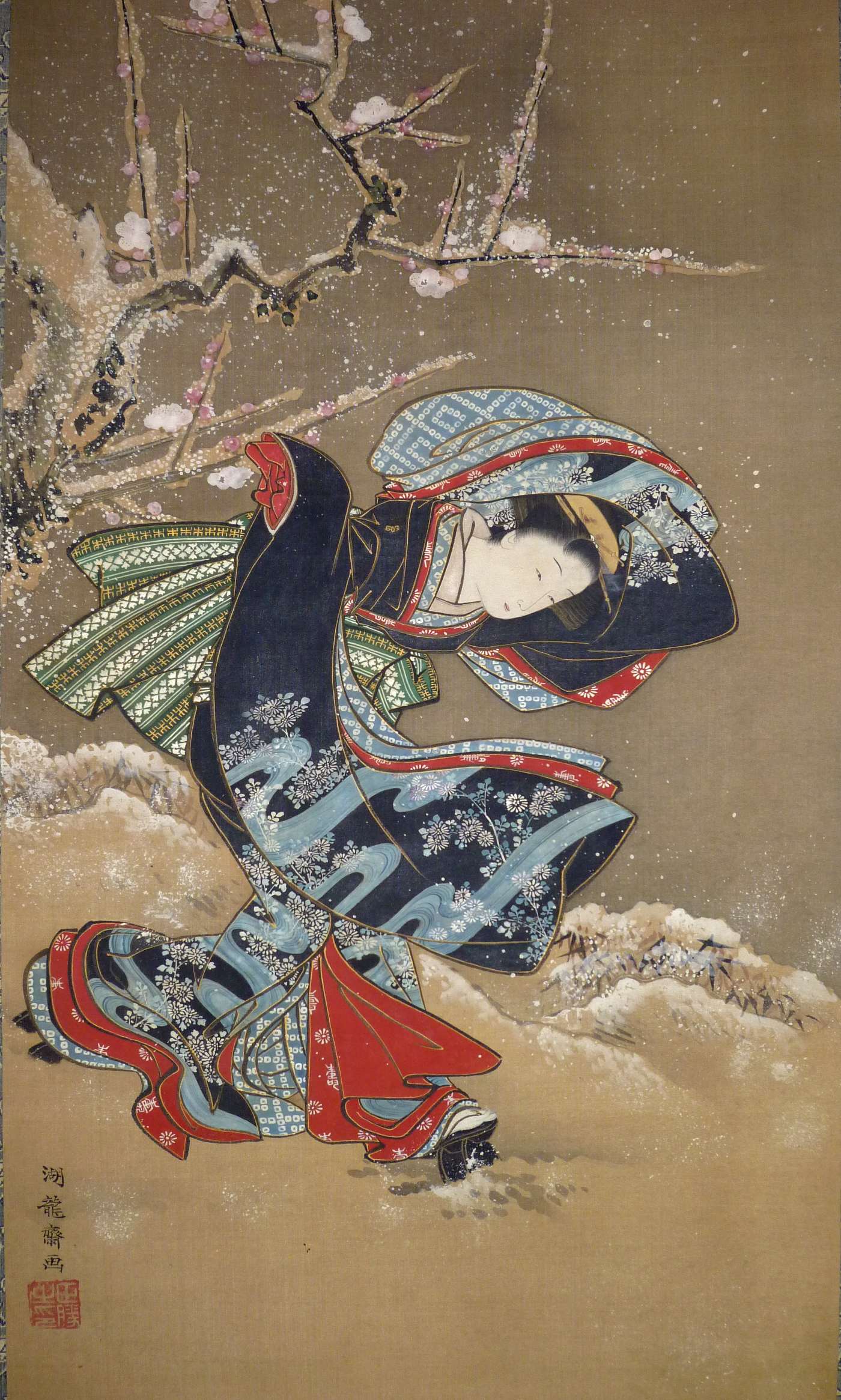
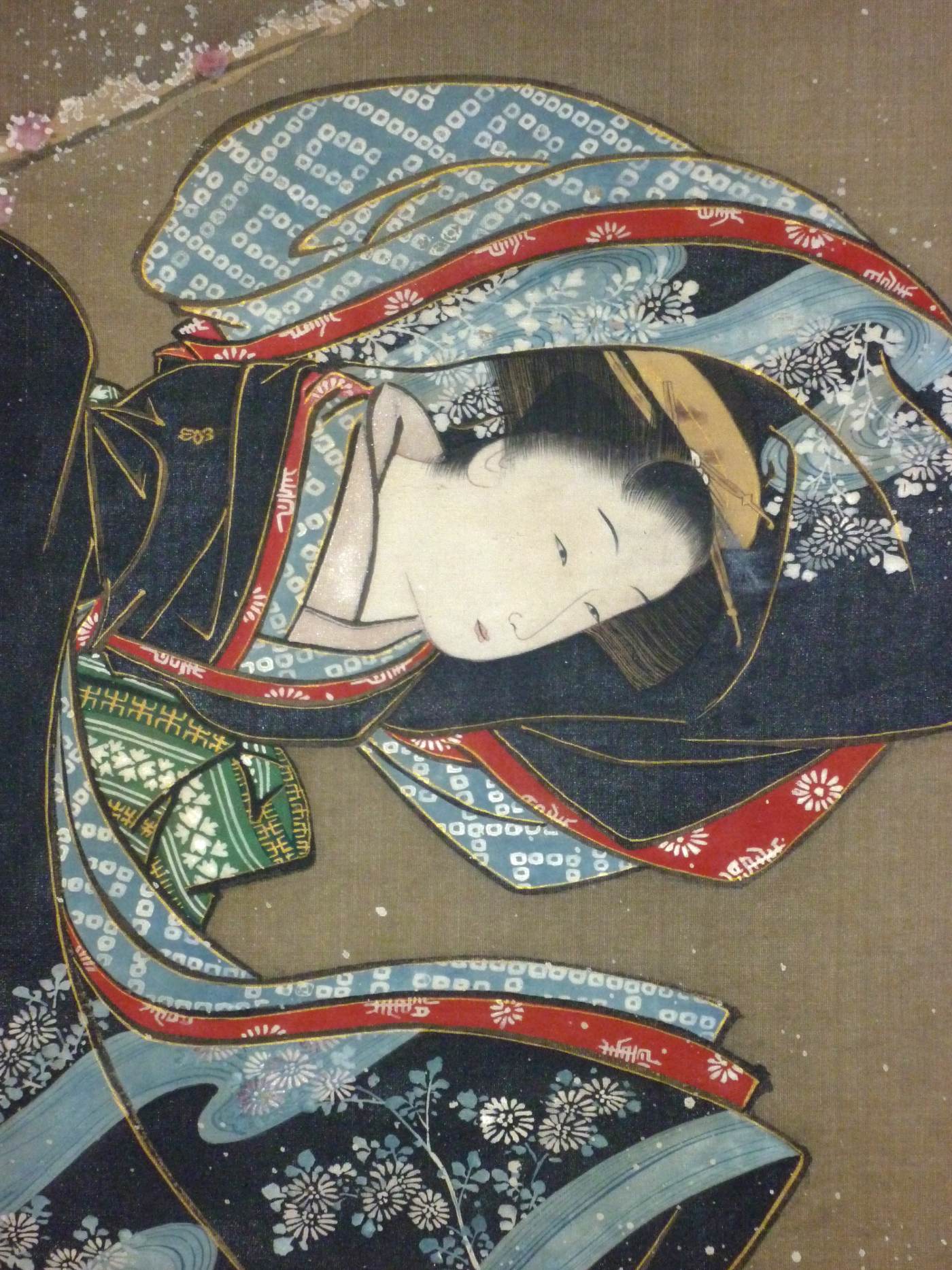
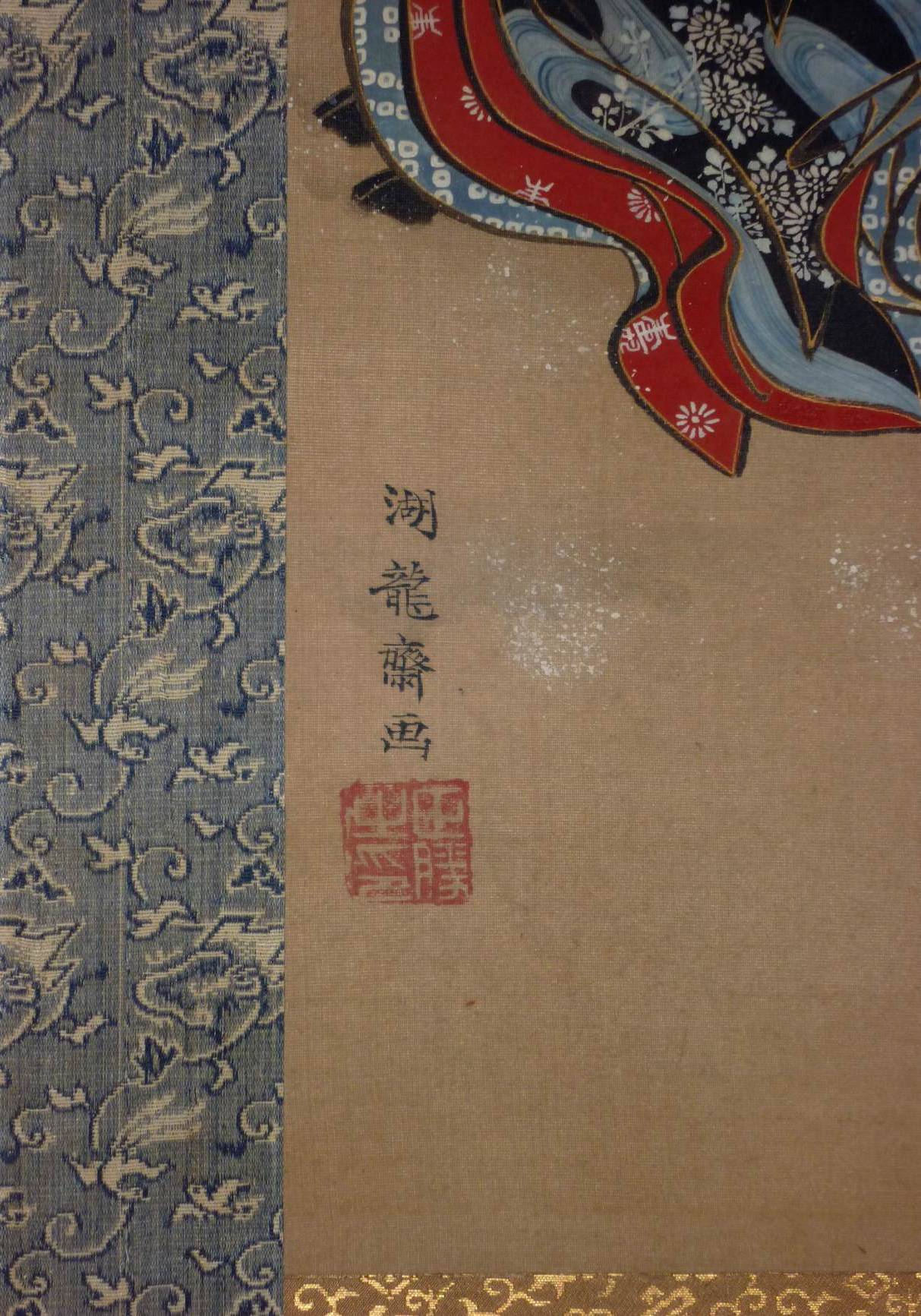
A superb original painting, full colour on silk, showing a beauty running in a late snowfall. Cherry blossom above. A leading artist of his time who produced some of the best bijin and kacho prints of the 1770s before concentrating on painting. Image size 40.25 x 14.25 in; 102.5 x 36 cm. Good condition. Painted c 1778. Signed Koryusai ga with seal Masakatsu, no in.
Status: Sold
Utagawa HIROSHIGE (1797-1858)
Click here to view image full size.
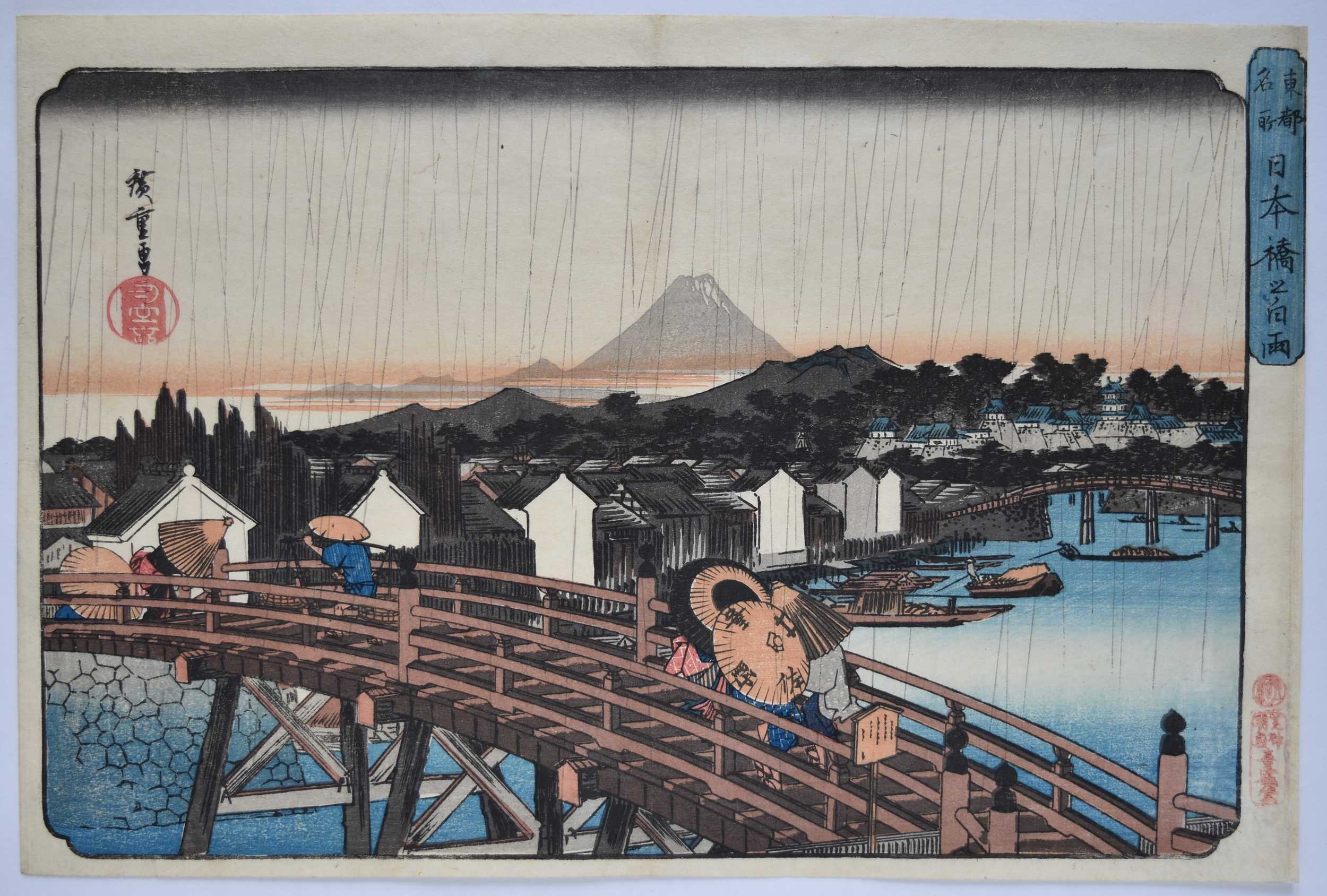
Nihonbashi no hakuu, “Light Rain on Nihon Bridge.” From a Toto meisho set of 21 designs published between c. 1832 and 1839 by Kikakudo. The set was subsequently enlarged. Shows figures crossing Nihonbashi in rain, one figure carries an umbrella with the publisher’s name. Warehouses in the background and a distant view of Fuji. A beautiful print and very difficult to find in early impression: The title cartouche had a plug inserted beside the bottom three characters of the title on the left. This damage seems to have occurred when the block was cut and over time the spigot gradually slipped out leaving an unprinted area (which is sometimes painted in). In the earliest impressions the plug is hardly visible (as here). Also, the publisher’s seal at the bottom right should be in red, later editions having it in black. There was also an early variant edition with a yellow sky.
Fine impression and colour. Imperceptible centre fold, also near the right edge, otherwise very good condition. Signed Hiroshige ga.
Status: Sold
Ichiryusai HIROSHIGE (1797-1858)
Click here to view image full size.
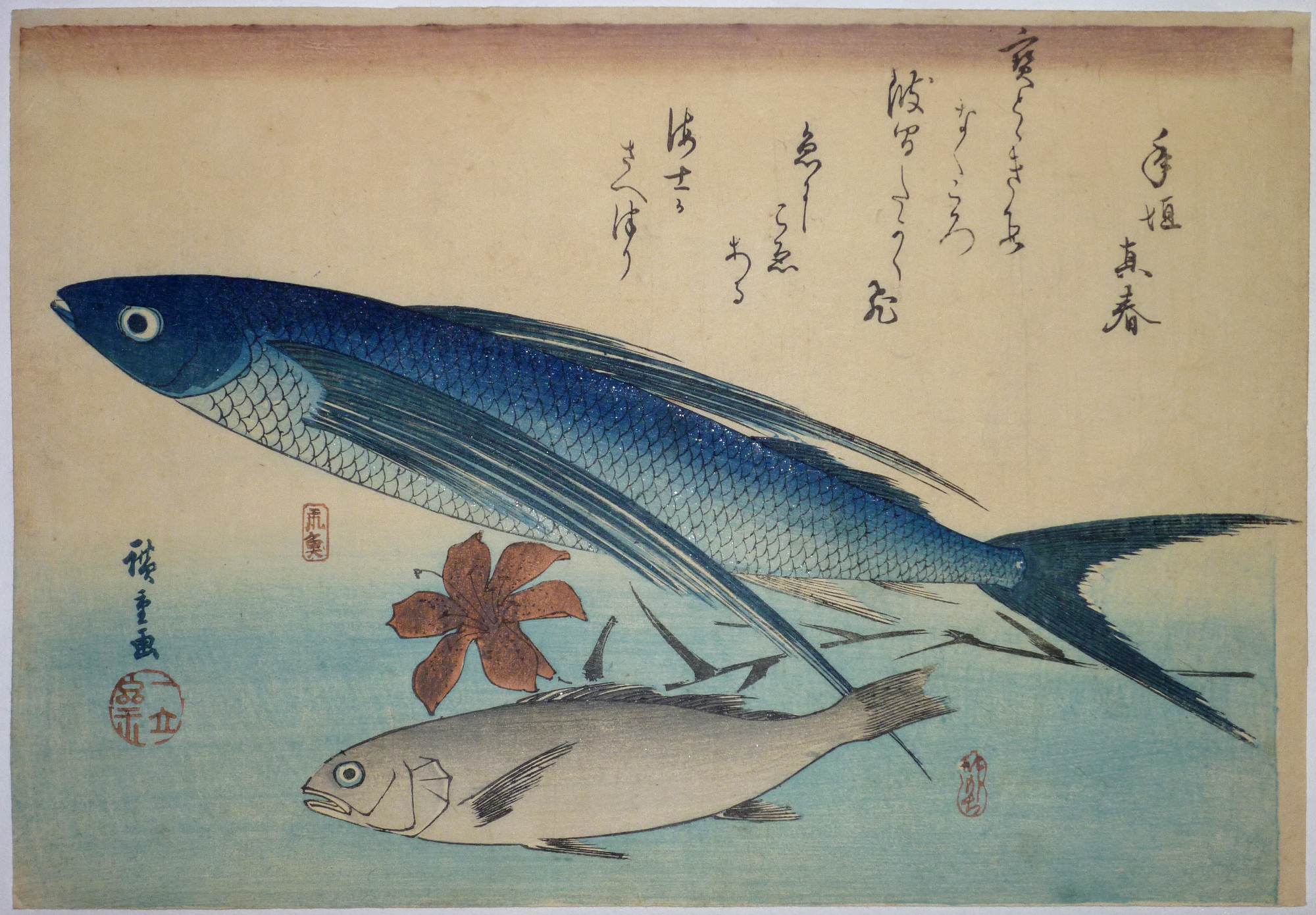
Tobiuo, flying fish (probably Prognichthys) and ishimochi also called guchi or shiroguchi, white croaker, (probably Argyrosomus argenatus). Together with a single lily. Poem by Toshigaki Maharu. From the second series of ten fish prints published by Yamasho, c1840-42.The first series was issued privately for a poetry group ( probably the Shingyoku Circle ) with judges’ names and extra poems. These prints are of the utmost rarity as probably only enough for the Circle were printed and they never come onto the market. Due to their popularity this first series was published commercially and a second set was commissioned.
Fine, early impression with mica on the flying fish. Fine colour and condition. Full size and no centre fold. Signed Hiroshige ga in blue (which I have never seen).
Status: Sold
Utagawa TOYOKUNI II (TOYOSHIGE) (1777-1835)
Click here to view image full size.
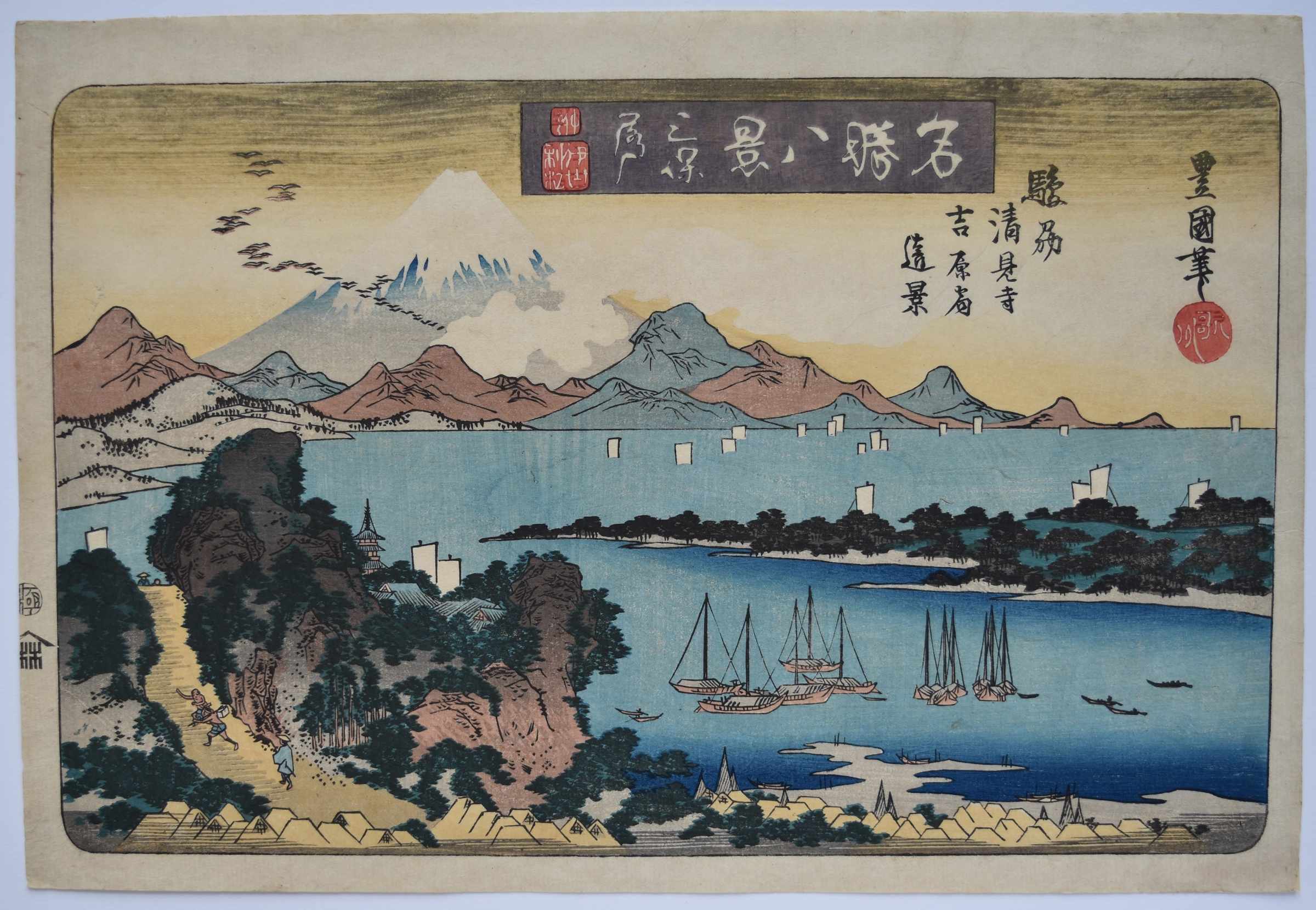
Returning Geese at Miho: Kiyomizu Temple of Suruga Province with a Distant View of Yoshiwara from Meisho hakkei, “Eight Views of Famous Places.” A popular theme in Japanese art originating in China and the landscape of the Xiaoxiang region where the Xiao and Xiang rivers converge. Published c 1833-4 by Kinjudo.
Fine impression, colour and condition. The pigment in the title cartouche intact, which is usually faded. Signed Toyokuni hitsu.
Status: Sold
Ikeda EISEN (1790-1848)
Click here to view image full size.
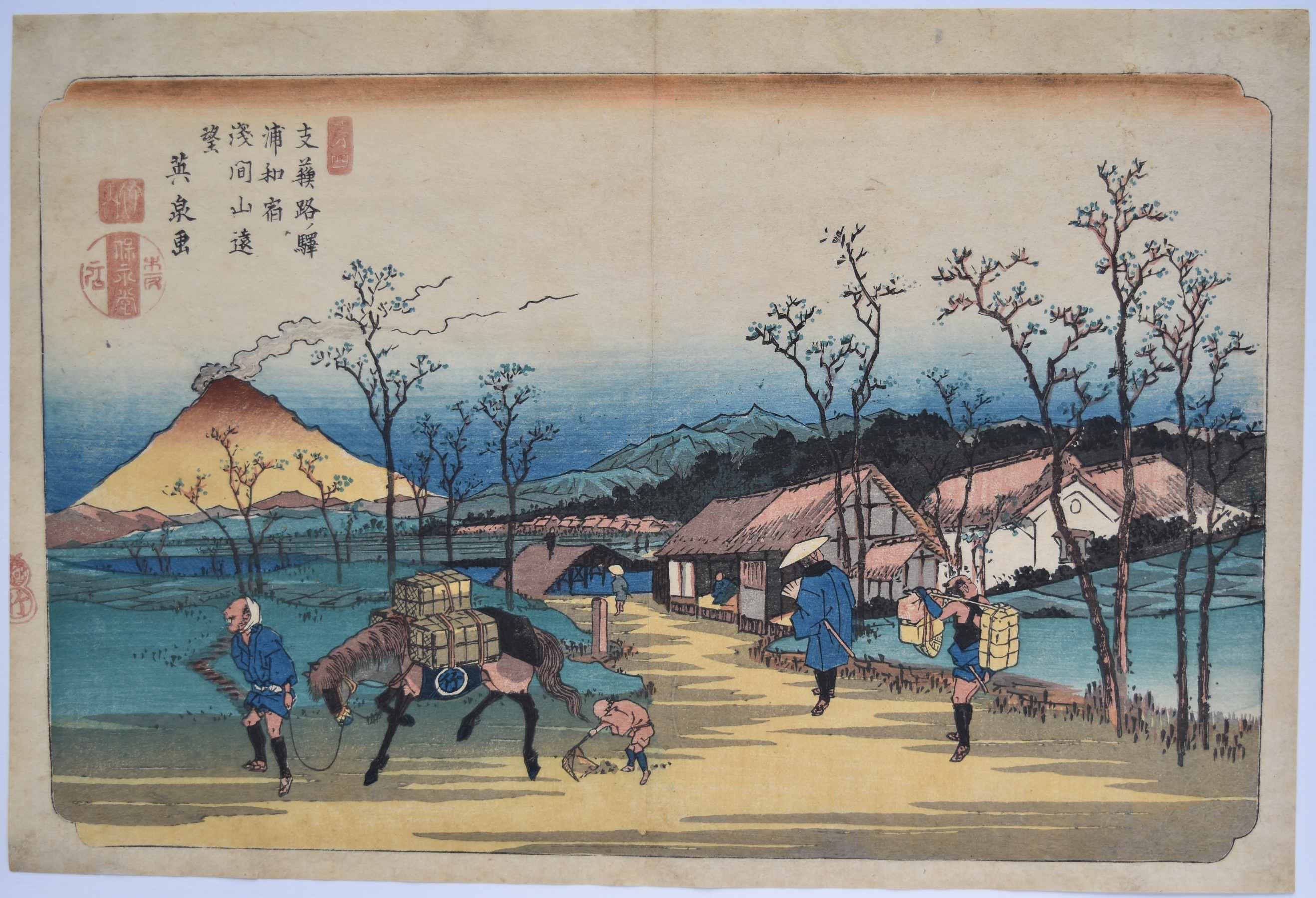
Urawa Shuku Asamayama enbo, “Urawa Station, Distant View of Mount Asama” from Kisokaido rokujukyutsugi no uchi, “Sixty-Nine Stations of the Kisokaido.” The set was published by Hoeido and Kinjudo, 1834-1842. The first 23 (of 70) prints were designed by Eisen, the rest by Hiroshige. In the distance can be seen a smoking Mount Asama. Although there is regular volcanic activity, the last bad eruption was in 1783.
Very good impression of the first edition with signature. (This was removed on later states.) Very good colour. Slight centre fold, otherwise very good condition. Signed Eisen ga.
Status: Sold
Ichiryusai HIROSHIGE (1797-1858)
Click here to view image full size.
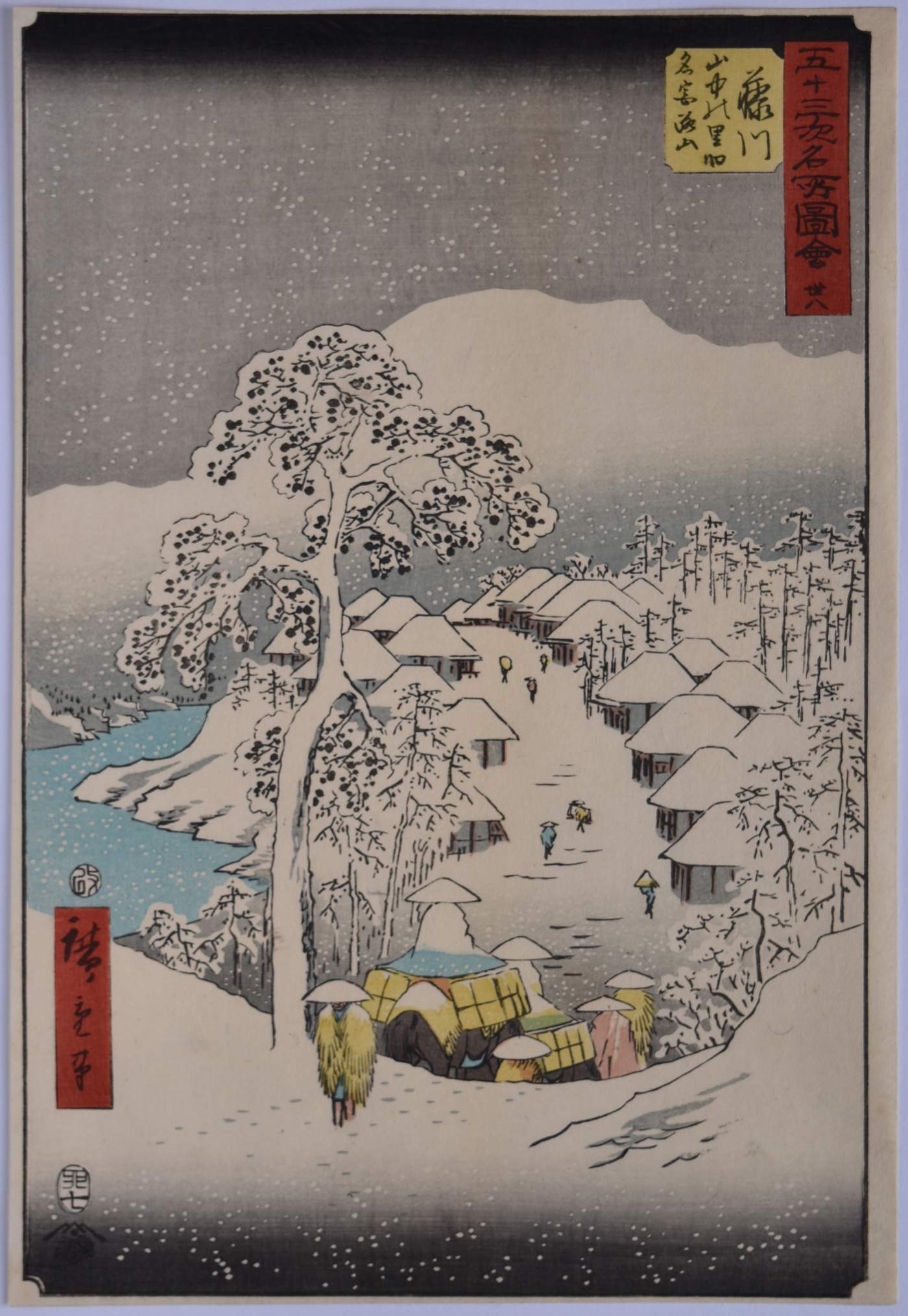
Fujikawa from the so-called “Upright Tokaido.” One of the two snow scenes from the set. Shows travelers coming and going at the edge of the village. Published by Tsutaya, Hare 7, 1855.
Very good impression with wood-grain evident in the sky. Very good colour. Trimmed close, otherwise very good condition. Signed Hiroshige ga.
Status: Sold
Utagawa HIROSHIGE (1797-1858)

Click here to view image full size.
Iki Shisaku, “Shisaku in Iki [Province]” from a set of 69 prints [Dai Nihon] Rokujuyoshi meisho zue, “Famous Places in the Sixty-odd Provinces [of Japan]” published by Koshihei between 1853 and 1856, this being 1856. A heavy snowfall over Iki island which lies to the northeast of the Kyushu coast in southern Japan.
Very fine impression and colour. Light album backing, otherwise fine condition. Signed Hiroshige ga.
Status: Sold
Utagawa HIROSHIGE (1797-1858)
Click here to view image full size.
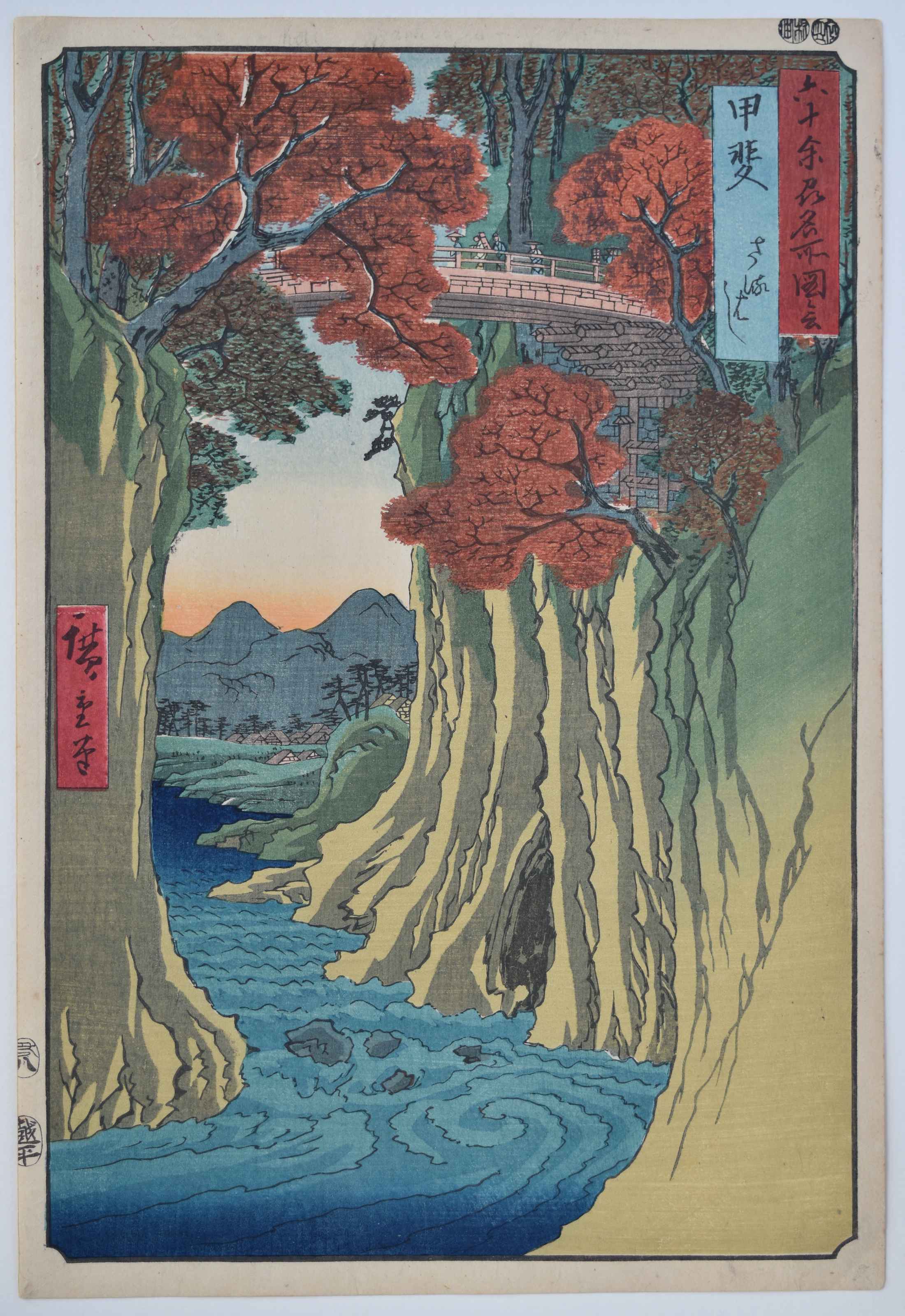
Kai, Saruhashi, “Kai [Province], Monkey Bridge” from a set of 69 prints [Dai Nihon] Rokujuyoshi meisho zue, “Famous Places in the Sixty-odd Provinces [of Japan]” published by Koshihei between 1853 and 1856, this being 1853. The bridge spans the Katsura River and is an example of the hanebashi method of construction whereby cantilever beams are set in the opposing cliff faces. Called the Monkey Bridge because monkeys are originally supposed to have strung themselves across the gorge.
Very fine impression and colour. Light album backing, otherwise fine condition. Signed Hiroshige ga.
Status: Sold
Utagawa HIROSHIGE (1797-1858)

Click here to view image full size.
Mino, Yoro no taki, “Mino [Province], Yoro Waterfall” from a set of 69 prints [Dai Nihon] Rokujuyoshi meisho zue, “Famous Places in the Sixty-odd Provinces [of Japan]” published by Koshihei between 1853 and 1856, this being 1853. The 32 metre fall is 4 metres wide and is located in Yoro Park, near Nagoya.
Very fine impression and colour with blind-printing on the fall. Light album backing, otherwise fine condition. Signed Hiroshige ga.
Status: Sold
Utagawa HIROSHIGE (1797-1858)
Click here to view image full size.
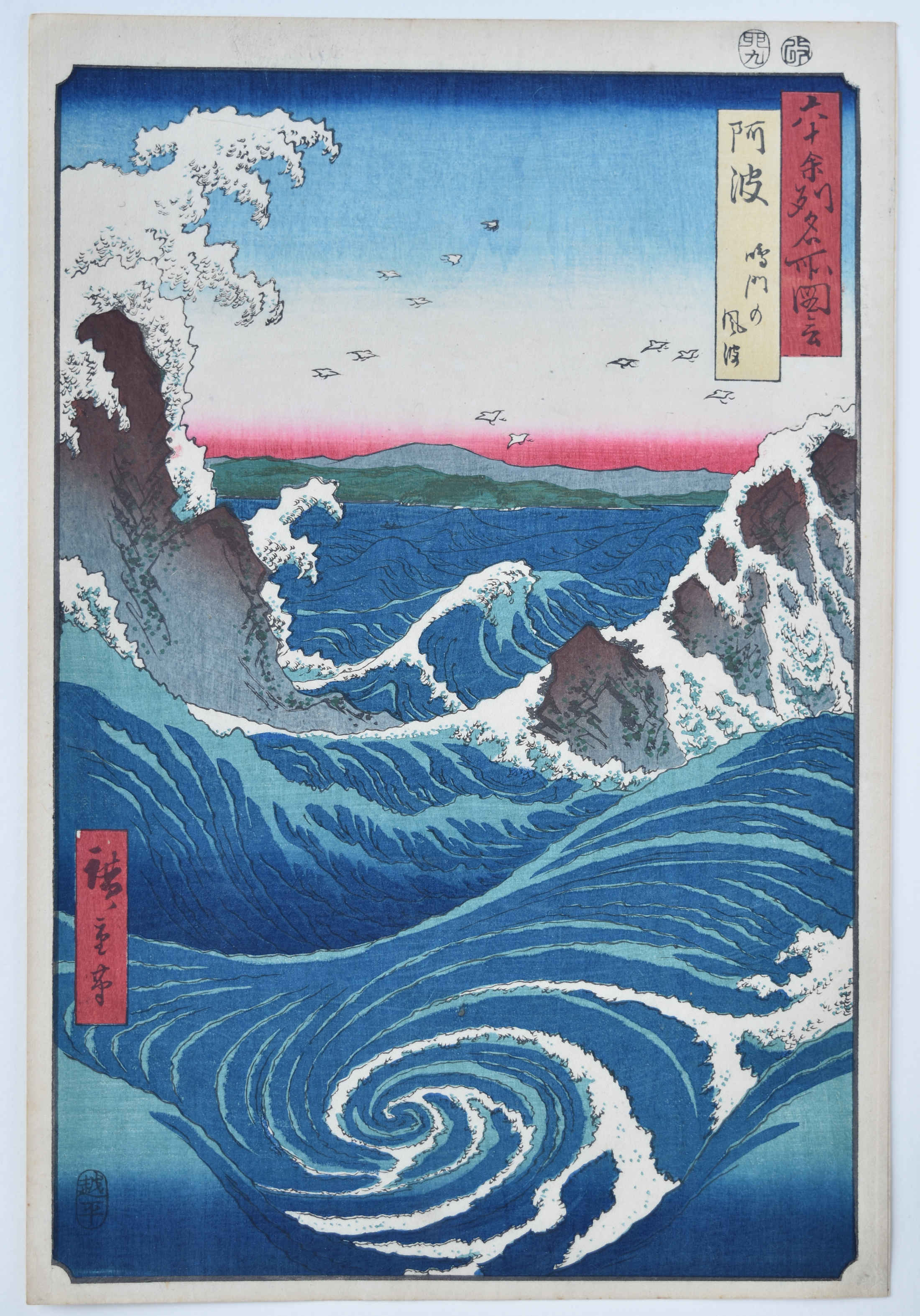
Awa, Naruto no fuha, Naruto Whirlpools, Awa [Province]” from a set of 69 prints [Dai Nihon] Rokujuyoshi meisho zue, “Famous Places in the Sixty-odd Provinces [of Japan]” published by Koshihei between 1853 and 1856, this being 1855. The finest print from the set and one of Hiroshige’s most important designs. The phenomenon is caused by the tides that move large amounts of water through the Naruto Strait into and out of the Inland Sea.
Very fine impression and colour. Light album backing, otherwise fine condition. Signed Hiroshige ga.
Status: Sold
Utagawa HIROSHIGE (1797-1858)
Click here to view image full size.
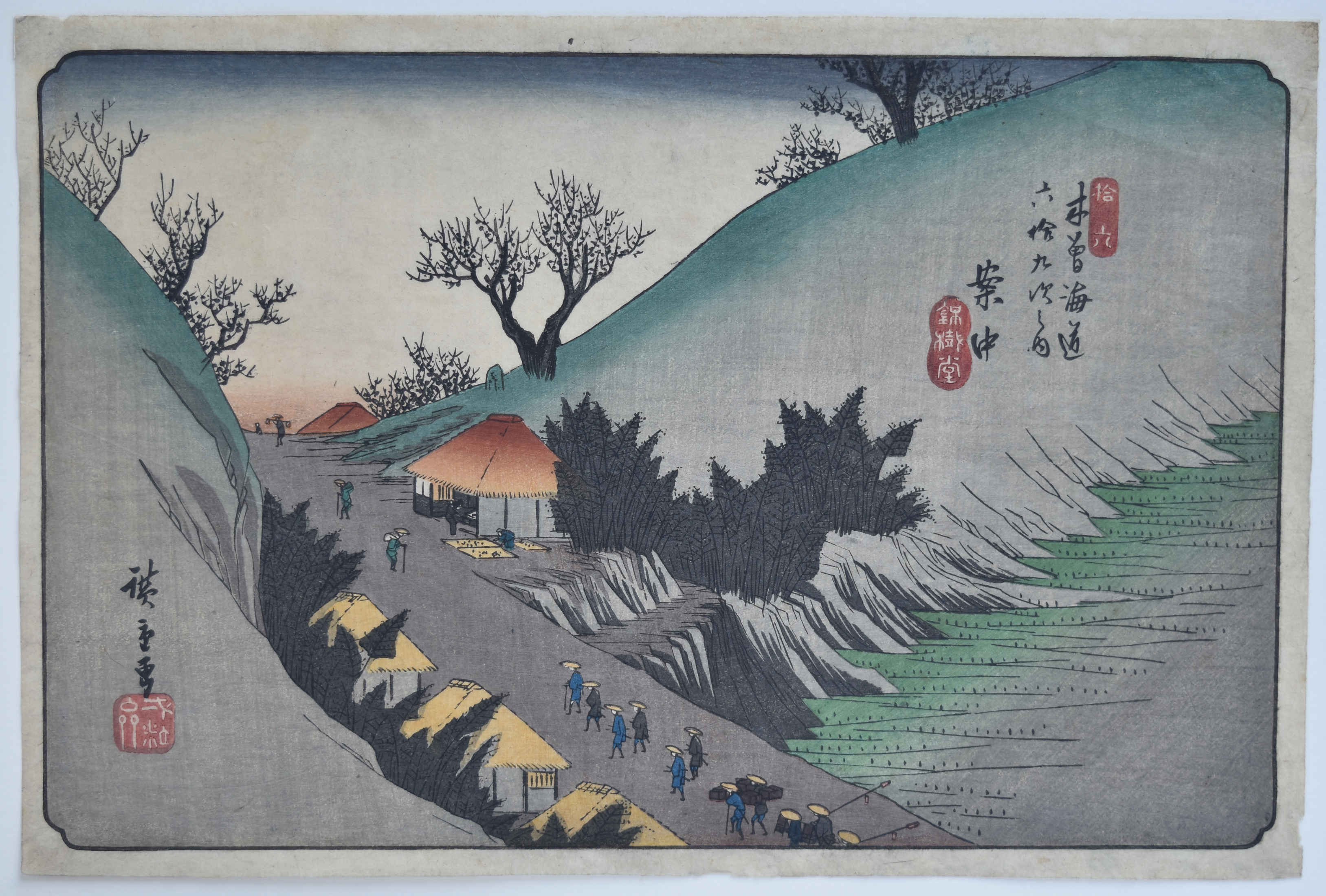
Station Annaka from Kisokaido rokujukyutsugi no uchi, “Sixty-Nine Stations of the Kisokaido.” Published by Kinjudo, the set was started by Eisen in 1835 who designed twenty-four prints before Hiroshige replaced him and completed the set before 1843. Shows the entourage of a feudal lord progressing along the road between rest houses.
Very fine impression of the earliest printing. Fine colour and condition. Signed Hiroshige ga.
Status: Sold
Utagawa HIROSHIGE (1797-1858)
Click here to view image full size.
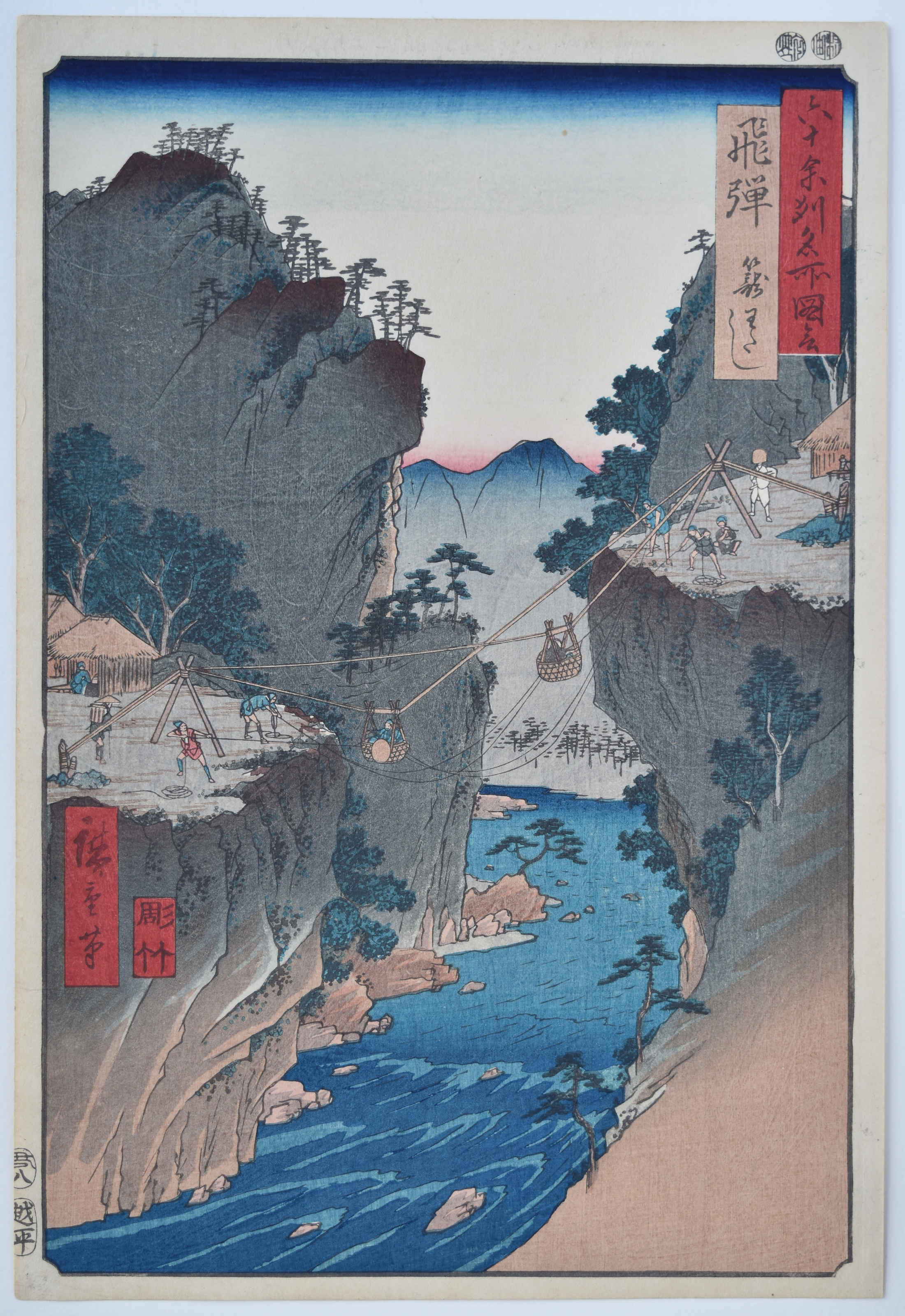
Hida, kago-watashi, “Basket Ropeway in Hida [Province]” from a set of 69 prints [Dai Nihon] Rokujuyoshi meisho zue, “Famous Places in the Sixty-odd Provinces [of Japan]” published by Koshihei between 1853 and 1856, this being 1853. Originating in China, Japan and northern India, travellers could cross deep ravines by suspending themselves in a harness which evolved into a basket.
Very fine impression and colour. Light album backing, otherwise fine condition. Signed Hiroshige ga.
Status: Sold
Katsushika HOKUSAI (1760-1849)
Click here to view image full size.
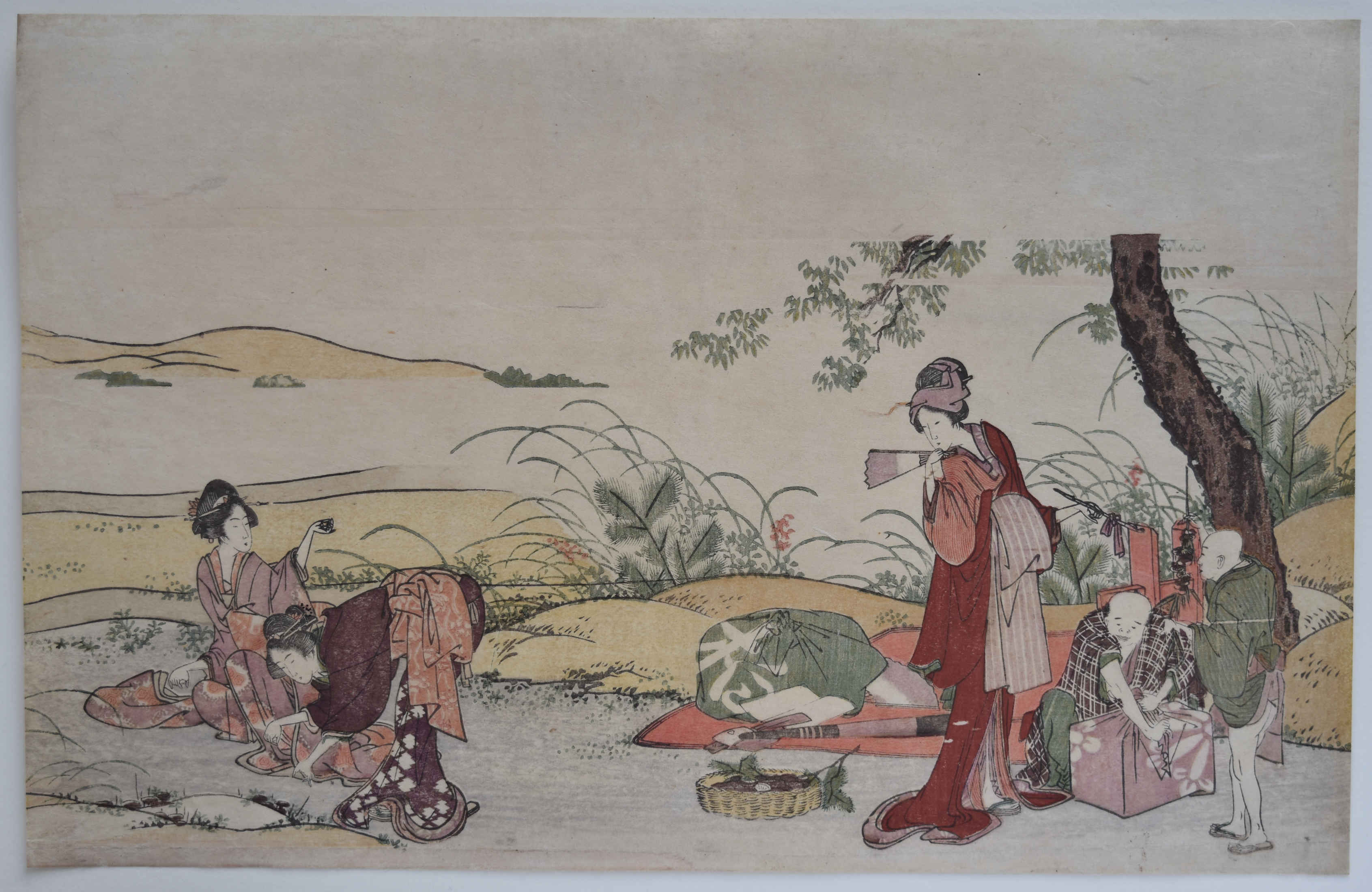
A group of three women picking mushrooms. Published c 1800. Another impression, from the Musee Guimet, is illustrated in Muneshige Narazaki, Ukiyo-e Masterpieces in European Collections, 6, Musee Guimet, Paris, 1, p. 176, no. 90.
Fine impression. Very good colour and condition. Unsigned.
Status: Sold
Katsushika HOKUSAI (1760-1849)
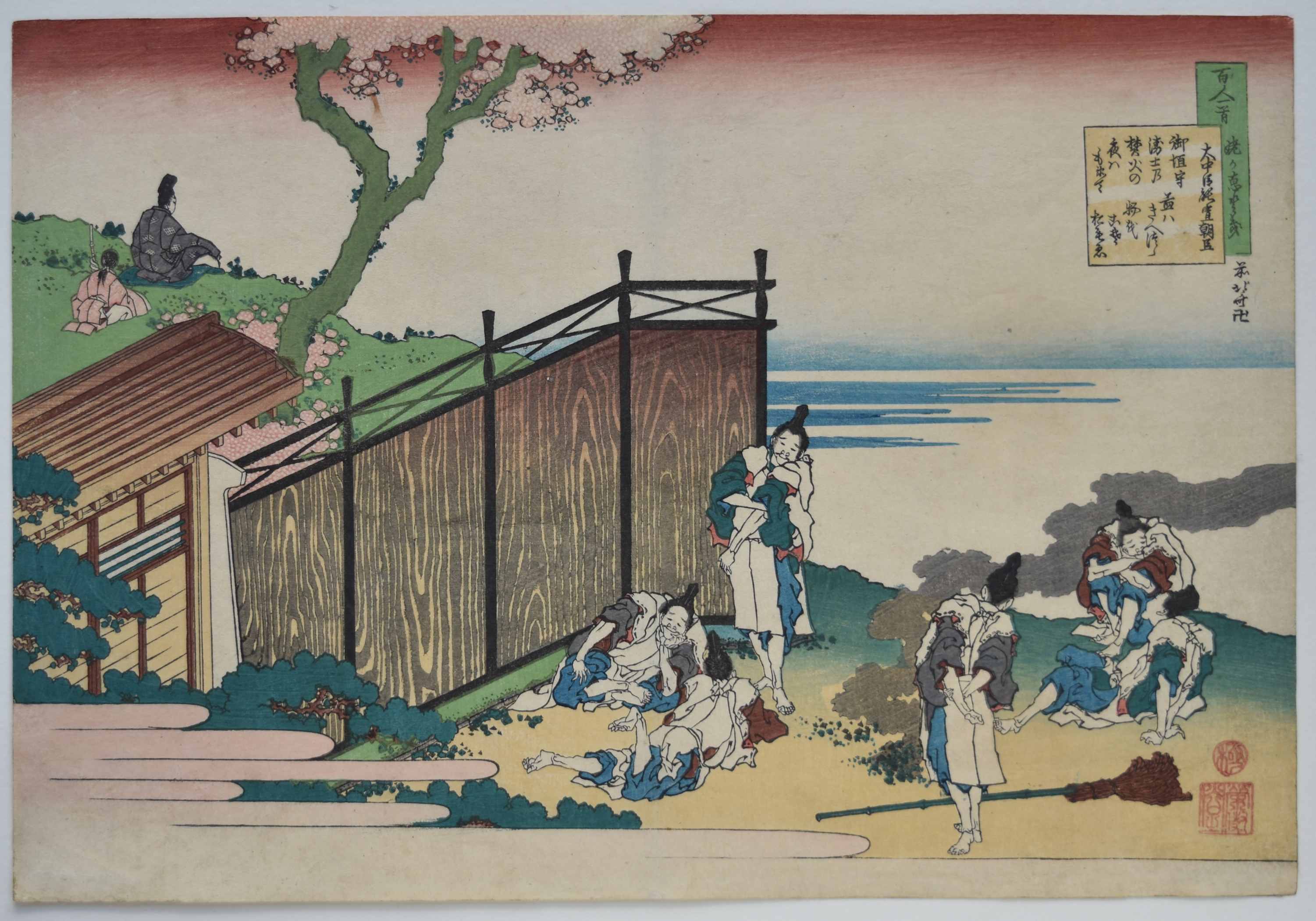
Click here to view image full size.
Hokusai’s interpretation of a poem by Onakatomi no Yoshinobu Ason (921-991). From an unfinished set: Hyakunin isshu uba ga etoki, “Pictures of One Hundred Poems by One Hundred Poets Explained by the Nurse.” The poems are from an anthology Hyakunin isshu, “One Hundred People, One Poem Each” compiled by the poet Fujiwara no Teika (1162-1241). The poet speaks of his love as being like the fire kept by the guards at the gate to the Imperial Palace: It burns hot only at night. There is actually some doubt that the poem can be attributed to Yoshinobu. Shows a group of off-duty Imperial carriage guards relaxing around the smoking embers of a fire. The poet with his servant is seen sitting on the distant hill. Published by Eijudo, 1835-36. A considerable number of original drawings exist for the set that were not turned into prints and are in various museums and private collections.
Fine impression, colour and condition. Signed Saki no Hokusai Manji.
Status: Sold
Utagawa HIROSHIGE (1797-1858)
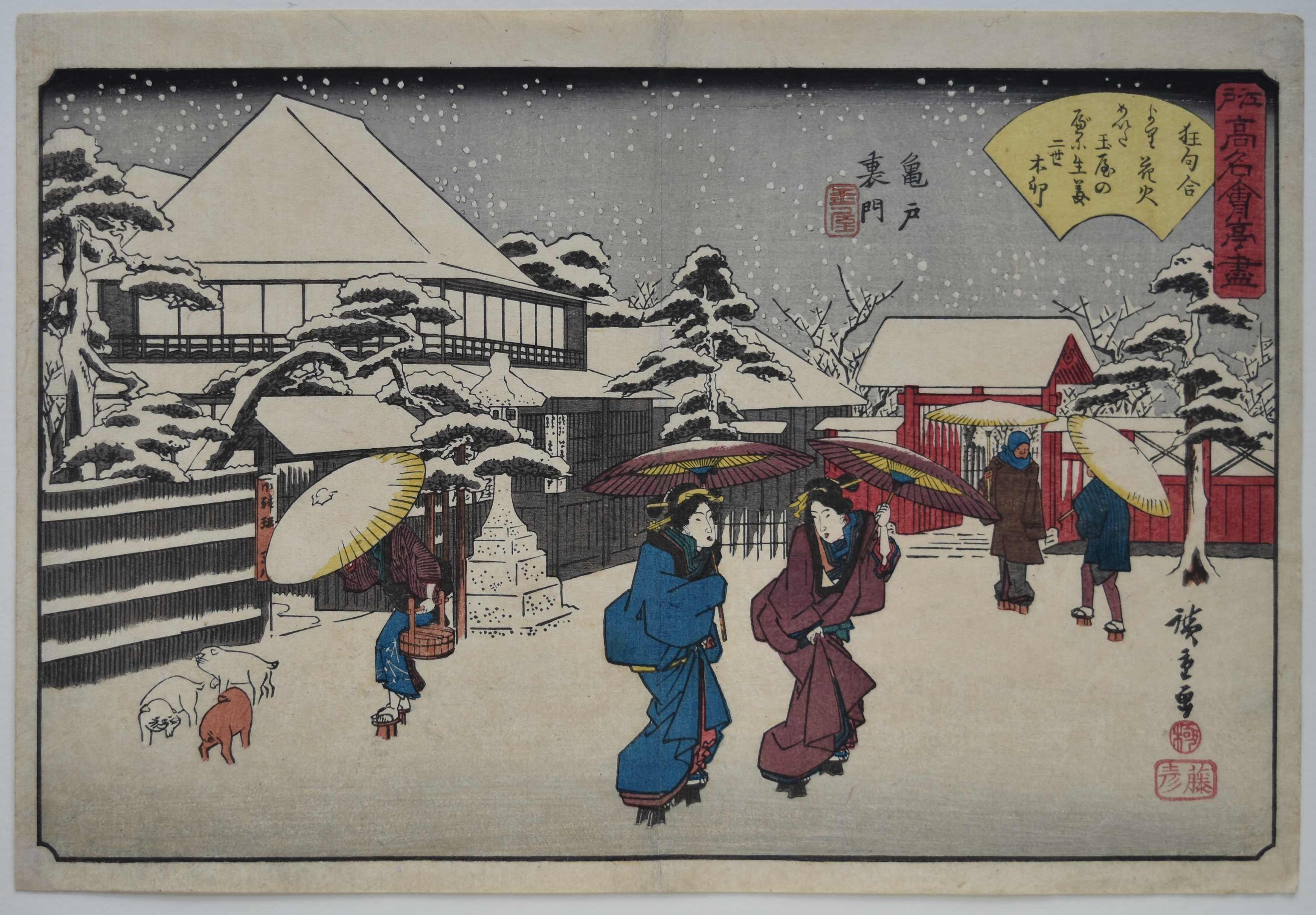
Click here to view image full size.
A snow scene from a set Edo komei kaitei zukushi, “Famous Teahouses of Edo,” Kameido uramon, Tamaya, “Back Gate of the Shrine at Kameido: The Tamaya Teahouse.” The set published by Shogendo, 1838-40.
Very fine impression. Fine colour. Slight centre fold (strengthened au verso), otherwise very good condition. Signed Hiroshige ga.
Status: Sold
Utagawa HIROSHIGE (1797-1858)
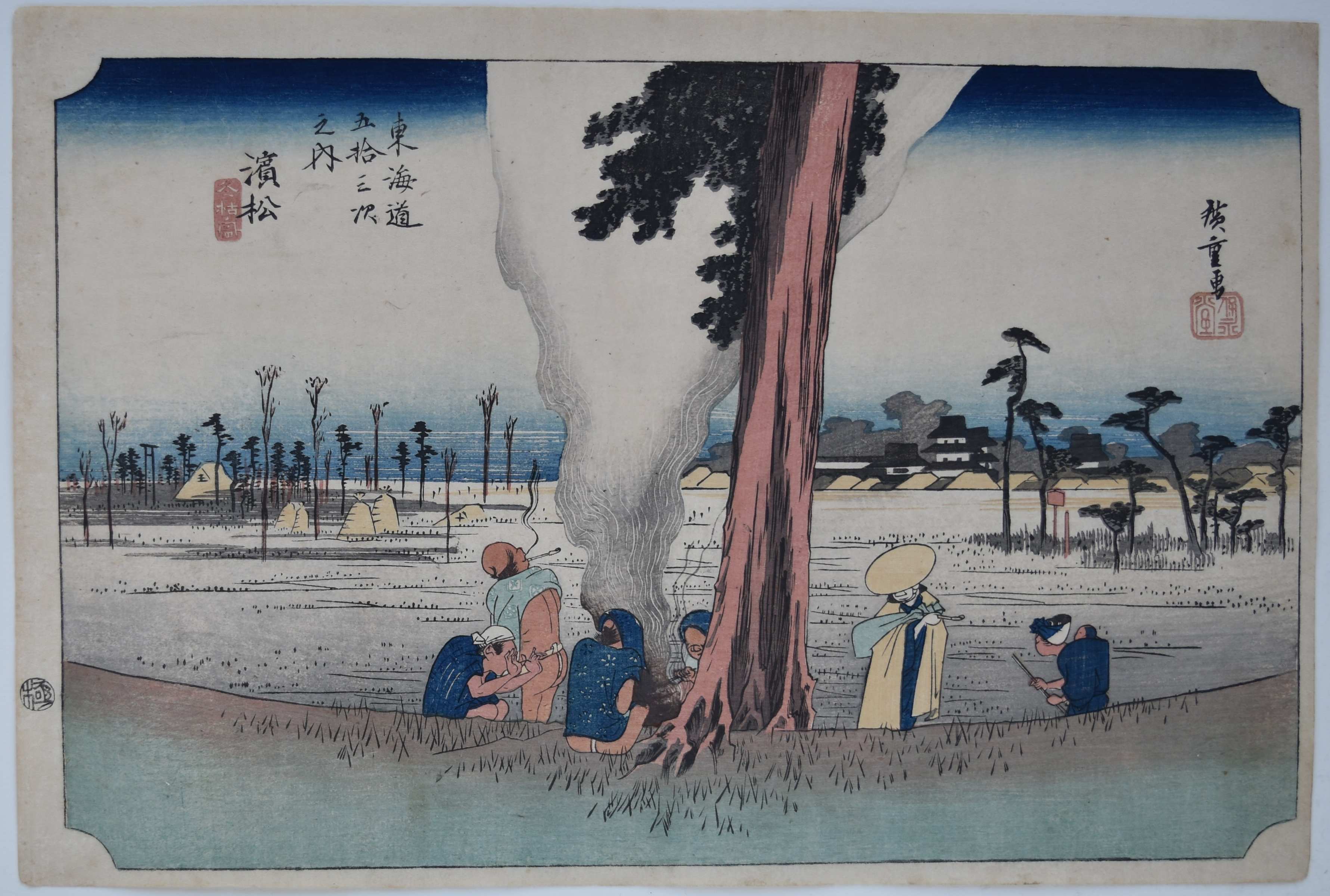
Click here to view image full size.
Station Hamamatsu from Tokaido gojusan-tsugi no uchi, “Fifty-three Stations of the Tokaido.” This seminal work was possible because Hiroshige was asked to accompany an official procession along the Tokaido Road from Edo to Kyoto in 1832, and he made numerous sketches to document the journey. A winter scene with farmers warming themselves around a fire. Hamamatsu Castle in the distance. Because of the set’s popularity, it was reprinted many times and there are a plethora of late impressions. Early printings are hard to find. Published by Hoeido (Takenouchi Magohachi) and Tsuruya Kiemon (Senkakudo) 1833-34.
Fine, early impression. Fine colour and condition. Signed Hiroshige ga.
Status: Sold
Utagawa HIROSHIGE (1797-1858)
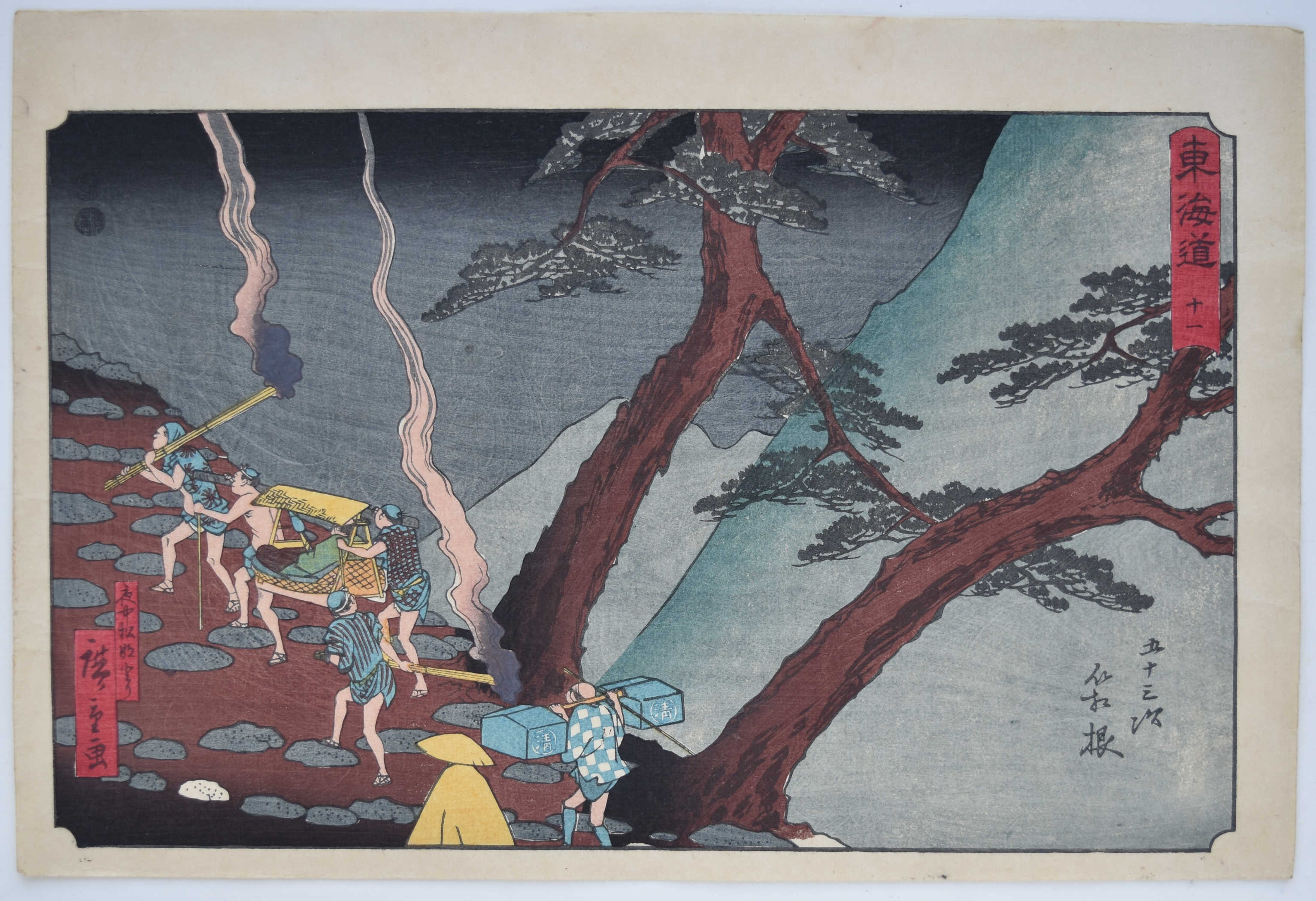
Click here to view image full size.
Station Hakone from a set Tokaido gojusan tsugi, “The Fifty-three Stations of the Tokaido Road,” aka the Reisho Tokaido from the clerical script used in the title, or the Marusei Tokaido after the publisher Maruya Seijiro (Marusei) who published the set 1847-52. Hakone, yonaka taimatsu tori, “Hakone, Travelling with Pine Torches at Night.” Porters lighting the way for a palanquin with firebrands on a mountain path. A beautiful design.
Very fine impression with strong woodgrain. Fine colour and condition. Signed Hiroshige ga.
Status: Sold
Keisai EISEN (1790-1848)
Click here to view image full size.
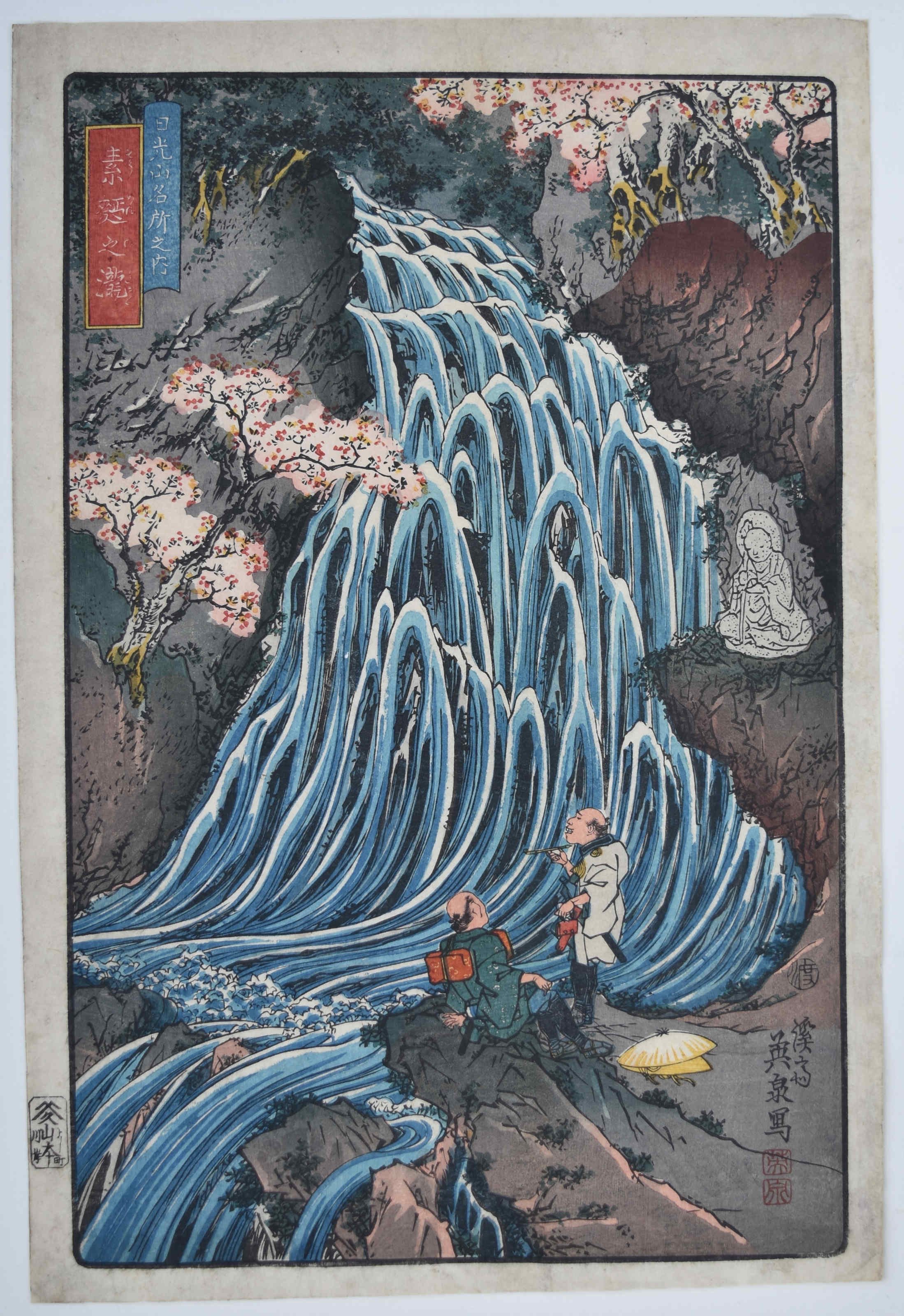
Somen no taki, “The Wheat Noodle Waterfall.” From a set Nikkosan meisho no uchi, “Celebrated Views in the Nikko Mountains.”Two travellers admire the fall from below. On a ledge above them is a stone statue of Jizo Bosatsu, the deity of travellers. From a set of five prints: It was probably intended to be a set of three prints but another two were added, possibly with the intention of going on to emulate Hokusai’s waterfall set. Published by Yamamotoya Heikichi (Eikyudo) c. 1843-47. In contrast to Hokusai’s set, Eisen’s have a more muscular appearance. See: The Japanese Print: A New Approach, J. Hillier, Bell & Son, 1960, Chapter XVI, where Jack Hillier discusses Eisen and his landscapes and considers this set “… is perhaps the crowning achievement of his career as a designer of landscape prints.”
Fine impression. (Late impressions are not known of this set, probably due to not having the popularity of Hokusai’s set.) Fine impression. Very good colour. Slight edge soil, otherwise very good condition. Signed Keisai Eisen utsusu.
Status: Sold
Utagawa HIROSHIGE II (1826-1869)
Click here to view image full size.
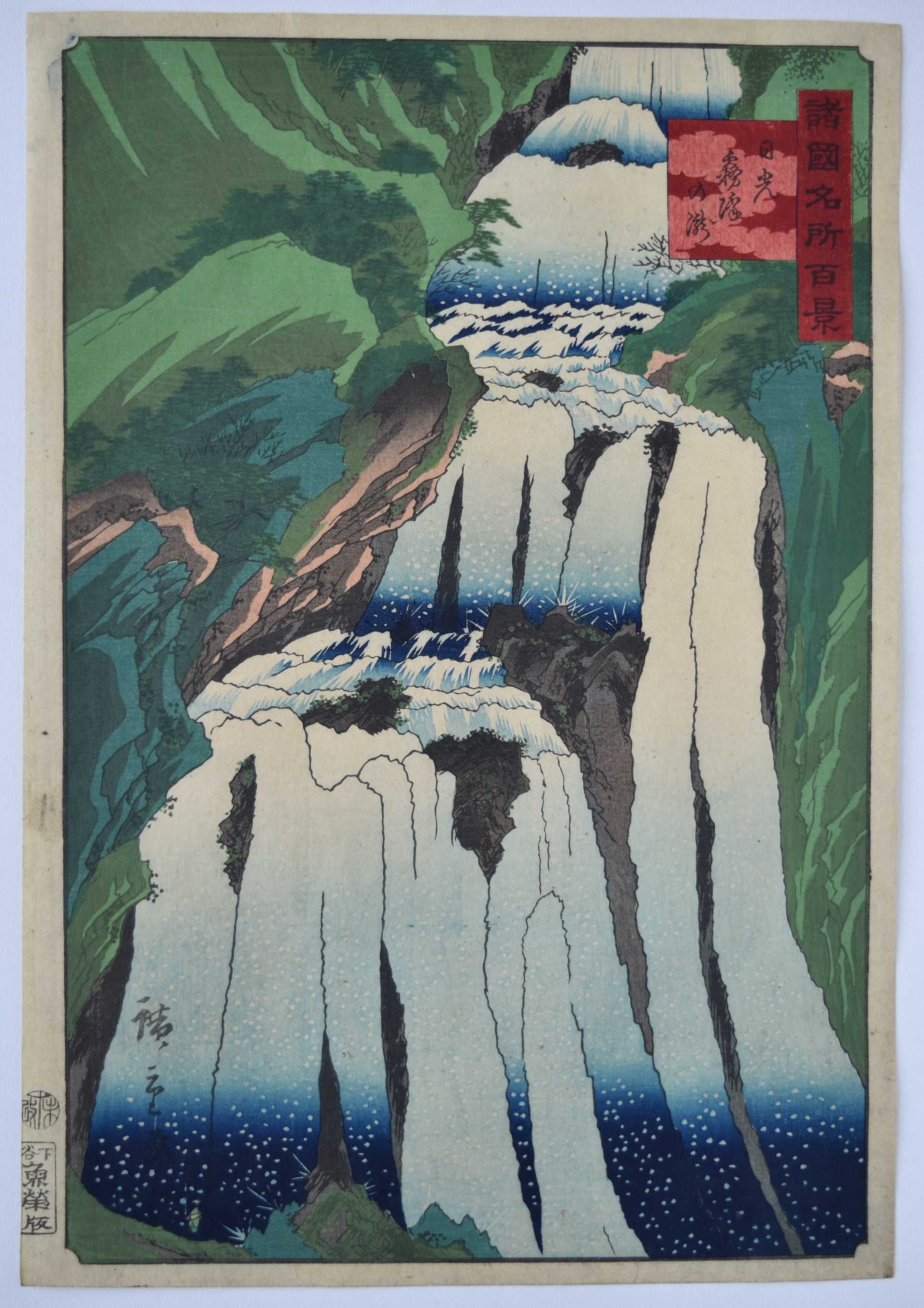
Nikko Shimofuri no taki, “Shimofuri Waterfall in Nikko” from Shokoku meisho hyakkei, the “Hundred Views of Famous Places in the Provinces.” An uncompleted set of 81 prints published by Uoya Eikichi between 1859-1861 (this being 1859).
Very fine impression of the first edition. Fine colour and condition. Signed Hiroshige ga.
Status: Sold
Utagawa HIROSHIGE II (1826-1869)
Click here to view image full size.
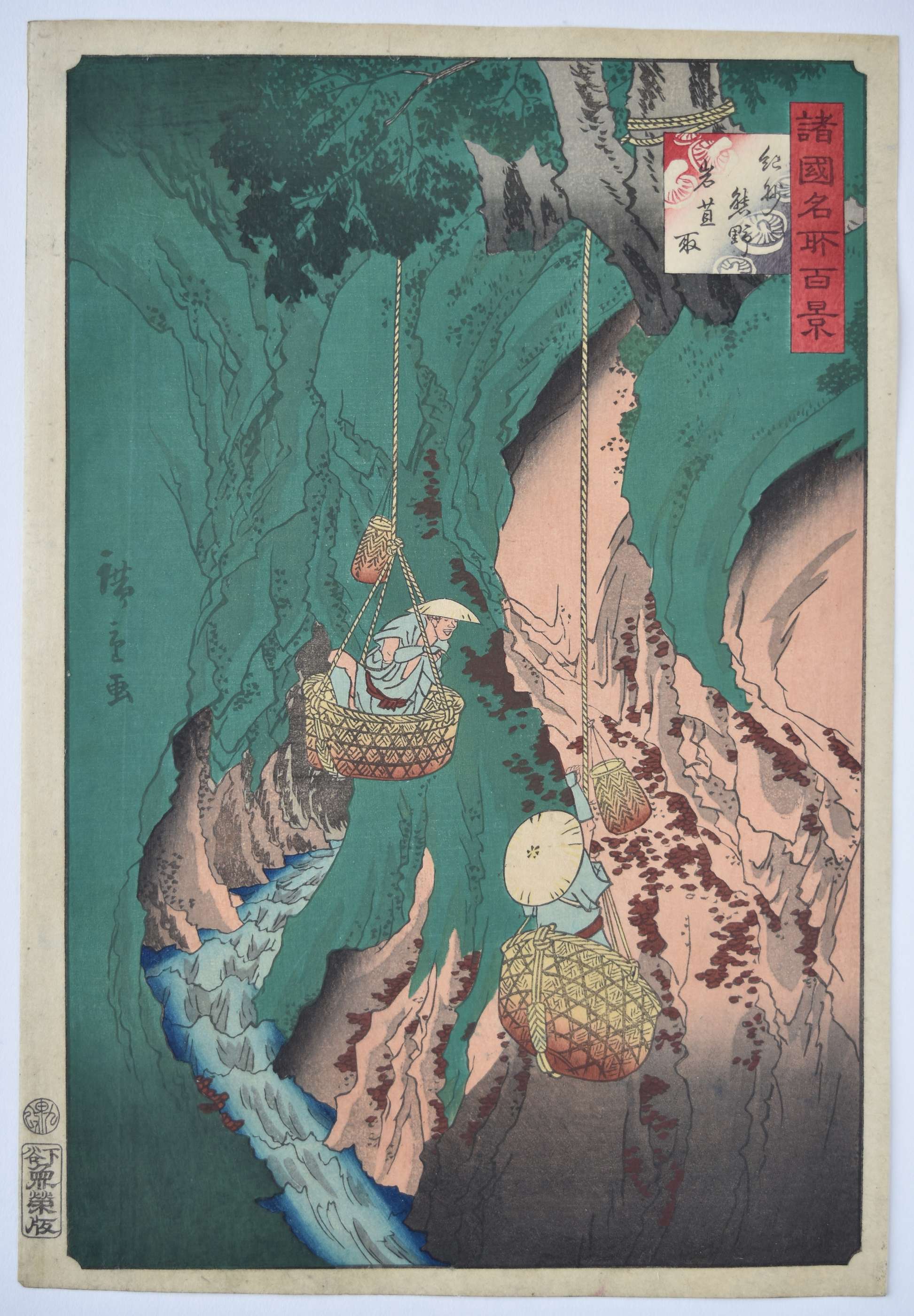
Gathering iwatake, rock tripe or rock mushrooms in Kii Province. The common name for various edible lichens that grow on cliffs. The gatherers used precarious baskets that were hauled up and down the cliff face to collect them. Kishu Kumano iwatake tori from Shokoku meisho hyakkei. “Hundred Views of Famous Places in the Provinces.” Published by Uoyei 1859-1861 (this being 1860).
Very fine impression of the first edition. Fine colour and condition. Signed Hiroshige ga.
Status: Sold
Utagawa HIROSHIGE (1797-1858)
Click here to view image full size.
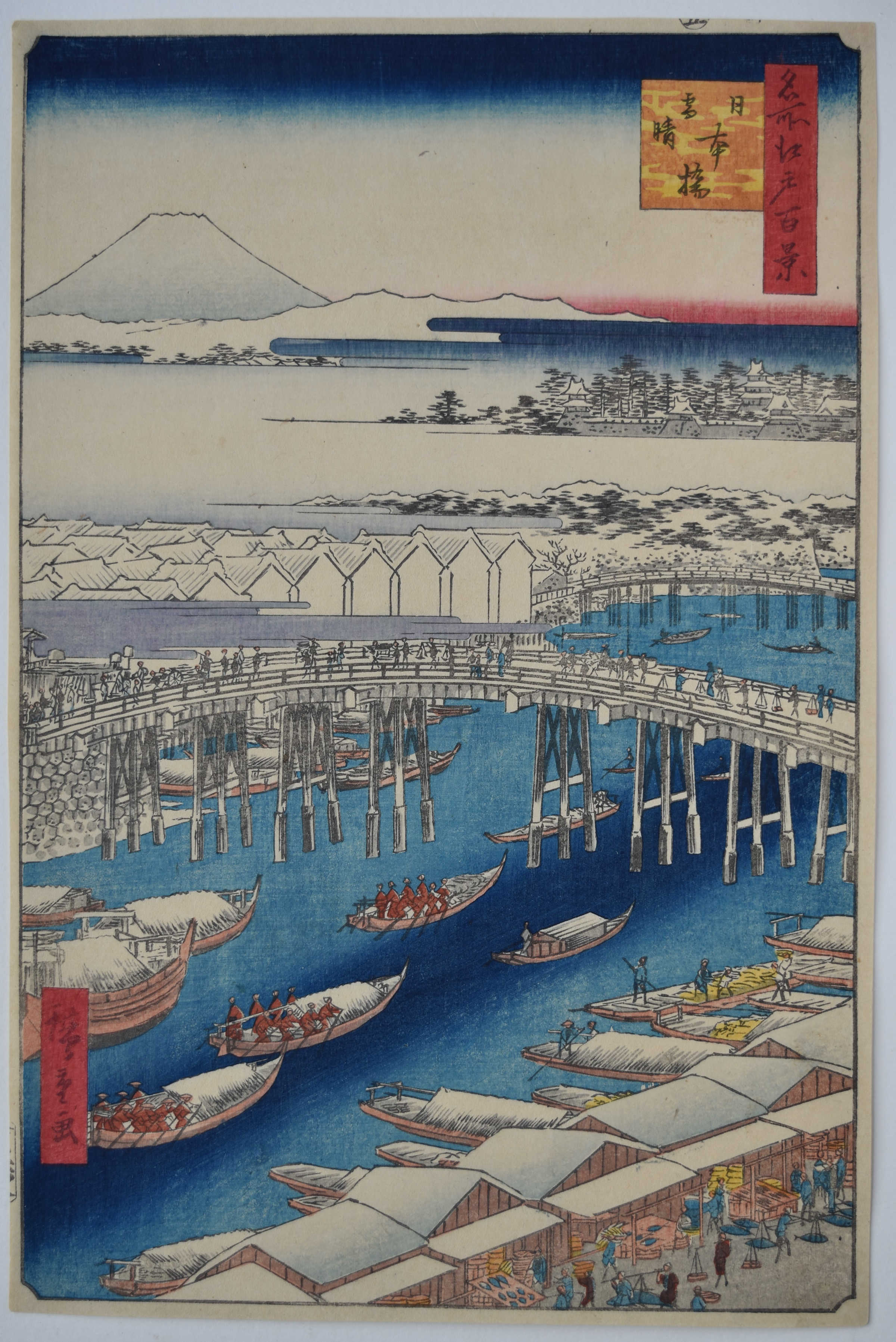
Nihonbashi yukibare, “The Nihon Bridge, Clear Weather After Snow.” From the set Meisho Edo hyakkei, “One Hundred Views of Edo.” The set published by Uoya Eikichi 1856-58 (this being 1856). The set comprises 118 prints by Hiroshige and another by Hiroshige II. However, three prints are dated 10/1858, the month following Hiroshige’s death and these are thought to be by Hiroshige II as well. They are: Ueno Yamashita, Ichigaya Hachiman and Bikunibashi. Number 1 from the set and a view of the Sumida River with Mt. Fuji in the distance. This is the starting point for the Tokaido Road.
Fine, early impression with gradation on the roofs and on Mt. Fuji. Fine colour. Margins trimmed a little, otherwise very good condition. Signed Hiroshige ga.
Status: Sold
Utagawa HIROSHIGE (1797-1858)
Click here to view image full size.
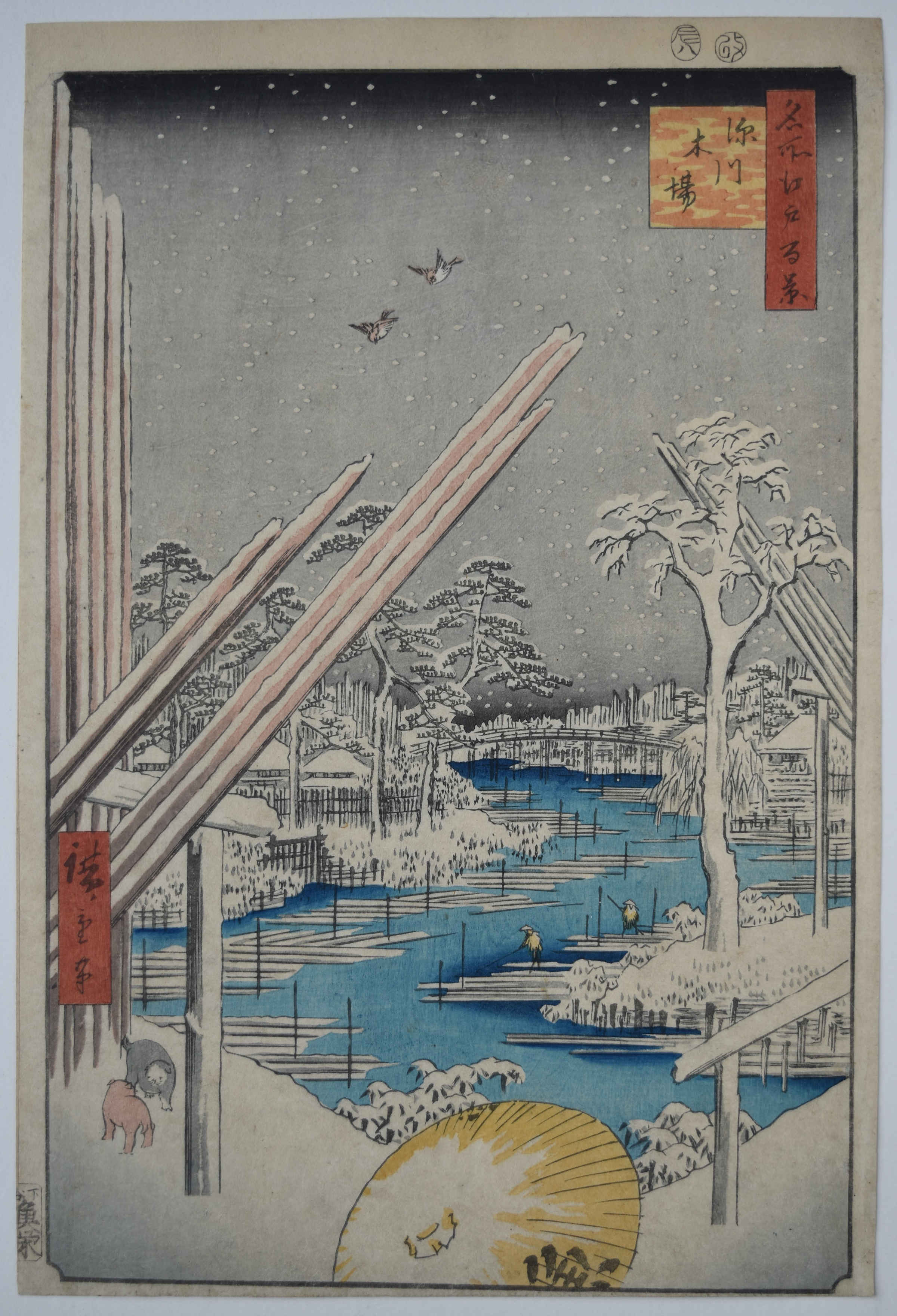
The lumberyard, Fukugawa, from the set Meisho Edo hyakkei, “One Hundred Views of Edo.” The set published by Uoya Eikichi 1856-58 (this being 1856). The set comprises 118 prints by Hiroshige and another by Hiroshige II. However, three prints are dated 10/1858, the month following Hiroshige’s death and these are thought to be by Hiroshige II as well. They are: Ueno Yamashita, Ichigaya Hachiman and Bikunibashi. Shows snow falling on the timber yards lining a river. An umbrella in the foreground is inscribed Uo, “Fish” – a reference to the publisher Uoya Eikichi. A large supply of timber was needed for the world’s largest wooden city. However, in 1641 a fire destroyed not only houses but the lumber which was then stored in a central area forcing the government to move the yards to Fukugawa.
Very good, early impression. Very good colour. Trimmed close at bottom. Otherwise very good condition. Signed Hiroshige ga.
Status: Sold
Utagawa HIROSHIGE (1797-1858)
Click here to view image full size.
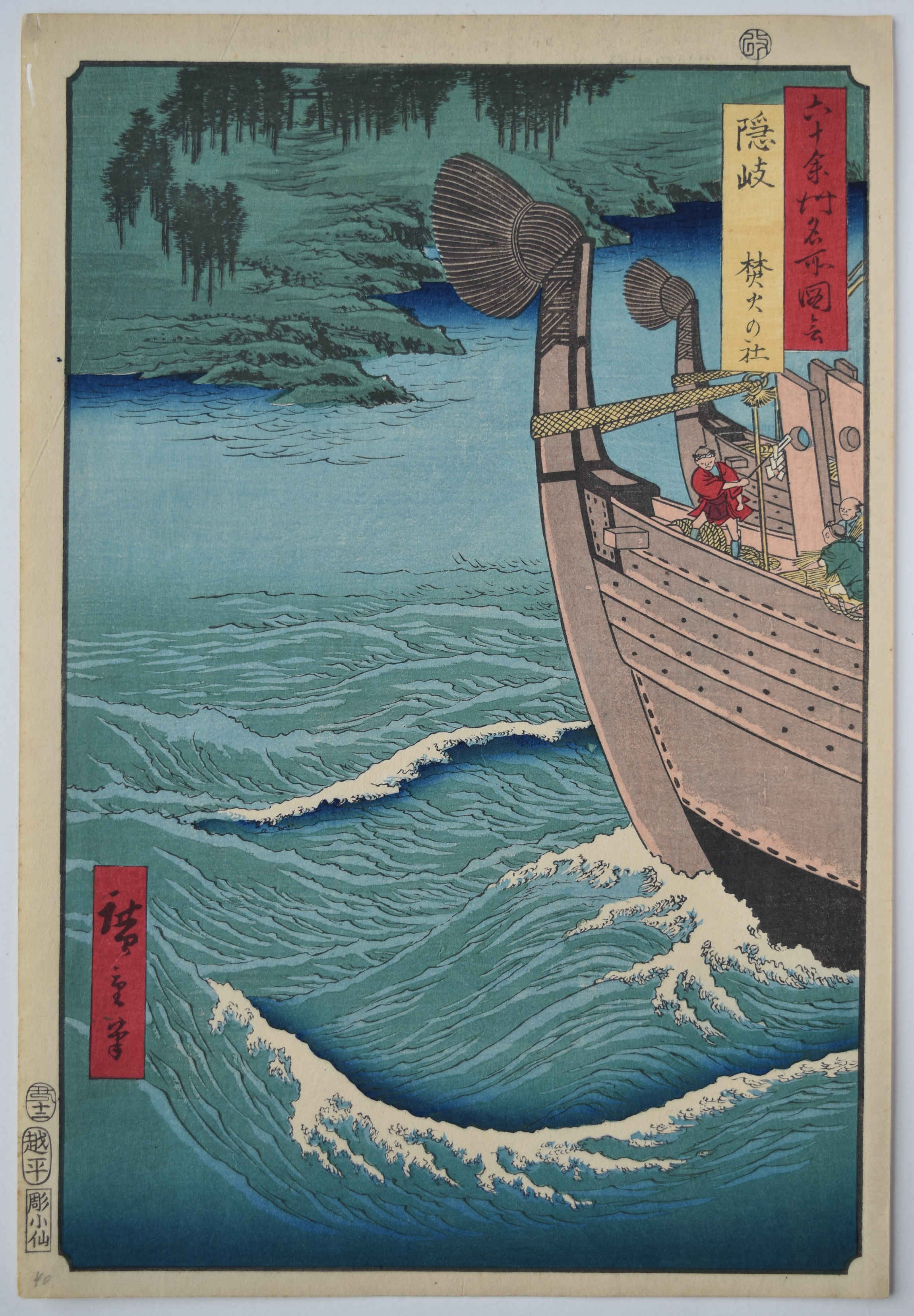
Oki Province, Takuhi Shrine. From a set of 69 prints [Dai Nihon] Rokujuyoshu meisho zue, “Famous Places in the Sixty-odd Provinces [of Japan]” published by Koshihei between 1853 and 1856, this being 1853. The prows of two boats near the island of Nishinoshima. A torii seen at the top of the print indicates the Takuhi Shrine, one of the most important shrines dedicated to the gods of the sea.
Fine impression and colour. Light album backing, otherwise very good condition. Signed Hiroshige ga.
Status: Sold
Utagawa HIROSHIGE II (1829-1869)
Click here to view image full size.
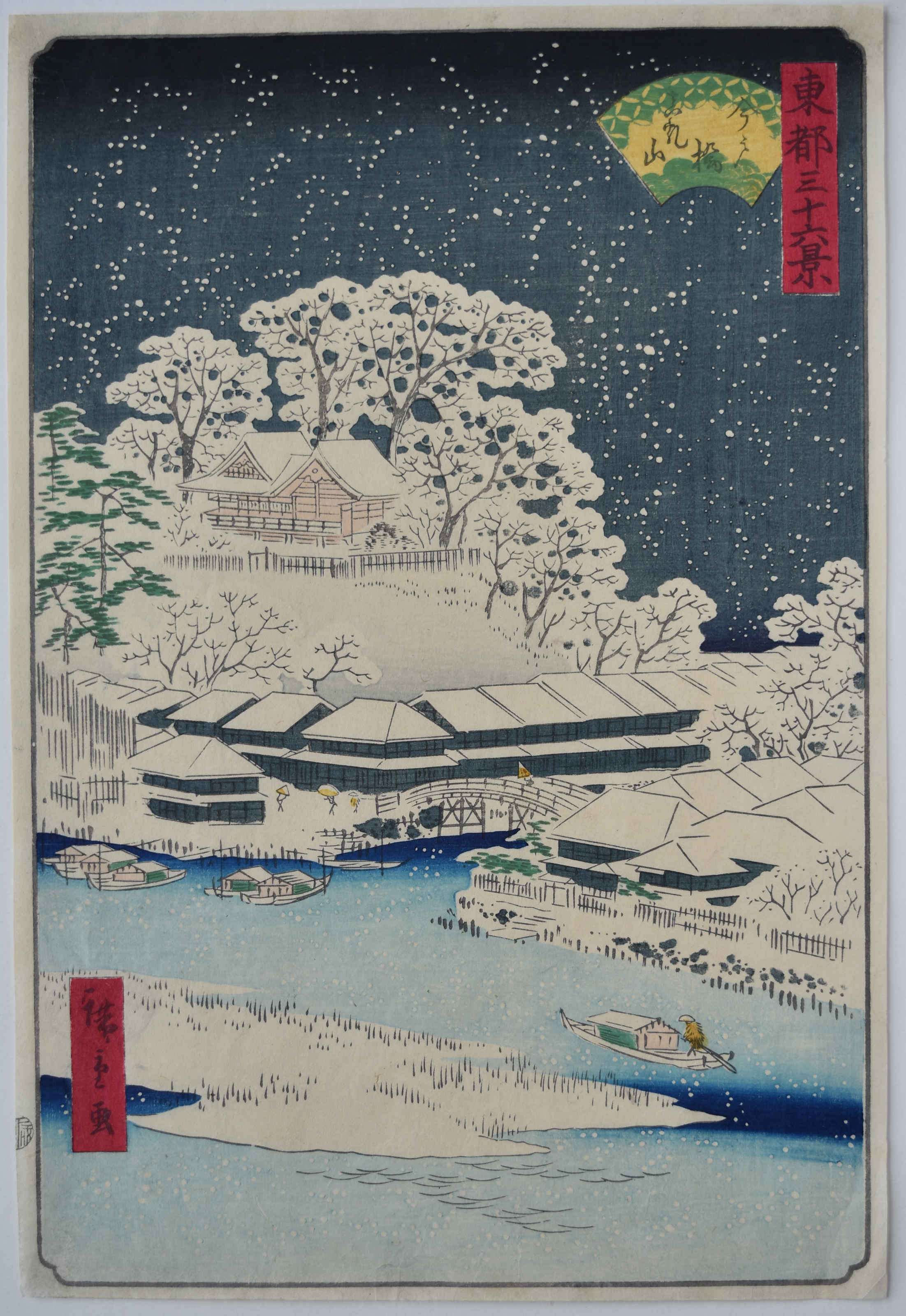
A snow scene: Imadobashi Matsuchiyama, “Imado Bridge and Matsuchi Hill.” From Toto sanjurokkei, “Thirty-six Views of the Eastern [Edo] Capital.” The set published by Ai-To between 1861-1862 (this being 1862). Hiroshige I also designed a number of prints of the same area. The bridge goes over the Sanya Canal.
Fine impression, colour and condition. Signed Hiroshige ga.
Status: Sold
Utagawa HIROSHIGE II (1829-1869)
Click here to view image full size.
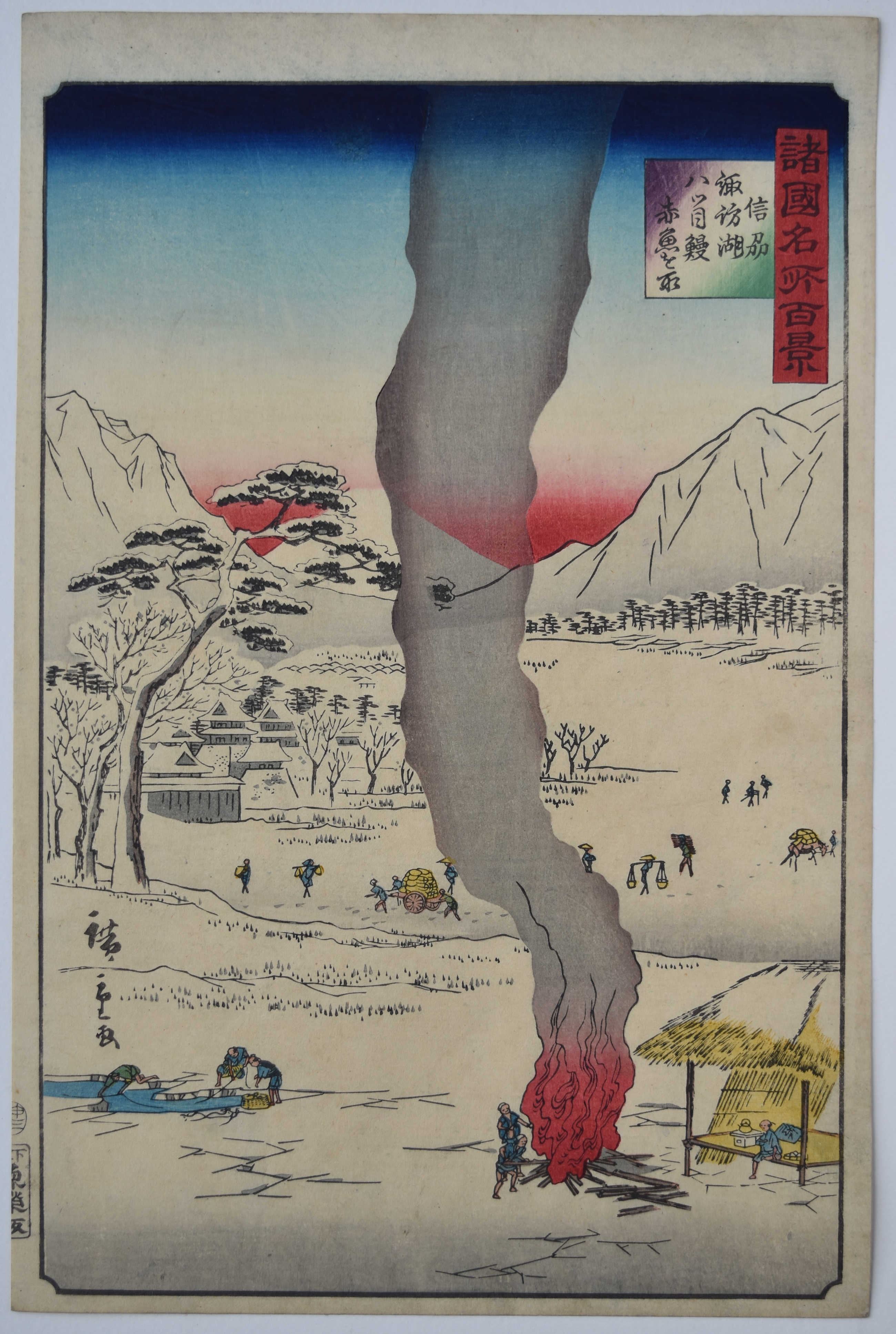
Shinshu Suwa-ko yatsume akauo wo to (ru). Shinshu (Shinano) Province from Shokoku meisho hyakkei, “Hundred Views of Famous Places in the Provinces.” An uncompleted set of 81 prints published by Uoya Eikichi between 1859-1861 (this being 1860). A winter scene showing figures catching lampreys, eels and red rockfish in Lake Suwa. The lake was unusual in having warm currents beneath the ice, even in mid winter.
Fine impression of first edition. Fine colour and condition. Signed Hiroshige ga.
Status: Sold
Utagawa KUNIYOSHI (1797-1861)
Click here to view image full size.
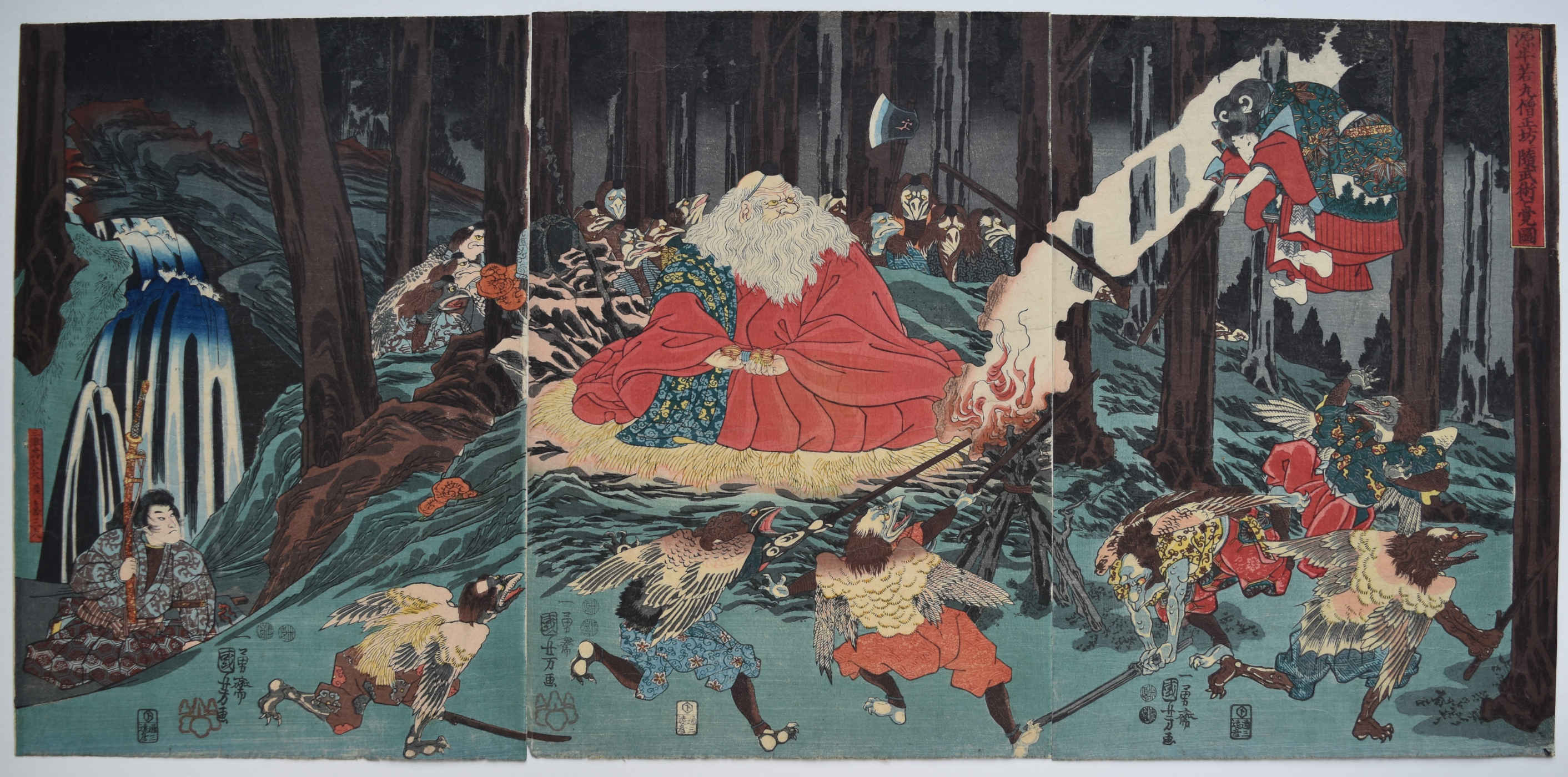
A triptych showing Ushiwaka Maru (Minamoto no Yoshitsune’s childhood name), attended by Kisanda, practising fencing with the karasu or “crow” tengu in a forest glade on Mt. Kurama, north of Kyoto. His training in martial arts is being supervised by a white-bearded yamabushi tengu, Sojobo, King of the Tengu. (The yamabushi were followers of Shugendo– a shamanistic mountain ascetism.) Yoshitsune (1159-1189) is the best known Japanese warrior and a popular subject for Japanese artists and craftsmen. Famous for exploits such as the battle on Gojo Bridge with Benkei and the battle of Dan-no-ura. Published by Enshuya Hikobei, 1851-2. Robinson T264.
Fine impression. This is the first state with gradation on the rocks top left. Fine colour. Very good condition. Signed Ichiyusai Kuniyoshi ga.
Status: Sold
Ichiryusai HIROSHIGE (1797-1858)
Click here to view image full size.
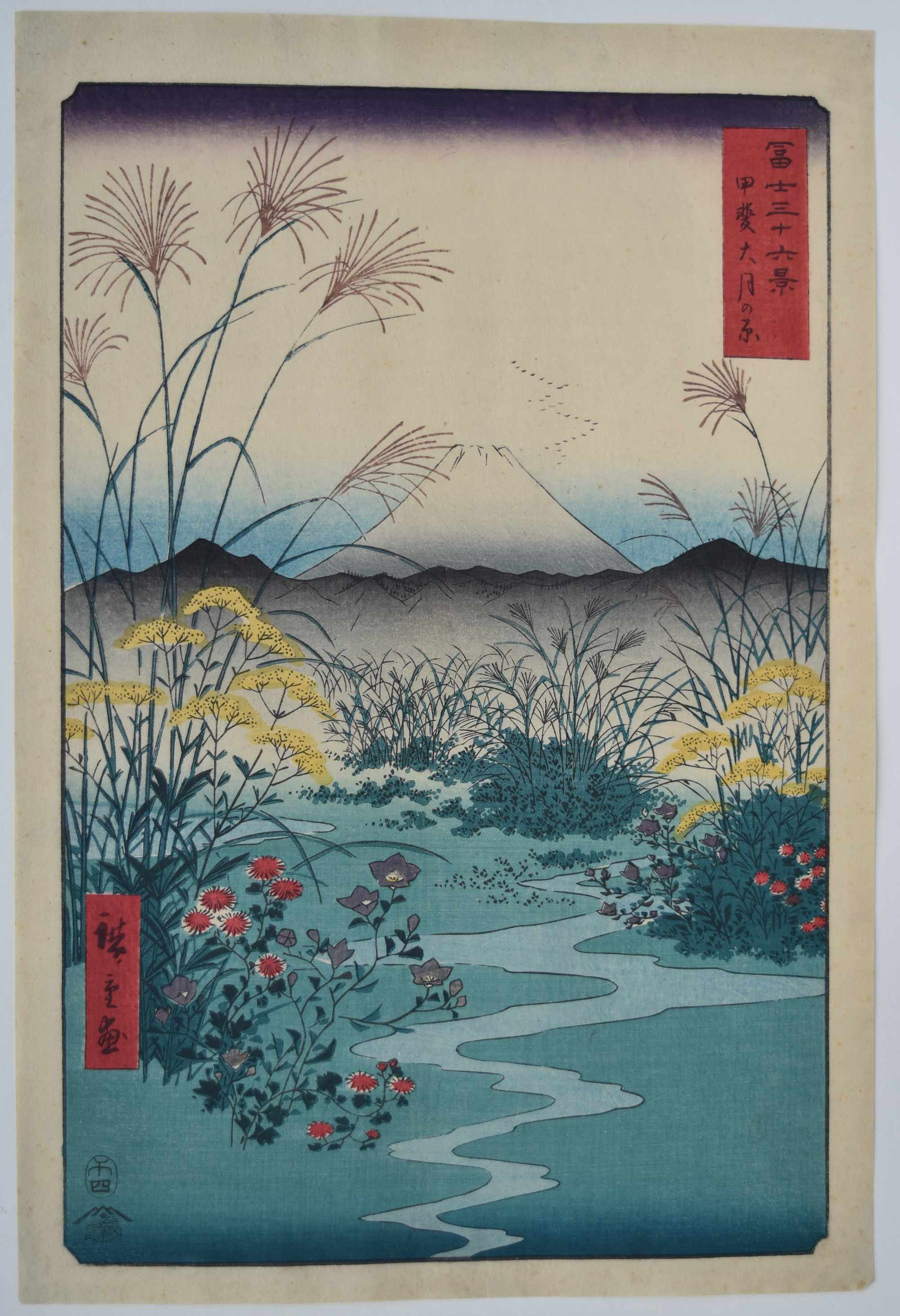
Kai Otsuki no hara, “Otsuki [“Great Moon”] Plain in Kai Province.” The most popular print from Fuji sanjurokkei, “The Thirty-six Views of Fuji.”Published by Tsutaya Kichizo, 4/1858. A distant view of Fuji with a stream meandering amongst wild flowers. Some of them are from the Seven Herbs (Nanakusa) of Autumn, being: pampas grass, susuki, yellow patrinia, ominaeshi, bellflowers, kikyo, and wild carnations, tokonatsu.
Fine impression, colour and condition. Signed Hiroshige ga.
Status: Sold
Ichiryusai HIROSHIGE (1797-1858)
Click here to view image full size.
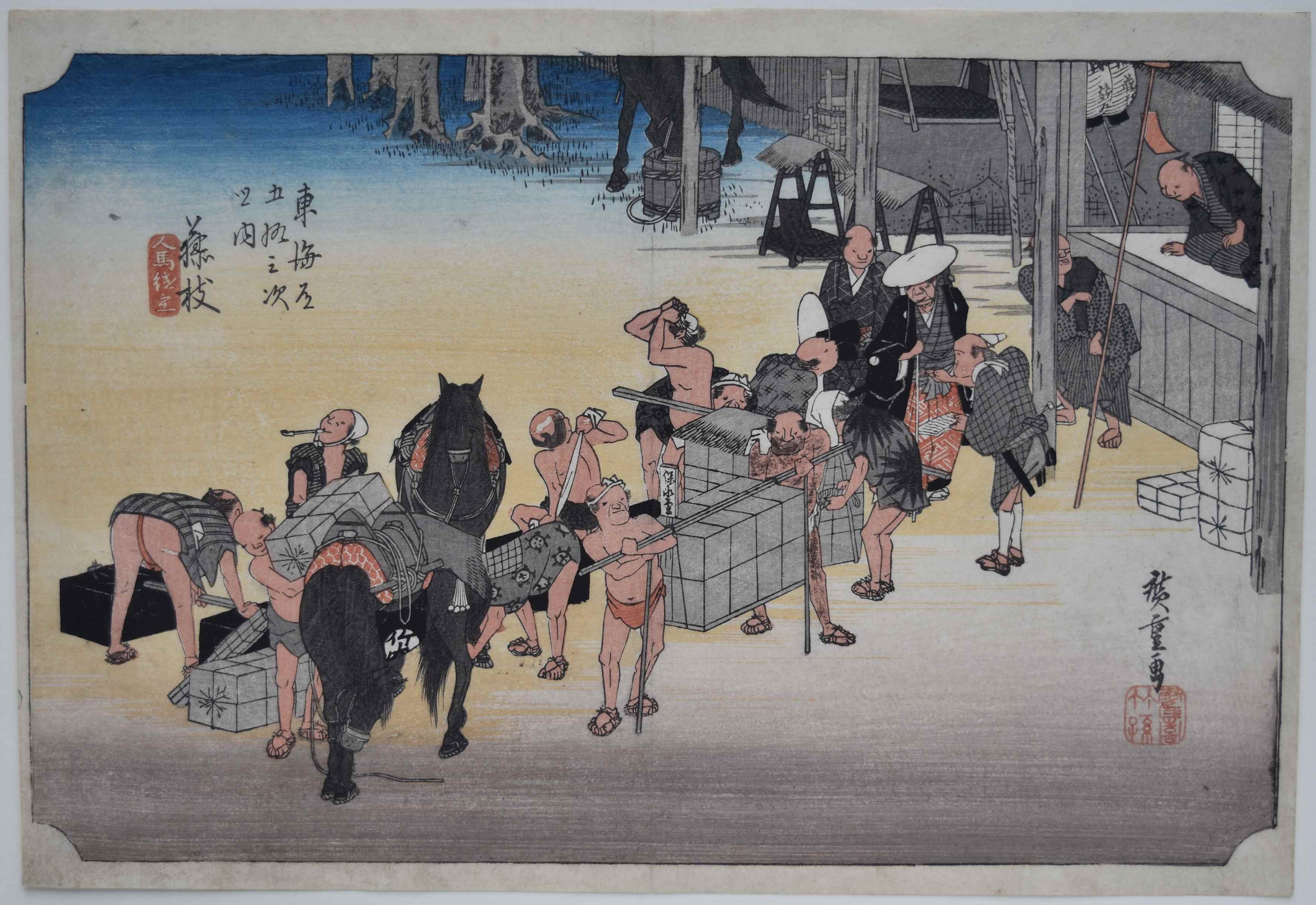
Fujieda from Tokaido gojusan tsugi, “The Fifty-three Stations of the Tokaido.” The set of fifty-five prints was published jointly by Hoeido and Senkakdo in 1834. Shows porters unpacking at the relay station. It was here that fresh horses could be obtained, luggage weighed, labour arranged, and payments made. Hiroshige’s most famous set that was reprinted many times.
Fine early impression: The porter just off-centre rubbing his back with a towel has a small area on his head that does not print on the earliest impressions, which was later corrected. Fine colour. Very slight centre fold, otherwise fine condition. Signed Hiroshige ga.
Status: Sold
Ichiryusai HIROSHIGE (1797-1858)
Click here to view image full size.
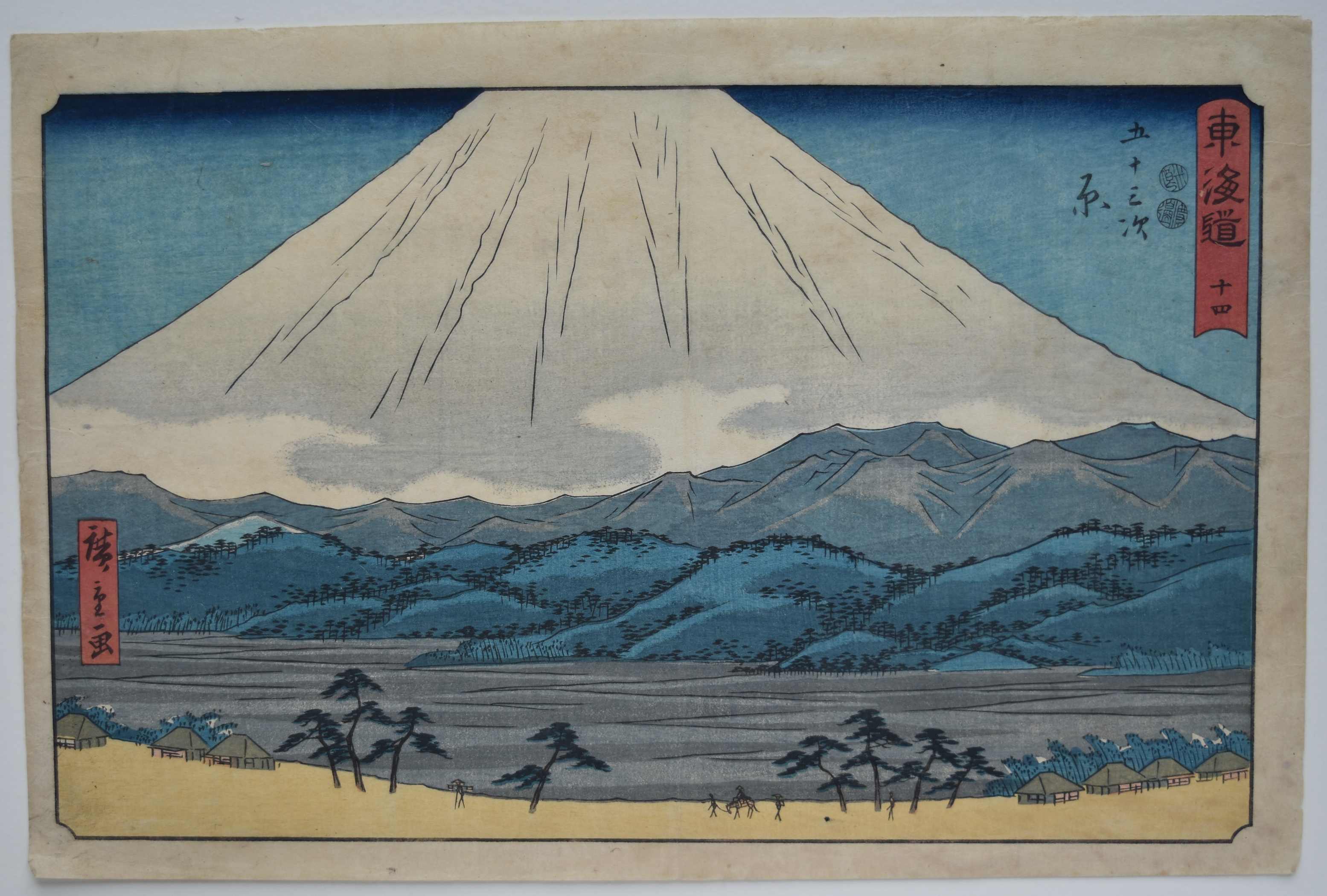
Hara from The Fifty-three Stations of the Tokaido published by Marusei, Maruya Seijiro, 1847-52. Called the Reisho Tokaido because of the angular style of Kanji used. Shows Fuji towering over the landscape with miniscule figures on the road at the bottom. One of the best designs from the set.
Fine impression and colour. Very slight centre fold, otherwise very good condition. Signed Hiroshige ga.
Status: Sold