Utagawa KUNIMARO (Active 1850-1875)
Click here to view image full size.
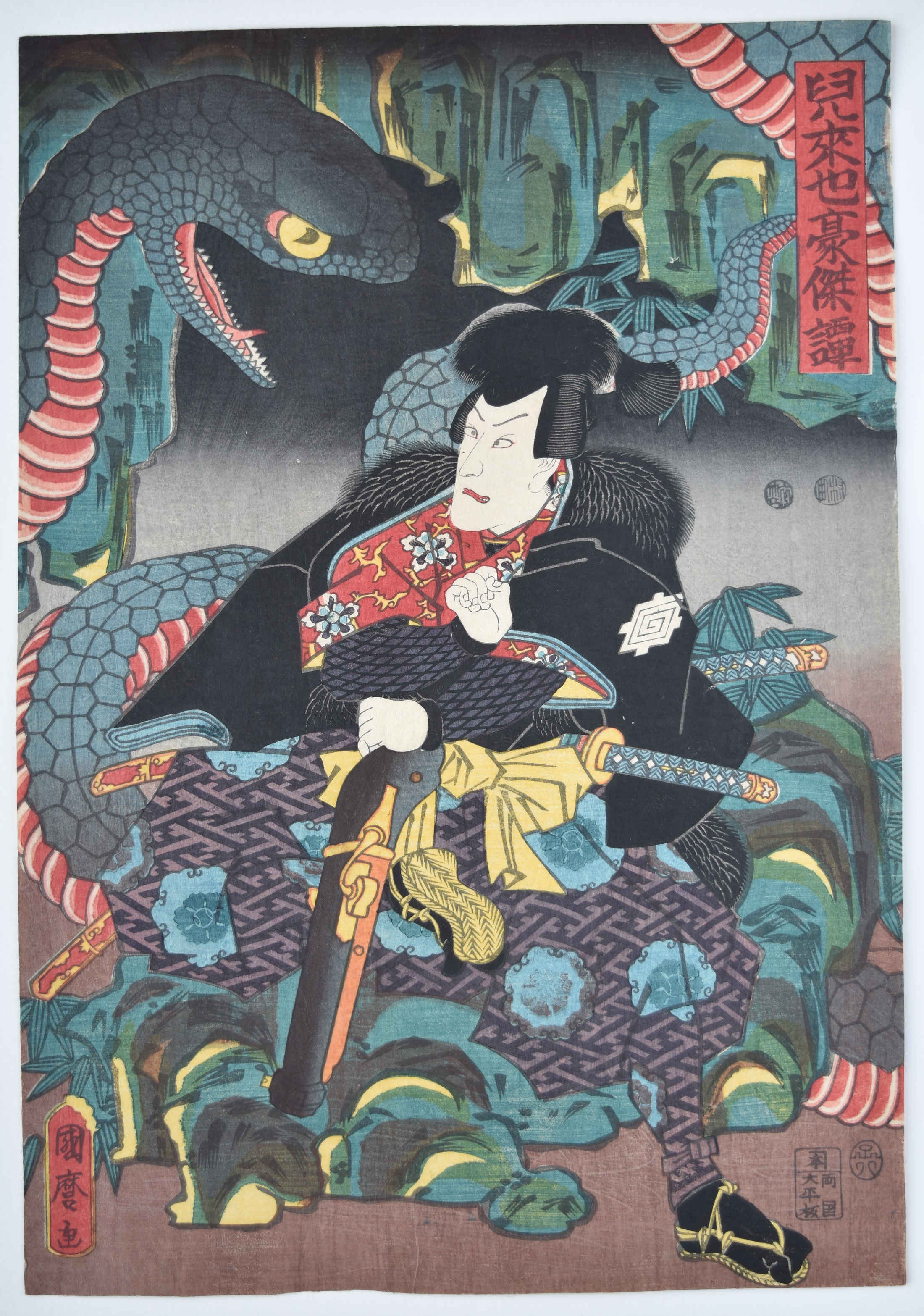
An oban showing Jiraiya (Ogata Shuma Hiroyuki), a ninja who was able to transmogrify himself into a giant toad. His arch enemy was Orochimaru, a master of serpent magic, who is seen here as a giant snake. Jiraiya kills the snake with his heavy o-zutsu, hand cannon. Based on a multi-volume book by Mizugakiya Egao, Jiraiya goketsu Monogatari, it went on to be a very successful Kabuki play performed at the Kawarazaki-za Theatre in 7/1852 with Ichikawa Danjuro VIII playing Jiraiya. Published by Daikokuya Heikichi, 8/1852.
Very fine impression. Fine colour. Slightly trimmed at bottom, otherwise very good condition. Signed Kunimaro ga.
Status: Sold
Utagawa YOSHITSUYA (1822-1866)
Click here to view image full size.
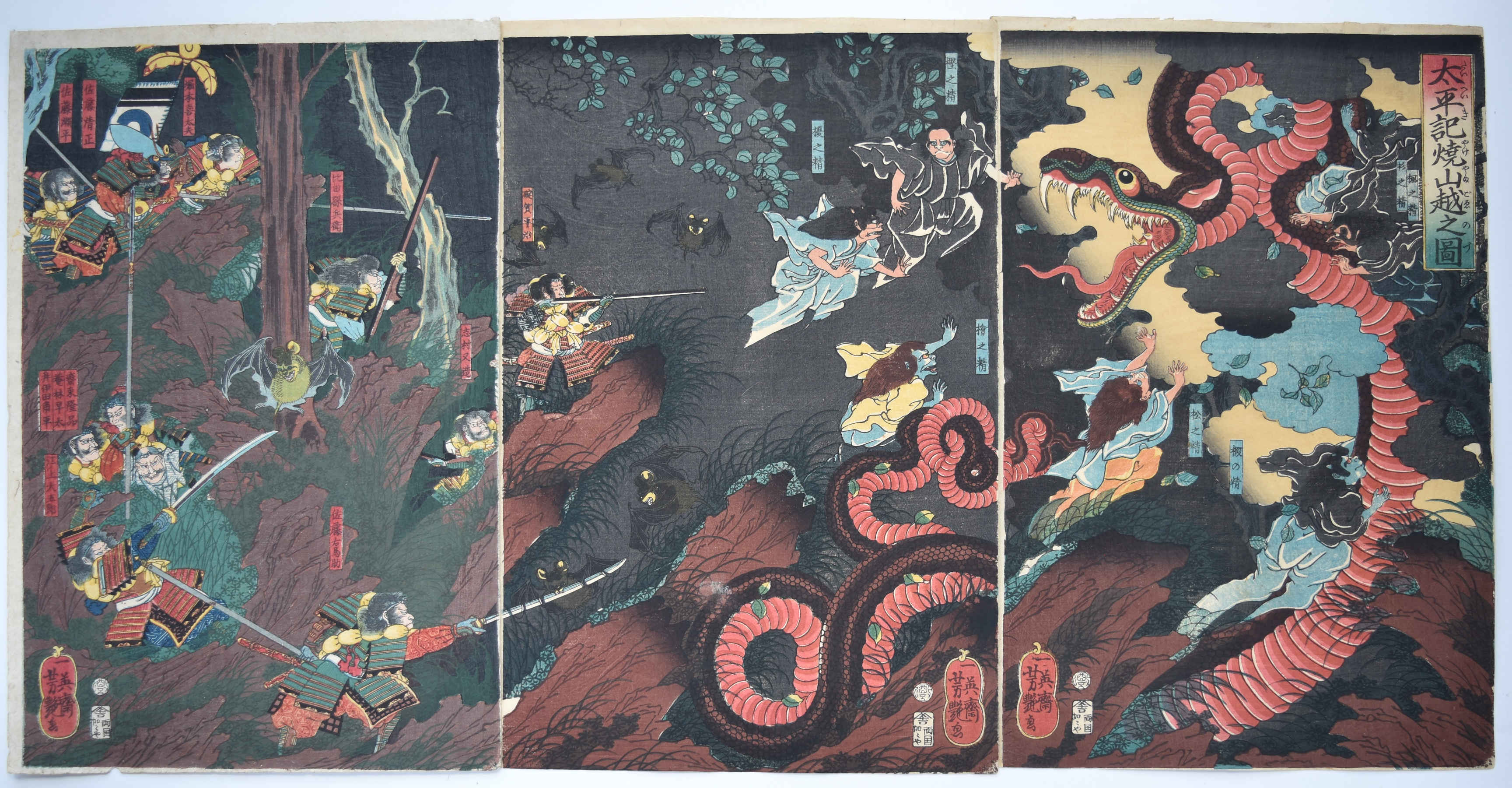
A triptych with title Taiheike Yakiyama-Goye no zue, “Picture of the Slope of Burning Mountain in the Taiheiki.” Shows the Japanese Daimyo Sato Masakiyo (Kato Kiyomasa), who was a leading general in Toyotomi Hideyoshi’s invasion of Korea, far left, and his men encountering a monstrous serpent surrounded by bats, tengu and flying goblins on a haunted mountain. Published by Kagaya Kichibei, 1861.
Fine impression, colour and condition. A lovely copy of this triptych. Signed Ichieisai Yoshitsuya ga.
Status: Sold
Utagawa YOSHIIKU (1833-1904)
Click here to view image full size.
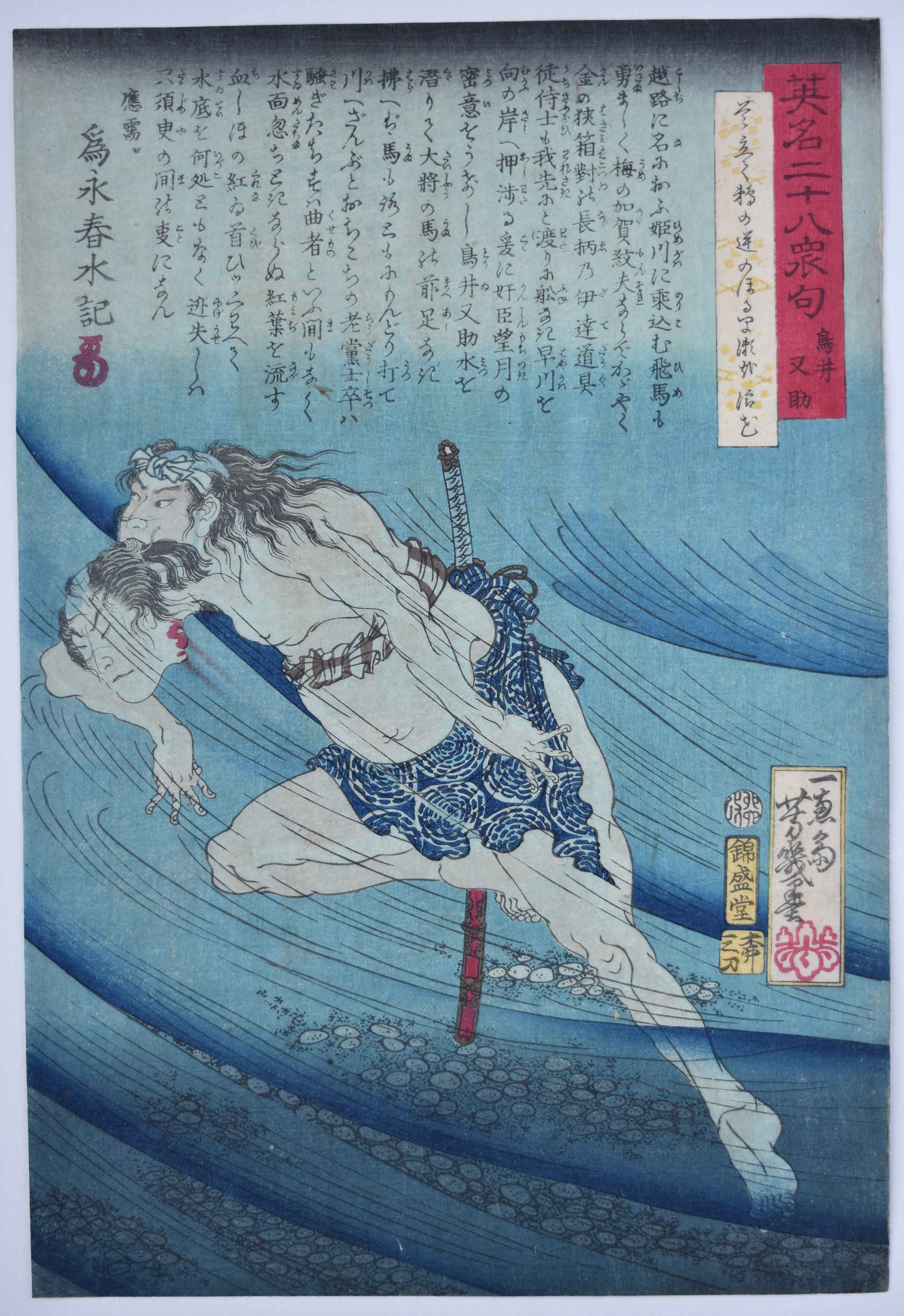
Torii Matasuke swimming underwater from a set of 28 prints Eimei nijuhasshuku, “Twenty-eight Murders with Verses.” The set was published jointly with Yoshitoshi, each contributing 14 prints. Matasuke is seen gripping the topknot of the severed head of his lord whom he has mistakenly murdered. Published by Kinseido between 1866-1869, this being 1867.
Very good impression, colour and condition. Signed Ikkeisai Yoshiiku ga.
Status: Sold
Tsukioka YOSHITOSHI (1839-1892)
Click here to view image full size.
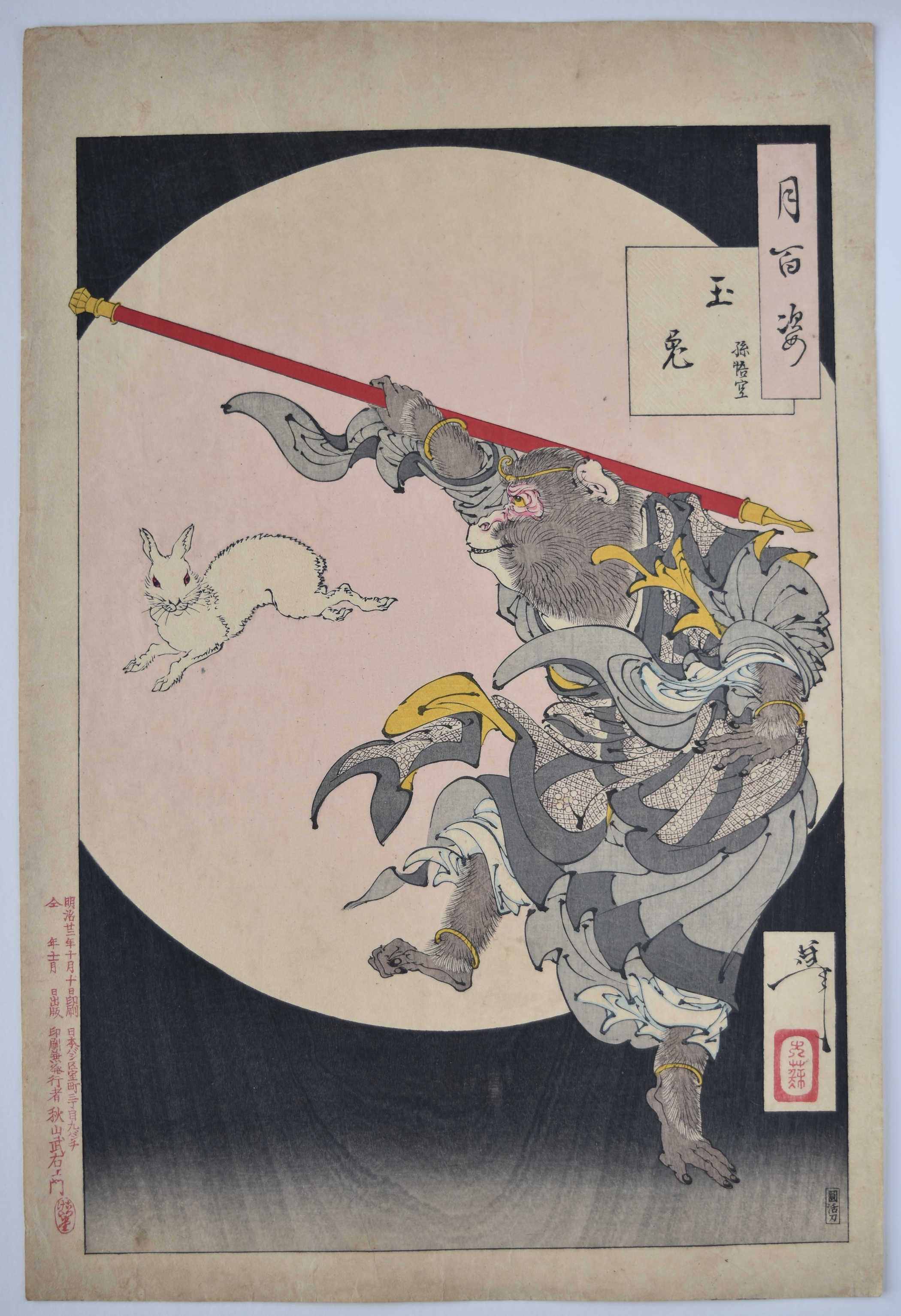
The Monkey King: One of the best designs from the set Tsuki hyakushi, the “Hundred Phases of the Moon.” The set published between 1885 and 1892 (this being 1886) by Akiyama Buemon. Based on the Chinese fable, the Monkey King achieved immortality by stealing peaches from the Garden of Immortal Peaches. He is seen with his fighting stave and the Jade Hare that lived on the moon and was constantly pounding herbs for immortals.
Fine impression from a very early edition. The set was popular and many editions were printed and many late impressions exist. . Great care was taken with the cutting of the blocks on this set and only early impressions do them justice. Fine colour and condition. An impression that has not been in an album. Full margins. Signed Yoshitoshi.
Status: Sold
Ichieisai YOSHITSUYA (Active mid 19th century)
Click here to view image full size.
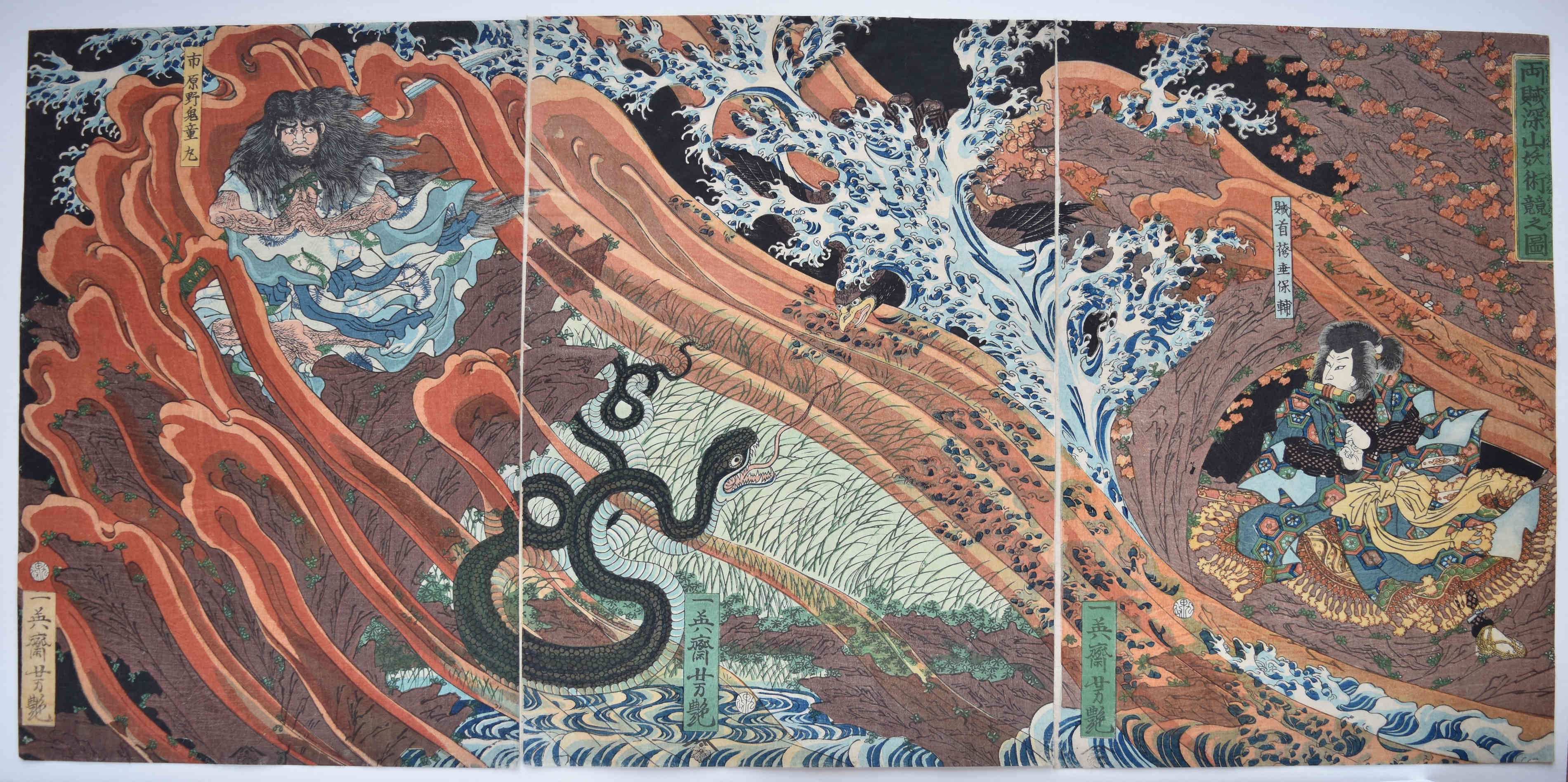
A triptych with title: Ryozoku shinzan yojutsu kurabe no zu, “A Picture of the Two Enemies in a Witchcraft Match in the Deep Mountain.” Shows Hakamadare Yasusuke and Kidomaru fighting with magic. Yoshitoshi designed a vertical diptych of the same subject in 1887. Published 1860 by Tsutaya Kichizo. A wonderful design.
Very good impression and colour. Slight trimming and minor corner defects, otherwise very good condition. Signed Ichieisai Yoshitsuya.
Status: Sold
Utagawa KUNIYOSHI (1797-1861)
Click here to view image full size.
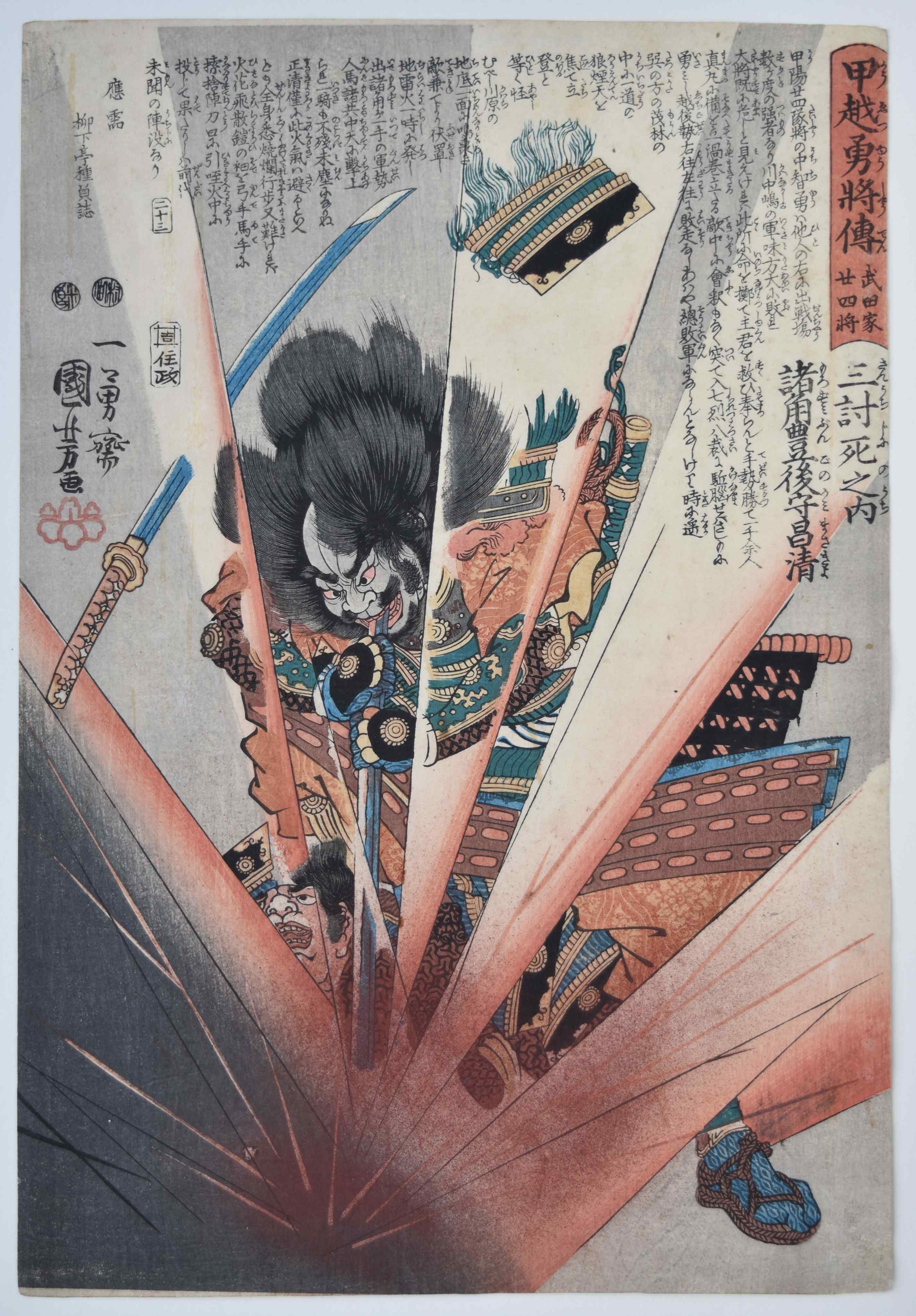
The general Morozumi Masakiyo, Lord of Bungo and a retainer of the Takeda Clan (Shingen of Kai Province) in a battle with the Uesugi Clan (Kenshin of Echigo Province), the wars taking place between 1553 and 1563. From a set Koetsu yusho den, “Stories of Courageous Generals of the Provinces of Echigo and Kai.” Masakiyo is shown committing suicide by inserting his sword into his mouth while being blown up by a land-mine. As with so much in Japan, the land-mine originated in China from early times. Published by Sumiyoshiya Masagoro, c. 1848-9. One of the “three great deaths” of these wars. A fine design.
Fine impression and colour with extensive sprayed pigment around the exploding mine. Trimmed slightly on the right, otherwise very good condition. Signed Ichiyusai Kuniyoshi ga.
Status: Sold
Tsukioka YOSHITOSHI (1839-1892)
Click here to view image full size.
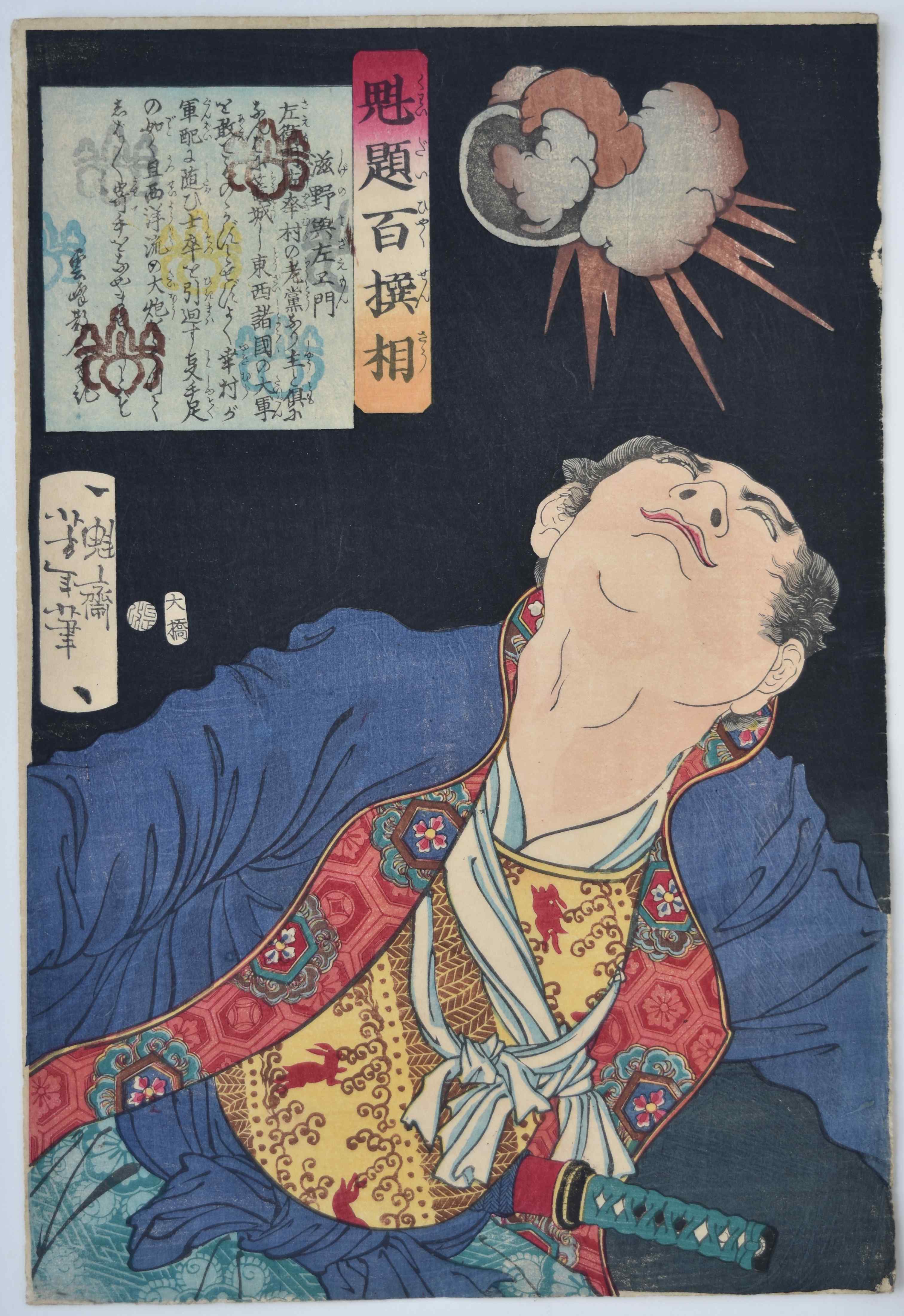
The samurai Shigeno Yozaemon looking up at an exploding houroku-hiya “hand grenade.” (As with so much in Japan, the grenade originated in China from early times.) From a set Kaidai hyaku, “Yoshitoshi’s Selection of One Hundred Warriors.” Sixty-five prints published by Ohashiya Yashichi between 1868 and 1869, this being 1869. The text in the square cartouches in this set refer to prominent warriors in the internecine wars of the 16th century but in fact the subjects are Shogitai soldiers. (Those that held out against the imperial forces and were massacred at Ueno, 4/7/1868.) An excellent set.
Fine impression, colour and condition. Signed Ikkaisai Yoshitoshi htsu.
Status: Sold
Tsukioka YOSHITOSHI (1839-1892)
Click here to view image full size.
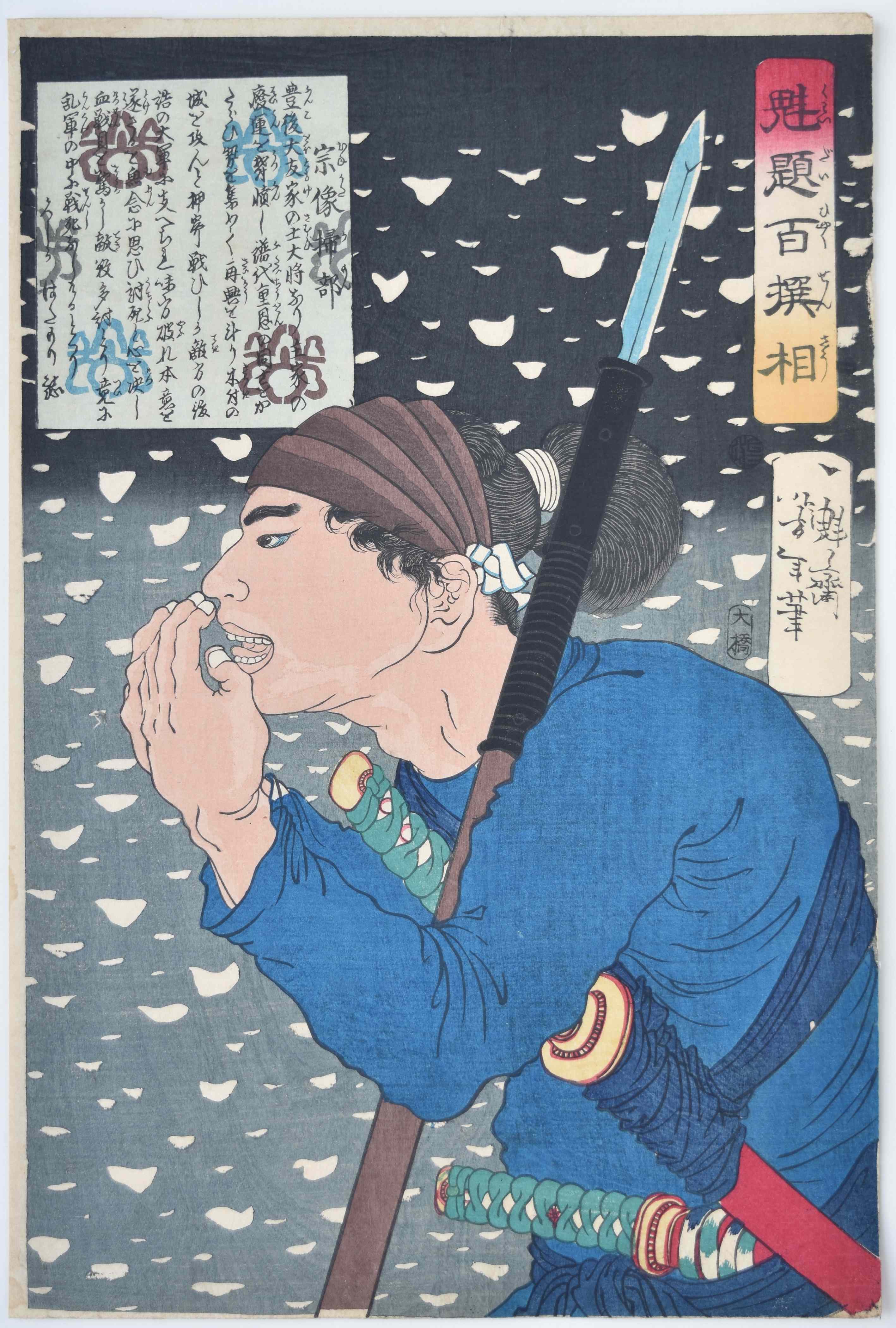
Shigetsugu Munakata Kamon warming his hands in a snowstorm: Large flakes float down. From a set Kaidai hyaku, “Yoshitoshi’s Selection of One Hundred Warriors.” Sixty-five prints published by Ohashiya Yashichi between 1868 and 1869, this being 1869. The text in the square cartouches in this set refer to prominent warriors in the internecine wars of the 16th century but in fact the subjects are Shogitai soldiers. (Those that held out against the imperial forces and were massacred at Ueno, 4/7/1868.) An excellent set.
Fine impression, colour and condition. Signed Ikkaisai Yoshitoshi htsu.
Status: Sold
Tsukioka YOSHITOSHI (1839-1892)
Click here to view image full size.
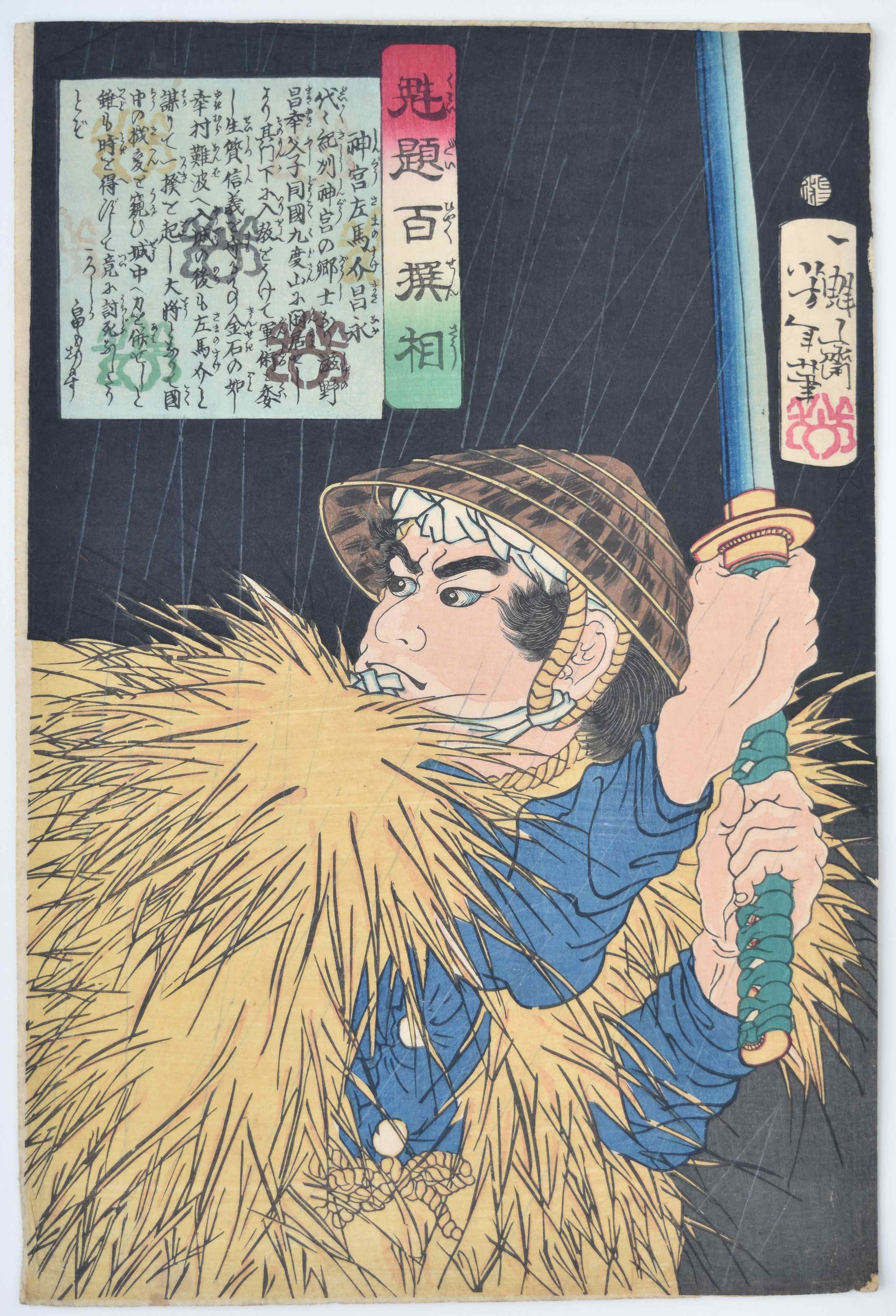
The warrior Jingu Samanosuke Masanaga holding a sword and wearing a mino (straw cape) in heavy rain. From a set Kaidai hyaku, “Yoshitoshi’s Selection of One Hundred Warriors.” Sixty-five prints published by Ohashiya Yashichi between 1868 and 1869, this being 1869. The text in the square cartouches in this set refer to prominent warriors in the internecine wars of the 16th century but in fact the subjects are Shogitai soldiers. (Those that held out against the imperial forces and were massacred at Ueno, 4/7/1868.) An excellent set.
Fine impression and colour. The rain printed in silver. Fine condition. Signed Ikkaisai Yoshitoshi htsu.
Status: Sold
Tsukioka YOSHITOSHI (1839-1892)
Click here to view image full size.
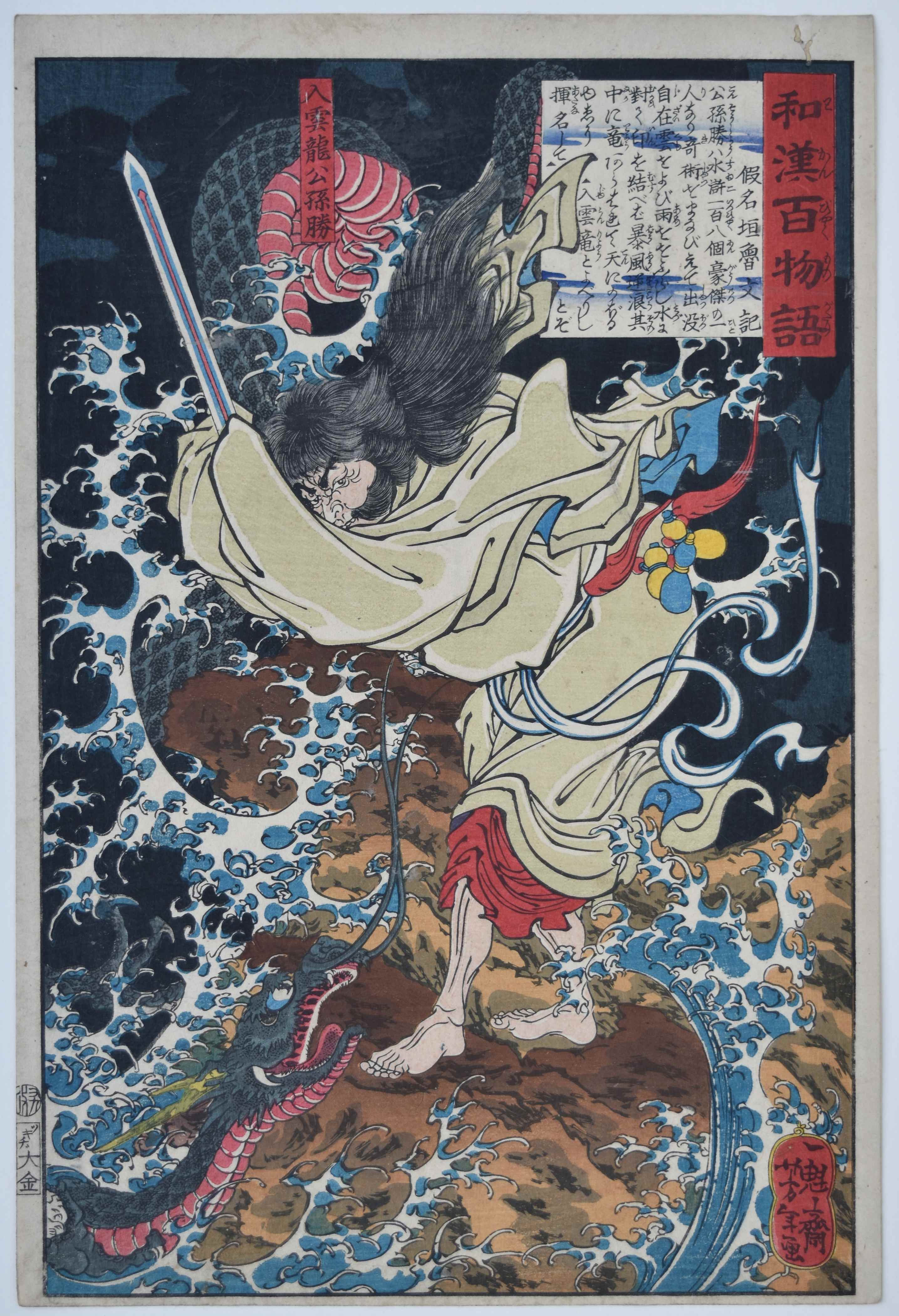
Shows Kon Sosho (Chin. Gongsun Sheng), a famous character from the Chinese popular novel Tales of the Water Margin (Jap. Suikoden). A Taoist sorcerer known as “Dragon in the Clouds” he was able to conjure up wind and rain, as here, where he is seen standing on a rocky promontory summoning up the Storm Dragon from the sea. From the set Wakan hyaku monogatari, “One Hundred Ghost Stories of China and Japan,” published by Daikin, 1865.
Fine impression and colour. Small backed wormhole in top right corner and has original album backing, otherwise very good condition. Signed Ikkaisai Yoshitoshi ga.
Status: Sold
Utagawa KUNISADA (1786-1865)
Click here to view image full size.
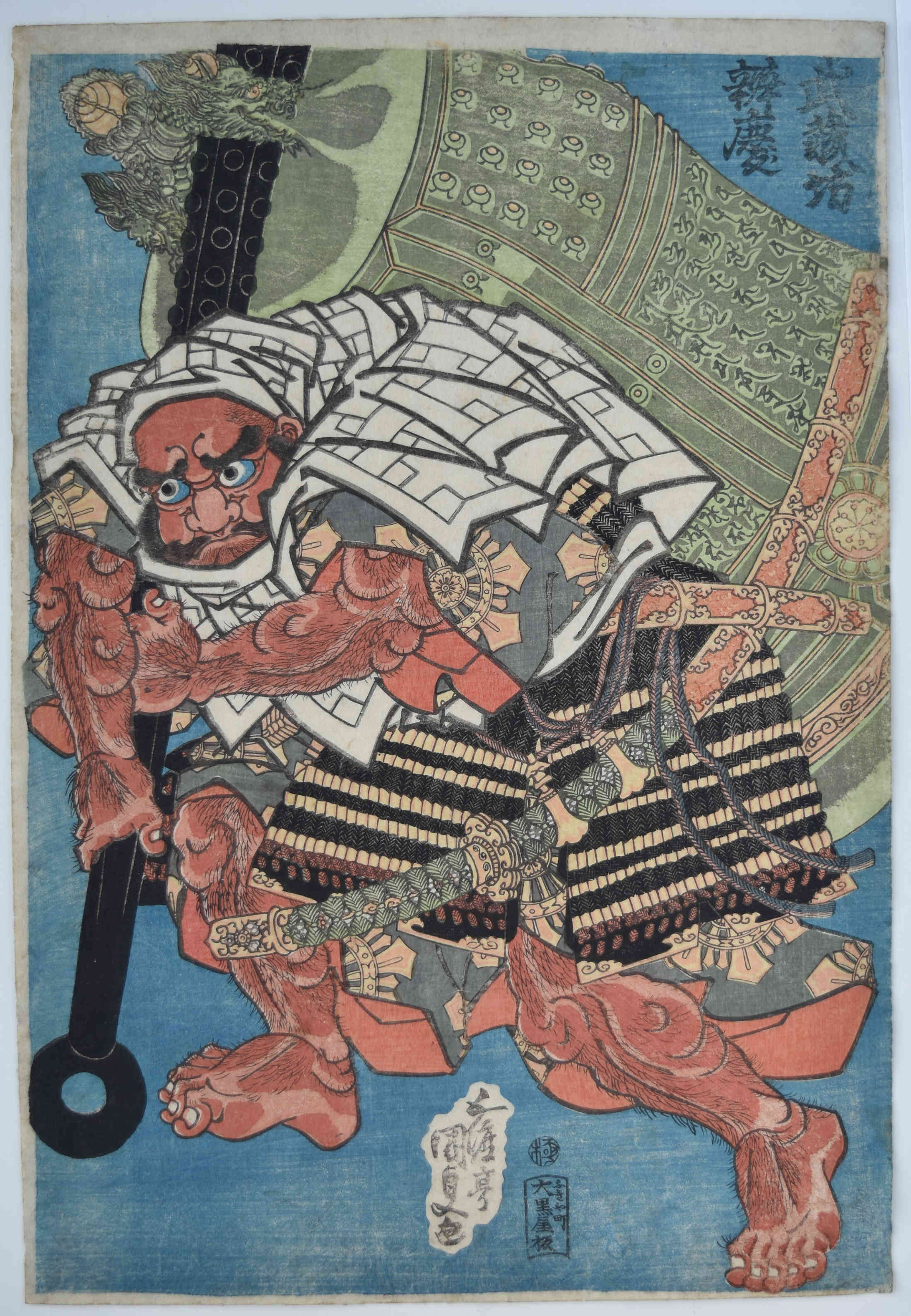
Shows Musashibo Benkei carrying the stolen giant Mii Temple bell up Mount Hiei to the Enryaku-ji, the Tendai-sect temple of the San-mon, “Mountain Order.” He is usually depicted dragging the half-ton bell, but here he is shown carrying it with the help of his kanabo, iron war club. Published by Daikokuya, c 1830-39. Another impression is in the British Museum, 1906,1220,0,1054. Rare.
Very good impression, colour and condition. Signed Gototei Kunisada ga.
Status: Sold
Katsukawa SHUN’EI (1762-1819)
Click here to view image full size.
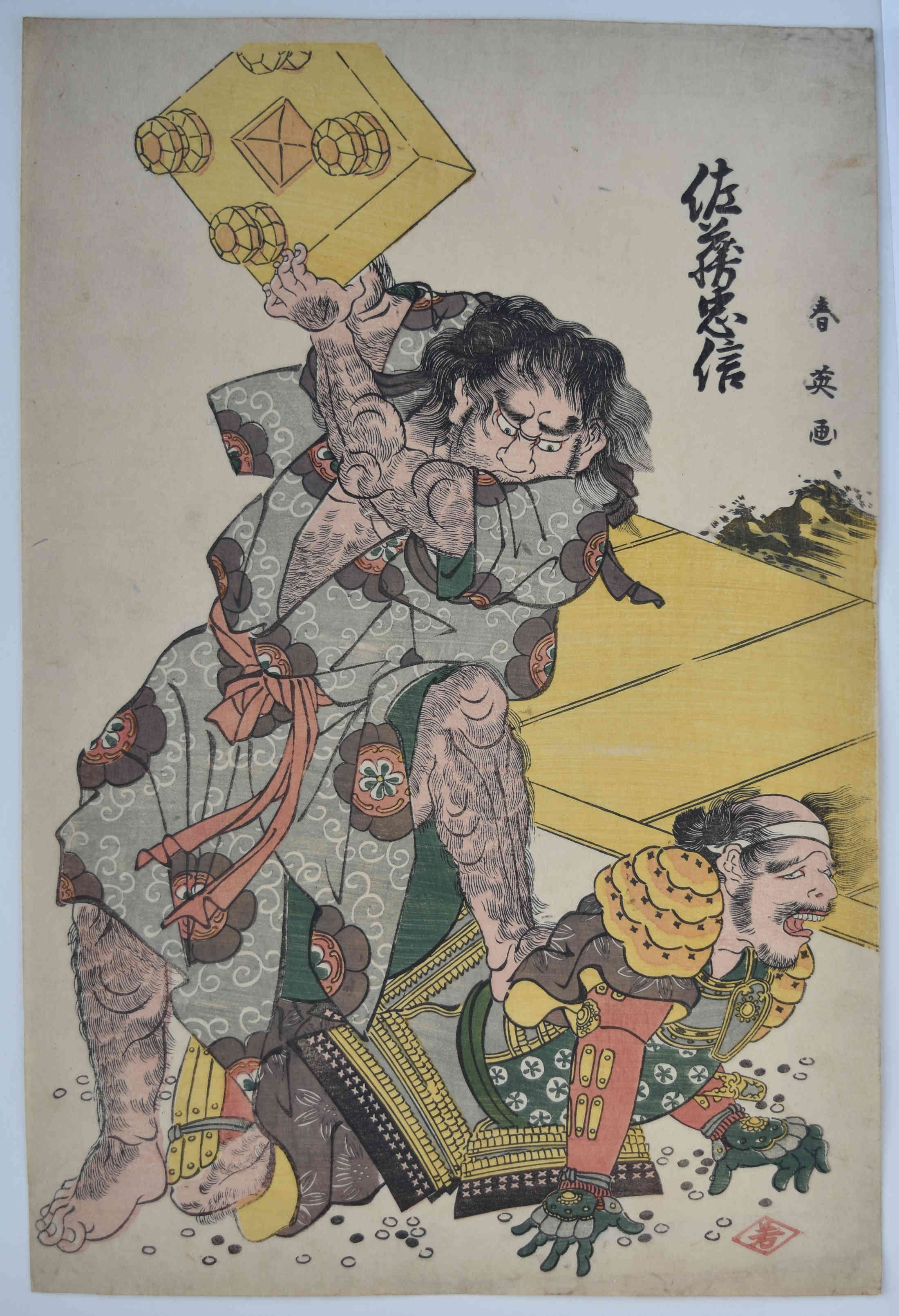
Shows the hirsute samurai Saito Tadanobu about to strike an adversary with a go board. This was a popular story relating to his death: He was attacked while playing go and used the heavy board to fight off his enemies. Published by Wakasaya Yoichi (Jakurindo), c 1810. Rare.
Fine impression, colour and condition. Signed Shun’ei ga.
Status: Sold
Kawanabe KYOSAI (1831-1889)
Click here to view image full size.
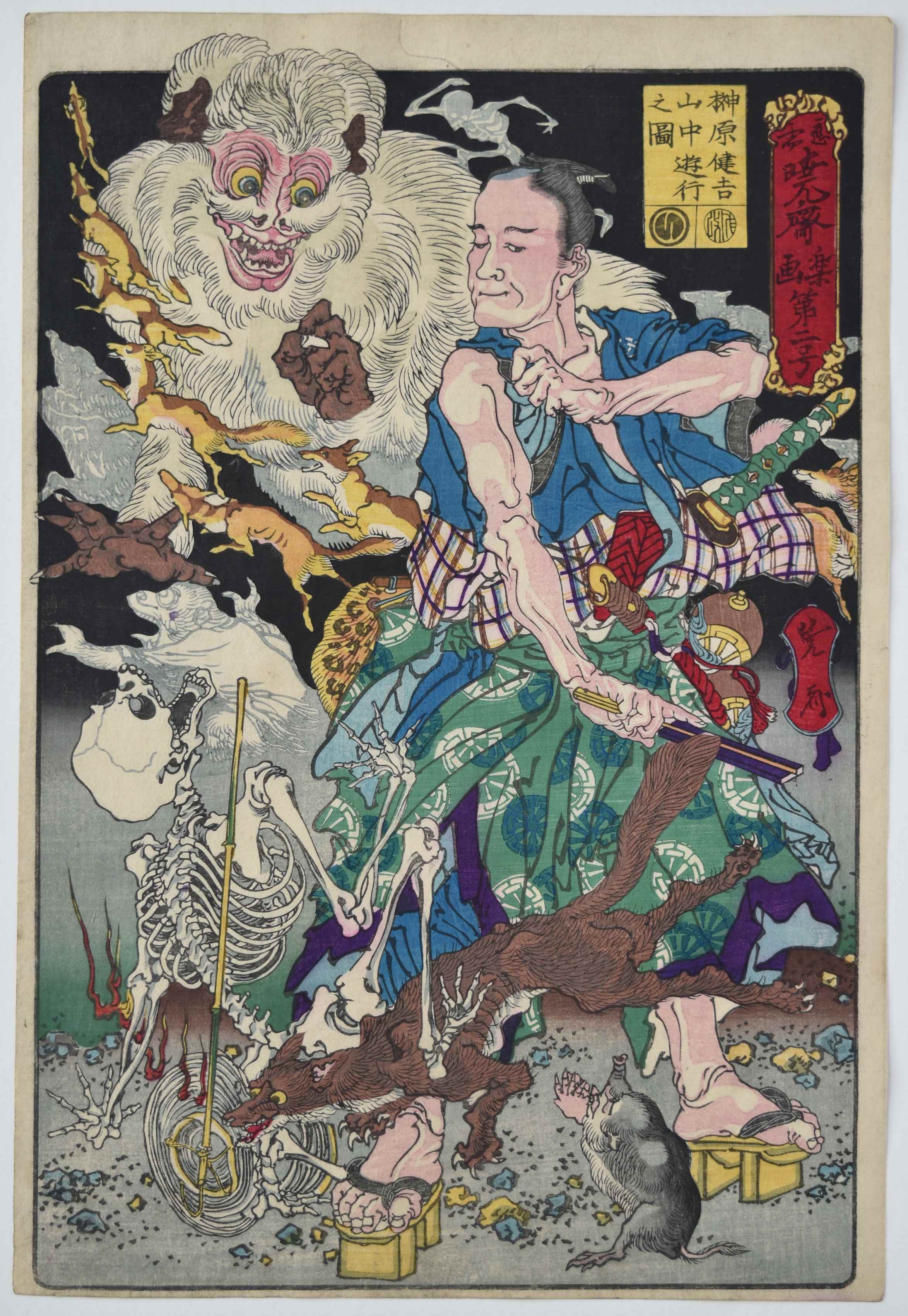
Shows the professional swordsman Kaibara Kenkichi travelling in the mountains from a set Kyosai rakuga, “Kyosai’s Drawings for Pleasure.” A satirical take on current events and mores. Generally considered the father of kendo. At the age of 13 he came under the tutelage of Seiichiro Odani to learn the art of swordplay and master its secrets. Became assistant instructor at the Kobusho in 1856. Famous for inventing the yamatozue, a wooden sword, and the ganko ogi, a wooden fan substitute for the wakizashi (short sword) when the decrees abolishing the wearing of swords in public was issued in 1876. Here he is surrounded by wild beasts and a skeleton. Published by Sawamuraya Seikichi in 1874. A set of 15 prints was planned but only 12 are known.
Very fine impression. Fine colour and condition. Signed Kyosai.
Status: Sold
Tsukioka YOSHITOSHI (1839-1892)
Click here to view image full size.
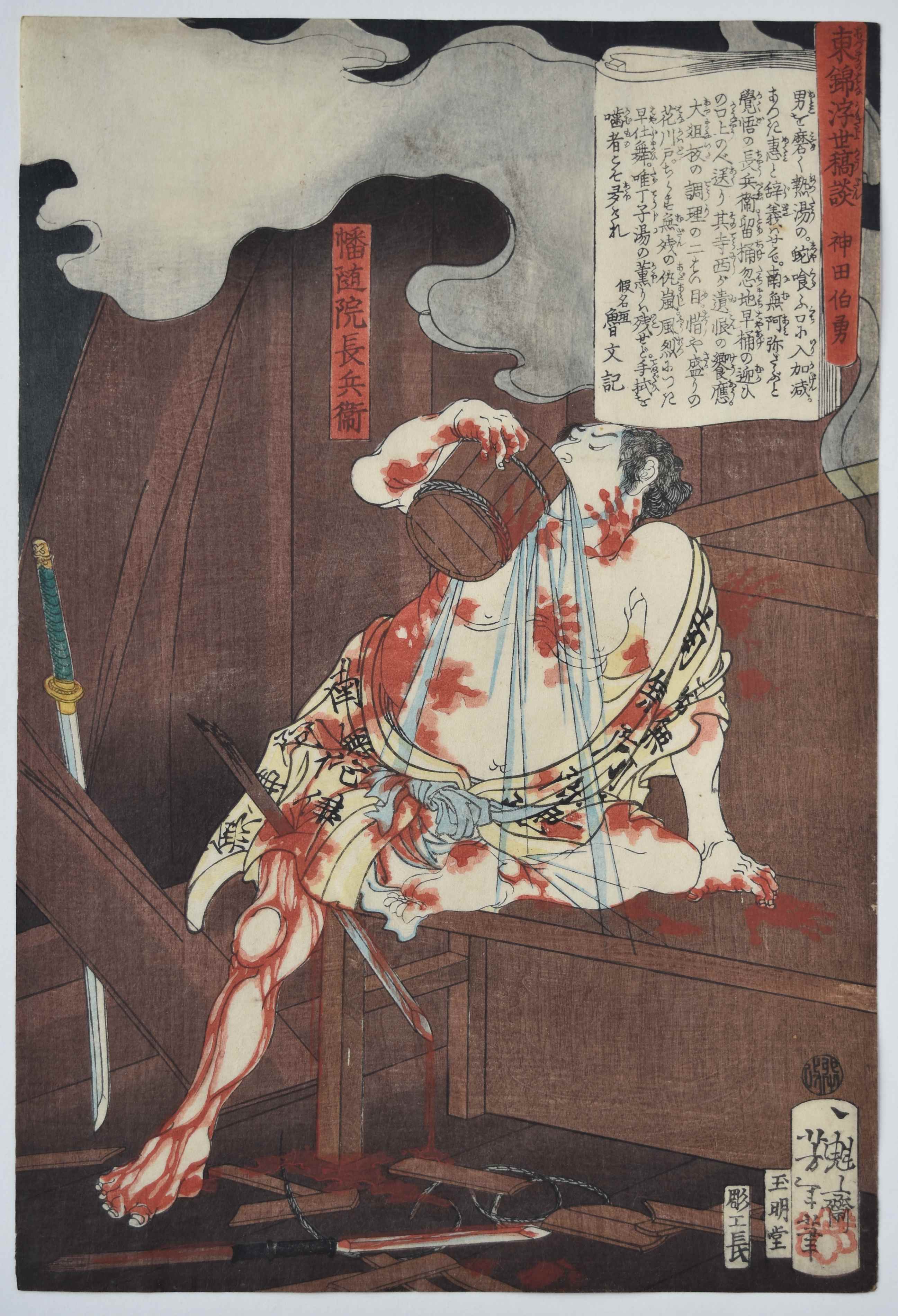
A design from the set Azuma no nishiki ukiyo kodan, “Tales of the Floating World on Eastern Brocade.” Kodan (traditional storytelling) raconteurs narrated Japanese folk stories, sometimes accompanying themselves with wooden blocks clapped together or a fan giving rhythm. The Kodan text is shown above. Having been popular from around 1700 (and known as Koshaku), these performances gained renewed popularity in the 1850s with the classic standards augmented by contemporary stories of heroes and villains. Here, the wounded and blood-smeared chief of the Edo otokodate, Banzuin Chobei, is seen drinking water in a bathhouse where he is treacherously murdered by Mizuno Jurozaemon. Various publishers from 1867-68, here Sekiguchi Gyokumeido, 10/1867.
Fine impression. Very good colour. Slight trimming, otherwise very good condtion. Signed Ikkaisai Yoshitoshi hitsu.
Status: Sold
Taiso YOSHITOSHI (1839-1892)
Click here to view image full size.
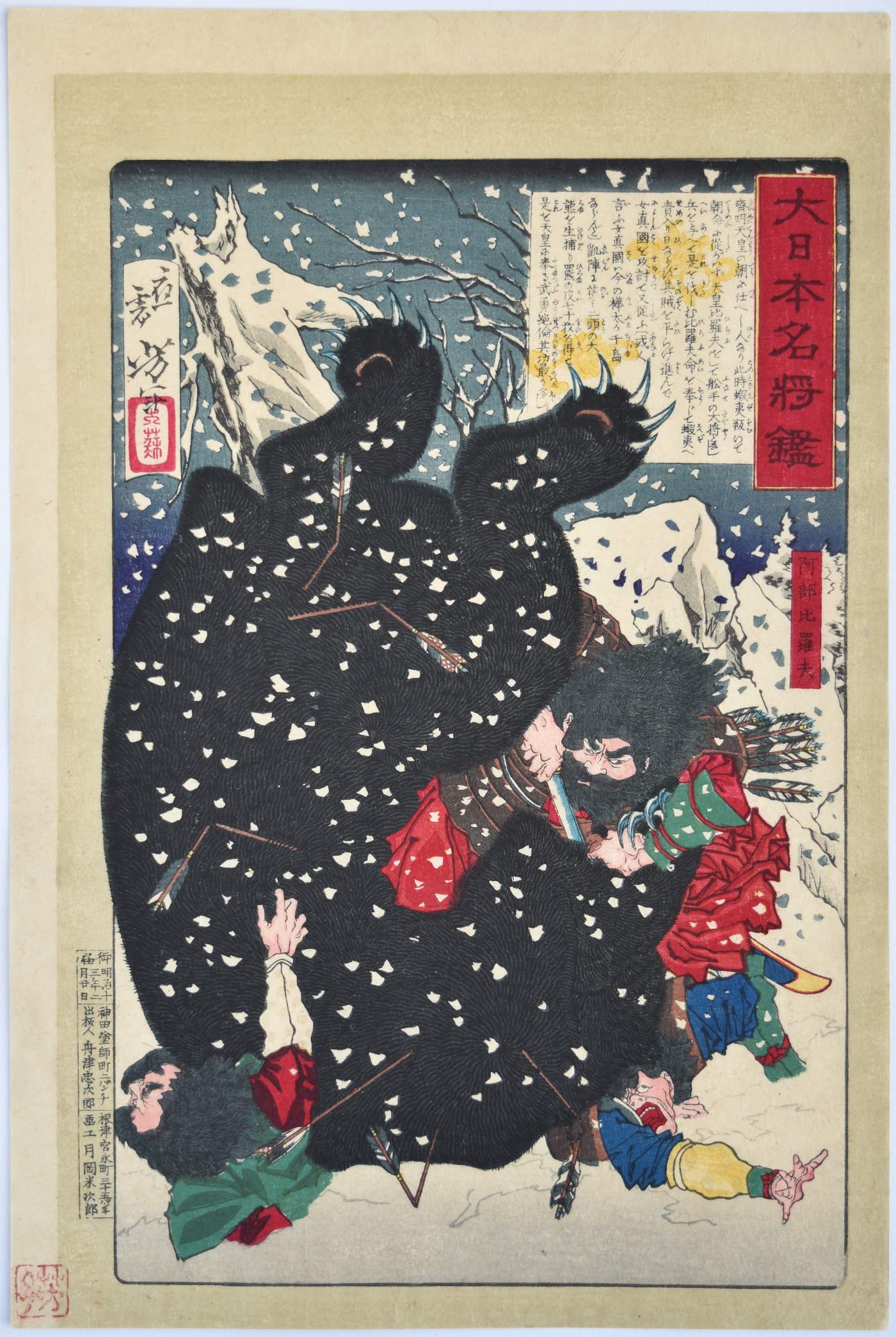
Shows Abe no Hirafu, a governor of Koshi, killing a giant bear in heavy snow. From a set: Dai Nippon meisho kagami, “Mirror of Famous Leaders of Great Japan.” Published by Funazu Chujiro, 1880.
Fine impression, colour and condition. Signed Oju Yoshitoshi hitsu.
Status: Sold
Ichiryusai HIROSHIGE (1797-1858)
Click here to view image full size.
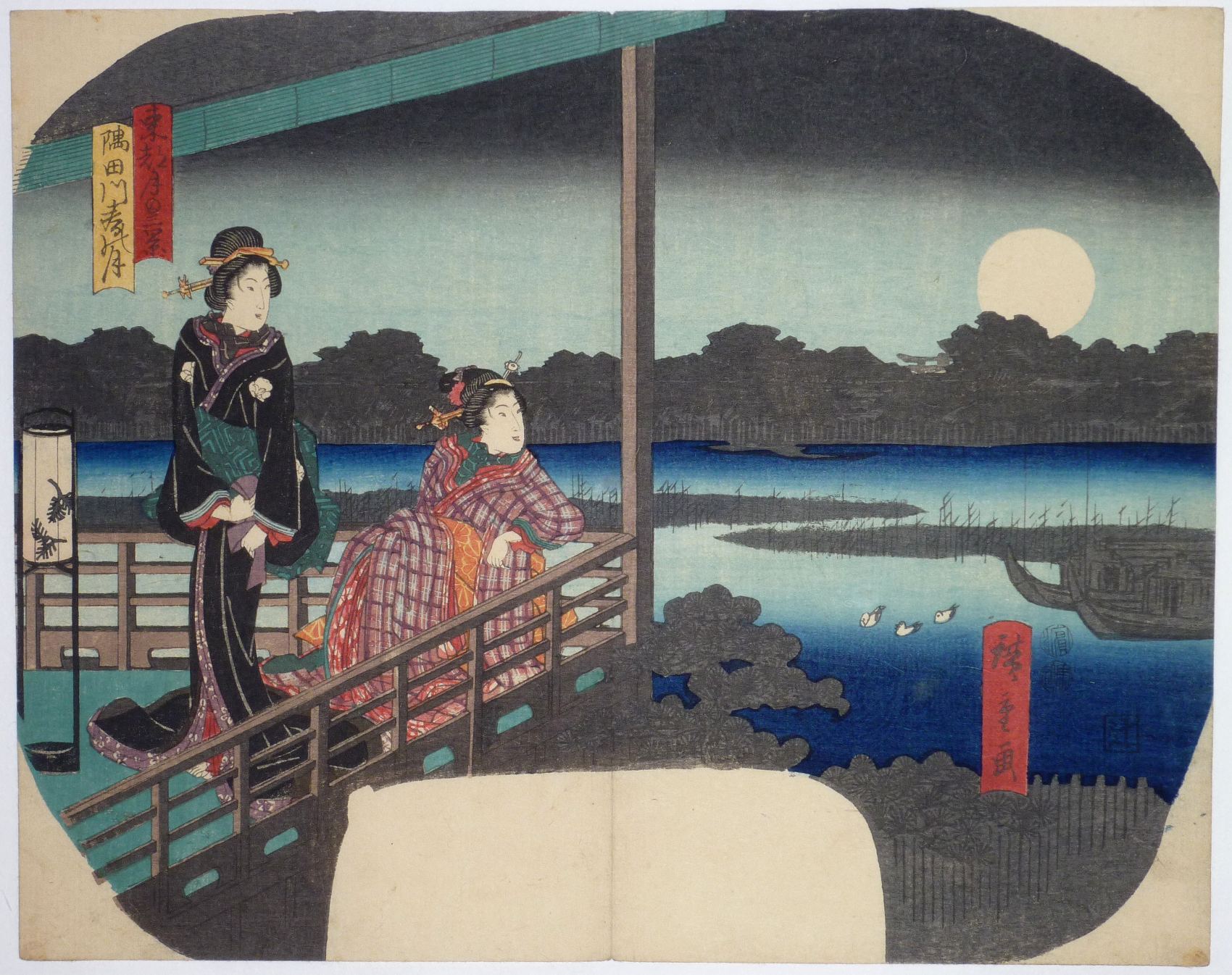
An extremely rare uncut fan print: Spring Moon from a set Three Views of the Moon in the Eastern Capital. Shows two beauties on a restaurant veranda admiring a full moon. The other two designs from this set are illustrated in Hiroshige no uchiwae, Hiroshige Fan Prints, Okuda, Atsuko, Unsodo, 2010, nos 29 and 30, p 28 and 29. Published by Tsujiya Yasubei, c 1849-52. If not unique, then certainly one of the few impressions extant.
Very fine impression and colour. Very slight centre fold, otherwise fine condition. Signed Hiroshige ga.
Status: Sold
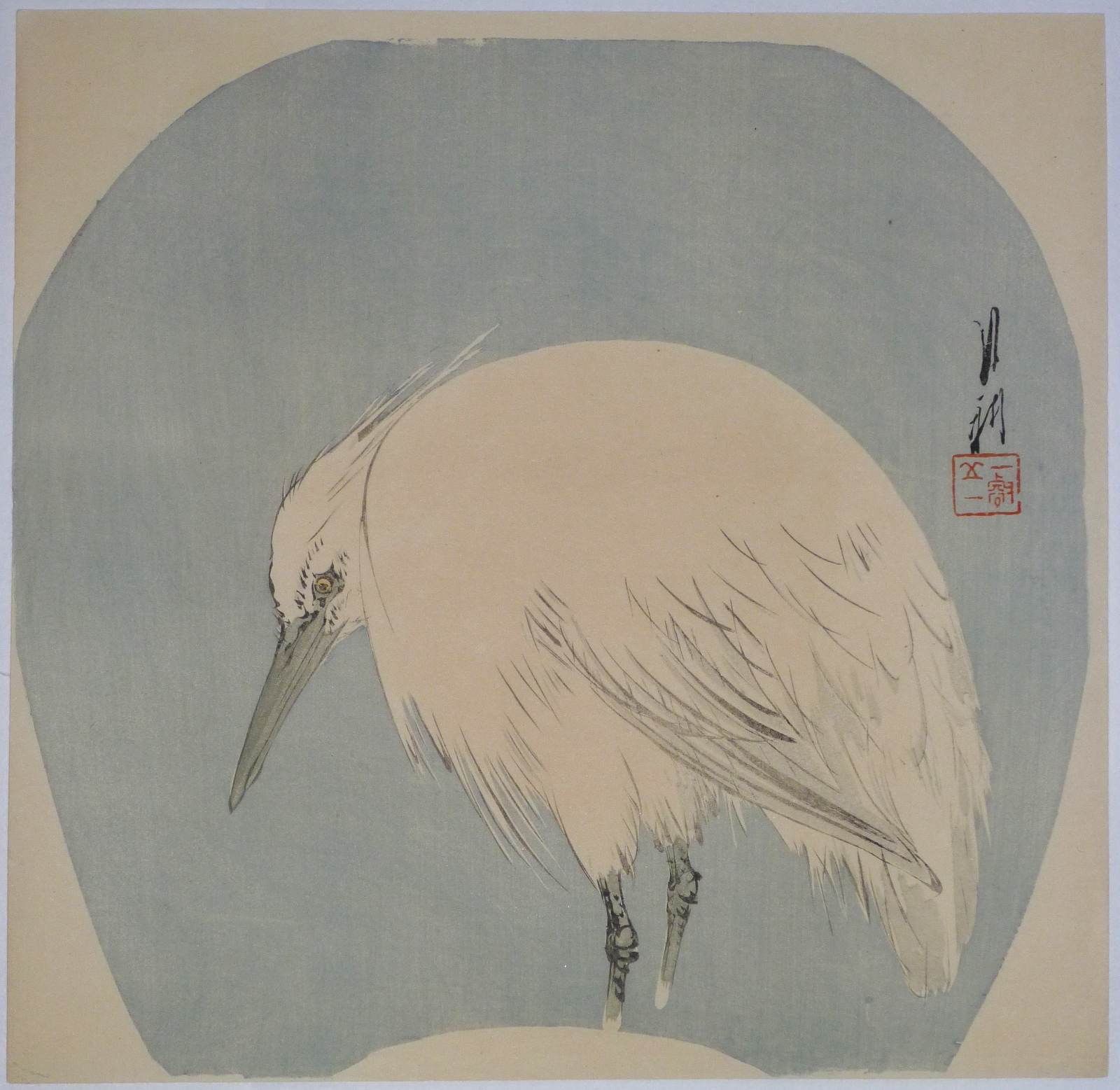
Ogata GEKKO (1859-1920)
Click here to view image full size.
An uncut fan print showing a great white egret. Rare.
Fine impression, colour and condition. Signed Gekko.
Status: Sold
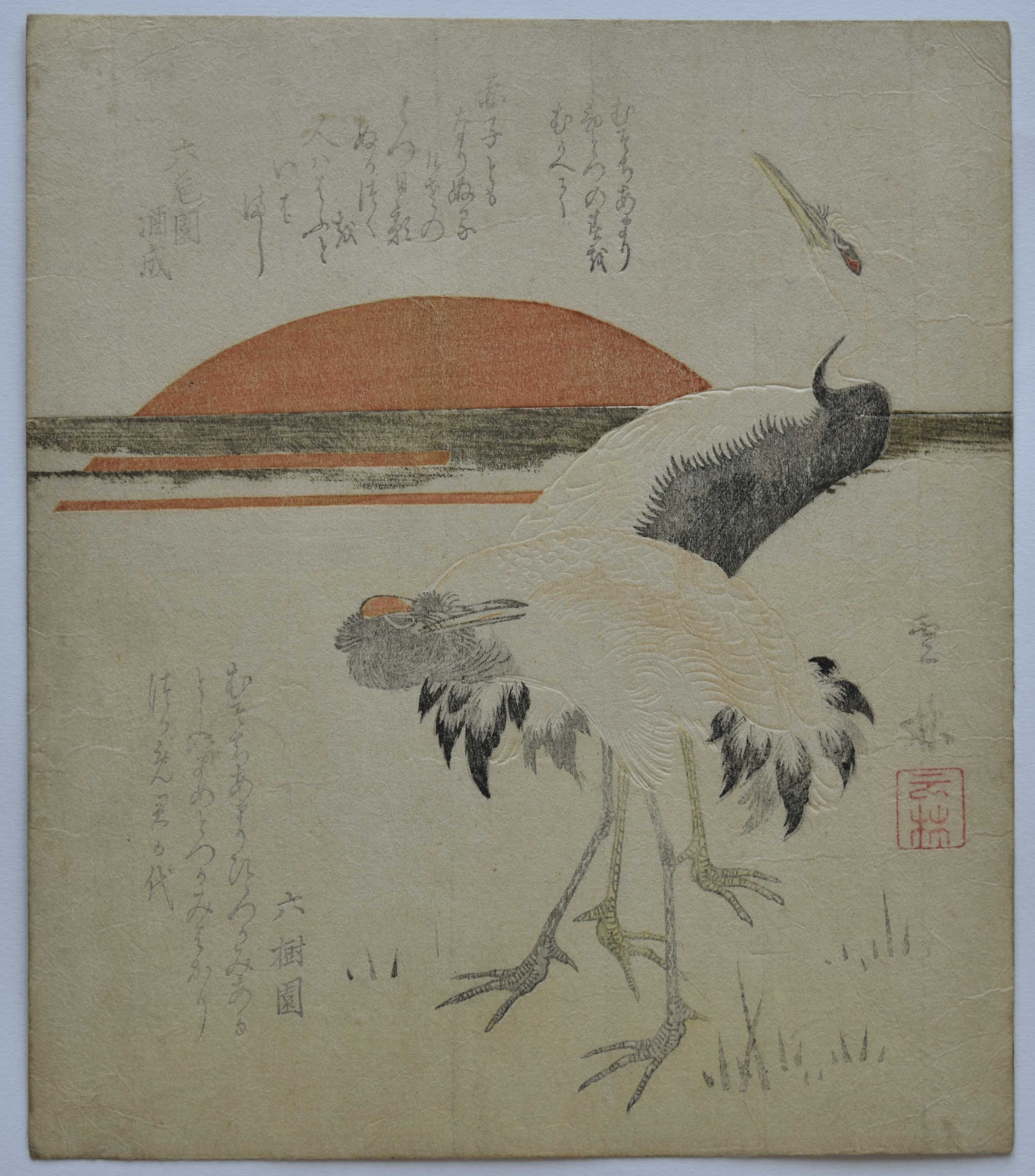
Honda UNRIN (Active c. late Edo period)
Click here to view image full size.
A surimono of a male and female red-crowned crane (aka Manchurian crane). Behind a huge setting sun. The crane represents good fortune, longevity and fidelity in Japan and is a popular subject for surimono. Unrin, a Nanga/Shijo artist, was a pupil of Tetsuo (1791-1871). Issued c. 1840s.
Fine impression with the birds outlines and plumage beautifully blind-printed. Very good colour. Minimal soil, otherwise very good condition. Signed and sealed Unrin.
Status: Sold
Utagawa HIROSHIGE (1797-1858)

Click here to view image full size.
Izumo, taisha Hotohoto no zu, “Izuma [Province], Hotohoto Festival at Izumo Shrine.” Shows pilgrims to the oldest Shinto shrine in Japan. A heavy mist scene with the torii gate seen to the right. Every year from the 11th to the 17th day of the 10th lunar month (usually November) all Shinto’s deities from around Japan supposedly assembled here. It is also the shrine to visit in the hope of finding a partner. From a set of 69 prints [Dai Nihon] Rokujuyoshi meisho zue, “Famous Places in the Sixty-odd Provinces [of Japan]” published by Koshimuraya Heisuke between 1853 and 1856, this being 1853.
Very fine impression and colour. Light album backing and very small wormhole at extreme edge of margin, top left, otherwise fine condition. Signed Hiroshige ga.
Status: Sold
Katsushika HOKUSAI (1760-1849)


An original 1815 two-sided woodblock carved from cherry wood (yamazakuro), 16 x 8.75 in; 40.5 x 22.25 cm, for the book: Ehon joruri zekku, “Picture Book with Mixed Verses on Joruri.” Four illustrations for pages 17 and 11. The book pairs scenes from popular puppet and kabuki plays with classical Chinese poetry provided by Hokusai’s pupil Hokutei Bokusen. Sold together with: A) An early edition of the book complete published by Kadomaruya Jinsuke, Edo and Matsuya Zembei, Nagoya, 1815. In good condition with original covers and title-slip. (57 images). B) A later but still Edo period printing copy published by Kadomaruya Jinsuke, Edo and Matsuya Zembei, Nagoya. On thick paper with bad wormage. Missing original covers. (54 images). C) A post 1868 two volume coloured edition published by Kadomaruya Jinsuke, Edo and Matsuya Zembei, Nagoya.
Good condition with original covers and title-slips. (56 images). D) Modern pulls from both sides of the block made by Paul Binney. Block sold “as is” with all imperfections. An excellent study group.
Status:Sold


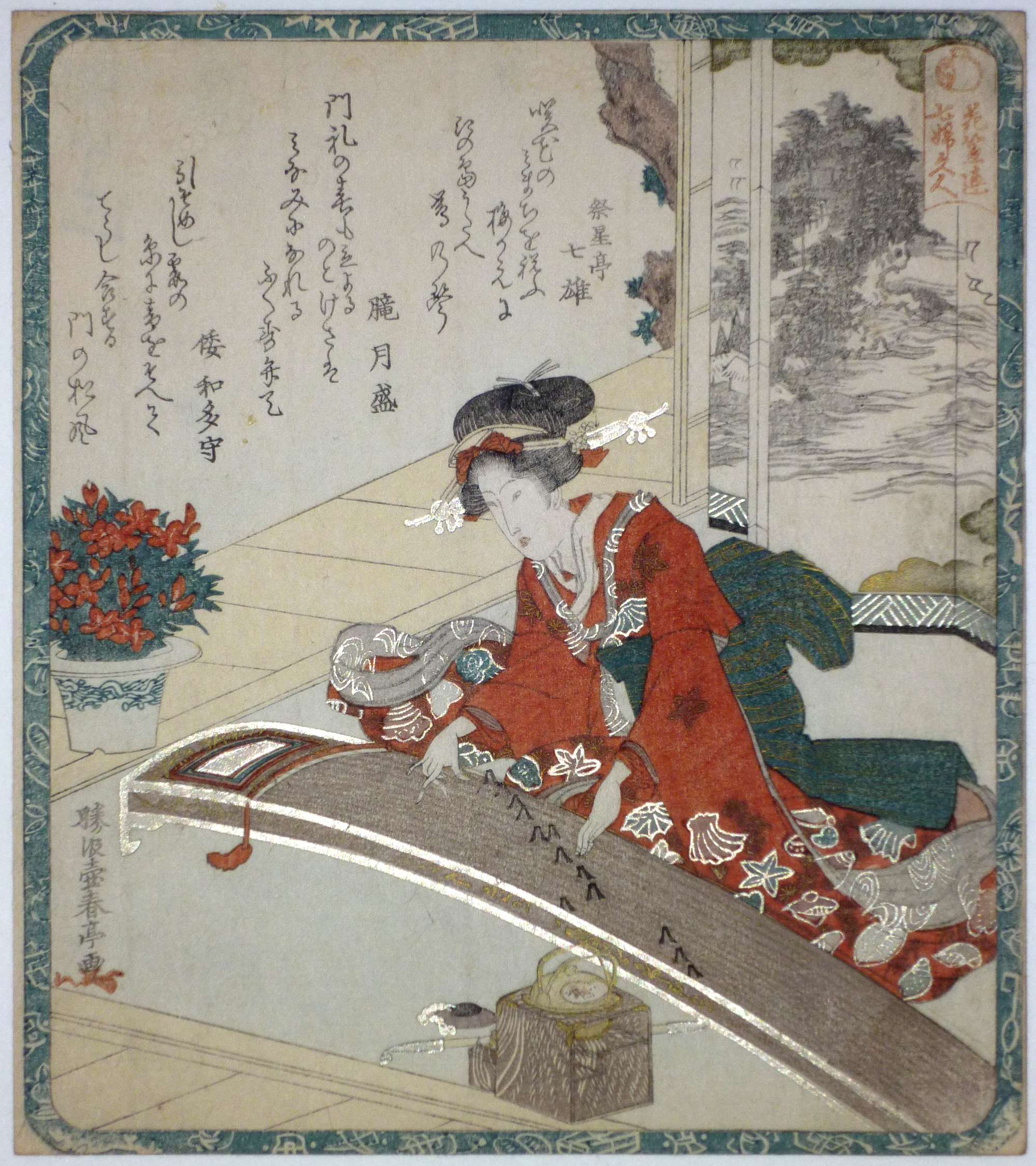
Katsukawa SHUNTEI (1770-1820)
Click here to view image full size.
A woman playing a koto from the set: Hanagasa-ren Shichifukujin, “Seven Women as the Gods of Good Luck for the Hanagasa Club. Each beauty represents a god, presumably in this case Benten. The series may be a parody of the new year tradition of making a pilgrimage to the seven shrines devoted to each of the Seven Gods of Good Luck. The set of eight prints published c 1820.
Fine impression and colour with silver and gold. Light backing, otherwise very good condition. Signed Shokyuko Shuntei ga.
Status: Sold
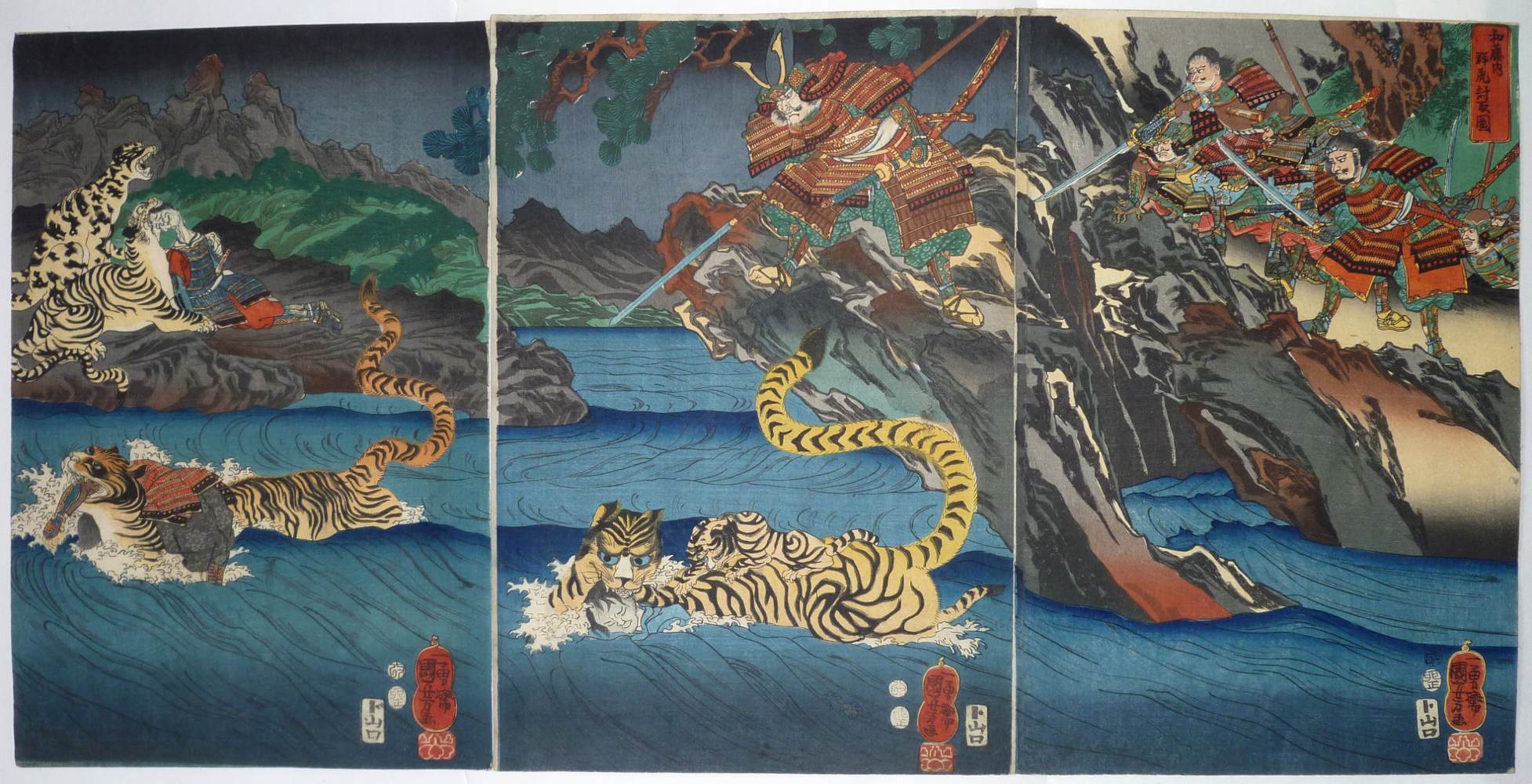
Utagawa KUNIYOSHI (1797-1861)
Click here to view image full size.
A triptych showing Kato Kiyomasa (Watoni) and his henchmen watching Korean man-eating tigers carrying off their compatriots across a river. Watoni gunko toshu no zu. Hideyoshi sent Kiyomasa to Korea twice in 1592 and 1597. He is often depicted killing a man-eating tiger. Published by Yamaguchi-ya Tobei in 1855.
Very early fine impression with beautiful colour variation on the rocks at right. Fine colour. Slight edge crease near left edge of first sheet and imperceptible centre folds, otherwise very good condition. Signed Ichiyusai Kuniyoshi ga.
Status: Sold
Utagawa KUNIYOSHI (1797-1861)
Click here to view image full size.
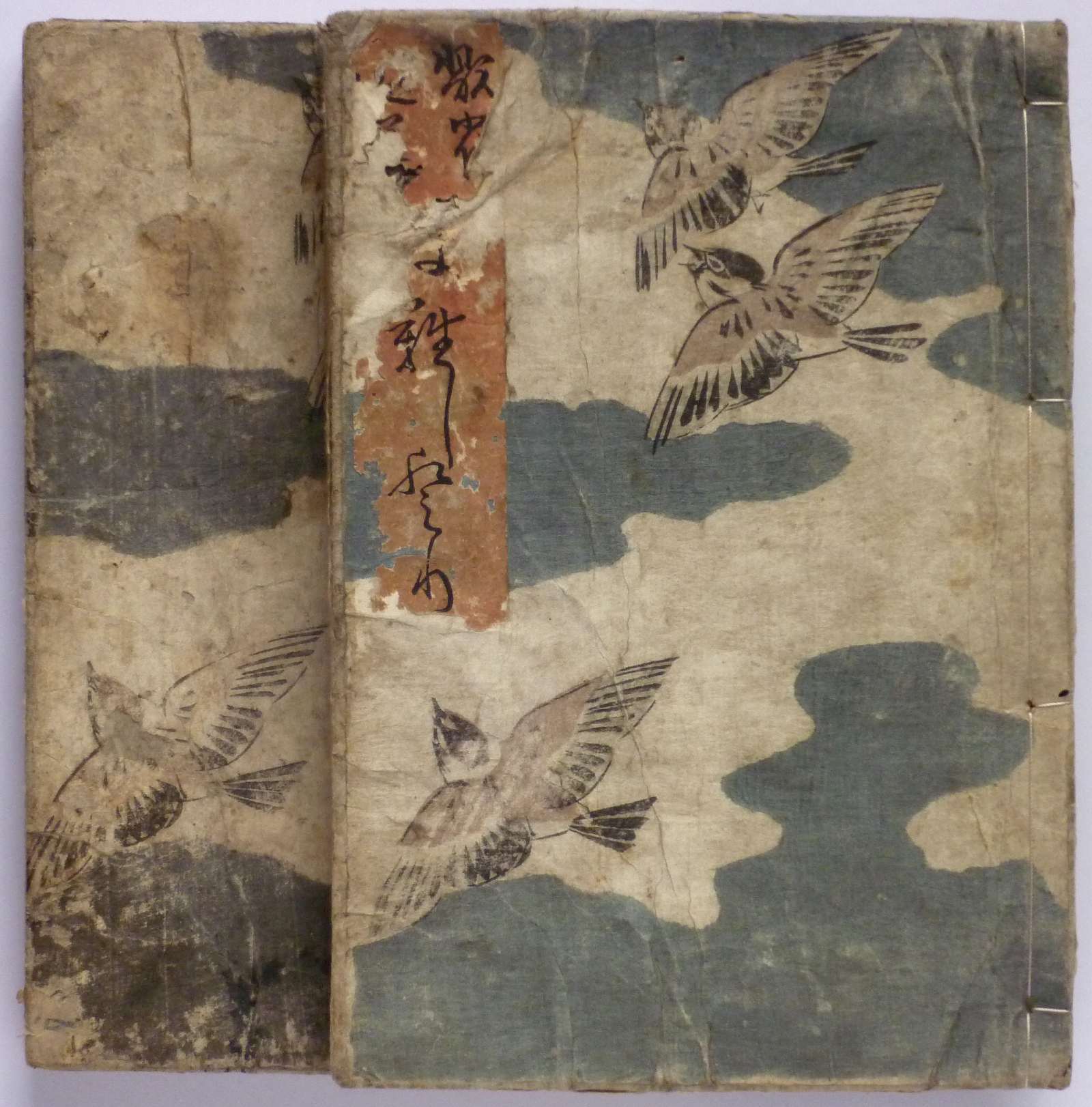
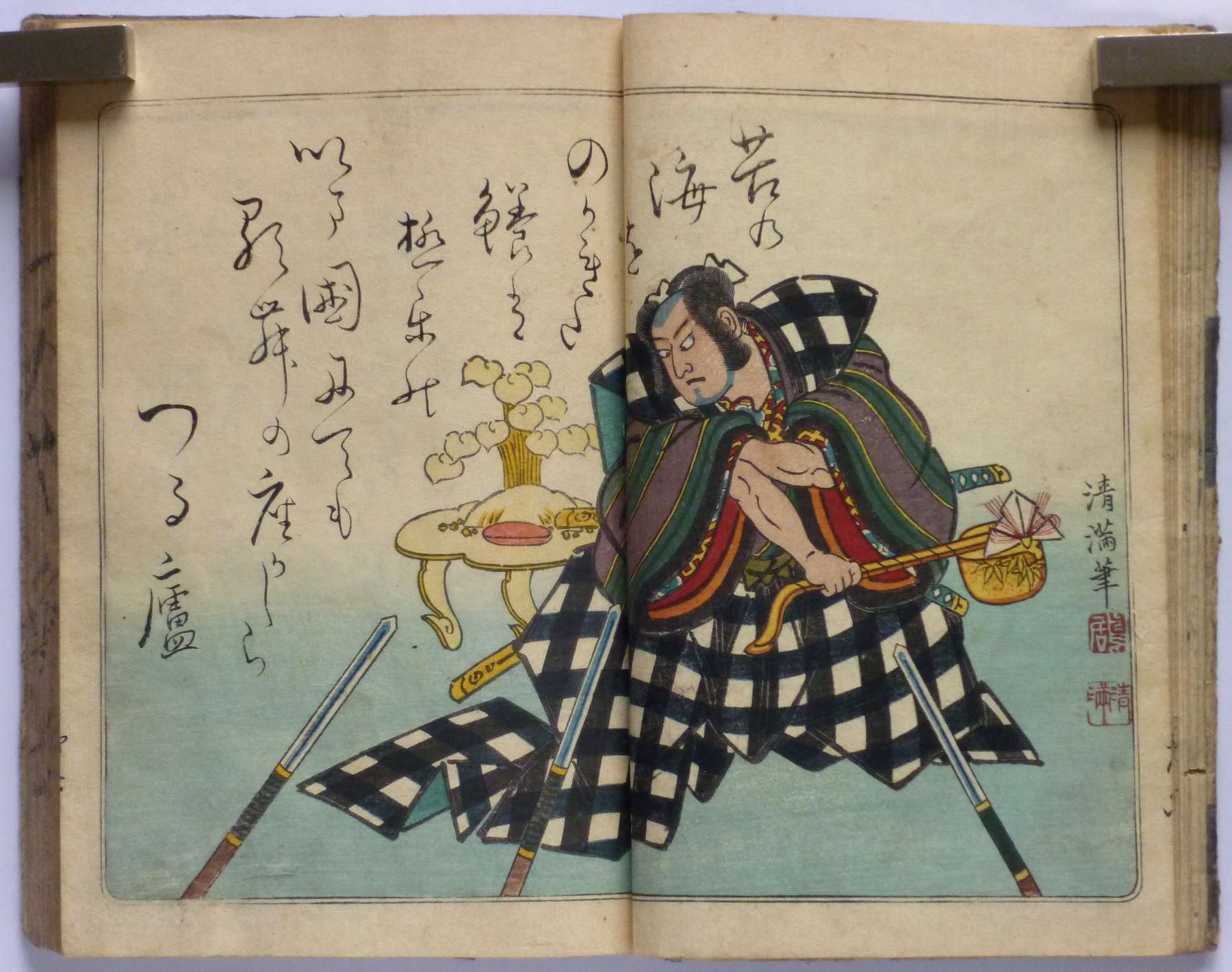
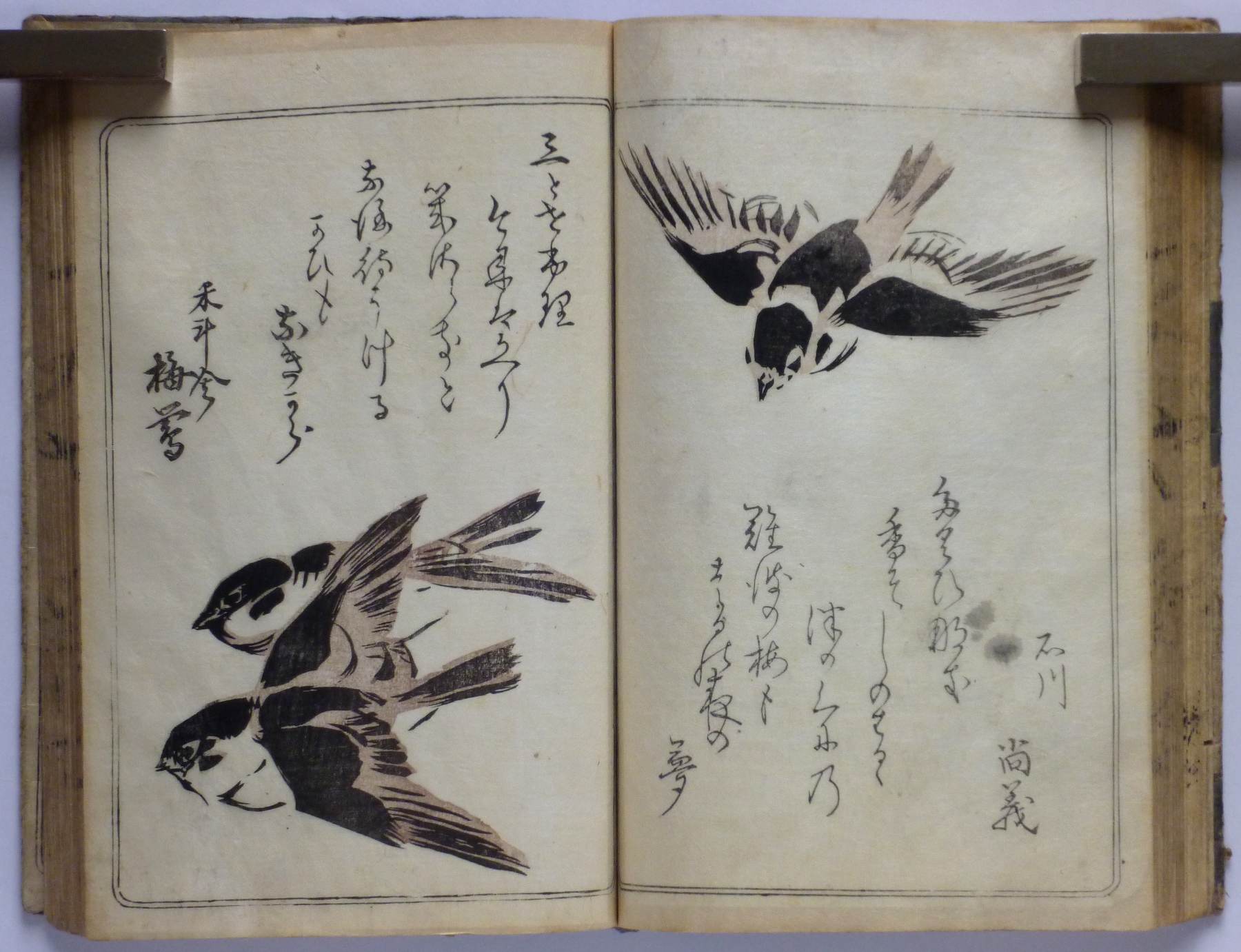
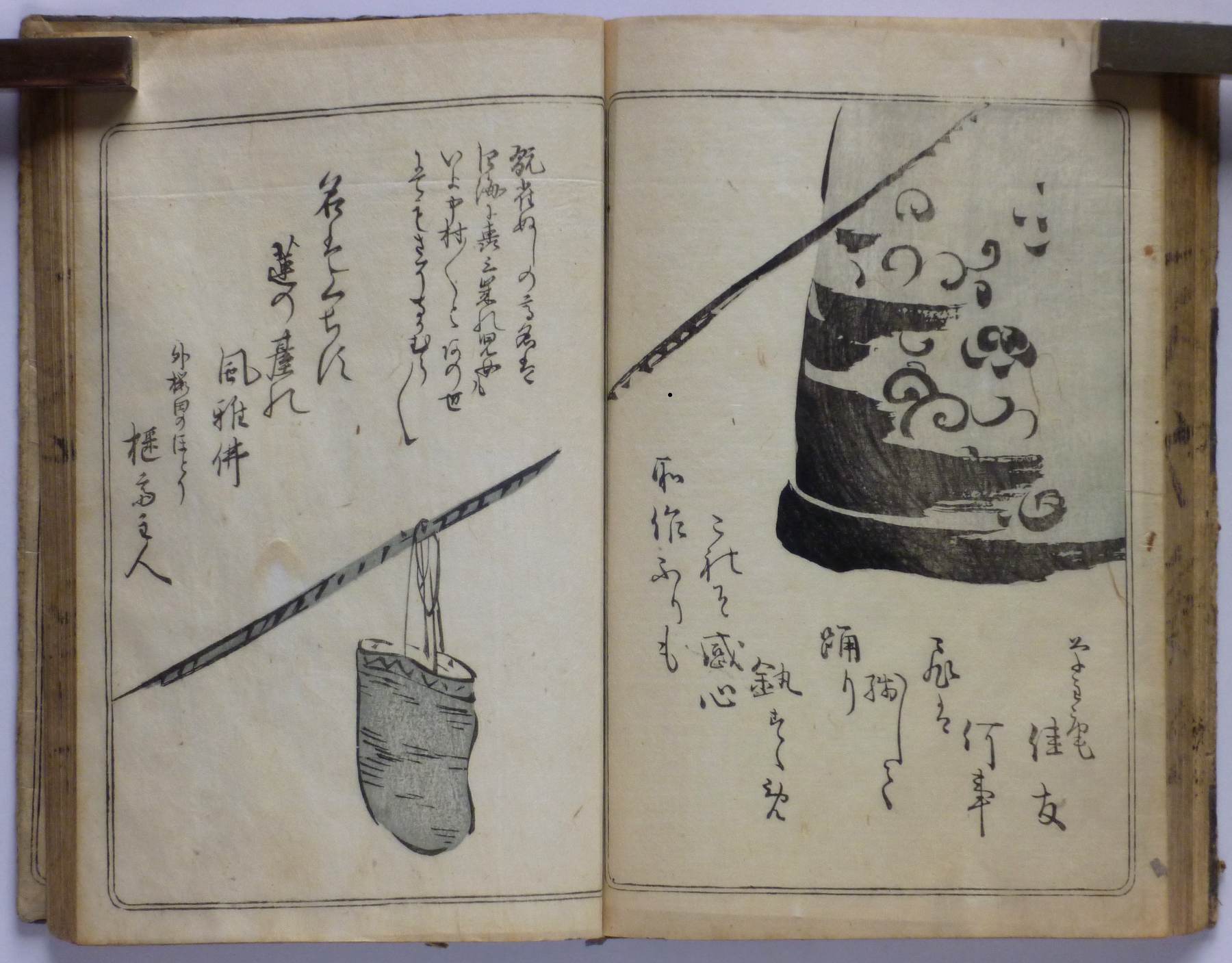
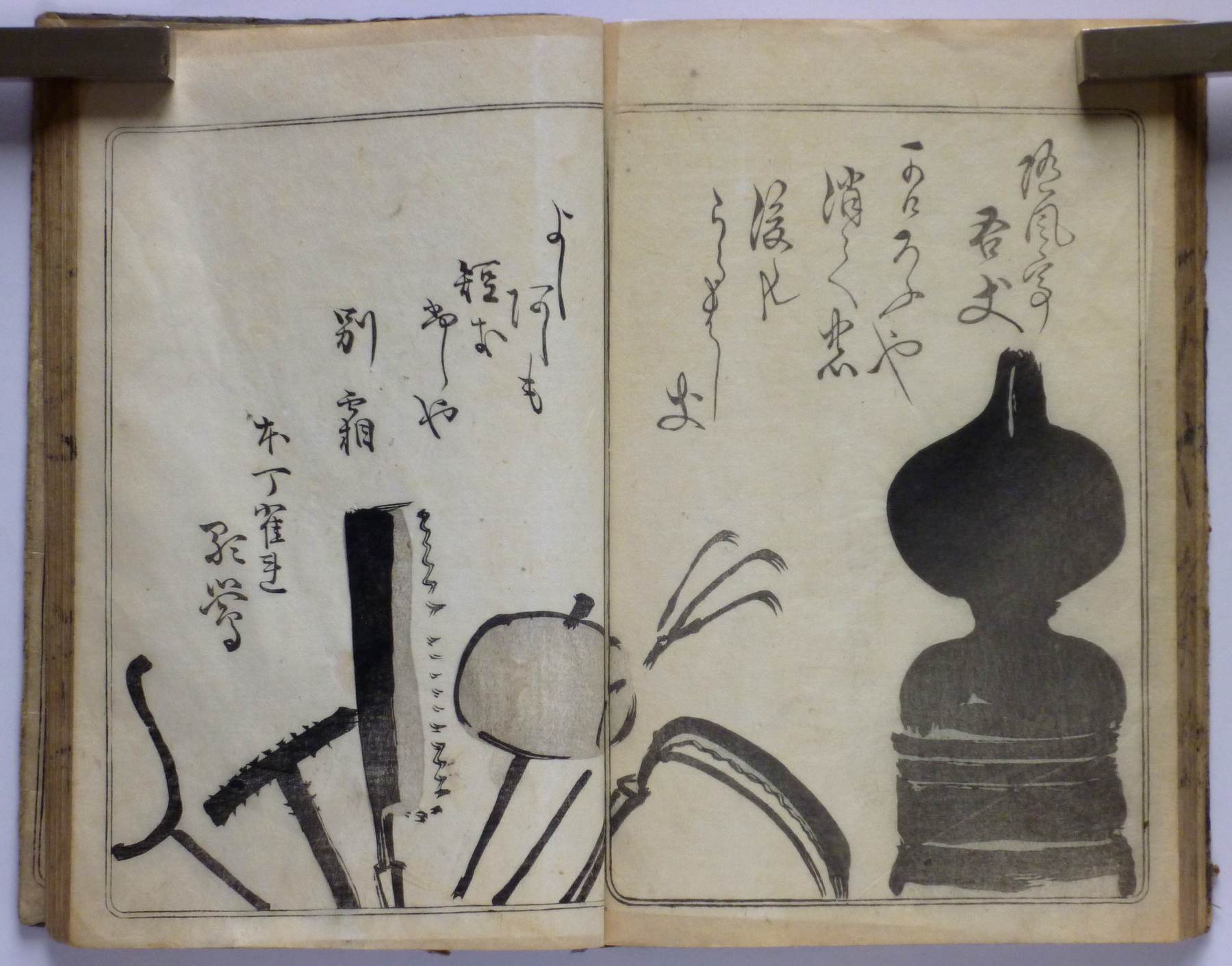
2 vols. complete: Kanjaku tsuizen hanashidori, “The Liberated Birds: A Memorial Book for Kanjaku.” A memorial book for the actor Nakamura Utaemon who died in 1852. He had the literary name of Kanjaku, meaning ”playing with sparrows” and the covers and many illustrations allude to this custom of releasing birds at funerals. Vol. 1: 1st preface , 3pp. giving the biography of Utaemon IV; poem 1p. 3 sheets: calligraphy (in ishizuri), 1p.; illustrations in colour, 5pp. signed on first page Toyokuni (III). Sheets 1-8: 2nd preface, 5pp., remaining pp. text, poems and colour illustrations. Sheets 1-75 with 15 single-page and 62 double-page illustrations in sumi and light colour. Inside back cover: colophon dated Kaei 5 (1852). Vol. 2: 110 sheets of text, poems, and illustrations. 38 single-page and 50 double-page illustrations (many in colour and includes a double-page illustration by Kuniyoshi). Last page, colophon, dated Kaei 5 (1852). Original covers with clouds and sparrows. Some soil and minor damage. One title slip missing and other damaged. Contents extremely good.
Status: Sold
Suzuki HARUNOBU (c 1725-1770)
Click here to view image full size.
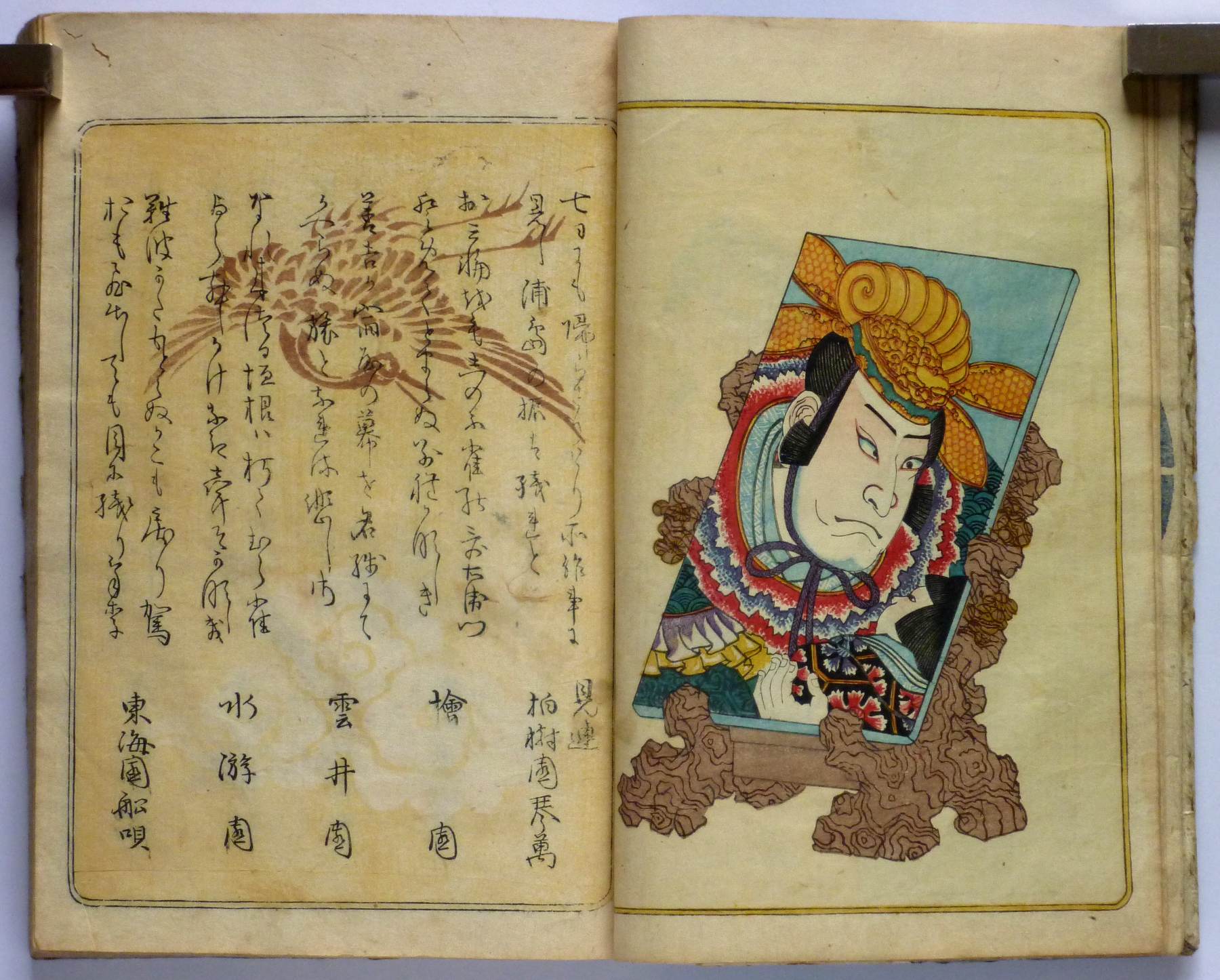
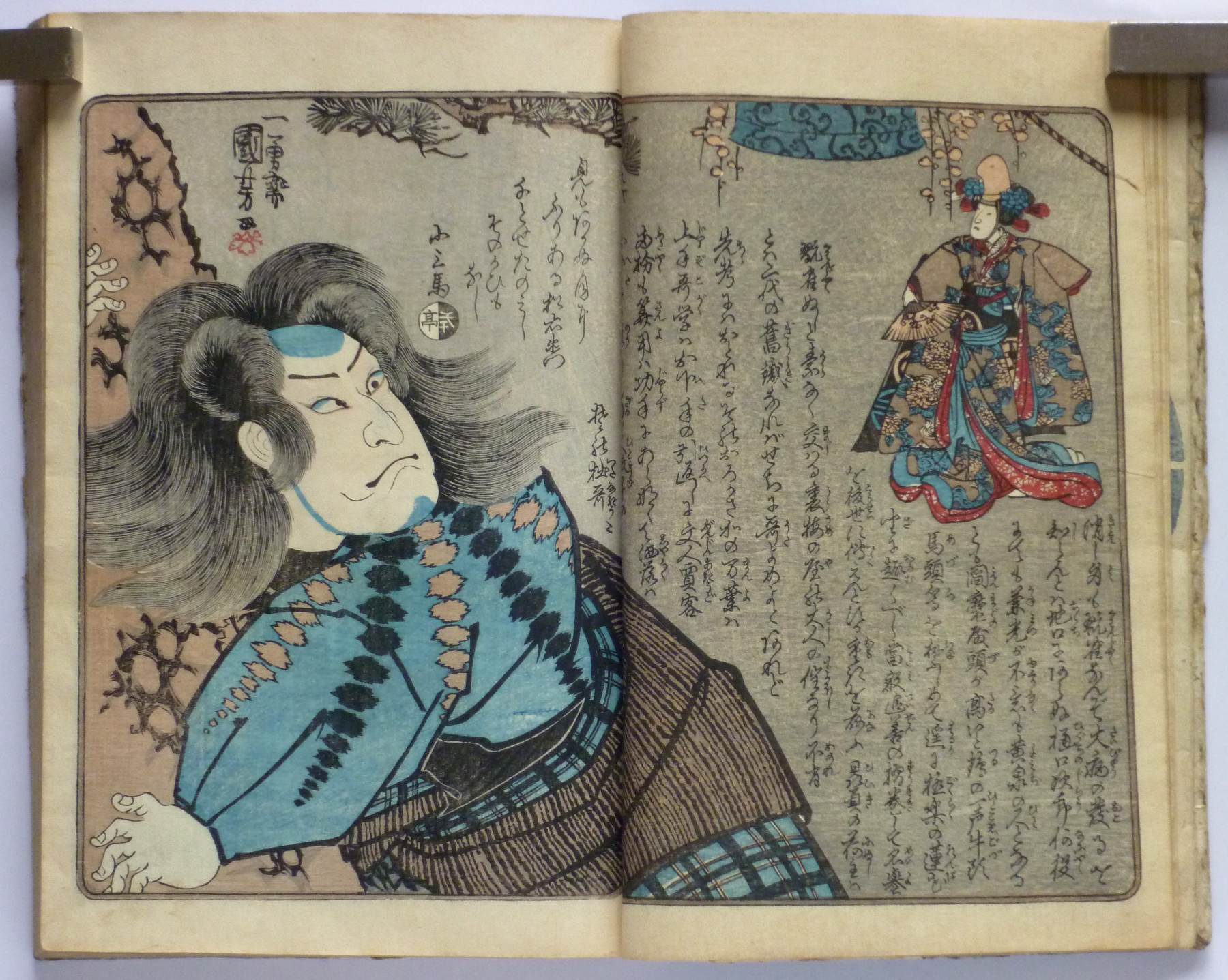
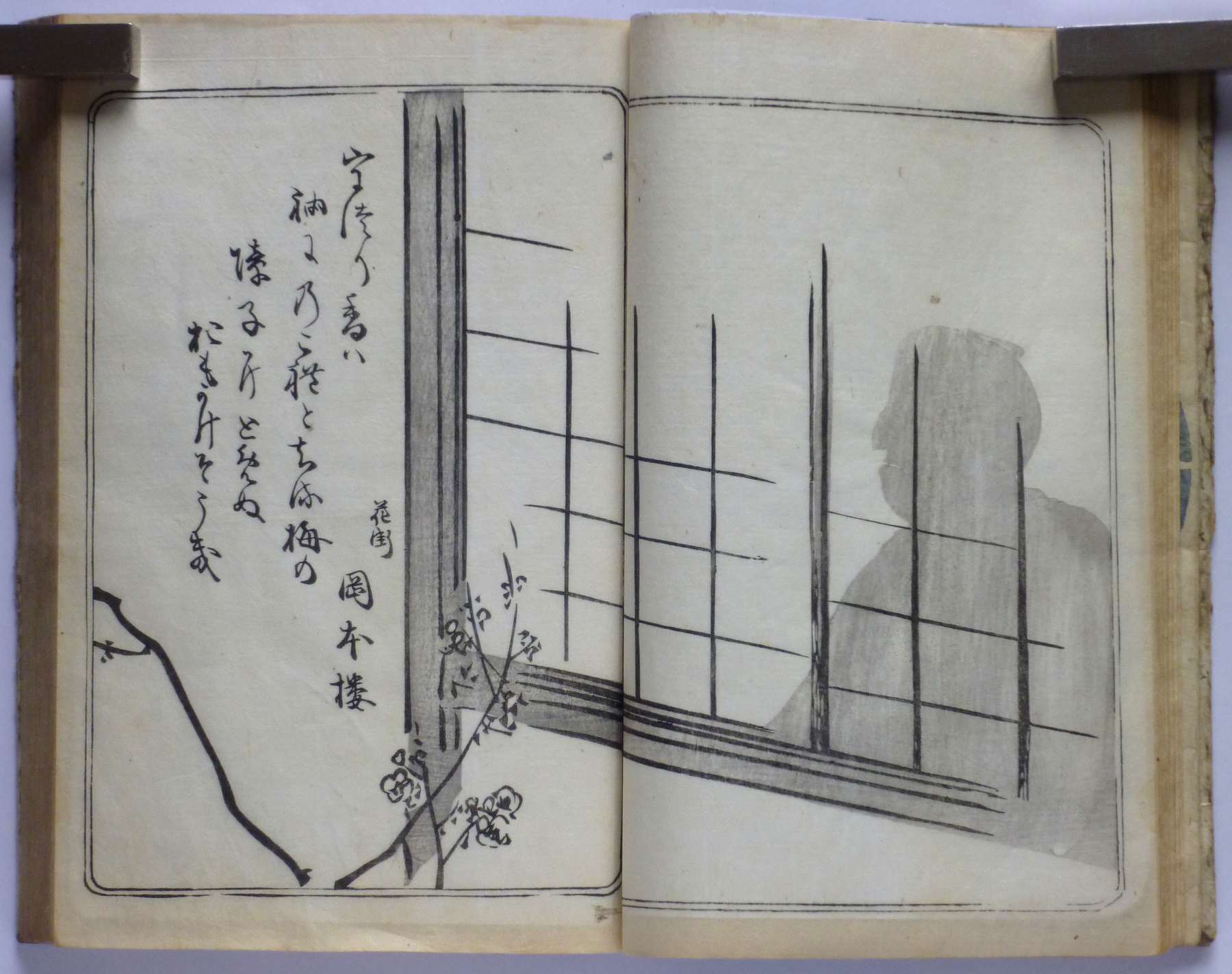
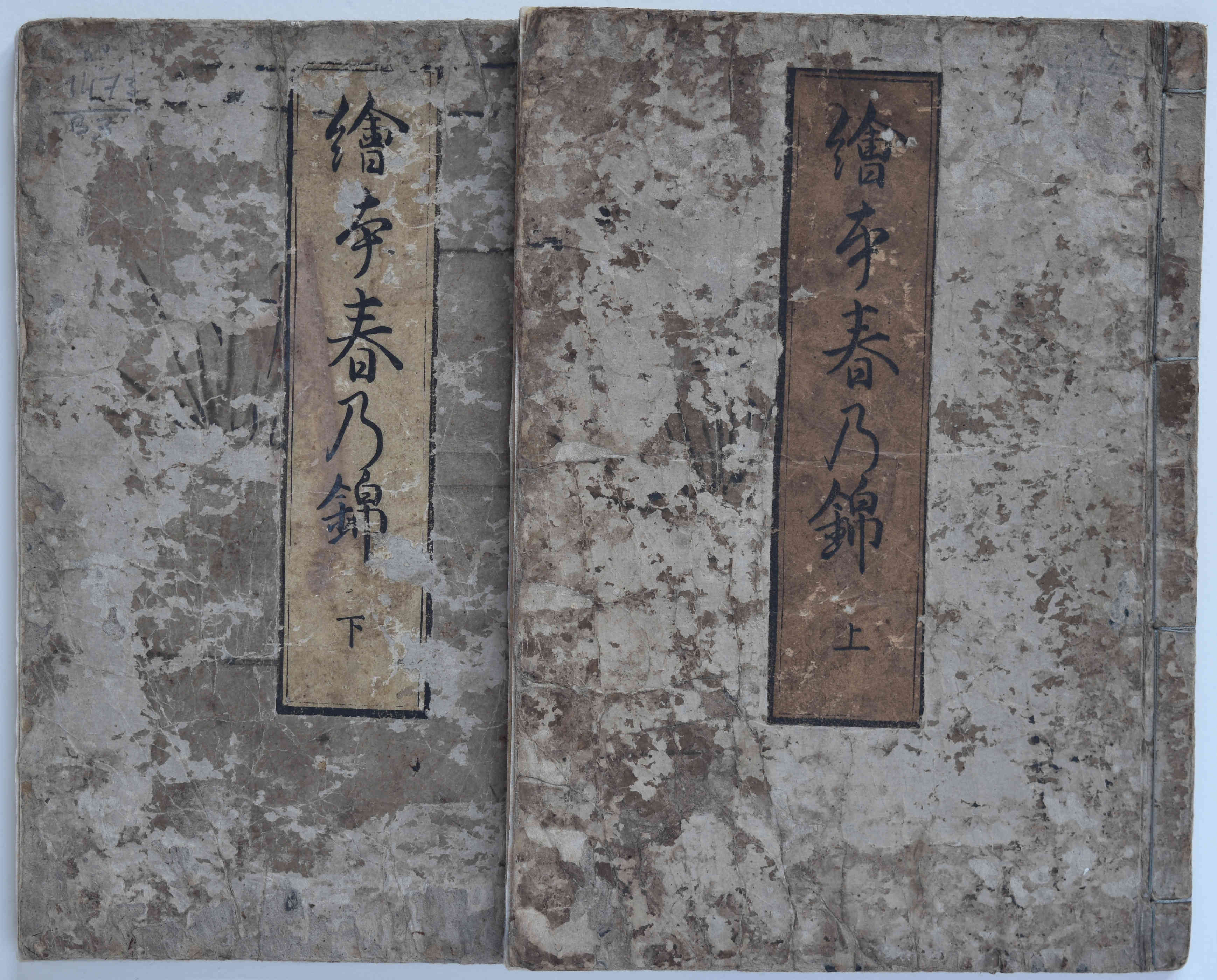
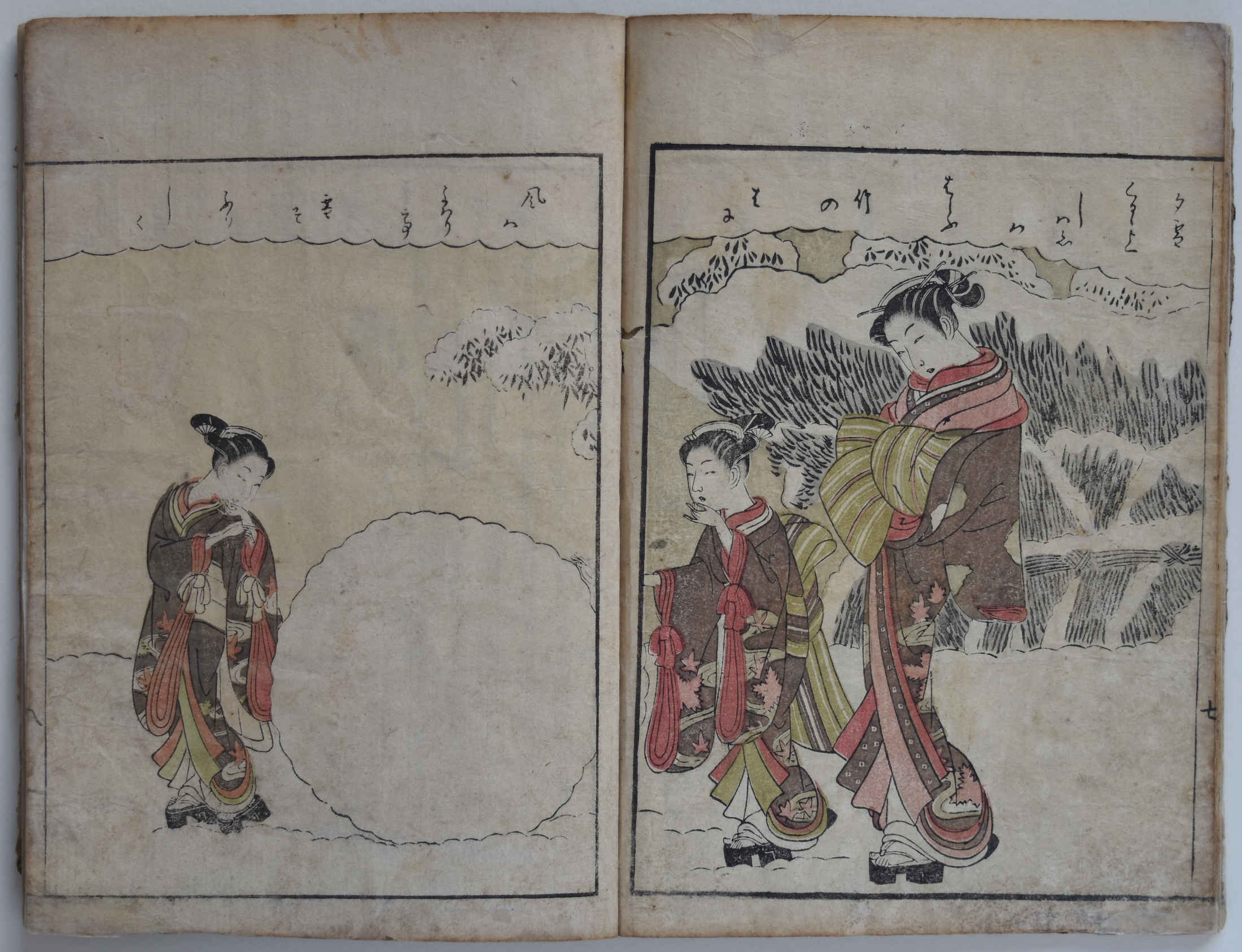
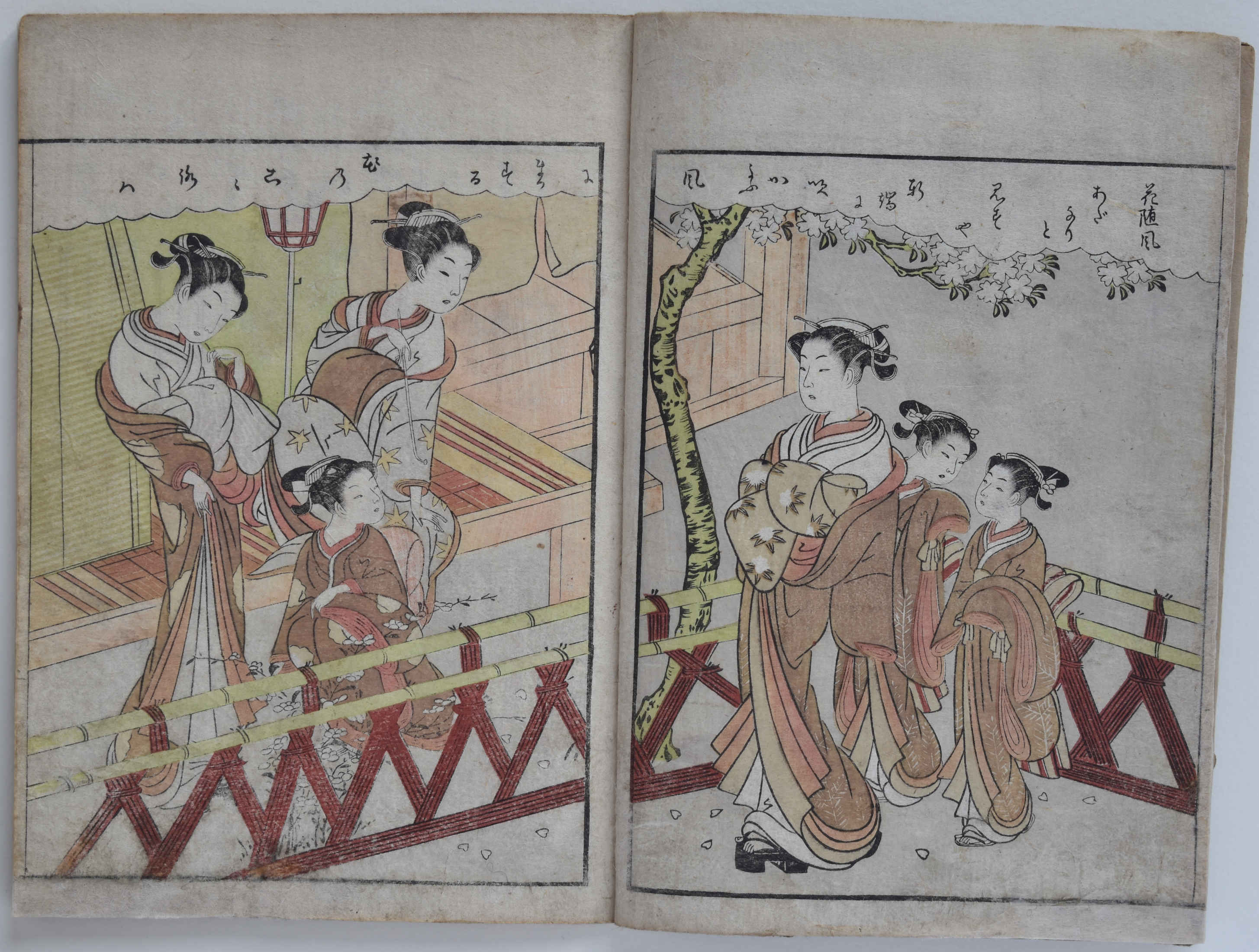
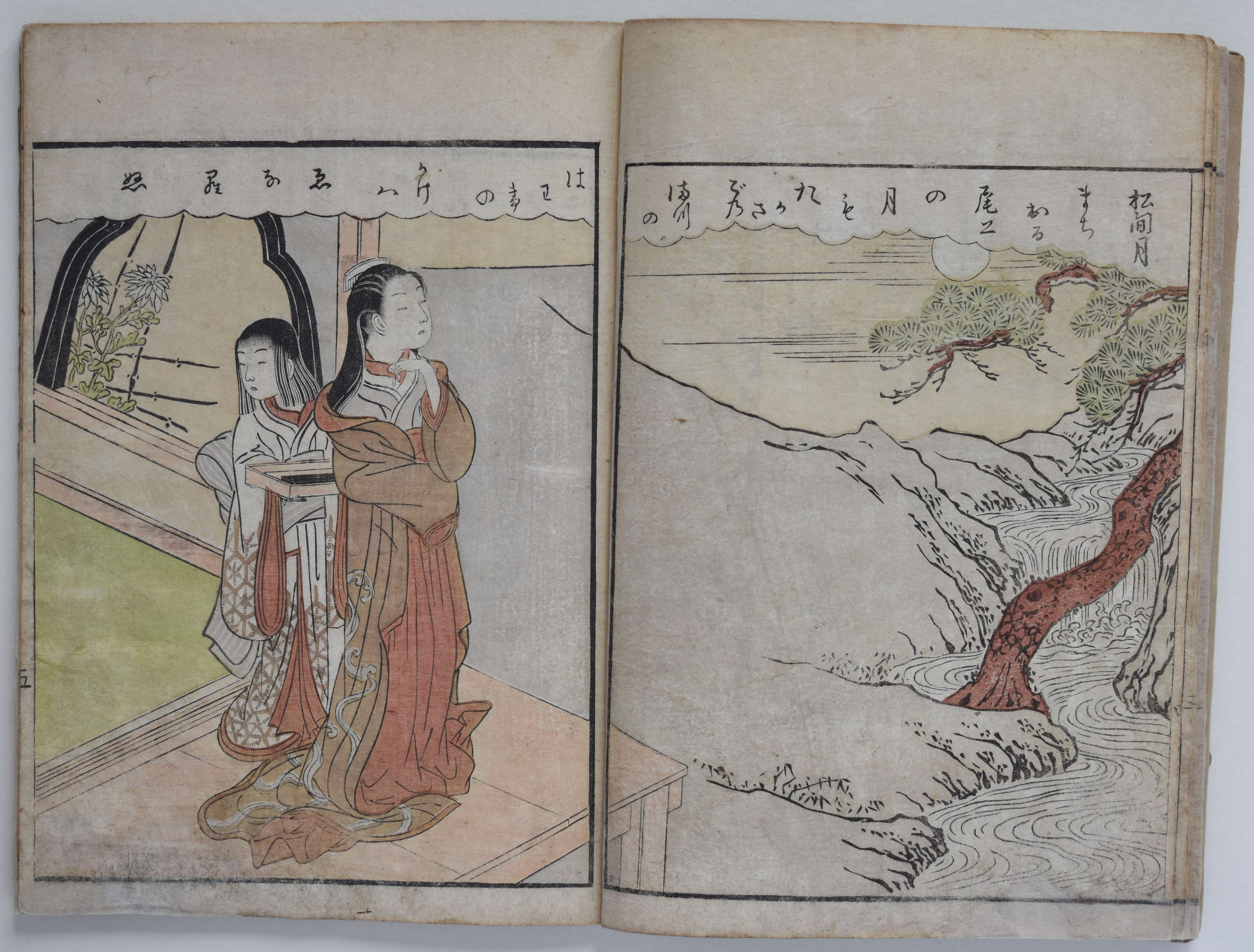
Two volumes complete: Ehon haru no nishiki, “Picture Book: The Brocades of Spring.” Vol. 1: 1 page preface dated Kanoto U (1770); single page and 8 double page colour prints. Vol. 2: 1 single page and 8 double page colour prints. 1 page colophon with date, publisher, block-cutter and artist as Suzuki Harunobu with his seal. 2 pages publisher’s announcements. Published by Yamazaki Kimbe, Edo. This is the first edition, Meiwa 8 (1771). Other copies are in the MFA, Boston, acc. no 1997.477.1-2 and Philadelphia Museum of Art, acc. no. 1970-46-1. Provenance: Ex collections H.M.Kaempfer and Hayashi (their seals on the first page of each volume). Original covers and title slips. Covers worn. Some soil and edge restoration. Very good impressions with generally very good colour. Rare in the first edition.
Status: Sold
Utagawa KUNIYOSHI (1797–1861)
Click here to view image full size.
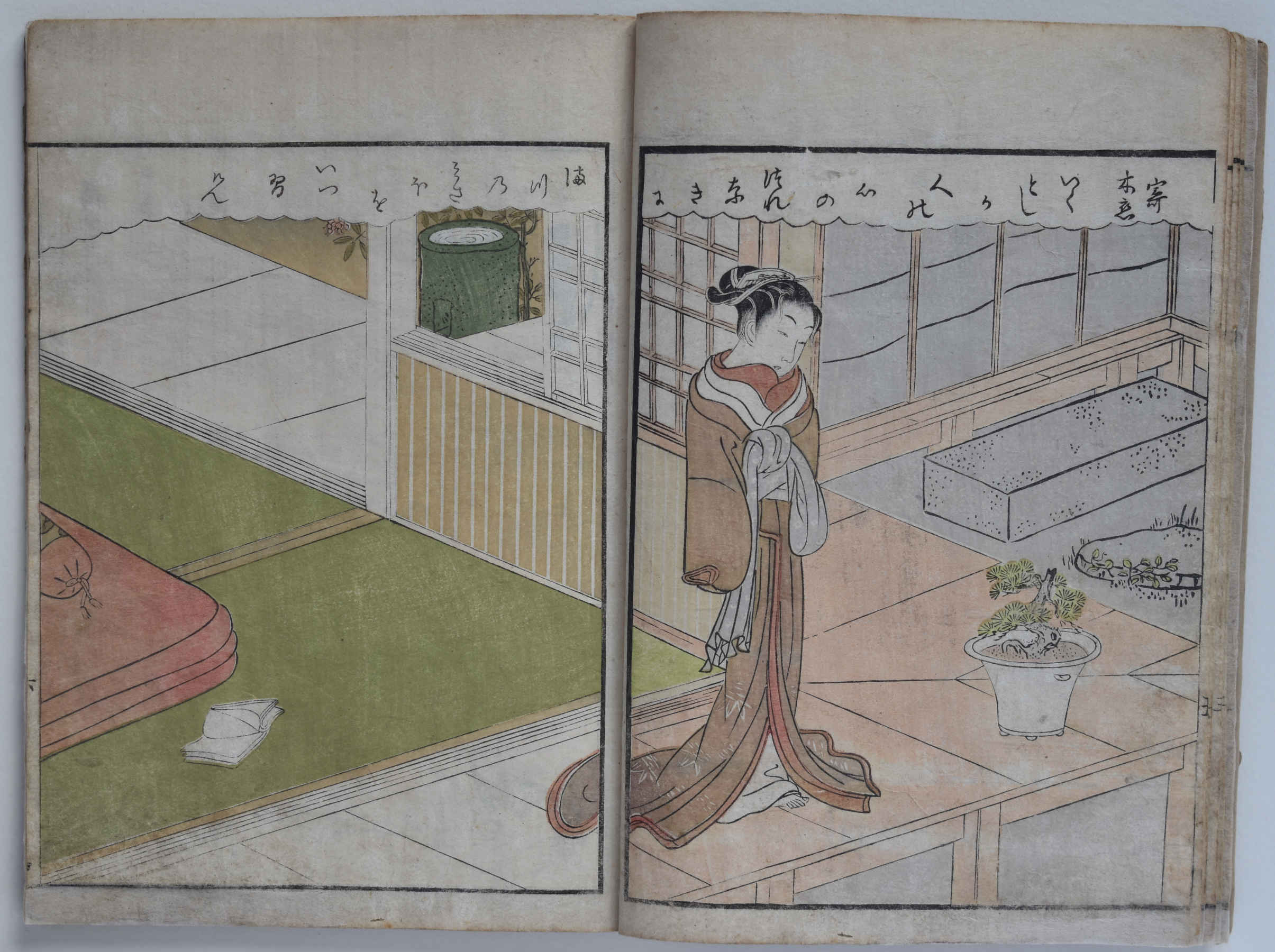
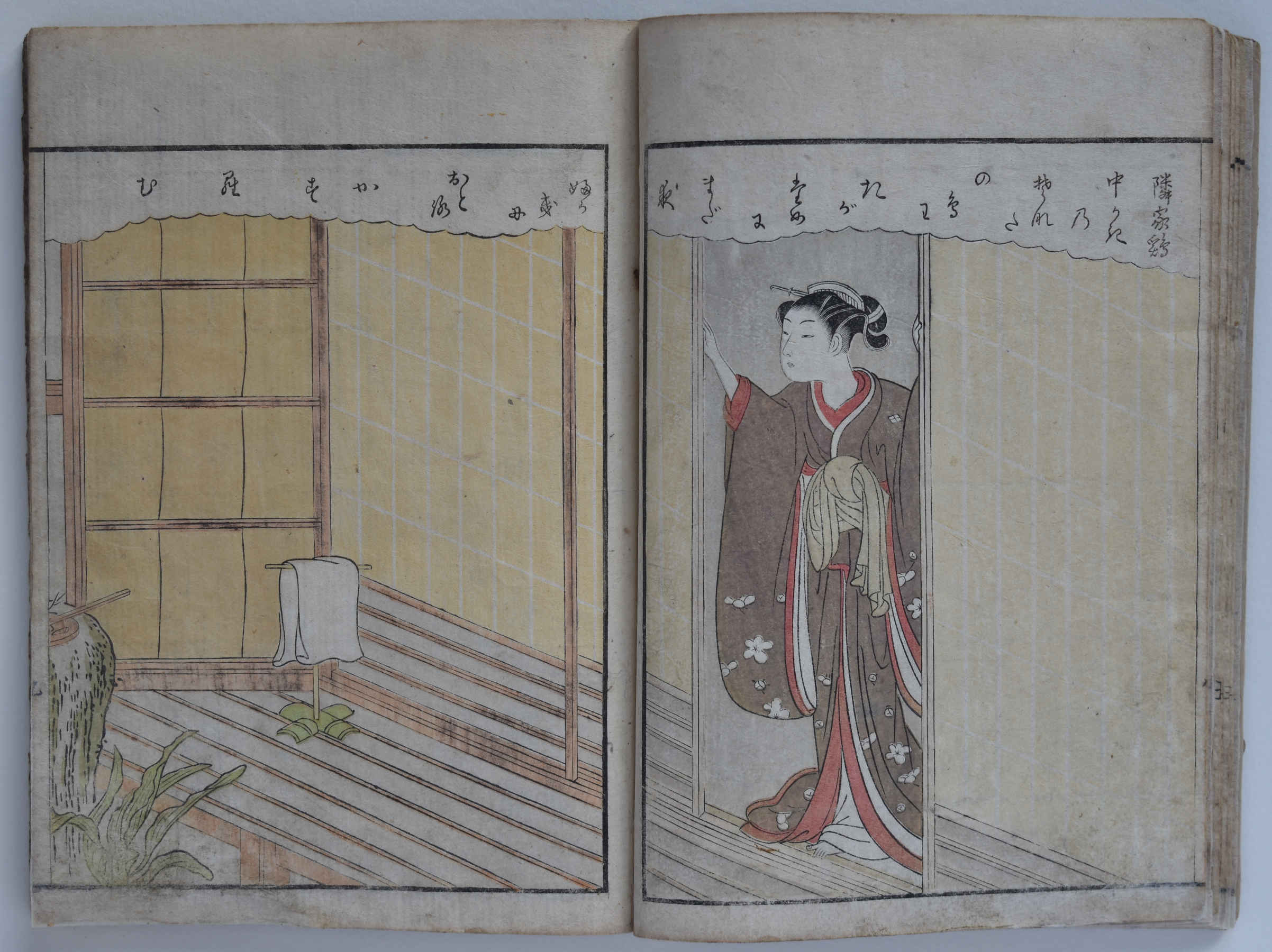
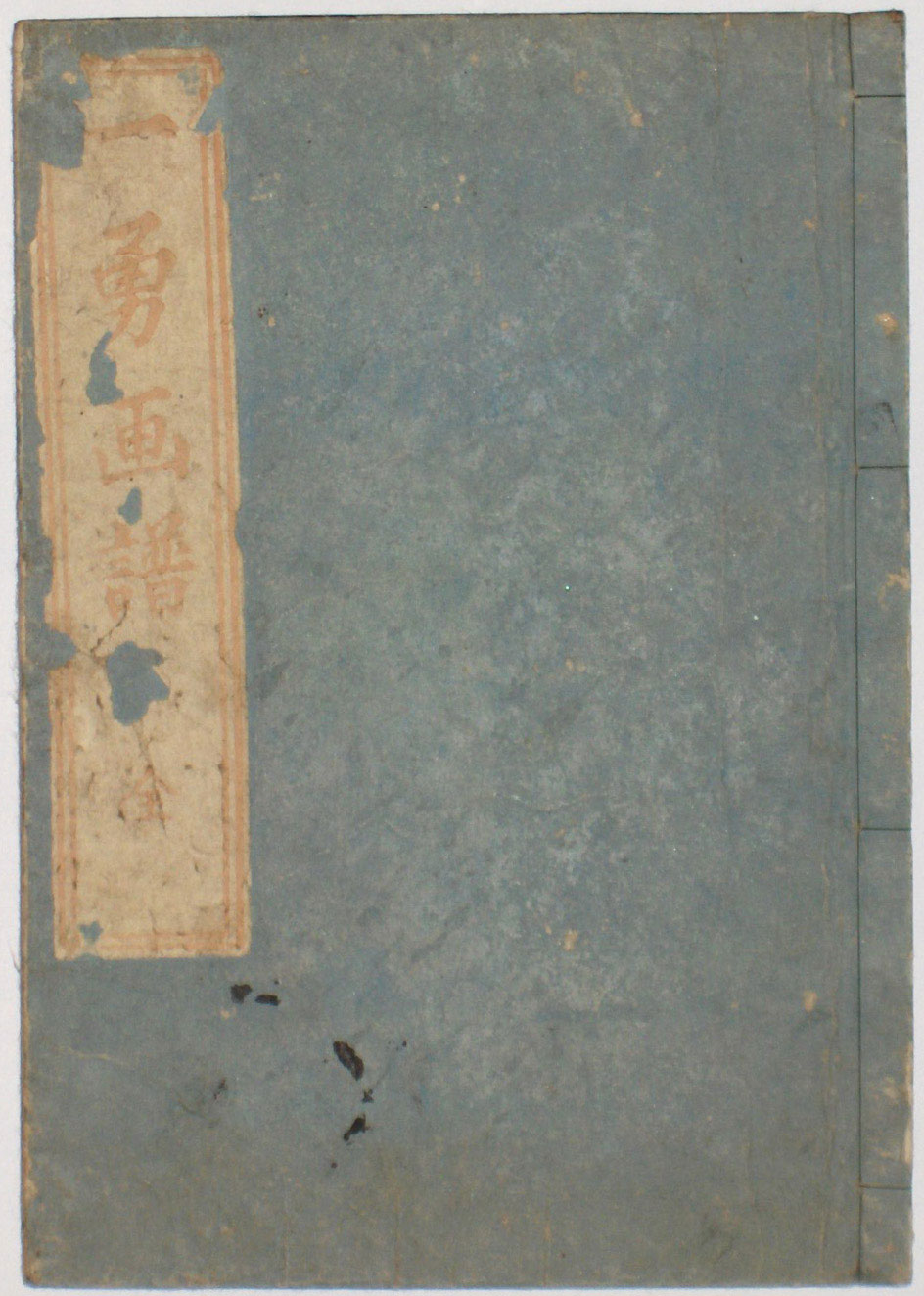
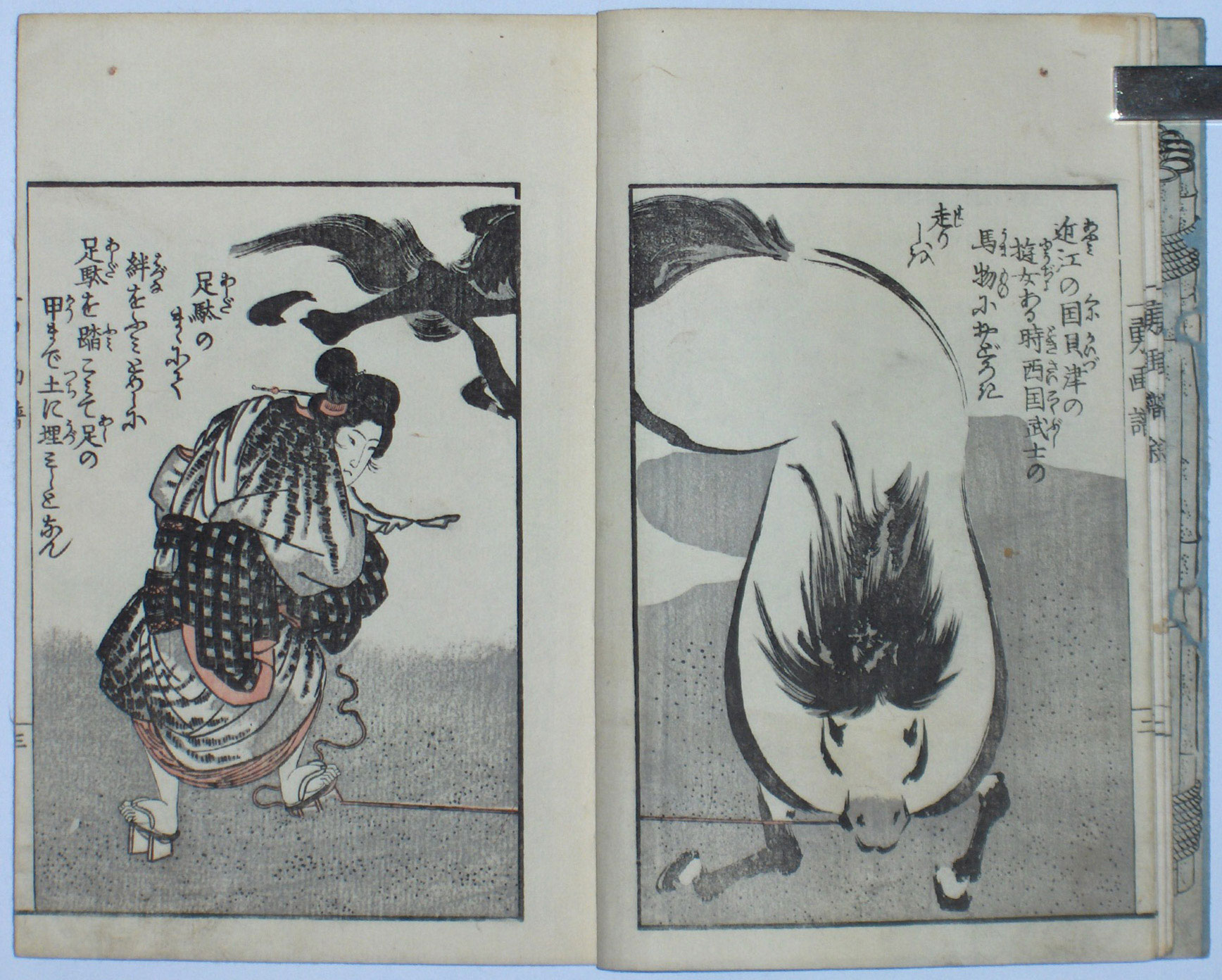
One volume complete Ichiyu gafu, “Drawings by Ichiyu [Kuniyoshi ].” Sumi and light colour. Some fine designs showing heroes and legends. This is the first edition, dated Bunsei 13 ( 1830 ). It was reissued in 1846.
Original covers and title slip. Minor wormage, otherwise fine condition.
Status: Sold
Yashima GAKUTEI (1786-1868) and Totoya HOKKEI (1780-1850)
Click here to view image full size.
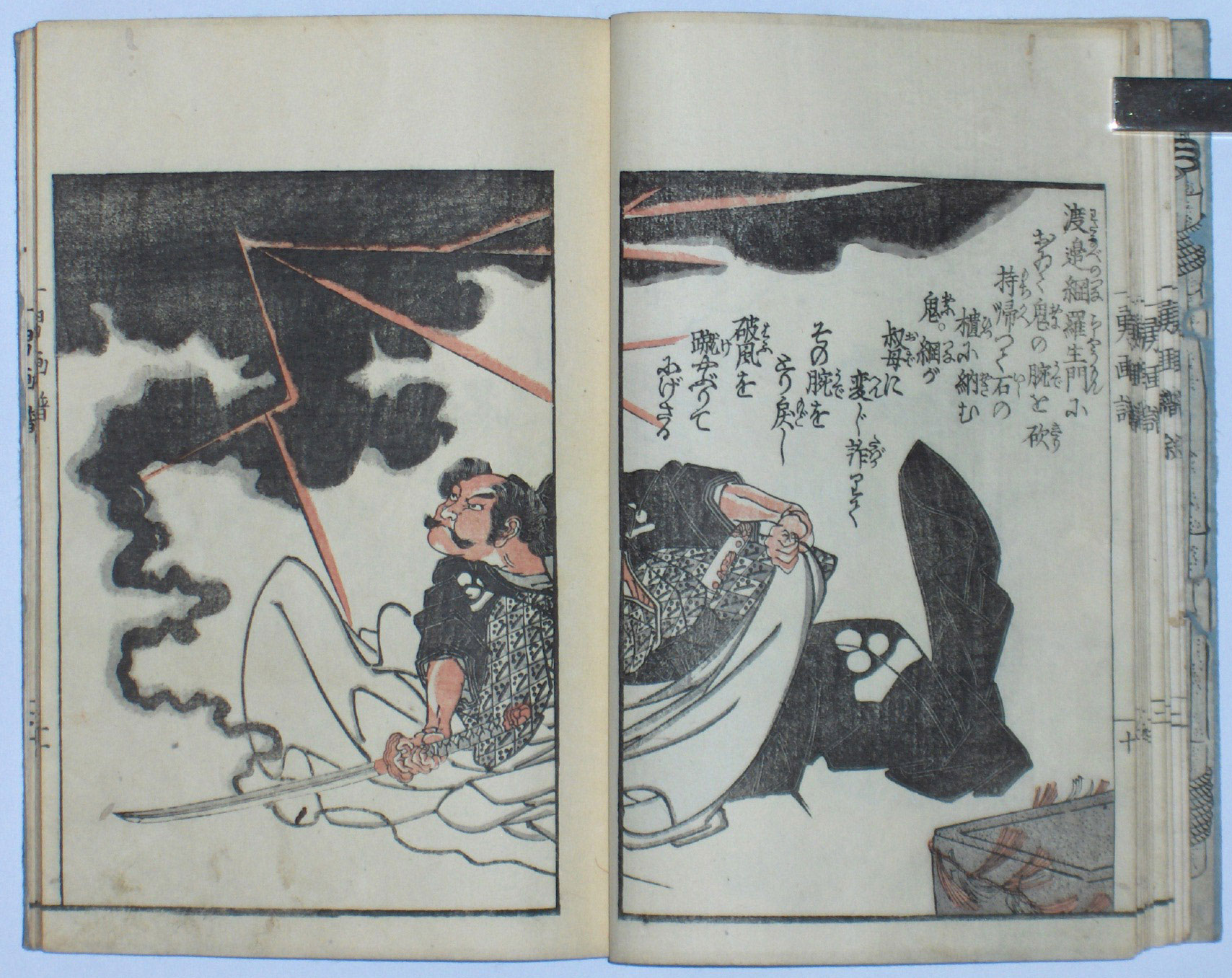
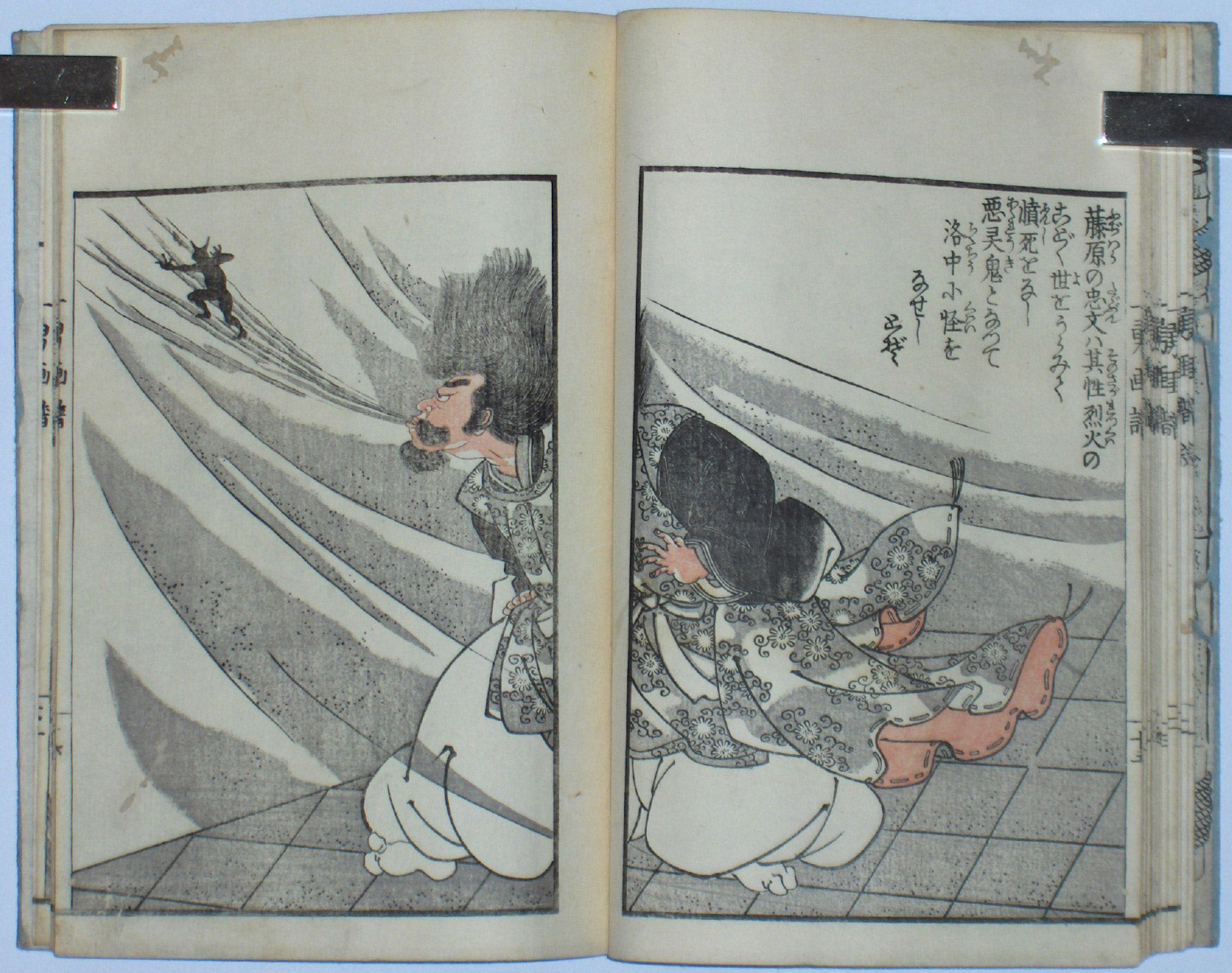
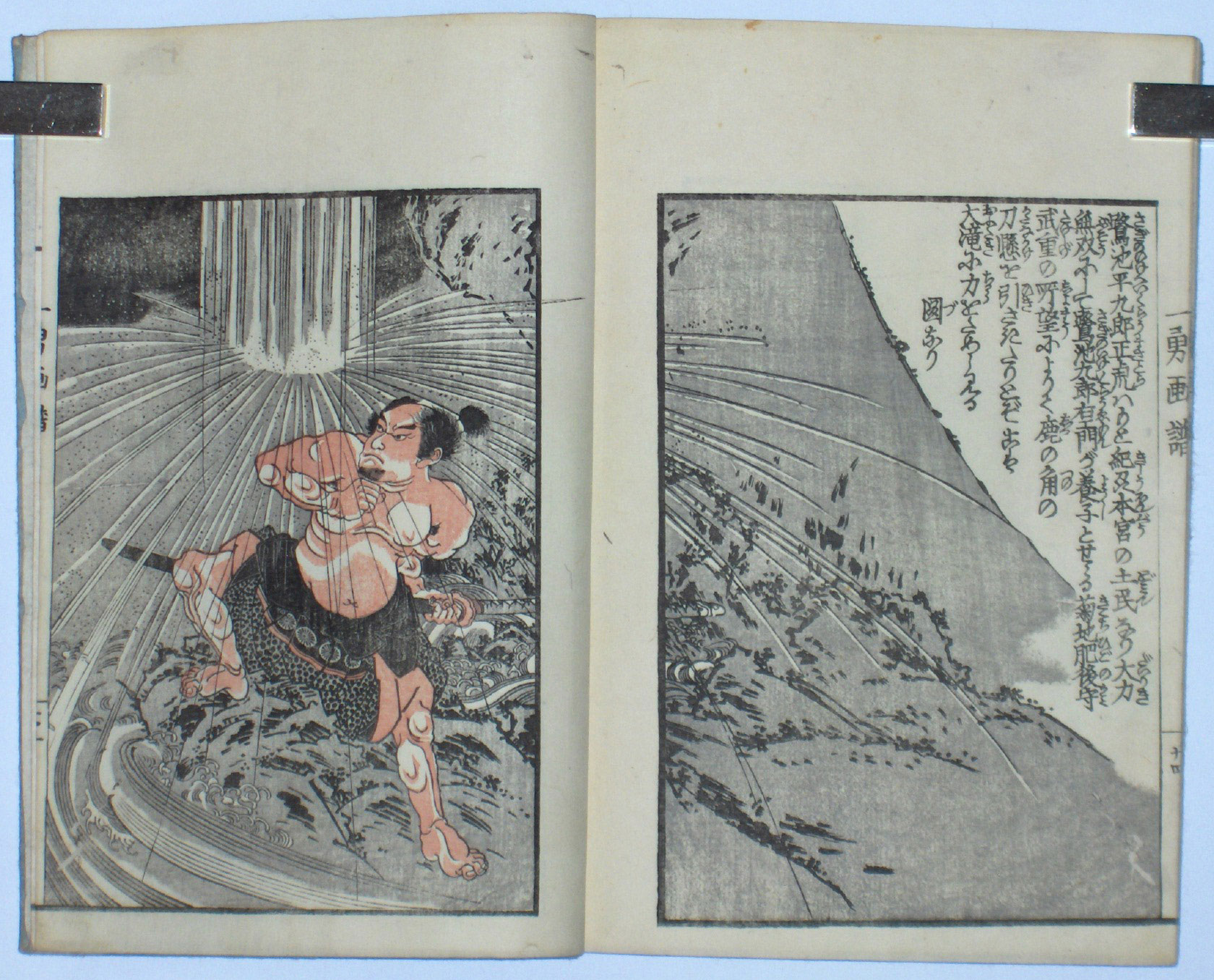
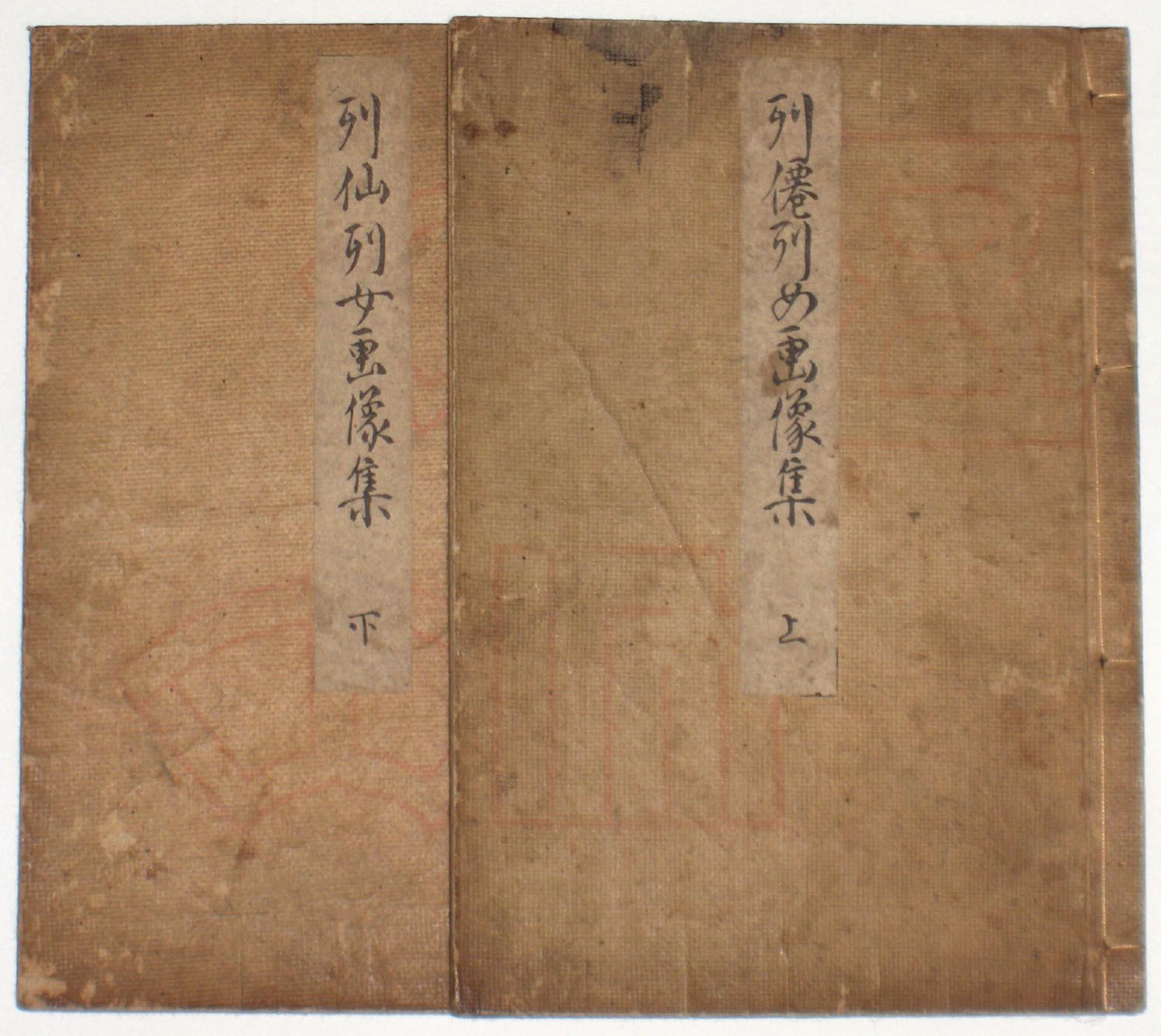
Two vols. kyoka books complete: Ressen retsujo gazoshu, a “Collection of the Portraits of Immortal Men and Women.” Twenty eight portraits of Chinese hermits and twenty one portraits of celebrated women in Japanese history. Being a selection of kyoka presented at the meetimg held at Kawachiya of Yanagibashi Ryogoku in Edo, 1st day of the 9th month, Bunsei 7 ( 1824 ). Published by Shinsenyen. Rare.
Original covers and title slips. Minor marks to covers, otherwise very good condition.
Status: Sold
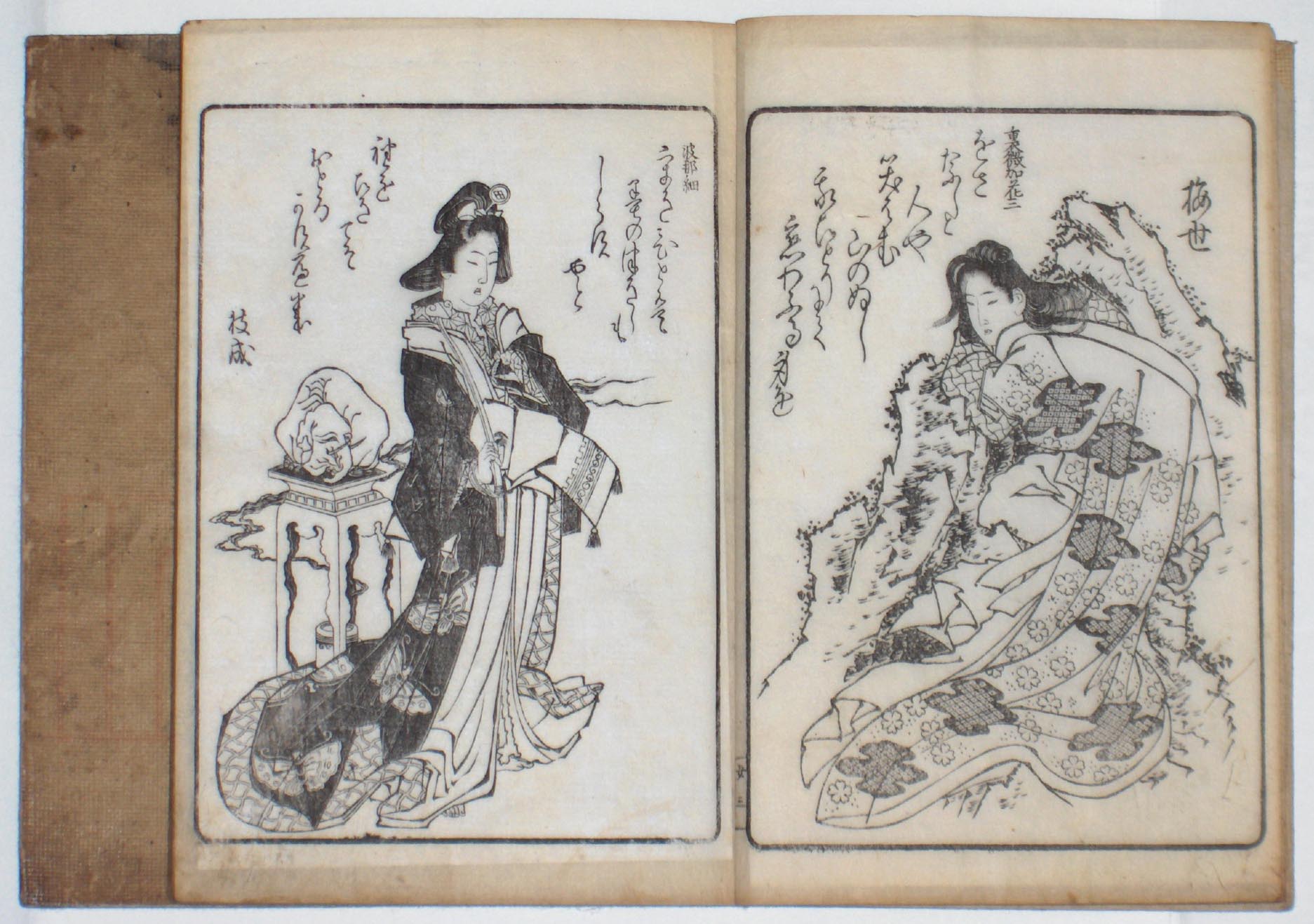
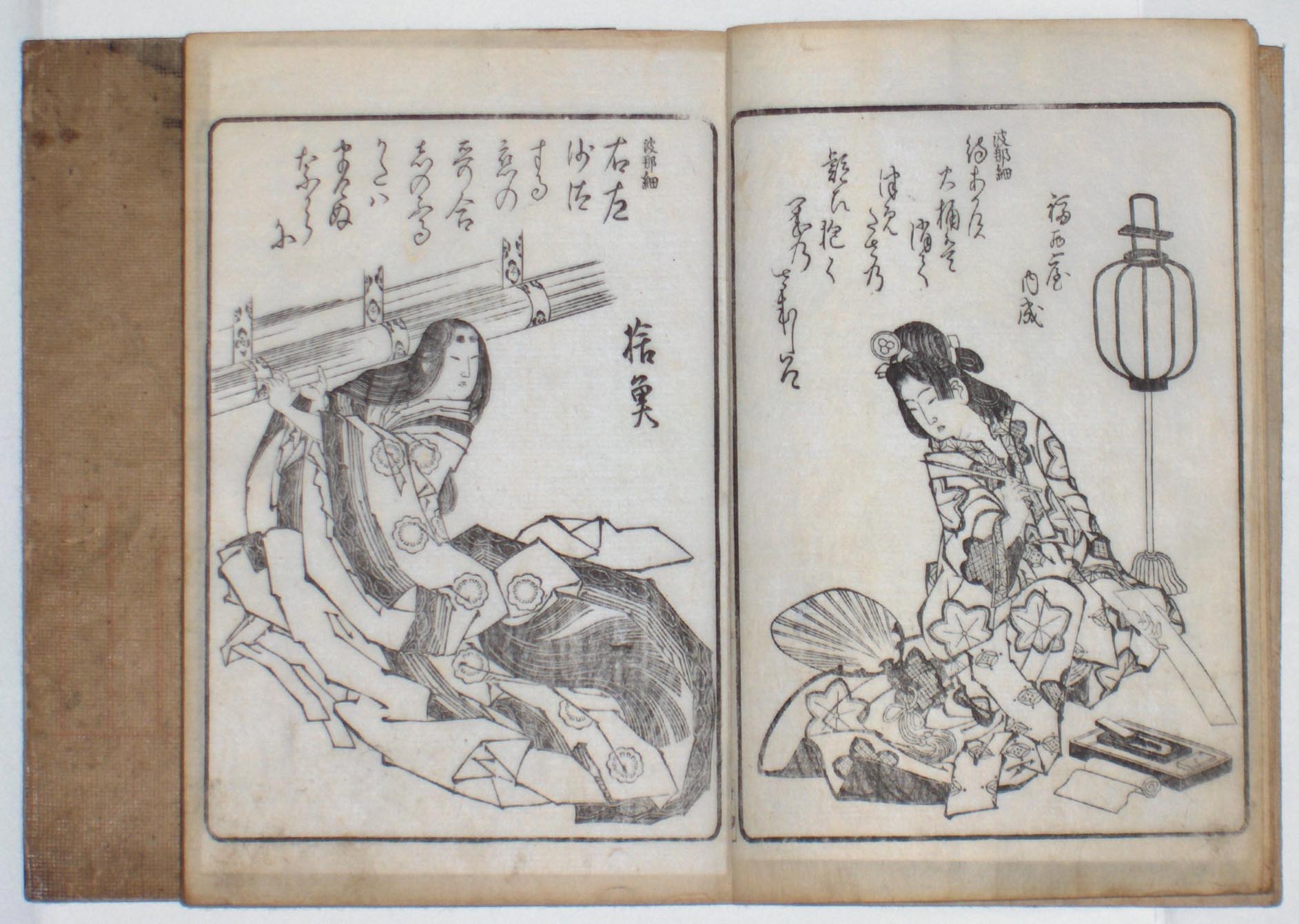
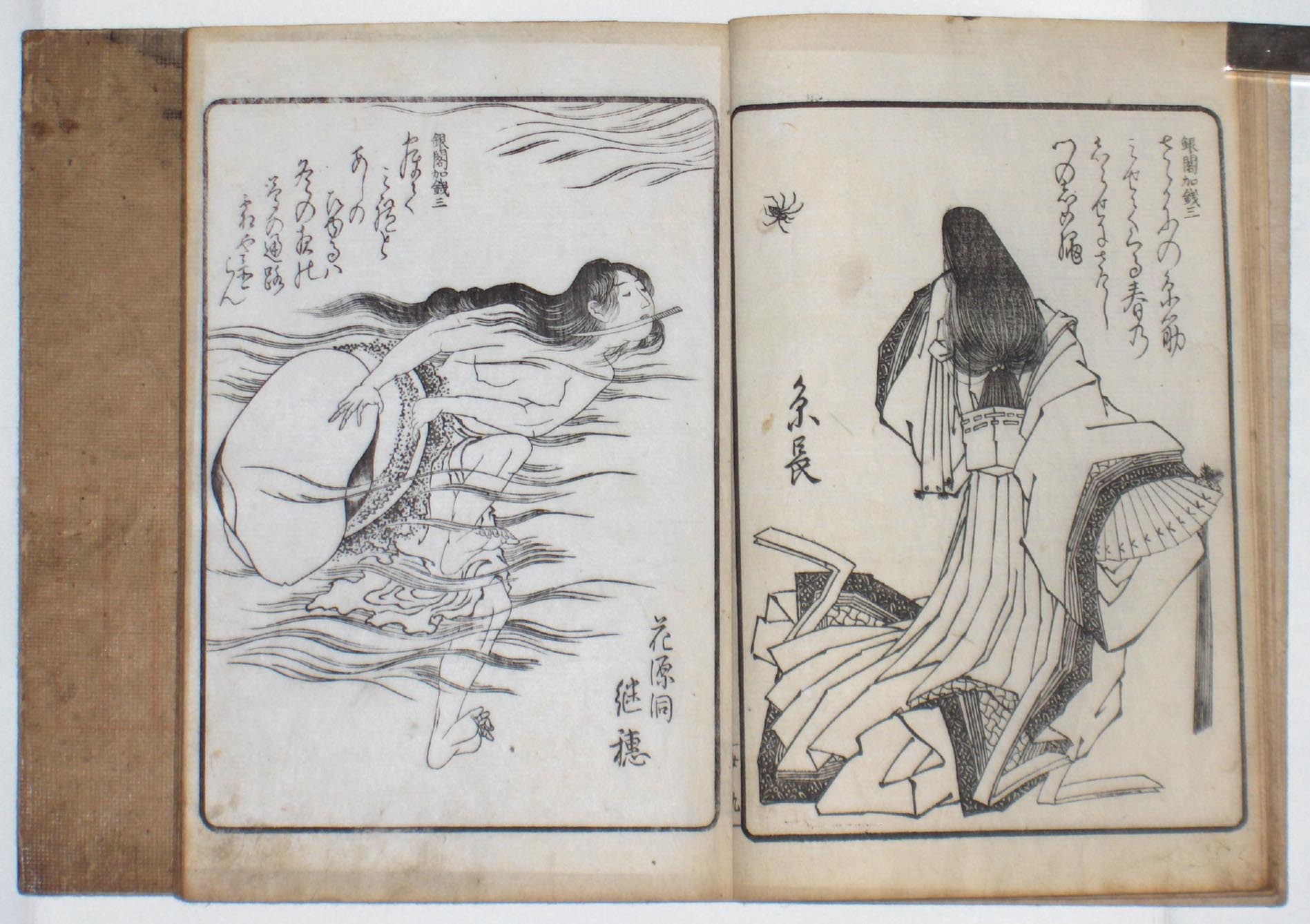
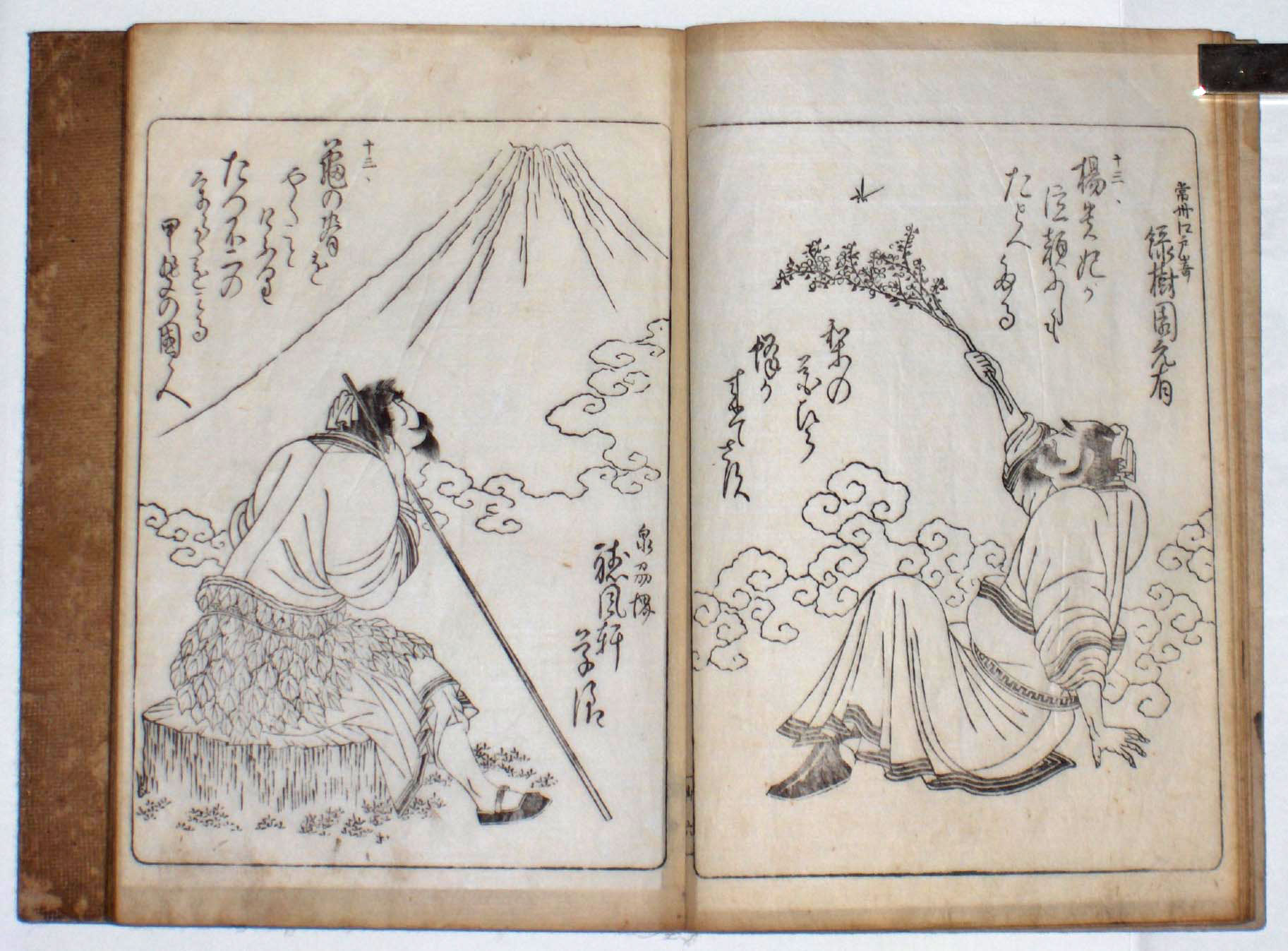
Onishi CHINNEN (1792-1851)
Click here to view image full size.
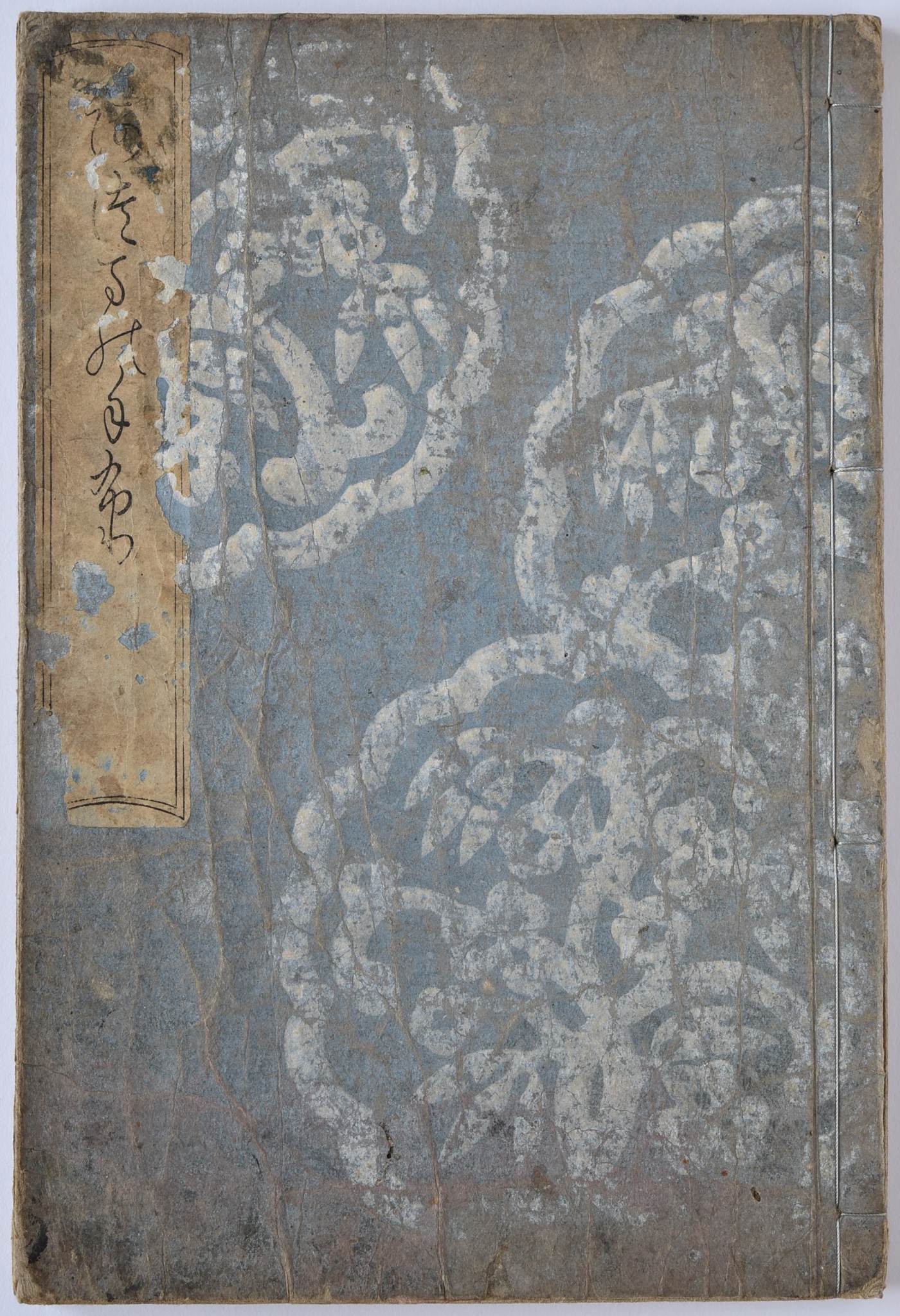
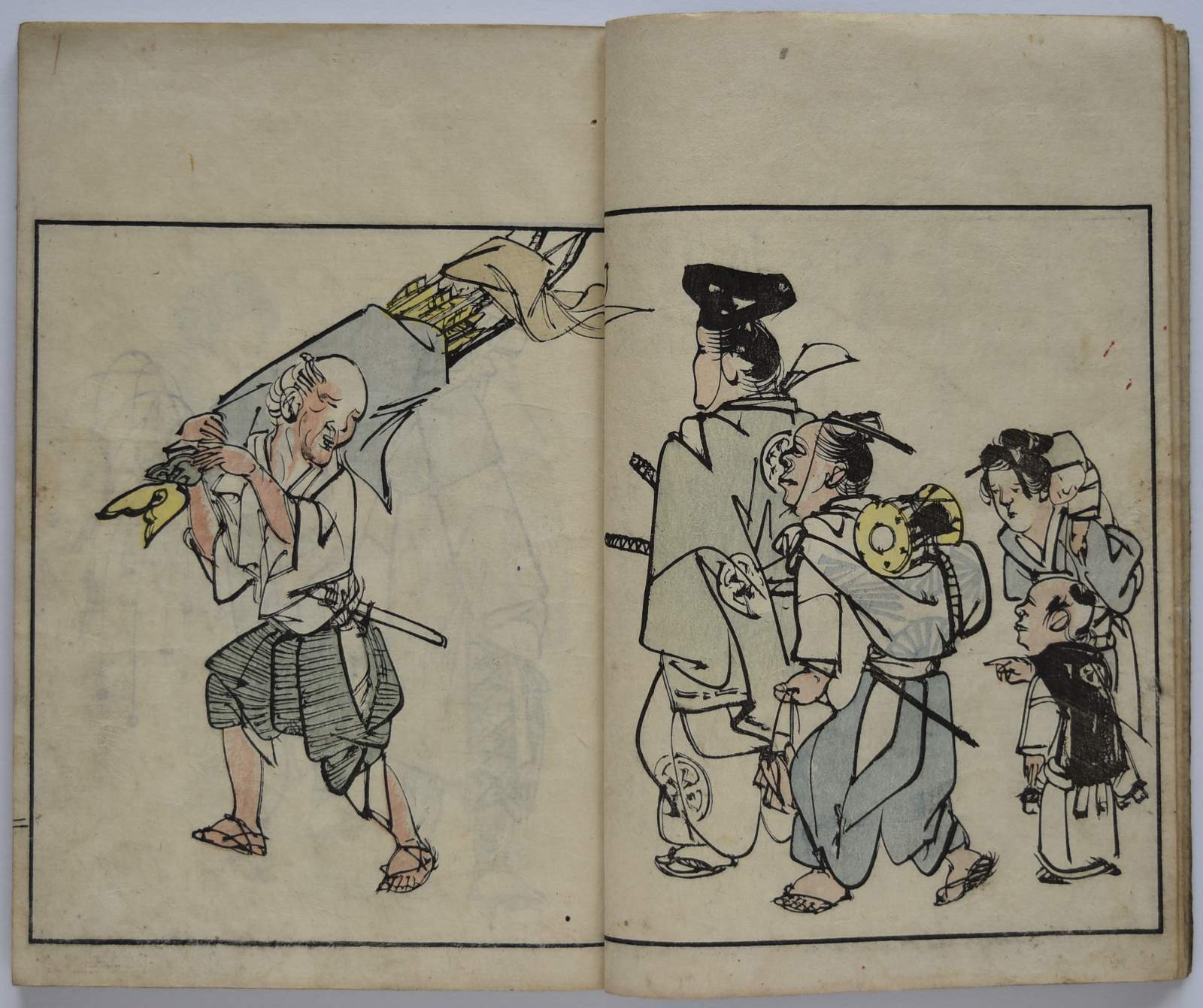
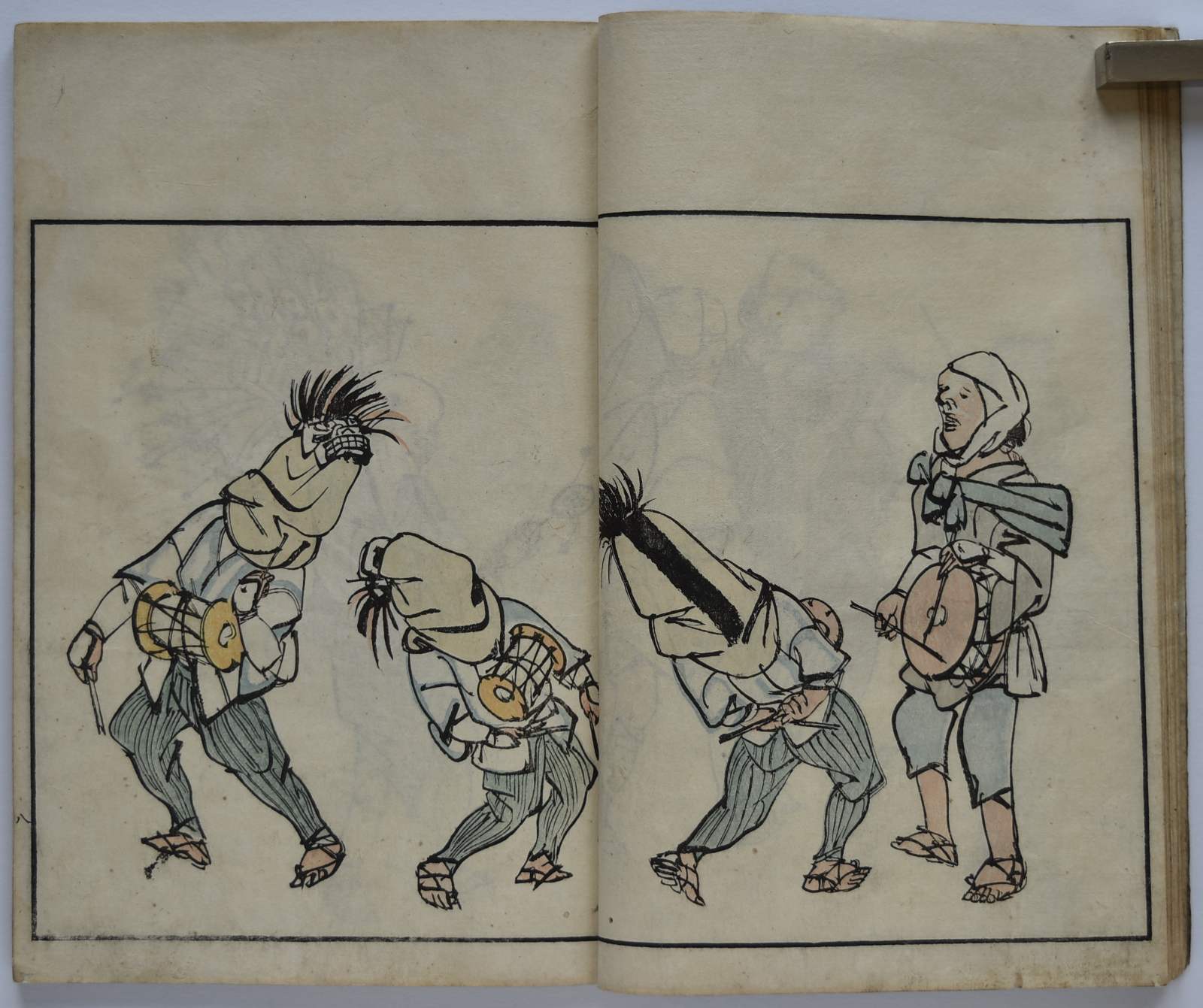
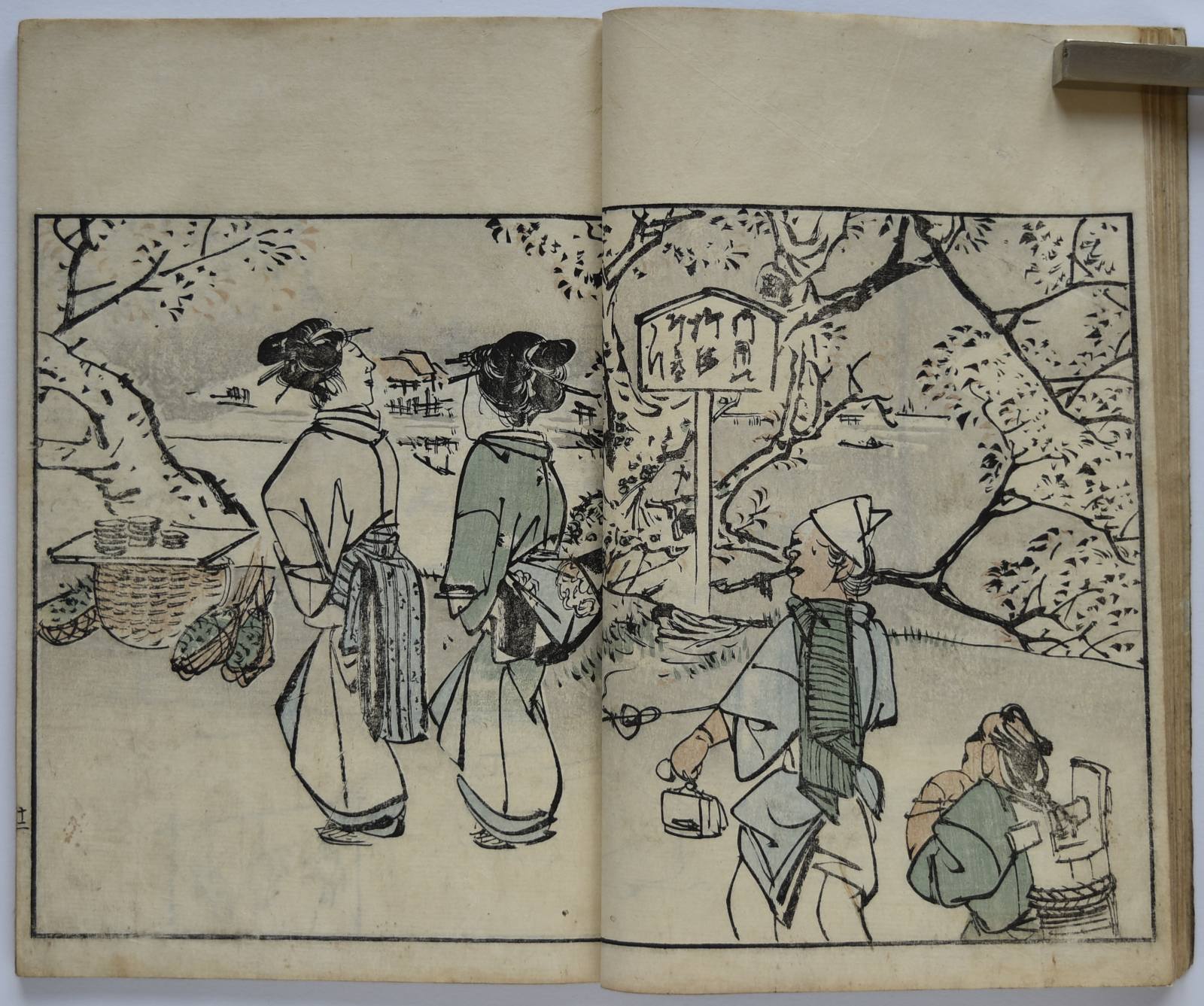
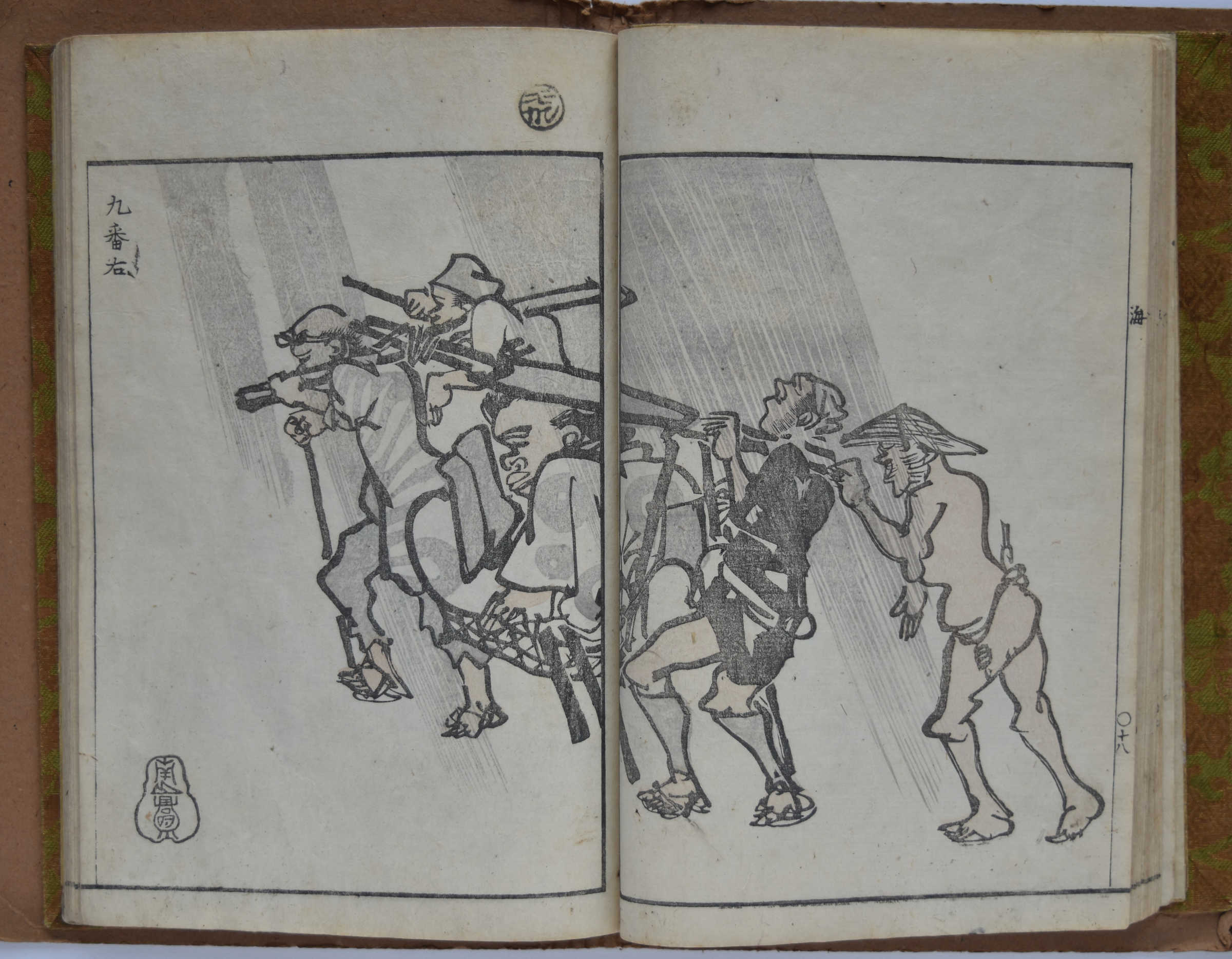
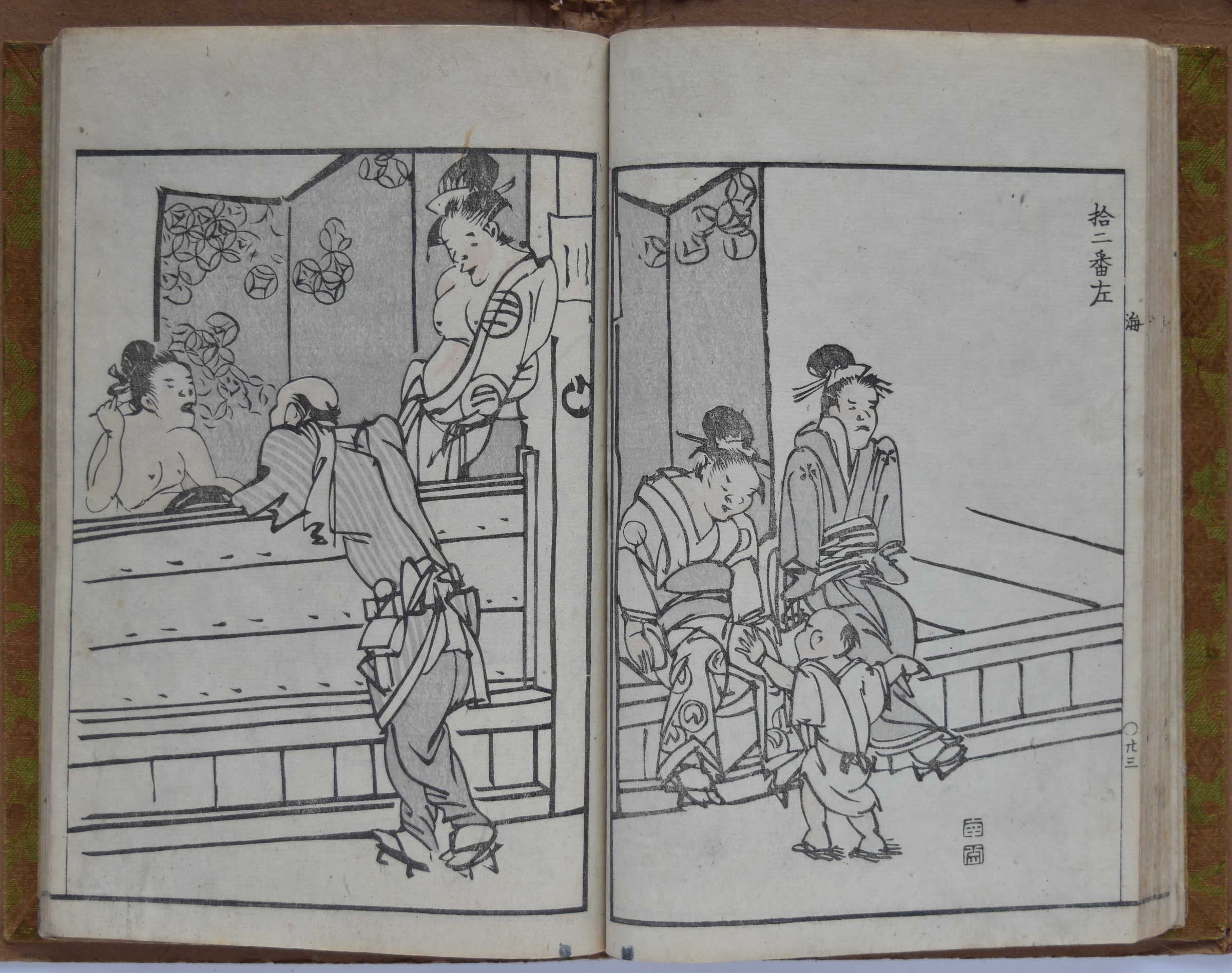
One volume complete Azuma no teburi, “Customs of the Eastern Capital”. Published Bunsei 12 (1829). Original covers, light blue-grey with silver stencilled decoration. Original title slip (damaged). Inside front cover title Taihei Uzo (the original title). Artist: Chinnen, and publisher Sonando. 25 double page illustrations showing the inhabitants of the capital going about their daily pursuits. Inside back cover: Colophon, dated Bunsei 12 (1829) and publishers Kobayashi Shimbei and Osakaya Gembei. Slight repared wormage and minor marks, but generally a nice copy of a fine shijo book.
Status: Sold
Maruyama OKYO (1733-1795)
Click here to view image full size.
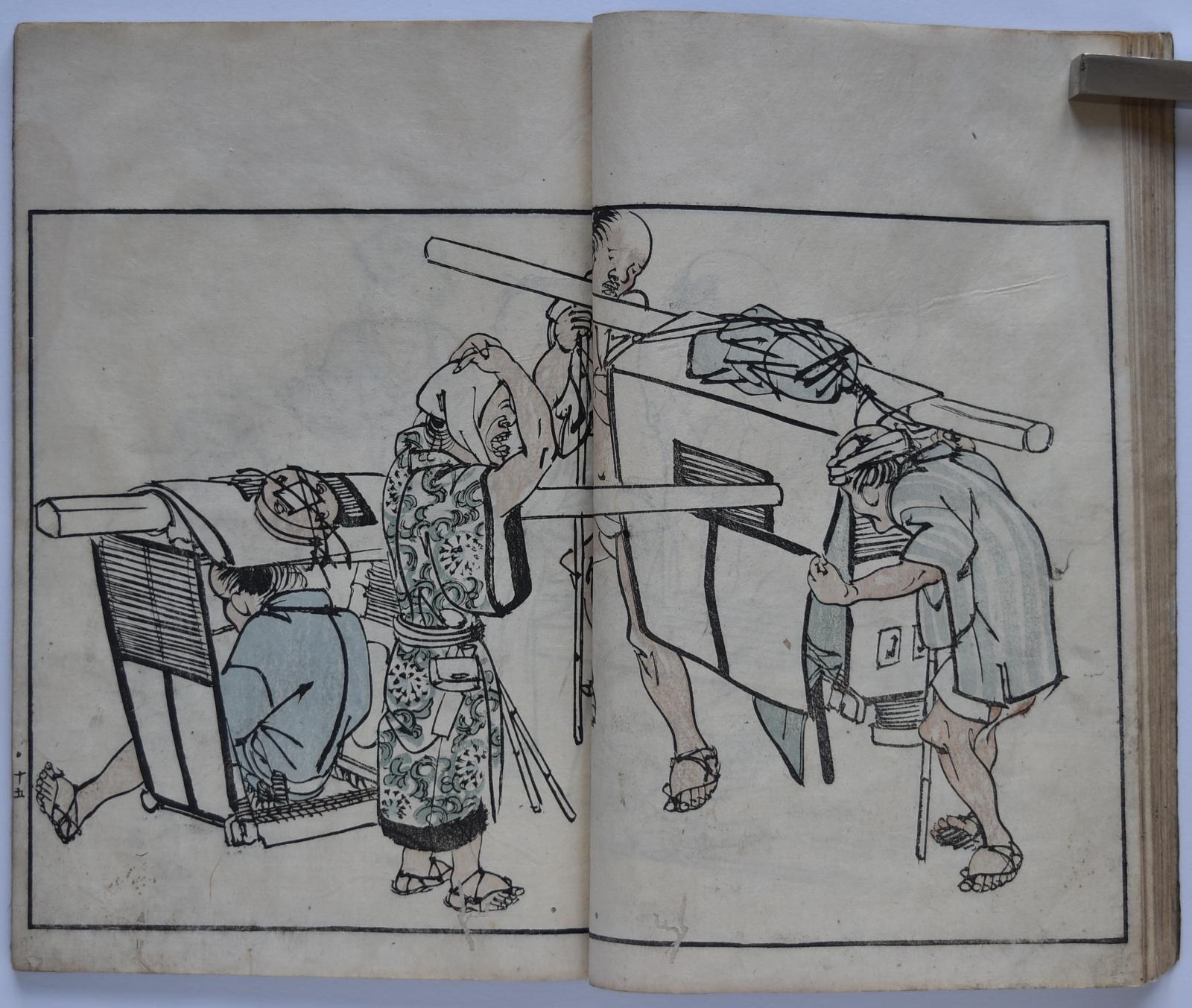
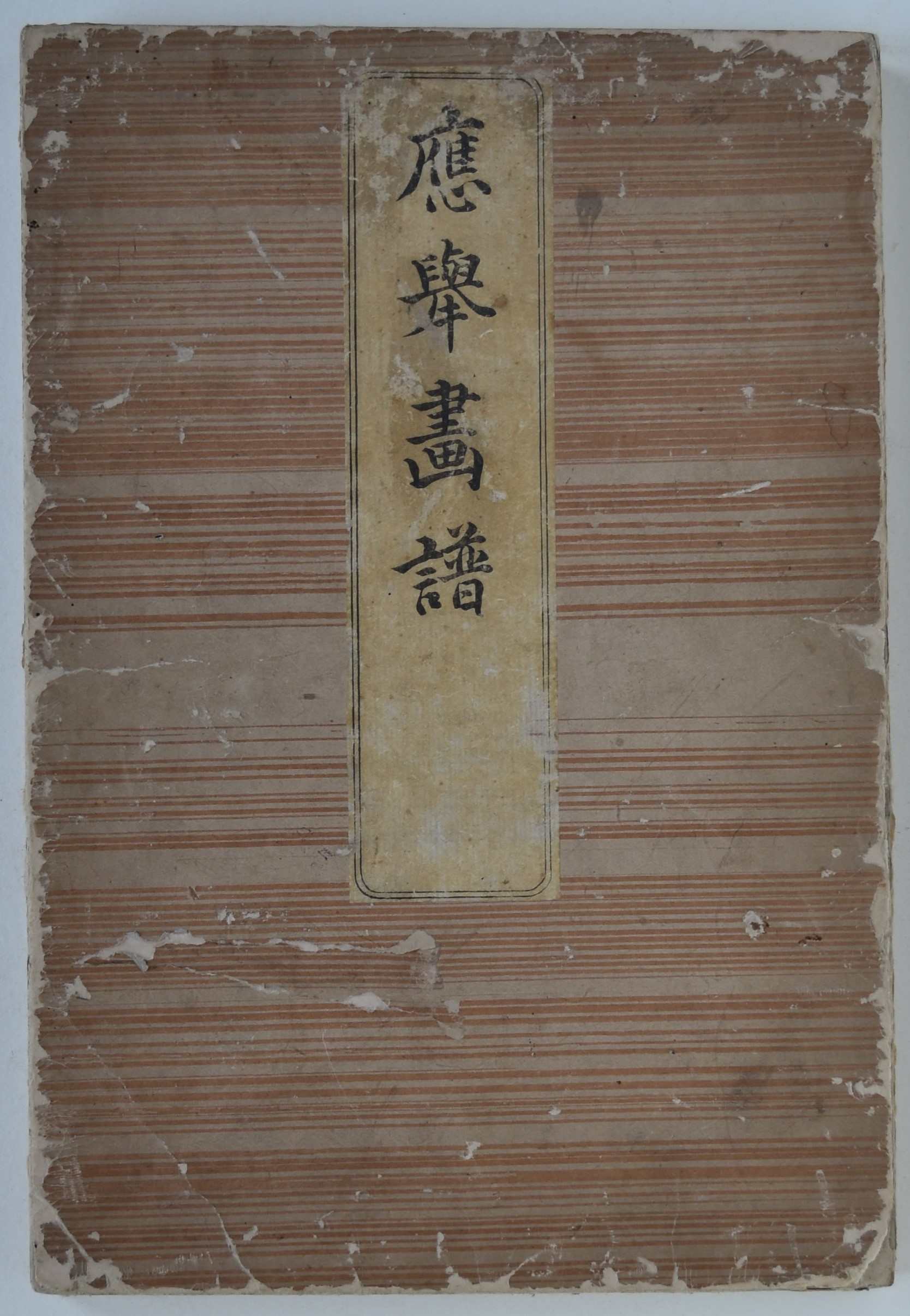
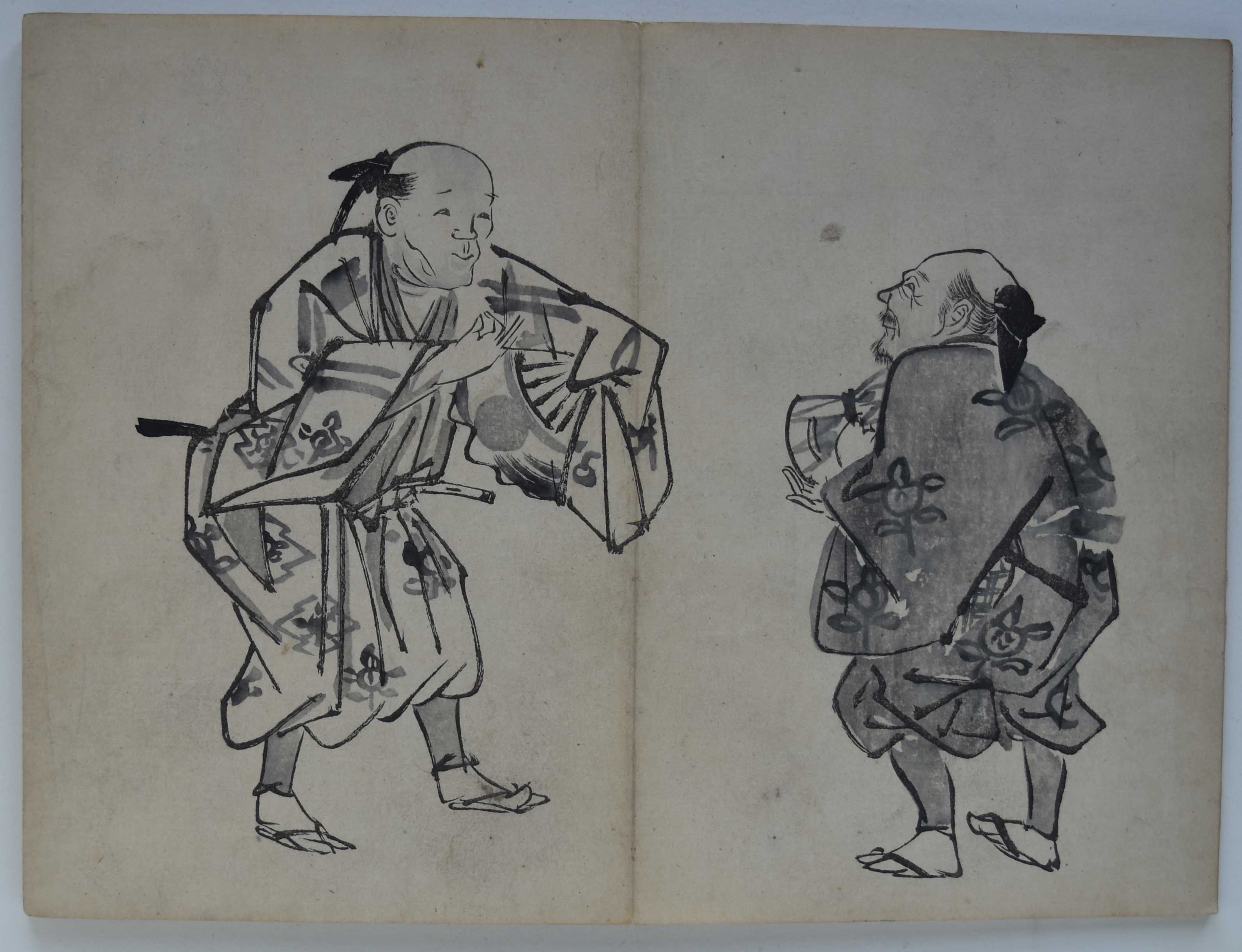
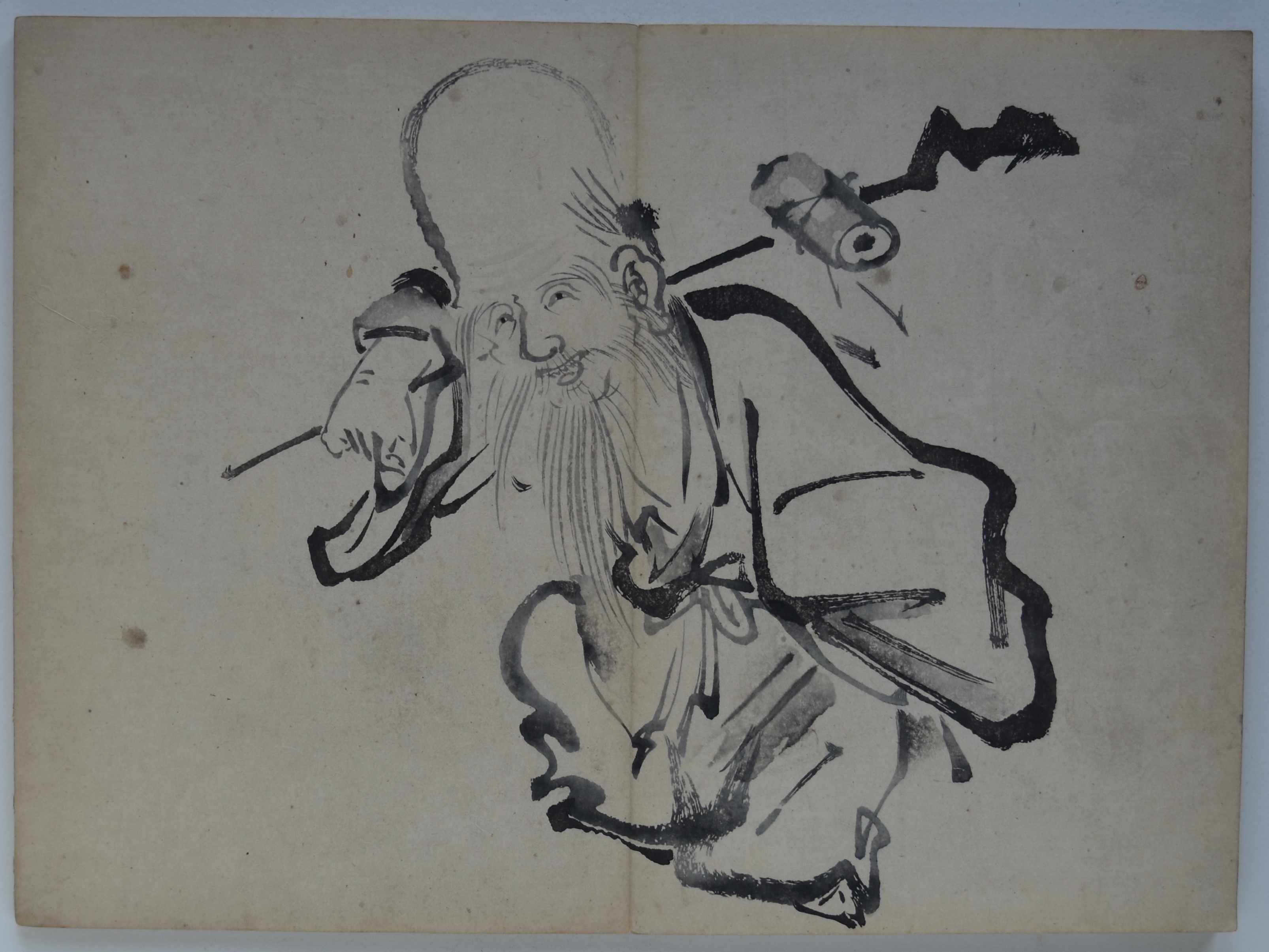
One volume complete Okyo gafu, “Book of Paintings by Okyo.” Original covers and title slip. A large book, 11.5 x 7.5 in; 28.4 x 19.2 cms folding out to 11.5 x 15 in; 28.4 x 38 cms. Published by Hishiya Magobe. Dated 1833 but first published 1850 (dated Kaei 3 [1850] at end). Twenty-four pages of sumi illustrations based on Okyo’s paintings. Arguably the most important Maruyama-Shijo painter. A tour de force of the block-cutters’ art replicating Okyo’s brush strokes. Minor imperfections but otherwise a very nice example of this work. Mitchell, p.441, example “A.”
A fascinating historical document. Some slight separation in the scrolls, but otherwise in very good condition. Various signatures and seals.
Status: Sold
Utagawa KUNISADA (1786-1864)
Click here to view image full size.
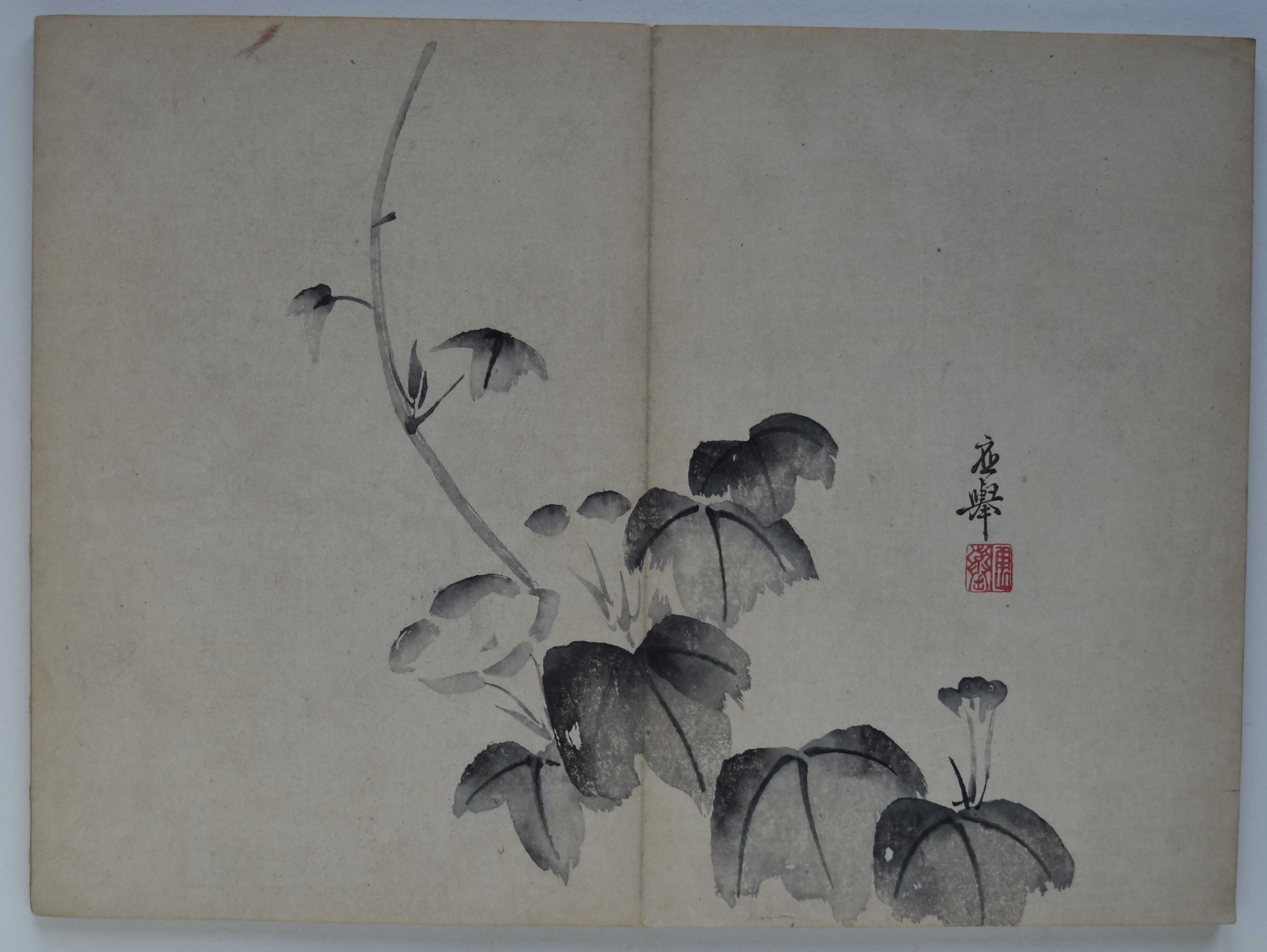
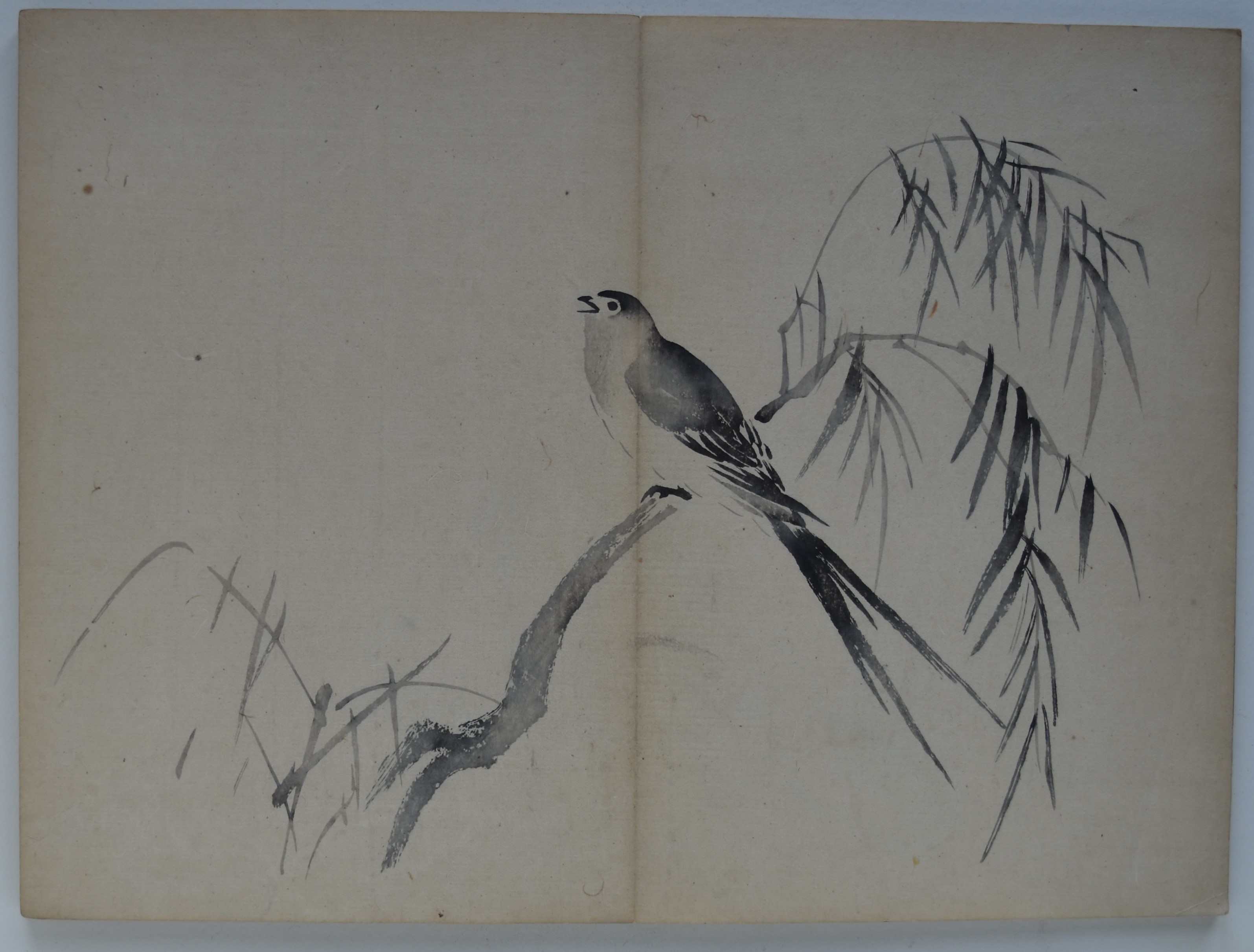
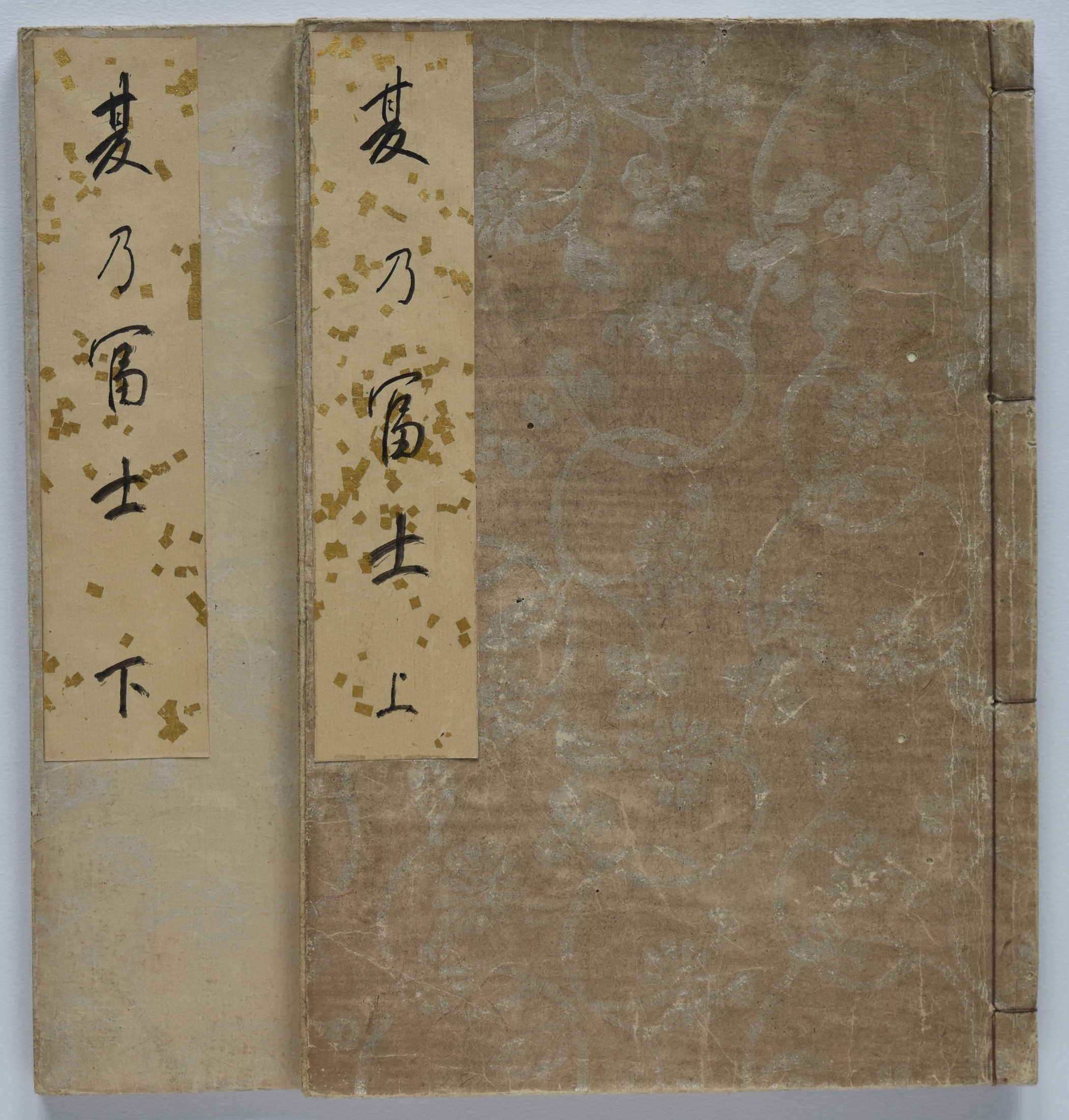
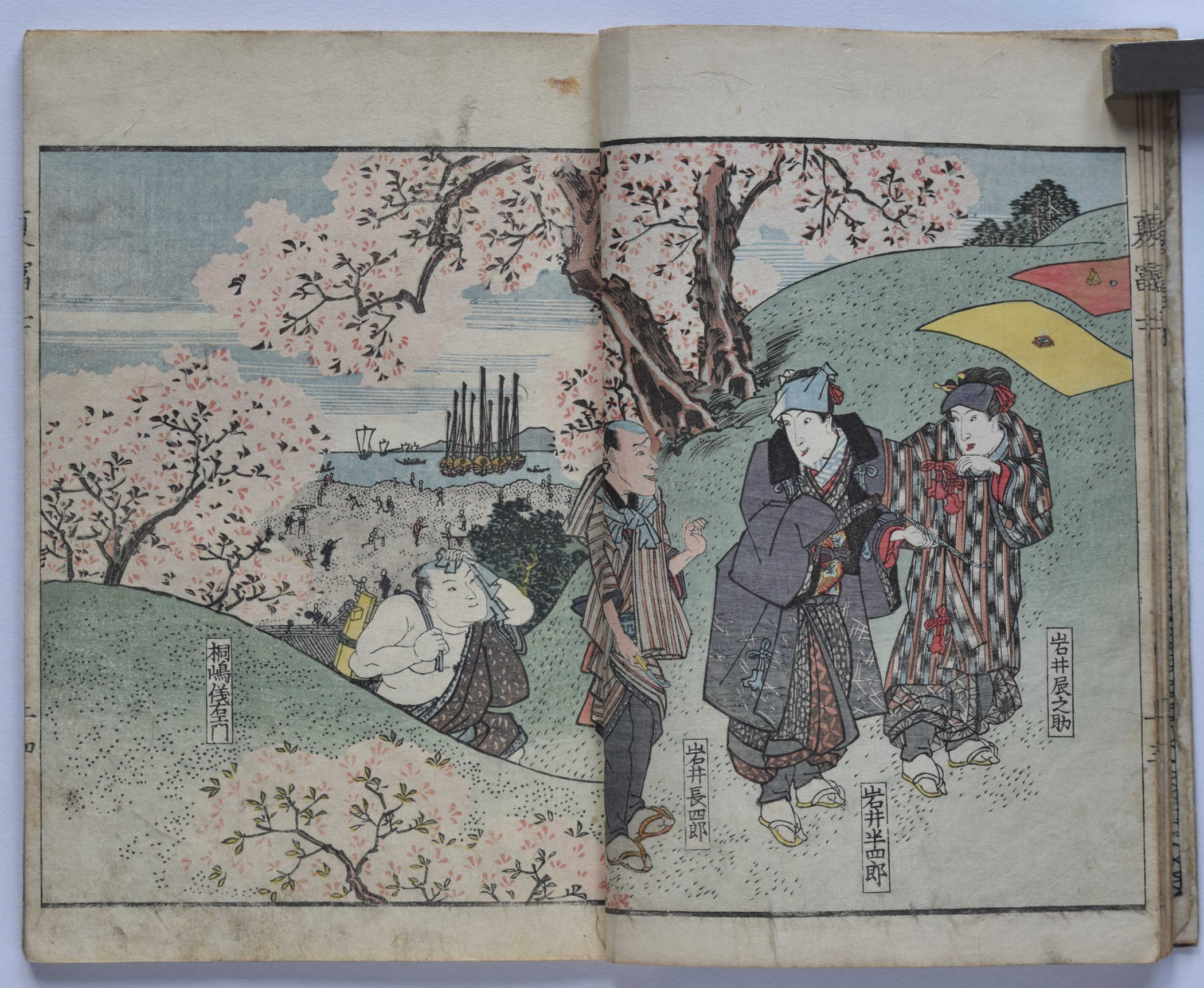
Two volumes complete Yakusha sugao natsu no Fuji, “Portraits of Actors Compared to Fuji in the Summer.” (In other words, without white makeup.) Vol. one: Preface signed Santoan Kyozan. Frontispiece illustration showing Mt. Fuji and nine double-page illustrations of actors and their acolytes in a variety of pursuits offstage. Postscript dated Bunsei 11 (1828). Vol: two: Preface by Tsuruya Namboku IV dated 9/1827. Frontispiece illustration showing a washbowl and fan and nine double-page illustrations of actors from Edo, Kyoto and Osaka. Postscript signed Kochoro Utagawa Kunisada ga with seal Gotokan to tekichoku ko and the publishers: Tsuruya Kiemon; Yamamoto Kyubei; Eijudo (Nishimuraya Yohachi); Kansendo (Izumiya Ichibei); Kinrindo (Moriya Jihei). This fascinating book shows actors in and around their residencies. Replaced title slips and covers. Fine impressions and very good colour. Minor marks and thumbing. Rare.
Status: Sold
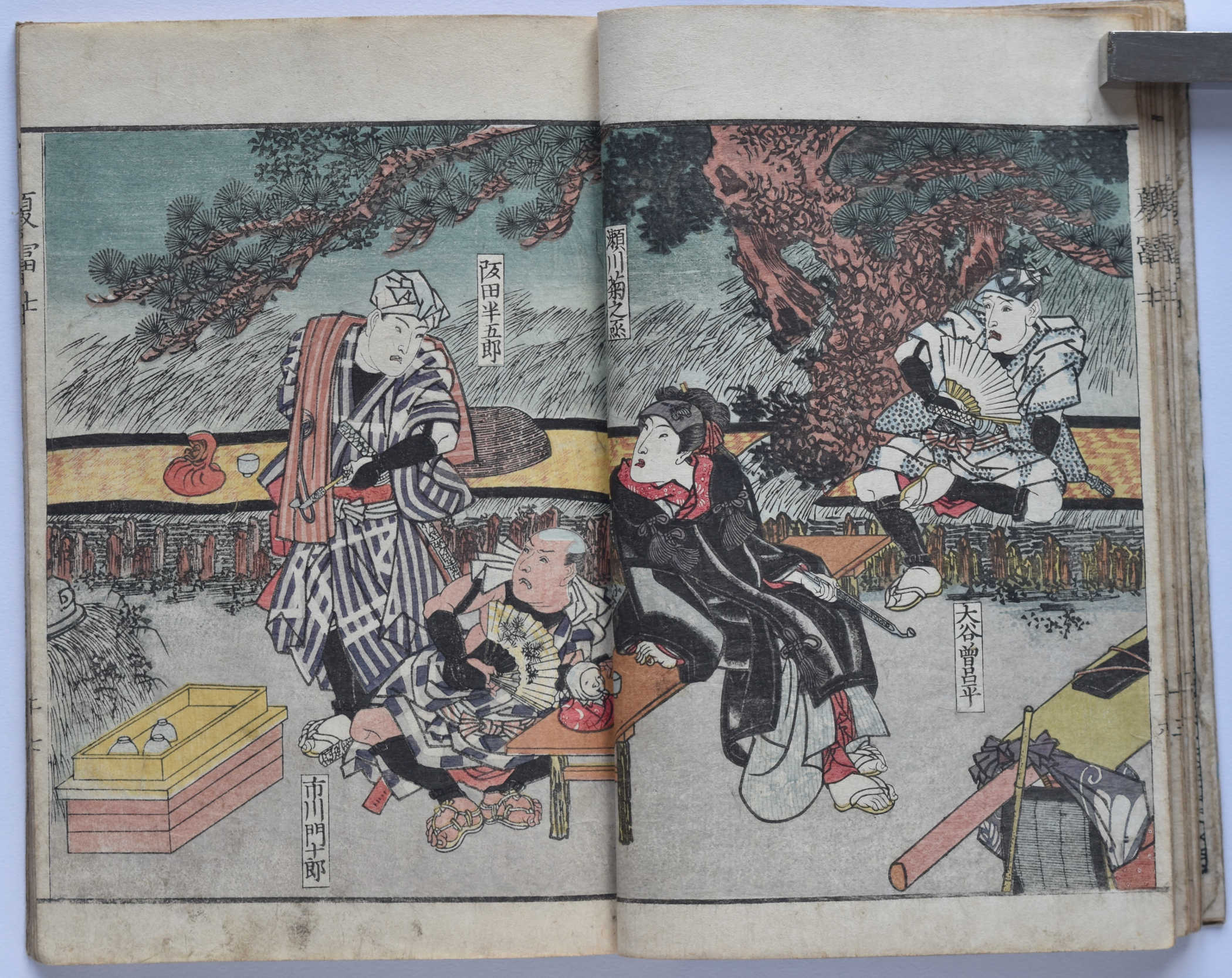
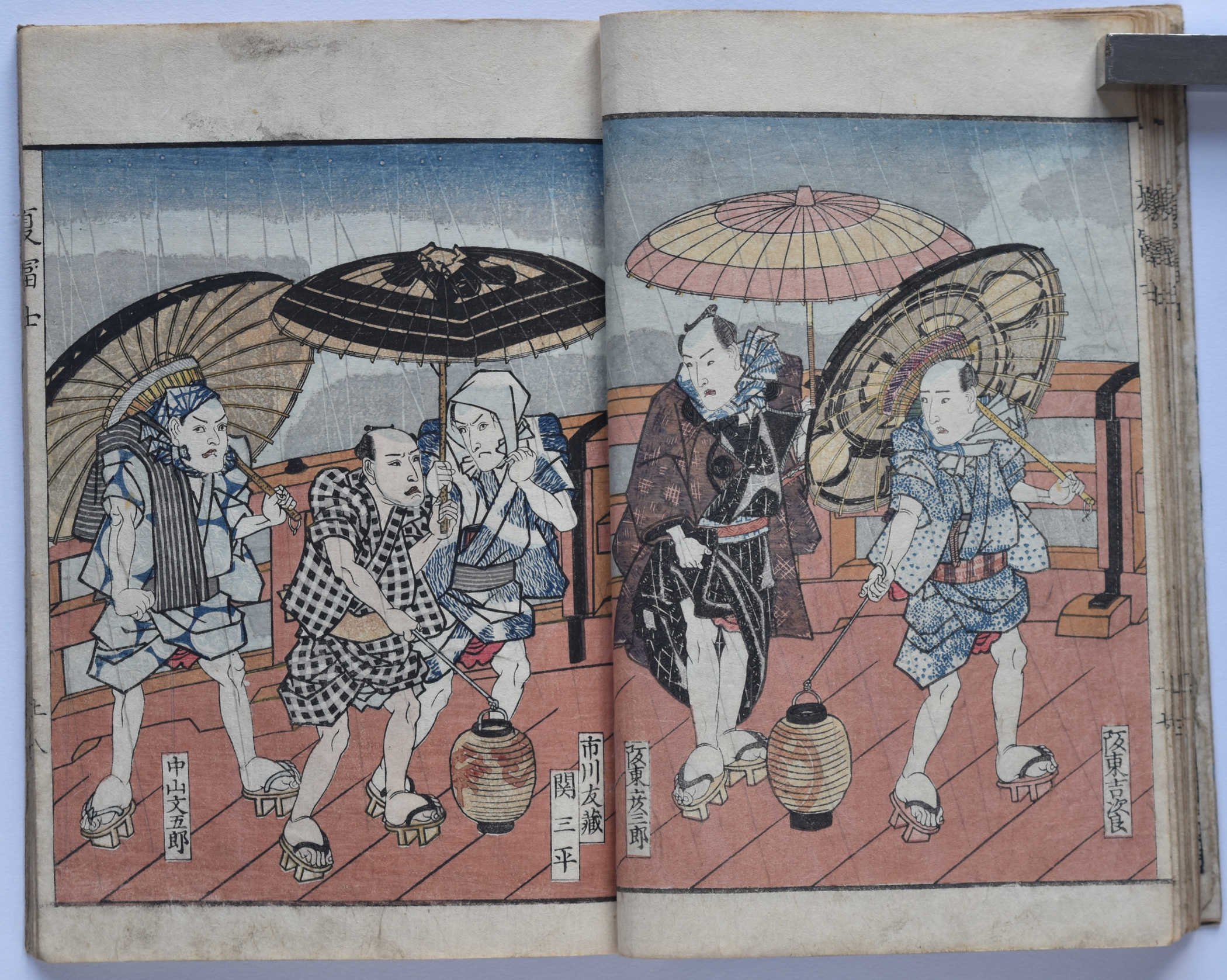
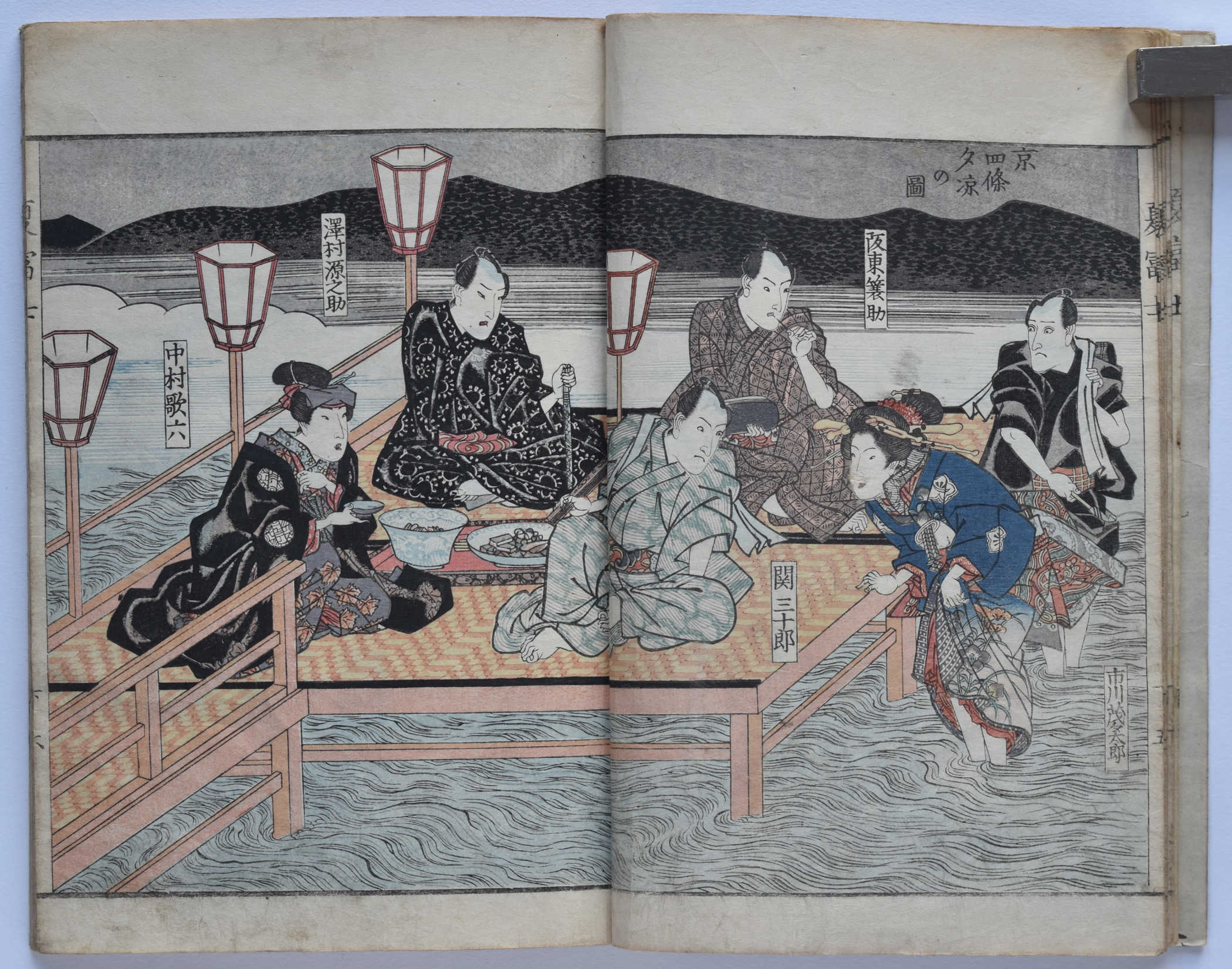
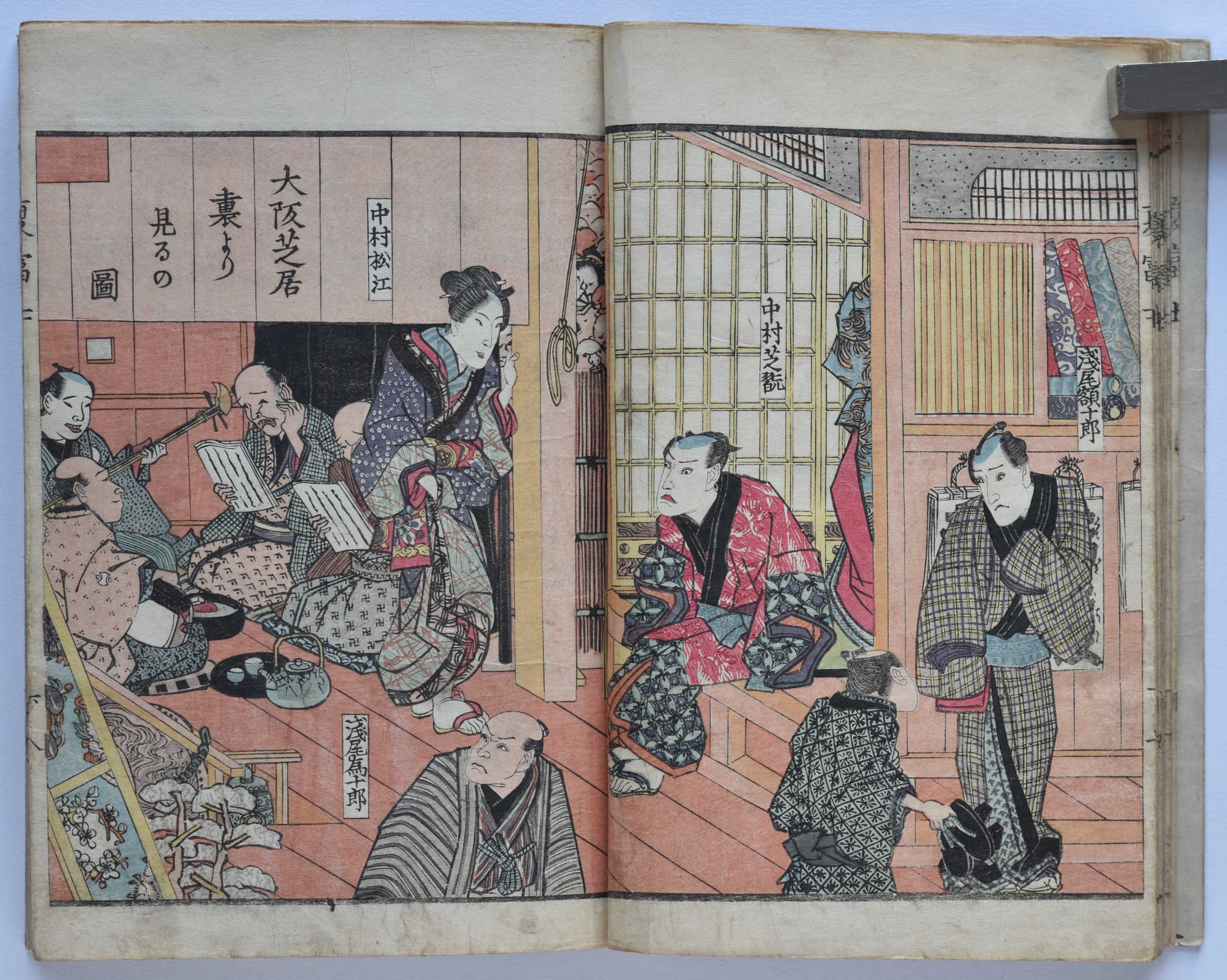
Utagawa HIROSHIGE (1797-1858) and Utagawa YOSHITORA (active c. 1850-1880)
Click here to view image full size.
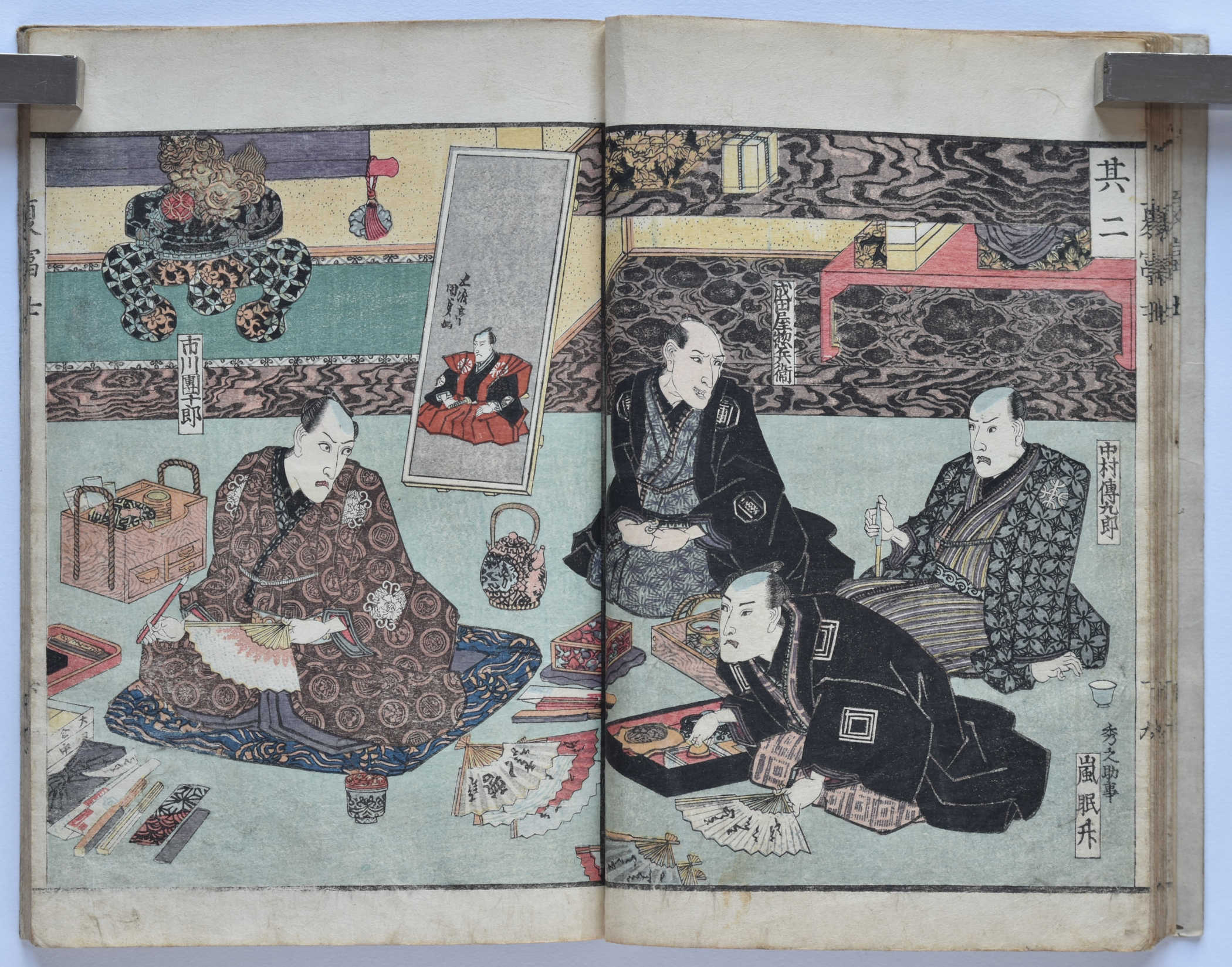
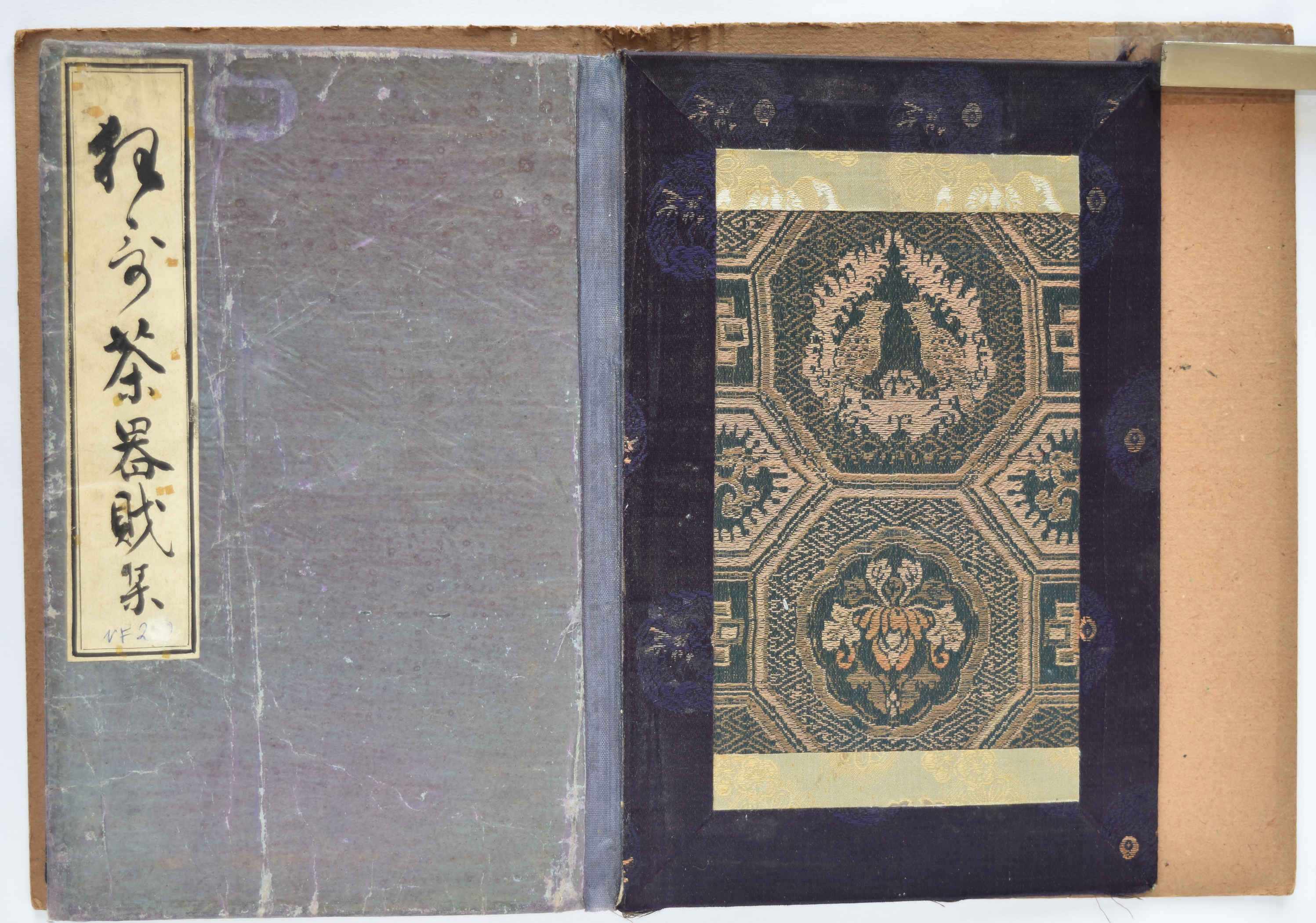
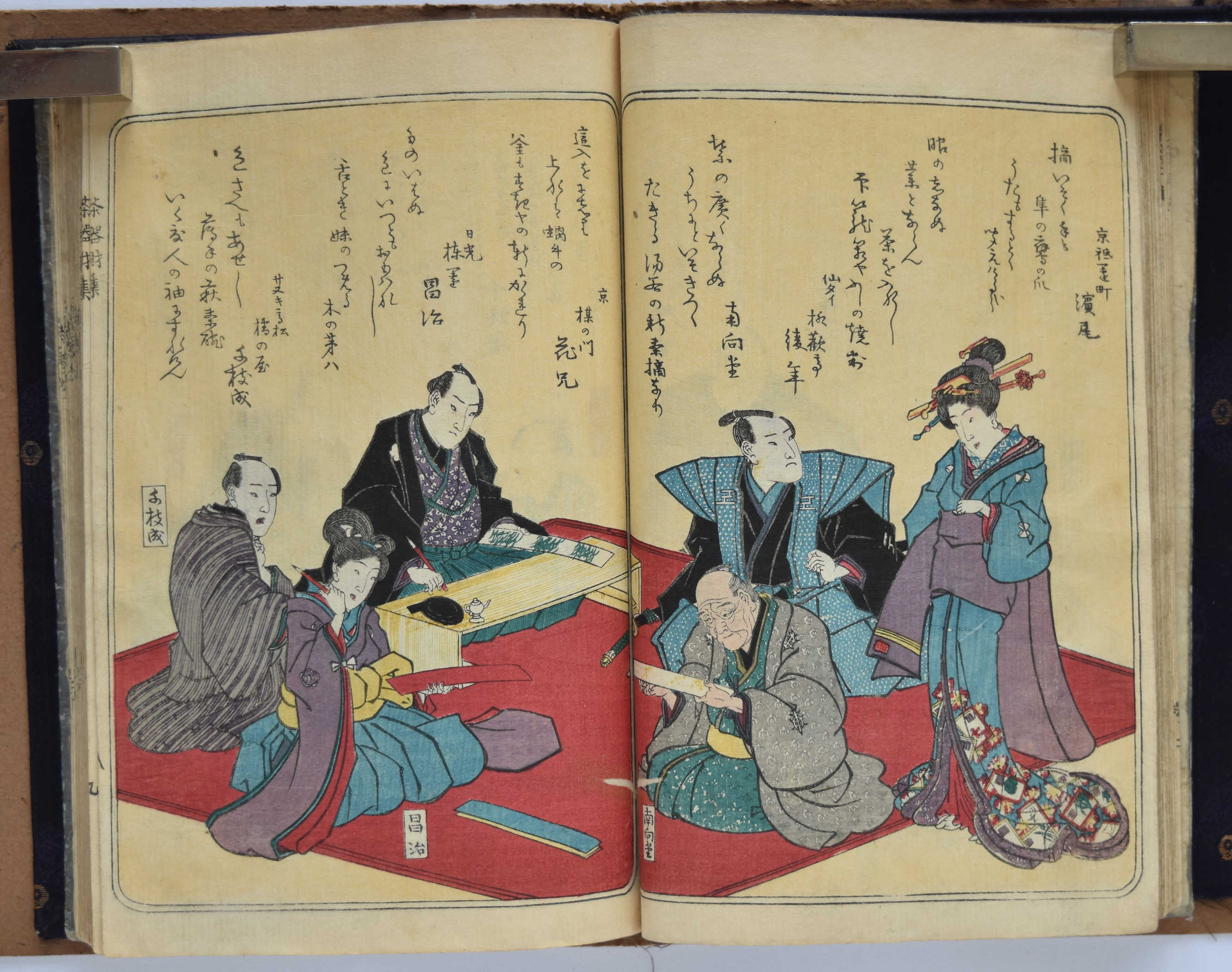
One volume complete Kyoka chakizai gazoshu, “Tea Ceremony Utensils, a Kyoka Collection.” Published Ansei 2, 1855 by Seiryuteizo. Inside front cover artists given as Ichiryusai Hiroshige and Ichimosai Yoshitora. Three pages preface; three pages decorative labels; four pages landscapes by Hiroshige (including the Uji River – a prime tea growing area); twelve pages of portraits by Yoshitora; twenty-one pages kyoka poems. Original covers with a hand inscribed title slip. Ex collection Edmond de Goncourt with his brocade binding and imitation wood slipcase. In very good condition.
Status: Sold

Utagawa HIROSHIGE (1797-1858)
Click here to view image full size.
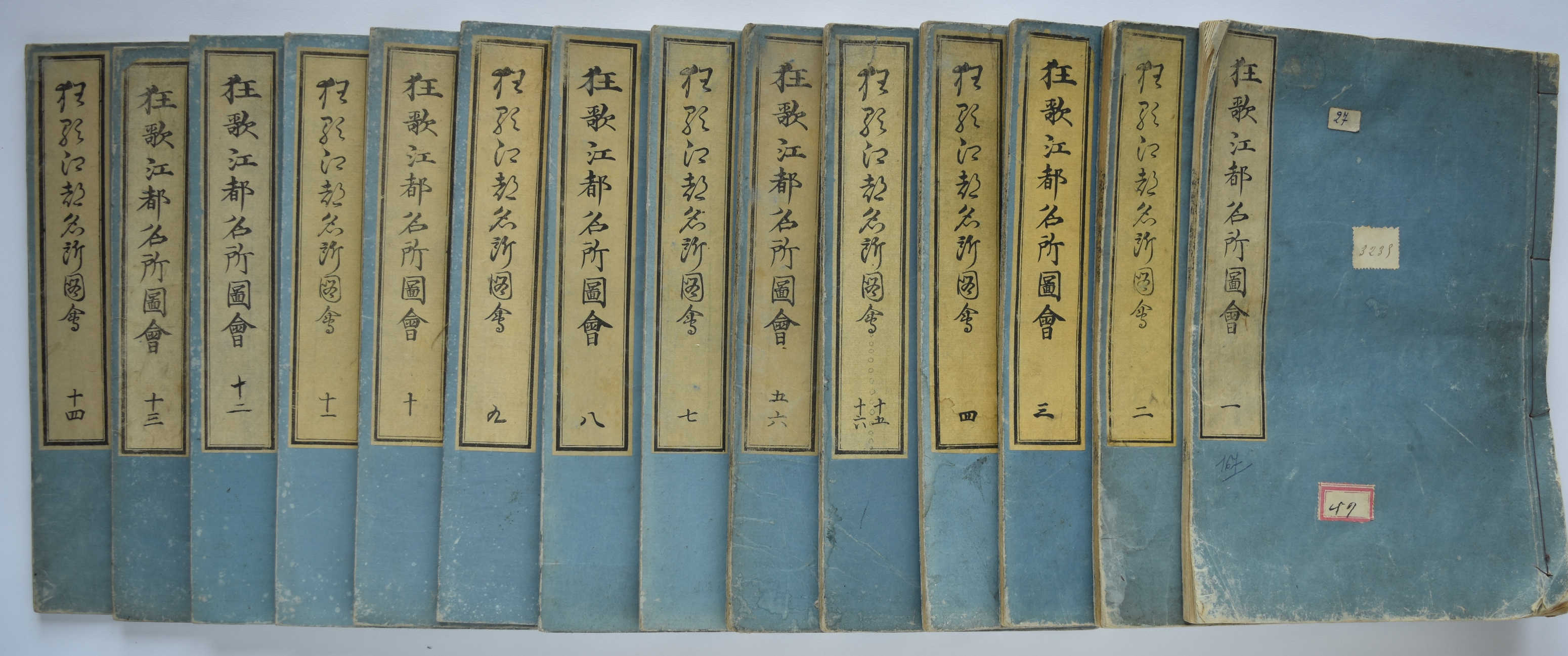
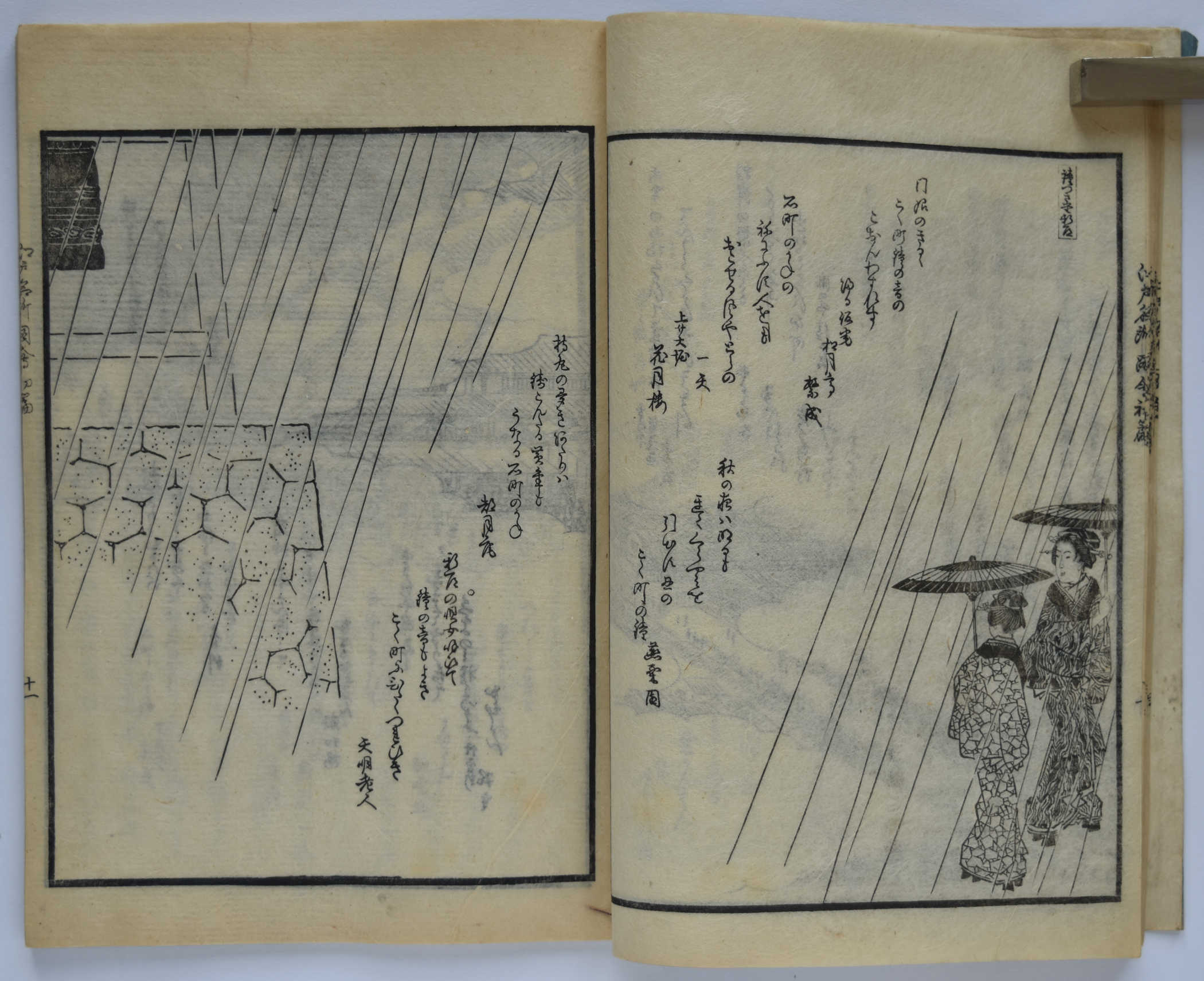
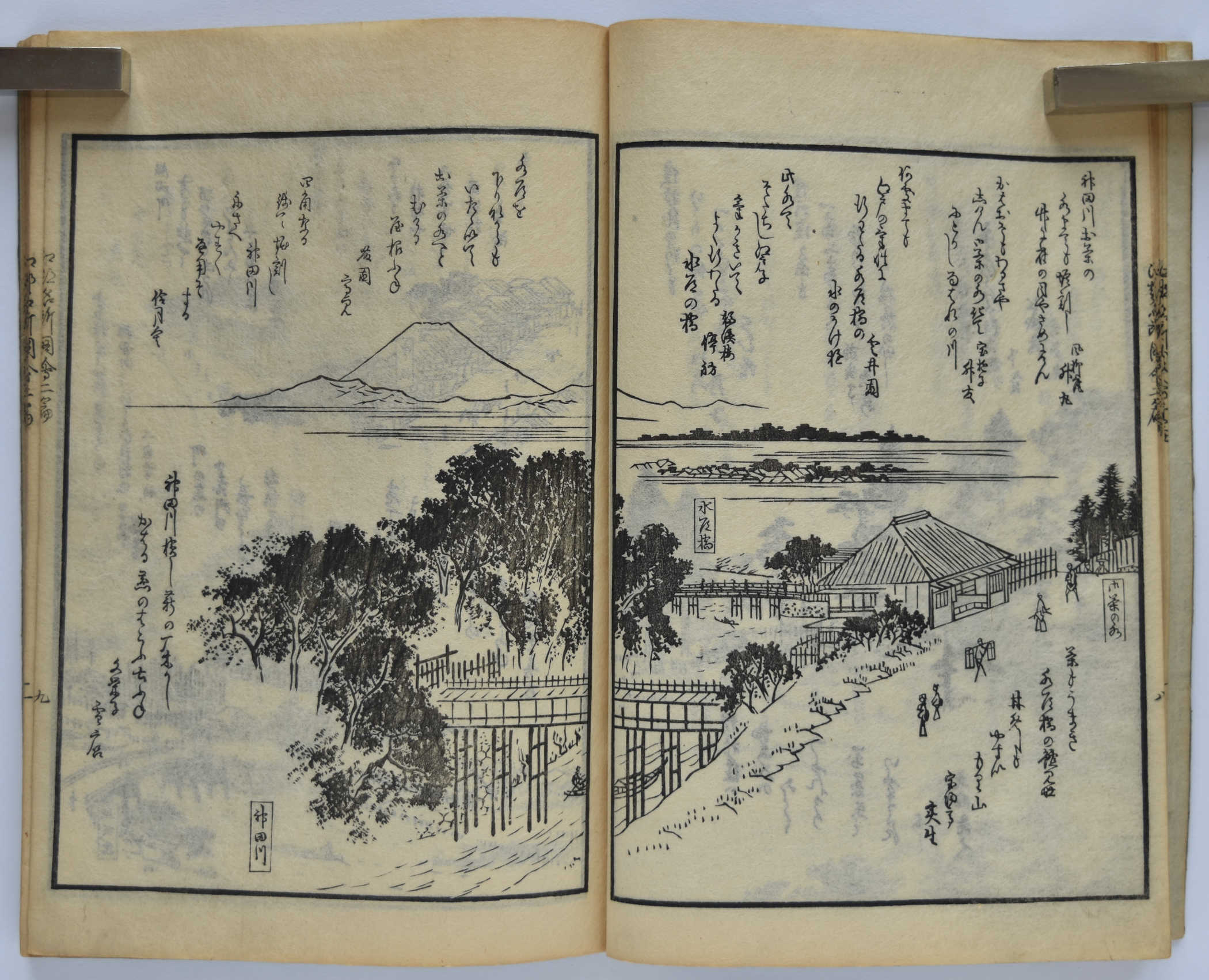
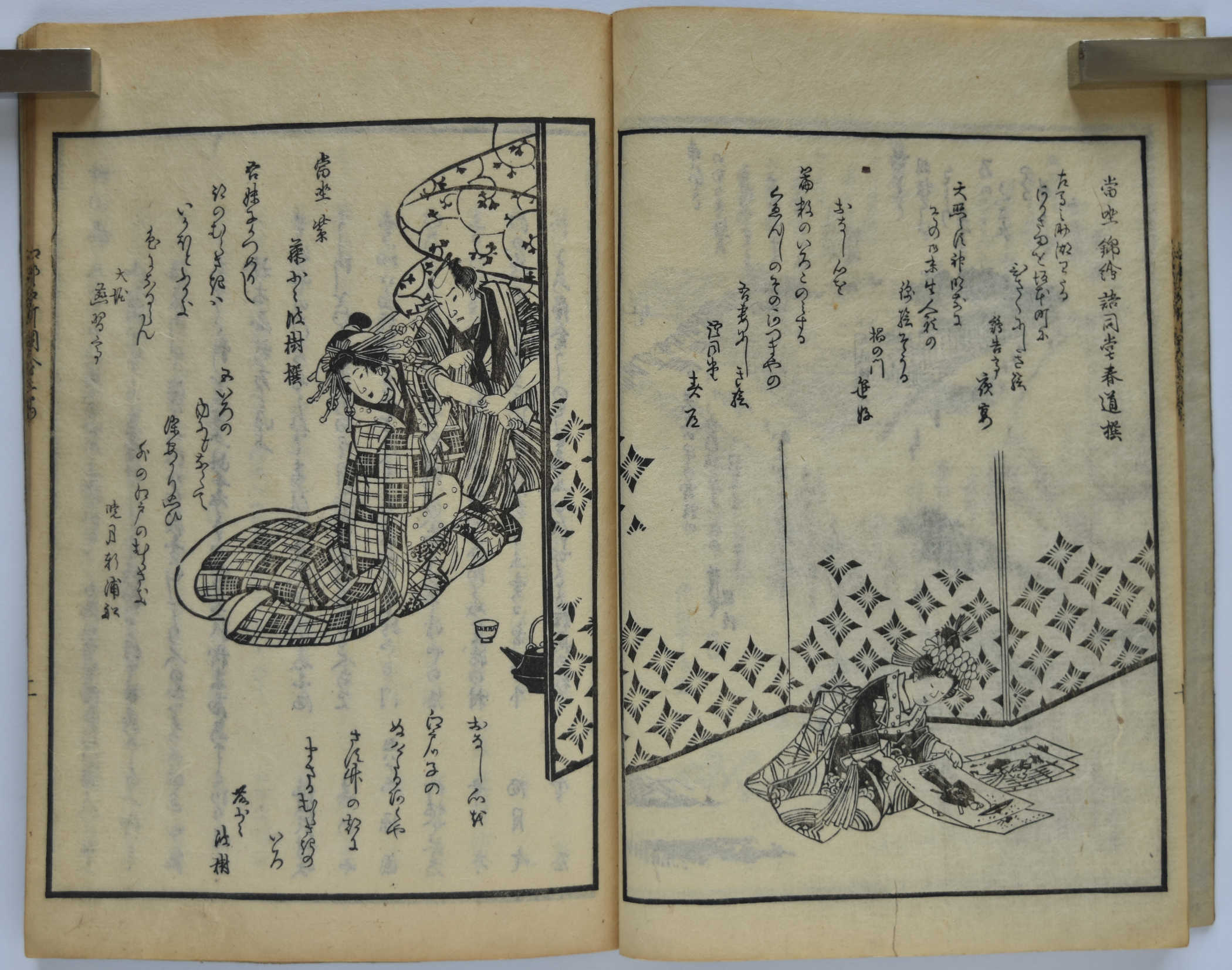
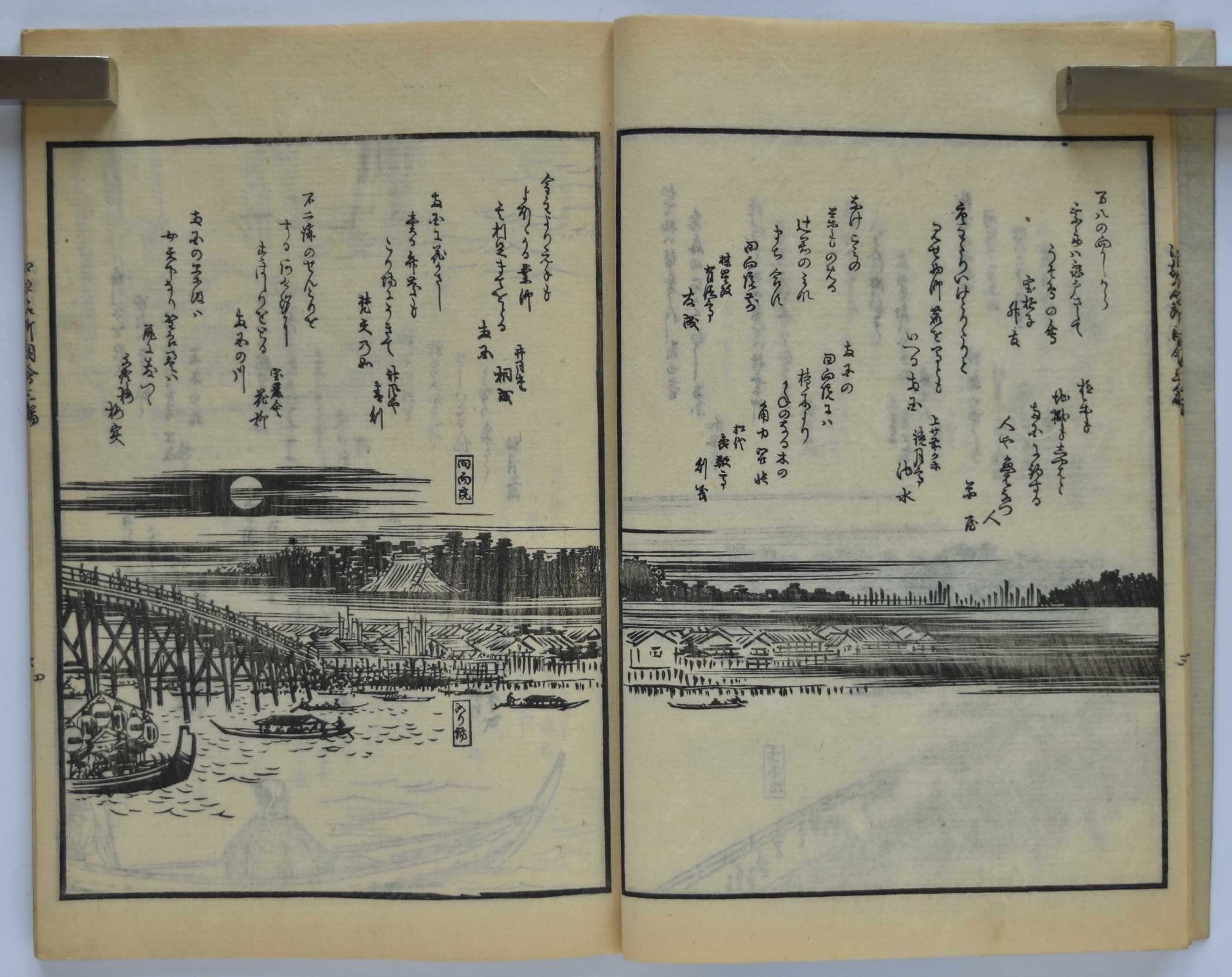
A complete set of Kyoka Edo meisho zue, “Collection of Pictures of the Famous Places of Edo in Kyoka.” Fourteen volumes (sixteen books) dated Ansei 3, 1856. Artist: Ryusai Hiroshige ga, with volumes fifteen and sixteen being by Hiroshige II. Compiler of poems: Tenmei Rojin. Publisher not given. Book 1: 25 sheets, 11 illustrations. Book 2: 24 sheets, 10 illustrations. Book 3: 23 sheets, 10 illustrations. Book 4: 19 sheets, 9 illustrations. Books 5-6: 34 sheets, 15 illustrations. Book 7: 22 sheets, 9 illustrations. Book 8: 21 sheets, 9 illustratins. Book 9: 22 sheets, 9 illustrations. Book 10: 21 sheets, 8 illustrations. Book 11: 14 sheets, 6 illustrations. Book 12: 18 sheets, 7 illustrations. Book 13: 16 sheets, 6 illustrations. Book 14: 16 sheets, 8 illustrations. Books 15-16: 23 sheets, 9 illustrations. The monochrome illustrations show the popular life of Edo as well as the views. Original covers and title slips.
In very good condition. Rare complete.
Status: Sold
Kawamura BUMPO (1779-1821) and Watanabe NANGAKU (1763-1813)
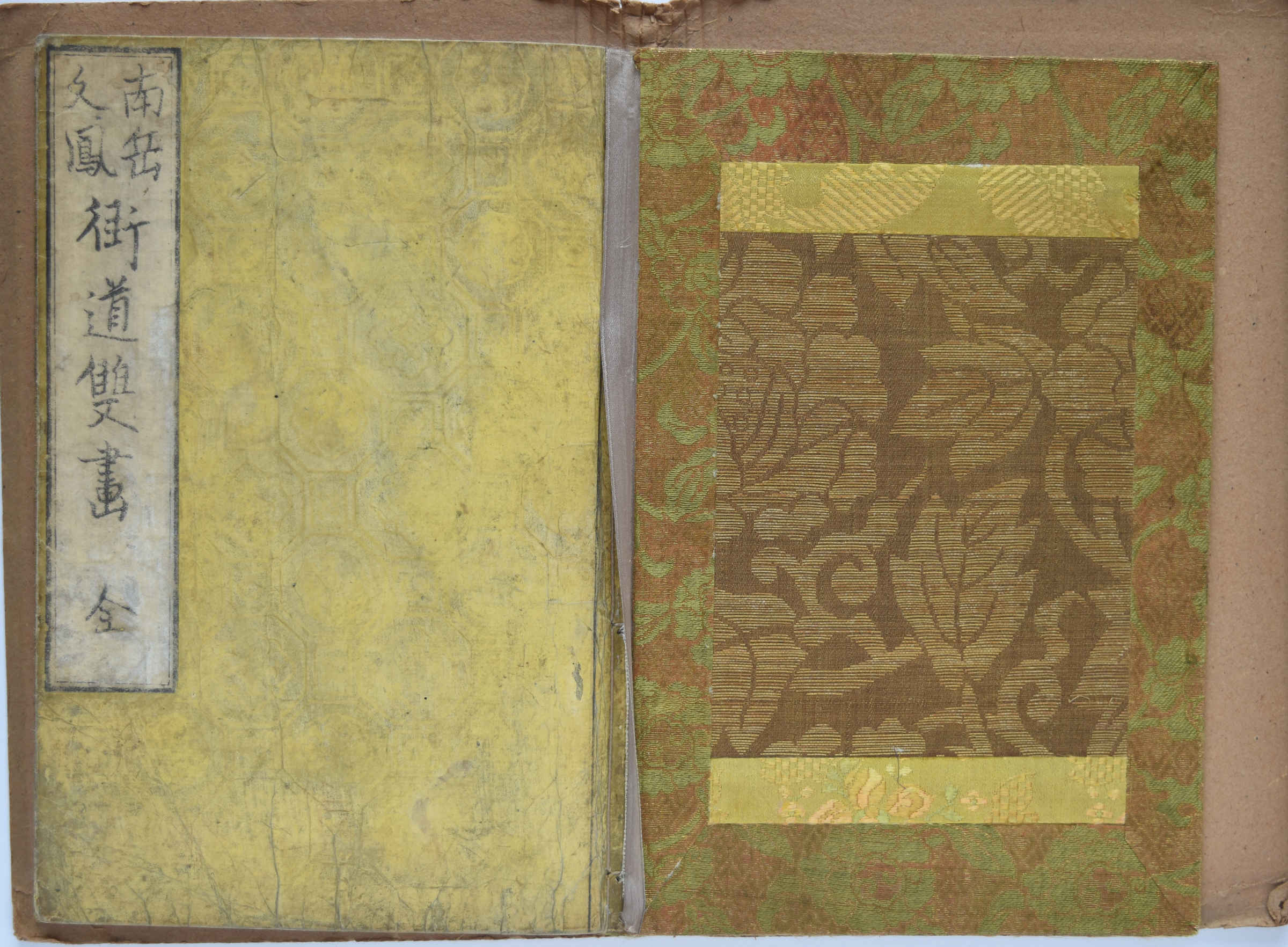
Click here to view image full size.
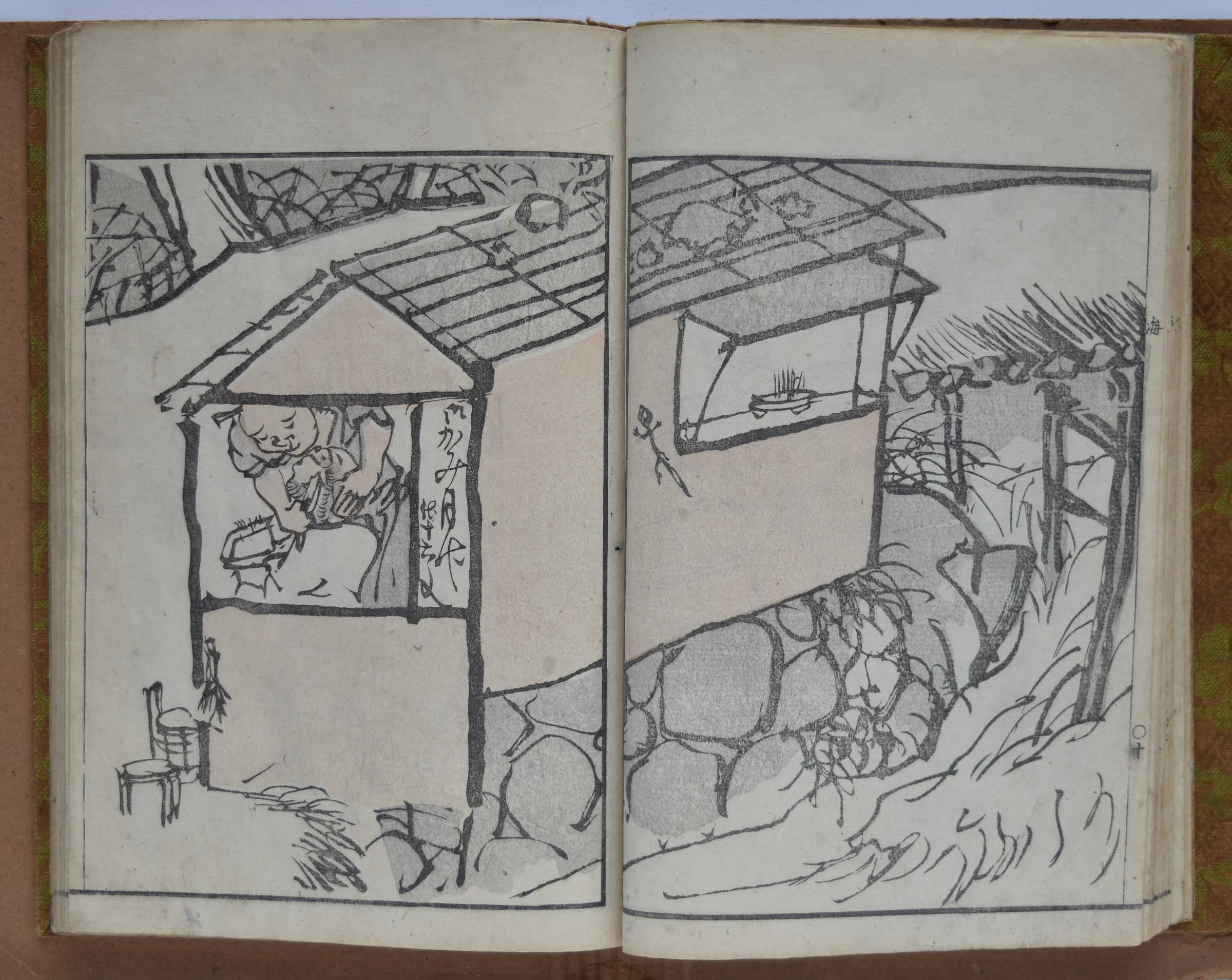
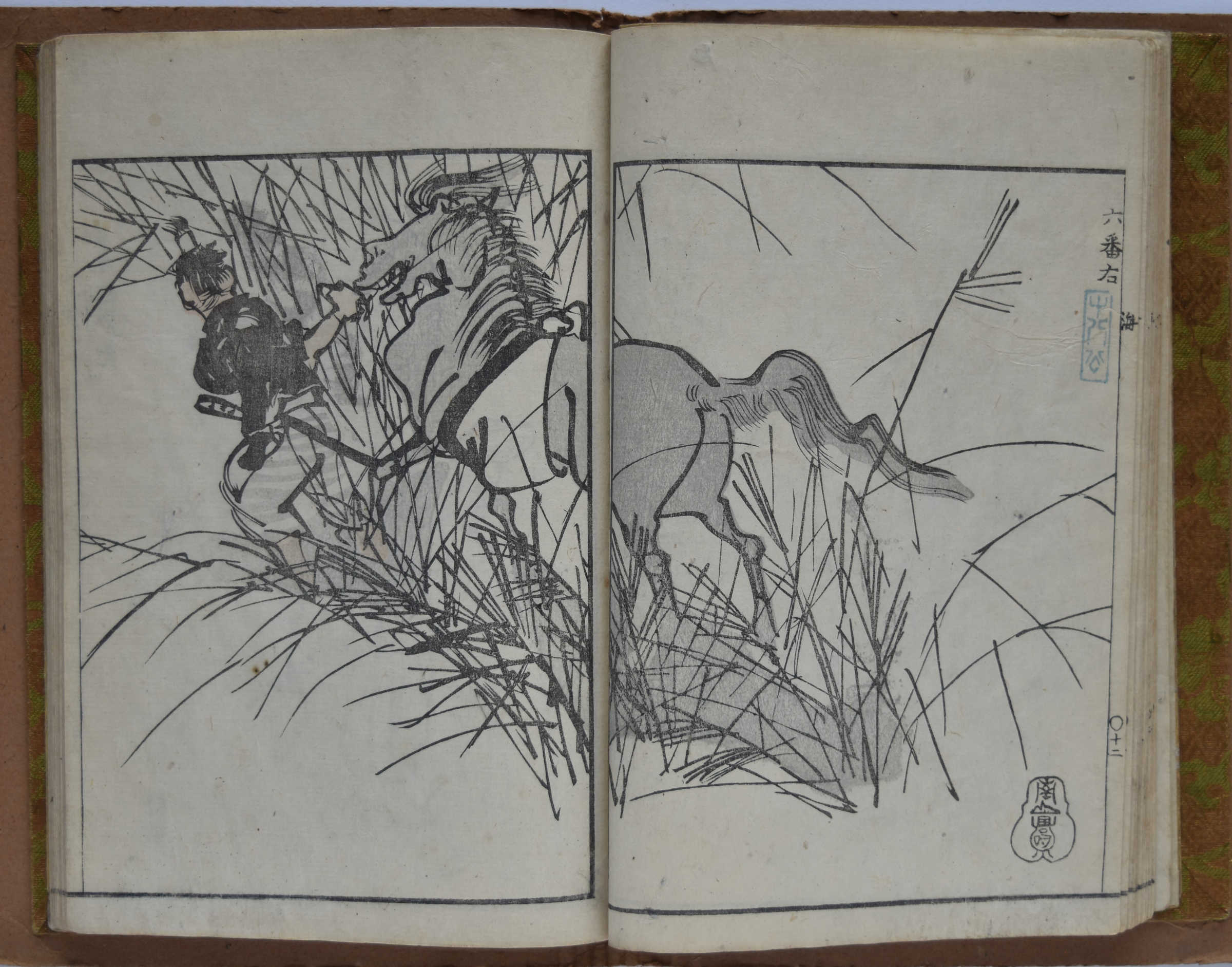
One volume complete Kaido kyoka awase, “Comparison of Kyoka Poems on the Highway.” Three pages preface signed Bumpo and thirty-six double-page illustrations alternating by Nangaku and Bumpo; last page colophon dated Bunka 8 (1811) with artists Nangaku Tseki and Bumpo Basei. Publishers Kawachiya Kihei, Osaka, and Yoshidaya Shimbei, Kyoto. Original embossed yellow covers with original title slip. Originally published in two volumes with the poems in volume one and almost immediately reissued as a one volume work, as here. Numerous collectors’ seals: Tanido Kyohitsu, Seiyo Kosetsu, and Edmond de Goncourt with his brocade binding and imitation wood slipcase. A beautiful example of this fine Shijo book in very good condition.
Status: Sold
Utagawa TOYOKUNI (1769-1825)
Click here to view image full size.
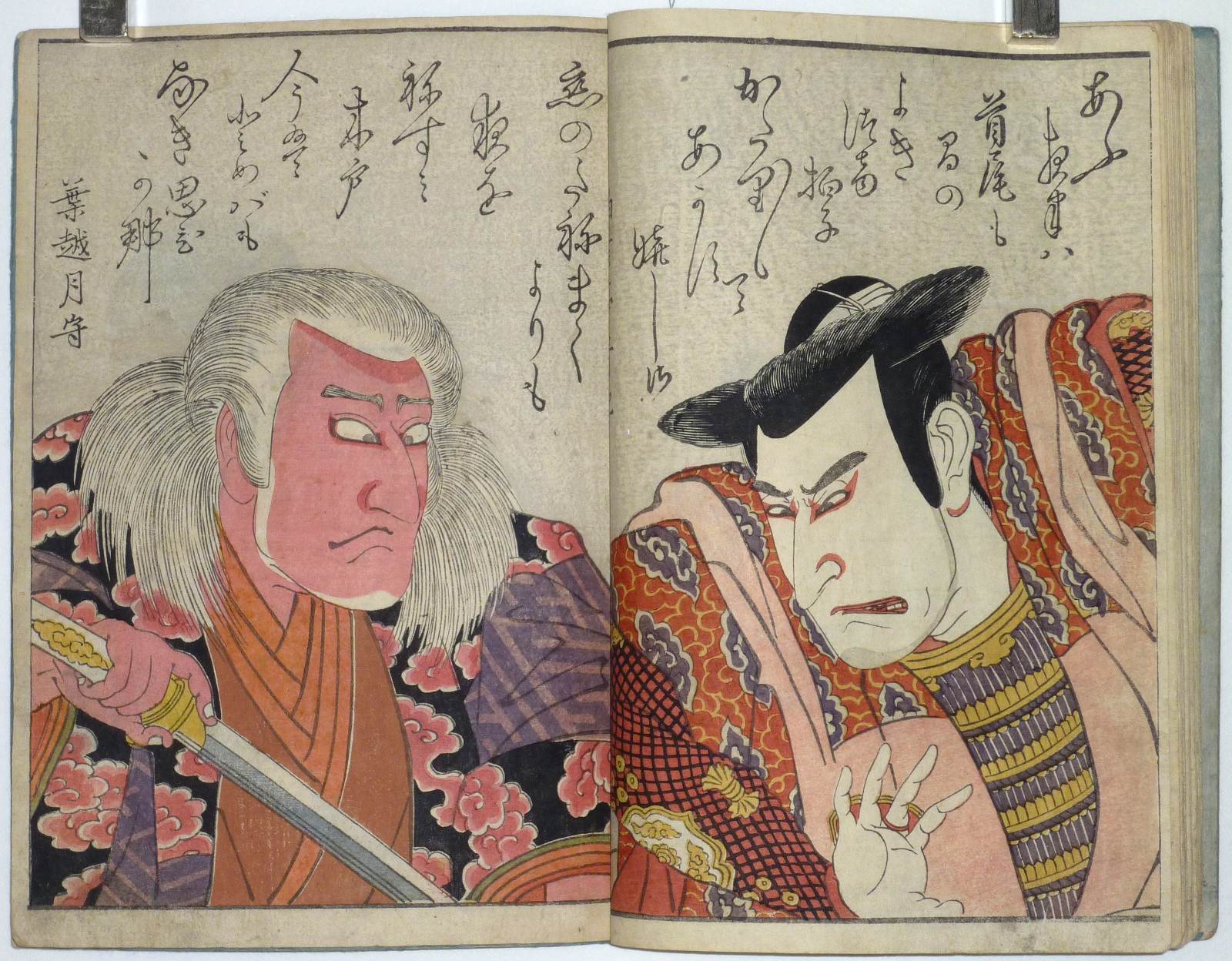
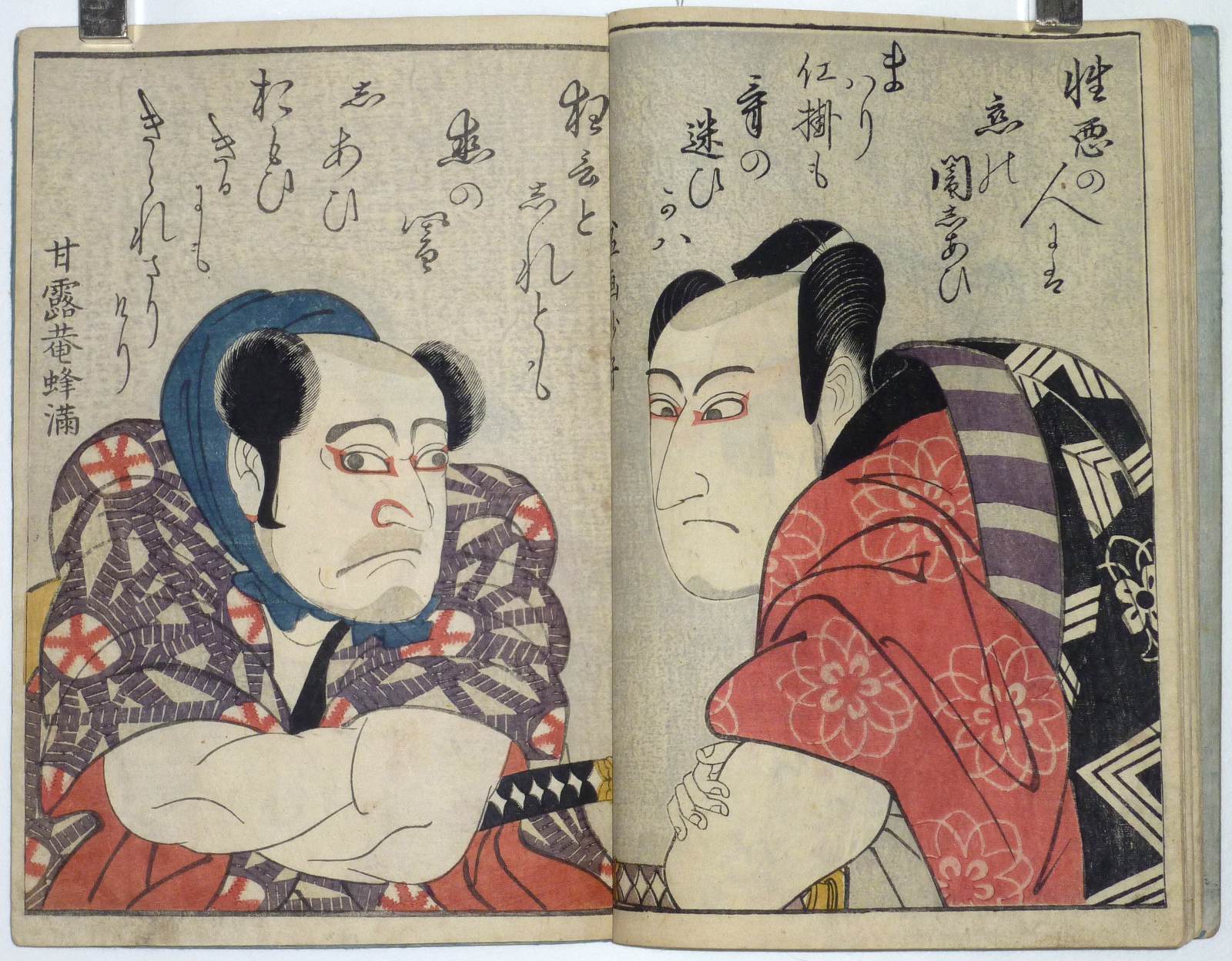
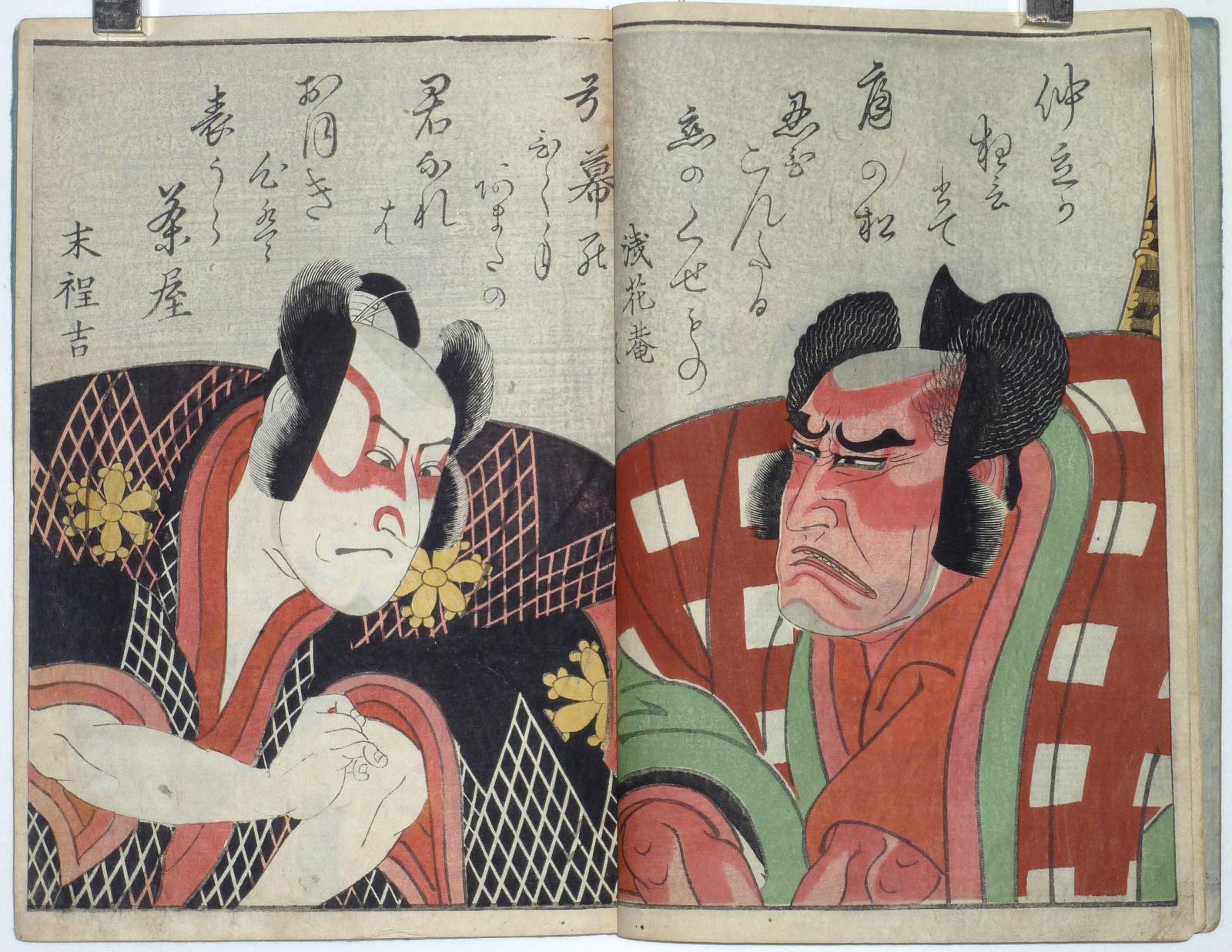
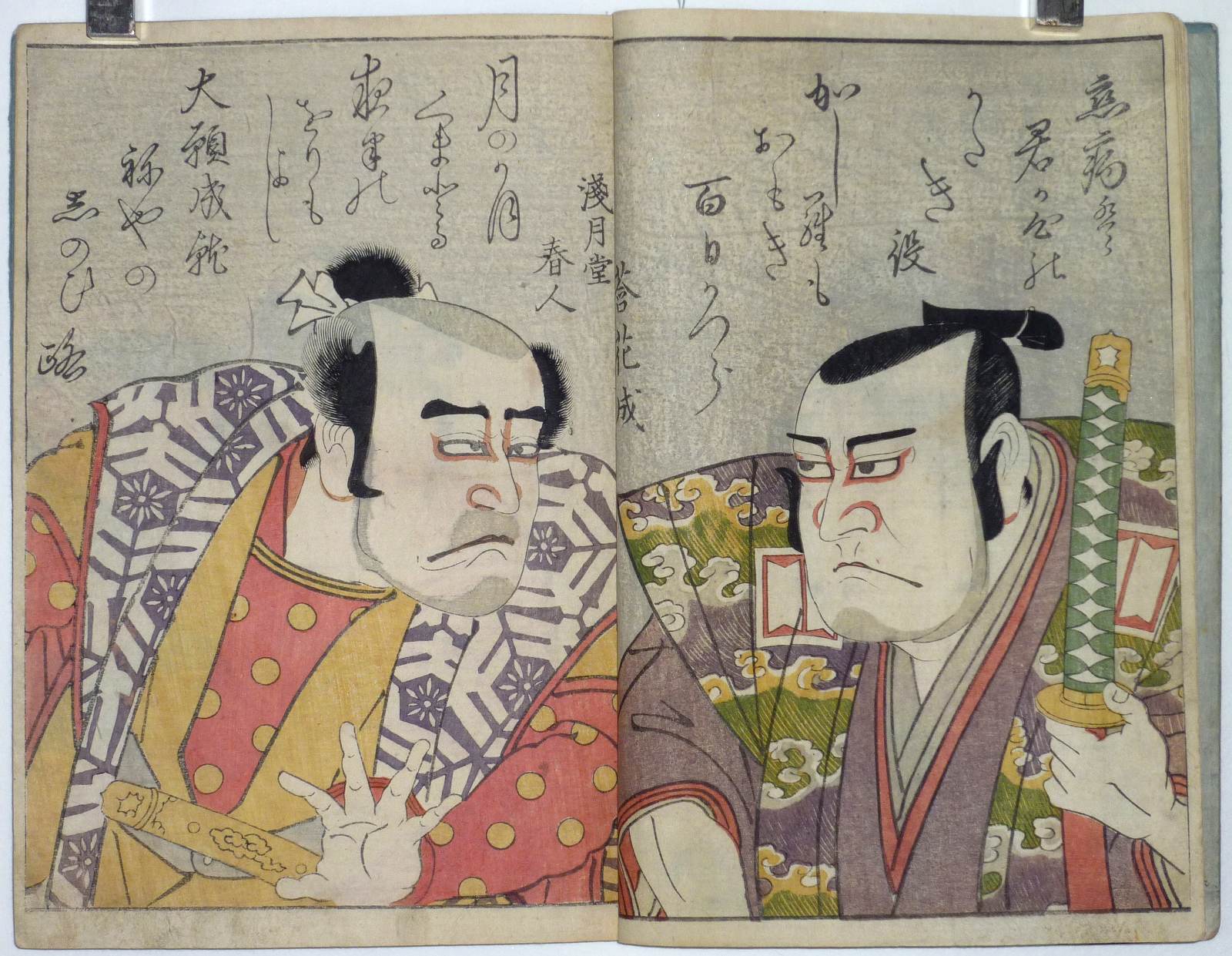
One of Toyokuni’s most famous books: 2 volumes bound as one, Yakusha Awase Kagami, “A Mirror of Actors’ Physiognomy.” Published Kyowa 4 (1804) by Bunshundo and Yamadaya Sanshiro. Vol. I, 4pp. preface, undated, 18 single-page half-length portraits of actors below kyoka poems. Vol. II, 15 single-page half-length portraits, followed by single page poem signed Ichikawa Hakuen (Danjuro V), 4pp. postscript, signed Kankoku. Lacking original covers with publisher Toto Banshundo on inside cover of Vol. I. Also lacking 2pp. second postscript by Banshundo and colophon. Very minor soil and three portraits with colour turned, otherwise very fresh impressions. Extremely Rare.
Status: Sold
[Shiba] Shin nigao-e (Published 1915)
Click here to view image full size.
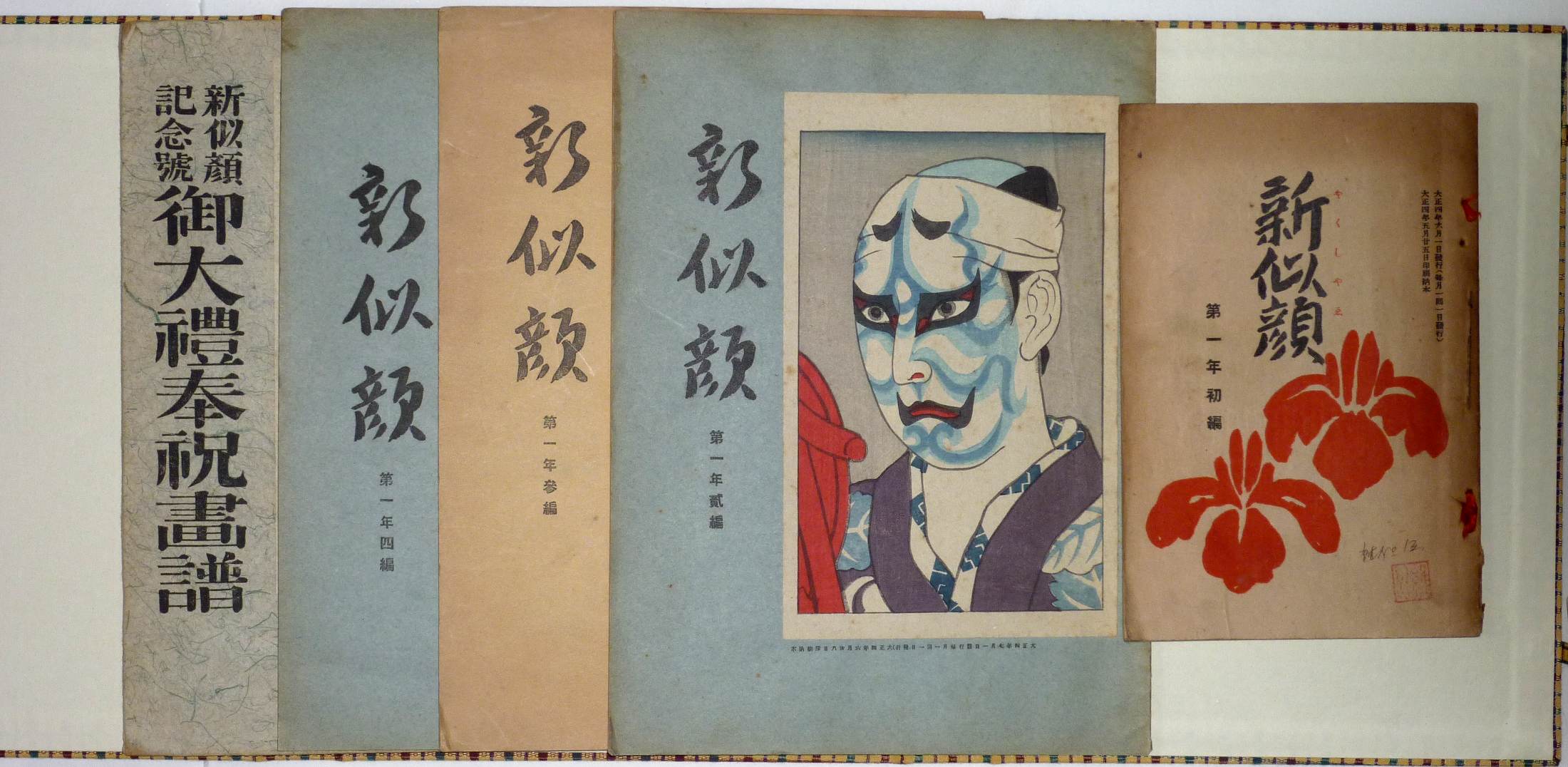
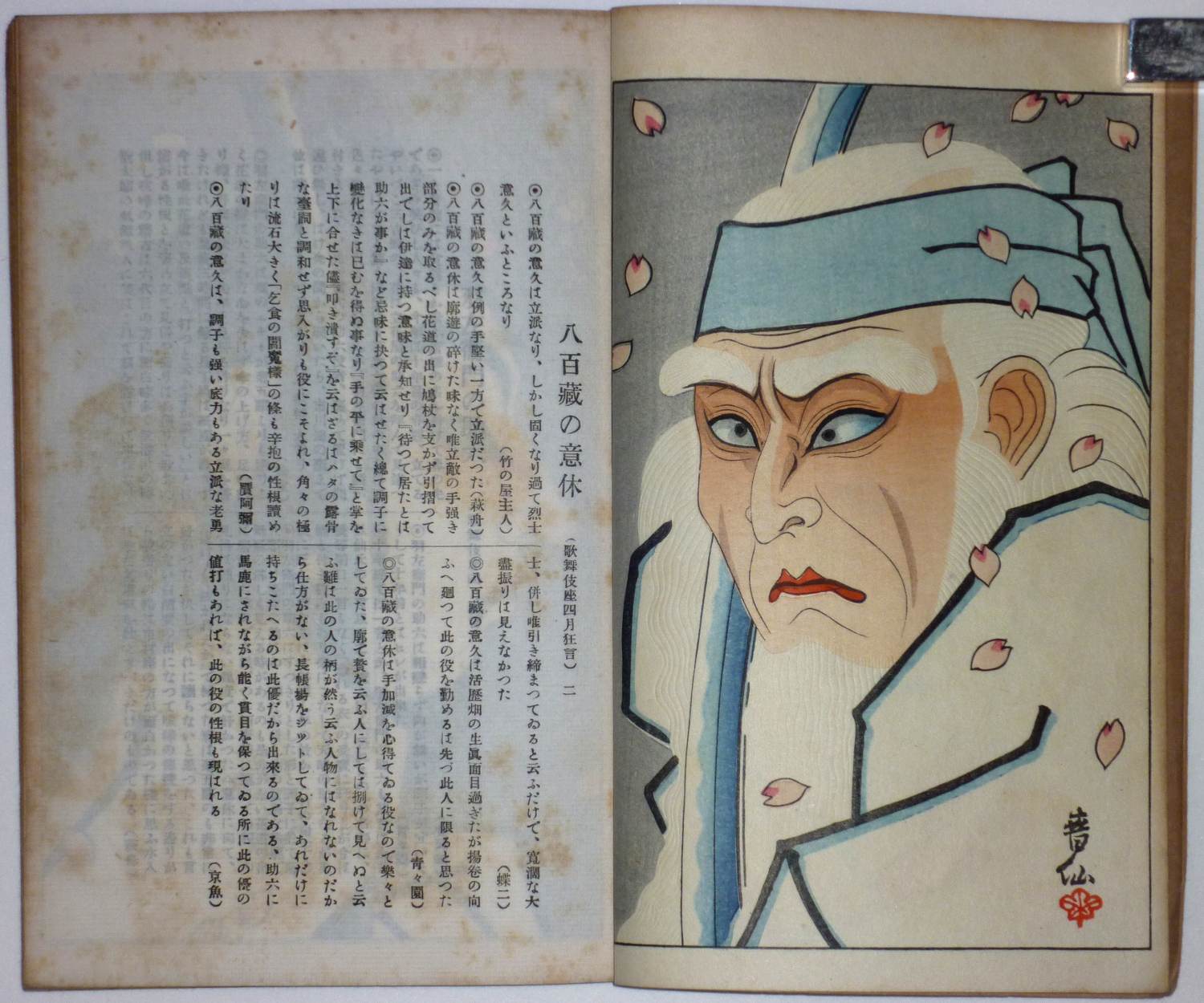
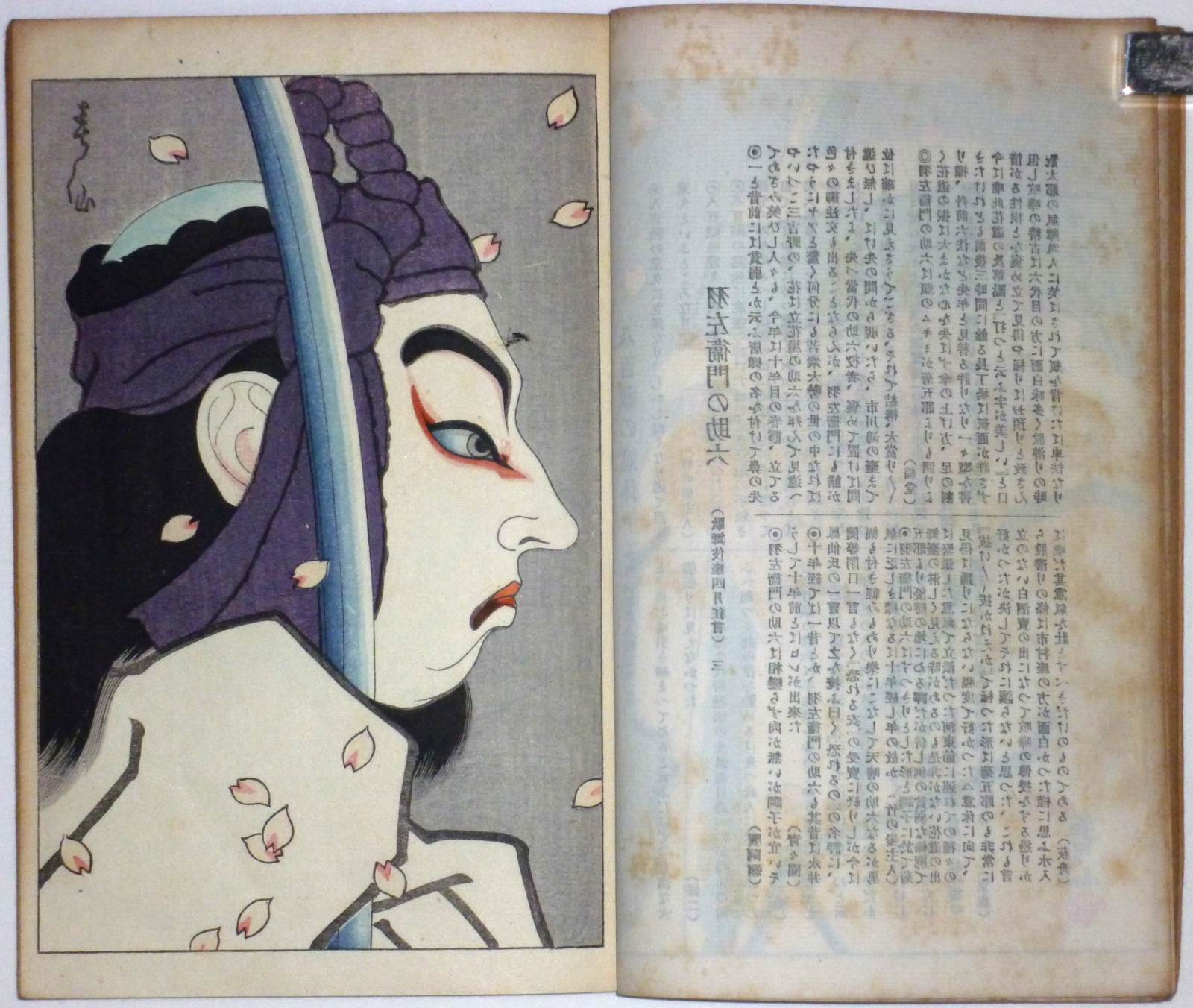
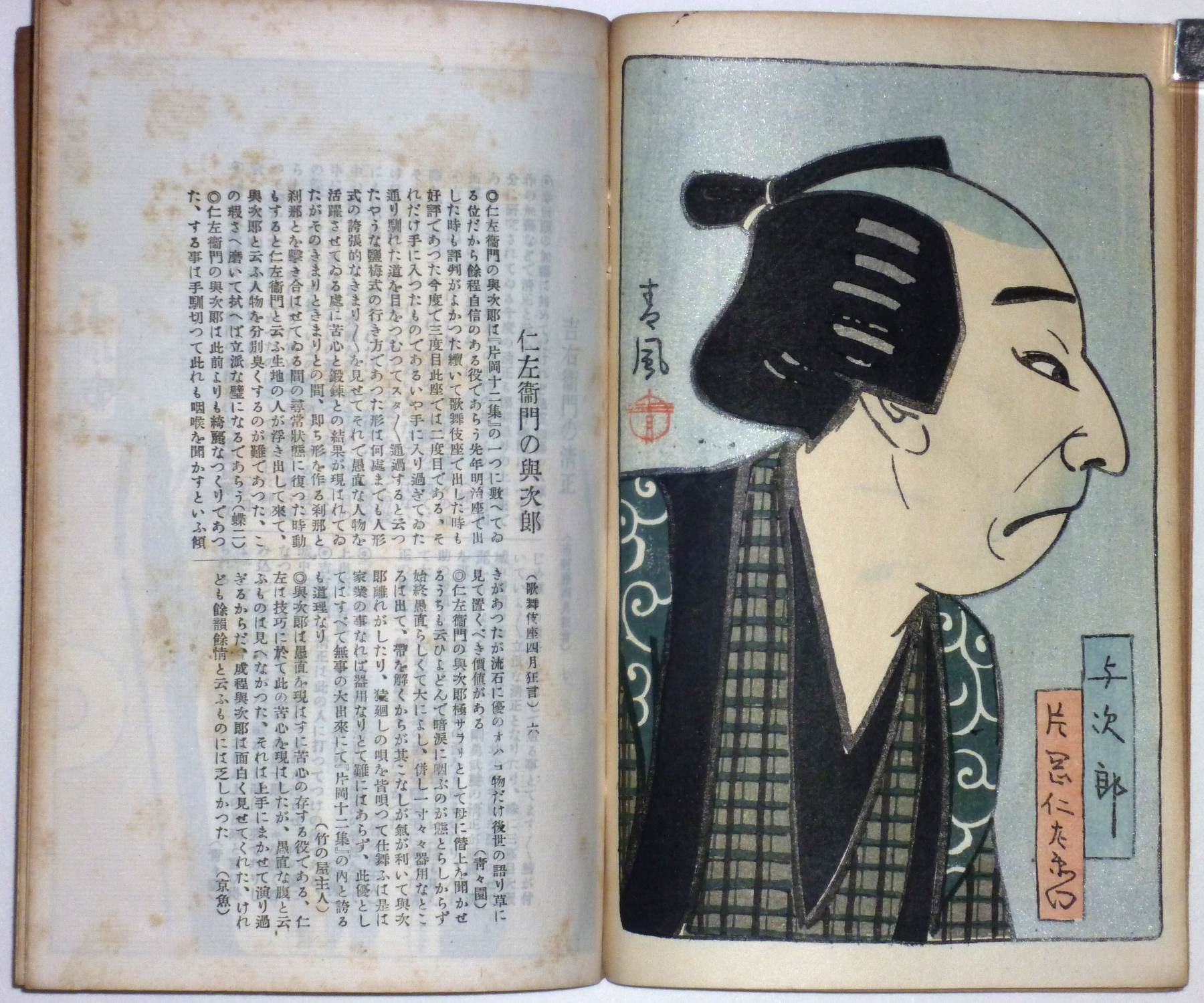
Five volumes complete: [Shibai] Shin nigao-e. Published in Tokyo Taisho 4 (1915) and illustrated by Natori Shunsen, Yamamura Koka, Torii Kotondo, Ishida Hakutei and others.
Volume one: 18.5 x 12.5 cm. Original covers, beige. The abbreviated title: Shin nigao and volume number are printed directly on the cover. On the right is the publication date, June 1, Taisho 4 (1915), and a note that subsequent numbers will be published on the first day of each month. Table of contents. Preface by Kinoshita Sataro. The fourteen colour woodcut portraits are by Natori Shunsen (5), Matsuda Seifu (4), Yamamura Koka (3), Torii Kotondo (1), and Ogawa Heibei (1). Block cutter: Igami Bonkotsu. Printer: Namamura Sanjiro. The text on actors and roles are mainly printed on tissue interleaves. Colophon page, dated June 1, Taisho 4 (1915). Compiler: Egawa Kinpei. Published by Nigao-do.
Volume two: 25.2 x 18.7 cm. Covers, light blue. The abbreviated title and volume number are printed directly on the cover. The first actor print is pasted to the cover, credited internally to Natori Shunsen. Front endpaper, table of contents. The forteen woodcut portraits are by Shunsen (4, including the cover), Koka (3), Terazawa Kotaro (2), Isshii Hakutei (2), Matsuda Seifu (2), Heibei (1). Colophon, dated July 1, Taisho 4; otherwise as Vol. one.
Volume three: 25.2 x 18.7 cm. Covers, beige. Title and volume number as for Vol. two. The first actor print is pasted to the cover, as above. The fourteen actor portraits are by: Shunsen (5), Seifu (3), Hakutei (3), Koka (2), and Heibei (1). Colophon dated August 1; otherwise, as above.
Volume four: 25.2 x 18.5 cm. Covers light blue in the same format as above. The fourteen actor portraits are by: Shunsen (5), Koka (4), Hakutei (2), Seifu (2), Heibei (1). Colophon dated October 1; otherwise, as above. Back cover, an ad for forthcoming special Coronation issue of Shin nigao.
Volume five: 25.1 x 18.6 cm. Covers, grey paper embedded with green fibres over stiff boards, bound with green silk tassels. The title, Shin nigao-kinen-go: Tairei Hoshoku gafu, “Shin nigao: Special Coronation Number” is printed directly on the cover. The format is basically the same, but two special sections have been added: five portraits of officials associated with Emperor Taisho’s coronation, and five portraits of geisha from Tokyo and Kyoto. The remaining eleven prints are of actors, for a total of twenty-one colour woodcuts: Shunsen (11), Heibei (3), Seifu (3), Ishizuka Kan (2), Kondo Hiroshi (1), and Koito Gentaro (1). Colophon dated November 1, Taisho 4 (1915), otherwise as above.
This set contains the earliest prints by Natori Shunsen and gave the impetus to have the larger actor portraits published. In slipcase. Very good condition.
Status: Sold
Cho GESSHO (1772-1832) and Kazaore YUJO (fl. c. 1790-1800)
Click here to view image full size.
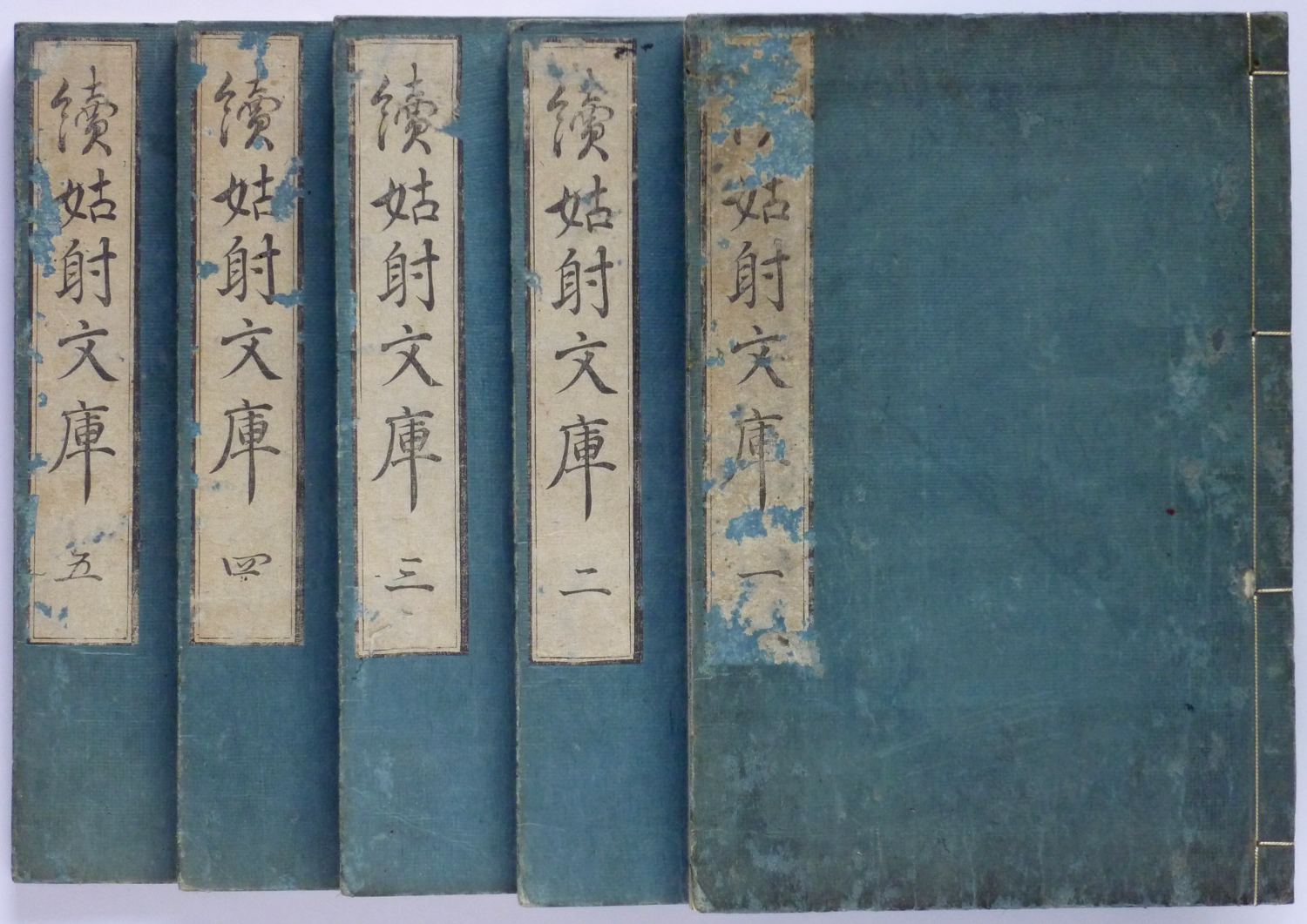
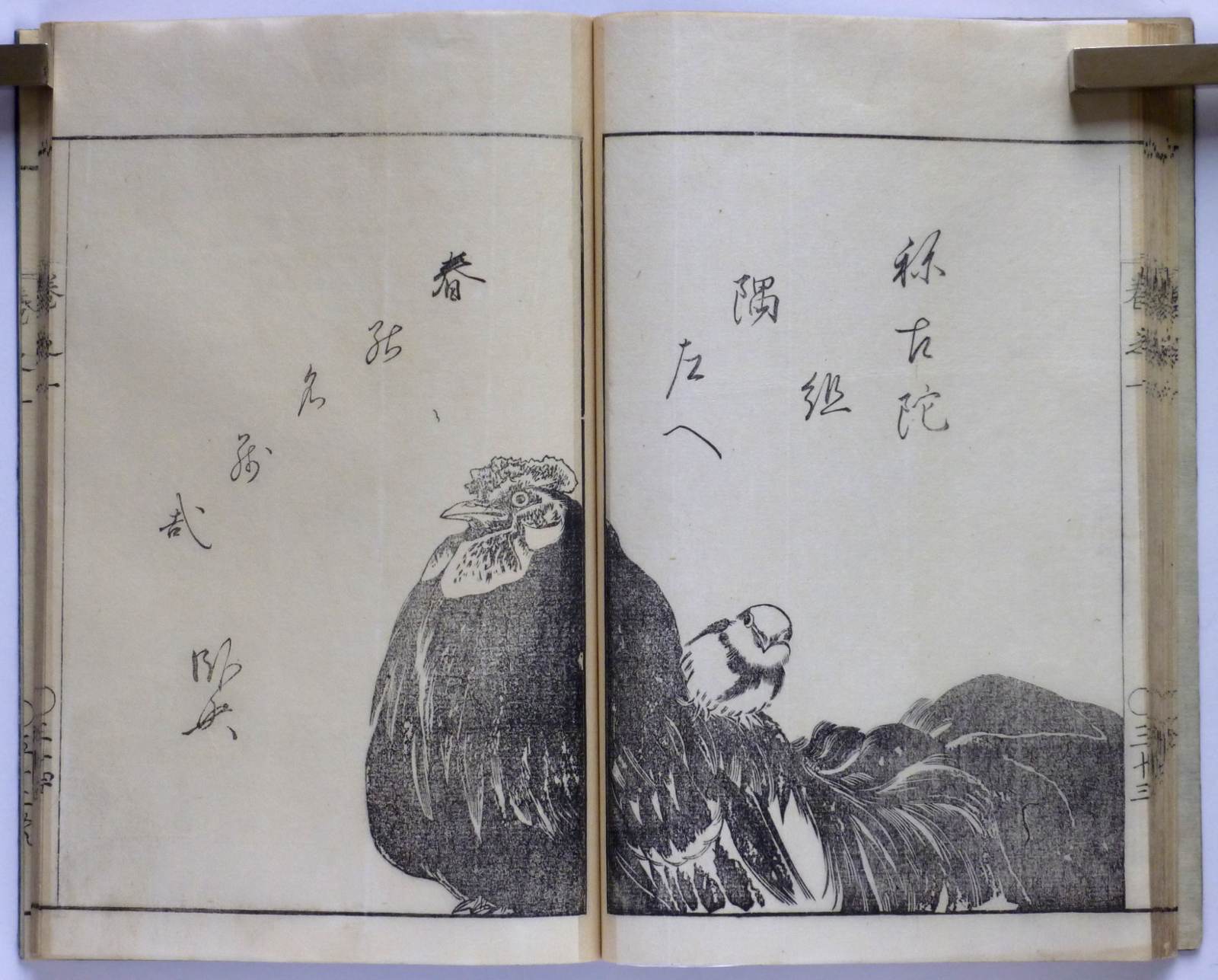
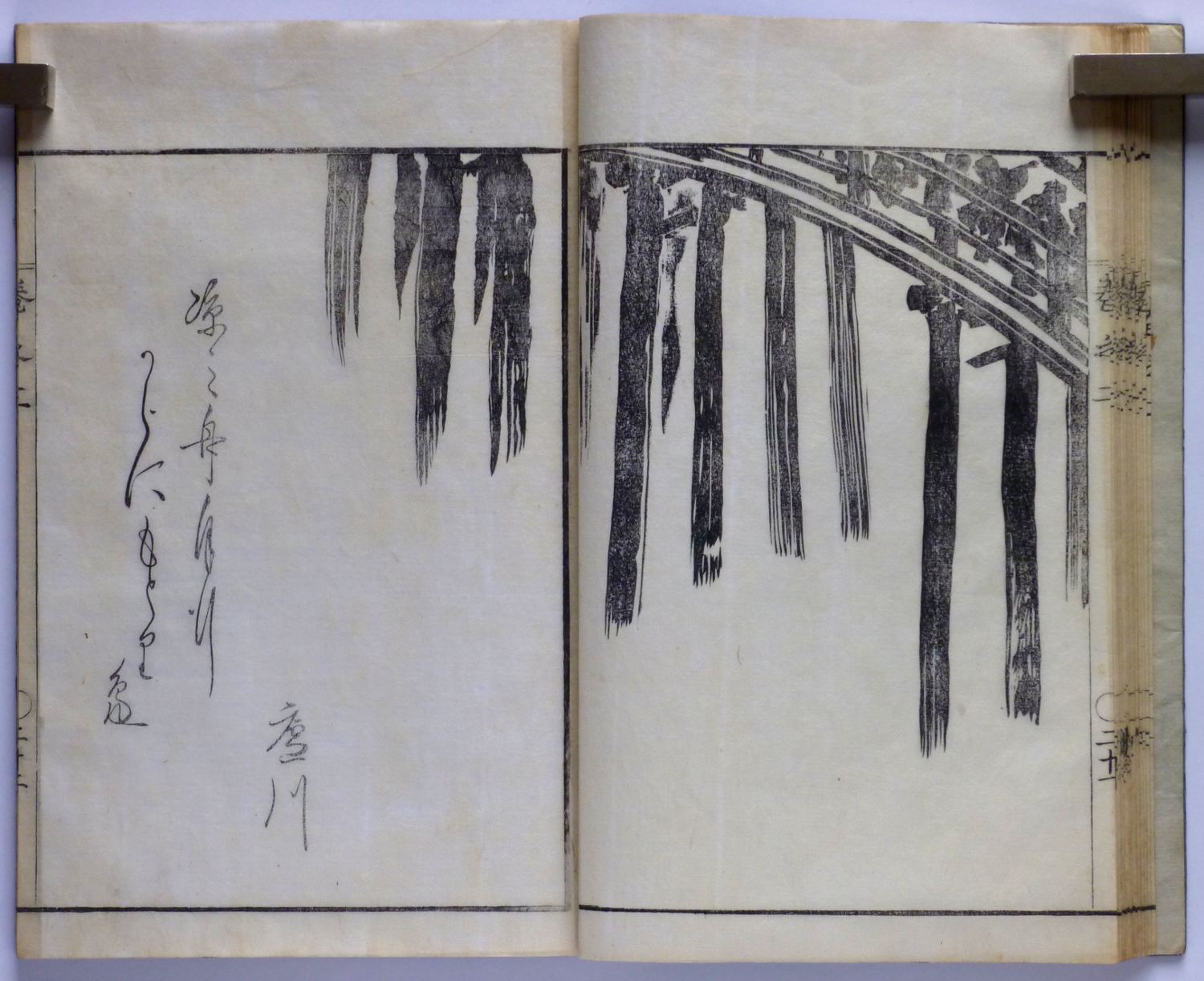
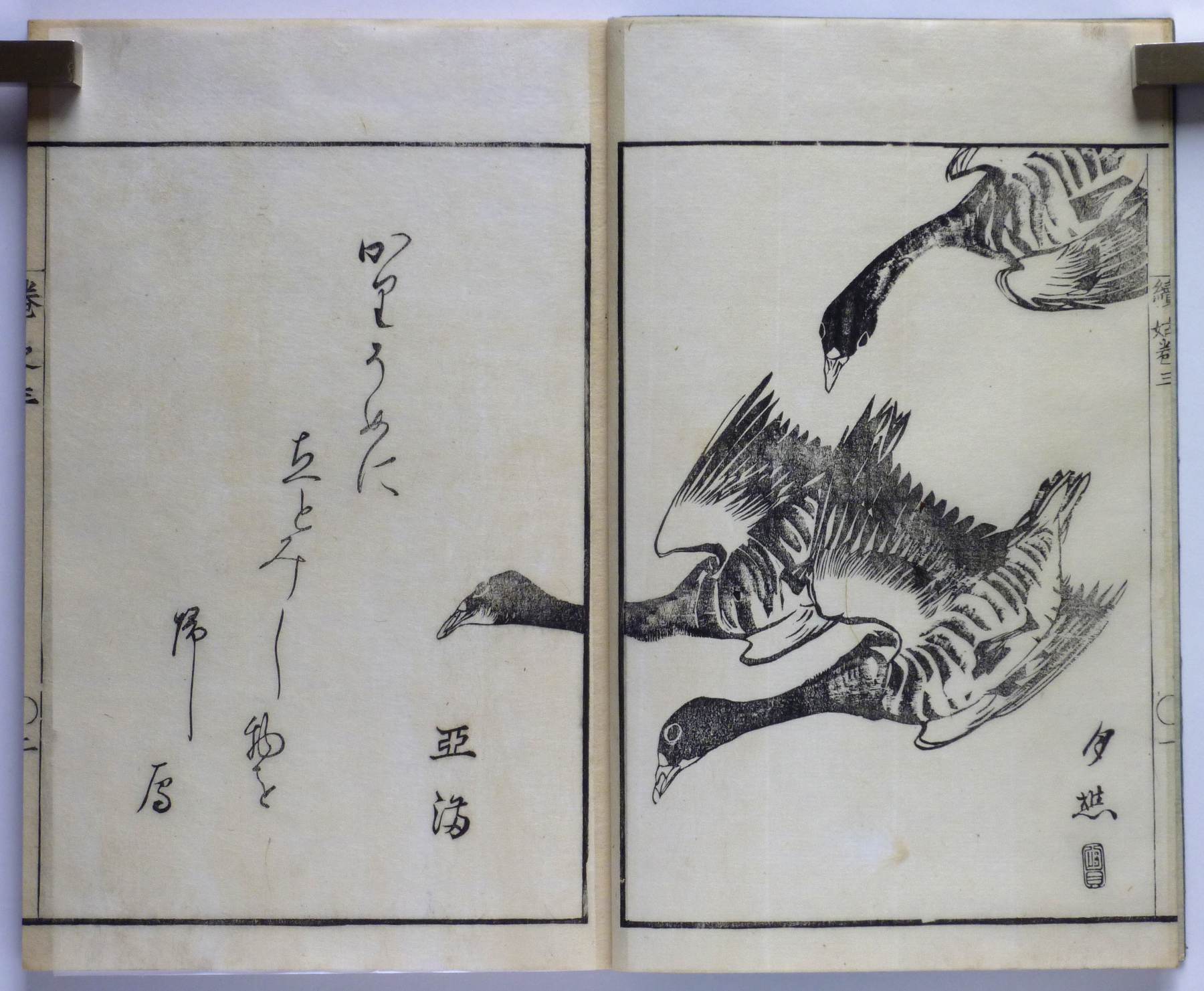
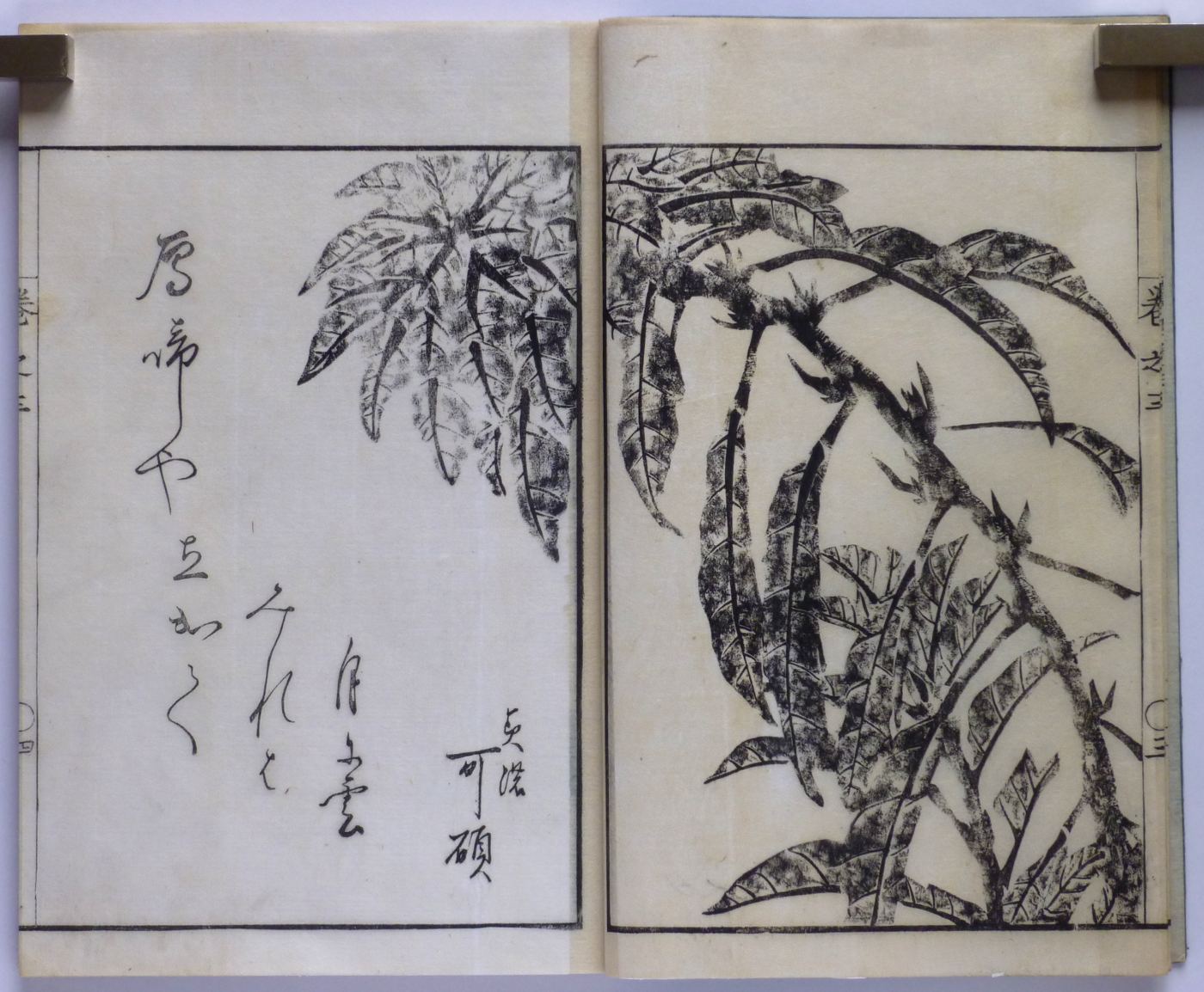
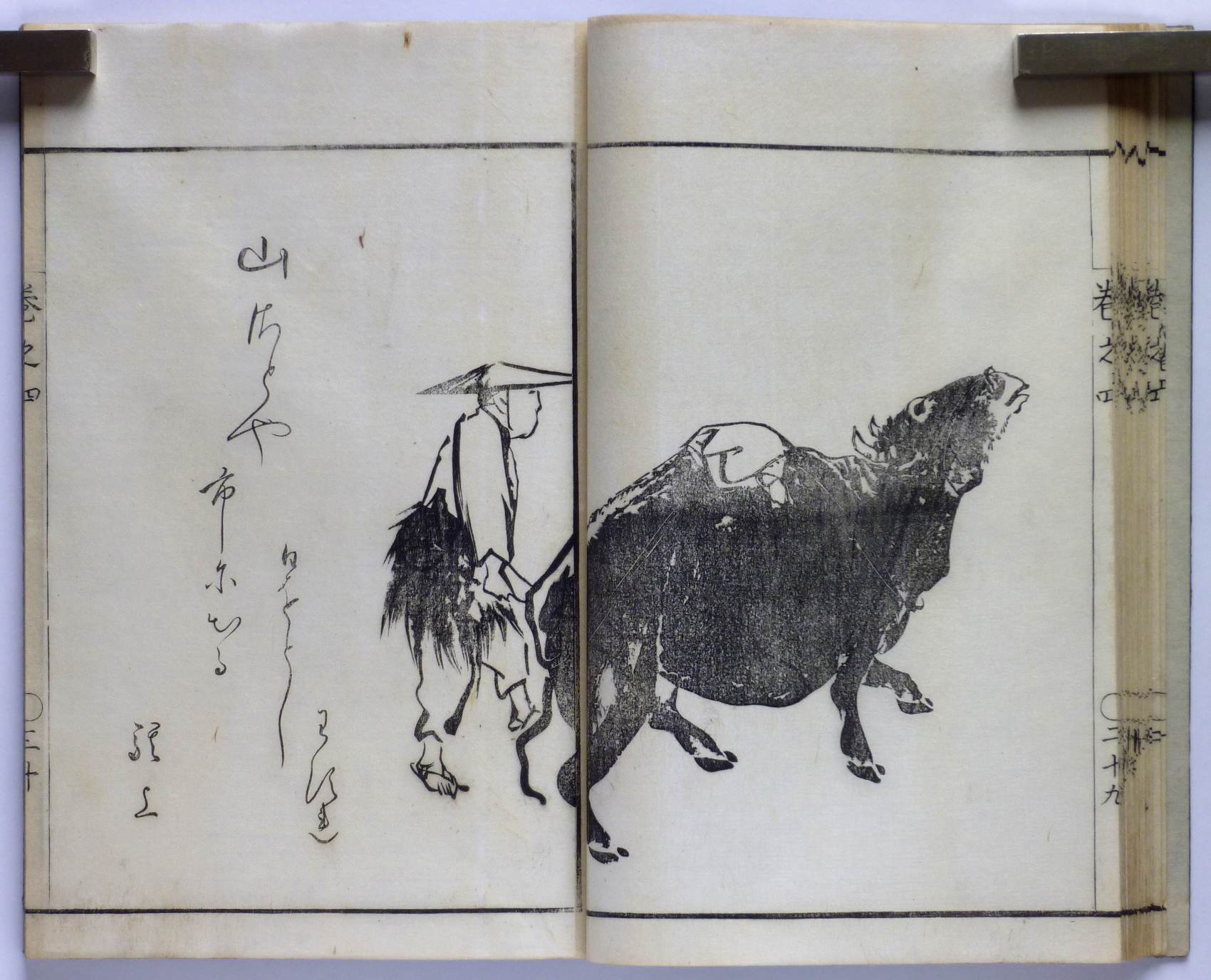
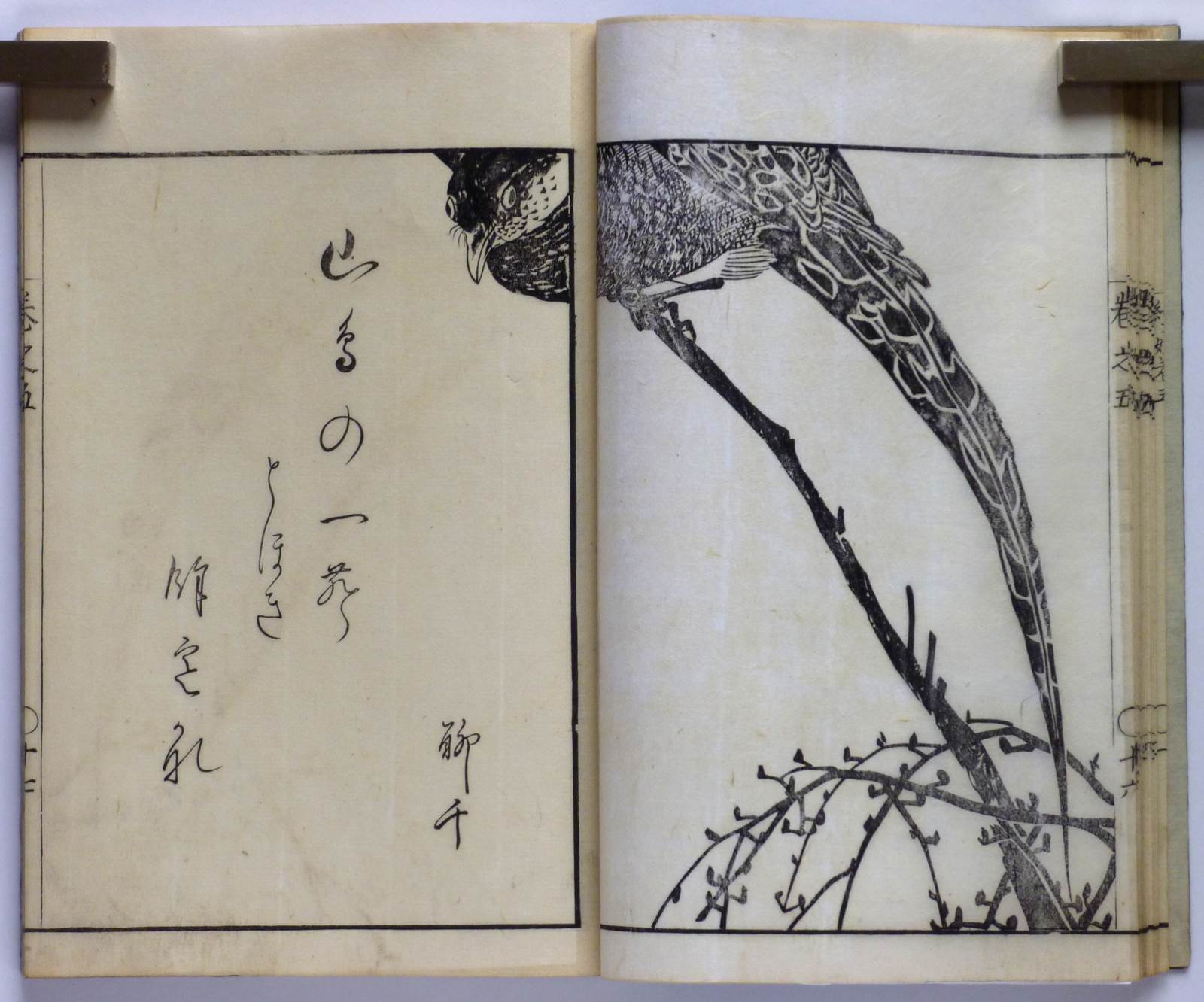
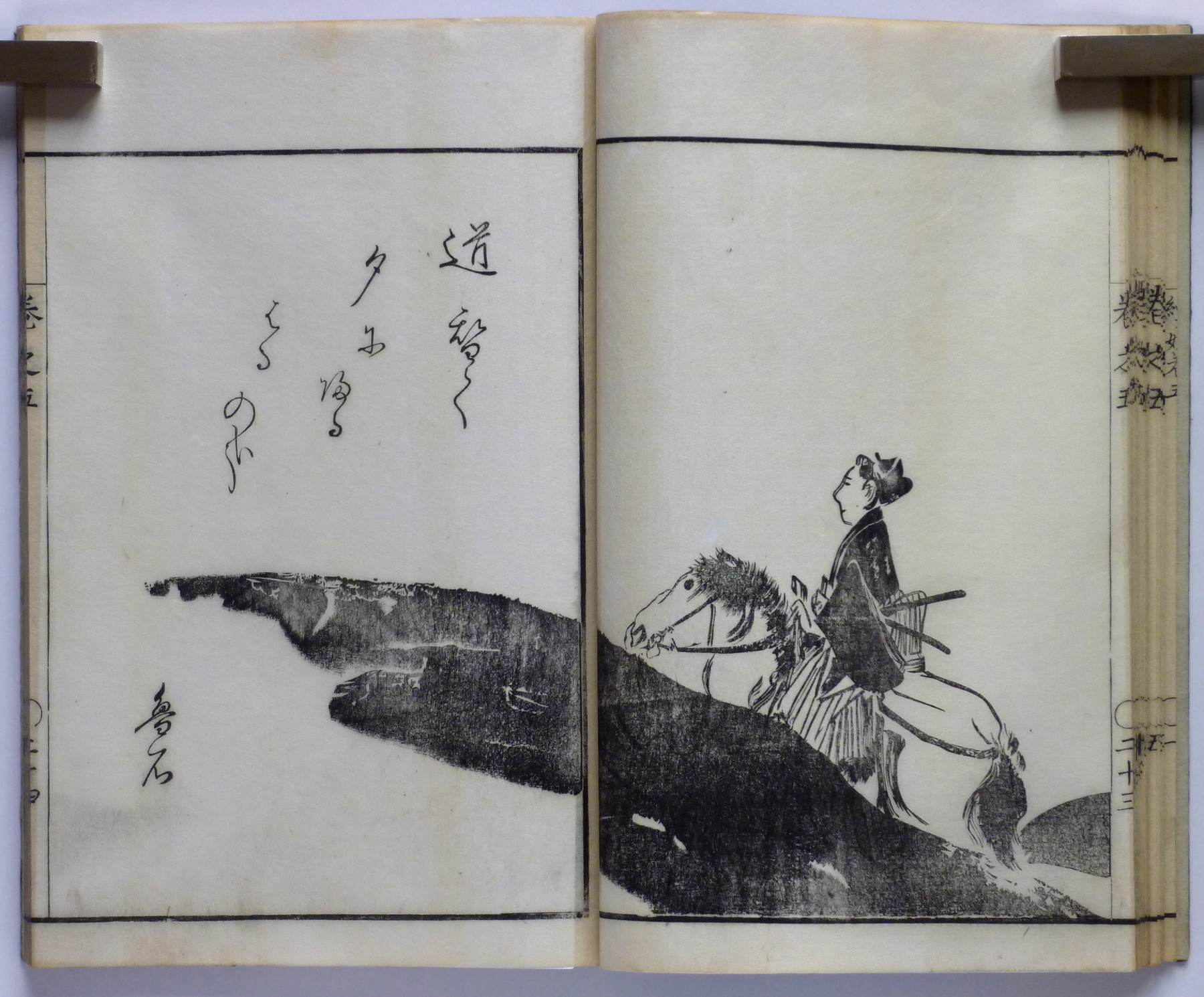
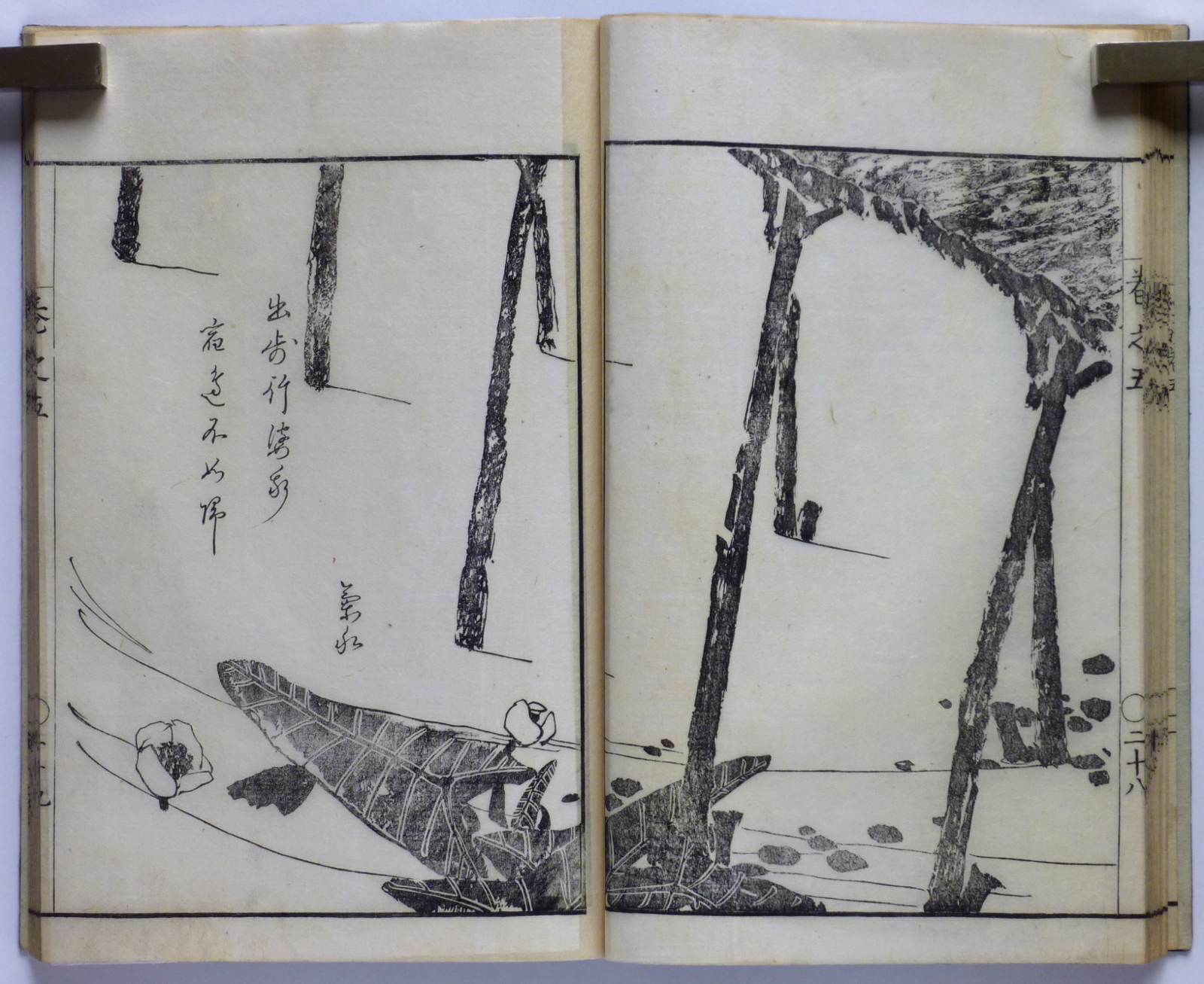
5 vols. complete: Zoku Koya Bunko, “The Sequel to Koya Library.” Vol. 1: 52 sheets; 48 illus. Vol. 2: 49 sheets; 48 illus. Vol. 3: 53 sheets; 51 illus. Vol. 4: 53 sheets; 52 illus. Vol. 5: 56 sheets; 54 illus. Preface, 5 pp. by Kogetsutei, dated Kansai 9 (1797). Artists: Kazaore Yujo and Cho Gessho. Published by Fugetsu Magosuke, Nagoya, Kansai 10 (1798), together with other publishers in Edo, Osaka and Kyoto. The greatest anthology of printed haiga (haiku poems accompanied by illustrations based on simple, yet often profound, observations of everyday life). The anthology was started by Yujo but taken over by Gessho on his death. Most of the work is Gessho’s. This is one of the few books where the block-cutter and printer must take pride of place beside the artist. The most striking effects were achieved by these artisans by imaginative working of the block surface and wiping of the blocks to produce distinctive variations in texture and formless adumbrations of trees, plants and landscapes, all in sumi. Other examples: Duret 464 (5 vols. 1799); Gonse (III), 438 (4 vols., 1798); Holloway 18; Ryerson, pl. XI. Original covers and title slips. Some slight damage to covers and slight restored wormage at bottom of first sheets of vol. 1. But otherwise an exceptionally fine and clean copy with hardly any thumbing on corners. A lovely and rare set.
Status: Sold
Katsukawa SHUNCHO (Fl. c. 1780-1795)
Click here to view image full size.
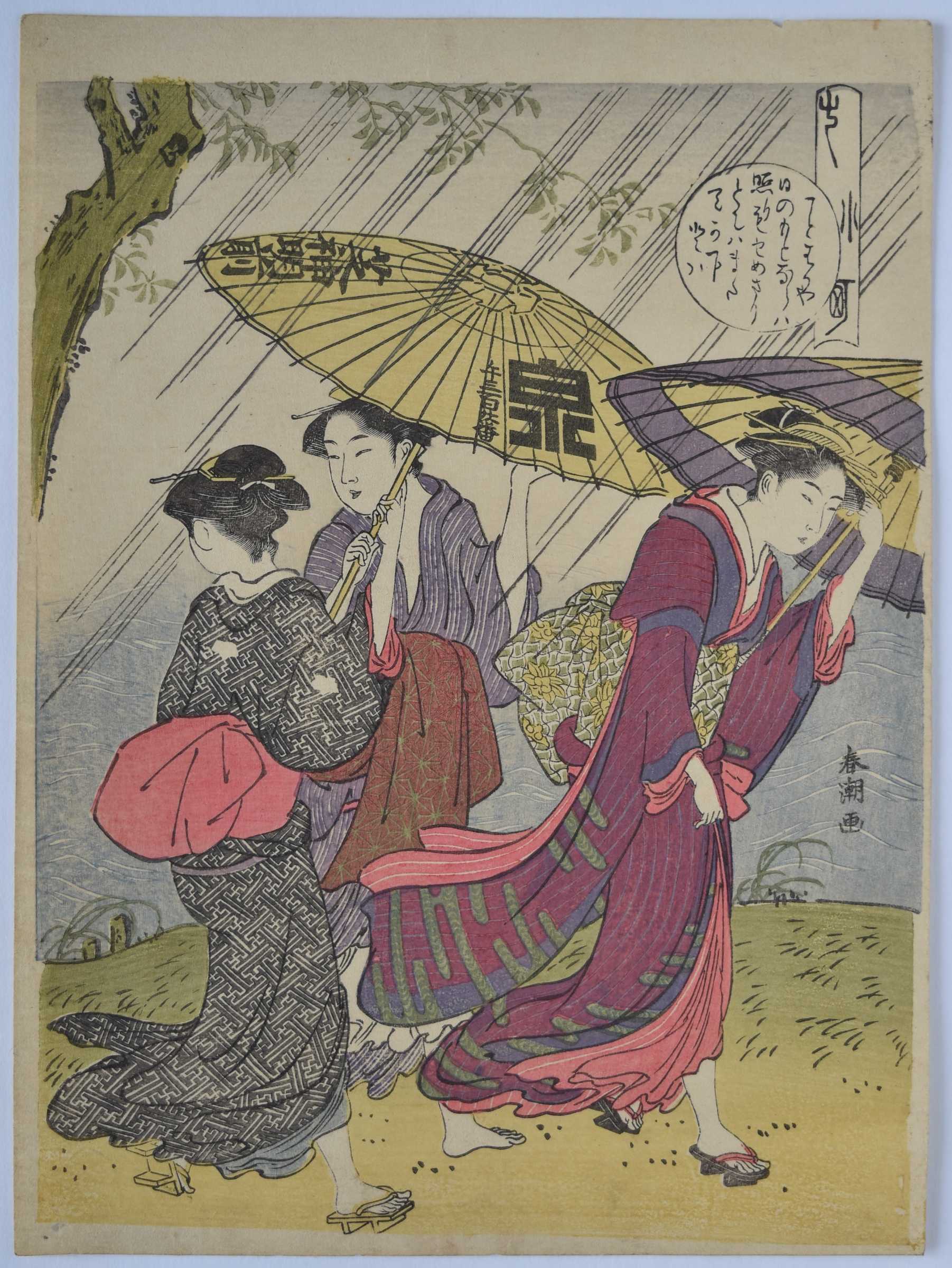
A chuban print showing a group of beauties caught in a downpour on the banks of a river. The centre figure has an umbrella with the publisher’s name Izumi [ya Ichibei] and address Shiba Jinmeimae which was in front of Shiba Daijingu Shrine. One of a set Nana Komachi, “The Seven Komachi,” being episodes in the life of the famous waka poetess Ono no Komachi (c. 825-c. 900). Little is known of Shuncho’s life except that he was a pupil of Katsukawa Shunsho and was then heavily influenced by Kiyonaga. He produced some particularly fine triptychs and pillar prints. Published c. early 1790s.
Superb impression, colour and condition: As the day it was printed. Signed Shuncho ga.
Status: Sold
Katsushika HOKUSAI (1760-1849)
Click here to view image full size.
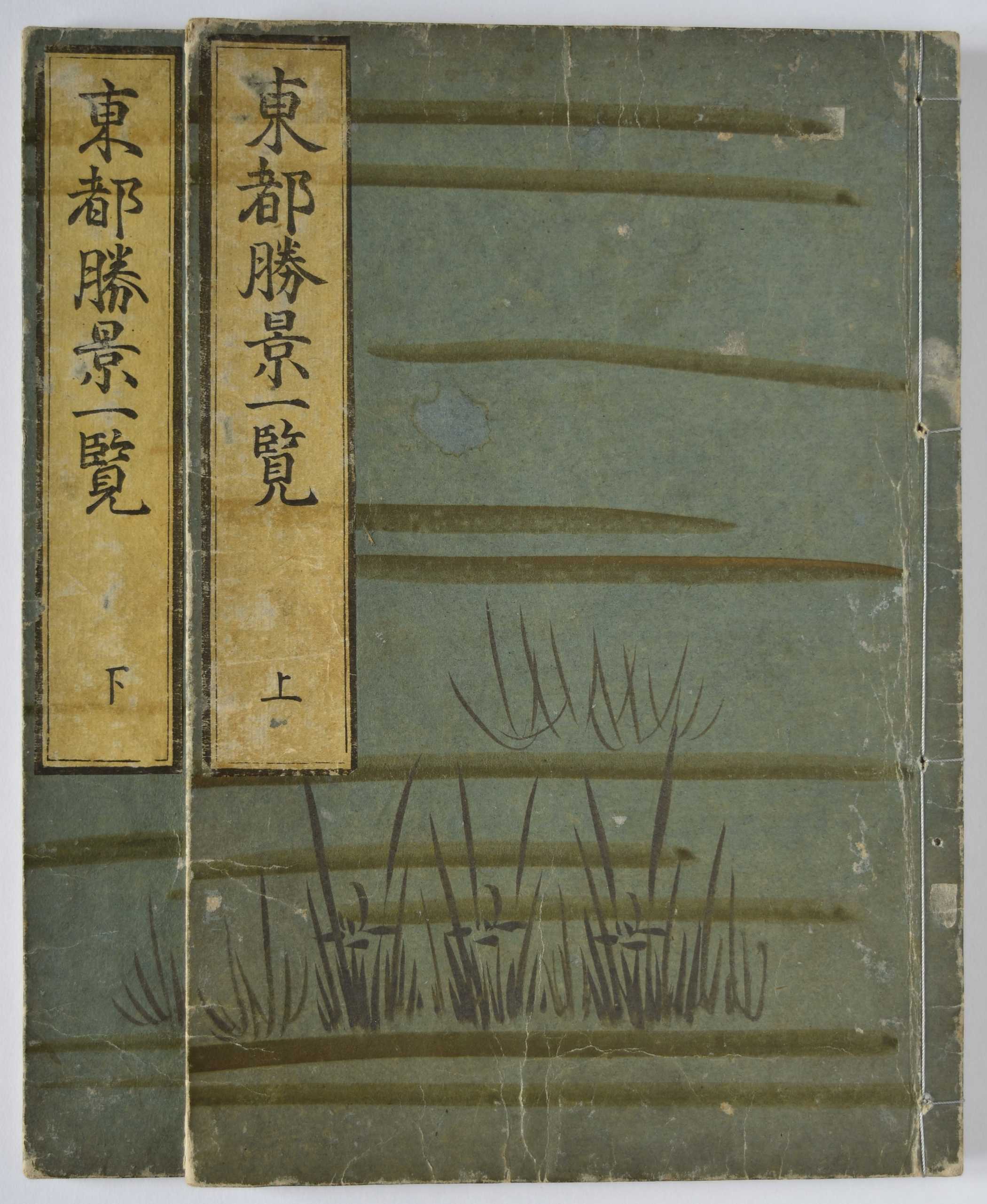
Two volumes complete: Toto shokei ichiran, “Fine Views of the Eastern [Edo] Capital at a Glance.” Shows famous places in Edo with accompanying kyoka poems at the top. Volume 1: 10 sheets, 1 p. preface. Volume 2: 11 sheets with colophon giving date Kwansei 12 (1800). Publishers Tsutaya Jusaburo, Suharaya Mohei and Suharaya Ihachi. Ando Enshi engraver and artist Hokusai shinsei. This book was first published with title Toto meisho ichiran by Tsutaya Jusaburo. Shortly afterwards the title was changed and the two other publishers joined Tsutaya Jusaburo. This is the edition offered here. Original hand-painted covers with a decoration of iris flowers and water (only found on the original edition). The blocks were subsequently sold to the Nagoya publisher Hishiya Kinbei who reissued it in 1815 together with Suharaya Mohei and Ihachi. The blocks were yet again sold, this time to Kawachiya Mohei who issued another reprint in 1840 with the above publishers. A lovely early example of this famous book. Cover and title slips in very good condition.
One wormhole affecting last 4 pages at the top outside image area, otherwise contents fine and clean. Provenance: Large seal of Hayashi Tadamasa at the start to each volume.
Status: Sold
Takehisa YUMEJI (1884-1934)
Click here to view image full size.
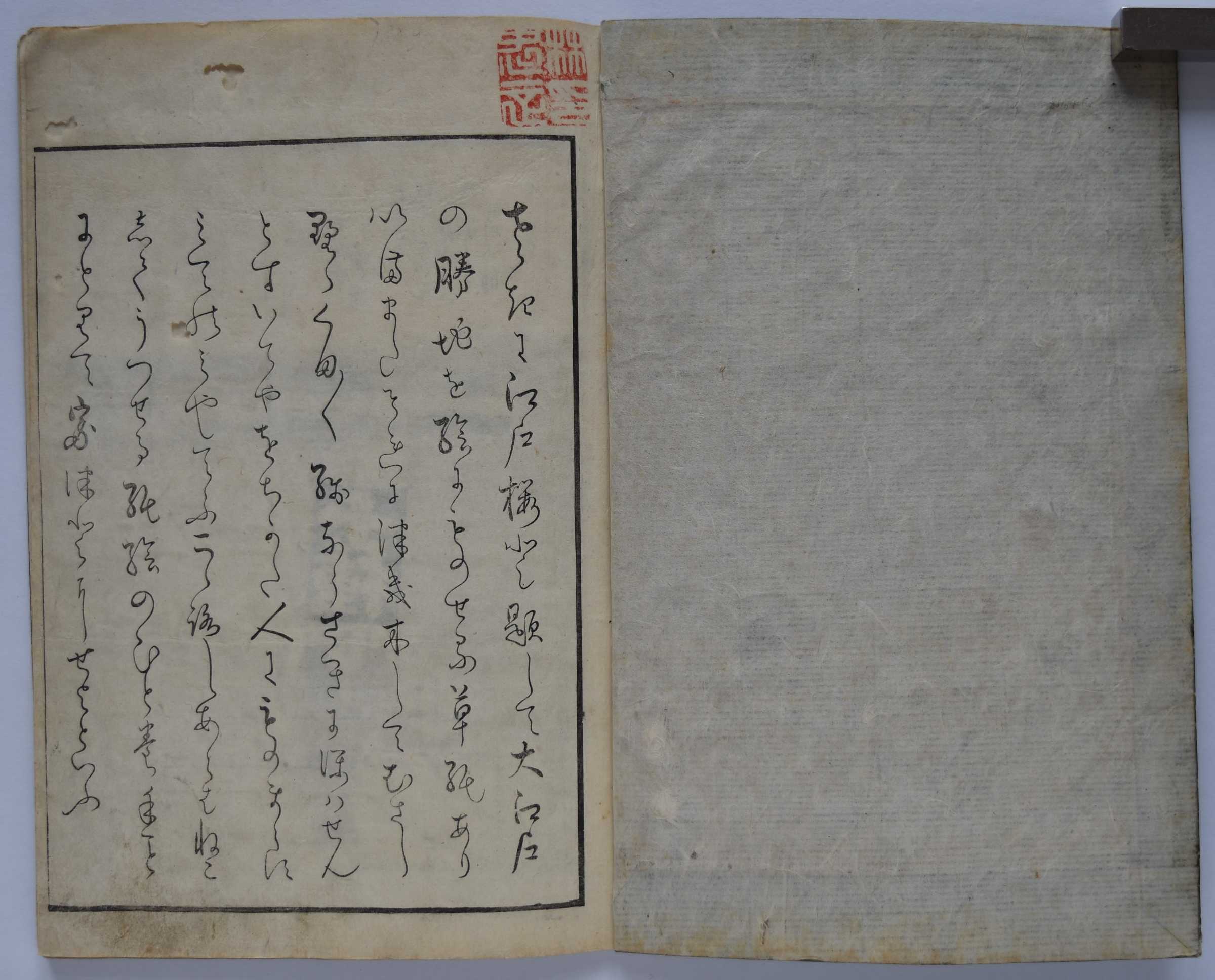
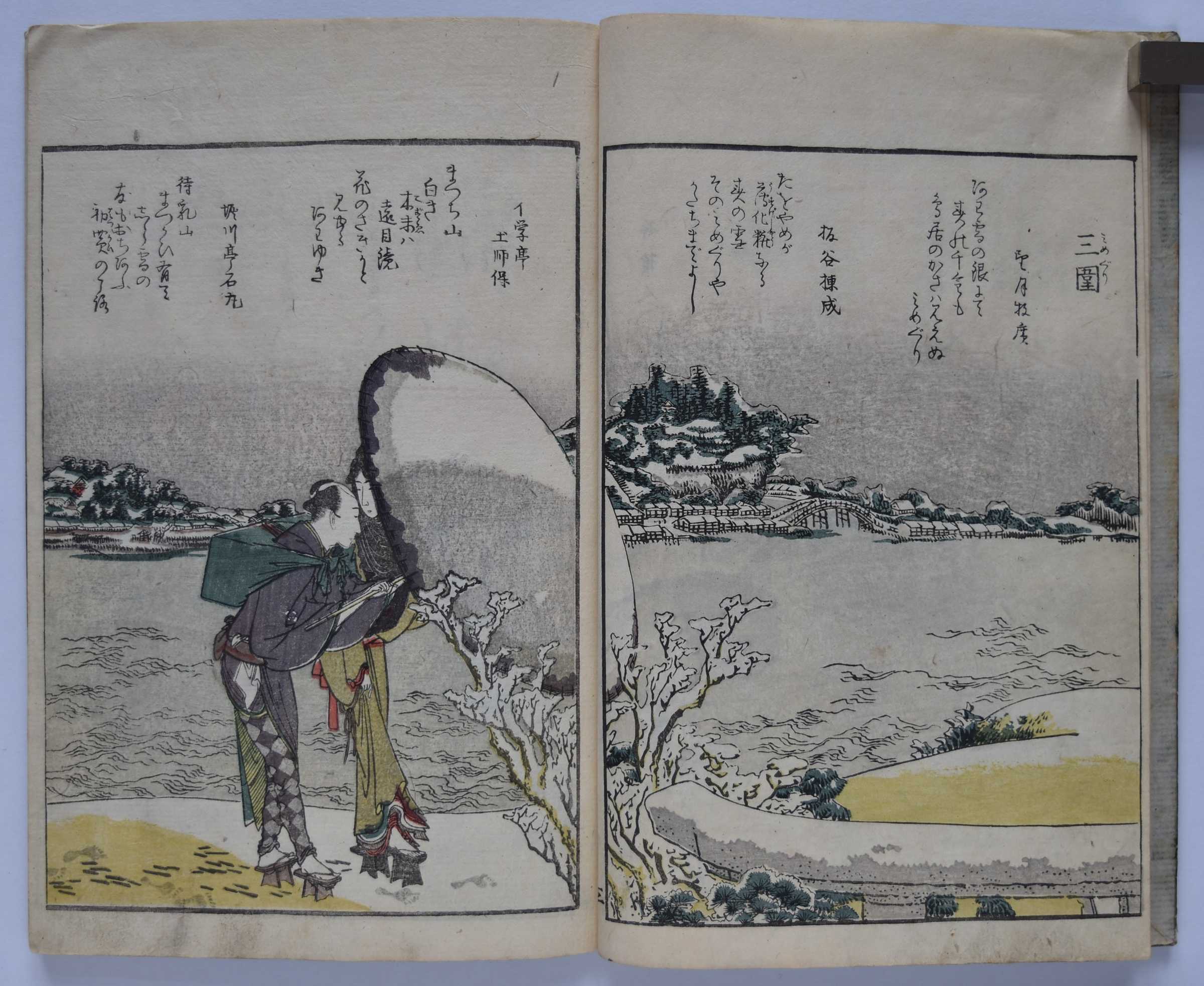
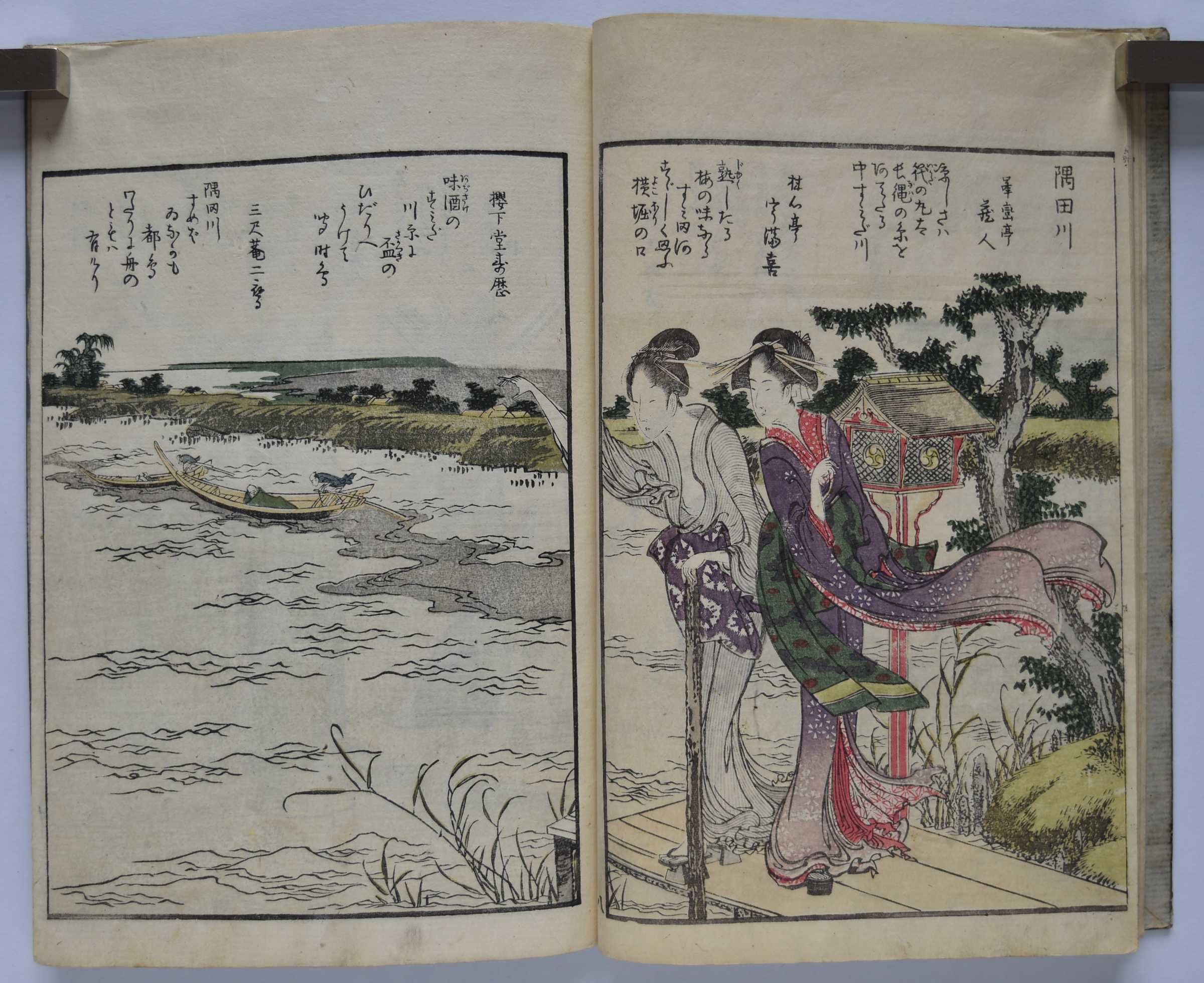
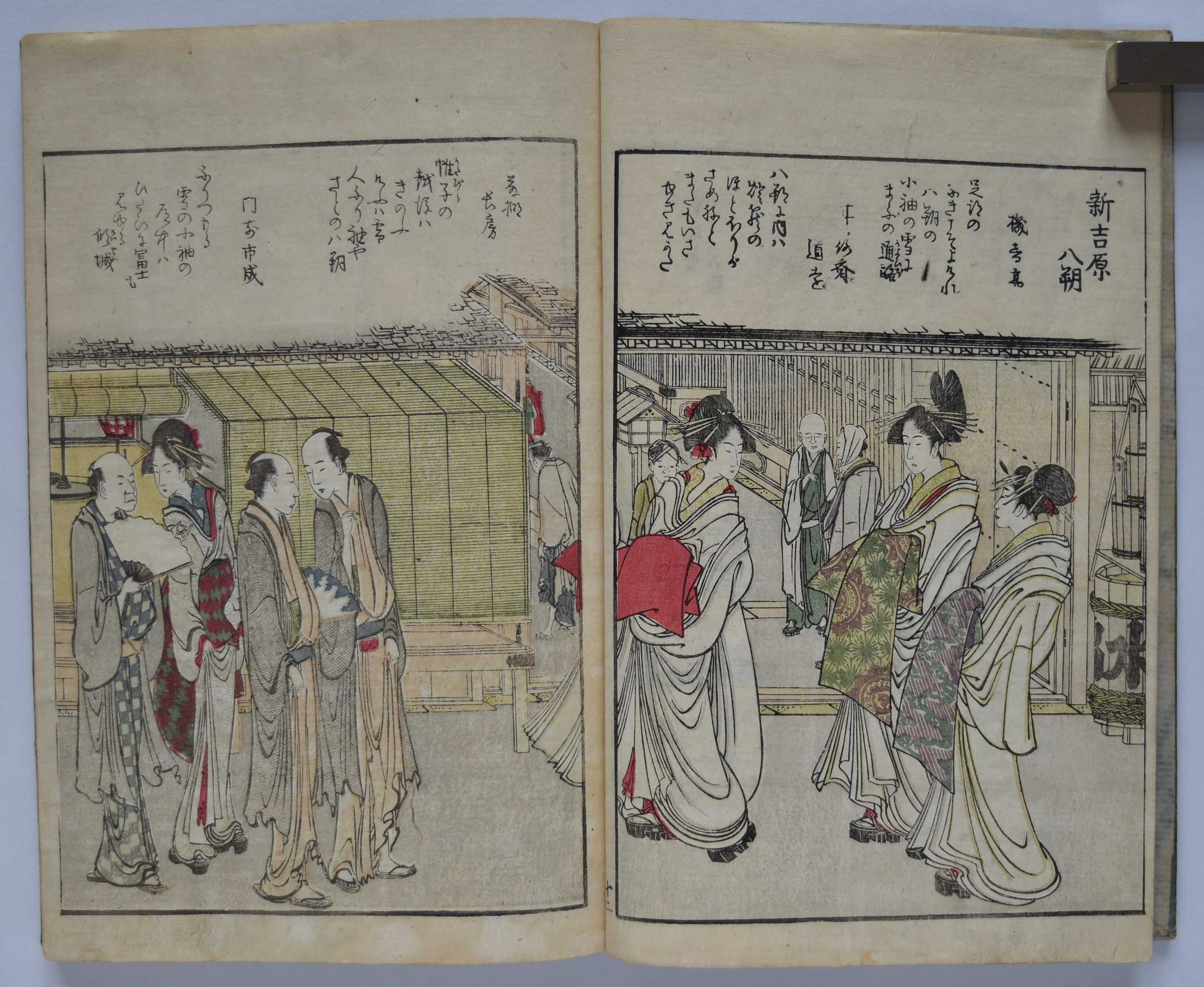
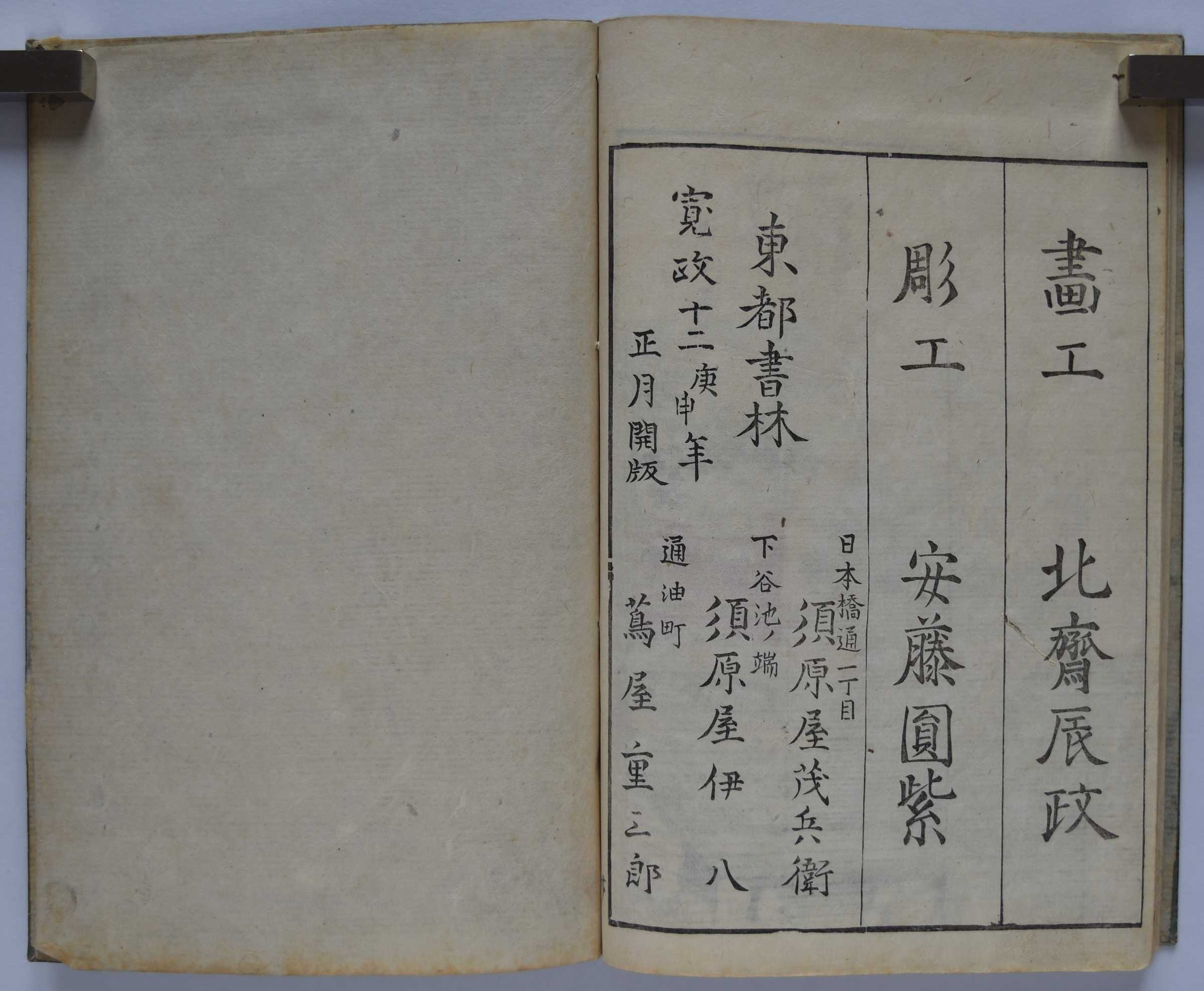
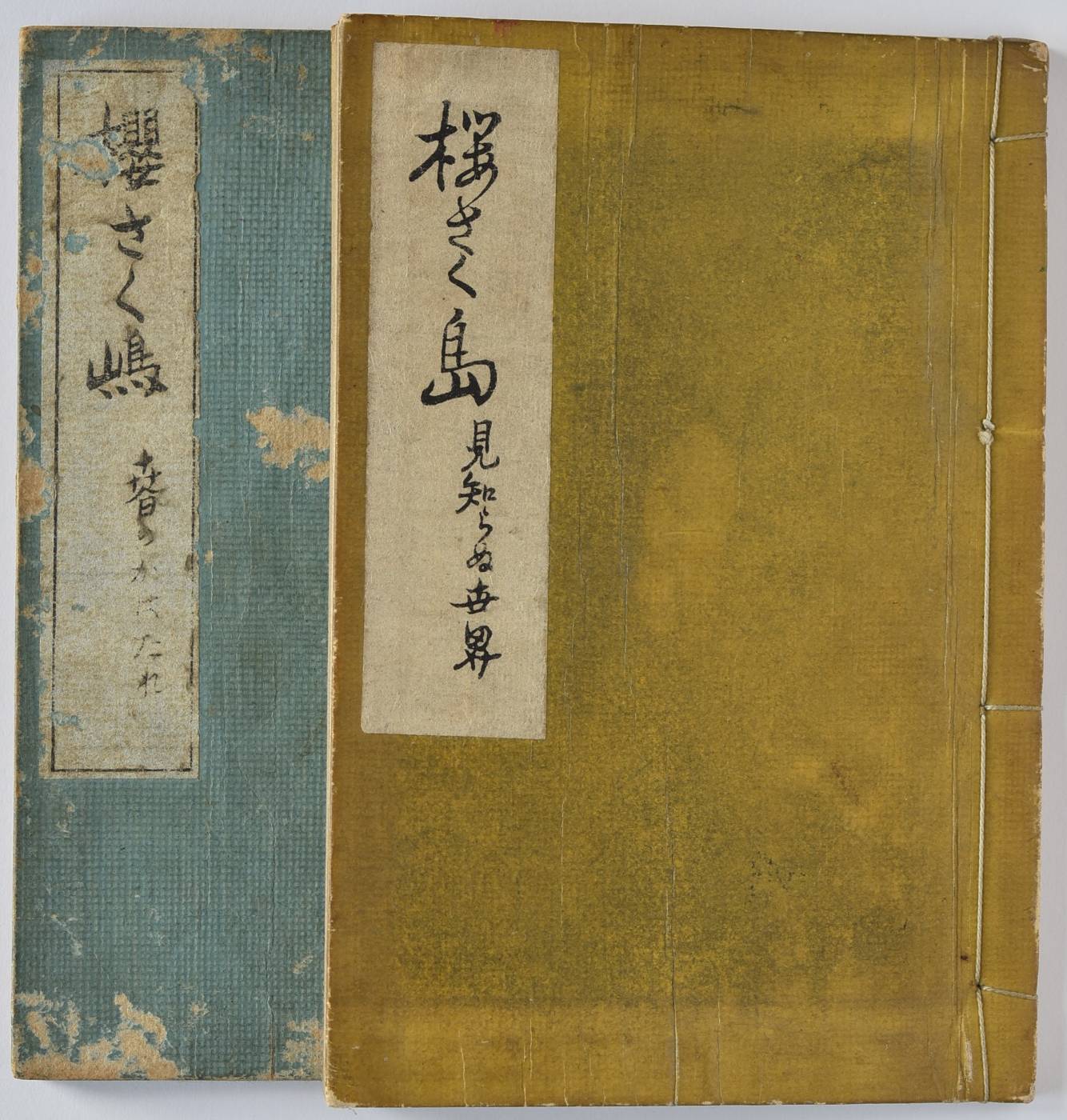
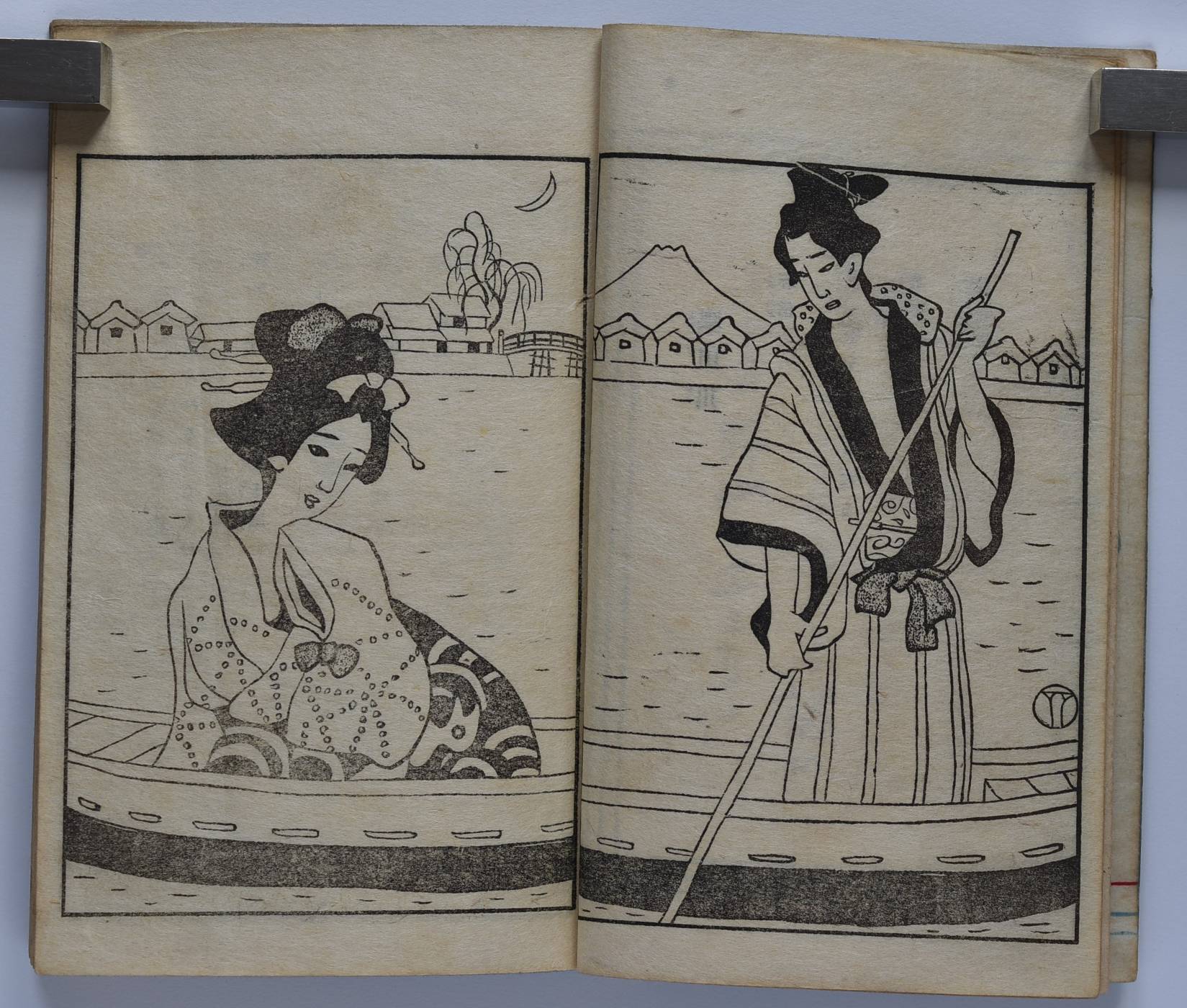
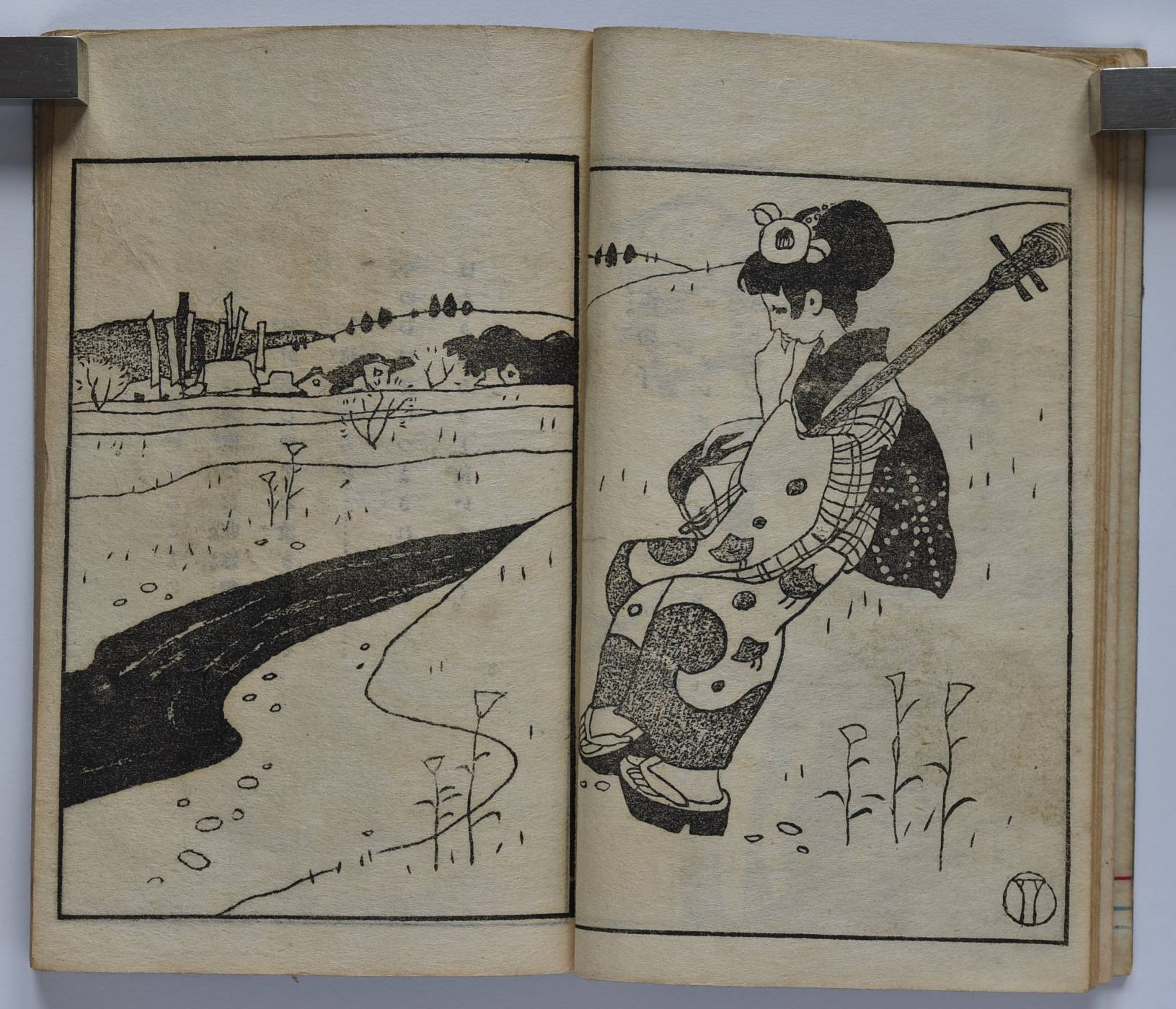
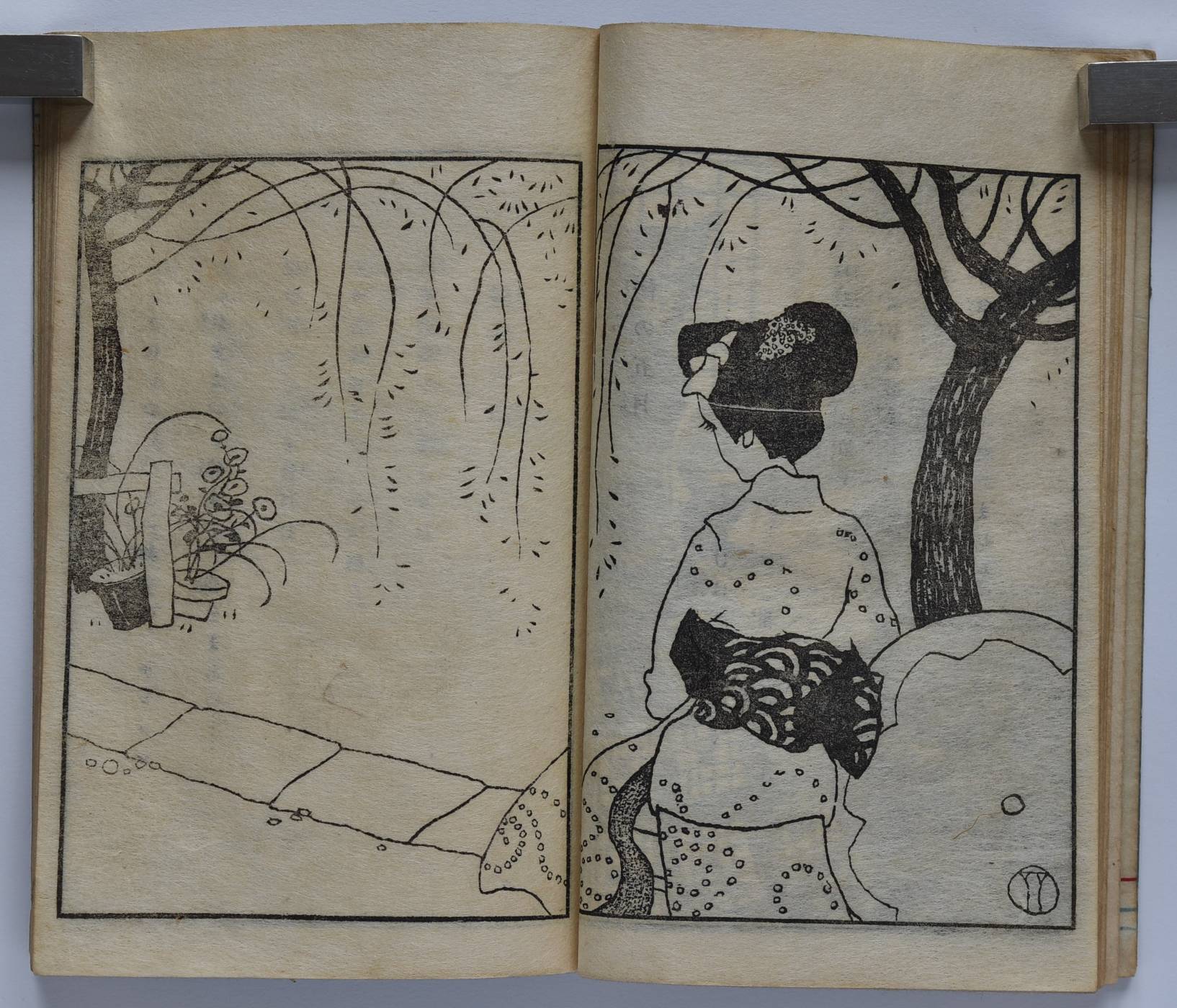
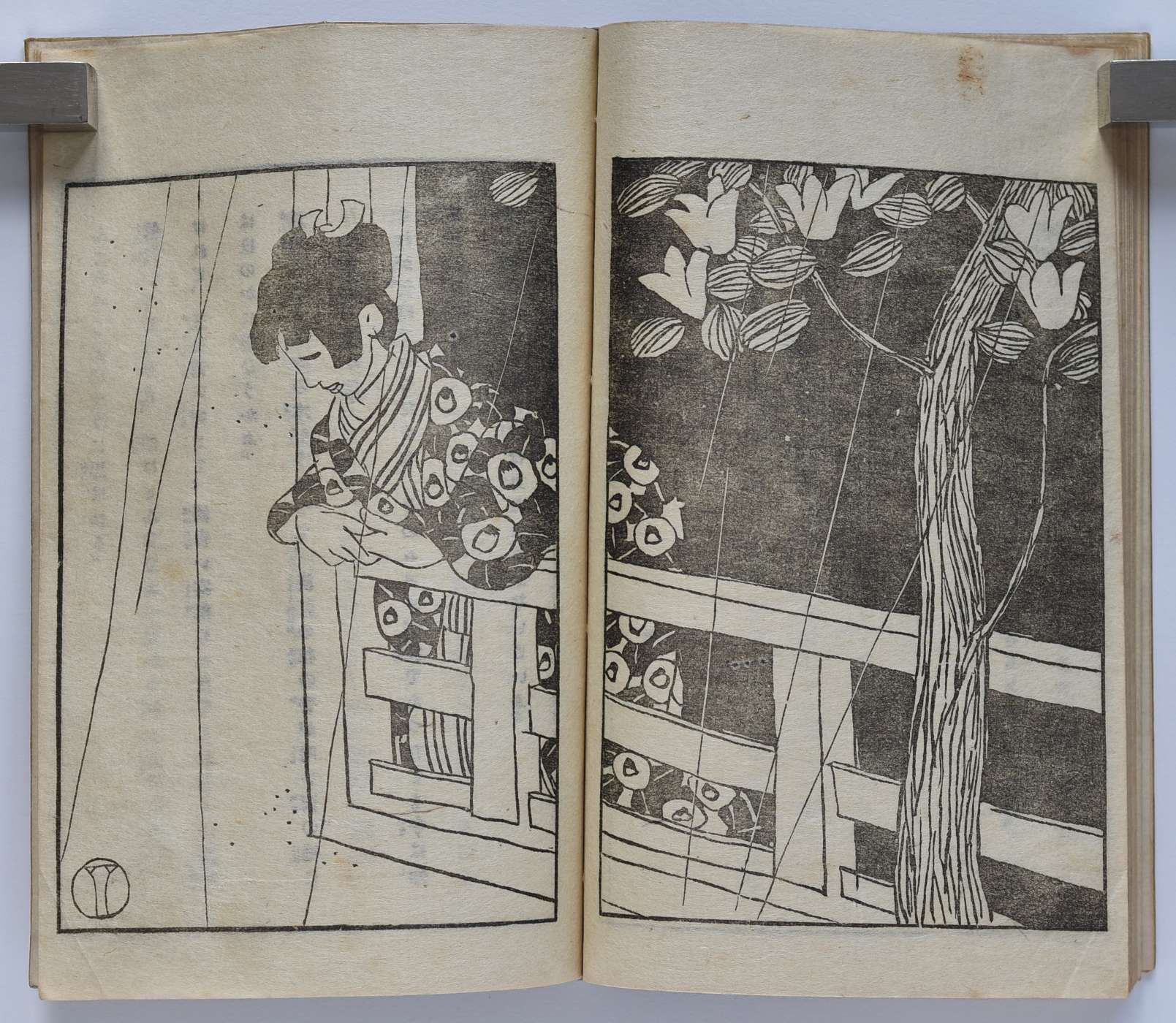
One volume complete Sakura-saku shima : Haru no kawatare. Title page: Within purple borders, the subtitle and Yumeji-saku in reddish brown. Frontispiece: colour woodcut across two pages entitled TUMABIKI, “Finger-plucking” in roman letters, with decorative seal. One page introduction by Yumeji. The remaining 50 pages (unnumbered) with poems by Yumeji and ten double-page and four single-page b/w woodcuts, all dealing with emotions associated with springtime. Colophon dated Meiji 45 (1912), first printing. Artist/author: Takehisa Yumeji. Publisher Kawamoto Kamenosuke. Publishing house Rakuyodo. One page ad for the four books then planned but only this and the following Sakura-saku shima: Mi shiranu sekai were produced. Original pale blue covers with original title slip. In very good condition. Wonderful early designs before becoming overly cloying.
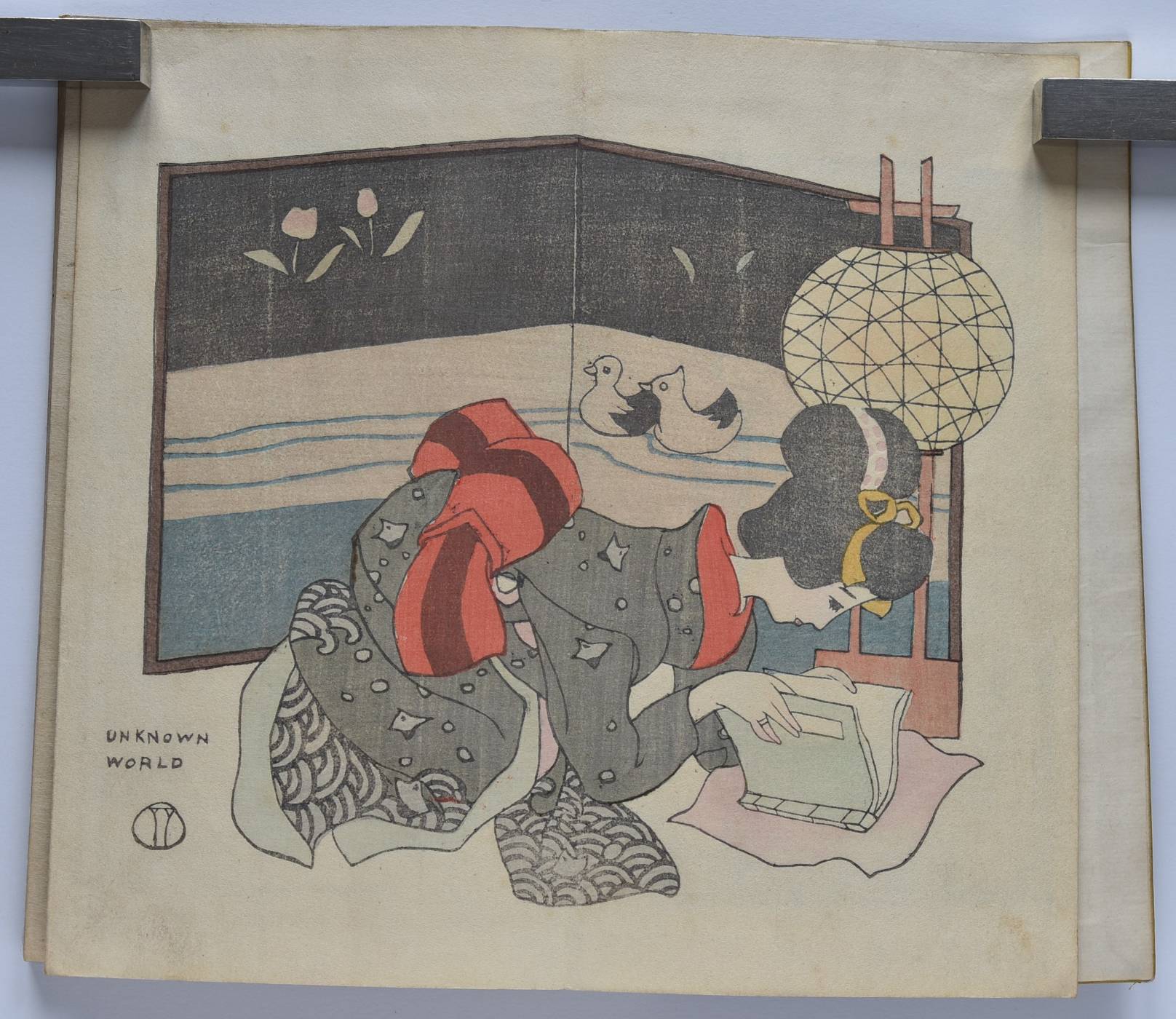
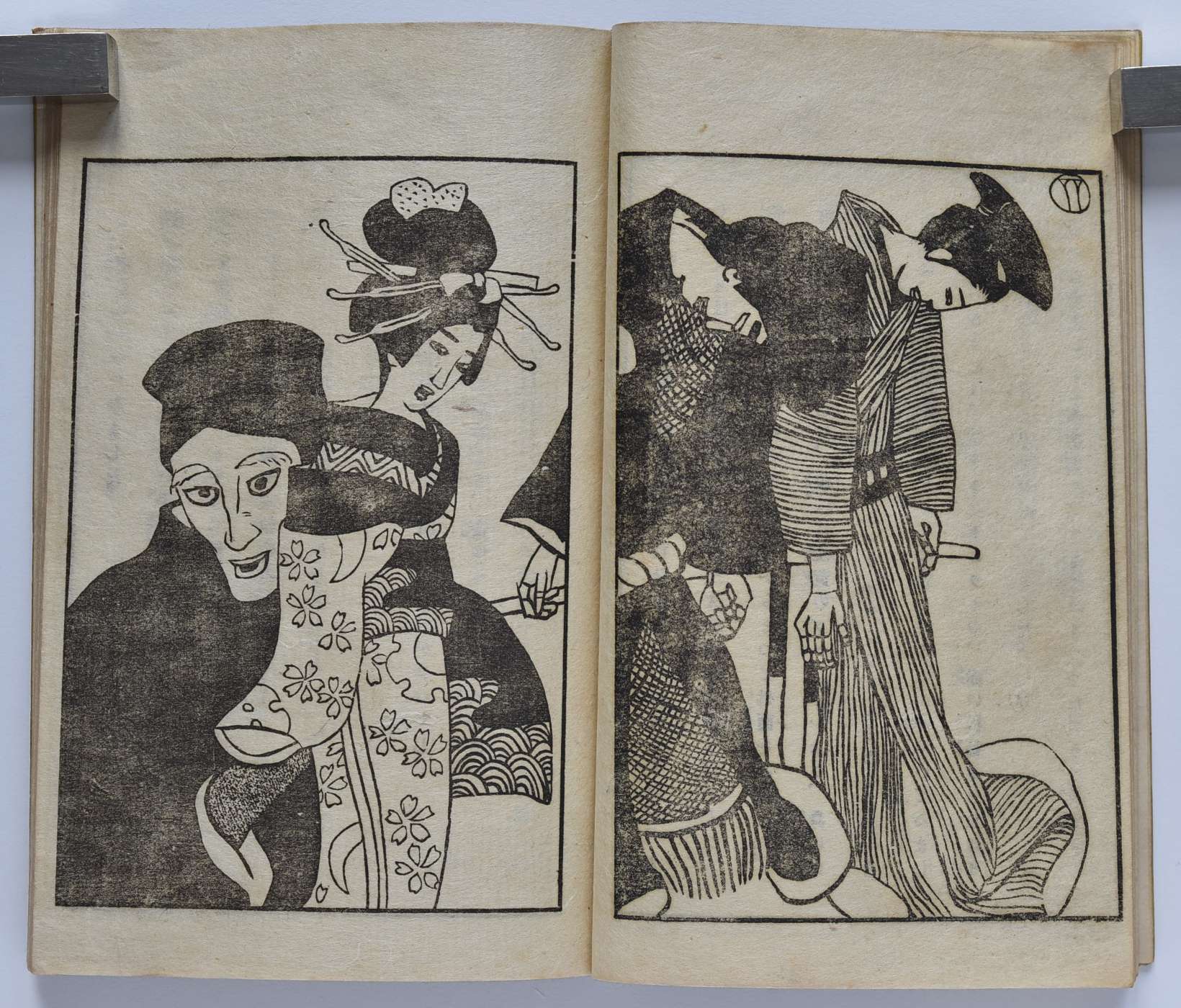
Sold together with: Sakura-saku shima: Mi shiranu sekai. Title page: Within black borders, the subtitle and Yumeji-saku in black, flanked by images of two demons, one red, the other green. Frontispiece: colour woodcut across two pages entitled UNKNOWN WORLD in roman letters, with decorative seal. The remaining 46 pages (unnumbered) with poems by Yumeji and ten double-page b/w woodcuts dealing with family relations and images of souls in hell. Colophon dated Meiji 45 (1912), first printing. Artist/author: Takehisa Yumeji. Publisher: Kawamoto Kamenosuke. Publishing house: Rakuyodo. Original yellow covers with title slip. In very good condition.
Status: Sold
Ichiryusai HIROSHIGE (1797-1858)
Click here to view image full size.
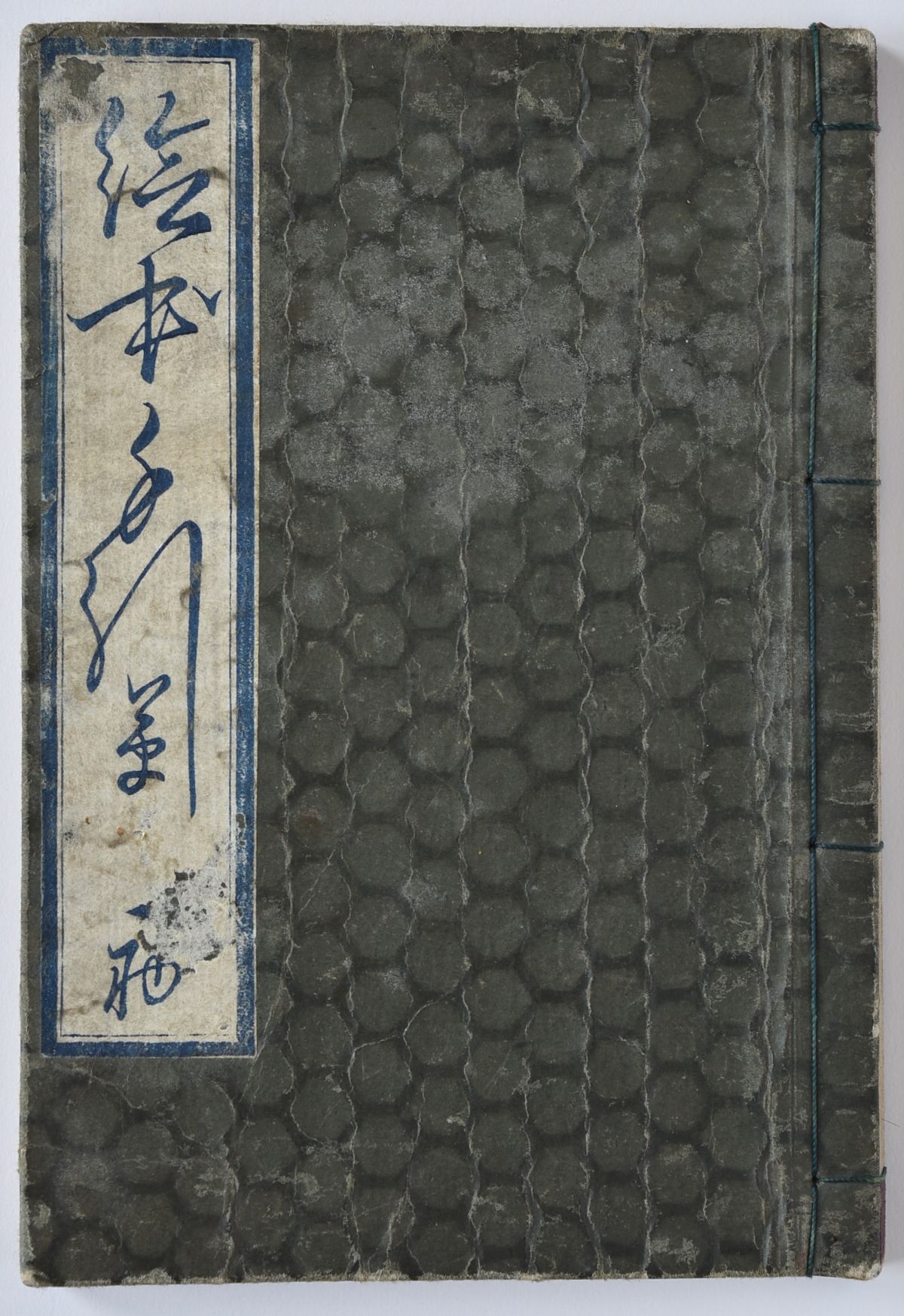
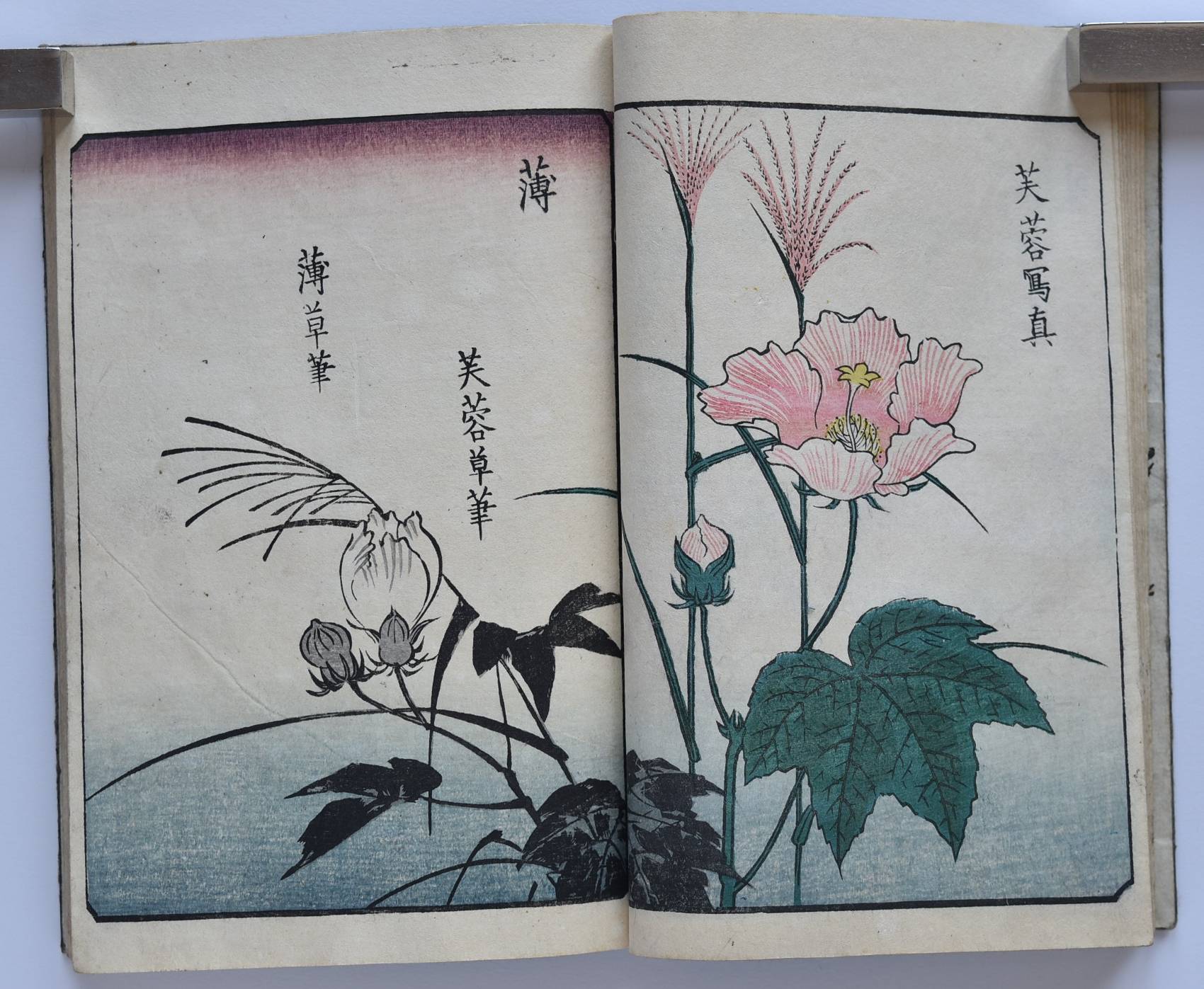
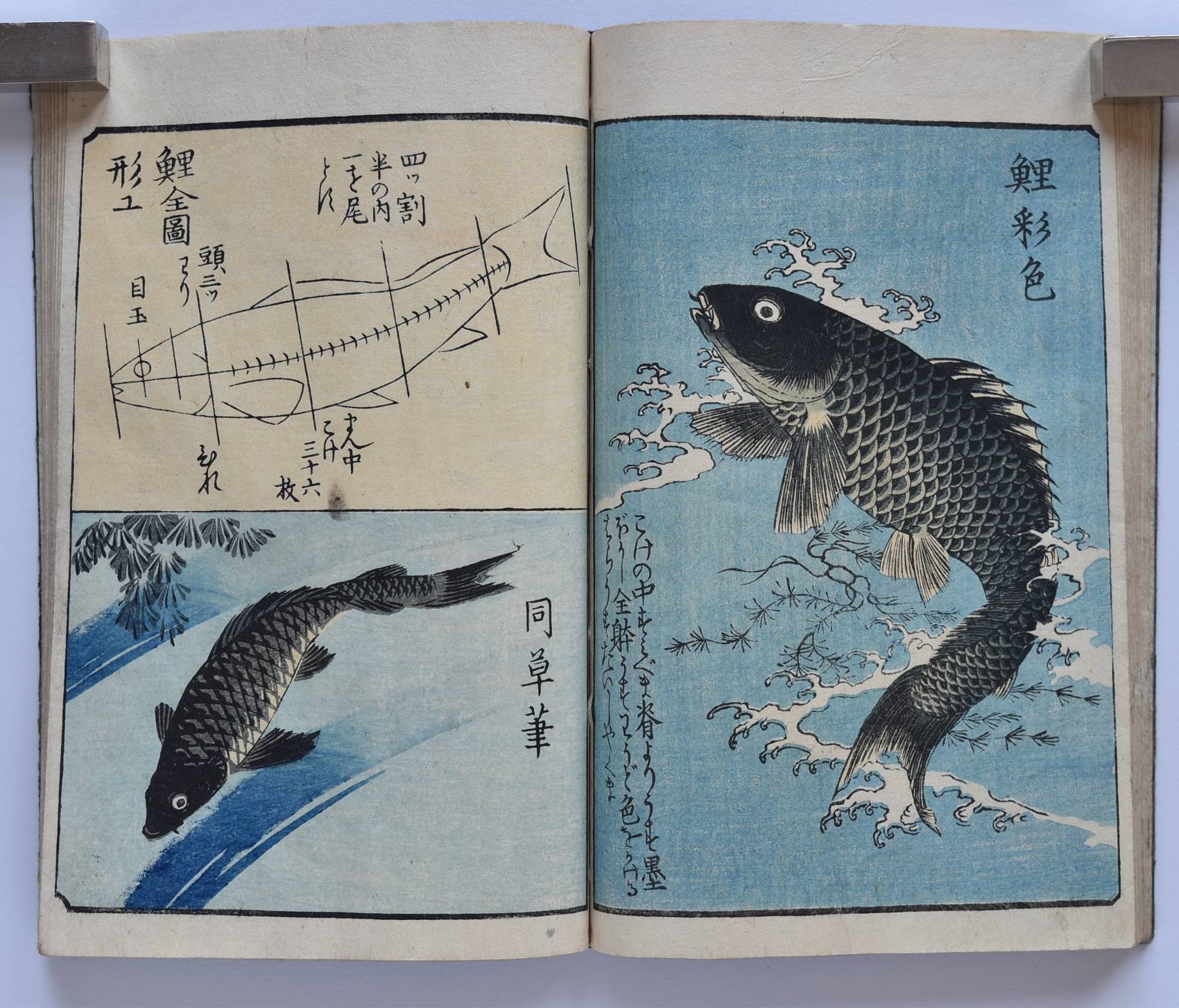
One volume complete, Ehon tebikigusa, “A Model Book of Plants.” Published by Iseya Rihei, 1849. Signed on inside of front cover Ichiryusai Hiroshige hitsu with three page preface signed Ryukatei Tanekazu (1807-1858) plus one page introduction by Hiroshige on how he was asked to design a book as a guide to drawing for children. (See Strange, The Colour Prints of Hiroshige, Cassell, 1925, p. 112-114 for a full translation.) Thirty-five pages of flowers, grasses and fish plus two page view of Mt. Fuji and last page signed Ichiryusai. This is the rare first edition: It was republished by Shojuya Shoshichi, lacking the introduction. Original embossed grey covers and blue title slip.
Extremely fine impressions. Some slight edge wormage at end, otherwise very good condition.
Status: Sold
Kitao MASAYOSHI (1764-1824)
Click here to view image full size.
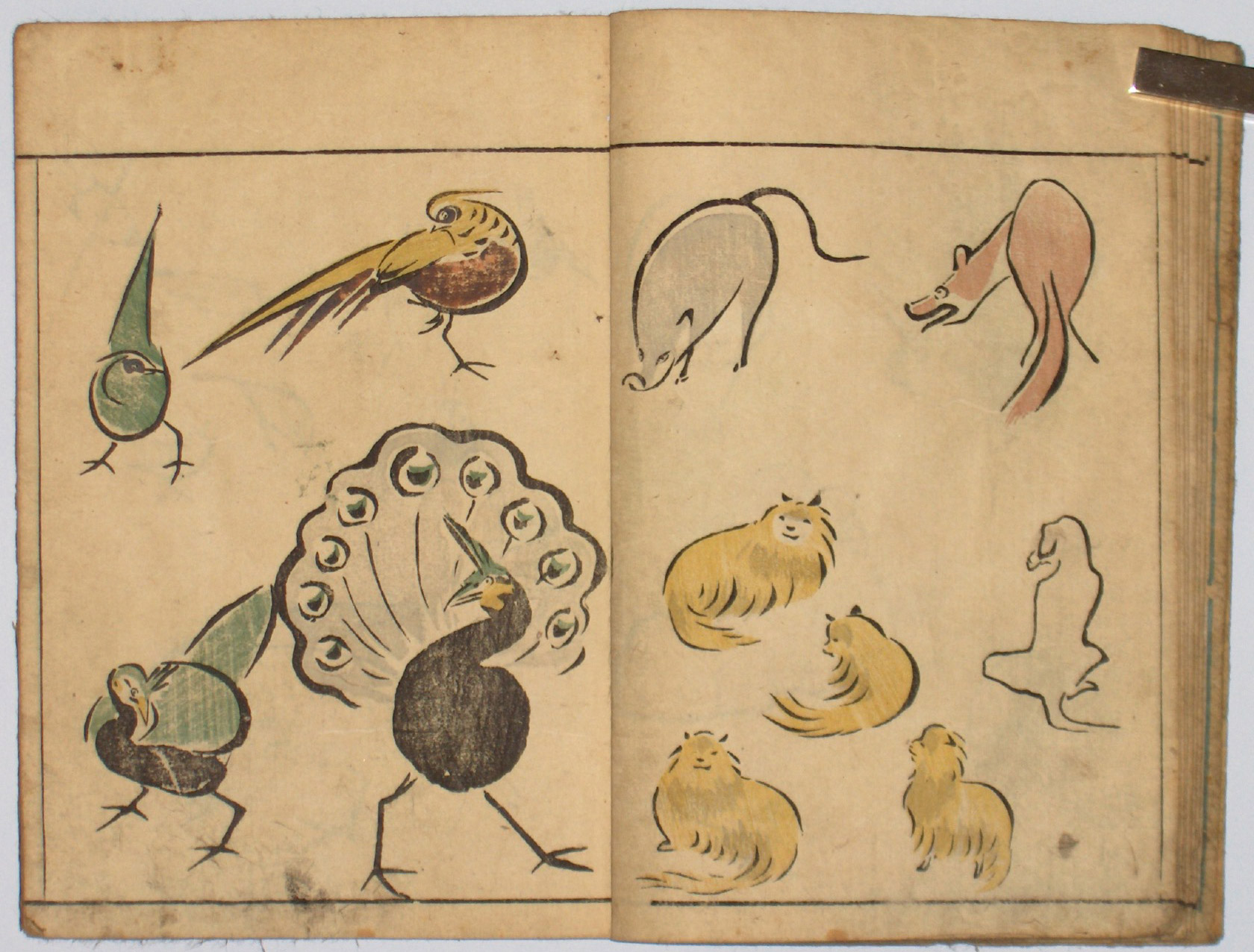
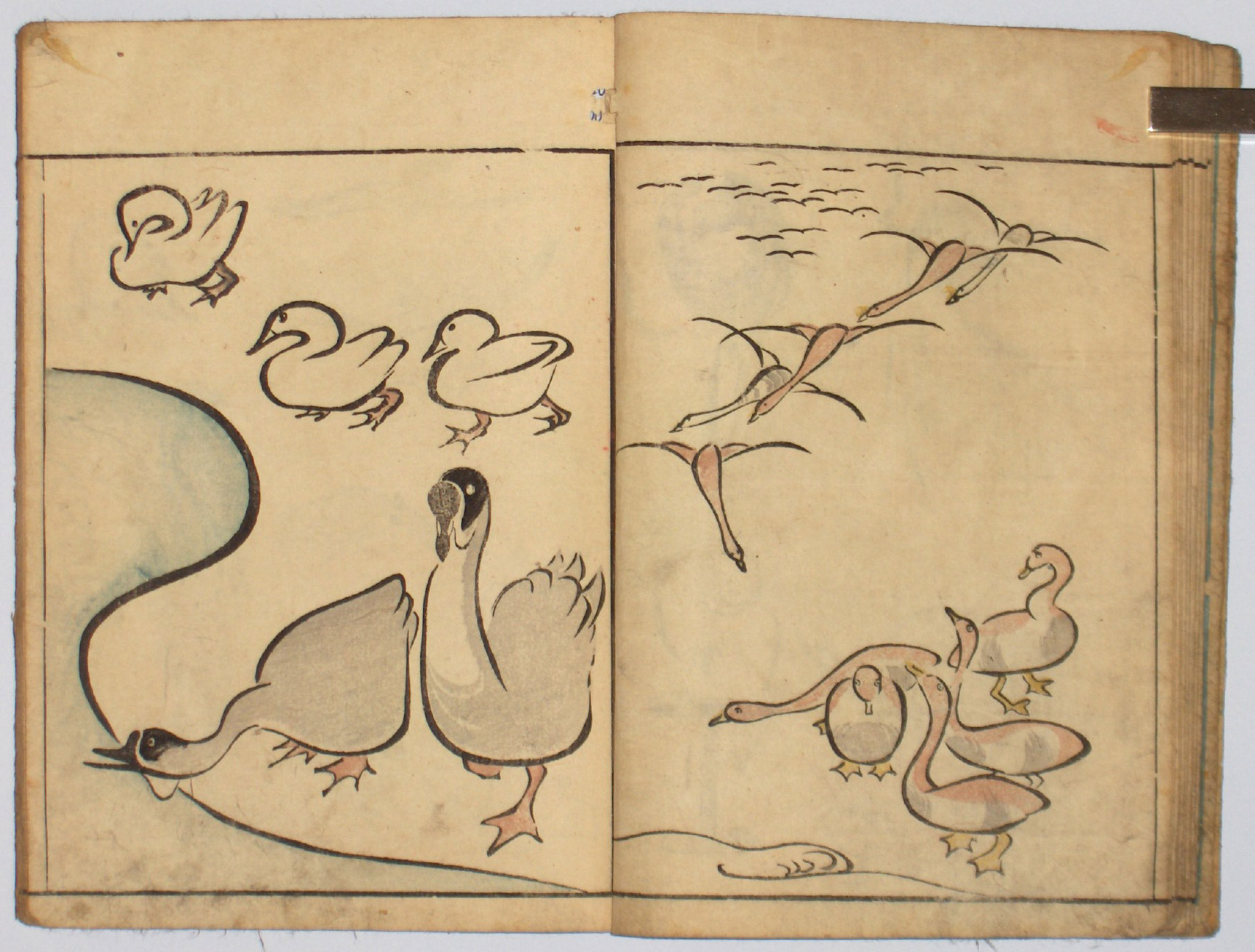
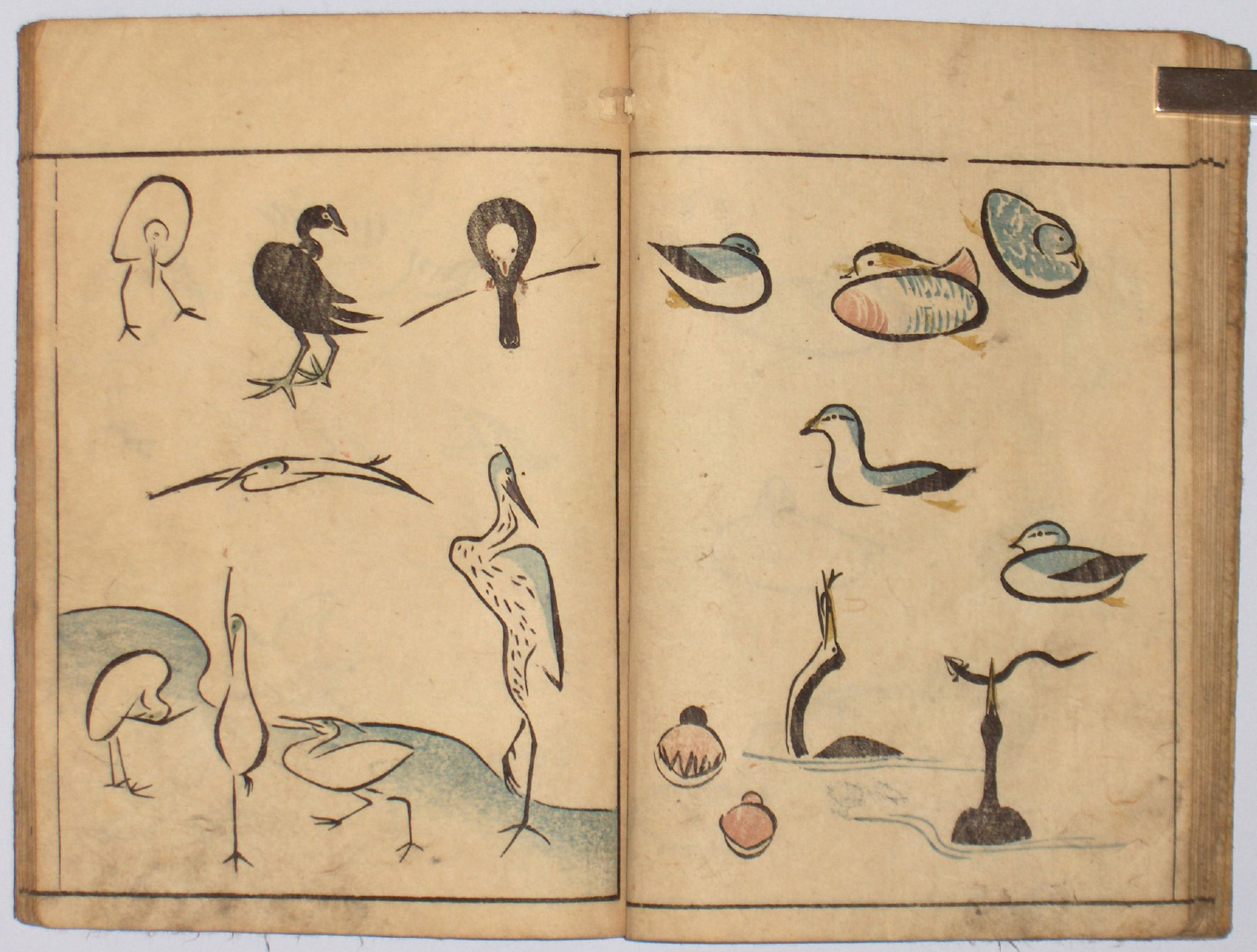
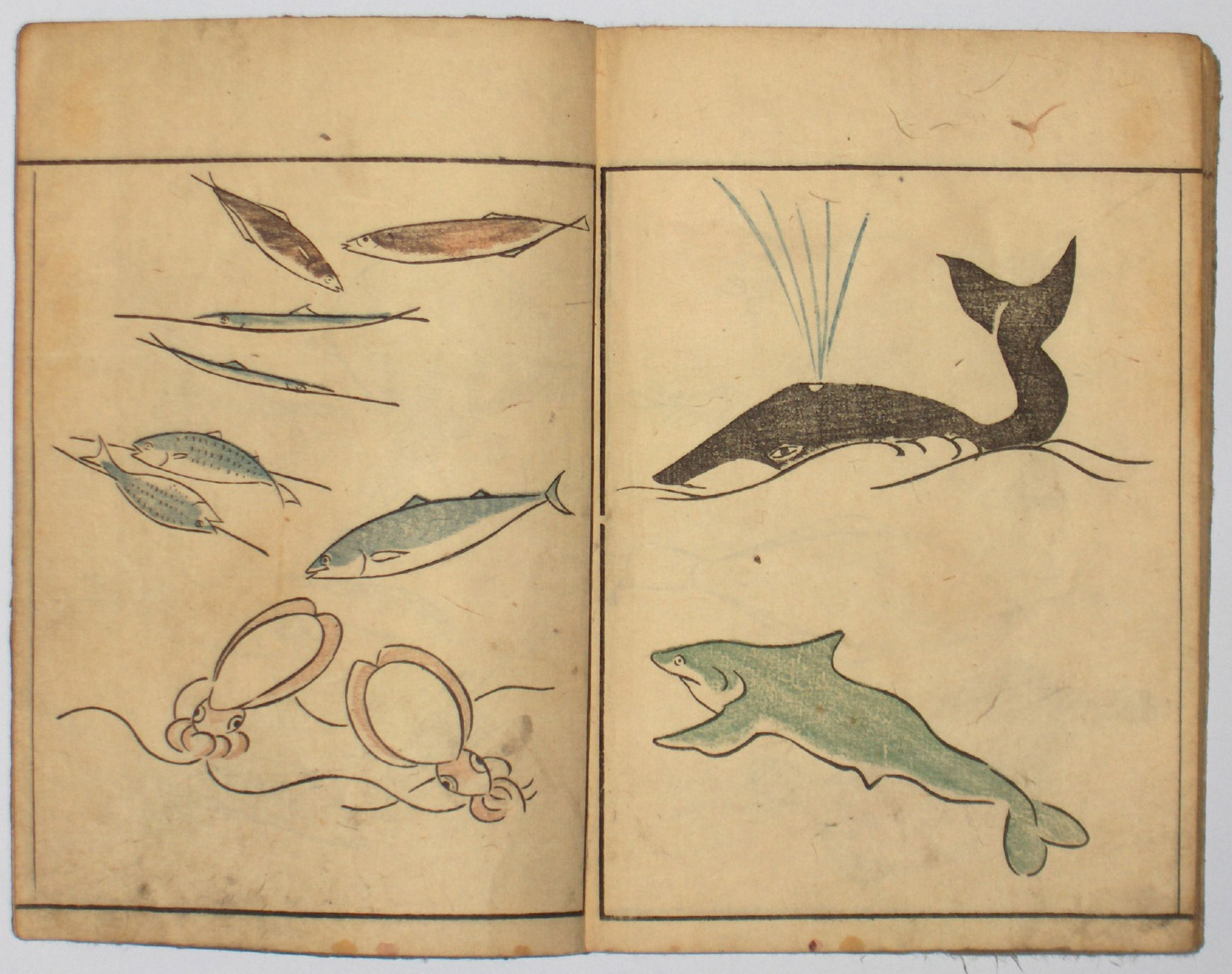
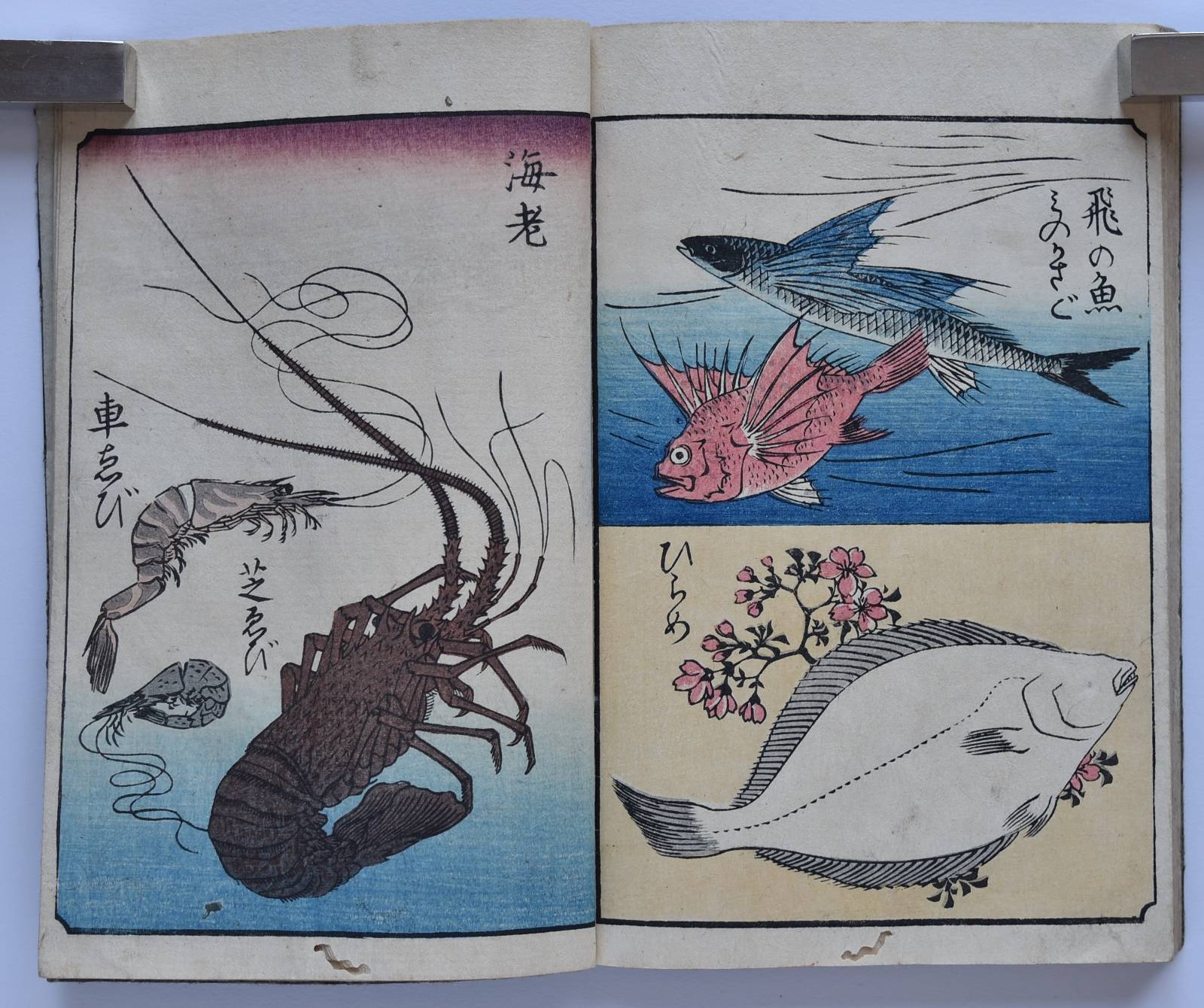
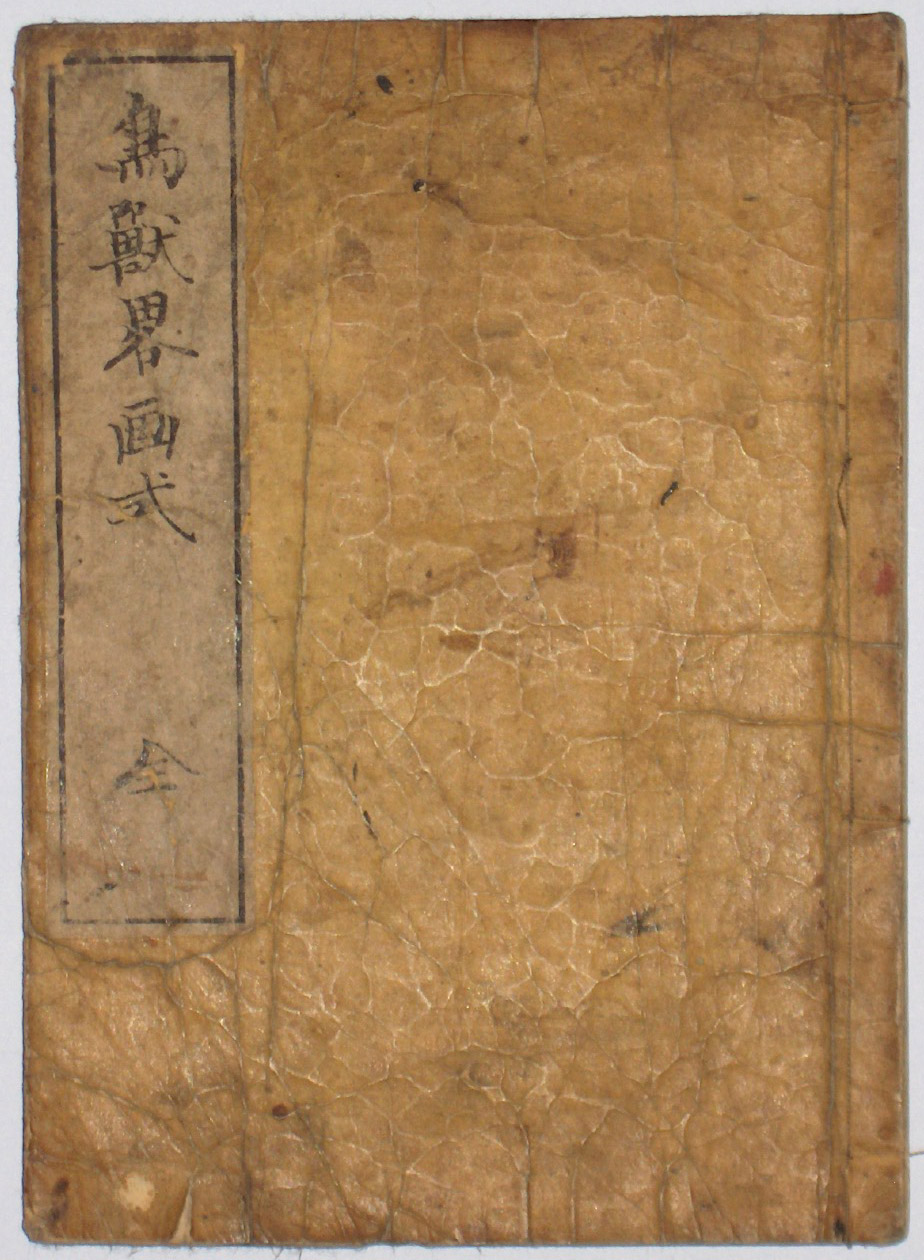
One volume complete Choju ryakugashiki, “Simplified Forms of Drawing Birds and Flowers.” Published Kwansei 9, 1797, by Suharaya Ichibei. Illustrated by Kuwagata Keisai ( Masayoshi ). These influential books of Masayoshi’s were popular and were reprinted many times.
Fine early copy. Original title slip and lemon-yellow covers ( some wear ). Some thumbing at bottom especially towards front, and other minor marks, otherwise good condition. Unidentified collectors’ seals at end and small annotation on back cover of a previous (?) collector: L. de la Bedollier.
Status: Sold