Utagawa HIROSHIGE (1797-1858)
Click here to view image full size.
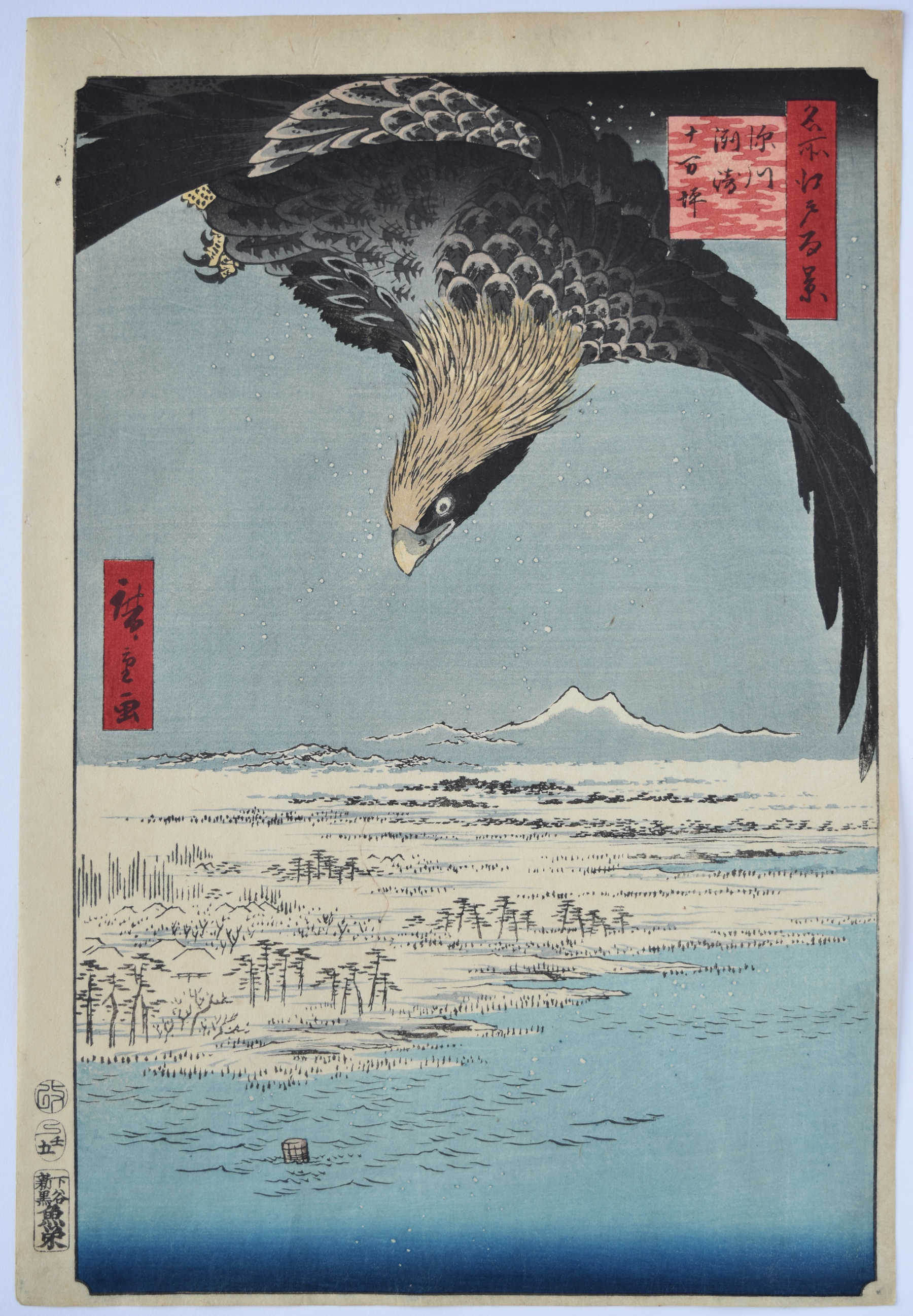
Fukagawa, Suzaki, juman-tsubo, “The One Hundred Thousand Tsubo Plain, Suzaki, Fukagawa” from Meisho Edo hyakkei, “One Hundred Famous Views of Edo.” The set published by Uoya Eikichi between 1856 and 1859 (this being 1857). An eagle hovers over the snowy coastal plain, Mt Tsukuba and the Chiba mountains in the distance.
Very good impression, colour and condition. Signed Hiroshige ga.
Status: Sold
Utagawa HIROSHIGE (1797-1858)
Click here to view image full size.
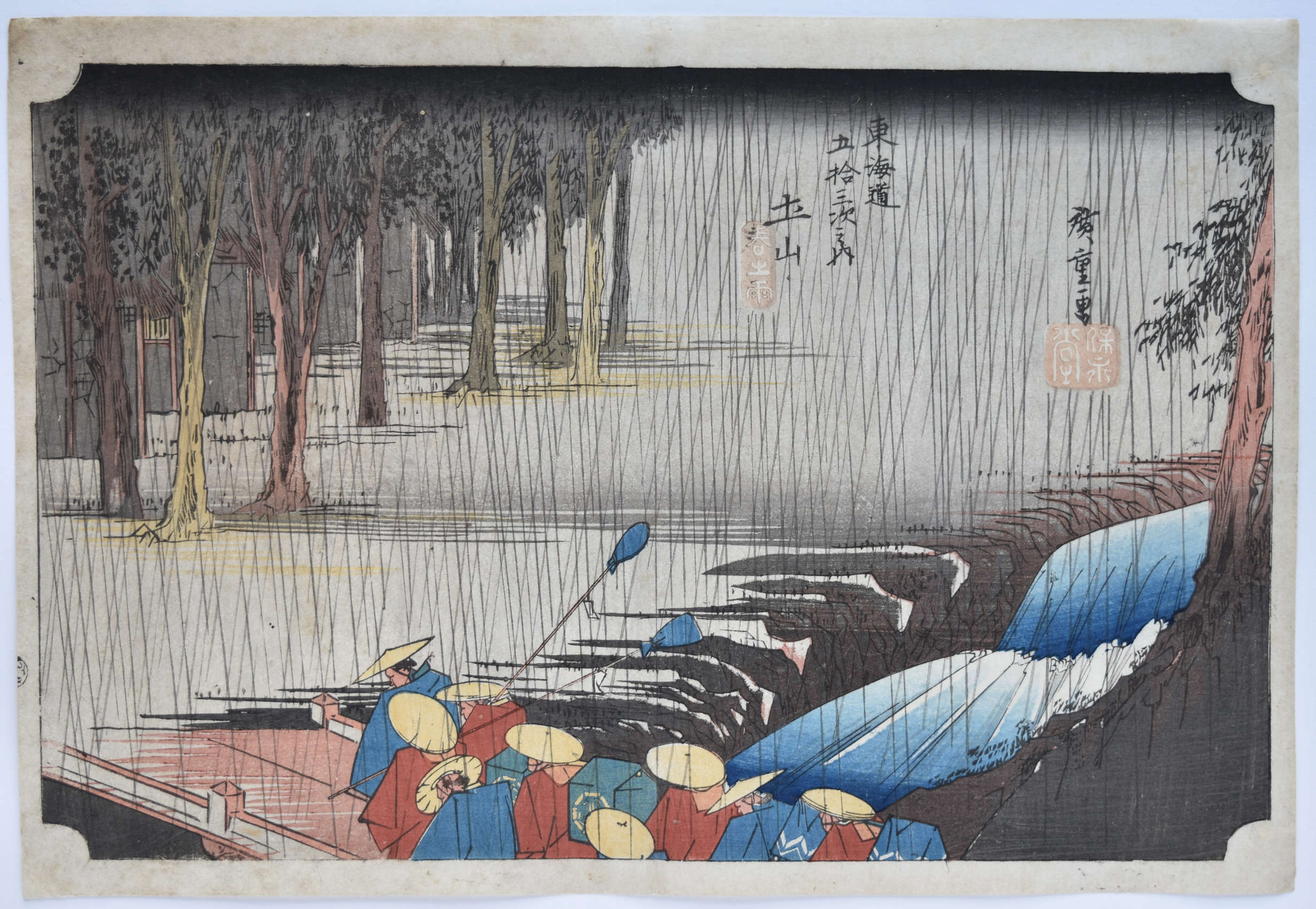
Tsuchiyama, haru no ame, “Tsuchiyama, Spring Rain.” Number 49 from the famous Tokaido gojusan tsugi no uchi, “The Fifty-three Stations of the Tokaido.” Published by Hoeido, c. 1833-4. Hiroshige travelled the length of the Tokaido as part of an official delegation in 1832 making sketches along the way. On his return he started work on the set eventually producing 55 prints. The first of the designs were published jointly by Hoeido and Senkakudo, but then Hoeido took over the production. Shows a daimyo’s cortege crossing the Tamura River. Tsuchiyama flourished because of its location at the entrance to the Suzuka Pass. However, in Meiji times, the town was bypassed by the railway because of the steep gradients here. This is the rare first edition.
Fine impression. Slight fading of seals, slight centre fold and minimal soil to left edge, otherwise very good condition. Signed Hiroshige ga.
Status: Sold
Utagawa HIROSHIGE (1797-1858)
Click here to view image full size.
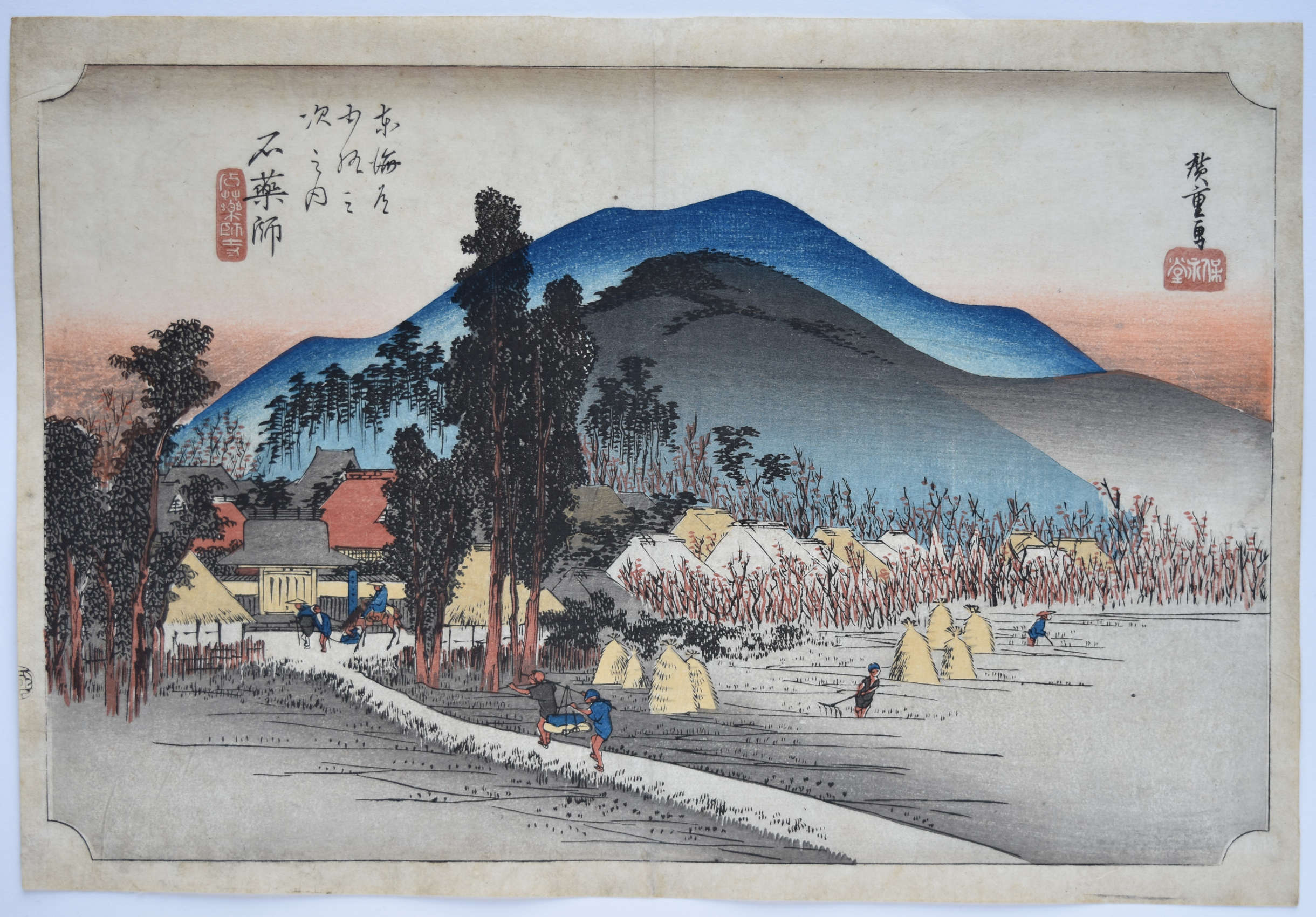
Ishiyakushi, number 44 from the Tokaido showing figures entering the village with others working in the fields. Ishiyakushi-ji Temple was seen on entering the village. From the famous Tokaido gojusan tsugi no uchi, “The Fifty-three Stations of the Tokaido.” Published by Hoeido, c. 1833-4. Hiroshige travelled the length of the Tokaido as part of an official delegation in 1832 making sketches along the way. On his return he started work on the set eventually producing 55 prints. The first of the designs were published jointly by Hoeido and Senkakudo, but then Hoeido took over the production. This is the rare first edition.
Fine impression. Slight fading of seals, slight centre fold and minimal soil to left edge, otherwise very good condition. Signed Hiroshige ga.
Status: Sold
Utagawa HIROSHIGE (1797-1858)
Click here to view image full size.
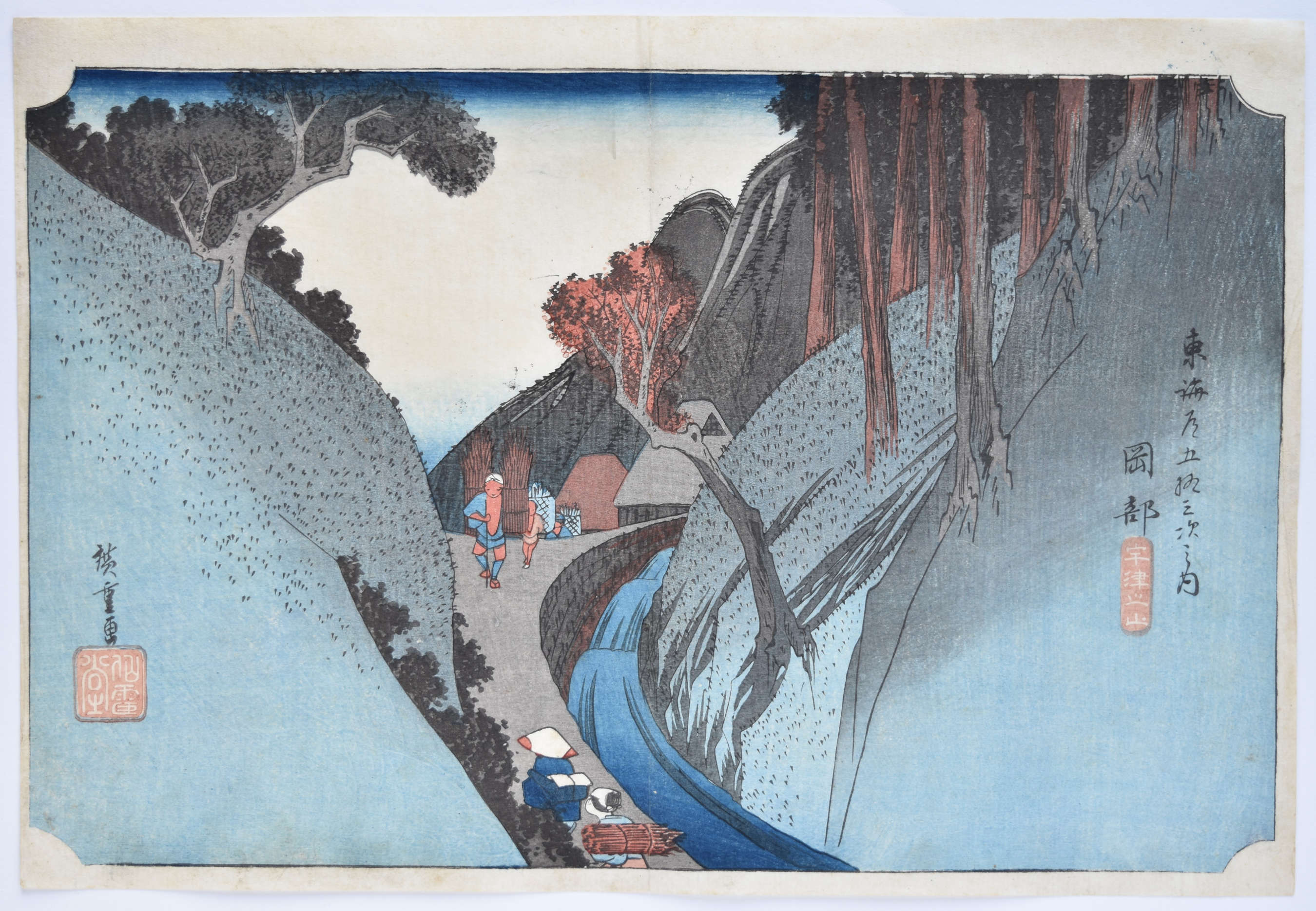
Okabe, Utsu no yama, “Okabe, Utsu Mountain.” Number 21 from the famous Tokaido gojusan tsugi no uchi, “The Fifty-three Stations of the Tokaido.” Published by Hoeido, c. 1833-4. Hiroshige travelled the length of the Tokaido as part of an official delegation in 1832 making sketches along the way. On his return he started work on the set eventually producing 55 prints. The first of the designs were published jointly by Hoeido and Senkakudo, but then Hoeido took over the production. Utsunoya Pass is just before Okabe. The pass is the scene of a Kabuki play by Mokuami Kawatake (1816-1893) where Jubei Itamiya kills and robs the blind Bun’ya. This is the rare first edition.
Fine impression. Slight fading of seals, slight centre fold and minimal soil to left edge, otherwise very good condition. Signed Hiroshige ga.
Status: Sold
Utagawa HIROSHIGE (1797-1858)
Click here to view image full size.
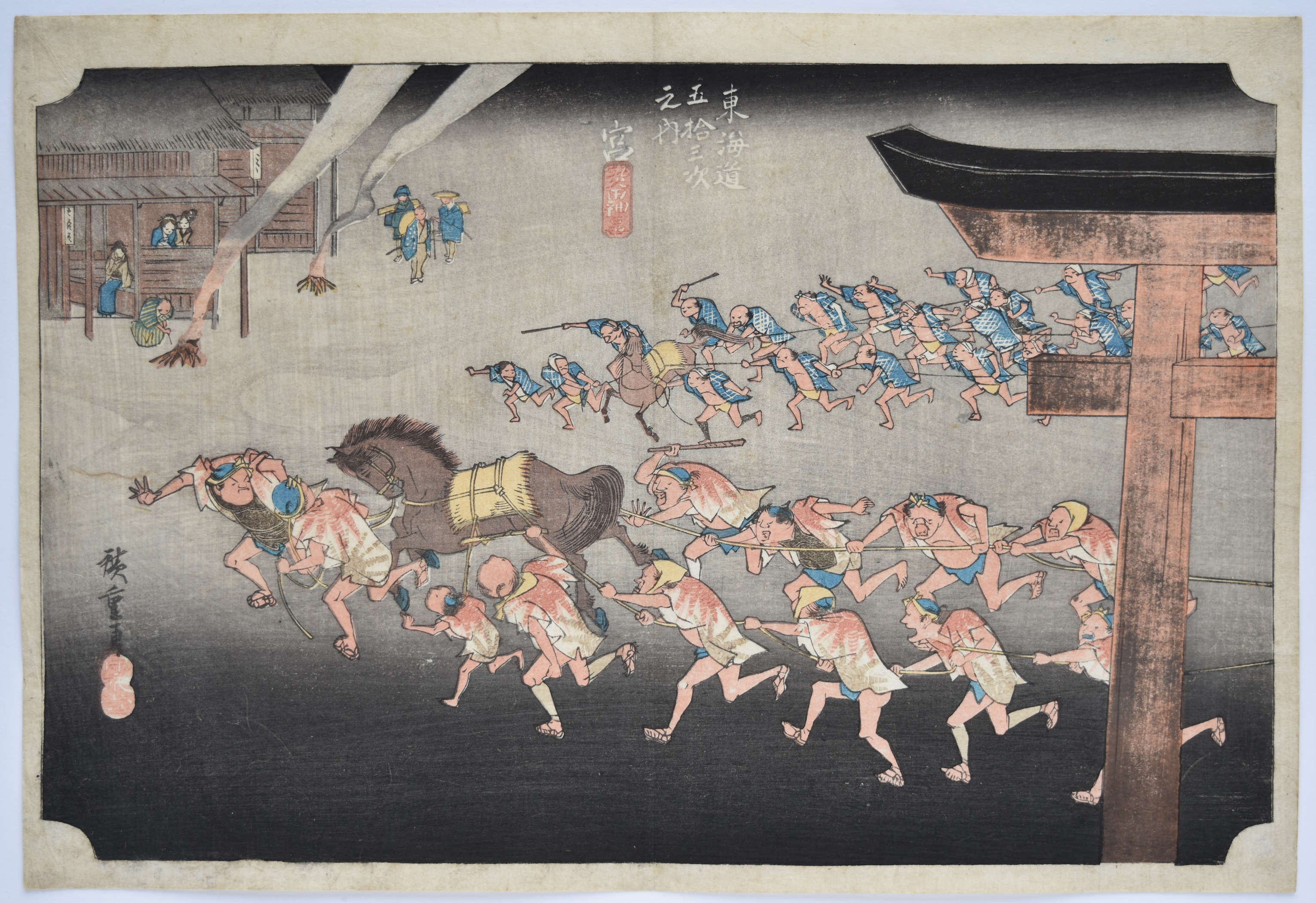
Miya, Atsuta shinji, “Miya, Festival of the Atsuta Shrine.” Number 41 from the famous Tokaido gojusan tsugi no uchi, “The Fifty-three Stations of the Tokaido.” Published by Hoeido, c. 1833-4. Hiroshige travelled the length of the Tokaido as part of an official delegation in 1832 making sketches along the way. On his return he started work on the set eventually producing 55 prints. The first of the designs were published jointly by Hoeido and Senkakudo, but then Hoeido took over the production. Miya was the largest station on the Tokaido. There were many inns catering for the pilgrims going to Ise and daimyo travelling to Edo. Shows the horse-driving festival held at the Shinto Atsuta Shrine, the Hama Gateway to the right. This is the rare first edition.
Fine impression. Slight fading of seals, slight centre fold and minimal soil to left edge, otherwise very good condition. Signed Hiroshige ga.
Status: Sold
Utagawa HIROSHIGE (1797-1858)
Click here to view image full size.
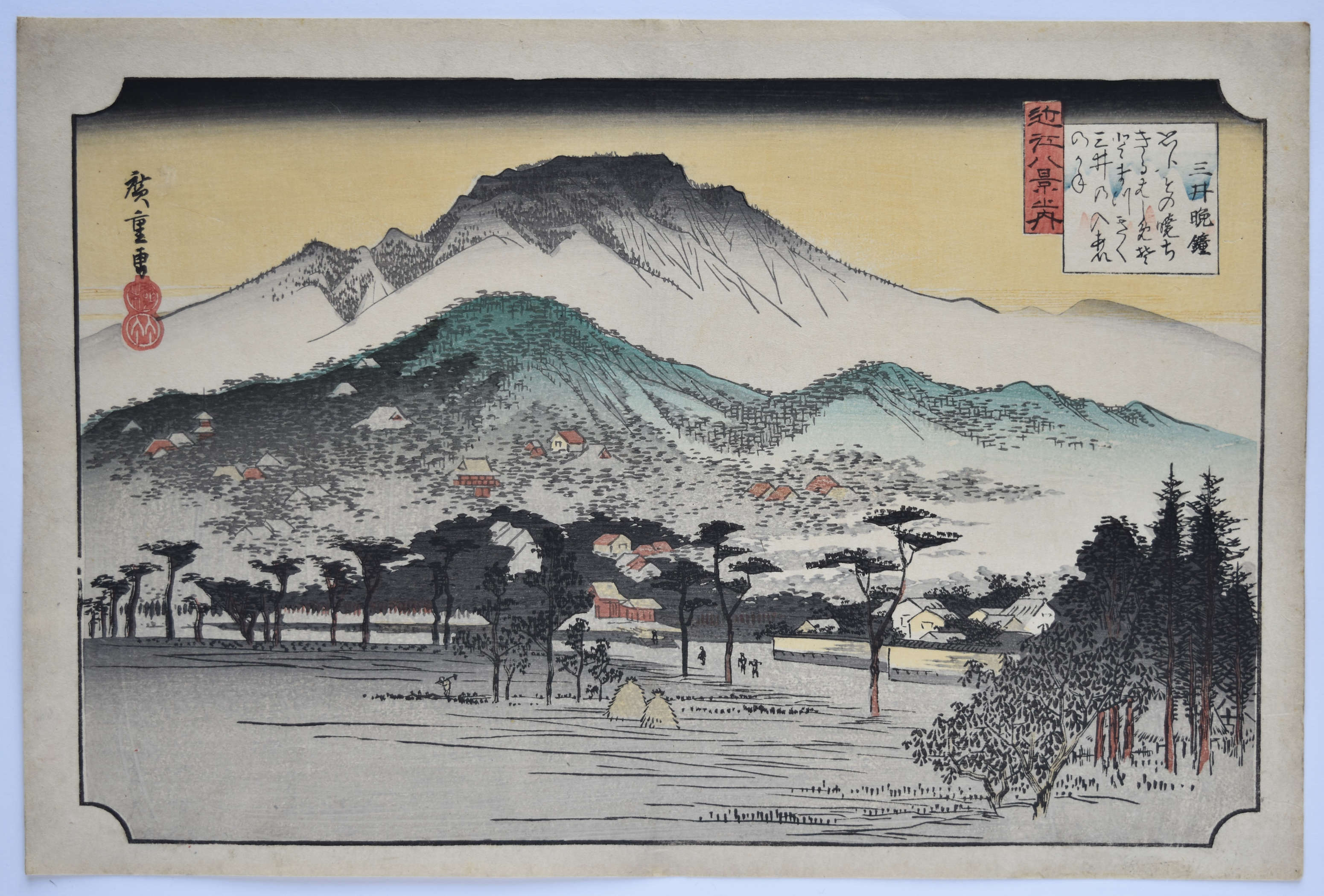
Mii no bansho, “Evening Bell at Miidera Temple” from an early set Omi hakkei no uchi, “Eight Views in Omi Province.” Shows the temple hidden amongst hills on the southern side of Lake Biwa. Miidera is the common name for the Onjoji, a temple of the Tendai sect, founded in 858. Published by Hoeido and Eikyudo in c. 1834-5. The “Eight Views” theme was derived (as so much else in Japanese art) from China and based on the Eight Views of Xiaoxiang paintings of the 11th century. The subject was transposed to Omi and then taken up by such artists as Harunobu , and later Hiroshige. It was also often playfully alluded to in sets of eight prints in mitate-e style.
Fine early impression and colour. Imperceptible centre fold, otherwise fine condition. Signed Hiroshige ga.
Status: Sold
Utagawa HIROSHIGE II (1829-1869)
Click here to view image full size.
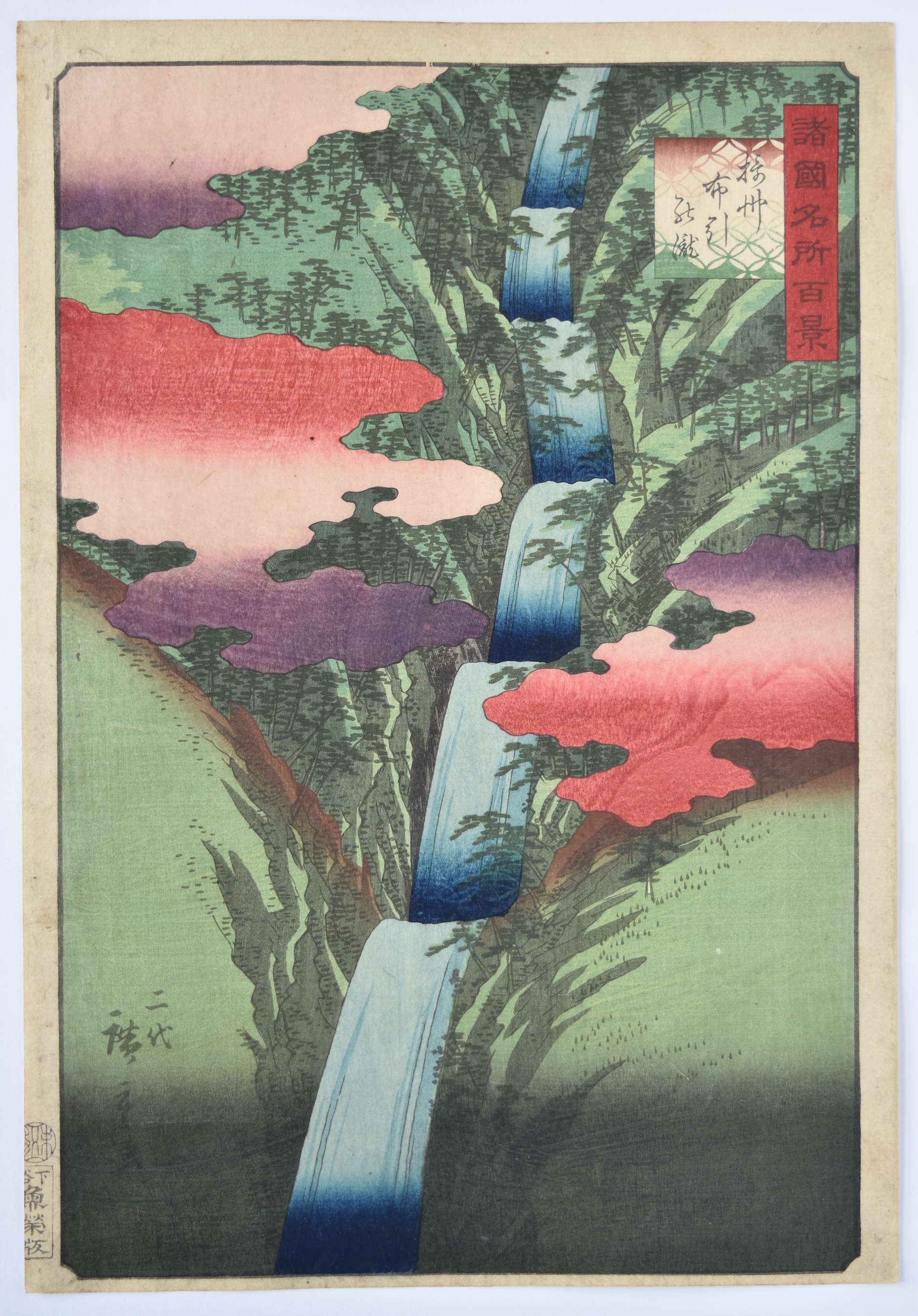
Sesshu Nunobiki no taki, “The Nunobiki Waterfall in Settsu Province,” from a set Shokoku meisho hyakkei, “One Hundred Famous Views in the Various Provinces.” The set published by Uoya Eikichi between 1859 and 1861 (this being 1859). He was the pupil of Hiroshige, given the name Shigenobu. After Hiroshige’s death he married his adopted daughter and became Hiroshige II. The couple were divorced in 1865. She went on to marry another pupil of her father’s – Shigemasa, who became Hiroshige III.
Superb impression and colour with extensive mica and woodgrain. Fine condition. Signed “The second” Hiroshige ga.
Status: Sold
Utagawa HIROSHIGE (1797-1858) and Utagawa KUNISADA (1786-1865)
Click here to view image full size.
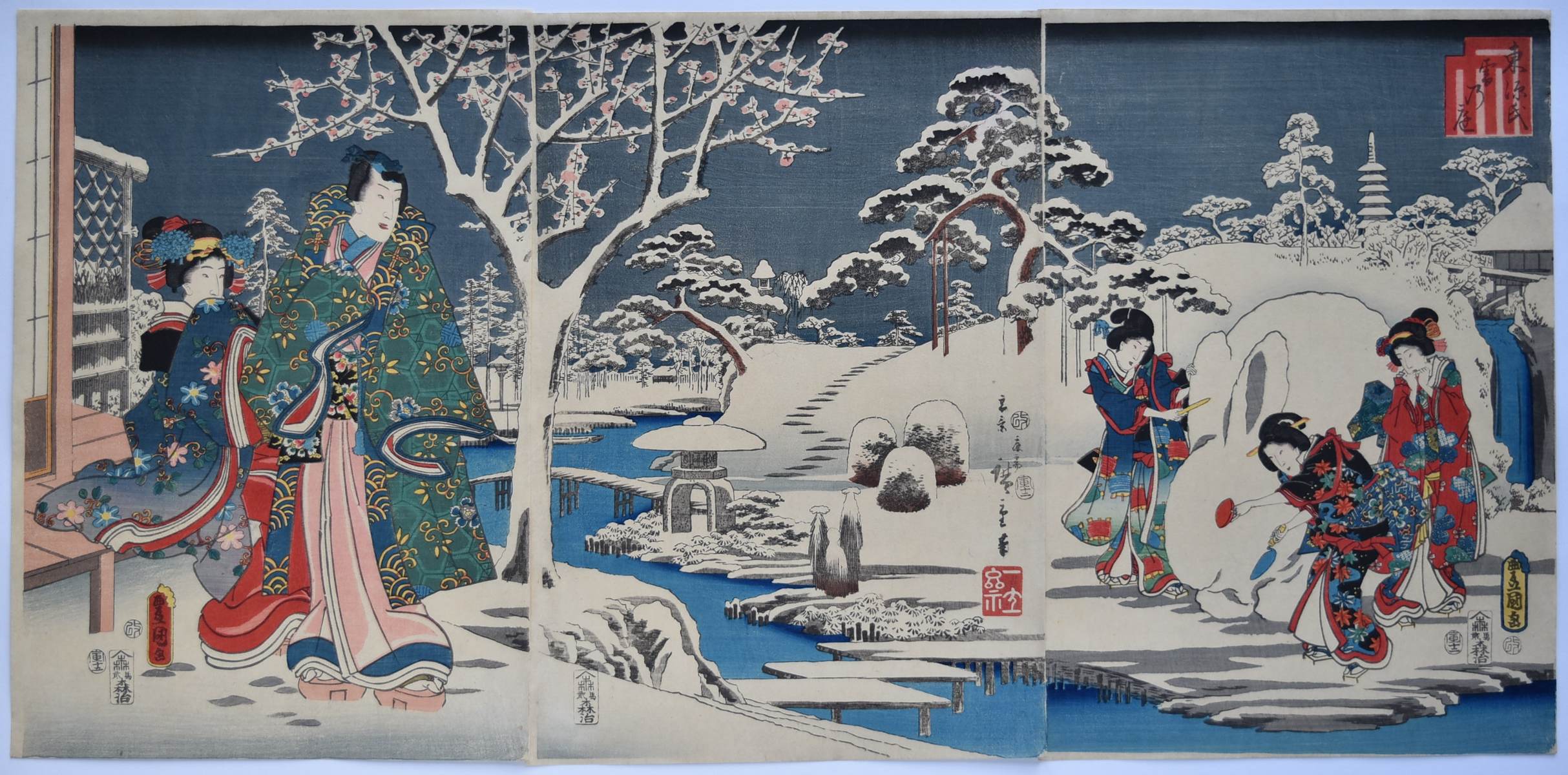
A triptych showing Mitsuuji, the romantic hero of the Inaka Genji (“A Rustic Genji”) accompanied by a beauty looking out across a snow-covered garden where a group of girls are building a giant snow rabbit. Hiroshige and Kunisada collaborated on a number of these Genji triptychs in the 1850s and this is one of the most charming. Published by Moriya Jihei of Kinshodo, 12/1854 (and therefore probably in anticipation of the following year, which was a Year of the Rabbit).
Very good impression, colour and condition. Signed Toyokuni ga and Yuki no kei oju, “Snow landscape by request” Hiroshige hitsu.
Status: Sold
Utagawa HIROSHIGE (1797-1858)

Click here to view image full size.
Izumo, taisha Hotohoto no zu, “Izuma [Province], Hotohoto Festival at Izumo Shrine.” Shows pilgrims to the oldest Shinto shrine in Japan. A heavy mist scene with the torii gate seen to the right. Every year from the 11th to the 17th day of the 10th lunar month (usually November) all Shinto’s deities from around Japan supposedly assembled here. It is also the shrine to visit in the hope of finding a partner. From a set of 69 prints [Dai Nihon] Rokujuyoshi meisho zue, “Famous Places in the Sixty-odd Provinces [of Japan]” published by Koshimuraya Heisuke between 1853 and 1856, this being 1853.
Very fine impression and colour. Light album backing and very small wormhole at extreme edge of margin, top left, otherwise fine condition. Signed Hiroshige ga.
Status: Sold
Utagawa HIROSHIGE (1797-1858) and Utagawa YOSHITORA (active c. 1850-1880)
Click here to view image full size.
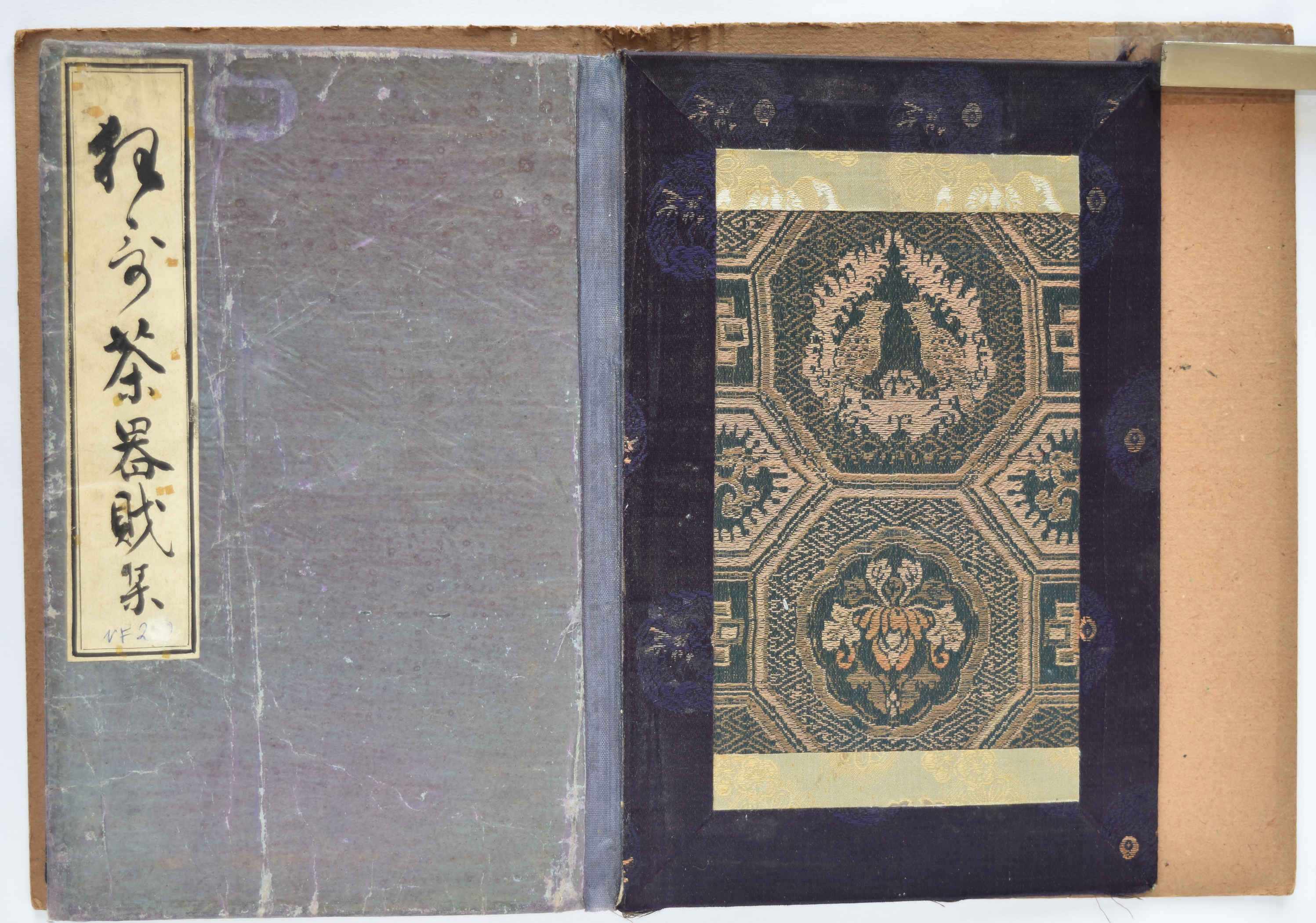
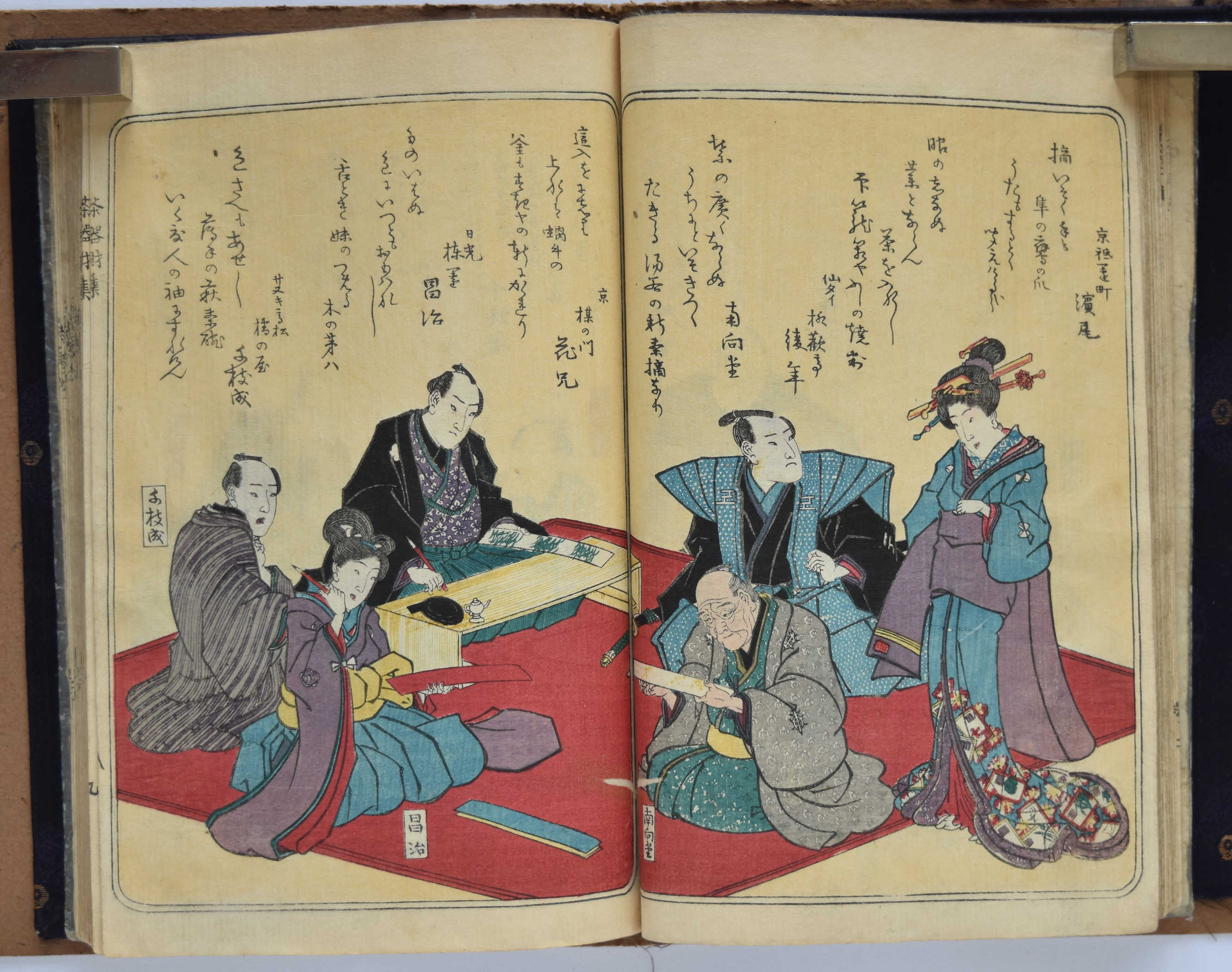
One volume complete Kyoka chakizai gazoshu, “Tea Ceremony Utensils, a Kyoka Collection.” Published Ansei 2, 1855 by Seiryuteizo. Inside front cover artists given as Ichiryusai Hiroshige and Ichimosai Yoshitora. Three pages preface; three pages decorative labels; four pages landscapes by Hiroshige (including the Uji River – a prime tea growing area); twelve pages of portraits by Yoshitora; twenty-one pages kyoka poems. Original covers with a hand inscribed title slip. Ex collection Edmond de Goncourt with his brocade binding and imitation wood slipcase. In very good condition.
Status: Sold

Utagawa HIROSHIGE (1797-1858)
Click here to view image full size.
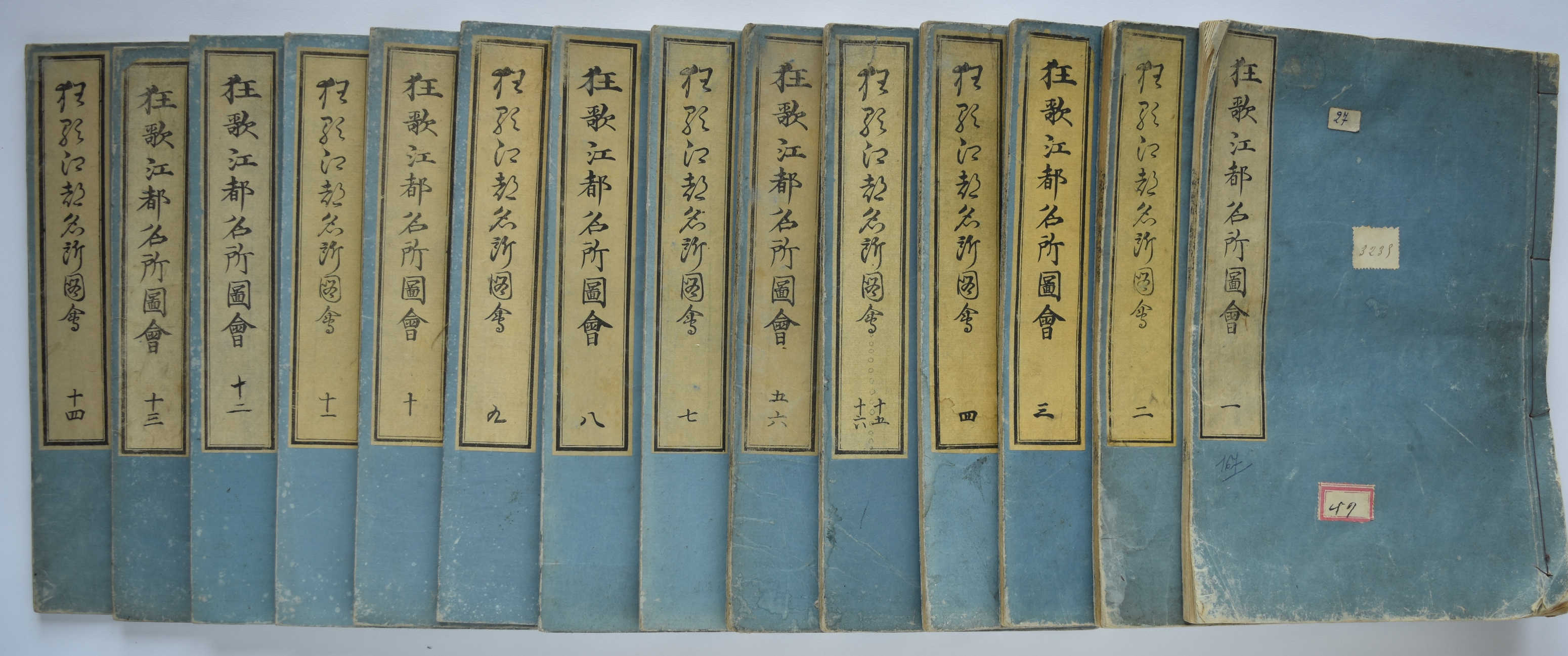
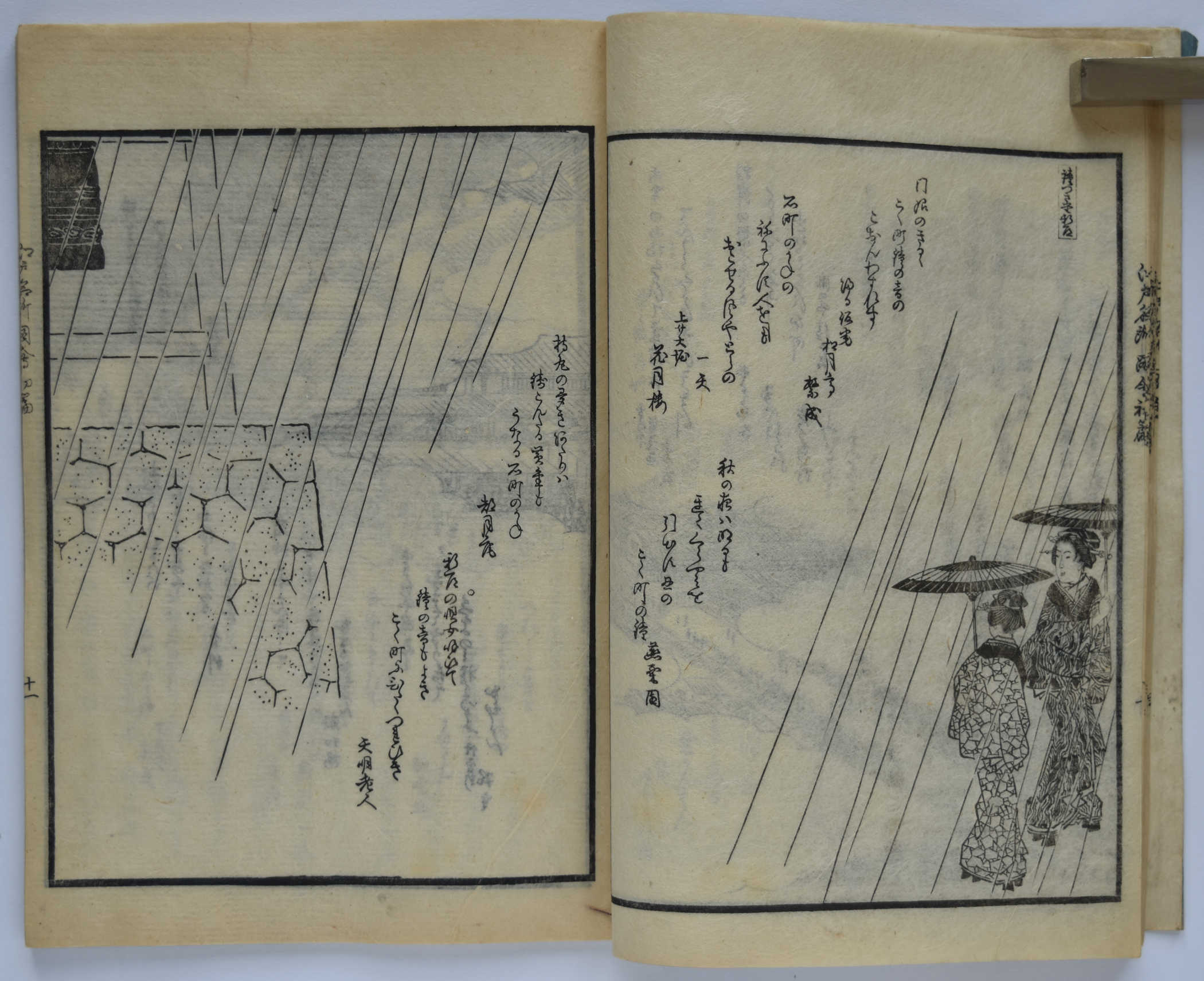
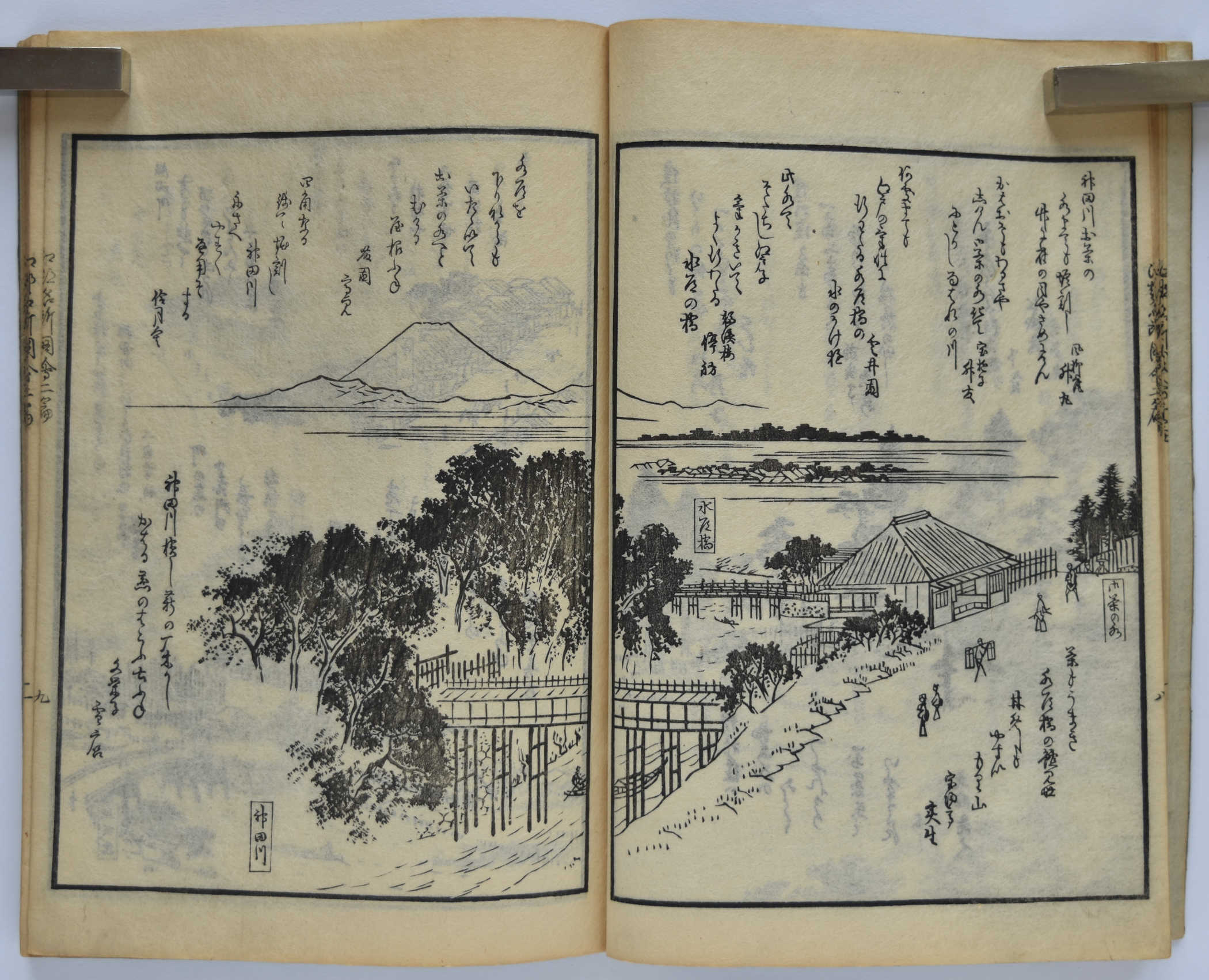
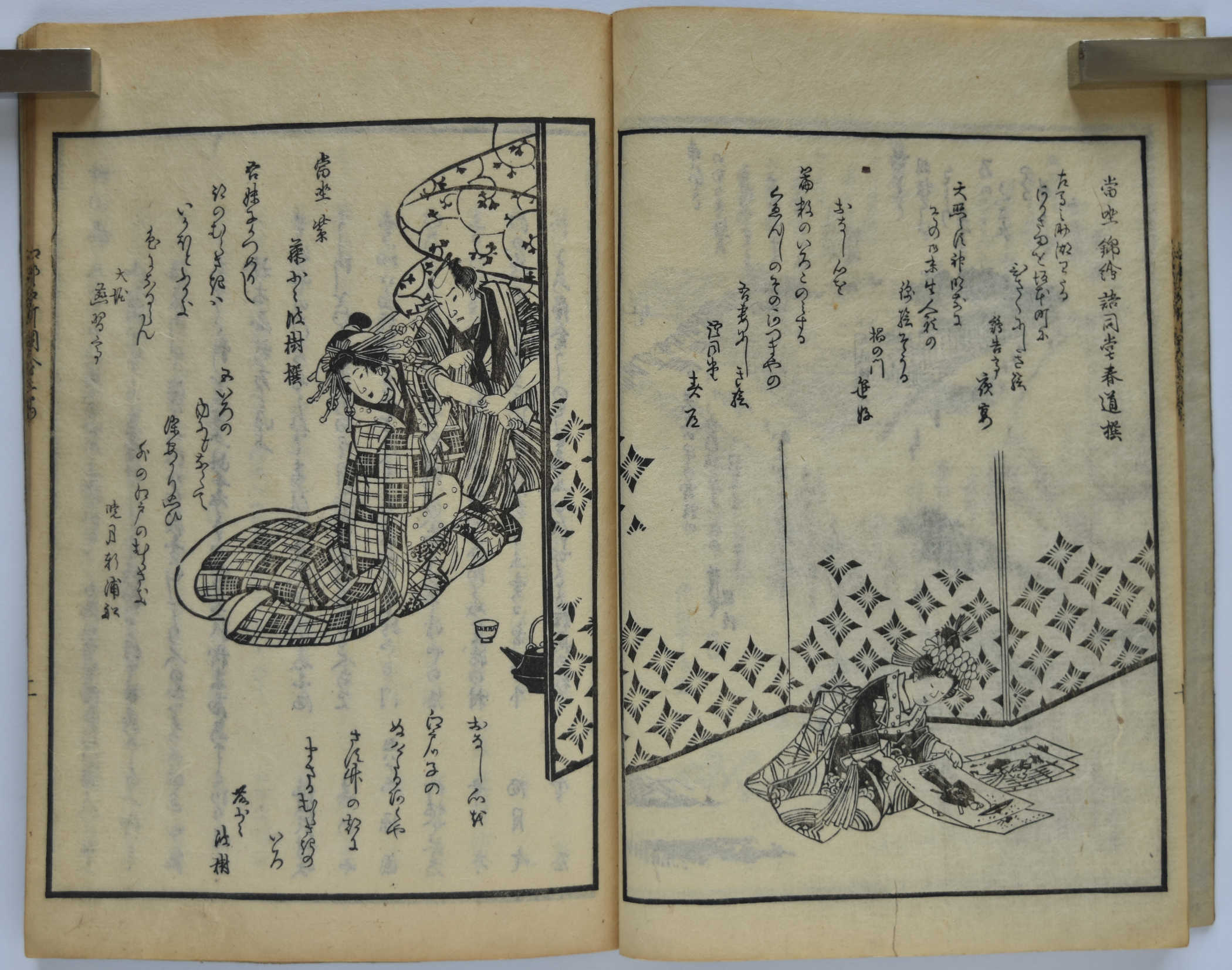
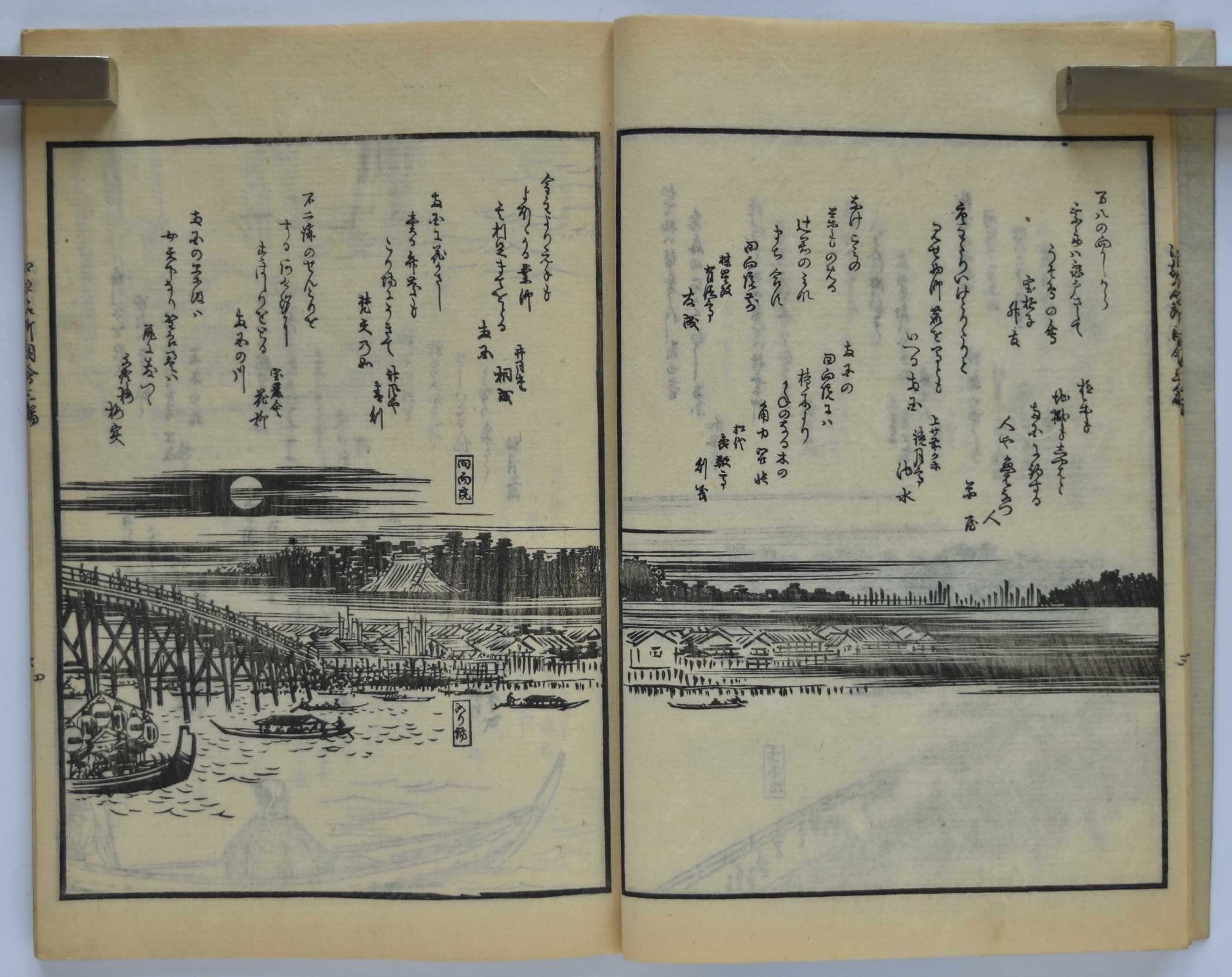
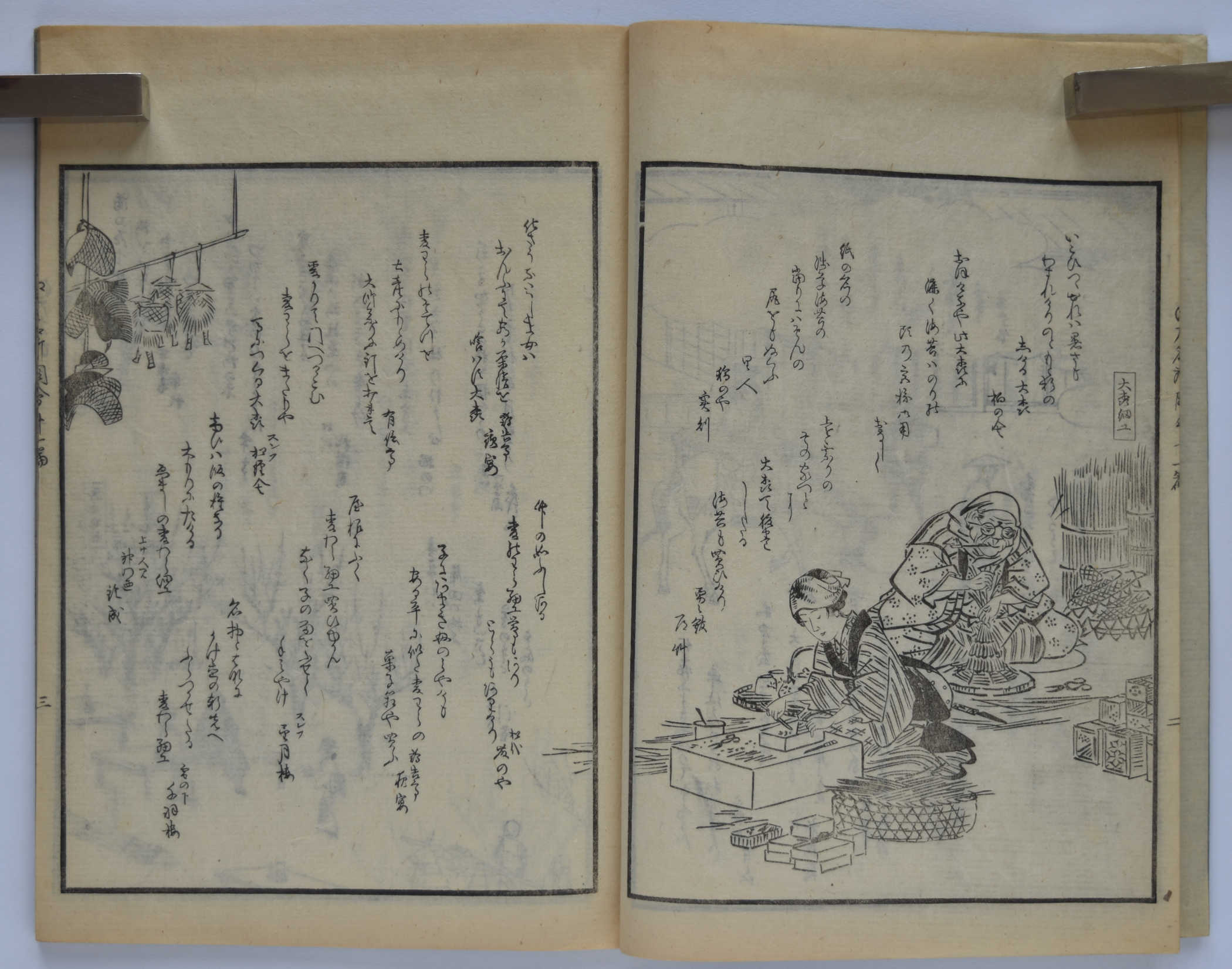
A complete set of Kyoka Edo meisho zue, “Collection of Pictures of the Famous Places of Edo in Kyoka.” Fourteen volumes (sixteen books) dated Ansei 3, 1856. Artist: Ryusai Hiroshige ga, with volumes fifteen and sixteen being by Hiroshige II. Compiler of poems: Tenmei Rojin. Publisher not given. Book 1: 25 sheets, 11 illustrations. Book 2: 24 sheets, 10 illustrations. Book 3: 23 sheets, 10 illustrations. Book 4: 19 sheets, 9 illustrations. Books 5-6: 34 sheets, 15 illustrations. Book 7: 22 sheets, 9 illustrations. Book 8: 21 sheets, 9 illustratins. Book 9: 22 sheets, 9 illustrations. Book 10: 21 sheets, 8 illustrations. Book 11: 14 sheets, 6 illustrations. Book 12: 18 sheets, 7 illustrations. Book 13: 16 sheets, 6 illustrations. Book 14: 16 sheets, 8 illustrations. Books 15-16: 23 sheets, 9 illustrations. The monochrome illustrations show the popular life of Edo as well as the views. Original covers and title slips.
In very good condition. Rare complete.
Status: Sold
Utagawa HIROSHIGE (1797-1858)
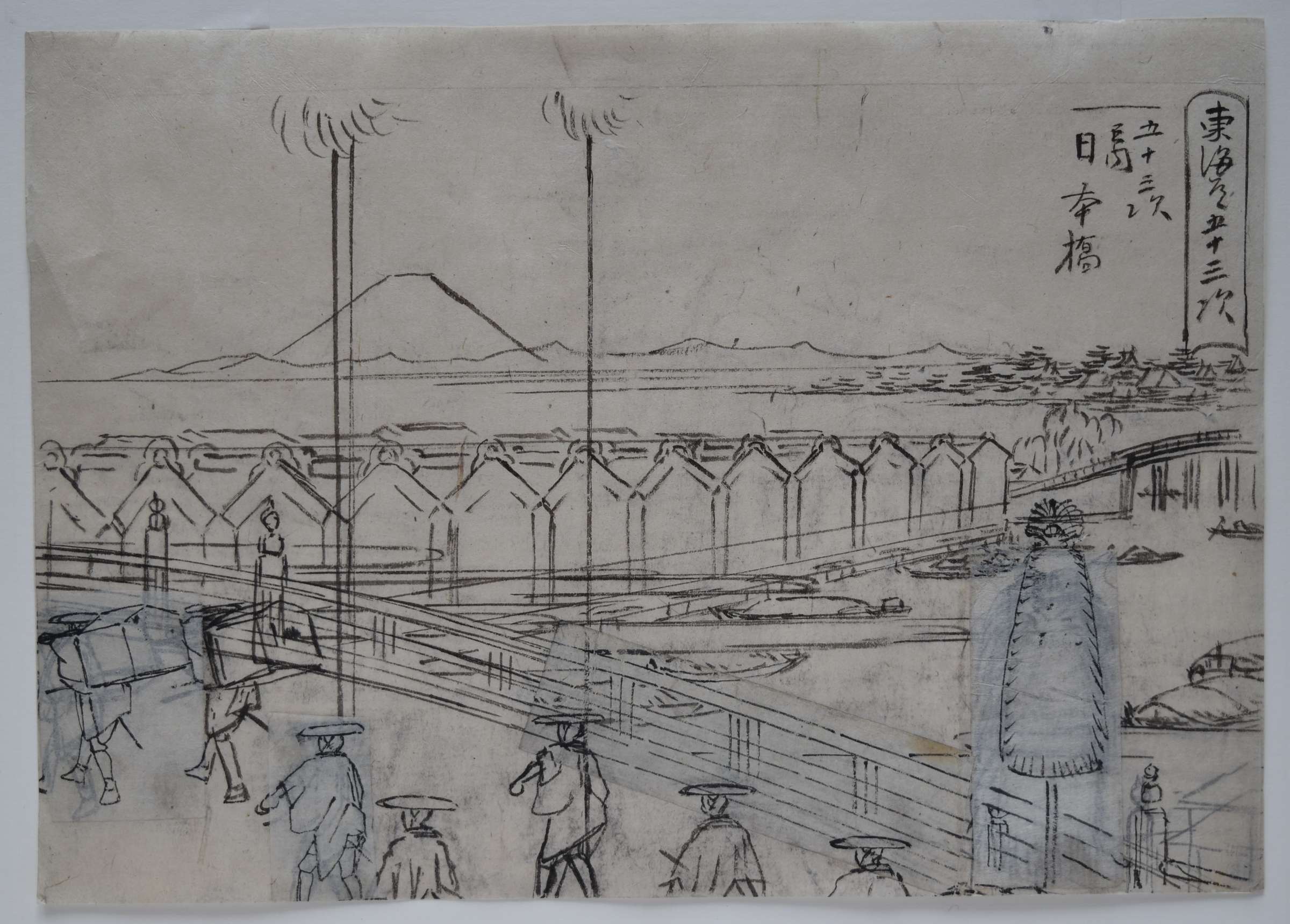
Click here to view image full size.
An important original drawing by Hiroshige being an hanshita-e (preparatory sketch) for an unpublished series Toto meisho gojusan tsugi, “Fifty-Three Views of Edo.” Shows Nihonbashi with a daimyo’s cortege crossing. Warehouses in the background and a distant Fuji.
Probably executed c. early 1850s. Sumi on thin paper, 9.5 x 13.5 in; 24 x 34 cms. Extensive pentimenti. Sold “as is” with imperfections but in good condition. Provenance: Ex Huguette Beres collection, sold Sothebys, Paris, 27/11/2002, lot 177.
Status: Sold
Utagawa HIROSHIGE (1797-1858)
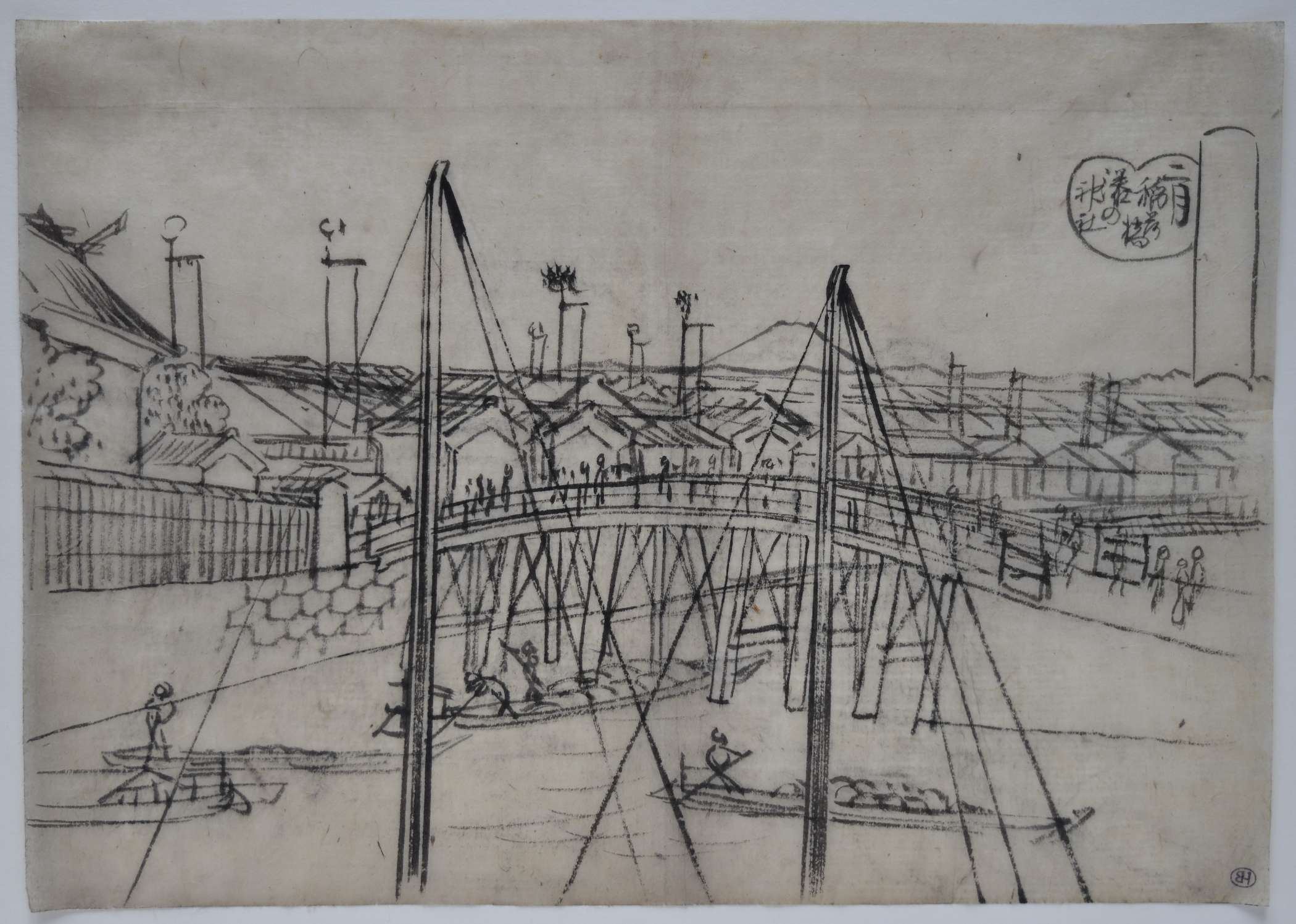
Click here to view image full size.
An important original drawing by Hiroshige being an hanshita-e (preparatory sketch) for an unpublished series Toto Fujimi junigatsu, “Mount Fuji Viewed from Edo in the Twelve Months.” This is February showing the Inari Bridge and the Minato Temple; boats in the foreground and Fuji in the distance.
Probably drawn c. early 1850s. Sumi on thin paper. Sold “as is” with imperfections but in good condition. Provenance: Ex Huguette Beres collection, sold Sothebys, Paris, 27/11/2002, lot 179.
Status: Sold
Utagawa HIROSHIGE (1797-1858)
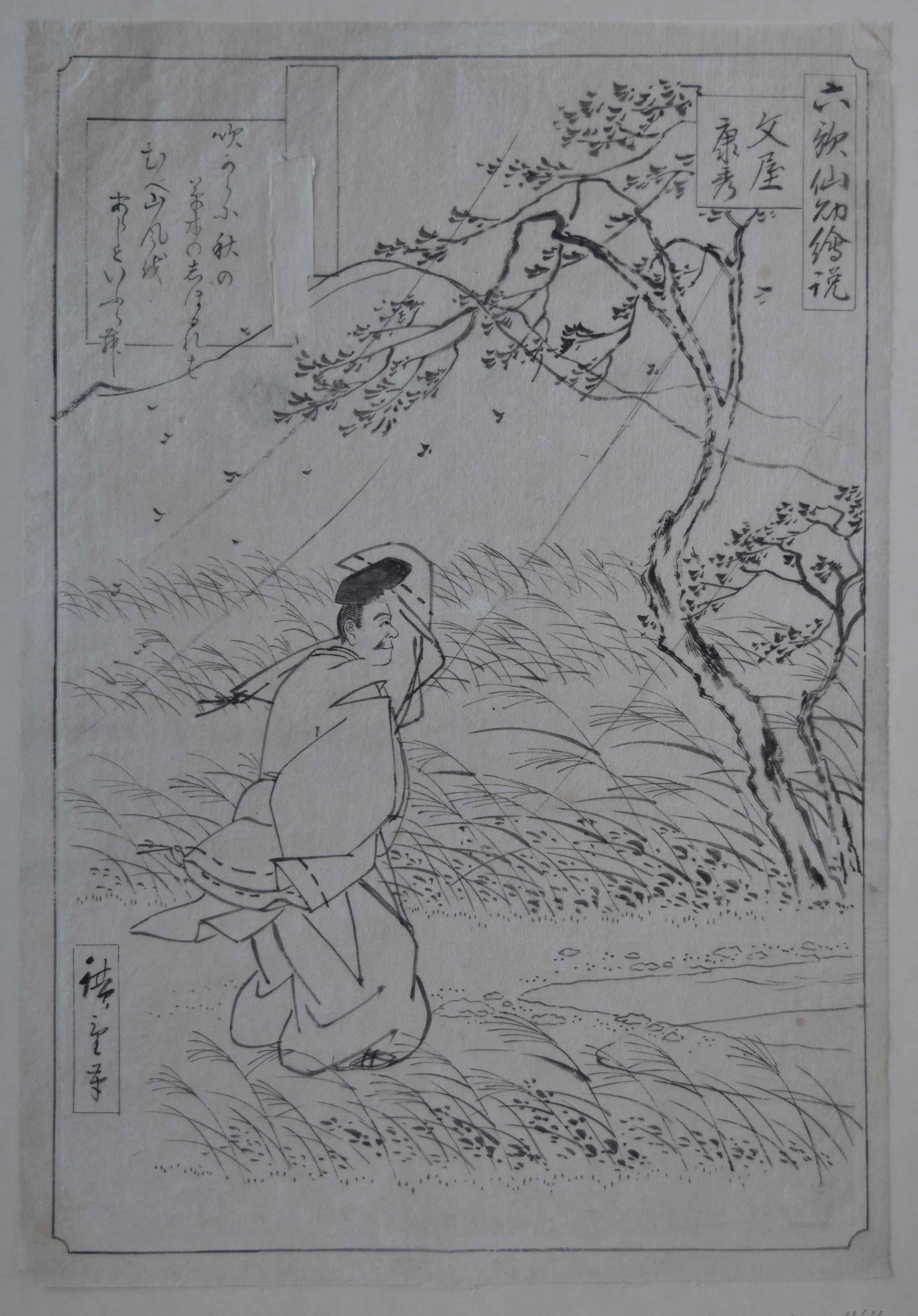
Click here to view image full size.
An original oban (14 x 9.5 in; 35.5 x 24 cms) hanshita-e drawing, sumi on thin paper, for an unpublished set Rokkasen kiri etoki, “Picture Storytelling of Climatic Scenes of the Six Immortal Poets.” In this case the poet Fun’ya no Yasuhide and depicts his most famous poem, no. 22 in the Hyakunin Isshu, which describes the autumn gales bending the trees and grasses. Shows the poet caught in a gale. In fact this is the same subject as a published design in a chu-tanzaku set by Hiroshige published by Shogendo in c 1835-39 (see MFA, Boston, acc. no. 21.7035): Possibly the publisher changed his mind about the format to use. Signed Hiroshige ga. Sold “as is” but in good condition.
Status: Sold
Utagawa HIROSHIGE (1797-1858)
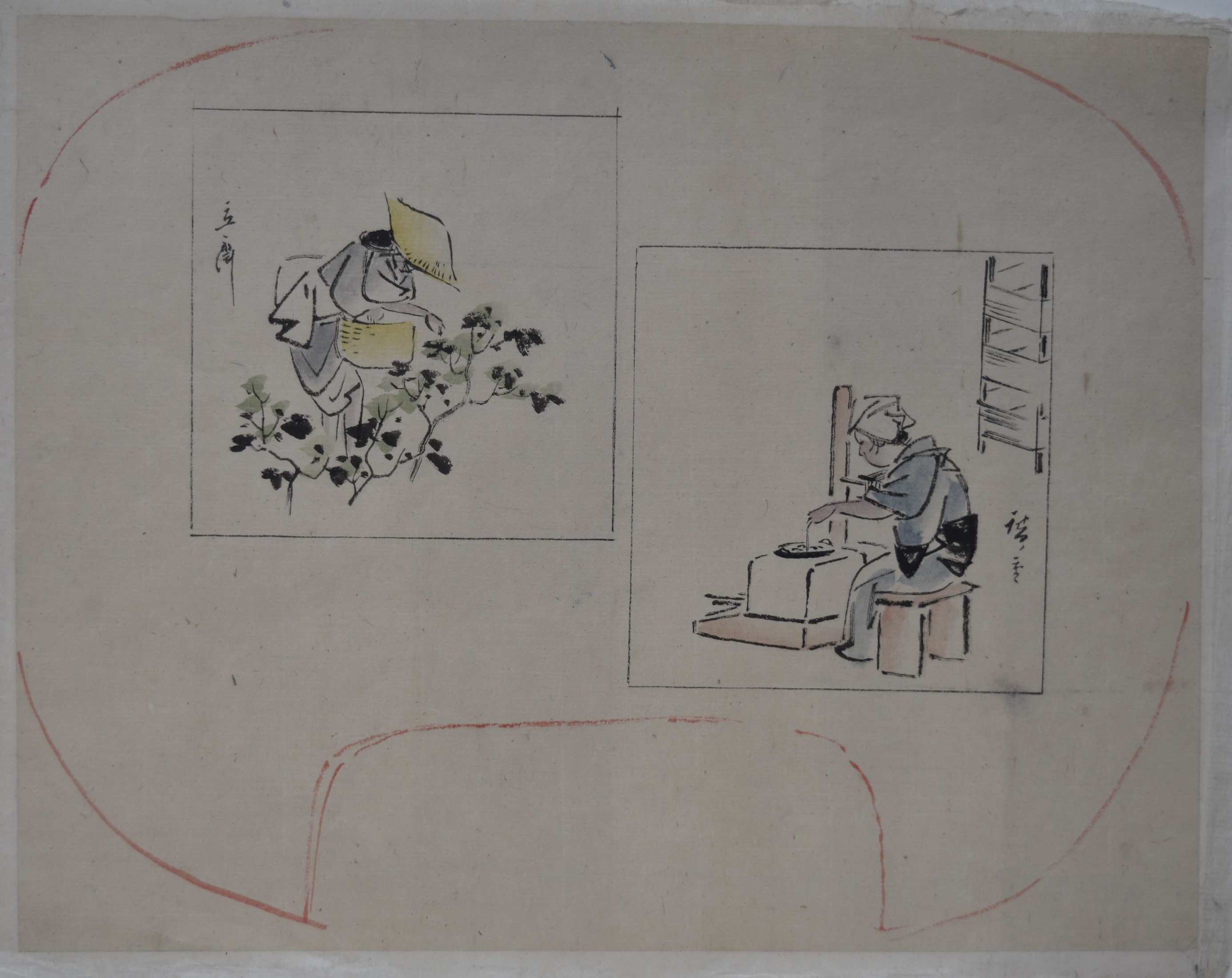
Click here to view image full size.
An original drawing, sumi and colour on thin paper laid onto Japanese paper. A preliminary design for a fan print, the outline indicated in red. Apparently never published. Shows a woman in the box on the left picking mulberry leaves (?), signed Ryusai. And in the box on the right a woman possibly in the process of spinning silk, signed Hiroshige. Good condition.
Status: Sold
Utagawa HIROSHIGE (1797-1858)
Click here to view image full size.
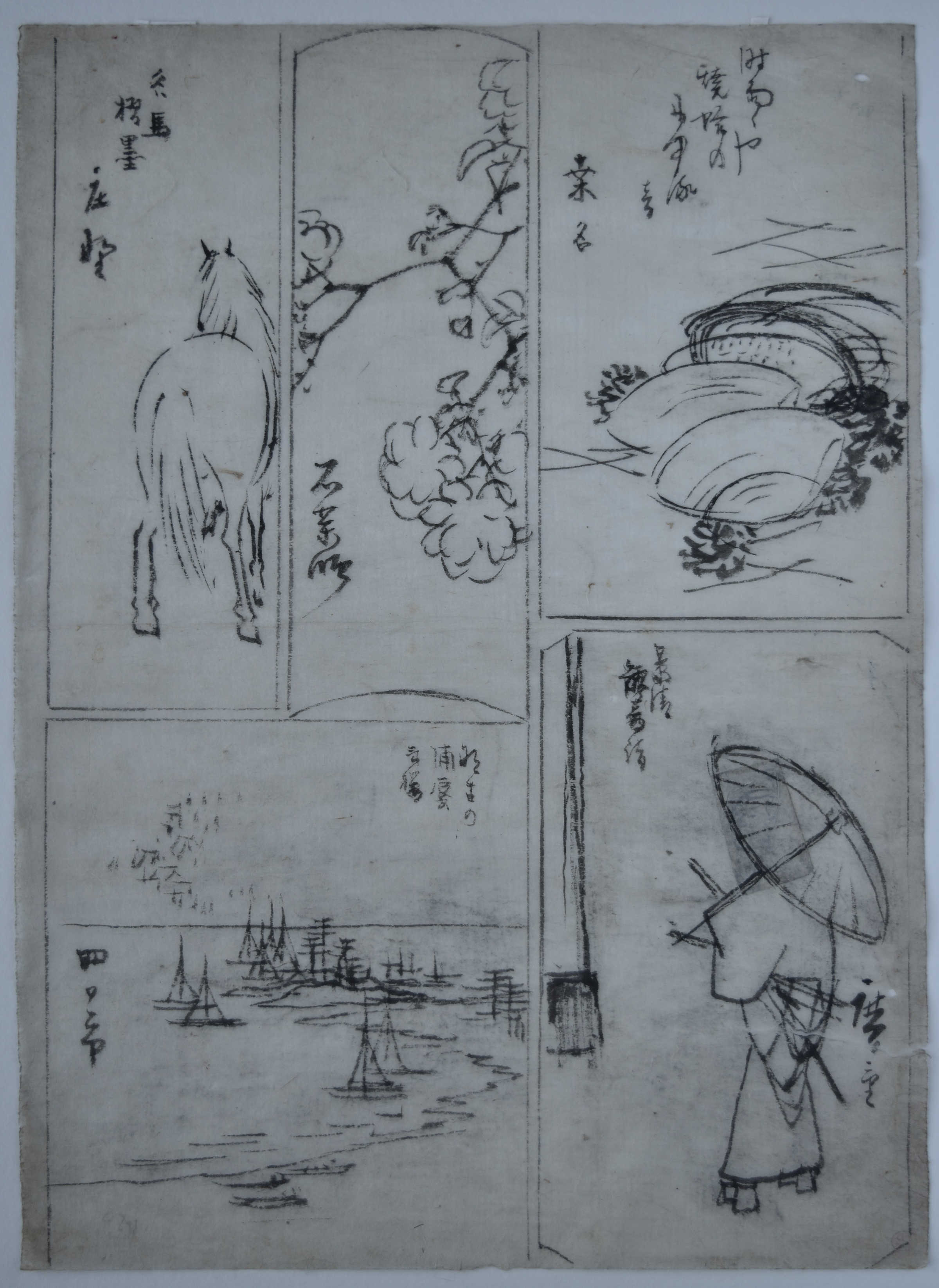
An original harimaze-e drawing (two or more images on a single page originally intended to be cut apart). Sumi on paper. Intended for a set of such prints of the complete Tokaido. This sheet shows five stations: Shono (horse); Ishiyakushi (cherry blossom); Kuwana (oysters and cockles); Asakusa (the tori of a temple and visitor); Yokkaichi (boats in the bay). Provenance: Ex H. Beres collection, sold Sothebys, Paris, 25/11/2003, lot 168. Minor faults, but all congruent with an original drawing that has survived. Signed Hiroshige bottom right.
Status: Sold
Utagawa HIROSHIGE (1797-1858)
Click here to view image full size.
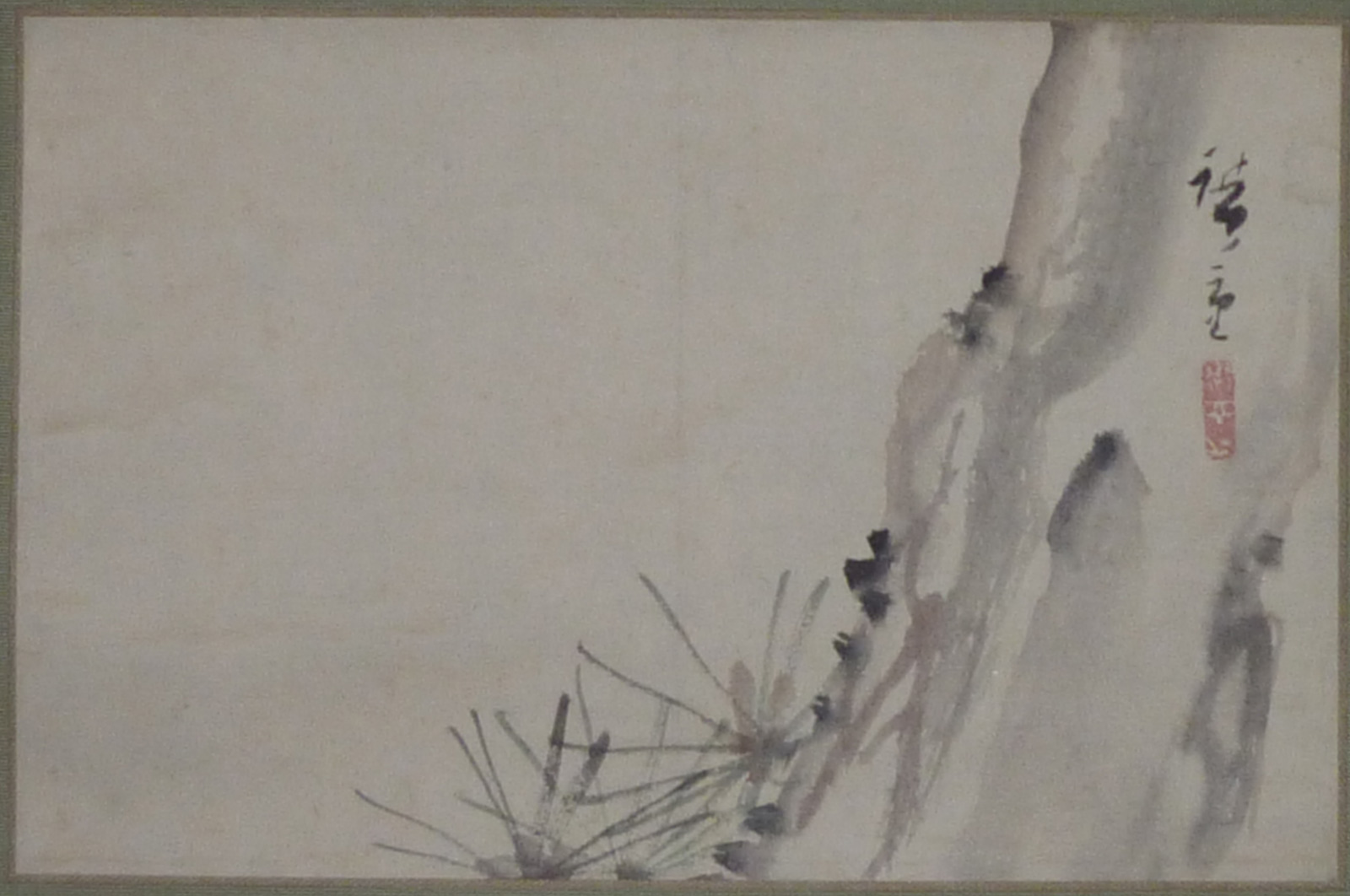
A small drawing taken from an album of an old pine tree. Sumi and light colour on paper. Image size, 23.25 x 11 inches; 59 x 28 cms. Mounted as a painting. Very good condition. Signed Hiroshige.
Status: Sold
Utagawa HIROSHIGE (1797-1858)
Click here to view image full size.
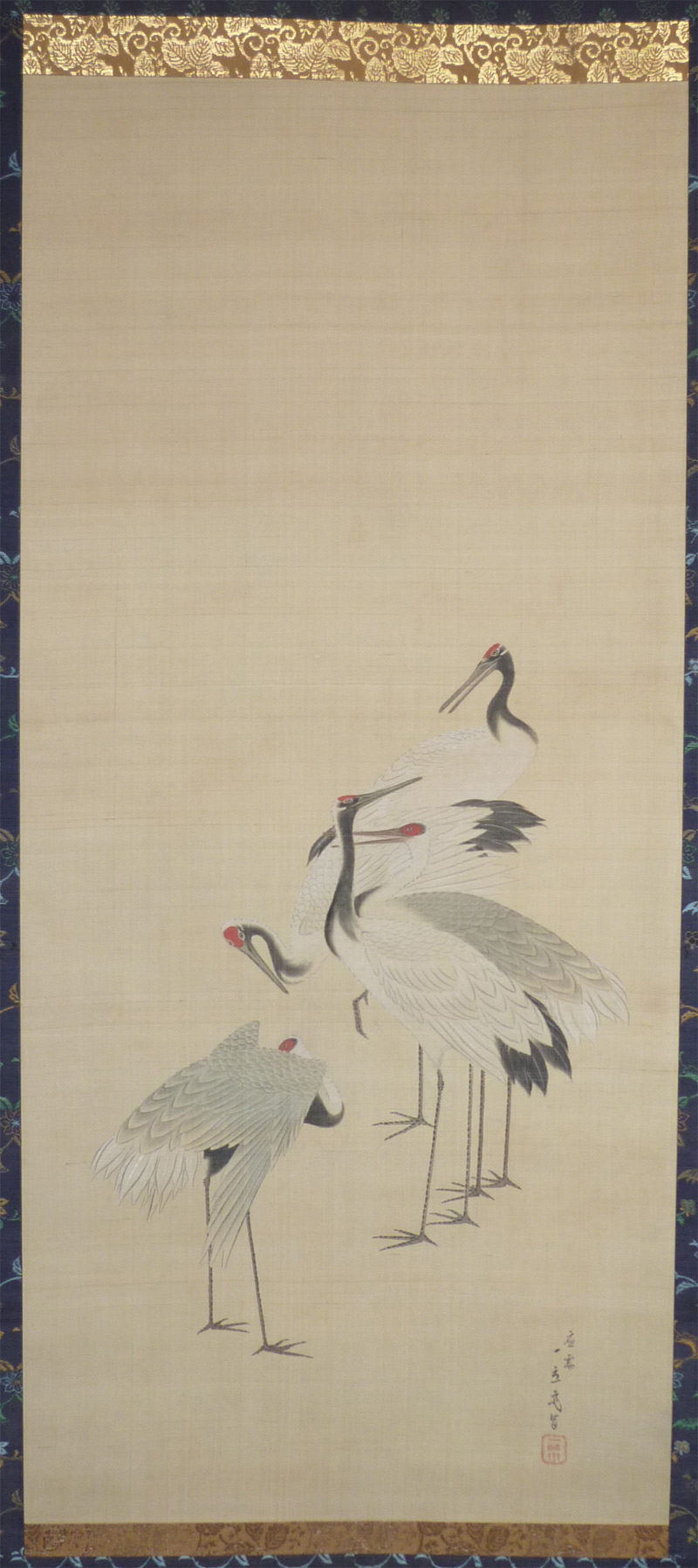
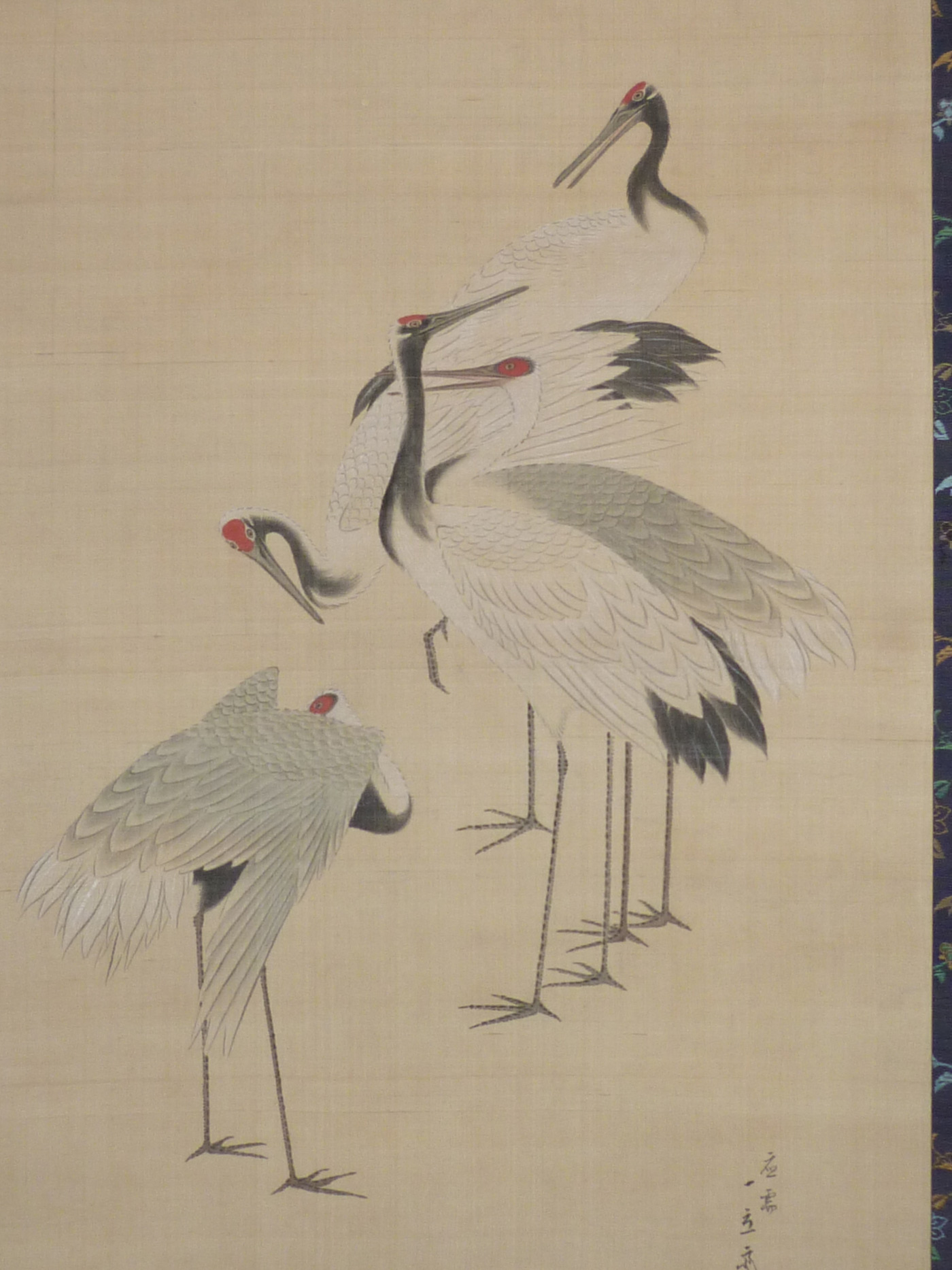
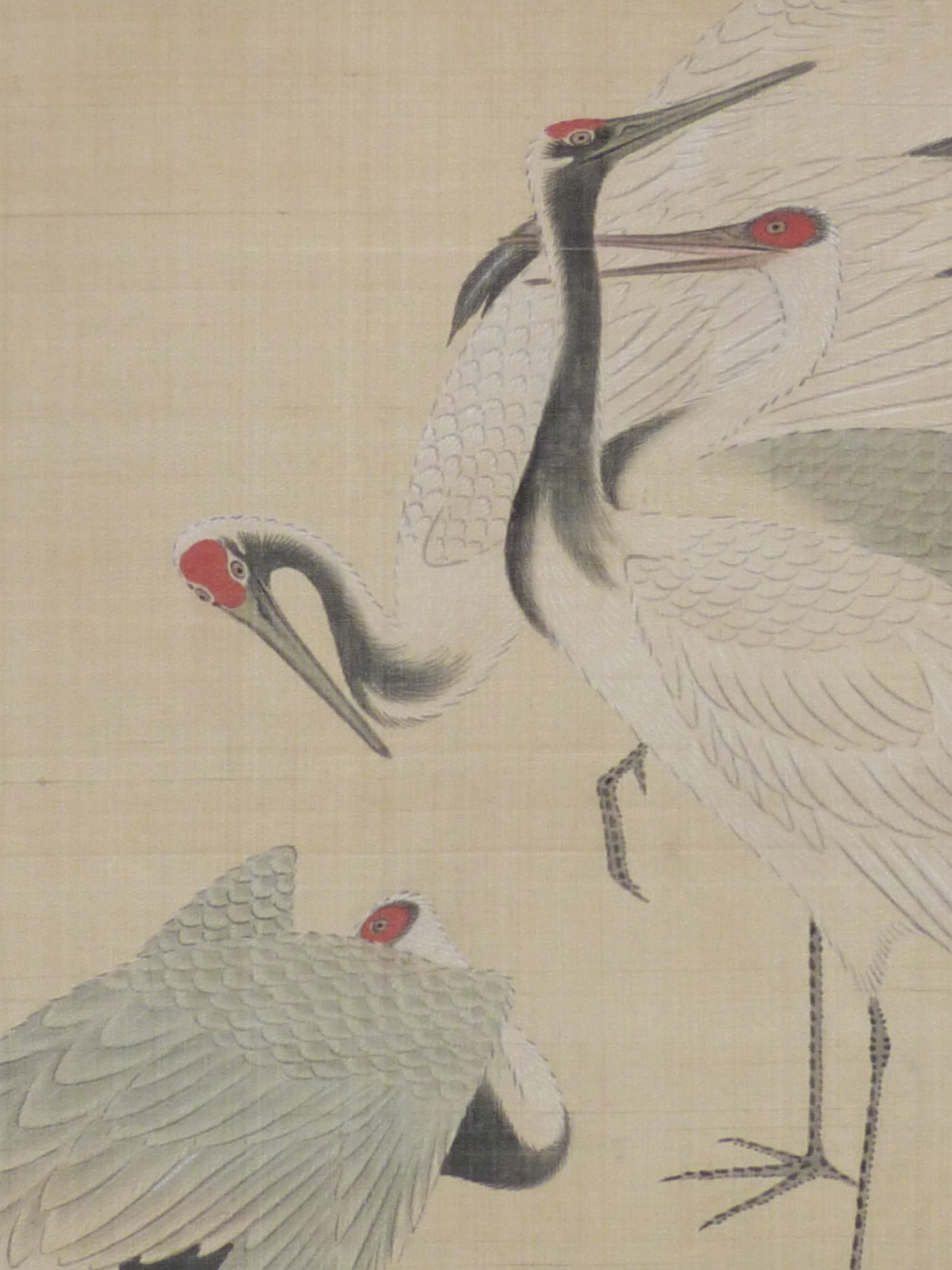
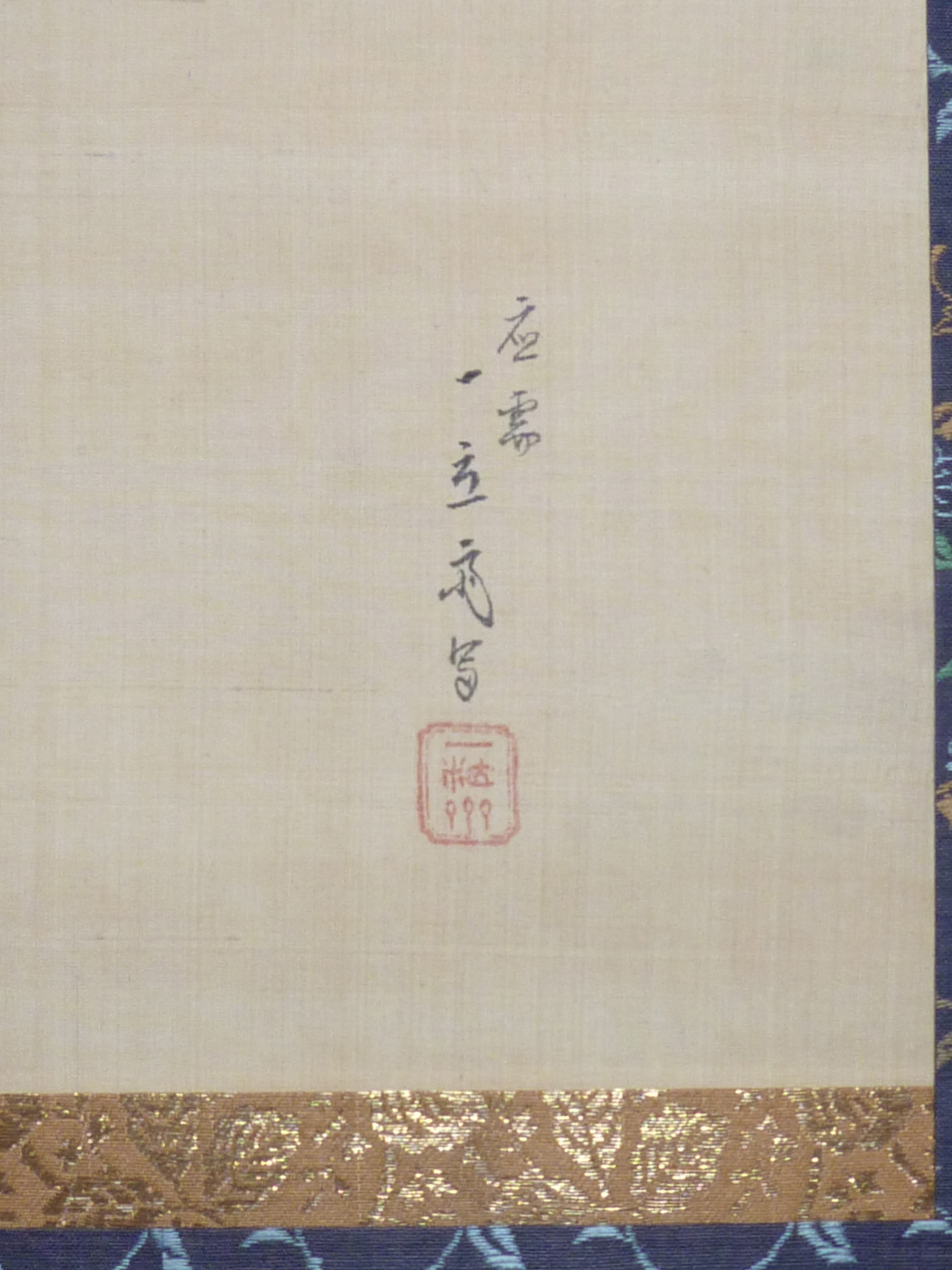
A fine and rare painting: Gunkaku zu, “A Flock of Cranes.” Hiroshige designed many fine kachoga during the 1830s through to the 1850s but there exist few paintings. This was a commissioned work from Hiroshige. The tancho ( “red crest” ) Japanese Crane, Grus japonensis, is the second rarest crane in the world, migrating to East Asia in the fall to spend the winter. There is also a resident flock in Hokkaido. Much loved by the Japanese, the crane was a symbol of luck, longevity and fidelity. Full colour on silk, image size 34.5 x 15.75 inches; 88 x 40 cms. In perfect condition with a futo-maki ( thick wooden roll to preserve the painting from damage ). New box. Signed Ojyu ( “commissioned” work ) Ichiryusai hitsu. ( A rare form of the signature used c. Tenpo 10 to 11 [ around 1839 – 40 ]. ) The Ichiryusai seal is also a rare form used around mid Tenpo period.
Status: Sold
Utagawa HIROSHIGE (1787-1858)
Click here to view image full size.
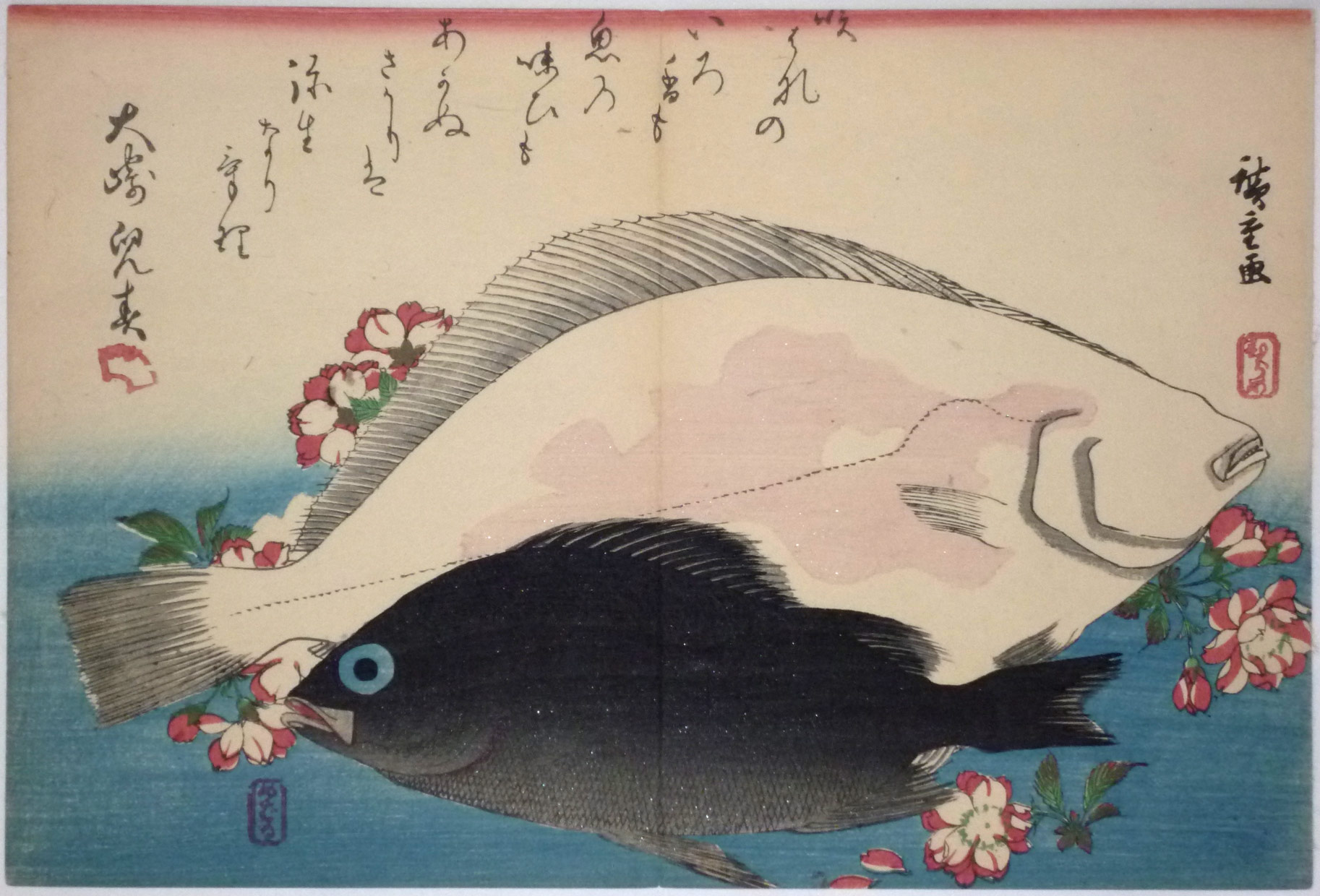
Hirame, olive halibut ( Paralichthys olivaceus ) and mebaru, black rock-fish ( Sebastes schlegeli ). Together with cherry blossom. Poem by Osaki Koharu. From the second series of nine fish prints published c 1840 – 42 by Yamasho ( Yamadoya Shobei ). Ex collection Felix Bracquemond ( 1833 – 1914 ). Japonisme in France usually starts with Bracquemond who was a graphic artist and designer and also worked with ceramics. He discovered Hokusai’s Manga in 1856 and used it as source material. He produced a number of etchings, often of birds and some with fish, obviously partly inspired by Japanese prints, including Hiroshige’s prints. So, it’s reasonable to suppose these were the actual prints he used as inspiration. Bracquemond’s initial: “B” accompanied the prints.
Very good impression, colour and condition. Centre fold as per usual. Signed Hiroshige ga.
Status: Sold
Utagawa HIROSHIGE (1787-1858)
Click here to view image full size.
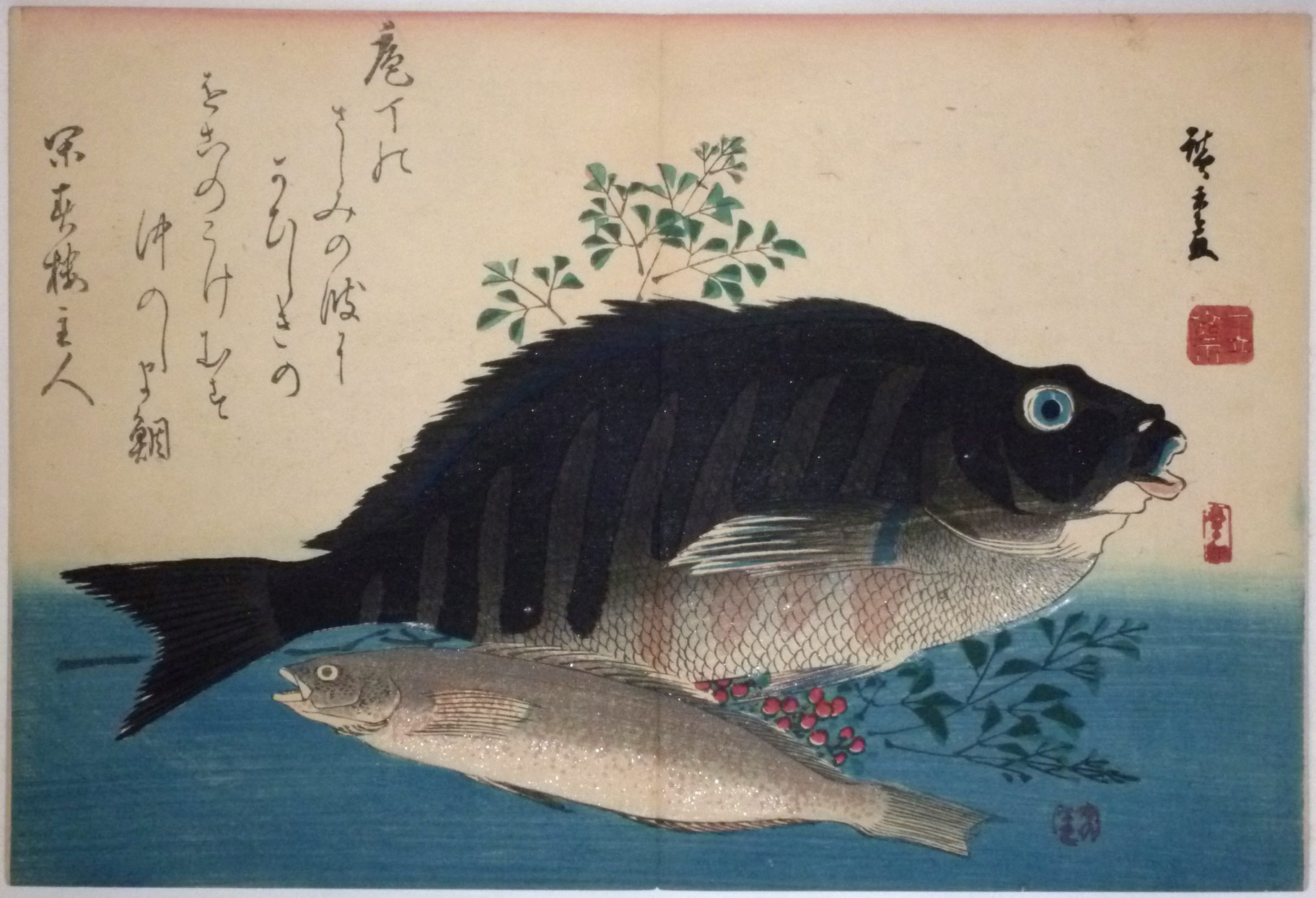
Shimadai, a grouper ( probably Chilodactylus zonatus ) and ainame, greenling ( Hexagrammus otakii ). Together with red-berried nanten. Poem by Kanshunro Nushibito. From the second series of nine fish prints published c 1840 – 42 by Yamasho ( Yamadoya Shobei ). Ex collection Felix Bracquemond ( 1833 – 1914 ). Japonisme in France usually starts with Bracquemond who was a graphic artist and designer and also worked with ceramics. He discovered Hokusai’s Manga in 1856 and used it as source material. He produced a number of etchings, often of birds and some with fish, obviously partly inspired by Japanese prints, including Hiroshige’s prints. So, it’s reasonable to suppose these were the actual prints he used as inspiration. Bracquemond’s initial: “B” accompanied the prints.
Very good impression, colour and condition. Centre fold as per usual. Signed Hiroshige ga.
Status: Sold
Utagawa HIROSHIGE (1787-1858)
Click here to view image full size.
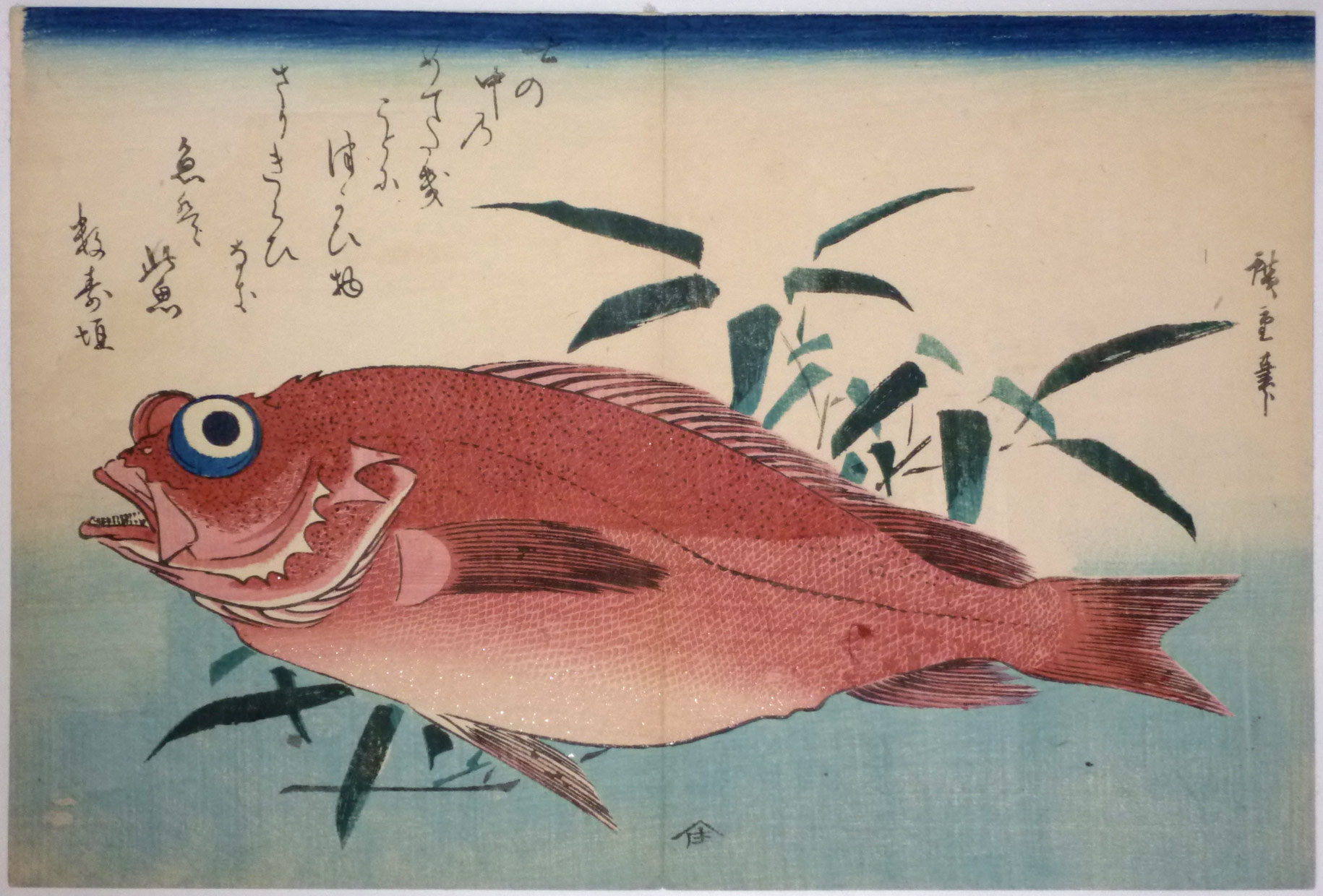
Akodai, the rock-fish. ( Sebastes matsubarae ). Known as the medetai, good-luck fish. Together with bamboo grass. Poem by Suzugaki. From the second series of nine fish prints published c 1840 – 42 by Yamasho ( Yamadoya Shobei ). Ex collection Felix Bracquemond ( 1833 – 1914 ). Japonisme in France usually starts with Bracquemond who was a graphic artist and designer and also worked with ceramics. He discovered Hokusai’s Manga in 1856 and used it as source material. He produced a number of etchings, often of birds and some with fish, obviously partly inspired by Japanese prints, including Hiroshige’s prints. So, it’s reasonable to suppose these were the actual prints he used as inspiration. Bracquemond’s initial: “B” accompanied the prints.
Very good impression, colour and condition. Centre fold as per usual. Signed Hiroshige hitsu.
Status: Sold
Utagawa HIROSHIGE (1787-1858)
Click here to view image full size.
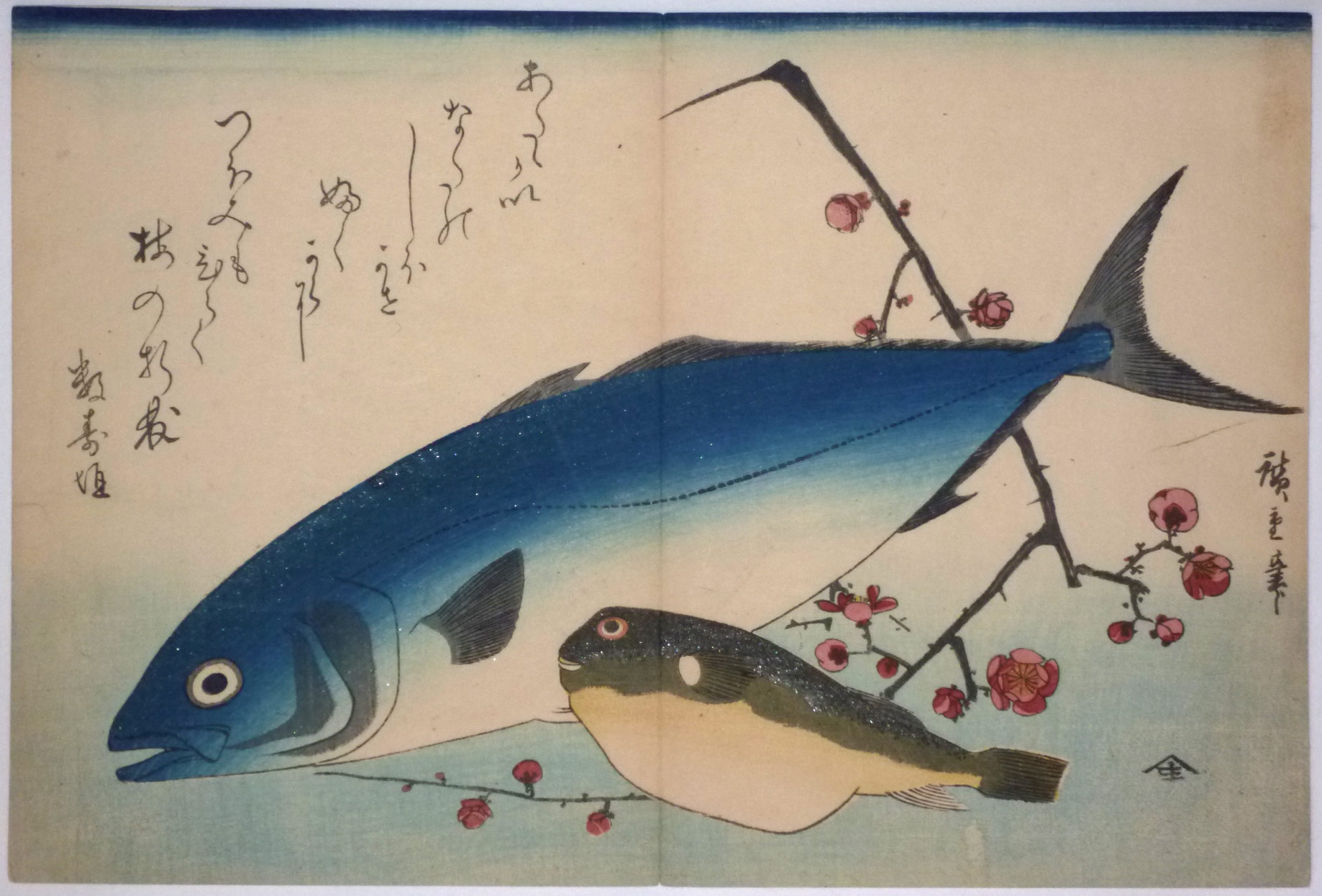
Inada, yellowtail or amberjack ( Seriola quinqueradiata ) and fugu, blowfish or puffer ( Fugu pardalis ). Together with plum blossom. Poem by Suzugaki. From the second series of nine fish prints published c 1840 – 42 by Yamasho ( Yamadoya Shobei ). Ex collection Felix Bracquemond ( 1833 – 1914 ). Japonisme in France usually starts with Bracquemond who was a graphic artist and designer and also worked with ceramics. He discovered Hokusai’s Manga in 1856 and used it as source material. He produced a number of etchings, often of birds and some with fish, obviously partly inspired by Japanese prints, including Hiroshige’s prints. So, it’s reasonable to suppose these were the actual prints he used as inspiration. Bracquemond’s initial: “B” accompanied the prints.
Very good impression, colour and condition. Centre fold as per usual. Signed Hiroshige hitsu.
Status: Sold
Utagawa HIROSHIGE (1787-1858)
Click here to view image full size.
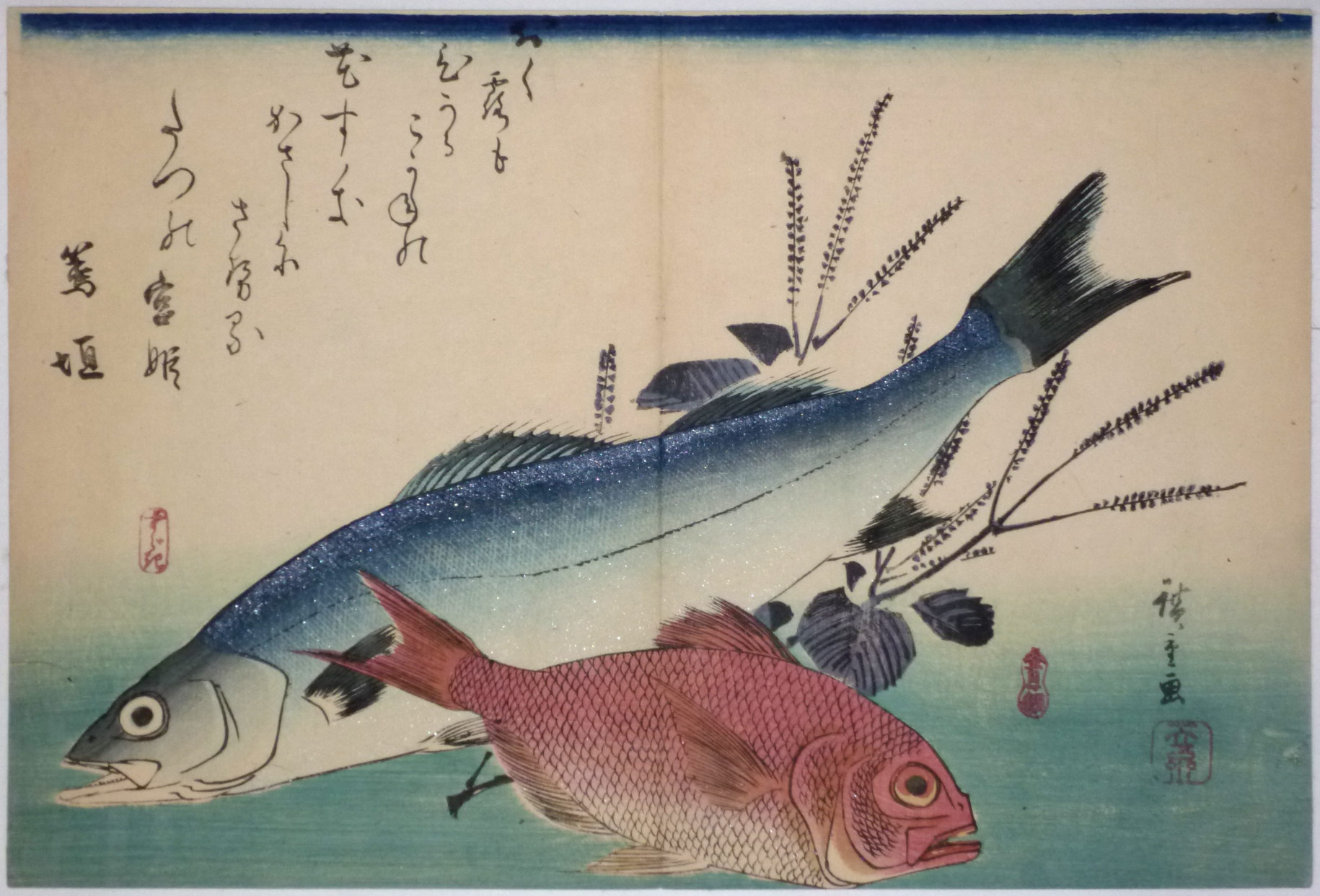
Suzuki, Japanese sea perch ( Lateolabrax japonicus ) and kaneme-tai, red bream ( possibly Beryx splendens ). With shiso or beefsteak plant. Poem by Atsugaki. From the second series of nine fish prints published c 1840 – 42 by Yamasho ( Yamadoya Shobei ). Ex collection Felix Bracquemond ( 1833 – 1914 ). Japonisme in France usually starts with Bracquemond who was a graphic artist and designer and also worked with ceramics. He discovered Hokusai’s Manga in 1856 and used it as source material. He produced a number of etchings, often of birds and some with fish, obviously partly inspired by Japanese prints, including Hiroshige’s prints. So, it’s reasonable to suppose these were the actual prints he used as inspiration. Bracquemond’s initial: “B” accompanied the prints.
Very good impression, colour and condition. Centre fold as per usual. Signed Hiroshige ga.
Status: Sold
Utagawa HIROSHIGE (1787-1858)
Click here to view image full size.
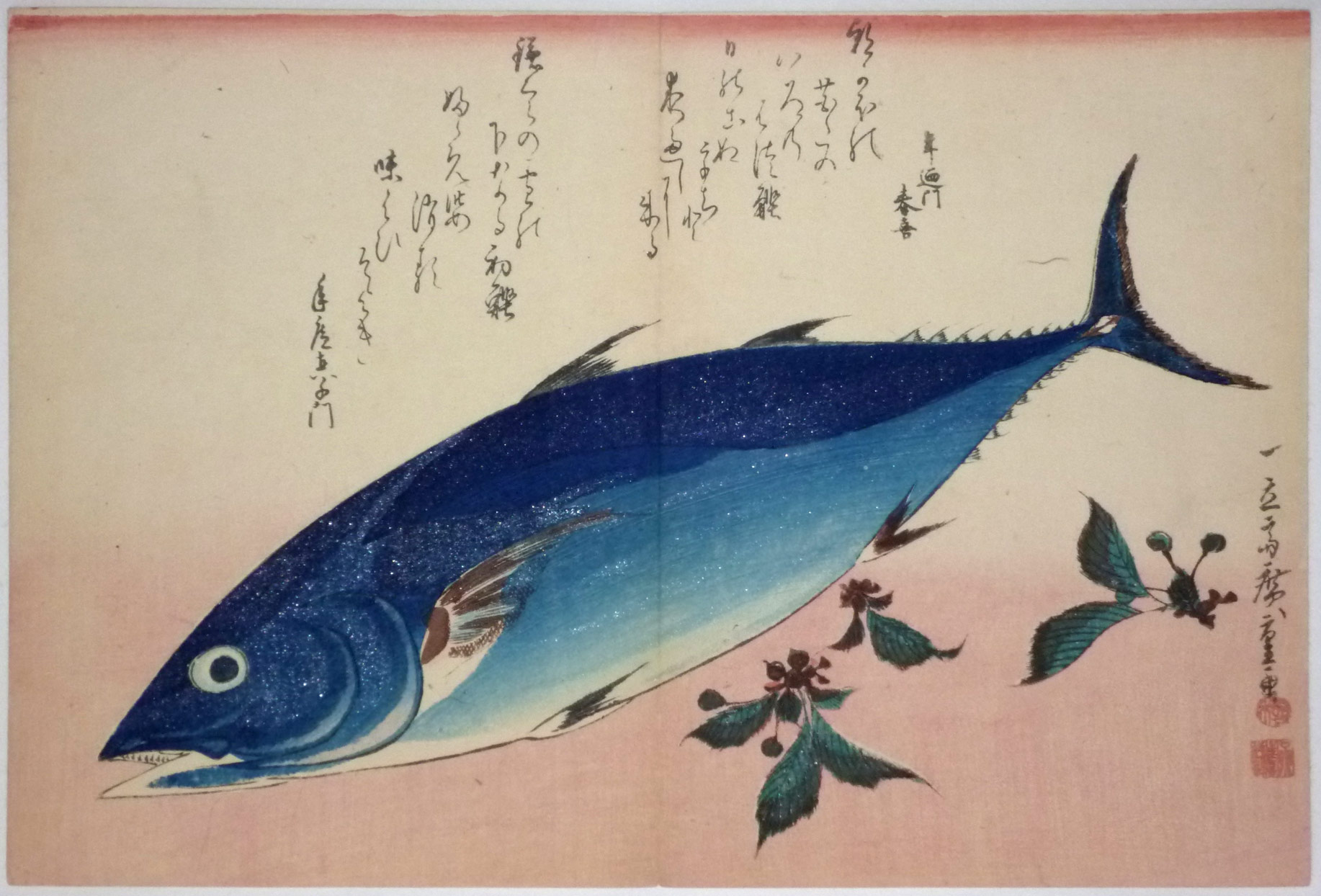
Katsuo, bonito ( Katsuwonus pelamis ). Also called ocean bonito, stripe-bellied bonito and striped tuna. Together with three sprigs of cherry ( sakura ). Poems by Toshinoto Haruki and Toshihiro Machikado. From the first series of eleven fish prints published c 1840 – 42 by Yamasho ( Yamadoya Shobei ). Ex collection Felix Bracquemond ( 1833 – 1914 ). Japonisme in France usually starts with Bracquemond who was a graphic artist and designer and also worked with ceramics. He discovered Hokusai’s Manga in 1856 and used it as source material. He produced a number of etchings, often of birds and some with fish, obviously partly inspired by Japanese prints, including Hiroshige’s prints. So, it’s reasonable to suppose these were the actual prints he used as inspiration. Bracquemond’s initial: “B” accompanied the prints.
Very good impression, colour and condition. Centre fold as per usual. Signed Hiroshige ga.
Status: Sold
Utagawa HIROSHIGE (1787-1858)
Click here to view image full size.
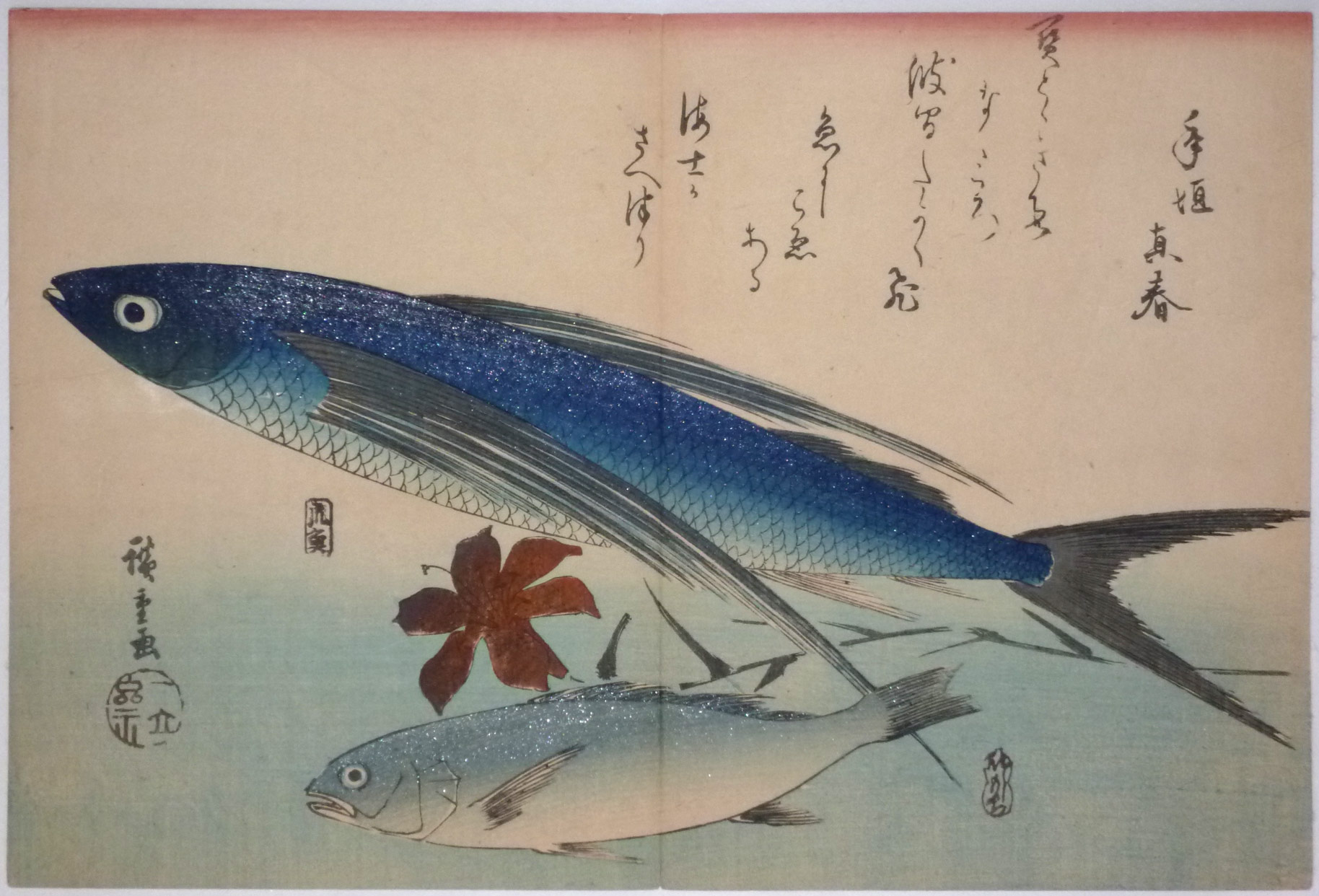
Tobiuo, flying fish ( probably Prognichthys ) and ishimochi also called guchi or shiroguchi, white croaker ( probably Argyrosomus argenatus ). Together with a single lily. Poem by Toshigaki Maharu. From the second series of nine fish prints published c 1840 – 42 by Yamasho ( Yamadoya Shobei ). Ex collection Felix Bracquemond ( 1833 – 1914 ). Japonisme in France usually starts with Bracquemond who was a graphic artist and designer and also worked with ceramics. He discovered Hokusai’s Manga in 1856 and used it as source material. He produced a number of etchings, often of birds and some with fish, obviously partly inspired by Japanese prints, including Hiroshige’s prints. So, it’s reasonable to suppose these were the actual prints he used as inspiration. Bracquemond’s initial: “B” accompanied the prints.
Very good impression, colour and condition. Centre fold as per usual. Signed Hiroshige ga.
Status: Sold
Utagawa HIROSHIGE (1787-1858)
Click here to view image full size.
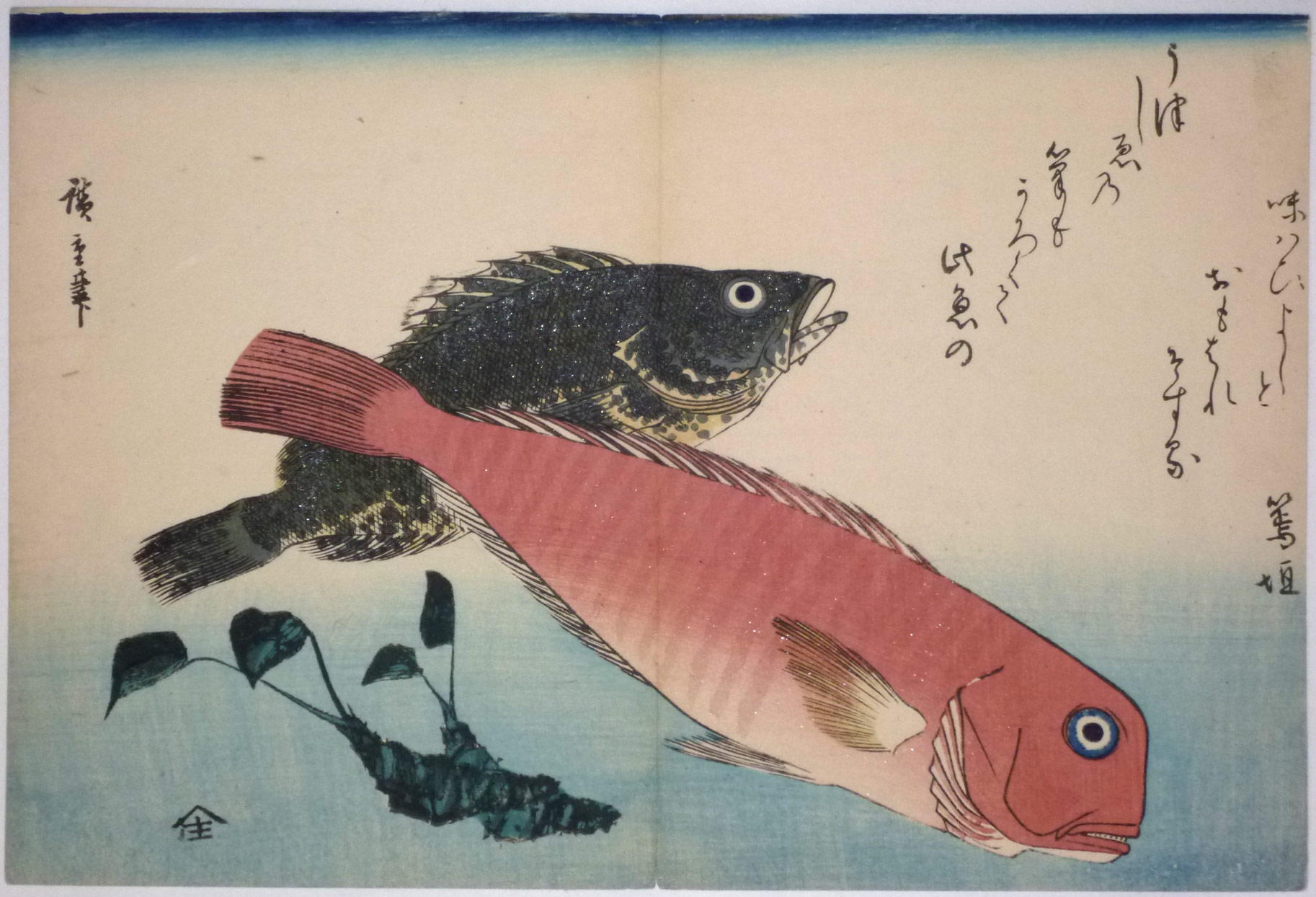
Shiroamadai, white horsehead ( Latilus argentatus ) and omonhata, rock cod ( Epinephalus areolatus ). Together with Japanese horse radish, wasabi. Poem by Atsugaki. From the second series of nine fish prints published c 1840 – 42 by Yamasho ( Yamadoya Shobei ). Ex collection Felix Bracquemond ( 1833 – 1914 ). Japonisme in France usually starts with Bracquemond who was a graphic artist and designer and also worked with ceramics. He discovered Hokusai’s Manga in 1856 and used it as source material. He produced a number of etchings, often of birds and some with fish, obviously partly inspired by Japanese prints, including Hiroshige’s prints. So, it’s reasonable to suppose these were the actual prints he used as inspiration. Bracquemond’s initial: “B” accompanied the prints.
Very good impression, colour and condition. Centre fold as per usual. Signed Hiroshige hitsu.
Status: Sold
Utagawa HIROSHIGE (1787-1858)
Click here to view image full size.
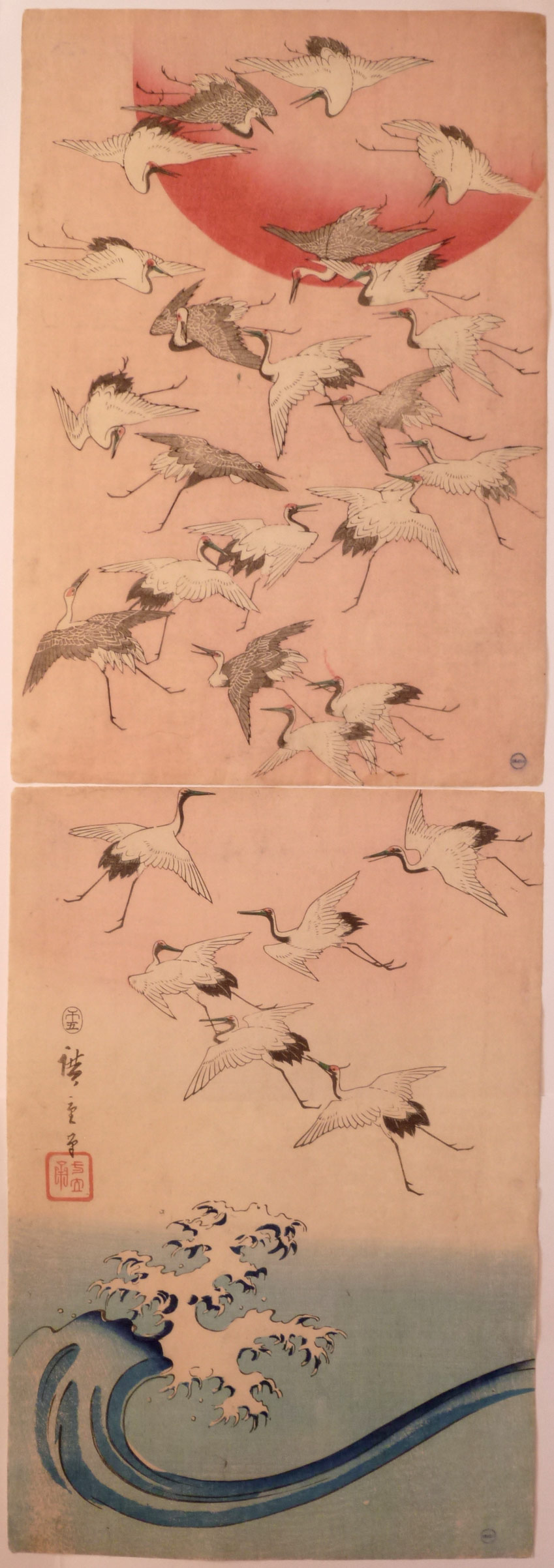
A vertical diptych showing a multitude of cranes flying up from a cresting wave to a large red sun. In fact this diptych was used by an Edo publisher as end sheets to albums – usually sets of Hiroshige landscapes. Rare: Invariably it is impossible to match the two sheets as the bottom design is always graded blue at the top. Another matching impression is illustrated pl. 143 in Four Hundred Ukiyoe Woodblock Prints From The Museum Of Art, Rhode Island School Of Design, Abby Aldrich Rockefeller Collection Of Japanese Prints, 1990. Published 5/1858.
Fine impression and colour. Small expertly repaired binding holes, otherwise good condition. Collector’s seal bottom right on each sheet. Signed Hiroshige fude.
Status: Sold
Utagawa HIROSHIGE (1787-1858)
Click here to view image full size.
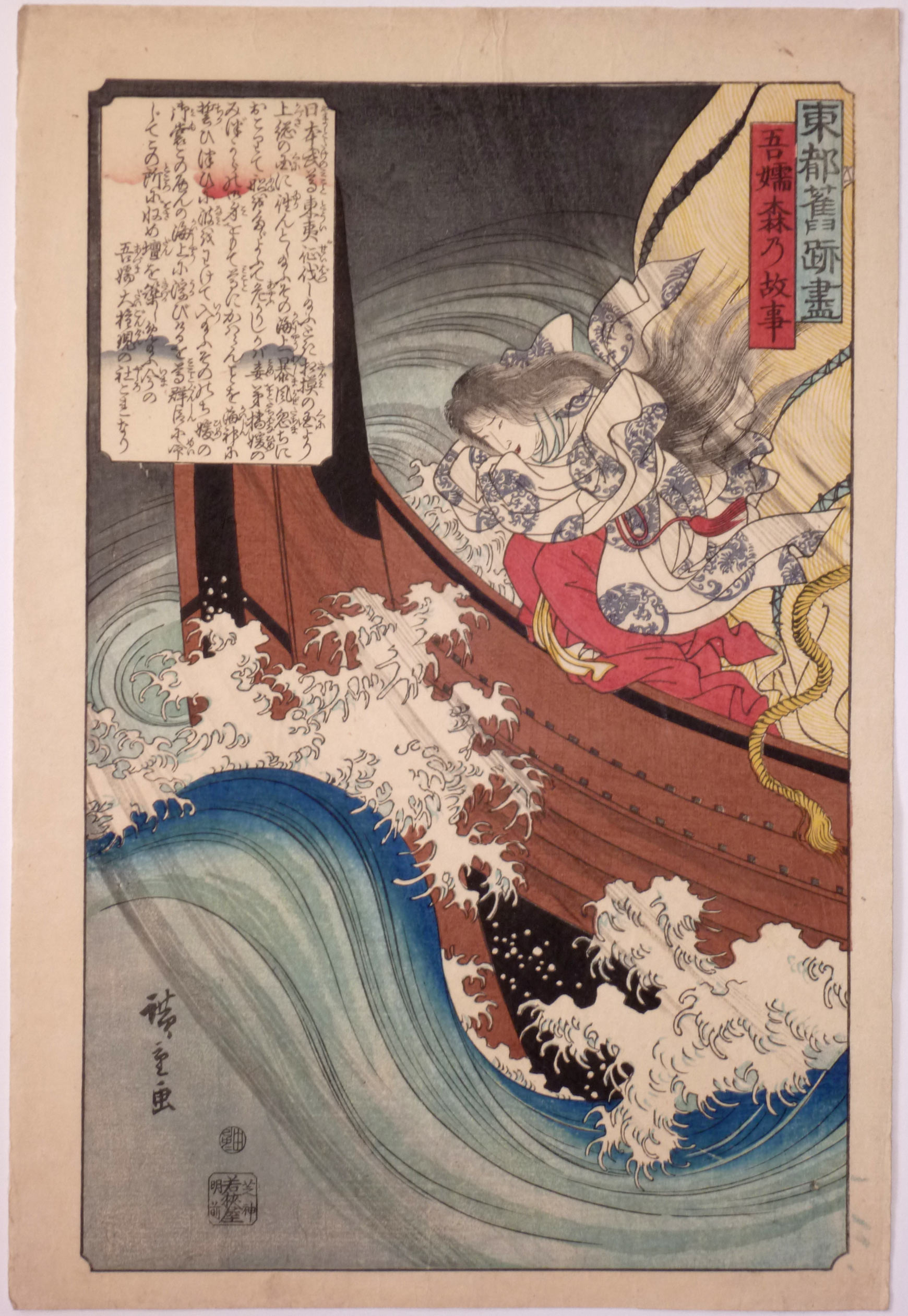
Azuma no Mori no koji “ The Old Story of Azuma” from a set Toto kyuseki tsukushi, “Old Edo Stories, Illustrated.” Exceptionally rare: Four other designs from the set came up at the Orange and Thornicraft sale, Sothebys, 25/3/1912, lot 440. And another impression of this design is illustrated in Hiroshige, The Albuquerque Museum, 1983, no. 722, pl. 74. Shows the concubine Tachibana Hime about to throw herself from the prow of the boat to appease the sea-gods and protect her lord Yamato Take. This she did despite him vowing to marry Miyazu Hime on his return. Published by Wakasa-ya, c 1845. A wonderful design.
Fine impression, colour and condition. Almost mint. Signed Hiroshige ga.
Status: Sold
Utagawa HIROSHIGE (1787-1858)
Click here to view image full size.
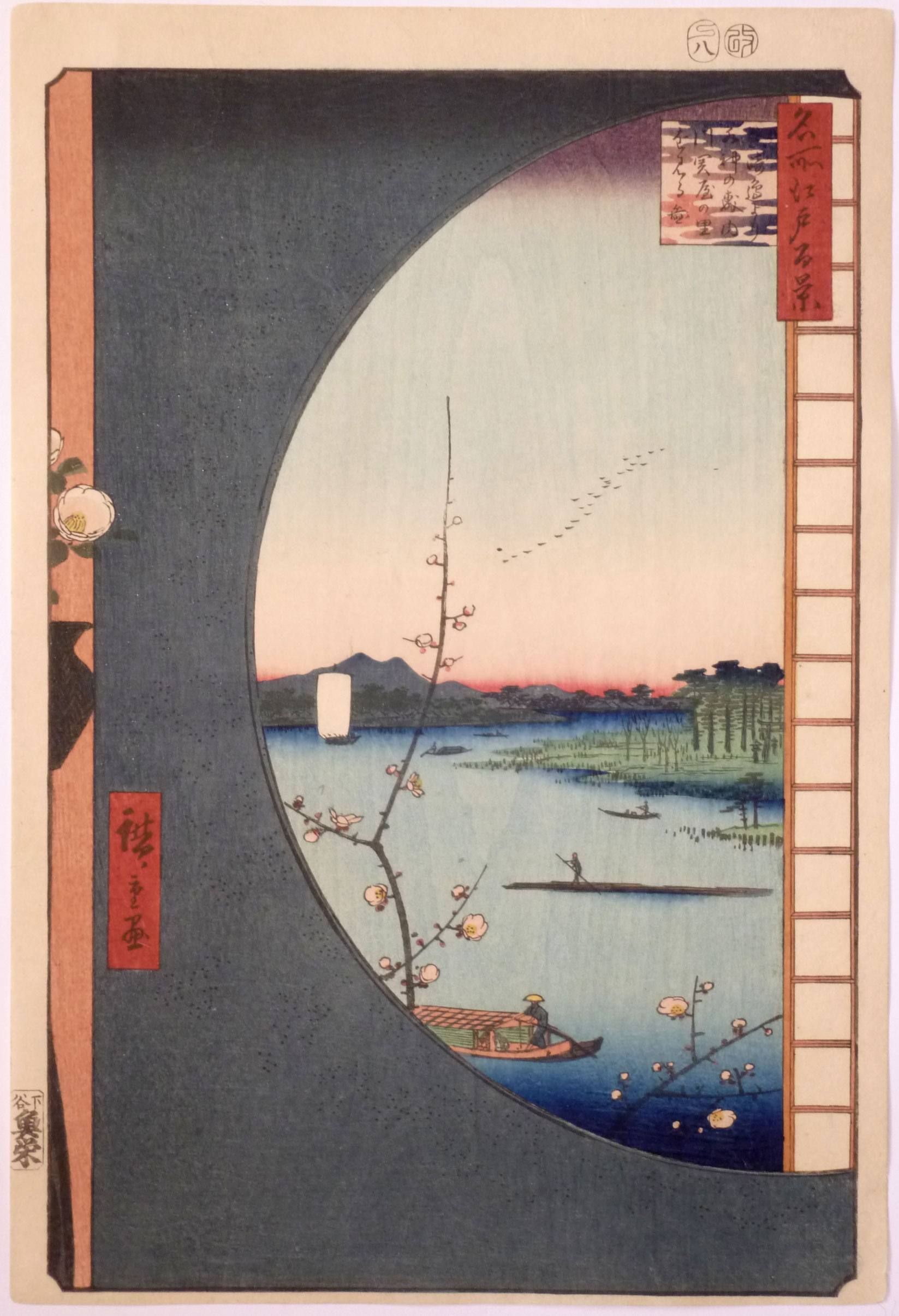
Masaki atari yori Suijin no mori uchikawa Sekiya no sata o miru zu, “View of Suijin Grove and Sekiya Village, Seen From Near Masaki” from Meisho Edo hyakkei, the “One Hundred Views of Edo” published by Uoei between 1856 and 1858 ( this being Snake 8, 1857 ). One of the great designs from the set, the view encapsulated by a semi-circular screen.
Superb impression of the first edition. Fine colour. One very small thinned spot, otherwise very good condition. Signed Hiroshige ga.
Status: Sold
Utagawa HIROSHIGE (1787-1858)
Click here to view image full size.
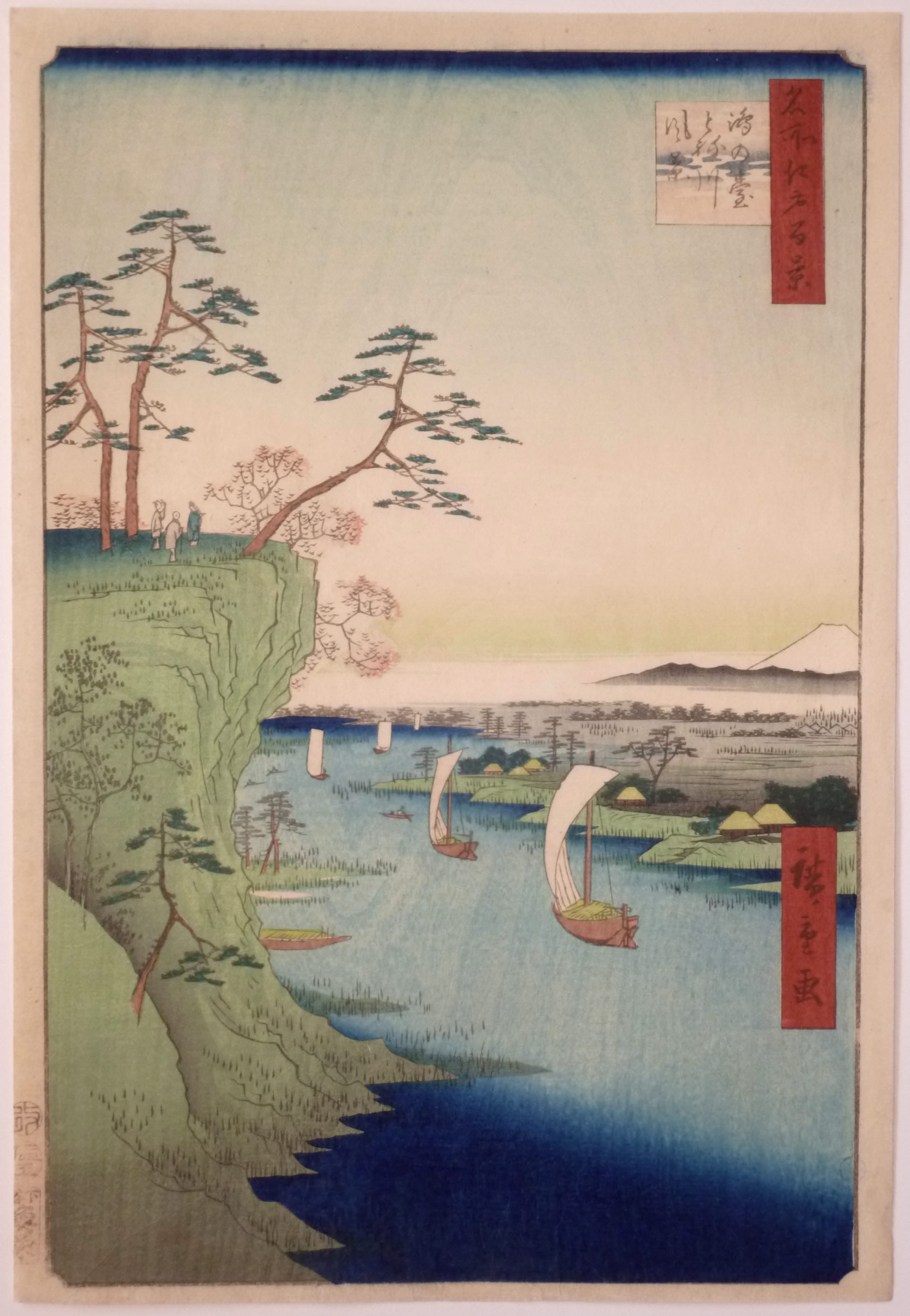
Konodai Tonegawa fukei, “View of Konodai and the Tone River” from Meisho Edo hyakkei, the “One Hundred Views of Edo” published by Uoei between 1856 and 1858 ( this being Dragon 5, 1856 ). Shows the river disappearing in the distance with Mt Fuji on the horizon. The scene being admired by three travellers on the rocky outcrop at left.
Superb impression of the first edition. Fine colour and condition. Signed Hiroshige ga.
Status: Sold
Utagawa HIROSHIGE (1787-1858)
Click here to view image full size.
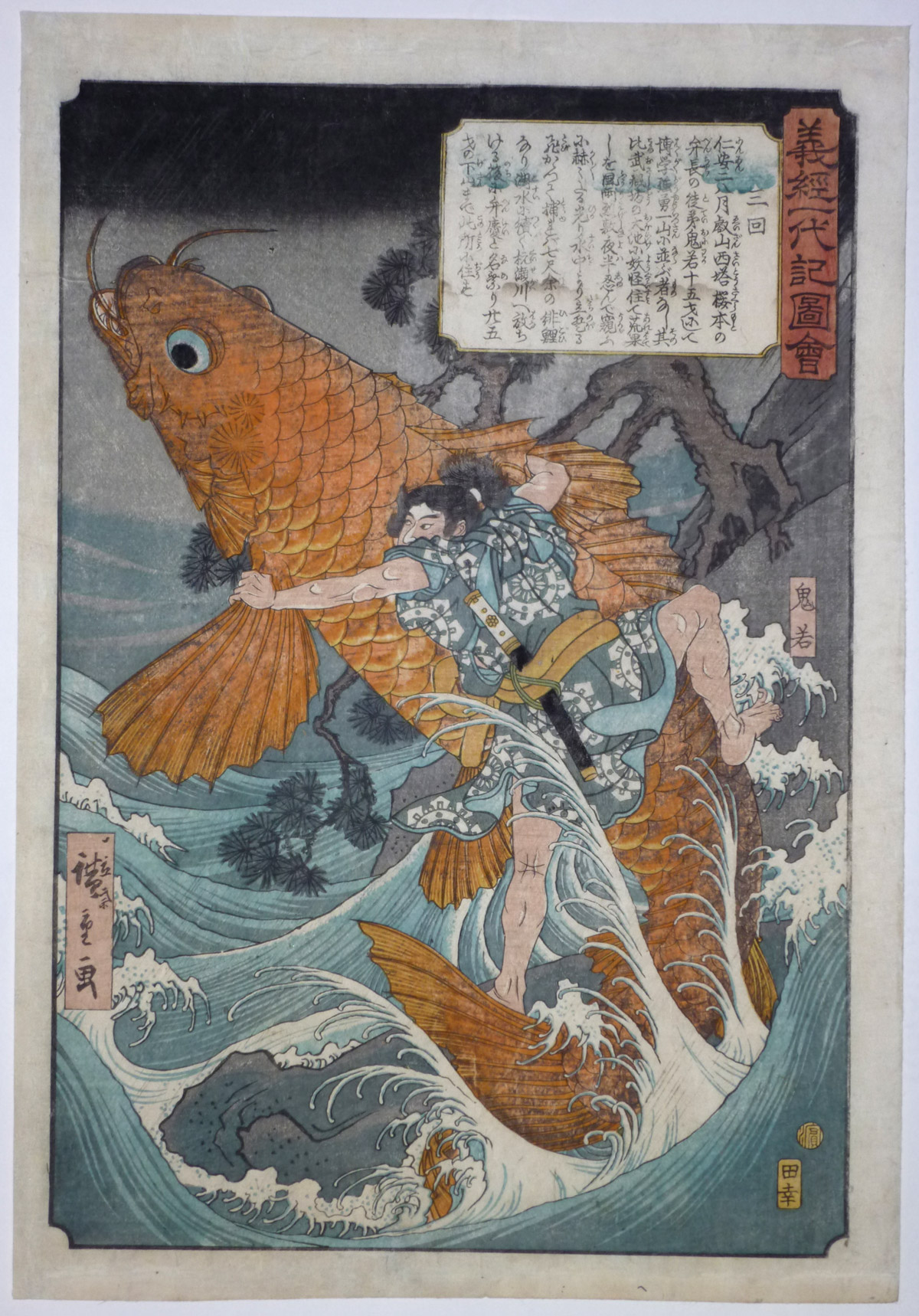
Oniwakamaru, the young Benkei, battling with the giant red carp that swallowed his mother. From a set Yoshitsune ichidai zu. Of the utmost rarity: Stewart in Subjects Portrayed in Japanese Colour-Prints, Kegan Paul, 1922, p. 318, states that only one design ( not this ) was known at that time. It is unknown how many prints were designed for this set. Published c. 1845. A wonderful design and shows that Hiroshige could excel in other areas apart from landscapes.
Fine impression and colour. Slight discolouration in margins, otherwise good condition. Signed Ichiryusai Hiroshige ga.
Status: Sold
Utagawa HIROSHIGE (1787-1858)
Click here to view image full size.
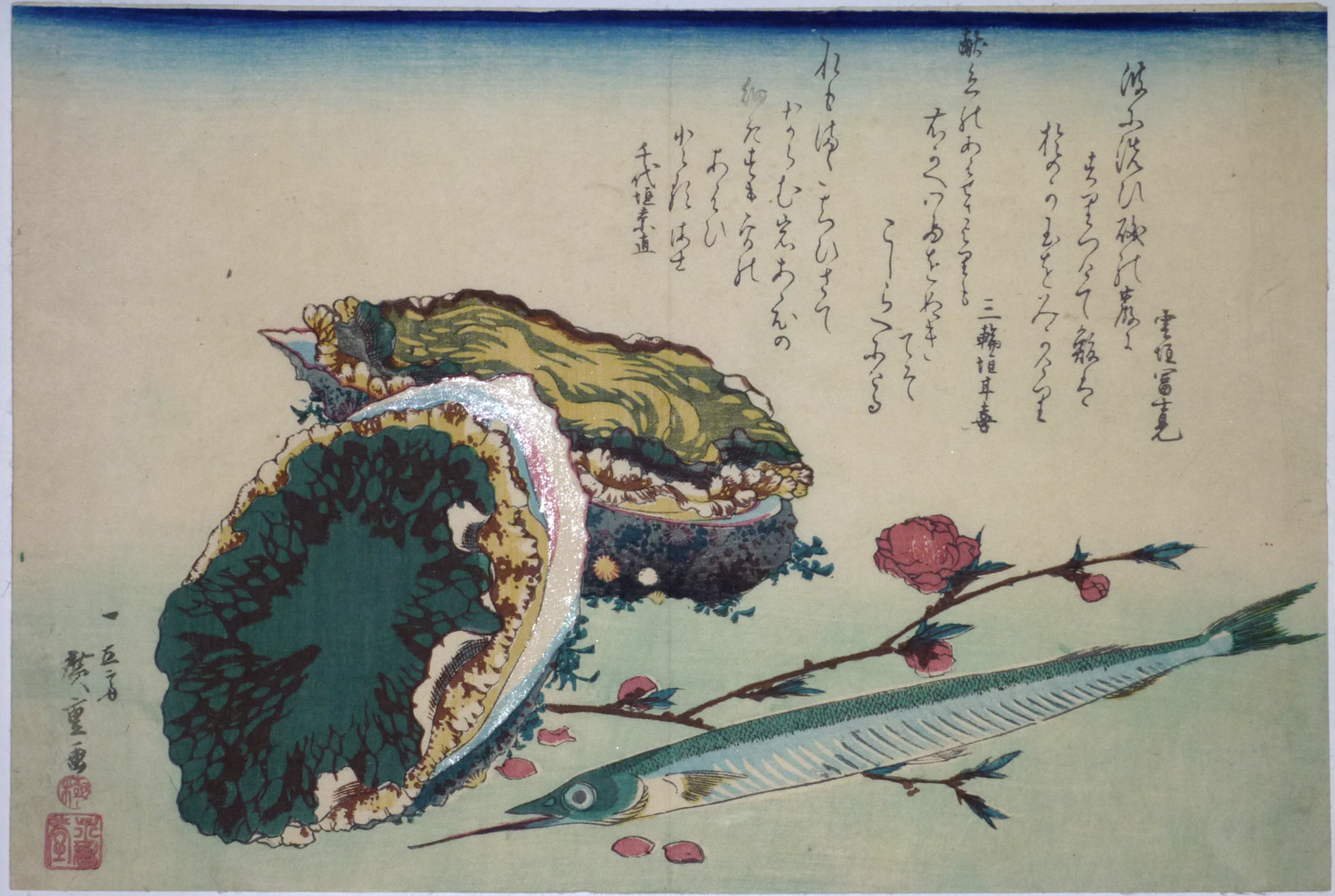
Awabi or tokobushi, abalone or “sea-ear” and sayori, Japanese half-beak or snipe-fish, together with peach blossom from the first series of ten prints published by Eijudo, c. 1832-4.
Good impression. Very good colour. Slight creasing, otherwise good condition. Signed Ichiyusai Hiroshige ga.
Status: Sold
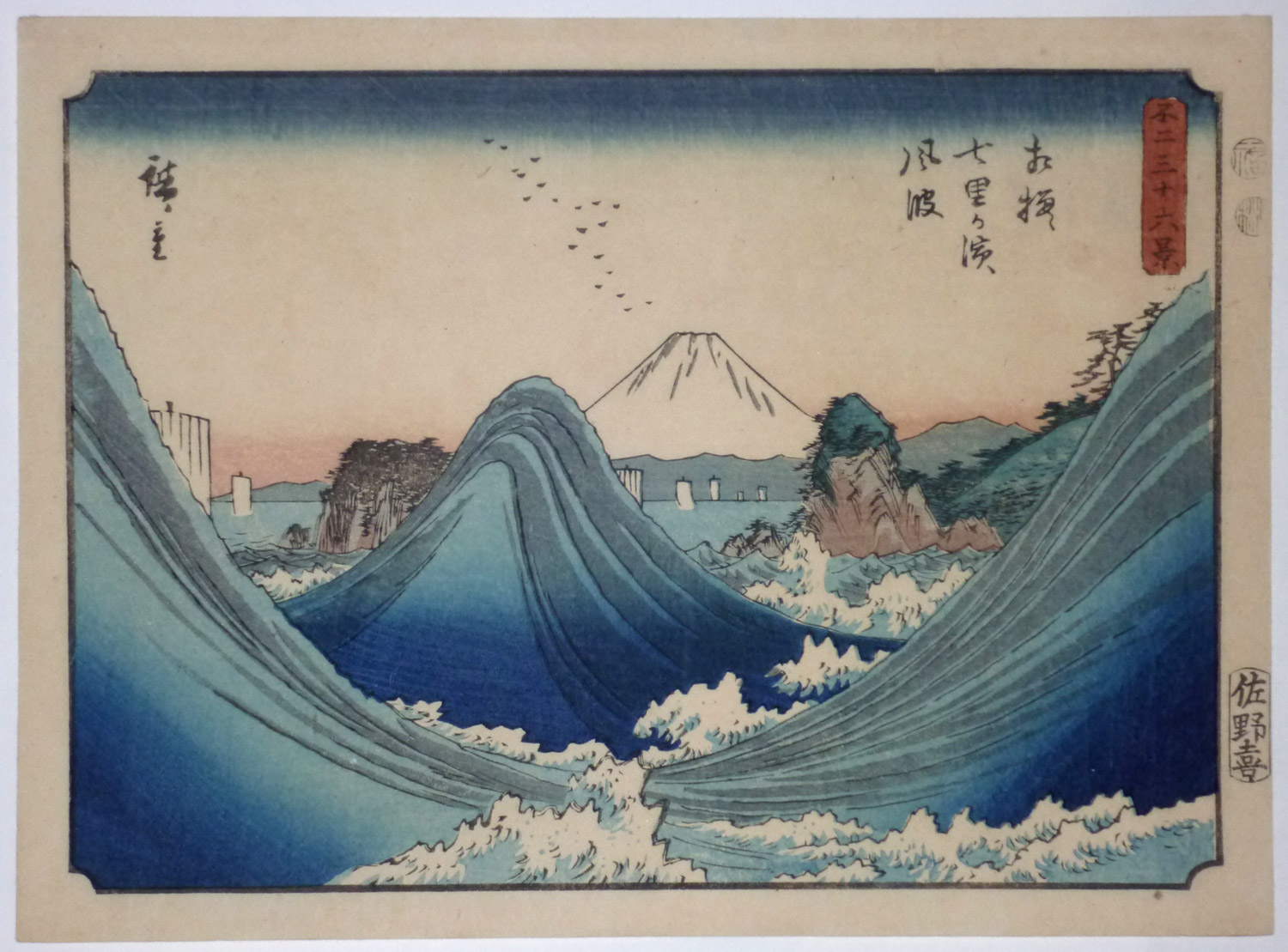
Utagawa HIROSHIGE (1797-1858)
Click here to view image full size.
The sea shore at Izu from the set Fuji sanjurokkei, the “Thirty-six Views of Mount Fuji.” The series published by Sanoya Kihei, 1852. This chuban set is now recognised as one of Hiroshige’s finest series and this is the best design. Late editions are not known which probably partly explains why the set was overlooked as it has always been rare. The heaving sea produces a wave that mimics the outline of Fuji.
Fine impression, colour and condition. Signed Hiroshige ga.
Status: Sold
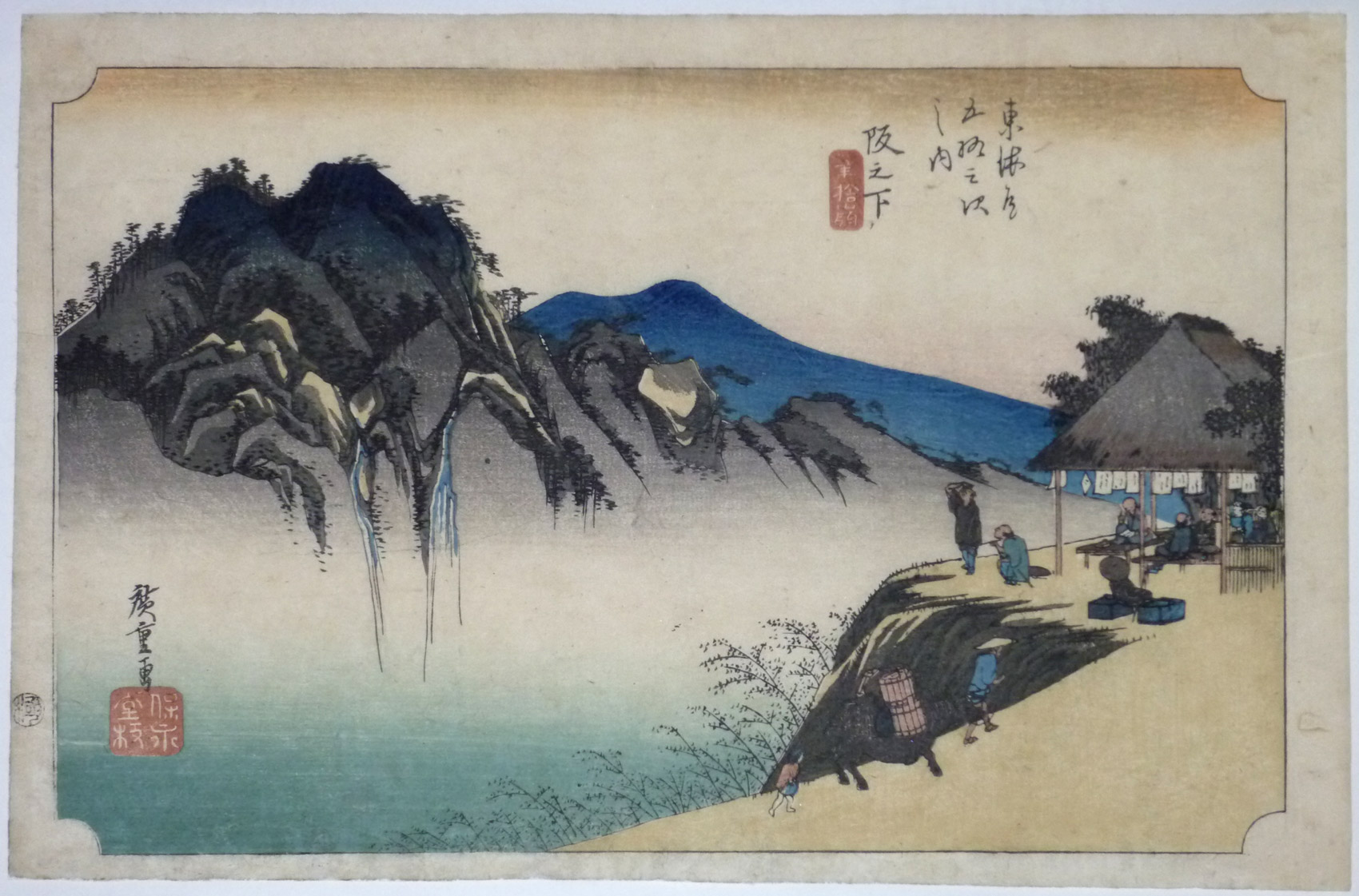
Utagawa HIROSHIGE (1797-1858)
Click here to view image full size.
Sakanoshita fudesute mine, “The Peak of Fudesute Mountain from Sakanoshita.” Fudesute means to “throw away brush” which alludes to the story of the artist Motonobu Kano who, unable to capture the beauty of this view, threw his brush away. From the Fifty-three Stations of the Tokaido. The set published by Hoeido and Senkakudo, c. 1833-4.
Fine impression and colour. The seals very crisp. Very early impression: much better than the example in Ukiyoe Taikei. ( First edition ? ) Probably no other set went into so many reprints and there are a plethora of coarse impressions extant. Proof of how popular the designs were with the public. Indeed, it is stated that the first two hundred sets sold out in a matter of hours. Slight edge soil, otherwise good condition. Signed Hiroshige ga.
Status: Sold
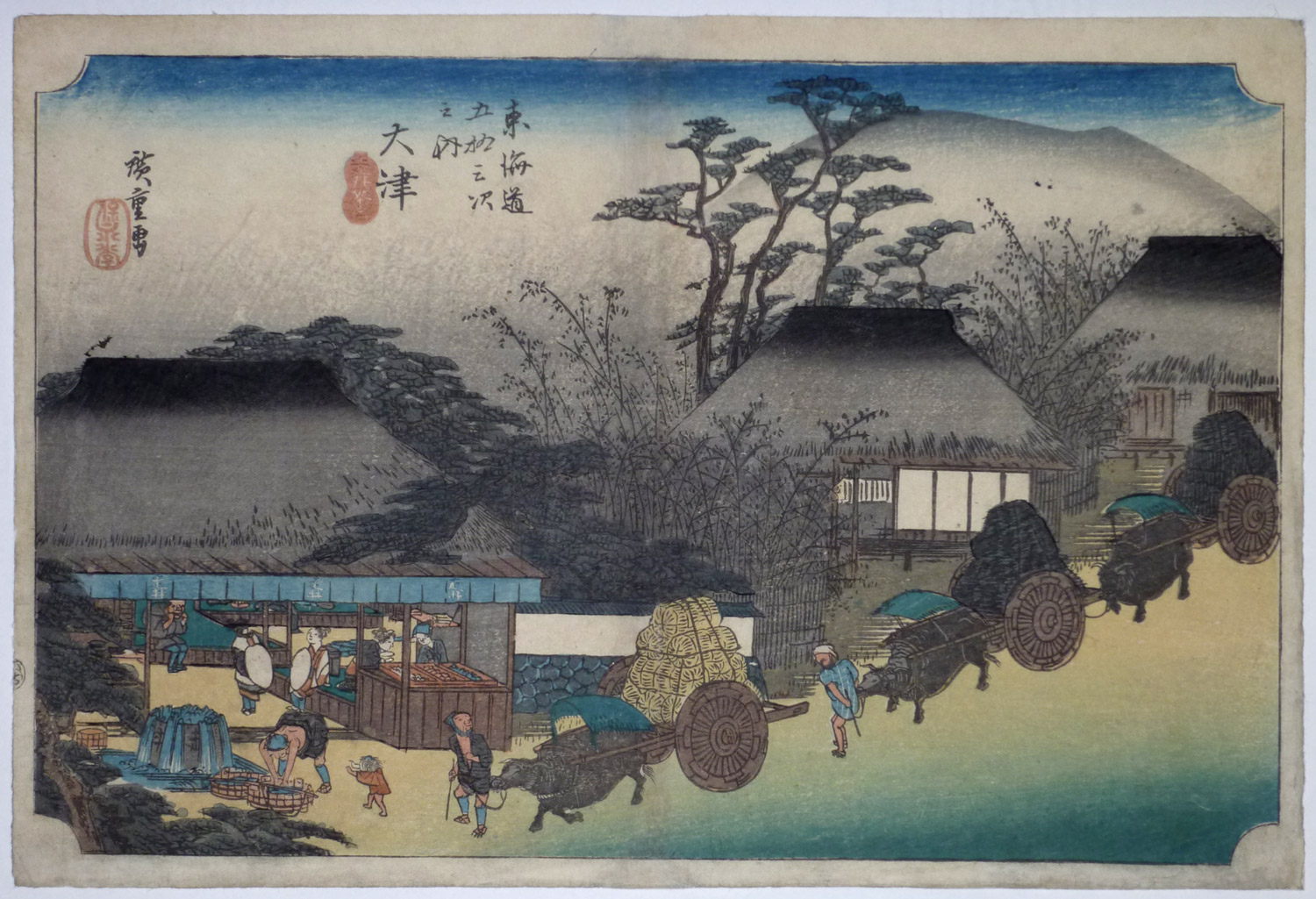
Utagawa HIROSHIGE (1797-1858)
Click here to view image full size.
Otsu hashirii chamise, “The Running Well Teahouse at Otsu” from the Fifty-three Stations of the Tokaido. The set published by Hoeido and Senkakudo, c. 1833-4. Shows the teahouse with the eponymous well at far left. So-called because of the water that gushed from it. Rice cakes in Otsu borrowed the name and were called Shirii rice cakes. This is the extremely rare first state of the first edition with the mountain in the background ( missing on all later editions ) and gradation on the tea house roofs. Ukiyoe Taikei, vol. 14, no 54 shows the first edition but second state without gradation. Other first editions were in the Happer sale, Sothebys, 26/4/1909, lot 141 and Metzger auction, AA Galleries, NY, 13/11/1916, lot 157.
Fine impression with very crisp seals and the mountain beautifully graded in grey ( some impressions being in blue ). Probably no other set went into so many reprints and there are a plethora of coarse impressions extant. Proof of how popular the designs were with the public. Indeed, it is stated that the first two hundred sets sold out in a matter of hours. Fine colour. Slight thinning in centre with backing support and small repairs top and bottom margins, but generally very good condition. Signed Hiroshige ga.
Status: Sold
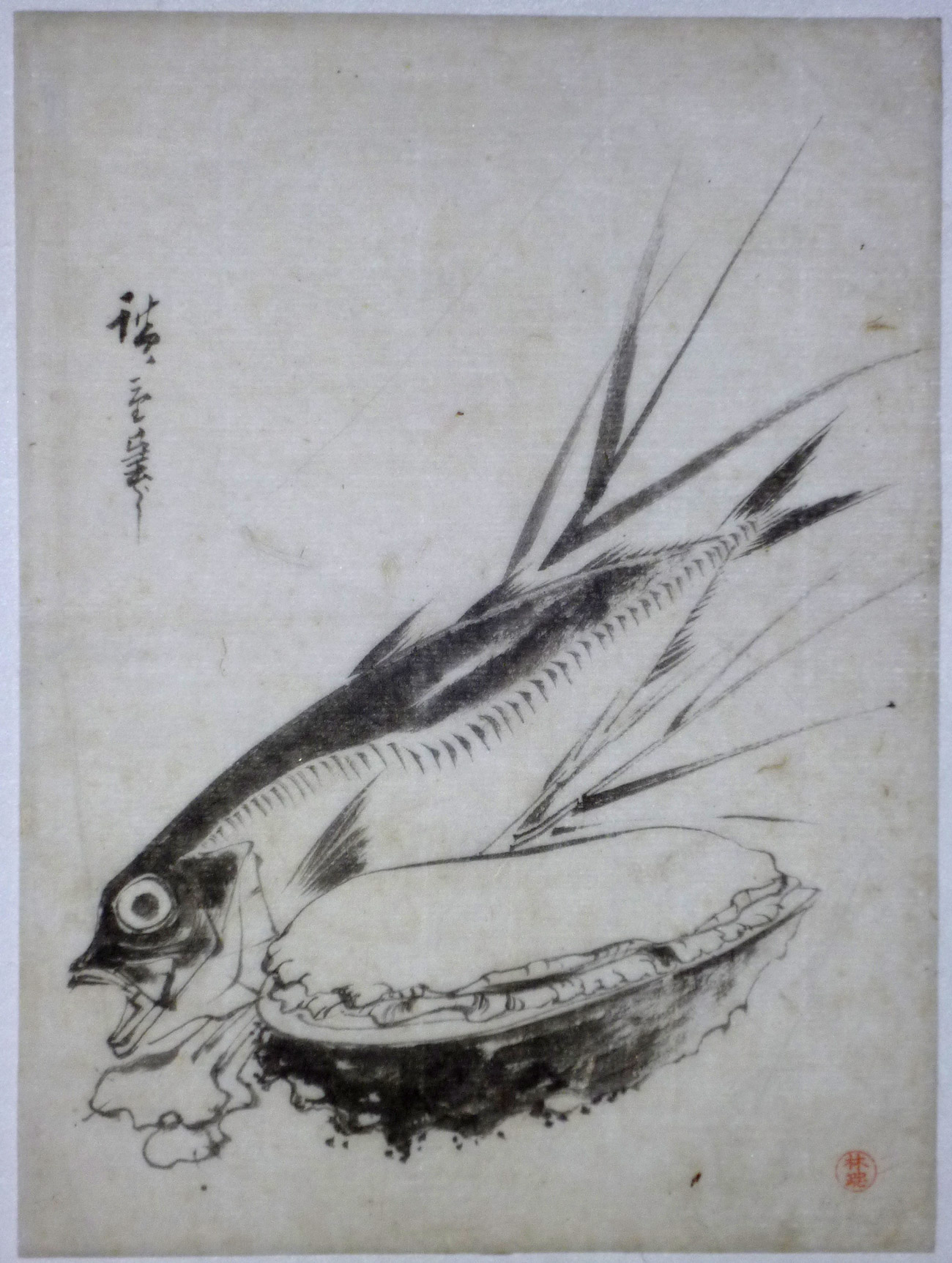
Utagawa HIROSHIGE (1787-1858)
Click here to view image full size.
An original Hiroshige brush drawing of an aji ( also muroaji ), horse-mackerel; awabi, abalone, and two ginger roots. On thin Japanese paper, 9 x 6.75 in, 22.9 x 17 cms. Beautifully signed Hiroshige hitsu. Probably a small present for a friend. Ex collections Hayashi ( seal bottom right ) and Oeder. Very good condition.
Status: Sold
Utagawa HIROSHIGE (1797-1858)
Click here to view image full size.
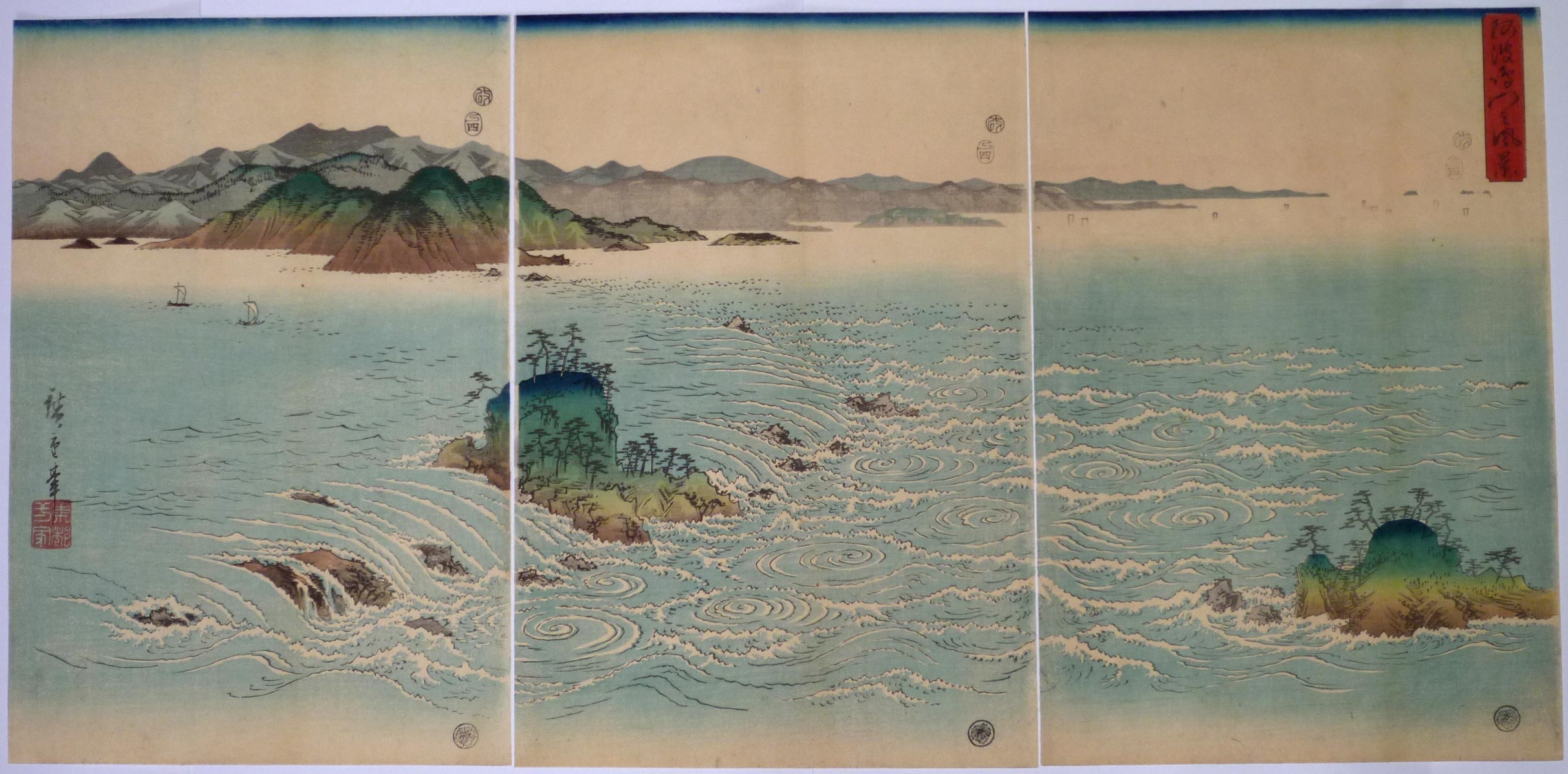
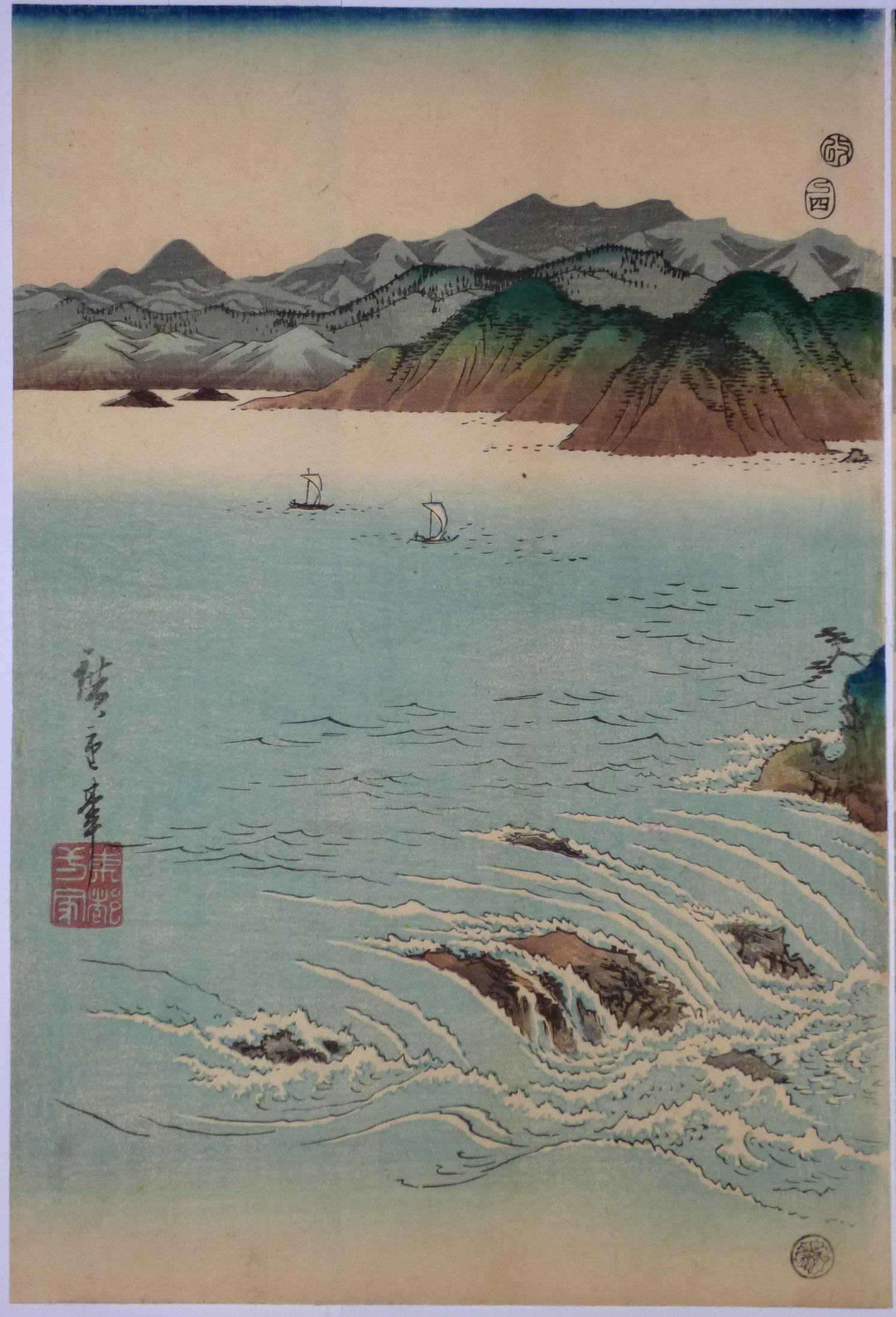
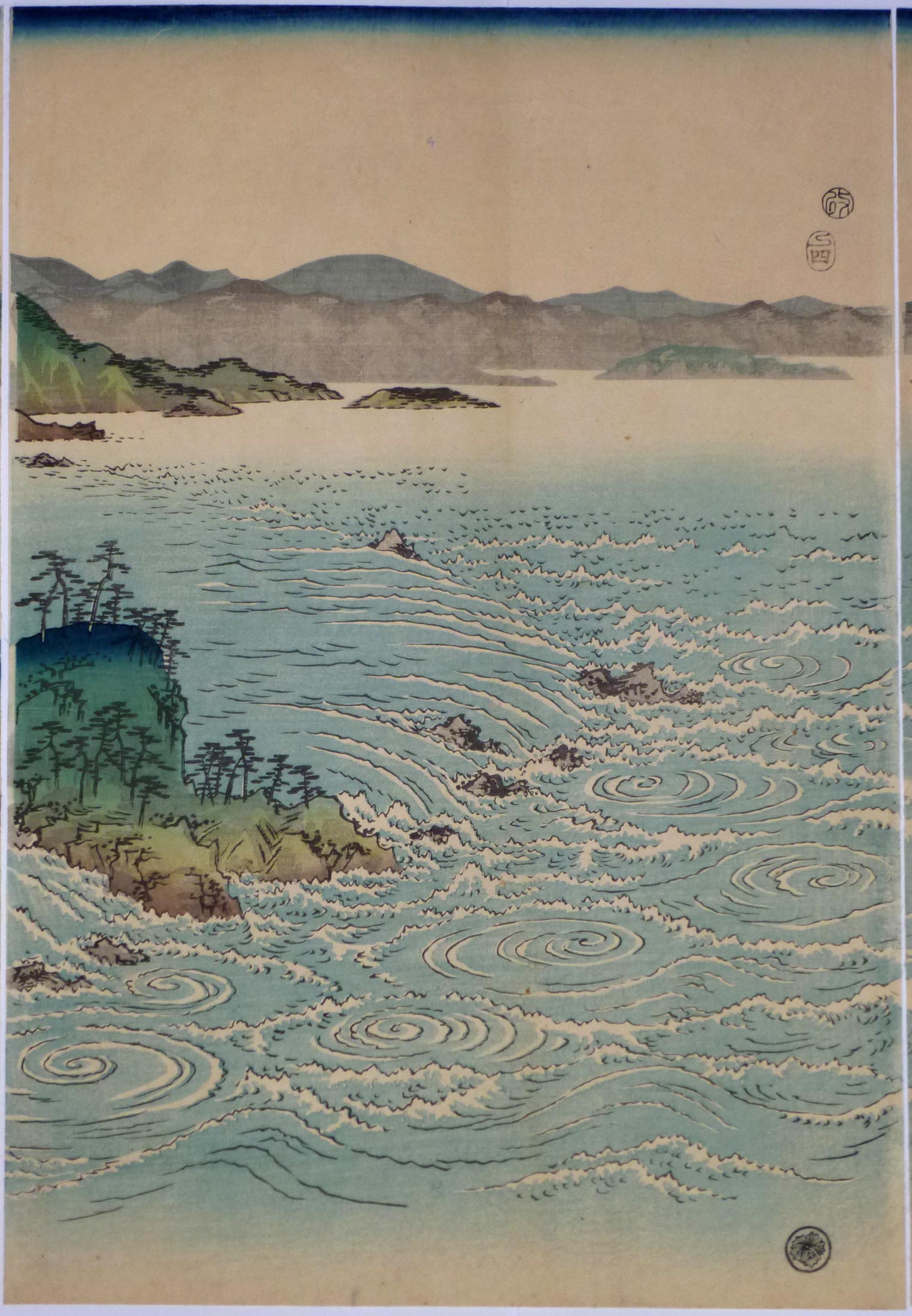
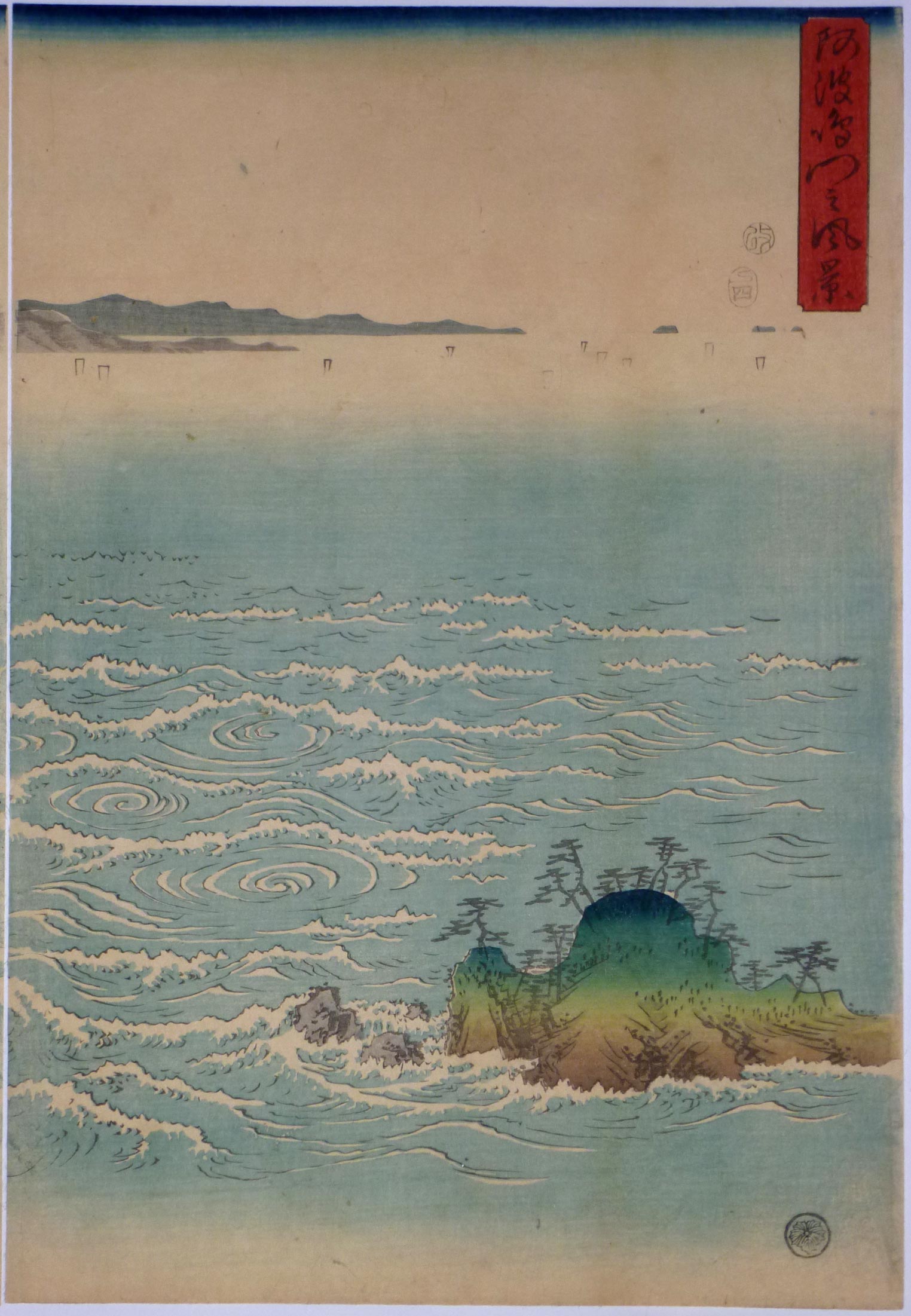
A view over the Naruto Strait of the whirlpools at Awa, Awa no naruto no fukei. Although no series title this is from a trinity of triptychs depicting Snow, Moon and Flowers, this being the last ( because the eddies and whirls were reminiscent of flowers [ nami no hana, “flowers of the waves” ] ). These were the last three great prints Hiroshige designed. All are rare, especially Snow and Moon. Published 1857 by Okasawaya Taheiji.
Fine impression. It is claimed that the first printings have a sliver of land on the far right horizon which is removed on later editions. However, there seems to be no discernable difference in quality between that state and very good impressions without. So, if true, this must have happened early on. Almost all impressions are without. Indeed, late impressions of this set of three triptychs are not known. Fine colour. Virtually untrimmed: These prints are extremely difficult to find without trimming, often well into the title cartouche. Signed Hiroshige ga.
Status: Sold
Utagawa HIROSHIGE (1797-1858)
Click here to view image full size.
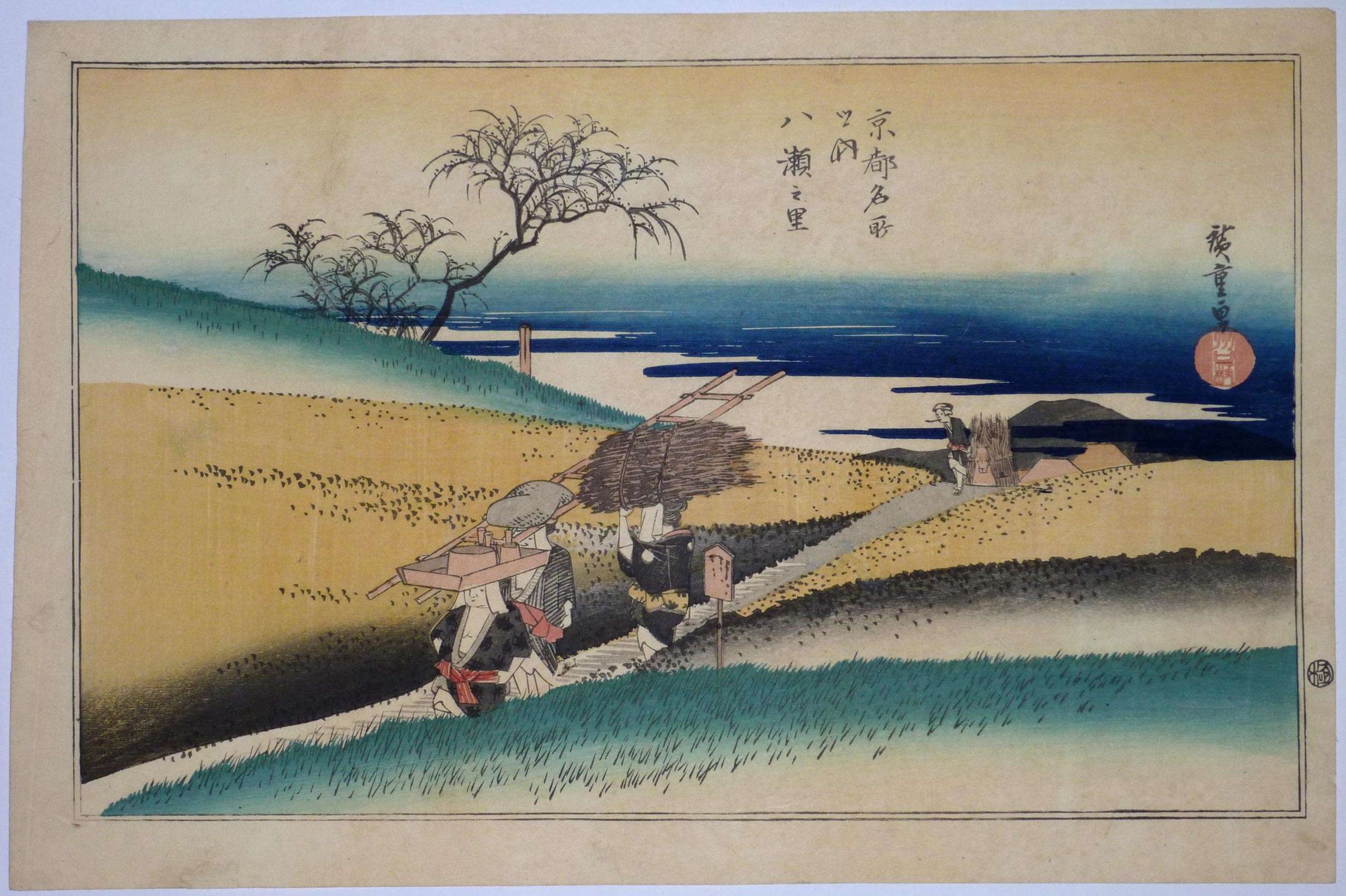
The village of Yase, Yase no sato from Kyoto meisho no uchi, “Famous views of Kyoto.” Shows Oharame from the village of Ohara travelling to Kyoto to sell their wares. A set of ten prints published by Kawaguchiya Shojo, c 1834.
Very good impression and colour. Several expertly repaired wormholes, otherwise very good condition with large margins. Signed Hiroshige ga.
Status: Sold
Utagawa HIROSHIGE (1797-1858)
Click here to view image full size.
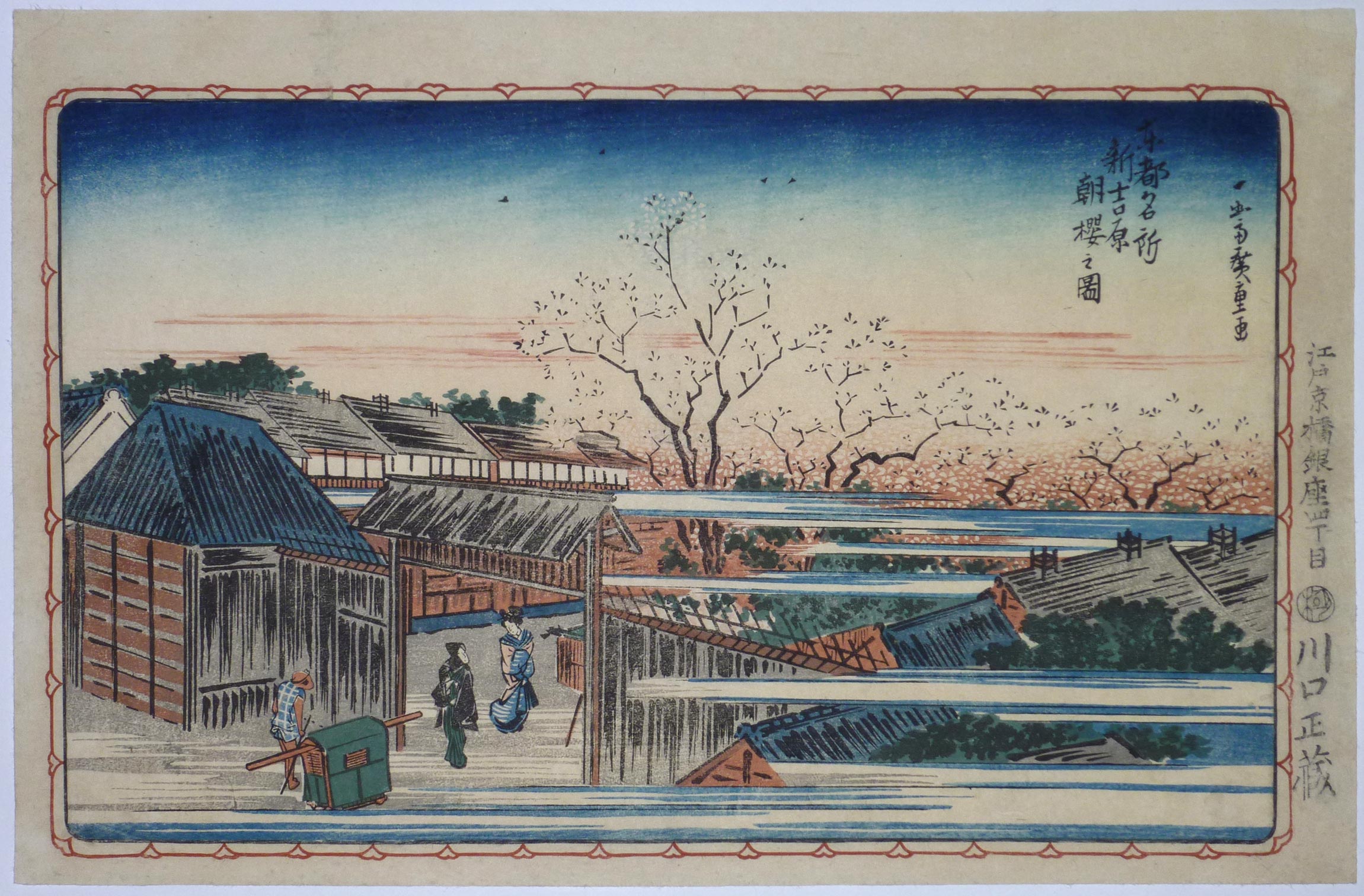
Shinyoshiwara asazakura no zue, “Morning Cherries at Yoshiwara” from Toto Meisho, “Famous Views of the Eastern Capital.” Hiroshige’s first landscape set of ten prints published c 1831 by Kawaguchiya Shojo. An early morning scene with low lying mist. A client takes leave of his companion.
Fine impression. The first edition with ochre patterned border. Missing on later editions. Fine colour. Thinned area top right border and minimal soil in right border. Large margins. ( The publisher’s name and address in right border is often trimmed off. ) Signed Ichiyusai Hiroshige ga.
Status: Sold
Utagawa HIROSHIGE (1797-1858)
Click here to view image full size.
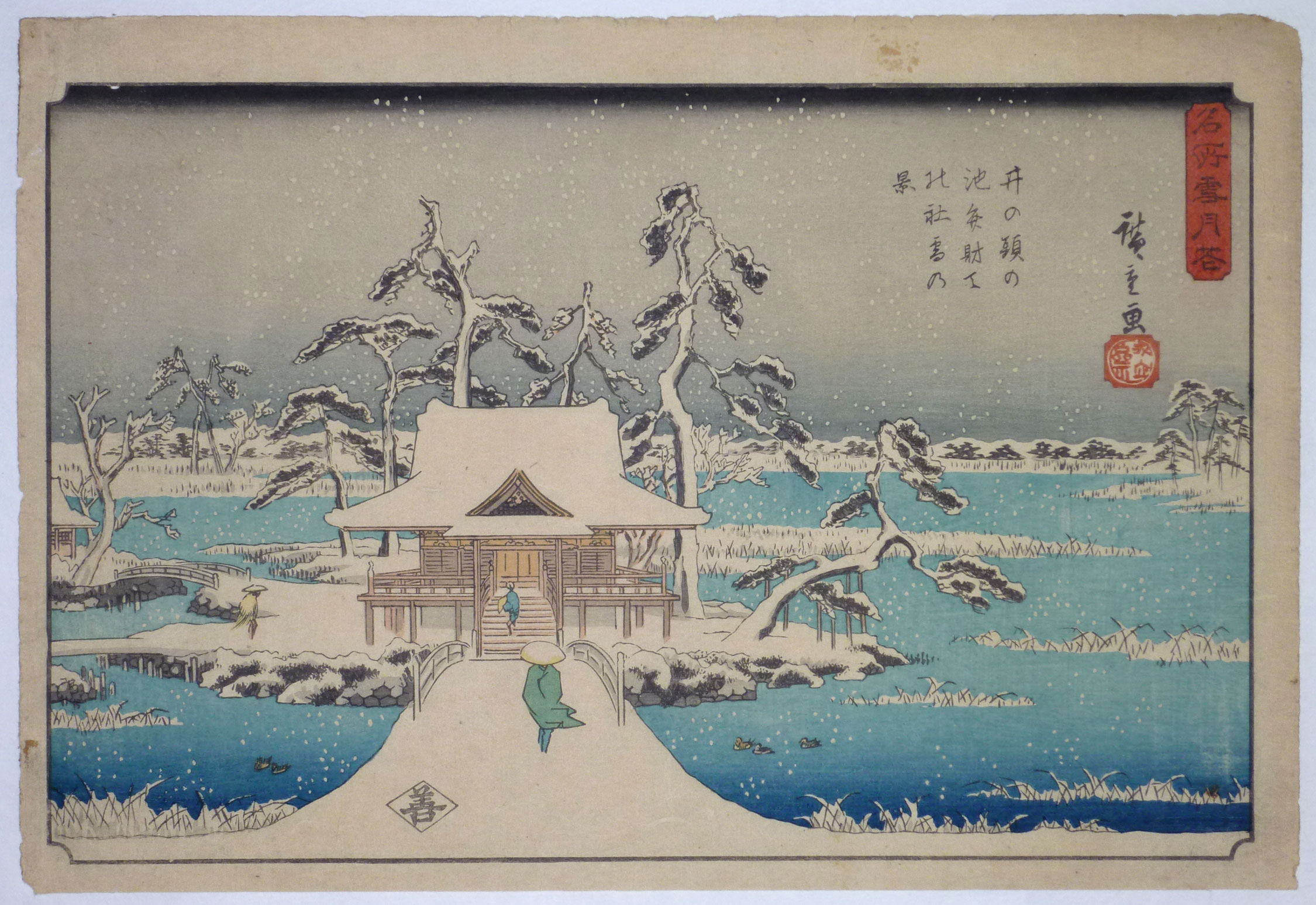
The Benten Shrine, Inokashira Pond in a snowstorm, Inokashira no ike Benzaiten no yashiro no kei. One of a set Meisho setsu gekka, “Famous Places: Snow, Moon and Flowers.” ( The other two are Flowering Cherries at Kogamei and Autumn Moon at Takanawa. ) A fine and rare snow scene, this being the hard to get first edition with publisher’s seal Riuya Zenbei (?) left centre bottom. A later edition altered the seal to circular and moved it to the right border. An even later reissue was published by Marujin, his and the censor seal being in the left margin. This state had the sky block recut with heavy snowflakes and completely ruins the design. For this state see Japanese Prints & Drawings From The Vever Collection, Jack Hillier, Sothebys, 1976, no. 926, p. 950. Also Tamba, no. 223 ( later edition ) and Suzuki, no. 146 ( first edition ). Ex collection Walter von Scheven, 1878 – 1950, and purchased by him from R. Wagner, Berlin in 1921.
Fine impression and colour. Minor edge soil, otherwise very good condition. Signed Hiroshige ga.
Status: Sold