Search Results for KIYONOBU II

Attributed to Torii KIYONOBU II (Active 1710s – 1760)

 Click here to view image full size. A sumizuri-e abuna-e sheet from a shunga set published c. late 1710s. MFA has 10 sheets from the set , RES.09.310.1 to .10. They are based on designs by his father, Torii Kiyonobu I.   Fine impression. Fine hand-colouring. Backed (from a scroll), some light soil and minor creasing, all appropriate with date.   Status: Sold  

Attrib. to Torii KIYONOBU II (Fl. c 1720s-1760)

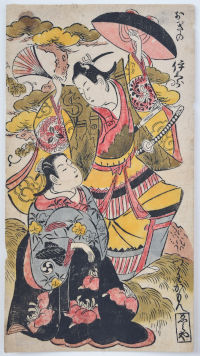
Click here to view image full size. A fine primitive showing the actors Ogino Isaburo (above) and the onnagata actor Tsugawa Kamon below. Published c late 1720s by Emiya Kichiemon. Ex collection Dr E.F. (1970). Rare.   Fine impression. Urushi beni-e with hand-applied colour: tan, blue, yellow, light and dark beni, lacquered sumi over an embossed pattern and gold powder. Minor imperfections, but otherwise in exceptional condition for a print of this period.   Status: Sold  

Torii KIYONOBU II (Fl. c 1720s-1760)

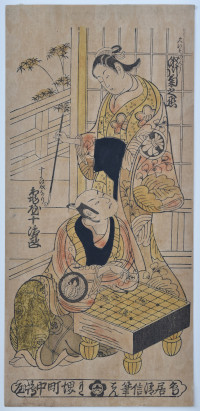
Click here to view image full size. An early print showing the actor Segawa Kikunojo as Oiso no Tora looking down at Kameya Jujiro as Soga no Juro Sukenari who is leaning on a shogi board (Japanese chess). The play Hatsu hikage maizuru Soga was performed at the Nakamura-za Theatre, 1 Published by Nakajima Izaemon. Ex collection Dr E.F. (1978). Rare.     Fine impression. Urushi beni-e with hand-applied colour: tan, yellow, light beni, gold powder and lacquered sumi over an embossed pattern. Toned with some fading of colour. Signs of mounting au verso. Signed Torii Kiyonobu hitsu.     Status: Sold

Torii KIYONOBU II (1706-1763)

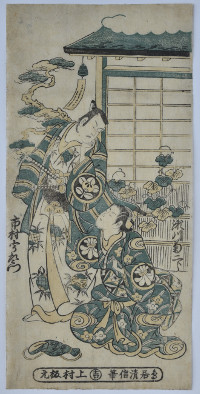
Click here to view image full size. An hosoban showing the actors Ichimura Uzaemon VIII (above) and Segawa Kikujiro I in an onnagata role. Published by Emiya Kichiemon, c. 1746. Another impression in the MET (JP831), listed as Kiyonobu I.     Very good impression. Good colour and condition. Signed Torii Kiyonobu hitsu.     Status: Sold

Torii KIYONOBU II (1706-1763)

 Click here to view image full size. A fine urushi-e hosoban showing the actors Sawamura Sojuro I ( above ) and Yamamoto Kiyoshiro I wrestling amongst bales of rice. It is impossible to be certain of the performance as records are scant, but Sojuro is probably playing the role of Sano Genzaemon and Kiyoshiro is probably playing Sano Genta in the play Miyakozome kaoru hachinoki performed at the Nakamura-za in the 11th month of 1739. Kiyoshiro was from the Kamigata region and only arrived in Edo in this month. He left for Osaka the following year. Although he did visit Edo once before this date, he did not act with Sojuro at that time. Very good impression. The hand-applied colours well retained. Small restorations to the sumi/brass, otherwise good condition. Signed Torii Kiyonobu hitsu. Status: Sold

Torii KIYONOBU I (1664-1729)

Click here to view image full size. A large sumi oban showing a couple in flagrante. These prints were normally issued in sets of twelve and would only have had the signature on the first sheet. Published c 1704-1711. Provenance: Ex Kiyoshi Shibui collection. Very good impression. Slight edge soil and centre fold with small pin holes, but generally good condition considering the age. Status: Sold

Torii KIYOMASU (FL. c. 1696-1720)

Click here to view image full size. An overlarge oban, 19.5 x 12.25 in; 49.5 x 31 cms. Coloured by hand with tan and mustard yellow. Shows the emporium of Daikokuten, the God of wealth and one of the Seven Lucky Gods (Shichifukujin). He is shown at the top seated in front of a pair of scales. Seated before him, to the left, is Benzaiten, the Goddess of love and music. On the right is Ebisu, God of fishermen and good luck. Behind him is Fukurokuju, the God of happiness and wealth, using an abacus. On the far right is Jurojin, the God of longevity. Below him, next to the cart, is Bishamonten, the God of war and warriors. At the bottom, stepping from the boat, is Hotei, the God of happiness. All the Gods are helping, together with rats, to unload bales of rice. The earliest depictions of the Seven Gods are in the second half of the 17th century and are amalgams of Indian and Chinese lore. This early rendition still hasn’t the fully developed characteristics of the Gods – especially Hotei – which we see in the 19th century. Published by Komatsuya (who published c. 1707-1734) c. 1710-1715. Little is known of Kiyomasu’s early career. He may have been the brother of Kiyonobu. An important painter and print artist. Of the utmost rarity: probably the only impression extant.     Very good impression. Some expert edge restoration, otherwise very good colour and condition. Signed Torii shi with Kiyomasu seal.     Status: Sold    

Torii KIYOMITSU (1735-1785)

 Click here to view image full size. A large oban panel, 11.75 x 16.5 in; 29.75 x 42 cms showing three beauties playing, from the left, a shamisen, a koto, and a kokyu in an interior with hand-painted screens. A beautiful and important print. Kiyomitsu was the son and pupil of Kiyonobu II, the third of the Torii line and a prominent print designer. He pioneered the polychrome print which was brought to full fruition by Harunobu. Benizuri-e with beni, blue, yellow and green by superimposing blocks. Published by Kichi Uemura (Kichiemon of Emi-ya) c. 1764. There was a convention of printing three hosoban designs to a sheet from the 1720s to 1760s with a linking theme, in this case even though the image is signed three times it is as one. Exceptionally rare: The only other impression appears to be that in the Ritsumeikan University, Japan, Z 0165-424. An unread collector’s seal bottom right.   Fine impression and colour. Minor expertly restored areas, but in fine condition for a print of this size and date. Signed three times Torii Kiyomitsu ga.   Status: Sold  

Artists

( A to Z ) Kyogado ASHIKUNI ( Fl. c. 1807 – 1818 ) Gigado ASHIYUKI ( Fl. c. 1814 – 1833 ) Ki BAITEI ( 1734 – 1810 ) Takizawa BAKIN ( 1767 – 1848 ) Ono BAKUFU ( 1888 – 1976 ) Georges BIGOT ( 1860 – 1927 ) Kawamura BUMPO ( 1779 – 1821 ) Ippitsusai BUNCHO ( Fl. c. 1765 – 1792 ) Toyohara CHIKANOBU ( 1838 – 1912 ) Kishi CHIKUDO ( 1826 – 1897 ) Tsubaki CHINZAN ( 1801 – 1854 ) Eishosai CHOKI ( Fl. c. 1756 – 1808 ). See also SHIKO Rekisentei EIRI ( Fl. c. 1790 – 1800 ) Keisai EISEN ( 1790 – 1848 ) Hosoda EISHI ( 1756 – 1829 ) Hosoda EISHO ( Fl. c. 1780 – 1800 ) Ichirakutei EISUI ( Fl. c. 1790 – 1823 ) Kikugawa EIZAN ( 1787 – 1867 ) Hirano HAKUHO ( 1879 – 1957 ) Elizabeth KEITH ( 1887 – 1956 ) Imao KEINEN ( 1845 – 1924 ) Yashima GAKUTEI ( 1786 – 1868 ) Ogata GEKKO ( 1859 – 1920 ) Adachi GINKO ( Fl. c. 1847 – 1897 ) Matsumura GOSHUN ( 1752 – 1811 ) GYOSAI. See Kawanabe KYOSAI Hirano HAKUHO ( 1879 – 1957 ) Suzuki HARUNOBU ( 1724 – 1770 ) Kawase HASUI ( 1883 – 1957 ) Kitagawa HIDEMARO ( Fl. c. early 19th century ) Kinoshita HIRONOBU ( Fl. c. 1851 – 1870 ) Gosotei HIROSADA ( Fl. c. 1847 – 1863 ) Ichiryusai HIROSHIGE ( 1797 – 1858 ) Ichiryusai HIROSHIGE II ( 1826 – 1869 ) Ando HIROSHIGE III ( 1843 – 1894 ) Nakamura HOCHU ( Fl. c. late 18th to early 19th century ) Sakai HOITSU ( 1761 – 1828 ) Totoya HOKKEI ( 1780 – 1850 )…

Nishikawa SUKENOBU (1671-1750)

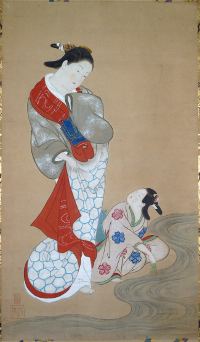
 Click here to view image full size. The pre-eminent painter in the Kyoto area during the first half of the eighteenth century. He enjoyed a great reputation in his lifetime and his (over 100) illustrated books influenced many artists, not only in the Kyoto-Osaka area but also in Edo. Many of his books were published by Hachimonjiya in Kyoto such as Hyakunin joro shina sadame (1723). Other famous books being: Tokiwa gusa (1731); Asakayama (1739); Chiyomi-gusa (1740). His paintings were collected by his contemporaries with Yanagisawa Kien (in his Hitorine, c. 1726) calling him the “supreme master” of Ukiy-e, superior to Okumura Masanobu, Torii Kiyonobu, Hanekawa Chincho and Kaigetsudo. Full colour on silk, 30.25 x 17.5 in; 76.7 x 44.3 cms. Shows a typically refined and elegant beauty watching her assistant washing a tea-whisk in a stream. Suihen bijin zu. There are two other versions of this design by Sukenobu: One was auctioned in 1933 at the Osaka Art Club from the W. Sturgis collection and there is another from Nagano, Japan, illustrated in Kokka, no. 18, 2011, p. 10. Other examples are in major museums such as the Metropolitan, Philadelphia, Freer, Honolulu, British, etc. Although Sukenobu produced many paintings, genuine works are now rare. Painted c late 1730s. Minor marks and creases and some loss of gofun, but in very good condition for an early 18th century painting. Sealed Nishikawa shi in and Sukenobu. Illustrated and exhibited in Nikuhitsu Ukiyoe Beauty, Tokyo Fuji Art Museum, 1983, no. 21, ex Hirano collection, Akita Prefecture.   Very good condition. Signed and sealed Bokusen. See my Blog on this update. here   Status: Sold    Click here to view image full size.  Click here to view image full size.  Click here to view image full size. here to view image full size.

Hanekawa CHINCHO (1679-1754)

Click here to view image full size. An oversized hosoban showing a parading courtesan with her kamuro and an attendant holding an umbrella. A rare arist who made few prints: Clarence Buckingham states that he was of samurai stock and only worked when in the mood. (Where he got this information I am not sure but it is repeated by Dr Richard Lane and Laurence Roberts.) He was a pupil of Torii Kiyonobu. Sometimes used the name Motonobu. Excessively rare: This may be the only impression extant. Published by Komatsuya who published c 1709-34.   Very good impression. Hand-applied colour in two shades of beni, mustard, and gold powder on the umbrella. Some small restored wormage and slight soil, but generally very good condition. Signed Hanekawa Chincho zu.   Status: Sold