Toyohara KUNICHIKA (1835-1900)

Click here to view image full size.
The actor Onoe Kikugoro V as Hisayoshi from a fine set of prints showing actors glimpsed through their dressing room sliding doors, prior to going on stage. Their figures partly silhouetted as are their assistants, here aiding the actor with his costume. From a set Gakuya nikai kage no hyoban, “Popularity of the Upstairs Dressing Room.” The set published by Takagawa Fusajiro, 1883.
Fine impression, colour and condition. Full size. Signed Toyohara Kunichika hitsu.
Status: Sold
Katsukawa SHUNSHO (1729-1792)
Click here to view image full size.
A hosoban showing the actor Arashi Sangoro II in the role of Ito Kuro disguised as Banta in the play Izu-goyomi shibai no ganjitsu performed at the Morita Theatre, 11/1772. He holds a brazier aloft and stands in deep snow.
Fine impression. Pristine colour. Small thinned area at top, otherwise fine condition. Full size. Signed Shunsho ga.
Status: Sold
Utagawa KUNISADA (1786-1864)
Click here to view image full size.
An untrimmed aiban fan print showing the actor Nakamura Shikan II on an outing to view the summer fireflies. Ukiyo hotarugari, “Firefly Viewing in the Floating World.” Published by Ibaya Kyubei, 1831.
Fine impression, colour and condition. Signed Kochoro Kunisada ga.
Status: Sold
Ippitsusai BUNCHO (Fl. c 1755-1790)
Click here to view image full size.
A hosoban showing the actor Ichikawa Monnosuke II standing before a torii and looking down at a snake. Not listed in the Riccar Art Museum Exhibition Of Ukiyo-e By Ippitsusai Buncho, 1978. Published c 1769.
Very good impression. Extremely well preserved colour. Probably slightly trimmed on right and slight soil, otherwise very good condition. Signed Buncho ga.
Status: Sold
Utagawa TOYOKUNI (1769-1825)
Click here to view image full size.
A print from the series Mitate Kofukujin, “ A Parody of Children’s Gods.” Featured are two of the seven gods of good fortune compared to famous heroes. Top left: Bishamonten no mitate, Tawara Toda Hidesato (Tawara Toda Hidesato defeating the giant centipede, compared to the god Bishamon). Bottom right: Daikoku no mitate, Otokonosuke, Hakuen (Ichikawa Hakuen I in the role of Arajishi Otokonosuke, compared to the god Daikoku). Hakuen (formerly Danjuro V) had already retired by this date so this does not depict an actual performance. However, the hero Otokonosuke is famous from the play Meiboku Sendai Hagi. Published 1804 by Nishimuraya Yohachi.
Very good impression and color. Small corner repair and slight edge soil, otherwise good condition. Signed Ichiyosai Toyokuni ga.
Status: Sold
Toyohara KUNICHIKA (1835-1900)
Click here to view image full size.
A fine set of prints showing actors preparing backstage for their performances. Haiyu gakuya no omokage, “Images of Actors in the Green Rooms.” Here Ichikawa Danjuro IX is shown in dressing gown being fanned by an attendant (off picture). Published 1888 by Sasaki Toyokichi.
Fine impression, colour and condition. Signed Toyohara Kunichika hitsu.
Status: Sold
Toyohara KUNICHIKA (1835-1900)
Click here to view image full size.
A fine set of prints showing actors preparing backstage for their performances. Haiyu gakuya no omokage , “Images of Actors in the Green Rooms.” Here Nakamura Fukusuke IV is shown preparing to put on makeup while an attendant (off picture) holds up what is presumably a supporter’s banner. Published 1888 by Sasaki Toyokichi.
Fine impression, colour and condition. Signed Toyohara Kunichika hitsu.
Status: Sold
Anonymous
Click here to view image full size.
An early Osaka kappazuri-e hosoban diptych (printed with woodblock outline and stencilled colours) showing, on the left sheet, Ichikawa Danzo V in the role of Genta Kagesue, and on the right sheet Arashi Kitsusaburo II in the role of Kajiwara Heiji Kagetaka in the “Genta Kando” act of Hirakana seisuiki, performed at the Kitagawa no Shibai, Osaka, 7/1827. Unidentified publisher’s seal. Complete diptychs are very rare.
Fine impression: Beautifully printed for a kappazuri print. Fine colour and condition.
Status: Sold
Toyohara KUNICHIKA (1835-1900)
Click here to view image full size.
A triptych of the famous scene from Meiboku Sendai hagi “The Disputed Succession” showing Kawarasaki Gonjuro I as Arajishi Otokonosuke and Onoe Kikugoro V as Yoshio. The rat with the scroll of conspirators is attacked, escapes, and reappears through a trapdoor in its true guise as the evil Nikki Danjo. Published by Tsujiokaya Bunsuke, 1869.
Fine impression, colour and condition. Signed Kunichika hitsu.
Status: Sold
Utagawa KUNISADA (1786-1865)
Click here to view image full size.
An original woodblock for printing the centre sheet of a triptych showing Ame no Tajikarao pulling the giant stone away from the Ama-no-Iwato cave where Amaterasu (the Sun Goddess) had ensconced herself thereby depriving the world of light. The block cut by the publisher Moriya Jihei, 6/1857. The block in very good condition. On the reverse side is the yellow block. Sold with a modern pull from the block. Signed Toyokuni ga.
Status: Sold

Click here to view image full size.
Utagawa TOYOKUNI (1769-1825)
Click here to view image full size.
Segawa Kikunojo III as the courtesan Kojoro of the Mikuni House (Mikuni Kojoro) and Arashi Sanpachi I as her elder brother Kujuro (Kojoro ani Kujuro) in the play Tomigaoka koi no yamabiraki by Namiki Gohei performed at the Kin-za in the 1st month of 1798. The design shows the evil cormorant fisherman Ugai Kujuro attempting to extract money from his younger sister whom he had previously sold into prostitution. He is eventually murdered by the hero Shimbei who is in love with Kojoro. Published by Nishimuraya Yohachi. Rare: A faded example in B.M. (1906, 1220, 0.391). And another faded impression in the Museum of Fine Arts, Boston, acc. No. 11.13701. One of the great Toyokuni double bust portraits.
Fine impression and colour. Very slight trimming at bottom, otherwise fine condition. Signed Toyokuni ga.
Status: Sold
Toyohara KUNICHIKA (1835-1900)
Click here to view image full size.
A vertical oban triptych showing Onoe Kikugoro V as Okiku’s ghost, above, and Ichikawa Danjuro IX as Asayama Tessan from the play Sarayashiki kesho no sugatami, “Mansion of Plates” performed at the Kabuki-za 1892. A famous ghost story with different versions. The gist is that Okiku was a maid at the mansion of the samurai Aoyama Tessan. He attempts to seduce her without luck and as an act of revenge hides one of ten valuable Dutch plates, claiming that she has stolen one. In remorse, she drowns herself in a neighbour’s well. Her ghost appears every night, sobbing and groaning, eventually causing Aoyama to go insane. Published by Fukuda Kumajiro, 1892.
Superb impression, colour and condition. Signed Toyohara Kunichika hitsu.
Status: Sold
Yurakusai NAGAHIDE (c 1799-1848)

Click here to view image full size.
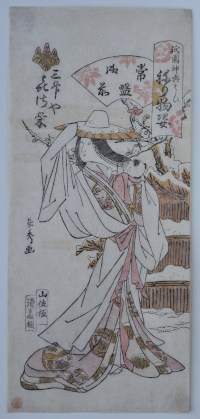
An hosoban kappazuri (coloured by stencils) print from a set: Gion mikoshi arai nerimono sugata, “Gion Festival Costume Parade.” The set was jointly designed by: Goshichi, Seikoku (Charakusai) and Toyokuni, as well as Nagahide, although he appears to have been responsible for many in the set. A large group is in the MFA, Boston, with another impression of this design being acc. no 11.26554. Published by Yamashiroya Sahei (Yamasa) c 1818. Shows a courtesan, Kisae of Mimasuya, parading in the Gion Matsuri Festival, held in the geisha quarter of Kyoto in July, dressed as Tokiwa Gozen, the mother of Minamoto no Yoshitsune. She is usually depicted fleeing through the snow during the Heiji rebellion cradling her son to her chest. Seal bottom left Kato [Shozo] who was an art dealer/collector in Oxford Street, London and sold prints to the BM in the 1920s.
Very good impression with extensive undamaged mica. Very good colour. Signs of mounting au verso, otherwise very good condition. Signed Nagahide ga.
Status: Sold
Utagawa TOYOKUNI I (1769-1825)

Click here to view image full size.
A fascinating triptych: Edo sanshibai yakusha nigao seisha nishiki-e, “Brocade Print of True Copies of Actor Likenesses in the Three Theatres of Edo.” Shows all the actors appearing in the three theatres at that time: Nakamura-za, Ichimura-za, Morita-za, with the roles for which they were famous. For example, jitsuaku, “truly evil” or katakiyaku, “villains.” Below the crests of the three theatres is Kabuki O-iri, “Kabuki Full Houses.” Published between 11/1799 and 1/1801 (Arashi Hinasuke II died in 2/1801).
Fine impression, colour and condition. Signed Utagawa Toyokuni hitsu.
Status: Sold
Katsukawa SHUNSHO (1726-1792)
Click here to view image full size.
An exceptional hosoban showing the actor Nakamura Tomijuro I in the role of a courtesan. Published c. 1771 and the influence of Harunobu can be seen. Probably the centre panel of a triptych.
Superb impression on thick hosho with the outlines of the figure in relief, similar to the best Harunobu prints of a few years earlier. Very fine unfaded colour. Fine condition. Signed Miyagawa Shunsho. (A signature I have not seen before: He did study under Miyagawa Shunsui early on.)
Status: Sold
Rantokusai SHUNDO (Active c.1770-1790)
Click here to view image full size.
A hosoban showing the actor Nakamura Sukegoro II as Sasano Sangobei (an otokodate – chivalrous commoner) in part two of the play Iro moyo aoyagi Soga, “Green Willow Soga of Erotic Design.” Performed at the Nakamura Theater 2/1775. Shundo was an early pupil of Shunsho’s and this fine design is comparable to the best that Shunsho produced. The left sheet of a diptych. The complete (faded) design is illustrated in The Actor’s Image, Clark & Ueda, A.I.C., 1994, no. 135, p. 358/9. Rare.
Fine impression. Fine, totally unfaded colour. Fine condition. Signed Rantokusai Shundo ga with Hayashi in jar-shaped seal.
Status: Sold
Toyohara KUNICHIKA (1835-1900)
Click here to view image full size.
A vertical diptych showing the actor Onoe Kikugoro V in the role of Komamonoya Saijiro, “Saijiro of the haberdashery store,” fighting a giant serpent in the play Inaba Kozo ame no yobanashi performed at the Nakamura-za theatre in 11/1887. Published by Fukuda Kumajiro, 1887. Evidently the actor was swallowed whole during this scene ! An extremely rare print.
Fine impression and colour. Extensive mica on the serpent’s head and body. Fine condition with the publication details intact on the left margin. Ample room for joining the two sheets. Signed Oju Toyohara Kunichika hitsu.
Status: Sold
Utagawa TOYOKUNI (1769-1825)

Click here to view image full size.
Shows Ichikawa Danzo IV as Shundo Jiroemon disguised as a beggar and Morita Kan’ya VIII as Takaichi Buemon in the Daianji Zutsumi scene from the play Katakiuchi tsuzure no nishiki, “The Vendetta in Patched-Brocade.” A fine grey-ground print published by Eijudo, 1798. Ichikawa Danzo IV had one of the great Kabuki faces. See the 1799 Toyokuni bust of Danzo as Keyamura Rokusuke in the drama Hikosan Gongen Chikai no Sukedachi.
Fine impression. Very good colour and condition. Signed Toyokuni ga.
Status: Sold
Toyohara KUNICHIKA (1835-1900)

Click here to view image full size.
In heavy rain before a giant waterwheel are two actors: On the right Ichimura Uzaemon XIII as the commoner Doroku confronting Ichikawa Kuzo III as Sanpei from the play Sarayashiki kesho no sugatami, “The Mansion of Plates and the Cursed Makeup Mirror.” Published by Kagiya Shobei, 1863.
Very good impression and colour. Backed, otherwise very good condition. Signed Kunichika ga.
Status: Sold
Toyohara KUNICHIKA (1835-1900); Utagawa KUNISADA (1786-1864); Utagawa KUNISADA II (1823-1880)
Click here to view image full size.
A concertina orihon consisting of 52 prints by the above artists. Various date seals to the early 1860s, the latest being 1865, which is presumably when the album was assembled. Includes the excellent Kunichika 5-sheet: Toto Fuji yuki no hada-ai. Fine impressions and colour. Some edge creasing and partial separation, otherwise very good condition. Untrimmed. The prints lightly adhered along the left edge only. Albums of prints were produced in great numbers and their contents vary: Some are of complete sets, while others cover a specific subject such as wrestler prints or are collections of a specific artist; but many are anything but homogeneous, even having incomplete diptychs, triptychs, etc and are not necessarily contemporaneous.
Status: Sold
Toyohara KUNICHIKA (1835-1900); Utagawa KUNISADA (1786-1864); Utagawa KUNISADA II (1823-1880); Kawanabe KYOSAI (1831-1889)
Click here to view image full size.
A concertina orihon consisting of 64 prints by the above artists. Various date seals to the early 1860s, the latest being 1865, which is presumably when the album was assembled. (Although the album is dated 1864.) Includes the excellent Kunichika 7-sheet tattooed firemen set: Sakari Edo no hanagata. Fine impressions and colour. Minor creasing and partial separation, otherwise very good condition. Untrimmed. The prints lightly adhered along the left edge only. Albums of prints were produced in great numbers and their contents vary: Some are of complete sets, while others cover a specific subject such as wrestler prints or are collections of a specific artist; but many are anything but homogeneous, even having incomplete diptychs, triptychs, etc and are not necessarily contemporaneous.
Status: Sold
Anonymous (c 1770s)

Click here to view image full size.
An uki-e, “perspective print” of a Kabuki theatre: Shinpan uki-e san shibai Kabuki kyogen no zu, “ Newly Published Uki-e Picture of Kabuki Plays from the Three Theatres.” The three theatres were: Nakamura-za, Ichimura-za, Morita-za. The actors have difficult to discern mon but appear to be: Nakamura Denkuro II, Ogawa Zengoro II, Arashi Sangoro II, Segawa Kikujiro III. Published by Iwatoya Genpachi who worked c 1758-82 and published uki-e prints by Utagawa Toyoharu, c 1770s. Toyoharu designed prints, probably based on European engravings which were viewed in stereoscopes. But he was not the first to use Western one-point perspective: Okumura Masanobu produced interiors using the method although Toyoharu introduced exteriors.
Very good impression, colour and condition. Unsigned.
Status: Sold
Utagawa YOSHITSUYA (1822-1866)
A set of 8 prints showing actors as firefighters: Edo no hana yoru no nigiwai, “Flowers of Edo, Excitement at Night.” It’s generally catalogued as having 8 designs, however the MFA Boston has a design not shown here: acc. no. 11.37798, so it seems there are 9 or 10 in complete set. It looks like there was originally a triptych published with the title showing the actors Ichikawa Kodanji IV (left), Kawarazaki Gonjuro I (centre), Nakamura Shikan IV (right) and then extra sheets were added which can be assembled as desired. Each sheet with hand-splashed gofun (oxidised) in the sky to resemble flying embers or sparks from the fires. Firemen were notorious for their rowdy behaviour and rivalrous nature leading to open hostility with other groups such as sumo wrestlers. Fires were a constant threat due to the building materials used, and firefighters were not above starting fires themselves in order to be the first on the scene (especially if they were in the construction business). Published by Ebiya Rinnosuke, 1860. Exceptional printing and designs on the thick, quilted cotton-soaked firefighters’ jackets (hikeshi-banten).
Fine impressions and colour. Minor marks, otherwise fine condition. Signed Icheisai Yoshitsuya ga on each sheet.
Status: Sold
Utagawa KUNISADA (1786-1865)
Click here to view image full size.
A dai-oban print showing the actor Kawarazaki Gonjuro I (Ichikawa Danjuro IX) in the role of Hanakawado no Sukeroku, an otokodate (chivalrous commoner) in the play Sukeroku yukari no Edo zakura, “Sukeroku, the Flower of Edo.” This play was performed at the Ichimura Theatre, Edo in 3/1862 and this print was published by Ebisuya Shoshichi the previous month to advertise the play. The storyline is based after the exploits of Soga no Goro and was one of the Kabuki juhachiban compiled by Ichikawa Danjuro VII for the family repertoire.
Fine impression with burnishing on the costume. Fine colour. Light album backing, otherwise fine condition. Untrimmed. Signed Ki-o Toyokuni ga.
Status: Sold
Toyohara KUNICHIKA (1835-1900)

Click here to view image full size.
A dai-oban print showing the actor Ichikawa Danjuro IX as Minister Kibi in the play Kibi Daijin Shina monogatari, “Minister Kibi, Tale of China.” The play centres on the historical minister Kibi no Makibi who joined a mission to the Tang Court in China in 716. He is supposed to have brought back to Japan the game of go, embroidery, and the secrets of the Chinese almanac. Published by Gusokuya Kahai, 1875.
Fine impression with gauffrage and extensive burnishing to Kibi’s black garment. Fine colour. Light album backing, otherwise fine condition, untrimmed. Signed Oju Toyohara Kunichika hitsu.
Status: Sold
Torii KIYOMASU II (Fl. c 1720s-1760)

Click here to view image full size.
An outstanding primitive showing the actor Ichikawa Danjuro II as Soga no Goro in a scene from Yanone, “The Arrow Sharpener.” One of the most popular of the Soga Brothers vendetta plays that was later designated one of the Eight Great Kabuki Plays. The role first performed as part of Suehiro eho Soga, “A Fan of the Auspicious Direction for the Soga Brothers” at the Nakamura Theatre, Edo, 1/1729. The forerunner for all the subsequent versions of this scene. This performance was supposed to have been inspired by the New Year’s arrow sharpening ceremony conducted by the official arrow sharpener of the Tokugawa Shogunate in the early Edo period. Shows Danjuro grinding a huge double-headed arrow on a large whetstone. Published by Emiya Kichiemon. Extremely rare: Possibly unrecorded. Ex collection Dr E.F. (1976).
Fine impression. Urushi beni-e with hand-applied colour: tan, blue, yellow, light and dark beni and gold powder. Minor small wormhole, otherwise in exceptional condition for a print of this period. Signed Torii Kiyomasu fude.
Status: Sold
Attrib. to Torii KIYONOBU II (Fl. c 1720s-1760)

Click here to view image full size.
A fine primitive showing the actors Ogino Isaburo (above) and the onnagata actor Tsugawa Kamon below. Published c late 1720s by Emiya Kichiemon. Ex collection Dr E.F. (1970). Rare.
Fine impression. Urushi beni-e with hand-applied colour: tan, blue, yellow, light and dark beni, lacquered sumi over an embossed pattern and gold powder. Minor imperfections, but otherwise in exceptional condition for a print of this period.
Status: Sold
Torii KIYOMASU II (Fl. c 1720s-1760)

Click here to view image full size.
An early print showing the onnagata actor Kirinami Onoe (above) and Ichikawa Danjuro II, possibly in the play Yatsumune Taiheiki performed at the Nakamuraza Theatre, 11/1727. If it is this performance, then it’s the first time a trap-door was used. Published by Omiya Kuhei. Ex collection Dr E.F. (1966). Rare.
Fine impression. Urushi beni-e with hand-applied colour: tan, lilac, yellow, light and dark beni, lacquered sumi over an embossed pattern and gold powder. Album backing and slight toning, otherwise very good condition. Signed Kiyomasu hitsu.
Status: Sold
Torii KIYOMASU II (Fl. c 1720s-1760)

Click here to view image full size.
An early print showing the actor Sanogawa Ichimatsu. He gained early recognition as a child actor. Published by Urokogata-ya hammoto, c mid 1730s. Ex collection Dr E.F. Rare.
Fine impression. Urushi beni-e with hand-applied colour: tan, blue, yellow, orange, light and dark beni and lacquered sumi over an embossed pattern. Album backing and light soil, otherwise good condition. Signed Eishi Torii Kiyomasu hitsu.
Status: Sold
Torii KIYONOBU II (Fl. c 1720s-1760)

Click here to view image full size.
An early print showing the actor Segawa Kikunojo as Oiso no Tora looking down at Kameya Jujiro as Soga no Juro Sukenari who is leaning on a shogi board (Japanese chess). The play Hatsu hikage maizuru Soga was performed at the Nakamura-za Theatre, 1/1737. Published by Nakajima Izaemon. Ex collection Dr E.F. (1978). Rare.
Fine impression. Urushi beni-e with hand-applied colour: tan, yellow, light beni, gold powder and lacquered sumi over an embossed pattern. Toned with some fading of colour. Signs of mounting au verso. Signed Torii Kiyonobu hitsu.
Status: Sold
Torii KIYONOBU II (Fl. c 1720s-1760)

Click here to view image full size.
An early print showing the actor Sawamura Harugoro as Soga no Goro. Another impression is in MFA, Boston, acc. no. 21.5656. Published by Hiranoya Kohachi c early 1740s. Ex collection Dr E.F. (1969). Rare.
Very good impression. Urushi beni-e with signs of hand-colouring (faded) and lacquered sumi. Paper toned and signs of mounting au verso. Signed Torii Kiyonobu hitsu.
Status: Sold
Adachi GINKO (Fl. 1874-1897)

Click here to view image full size.
The actor Onoe Kikugoro V in the role of the evil Asao no Tsubone in a story by Murai Teikichi from a set Kodan isseki; yomikiri tsuika, “Storytelling Complete in One; More Stories.” Published by Gusokuya Kahei, 1874. Shows Tsubone encircled by snakes who force her to reveal her true identity – the Fox Spirit. Kodan (traditional storytelling) raconteurs narrated Japanese folk stories, sometimes accompanying themselves with wooden blocks clapped together or a fan giving rhythm. (The open Kodan text is shown top right.) Having been popular from around 1700 (and known as Koshaku), these performances gained renewed popularity in the 1850s with the classic standards augmented by contemporary stories of heroes and vigilantes.
Very good impression and colour. Minimal trimming, otherwise very good condition. Signed Oju Ginko hitsu.
Status: Sold
Okumura TOSHINOBU (Active c 1717-1750)
Click here to view image full size.
An hosoban showing a young actor in the role of a peddler of Chinese medicine, an Uiro, in a scene called Uiro-uri. This role is associated with the Danjuro line and Danjuro II did perform it more than once. Published c 1720 by Emiya. Rare.
Good impression. Coloured by hand: mustard yellow, yellow, gold powder and heavy sumi over an embossed pattern. Possibly some fading, otherwise very good condition. Signed Yamato gwako Okumura Toshinobu hitsu.
Status: Sold
Katsukawa SHUNKO (1743-1812)
Click here to view image full size.
An hosoban showing the actors Ichikawa Danzo IV as Doi no Yataro (above) and Ichikawa Raizo II as Kojiro Masahira (below) in the play Kaomise Ama no Iwato, performed at the Nakamura-za theatre 11/1774. A fine design.
Fine impression, colour and condition. Signed Shunko ga.
Status: Sold
Toyohara KUNICHIKA (1835-1900)

Click here to view image full size.
A vertical triptych showing the actor Ichikawa Udanji I as the ghost of Sogo’s wife (Sogo tsuma no rei) carrying off Nakamura Kangoro XII as Yamazumi Goheita in the play Sakura Sogo den performed at the Haruki-za Theatre, 3/1893. Published by Fukuda Kumajiro.
Fine impression and colour. Slight toning and creasing, otherwise very good condition. Signed Osetsu Toyohara Kunichika hitsu.
Status: Sold
Ippitsusai BUNCHO (Active c 1755-1790)

Click here to view image full size.
Little is known of Buncho’s life. With Shunsho, he was the pre-eminent designer of actor hosoban producing them during the short period of 1766-1773. He also collaborated with Shunsho on the fine 3 vol. Ehon butai ogi in 1770. Shows the actor Nakamura Matsue I in an onnagata role holding a child beside a large bell. This is possibly Matsue playing Sakuragi, the wife of Munesada, in the play Kuni no Hana Ono no Itsumoji performed at the Nakamura-za Theatre in 11/1771. Provenance: Ex collection Ernest Le Veel. Sold lot 13, 3rd sale, Ader Picard Tajan, 5/11/1981. Seal au verso. Rare: Not listed in Exhibition Of Ukiyo-e By Ippitsusai Buncho, Riccar Art Museum, 1978.
Fine impression. Very good colour. Fine condition. Signed Ippitsusai Buncho ga with Mori uji seal.
Status: Sold
Katsukawa SHUN’EI (1762-1819)

Click here to view image full size.
The actor Segawa Kikunojo III in an unidentified onnagata role adjusting her hair in a mirror. Shun’ei was a gifted pupil of Katsukawa Shunsho. Designed many hosobans but also some fine bust portraits and was possibly the originator of this type of print. Published by Emiya Kichiemon c early 1790s. (This publisher is said to have been the first to exploit the kento mark for keying blocks.) Another impression is in the MFA Boston, 21.5998.
Fine impression and colour. Slight toning, otherwise very good condition. Signed Shun’ei ga.
Status: Sold
Katsukawa SHUNSHO (1726-1792)

Click here to view image full size.
The actor Otani Hiroemon III in an unidentified role leaning forward with a sword in his mouth. Shunsho was a prolific designer of actor prints as well as views of the green room, wrestlers and bijin. He also collaborated with Kitao Shigemasa on the fine Seiro bijin awase sugata kagami of 1776. Published c 1770. Another (partially faded) impression is in the MFA Boston, 21.4148. A fine design.
Very good impression, colour and condition. Signed Shunsho ga with Hayashi/tsubo seal.
Status: Sold
Utagawa KUNISADA (1786-1864)

Click here to view image full size.
An okubi-e showing the actor Arashi Hinasuke I as Fujiwara no Shihei. This was the Minister of the Left, the antagonist, in Sugawara denju tenarai kagami, “Sugawara’s Secrets of Calligraphy.” The set of “surimono-style” prints were published by Ebisuya Shoshichi between 1860 and 1869, the last 12 being by Yoshitora, and only 60 being completed by Kunisada before he died. The set is technically of the highest order and a fitting tribute to his life.
Fine impression with extensive burnishing. Very good colour and condition. Signed Nanajuhassai Toyokuni ga, “At the age of seventy-eight.”
Status: Sold
Tsukioka YOSHITOSHI (1839-1892)

Click here to view image full size.
A triptych showing from left to right the actors: Seki Sanjuro III as Nippon Daemon (above) and Ichimura Uzaemon XIII as Benten Kozo Kikunosuke. Centre: Nakamura Shikan IV as Nango Rikimaru. Right: Iwai Kumesaburo III as Akaboshi Juzaburo (above) and Kawarasaki Gonjuro I as Tadanobu Rihei. The group of five dandy-thieves in Aoto zoshi hana no nishiki-e or Shiranami gonin otoko. A famous play written by Kawatake Mokuami, this being the first performance at the Ichimura-za Theatre in 3/1862. Published 3/1862 by Seibundo (Gifuya Seishichi). An extremely rare and early work: Not listed in Keyes.
Fine impression and colour. Slightly trimmed around, otherwise very good condition. Signed Ikkaisai Yoshitoshi ga.
Status: Sold